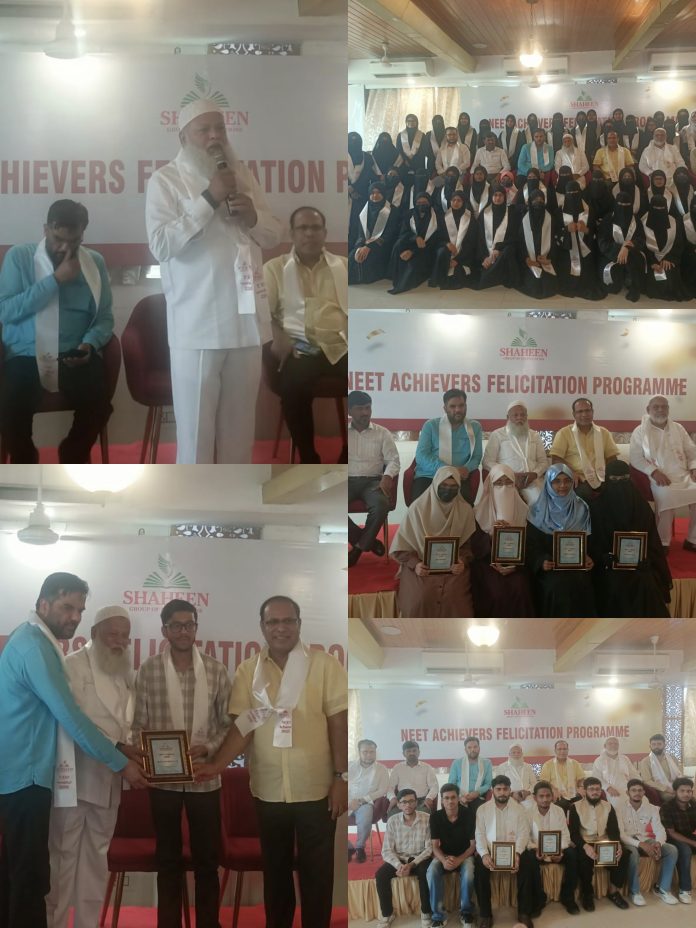
Shaheen Academy organised a grand event to honour its NEET achievers. The ceremony celebrated the students’ success and dedication.
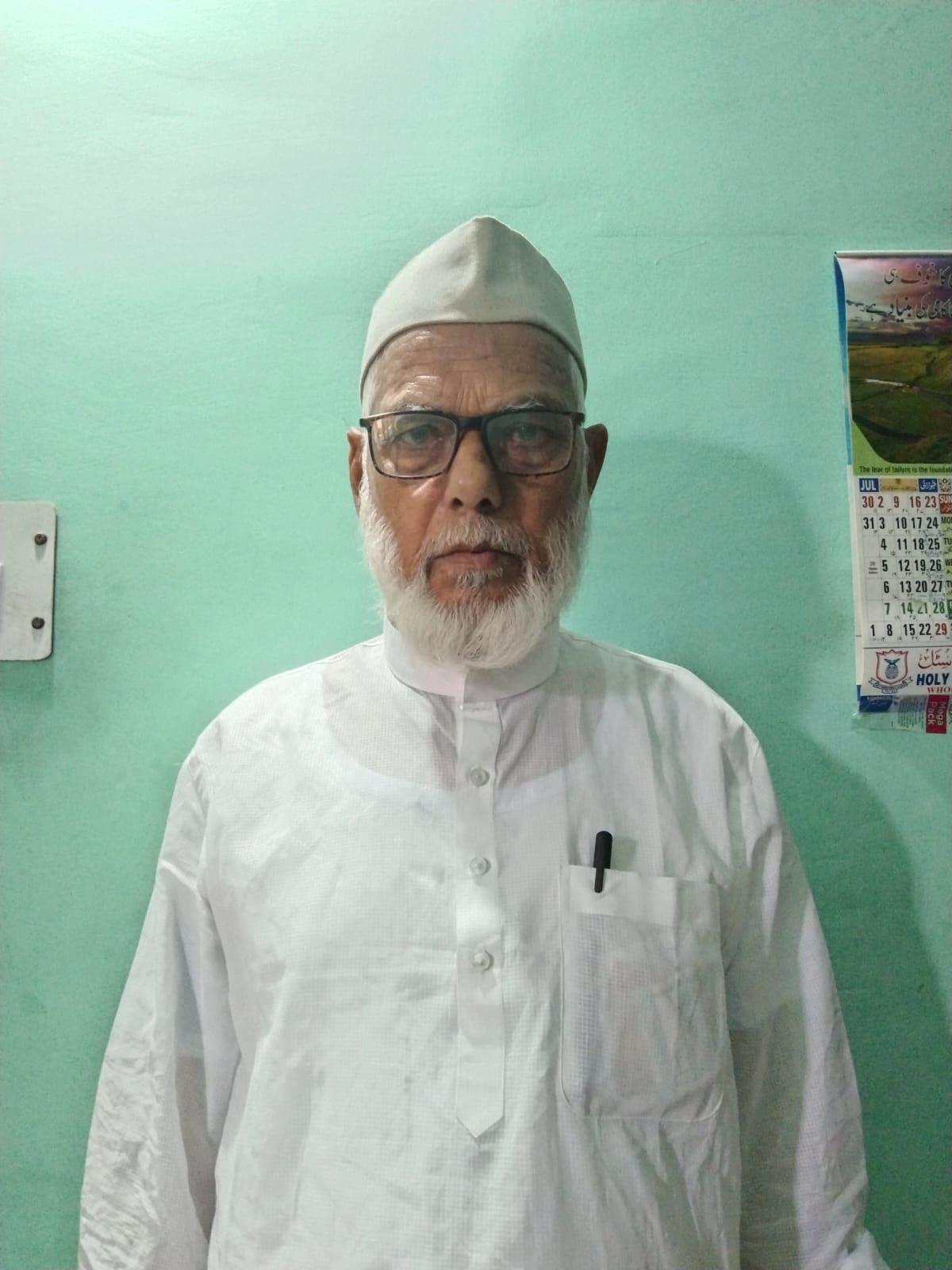
The event was attended by educationists and community leaders. Among them was Abdul Qadeer, founder and chairman of Shaheen Group of Institutions.
In his keynote speech, Abdul Qadeer praised students and faculty. He stressed that education should not just be for earning. “Education can uplift society and spark social change,” he said. “It plays a key role in national growth and development.”
He reaffirmed Shaheen Academy’s mission: to offer value-based, holistic education. He said students must grow into responsible citizens and future leaders.
Abdul Qadeer urged students to look beyond personal success. He asked them to engage in social service and nation-building.
He also made a heartfelt appeal against lavish weddings. “Don’t spend lakhs on grand celebrations,” he said. “Use that money to educate your children, neighbours, and the poor.”
He called education the true celebration. “Transforming lives through education is the real joy,” he added.
He also underlined the need for wider educational outreach. “Five or six institutions are not enough,” he said. “We need 5,000 organisations working for value-based education. Shaheen must have 500 branches to transform society.”
Kaleemul Hafeez, Chairman of Al-Hafeez Educational Academy, also spoke. He compared Abdul Qadeer’s work to that of Sir Syed Ahmad Khan. “Abdul Qadeer Sahib is continuing that legacy to educate a new generation,” he said.
Noor Nawaz, founder of The Hind Guru Academy, echoed the same spirit. He reminded students of the idea of Rabbul Alamin—Lord of all worlds. “Be ambassadors of Prophet Muhammad ﷺ,” he said. “Show compassion, honesty, and service in all you do.”
The event ended with a special honour for teachers and staff of Shaheen Academy. Their hard work was praised as a key part of the students’ success.
The celebration not only recognised academic achievement but also highlighted education’s role in building a better society.
source: http://www.radiancenews.com / Radiance News / Home> Latest News> Report / by Radiance News Bureau / June 28th, 2025
The historic achievement brings pride to his family, the state, and the nation; it proves that dedication, family support, and strong values can lead to exceptional results.

New Delhi / Guwahati :

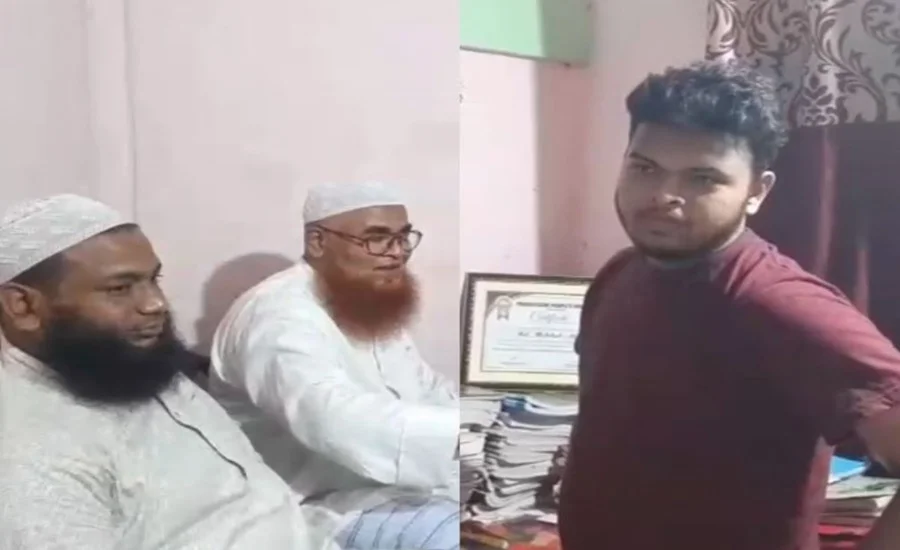
In a proud moment for Assam and the entire Muslim community, a young boy from the South Village in Guwahati has written his name in the history books. Musa Kaleem, 18, has emerged as the state topper in the National Eligibility cum Entrance Test (NEET-UG) 2025, leaving behind over 42,000 aspirants from Assam. With the 99.97th percentile, Musa’s achievement is not just academic excellence — it is a powerful reminder of the potential of the Muslim youth.

Out of 20.08 lakh students who appeared for the NEET UG exam nationwide, 12.36 lakh students cleared the cut. Among them, Musa stood out in Assam, becoming the number one in the state. Nationally, the top rank went to Mahesh Keshwani of Hanumangarh, Rajasthan. While Mahesh made the nation proud, Musa brought immense joy and hope to Assam by becoming the highest scorer in the state.

Musa’s story begins in Sri Bhumi, Assam, where he was born. His family later moved to South Village in Guwahati. His father, Anwar Hussain, once worked as an engineer in Sri Bhumi. Now, he runs a small cosmetic shop in Guwahati. His mother, Rehana Begum, is a homemaker. Coming from a modest background, Musa’s success becomes even more meaningful.

Speaking to Salam TV, Musa said, “I am very happy. I give all the credit to my parents. Their support never stopped. They stood by me in every moment.”

Musa prepared for the exam at Allen Coaching Institute in Guwahati. Known for his quiet focus and regular study schedule, his teachers describe him as a student who never wasted time. He avoided distractions and remained deeply committed to his goal of becoming a doctor.

At a time when many from the Muslim community face social bias and economic challenges, Musa’s result shines like a ray of hope. His determination sends a clear message: success is possible through effort and discipline, even without wealth or privilege.

Speaking to reporters, Musa said, “My dream is to serve the country. I don’t just want to become a doctor. I want to become someone who helps the poor and stands with those who have no support.”

His words reflect the values many Indian Muslims hold dear—serving humanity, staying humble, and always standing for justice.

Musa’s father, Anwar Hussain, expressed deep happiness over his son’s success. With teary eyes and a proud smile, he said, “I never asked him to run after money. I always told him to become a good human being first. Only then will you become a good doctor.”

His advice is touching. In a world where success is often measured in numbers and bank balances, Anwar Hussain’s simple yet strong message brings back the true meaning of education—character and compassion.

News of Musa’s achievement quickly spread across Assam, especially among the Muslim community. Social media platforms and local mosques were abuzz with congratulations and prayers. From imams to teachers, everyone expressed pride.

Maulana Naseeruddin, an Islamic scholar from Guwahati, said, “This boy has shown what true Islam teaches us—to seek knowledge and to serve mankind. May Allah bless him and make him a source of pride for the community.”

In a time when Muslims are often portrayed unfairly in the media, stories like Musa’s are a reminder of the silent majority who quietly focus on education, ethics, and contribution to the nation.

Local leaders and education officials have praised Musa for his outstanding performance. Assam’s education minister, during a press conference, said, “We congratulate Musa Kaleem. This is a big moment for Assam. He is an inspiration for students across communities and regions.”

Although no government reward has been announced yet, many believe that a talent like Musa deserves both recognition and support for future studies.

For decades, Muslims in India have faced multiple challenges in the field of education—poor access to quality schools, financial constraints, and social discrimination. Yet, despite these odds, young Muslim boys and girls continue to prove their strength.

Educational researcher Dr Sameera Ahmad pointed out, “Musa’s result is part of a quiet revolution. More and more Muslim families are investing in their children’s education, even when they don’t have enough for themselves. This is courage, not just sacrifice.”

Musa Kaleem’s story stands as an answer to those who stereotype Indian Muslims as backward or uninterested in studies. It shows that when given a fair chance, they can lead in merit-based competitions like NEET UG.

Musa plans to join a top medical college to continue his studies. His dream is to work in rural and poor areas where healthcare is still far from reach. He believes that doctors have a duty to serve beyond city hospitals and five-star clinics.

“I want to go where people have no help,” he said. “A real doctor should always be available for the needy.”

This thinking, especially from such a young man, shows maturity and compassion, traits India needs from its future doctors.

Musa Kaleem’s story is not just about topping an exam. It’s a story of dreams, belief, and values. It reminds the country that Indian Muslims are not behind. They are rising, despite hurdles, with dignity and dedication.

The achievement also calls upon society to treat Muslim students fairly, to support their education, and to highlight their success, not just their failures.

As Musa moves forward in his journey to become a doctor, he carries with him the hopes of many—of parents who never gave up, of teachers who believed, and of a community that wants nothing more than peace, respect, and a better future for its children.

“Success will come and go,” Musa said quietly. “But being a good human being is forever.”

source: http://www.clarionindia.net / Clarion India / Home> Indian Muslims / by Mohammad Bin Ismail / June 17th, 2025
The Sarojini Naidu Centre for Women’s Studies in collaboration with the Dr Zakir Hussain Institute of Islamic Studies, Jamia Millia Islamia, hosted a special extension Lecture titled, “Unpacking the Myths: Separating Fact from Fiction about Women in Islam” on April 24, 2025, at Mir Anis Hall of Jamia Millia Islamia.
The lecture was delivered by noted British Islamic Scholar Dr Shiekh Mohammad Akram Nadwi. Formerly the Dean of Cambridge Islamic College and currently the Principal of the Al-Salam Institute and famous for his multi volume book Al-Muhaddithat, which documents female scholars in Islamic history, he is a leading authority on Islamic jurisprudence and Hadith, inspiring global audiences with his teachings.
The event opened with a soulful recitation of the Holy Quran, followed by a warm welcome from the honorary director of SNCWS Prof Nishat Zaidi.
The introduction of the speaker was given by Prof. Habibullah Khan, Honorary Director of the Dr Zakir Hussain Institute of Islamic Studies. Prof Habibullah praised Dr Nadwi’s globally recognised contributions to Islamic scholarship, particularly his work on gender and Hadith.
Dr Nadwi’s lecture captivated the large audience present in the hall as the urging open dialogue to dismantle stereotypes about women in Islam.
Referencing his monumental 40-volume work, Al-Muhaddi that: the Women Scholars of Islam that chronicles the contributions of female Islamic scholars.
The speaker presented a compelling case for re-evaluating historical narratives, generalisations, myths and patriarchal notions through rigorous scholarship and proper understanding of Islam. His call for mutual respect and understanding across cultures sparked vibrant discussions among attendees, reinforcing the lecture’s relevance in today’s diverse world.
The lecture was followed by the presidential remarks by the Vice-Chancellor, Prof. MazharAsif, who emphasised Jamia’s commitment to inclusive discourse and highlighted the pivotal role of women in shaping Muslim society.
He urged audience to practice equality of women in their lives and shape a society that respects women.
Among the attendees were Prof Mohammad Muslim Khan (Dean, Faculty of Social Sciences), Prof Iqtidar Khan (Dean, Faculty of Humanities and Languages),Prof Kausar Mazhari , faculties and staff of SNCWS and Dr Zakir Hussain Institute of Islamic studies besides teachers, researchers and students from across the faculties of the Social Sciences, Humanities and Languages and from various Centers of the University.
Dr Tarannum Siddiqui of the Sarojini Naidu Centre for Women’s Studies convened and moderated the program. Dedicated volunteers, including Vaibhav, Zoyba, Gargi Mishra, Shubhangi, RaiyahQamar, and Fatima Zohra from MA Gender Studies of SNCWS ensured a seamless experience.
“Dr Nadwi’s lecture is a clarion call to challenge misconceptions and embrace informed dialogue,” said Prof Nishat Zaidi while thanking the speaker. She further said: “His scholarship inspires us to bridge tradition and modernity in pursuit of equity and understanding.”
The session concluded with pertinent Q&A session in which students satisfied their curiosities by asking relevant questions to the speaker.
A formal vote of thanks was presented by Gargi Mishra, student of MA Gender studies. Students and particularly girls who attended the talk were well impressed to know about the historical contributions of women in shaping society and their contributions in nation building.
source: http://www.theokhlatimes.com / The Okhla Times / Home> JMI-EDU / by theokhlatimes / April 29th, 2025
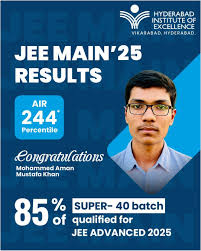
The Hyderabad Institute of Excellence (HIE) has once again proven its academic prowess with an impressive performance in the IIT-JEE Mains 2025. Around 85% of the students from the institute’s prestigious ‘Super 40’ batch have qualified for the IIT-JEE Advanced 2025, reported the Siasat.
Among the top achievers, Mohammed Aman Mustafa Khan stood out by securing an outstanding 99.831 percentile, earning him an All India Rank (AIR) of 244 in the IIT-JEE Mains 2025.
The HIE, a residential junior college known for its 100% success rate in intermediate examinations, offers a focused academic environment for students aiming for careers in engineering, medicine, or defense through the NDA. Situated on a sprawling 115-acre campus, the institute boasts world-class facilities including international-standard sports infrastructure, a gym, swimming pool, horse riding tracks, and more.
The remarkable results this year are a testament to the institute’s dedicated mentoring and comprehensive academic strategy.
source: http://www.radiancenews.com / Radiance News / Home> Latest News> Report / by Radiance News Bureau (headline edited) / April 20th, 2025
31 Muslims figure in the list of 791 recommended candidates.
New Delhi:
A girl student topped the list of the successful Muslim UPSC candidates when the results were announced yesterday. Of the total 791 candidates recommended by the commission in its list for various government posts, 31 are Muslims and the girl student topping them in the list is among the top 100 Union Public Service Commission (UPSC) successful candidates.
According to the press release issued by Union Public Service Commission (UPSC), Sufiyah Faruqui ranking 20 in the list of 791 candidates is among the list of 100 toppers for which the results were announced by the Union Public Service Commission (UPSC) yesterday. Sufiyah is on top in the list of 31 Muslim candidates who figure in the list released by the commission that includes three other Muslim girls besides her.
While Sarfaraz Ahmad ranking 26, Shaid Iqbal ranking 51,Tamboli Ayyaz ranking 75 and Sadre Alam ranking 90 are other Muslims who are in the top 100 list, Koya Praveen ranking 120, Ayesha Rania ranking 139 and Sabiha Rizvi ranking 303 are the other three Muslim girls who stand in the list of 791 successful candidates.
The results were announced yesterday based on the written part of Civil Services (Main) Examination, 2008 held by the Union Public Service Commission (UPSC) in October-November, 2008 and the interviews for Personality Test held in March-April, 2009.
A total of 791 candidates have been recommended by the commission for appointment including 364 General (including 13 Physically Challenged candidates), 236 Other Backward Classes (including 07 Physically Challenged candidates), 130 Scheduled Castes and 61 Scheduled Tribes candidates.
Owing to the poor representation of Muslims in the Union Public Service sector, the Muslim Institutions like Aligarh Muslim University (AMU), Jamia Hamdard, Delhi and Jamia Millia Islamia, Delhi are running special coaching classes for UPSC students since past three years.
“The result shows that Muslim representation for this year’s UPSC exams stands at 3.92%, a better progress compared to 3.6% in 2006 and 3.1% in 2007”, Omair Anas of Center for West Asian Studies, Jawaharlal Nehru University said to ummid.com adding, “However the achievement is still not at par and the institutions engaged in coaching the Muslim students for UPSC exams should pay special attention to contribute substantially in administrative services.”
The recommended candidates would be eligible for various coveted government posts including Indian Administrative Service (IAS), Indian Foreign Service (IFS), Indian Police Service (IPS) and Central Services-Group ‘A’ and Group ‘B’.
Appointment to the various services will be made according to the number of vacancies available with due consideration to the provisions contained in Rules 2 and 19 of the Rules of the Examination and subject to the final decision of the Supreme Court / High Court / C.A.Ts. on the S.L.Ps. / R.As/ W.Ps. O.As. pending therein.
The number of vacancies reported by the Government for the Indian Administrative Service is 120 (60 General, 33 Other Backward Classes, 17 Scheduled Castes and 10 Scheduled Tribes); for the Indian Foreign Service is 26 (13 General, 08 Other Backward Classes, 04 Scheduled Castes and 01 Scheduled Tribe); for the Indian Police Service is 130 (65 General, 36 Other Backward Classes, 20 Scheduled Castes and 09 Scheduled Tribes); for the Central Services Group ‘A’ is 546 (282 General, 146 Other Backward Classes, 81 Scheduled Castes and 37 Scheduled Tribes) and for Central Services Group ‘B’ is 59 ( 34 General, 13 Other Backward Classes, 08 Scheduled Castes and 04 Scheduled Tribes). This includes 20 vacancies for Physically Challenged candidates.
List of the 31 Muslim Candidates with their Ranks:
20: 002666: SUFIYAH FARUQUI
26: 010669: SARFARAZ AHMAD
51: 192126: SHAID IQBAL
75: 079564: TAMBOLI AYYAJ FAKIRBHAI
90: 001339: SADRE ALAM
120 003004 KOYA PRAVEEN
128: 024509: MASOOM ALI SARWAR
134: 003602: IMTIAZ ISMAIL PARRAY
139: 131443: AYESHA RANI A
169: 056251: ZIAUL HAQUE
244: 114573: ASHIQUZZAMAN
257: 043392: BASIR AHMED
303: 004357: SABIHA RIZVI
304: 010883: ANEES AHMAD ANSARI
353:008606 PATTAN IMTIYAZ KHAN
382: 010383: MASHHOOD UR REHMAN FAROOQUI
393: 104282: SHAHNAWAZ UL RAHMAN
398: 039145:0020: CHAN BASHA M
460: 102384: KAZI SUHAIL ANEESAHMED
472: 147935: T K SHIBU
499: 102579: TARIQ MABOOD
502: 051643: GEELANI BASHA K S M
523: 290928: R GULZAR BEGUM
540: 056907: MOHD SHAHID ALAM
546: 108290: MOHD FAIZAN NAYYAR
582: 303331: MAHFOOZUR REHMAN
595: 004523: MD SADIQUE ALAM
603: 002722: MD SALIK PARWAIZ
606: 018478: MD FAIZUL HAQUE
619: 079717: MOHAMMED YUSUF QURESHI
664: 055051: ABDUL HAKEEM M
source: http://www.ummid.com / Ummid.com / Home / by Staff Reporter / May 05th, 2009
A joint study conducted by a Delhi-based think tank – Centre for Study and Research (CSR) and NOUS Network Private Limited – has busted the myth that Muslim-run institutions cater to Muslims only.
The study titled “A Survey of Muslim-managed Public and Private Institutions of Higher Education in India” reveals that Hindu students outnumber Muslim students in higher education in Muslim-managed institutions across the country.
The percentage of Hindus, according to the report, is about 55 percent in these institutions against 42 percent of Muslim students.
However, the report is silent about the reasons behind Hindu students exceeding their Muslim counterparts in Muslim-run institutions.
But the higher number of Hindu students is an indicator that the Muslim institutions do not discriminate against non-Muslims and are open to all religious communities against the prevailing misconception that Muslim institutions serve only Muslim students.
This is also a proof that the standard of education in Muslim-run institutions are at par with institutions run by other communities. Had the quality of education in Muslim institutions been poor, Hindu students would certainly have avoided it and not enrolled en mass as is happening currently.
The study provides empirical evidence against the prevailing false notion among certain sections of society regarding Muslim-managed educational institutions.
The report reveals a surprising trend: in Muslim-run universities, Hindus constitute the majority of students (52.7%), while Muslims make up 42.1%. This pattern holds true for colleges managed by the Muslim minority as well, where Hindus are the largest student group (55.1%), followed by Muslims (42.1%) and other minority groups (2.8%).
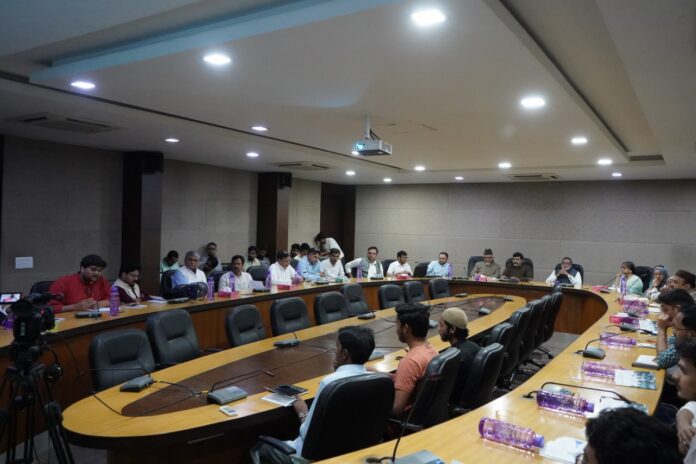
The findings of the report were discussed at a roundtable event attended by educators, policymakers and stakeholders. They applauded the report as a valuable resource for addressing existing challenges faced by the Muslim community in the realm of higher education.
Concerns were also expressed over the grim situation of the community, particularly their meagre share in higher education and their sharp dropout rates.
CSR director Dr. Mohammed Rizwan presented the vision of CSR, which aims to evolve a purposeful, holistic, and value-based knowledge ecosystem. He asserted that the report is a “myth-buster” that provides empirical evidence against the prevailing misinformation among certain sections of society.
“To our knowledge, no such study has been conducted to date, and there is currently no data available on the number of institutions for higher education affiliated with the Muslim minority group, while this research represents the first attempt of its kind to address this critical gap,” Dr. Rizwan stated.
Elaborating that despite consistent efforts from the community, empirical evidence suggests a need for even more concrete efforts, Dr. Rizwan said that those efforts should particularly focus on areas like gross enrolment in higher education, decreasing the dropout rate, and other aspects of higher education.
Dr. Rizwan believes that this report sheds light on the challenges and opportunities within higher education by meticulously analyzing various facets. These facets include the number and types of educational institutions, the gender ratio within them, their affiliation status, their academic productivity, their NAAC accreditation standing, student demographics, and more.
“The report’s findings underscore the importance of recognizing the unique needs of the Muslim minority in higher education and advocating for targeted interventions to address those needs,” he added.
Speaking at the roundtable, Jamaat-e-Islami Hind (JIH) Vice President Prof. Salim Engineer commended the CSR and NOUS team for conducting such an important study. However, he cautioned that the findings regarding the community’s education situation are not encouraging.
Prof. Salim highlighted that the study serves as a roadmap for improvement, identifying areas where the community needs to focus its efforts while acknowledging its achievements.
Emphasizing the need to encourage the community, not discourage it, by recognizing its accomplishments and contributions in the past 75 years of independence, he pointed out the community’s resilience in the face of continued communal riots and a challenging post-partition atmosphere.
Criticizing the apathy of successive governments towards the Muslim minority, Prof. Salim lamented that numerous studies, including the noteworthy Sachar Committee report, have been conducted on the community’s socio-economic and educational status. However, these reports have been largely debated without any significant implementation of their recommendations.
Acknowledging the community’s progress in education despite these hurdles and the negative attitudes of some governments, the JIH leader commended, the establishment of numerous educational institutions and the achievements of students in higher education and civil services.
Stressing that the country’s progress hinges on the advancement of the Muslim minority, Prof. Salim urged the community to avoid self-blame and instead celebrate its achievements in the face of adversity. He concluded by referencing the Quran, stating that the Muslim community is meant to serve others.
Ali Javed, CEO of NOUS Network Pvt. Ltd., a Delhi-based think tank and media house, asserted that this report stands out as a truly unique attempt, as there is currently no existing comprehensive overview providing insights into the status of higher education in institutions catering to Muslims.
Ali Javed expressed the hope that this report would be an indispensable resource for academics, policymakers, and anyone interested in educational advancement. He believed it would significantly contribute to our understanding of Muslim-affiliated higher education institutions, paving the way for further discussions and initiatives in this area.
Emphasizing the importance of collective action, NOUS CEO explained that the purpose of convening this roundtable of experts, educators, academics, and stakeholders is to collaborate and find solutions to the community’s problems. He stressed that joint efforts are necessary for progress.
Expressing concern about the “extreme deprivation” faced by the community, not just in education but across various indicators, Javed proposed a multi-pronged approach, including data collection through surveys in Muslim-dominated areas, gathering disaggregated data, and developing the community’s own policy documents for negotiation with policymakers. He also emphasized the need for an evidence-based strategy for societal reform and infrastructure development.
Highlighting the study’s findings, researcher Abid Faheem, who played a key role in compiling the data, pointed out that Muslims constitute over 14% of India’s population. However, their representation in higher education remains low. According to the latest All India Survey of Higher Education (AISHE-2021-22), only 4.8% of students enrolled in higher education are Muslims. This is even lower than the enrolment rates for Scheduled Castes (SC) and Scheduled Tribes (ST), which stand at 15.3% and 6.3% respectively. SCs and STs comprise 16.6% and 8.6% of the total population, respectively.
Faheem used a PPT to show that the gross enrolment ratio for Muslim students in colleges affiliated with Muslim institutions is 1.23. This ratio is significantly lower in universities, at just 0.23. The combined gross enrolment ratio for Muslim students is 1.46. However, the situation is even worse in institutions of national importance like IITs, IIITs, IISERs, NITs, and IIMs, where only 1.72% of students are Muslim.
Faheem expressed concern that despite the Sachar Committee report on the socio-economic and educational status of the Muslim community released 17 years ago, there has not been much progress. He noted that in 2006, when the Sachar report was published, Muslim enrolment in higher education was 3.6%. While efforts have been made to improve this ratio, the first AISHE report in 2012-13 showed only a 0.6% increase after six years. A decade later, the AISHE report indicated another modest increase of 0.6%. In contrast, other disadvantaged groups like SCs and STs have made significant progress. Their enrolment rates have risen from 2.4% in 2006 to 15.3% and 6.3% in 2021-22, respectively.
However, the enrolment rates for SCs and STs have shown a much sharper rise compared to Muslims. Their share in higher education has climbed from a combined 2.4% in 2006 to 15.3% for SCs and 6.3% for STs in 2021-22.
It’s important to note that the Sachar report initially reported a combined enrolment rate of 2.4% for SCs and STs.
Speaking on the occasion, Prof. Sanghmitra, Chairperson of the Centre for Social Medicine and Community Health at Jawaharlal Nehru University, appreciated the CSR and Nous Networks team. She also appreciated their work in clarifying some widely held misconceptions about the Muslim community.
Prof. Sanghmitra emphasized the importance of inclusivity in policymaking. However, she expressed concern about the gap between policy and reality. She pointed out that the Sachar Committee report had already documented the disadvantaged state of Muslims and provided evidence. She further noted that the Amitabh Kundu Committee report, which followed the Sachar Committee report and received less attention, showed minimal progress in the community’s status despite the evidence and recommendations presented earlier.
Prof. Sanghmitra also recommended collecting data on the Muslim community at the secondary level in addition to the primary level.
Dr. Kamal Farooqi, spokesperson for the AIMPLB and former chairman of the Delhi Minority Commission, emphasized the importance of shifting the Muslim community’s fundamental attitude and mindset towards education.
Prof. Sadia Halima, an economics professor at Jamia Millia Islamia University, asserted for a shift in focus from mere literacy rates, ratio, enrolment figures and the number of students or institutions to prioritizing knowledge and quality education.
Prof. Majid Jameel, an electrical engineering professor at Jamia Millia Islamia University, commended the CSR-NOUS Network for the study. He shared his experiences motivating students in his hometown Saharanpur, UP, to pursue higher education, while also expressing concern about the high dropout rate within the community.
Former civil servant Akhtar Mahboob Syed stressed the importance of data collection and studies to understand the socio-economic state of the Muslim community. He pointed out that while the Sachar Committee report receives much attention, the Amitabh Kundu Committee report and Professor Mattu reports are less discussed.
Having worked with various government departments, he questioned the impact of existing schemes aimed at improving education for minorities, such as pre and post matric scholarships and the Maulana Azad Foundation and Ministry of Minority affairs. He argued that the community itself needs to gather data on the effectiveness of these initiatives, as the government is unlikely to do so. In addition to data collection, he suggested addressing the “fear complex” within the community.
Mr. Nizamuddin Shaikh of the Institute of Objective Studies and the All India Milli Council highlighted three key points: Islamization of knowledge, changing the community’s attitude towards education, and establishing more educational institutions.
The Millat Time editor Shams Tabrez Qasmi also spoke on the occasion. In the open session, various noted participants expressed their views on the study.
The report illuminates the number and growth trajectory of Muslim-affiliated institutions, along with their demographic characteristics. It underscores the pressing need for policymakers to address the under-representation of Muslims in higher education. The report also provides valuable insights into the educational quality, programme offerings, and research output of these institutions.
Other Key Results of the Study:
Universities:
Out of the total 1113 universities in India as per AISHE 2020-21 data, 23 universities belong to Muslim Minority. The share of Muslim managed universities is just 2.1%.
2. Uttar Pradesh has the highest number of universities, followed by Karnataka.
3. Of the 23 Muslim universities, the majority (43.5%) are privately managed, followed by public state universities (26.1%), deemed private universities (13%), and central universities (13%).
4. Around 69.9% of Muslim universities are located in urban areas.
5. Out of the total 97,928 students enrolled in the academic year 2021-22, 42.1% are Muslims, 52.7% are Hindus, and 5.2% belong to Other Minority groups.
6. Regarding Muslim students, there were 26,039 (63.09%) male students and 15,236 (36.91%) female students enrolled in Higher Education.
7. Among the 41,275 Muslim students enrolled, less than 1% represent Scheduled
8. Tribes, 34% were belong to Other Backward Classes, 42.8% were from the Unreserved Category, and the remaining 16.4% are from the Economically Weaker Sections (EWS).
COLLEGES:
1. Out of the total 43,796 colleges in India as per AISHE 2020-21 data, 1,155 colleges are managed by Muslim minority community. It means that the share of Muslim managed colleges is just 2.6%.
2. Of these 1,155 colleges, 141 (12.2%) are technical colleges registered with the All India Council for Technical Education.
3. Despite making up 73.4% of all minority groups, Muslim minority communities only have a 16.6% share in technical colleges. In contrast, other minority groups, comprising 26.6% of the population, hold an 83.4% share in technical colleges.
4. 6.4% of Muslim colleges in India are exclusively for girls.
5. The top 10 states in terms of the number of colleges in India are Kerala, Uttar Pradesh, Maharashtra, Karnataka, Telangana, Tamil Nadu, Andhra Pradesh, West Bengal, Bihar, and Jammu & Kashmir. These states account for 90.47% of the total colleges in the country.
6. Of the 1,155 Muslim minority colleges, 85.5% are private (unaided), 10.6% are private (aided), and 3.9% are government colleges.
7. Kerala has 24.9 colleges per lakh population while UP has 4.9 colleges and West Bengal has a mere 1.8 colleges per lakh population. The national average of colleges per lakh population stands at 6.4%.
8. Of the 1155 Muslim minority colleges, 85.5% are private (unaided), 10.6% are private (aided), and 3.9% are government colleges.
9. About 57.8% of Muslim minority colleges are located in rural areas.
10. The majority of colleges (93.16%) offer Undergraduate level programs, while only 6.32% offer PhD level programs.
11. Kerala has the highest number of colleges offering PhD programs, followed by Tamil Nadu and Maharashtra.
12. Around 51% of colleges only provide undergraduate level programmes.
13. Out of the total 524,441 students enrolled in the academic year 2021-22, 42.1% are Muslims, 55.1% are Hindus, and 2.8% belong to Other Minority groups.
14. In terms of Muslim students, there were 104,163 (47.18%) male students and 116,622 (52.82%) female students enrolled in Higher Education.
15. Among the 220,785 Muslim students enrolled, less than 1% represent Scheduled Tribes, 48.1% belong to Other Backward Classes, 50.7%
16. come from the Unreserved Category, and the remaining 0.9% are from the Economically Weaker Sections (EWS).
17. 96.4% of colleges did not participate in the NIRF ranking of 2023.
18. None of the colleges secured a position in the top 100 in the NIRF 2023 college rankings.
source: http://www.indiatomorrow.net / India Tomorrow / Home> Education / by Anwarulhaq Baig / May 15th, 2024
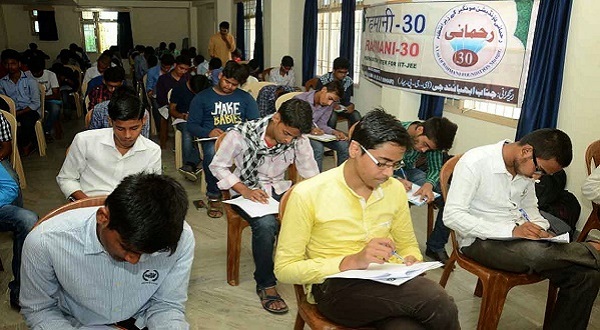
In a groundbreaking achievement, Rahmani30 celebrates a historic milestone as 176 out of 205 students successfully pass the JEE Mains 2024, qualifying them for the prestigious JEE Advanced examination.
The program, known for its excellence in preparing students for challenging tests, has seen its success rate soar to approximately 86% this year.
Despite the various challenges that have necessitated adaptive strategies in teaching and student support, our success rate in the JEE Mains has increased over years to approx 86% this year. Among the successful students, 9 scored a 99 percentile, while 13 scored 98 percentile, 19 scored 97 percentile, 7 scored a 96 percentile, and 17 scored a 95 percentile. Overall, 128 out of the 176 successful students scored above the 90 percentile. Alhamdulillah. The All India Rank (Category) was 894 and the General India Rank was 3247. The success rate of Rahmani 30 students is 86% .
Maulana Mohammad Wali Rahmani envisioned Rahmani30 as a bridge to higher education for underprivileged meritorious Muslim students, a vision that continues today. Unlike institutes charging exorbitant fees (₹2 – ₹7 lakhs), Rahmani30 offers completely free coaching for all, regardless of financial background. Initially, with the support of Hazrat Maulana RA himself, Rahmani30 provided full scholarships including living expenses. However, as the program expanded regionally and in numbers, new donors were accommodated, and a temporary financial model was made. The model shifted to free coaching, with financially capable students to contribute towards non-educational expenses (food and lodging). Importantly, the Rahmani30 further supported students facing financial hardship, ensuring no one was ever denied a class or a meal due to unpaid committed contribution towards non-educational expenses such as lodging & boarding as per new financial model. This unwavering commitment to high quality education accessibility has empowered countless students, fulfilling the legacy of Maulana Mohammad Wali Rahmani.
Hazrat Maulana Ahmad Wali Faisal Rahmani , the patron of Rahmani30 and Ameer E Shariat for Bihar, Odisha, Jharkhand, and parts of Bengal attributes this success to divine grace. He emphasized that such historic achievements could only be realized with Allah (SWT) mercy and guidance.
Looking to the future, Hazrat Maulana Ahmad Wali Faisal Rahmani sb is optimistic about doubling this number. In line with this goal, Mr. Fahad Rahmani, CEO of Rahmani30, announced new initiatives to provide academic guidance starting from classes 9 and 10. This early intervention aims to strengthen students’ foundational knowledge and help them make informed choices about their educational pathways in fields such as IIT, NEET, Chartered Accountancy, Company Secretary, NDA, and CLAT. Selection process for class 9th & 10th is in progress.
Rahmani30 has expanded its reach beyond Patna, operating additionally at Khuldabad (Maharashtra), Jehanabad (Bihar), Hyderabad (Telangana), UP (Aligarh), and Bangalore (Karnataka), which also cater to NRI students from various regions.
On this momentous occasion, Mr. Fahad Rahmani expressed his gratitude to the educators, team members, supporters, and the families of the students. He reaffirmed his commitment to advancing the visionary goals set by the founder of Rahmani30, Hazrat Maulana Mohammad Wali Rahmani sb. RA, and called on the community to support this transformative educational mission.
source: http://www.muslimmirror.com / Muslim Mirror / Home> Education> Indian Muslim> Positive Story / by Muslim Mirror Desk / April 30th, 2024
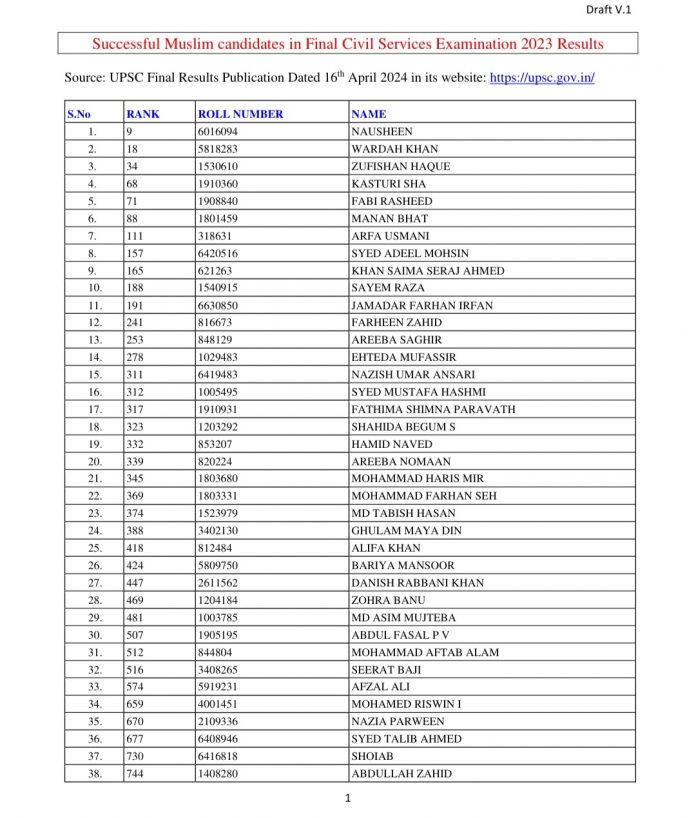
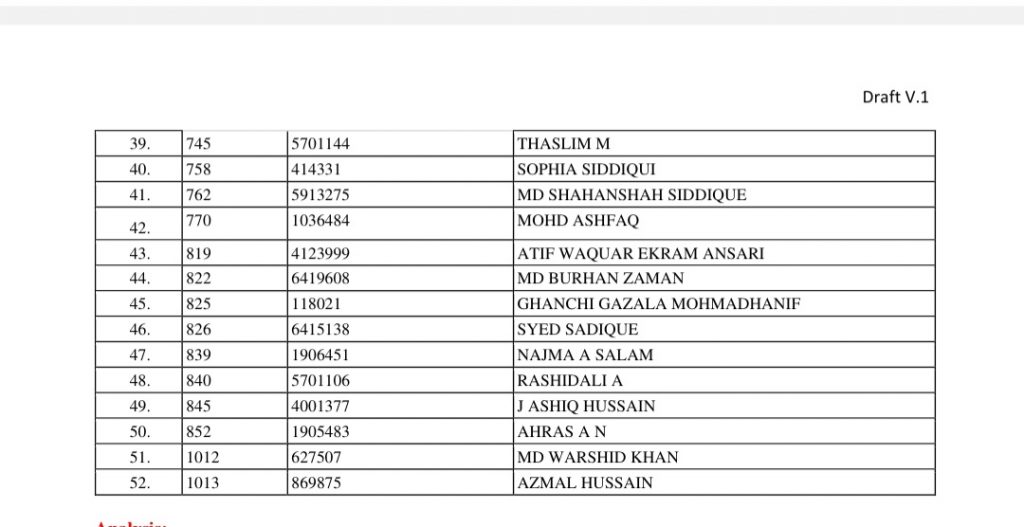
More than 50 Muslims figured in the UPSC Civil Services Merit List 2023.
More than 50 Muslims figured in the UPSC Civil Services Merit List 2023 released today, with five of them securing different ranks and positions in the list of top 100.
Of the total 51 Muslims who figured in the Civil Services Merit List 2023 released today, five – Ruhani, Nausheen, Wardah Khan, Zufishan Haque and Fabi Rasheed are in the Top 100 list.
A total of 1,016 candidates cleared the examination and have been recommended for different central government services, the UPSC said.
The Civil Services Exam is conducted annually in three stages — preliminary, main and interview — by the UPSC to select officers of Indian Administrative Service (IAS), Indian Foreign Service (IFS) and Indian Police Service (IPS), among others.
List of sucessful Muslims candidates who cracked UPSC 2023
source: http://www.muslimmirror.com / Muslim Mirror / Home> Indian Muslim> Positive Story / by Muslim Mirror Staff / April 16th, 2024
I was in grade 7 or 8 when Wasi Ahmed Shamsi sahab joined B D Y High School as an Urdu and Persian teacher. Tucked away on the bank of a pond and surrounded by cultivable land and greenery, the school in rural Darbhanga was like a sanctuary, a gurukul. Away from the din and bustle of a populated location, the school was emotionally attached to people in neighbouring villages though it kept a physical distance from them.
Though the tiled roof leaked in monsoon and wall plaster had peeled off at places, giving the whole structure an impoverished look, we regarded the school as a boon. It was a privilege to be at this school which had earned a reputation for discipline and churning out good students.
The school nurtured dreams and helped shape many destinies. It was in that positive ecosystem that Wasi sahab joined the team of a dozen or so teachers. Clad in white kurta-pajama with the skull cap covering his head, he did not wear a long beard. Like his appearance, Wasi sahab was not very orthodox in thinking too. Since he was educated at Madrassa Shamsul Hoda, Patna, one of the oldest Islamic seminaries of Bihar, he had imbibed many values which orthodox maulvis would disapprove of.
Since my father and Wasi sahab were colleagues though they taught different subjects, they had a cordial relationship and they shared a lot of things, especially about progress of their children.
Wasi sahab had spent years in urban set up before he took transfer to a school close to his village. He wanted to work for his people and therefore he got transferred from a school in Madhubani.
He was fond of reading newspapers and magazines and had even set up a library at his home. The fact that his nephew Abdul Bari Siddiqui, a senior member of Lalu Prasad Yadav’s RJD and a former minister had also built his house in the same mohalla where Wasi sahab lived enhanced Wasi Sahab’s stature. Many of those who visited Siddiqui sahab invariably visited Wasi sahab too. After all, he was a reputed teacher, a wise man, a man of letters, a concerned citizen.
Wasi sahab valued journalism and would “console” my father whenever he despaired at my choice of career as a journalist. If I learned my Ghalib and Iqbal a little early, credit goes to this good teacher who made his lectures interesting. He would ask us to read books beyond what was prescribed in the textbooks. Since I often saw him reading–books, magazines, newspapers–I unknowingly emulated him. He helped create in me a hobby for reading. He was happy that I chose to become a journalist.
After retirement, Wasi sahab undertook a herculean task of writing a book on people of his ilaqa (locality) who had made a mark in life. One summer evening I visited his village home. Clad in just lungi and gunjee (vest), with a ceiling fan whirring overhead, I saw this then septuagenarian retired teacher writing furiously on his pad. Surrounded by books and papers, he was figure of a wordsmith who thought he had little time left on this earth. Age and health issues, especially diabetes, made him restless. He wanted to complete the project he had embarked upon as soon as possible. He wanted to finish the book before the final call came.
Our telephonic discussions were long. I had encouraged him to complete the project before it was too late. Concerned about his health, I would tell him not to exert himself too much as he would fall ill often. Finally, he completed the huge volume he had spent countless hours on. The bulky book in Urdu carries life sketches of many famous personalities Wasi sahab had met at different stages in his life. I was pleasantly surprised to see that he had devoted a few pages writing about my family too, especially the struggle of my father to educate his children. Wasi sahab valued education and had great regards for those who endeavoured to educate themselves and others.
When some of my friends held a discussion on my book “Aligarh Muslim University: The Making Of The Modern Indian Muslim” at Dr Zakir Hussain Teachers’ Training College, Darbhanga, he was kind enough to attend it. And he spoke eloquently about AMU’s contribution and my humble efforts to record some of the fine features of AMU.
I remember, years ago, he had organised an educational conference in his village where the famous Urdu journalist of Patna Ghulam Sarwar who later became a minister too was invited as a chief guest. It is also because of Wasi Sahab’s efforts that Ghulam Sarwar, a great orator, had attended our school’s annual Jalsa- a-Seeratul Nabi function. The headmaster late Ramswaroop Yadav had made a rule that Muslim students would hold Seerat Jalsa, in honour of the holy Prophet, while Hindu students would celebrate Saraswati Puja. Interestingly, both Hindu and Muslim students would participate in one another’s functions. Remarkably, my father, a devout Muslim, would be made in charge of distribution of prasad or sweets as gifts to the visitors at the annual Saraswati Puja. What a great example of communal harmony the school had set?
Koi lauta de woh din for se mere pyare Hindustan mein!!
Of late,Wasi sahab was not keeping well. Despite his poor health, he wanted to bring out an abridged version of his voluminous book. I don’t know if he could complete it or not.
This afternoon I recieved three calls. First, from my elder brother, then from youngest brother, followed by a call from Mujtaba, son of Wasi Sahab. All informed me about the sad demise of Wasi Sahab, my beloved teacher who taught us diligently and honesty. But more than that, he inspired us to strive to excel.
Wasi sahab will be remembered at least for two things–for being an ideal guru, a teach par excellence and for his valuable contribution to writing and preserving the history of the locality he grew up in. He has done a great service to the person of the area. Wasi Sahab now sleeps peacefully among many of his people who preceded him.
Rest in peace, Sir. I will miss you.
Maut uski hai kare jiska zamana afsos/Yun toh duniya mein aye hain sabhi marne keliye
(Death is one which is grieved by the world/Otherwise everyone is fated to die one day).
source: http://www.timesofindia.indiatimes.com / The Times of India / Home> India / by Mohammed Wajihuddin in Beyond the Burqa, Spirituality, TOI / January 07th, 2024
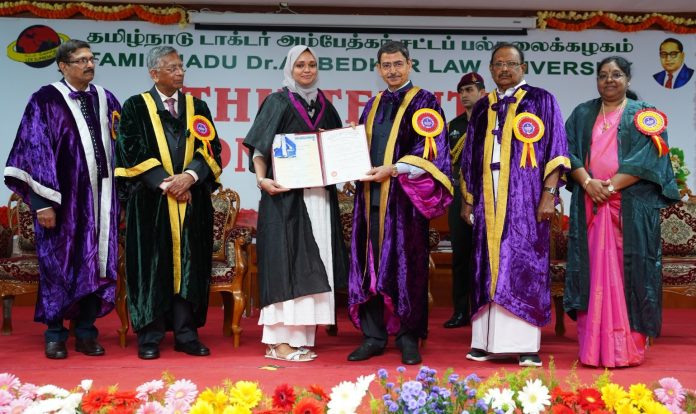
Nimrah Ali receiving Gold Medals and certificates of merit from Shri R.N. Ravi, Governor of Tamil Nadu on February 24, 2024
Chennai :
Nimrah Ali, wife of Hasnain Ahmed, has been honored with two prestigious Gold Medals and certificates of merit, the Tamil Nadu Dr. Ambedkar Law University Gold Medal Award and the Justice Subbiah Ratnavel Pandian Gold Medal Award from Madras Bar Association, for achieving the 1st Rank in the 5-Year B.Com. LL.B. (Hons.) Degree course at the Tamil Nadu Dr. Ambedkar Law University’s 13th Convocation held on February 24.
She was also awarded the P.B. Sanjana Endowment Scholarship cash prize and certificate of merit for her exceptional performance.
The above awards were presented to her by Shri R.N. Ravi, Governor of Tamil Nadu, in the presence of Mr. R. Venkataramani, Attorney General of India, a distinguished Constitutional Lawyer and Senior Advocate at the Supreme Court of India, Mr. S. Regupathy, Minister of Law, Courts, Prisons, and Prevention of Corruption of Tamil Nadu amongst other distinguished dignitaries.
In addition, she cleared ICSI (Institute of Company Secretary of India) course on the first attempt.
The awards recognize her outstanding accomplishment as the top-ranked law student at the prestigious Law University School of Excellence in Law, The Tamil Nadu Dr. Ambedkar Law University, Chennai.
She belongs to the illustrious Nawab of Arcot family.
source: http://www.radiancenews.com / Radiance News / Home> Pride of the Nation> Awards / by Radiance News Bureau / February 28th, 2024