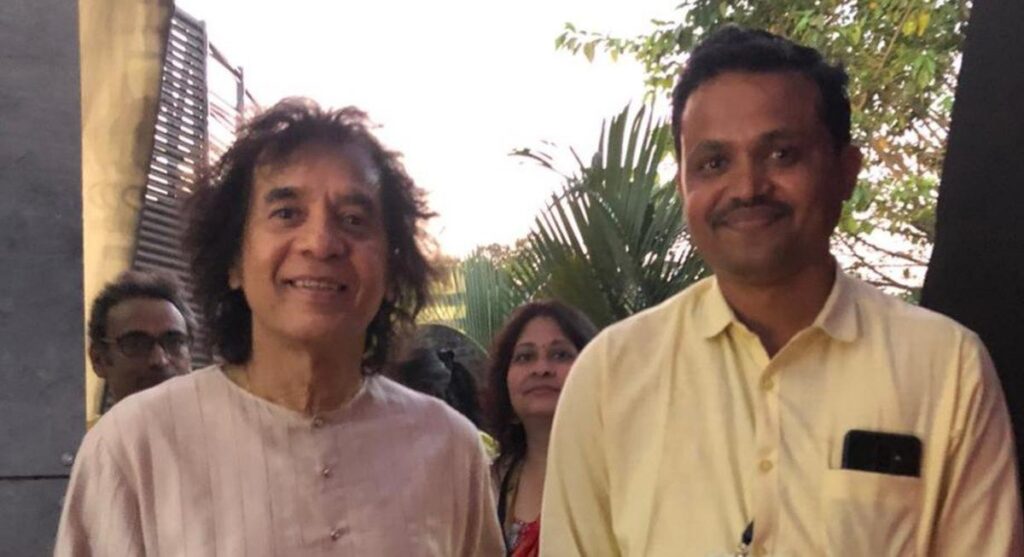
Shah Rasheed Ahmed Quadri is engaged in the field of Bidri Ware handicrafts and is known for introducing the Phooljhadi design.
Image: Twitter/@rashtrapatibhvn
New Delhi:
President Droupadi Murmu on Wednesday, presented the Padma Shri award to renowned craftsman Shah Rasheed Ahmed Quadri for Art.
The master craftsman is engaged in the field of Bidri Ware handicrafts and is known for introducing the Phooljhadi design.
Quadri has invented many Bidri Ware articles and has trained hundreds of artists in the field.
” Quadri has repeatedly raised concerns regarding Indian art due to the lack of marketing. He has also requested the government to provide an appropriate market and platform to artists so that they can create and develop their art “
Notably, Quadri is among the eight personalities from Karnataka to receive the prestigious Padma award this year.
Who is Shah Rasheed Ahmed Quadri?
Shah Rasheed Ahmed Quadri started learning this ancient art when he was just 10 years old against the wish of his father Shah Mustafa Quadri who was also a Bidriware craftsman. The 68-year-old artist is a third-generation artisan from his family. Apart from introducing the Phooljhadi design, Rasheed Quadri has also reintroduced sheet-work, which was popular during Bahmani empire.
Before winning the Padma award, Quadri has already won the State Award in 1984, National Award in 1988, District Karnataka Rajyotsava Award in 1996, and The Great Indian Achievers’ Award in the year 2004.
The artisan has also exhibited and demonstrated the ‘Bidri’ craft across many countries, including USA, Netherlands, Spain, Bahrain and Oman.
All you need to know about the Padma Awards
Padma Awards are presented in three categories including Padma Vibhushan, Padma Bhushan, and Padma Shri to honour people for their notable work in different disciplines and fields like art, social work, literature and education, public affairs, etc.
The Padma Shri is the fourth highest civil honour in India. While the Padma Shri is bestowed on those with distinguishing contributions in any field, the Padma Bhushan is granted to those who have had distinguishing contributions of a high order. The Padma Vibhushan is the highest of all and is awarded to those with exceptionally distinguished services.
Bharat Ratna is considered to be the highest civilian award of country. Notably, the award has not been bestowed to any single person since 2019. The last Bharat Ratna was awarded to Nanaji Deshmukh (Posthumous), Bhupen Hazarika (Posthumous) and former President of India Pranab Mukherjee.
source: http://www.republicworld.com / Republic World / Home> English News> India News> General News / by Mahima Joshi / April 06th, 2023
The Pune rapper and producer hails the national spotlight from the reality show as a win for the Indian hip-hop community.
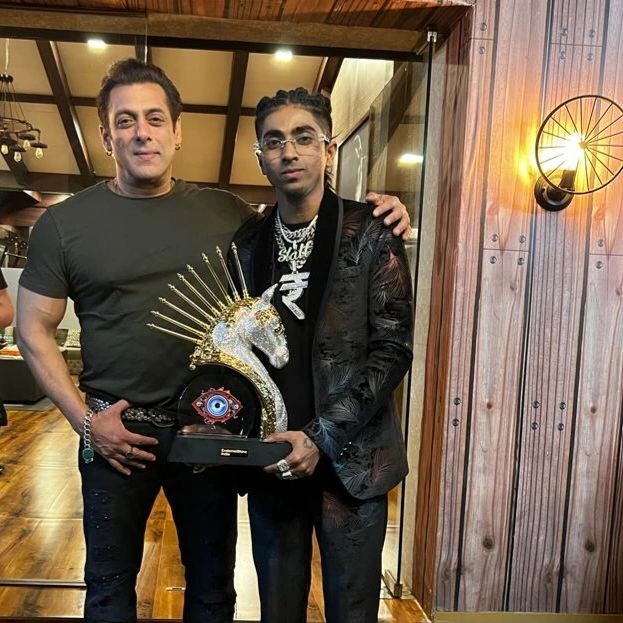
MC Stan with actor and host Salman Khan after winning ‘Bigg Boss’ Season 16. Photo: Courtesy of Endemol Shine India
After four months in the Bigg Boss house, Pune rapper and producer MC Stan aka Altaf Tadavi Shaikh emerged as the winner of Season 16 of the reality show, taking home the trophy and a reported cash prize of ₹31.80 lakhs following public voting. With this, Stan is the first Indian rapper and musician to win the long-running reality show, which has generally been dominated by actors and film industry celebrities.
“The journey has been very powerful. I got a lot of experience,” Stan said in a post-win press conference in Mumbai. After actor and host Salman Khan held up Stan’s hand to judge him the winner, the first photos from his win came with the rapper holding the Bigg Boss horse trophy with Khan.
In an Instagram post celebrating the win, Stan wrote, “We created history, stayed real throughout, repped hip-hop on national T.V. Ammi ka Sapna poora hogaya [My mother’s dream came true]. Trophy P-town aagayi [The trophy has come to Pune].”
Seated amongst press in a black leather jacket, with all his chains and rings in place, Stan was reflecting where Indian hip-hop can reach in terms of public consciousness. “If you go to see, this is a win for a lot of people; the rap community — whoever’s here from the gullies and [those] areas — I don’t know honestly what people saw and liked in me, but I’m grateful for their love,” he said at one point.
Winning and surviving 133 days in the Bigg Boss house through public voting, Stan acknowledged the role that the public played in keeping him in the competition. He adds, “I saw a lot of housemates talk about how they want to win, but I didn’t think I could make that claim, because it’s not in my hands. Woh Hindustan ka haath mein tha [It was in India’s hands].”
By January, it was clear that MC Stan was a top contender to win Bigg Boss Season 16, owing to how he often kept his head down and just went with the flow, although he was occasionally involved in a few fights with other housemates. In addition to his in-house concert with hip-hop acts like Seedhe Maut and Ikka, MC Stan was at first adamant to get done and go home, but eventually stuck it out to win.
source:http://www.rollingstoneindia.com / Rolling Stone India / Home> HomeFlashbox> News & Updates / by Anurag Tagat / February 13th, 2023
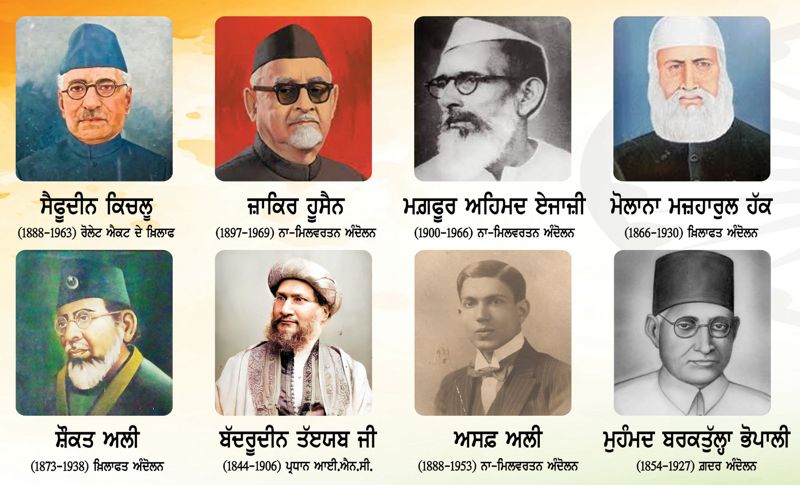
With an intent to highlight the role of Islamic leaders in the pre-independence freedom struggle, a group of Muslim youths have decided to organise a function on the occasion of Republic Day, during which sacrifices of unsung heroes from their community would be highlighted.
Besides organising an elaborate programme after unfurling the Tricolour at the Dehliz Chowk on January 26, the enthusiasts will also install banners displaying portraits of more than 20 prominent Muslim freedom fighters at various locations.
The organisers say the gesture will motivate Muslim youths of the region to come forward and play active in nation building, irrespective of their political, social or religious allegiances.
Zeshan Haidar, the convener of the scheduled event, said youths from various Muslim organisations of the area had been roped in to work in tandem for restoring the lost glory of leaders from their community, who had made supreme sacrifices in struggle against the British Government and played a major role in getting freedom for the country.
“Unfortunately, successive governments have failed to recognise the contributions of Muslim leaders in the freedom struggle and a majority of Muslim freedom fighters and martyrs have remained unsung during functions held to celebrate national events such as Republic Day and Independence Day,” Zeshan Haidar said, adding that these names were also missing from history books.
The enthusiasts have shortlisted names of about 100 Muslim leaders of pre-Independence era and portraits of 20 from them will be displayed in the region.
Maulana Shah Abdul Qadir Ludhianvi (grandfather of Shahi Imam Punjab Maulana Usman Ludhianvi), Zakir Husain, Begum Hazrat Mehal, Maulvi Ahmadullah, Abadi Bano Begam, Ashfaqulla Khan and Husain Ahmed Madni were cited among more prominent Muslim freedom fighters whose portraits figure on the proposed banners.
source: http://www.tribuneindia.com / The Tribune / Home> Ludhiana / by the Correspondent, The Tribune / January 24th, 2023
The first Muslim judge of a high court in colonial times, Syed Mahmood’s professional conduct offers a counterpoint to the declining standards in Indian judiciary.
WHEN Justice Abdul Nazeer addressed the 16th national council meeting of the RSS-affiliated Akhil Bharatiya Adhivakta Parishad at Hyderabad last December, he said, “Great lawyers and judges are not born but made by proper education and great legal traditions, as were Manu, Kautilya, Katyayana, Brihaspati, Narada, Parashar, Yajnavalkya, and other legal giants of ancient India.” In the symposium on “Decolonisation of the Indian Legal System”, Justice Nazeer also said the “continued neglect of their great knowledge and adherence to the alien colonial legal system is detrimental to the goals of our Constitution and against our national interests…”.
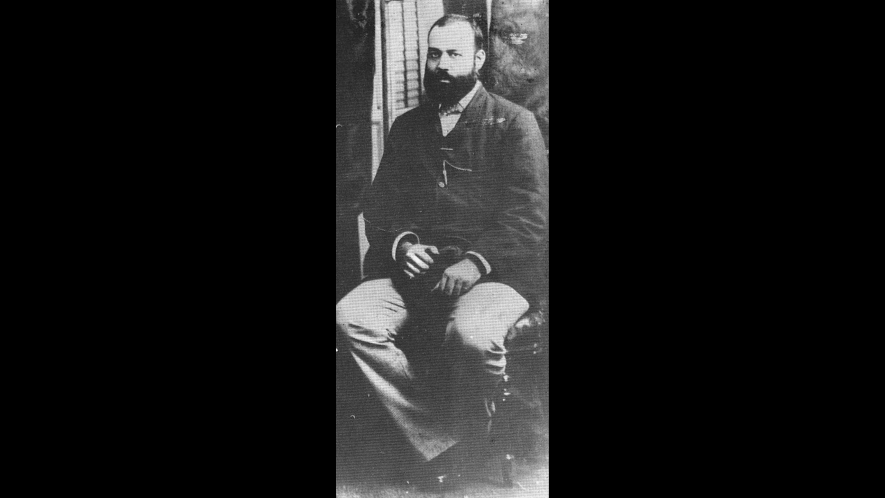
Perhaps Justice Nazeer should have also recalled 19th-century jurist Justice Syed Mahmood (1850-1903). A pioneer in bold assertions against the colonial judiciary, he produced incisive legal commentaries that reflect an audacious dissenter’s point of view. Writing in an Urdu newspaper, his father, Sir Syed Ahmed Khan, narrates Mahmood’s resignation from the Allahabad High Court in 1893 to “protect the self-respect of Indians against the racism of British judges”.
In that era, conceptions of nationhood were still evolving in India. Indian judges would not muster the courage to contest the racism of the imperial power or fellow European judges. But Mahmood did, in intrepid ways. Khan founded the Mohammedan Anglo-Oriental (MAO) College at Aligarh in 1877 and figures prominently but contentiously, stereotyped as a British loyalist and separatist in debates on contemporary nationalism. Mahmood supported his father’s modern education project, but unfortunately, his contributions are largely ignored by historians and the legal fraternity.
By 1920, MAO College, now Aligarh Muslim University, was the most prominent residential university in the country. Its history department has been a premier centre for advanced studies for a half-century. In 1889, primarily on Syed Mahmood’s initiative and his gifts in terms of books, journals and cash, AMU established a law department. Yet, he was neglected in its research. Only in 1973, seven years after the centenary of the Allahabad High Court, the Aligarh Law Journal brought out Mahmood’s contributions, and legal scholars reflected on his high calibre as a lawyer and judge.
The good news is, in 2004, Alan M. Guenther did his doctoral thesis on Mahmood at McGill University, Canada, which is available online for the public to access. His meticulous and well-researched account touches almost every aspect of Mahmood’s public life. Guenther also published an extended essay in 2011on Mahmood’s views on English education in 19th-century India. (In 1895, Mahmood had written a book on the theme for his speeches at the Educational Conference.)
In 1965, Asaf Ali Asghar Fyzee (1899-1981) complained, “Syed Mahmood’s contributions to the transformation of Muslim law in India have been largely neglected by historians and survive primarily as footnotes in legal texts on Muslim law.” Guenther, too, observes, “…overshadowed by the life and writings of his illustrious father, Ahmad Khan, his legacy has not received the attention it deserves. A large part of his father’s achievements in the reform of education, in fact, would not have been possible without the assistance of Syed Mahmood. But when he reached the age at which his father had made his most significant achievements, [Mahmood] had his life cut short.”
Mahmood had laid out his life plans clearly. S. Khalid Rashid, writing in 1973, reports that Mahmood decided early on that, like his ancestors, he would devote the first third of his life to educating himself, the second to earn a living, and the last to “retired study, authorship and devotion to matters of public utility”. But Guenther writes about how Mahmood’s health had deteriorated through alcohol abuse and disease. He died before he turned 53, broken by forced retirement, estranged from his father (who had died five years previously), stripped of responsibilities at the college he had helped found, separated from wife and son, and in poverty. He was selling personal items to repay debts. “His father’s numerous writings and letters are still republished, but Syed Mahmood’s contributions to Muslim thought are hidden in bound volumes of the Indian Law Reports and brittle files of government correspondence,” Guenther writes.
One aspect of Mahmood’s last years is captured by Prof. Iftikhar Alam Khan’s Urdu books, Sir Syed: Daroon-e-Khana (2006, 2020) and the recent Rufaqa-e-Sir Syed: Rafaqat, Raqabat wa Iqtidar Ki Kashmakash. These accounts expose the smear campaigns of the three companion successors of Sir Syed—Samiullah, Mohsin-ul-Mulk and Viqar-ul-Mulk—against Syed Mahmood as they vied for the secretary’s post at MAO College. Often European members of MAO College conspired with them. Exploiting his weaknesses and eccentricities, they ousted him to get a hold over college affairs, compounding his hurt during his tragic final years.
SYED MAHMOOD’S ROLE IN SIR SYED’S EDUCATIONAL ENTERPRISE
Having returned to India in 1872 after studying in England, Mahmood took time out of his budding legal career to assist his father’s reform work, particularly setting up MAO College. He prepared a detailed plan along the lines of his experiences in Cambridge. His specific aim, explained in February 1872, was to produce future leaders of India through an educational institution whose residential nature would be “as indispensable an education as the course of study itself”. The aim was to create a society of students and teachers quite different from the rest of society.
He travelled with his father to Punjab in 1873 and spoke at a rally to promote the project. In 1889, Sir Syed introduced a motion to nominate Mahmood as joint secretary of the board of trustees of MAO College by highlighting his assistance despite the opposition he faced. In particular, he considered his son’s influence the primary factor that persuaded European professors to come to India and teach there.
European staff members confirmed this around six years later when there was renewed opposition to Mahmood continuing as joint secretary. The principal, Theodore Beck (1859-1899), testified, “Syed Ahmad….acknowledged his reliance on Syed Mahmood for advice in all matters, and his imprint could be noted in the correspondence relating to the school. He declared his firm conviction that Syed Mahmood was the one person who shared his vision for the college, and apart from him, no one would be able to administer the school in keeping with that vision.” However, Samiullah (1834-1908) disagreed with Sir Syed on this count. As a result, a tussle for power began in the college management. The power-play could explain why AMU felt inhibited in bringing out a biography of Mahmood, a research gap that Guenther’s doctoral thesis fills. He has extensively relied on important correspondences of Mahmood preserved in the London India Office (British) Library.
SYED MAHMOOD’S TRYST WITH MUSLIM LAW
Mahmood is a forgotten pioneer of the transformation of Muslim law in modern South Asia. In 1882, at just 32, he became the first Muslim judge of the high courts in British India. He delivered numerous landmark decisions that shaped Muslim law, the law in general, and its administration.
Earlier, he blazed a trail his younger contemporaries followed in their judicial roles in British India. He was one of the first Indian Muslims to study in England and train in the English system of jurisprudence, the first Indian to enrol as a barrister in the High Court of Judicature at Allahabad in 1872, the first appointed as a district judge in the restructured judicial system of Awadh in 1879 and the first Indian assigned as a puisne judge to the High Court at Allahabad. He was the first Muslim in any High Court of India. He cleared a path for Indian Muslims to participate in administering justice in India. But his contribution is not limited to creamy career opportunities for Muslim youngsters. His lasting legacy is how Muslim law is perceived and administered in South Asia today.
CHAMPION OF ACCESSIBLE JUSTICE
An abiding concern of Mahmood was the cost of administration of justice. Court procedures were lengthy and expensive, and the “mass of law” was complicated. Distance from courts was another concern, for which he proposed a network of village courts for “on-the-spot” adjudication. He sought to make justice accessible through unpaid tribunals and honorary munsifs. He prepared a comprehensive draft for this, Guenther informs.
Furthermore, he attacked the [racial] mindset and court fees and stamp duties on legal documents. He ruled in August 1884 and February 1885 that “…if justice costs the same amount [to the] rich and poor, it follows that the rich man will be able to purchase it, whilst the poor man will not.” He declared, more than once, that British judges in India were too quick to find fraud.
In a speech at the Allahabad Bar in April 1885, Mahmood raised the language issue in judicial transactions, saying laws should be in languages intelligible to the masses. He insisted on the vernacular in arguments, pleadings and justice delivery and translated verdicts so that people unfamiliar with English could rest assured that judgments are reasoned. Of course, the issue of judicial language continues to be debated, and for this, acknowledgement is due to Mahmood.
AN INDIAN DISSENTER IN THE HIGH NOON OF BRITISH COLONIALISM
Mahmood is known most for outstanding dissenting judgements. In volume 2 of his 2021 book, Discordant Notes, Justice (retd.) Rohinton F. Nariman writes that Mahmood was known for detailed judgments, some of which stand out for thoroughness and fearless language. Mahmood would refer to the original Sanskrit versions when ruling on Hindu laws and the Arabic texts for Muslim laws, rather than using interpretations of the relevant texts.
From the 1860s to 1880s, during the codification of laws, he sought limits on importing British laws and protested that the local context was getting overlooked. His concern was not just the laws but their efficacy and adaptability within India’s cultural diversity.
Guenther observes, “…throughout his life, he identified himself as a Muslim as well as an Indian and a subject of the British crown, and that he was actively involved in the education and improvement of the Indian Muslim community. At the same time, Mahmood… [made] efforts to promote harmony between people of diverse backgrounds, and…[supported] initiatives that improved the situation of all Indians, regardless of religious affiliation…”
An anecdote from Altaf Hali’s Hayat-e-Javed (1901), cited by Shamsur Rahman Faruqi (2006), is worth sharing. “Contrary to the culture of sycophancy and genuflecting before the English colonial authority….Syed Ahmad Khan and his high-profile and brilliant son Syed Mahmud strived to conduct themselves as if they were equal to the English….Syed Ahmad Khan had stayed away from the [1867 Agra] Durbar because Indians had been given seats inferior to the English. A medal was to be conferred on Syed Ahmad Khan at that Durbar. Williams, the then Commissioner of Meerut, was later deputed to present the award to Syed Ahmad Khan at Aligarh railway station. Willams broke protocol and showed his anger at having to do the task under duress and said that government orders bound him, or he wouldn’t be presenting the medal to Syed Ahmad Khan. Syed Ahmad Khan accepted the medal, saying he wouldn’t have taken the award, except that he too was bound by government orders.”
Indian democracy is an outcome of anti-colonial nationalism, and dissent is its core component: Mahmood’s dissent contributed to nationalism in his time. In 2022, the V-Dem Institute described India as an electoral autocracy where dissent is being criminalised, and the judiciary is failing to contain the majoritarian upsurge. Mahmood’s professional conduct is an encouraging counterpoint to the degeneration in the Indian judiciary.
WHAT DID MAHMOOD THINK OF THE INDIAN NATIONAL CONGRESS?
According to Guenther, though Mahmood never joined the Congress, he was “equally aloof” from the anti-Congress propaganda his father indulged in. “…a rare catholicity characterised his views on most of the controversial questions,” he writes. He adds, “His acceptance among the Hindus [elites] generally was demonstrated by the fact that they tried to send him as their representative to the Imperial Legislative Council, though he never received that appointment.”
Nonetheless, like his father, Mahmood harboured class and regional prejudices. Guenther reveals an article Mahmood wrote in The Pioneer on 4 September 1875, suggesting the government must strive to with the sympathies of the “higher classes of natives”. When challenged to defend his position by “Another Native” in the same newspaper two weeks later, Mahmood responded that people in Punjab and the North-western Provinces [now Uttar Pradesh] were, historically speaking, of “much greater political significance” than those of Lower Bengal. Gunther cites his write-up: “…any educational system that succeeded in ‘attracting the Bengalee and fail(ed) to exercise any influence upon the higher classes of the Rajpoot, the Sikh, and the Mussulman’ must be regarded as a failure.”
Considering the socio-regional composition of top functionaries of AMU, even impartial insiders would testify that it still harbours regional and sub-regional prejudices. The Sir Syed Academy is releasing many publications during the ongoing centenary celebration of AMU. Publishing Guenther’s dissertation may be a fitting tribute to Mahmood, who must be regarded as a prominent co-founder of MAO College.
Mohammad Sajjad teaches modern and contemporary Indian History at Aligarh Muslim University. Md. Zeeshan Ahmad is a lawyer based in Delhi. The views are personal.
First published by Newsclick.
source: http://www.theleaflet.in / The Leaflet / Home> History / by Mohammad Sajjad and Zeeshan Ahmad / April 01st, 2022
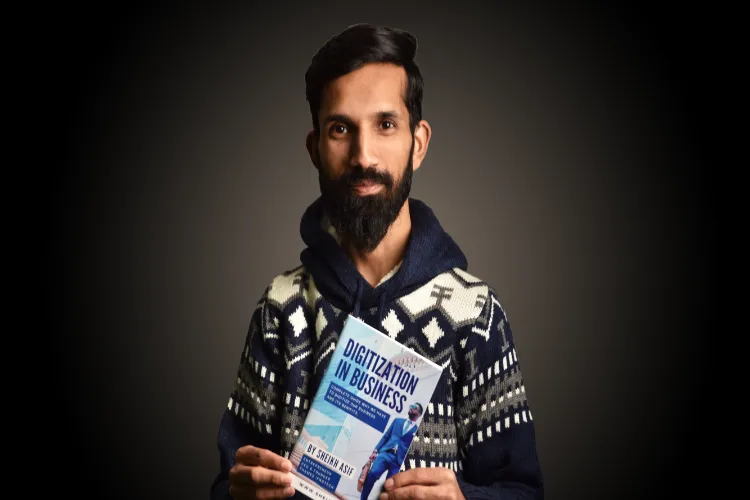
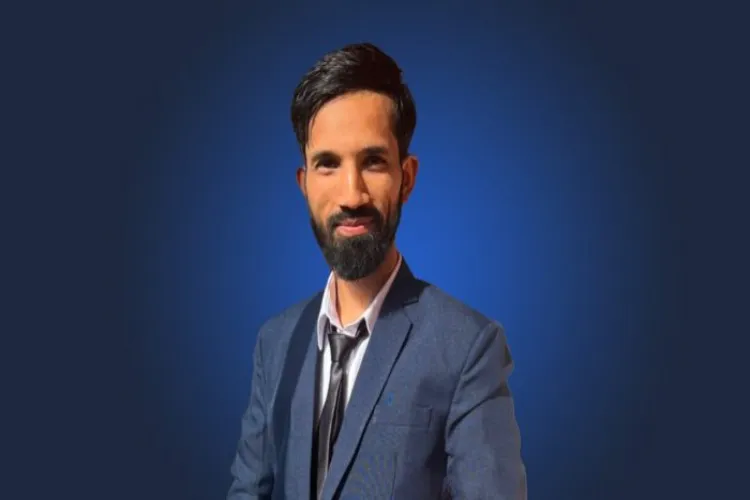
Sheikh Asif, founder, Thames Infotech, holding one of his books
Breaking the stereotype of a company chief, Srinagar’s Asif Sheikh, a school dropout, is the CEO and founder of Thames Infotech, a Manchester-based company with a turnover of Rs 5 crore! He has just turned 28.
“I believe that a person who works hard, with dedication and honesty is always successful; he can never give up even when many a time one loses the courage to carry on. There were setbacks and at the time I did seem to lose courage, but I did not give up,” Sheikh Asif told Awaz-the Voice in a telephonic interview.
Asif’s success is extraordinary given his poor educational background and reaching a position that many persons with degrees from top-end colleges aspire to.
Besides being a successful entrepreneur, Asif is also a professional web designer, developer, graphic designer, digital marketer, and writer. He also gives back to society by giving free tuition to students from all over the world.
Sheikh Asif’s work profile is interesting: he worked with a tour and travel company, sold medical equipment for a company, and with telecom companies like Airtel, Vodafone, and Aircel.
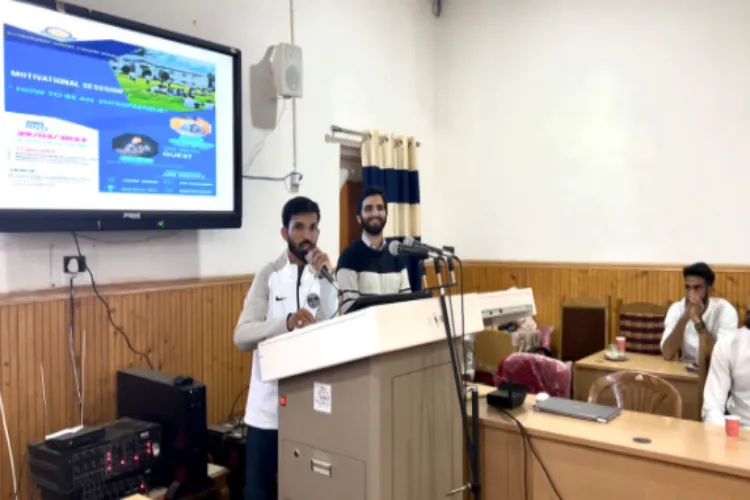
Sheikh Asif deliving a talk on business
In the year 2000, Sheikh Asif was 8 years old when his father’s health deteriorated. His father was a head constable. Due to his father’s illness, the family was reduced to penury. Sheikh Asif says that his father’s illness remains a mystery as the family consulted experts and eminent doctors but nobody could diagnose it.
Sheikh Asif told Awaz-the Voice that his mother sold most of the household assets and took loans to pay for his father’s treatment.
Recalling those days, Asif says that he can never forget one particular day when he was studying in the eighth grade and was to write his exam, but he had no pen. “I was leaving for the examination hall and was worried. My mother came to know the reason for my worry, she sold a copper dish from her kitchen to buy me a pen.”
He says that his mother often sold household goods for the family, especially to meet the needs of the children.
The conditions at home were not conducive for Sheikh Asif to continue his studies. He left school and started working to support his family.
“I went against my mother’s wishes, as she wanted me to become a doctor most parents in Kashmir do, but I gave up my studies to support my financially broke family,” said. He was 15 years old in 2008 when he started earning for his family by doing odd jobs.
Sheikh Asif
Sheikh Asif was always fascinated by computers and spent a lot of time on them. Due to this, he got his first job as a data entry operator with a local tour and travel company at the age of 16. He earned a salary of Rs 1500.
Sheikh Asif said seeing his interest his father took a loan from a bank to buy him a computer. The turning point in his life came as he watched an interview with Microsoft founder Bill Gates on BBC.
He took full advantage of his computer and yet the challenge was the lack of a high-speed broadband facility in Kashmir. While the rest of the world was running 4G internet, in his locality only 2G internet was available.
He left his first job within two months and started working in a local shop as a salesman for four years. Here he honed his skills and learned all the basics including graphics designing, web designing, etc.
Again there was a rough patch in his life as in the 2014 Kashmir floods, his house was washed away. He used all his savings in rebuilding his house. The family had to start from scratch as all their household belonging had got damaged and washed away.
In the year 2014, he quit his job and started his business, but it turned out to be a year full of troubles for him.
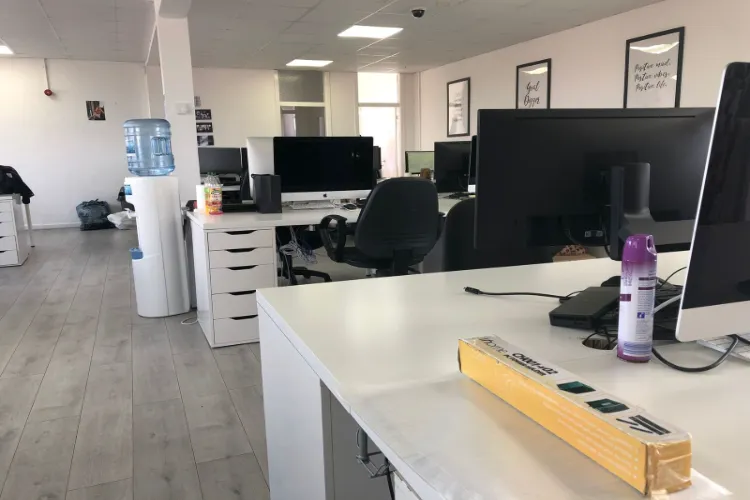
Sheikh Asif’s Srinagar office
However, fortunately, the next year Asif got an opportunity to work in Delhi, and the exposure there opened his mind to a bigger canvas.
“The 2014 flood severely damaged our house and we had to repair or renovate it periodically for four consecutive years after the flood and finally had to sell the house in 2018,” he said.
In the meantime, he worked with OLX from April 2015, and from there he was offered a job at Trimax Printing and Graphics, a UK-based company owned by Tajinder Singh. He was working for the company Hayes Harlington. The company runs an online general store and it had no element of graphic designing till then.
Sheikh Asif told Awaz-The Voice: “I worked for Chanda Trimax Printings & Graphics. Meanwhile, the killing of a militant in Kashmir saw the valley under lockdown for nearly three months. For this reason, I left for Delhi.”
When he met Tajinder Singh in Delhi, the latter was facing issues with his business. His business was suffering due to low sales. Having seen his latent, Tajinder Singh offered him a job at Hayes, Harlington, UK, where Tajinder’s brothers were already working.
Sheikh Asif says he consulted his mother before picking the UKL job. He signed an agreement to work for 18 months and an assured return flight ticket to India.
“They told me that they had changed the name of Trimax Printings & Graphics to Thames Infotech on June 6, 2016,” Asif said.
He set foot on foreign soil for the first time in the first week of November 2016. However, the business did not show positive results there either, thus Tajinder’s brother advised him to find a part-time job in the UK to meet his expenses.
“When I was looking for a part-time job, I met Rizwan, a Kashmiri man originally from Baramulla district in North Kashmir, who came to Manchester in 2000 and now runs a restaurant, Riz Spices.
Sheikh Rizwan offered him a space in his restaurant to set up a part-time business. “Two months later I met another man, Hamza Salim, a senior software engineer at Google, who asked me to build a website for his tech company, on the condition that only if he liked my work I would be paid,” he said.
After approving his website design, Hamza Salim offered him 50 percent equity in his firm.
pix05
During this time, Asif meet many people including natives and others, and kept looking for opportunities.
One such person was Rudrigo Ruiz Karvajal, who frequented the restaurant. He offered me a place that was quite conveniently located. He told me that his father had started his business from there.
“I got my first order for a logo for which I was paid 500 pounds and I was only expecting 30-40 pounds. They gave me another order to build a website for which I was paid 7000 pounds.”
“I was wondering if it’s a dream. Never expected such high remuneration. This order was from the largest food chain in London called Zabka.”
On June 9, 2016, Asif took over the Thames Infotech Manchester UK company which has a current turnover of Rs 5 crore.
It has an office at Advent Colony in Naugam, Srinagar, Kashmir. He employs 35 locals including 32 in UK and 3 in Kashmir for website designing and development, digital marketing, graphics designing, personal branding, social media handling, etc.
Sheikh Asif told Awaz-The Voice that our company is a leading web designing company and has won the 2017, 2018, 2019, and 2020 awards as the Three Best Rated UK, and Best IT Service Provider Award 2018, 2019 organized by Top Developers USA, he claims.
Sheikh Asif said that he received the first award in the year 2003, less than one year after his launching of his company.
So far, Asif has trained around 1000 students, helped 40 businesses through the Covid-19 pandemic, and has published three books – Digitization In Business, Online Business Idea, and Start a Business.
Sheikh Asif was named Entrepreneur of the year 2022 by The Fireboxx. There he was honored by Google as a Digital Marketing Expert in 2018.
To the youth, Sheikh Asif says they must never lose hope and always keep their focus on business. Secondly, they must avoid drugs. They shouldn’t waste their lives by getting immersed in romantic liaison and heartbreaks; these are temporary phases of life and not a goal. “Your personality is your work,” he says.
source: http://www.awazthevoice.in / Awaz, The Voice / Home> Youth / by Shah Imran Hasan, New Delhi / December 17th, 2022
Contrary to the popular notion that wars are fought by the armies alone, the whole nation including Bollywood personalities and leading artists get involved in the national efforts to fight the enemy.
The Chinese invasion in October 1962 was a shocking moment for India. Traditionally, India had supported China at every international forum for at least half a century. The invasion was the least expected from China and India was not at all prepared for it. Prime Minister Jawaharlal Nehru urged the nation to stand united in that hour of emergency and in response Indians donated generously to the National Defence Fund.
The film industry did not lag. Film Industry’s war efforts were led by legendary filmmaker Mehboob, singer Mohammed Rafi and music composer Mohammed Zahur Khayyam Hashmi (Khayyam).
In less than a week they collaborated to produce two music videos, which were to be played in film theaters, on the radio, and on the roadsides to raise funds for the war.
One of those two songs, “Awaz do hum ek hain…”, by Jaan Nisar Akhtar is now a popular political slogan in India. On Nehru’s call to the nation, Jaan Nissar Akhtar wrote the song to which music was given by Khayyam and the voice by Mohammad Rafi. The song is an invocation to Indians to unite in the face of an invader became a national passion and remains so till today.
The song starts with:
ek hai apni zameen, ek hai apna gagan
ek hai apna jahaan, ek hai apna watan
apne sabhi sukh ek hai, apne sabhi gham ek hai
Aawaz do ham ek hai
(We have a common earth, we have a common sky
We have a common world, we have a common motherland
All our joys are common, all our sorrows are common
Say it aloud that we are one!)
The powerful lyrics were turned into a national rage by the soulful singing of Rafi. Jago watan khatre me hai, sara chaman khatre me hai (wake up our motherland is under threat, whole garden is under siege) and dushman se nafrat farz hau, ghar ki hifazat farz hai (hating your enemy is a duty, to guard your home is a duty), aroused patriotic emotions among millions of Indians. The song asks the youth to join the army and fight the aggressor.
The song was picturized on Rajendra Kumar, Sunil Dutt, Raj Kumar, and Kamal Jeet.
Another song produced along with this was written by Sahir Ludhianvi, “watan ki abroo khatre main hai…” (dignity of the nation is under threat). It was also produced by Mehboob and sung by Mohammed Rafi. The song specifically points to the Panchsheel pact and other friendly gestures made by India towards China. It says,
Wo jinko saadgi mein hamne
Aankhon par bithhaaya thha
Wo jinko bhai kehkar
Hamne seene se lagaaya thha
Wo jinki gardanon mein haar
Baahon ka pehnaaya thha
Ab unki gardanon ke waaste
Talwaar ho jaao
(The people we honoured because of our innocence
The people we embraced and called brothers
The people we received with love
Now, do become swords for their throats)
The song also points toward the internal threats at the time of war.
Khabar rakhna koi gaddaar
Saazish kar nahin paaye ae
Nazar rakhna koi zaalim
Tijori bhar nahin paaye ae
(Be vigilant that no traitor conspires against the nation
Be vigilant that nobody makes money out of our war efforts)
The song was picturized on Dilip Kumar, Rajendra Kumar, Raj Kumar, and Kamal Jeet in a video produced by Mehboob.
Lorries with speakers would roam around playing these songs and prompting people to donate generously. It is said that when one such procession reached the house of Shammi Kapoor his wife actor Geeta Bali started crying. She rushed inside her house and told Shammi that she needed to do something for the nation. Geeta took all her jewelry, even the pieces she wore, and gave it away for war.
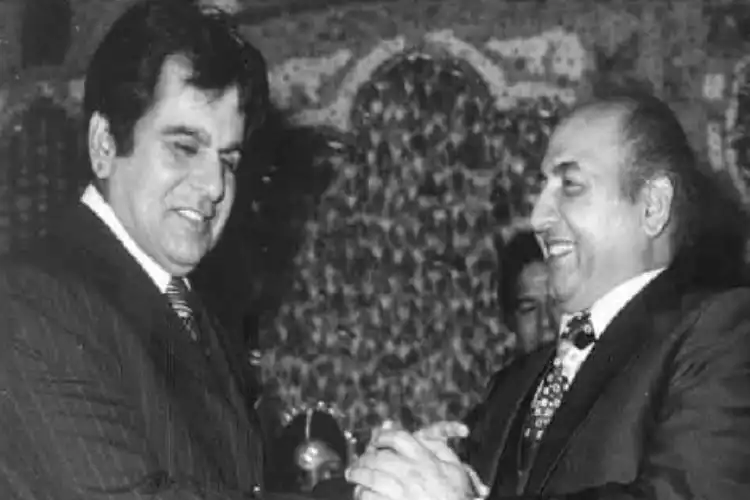
Rafi felt that singing in the safety of Mumbai was a disgrace in the line of his national duty. He discussed with Dilip Kumar and urged PM Nehru to send them to the border. What would they do there? Rafi felt that his songs could boost the morale of Indian soldiers and the presence of Dilip Kumar would assure the troops that the whole nation is standing behind them.
It was a dangerous mission. It was unprecedented for the artists to perform at the war front. In the cold, Rafi and Dilip reached the war frontier. He sang songs, interacted with soldiers, and boosted their morale. Dilip Kumar later recalled, “needless to say he was the star attraction with the jawans and the young newly commissioned officers”.
After the war ended with a ceasefire the collected funds were used to recover the economy and modernizing the Army.
On 27 January 1963, Mehboob organized an event in Delhi where he invited.all the prominent film stars to perform in the presence of President S Radhakrishnan and PM Jawaharlal Nehru. The event is often remembered for the rendition of “Aey mere watan ke logo…” by Lata Mangeshkar and Mohammad Rafi sang two songs. One was written by Shakeel Badayuni and its music was composed by Naushad, “Apni azadi ko hum hargiz mita sakte nahi.” The song was later adapted into the film Leader and the other was “Kar chale hum fida….” written by Kaifi Azmi and composed by Madan Mohan, which was later adopted in Haqeeqat, a movie based on the India-China war.
The fact that Rafi went to the war frontier and stayed there for a few days to play what turned out to be a big morale booster for the troops remains an unprecedented manifestation of one’s sense of responsibility towards his country.
source: http://www.awazthevoice.in / Awaz, The Voice / Home> Culture / by Saquib Salim / December 24th, 2022
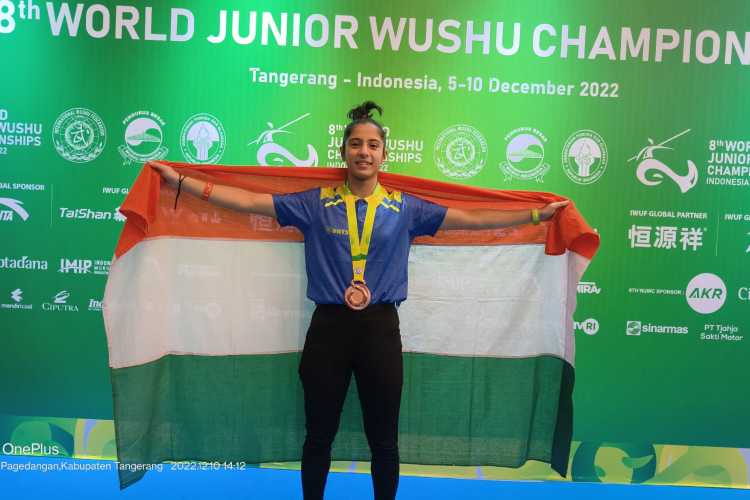
Ayeera Chisti, the first Kashmiri girl to win a medal at the World Wushu Championship
Ayeera Chisti, the Wushu wonderkid from the Kashmir valley added another feather in her rising career by winning a bronze medal at the World junior Wushu championship this weekend.
With this achievement she has become the first girl from Jammu and Kashmir to win a medal at this prestigious championship.
Among the first to congratulate her was JK Sports Council.
The 8th world junior Wushu championship was held in Banten, Indonesia from December 2 to 11.
Speaking to Awazthevoice.in, Ayeera’s coach, Asif said, “This is just the beginning. This is the result of years of hardwork, dedication, patience and discipline. There are many targets we have to achieve”.
Before departing for the championship, Ayeera had exuded confidence of doing well at the event. “I will come back with a medal”, she had told Awazthevloice.in.
The 11th class student of Amira Kadal Higher Secondary School, Srinagar had already etched her name in history books by becoming the first girl from Srinagar to represent the country in the world championships.
Khelo India congratulated Ayeera on becoming the first girl from JK to win a medal at this level.
Ayeera had lost to Malak Ossama of Egypt in the semifinal.
She had earlier defeated her rival from Macau in the last-eight stage.
The Indian contingent finished with a record eight medals, including three golds in the championship. Apart from the yellow metal, India also won three silvers and two bronze medals.
source: http://www.awazthevoice.in / Awaz, The Voice / Home> Sports / by Nakul Shivani, New Delhi (headline edited) / December 12th, 2022
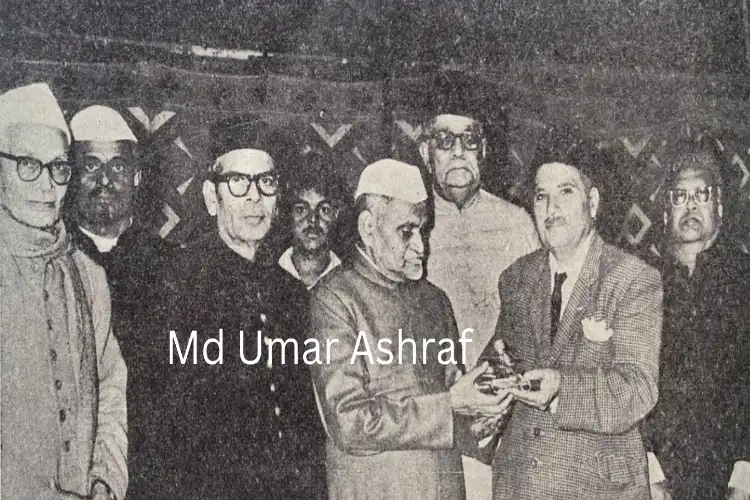
Administrator of Ajmer Sharif Aley Mohammad Shah donating gold to the minister (Courtesy: Md Umar Ashraf)
If I tell you that the Dargah of Khwaja Moinuddin Chishti at Ajmer, Rajasthan, played a role in the war against China when India was invaded in 1962, will you believe it?
In October 1962, the Chinese Army invaded India which had gained freedom 5 years ago. Such national crises test the character of a country. Indians of all creeds, castes, races, and social groups joined hands to fight the mighty enemy.
After 200 years of British colonialism, the Indian economy was in shambles when the colonial rulers left in 1947. When China invaded, India was not as big an economy as it is now. Prime Minister Jawaharlal Nehru appealed to his compatriots to donate gold and money to the defence funds.
Responding to the call, Dargah at Ajmer opened its vaults for the country’s defence forces. The management of the shrine of Hazrat Khwaja Moinuddin Chishti believed that national service comes before any other service. The administrator of the committee handed over 2 kilograms of gold and invested Rupees one lakh in Defence Saving Certificates to the Union Minister of Irrigation and Power at a meeting held at the Dargah. It also announced holding special prayers for the success of the Indian Army daily.
The administrator who handed over the gold, to the minister was Aley Mohammad Shah. His elder son Zameruddin Shah rose to become the Deputy Chief of Army Staff in India while his other son Naseeruddin Shah is a popular film actor.
The episode is a testimony to the fact that for Indian Muslims following Islam and serving the nation are not contradictory.
source: http://www.awazthevoice.in / Awaz, The Voice / Home> Culture / by Saquib Salim / December 14th, 2022
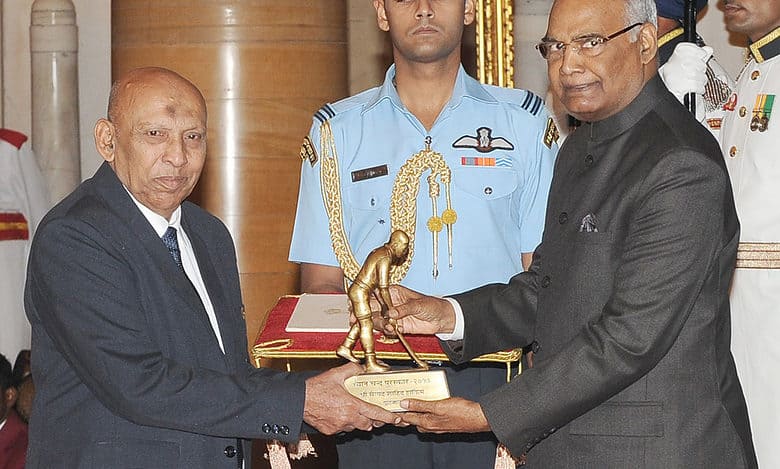
The President, Shri Ram Nath Kovind presenting the Dhyan Chand Award, 2017 to Shri Syed Shahid Hakim for Football, in a glittering ceremony, at Rashtrapati Bhavan, in New Delhi on August 29, 2017. Photo: Wikipedia
The name of Syed Shahid Hakim is familiar to the entire football fraternity of India. He was one of the most accomplished personalities who graced Hyderabad and Indian football as a player, referee and coach. Indeed it would not be wrong to say that there were few people in India who could match his knowledge and acumen about the different aspects of football. Besides being a well known personality in football, he also served as an officer in the Indian Air Force.
Being one of the sons of the great coach S.A. Rahim, he grew up in a football related environment. Hakim belonged to that period when Hyderabad was at the zenith of Indian football. He played with the illustrious players of India. Among his teammates were the famous goalkeeper Peter Thangaraj, D. Kannan, S.A. Latif, Yousuf Khan, S. Narayanan, H H Hamed and others. All these players were from the twin cities of Hyderabad and Secunderabad.
As a player, Hakim’s talent bloomed at an early age. He was at his peak in the late 1950s. He was a member of the Hyderabad state team which won the Santosh Trophy in 1957. Due to his prodigious talent and his rising status in Indian football, he was selected to represent India in the Pre-Olympic tournaments in Jakarta, Singapore and Malaysia.
It was not a surprise when he was also selected in the Indian team for the 1960 Olympic Games in Rome. That was the last time that India qualified for the Olympic Games. Although India narrowly failed to enter the knockout stage of the tournament, the Games were a great learning opportunity for Hakim.
The close interaction that Hakim had with the world’s best players and coaches gave his keen intelligence some valuable insights into the tactics and training of European and South American players. These he later put into use when guiding his own trainees. This is where his education and learning proved to be a big asset. Having studied at All Saints HS, Nizam College and then Osmania University, his level of education was above many other footballers. This enabled him to interact easily with foreigners and learn from everything that he observed.
Later, after he joined the Indian Air Force, he played for the defence services team and went on to be appointed captain of the All India Services team.
After retiring from the game as a player, he continued to serve Indian football in various capacities. He became a well known referee who was among the best in India. Starting from 1970 he continued to serve as a referee for many years. In 1974 he was selected to be a member of the FIFA Referees panel which was a great honour for an Indian referee.
Thereafter, he officiated in 33 international matches and it is a record which is still not broken. No other Indian referee has officiated in 33 international matches.
But that was not the end of his distinguished career. Thereafter, Hakim became a reputed coach and coached the Indian team from 1980 to 1982 for the Merdeka Cup and Delhi Asian Games along with other coaches.
When he was 80, he fell prey to the rampaging COVID pandemic but recovered. However, despite winning the battle against the dreaded virus, his life did not last long thereafter. He suffered two strokes in rapid succession and passed away in Gulbarga where he had been admitted to a hospital in August 2021. His death left a void in Indian football which will perhaps never be fulfilled.
source: http://www.siasat.com / The Siasat Daily / Home> News> Hyderabad / by Abhijit Sen Gupta / December 09th, 2022
Traditional makers of classical Indian string instruments worry about the extinction of their art, with little interest among the younger generation, and most of their clientele now based abroad.
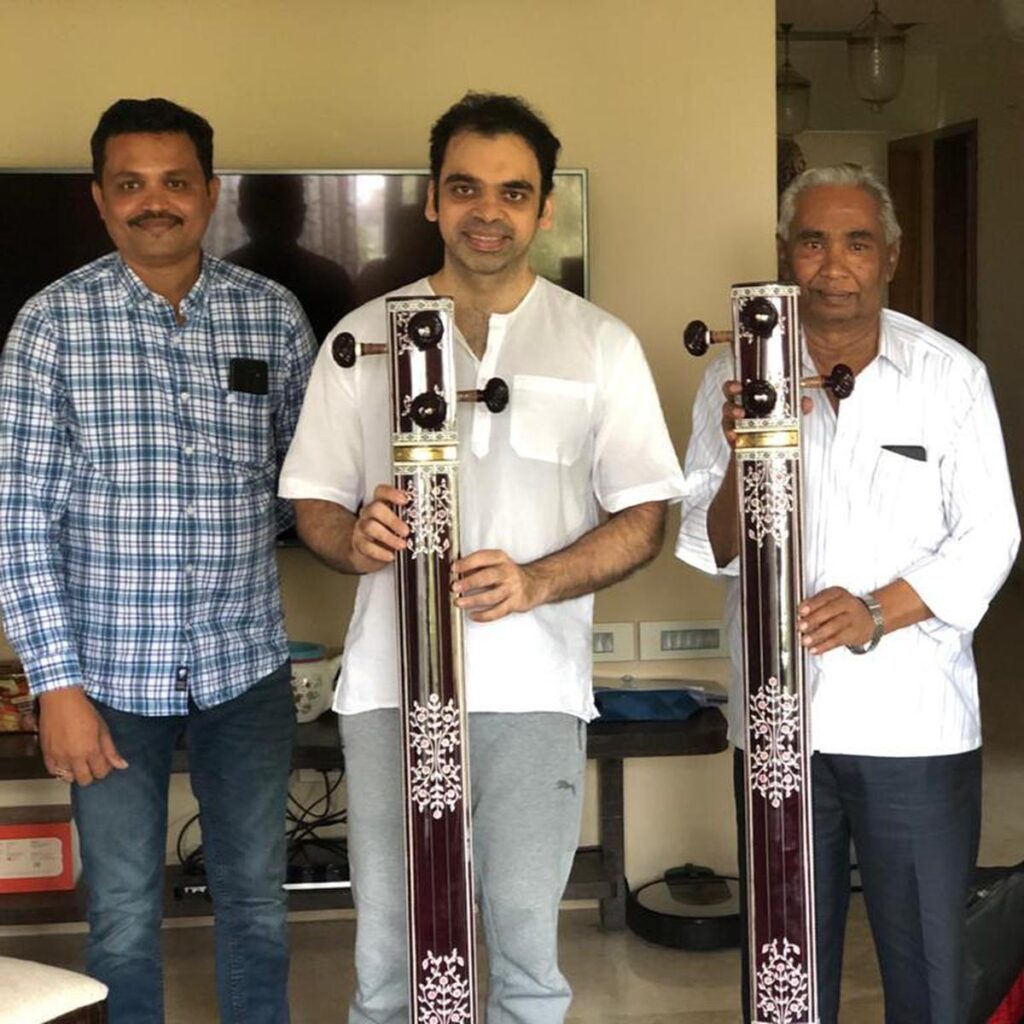
Tanpura artist Altaf Mullah, classical vocalist Rahul Deshpande and Yusuf Mullah (Altaf’s father and Tanpura maker to Bhimsen Joshi). | Photo Credit: Special Arrangement
For generations, Altaf Mullah and his family, residents of Miraj in Goa, have been in the business of tuning the strings and twisting the pegs of Indian string instruments such as the tanpura, surbahar, rudra veena and vichitra veena. They are currently headed for a tour of the United States and the United Kingdom, to hold workshops on how best to keep these instruments tuned, for their clients abroad, a number that now oustrips their domestic market.
On the face of it, it seems as though Mr. Mullah and his family have negotiated the ravages of modernity on traditional businesses quite well, by shifting their client base abroad. But the story is quite different. In fact, the workshop is being sponsored by the Indian Council for Cultural Relations (ICCR) after a distress email from Mr. Mullah, who feared the extinction of this art of making and maintaining string instruments.
“We are the fifth generation making these string instruments. We were given Rajashray (royal patronage) in 1862, but the way things were going, this art would not survive beyond this generation. We make upto ₹500 per day, the younger generation is not that attracted to it,” says Mr. Mullah. His father, Yusuf Mullah, is a much-feted string instrument maker, with Hindustani music maestro Bhimsen Joshi having been a faithful patron.
After having knocked on many doors, Mr. Mullah wrote to ICCR president Vinay Sahasrabuddhe about the systemic and immediate problems faced by his tribe of string instrument makers. “For 1.3 billion people, and countless afficianados abroad, there are only 220 karigars (artisans), mostly concentrated in Goa or Kolkata,” he said.
Mr. Sahasrabuddhe’s response was immediate, and one of the first things he did was to set up a meeting between Mr. Mullah and the Postmaster General of India, in New Delhi. “Our immediate issue was that the parcels of instruments that we used to send abroad [which is the bulk of the business] were through speed post. The department of posts changed it from weighted charges to volumetric post, that raised our costs by three times the amount. We were really struggling,” said Mr. Mullah. The Postmaster General agreed to make an exception for the parcelling of string instruments and some relief was gained.
“Our major problems, however, remained. Our worst period was of course between 1990-2000 with the rising popularity of electronic instruments. Fortunately, acoustic sound made a quick comeback, and our business went up again, but not enough to attract the next generation,” he said.
Mr. Sahasrabuddhe told The Hindu that preserving the tradition of making and maintaining Indian string instruments was important as they were “the tangible and intangible heritage of India, and Indian musical tradition.” In fact, there is now talk of standardising a curriculum via the All India Council for Technical Education (AICTE) for this purpose, to create a base of instrument makers, and prevent the skill from dying.
The Mullahs’ client list, ranging from composer A.R. Rahman to India’s nightingale, the late Lata Mangeshkar, to Bhimsen Joshi and tabla maestro Zakir Hussain — reads like the who’s who of Indian music.
Tanpura artist Altaf Mullah with Tabla maestro Zakir Hussain. | Photo Credit: Special Arrangement
Indian string instruments, especially the tanpura, have been historically referenced through much of Indian history. In his devotional song, “O Sadho”, the poet-saint Kabir draws a parallel between the human body and the tanpura. “ Yaha tan thaata Tambure kaa, paanch tatwa ka banaa hai Tambura, khaenchta taar marodata khoonti, Nikalta raag hajure ka, O Sadho” (O seekers, this body is a splendid tanpura, made of five elements, strung together with nine resonances. Tighten the strings, twist the pegs and it sings the song of the Lord).
As the irreplaceable accompaniment to the sound track of India, the tanpura, struggling for breath, was hoping to “get a ventilator soon”, said Mr. Mullah.
source: http://www.thehindu.com / The Hindu / Home> News> India / by Nistula Hebbar / December 04th, 2022