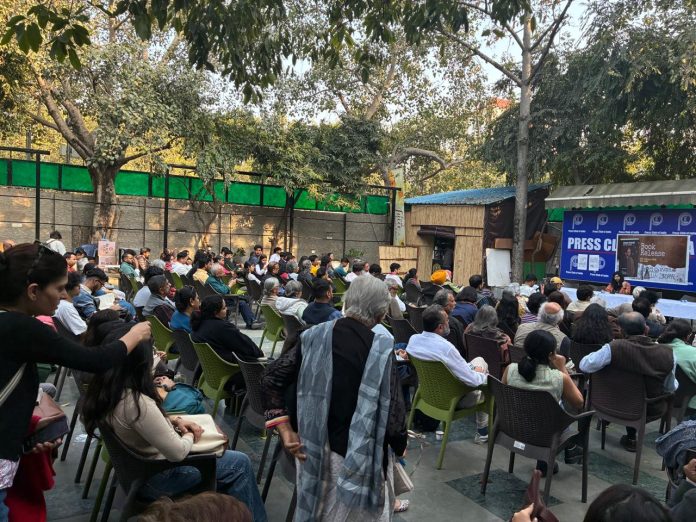
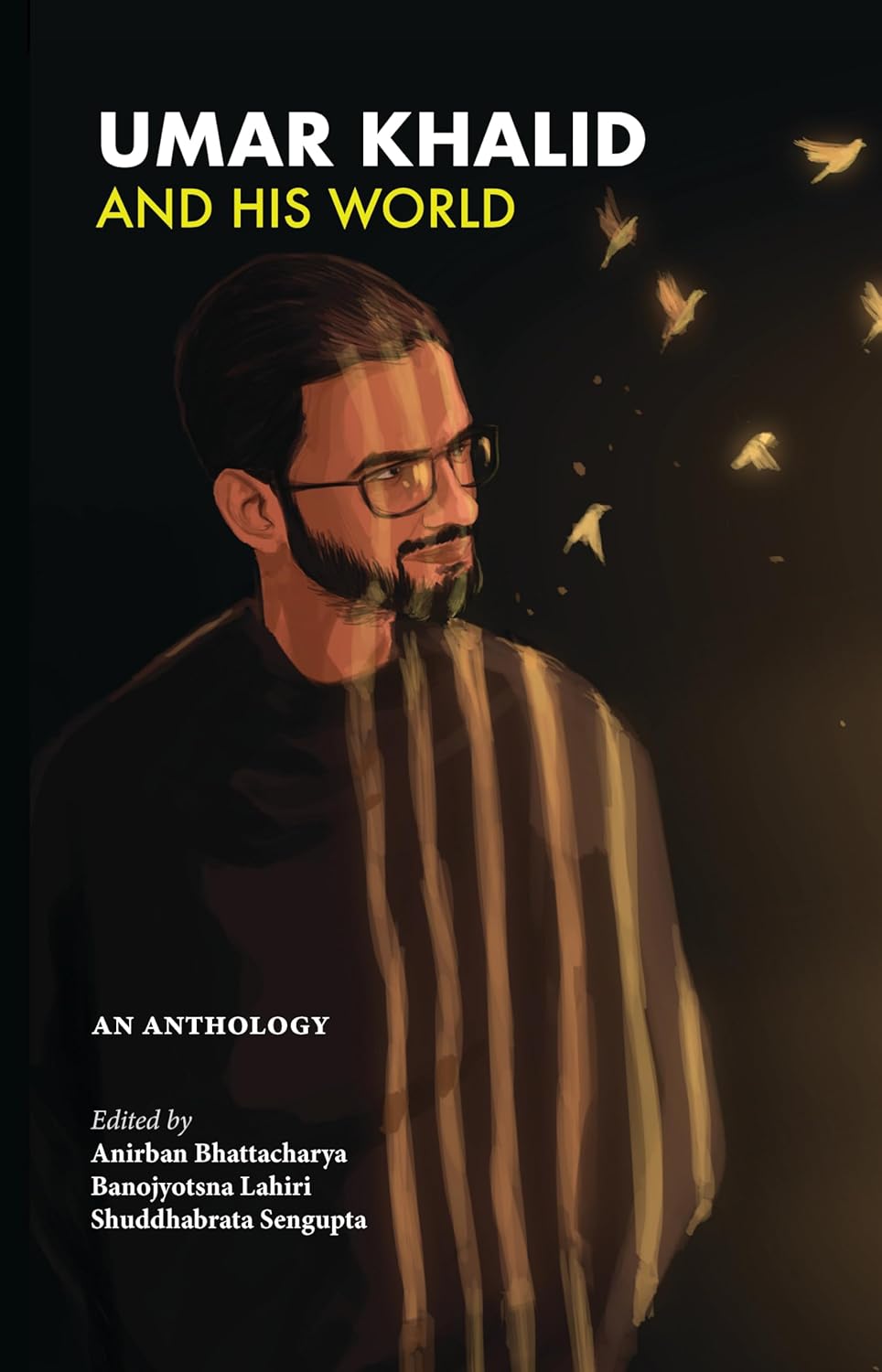
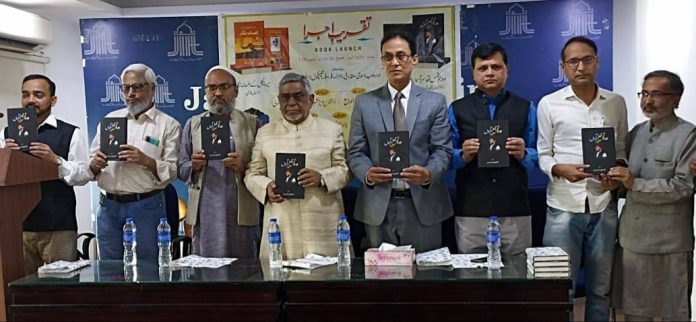
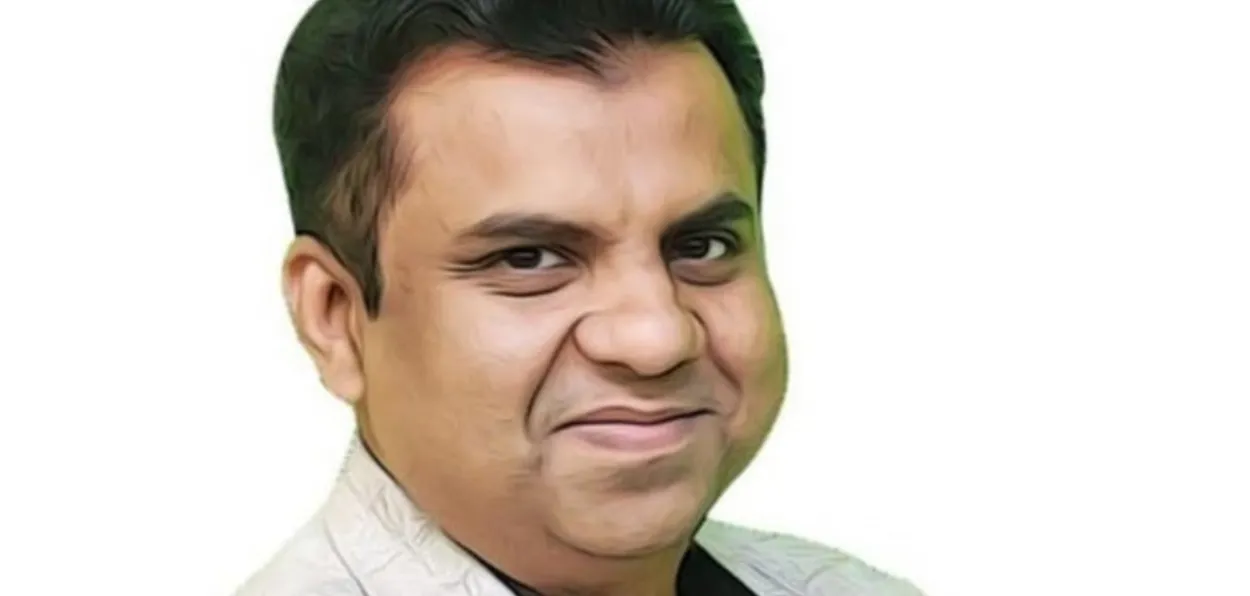
An overflowing audience of the young and the very old at the Press club of India, New Delhi, on Tuesday witnessed the release of a book on Umar Khalid, a JNU scholar now in jail these last six years.
The book titled Umar Khalid and His World: An Anthology, published by Three Essays Collective, is edited by Anirban Bhattacharya, Banojyotsna Lahiri, and Shuddhabrata Sengupta.
It is an anthology of writings by and about the incarcerated activist, featuring contributions from various public figures, intellectuals, and friends. The anthology is curated by researcher/activist Anirban Bhattacharya, writer and activist Banojyotsna Lahiri (who is also Umar Khalid’s partner), and artist/writer Shuddhabrata Sengupta.
The book features letters, essays, and reflections, including writings from Umar Khalid himself, along with contributions from Romila Thapar, Ramachandra Guha, Anand Teltumbde, and Kunal Kamra. It highlights themes of resistance, the injustice of prolonged detention, and the political atmosphere in India.
source: http://www.radiancenews.com / Radiance News / Home> Review Article> Book Release> Focus / by Radiance News Bureau / February 17th, 2026
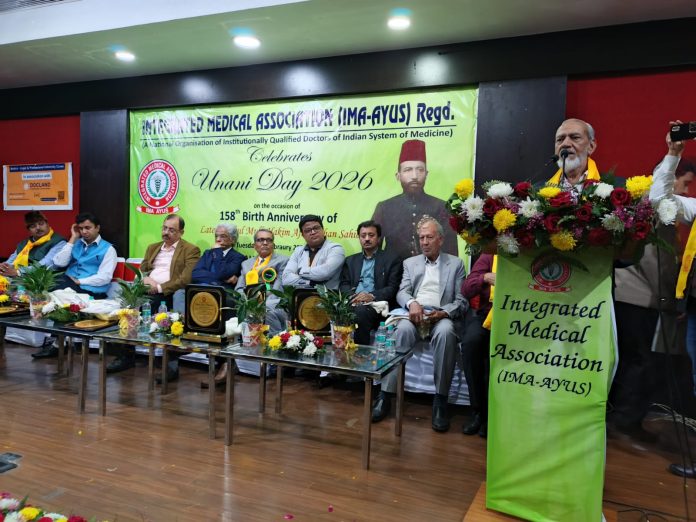
Tribute Paid to Hakim Ajmal Khan’s Medical Services; Awards Presented to Doctors
New Delhi:
On the occasion of the 158th birth anniversary of the eminent medical personality Hakim Ajmal Khan, a dignified felicitation ceremony was organised by the Integrated Medical Association (IMA–AYUSH) at the Ghalib Institute, Mata Sundri Lane, New Delhi. A large number of distinguished physicians and practitioners from across Delhi attended the event and paid rich tribute to Hakim Ajmal Khan’s outstanding contributions to Unani medicine.
Addressing the gathering, former Head of the Unani Department at Safdarjung Hospital, Syed Ahmad Khan, stated that Hakim Ajmal Khan elevated Unani medicine to new heights and introduced innovative treatment methods in line with modern medical requirements. He further said that Hakim Ajmal Khan’s intellectual insight and research contributions continue to serve as a guiding light for practitioners, and his medical philosophy will remain a source of inspiration for future generations.
During the ceremony, doctors associated with various medical institutions in Delhi were honoured with awards and certificates in recognition of their remarkable services. Speakers on the occasion reaffirmed their commitment to making collective efforts for the promotion of Unani medicine and for providing effective and safe treatment to the public.
At the conclusion of the programme, the organisers from the Integrated Medical Association announced that scientific and literary programmes would continue to be organised in the future to promote the ideas and medical legacy of Hakim Ajmal Khan, so that the younger generation may become acquainted with the services of this great medical leader.
On this occasion, Dr. R.S. Chauhan, in his address, said that Unani medicine is in fact a complete way of life and a balanced therapeutic system, to which Masih-ul-Mulk Hakim Ajmal Khan gave renewed vitality. He remarked that Hakim Ajmal Khan’s medical vision, research, and humanitarian approach continue to guide practitioners around the world. According to him, Hakim Ajmal Khan’s ideas hold fundamental importance in the promotion of the AYUSH system of medicine, the growing inclination toward natural healing, and the strengthening of public health. Dr. Chauhan further emphasised that introducing the younger generation to Hakim Ajmal Khan’s intellectual legacy and spirit of service to humanity is the need of the hour, so that this great treasure of Eastern medicine may be passed on to future generations.
Among those present on the occasion were Professor (Dr.) Kashinath Samagandi, Dr. Arif Zaidi, Dr. Raghu Ram Ayyagari, Professor (Dr.) Mohammad Idris, Hakim Imamuddin Zakaai, Professor (Dr.) Naseem Akhtar Khan, Dr. Syed Ahmad Khan, Dr. R.S. Chauhan, Dr. O.P. Vashisht, Dr. Naresh Kumar Chhwania, Dr. Raman Khanna, Dr. Mohammad Usman, Dr. Mohammad Asad, Dr. Arun Kataria, and Dr. Krishan Kumar Singhal.
source: http://www.radiancenews.com / Radiance News / Home> Latest News> Report / by Radiance News Bureau / February 19th, 2026
As the year draws to an end, we have compiled a brief list of the Indian Muslims who have been in news during 2021.
Danish Siddiqui :
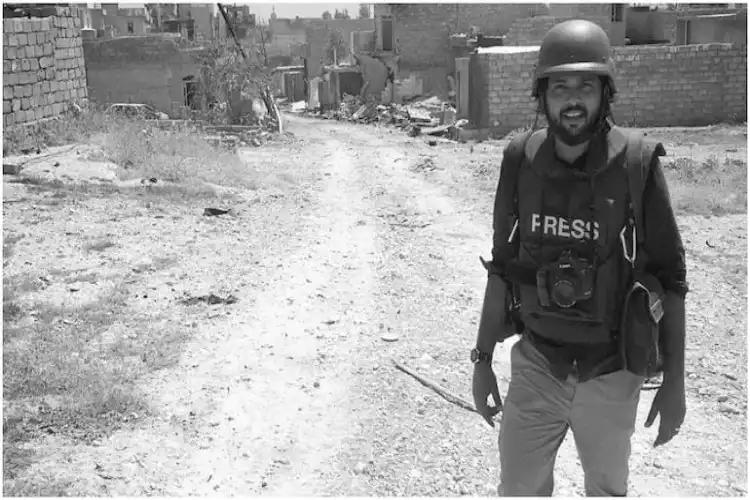
Danish Siddiqui was a Pulitzer Award winning photojournalist from New Delhi, who was killed by Taliban while covering the war in Afghanistan. An alumnus of Jamia Millia Islamia, Siddiqui was one of the country’s most well known photographers who documented the Rohingya refugee crisis, Covid deaths and the Delhi riots to win several awards. In July 2021, Reuters assigned him documentation of the Afghanistan War as an embedded journalist with Afghan Special Forces. On July 16, Siddiqui was killed in action. Governments of India, USA, Afghanistan and United Nations expressed grief and shock on his death and thousands joined his funeral procession in DelhI.
Dr Shahid Jameel :
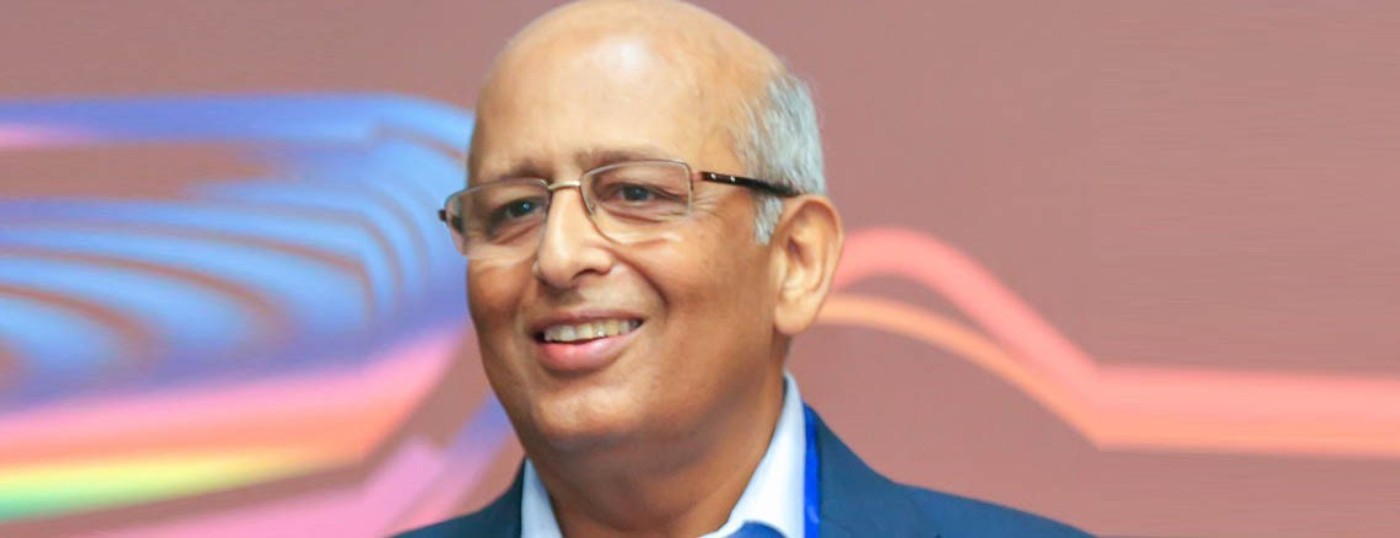
Dr. Shahid Jameel is a world renowned virologist and is one of the leaders of India’s fight against Covid-19. The Covid-19 outbreak has thrown new challenges to the scientific community. When the Government of India set up an Indian Sars-Cov-2 Genomics Sequencing Consortium (INSACOG), which consists of 38 laboratories to monitor the genomic variations in the SARS-CoV-2, Jameel was appointed as the head of its scientific advisory group. He served the INSACOG in this position till May, 2021 and still advises different government and non-government bodies in strategising the war against Covid-19.
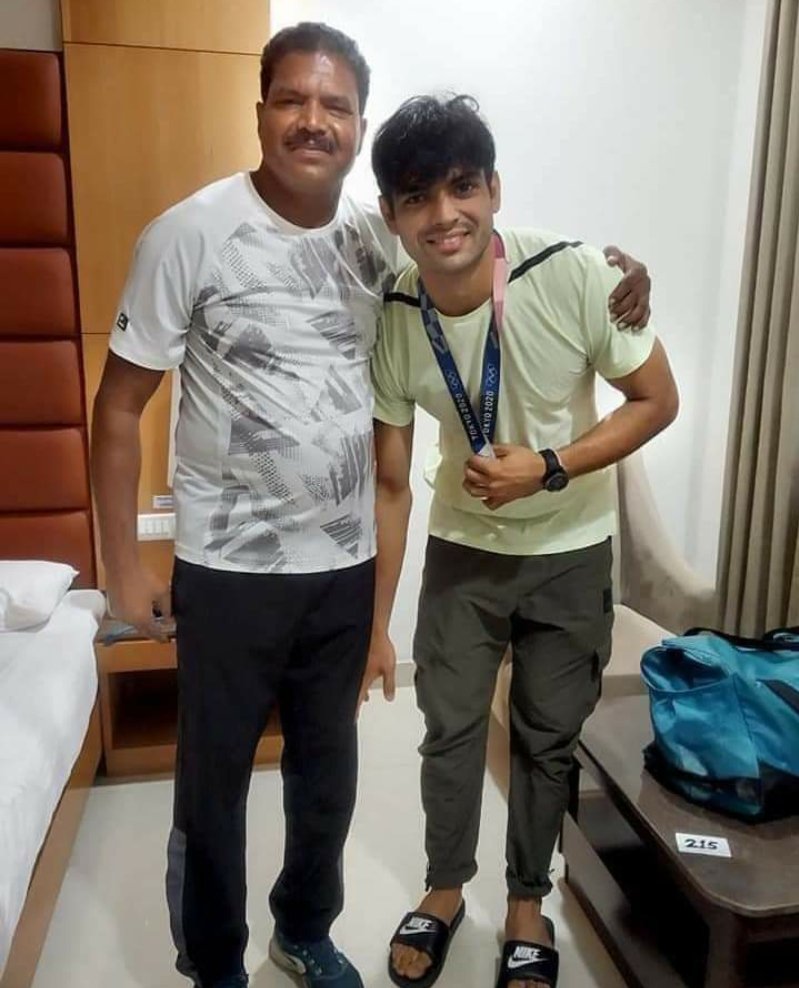
Coach Naseem Ahmed with Olympian Neeraj Chopra
Naseem Ahmed :
Naseem Ahmed: On 7 August, 2021, Neeraj Chopra threw Javelin for 87.58 mts. and became the first Indian to win an Olympic Gold in track and field events. With this success, Naseem Ahmed of Panchkula also hit the headlines. Ahmed was his first coach, who coached Chopra for almost six years at Tau Devi Lal Sports Complex in Panchkula. It was under his guidance that Chopra turned into an athlete from a chubby child. After returning to India, Chopra went to meet and receive blessings from his coach.
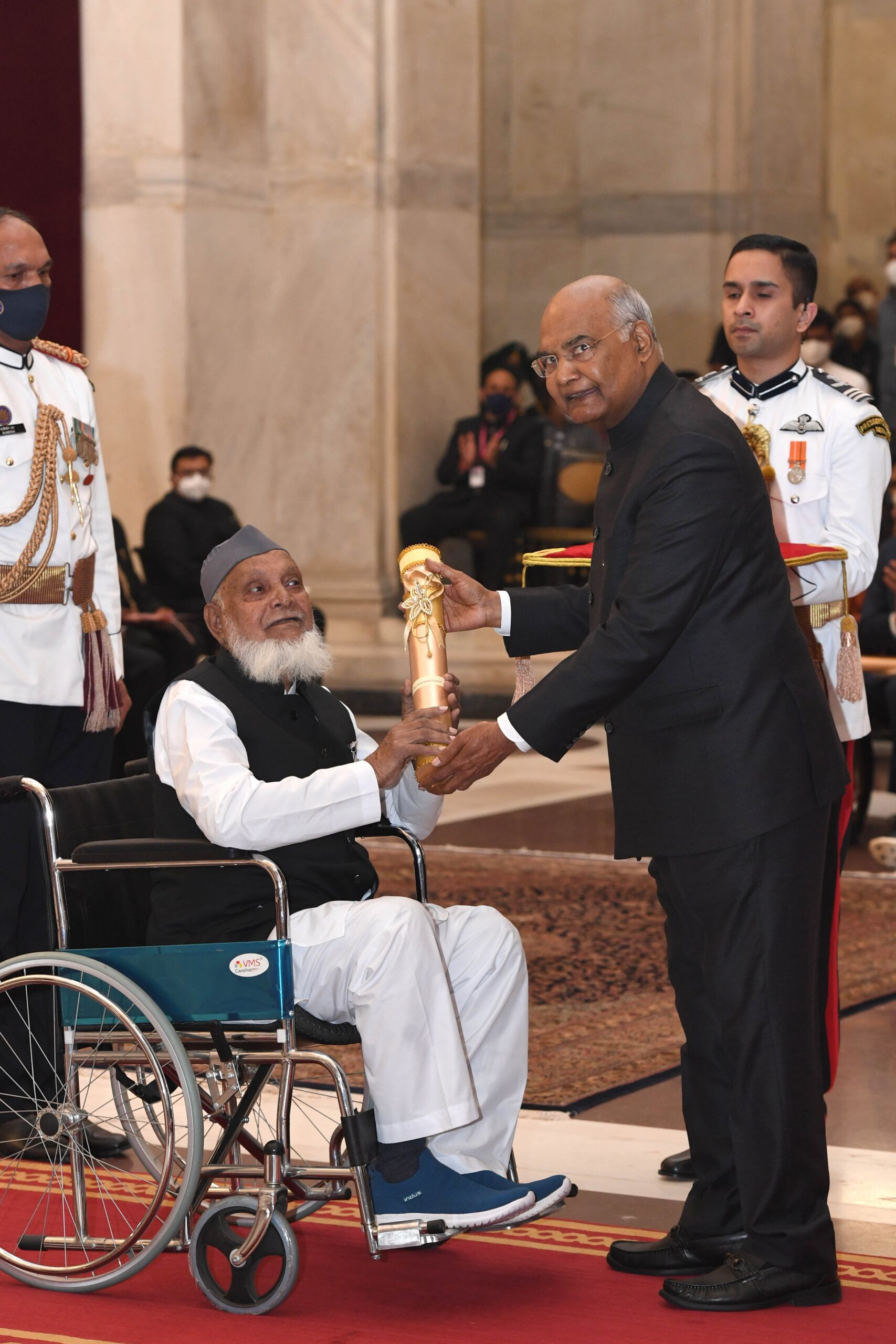
Mohammad Shareef alias Shareef Chacha receiving Padma Shri from President Ran Nath Kovind
Mohammad Shareef :
Mohammad Shareef is a bicycle mechanic from Faizabad, Ayodhya and hit the news headlines this year for receiving Padma Shri, the fourth highest civilian award in India, from the President Ram Nath Kovind. In 1992, his son was murdered and was eaten by animals as nobody claimed it. This incident moved him so much that he took it upon himself to perform the last rights of unclaimed dead bodies. In the last 28 years, he has performed the last rights of more than 25,000 unclaimed dead bodies according to their religions.
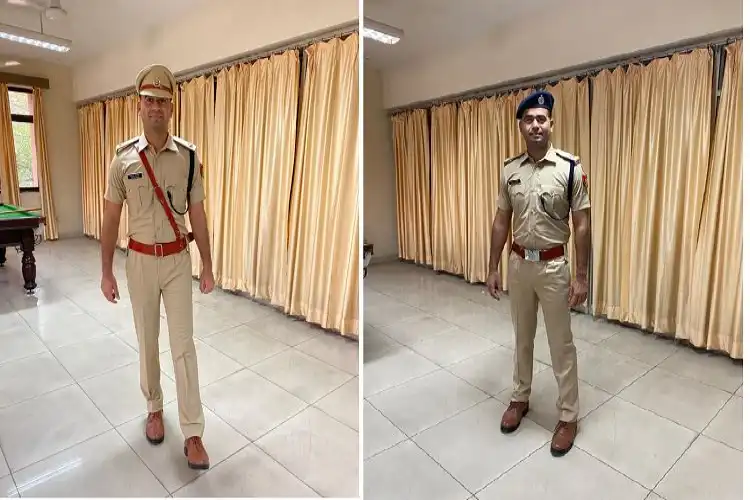
Firoz Alam as an IPS officer (Left) and as a Constable of the Delhi Police (Right)
Firoz Alam :
Firoz Alam’s story is straight out of a fiction, where his character bears resemblance to those played on screen by several film stars. Alam, a resident of Hapur in U.P, was a constable with Delhi Police since 2010. In 2014, he started preparing for UPSC CSE. The work pressure and family responsibilities did not allow him to devote full time to the studies, like many availing coachings could do. After five unsuccessful attempts, in his sixth attempt he qualified UPSC CSE and joined as an IPS officer. His inspiring journey from a constable to IPS had taken the nation by a storm when he joined the training after leaving the job as constable.
Sadaf Choudhary
Sadaf Choudhary :
Sadaf Choudhary came into limelight when the UPSC CSE results were declared in September and she secured 23rd rank. She was the highest rank holder among Muslims this year and will become an IAS officer. It must be kept in mind that since independence only 179 Muslims have secured ranks to get IAS allotted to them.
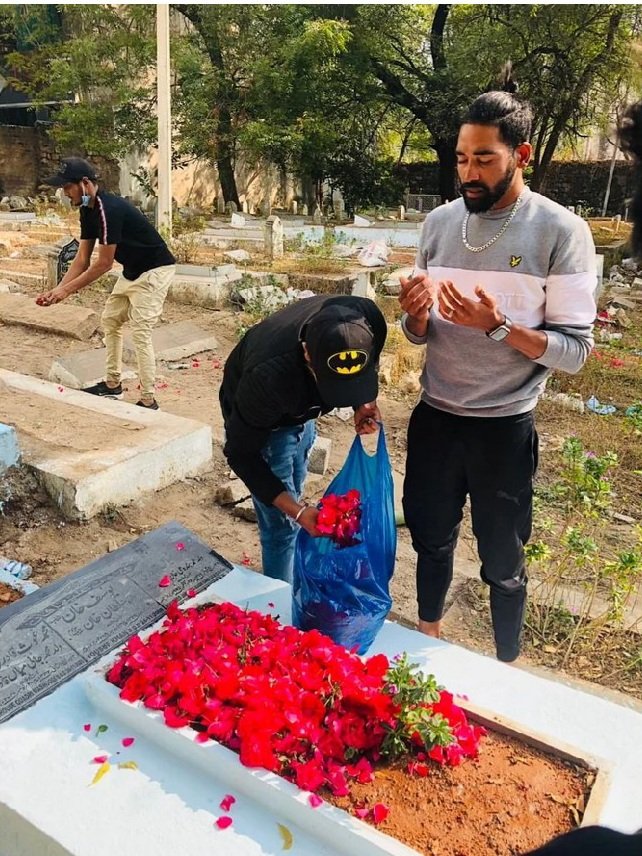
Mohammed Siraj praying at the gave of his father
Mohammed Siraj :
Mohammed Siraj is an Indian cricketer from Hyderabad who made it to the headlines in January by becoming the highest wicket taker from India during the India – Australia Test Match Series in Australia. To claim his 13 scalps, he played only three of the four tests in the series. The fact that his father had died just before the series and he was given an option to return to the country, which he declined citing his commitment to the nation made it even more special.
In the last test match at Brisbane, he bagged five Australian wickets to script a historic win and became a national hero. The headlines of the sports column were filled with his heroics, commitment and ability. Since then he has been a regular feature of the Indian Cricket team as a pacer.
source: http://www.awazthevoice.in / Awaz, The Voice / Home> Stories / by Saquib Salim / December 30th, 2021
A sense of ‘Think global, act local’ prevailed at the launch of two significant books “Who jo Shams tha Sar-e-Aasmaan” and “Seemanchal ke Afsana Nigar.” The launch was jointly organized by Forum for Intellectual Discourse and Idara Adab-e-Islami, Delhi on Sunday, 7 November, 2021 at the headquarters of Jamaat-e-Islami Hind.
The book “Who Jo Shams tha Sar e Assmaan” was compiled by Dr Noman Qaisar and Mohd Islam Khan and has 41 Urdu articles and six poems on the life and services of journalist Dr Abdul Qadir Shams who died during Covid-19 on 25 August, 2020. It also has four write-ups in English.
Another book “Seemanchal ke Afsana Nigar” is an effort to document the life and works of dozens of fiction writers of Seemanchal.
Presiding over the programme renowned Islamic scholar and former President of Maulana Azad University, Jodhpur, Prof Akhtarul Wasey said that the work done by Abdul Qadir Shams was ‘unusual’. “Shams used to sleep in Delhi but dreamed of Seemanchal.” The void left with his demise would always be felt in my life, said Wasey, who is also the Professor Emeritus of Islamic Studies at Jamia Millia Islamia. Seemanchal ke Afsana Nigar will be an indispensable work in the history of short-story writing. Prof Wasey also congratulated the Forum for Intellectual Discourse stating that the need for such an organization like the Forum could never be felt more strongly than the present times. He wished the Forum success.
Special guest, editor general at NCERT, Dr Perwaiz Shaharyar expressed happiness over organizing a meeting for a journalist in which a large number of people from media were present whose responsibility had grown manifold as the nation was confronted with difficult situations. He called the book a ‘valuable addition to literature’. Prof Abu Bakar Abbad had his reservations for confining any segment of Urdu literature to a specific region as Urdu was a global language. The protagonists, however, had their own arguments for identifying geographical regions, as was also the case with Seemanchal, a region long ignored by most literary aficionado.
Abdul Mannan, editor of monthly Yojana reasoned that the creative facets of Seemanchal remained shrouded because their writers usually shied away from the limelight. In that context, he considered Ehsan Quasmi’s work exceptional.
Chief guest, senior journalist Siraj Naqvi, who had worked with Abdul Qadir Shams for over a decade said that Shams new the art of maintaining relationships. Despite all the difficulties, the smile on his face would dispel worries. Author, critic and famous litterateur Haqqani Al-Qasmi paid a glowing literary tribute to his childhood friend Abdul Qadir Shams which moved the audience. He said Woh jo Shams tha… is not merely a collection of articles but teardrops flowing directly from the hearts.
Dr Waris Mazhari, Assistant Professor, Jamia Hamdard; Dr Khalid Mubashshir, Assistant Professor, Jamia Millia Islamia; Dr Ahmad Ali Jauher, Assistant Professor, Indira Gandhi National Open University; Dr Jasim Uddin Qasmi of Delhi University, Jamshed Adil Alig and Dr Zain Shamsi also shared their views. Uzma Shaheen, daughter of late Abdul Qadir Shams paid a rich tribute to her father.
Manzar Imam of Forum for Intellectual Discourse moderated the three-hour long programme which had begun with Qur’anic recitation of Abdur Rahman, followed by welcome remarks of Dr Mohammad Ajmal, Assistant Professor, Centre for Arabic and African Studies, Jawaharlal Nehru University. It ended with a vote of thanks by journalist Abid Anwar.
source: http://www.muslimmirror.com / Muslim Mirror / Home> Books / by Manzar Imam / November 10th, 2021
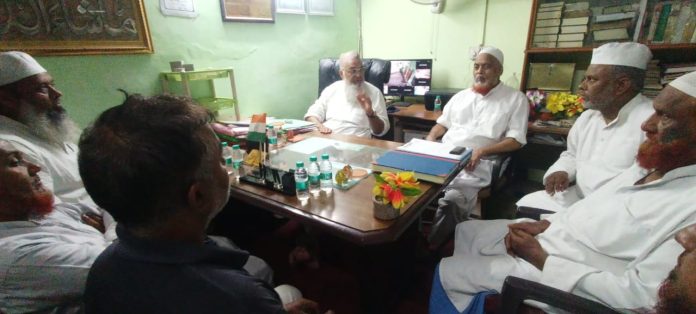
The annual meeting of the Executive Council of Rahmaniya Education Society was held at Darul Uloom Rahmaniya (a branch of Nadwatul Ulama, Lucknow), located in Sangam Vihar, New Delhi, under the chairmanship of Maulana Muhammad Khalid Nadwi Ghazipuri. In this meeting, renowned social figure and medical expert Dr. Syed Ahmad Khan was unanimously elected as the new President.
On this occasion, after presenting the Secretary’s report, Maulana Muhammad Khalid Nadwi Ghazipuri congratulated Dr. Syed Ahmad Khan on his new responsibilities and extended best wishes to him. The meeting conducted a thorough review of the educational and training activities of the madrasa and deliberated on its infrastructural needs. Additionally, the proposal for the annual increment in the salaries of the madrasa’s teachers and staff was approved.
The meeting also considered the inclusion of certain necessary contemporary subjects in the madrasa’s curriculum. In light of this need, a structured plan of action was prepared and a proposal was made to implement it.
Special participants in the meeting included Maulana Shamsul Haq, Dr. Obaidur Rahman, Haji Syed Zahid Ali, Abdul Ahad, Muhammad Ishaq Khan, Muhammad Sabir, and Me’raj Khan Nadwi, all of whom shared their thoughts and emphasised the importance of expanding educational and training programmes at Darul Uloom Rahmaniya.
The meeting concluded with an emotional prayer led by Maulana Muhammad Khalid Nadwi Ghazipuri, and a vote of thanks was delivered by Maulana Me’raj Ahmad Nadwi.
source: http://www.radiancenews.com / Radiance News / Home> Latest News / by Radiance News Bureau / July 07th, 2025
As Muslims all over the country are protesting against the Pahalgam carnage by the Pakistan-backed terrorists killing 27 persons, including a local ponywallah, Sameer Ahmed Siddiqui, a well-known IAS coaching Academy head, has proposed that the community should raise the “world’s largest anti-terror fund” to deal with aftermath of the terrorist attacks.
This fund, he said, would help the survivours and dependents of the victims of terrorism.
Sameer Ahmed Siddiqui, who is also emerging as a new age social thinker, says if 20 lakh Indian Muslims contribute Rs 100 each, a huge fund can be created. This fund can be used to provide financial assistance to the families killed in the Pahalgam attack for ‘seven generations’.
Sameer’s idea is similar to that of Kolkata’s Wali Rahmani, who established a state-of-the-art school for Rs 12 crore through similar small financial contributions.
Siddiqui’s idea is that the Chief Minister of Jammu and Kashmir, Omar Abdullah, must take the initiative for this fund. He says Abdullah must take the lead since Kashmir has been associated with terrorism and negative images for a long time. He said, “It’s time to associate Kashmir with a positive and historical record as well.”
He says, “At a place where innocent people have been killed after asking about their religion and attempts have been made to dishonour the Kalma, the world’s biggest anti-terror fund should be created on the call of the people there. This will not only change the face of Kashmir but will also send a strong message in favour of humanity.”
Sameer Ahmed Siddiqui presented his proposal on his YouTube channel ‘Team Sameer Siddiqui’ six days ago. The video has gone viral on social media, and the people are appreciating it as an ‘eye-opening initiative’.
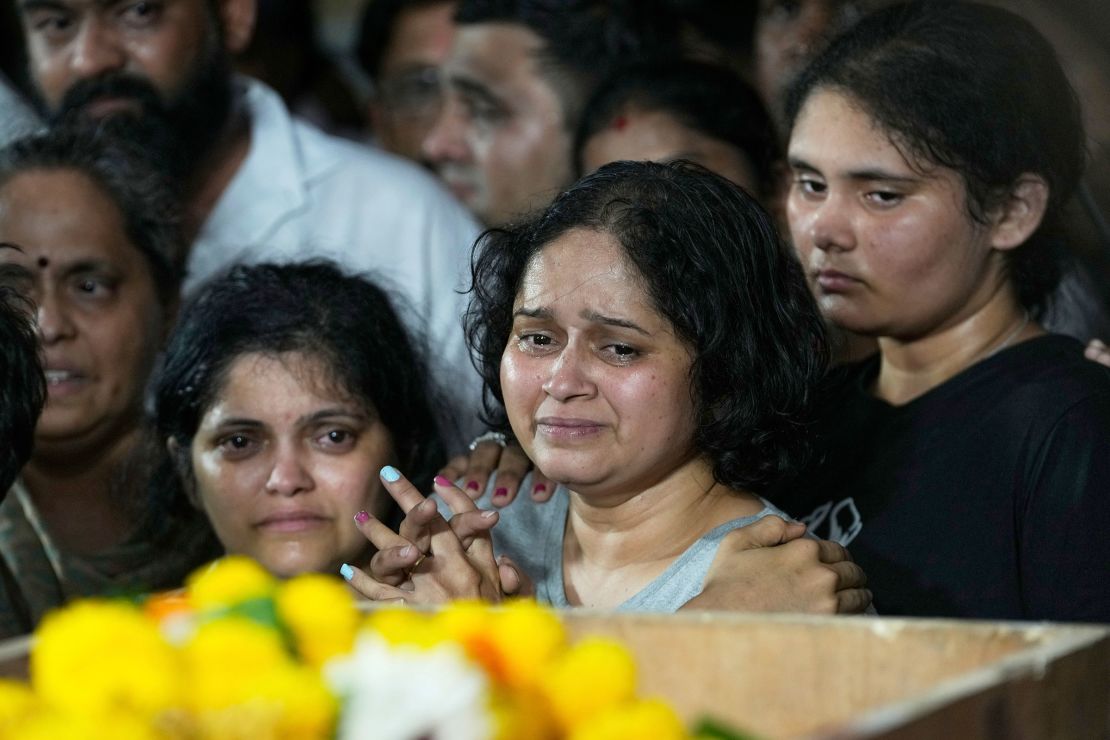
A family mourning the loss of their kin in the Pahalgam terrorist strike
The viewers have posted the following comments on the video:
“Sir, I salute your thinking. What you have said is very important in today’s time.”
“Distance from education is our failure today, scholars like you are our hope.”
“Subhan Allah! With what deep thinking you have given such a big message.”
Some of the reactions in the comments sections are as follows:
“How deeply you have explained a big thing.”
“The strongest answer is – unity and education.”
Sameer Ahmed Siddiqui is a reputed IAS coach and a business analyst. He has experience in the information technology and service industry. He is adept at operations management, communication, leadership and data analysis.
A graduate of Aligarh Muslim University, Sameer is currently the head of General Studies at M Puri IAS Institute, New Delhi. This institute is one of the top civil service training institutes in the country, from where the highest selection rate has been achieved in IAS, IPS, and Group-A services.
His books, especially the book on “Internal Security and Bilateral Relations”, are highly popular among competitive students.
Sameer advocates change in education in accordance with the needs of the future, and preparing the new generation for the era of Artificial Intelligence, Machine Learning and Robotics. He is also famous for beautifully combining the principles of traditional and modern science.
His lectures and analyses have been viewed and shared by millions of people on YouTube and other internet platforms.
If the Muslims of India unite and adopt this plan and the people of Kashmir take the initiative, then not only will the suffering families get support, but a new message will also be sent to the whole world – that the unity of humanity is much stronger than the hatred of terrorism.
source: http://www.awazthevoice.in / Awaz, The Voice / Home> Stories / by Malick Asghar Hashmi, New Delhi / April 28th, 2025
Mohammad Hashim, a porter at the New Delhi Railway Station railway station and an eyewitness to the horrific tragedy of stampede in which 18 persons died, tuned into a savior of a four-year old child.
He gets emotional as he recounts how a 4-year-old girl was resuscitated.
“…We were working like any other day when we suddenly heard screams. All of us, all porters, rushed there. We saw children on the floor, women & men running helter-skelter.
#WATCH | Stampede at New Delhi railway station | Mohammad Hashim, a porter (coolie) at the railway station and an eyewitness narrates the scenes he saw yesterday; gets emotional as he recounts how a 4-year-old girl, who he saved, was resuscitated.
“People were screaming. We pulled up a lot of children and brought them out. A few people had died and some others had fallen unconscious. We brought them to the ambulance.
“I rescued out 8-10 children…A woman was crying that her 4-year-old daughter died. I rescued the child and brought her out. Two minutes later, the child started breathing again, and she broke down.
“Her mother burst into tears of joy…We can call ourselves either brave or fools that we too jumped in, risking our lives…We saved several lives…”
He said he and other porters had never seen such scenes in their lives.
“Entire staff, GRP, RPF and porters were working on it…The crowd was for several trains. It happens every day, not just yesterday. But only God knows what happened…But porters helped a lot, there are 1478 porters here…”
source: http://www.awazthevoice.in / Awaz, The Voice / Home> Stories / posted by Aasha Khosa / February 19th, 2025
Badruddin Tyabji, the grandson of freedom fighter and third Congress President by the same name, was entrusted with arrangements for the inaugural Republic Day celebrations in 1950.
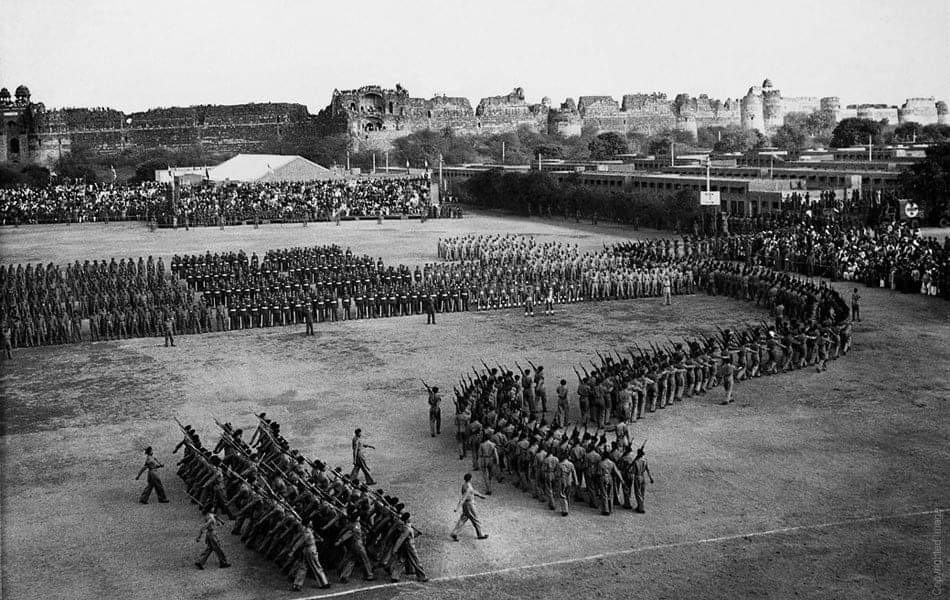
HISTORIC: National Stadium during the first Republic Day Parade. Old Fort is also visible
Every year on January 26, the Tyabji family sit together in their posh West End Colony house (near Vasant Vihar) to watch the Republic Day Parade which holds special significance for them.
Their late patriarch Badruddin Tyabji, a 1936 batch Punjab cadre Indian Civil Service officer, was responsible for looking after the arrangements of January 26, 1950 functions: first at the President House and later at Irwin Stadium (now Major Dhyan Chand National Stadium).
Tyabji’s painter wife Surayya Tyabji made the prototype of the Tri-colour on paper based on which the flag of cloth for Republic Day was made in Connaught Place.
“Just a couple of weeks before the first Republic Day, Prime Minister Pandit Jawaharlal Nehru entrusted me to look after the arrangements of the January 26 functions,” Tyabji told this writer in his south Delhi house in 1994.
He was also member secretary of the Constituent Assembly.
“I was called by Pt. Nehru and he gave me the huge responsibility for the historic day. I used to live at Sujan Singh Park during those days.”
From that day onwards, the tall and gracious Tyabji moved from the President House (now Rashtrapati Bhavan) to Irwin Stadium several times a day to finalise the arrangements as time was running out for the big day.
HAPPY FAMILY: The Tyabji clan including Laila Tyabji (centre, front row), who is a social worker, designer, writer and crafts activist
The big day for which Tyabji had worked so hard was also hectic for Rajendra Prasad, the soon-to-be first President of independent India. He marked the momentous occasion with a visit to Raj Ghat to pay homage to Gandhiji. He remained there for around 15 minutes.
But before the would-be President of India could get to the President House, C Rajagopalachari, the Governor General of India, had already reached there. The latter used to live in the double-storeyed bungalow at the then 10, Hastings Road, which was later renamed after him as Rajaji Marg. Edwin Lutyens, the chief architect of New Delhi, also lived in the bungalow, and so did Pranab Kumar Mukherjee, who also lived in that house after demitting his office of President of India.
“Dr Rajendra Prasad was sworn in as the country’s first President at around 9 am by the Governor General of India, C. Rajagopalachari. Rajvanshi Devi, his wife, and other family members were also there. The swearing-in ceremony was attended by over 500 guests, who had assembled inside the Durbar Hall. President Sukarno of Indonesia and several members of the Diplomatic Corps, members of the Constituent Assembly and prominent citizens had graced the occasion. The President was dressed in black achkan, white churidar and a white Gandhi cap. Pandit Nehru and his other Cabinet colleagues were sworn in soon after Rajendra Prasad,” recalled Tyabji, who was named after his grandfather, the third President of Indian National Congress.
Immediately after returning from Raj Ghat, Rajendra Prasad was sworn in. The Chief Justice of India, Sir Hiralal Kania, read the oath of office in Hindi. President Prasad repeated it sentence by sentence.
“The outgoing Governor General, C. Rajagopalachari; our first Prime Minister, Pandit Jawaharlal Nehru, beaming with pride and joy; the Deputy Prime Minister, Sardar Patel; cabinet ministers, judges of the Supreme Court and the Auditor-General of India, were present in the hall to witness the historic moment of India’s history. Pandit Nehru and his other cabinet colleagues were sworn in soon after.”
The national emblem of Ashoka Pillar with three lions was placed in the Durbar Hall for the first time near the throne where the British Viceroys used to sit.
A smiling statue of Lord Buddha was also placed behind the throne for the first time. Rajendra Prasad, the President, who greeted the large gathering smilingly with folded hands, made a short speech in Hindi and English, stating that it was a memorable day in our annals.
“Let us begin by offering our thanks to the Almighty Power who has enabled us to see this day; to the Father of the Nation who showed us and to the world at large his infallible method of Satyagraha, and led us on along it to freedom and to the numberless men and women, whose suffering and sacrifice have rendered the attainment of independence and establishment of this sovereign democratic Republic possible.”
The birth of the Republic was celebrated by the masses in the Capital through Prabhat Pheries (early morning movement of people singing patriotic songs). Outside the Durbar Hall, there were unforgettable scenes of jubilation. Large crowd of men, women and children had assembled in the forecourt of President House.
People raised slogans of Gandhiji-ki-jai and Vande Mataram.
After a dignified ceremony was held at the President House, the scene shifted to Irwin Stadium. The new President travelled to the stadium in a horse-drawn carriage and Delhi’s roads were lined up with enthusiastic crowd standing along the five-mile route with the Tri-colour in their hands. A huge crowd greeted the President’s entourage when it reached the vicinity of Connaught Place. And when the first President of India reached the stadium, he was welcomed with a booming 31-gun salute.
According to Tyabji, “Rajendra Prasad made a brief speech at the stadium. Later, students from various schools of the Capital presented cultural programmes.”
Old timers still recall that there were very few policemen guarding the VIPs inside the stadium. After the programme, the leaders mingled with the people. Nehru was mobbed by his admirers. He spent a good 20 minutes with them.
Tyabji, who could not sleep for several days ahead of the big occasion, was there managing the affairs carefully with his colleagues. Following very cold weather days in Delhi, brilliant sunshine greeted the Capital on January 26, 1950.
It was India’s defining moment, the day India truly freed itself from the shackles of colonialism to become a Republic. A truly sovereign state.
The talk of the first Republic Day cannot be complete without discussing the role of Tyabji’s wife, Surayya, in the making of the first Tri-colour.
According to Tyabji, “Once the Constituent Assembly finalised our Tri-colour with Ashok Dharma Chakra inside the flag, I was asked to furnish the model of Tri-colour on both paper and cloth.”
Without wasting any time, Badruddin Tyabji went straight to his Sujan Singh Park residence and asked his wife Surayya to make the Tri-colour on paper. She did not disappoint her husband. Once she made it on paper, Tyabji carried the design to the now defunct SC Tailors at Regal building of Connaught Place and asked them to make the Tri-colour in cloth. The rest, as they say, is history.
After retirement from government service, Tyabji also served as the Vice-Chancellor of Aligarh Muslim University in the 1960s.
He finally settled in Delhi and passed away in 1999. His wife, Suraiya, had died before him.
During one of our meetings, Tyabji had told me that when he came to Delhi from Hyderabad to appear for ICS examination, he was staying in Daryaganj.
He used to take a tonga to reach Metcalfe House in Civil Lines to appear for his examinations.
“Delhi was a very small city then. Except for old Delhi and villages, there was not much here. New Delhi was coming up,” he had said.
When India was divided on the basis of religion in 1947, he was perhaps one of the only two Muslim ICS officers who opted to stay in India instead of accepting Islamic Pakistan.
OFFICER RANK: Badruddin Tyabji was a 1936-batch ICS officer of Punjab cadre. His wife, Surayya was a painter
Tyabji’s first son, Hindal Ahmad, was an IAS officer. He passed away last year.
Tyabji’s daughter, Laila Tyabji is a noted social worker, designer, writer and crafts activist. She is one of the founders of Dastkar, a Delhi-based non-governmental organisation working for the revival of traditional crafts in India.
Like in the past, the Tyabji family would watch the annual parade this year too. After all, they are the true and proud first family of India’s Republic Day. Yet, they are so self-effacing.
source: http://www.thepatriot.in / The Patriot / Home> Cover Story / by Vivek Shukla / January 26th, 2024
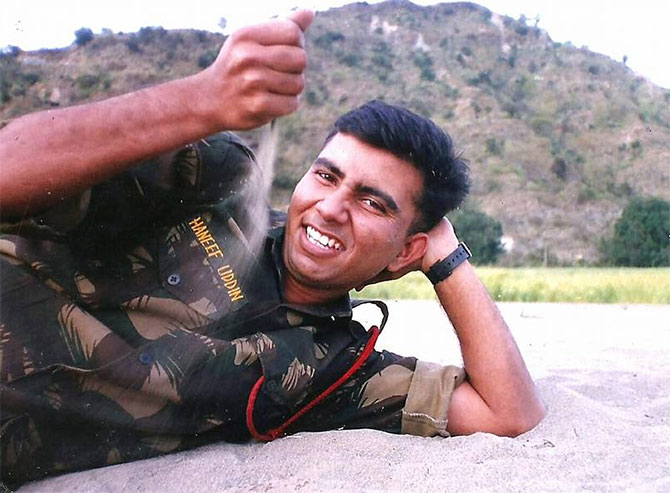
Pakistan’s misadventure in Kargil will be remembered not only for the convincing win of the brave Indian army but also for some of the heroes who sacrificed their lives for our dear motherland. Prominent among those heroes was a 25-year young Captain Haneefuddin of 11 Rajputana Rifles who led from the front and made the ultimate sacrifice. Martyr Vir Chakra Captain Haneefuddin had to be from the Dilwalon ki Dilli! Truly, he had a large heart for he volunteered to command an operation to capture a post which would give a vantage position to observe the enemy’s movements.
It was quite early days of Kargil war when there was hardly any information available about the enemy troops. A company of 11 Rajputana Rifles was deployed in Operation Thunderbolt on June 6th, 1999 led by Captain Haneefuddin. It was at an altitude of 18,000 feet in the Turtuk region. The Mission: To capture a position in the region which would facilitate the Indian army to monitor the movements of the enemy troops better. The capture of this position would give the troops a strategic advantage in those early stages of the war. Captain Haneef volunteered for this Operation Thunderbolt as it was his ingrained in his nature to lead from the front. He set off for the vital operation with one junior commissioned officer and three other ranks. They made significant strides on the nights of 4th and 5th June 1999. They captured nearby positions. They captured the adjacent position and set out their advance on 6th June 1999 to capture the position they desired. They were undaunted by an altitude of 18,500 feet and extremely cold temperatures. They were however spotted by the enemy and fired upon. A firefight followed, against an enemy equipped with heavy artillery.
Captain Haneefuddin was concerned about the safety of his team more than himself. He took up a position and fearlessly showered bullets on the enemy. In the exchange of bullets, he was severely injured. But he kept engaging the cunning enemy, until his boys were safe from the enemy fire. Unfortunately, he ran out of ammunition and he was shot from all directions. He succumbed to his injuries, just 200 meters from the position they valiantly set out to capture. He displayed extraordinary valor in the face of the enemy and cared more about his team’s safety than his own. Captain Haneefuddin attained martyrdom at the young age of 25. It was exactly two years after he was commissioned in the army. But his body could not be retrieved due to heavy firing till a brave Colonel Bhatia and his illustrious team set out to retrieve the body. It was on 18th July, 43 days after Haneef’s martyrdom, Captain S K Dhiman, Major Sanjay Vishwas Rao, Lieutenant Ashish Bhalla, Havaldar Surinder and Rifleman Dharam Vir volunteered for the task.
Col. Bhatia and his team carefully negotiated the deadly precipices. The team managed to locate the brave heroes Haneef and Parvesh. They extricated the frozen bodies. Dragging them behind the boulders, the team carried the fallen heroes on their backs. They walk quietly through the night, reaching Zangpal by early morning. A helicopter carried the bodies away as the brave Colonel Bhatia watched the body bags with moist eyes for one last time.
Vir Chakra Captain Haneefuddin’s mother Hema Aziz had paid tribute to her martyr son thus: “As a soldier, Capt Haneef served his country with pride and dedication. “There cannot be a greater statement on his valor than his death which came while fighting the enemy.” Later, a subsector in the battle zone was named as Subsector Captain Haneefuddin.
It is interesting to note that Captain Haneefuddin had gone to fight for 11 Rajputana Rifles whose war cry is ‘Raja Ram Chandra ki Jai’. Twenty years later, in February 2020, in Captain Haneefuddin’s hometown – Delhi, a similar war cry — Jai Sri Ram was used by the rioters who looted, raped, killed innocents, destroyed 11 mosques and burnt down the copies of the Holy Quran, according to the just released report of the Delhi Minorities Commission. Those who carried out this pogram do not have guts to go to the borders and fight the enemies Pakistan and China. Instead, they choose our own citizens!
Where have the Dilwallas disappeared from Dilli? Lest we forget Kargil War Hero Vir Chakra Captain Haneefuddin and other heroes!
source: http://www.beyondheadlines.in / Beyond Headlines / Home> Lead / by Dr Ahmed Mohiuddin Siddiqui / July 27th, 2024
Mohibbullah Nadvi’s nomination by the SP and his road to victory in the general elections were peppered with confusion and drama. He was not the party’s first choice candidate and filed his papers at the last hour on the final day of nomination on March 27.
Mohibbullah ‘Nadvi’. Photo: Omar Rashid
New Delhi:
Mohibbullah ‘Nadvi’ took 19 years – and a detour through his home town, Rampur in Uttar Pradesh – to traverse the roughly 25-30-metre-wide tarmac separating Indian parliament from the mosque where he leads prayers as an imam. Surprising everyone, the Samajwadi Party nominated the 48 year old as its Lok Sabha candidate in Rampur; and, battling several odds, Nadvi came through, defeating the Bharatiya Janata Party by over 87,000 votes.
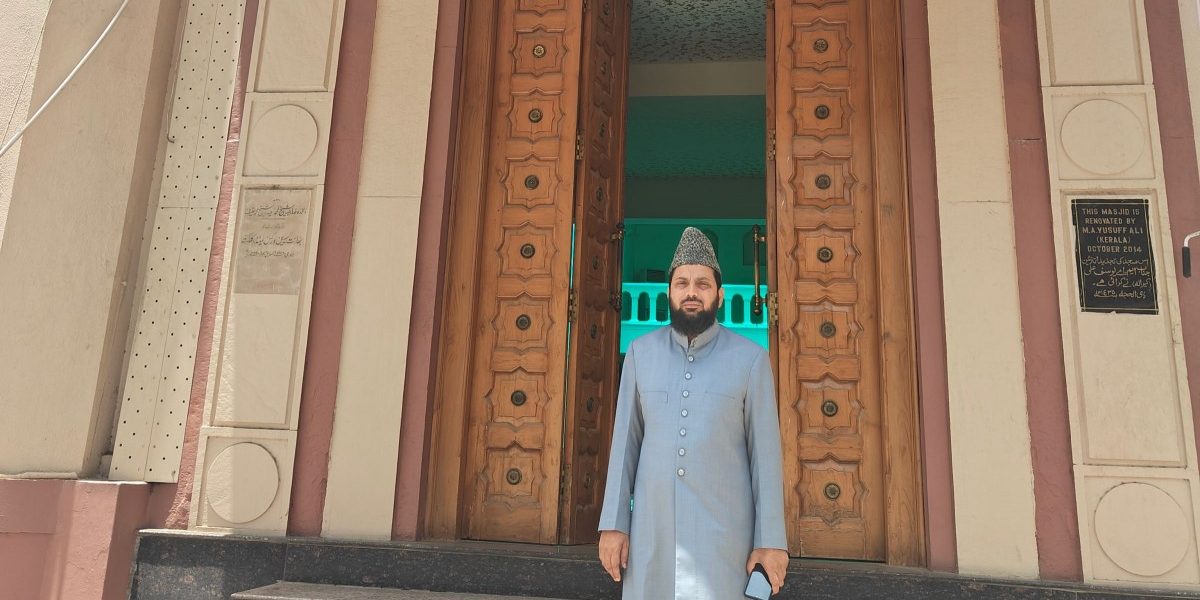
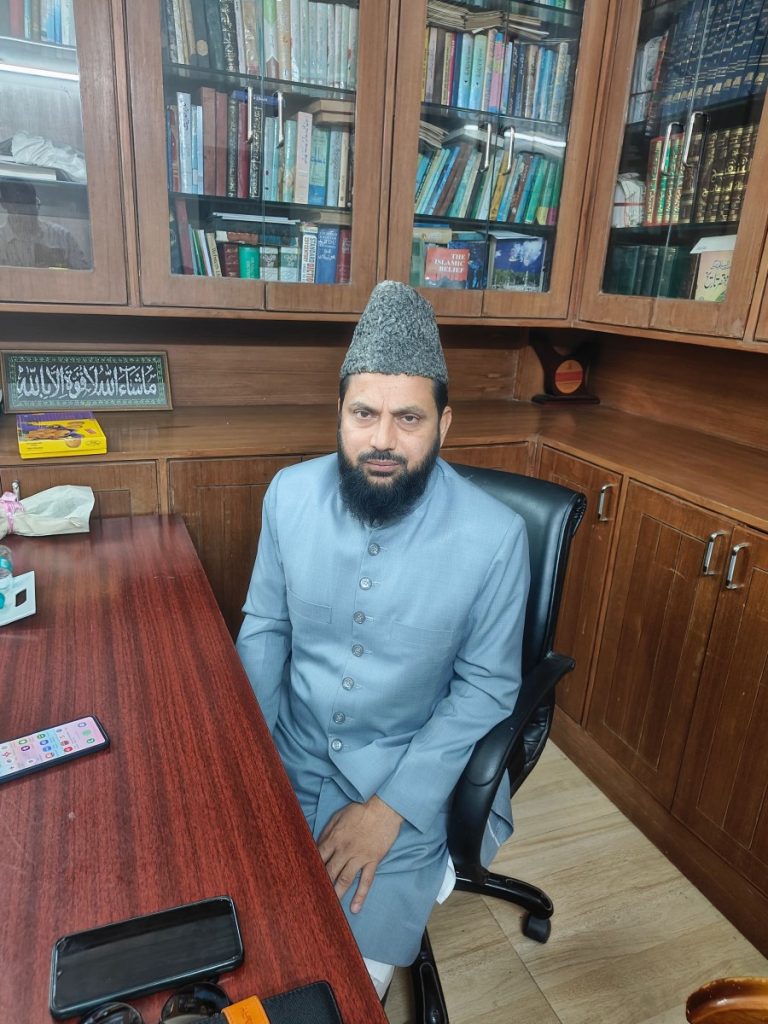
It is a little past noon and the sun is blazing down on Parliament Street, where the Jama Masjid is located in the capital. Nadvi has been its imam since 2005. With a small group of associates, he is seated in his office, still receiving congratulatory phone calls.
Nadvi was one of the five Muslims who were elected as MPs from UP this time. Six had contested. Nadvi hoped that now that the Opposition had performed better, taking the BJP head-on on issues of livelihood, the question of the worryingly low Muslim representation may be addressed better. But it should not be seen solely through the lens of numbers, he said.
“Our political representation should not be seen in terms of quantity but quality…even if there is one person, who is good, 100% faithful to the community, understands Islamic things and sentiments of Muslims, and raises their questions correctly,” Nadvi told The Wire. Muslims in India were not asking the government for anything beyond the rights the Constitution promises all citizens, he added.
Nadvi’s nomination by the SP and his road to victory in the general elections were peppered with confusion and drama. He was not the party’s first choice candidate and filed his papers at the last hour on the final day of nomination on March 27. Nadvi’s nomination also caught several party leaders by surprise as he did not have a political background. Fielding a Delhi-based maulana from a communally-sensitive constituency marred by internal divisions in the SP did not seem like a clever decision to many.
Though he had met SP president Akhilesh Yadav once when the latter was chief minister in 2012, the breakthrough came when they spoke in Lucknow in January this year. According to a source, Nadvi, who harboured electoral ambitions, had gone to Lucknow to invite Yadav to an event of Muslim leaders in Delhi. In Lucknow, Nadvi came in touch with Uday Pratap Singh, former MP and a close associate of Akhilesh’s and his late father Mulayam Singh Yadav’s, and also met Shafiqur Rehman Barq, former MP, with whom he already shared a good connection. Barq, a Turki Muslim like Nadvi, pitched for the maulana. That would be Barq’s last visit to the SP office as he died a month later, aged 93.
Mohibbullah ‘Nadvi’. Photo: Omar Rashid
Akhilesh did not promise Nadvi the ticket right away, but kept him on stand-by as an alternative, if needed. As nomination day approached, the SP was caught in a mini-crisis as it failed to zero down on candidates in two important and winnable seats, Rampur and Moradabad, both with a record of electing Muslims. Much of this had to do with the stubbornness of senior leader Azam Khan in having his say in candidate selection in his bastion.
On March 22, Akhilesh visited the Sitapur jail to meet Khan, who is incarcerated there, to discuss the candidates in Rampur and adjoining seats. Khan, who has faced the endless wrath of the Yogi Adityanath government, apparently proposed that either Akhilesh contest himself from Rampur or nominate one of his family members. This did not sound feasible to the party.
According to sources, the party asked several leaders to contest from Rampur but Saleem Shervani (ex-MP from Budaun), Kamal Akhtar (former minister) and S.T. Hasan (elected Moradabad MP in 2019) all rejected the proposal. Nobody wanted to encroach on Khan’s territory.
The SP’s top leadership wondered if it would be feasible to field Tez Pratap Singh Yadav, Akhilesh’s nephew and former MP, from Rampur but apparently the idea was turned down by Akhilesh’s uncle Ramgopal Yadav, the party’s national general secretary.
Only a day was left for the nomination and the SP was without an official candidate. A disaster was on the cards.
A similar situation prevailed in neighbouring Moradabad, where two candidates of the SP, sitting MP Hasan and former MLA Ruchi Veera, a close associate of Khan’s, both filed nominations, confusing the rank and file of the party. To Hasan’s dismay, Veera even received the party’s authorisation letter as its official candidate. He was obviously not happy.
In Rampur, too, the matter got out of hand after Asim Raja, an aide of Khan’s, filed his nomination while claiming to be the SP’s candidate. Raja, who had lost the Rampur seat in a by-poll in 2022, even led the Khan camp to declare a boycott of the 2024 election as Akhilesh had not paid heed to their request of contesting himself.
It was around 5 pm on March 26 that Nadvi received a call from the SP informing him that he would be the official candidate in Rampur. Along with his aides, he left for Rampur overnight. With the clock ticking, SP state president (and now MP) Naresh Uttam Patel along with a trusted lawyer boarded a chartered flight to deliver the Form AB to Nadvi, and in a change of tack, nominate the disgruntled Hasan as the official candidate in Moradabad by handing him the party’s authorisation letter. The flight landed on an airstrip in Mundha Pande, midway between Rampur and Moradabad, at around 11 am, sources said. Nadvi managed to file his nomination on time but Hasan could not receive the authorisation letter within the stipulated period. Their first priority was Rampur.
“It was a difficult time. We didn’t even have a back-up candidate. Time was running out,” Nadvi told The Wire, recalling the tense moments before his first-ever nomination. Later, Hasan in an interview to PTI alleged that some leaders had “conspired” to ensure that the party’s authorisation letter did not reach him on time.
After his nomination, Nadvi battled the ‘outsider’ tag, the internal opposition of the Khan camp, BJP’s communally-driven campaign and hostility from the administration. He brushed aside the outsider tag, underlining that he was born in a village, Razanagar, in Suar tehsil of Rampur. His uncle was a former pradhan. Nadvi, who owns 7.44 acres of inherited land in his village, completed his Quranic education or Hifz from Rampur city before spending time in a madrasa in Sambhal.
Following that, he went to Lucknow to pursue his higher education in Islamic studies from the renowned seminary Darul Uloom Nadwatul Ulama, from where he got his title. Nadvi then went to Aligarh for further education but as he did not appreciate the heated political climate on campus, he instead enrolled in Jamia Millia Islamia University in Delhi and graduated from there in Arabic Honours. He went on to complete his MA in Islamic Studies and got a BEd from Al-Falah University. In 2005, he was appointed as an imam at the Parliament Street Mosque after clearing an interview. “I didn’t have much inclination towards politics earlier. But I did develop some interest as the people who offered namaz behind me included some very important political people,” said Nadvi, on being asked why he suddenly jumped from the pulpit to politics.
Given the mosque’s location, top Muslim politicians and officials come there to pray. Even the likes of Liaquat Ali Khan, Maulana Azad and Zakir Hussain, former president of India, prayed at the mosque or used to visit it, said Nadvi. Jawaharlal Nehru and Indira Gandhi too have visited the mosque, whose compound houses an elegant white tomb of former president Fakhruddin Ali Ahmed. Nadvi, who took over prayers at the mosque at 29 years of age, was delighted to share that even former President A.P.J. Abdul Kalam had prayed behind him.
The maulana feels that Akhilesh took a “strong decision” by nominating him in Rampur, where he initially faced opposition from a section of party workers loyal to Khan.
“I faced some problems from our party friends who were unhappy. But I managed to tackle them beautifully. Credit to them, they also did not hype it so much, maybe due to public pressure or my acceptance in public,” said Nadvi. He feels his identity as an Islamic scholar and imam may have helped him win acceptance in his native land. “I have roots in Rampur. I want to take everyone forward and work on education and health,” he said.
While his nomination process was controversial, following his victory, too, Nadvi has garnered the headlines. He was trolled by supporters of Khan after he met the divisional commissioner of Moradabad, Aunjaneya Kumar Singh, who while serving as the district magistrate of Rampur had initiated a wave of action against Khan and his family members. Nadvi downplays the meeting. “I am a mazhabi alim. I don’t have negativity towards anyone,” he said, adding that he had met the official to discuss plans for the betterment of his constituency.
He also landed in a soup for his comments on the jailed Khan. When asked by reporters if he would visit the leader in jail, Nadvi said, “People are sent to jail for correction. Jail is a correctional facility and I can only pray for Azam Khan.”
Azam’s wife and former MP Tazeen Fatima lashed out at Nadvi for the comments. “He said that jail is a correction home. It seems like he had a deep experience of going to jail and he has been to jail,” she said.
Nadvi said his comments were misrepresented and exaggerated by the media. “I said that the jail is not heaven, that we would like to go there. We have our empathy for Azam sahab. What else can we do for him? The media gave it unnecessary hype,” said Nadvi. When I asked him if his relationship with Khan was fine, he took a long pause and before he could answer, an aide of his cried from the other end of the small room, “Abhi tak toh theek hai (So far, it’s fine)!”
Ruchi Veera, the newly elected Moradabad MP, visited Khan’s family following her win. She criticised Nadvi for his comments on Khan. “He should not forget that he won because of the party and Azam Khan sahab has made a lot of sacrifices for the party,” Veera said. She called him out for his “political immaturity”. “He’s not a political person. I don’t know how he got the ticket for the election and won.”
In Rampur, Nadvi not only saw off the challenge from the BJP but also ensured that the Muslim candidate of the Bahujan Samaj Party did not spoil his chances. The BSP candidate received 79,000-odd votes while he beat the BJP by over 87,000 votes. Had the election been conducted in a “fairer” manner, the margin would have been over one lakh to 1.5 lakh, said Nadvi, alleging that voting had been disturbed on 12 to 15 booths where the SP had a strong voter base.
Despite the BJP’s shrill anti-Muslim campaign, Nadvi says even Hindus voted for him, as he went to people with a “positive message”. “I spoke about education, health and employment. Who would the people choose? Someone who is abusing others or one who is asking them about their needs?” he asked. In an election where the BJP lost the election in the land of the Ram Mandir, a maulana scripted a successful political debut in a district bearing the name of the Hindu deity.
source: http://www.thewire.in / The Wire / Home> Reportage> Politics / by Omar Rashid / June 15th, 2024