Belonging to a conservative Muslim family, it was hard for Fatima Ahmed to break the shackles but she made sure to follow her dreams and do all that she ever wanted. From travelling the world to living like a “gypsy” and creating her very own niche in the world of art, Ahmed has lived her life on her terms. Read about this feisty and inspiring artist.
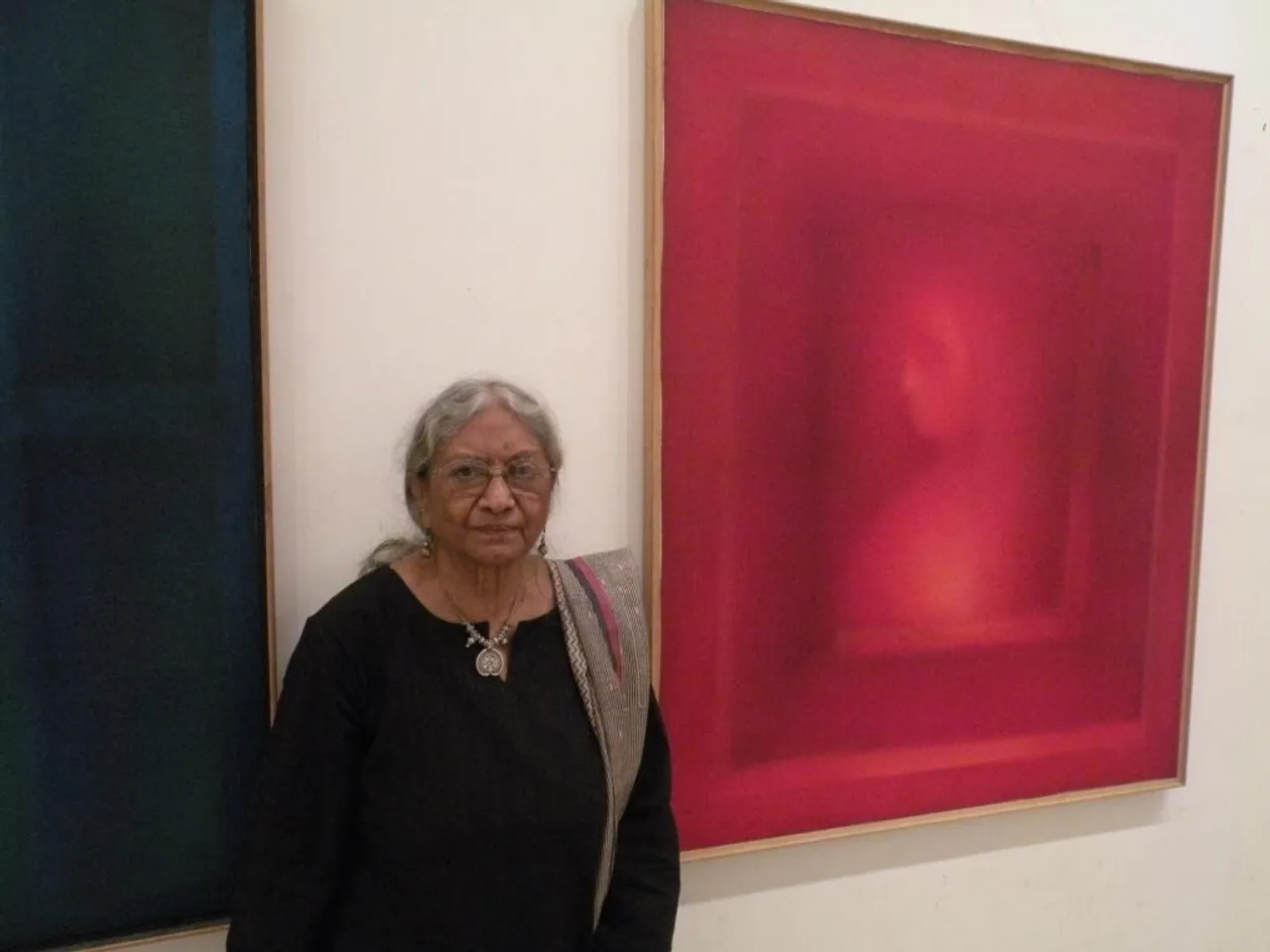
Legendary rebel artist and writer Fatima Ahmed, who is nearing 80, is a picture of contrasts. While she is fun-loving and full of life, her paintings are still and silent. (Credit: Surekha Kadapa- Bose\WFS)
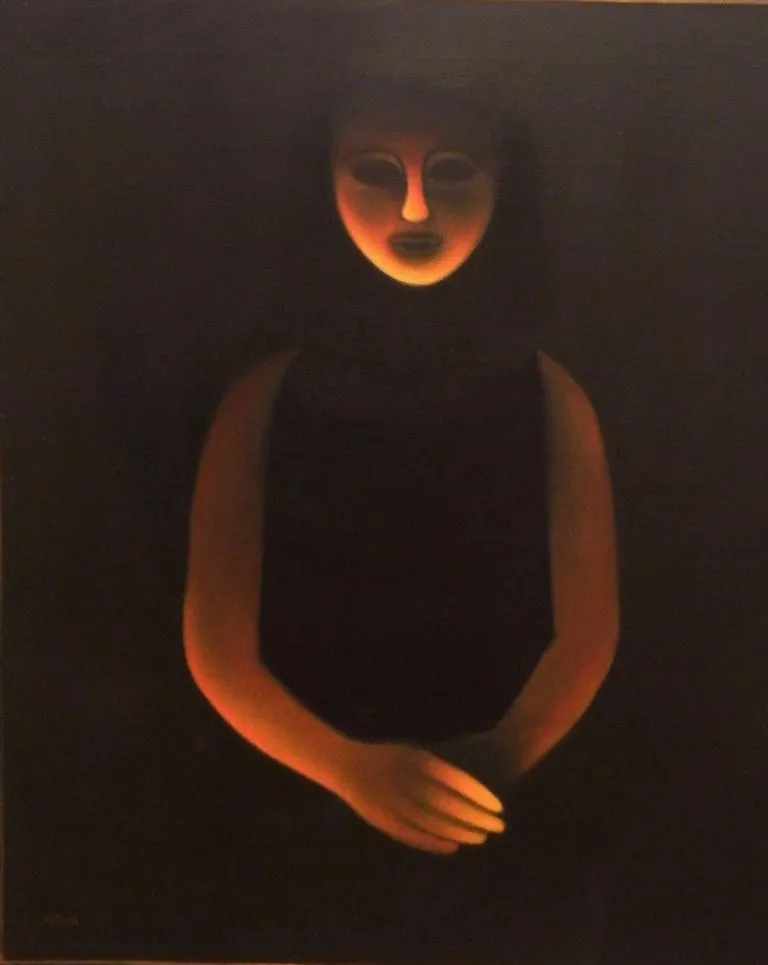
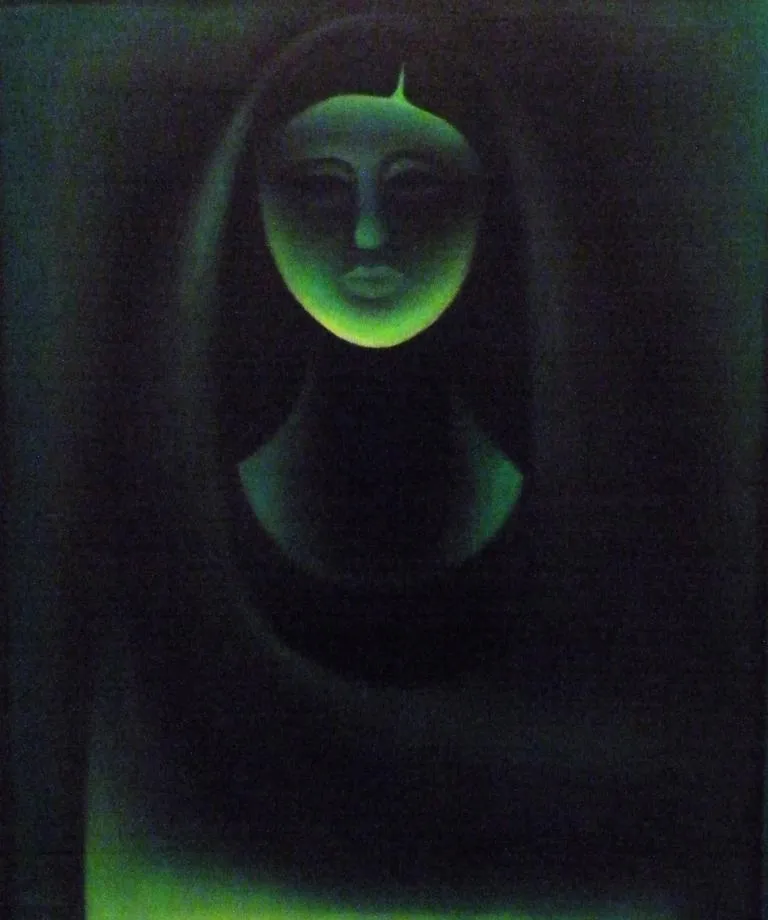
‘If only silence could speak’ goes the adage. Well, here silence does speak – and how! Soft, hazy, elusive images of women gaze steadily from the confines of their canvas making the much-mesmerised onlooker feel as though they would simply vanish if s/he so much as blinked. The women in red, pink, beige oil paints look ethereal, delicate and yet they convey power, strength – much like the woman who has created them.
“Space and light are very important to any work of art, especially paintings,” explains legendary rebel artist and writer Fatima Ahmed, whose latest oil canvases were on display in Mumbai recently. She continues, “In life, there has to be some mystery. Everything shouldn’t be very obvious and spoken out loud. In my works I don’t like clutter, loud colours or screaming. I like my paintings to be as subtle as a whisper.”
“Let me start by saying I simply love to eat the crisp crust of a samosa,” she says, with twinkle in her eyes, before adding, “Now as far as the silence in my work is concerned, throughout my life I have been more of an observer. I was a recluse during my childhood as I didn’t have anyone to share my thoughts and feelings with. I was a rebel for everyone around me and way back in the middle of last century it wasn’t a good sign.”
Coming from a conservative Muslim family in Hyderabad, Ahmed never really fit in because she was a free spirit who believed in equality. Her father was a Collector under Nizam Osman Ali Khan, Asif Jah VII, the last Nizam of Hyderabad.
In her joint family, daughters were married off in their early teens within the extended family. Moreover, as the Ahmed family was very highly placed within the Nizam’s palace, its members, too, were treated as royalty, which was never acceptable to her.
“I just couldn’t tolerate treating those employed in our household as slaves. Besides, women in that era didn’t have any say in any sphere of life and were forced to blindly follow all the dictates of men without questioning them. I certainly wasn’t going to do that,” she says emphatically, her voice betraying the anger she still feels towards the strict patriarchal rules they were made to adhere to in that period.
The women in red, pink, beige oil paints look ethereal, delicate and yet they convey power, strength. (Credit: Surekha Kadapa-Bose\WFS)
So Ahmed grew up with vivid visions of freeing everyone who was treated as a lesser human being. “Quite unknowingly, I was influenced by socialism,” she remarks. And at that age she had also made up her mind that she would rather die than marry one of her cousins. According to her, the one good thing her father did was to enrol her in the Government Mahaboobia Girls School, the foremost learning institution at that time. “Our teachers taught us out of syllabus and gave us the freedom to think. I didn’t like Hyderabad then but I loved my school,” says the artist, who is nearing 80.
It was there that she developed a deep love for drawing, painting and the classical Indian dance form Kathak, all of which she learnt without the approval of the family elders. The dance classes came to an end as soon as her father came to know.
“Unfortunately, my mother had a stroke at the time. And though I did have a large family of sisters, brothers, cousins and aunts, I could never really converse with any of them or share my true feelings,” she elaborates.
After school, as Ahmed refused marriage outright, she was grudgingly allowed to join college. But there again she met with another hurdle. She wasn’t interested in any of the usual subjects of science and wanted to join College of Fine Arts, which, of course, wasn’t permitted. So she found a way to get in. Mischievously she narrates, “I forged my father’s signature on the application form but the principal detected my lie and quizzed me. When he understood that I was really interested in the arts and saw a painting I had done of a litter of puppies, he relented.”
The demise of her parents made her leave home and Hyderabad for good. “I certainly didn’t want to stay back and be bossed around by my brothers and other family members,” she says about her escape to Bombay in early 1960s.
Admitting that the Hyderabad of today has changed considerably, the ageing artist nonetheless doesn’t think there is much difference still in the way girls from poor Muslim families are treated, “While girls from well-to-do homes get an education, are fashionable, go abroad, mingle with the rest of the world, this is not true of the low income Muslim families. They still live in a very male dominated society and this is not only restricted to Hyderabad or India but all over the world.”
Her arrival in Bombay and the “gypsy lifestyle” she led for the next two decades saw her engage closely with the world of art and writing. “I really didn’t exploit the kind of opportunities that came my way. I just took life one day at a time by living it on my own terms,” recalls Ahmed especially referring to her two-year stint in London where she painted, went through a financial crisis and then discovered spiritualism.
Fatima Ahmed, whose latest works were part of a recent exhibition, ‘If only silence could speak’, likes her paintings to be as subtle as a whisper. (Credit: Surekha Kadapa- Bose\WFS)
Despite those struggles, great success has come to her. She has held innumerable exhibitions in Mumbai, Delhi, Chennai, Hyderabad, Bhopal, London, Mauritius, Dubai, Hong Kong, Russia and South Africa, among many other places. Her works have been auctioned by Christies and are part of several private collections and state galleries, including the National Gallery of Modern Art (NGMA) in Delhi, Birla Art Akademi, Kolkata, the Stuttgart State Library and Masanori Fukuoka Museum in Japan.
What or who has influenced her art over the years? Initially, Ahmed says she was influenced by Gauguin, Cezanne, Van Gogh and Modigliani. But she consciously stayed away from those influences, as she felt “there was no fun in copying others”, and developed her own style.
Once she got back from London to Mumbai she caught up with many of her journalist friends. One of them was late Khushwant Singh, with whom she argued, fought and enjoyed interacting. It was he who encouraged her to get into writing. She started by translating works of Ismat Chugtai, Saadat Hassan Manto, Kaifi Azmi and other Urdu literary greats into English. This paved the way for to her write the semi-autobiographical, ‘In Haleema’s Words’. It was on one of her reporting assignments that she visited the Rajneesh Ashram in Pune, which has become her permanent home now.
Personally, Ahmed may be less of a rebel these days but her works more than make up – though still and silent they exude the quiet strength of women.
Written by Surekha Kadapa-Bose for Women’s Feature Service (WFS) and republished here in arrangement with WFS.
source: http://www.thebetterindia.com / The Better India / Home> Art / by Surekha Kadapa-Bose / December 14th, 2014
In a world increasingly fragmented by invisible walls and bitter divides, two young men from Nampally recently proved that the pulse of humanity beats stronger than the fear of death. Mohammad Imtiaz and Habib didn’t just save lives; they offered the world a profound lesson written in soot and sacrifice: “Humanity is the greatest religion of all.”
The Dance of Death
The day began like any other, but it quickly turned into a nightmare as a ferocious fire broke out in the narrow lanes of Nampally. As the sky turned black with smoke and the screams of trapped children pierced the air, a crowd gathered. Many watched in horror, paralysed by the spectacle of the “dance of death.”
But Imtiaz and Habib did not hesitate. They didn’t stop to ask the names of the children or the faith of their parents. To them, they weren’t “someone else’s children”; they were simply young lives on the verge of being extinguished.
A Sacrifice for the “Tender Buds”
Driven by a singular, frantic urge to protect the innocent, the duo plunged into the inferno. Witnesses describe a scene of pure heroism: two shadows moving through the orange glow, determined to pluck “tender buds” from the jaws of a fiery end.
They succeeded in their mission – the children were brought to safety. But in a cruel twist of fate, the fire that failed to claim the little ones took the lives of their saviours. Imtiaz and Habib breathed their last, leaving behind grieving families and a city in mourning.
The Message in the Blood
These were young men with dreams, parents waiting at home, and a future ahead of them. Yet, in that defining moment, they chose “the other” over themselves. Their sacrifice sends a stinging rebuke to a society often blinded by communal friction. Through their actions, they declared that their faith was one that gives life, not one that takes it.
As the saying goes, “It is better to light a candle than to curse the darkness.” Imtiaz and Habib became those candles. They burned out, but in doing so, they ignited a flame of empathy in thousands of hearts.
Our Debt to the Martyrs
The question now remains: How do we honour such a colossal sacrifice?
State Recognition: It is imperative that the government supports their families and recognises their bravery with posthumous gallantry awards.
A Living Tribute: The truest monument we can build for them is not made of marble, but of mindsets. To truly salute Imtiaz and Habib, we must purge the religious prejudice from our hearts and learn to see the human before the creed.
In the ashes of Nampally, a grim tragedy occurred. But from those same ashes, a story of immortal love has risen – one that Hyderabad, and the nation, must never forget.
source: http://www.radiancenews.com / Radiance News / Home> Features > Focus / by Radiance News Bureau / January 29th, 2026
Siblings Nargis Fatima, Saba Fatima and Mohammed Zainulabedein on charting their own path in shooting
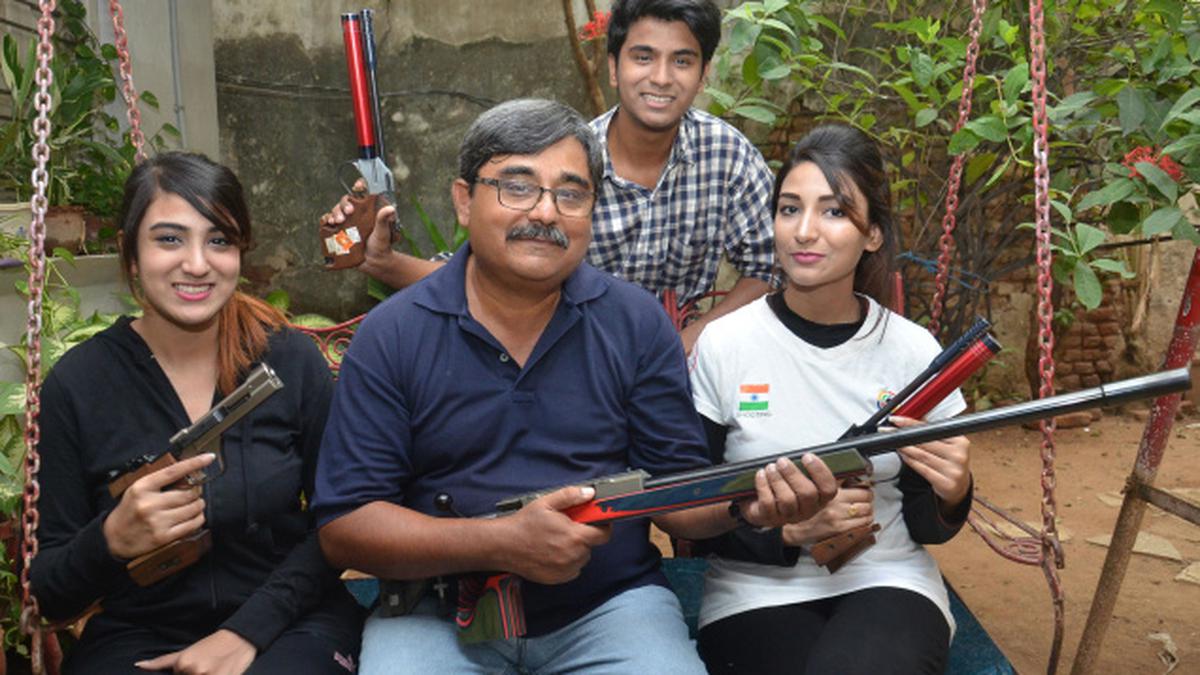
Narjis Fatima, A.M. Zainulabedin, and Saba Fatima with their father and coach Abbas / Photo: Nagara Gopal
On the first floor of Aga Mohammed Hussain’s house, Saba Fatima aims at the target as her sister Nargis Fatima and brother Mohammed Zainulabedein watch on. “I am very strict during practice and keep giving instructions,” laughs Saba. The trio do not indulge in the usual brother-sister spats and instead regularly practice on the home trainer range installed at home. These siblings make Hyderabad proud with their shooting achievements.
Interestingly, they are fulfilling their father Hussain’s dreams. Hussain has been shooting for the past 16 years and is a renowned shot. “Since I was into shooting, the children saw me and got guidance. The biggest advantage was that the weapons were at home,” recalls Hussain on how his children took to shooting. He also adds that his fatherly instincts do not come in the way of coaching. “When I am coaching I tend to forget I am their father. I am disciplined and strict and the results show. The only reason they have come up in the field at such a young age is because of their perseverance, discipline and dedication,” he says.
While Nargis Fatima won her first national medal at the age of 11, her aim is to make it to the Olympics. “By God’s grace both Saba and Zain are in the Indian national squad,” states Hussain. Saba, whose ranking is no. 4 is practicing to take part in shooting championship later this year. “Only the top three are sent by the sports ministry and she will be going at her own cost,” says Hussain.
Recently Saba, a D. Pharm student couldn’t go to Germany because of her final year exams. “D. Pharmacy is worse than medicine; it is a five-year course and I told her not to take it because she has to study a lot,” adds the father. However, he is more than glad with Zain’s performance and feels he will bring in laurels to the country. “Zain, whose ranking is number 5 is going for selection trials; Next year, he will be representing the country but getting into the Indian squad itself is a big achievement,” he points out.
Hussain speaks of his recent visit to Uttar Pradesh. “Youngsters are working very hard and one can see them practicing for even six hours,” he adds.
What do the girls do when not shooting? “I study or attend family parties,” laughs Saba. She feels Indian women shooters are charting their own path. “There is Heena Siddhu, who is making us proud,” she beams.
On the importance of having calm nerves during shooting, Hussain says, “For shooting, one needs a temperament that is extraordinarily soft and a synchronisation of multiple things; about 20 things happen in a fraction of a second and one needs to hone the technique and register it in the sub-conscious mind. Conscious mind is very powerful and the moment you shoot with it, you tend to lose everything. One needs to blindly follow what one has put in the training. Ninety percent shooters fail because they get excited and go in for score and don’t get the technique,” he explains.
source: http://www.thehindu.com / The Hindu / Home> Features> Metroplus / by Neerja Murthy / October 18th, 2016
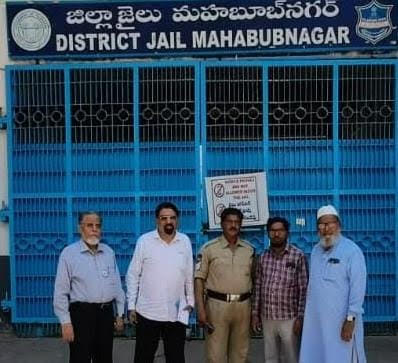
The Movement for Peace & Justice (MPJ) Telangana has reaffirmed its commitment to supporting justice and rehabilitation by providing monetary and legal assistance to first-time Muslim offenders seeking bail across various jails in Telangana. In the year 2024–2025 alone, MPJ facilitated the release of 57 such prisoners.
The organisation, which has consistently worked to aid the underprivileged segments of society, specifically limits its legal and financial support to individuals charged for the first time with non-heinous crimes. Those involved in grave offenses such as rape, murder, or digital financial frauds are excluded from MPJ’s assistance programs, irrespective of their first-time offender status.
In addition to helping individuals secure bail, MPJ Telangana previously extended support to prisoners who had completed their sentences but remained behind bars due to an inability to pay court-imposed penalties.
Beyond legal aid, MPJ Telangana has also taken several humanitarian steps. The organisation distributed general knowledge books, Islamic literature in Urdu and Telugu, stationery, and sports items to inmates. Notably, educational materials were also provided for children living with their incarcerated mothers at the Chanchalguda Special Prison for Women.
Expanding its outreach, MPJ Telangana provided general aid to 121 underprivileged families, educational support to children of 41 daily wage laborers, and medical aid to 59 impoverished families in the state.
MPJ Telangana continues to serve as a vital support system for the marginalized, promoting both justice and rehabilitation with dignity and compassion.
source: http://www.radiancenews.com / Radiance News / Home> Latest News / by Reliance News Bureau / June 11th, 2025
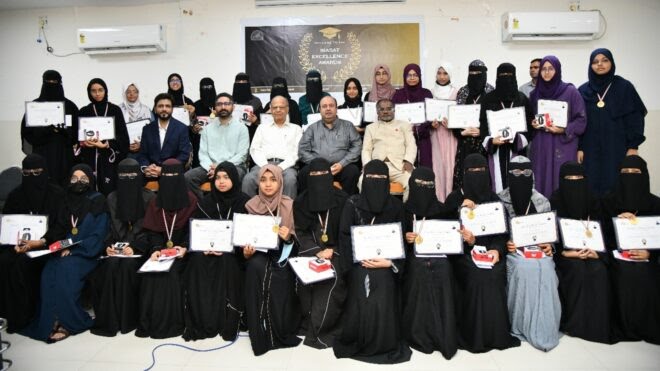
In a celebration of academic excellence and community empowerment, The Siasat Daily hosted a grand felicitation ceremony to honour 373 Intermediate BiPC students who scored above 90% in their board examinations. The event, held at the Siasat Auditorium on Tuesday, is part of a larger educational upliftment initiative spearheaded by Congress MLC Amer Ali Khan.
Addressing the packed hall, Amer Ali Khan declared, “This is not just a function—it is a movement. A campaign to build an atmosphere of academic pride and ambition among Muslim youth.” His powerful words echoed the core message of the ceremony: education is the most effective tool to uplift India’s Muslim community and ensure a dignified future.
Over 1,500 students had responded to an open call, out of which 373 were selected for recognition. Notably, 43 top performers scoring between 99% and 99.6% were awarded cash prizes, certificates, medals, and boAt smartwatches under the tagline “Smart Watches for Smart Students.” An additional 204 students scoring above 95% also received smartwatches as a token of encouragement.
The students were honoured in the following score brackets:
43 students with 99% and above
97 students with 98% and above
49 students with 97% and above
36 students with 96% and above
33 students with 95% and above
27 students with 94% and above
29 students with 93% and above
19 students with 92% and above
98 students with 91% and above
19 students with 90%
Speaking with heartfelt emotion, Amer Ali Khan reminded students of their heritage: “Knowledge is noor (light), and hard work is ibaadat (worship). With Allah’s help, even the impossible becomes possible.” He urged them to emulate Islamic historical figures such as Muhammad bin Qasim, Salahuddin Ayyubi, and Imam Bukhari, who once were students and later transformed the world through their knowledge and leadership.
The event emphasized the importance of both male and female education. Faiz-e-Aam Trust Secretary Iftekhar Hussain passionately appealed to parents to support their daughters’ education. “Girls often outperform boys. We must break the practice of marrying them off immediately after exams,” he said.
The ceremony began with the recitation of the Quran and concluded with the distribution of awards. Despite his busy schedule, Amer Ali Khan remained present throughout, personally honouring each student and motivating their families.
Other dignitaries present included Asghar Ali Khan, M.A. Hameed (Career Counselor), Zahed Farooqui (Director, Siasat Hub), N. Snehith, and Sai Sree (Managers). The event proceedings were conducted by senior journalist Mohammed Riyaz Ahmed.
With applause reverberating through the auditorium, the atmosphere brimmed with pride, inspiration, and a strong sense of community direction. The initiative reinforced the idea that education is not just a means to employment, but a path to dignity, empowerment, and leadership.
source: http://www.radiancenews.com / Radiance News / Home> Education> Latest News>Markers of Excellence / by Radiance News Bureau / June 06th, 2025
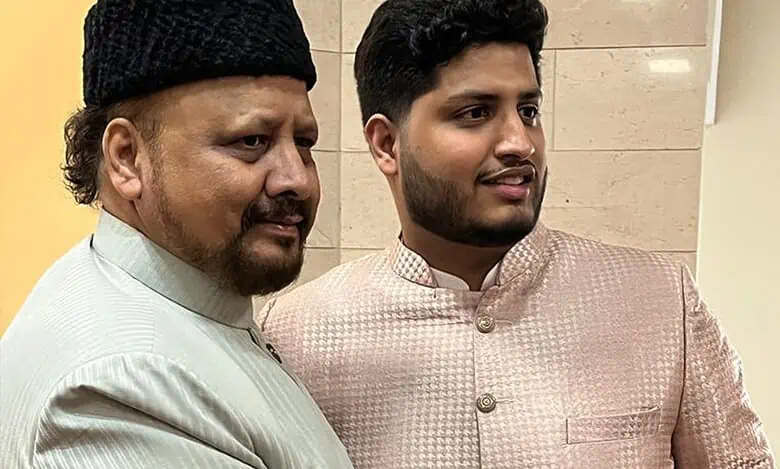
The Famous personality of Hyderabad Nawab Wajid Ali Khan Retd. Superintendent of Police Ex AP, son Engr. Ameer Mohammed Ali Khan, grandsons Mohammed Shahzaib Ali Khan, Financial Analyst and Engr. Mohammed Shahwaar Ali Khan, wedding and reception ceremonies were held in accordance with the Hyderabadi culture and traditions at the Shalimar Banquets and Ambiance Banquets both were held in the Chicago America.
On this occasion, many guests attended functions by many friends and dignitaries from different states of India, America, Canada and KSA. Engineer Ameer Mohammed Khan is a well-known Civil Engineer of Indian origin and President of the All-Saints’ High School old students association.
The marriage ceremony of his younger son Mohammed Shahzeab Ali Khan was performed at the Masjid Al Jumma Bolingbrook IL with Zaina Salim, the daughter of prominent American businessman Asif Salim.
Maulana Mufti Qari Arif Kamal read the marriage sermons and prayed for the couples and ummah. While many distinguished guests participated in the wedding reception of eldest son Engr Mohammed Shahwaar Ali Khan, son of Engr Ameer Mohammed Ali Khan. In both the ceremonies, the guests were entertained and served authentic traditional and tasty Hyderabadi foods.
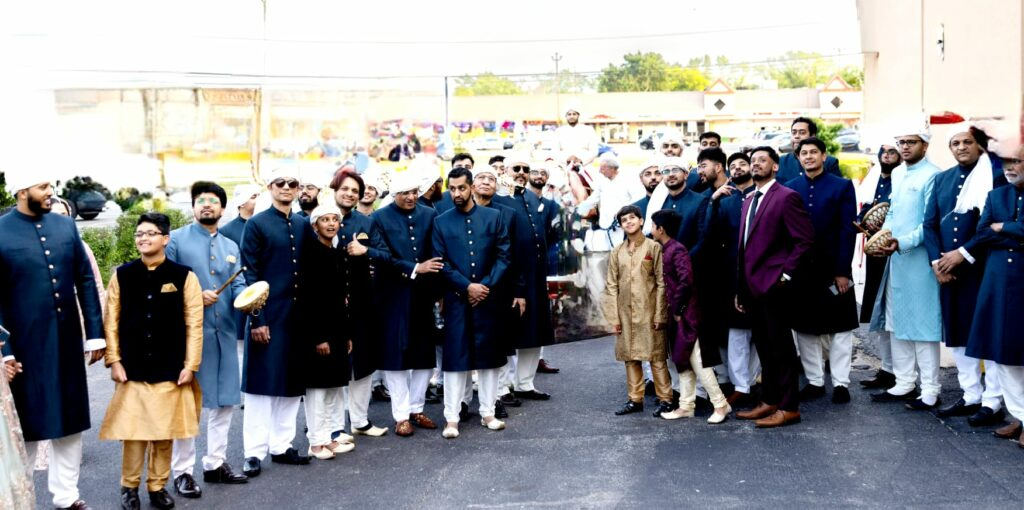
The highlight of Mohammad Shahzeab Ali Khan’s wedding was that there was an opportunity to see an extraordinary glimpse of Hyderabadis civilization in the baraat procession. All the guests were dressed in sherwanis & Turbans in the procession.
The groom was riding a decorated horse and the procession gave an impression of a prince’s marriage procession. In both the ceremonies, special attention was paid to the traditional Hyderabadi culture and together with the participation of the two daughters in laws of Mrs. & Engr Ameer Mohammed Ali Khan, Syeda Urooj Khan the daughter of, Nawab Mir Qutbuddin Ali Khan Saheb and Mr. Asif Saleem Saheb Zaina Saleem.
For the information of It should be noted that Syeda and Urooj Khan is the great granddaughter of His Highness, the HEH the Nizam 7th of Hyderabad Deccan, Nawab Mir Osman Ali Khan Saheb Bahadur.
The Wedding ceremony and the Wedding reception ceremony were attended by the family members of late Muhammad Bin Saeed Bahaman (Super A Class Contractor, Hyderabad), late Nawab Wajid Ali Khan Sahib (former Superintendent of Police, Ex AP) from Hyderabad Deccan.
Among the invitees who attended in these ceremonies were from the different parts of United States of America and Canada were State Senator Ms. Nabila Syed (Illinois), Martin McManamon (Commissioner, Highways Illinois) Haime Fallad (Dy Chief Engineer Metra Rail) Mr. Khokhar (Mayor, Glendale Heights, Illinois), Politicians, CEO’s and the Presidents of several Engineering companies, famous and well-known Doctors, Attorneys, Judges, Businessmen, Industrialists, Chartered Accountants, many of the professional experts from various walks of life participated and expressed good wishes to the two new couples and blessed them with their prayers.
Among those who showered their love and faithfulness on both the Bridegrooms and the Brides. The close relatives who have welcome the guests were Dr. Sultan Sikandar Ali Khan (New York), Advocate Malik Liaquat Ali Khan (California)
Engr. Fazal Mustafa Ali Khan (KSA), Dr. Fazal Sarvari (Chicago) Dr. Muhammad Saifuddin (Chicago) Mr. Muhammad Athar (Chicago), The family members of Nawab Mir Qutbuddin Ali Khan (Chicago), Mr. Asif Salim, (Chicago), Abubakar Bin Mohammad and Umar Bin Mohammad (Builders and Developers Deccan Hi-Tech Constructions, Hyderabad), Dr. Shaheera Khan, Attorney Shahina Khan, Engr Shariq Shaikh, Engr Zubair Ali,(all Chicago). Engr Zaheer Khan (California), Engr Ghouse Khan (Boston), Engr Shujaat Khan (New Jersey), Dr. Fahad Sarvari (Chicago), Engr Shafath Khan (Dallas), Syed Irfan Ahmed (California) and others.
Mrs. & Engr Ameer Mohammed Ali Khan has thanked the guests.
source: http://www.siasat.com / The Siasat Daily / Home> NRI’s Corner / by News Desk X / June 17th, 2023
Muzaffarnagar and Adilabad, two districts in India, are celebrating the remarkable achievement of their Muslim scientists who contributed significantly to the success of the Chandrayaan 3 mission. The successful landing of Chandrayaan 3 on the Moon’s south pole has ignited a sense of festivity and pride in both regions.
Areeb Ahmed, an ISRO scientist hailing from Khatoli, Muzaffarnagar, emerged as a central figure in this achievement. As a key member of the Chandrayaan-3 team, Areeb Ahmad played an instrumental role from the mission’s launch to its successful landing. The celebrations in Muzaffarnagar included fireworks and heartfelt congratulations to the Areeb family.
The success story extends to Adilabad, where scientist Sheikh Muzammil Ali, originally from Kaghaz Nagar, shone as a valuable contributor to the Chandrayaan 3 mission. His involvement in the ISRO team that achieved the lunar landing brought immense pride to the Muslims of Telangana. Sheikh Makhdoom Ali, Sheikh Muzammil Ali’s father, expressed his joy and gratitude for his son’s accomplishment, viewing it as a divine blessing and a moment of national pride.
Sheikh Muzammil Ali’s educational journey showcased dedication and determination. After completing his education from various esteemed institutions, he cleared the ISRO exam in 2016, leading to his appointment as a “Scientist Group Gazetted Officer” in 2017. His father’s unwavering support, despite a modest salary, served as an example of the importance of higher education for Muslim parents aspiring to empower their children.
The accomplishments of Areeb Ahmed and Sheikh Muzammil Ali underscore the significance of providing quality education to young Muslims and encouraging them to pursue careers in cutting-edge fields. Their contributions not only contribute to India’s scientific progress but also inspire others to strive for excellence irrespective of adversity.
source: http://www.munsifdaily.com / The Munsif Daily / Home> News> Regional> Telangana / posted by Rasia Hashmi / August 24th, 2023
Hyderabad engineer Maaz Ahmed Khan founded his startup Torq Electric to convert old two-wheelers into electric vehicles.
In 2021, Maaz Ahmed Khan was still a mechanical engineering student when his interest in electric vehicles began brewing . “It started when I got into the EV subject of the syllabus in final year,” he recalls, adding that he would look closely into the working of these machines and formulate his own ideas to make his own version of them.
But the 23-year-old’s idea was not to build a new design. Instead, it was to convert existing fuel vehicles — which would otherwise be turned to scrap — into fully functioning EVs.
The then final year student of Methodist College of Engineering and Technology, Telangana, started looking for someone’s help to start building on his vision. This brought him to a non-academic startup incubator EdVenture Park, which focuses on student innovations. He applied for a job here and was selected.
With their support, the youngster began working on his dream project, eventually founding Torq Electric in March 2021.
“A few years ago, I happened to attend the launch of Tata Nexon. Even though the vehicle excited me, I also thought, ‘Why should we buy a new EV if there exists a technology to convert existing vehicles?’,” he tells The Better India.
He continues, “I also had ‘electric vehicles’ as a subject in college. I learned that after 15 years of running, the fuel usage of any vehicle goes up and it contributes to greater pollution. Instead of turning it to scrap, you can convert it.”
On 27 August 2021, Maaz came up with the prototype of a two-wheeler EV, which he built by transforming an old petrol scooter and spending Rs 60,000. The model was covered widely by the media and popularised further through the internet, he recalls.
The EV by Torq Electric.
“Even then, it took time to gain people’s trust. A few months later, I managed to get some customers. A majority of them were unwilling to let go of their two-wheelers due to emotional attachments and similar reasons. Converting these into electric vehicles seemed like a great idea to keep your old favourite bike,” he explains.
Maaz says he has so far converted seven bikes, and received orders for 15 more.
Additionally, he helps engineering students to take up college projects related to EV and supports them with the related technical know-how.
For a greener future
Even though it takes just 5-7 hours to convert a two-wheeler into an EV, Maaz asks for two days to check and ensure the vehicle’s safety after riding.
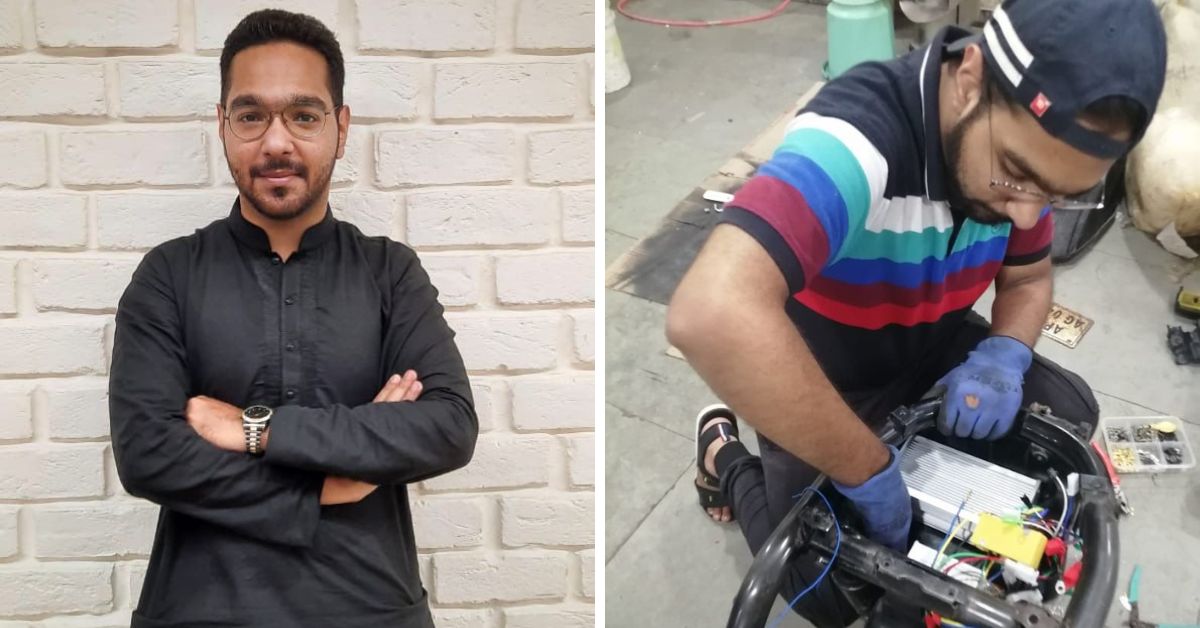
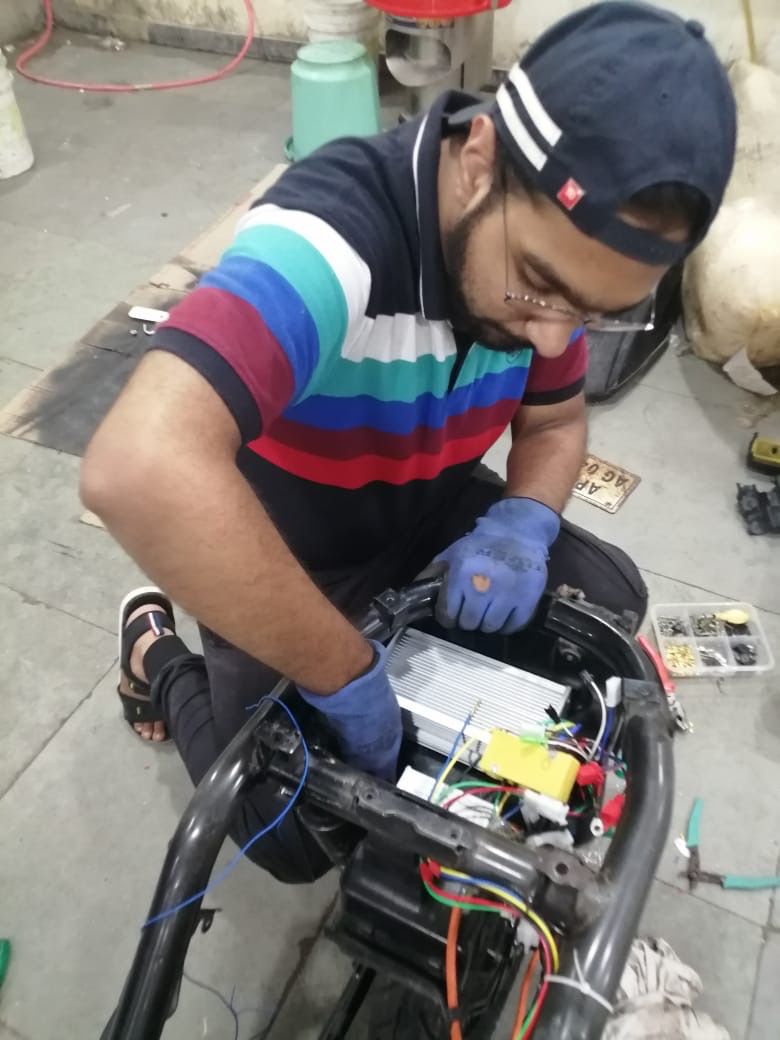
Maaz busy at work.
He provides two types of models — fully electric and hybrid vehicles. Those who wish to keep fuel as an option can opt for the latter. He says the price to convert any type of two-wheeler into a fully electric EV is Rs 50,000. For hybrid, he charges Rs 55,000.
“In fully electric two-wheelers, the engine and fuel tank are replaced with a powerful motor and batteries. In hybrid conversion, a motor and battery are added to the existing engine. This gives the flexibility of driving on both electric power and engine power,” says the engineer.
The base variant of the vehicle takes about three to four hours to charge, and can run up to 75 km at an average speed of 45 km/hr, Maaz says. Customers can also give their preferences, for which prices may differ.
“EVs are in their early days in India. But undoubtedly, they are the future. It is important to be aware of the pollution from fuel vehicles. Soon, we might be living in a country where breathing feels like smoking a cigarette. But we can prevent this by showing responsibility. Like shifting from plastic bags to cloth bags, or using public transport, opting for an EV is a great step,” Maaz says.
The electric vehicle built by Maaz.
Through his company, he aims to create sustainable living through automotive manufacturing, with the vision to create an eco-friendly world.
Even though his current innovation is receiving great response, the engineer’s dream is to launch his own design of an EV, exclusively for Indians. He also plans to extend the current innovation to three and four-wheelers.
Maaz Ahmed Khan — the engineer.
“The rise in fuel prices has most affected the auto drivers of the country. After a little research, I discovered that if they switch to EVs, they can save around Rs 400 a day. This accounts for Rs 12,000 a month. Thus, my plan is to launch an innovation pertaining to three-wheelers,” he shares.
Visit his website www.torqelectric.com
Edited by Divya Sethu
Photo Credits: Maaz Ahmed Khan
source: http://www.thebetterindia.com / The Better India / Home> English> Electric Vehicles – Sustainability / by Anagha R Manoj / September 20th, 2022