Tag Archives: Tipu Sultan aka Fateh Ali Sahab Tipu

Evaluating Indian Kings: Tipu Sultan Stood Against the British with Valour and Courage

Mysuru, KARNATAKA :

The half-baked propaganda of communal forces against the Tiger of Mysore is trying to divide communities
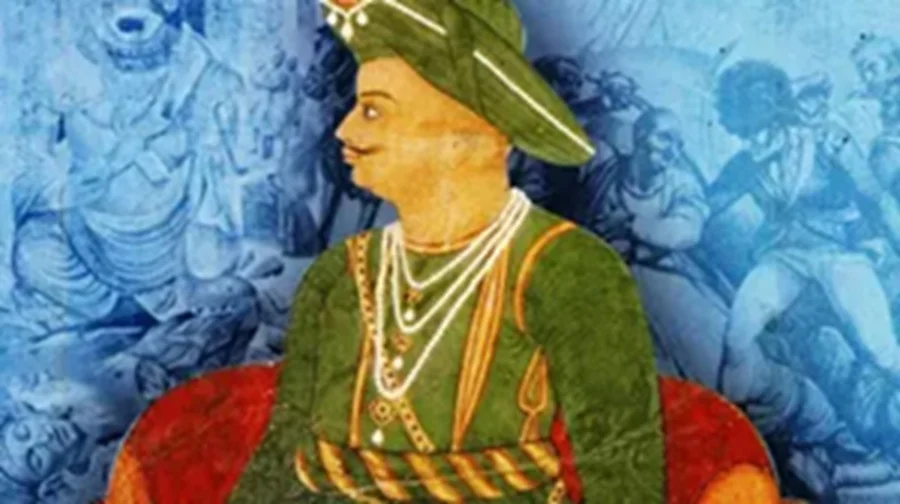
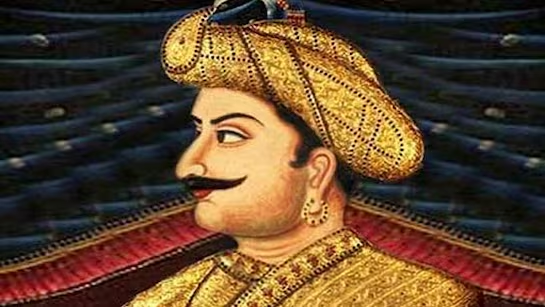
THE Tiger of Mysore (Sher-e-Mysore) Tipu Sultan often finds space in sections of the media, especially in Karnataka. There have been occasions of State-sponsored celebrations of his birth anniversary and the Bharatiya Janata Party (BJP) regularly creates obstacles to these celebrations, resulting in unnecessary ruckus. This time around, Tipu Sultan is in the news from Malegaon in Maharashtra.

The newly elected deputy mayor of Malegaon Shan-e-Hind Nihal Ahmad, put up the portrait of Tipu Sultan in her office, upsetting the Shinde group’s Shiv Sainiks and the BJP. These forces got the portrait removed with the intervention of the authorities. Some protests were also held.

Maharashtra Pradesh Congress Committee President Harshvardhan Sapkal got incensed and defended Tipu Sultan, claiming that the contribution of Tipu Sultan to Mysore is equivalent to that of Chhatrapati Shivaji Maharaj in Maharashtra.

But, Chief Minister Devendra Fadnavis did not like the idea of comparing Tipu Sultan and Shivaji Maharaj, as it was an insult to the latter. Following this absurd comment, the Congress office was pelted with stones by BJP workers and nearly seven people were injured in the ensuing mayhem.

The objection of the BJP to the statement from the Congress leader is that Tipu was a “mass murderer of Hindus” and he tried to convert Hindus to Islam. There are many other charges put against Tipu by Hindutva elements. Most of these try to project Tipu as anti-Hindu and a cruel king. This is far from the truth.

Lots of these myths are part of the communal narrative, accentuated by the British narratives, which are harsher against Tipu in particular. This is because he was one of the few rulers who fought against the British. Tipu had asked Nizam and the Peshwas to oppose the armies of the East India Company. He foresaw the dangers of British power entrenching in India.

Tipu’s administration was a mixed one, with many top officers being Hindus. Purnaiah served him as the Mir Miran (head of a department) and was crucial to his administration. Krishna Rao was his treasurer. Shamaiya Iyengar held a high-ranking ministerial position and Narsimha Iyengar held a position in the postal department. Tipu Sultan reportedly provided grants to the Sringeri Shankaracharya, including for the rebuilding of the temple and the installation of the Hindu goddess Sharada. He granted land and endowments to various temples throughout his kingdom. During his reign, the 10-day Dussehra celebrations were an integral part of the social life of Mysore.

In 1791, Maratha forces led by Raghunath Rao Patwardhan attacked and plundered the historic Sringeri Sharada Peetham, causing the Shankaracharya to flee. Upon learning of this, Tipu Sultan expressed deep anger, stating that those who committed such acts would face consequences, and promptly sent funds, gifts, and letters to restore the temple and reconsecrate the idol. The raid was part of the Third Anglo-Mysore War, during which Maratha forces caused significant destruction to the temple complex, including killing or wounding people and looting property.

Tipu Sultan, who frequently interacted with the Sringeri Jagadguru and addressed him with high respect, immediately ordered the Mysore administration to assist in the restoration, demonstrating his patronage of certain Hindu institutions. Evidence of this restoration is found in several letters in Kannada, preserved in the Sringeri monastery records, where Tipu requested the Jagadguru to pray for the prosperity of his kingdom.

Tipu Sultan was a staunch opponent of the British. There is an accusation against him that he persecuted some Hindu and Christian communities. The reason for this persecution, however, was purely political, not religious. About these persecutions, historian Kate Brittlebank says that “This was not a religious policy but one of chastisement”. The communities targeted by him were seen as disloyal to the State.

The communities Tipu targeted did not belong only to the Hindu stream. He also acted against some Muslim communities, like the Mahdavis. The reason was that these communities were supporting the British and were employed as horsemen in the East India Company’s armies. Another historian, Susan Bayly, says that Tipu Sultan’s attack on Hindus and Christians outside his state is to be seen on political grounds, as at the same time he had developed close relations with these communities within Mysore.

Sarfaraz Shaikh, in his book Sultan-E-Khudad has reproduced the ‘Manifesto of Tipu Sultan’ in which he declares that he would not discriminate on religious grounds and would protect his empire until his last breath. He had a great interest in rocket technology. This finds appreciative mention in Dr APJ Abdul Kalam’s book, Wings of Fire.

It is interesting to note that in the Rashtriya Swayamsevak Sangh’s series for children on Indian history, they had published a book on Tipu in the 1970s. BJP’s Yeddyurappa had adorned Tipu’s headgear to solicit votes in the 2010 elections in Karnataka. Then President, Ramnath Kovind, sent a eulogising message on the occasion of Tipu Jayanti (2017). He has an RSS background. He praised Tipu by saying that “Tipu Sultan died a heroic death fighting the British. He was also a pioneer in the development and use of Mysore rockets in warfare.”  Tipu – along with Rani Laxmi Bai – are also depicted as freedom fighters through drawings in Part XVI (page 144) of the original, hand-written and illustrated copy of the Indian Constitution.

Due to his policies, Tipu was popular among the people of Mysore. There are many folk songs, sung in villages, praising him. It is for this reason that one of our greatest playwrights, Girish Karnad, said that had Tipu been a Hindu, he would have the same status that Shivaji Maharaj has in Maharashtra. This is very close to what Sapkal stated, nothing extra.

This whole incident of opposing the portrait of Tipu in the Deputy Mayors’ office is one more instance of communal forces latching on to divisive politics. Kings should not be seen just by their religion; their policies towards people of different religions and people’s welfare should be the major criterion for evaluating them. Tipu stands very tall in this scale of religious tolerance. The half-baked propaganda of the communal forces is trying to divide communities.

A major tribute to Tipu was paid by Subhash Chandra Bose. He adopted Tipu’s ‘springing tiger’ as the insignia of Azad Hind Fauj, which fought against the British. The major contribution of Tipu was to forewarn the Indian rulers about the advancing threat of the East India Company, the British. It was for this that he bravely fought against the British and laid down his life in the fourth Anglo-Mysore War. The communal forces who are out to demonise Tipu belong to the ideology that did not even lift a little finger against the British rule.

source: http://www.clarionindia.net / Clarion India / Home> Opinion / by Prof Ram Punyani / February 18th, 2026
Tipu Sultan’s sons engineered the Vellore Mutiny

Srirangapatna (Mysore) KARNATAKA :

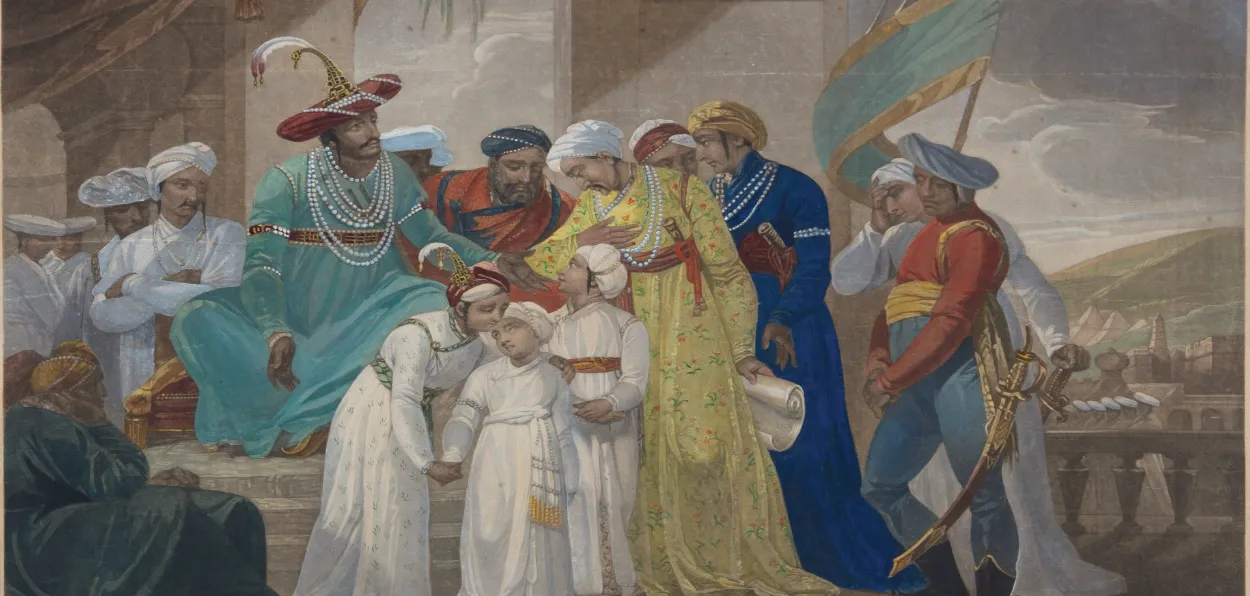
Tippoo Sultaun delivering to Gullum Alli Beg the Vakeel his sons who are taking leave of their brother previous to their departure from Seringapatam (1793) Painting by Henry Singleton

“The Christian drummers were seized, taken to the palace where Tippu’s sons were confined, and made to beat the “general” ; lights flashed in the palace, refreshments were brought out; a mob of sepoys called on the princes to place themselves at their head; Tippu’s own flag, green stripes on a red field, was nailed to the flagstaff. Prince Muizuddin (son of Tipu Sultan) ordered his horse to be saddled, and told off a party of sepoys to go and seize the principal hill fort; when that was captured and the dead body of Colonel Marriott, paymaster of stipends, brought before him, he promised he would mount his horse and ride through the native town proclaiming the restoration of the Mahommedan power.”

A Slice of History

This is the account by Colonel Alfred Keene of the night of 10 July 1806 at Vellore. The rising, popularly known as the Vellore mutiny, was a dress rehearsal of a sort of what would happen in May 1857 at Meerut.

Keene pointed out, “In the mutinies of Vellore and the greater one of 1857, two points of similarity stand out prominently. In each is the unreasoning fear of an attack on the institutions of religion and of caste; for the greased cartridges in the latter mutiny had as much to do with the outbreak as had the new head-dress in 1806, and the presence of the remnants of the Moghul Dynasty at Delhi acted in 1857 precisely as had the presence of Tippu’s family at Vellore in 1806.”

After the fall of Tipu Sultan in 1799, the English East India Company shifted his children to Vellore. In early 1806, the Commander-in-Chief ordered a new headgear and, the removal of beards, tilaks, earrings, or any mark of caste identity.

The Indian sepoys of the 2nd Battalion 4th regiment showed dissatisfaction in May 1806 and disobeyed the orders. These sepoys were tried in army court and 21 of them were found ‘guilty’. Of them, one Hindu leader and other Muslims were discharged from the duty and sentenced to receive 900 lashes each. The other 19 were not discharged but ordered  500 lashes each. The order was passed on 29 June and published to the army on 2 July 1806.

The wife of a serving English officer at Vellore, F. W. Blunt, wrote in a letter to her family in England, “Nine of the ringleaders, as they were called, were brought down to Madras and here passed publicly through the streets in irons, destined to receive the most dreadful military punishment…… The nine men in irons awaiting a most severe punishment was made use of by the sons of Tippoo, who have been kept prisoners in the Palace at Vellore since the taking of Seringapatam and served to ripen a design that had been long formed. A conspiracy was formed by the Sepoys to murder all the Europeans and take possession of that Fort.”

Tipu Sultan

On the night of 10 July 1806, Shaikh Kasim, a sepoy, led the English East India Company sepoys in starting a general massacre of the English troops.

Lt. Col. W. J. Wilson in ‘History of the Madras Army’ wrote, “The sepoys went away shortly afterward, and were heard to call out “Come out, Nawab, come out, Nawab, there is no fear.” This was supposed to be addressed to Futteh Hyder, the eldest of the four Mysore Princes.”

Of the 372 Englishmen present at Vellore, 128 were killed that night by the Indian sepoys. The English flag was replaced with the flag of Tipu Sultan, which was handed over by Moizuddin, the eldest son of Tipu. He was proclaimed the leader of the revolutionaries.

Though the immediate cause was the headgear and other orders, the revolt had been planned for a long time. Charles Macfarlane wrote, “The splendour which the sons of Tippoo were enabled, by the liberality of the Company, to keep up, attracted a continual influx of visitors, including all that came to Vellore from the countries which had once belonged to their father. Among these men were very many who had lost by the change which had taken place in Mysore, who hated the tranquillity which we had introduced into their country, and who longed for the old days of rapine and violence. It is believed that these desperadoes contributed to a regular conspiracy and facilitated the execution of the daring design.

It is said that the confederates intended that all who were brought to join in the insurrection should act upon a preconcerted plan, which had been digested and privately circulated by some of the turbulent Marawa chiefs; and that in connection with these desperadoes were some few Frenchmen, disguised as fakeers or dervishes, who went about the country inveighing everywhere against the English as robbers and tyrants. It is also stated that placards were fixed up within the mosques and Hindu temples, where Europeans never entered, to excite a general spirit of revolt among the whole native population of Madras.”

The English Government set up an enquiry commission headed by Major General Pater which submitted its report on 9 August 1806. The report said, “There are two principal causes which appear to us to have led to the mutiny. The late innovations in the dress and appearance of the sepoys, and the residence of the family of the late Tippoo Sultan at Vellore.”

Sir J. F. Cradock, the Commander-in-Chief, disagreed with these findings and argued in his submission that change in dress was a pretext and the real objective was to restore the rule of Tipu Sultan’s family. 

The Court of Directors after the investigation declared that the “immediate cause of the discontent among the sepoys was the introduction of certain innovations in their dress, which were offensive, and, as they held, degrading to them; and that the captive sons of the late Tippoo Sultan, with their adherents and abettors, took occasion, from the dissatisfaction of the sepoys, to instigate them to insurrection and revolt, with the view of effecting their liberation, and the restoration of the Mahomedan power.”

The mutiny was suppressed by noon on 10 July. Colonel Gillispie stationed at Arcot came to rescue the Englishmen at Vellore before 7 am. His forces, which also included Indian sepoys, killed more than 500 Indians in the fort within a few hours.

At least 15 English officers including, Colonel Fancourt, H.M.’s 34th regiment, commanding the garrison, Lieutenant-Colonel McKerras, Captain Willison and Lieutenants Winchip and Jolly of the 23rd, Captain Miller, Lieutenants O’Reilly, Smart, and Tichbourne of the 1st, and Lieutenants Eley and Popham of the 69th, Mr. Mann Deputy Commissary of Stores, Mr. Gill Conductor of Ordnance, Mr. Smith the Military Paymaster and Major Armstrong of the 16th N.I. were killed.

Among the captured sepoys, six were blown away with cannon guns, five were shot by firing squads, eight were hanged, and several others were transported for life. Out of the retainers of Mysore Princes, one was sentenced to death, two to transportation for life, one to imprisonment for life, and one to imprisonment for ten years. The sons of Tipu Sultan were sent to Kolkata with stricter vigilance.

Lord William Bentinck, Governor, and Sir J. F. Cradock, C-in-C, were removed from their respective offices by the Court of Directors.  

source: http://www.awazthevoice.in / Awaz, The Voice / Home> Stories / by Saquib Salim / July 10th, 2025

India: Historians recall role of Muslims in freedom struggle

Coinciding 74th Independence Day on Aug. 15, scholars recollect help of Turkey to India’s national freedom struggle

Abdul Hameed Nomani, General secretary of the All India Muslim Majlis Mushawarat

New Delhi:

Celebrating country’s 74th Independence Day on Aug. 15, under the shadow of recent communal riots in capital Delhi and anti-citizenship law stir, many Indian scholars have called for recalling the role of Muslims during India’s freedom struggle.

Author and scholar Waseem Ahmed Saeed said over time, the contribution of Muslim freedom fighters in India has been forgotten.

In his book titled Kala Pani: Gumnam Mujahideen-e-Azadi 1857, Saeed said from the 1757 Battle of Plassey in Bengal, Tipu Sultan’s Seringapatam battle in South India in 1799 to the massive revolt in 1857 against the British was led by Muslims.

Saeed, who has authored a book on the subject in the Urdu language, said while India’s official history celebrates Udham Singh for killing Michael O’Dwyer, the lieutenant governor of Punjab in India, in revenge for the 1919 Jallianwala Bagh massacre in Amritsar, it does not recognize Sher Ali Afridi, who killed Lord Mayo, British viceroy and governor-general of India from 1869-1872.

Speaking to Anadolu Agency, many Muslim scholars and historians said the role of their ancestors in the freedom struggle has been overlooked.

According to Syed Jamaluddin, director of historical research projects at the Institute of Objective Studies, a think tank, there is no adequate coverage of the role of the Indian Muslims in the national movement.

“The contribution of Muslim revolutionaries, poets and writers is not known today. Similarly, little is known about the contribution of people like Ali Musliyar and Bi-Amma, who made significant contributions,” he told Anadolu Agency. He is currently editing a book on the Muslim role in India’s freedom struggle.

Saeed recalled in his book that it was the ruler of Bengal Siraj-ud-Daulah, who first fought and lost to the British in 1757, which became a cornerstone for the imperial power to colonize India.

He said that even after losing this battle, there were many rebellions led by Muslims until 1850.

Muslim revolts against British

Jamaluddin mentions the Fakir-Sannyasi rebellion, a joint revolt against colonial power by Muslim and Hindu ascetics, for preventing them from collecting religious tax from locals. It started in 1764 and continued until the 1850. He said the rebellion even spread its wings to southern India’s Madras (now Chennai) presidency.

But most prominent and popular movements that hit the British hard in the early 20th century in the subcontinent was the Reshmi-Rumaal Tehreek (Silk Cloth Movement) led by Maulana Ubaidullah Sindhi with the help of Turkey, Germany, and Afghanistan.

Speaking to Anadolu Agency, a prominent Muslim scholar Abdul Hameed Nomani said that despite his best efforts, Sindhi’s contribution has not been included in the official Indian history.

Along with an Indian prince Raja Mahender Pratap Singh, Sindhi, and Maulvi Barkatullah had established the exiled government of India in Afghanistan in 1915.

“The movement picked up around the same time when Subhash Chandra Bose [renowned Indian freedom fighter] was allying with Germany and Japan to oust the British from India. While Bose is celebrated nationwide, not much is known about Sindhi and his supporters,” said Nomani, who is also the general secretary of the All India Muslim Majlis Mushawarat, an umbrella group of prominent Muslim organizations.

It was named Silk Cloth Movement because Sindhi and other leaders used to send letters and directions to their cadres written on silk cloth.

Later, Sindhi went to Turkey and joined the country’s national struggle.

“The movement led to the formation of Indo-German-Turkish mission to encourage local tribes on the borders of Afghanistan to attack Britishers and their interests. While the key figures were arrested by the British, the movement remains a key event in the freedom history,” he added.

He said even though in 2011 the government released a postal stamp to commemorate Sindhi’s movement, there has been no vigor to record the sacrifice of Sindhi and his allies Mahmud Hasan and Husayn Ahmad.

“Only passing reference has been made about the role of Muslims in India’s national struggle,” rued Nomani.

source: http://www.aa.com.tr / Anadolu Agency / by Cheena Kapoor / August 14th, 2020

Why legends of Tipu Sultan live on in Calcutta

Kolkata, WEST BENGAL :

TipuMosqueKOLKATA08Mpos08nov2017

Tipu Sultan, the `Tiger of Mysore’, born Fateh Ali Sahab Tipu in 1750 at a place now part of Bengaluru, was never in Calcutta. But our city has two masjids in his name as descendants of his descendants live in our city. Last year, the government of Karnataka decided that November 10 will be annually celebrated as  Tipu Sultan Jayanti. This attracted foolish objections from those who never learned from history but want to rewrite it and rip up the country’s social fabric. As Stephen Hawking succinctly puts it, “We spend a great deal of time studying history , which, let’s face it, is mostly the history of stupidity.”Tipu Sultan, the powerful ruler in south India during the 18th century , when the British themselves were taking over India in their empire-building frenzy , was a formidable opponent to their imperialistic ambitions.Unfortunately , he died on the battle field in 1799, one of the first Indian rulers to do that. However, he had also signed a treaty with the British seven years earlier by which he ceded half his kingdom and unable to pay the colonists some `300 lakh, had to accept his two minor sons being exiled to Calcutta.Although they were returned to their family two years later, a `mutiny’ in 1806 resulted in the entire family and entourage of about 300 people literally being shipped off to Calcutta. This included Tipu’s 11th son, Prince Ghulam Mohammed Anwar Shah. Ghulam Mohammed is remembered today , if at all, by the name of the road that skirts around the Royal Calcutta Golf Club (RCGC) and arrives at the Golf Green area.

The family was settled in hutments on marshy tracts of land in Russapugla, the area which now houses Tollygunge Club and RCGC, initially liv ing in penurious conditions.However, Ghulam Mohammed Shah was enterprising. He scrounged and saved the stipend he received from the British and built up his finances through judicious investments, later acquiring the lands they were settled in and setting up the Prince Golam Mohammed Trust in 1872. He built the famous Tipu Sultan Shahi Masjid located at the junction of Dharmatala Street and Chowringhee in honour of his father in 1832. A decade later he built the twin of that mosque in Tollygunge at the crossing of Prince Anwar Shah and Deshpran Sasmal Roads. The Trust started by him is considered to be one of the richest Muslim trusts in the country , their revenues earned mostly from the ownership of multiple properties stretching from south to central Calcutta. It is said the land on which the Lower Circular Road Christian cemetery is located was acquired from Tipu Sultan’s son in 1840.That explains the small mosque in an enclosed area at the rear of the cemetery .

It is fun to extrapolate that despite the political and social conflicts raging in the nation at that time, the Tipu Sultan Shahi Masjid, one of the lesser known heritage attractions of Calcutta, along with the Sacred Heart Church, a short walk down Dharmatala Street, as its contemporary neighbour, are rather obvious examples of this city’s plurality and cosmopolitan nature.Tollygunge, not yet known as Tollygunge, would be called that after Colonel William Tolly dredged the Gobindapur Creek in 1773 and reconnected Calcutta Port with the Matla and Bidyadhari rivers. He was also permitted to levy a tax on ships plying to and from today’s Bangladesh and built a market there, a ganj. The area was thereafter known as Tollygunge. In due course, Prince Ghulam became the owner of almost all the land.

The first hole of  Tolly Club’s golf links is named after Tipu Sultan and for someone who never even set foot in this city, his legacy here is quite something to wonder at. George Orwell said, “The most effective way to destroy people is to deny and obliterate their own understanding of their history .” Rewriting the history of a country to fit a particular political mould is an attempt to do exactly that and it shall fail because those doing so are in denial. Tipu Sultan was many things to many people. He was probably what many monarchs were at that time, benevolent and violent, fighting valiant battles to retain his lands and his people, harsh and despotic, heroic and innovative, patriotic and tyrannical, and a whole lot more. He, nevertheless, will be a significant character in our history, if for no other reason but that he was where he was, when he was.

One of the ways someone like Tipu Sultan will live on in history is because of music.He featured in folk songs of the period as he did in English ballads of the time. The English songs were of course all derogatory and cursed the Indians in various ways, while being full of self-praise and odes to British military valour.Perhaps there is still time for someone to do what Francis James Child did in the 1800s, collecting Scottish and English ballads and transcribing them to text and notation. The wealth of folk music in India would give us, what could only be an amazing take on the history of our country .

— PATRICK SL GHOSE

source: http://www.timesofindia.indiatimes.com / The Times of India / News> City News> Kolkata News / by Patrick SL Ghose / TNN / November 06th, 2017