Category Archives: Business & Economy

Delhi’s Sahyog Credit Co-Op Society Celebrates 1st Year, Transforming Lives with Interest-Free Micro-Financing for Daily Wagers, Small Businesses, Shopkeepers

NEW DELHI :

Member of Parliament Tariq Anwar speaking at the first year celebration of Sahyog credit co-operative society in Abul Fazal Enclave, Jamia Nagar, on February 23, 2025.

New Delhi :

Delhi’s Jamia Nagar-based Sahyog Credit Cooperative Society Ltd celebrated its first anniversary on Sunday, offering a comprehensive range of services, including Daily Deposit Accounts where daily wage earners and small businesses can deposit a minimum of Rs. 100 daily at their doorsteps, and providing interest-free loans and financial assistance ranging from Rs. 50,000 to Rs. 2 lakh under various personal consumption, consumer, and commercial loan schemes.

Sahyog is working under the nationwide Sahulat Microfinance Society, a game-changing initiative in the interest-free finance sector that operates in 13 states and has 130 branches serving 3.5 lakh members across the country.

Its first annual programme was held at Milli Model School in Okhla, New Delhi, with Congress MP Tariq Anwar speaking as the chief guest and attended by various local dignitaries and prominent personalities.

Sahulat’s Groundbreaking Work in Microfinance: A Beacon of Hope for Low-Income Families

Speaking at the event, Usama Khan, CEO of Sahulat Microfinance Society, highlighted the organization’s 14-year history of providing interest-free microfinance services across India. He shared that Sahulat currently has 63 registered interest-free credit cooperative societies affiliated with it, operating 121 branches across 13 states. These branches serve nearly 3.5 lakh members, with the number steadily increasing.

Usama further detailed its impressive figures, including annual deposits of approximately Rs. 1460 crores and annual loan disbursements of around Rs. 625 crores, both of which are doubling every year.

Emphasizing that Sahyog’s success is built on the strong foundation of Sahulat’s 14 years of experience, Usama said, “Sahyog’s journey is not just one year; it is backed by the proven track record of Sahulat’s nationwide operations.”

“Credit cooperative societies worldwide are supply-side models,” Usama said. “Similarly, Sahulat-affiliated societies help low-income individuals save a small portion of their income, whether from daily wages, small businesses, or other livelihoods, which, over time, can accumulate and be used for essential needs.”

Assuring the audience, Usama stressed that the foundations of Sahyog and other affiliated societies are robust, adhering to both Indian regulations and international microfinance standards. He also praised Sahyog’s office bearers, including President Shamsuz Zoha and Vice President, as trustworthy persons.

Defining Sahyog,  Usama Khan explained that the society is registered under the Delhi Cooperative Societies Act as a credit cooperative society. It offers thrift schemes to its members, mobilizes deposits, and provides interest-free loans and financial assistance of up to Rs. 50,000 to meet the various consumption and business needs of small-income individuals in the Jamia Nagar locality, regardless of caste, class, or religion. Usama highlighted that Sahyog primarily serves small-scale businessmen and low-income people in areas such as Zakir Nagar, Batla House, Abul Fazal, Okhla Vihar, and Shaheen Bagh.

Usama further detailed Sahyog’s services, including the Daily Deposits Account. This initiative allows daily depositors, such as daily wage earners, shopkeepers, street vendors, and auto and cab drivers, to make deposits without leaving their workplaces or shops. Sahyog’s staff collects deposits directly from members’ homes, doorsteps, shops, or other locations, starting with a minimum of Rs. 100. Under this scheme, daily wage earners and small shop owners can deposit a minimum of Rs. 100 daily at their doorsteps.  The service also provides e-receipts (via SMS) and passbooks for members.

For salaried individuals, working women, and both skilled and unskilled professionals, Sahyog offers a Saving Account with a minimum deposit of Rs. 200. This account is designed to cater to their future needs and is supported by deposit collection both in the field and at the branch office.

Micro Finance institution Backed by Strong Islamic Interest-free norms

Speaking about Sahyog’s interest-free loan offerings, Usama Khan outlined three types of loan schemes: Demand Loan, Consumer Murabaha Financing, and Commercial Murabaha Financing. He explained that the Demand Loan is specifically designed for consumption purposes, such as personal use, with a maximum tenure of 12 to 18 months. Under this scheme, Sahyog charges no interest or profit, not even based on depositor profits or institutional standards. Instead, the society only applies a minimal surcharge of 1-2%, covering the actual costs of office maintenance, such as doorstep collections, record keeping, and expenses related to core banking software and office staff.

Usama emphasized that Sahyog, as a non-banking institution, operates with core banking software to ensure transparency and efficiency in its operations.

Addressing concerns regarding the minimal surcharge being equated with interest, Usama firmly stated that all of Sahyog’s schemes strictly adhere to Islamic teachings, reinforcing the society’s commitment to providing interest-free financial services.

Usama made a heartfelt appeal to marginalized and low-income people, encouraging them to save and invest in the scheme to meet their daily needs. He also urged the affluent members of society to contribute resources and support this initiative to uplift those in need.

Sahyog: Expansion Plans and Promising Future

In a conversation with Indiatomorrow.net, Sahyog Vice President Abdul Mannan clarified that the society does not charge interest or fixed percentage fees on loans. Instead, it only recovers the actual costs associated with services like doorstep collections, office maintenance, and software upkeep. These costs are minimal, typically ranging from Rs. 500 to Rs. 2,000 per loan of 20-50 thousand. He also shared that Sahyog’s Jamia Nagar branch has been operating smoothly, with 750 members joining within its first year. The members have shown great cooperation, with loan repayments being made responsibly. Abdul Mannan revealed plans to expand Sahyog’s branches in different areas of Delhi and aimed to increase the membership to 1,000 by 2025.

Regarding the Consumer Murabaha Financing scheme, Abdul Mannan explained that it allows Sahyog to provide durable products to members for consumption. The loan repayment period ranges from 3 to 18 months, with amounts between Rs. 10,000 and Rs. 1 lakh. For example, if a member wants to purchase a refrigerator priced at Rs. 20,000, Sahyog buys the refrigerator at that price, and then negotiates a one-time profit share with the seller. The member then repays the exact Rs. 20,000 in easy instalments. Abdul Mannan emphasized that this profit is in compliance with Islamic teachings.

Abdul Mannan also introduced the upcoming Commercial Murabaha Financing scheme, which will provide commercial products to members. Loans for these products will range from Rs. 10,000 to Rs. 2 lakh. Members can also invest in one-time shares up to Rs. 50,000 and make time-bound savings of up to Rs. 1 lakh.

Moreover, the Sahyog official mentioned the Haj and Umrah Account, which allows individuals planning to undertake the sacred pilgrimage to open an account with a minimum deposit of Rs. 200 per day or Rs. 5,000 per month. The term period for this account can range from 1 to 5 years, depending on the member’s needs.

Lauding Sahulat and Sahyog’s services for their focus on human care and the empowerment of low-income individuals, MP Tariq Anwar praised the society’s constructive work, highlighting its crucial impact on society. He commended the society’s interest-free loan schemes and financing programmes as a significant and commendable effort to assist those in need.

The MP said, “India is still not a developed country. We are still struggling to reach that goal. Even after 75 years of independence, our dream of a developed nation remains distant. It is a sad fact that around 90% of the population in this country is either poor or below the poverty line. Nearly 80 crore people depend on government rations or food.”

Urging people to work together and support initiatives like Sahyog to help elevate the country from poverty, Tariq Anwar emphasized the importance of cooperation. He reminded the audience that the cooperative movement in India began even before independence and has since become an integral part of the nation’s structure, with cooperatives playing key roles in different sectors including agriculture.

Lauding the progress of Sahulat and Sahyog, Prof. D.K. Dhusia, Head of the Department of Commerce and Business Studies at Jamia Millia Islamia, stated that microfinance is synonymous with empowerment. He emphasized that microfinance is particularly beneficial for small-scale businesses, noting that these cooperative societies operate interest-free, in alignment with Islamic banking principles that also function on a zero-interest basis. He highlighted that microfinance societies play a vital role in empowering low-income groups within society.

During the event, Dr. Majid Ahmed Talikoti, a renowned surgeon and chairman of the 600-bed Medicant Hospital and Research Centre in Bokaro, Jharkhand, made a significant announcement. He pledged to offer free OPD treatments to all members of Sahyog and provided a 50% discount on cancer treatments. Dr. Talikoti also committed to extending full support and assistance to Sahyog’s members at his hospital.

source: http://www.indiatomorrow.net / India Tomorrow / Home> Economy / by Anwarulhaq Baig / February 24th, 2025
Aziz Ali’s UPI service in local dialect gets RBI nod for launch

ASSAM :

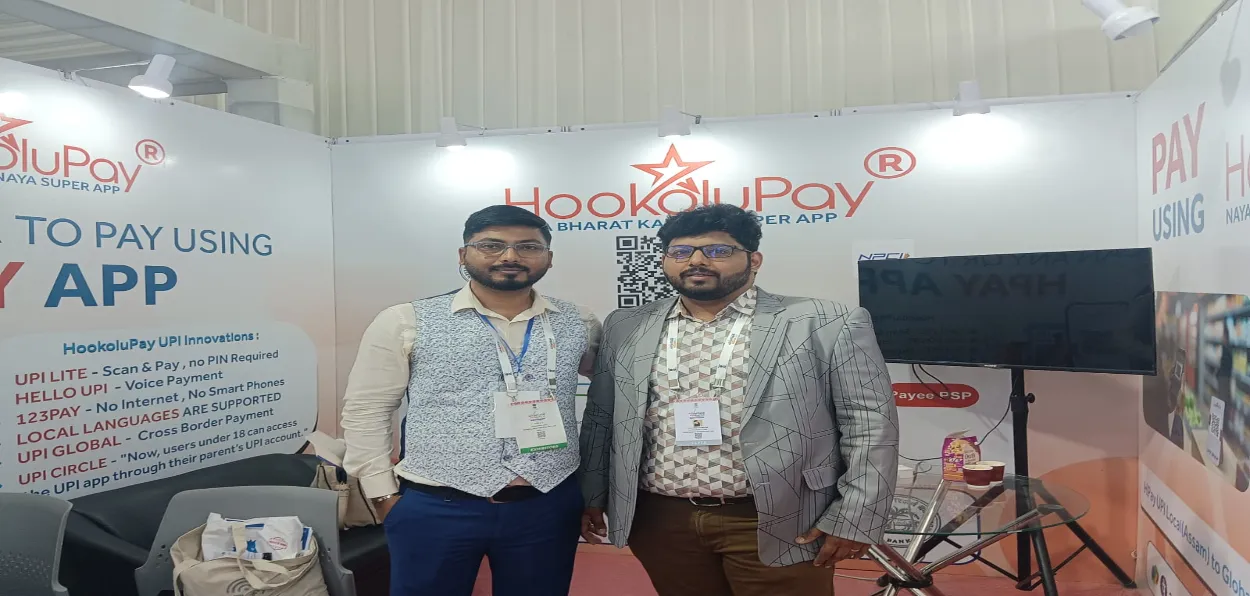
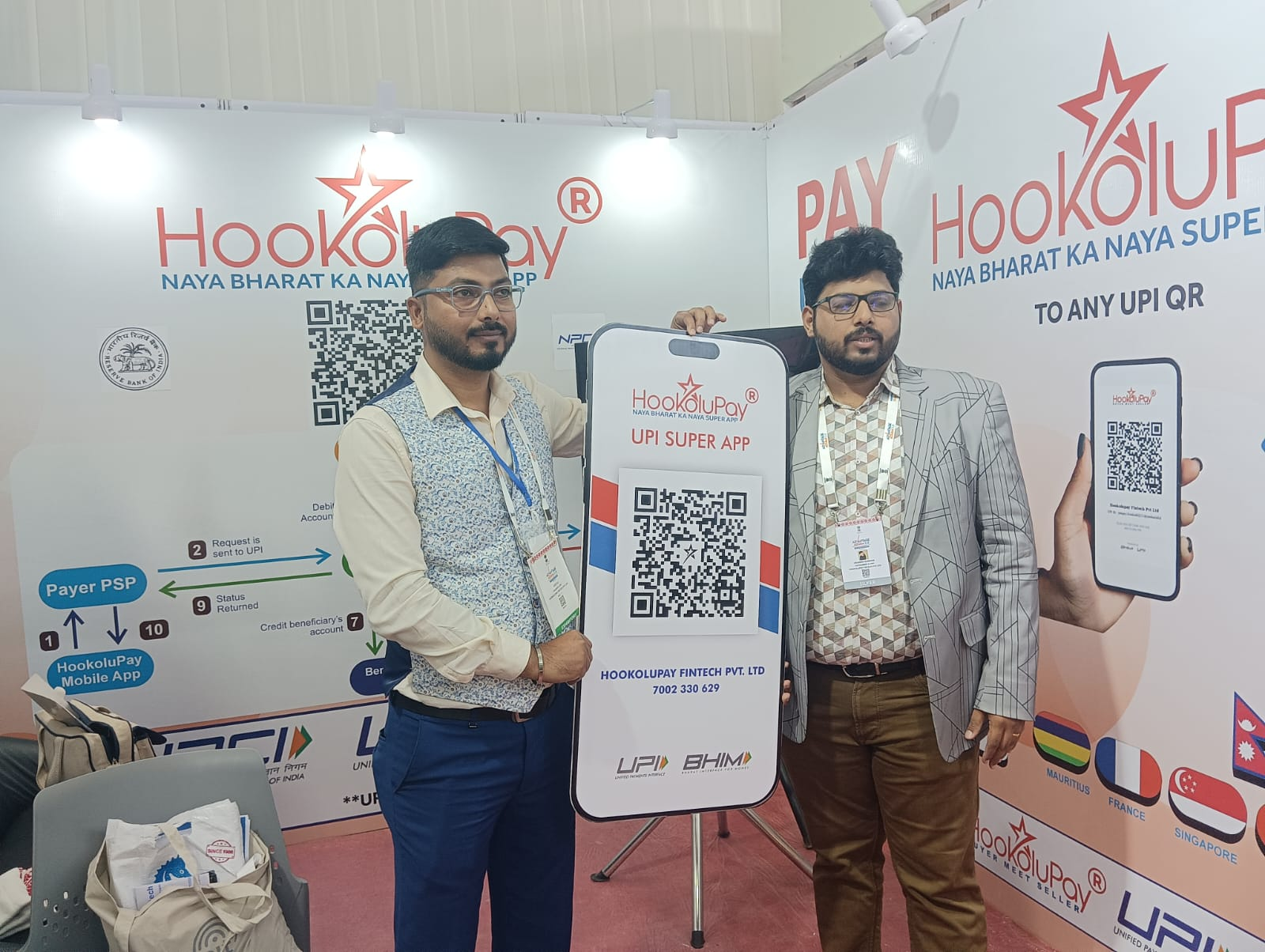
Ali and Anand Kannan displaying HookoluPay at Advantage Assam conclave

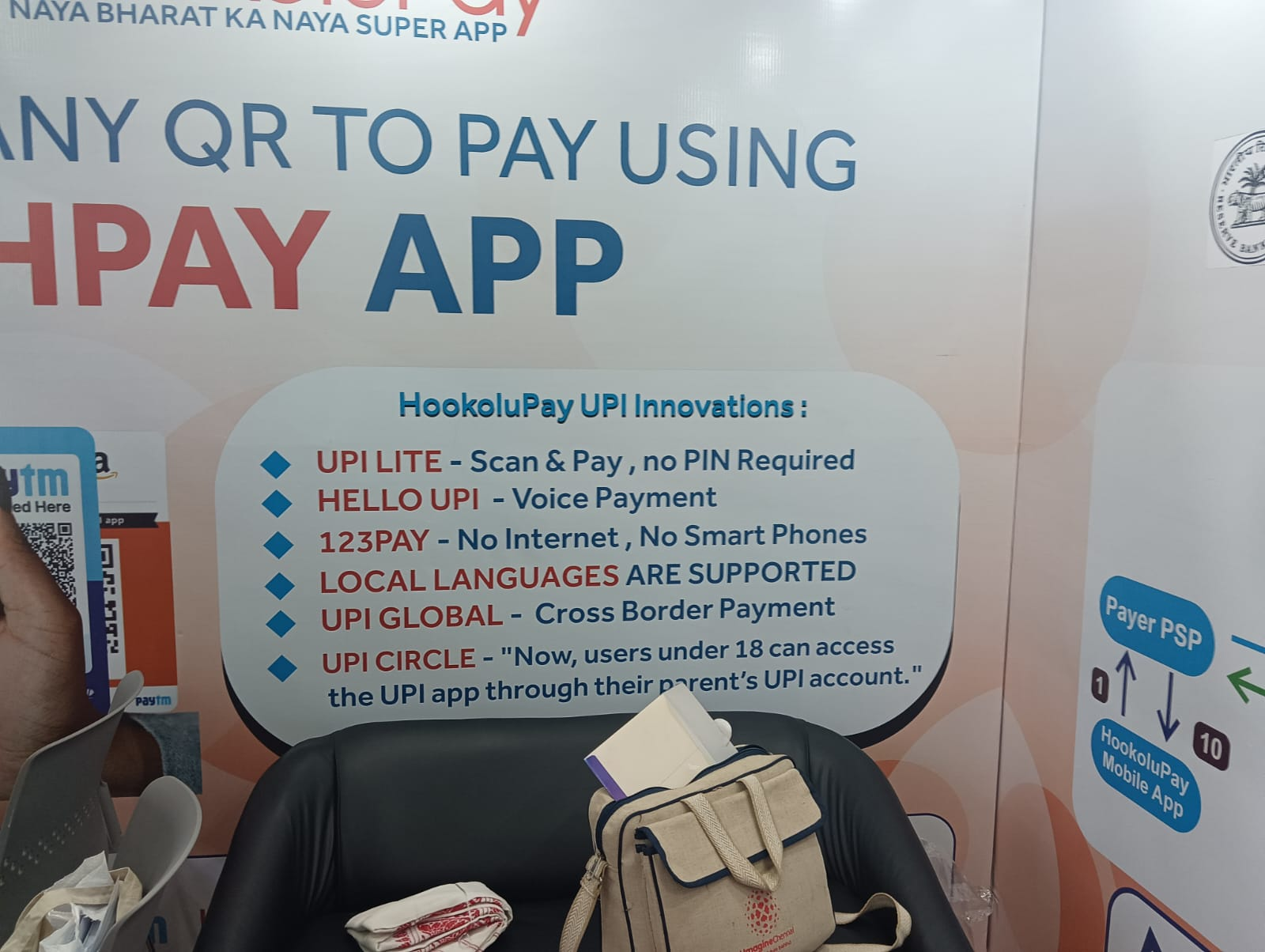
People in India’s northeast can get set for a new UPI (Unified Payment Interface) experience. The new UPI service, HookoluPay, has received a license from the Reserve Bank of India (RBI) and the National Payments Corporation of India (NPCI) as a digital payment platform using local languages of the Northeast region.

It’s likely to be launched by May or June.

Developed as part of a startup initiative by Assam-based entrepreneur Aziz Ali, HookoluPay is likely to help users with most of the local dialects available in the northeast region apart from English and Hindi.The

Ali, a B.Com graduate and an MBA has also kept the option of offline payment in HookoluPay because most places in the northeast still lack high-speed data.HookoluPay is set to break the existing language barrier with the existing UPI services.

“I have started working on HookoluPay in 2018. We got the license from the RBI and the NPCI in November last year. Once launched, HookoluPay will help users in India’s northeastern states with their own languages and dialects.

“While India is on the path of digital transformation, one must keep in mind that 60 percent of the people are still not included in the financial services. In many places, particularly in the hilly regions of the northeast people still use cash.

Ali and Anand Kannan displaying HookoluPay at Advantage Assam conclave

“Although there are UPI services like the GPay, PhonePe, PayTm, etc, most of them have English or Hindi language options. HookoluPay will have services in most of the dialects that are available in the region,” said Ali while talking to Awaz-The Voice.

Ali, who had set up a stall at the Advantage Assam 2.0 summit to showcase the product, received large-scale encouragement from the visitors. Even Prime Minister Narendra Modi visited the stall put up by Ali and appreciated the initiative.

The Prime Minister reportedly asked Ali to take the new UPI service to every nook and corner of the country, mostly in India’s northeast where there is still a lack of digital payment services.

“Our main focus behind developing this new payment gateway is to bring more financial inclusion in the rural areas,” said Ali who is the founder of HookolyPay. Ali is a native of Jeypore near Naharkatiya in Assam’s Dibrugarh district. HookolyPay is a locally developed Fintech startup based in Assam.

An advertisement of the HookoluPay

m Ali’s partner and Co-founder of HookoluPay, Anand Kannan said that HookolyPay can be used for institutions, small enterprises, businesses for governments, travel, etc.

“Like any other payment gateway like GPay, PhonePe, PayTm, it can be used anywhere and by anyone. We are going to launch it pan India but our focus area will be Assam and Northeastern states as we are a startup from this region,” Kannan said.

“At present, we have the options of Hindi, English, Assamese, Mizo, and some other languages but more languages are being added so that it becomes user-friendly to the people,” said Ali.

This will help digital payments in India’s northeast, said Ali.

“Our stall was visited by the Hon’ble Prime Minister of India during his visit to the Advantage Assam 2.0 summit on February 24 evening. The Prime Minister’s words are very encouraging for us,” said Ali while adding that they are also taking this new UPI service to seven other countries which include Singapore, UAE, Bhutan, etc.

source: http://www.awazthevoice.in / Awaz, The Voice / Home> Story / by Karabi Sharma, Guwahati / March 01st, 2025

Rabiya Yaseen: Kashmir’s First Female Truck Driver Defies Gender Norms

Pulwama, JAMMU & KASHMIR :

First Female’ Truck Driver Of Kashmir Breaks Stereotypes

Pulwama, Kashmir :

In a remarkable display of determination and resilience, 37-year-old Rabiya Yaseen from South Kashmir’s Pulwama district has emerged as the region’s first female truck driver, breaking societal barriers and challenging gender stereotypes in a traditionally male-dominated profession.

A resident of Wakharwan, Rabiya’s journey began with her passion for driving light motor vehicles, which soon led her to obtain a heavy motor vehicle license. Now, she drives her own truck across India, covering long distances and earning her livelihood through her unconventional career choice.

Supported unconditionally by her family, especially her husband Mohammad Imtiyaz and mother-in-law Shehnaza Begum, Rabiya has faced numerous challenges but remained steadfast. “It was tough to step into this profession, but we all stood by her,” Shehnaza stated, emphasizing the importance of family encouragement in breaking societal norms.

For the past three years, Rabiya has been on the road, navigating highways across the country and proving that women can excel in any field when given the right opportunities. Her inspiring journey stands as a testament to the evolving role of women in Kashmir and serves as motivation for others to pursue their dreams fearlessly.

source: http://www.radiancenews.com / Radiance News / Home> Pride of the Nation> Markers of Excellence / by Radiance News Bureau / February 26th, 2025

Jamal Ahmed ‘Jamal’: A 98-Year-Old Poet Who Met Gandhi, Donated Land and Advocates for Unity

Marui Village (Nawada District), BIHAR / Kolkata, WEST BENGAL :

A young Jamal who met Gandhi in 1947 later shaped Kolkata’s hospitality scene and contributed to renowned chains like Arsalan and Mezban.

A scholar of Sanskrit, he is a well-known figure in the city’s literary circles. However, despite his generous donation of 15 katthas of land for a government hospital, the Bihar government has yet to honor the donors, leaving his legacy unacknowledged.

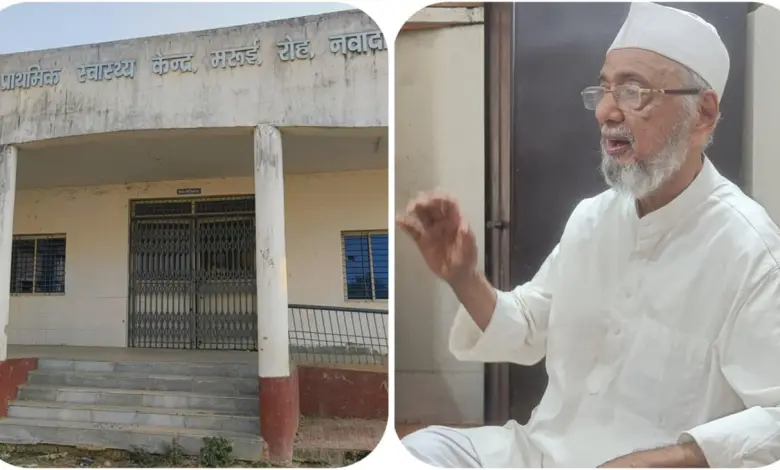
  Primary Health Centre in Marui, Nawada and Jamal Ahmed ‘Jamal’

Kolkata:

In the heart of Kolkata’s vibrant Prafulla Sarkar Street, Jamal Ahmed, the 98-year-old hotelier and poet, sits in the backroom of Aliah Hotel, his voice resonating with the same intensity as the lively street outside.

Jamal Ahmed, a nonagenarian, is known in the city as a poet and a concerned citizen. But the 98-year-old is also a philanthropist. He has donated 15 Katthas of land in his native village in Bihar for a government hospital, which last year became operational.

A Philanthropic Legacy: Land Donation for a Government Hospital in Bihar

“The land (in Marui village, Nawada district) was the costliest in the adjoining areas. But my father, who decided to donate it to the government to build a hospital there, did not hesitate,” informed Firdaus Jamal, son of Jamal Ahmed.

The market rate for land in Marui village is at least Rs 20 lakhs per kattha. In Bihar’s Nawada district, one kattha of land is equivalent to 3 decimals.

“I had told my mother that one day there will be a hospital in your name. So I had to do it,” Jamal Ahmed told eNewsroom. The family proposed the name of the hospital as QZJ Government Hospital, incorporating the names of Jamal and his parents. There is a board at the hospital where Jamal Ahmed Jamal’s name as the donor is mentioned. However, the Bihar government has yet to adopt the name suggested by the donors’ family.

The 20-bed primary hospital is now operational.

Poet Jamal Ahmed ‘Jamal’ | eNewsroom

When donating, I did not make any demands, such as asking for government jobs for my family members or insisting that a doctor from my family should practice here,” he said.

“I demand that either the Bihar Chief Minister (Nitish Kumar) or the Health Minister inaugurate the hospital,” the donor added.

Jamal Ahmed, a multifaceted personality, knows five languages and completed his Master’s in Sanskrit from Banaras Hindu University (BHU) and his Bachelor’s in Science (BSc) from Patna University. He frequently uses Sanskrit shlokas in his poetry. Much of his poetry focuses on communal harmony in the country.

A major event in his life was meeting the Father of the Nation, Mahatma Gandhi, on August 13, 1947 in Kolkata.

A Life of Literature and Peace: Jamal Ahmed’s Encounter with Mahatma Gandhi

“I was just 18 years old, but Gandhiji was desperately seeking peace for the country. When I heard that Gandhiji was in Kolkata and my uncle, Kareem Sahab, was going to meet him, I joined my uncle and reached Beleghata,” recalled the nonagenarian, quickly adding that he has no picture with Gandhiji.

“In my brief interaction, I requested Gandhiji for peace in the country and to stop the riots. Gandhiji replied that he came to Kolkata for this very purpose and would be traveling to other parts of the country for the same reason.”

The well-known hotelier has great command over recipes and dishes. “I have helped several hotel outlets in Kolkata and abroad set up their centers. Some of them are now big names, like Arsalan and Mezban.”

Jamal Ahmed’s sons run several hotels in Kolkata, including the famous Arafat Hotel on Rafi Ahmed Kidwai Road, which is managed by Firdaus Jamal.

Aliah Hotel on Prafulla Sarkar Street—where Jamal Ahmed feels he gains the wings to fly.

Preserving Harmony Through Poetry: The ‘Tatkal’ Poet’s Message for Unity

But in Kolkata’s literary circles, ‘Jamal’ is known for his ‘Tatkal’ poetry. A ‘Tatkal’ poet is one who can deliver a poem instantly, depending on the situation.

“I was very young when I met Gandhiji, and still, I recited a poem for him:

Andhi Tawaf Karti Hai, Gandhi Ki, Aye Jamal.
Ye To Bhanwar Se Laye Hain Kashti Nikal Ke

(The storm circles around Gandhi, O Jamal. He is the one who has brought the boat out of the whirlpool.)”

The poet ‘Jamal’, an Acharya in Sanskrit often uses the couplet to promote communal harmony.

Yem niza pro weti ganna laguchetshaam udarnaam chatrinantu, washudhew kutumbakam.

A rough translation of this Sanskrit couplet is:

“This is ours, that is yours—those who think this way have small hearts. But for the great ones, the entire world is one.”

He also mentioned that the shloka is written at the entrance of the old Parliament building’s gate. Eleven members of Parliament, including Maulana Azad, had agreed to imprint it there.

source: http://www.enewsroom.in / eNews Room India / Home> Art & Culture> Bengal / by Shahnawaz Akhtar / February 19th, 2025

The Linguistic Relationship Between Unani Medicine and Urdu is Deep-Rooted

NEW DELHI :

New Delhi :

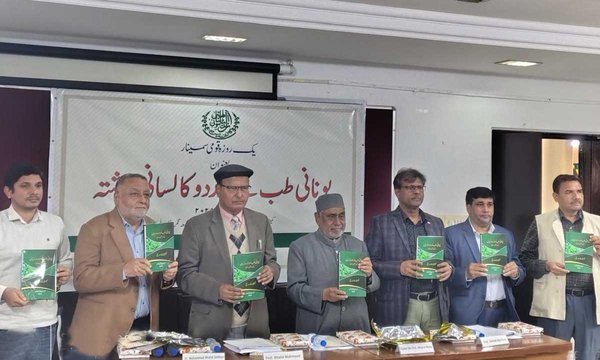
A one-day national seminar titled “The Linguistic Relationship Between Unani Medicine and Urdu” was organized by the All India Unani Tibbi Conference at the Committee Room of Nehru Guest House, Jamia Millia Islamia.

Delivering the presidential address at the inaugural session, Professor Akhtarul Wasey stated that Unani medicine and Urdu share an ancient relationship; it is not just a method of treatment but also a cultural attitude. Chief Guest Professor Khalid Mahmood emphasized that numerous vivid traces of this relationship can be found in Urdu language and particularly in poetry, which help in understanding the mutual connection between Unani medicine and Urdu. Former Head of the Urdu Department at Jamia Millia Islamia, Professor Ahmed Mahfooz, remarked that classical Urdu literature frequently references Unani medicine, and multiple instances of adaptation and benefit can be observed within it.

Objective of the Seminar

The seminar aimed to highlight the historical and linguistic connection between Unani medicine and the Urdu language to strengthen its scholarly tradition and explore possibilities for its promotion through Urdu. Speakers shed light on the Arabic, Persian, and Urdu traditions of Unani medicine and emphasized that Urdu has played a crucial role in making Unani medicine accessible to the masses.

Dr. Khalid Siddiqui, General Secretary of the All India Unani Tibbi Conference and the convener of the seminar, warmly welcomed all attendees and delegates.

Hakim Fakhr Alam elaborated on the objectives of the seminar.

Sessions & Discussions

Various sessions of the seminar featured research papers on the historical texts of Unani medicine, medical literature in Urdu, and its academic and research significance in the modern era. The speakers recommended further systematic organization and digitization of classical and contemporary Unani medical literature in Urdu to ensure that future generations can benefit from this valuable knowledge. Dr. Shahnawaz Fayyaz moderated the inaugural session.

First Session:

  • Chaired by Professor Badarudduja Khan and Dr. Mohammad Mohsin
  • Papers presented by: Professor Ashhar Qadeer, Dr. Afsahul Kalam, Dr. Mustahsan Faizur Rahman Aqdas, Dr. Umair Manzar, Dr. Mohammad Muqeem, Dr. Shahnawaz Fayyaz, Dr. Asad Faisal Farooqi

Second Session:

  • Chaired by Hakim Ashhar Qadeer, Dr. Shabbir Ahmad, Dr. Shah Alam
  • Papers presented by: Dr. Ahmad Saeed, Hakim Fakhr Alam, Professor Abdul Haleem, Hakim Nazish Ehtesham Azmi, Hakim Misbahuddin Azhar, Dr. Safiur Rahman, Dr. Ashfaq Ahmad, Dr. Amanullah

Conclusion

In the concluding session, the organisers expressed gratitude to all participants, speakers, and esteemed guests for making the seminar a success. They reaffirmed their commitment to continuing such academic gatherings in the future to further the promotion of Unani medicine and the Urdu language.

The seminar witnessed the participation of students and faculty members from Aligarh Muslim University, Jamia Millia Islamia, Jamia Hamdard, and Delhi University.

source: http://www.milligazette.com / The Milli Gazette / Home> News> Community News / by The Milli Gazette Online / February 18th, 2025

Bilal Mir’s Solar Car ‘RAY’ Set for Launch in Srinagar

JAMMU & KASHMIR :

Photo Credit: Basit Zargar

Srinagar:

After three years of relentless efforts, mathematics teacher Bilal Ahmad Mir is set to launch his solar-powered car, RAY, revolutionizing eco-friendly transportation. The much-anticipated vehicle will hit the roads on Monday, February 10, marking a significant step in clean energy innovation.

Mir, who entirely self-funded his project with an investment of ₹20-22 lakh, embarked on this journey in 2022. He extensively studied automobile designs from the 1950s to modern-day luxury cars, incorporating cutting-edge technological advancements into his solar vehicle. His research, published in six countries, has earned him the moniker ‘Elon Musk of Kashmir’.

The RAY solar car boasts a 1 kW solar-powered engine, a high-tech Battery Management System (BMS), and autonomous parking sensors. Its gull-wing doors, embedded with solar panels, enhance both aesthetics and energy efficiency. Unlike traditional electric cars that require sunlight for charging, RAY can charge itself even in cloudy or snowy conditions.

Mir initially caught the attention of Mahindra Group Chairman Anand Mahindra, but a potential collaboration fell through due to technical constraints. Despite this, Mir remains optimistic about his prospects in the global market.

While Indian manufacturers are producing electric vehicles, Mir believes his solar innovation faces no domestic competition. Instead, he aims to compete with international firms like Lightyear and Aptera Motors, both pioneers in solar-powered vehicles. His research continues to receive global recognition, further strengthening his reputation in the field.

The prototype of RAY was developed by modifying a 1988 Nissan Micra, a process that took Mir 13 years of dedication. The car, which features a dual power system—solar energy and a rechargeable battery—will officially launch on February 10 and is expected to hit the roads by June 2025. However, Mir remains tight-lipped about future production plans.

As the world shifts toward sustainable solutions, Bilal Mir’s innovative solar car serves as an inspiration for India’s clean-energy future.

source: http://www.radiancenews.com / Radiance News / Home> Pride of the Nation / by Radiance News Bureau / February 11th, 2025

Grand inauguration of ‘Beary Mela-2025’ in Dubai

KARNATAKA / Dubai, U.A.E :

Dubai: 

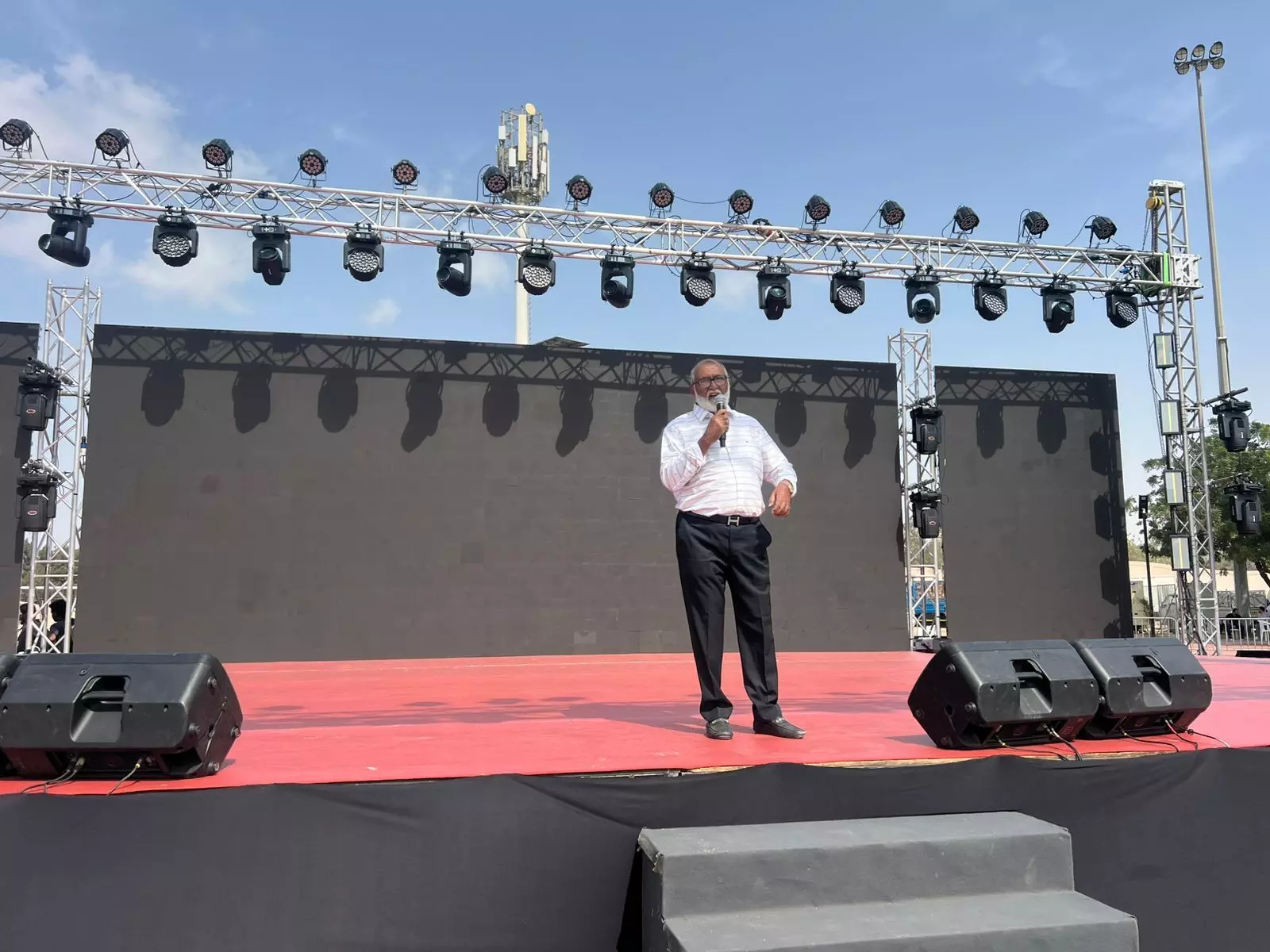
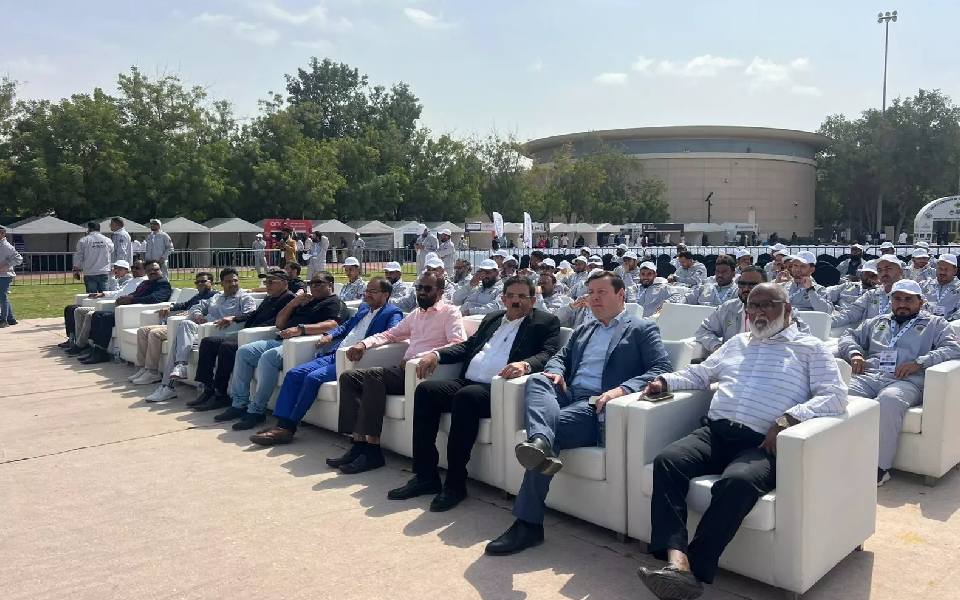
The ‘Beary Mela-2025’ was inaugurated in a grand ceremony at the Etisalat Academy Ground on Sunday.

Organised under the aegis of the UAE Bearys Chamber of Commerce & Industry (BCCI), the event was inaugurated by S.M. Rasheed Haji, President of the Mangaluru Bearys Chamber of Commerce & Industry (BCCI), who extended his best wishes.

Speaking as the chief guest, Zakariya Jokatte, CEO of Al Muzain in Saudi Arabia, stated that the Beary community is known for its peaceful and harmonious nature. He emphasised the importance of preserving the community’s culture and continuing initiatives that benefit the community.

During the event, he announced that the next Beary Mela would be organised in Saudi Arabia after the Eid celebrations in 2026.

Hidayath Addoor, President of the UAE chapter of BCCI, delivered the presidential address.

Other dignitaries present included Umar U.H., President of Beary Sahitya Academy, Golthmajalu Razak Haji, Badruddin, Imtiyaz, and Ronald Martis.

source: http://www.english.varthabharati.in / Vartha Bharati / Home> Gulf / by Vartha Bharati / February 09th, 2025

Indian Nawayath Forum elects new office bearers for 2025-2028 term

KARNATAKA :

Mangalore:

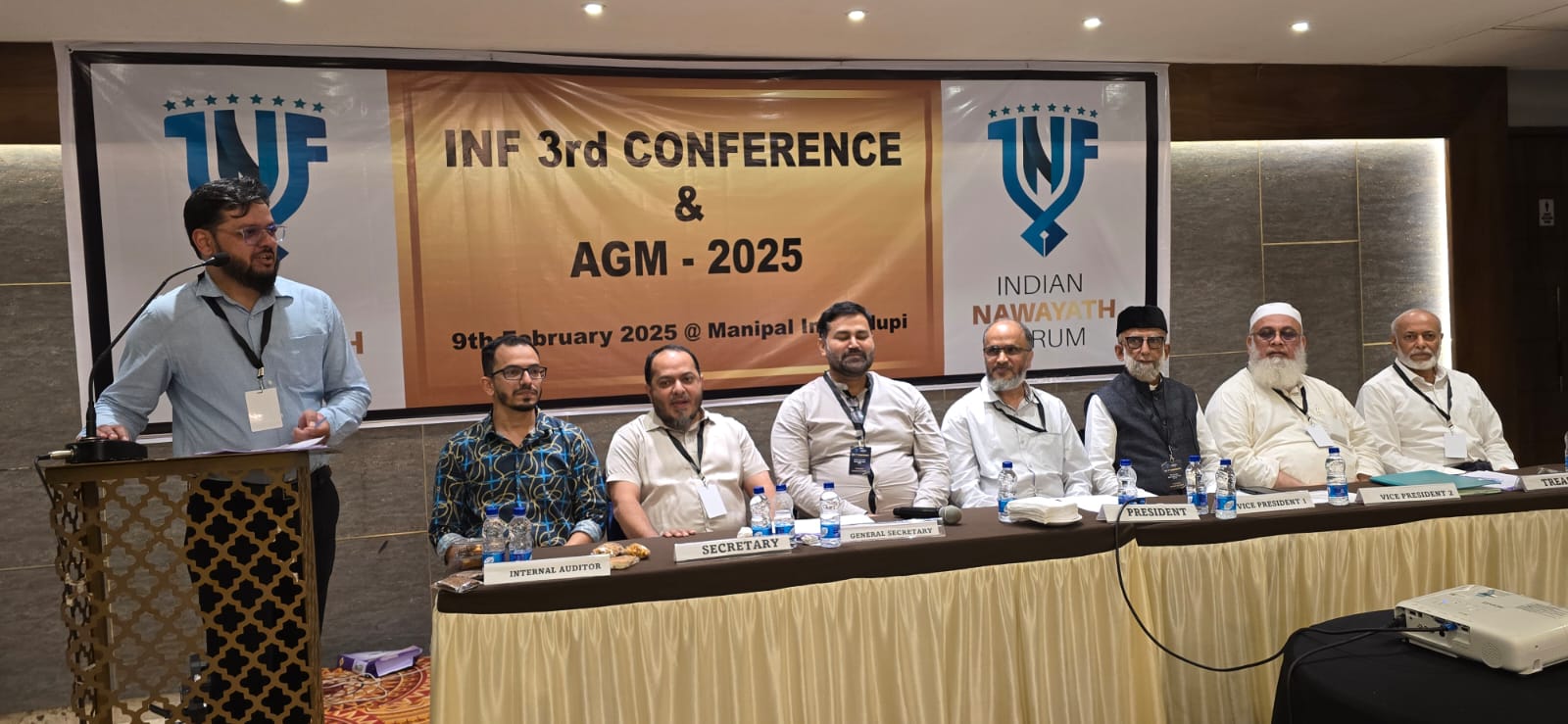
The Indian Nawayath Forum (INF) has appointed its new office bearers for the term 2025-2028, with Aftab Kola assuming the role of President. Hashim Mohtesham (Barni) and Fayyaz Mohtesham have been named as the first and second Vice Presidents, respectively.

Adil Nagarmat has been entrusted with the responsibilities of General Secretary, while Gufran Lanka will serve as Secretary. The forum’s financial management will be overseen by Treasurer Ummer Khalifa, and Faizan Lanka has been designated as the Internal Auditor.

The Indian Nawayath Forum, a prominent organization working for the upliftment and welfare of the society, plays a crucial role in social, educational, and cultural initiatives. With a strong commitment to community development, the newly appointed team aims to carry forward the organization’s objectives and address various issues concerning the Nawayath people.

source: http://www.english.varthabharati.in / Vartha Bharati / Home> Karavali / by Vartha Bharati / February 10th, 2025

High on herbs

Dehradun / Bengaluru, KARNATAKA :

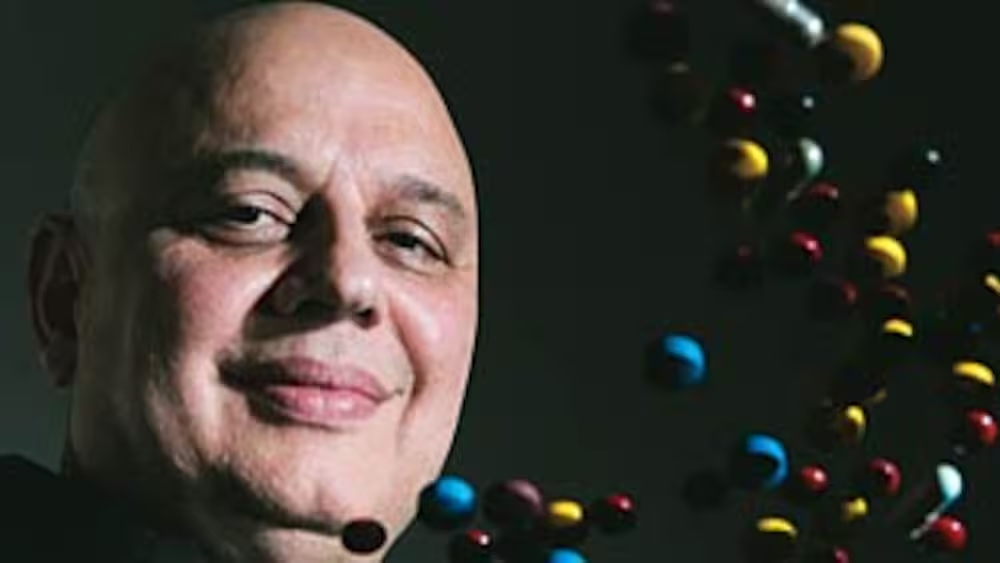
Meraj Manal is taking ayurveda places.

He can afford to hand out fistfuls of Liv.52 to anyone feeling liverish, although he would prefer to sell the pill. As Meraj Manal says, one Liv.52 is bought every second somewhere in the world. The only ayurveda pill among the 12 bestselling medications in India, Liv.52 has powered its manufacturer The Himalaya Drug Co into the ranks of Big Pharma in India.

But ask Manal to sell a slice of his privately-held company and you are shown the door. Many consumer care companies have tried to acquire a stake in Bangalore-based Himalaya. Dealmakers know it is not up for sale, but they do not give up hope or stop making bids.

Why should they? Himalaya, started by Manal’s father, the late M. Manal, in 1930 to make herbal tablets in the Himalayan town of Dehradun, is today an established brand in over 70 countries with about 160 products – 66 in pharma, 63 in personal care, nine in baby care and 22 in animal care.

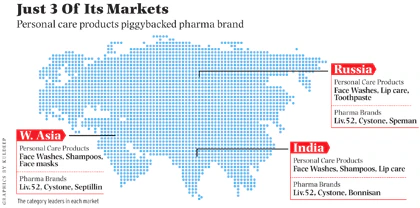
After India, its three top markets are West Asia, Russia and the CIS, and South East Asia. In 1999, Himalaya took its personal care range into global markets, piggybacking the equity of its pharma products.

Figures are not available, but Manal says turnover has crossed Rs 1,000 crore on the back of Liv.52, some similar pills and the personal care products. “Liv.52 is one of the biggest successes of my father,” says Manal, Chairman of Himalaya Global Holdings, which owns the nine operating subsidiaries in different regions.

___________________________

I get 3 or 4 offers a year: Meraj Manal

Meraj Manal, 62, has always let his business heads to do the talking. In a rare interview with BT’s K.R. Balasubramanyam, he explains why he does not want outside investments, and why values count more than profits. Edited excerpts

How did your father get into the herbal medicine business?
My father spent his lifetime gathering knowledge about traditional household remedies, standardising them, testing them for safety and efficacy and demonstrating them to doctors. He was the first who thought of producing herbal medicines in tablet form so doctors can prescribe them… Whenever he heard about a remedy, he would jot it down on a plain card to work on them later. We have tens of thousands of such cards stored in boxes. Our toothpaste is a product from one such card scribbled 40 years ago.

Why are you still not a public company?
I don’t want a rupee from anyone other than the bank, because it is difficult to explain what we do to a shareholder. Can I accept outside investments and allow these cards (pointing to the stacks of his father’s cards) to disappear? Our whole philosophy, our value system is so different, how do I explain this to investors? All my children – four daughters and three sons – think so.

Do you get offers?
I receive three or four offers a year. Multinationals have spoken to me and one of them even said we are the nugget of the herbal industry. If I accept these offers and put that money in a bank, I would no doubt get millions every month… What will I do with that money? I don’t want the liability of someone else’s money with me, big or small. Once you accept outside investment, they will start advising us on things like cutting the number of curries in the lunch at our canteen… or the staff transport. They will ask us why you are doing this and that. There is no “why” here. This is how it is. Since we are closely held, I have the luxury to say profits are not everything.

How much of your revenues goes into R&D?
In this company, there is no limit on expenses on R&D. That is the only division without a budget. These (pointing to the cards) have to be converted into products.

How are you professionalising the company?
As you grow, you need people who know more than you do. You cannot reach the next step unless you professionalise…. We will reserve the holding company for family members and the subsidiaries will have only professionals. We have separated ownership from management. Family members will be responsible for nurturing our value system. I don’t want family members on the business side. If they have energy, they are free to go out and pursue their interests.

So a family member becomes part of the holding company by default?
Admission is not by default. They must have something to contribute….My son heads the US business, and not because he is my son, but because he is a professional who knows the US market the best. He is doing remarkably well.

What about this Deputy Chairman’s post?
I created the post two years ago and appointed Ravi Prasad for a very special reason. To send a strong message that the operational head does not have to be a Manal. People were astonished and are happy about the decision. Like any CEO of any other region, my son too reports to Ravi. (Ravi Prasad was elevated as Executive Chairman in October. He leads the global management team.)

Are you satisfied with your growth?
The growth we have had is more than satisfactory. If I want more than that, then we are greedy. We crossed Rs 1,000 crore in revenues last year. I don’t know much about finances. Professionals handle that. I just sign on the papers. …When I joined the business in 1965, the revenues were Rs 40 lakh…. The way we are growing in North and South America tells me that 20 years from now, they could possibly be our largest markets by volume.

Where is Himalaya headed?
We will never move from our core competence. I am not for diversifying. I am not a person who can do other things. Opportunities for growth are unlimited and there is no real need to diversify. Our global operations have taught us many things. The country does not matter. As long as there are homes with people, we will go there.

_______________________________

Research backbone
Although Himalaya’s reliance on Liv.52 has come down after both its new as well as old pharma products picked up steam in the market, and it launched personal care products, it all began with this blockbuster, whose recipe was among the many jotted down by Manal’s father on a card.

(Himalaya’s future lies in thousands of similar cards with notes that are stacked in boxes in Manal’s room.) The 52nd formula was a hit. Manal senior’s aim had been to make herbal remedies available in tablet form, scientifically tested for efficacy, identified by name and prescribed by doctors. The passion for research continues.

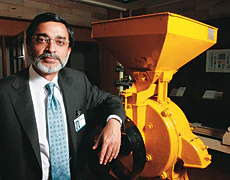
Ravi Prasad

Himalaya has raised its research, development and manufacturing standards so that its products clear regulatory hurdles abroad. “Apart from ayurvedic institutions, we also do clinical trials in leading allopathic institutions both in India and abroad,” says Ravi Prasad, Executive Chairman of Himalaya Drug Company, who leads the team of professionals worldwide.

“The regulatory picture is not clear in many countries and in some countries our standards have been recognised as the benchmark,” he says. Himalaya’s R&D facility, he says, is one of the biggest for an ayurveda manufacturer, with about 120 multidisciplinary scientists. As Manal proudly declares, R&D is the “backbone” of the company.

Himalaya knows the key to growth lies in its ability to create more patents. The US Patent and Trademark Office has granted it patents for its sunscreen, under-eye cream, laxative, sedative, immunestimulant, anti-acne range and hairloss cream, and 76 applications are pending. It has just released in the US markets a new type of tablet in which the binders are also derived from herbs. “No company has done this before, and we have filed for a process patent,” says Ravi Prasad. Until the 1990s, Himalaya’s portfolio had only pharma remedies. It entered the equally lucrative consumer care market with some 20 products under the Ayurvedic Concepts range in 2001. Two years later, it created the umbrella brand Himalaya Herbal Healthcare. It also began opening exclusive outlets: there are 130 shops in India and 25 in Singapore, Malaysia, South Africa and the Cayman Islands.

Dream run
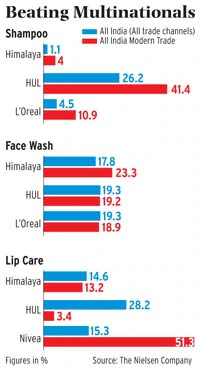
According to Ravi Prasad, Himalaya’s personal care products are growing much faster globally than pharma products, because pharma faces tough regulations in some countries. As of now, Himalaya gets 58 per cent of its revenues from pharma products, but that seems set to change. Saket Gore, Business Head of the consumer products division, says: “Today, we are the market leaders in face washes in the UAE, India and Malaysia.”

According to The Nielsen Co figures for April-June 2010, Himalaya face washes had a 17.8 per cent market share in India, less than two percentage points behind multinationals Hindustan Unilever Ltd and L’Oreal. Himalaya’s individual products also face competition from firms that are strong in one or just a few products, such as Colgate in toothpaste and Fair & Lovely in face masks. Doctors have been Himalaya’s biggest brand ambassadors in pharmaceuticals.

Philipe Haydon, President & CEO for pharmaceuticals, says Himalaya is in touch with about 3.75 lakh doctors and reaches 94 per cent of pharma retailers. “We are the modern face of ayurveda in India and our medical representatives promote products with scientific detailing,” says Haydon, who is also the CEO of the Asia Pacific region. In ayurveda retail, Himalaya competes with the likes of Dabur, Charak, and Baidyanath

______________________________

Odd man out
In a crowd of allopathy

RankDrug/ Company
1 Corex/ Pfizer
2 Phensedyl / Nicholas Piramal
3 Voveran/ Novartis
4 Augmentin/ GSK
5 Human Mixtard/ Abbott
6 Revital/ Ranbaxy
7 Dexorange/ Franco-Indian
8 Zifi/ FDC
9 Monocef/ Aristo Pharma
10 Becosules/ Pfizer
11 Taxim/ Alkem
12 Liv. 52/ Himalaya

Source: Indian Pharmaceutical Market rankings based on Org SSA report / Aug 2010

__________________________

Internationally, consumer care and pharma contribute equally to revenues. “In 20 years from now, North and South America could possibly be our largest markets by volume. They are very big on herbal medicine,” says Manal. These markets are headed by his son Nabeel, 36.

The Prognosis
Industry observers believe that while Himalaya has built a cult in Liv.52, it needs more such blockbusters to make up for its low-key marketing and a distribution network weaker than that of rivals such as Dabur India.

“Today, the brand Himalaya is recognised and closely associated as a natural remedy, but on the personal-care front it sends out no cues to a consumer. This is important in the FMCG category where it competes with many others,” observes Kannan Sitaram, a former chief operating officer of Dabur.

Analysts say that opening shop-in-shops and branded stores is a good strategy. “But brandbuilding investments are required so that consumers will walk into a shop only for the Himalaya display. Also, being positioned as a mass brand, it needs greater presence and investment in distribution,” says Sitaram. But the company has to figure out if its returns are justified. “After all, rentals are going up,” he says.

In pharma, Himalaya is stronger. “It has very sharply- positioned products for the eyes, liver, bones and so on. It is also present in areas that are not crowded. Besides, it spends huge sums on R&D and can compete with some of the best pharma companies in India,” says R.B. Smarta, Managing Director, Interlink Marketing Consultancy.

This also gives it an edge in global markets, where the demand for natural, ayurvedic and herbal remedies is growing. “They have very precise and extensive documentation on each of their ingredients, that can withstand the rigor of clinical trials. Their patents also stand them in good stead,” says Smarta.

By buying raw materials directly from growers, collectors and nongovernmental organisations, Himalaya keeps costs under control. Recently, it signed an agreement with the Sikkim government to prepare farmers in organic farming of herbs and sustainable collection. In September, Himalaya, along with a few others, came under fire from the Centre for Science and Environment or CSE, which claimed that Himalaya’s honey contained antibiotics beyond the stipulated standards. Ravi Prasad denies the charge. “The same batch was tested at three independent laboratories and none found any trace of antibiotics.

Our technical team will soon meet the CSE with these findings and seek its comments,” he says.

No entry
Manal does not run day-to-day affairs and has professionalised the company by elevating Ravi Prasad as the executive head, so that his father’s legacy grows independent of the family. “My father’s life’s mission was to help people and we will move in his footsteps,” says Manal, who follows the modest example set by his father. (In September, when Ravi Prasad called on Manal at his apartment in Dubai, the chairman travelled with him to Himalaya’s office in the Metro and then took a bus to attend another meeting.)

Of Manal’s seven children, only Nabeel works for the company. Two daughters are married and homemakers, and the other two daughters and a son are still studying. One son works in the financial sector in the US. Manal is content with bank funding, and proud of his 40-yearold relationship with Union Bank of India. In turn, M.V. Nair, the bank’s Chairman and Managing Director, says its long relationship with Himalaya is a wonderful example of a banker- entrepreneur growth story.

Himayala’s requirement of funds depends on projects. It borrowed Rs 100 crore two years ago from the bank to make its manufacturing unit in Bangalore compliant with European and American standards.

Dealmakers and investment bankers are not put off by Manal’s “No Entry” board. Recently a personal-care multinational contacted Bangalore’s Viedea Capital Advisors, looking for a sizeable stake in Himalaya. Deepak Srinath, cofounder of Viedea, says: “The management did not entertain any conversation on the subject.”

Himalaya, Srinath says, is a dream mandate for any investment banker because it has all the ingredients that a PE or strategic investor looks for – a highly credible brand name, an impressive product portfolio, a professional management and profitability.

“Also, the promoters have a reputation for being ethical,” says Srinath. According to the India head of an American PE firm, Himalaya is an ideal target since its capex needs are not large and can be met by internal accruals and bank funding. Such companies usually give robust returns.

But Manal is focused on different things: “The scope for growth is unlimited. As long as there are homes with people, that family is our customer. We don’t recognise borders.”

With inputs by Shamni Pande

source: http://www.businesstoday.in / Business Today.in / Home> News> BT Magazine> Features / by K R Balasubramanyam / Print edition / November 28th, 2010

American Specialty Foods Co wins prestigious Westford Award for Business Excellence

Mangaluru, KARNATAKA/ Maryland, U.S.A / Dubai, U.A.E :

Dubai: 

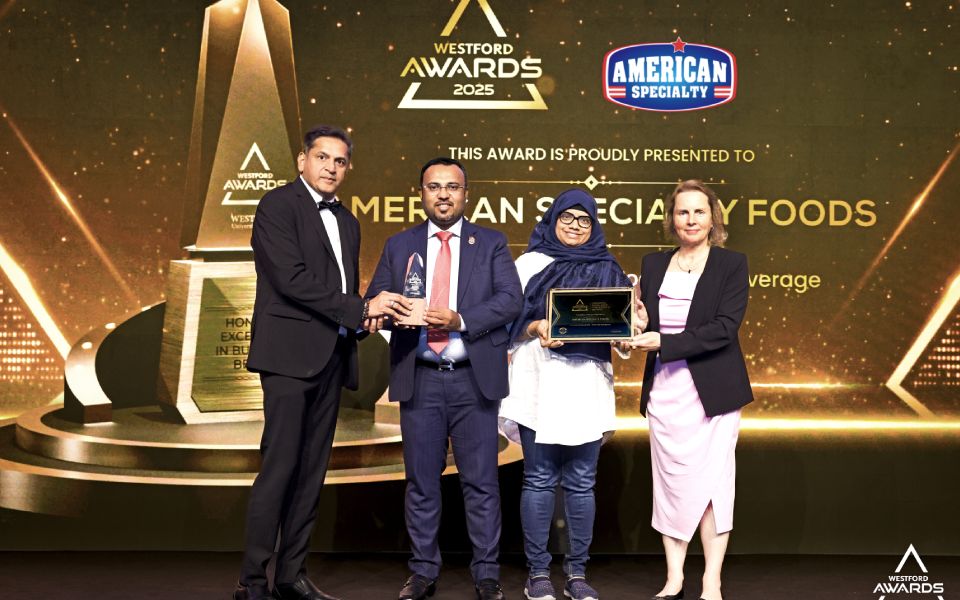
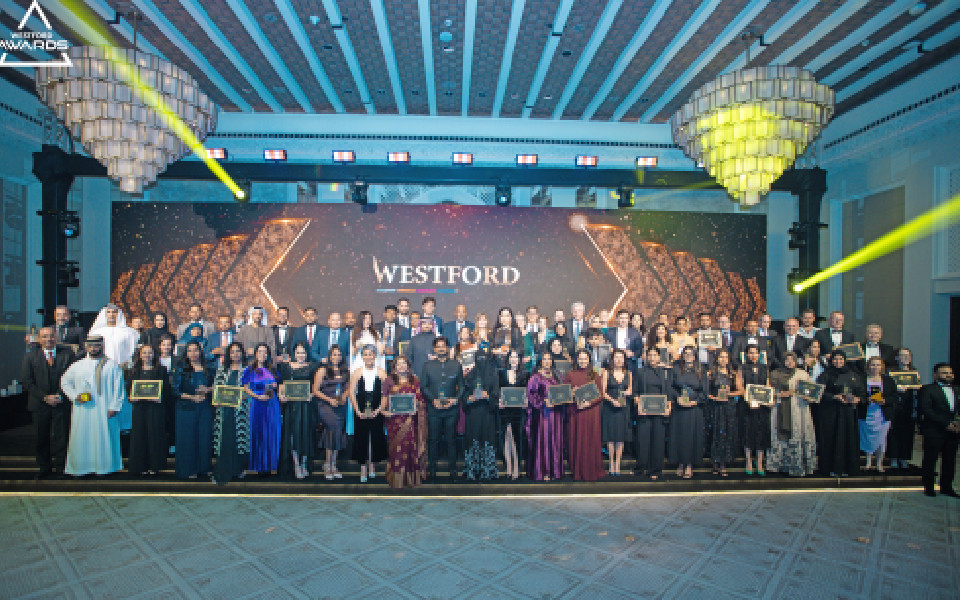
American Specialty Foods Co has been honored with the prestigious Westford Award for Business Excellence in the Food & Beverage category. The award was presented at a grand ceremony held at Madinat Jumeirah, Mina Al Salam, Dubai, on January 24, 2025.

The award was received by the company’s Founder and CEO, Hany M. Haneef, along with Co-founder and Director, Shahanaz Haneef. Expressing his gratitude, Haneef stated, “I am truly honored to receive this award. It belongs to our incredible team, partners, and supporters. Success is built on dedication, teamwork, and excellence. This is just the beginning; there is so much more ahead.”

Established in 2013, American Specialty Foods Co has grown into a leading provider of premium global food solutions. Headquartered in Maryland, USA, the company also has offices in New York, Mexico, the UK, and the UAE. With a distribution network spanning over 50 countries, the company offers more than 20 specialty food categories and actively participates in major international food trade events worldwide.

The Westford Awards recognize outstanding business achievements across various industries, providing winners with greater visibility and networking opportunities. “This recognition further cements American Specialty Foods Co’s position as a leader in the specialty food and beverage sector,” a statement from the company added.

source: http://www.english.varthabharati.in / Vartha Bharati / Home> Gulf / by Vartha Bharati / January 31st, 2025