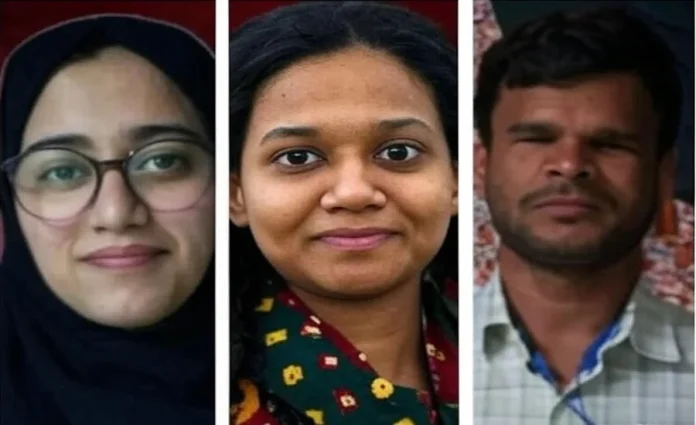
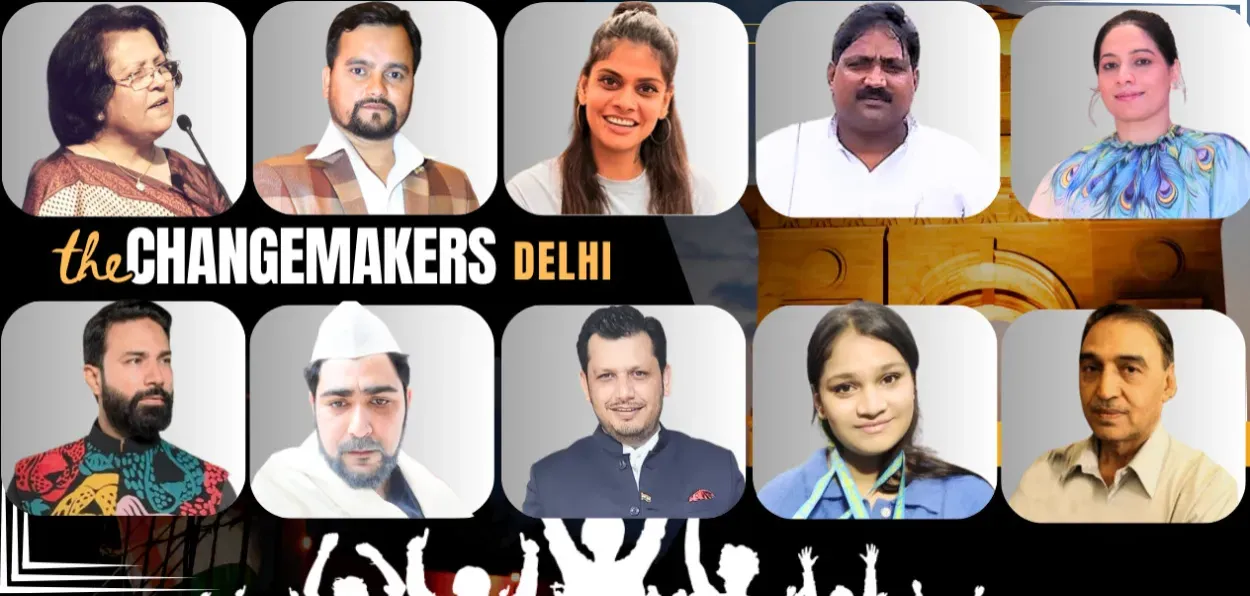
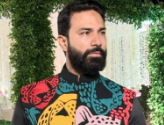
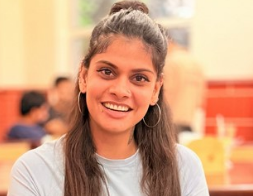
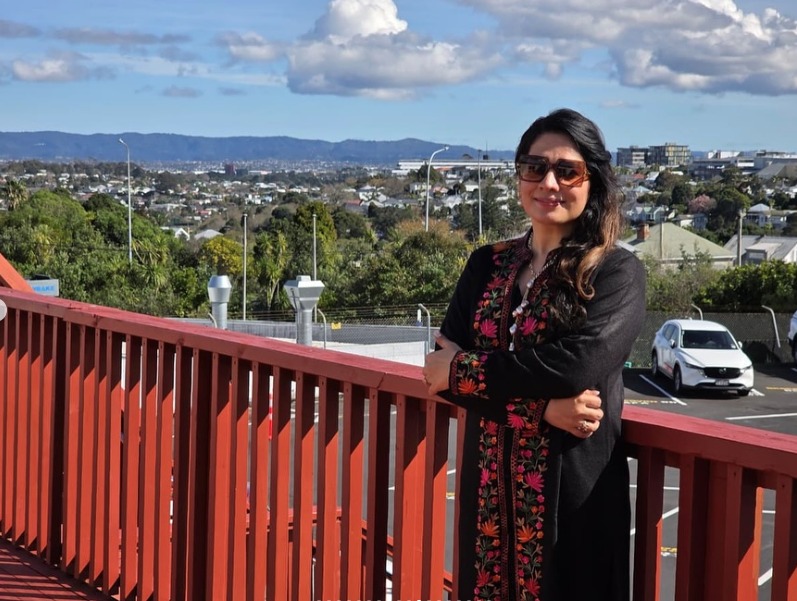
For the first time in the history of Aligarh Muslim University Student politics, three women have won the student union elections. Ghazala Ahmad, Sadaf Rasool and Labiba Sherwani all contested the polls for the first time and all three won posts of cabinet members in the AMUSU.
The results of AMUSU elections sent a positive message about gender equality in an university that had gotten bad press for restricting library access for undergraduate women students.
Ms. Ahmad is final year student of Bachelors of Social Work, Ms. Rasool is in the final year of B.U.M.S. and Ms. Sherwani is in her first year of Bachelors of Social Work.
In 2015, one female student had won the union elections. But this is the first time in the history of AMU that three women have won the polls in their maiden attempt.
Kehkashan Khanam, a student of Ph. D. in Theology had won the post of cabinet in the last AMU student union elections. Ms. Khanam had contested this time for the post of vice-president in the AMUSU.
While talking to The Hindu on phone from Aligarh, Ghazala Ahmad said she held the victory of three girls in their first attempt to be a “sign that students of AMU want to see more girls presence and participation in overall student politics”.
When asked how she convinced a male-dominated electorate to vote for her, Ms. Ahmad said, “I told everybody on the campus that time has come to change outsiders’ perception of AMU. I told them, lets show the outside world that AMU campus is friendly and open to girls.”
The twenty-one-year old Ms. Ahmad said her inspiration was her working mother Nahid Fatima, Principal of a Government Primary School in Aligarh.
The job of a cabinet member is to ensure that the problems faced by the students at the departmental and faculty level, should be conveyed and taken up with the president, vice-president and secretary of the AMUSU. “It is a male-dominated campus but the results show that students on the campus want to more participation from girls. After all girls are also there on campus. Who will represent them. It was a tough competition so I had to work really very hard,” said Ms. Ahmad.
source: http://www.thehindu.com / The Hindu / Home> News> India> Other States / by The Hindu / November 01st, 2016
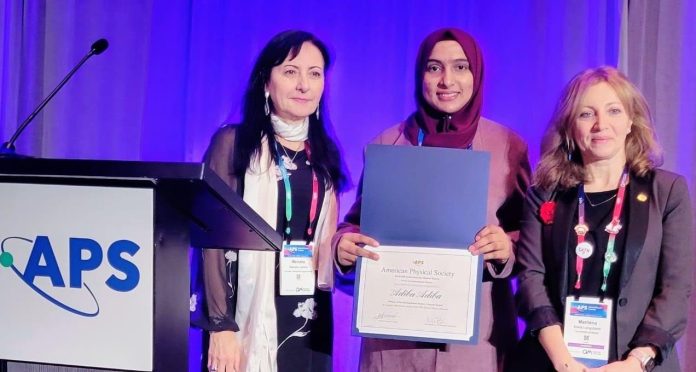
Adiba receiving the Prestigious APS Distinguished Student Award
Aligarh:
Adiba, a PhD student in Physics at Aligarh Muslim University (AMU), has been honoured with the Distinguished Student Award by the American Physical Society (APS) at the APS March Meeting 2025 in Anaheim, California.
Instituted in 2015, the award recognises exceptional early-career researchers from outside the U.S. and supports their participation in APS’s flagship meetings.
Adiba, working under the supervision of Prof Tufail Ahmad, is conducting cutting-edge research on Resistive Random Access Memory (ReRAM) devices for neuromorphic computing – an emerging frontier in physics and artificial intelligence. Her work earned her the prestigious award for outstanding contributions to the field.
Beyond research, she leads as President of the International Centre for Muslim Women in Sciences (ICMWS), championing science education among young women.
Expressing her gratitude to AMU for its role in her success, Adiba said, “Receiving this recognition from APS makes me feel incredibly proud and motivates me to strive even harder.”
source: http://www.radiancenews.com / Radiance News / Home> Latest News> Research> Science & Technology / by Radiance News Bureau / April 08th, 2025
Mecca, (Ottoman-SAUDI ARABIA / Kolkata, WEST BENGAL / DELHI :
Abul Kalam Ghulam Muhiyuddin (November 11, 1888-February 22, 1958), better known as Maulana Azad, was a writer-activist-statesman.
Historian S Irfan Habib speaks on Maulana Azad on his birth anniversary at an event organised by the Maulana Azad College alumni association in Calcutta on Tuesday / The Telegraph
Historian S. Irfan Habib, while delivering his Maulana Abul Kalam Azad memorial lecture titled “Revisiting Maulana Azad in Contemporary India” on Tuesday, rued how in today’s India, anytime he posts anything on social media on the freedom fighter, 80 per cent of the comments comprise hateful abuse.
“Full of abuse… 80 per cent of the comments. And from people who have no idea of who he was, what he stood for, and what he did for India,” said Habib, whose lecture on the Maulana on the icon’s 137th birth anniversary was organised by the Maulana Azad College alumni association to mark the college’s centennial.
Abul Kalam Ghulam Muhiyuddin (November 11, 1888-February 22, 1958), better known as Maulana Azad, was a writer-activist-statesman.
One of Mahatma Gandhi’s most trusted lieutenants and the youngest president of the Indian National Congress, he made crucial contributions to the freedom movement. He was also Independent India’s first education minister.
“I will speak about those issues relevant for today’s India. What he did for education, how he defined nationalism — today all those who have no idea of what nationalism is are nationalists — and how he defined Islam…. Islam too is in danger when we see what we believers have done to our own faith,” said Habib, former Maulana Azad Chair at the National University of Educational Planning and Administration, New Delhi.
Maulana Azad’s family moved from Mecca to Calcutta when he was two. He spent several decades of his life in this city, his residence on 5 Ashraf Mistry Lane of Ballygunge now a museum.
November 11 is celebrated as National Education Day to recognise his contribution in establishing the education foundations of India — from the Indian Institutes of Technology, the University Grants Commission, the All India Council for Technical Education, the Council of Scientific and Industrial Research, the Indian Institute of Science, and the Sahitya Akademi, the Sangeet Natak Akademi and the Lalit Kala Akademi, besides the Indian Council for Cultural Relations.
“Patriotism, nationalism and humanism, the difference between them Maulana tried to look at. In this (the belief in the culmination in humanism) he was very close to Gurudev Rabindranath Tagore, and he actually writes about it, that he believes in the idea of nationalism which was pitched by the idea of Tagore’s humanism and universalism,” said Habib.
“True relationship is only one, where the entire earth is one’s native land. This is necessary is today’s India, where we indulge in othering among own citizens, in the name of religion, caste, language, all sorts of issues, all sorts of divisive tools we use to divide Indians, while Maulana says mankind is one family and all humans are brothers, this is the idea of humanity of nationalism which Maulana left behind,” he added.
Habib underscored how the Maulana began as a pan-Islamist, speaking against the subjugation of Muslim nations by imperialist powers — a sentiment expressed strongly in his papers Al-Hilal and Al-Balagh, and it was because of his role as a fiercely upright journalist that the British Raj viewed him as one of the most dangerous persons in India.
Habib stated that after the Maulana was released from exile in Ranchi in 1920, he was torn between reading and writing in seclusion, or public life and the freedom struggle. It was soon after coming out of exile that the Maulana met Gandhi on January 18, 1920, for the first time.
“The meeting seemed to have had a profound impact on both… and they remained inseparable for the rest of his (Gandhi’s) life,” he said.
According to Habib, the Maulana fought on multiple fronts, not only against the British, but also Hindu and Muslim communalists.
“Maulana stressed on indivisible or composite nationalism, where he went back to early Islamic history, when the Prophet (Muhammad) created the first Muslim nation in Medina by aligning with the Yehudis (Jews). He saw no reason why Muslims could not join hands with Hindus and others in nation-forming…. He was appalled with communalists busy with sectarian campaigns when the need was to fight the British as a composite nationalist group,” Habib said.
“Maulana stood for a united India and remained steadfast in this resolve till the end. We are amid polarising politics where religion has become a distinct marker of identity…. The majoritarian nationalism being flaunted today runs contrary to the idea of composite nationalism espoused by Maulana all his life,” he added. “Maulana found the demand for Pakistan absurd as he was conscious of the fact that religion cannot be a binding factor for a nation.”
source: http://www.telegraphindia.com / The Telegraph Online / Home> West Bengal / by Meghdeep Bhattacharyya / November 12h, 2025
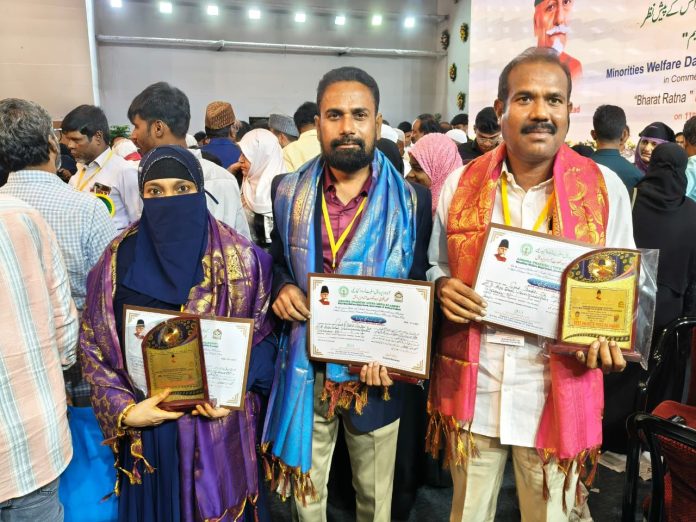
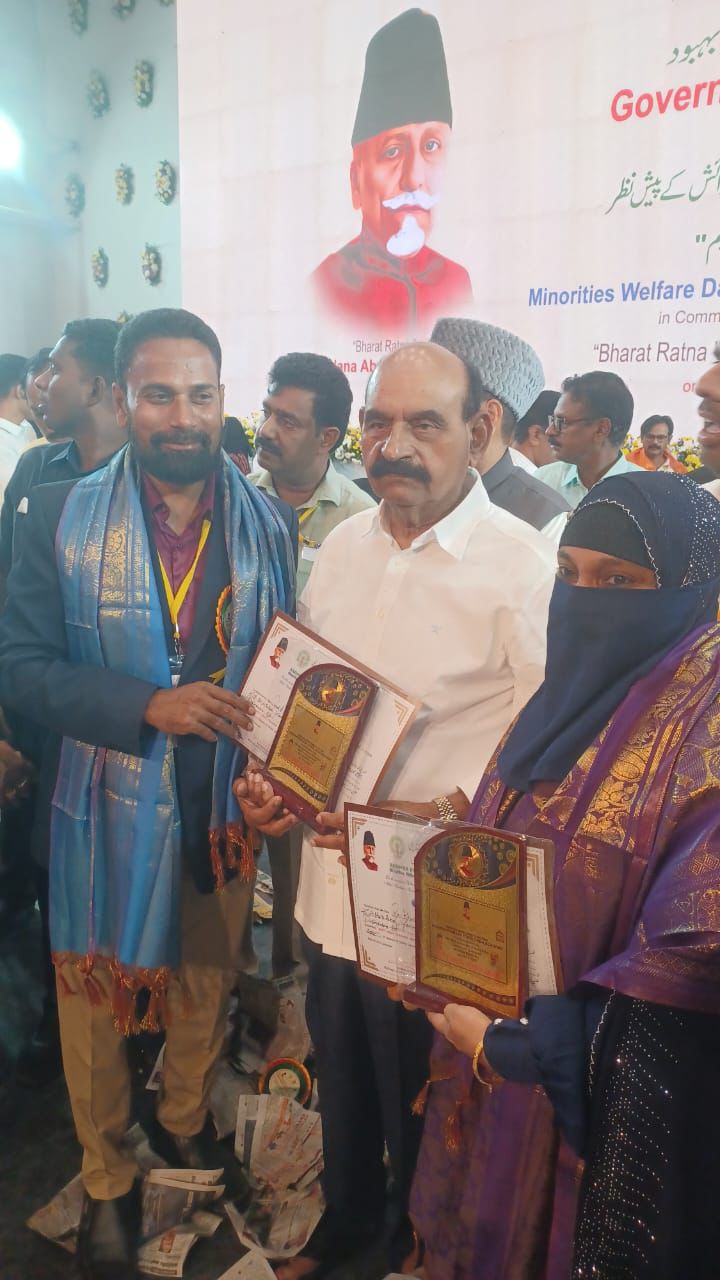
In celebration of National Education Day, the State Urdu Academy organised a special felicitation programme where teachers from ZPHS Urdu School, Yerragondapalem, a village in Prakasam district of Andhra Pradesh, were honoured with the State-Level Urdu Best Teacher Awards.
The awards were presented by the Minister for Minority Welfare, S.M.D. Farooq, to Syed Abdul Ghaffar (SGT Urdu), Shaik Khursheed Begum (SA SS), and Syed Shafi (SA Urdu) in recognition of their outstanding contributions to Urdu education.
Local residents, students, and parents extended their heartfelt congratulations to the award-winning teachers and expressed their hopes that they continue to bring more laurels in the future while nurturing many more bright students under their guidance.
source: http://www.radiancenews.com / Radiance News / Home> Awards> Pride of the Nation> Latest News> Report / by Radiance News Bureau / November 13th, 2025
Muslim students have made a strong mark in this year’s Jawaharlal Nehru University (JNU) student union elections, with Danish Ali, Hafsa Bukhari, and Mohammad Aslam among the winners. The elections saw the Left alliance secure all four top posts, defeating the ABVP. Aditi Mishra was elected President, K Gopika Babu as Vice President, Sunil Yadav as General Secretary, and Danish Ali as Joint Secretary.
Danish Ali, a research scholar at the Centre for Historical Studies, defeated ABVP’s Anuj to win the Joint Secretary seat. Coming from Narsinghpur, Madhya Pradesh, Danish belongs to a family of educators. She was active in student mobilisations during the 2019 CAA protests and said her victory belongs to all students who value justice and democratic rights.
Hafsa Bukhari from Poonch, known for her hijab-wearing identity, also won a councilor seat. Her election is seen as a step forward for women’s representation and Muslim inclusion on campus. Alongside her, Mohammad Aslam, a visually impaired PhD scholar from Bihar, earned a councilor position. Despite his challenges, Aslam has consistently spoken up for equality, disability rights, and social justice.
Faculty members at JNU described their wins as a reflection of courage, resilience, and commitment to equality. Students across the university have welcomed the outcome, seeing it as a mandate for inclusivity and democratic engagement.
source: http://www.radiancenews.com / Radiance News / Home> Latest News> Report / by Radiance News Bureau / November 08th, 2025
Saniya Samreen receiving a Gold Medal from Justice Dinesh Maheshwari, Chairperson of the Law Commission of India and former Judge of the Supreme Court, at the 9th Convocation of the Central University of Karnataka (CUK) held on Saturday. | Photo Credit: ARUN KULKARNI
Defying all odds, Saniya Samreen, daughter of a fruit vendor from Aland town in Kalaburagi district, bagged the Gold Medal in Master of Commerce (MCom) at the 9th convocation ceremony of the Central University of Karnataka (CUK) held on Saturday.
She received the medal from Justice Dinesh Maheshwari, Chairperson of the Law Commission of India and former Judge of the Supreme Court, in the presence of Vice-Chancellor Battu Satyanarayana, Registrar R.R. Biradar and Controller of Examinations Kota Sai Krishna, on Saturday.
Ms. Samreen, who completed her schooling and college education in Aland before joining CUK for her postgraduate studies, said that her achievement was a result of perseverance and family support.
“All of my achievements are the result of hard work, dedication, and the unwavering support and guidance from my family and mentors,” she with gratitude during her interaction with media representatives on the sidelines of the convocation.
Her father, Mr. Shamu Bagwan, earns his livelihood as a fruit vendor, while her mother, Mrs. Raziya Begum, is a homemaker. “My parents’ constant belief in me has been the driving force behind my success,” Saniya added.
Saniya, who has also qualified both the Karnataka State Eligibility Test (KSET) and the National Eligibility Test (NET) for assistant professor, said she wishes to build her career in academia.
“I aspire to contribute to the field of commerce through teaching and by shaping future professionals,” she said.
source: http://www.thehindu.com / The Hindu / Home> News> India> Karnataka / by The Hindu Bureau / November 08th, 2025
Delhi is the city of enterprising people, many of whom are migrants from smaller towns and cities. Many achieved successes in careers, businesses and professions — but some of them transcended the boundaries of success. They are trailblazers who give it back and inspire others. Here, we feature ten personalities of Delhi whose work makes them extraordinary and the Changemakers:
Sirajuddin Qureshi
Sirajuddin Qureshi a well-known industrialist who laid the foundation of India’s meat industry and food processing. Besides, he is one of the founders of the India Islamic Cultural Centre in Delhi. He is a trailblazer in modernising and scaling up the meat and food processing industry under the aegis of his Hind Group. He set up the first modern slaughterhouse and expanded his food business to 50 countries.
However, his lasting contribution to society is his relentless campaign for promoting education among the Qureshi clan, who were small-time meat sellers and traders. He persuaded his community members to pledge to promote the education of girls and women, opt for simpler weddings and encourage youth to join professions. His social campaign was so successful that today, only 20 per cent of the Qureshi men are meat sellers, and women have higher educational standards.
Azra Naqvi
Azra Naqvi wears many hats, but her core remains attached to Urdu, the language, she claims, she breathes, thinks in, and is in her DNA. Despite having lived a fulfilling life with her husband in many countries, dabbled in different professions and roles, her heart always pined for her favourite language. So, when she got a chance to work as a consulting editor with Rekhta Foundation, she made the most of the opportunity.
Besides fulfilling her passion for Urdu at Rekhta, Azra Naqvi found an innovative use of the WhatsApp application on her mobile. First, she connected 200 Urdu women writers to establish a first-of-its-kind literary organisation, Bainalakwami Nissai Adabi Tanzeem (BANAT). The BANAT has created a sisterhood of Urdu writers. So far, BANAT has published two anthologies based on WhatsApp communication, while a third one is in process. Using the WhatsApp group, Azra Naqvi collected theme-based writings of 40 women writers.
Siraj Khan
‘Yes, We Can’ stands as a reminder that unity and opportunity can transform lives. This non-profit organisation is dedicated to empowering communities, nurturing youth potential, and creating safe spaces for growth. At the heart of this movement is Shiraz Khan, a changemaker from Old Delhi, whose journey of self-discovery and resilience has shaped the ethos of “Yes, We Can”. The seeds of Yes We Can were planted in 2015. For Shiraz Khan and his co-founder, Nandish, the pandemic wasn’t just a crisis; it was also a wake-up call. They realised that people needed support not only in material terms but also in inspiration, guidance, and community.
From grassroots awareness drives to collaborations with youth-led groups, Yes We Can has quickly grown into a space where possibility meets action. Shiraz often says, reflecting the organisation’s focus on building resilience rather than dependency.
Sahar Hashmi
Mental health in India remains a taboo; words like depression, anxiety, or personality disorder are either laughed off or bring shame. Breaking this deafening silence is Sahar Hashmi, the 29-year-old woman from Delhi. She not only overcame her mental illness but also became a beacon of hope for others suffering in silence.
In April 2025, Sahar launched a campaign, “Breaking Stigma: One Mile at a Time”. She took a 2,779 km bike ride from Delhi to Kashmir. This journey was not just about crossing the geographical boundaries, but an emotional journey against the stigma and silence of society on mental health.
Asghar Ali
Delhi-based artist Asghar Ali is spreading the message of Ganga-Jamuni tehzeeb (Inclusive Indian culture) in society through his art. Asgar Ali, a Muslim by faith, has more than 50 paintings based on Lord Krishna and his life story to his credit.
Asghar Ali said that since his childhood, he was fascinated and influenced by Shri Krishna, colours of his peacock feathers and the flute. Asgar Ali’s major work is on the childhood form of Shri Krishna (Bal Krishna), his youth, his objectives in the Mahabharata war, as well as his leela (stories).
Asgar Ali had also organised an exhibition of his Krishna-themed paintings at the recently concluded International Geeta Mahotsav at Kurukshetra, Haryana, where people appreciated his work.
Amna Mirza
Amna Mirza is a trailblazing teacher who prefers holding her lectures outside her classroom amidst the pieces of history strewn around in Delhi. She not only makes teaching interesting, but also helps heritage and modernity coalesce. In the rat race of the modern world, Dr Amna Mirza stands tall as a teacher bringing about profound changes in people’s mindsets.
A political science professor at the University of Delhi. Dr Mirza’s journey defies the rigidity often associated with academia. She wears many hats with ease: educator, social worker, cultural custodian, and above all, a proud Delhiite who believes in nurturing the soul of a nation through its people and plurality.
Mohd. Meraj Rayeen
Md. Meraj Rayeen’s inclusive campaign to improve the conditions of indigenous Pasmanda Muslims, who comprise approximately 80 per cent of the Muslim population, is shaping social change.
Rayeen says, “Politics alone cannot be the solution to every problem.” Based on this thought, he founded the ‘Pasmanda Vikas Foundation’ over a year ago. The organisation has undertaken substantial work to change the lives of people and instil new hope and confidence within the community.
This foundation is not into rhetoric in favour of Pasmanda Muslims’ rights on political platforms; It addresses issues such as education, health, economic empowerment, and social justice.
Meraj Rayeeen believes that the development of Pasmandas is possible only with the awakening and cooperation of the community members. but the entire Muslim society, especially the Ashraf class.
Uvais Ali Khan
Uvais Ali Khan is a successful Chartered Accountant and a changemaker whose journey stands as a beacon of determination and service to society.
He quit his job and started his own business in a small apartment in Laxmi Nagar, East Delhi. Borrowing from friends and banks, he began building not just a company, but a platform for change. Uvais believes in a simple but powerful idea: “Providing basic skills to an individual can open avenues for them to get a job. That single opportunity can change the life of a family for generations.
Adeeba Ali
Adeeba Ali’s life is a testimony to the power of the human spirit and willpower. The 17-year-old is not only a rising star in the world of para-shooting but also an inspiration to many others struggling with self-pity and helplessness.
Five years ago, Adeeba fell from the balcony of her house in Nizamuddin. Four years later, she stunned everyone with her stellar performance at the 26th National Shooting Championship held at the Madhya Pradesh State Shooting Academy, Bhopal, in December 2023.
Adeeba’s success is not just a story of winning two medals; it is a story of perseverance that transformed disability into a new identity, not a hindrance.
Syed Sahil Agha
Storytelling is associated with Sufis and Khanqahs; it’s a medium of the message of peace and love, which instils patriotism, unity, and religious harmony, and nurtures the Ganga-Jamuni (inclusive) civilisation. Keeping the tradition in mind, Syed Saahil Agha revived this art and gave it a modern context. Today, he is one of the most well-known names in the world of storytelling.
Syed Saahil Agha conducts storytelling programs in India and abroad. He says, “I realised that people prefer listening over reading, so I thought stories should be narrated so that the public can become familiar with the past and also learn lessons from it.”
He says his aim is not just to narrate stories but also to promote Indian civilisation.
source: http://www.awazthevoice.in / Awaz, The Voice / Home> The Changemakers / by Aasha Khosa / November 09th, 2025
Mangaluru, KARNATAKA / Kozhikode, KERALA / Dubai, U.A.E :
Shabana Faizal with her husband Faizal Kottikollon
New Delhi :
Mangalore-based Shabana Faizal has emerged as the youngest woman among India’s top 10 philanthropists, according to the EdelGive Hurun India Philanthropy List 2025.
She has donated ₹40 crore (approximately $1.5 billion) through the Faisal & Shabana Foundation to education, health, and social development.
Shabana Faisal’s journey from being raised in a small town in Mangalore to co-leading a global enterprise is about he hard work and ambition.
Her entrepreneurial journey began in 1995 as a retailer of unique, speciality and luxury products. After leading the company for eight successful years, she decided to team up with her husband, entrepreneur Faizal Kottikollon, and support him in running the world-class foundry, Emirates Techno Casting (ETC).
Shabana took charge of all human resources and administrative processes at ETC, where she created a significant impact in shaping the company’s business success.
In her role as Vice Chairperson of KEF Holdings, she is actively involved in guiding the business’s growth strategy across global markets. Deeply committed to social improvement, Shabana and her husband founded the Faizal & Shabana Foundation in 2007, with the vision of ‘Giving to Create Impact’.
At 53, Shabana’s work has placed her among some of the most influential women in India’s philanthropy world, including Rohini Nilekani, Kiran Mazumdar-Shaw and Bina Shah.
EdelGive Foundation, in collaboration with Hurun Research Institute, recently released the 12th edition of the EdelGive Hurun India Philanthropy List 2025.
The list honors India’s most generous individuals and families. Over the past three years, 191 philanthropists have donated a total of ₹10,380 crore, representing an 85% increase in contributions.
The education sector continues to lead as the top donor, receiving ₹4,166 crore from 107 donors.
Shabana is the mother of four children – Sophia, Sara, Zakaria, and Zarina – but continues to play an active role in business and philanthropy. Her work makes her one of India’s most influential female philanthropists, exemplifying how professional leadership and a commitment to giving can combine to create widespread social impact.
The EdelGive Hurun India Philanthropy List 2025 states that the top 25 donors contributed ₹50,000 crore in just five years, or an average of ₹46 crore per day. Mumbai leads in philanthropy, contributing 28% of total donations, followed by New Delhi and Bengaluru.
source: http://www.awazthevoice.in / Awaz, The Voice / Home / posted by Aasha Khosa / November 10th, 2025
Dr. Nazir Ahmad Nadwi, senior faculty member of Darul Uoom Nadwatul Ulama, Lucknow passed away after a brief illness on 7 October 2025 in Lucknow. His sudden demise came as a shock for everyone.
Almighty Allah bestowed upon him extraordinary qualities and a variety of calibres. His personality was a marvellous amalgamation of a teacher, orator, journalist, academician, preacher of Islam and translator par excellence.
Born in 1965 in district Itawa, Uttar Pradesh (India), he received his basic education in his hometown. Thereafter, he joined Darul Uloom Nadwatul Ulama for higher studies. He did his Alimiat in 1987 and Fazilat (Specialisation in Hadith) in 1989 respectively. He also did his Ph.D. from the University of Lucknow. After completion of education from Nadwa, he was appointed as an employee in Al-Raid (Fortnightly), an Arabic wing of Nadwatul Ulama. While working at Al-Raid, he came in close contact with Maulana S.M. Wazeh Rasheed Nadwi, an accomplished journalist and prominent Islamic scholar. No doubt Maulana Wazeh left an indelible impact upon his life. It was Maulana Wazeh who had developed journalistic flavour and literary taste in him. Besides, he derived considerable academic benefits from Maulana S.M. Rabey Hasani Nadwi, former Rector of Nadwatul Ulama and Maulana Dr. Saeedur Rahman Azami Nadwi, Principal of Darul Uloom Nadwatul Ulama, Lucknow.
After a few years, he was promoted as a teacher. He was an embodiment of all sublime qualities and virtues, necessary for a good teacher. He proved himself as a selfless and dedicated teacher. His method of teaching was unprecedented.
He was a beloved teacher and scores of students quenched their thirst for knowledge from him.
Maulana led a very simple life. He left behind remarkable marks. He always kept himself away from name and fame. He did everything merely for the sake of Allah.
It should be noted that Maulana Nazir Nadwi achieved distinction in many languages such as Urdu, Arabic, English, Hindi, and Persian.
There are a number of things about Dr. Nazir Ahmad which people noticed and have written about. I personally have been most influenced by his personality. To him nothing was more precious than time. He was very punctual and meticulous.
The nicest thing is that he treated all with equal courtesy. He was a paragon of morality. He never showed egotism, pride and haughtiness. He performed his duties with honesty and integrity.
He had literary flavour, poetic flourish and journalistic taste. He wrote numerous articles for different newspapers and journals including Al- Raid. He also compiled a few books.
On his demise various condolence meetings were held in and out of India in which glowing tributes were paid to the departed soul.
A condolence meeting was held in Nadwa’s Jama Masjid on the second day of his death. In his condolence message, Maulana S. Bilal Abdul Hai Hasani Nadwi said, “Maulana Nazir Ahmad Nadwi possessed extraordinary qualities and sublime norms. He was a dedicated teacher who knew pros and cons of the Arabic language. He taught in Nadwa for more than three decades. He paid particular attention to each of his students to prepare them for the great task of spreading education in every nook and corner of the country. He left behind a galaxy of students.
Besides, he had profound knowledge of the Qur’an and Hadith. Truly speaking, he was a man of letters. His passing away is a great loss to Nadwa.
Describing his outstanding contributions in the field of the Arabic language, Maulana S. Ammar Hasani Nadwi, Nazir-e-Aam Nadwatul Ulama stated that Maulana Nazir Ahmad was a great Arabic scholar. He was well trained by Maulana Wazeh Rasheed Nadwi. He had good command over different languages. He always talked with authenticity and reference. A good number of students benefited from him. He will always be remembered for his selfless services.
Decidedly, Maulana’s sad death is an irreparable loss. He was not just a teacher but an institution. He is survived by his wife and a daughter. His funeral prayer was led twice. The first funeral prayer was led by Maulana S. Bilal Abdul Hai Hasani Nadwi, Rector of Nadwatul Ulama at the premises of Nadwa and the second was led by Imam of the late Maulana’s village and was buried in his ancestral graveyard. A host of his admirers from various parts of the country thronged to attend the last rites of Maulana Nadwi.
May Allah adorn his grave with luminosity and refulgence and grant peace to his soul! Aameen!
[Dr .Obaidur Rahman Nadwi is Faculty Member of Darul Uloom Nadwatul Ulama, Lucknow, Uttar Pradesh]
source: http://www.radiancenews.com / Radiance News / Home> Art & Culture> Focus> Obituary> Personality / by Dr Obaidur Rahman Nadwi / November 07th, 2025
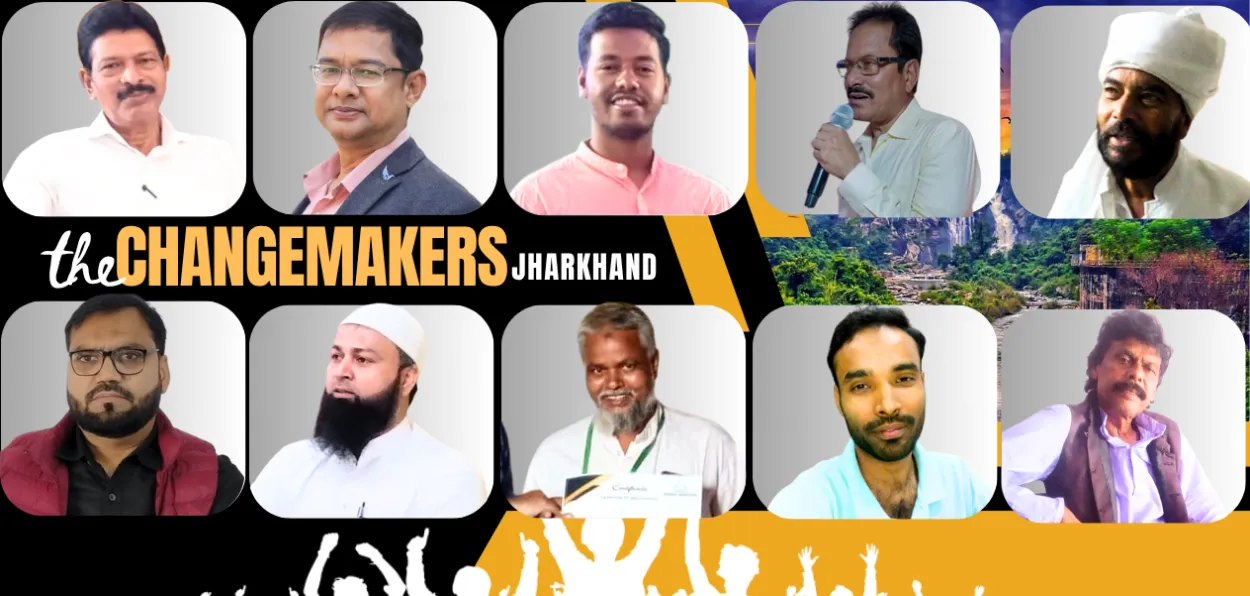
Jharkhand is one of the youngest Indian states, located in eastern India, and is also known as the tribal homeland. Since its inception, it has seen good growth, but the teething problems posed their own challenges. During these exciting times, some individuals have made significant contributions to society.
We, at Awaz-The Voice, bring to you stories of such unsung heroes from the length and breadth of India. Here are stories of ten extraordinary Muslim personalities of Jharkhand, who made a lot of difference to the lives of people and thereby helped state’s growth:
Dr Sajid Hussain
Dr Sajid Hussain left a prestigious research career to build a brighter future for the children of Chitarpur village in Ramgarh. His model, ‘Schoologium’, is redefining education across India.
Sajid explains, “Just as our body needs exercise to stay fit, the brain too needs regular practical workouts to stay active.” At Schoologium, children don’t just study from textbooks — they learn through touch, smell, taste, and experience. It’s learning through interaction and imagination — reminiscent of Rabindranath Tagore’s vision of Shantiniketan.
Sajid worked as a scientist at the National Aerospace Laboratories. But his exposure to premier institutions in India and abroad revealed a painful truth — rural children do not lag because of a lack of intelligence, but because they lack access to quality educational tools.
Determined to bridge this gap, Sajid resigned from his government job in 2012 and returned to his village. That’s where Schoologium was born — the name itself blending “school” and “gymnasium.”
Sattar Khalifa
Sattar Khalifa, better known as Painter Jilani, has brought hope to the people of Palamu, a division in Jharkhand that lags in development and where people face economic deprivation.
In college, Jilani always dreamed of serving people. A painter by profession, Jilani channels his earnings into helping the needy. “Art is my tool, service is my purpose,” he says.
His reputation made sure that even during the peak of Naxal and extremist dominance, Jilani travelled fearlessly between Bishrampur and Daltonganj, through a Naxal-dominated area.
For the poor, Dalits, Mahadalits, and marginalised communities of Palamu and Garhwa, Jilani is a symbol of assurance. From securing ration cards and pensions to arranging drinking water and hospital aid, he is always there.
Mohammad Minhaj
Mohammad Minhaj’s calm countenance hides the fire inside his mind that has driven him to serve society for over four decades. Mihaj has changed many lives in Ranchi’s slums. He ensures the people living in slums get education, health services, and social rights.
His journey began in 1982, when Ranchi was rapidly expanding, but its slums remained shrouded in neglect. Daily wage earners, rickshaw pullers, and working-class families struggled each day just to earn enough for two meals. For them, education was a distant dream. That was when Minhaj decided to step in and make a difference in many lives.
Muzaffar Hussain
Muzaffar Hussain’s dream is simple yet profound — no one in Jharkhand’s Santhal Pargana should sleep hungry. In this remote region, poverty isn’t just a condition — it’s a living reality. The six districts of Pakur, Godda, Sahebganj, Dumka, Jamtara, and Deoghar carry a long and painful history of deprivation, now slowly being rewritten.
A study claims that 82 percent of Santhal people live in extreme poverty, with most owning no land. In the middle of this harsh reality stands Muzaffar Hussain of Pakur, whose battle began even before the Right to Food Act was passed in 2013. Today, while the Act exists on paper, the real task is ensuring food reaches the truly needy — a task Muzaffar has made his life’s purpose. His efforts have borne fruit: around 600–700 families now have ration cards and receive regular supplies of food grains.
Ibrar Ahmad
In Ranchi, the capital of Jharkhand, its lanes, neighbourhoods, and beyond, one name that resonates hope is that of Ibrar Ahmad. Once employed in a bank and associated with the cultural organisation IPTA, Ibrar has been engaged in improving the lives of people around for over three decades. He is known as the person who steps in when a child drops out of school for want of fees, where poor patients wander helplessly for treatment, or where communal tension threatens to tear society apart.
Ibrar Ahmad has consistently reached out to children and youth. As President of Anjuman Islamia Ranchi, he arranged scholarships for poor children, launched talent shows and quiz competitions, ensuring that education went beyond textbooks to build both confidence and skills.
Dr. Shahnawaz Qureshi
The Quraish Academy of Ranchi has produced doctors, engineers, teachers, software developers, and many other bright minds. Located close to Ranchi’s iconic Albert Ekka Chowk is Gudri Qureshi Mohalla, officially declared a slum by the municipal corporation, where the founder of this academy, Dr Shahnawaz Qureshi, was born.
Whether through journalism or social service, Dr Qureshi changed not just the image of his locality but also the mindset of its people.
In 1993, while working with the National Literacy Mission, Dr. Qureshi established a night school in his own neighbourhood. After long days of labour, elderly men and women would gather after evening prayers, notebooks and pens in hand. The sight of wrinkled fingers tracing letters under the dim glow of a kerosene lamp became a symbol of hope and awakening. The classes were free, and the locals provided fuel for the lamps.
Mukhtar Alam Khan
Mukhtar Alam Khan’s efforts have transformed the image of Azad Basti in Jamshedpur, which was once a notorious place. It was once associated with crime, fear, and a negative image—much like Dhanbad’s Wasseypur. Mukhtar is among the few locals who brought about a positive change in this area. Today, Azad Basti’s name is taken with pride.
On any given day, Mukhtar and his team could be seen arranging blood and medicines for patients, feeding the hungry, or supporting children in education and competitive exams.
Tanveer Ahmad
In 2010, when areas like Islam Nagar and Baba Khatal in Ranchi were demolished under encroachment drives, hundreds of families were rendered homeless. The greatest sufferers were children, as some missed their exams, and others dropped out of school permanently.
In this situation, Tanveer Ahmad decided to extend a helping hand to the suffering children.
He thought, if circumstances had taken schools away from them, why not return education to them, as friends. This idea marked the beginning of a journey—from friendship to education.
Tanveer Ahmad says, “Our mission is to reach underprivileged children in Ranchi and Jharkhand who are drifting away from mainstream education. We believe education is the key that can transform their future.”
When one hears the name Ranchi, images of lush greenery, hills, and a rapidly developing city often come to mind. But hidden behind this image lies another reality—a large section of the city’s population lives in slums and makeshift settlements.
Anwarul Haq
Anwarul Haq, a resident of Chadri village in Kanke block, has launched a unique initiative that is changing the lives of children who would otherwise lag due to poverty. By day, he teaches football, and by night, he tutors children. In just three years, his efforts have transformed the lives of many children for whom both education and sports were once a distant luxury.
It all began when Anwarul Haq, a sports teacher at a residential girls’ school in Ranchi, decided to go beyond his job to make a difference. He was disturbed by the condition of children in his and neighbouring villages. Most children were from families surviving on daily wages, skipped school, and some fell into bad company. He had a plan up his sleeve to change their lives by imparting education and sports training to the underprivileged children.
SyedTariq Alam
Syed Tariq Alam has been quietly transforming lives, supporting poor and underprivileged families through education, employment, and social welfare in the Kolhan region of Jamshedpur.
His efforts have been focused on Kapali, a small township just 20 kilometres from Jamshedpur — the industrial hub of eastern India. Jamshedpur draws thousands of laborers from across the country, many of whom settle in Kapali where living costs are lower. While these workers find temporary employment in the steel city, the jobs are often low-paying and unstable.
This insecurity directly affects their children’s education, leading to high dropout rates in Kapali and nearby areas. It was this grim reality that moved Syed Tariq Alam deeply. Determined to bring change, he embarked on a mission that has now become a beacon of hope for thousands.
source: http://www.awazthevoice.in /Awaz, The Voice / Home> The Changemakers / by Aasha Khosa / October 26th, 2025