Category Archives: Royal Families, PreIndependence -Descendants (wef. Jan 02nd,2022)

Glorious Role of Muslims in Indian Freedom Struggle

INDIA :

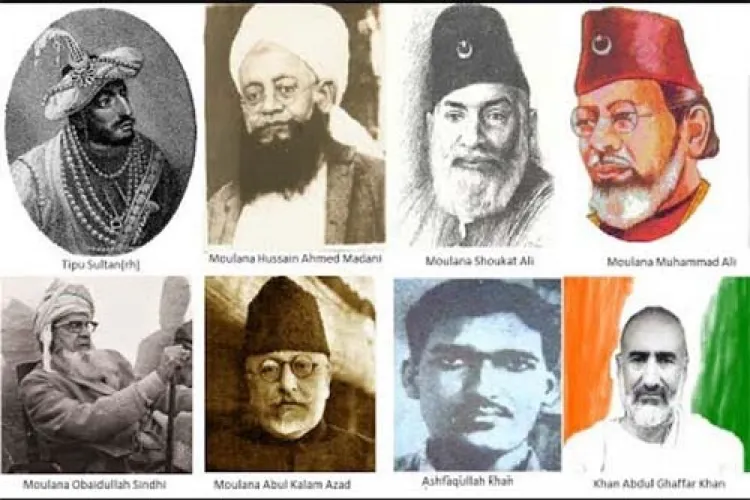
Muslim freedom fighters of India

“The Musalmans of India are, and have been for many years, a source of chronic danger to the British Power in India.” – W W Hunter, an English official posted in India, in his famous book ‘The Indian Musalmans’, published in 1871. 

After 1947, Indian scholars wrote a ‘nationalist’ history of the Indian freedom struggle and for unknown reasons, they excluded Muslims. For the last seven decades, we have been reading a history of the Indian Freedom Struggle that has largely overlooked the contribution of Muslims. The generations brought up over this narrative believe that either the Indian Muslims were pro-British or aloof from the freedom struggle. 

In this age of social media, we find people questioning the patriotism of the Indian Muslims based on this false understanding of the freedom struggle. In fact, almost 30% of the total martyrs mentioned in ‘Dictionary of Martyrs of India’s Freedom Struggle (1857-1947)’ launched by PM Narendra Modi in 2019 are Muslims. We must take note that the dictionary does not account for the martyrs before 1857, which were in large numbers as well.

Such falsehoods propagated in the name of history should be challenged.

The British imperialism in India was resisted by the Indians right from its outset and the Muslims were the flag bearers of this resistance. The British took over Bengal administratively and economically after defeating the royal armies at the Battle of Plassey (1757) and the Battle of Buxar (1764). With their win over the Nawab of Bengal, the British started exploiting the Indians of Bengal province in an unprecedented fashion. Their ruthless loot resulted in a famine in 1770, which accounted for the deaths of one-third of the total population of Bengal.  

No wonder the first popular national resistance to foreign colonial rule arose in Bengal. A united front of Hindu Sanyasis and Muslim Fakirs rose up in arms against the British. The man who led this fight was, Majnu Shah, a Muslim sufi from Kanpur (Uttar Pradesh).  Majnu was a devotee of Shah Madar, Kanpur, and took up the cause of poor peasants on the advice of another Sufi saint, Hamiduddin. Almost 2000 Fakirs and Sanyasis, under his command, would loot the treasures of the British and British-backed landlords to distribute the money and food among poor exploited masses. From 1763 till his death in 1786, Majnu was the most dangerous threat to the British Empire in India. Fakir and Sanyasi forces killed several officers and soldiers of the British in guerrilla wars. After his death, Musa Shah took up the leadership of the movement. Hindu Sanyasi leaders, like Bhawani Pathak, were also there and fought alongside but the colonial records considered Majnu as the most threatening leader because under him Hindus and Muslims fought a united war. The ruthless British suppressed this movement a few years after the death of Majnu but the spirit of nationalism could not be killed.

The suppression of the movement led by Fakirs in Bengal did not mean that they accepted defeat. Fakirs changed their strategy and joined Marathas and other anti-British forces at the turn of the 18th century. The first major mutiny by the Indian sepoys of the English East India Company Army in 1806 at Vellore, which is said to be the inspiration behind 1857, was planned by Holkars, sons of Tipu Sultan and brother of Nizam of Hyderabad with the help of Fakirs. In every cantonment in South India, Fakirs propagated the message of nationalism through religious sermons, songs and puppet shows. When the revolt broke out at several places including Vellore the Indian revolutionaries were led by Fakirs like Shaikh Adam, Peerzada, Abdullah Khan, Nabi Shah, and Rustam Ali. Scholar Perumal Chinnian writes, “the Southern conspiracy was supported by Fakirs and other religious mendicants. The conspiracy was established in all the army stations by them.” 

Within a few years, the British faced another challenge in the form of three distinct movements led by Syed Ahmad Barelvi, Haji Shariatullah and Titu Mir respectively. 

Born in Uttar Pradesh, Syed Ahmad toured a large part of the country and gained followers in Bihar, Bengal, and Maharashtra. His followers took up arms against the British and its allies in the areas adjacent to Afghanistan. The movement posed a challenge to the British for decades. The British painted the movement as a work of religious fanaticism while in reality, Syed Ahmad tried to forge an alliance with Marathas against the foreign rulers. After he died in 1831, Enayat Ali and Wilayat Ali, both from Patna, took up the leadership of the movement. The wars they led in the frontier region caused the death of thousands of soldiers of the British army. 

Haji Shariatullah and his son Dudu Miyan took up arms in Bengal to resist the tyranny of rich landlords. They led peasants to revolt against the indigo planters and other British agents. The movement they led is known as Faraizi movement. 

Titu Mir also led a movement of poor masses against the British-backed landlords. He formed his army and set up a popular administration. In 1831, Titu was killed during a battle with the British. Hundreds of his supporters were arrested and hanged, including his deputy, Ghulam Masum.

Meanwhile, the Movement started by Syed Ahmad remained a grave danger to British rule in India. Enayat Ali, Wilayat Ali, Karamat Ali, Zainuddin, Farhat Husain, and others led an armed struggle against the British. In Patna, as soon as the news of the revolt of 1857 reached, all the prominent leaders were arrested before they could act. Still, Pir Ali launched a revolt in Patna. Though not a part of the larger movement himself the British believed that he had their support. Pir Ali, Waris Ali, and other Muslim revolutionaries were executed in Bihar during the revolt of 1857.

The First War of the National Independence of 1857 had a long history of planning behind it. In 1838, the English government arrested Mubariz ud-Daula for plotting a nationwide revolt against the foreign rule. The investigations revealed that Raja Ranjit Singh, Gaekwars, Satara, Jodhpur, Bhopal, Patiala, Rohilla Pathans, and several nawabs, rajas and zamindars had agreed upon the plan. Raja Ranjit Singh had actually sent his troops to help Mubariz and contacted Persian and French powers for help. The plan, because of a few traitors leaked out, Mubariz was imprisoned where he died in 1854 and the revolt took place two decades later.

In 1845, again a plan for a nationwide war of independence was discovered by the English. Khwaja Hasan Ali Khan, Malik Kadam Ali, Saif Ali and Kunwar Singh of Bihar were trying to raise a large army with the help of several royals like Bahadur Shah Zafar, Scindias, and Nepal Naresh. Again a few Indians sold themselves to the foreign rulers and told the English about this grand design to overthrow them. 

The role of Muslims in 1857 is no secret. The unity of Hindus and Muslims in 1857 threatened the British like never before and they resorted to a policy of divide and rule after that. Maulvi Ahmadullah Shah of FaizabadFazl-e-Haq of KhairabadiImdadullah Muhajir Makki of Muzaffarnagar, and Azimullah Khan, an associate of Nana Saheb, were prominent in propagating the need of taking up the arms against the colonial rule. For years before 1857, they were propagating these ideas among sepoys as well as civilians. 

The sepoys at Meerut revolted against their British masters on 10 May 1857. Leaders of these sepoys were Sheikh Peer Ali, Ameer Qudrat Ali, Sheikh Hasan ud-Deen, and Sheikh Noor Muhammad. More than half of the 85 sepoys, who revolted initially, were Muslims. The sepoys were soon joined by the civilians. and The revolutionaries marched on to Delhi and proclaimed Bahadur Shah Zafar as the emperor of India. Delhi was liberated. In Lucknow, Begum Hazrat Mahal took up arms against the British and led one of the longest resistance movements during the revolt. Maulvi Ahmadullah was also fighting the British with his forces and attained martyrdom during a battle. In his book on the revolt, Veer Savarkar dedicated several pages to the valour and martyrdom of Ahmadullah.

In Muzaffarnagar, Imdadullah led a popular revolt with the help of Qasim Nanautvi, Rashid Gangohi, and others liberated Shamli and Thana Bhawan. A national government was set up. These revolutionaries were later defeated as the British recaptured the region. Nawab of Jhajjar, Abdur Rehman, was also hanged by the British for fighting for his motherland. The list is unending. The British records mention several Muslims who fought them in 1857. For example, an anonymous Burqa-clad Muslim woman killed several English soldiers in Delhi before getting arrested.

In Bihar, Kunwar Singh was leading the revolt of 1857. Zulfiqar was one of his most trusted comrades with whom Kunwar was discussing every plan. After liberating Arrah the civil government installed by Kunwar had his most trusted allies and there were several Muslims. The government had “Shaikh Ghulam Yahea as Magistrate. Shaikh Muhammad Azimuddin, an inhabitant of Milky Tola in the town of Arrah, was appointed Jamadar (treasurer) of the eastern thana: Turab Ali and Khadim Ali, sons of Dewan Shaikh Afzal, were made Kotwals (Police officers in charge of a city)”

The revolt did not succeed. Bahadur Shah was exiled to Burma, several were hanged and many more were transported for life to Andamans. But, the zeal for freedom did not die. 

In 1863, tribals in North West Frontier Province stormed the British territories and entered into a war. The British, though registered a victory, had to face one of the stiffest military challenges. They lost more than a thousand of its English soldiers. Intelligence reports pointed towards a financier in Ambala. The man was Jafar Thanesri. During the raid police found several letters which established him as the principal financier of the war in NWFP. He channelled money, men and arms from different parts of the country to the war front. Yahya Ali of Patna and nine others were also charged for waging the war against the Queen. What followed was a series of arrests and trials across India. 

People were arrested in Ambala, Patna, Malda and Rajmahal. Ahmadullah, Yahya Ali, Jafar, Ibrahim Mandal, Rafique Mandal and others were arrested and transported to Andamans. These revolutionaries celebrated martyrdom over life, hence the British decided not to hang them but to send them to the Andamans. In 1869, Amir Khan and Hashmat Khan were arrested in Kolkata. Norman, the Chief Justice, sentenced them to the Andamans. The sentence was avenged by Abdullah by assassinating Norman in 1871 and after a few months Sher Ali killed the viceroy, Lord Mayo, in the Andamans. 

Bipin Chandra Pal, in his autobiography, credited these trials and killings as an important influence on his political career. Another famous revolutionary, Trailokya Chakravarty, noted, “the Muslim revolutionary brothers gave us practical lessons of unbending audacity and inflexible will and also advice to learn from their mistakes”. 

In Maharashtra, Ibrahim Khan, a Rohilla leader, and Balwant Phadke launched a guerilla war against the British. They provided a tough resistance through the 1860s and 70s, and threatened the British in south India.

Meanwhile, in 1885, Indian National Congress (INC) was formed to voice the apprehensions of the emerging educated middle class. Badruddin Tayyabji and Rahmatullah Siani were two of the earliest members and presidents of Congress. Later on, M.A Ansari, Hakim Ajmal Khan, Hasrat Mohani, Abul Kalam Azad, and others remained associated with the largest political outfit of India. 

In 1907, peasants in Punjab started agitation against the canal colonies. Along with Lala Lajpat Rai and Sardar Ajit Singh, Syed Hyder Raza was one of its prominent leaders. The movement is seen as a precursor to later Ghadar movement.

During the First World War (1914 – 18), the British intercepted three letters written on silk cloth. The letters were written by Maulana Ubaidullah Sindhi to Maulana Mahmood Hasan and pointed towards a global plan to overthrow the British rule in India. Ubaidullah was named as one of the most dangerous Indians for the British in the Rowlatt Committee Report. He formed armed groups, preached anti-British ideas and formed a provisional government in Kabul. The Prime Minister of the government was Maulana Barkatullah. The government had to have an army as well, which would attack India to free it. But, the plan failed because of the leaked silk letters and the end of the World War. The plan was called Silk Letter Movement and 59 freedom fighters, mostly Muslims, were charged for waging the war against the Empire. Maulana Abul Kalam Azad, Abdul Bari Firangi Mahli, Ubaidullah Sindhi, Maulana Mahmood, Husain Ahmad Madni and M.A Ansari were few of them. Maulana Mahmood and Madni were arrested in Makkah and imprisoned in Malta.

Maulana Abul Kalam Azad, who is often seen as a token Muslim in a largely Hindu dominated Congress, was a freedom fighter whom the British feared. His name occurred in different CID reports for planning armed revolutions. At least 1700 freedom fighters took oath to die for the cause of freedom as members of Hizbullah, a revolutionary organisation formed by Azad. Al-Hilal, a paper edited and published by him, was banned for propagating the revolutionary nationalist ideas. Azad established Darul Irshad, a madarsa, to popularise the anti colonial ideas. For his organization, Hizbullah, Jalaluddin and Abdur Razzak were prominent recruiters, who also united Hindu and Muslim revolutionaries of Bengal. No wonder, Azad was jailed many times and was the President of INC when the Quit India Resolution of 1942 was passed.

The Silk Letter Movement was not the only resistance movement during the World War. Ghadar Movement was another movement in which several Muslims took part and attained martyrdom. Rehmat Ali was hanged in Lahore for trying to instigate mutiny among soldiers. The efforts bore fruit in Singapore, when, in February, 1915, 5th Light Infantry consisting mostly Muslims from Punjab revolted. The soldiers captured Singapore for a few days. The revolutionaries were later defeated, captured and shot dead.

Another misconception prevalent among Indians is that the Bengali revolutionaries were Hindus. Interestingly, the revolutionary organizations with Hindu religious overtones, like Jugantar and Anushilan had many active Muslim members. Sirajul Haq, Hamidul Haq, Abdul Momin, Maksuddin Ahmad, Maulvi Ghayasuddin, Nasiruddin, Razia Khatun, Abdul Kader, Wali Nawaz, Ismail, Zahiruddin, Chand Miyan, Altaf Ali, Alimuddin, and Fazlul Kader Chowdhury were few of the Bengali Muslim revolutionaries who took up arms along with Hindus. Many of them were sent to Andamans or killed.

After the World War, the British introduced a draconian Rowlatt Act. The Indians protested against the act and many leaders were arrested. At Jallianwala Bagh people were massacred when they were protesting against the arrest of Saifuddin Kitchlew. The proportion of Muslims killed at Jallianwala was quite high. Around this time, 1919 onwards, Abdul Bari Firangimahli, Mazharul Haque, Zakir Husain, Mohammad Ali, and Shaukat Ali emerged as the mass leaders. Women like Bi Amma, Amjadi Begum, and Nishat al-Nisa also jumped into the freedom struggle.

In Tamil Nadu, Abdul Rahim organised the workers during the 1930s against the oppressive colonial rule. V. M Abdullah, Sharif Brothers, and Abdul Sattar were other prominent Muslim leaders in South India who led nationalist movements and braved torture and imprisonments.

Khan Abdul Ghaffar Khan led pathans posed a non-violent challenge to the British. In 1930, the British fired upon a crowd protesting against the arrest of Ghaffar Khan at Qissa Khwani Bazar, Peshawar. Hundreds of pathans laid their lives for the service of the motherland.

Faqir of Ipi, Mirza Ali Khan, and Pir of Pagaro, Sibghatullah, raised their armies in the 1930s in Waziristan and Sindh respectively to fight the British during the World War. In a larger scheme of things, Subhas Chandra Bose and Axis Powers allied with their armies in order to liberate India. 

In 1941, Netaji Subhas Chandra Bose escaped from house arrest. The man who played an important role in the escape was Mian Akbar Shah. Netaji reached Berlin and formed a Free India Legion. Abid Hasan, became his confidant here and served as secretary. Abid was his only associate who accompanied him on a famous submarine journey from Germany to Japan. In 1943, Netaji formed Azad Hind Sarkar and Azad Hind Fauj. Here several Muslims like, Lt. Col. Aziz Ahmad, Lt. Col. M.K Kiani, Lt. Col. Ehsan Qadir, Lt. Col. Shah Nawaz, Karim Ghani, and D.M Khan became ministers with important portfolios. Azad Hind Fauj faced reverses in war and its soldiers were taken prisoners by the British. Rashid Ali’s imprisonment became a symbol of Hindu Muslim unity when Hindus and Muslims across the political affiliations came out on Kolkata road demanding his, and other Azad Hind Fauj soldiers, release in 1946. The police fired upon the protesters killing dozens of Indians. Elsewhere, in Mumbai and Karachi, the Royal Navy revolted in support of Azad Hind Fauj. Anwar Husain was one of the prominent martyrs of this revolt as Colonel Khan led the soldiers in revolt at Mumbai port. 

India gained independence on 15 August, 1947. It was a costly affair. The cost was the Indian lives. The lives we paid were neither Hindu, nor Muslim. The lives belonged to the Indians. Those who laid their lives were Indians first, and Hindus or Muslims later. Here again, Muslim leaders like Allah Bux Somroo, K. A. Hamied, Faqir of Ipi, Abdul Qayyum Ansari, Abul Kalam Azad and others fought against the divisive communal politics of Muslim League to stop the partition. Tragically, more than seven decades later people have forgotten this important aspect of our freedom struggle and try to divide this great struggle along petty sectarian lines.

(The article is an updated version of an article published last year.)

source: http://www.awazthevoice.in / Awaz, The Voice / Home> Culture / by Saquib Salim / August 15th, 2022
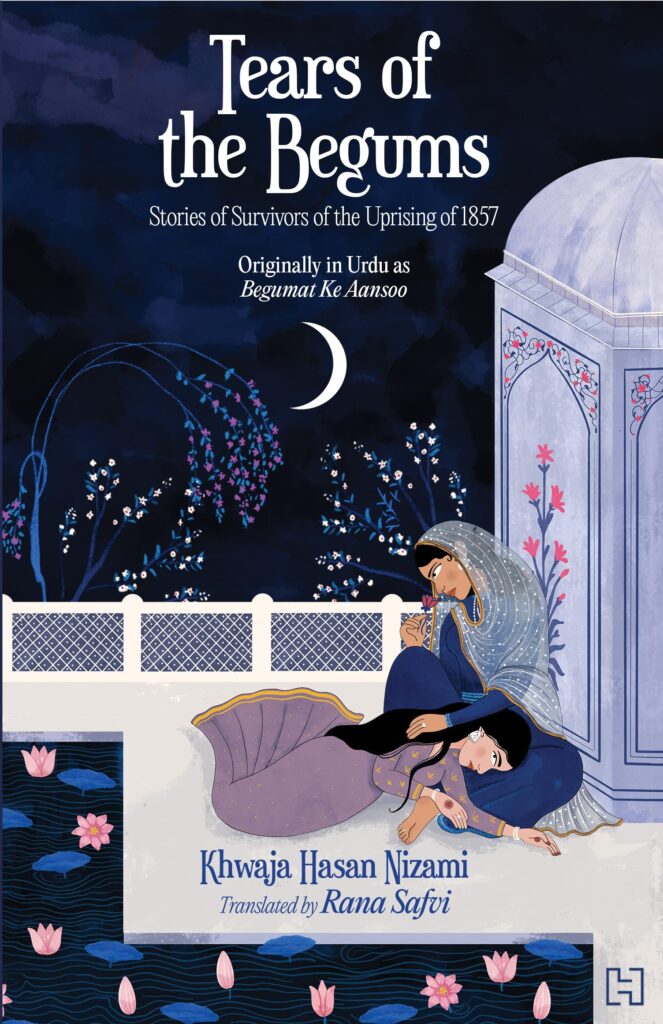
Tears of the Begums: Stories of Survivors of the Uprising of 1857 (Originally in Urdu as Begumat ke Aansoo)

INDIA :

New Book , First ever English translation of Nizami’s invaluable Urdu book Begumat ke Aansoo 

pix: amazon.in

Apart from the fifteen years that Sher Shah Suri snatched upon defeating Humayun, the flag of the grand Mughal Empire flew over Delhi undefeated for over 300 years.

But then, 1857 arrived and the mighty sword fell helpless in the face of a mightier British force.

After the fall of Delhi and Emperor Bahadur Shah Zafar’s tragic departure from the Red Fort in 1857, members of the royal Mughal court had to flee to safer places. Driven out from their palaces and palanquins onto the streets in search of food and shelter, the dethroned royals scrambled to survive. Some bore their fate with a bitter pride, others succumbed to the adversity.

Through twenty-nine accounts of the survivors of the Uprising of 1857, Khwaja Hasan Nizami documents the devastating tale of the erstwhile glorious royalty’s struggle with the hardships thrust upon them by a ruthless new enemy.

In vivid and tragic stories drawn from the recollection of true events, Nizami paints a picture of a crumbling historical era and another charging forward to take its place.

With the reminiscence of past glory contrasted against the drudgery of everyday survival, Tears of the Begums – the first ever English translation of Nizami’s invaluable Urdu book Begumat ke Aansoo – chronicles the turning of the wheel of fortune in the aftermath of India’s first war of independence.

source: http://www.amazon.in / Amazon / Home> Books> History> World / as on August 06th, 2022

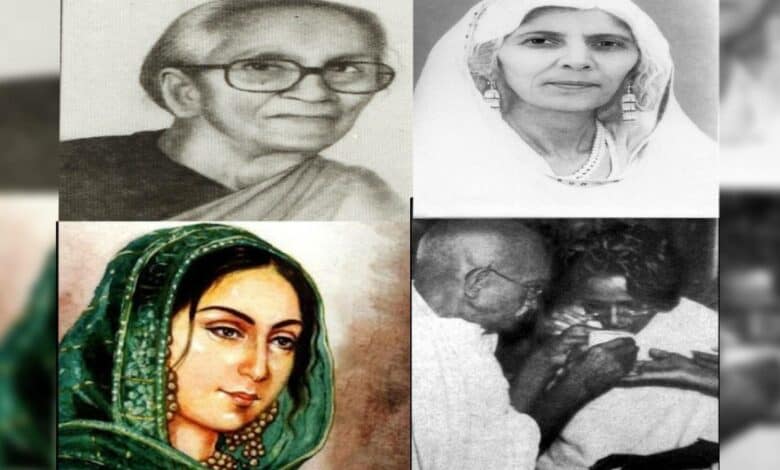
Remembering 4 Muslim women who fought for Indian independence

UTTAR PRADESH / PUNJAB :

Hyderabad: 

On the occasion of 74th Independence Day, let us remember these Muslim women who proved their strength, enthusiasm and determinism in the fight for freedom.

These women broke the stereotype of Muslim women in the society, who are merely perceived to be clad in Burqha and were never let out of the house. They participated in the India’s struggle for independence and emerged victorious.

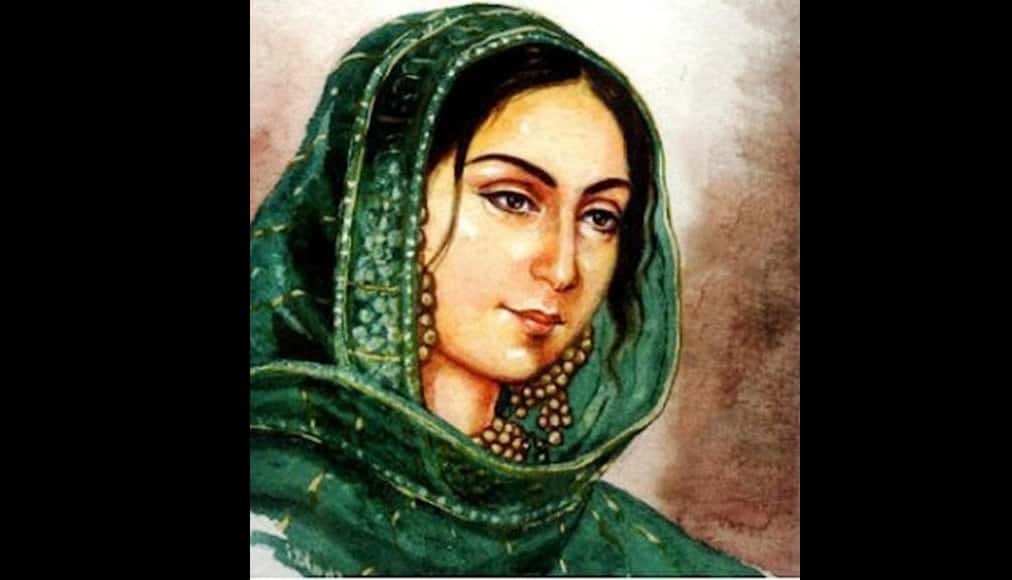
Begum Hazrat Mahal (1830–1879)

Begum Hazrat Mahal, a prominent woman of 1857 rebellion, was born in 1830 Faizabad of Uttar Pradesh. Her actual name was Muhammadi Khanum. Her father is Gulam Hussain of Faizabad. At her tender age itself, she showed good talent in literature.

She was married to Wajid Ali Shah, the Nawab of Awadh. They were blessed with a son Mirza Birjis Khadir Bahadur. On 13 February, 1856, the British troops imprisoned Wajid Ali Shah. They sent him to Calcutta on 13 March and occupied Awadh illegitimately. This irked the people and native rulers.

They revolted against the British under the leadership of Begum Hazrat Mahal. The native rulers and people met at Chavani area of Lucknow, the capital of Awadh on 31May, 1857 and declared independence. They taught a lesson to the British troops and wiped out their power in Lucknow. Later, Begum Hazrat Mahal declared her son Birjis Khadir as the Nawab of Awadh on 7 July, 1857.

As the King’s mother, she gathered 1,80,000 troops and renovated the Lucknow fort spending huge amount of money. She established a high level committee for the good governance of the state. Hazarat Mahal ruled the state on behalf of her son for about ten months and challenged the British force by inspiring patriotism among the people and the fellow native rulers. She issued a historic statement on 31 December, 1858 challenging the proclamation issued by the Queen Victoria on November 1, 1858.

But, when Delhi, the prime center for the First War of Independence was captured, the British troops surrounded and attacked Lucknow in March 1859. There was a fierce battle between the Company troops and the Begum troops. When defeat became inevitable, Begum Hazrat Mahal retreated to the Nepal forests along with the co-revolutionary leaders like Nana Sahib Peshwa and others.

The British rulers offered her huge amount of money and luxurious facilities in order to bring her back to Lucknow. But, the Begum denied them and made it clear that nothing else was acceptable to her except Independent Awadh state. Begum Hazarath Mahal was struggling for the independence of her state till her last breath. She passed away at Khathmound of Nepal on 7 April, 1879. In 1984 Government of India released a postal stamp in her honour.

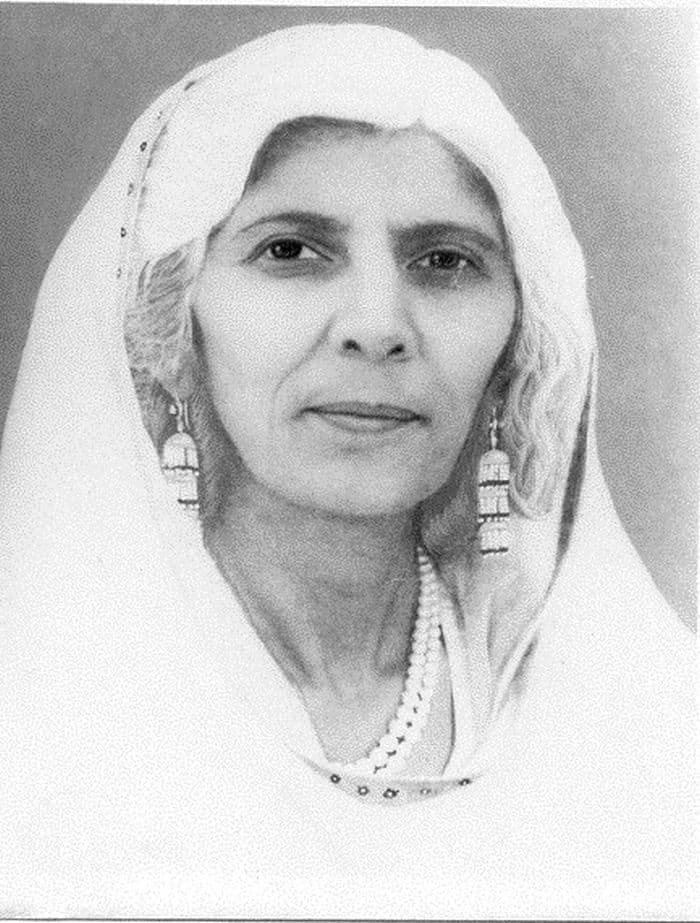
Abadi Bano Begum (1852-1924)

Abadi Bano Begum, who took active part at par with men in the Indian National Movement, was born in 1852 in Amroha village, Moradabad district of Uttar Pradesh. She was married to Abdul Ali Khan of the Princely State Rampur.

Though she lost her husband at a young age, she did not remarry. She had two sons Moulana Mohammed Ali and Moulana Showkath Ali, who were famous as ‘Ali Brothers’. She nurtured her children, into becoming memorable leaders of the Indian Independence Movement. Her involvement in the freedom movement began with the Home Rule Movement, to which she rendered moral and most importantly, financial support.

When the British government detained the Ali Brothers in Chindanwad village, under the Indian Defence Regulations, she went along with them. When a police official proposed for the surrender of her sons, she bluntly refused saying, ‘If my sons agree to the proposal of the government, I will kill them by strangulation. I hope God will bestow enough energy into this old woman’s hands’. Abadi Bano met Mahatma Gandhi in 1917 for the first time.

There after Mahatma Gandhi always addressed her ‘Ammijan’, and all other freedom fighters followed Gandhi’s address. She helped Mahatma Gandhi and other Khilafath leaders financially for undertaking all India tours.

She attended the Indian National Congress and the All India Muslim League sessions in 1917, held at Calcutta. She spoke in those meetings emphasising that complete freedom could be achieved through unity between Hindus and Muslims.

She also played a constructive role in the Khilafat and Non[1]Cooperation Movement in 1919. She declared in several meetings that ‘it was her ambition that even the dogs and cats of her country should not be under the slavery of the British’.

The fact that the British government official records treated her as a ‘dangerous person’, which established the kind of challenge she hurled at the colonial rule.

 Apart from participating in politics she also guided several women’s organisations all over India. So intensely patriotic and nationalist that Abadi Bano Begum who played an active role in national movement without caring old age, ill health and cruel atrocities of police, breathed her last on 13 November, 1924.‹

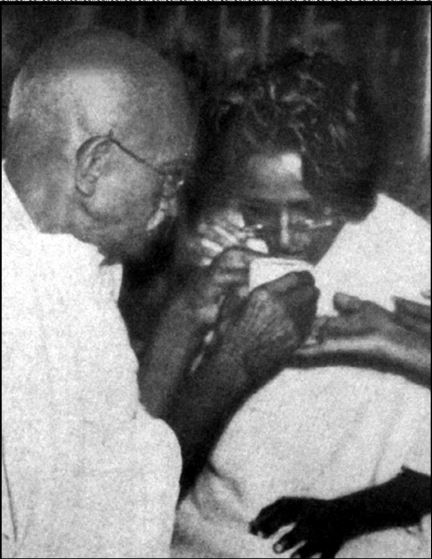
BIBI AMATUS SALAM (1907-1985)

Bibi Amatus Salam, who strongly believed that freedom from the slavery of British could be achieved, through the Gandhian methods only, was born in 1907 in Patiala of Punjab in Rajputhana family.

Her father was Colonel Abdul Hamid and her mother Amatur Rehaman. Amatus Salam was the younger sister of six elder brothers. Her health was very delicate since her childhood. She was inspired by her eldest brother, freedom fighter Mohammad Abdur Rashid Khan.

Following the footsteps of her brother, she decided to serve the people of the country.

Amatus Salam participated in the Khadi Movement and attended the meetings of the Indian National Movement along with her brother. She was attracted towards the Non[1]Violence theory of Mahathma Gandhi and Sevagram Ashram.

She decided to join Sevagram Ashram, and went there in 1931. She joined Ashram and followed the strict principles of the Ashram. With her selfless service she became very close to Gandhi couple.

They considered Amatus Salam as their beloved daughter. During the Indian National Movement, she went to jail along with other women in 1932 despite her illness with the permission of Gandhi.

After being released from Jail, she reached Sevagram and took over the responsibilities as Personal Assistant of Gandhi. She said that besides achieving independence, harmony between the Hindus and Muslims, Welfare of the Harijans and Women were her life ambitions. When communal riots erupted, she toured North-West Frontier, Sindh and Noukhali areas as an ambassador of Gandhi.

She held Satyagraha for 20 days to normalize the situation in those areas. After Independence, she rededicated herself to the Public Service. She published an Urdu Magazine called ‘Hindustan’ to promote national integration and communal harmony. When Khan Abdul Gaffar Khan toured in India in 1961, she travelled with him as his personal assistant. When India was at war with

China in 1962 and with Pakistan in 1965, she took all the pains in reaching the mountains or war area along with her adopted son Sunil Kumar to encourage our soldiers and to serve them. Bibi Amatus Salam, who spent all her life following the Gandhian ideology, breathed her last on 29 October, 1985.‹

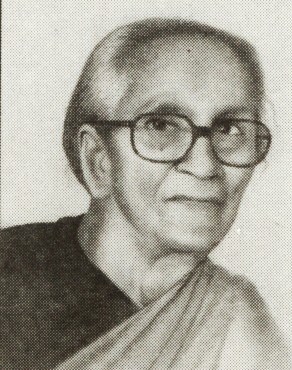
HAJARA BEGUM (1910-2003)

Hajara Begum, who fought against the British to liberate the Nation and worked for the welfare of the toiling masses of the country, was born on 22 December, 1910 at Saharanpur in Uttar Pradesh. She came to know about the sacrifices of the freedom fighters who were fighting against the British from her father, who was a police officer.

After the failure of her marriage, she went to London to pursue her higher education, where she got acquainted with the anti-British forces. This led her to decide to fight against the British Imperialist forces to liberate the nation. She had to face the anger of the British Government as she was criticizing their acts in several International fora.

She returned to India and joined as a lecturer in the Karamat Hussain women’s College at Lucknow in 1935.

She also worked along with famous poet Sajjad Zahir in the formation of All India Progressive Writers’ Association.

She got married to a nationalist leader Dr. Zainul Abedeen Ahmed in 1935 and in the same year both of them took membership in the Indian National Congress. Since the police were after them for their anti-British activities, they resigned their jobs and dedicated themselves totally to the Indian National Movement.

While participating in the activities of the Indian National Congress, Hajara Begum also campaigned for the Communist Party without the knowledge of the Police. She actively took part in the election campaign in those days, and as a result of this a number of Congress leaders could get elected. She attended a secret political workshop at Kotthapatnam in Andhra Pradesh in 1937.

 She spoke on different subjects in the workshop as a lecturer. Hajara Begum was against the gender bias since her younger age. She fought against all types of inequalities successfully. She left the Indian National Congress in 1940 along with her husband. Since then, she played a vital role in organizing the unorganized labour sector.

She became very popular as ‘Hajara Aapa’ in the circles of toiling people and women. The Soviet Union honoured her with ‘Supreme Soviet Jubilee Award’ in 1960 in recognition of her work for the downtrodden people on the eve of the birth centenary of Lenin. Hajara Begum, who spent her entire life in the service of the country, breathed her last on 20 January, 2003.


Syed Naseer Ahamed can be contacted at Phone: +91 94402 41727

source: http://www.siasat.com / The Siasat Daily / Home> Featured News / by Nihad Ahmed / Input by Syed Naseer Ahmed / August 15th, 2020

Numismatist tells legacy of Bahmani Sultans through coins

Kalaburagi (formerly Gulbarga), KARNATAKA :

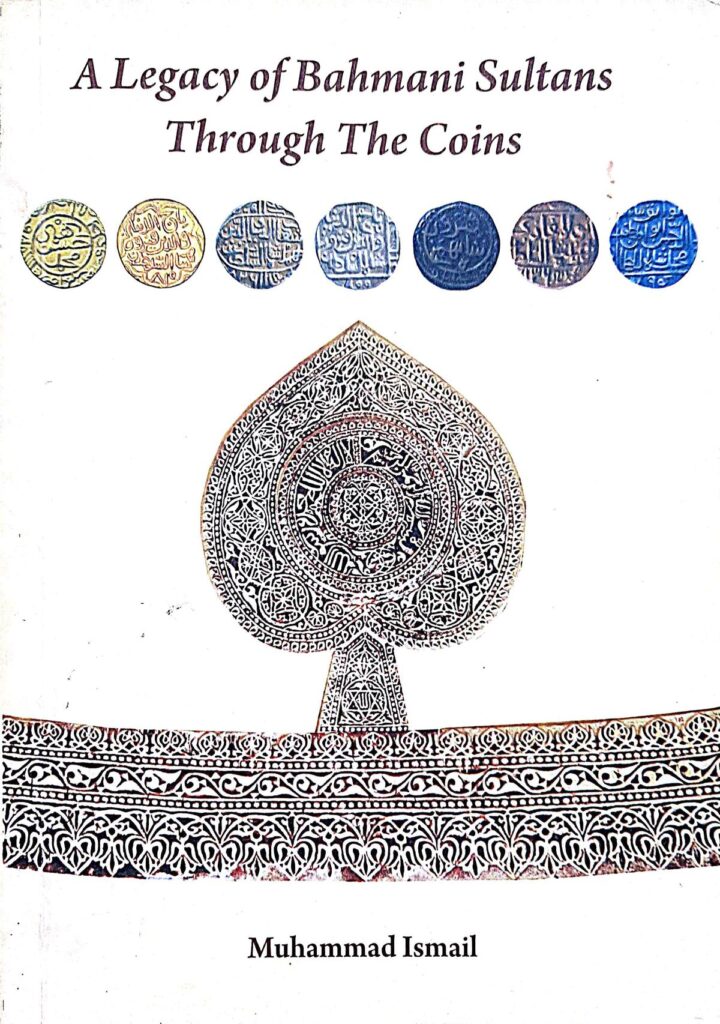
Cover page of the book ‘A Legacy of Bahmani Sultans through Coins’ published by the Gulbarga Bahmani Numismatics Research and Educational Trust. | Photo Credit: ARUN KULKARNI

Mohammad Ismail has got a rare treasure of coins dating back to Bahmani Sultans from 14th to 16th Century

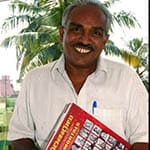
The Gulbarga Bahmani Numismatics Research and Educational Trust recently published a book titled ‘A Legacy of Bahmani Sultans through coins’ authored by Numismatist Mohammad Ismail in which he depicts the numismatic journey of Bahmani Sultans through his collections.

The book traces the journey of coins belonging to all the 18 Bahmani Sultans starting from Alauddin Hasan Bahman Shah (1347-58), till the last Sultan – Kalimullah Shah (1526-1538). Mr. Ismail has meticulously worked, richly illustrated, about each coin issued during Bahmani Sultans period.

Mr. Ismail has got a rare treasure of antique coinage, belonging to Bahmani Sultans from 14th Century to 16th Century. The numismatist has more than 2,500 coins in his collection of various rulers, dynasties and kingdoms. Among his treasury are also coins dating back to 1,600 years ago.

The numismatist also organises a campaign “Save Coin Save Heritage.” The objective of this campaign is to spread awareness about ancient coins at schools and to take forward the legacy to younger generations.

Speaking to The Hindu, the numismatist explained the legacy of Bahmani Sultans and displayed a collection of nearly 80 copper coins issued in one year period between 1378-1379, and said that all the four Sultans including Dawood Shah-I, Muhammad Shah-II, Ghiyasuddin Tahmathan Shah, Shamshuddin Dawood Shah–II (4th, 5th, 6th and 7th sultans, respectively), have ruled for less than a year. His collection has got nearly 500 coins issued during Tajuddin Firoz Shah (8th Bahmani sultan), followed by 400 coins of Muhammad Shah-I (the second Bahmani sultan), and 300 coins of Kalimullah Shah (18th Bahmani sultan) Period.

According to Mr. Ismail, the study of coins gives insights into history as no other source does. The enthusiast numismatist tries to enhance his collection by getting in touch with collectors across India. His collection includes coins of various shapes, sizes and weights issued during different reigns made up of gold, silver, bronze and copper, some very rare.

When asked about the estimated value of coins in his collection, Mr. Ismail said that the value of each coin varied depending on its age, rarity and material. “But for me, as a numismatist, it is the coin’s age and rarity which matters more than its price,” he said.

Some of the rarest coins in his collections are of Tahmatun Shah, Dawood Shah, Ahmed Shah III, Muhammad Shah IV and Mujahidin Shah. Mr. Ismail’s rare collection includes 10 copper and one gold and silver coin minted during the Tahmatan Shah period. It took him eight years to find those coins. His collection also includes the rare gold and silver coins of Ahmed Shah II and Mujahidin Shah.

He also has coin collections belonging to Chalukyas, Kakatyas, Rashtrakutas, and the Vijayanagara Kingdom. Mr. Ismail wants to bring out a catalogue of these collections too.

source: http://www.thehindu.com / The Hindu / Home> News> National> Karnataka / by Praveen B Para / Kalaburagi – July 03rd, 2022

‘Nizam of Hyderabad Necklace’ is worn by Queen Elizabeth II and also by Kate Middleton

Hyderabad, TELANGANA (formerly) HYDERABAD STATE :

Imaginative cuisine, stylish wardrobes, magnificent palaces, and an opulent lifestyle. These are just a few things that the Nizams of Hyderabad are known for. Well, there’s one more thing: spectacular jewelry.

Most people already know that the last Nizam, Mir Osman Ali Khan was one of the wealthiest men in the history of the world. So, it comes as no surprise that he owned a fabulous collection of jewelry – diamonds, gold ornaments, and precious stones.

Almost all this collection was purchased by the Government of India, which arranges its exhibition from time to time. 

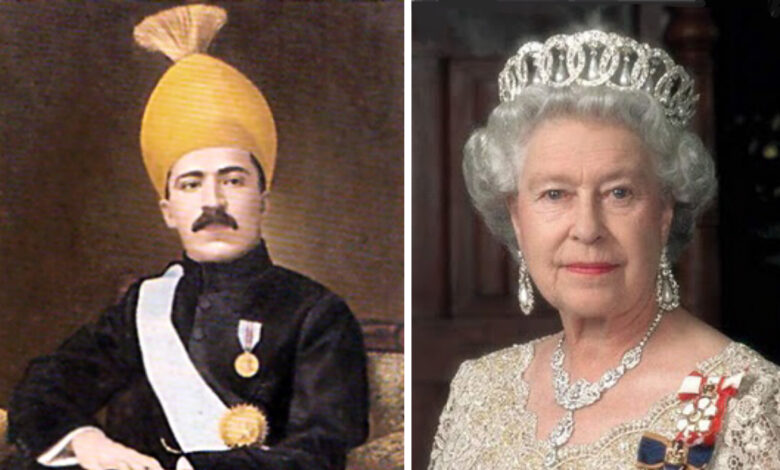
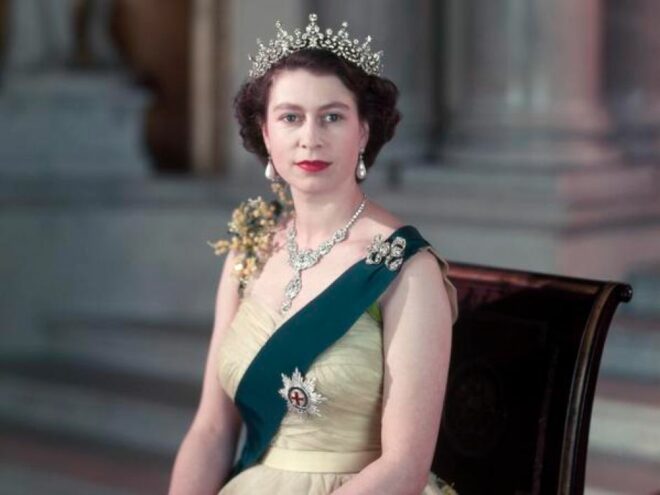
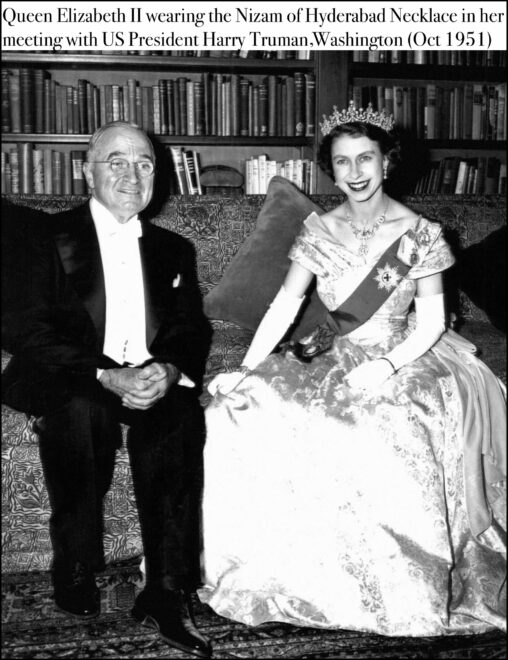
However, the most fitting exhibition of the Nizam’s jewelry occurs, albeit unwittingly, when Queen Elizabeth II, the Queen of the United Kingdom, wears the spectacular Cartier diamond necklace. It was gifted to her by the 7th Nizam on the occasion of her wedding to Prince Philip of Greece and Denmark on 20th November 1947. He had also gifted her the “Hyderabad Tiara” which had a design based on English roses with 3 detachable floral brooches, all made of diamonds and set in platinum.

The aptly named Nizam of Hyderabad Necklace is also a floral piece made of diamonds that are set in platinum.

The British art historian, Hugh Roberts who authored the best-selling book “The Queen’s Diamonds”, describes it in his book as: “The pavé-set centre with detachable double-drop pendant incorporating 13 emerald-cut diamonds and a pear-shaped drop; the chain of 38 brilliant-cut open-back collets with an elongated oval brilliant-set snap”. 

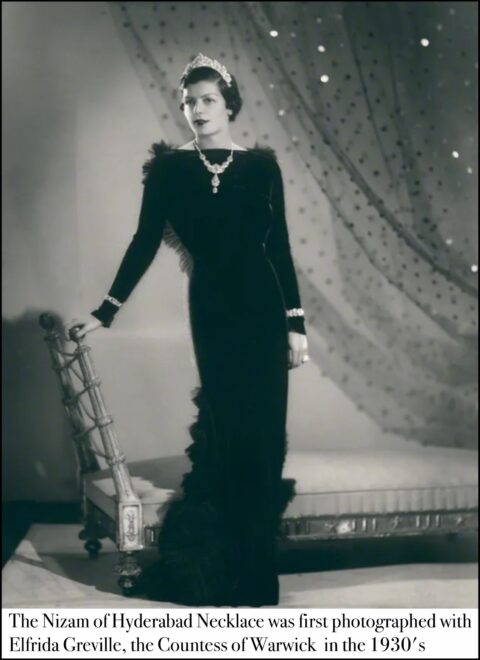
The Nizam, in his generosity, reportedly instructed Cartier to let the bride (then Princess Elizabeth) choose whatever she desired from their collection. The princess then chose the necklace and the matching floral tiara. She is not its first owner, however. Cartier made the necklace in 1935, sold it and then reacquired it from the first buyer in 1936. One of its earliest pictures is of Elfrida Greville, the Countess of Warwick who wore it for a portrait in the 1930s.

But the piece has remained a mainstay in the Queen’s jewelry collection. It appears to be one of her favorites as she has worn it on many official engagements, for instance on her first ever trip to Washington in October 1951 where she met President Harry Truman. She can also be seen posing in it for official portraits that would be used on currency bills like the Bahamas Dollar. She still wears it on important occasions.

Of late there has been a renewed interest in the necklace among jewelry enthusiasts when the Duchess of Cambridge Kate Middleton was photographed wearing it on at least two occasions. It was lent to her by the Queen as the duchess is her grand daughter-in-law due to her husband Prince William. It may now be safely assumed that the necklace has passed on from being a personal wedding present to a family heirloom and will adorn the subsequent generations of British royalty.

Dr Mohammed Najeeb Shahzore

Dr Mohammed Najeeb Shahzore is a specialist physician based in Kuwait with an interest in Hyderabad’s history & culture.

source: http://www.siasat.com / The Siasat Daily / Home> News> Hyderabad / by Dr. Mohammed Najeeb Shahzore / September 26th, 2021

This unassuming public library stands testimony to the power of the page

NEW DELHI :

The Delhi Youth Welfare Association works for the upliftment of underprivileged children in Old Delhi through many initiatives, including its Hazrat Shah Walliulah Public Library.

DYWA team with Capt Zoya and Heena Sodhi

On a hot Wednesday afternoon in June, Laxmi (14)  and Ritika (11), residents of the walled city, braved the heat as they made their way through the crowded lanes of Old Delhi to arrive at a cramped quarter in Churiwalan, Jama Masjid. The dated signage and dilapidated environs may have served to put them off their mission, but they persevered. After all, they had it on the best possible authority––of their own older sister––that this was where they would receive school textbooks for the upcoming academic year.

These hardworking sisters are a few of the many girls and boys lining up outside the doors of the unassuming Hazrat Shah Waliullah Public Library, which distributes course books for children once a year, free of cost, to support them in their pursuit of education despite financial and other constraints.

In 1987, in the wake of curfew following religious tensions in Old Delhi, a group of young friends turned their energies towards the upliftment of destitute locals. 

The library

They began by distributing rations, medicines, and scholarships to deserving widows and others in need, under the banner of the Delhi Youth Welfare Association (DYWA); but felt this action, though noble, did not make the desired difference to ground realities. Illiteracy due to poor financial conditions and the resultant lack of resources was a chronic problem that needed their immediate attention. Hence, they started sponsoring the education of deserving children, and opened the Hazrat Shah Waliullah Public Library, sometime in the 90s.

Muhammad Naeem, the President of the DYWA, has been associated with the organisation from the beginning. Narrating an incident that summarises the need for their organisation, he says, “Financial conditions are bad for the locals here. As soon as they clear their ninth standard exams, they want to move to Open University instead of going to school, so they can work and earn money. This is true for both boys and girls.”

Amidst this, the Hazrat Shah Waliullah Library strives to encourage a love of reading and learning–– an art that is swiftly being sidelined.  SM Changezi, the General Secretary of DYWA and custodian of the library, wears his royal ascendancy from Chengez Khan with pride. However, he only displays it to the world through his passion for beautiful and rare old books. 

The library’s vast collection includes a 100-year-old Quran with every page written in a different style, a copy of an illustrated Ramayana in Persian, and even one of the last copies of Bahadur Shah Zafar’s poetry, printed and sealed in the royal press while he was still in power.

About 50 percent of the books in the library are donated by locals who support the organisation, and the remaining are bought from the organisation’s funds. 

With the increasing number of books, the association is now planning to open a second library in Haryana’s Nuh to cater to the local slums in the area. Apart from free course books, the DYWA sponsors the education of around 30 girls. To this effect, the DYWA collects and pays Rs 2.5-3 lakh per annum towards children’s fees, all from donations made by people who believe in the cause.

Other initiatives include inviting celebrated personalities originally from this area to speak to the children about making a success of their life. This happened recently when Air India pilot and social activist Captain Zoya Agarwal and Heena Sodhi Khera of women’s networking platform Queen’s Brigade, met the children for their course distribution ceremony.

Khera explains, “Capt Zoya shared her own experiences of being judged for her big ambitions. Yet, she achieved what she wanted and encouraged the kids to do so as well. The children were ecstatic and listened to her with rapt attention.” 

source: http://www.newindianexpress.com / The New Indian Express / Home> Good News / by Noor Anand Chawla / June 24th, 2022

35 years later, Centre resumes hunt for Nizam’s gold coin

Hyderabad, TELANGANA :

Hyderabad: 

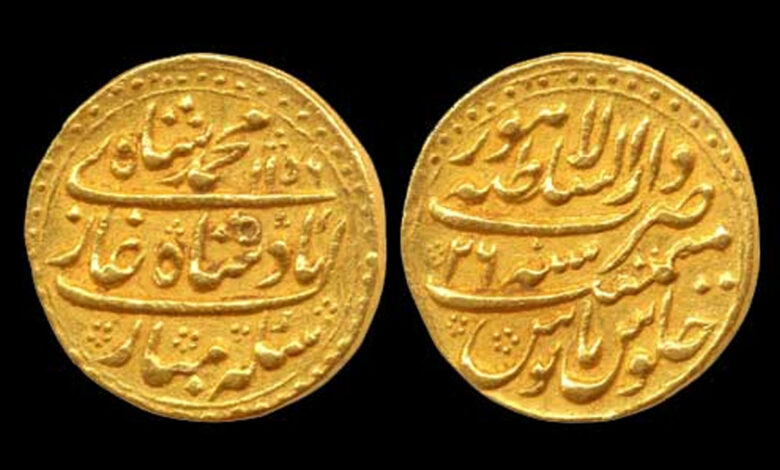
The Centre has resumed the hunt for a 12 kg gold coin which has been missing for almost four decades.Touted as the world’s biggest gold coin, it was last seen in hands of titular Nizam VIII of Hyderabad, Mukarram Jah.

Reportedly, he had auctioned the coin at the Swiss Bank. However, India’s CBI couldn’t get hold of the gold coin that was passed to Jah through his grandfather and last Nizam of Hyderabad, Mir Osman Ali Khan.

The last Nizam had taken over the coin which was devised by emperor Jahangir. Renowned historian Prof Salma Ahmed Farooqui of HK sherwani Centre for Deccan Studies, Maulana Azad National Urdu University, conducted research on the history and legacy of the world’s biggest gold coin and said it was invaluable to Hyderabad’s pride.  At present, the coin hunt has begun after 35 years.

In 1987, when Indian officials in Europe alerted the central government about auctioneer Habsburg Feldman SA auctioning the 11,935.8 gm gold coin in Geneva at Hotel Moga on November 9 through Paris-based Indosuez Bank’s Geneva branch, CBI came into the picture. Investigations started and much information was unearthed,” Prof Salma was quoted by TOI.

She further stated that the CBI played the role of historians while searching for the huge coin but later the search was left hanging as the officials’ didn’t return to the office.

In a book written by former joint director of CBI, Shantonu Sen said that officials discovered that Jahangir has printed two similar coins. One was given to the ambassador of the Shah of Iran, Yadgir Ali and the other was in control of the Nizams.

An FIR was registered under the Antique and Art Treasures Act 1972 by a superintendent rank officer In 1987, said Prof Salma.  She said, “Further investigations revealed Mukarram Jah was trying to auction two gold mohurs in 1987 at the Swiss auction, one of which was supposedly the 1,000 tola coin. It was valued at $16million in 1987.”

Since many years have gone by and nobody has information related to the big gold coin minted by Jahangir, Salma hopes that new efforts by the Centre may bring positive results this time.

source: http://www.siasat.com / The Siasat Daily / Home> News> Hyderabad / posted by Umm E Maria / June 27th, 2022

Hyderabad: Ship with ‘Rs 51 lakh’ sank 100 yrs ago & spurred cash printing

HYDERABAD / BRITISH INDIA :

ss egypt: Nizam Currency Sank With Ss Egypt, Sparked Printing Revolution In  India | Hyderabad News - Times of India
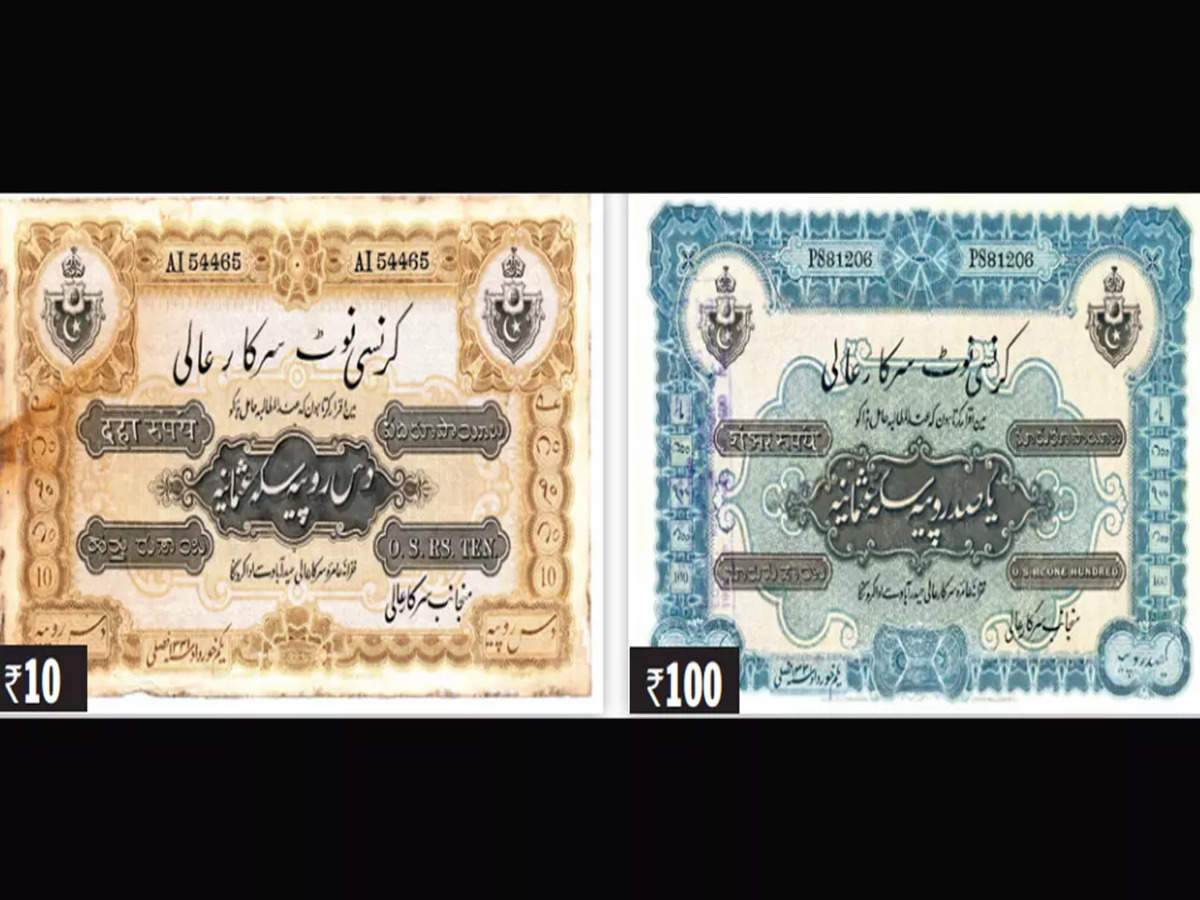
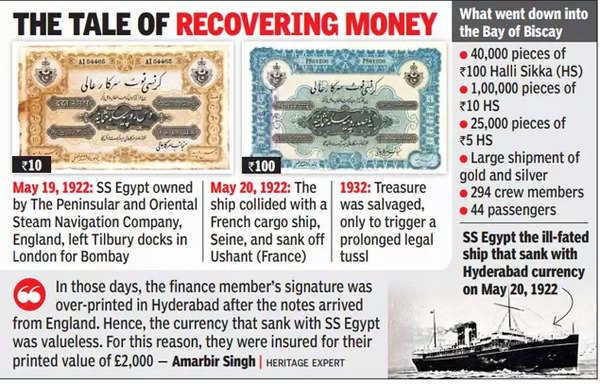
The Hyderabad currency comprised 40,000 pieces of 100 Halli  Sikka (HS), 1,00,000 pieces of 10 HS, and 25,000 pieces of of 5 HS, totalling 1,65,000 pieces

After the ocean liner, SS Egypt , sank in the Celtic Sea on May 20, 1922, the events that unfolded over the next 17 years forced the Nizam VII, Mir Osman Ali Khan, to shift the printing of Hyderabad currency from England to Nashik.

ss egypt: Nizam Currency Sank With Ss Egypt, Sparked Printing Revolution In  India | Hyderabad News - Times of India

On this day (May 19) 100 years ago, SS Egypt owned by The Peninsular and Oriental Steam Navigation Company, England, left Tilbury docks in London for Bombay (Mumbai). It had 44 passengers and 294 crew members, besides a large shipment of gold and silver and 1. 6 lakh pieces of Hyderabad currency, which had a face value of Rs 51,25,000.


The next day (on May 20, 1922), the ship collided with a French cargo ship and sank off Ushant in France. The Hyderabad currency shipped by Waterlow and Sons to the princely state of Hyderabad too went down into the sea. The treasure was salvaged a decade later in 1932, only to trigger a prolonged legal tussle.


“The Hyderabad currency comprised 40,000 pieces of Rs 100 Halli Sikka (HS), 1,00,000 pieces of Rs 10 HS, and 25,000 pieces of Rs 5 HS, totalling 1,65,000 pieces. The face value was Rs 51,25,000,” eminent numismatist and heritage expert . Amarbir Singh told TOI, adding that since the currency notes were unsigned, they did not legally carry value.


“In those days, the finance member’s signature was over-printed in Hyderabad after the notes arrived from England. Hence, the currency that sank with SS Egypt was valueless. For this reason, they were insured for their printed value of £2,000,” Amarbir said.


Stating that few of the notes salvaged had made their way to Hyderabad, resulting in a spate of legal fights, Amarbir said the issue was closed 17 years after the notes were printed which entailed seven years of negotiation and litigation.

“The government of Hyderabad decided it would be safer to print currency in India. The outbreak of World War II shortly after proved it was indeed a wise decision,” Amarbir said, explaining how the princely state changed location of currency printing from England to India.

The Hyderabad government requested Waterlow to destroy the notes and ordered a replacement stock from the printers, with the same series repeated, but in a slightly different type of font used in the serial number to indicate the difference. These were received and duly circulated, and the matter was regarded as closed, he said.

source: http://www.timesofindia.indiatimes.com / The Times of India / Home> City> Hyderabad> News> City News> Hyderabad News / by Syed Akbar, TNN / May 19th, 2022

How U.P. police tried to keep Azam Khan in jail till the last minute

UTTAR PRADESH :

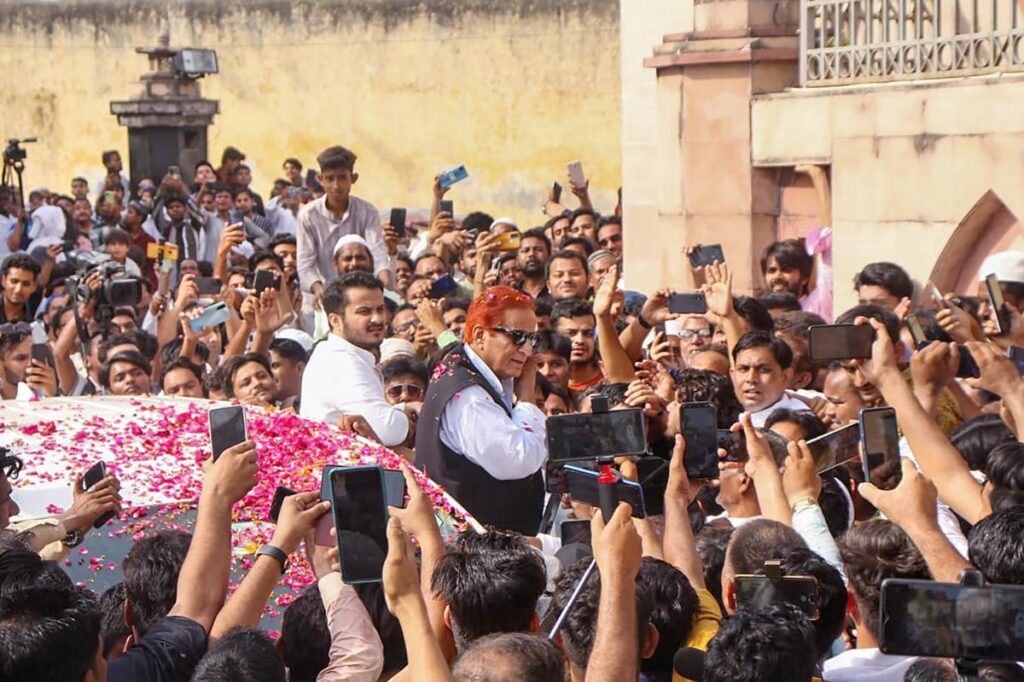
Samajwadi Party leader Azam Khan is greeted by supporters after his release from jail in Sitapur on May 20, 2022. | Photo Credit: PTI

Supreme Court had invoked Article 142 to grant him interim bail 

The Uttar Pradesh police’s efforts to keep Samajwadi Party stalwart Mohd Azam Khan in custody were interrupted as the SP leader walked out of the Sitapur Jail on Friday after more than two years in custody.

While invoking its powers under Article 142 of the Constitution of India to grant him the relief, the Supreme Court had outlined the circumstances under which Khan was implicated in the 88th FIR against him.

To begin with, the court noted that even though this FIR was registered in March 2020 and a charge sheet filed, the U.P. police did not consider implicating Khan in the said case until the Supreme Court started hearing his case this year.

Moreover, the court also noted that while opposing interim bail to Khan in this case, the police had alleged that he had threatened the investigating officer of the case. However, it also pointed out the “sheer coincidence” in the timing of this threat, which was registered by the police as a General Diary entry at 3:04 a.m. on May 17, only hours before the top court was to hear the matter.

Noting that Khan was implicated in this case 1 year and 7 months after a charge sheet had been filed, the court said, “It is not as if that the allegations which are now sought to be made against the petitioner (Khan) could not have been made at that point of time.”

When Khan had approached the Supreme Court earlier this year, there were 87 criminal cases pending against him, of which he had secured bail in 84. As the top court started hearing his plea regarding the delay in bail being granted in the remaining three cases, he was further granted bail in two of them, leaving just one more case for him to get relief in as of the beginning of May.

It was at this point that the U.P. police acted to implicate Khan in the 88th case, where he was not an accused or suspect till May 5, when the police first requested to summon him in the case. As the Supreme Court was told on May 6 that the Allahabad High Court would soon deliver its judgement in the last remaining case, the Additional Chief Judicial Magistrate (Rampur) on the same day passed an order remanding Khan in custody in the 88th case.

While hearing Khan’s case last week, the Supreme Court had also noted a pattern in the police action against him, orally pointing out that the 9-time SP MLA was being arrested in a fresh case every time he was granted bail in a previous one to prolong his incarceration.

Khan, once among the most powerful ministers in the SP-led U.P. government, faced a barrage of FIRs soon after the Bharatiya Janata Party came to power in 2017, the first of which came on allegations of forging his son’s birth documents. The bulk of the FIRs (81 out of a total 88) then came in 2019, immediately before and after the Lok Sabha elections that year, all in quick succession.

As per the most recent election filing in 2022, charges have been framed against Khan in just 14 of the 88 cases.

Therefore, considering that he had been granted bail in 87 cases and the circumstances under which he was implicated in the 88th case, the Supreme Court invoked its power under Article 142 for the second time in two days to grant interim bail to him.

The top court had just a day before invoked the same powers to free Rajiv Gandhi-assassination convict A.G. Perarivalan.

Article 142 gives the Supreme Court sweeping powers to pass any such orders or decrees as it may deem fit in the interest of ensuring that “complete justice” is done in any cause or matter pending before it.

These powers are rarely invoked by the court and it has done so notably in its Ayodhya-Ram Janmabhoomi land dispute judgement in 2019, in 1989 while asking Union Carbide to pay $470 million in compensation to Bhopal gas tragedy victims, and in 2016 while banning the sale of liquor within 500 metres of state and national highways in a bid to curb driving accidents.

source: http://www.thehindu.com / The Hindu / Home> News> National> Other States / by Abhinay Lakshman / New Delhi – May 20th, 2022

Preserving the beauty of tradition is a way of life for the Razas

Lucknow, UTTAR PRADESH :

In a believe-it-or-not type of story, a ‘heritage’ house in Lucknow owned by a descendant of the erstwhile Nawabs, who once ruled the region, preserves an ambience that may have prevailed in many royal households centuries ago.

A visit to Syed Masoom Raza’s family house, Saltanat Manzil, near City Station, located in a sprawling one acre campus, is like stepping into a time machine and getting transported to a bygone era.

This house boasts of a 55-feet tall clock tower, and a drawing room full of antiques such as a violin, radio, chandeliers, and sofa sets that are all more than 100 years old. Other antiques one could see include coins, pen nibs and even fire extinguishers. The walls are adorned with handwritten letters and awards that the family had received at different periods in the past.

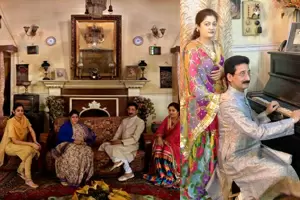
Royal grandeur: The Raza family members love to follow their customs though it could be cumbersome at times (right) Syed Masoom Raza with his wife Naseema 

As you enter the house, Masoom Raza greets you with the customary adab and a domestic aide offers you a glass of water in a silver glass. Directions are issued for tea.

It is another matter that when one can get instant tea, it takes more than one hour to prepare tea in Raza’s house with all the etiquettes.

“We have been living like this for ages. Our daily chores are also done in the same manner. It takes time but we feel inner satisfaction and pride that we are living the blue lineage,” says Raza.

The stone plaques reflect that the house was opened by the then state governor C W Guwyne of British era. “We belong to the family of nawabs and are descendents of the Law Minister during the regime of the first king of Awadh,” reveals Raza.

The female members of the family also take pride in following the customs, even though at times it proves cumbersome for them. “There is nothing like fast food in our house. The cooking takes several hours and our domestic aides take care of it. The food is laid on a common dining area which is itself a reflection of a variety of Awadhi cuisine,” says Naseema, Raza’s wife.

Their daughter Haya Fatima presently pursuing engineering too is at ease living in this style where everything moves at a lethargic pace. “We use modern gadgets, but even our computer table is an antique,” she adds.

source: http://www.theweekendleader.com / The Weekend Leader / Home / by Mohd Faisal Fareed / Volume 3, Issue 3 / June 26th, 2011