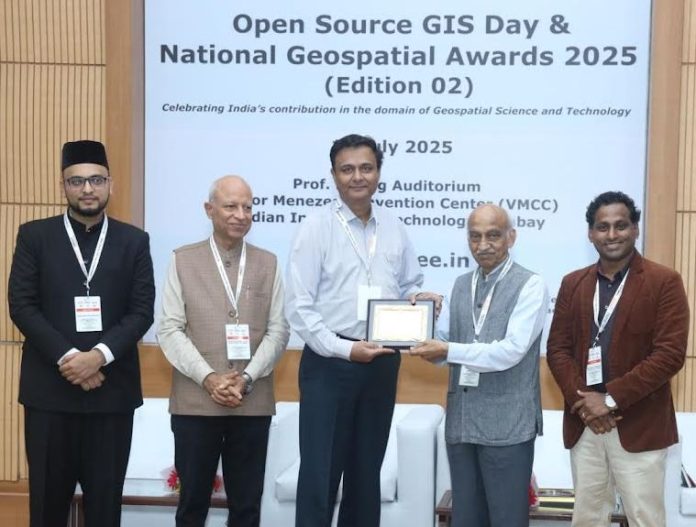
Prof Shahab Fazal of the Department of Geography, Aligarh Muslim University (AMU), has been conferred the prestigious National Geospatial Faculty Fellow Award at the Indian Institute of Technology (IIT) Bombay.
The award was presented in recognition of Prof Fazal’s significant contribution to advancing geospatial education through his textbooks and Massive Open Online Courses (MOOCs) on remote sensing and Geographic Information Systems (GIS). His work has played a vital role in popularising geospatial technologies and making them accessible to students across the country.
Padma Shri Prof Kiran Kumar, Former Chairman of the Indian Space Research Organisation (ISRO), presented the award during a special ceremony held at the Prof B. Nag Main Auditorium of IIT Bombay.
The award ceremony was a key highlight of the Open Source GIS Day Celebrations, organised by the FOSSEE GIS project of IIT Bombay. This initiative falls under the National Mission on Education through ICT (NMEICT), Ministry of Education, Government of India.
source: http://www.radiancenews.com / Radiance News / Home> Pride of the Nation> Awards> Latest News / by Radiance News Bureau / July 18th, 2025
Another area where his enthusiasm manifested itself was in exploring the religious history of meteors.
Mohammad Abdur Rahman Khan
The night sky has been one of the oldest sources of wonder. Through the ages men and women have looked up to the stars and been filled with curiosity and awe. This peculiar awe inspired by the diamond-studded vault has also inspired a number of distinct disciplines and practices. From hobbies like stargazing to highly systematised knowledges like astronomy and astrology and several cosmological myths in every major world religion have all been inspired by the awe one feels for the “heavens”. When we write the history of our all-too-human interest in the night skies, however, we usually parse these various practices and knowledges into neat silos.
Stargazing is seen to be an activity proper to children and hobbyists. Religious cosmologies are mostly left to theologians or historians of religion. Astronomy becomes the province of the savant. Even if some traffic between these distinct groups and their practices may be allowed in earlier eras, the distinctions seem to have become watertight by the 20th century. And that might be why no one today remembers Mohammad Abdur Rahman Khan.
A passion for meteors
In the last decade of British rule in India, Khan published a whopping ten papers and reports in Nature, the preeminent scientific journal of the time. Khan only had a bachelor’s degree to his name and had taught all his life at the Osmania College, away both from the then-new research institutions like the IISc and the old universities like those at Calcutta, Bombay, or Madras.
By the end of the 1940s, however, Khan had become well-known to the international scientific community. Besides his regular contributions to Nature and other scientific publications, he had also been elected a Fellow of the Royal Astronomical Society and appointed a Research Associate at the Institute of Meteoritics at the University of New Mexico. In 1936 and again in 1948 Khan was invited to present papers at the annual meetings of the Society for Research on Meteorites in the United States.
Khan’s passion was meteors. He had first become interested in them as a schoolboy at the Madrasa-i-aliya in Hyderabad in the late 1880s.
Later, the arrival of Halley’s Comet in 1910 reinvigorated his interest in astral phenomena and he set about translating Sir John Herschel’s Outlines of Astronomy into Urdu. It was also the time when he began to systematically observe the night skies. In 1940, by then nearly 60 years old, he reported to Nature that he had spent a total of 103.25 hours over 152 nights observing the skies that year. As a result, in just that single year, he had observed and mapped the paths of 1390 meteors!
Apart from personal observations, Khan managed to put together a network of other amateur observers who regularly sent him their observances as well. One 1945 publication, for example, contained observations from MM Ali Beg, a school headmaster, MA Latif Khan, a lawyer, and MT Ali, an official in the Finance Department of Hyderabad. What Khan had thus managed to do was link up a number of hobbyists and turn them into data collectors. Here was an early example of what would later sometimes be called “citizen science”, i.e., incorporating lay citizens into the task of scientific knowledge production.
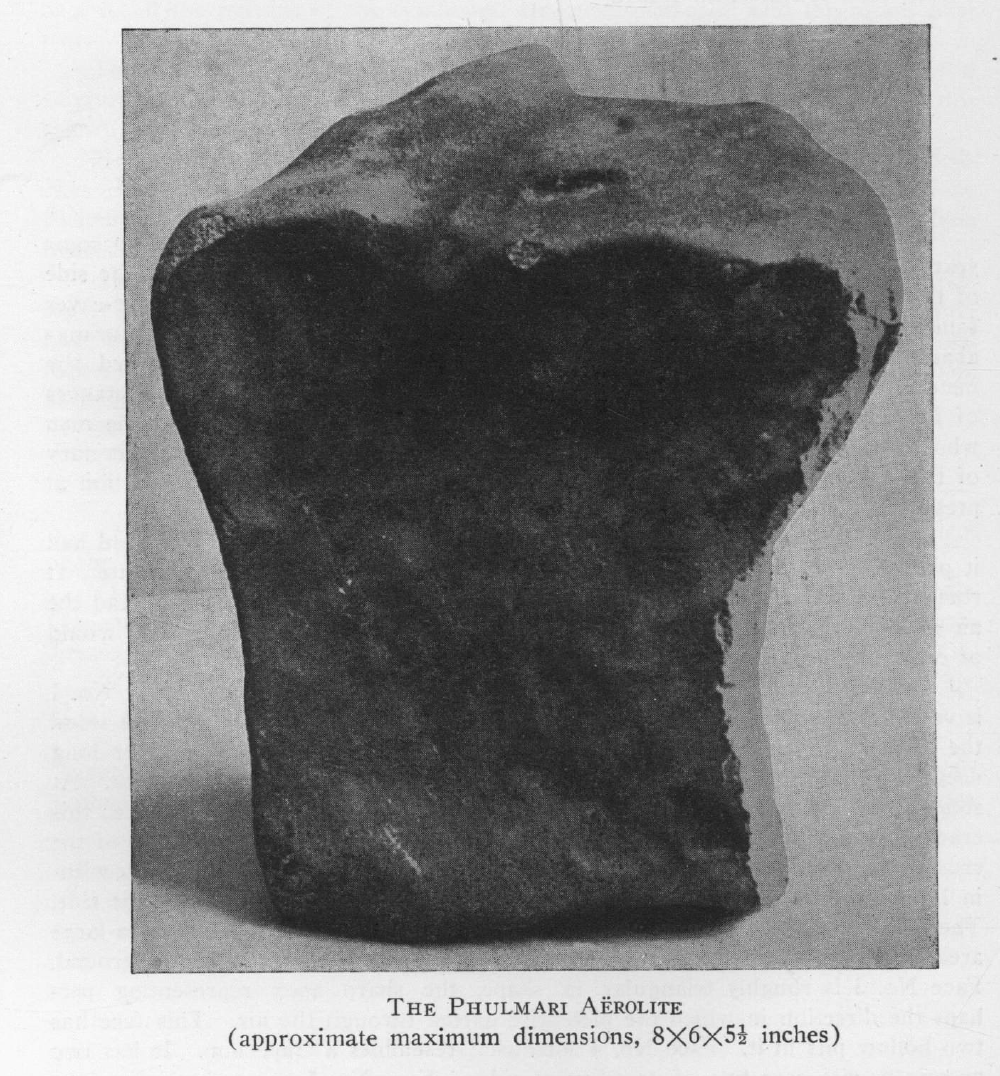
The study of meteors at the time depended not only upon the mapping of aerial pathways and frequencies but also on the study of the actual meteorites. Here again, Khan utilised his social networks to great advantage. In August 1936, for instance, he received from Maulvi Abdul Hag Saheb an aerolite that had fallen a couple of years ago onto a farm near the village of Phulmari in Aurangabad district. At other times, he heard of an old meteor shower in an area and personally went to search for meteorites. Since, unfortunately for Khan, the ground had been flattened in the intervening years, he offered a financial reward to the local villagers to induce them to part with any pieces of the old “shooting star” that anyone might have kept back.
The Phulmari aërolite.
Not satisfied with simply collecting local meteorites, Khan also started buying rarer meteorites from international dealers. He bought several pieces, for instance, from Wards’ Natural Science Establishment – a dealership trading in rare scientific specimens based at Rochester. On another occasion, possibly in the 1920s, he paid the then-princely sum of $24 to a dealer in Denver for some rare meteorites. His collection, in time, became a significant scientific resource. The eminent physicist Satyendra Nath Bose, remembered today as the discovery of the “boson”, once borrowed some meteorites from Khan’s personal collection for x-ray analysis at Bose’s laboratory at Dhaka University. What is also noteworthy is that Khan financed his collection entirely out of his salary as a college teacher. The prices charged by foreign dealers, the financial rewards given to locals etc. all came out of his personal finances.
Yet, Khan had not been a rich man. He came from a scholarly family with roots originally in Ghazni. His ancestors had then served the Nawabs of Arcot before switching to British employment upon the fall of Arcot. The family had been comfortably off as a result of employment in the British military and civil establishments. But Khan’s father had died suddenly when he was still in college, putting the entire family in straightened circumstances. A small scholarship given to him by the government allowed him to tide over the lean period. Always a very good student, he was able to find employment soon after graduation and thus eventually mend his financial circumstances. That neither this experience of precarity nor the relatively modest salary of a college teacher discouraged him from spending lavishly on the collection of meteorites is a testament to the depth of his passion.
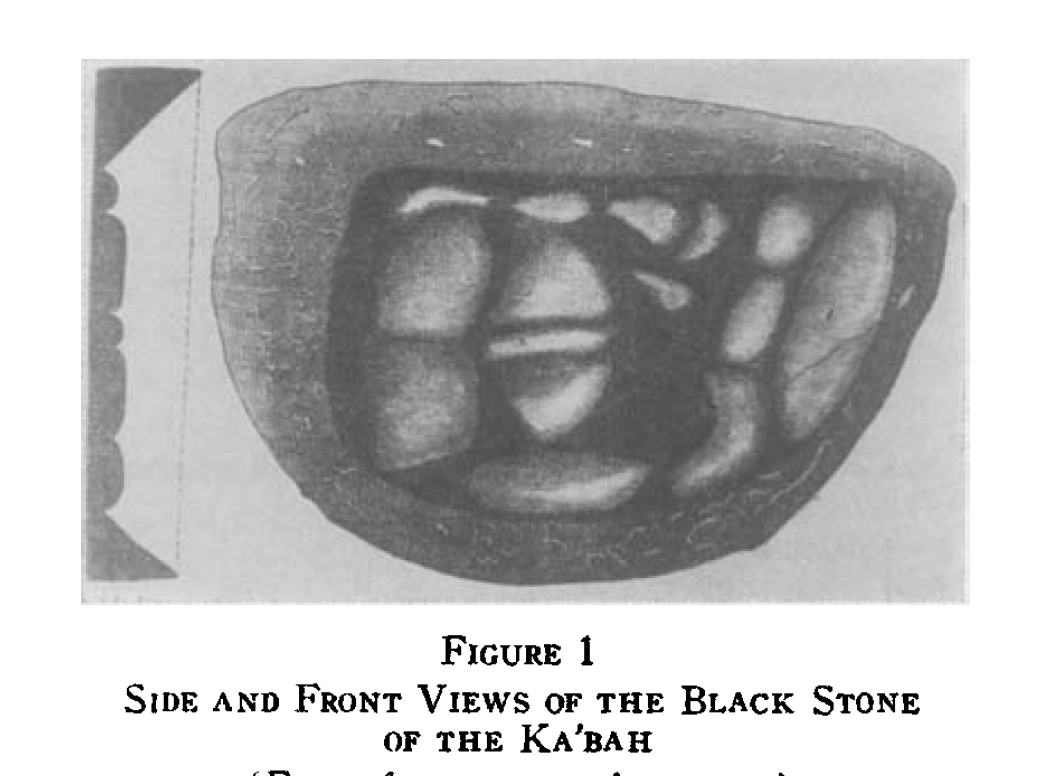
Spending hours staring at the night sky or shelling out generous sums for buying meteorites did not exhaust Khan’s passion for the topic. A third area where his enthusiasm manifested itself was in exploring the religious history of meteors. Hailing from a scholarly family and being educated in classical Persian and Arabic, Khan sought to document and analyze the reports of meteorites in religious texts. One of his most interesting studies in this regard comprised attempts to establish the meteoric origins of the holy black stone of Ka’aba in Mecca. Though he was far from being the first one to propose the theory, it was to his credit to bring both scientific knowledge about meteors and classical textual references together to try to establish the case.
Side and front view of the black stone of the Ka’bah.
A node at which several disparate worlds came together
Khan’s career as a man of mid-20th-century science is a curious blend. At one level he is a hobbyist who managed to keep alive an interest in stargazing that arose as a child. On another level, he is a man brought up in an old Islamic scholarly culture with an abiding antiquarian interest in classical works in Arabic and Persian. At a third level, he is a figure in a global scientific network organised in the form of scientific societies, research institutes, and scholarly journals. Above all, however, he was a node. A node at which several disparate worlds came together. The worlds of hobbyists and scientists, the worlds of antiquarians and astronomers, the worlds of old Hyderabad and modern America, to name only a few.
As a node connecting these heterogeneous worlds, he is reminiscent of an early modern practitioner of natural history. A kind of meta-discipline that predated the birth of modern science, natural history combined the collection of specimens, particularly of exotic and rare objects, with textual studies of classical texts. It was largely displaced by the middle of the 19th century when modern, organised, and increasingly professionalised science took its place. Disciplines gradually became more specialised, collections became institutionalised, and scholarly enquiry became less interested in classical precedents to their topics. The relish with which Khan is said to have displayed his personal collections of meteors to visitors, like SN Bose, after lavish Hyderabadi dinners, or the way he would recite both Sa’adi’s poetry and talk about meteorites at the same event, clearly recalls a world of early modern natural history than modern, scientific astral sciences.
The success of Khan’s career demonstrates the incompleteness of the transitions from natural history to modern science. The former, it would seem, could continue to coexist with modern scientific practices. Moreover, it could even inspire new modes of participatory citizen science, thereby turning dilettantism into a valuable resource for cutting-edge scientific work.
Astronomy was once called the Queen of the Sciences. But the Queen always had more lowly siblings, like stargazing, that remained outside the hallowed halls of science. Remembering Khan and his likes reminds us that on occasion the Queen did in fact meet and learn from her humbler siblings.
Projit Bihari Mukharji is the Head of the Department and a Professor of History at Ashoka University.
source: http://www.scroll.in / Scroll.in / Home> Reading Science / by Projit Bihari Mukherji / August 05th, 2025
The evocative recapitulation of eminent personalities provides a quick, candid, exquisite and scrupulous portrayal of those who retain their abiding presence without being physically present in the world.
The unprecedented acceptance of monolingualism has put a big question mark on the existence of numerous languages through which people stitch up a warm social rapport and seek to fulfill their cultural aspirations. India, an awe-inspiring repository of innumerable dialects, languages and different linguistic traditions, finds it nerve-racking to carry through the challenges thrown open by the technology-savvy language-English. The domination of English has taken a heavy toll on regional languages, and Urdu, once considered a significant link language, is no exception. Though Urdu is widely used as a spoken language, and its sensitively rendered poetry gets across the country, its script has been fading away with bewildering speed.
It aches much to realize that the popularity draws its sustenance from its oral rendering, and familiarity with its distinct script has been melting away steadily. Barring some notable exceptions, only faculty members and research scholars associated with various departments of Urdu of the universities and colleges use Urdu as the medium of trifling academic discourse. At a time when Urdu faces the threat of obsolescence, the gleam of hope emerges from the citadel of learning, Aligarh, where academicians not belonging to humanities draw on Urdu to initiate a perceptive discourse on a plethora of issues without bringing rhetorical flourish into play.
Professor Saeeduz Zafar Chagatai (Physics), Professor Faseeh Ahmad Siddiqui (Chemistry), Professor Athar Siddiqui (Zoology), Professor Shaan Mohammad (Political Science), Professor Iftikhar Alam Khan (Museology), Professor Zilur Rehman (Unani Medicine), Professor Mohammad Sajjad( History ), Professor Zafar Mahfooz Nomani (Law) Dr Asad Faisal Farooqui (Mass Communication) and the like seek to strengthen non-fiction prose in Urdu.
Autobiography, memories, diary, letters, sketches and anecdotal scrolls are much-adored genres of non-fiction prose, but in Urdu, they usually betray a strong sense of gushiness and sickening self-adulation. The preponderating narrative of reminisces does not go well with the celebrated author, Professor Athar Siddiqui, whose evocative recapitulation of eminent personalities appeared.
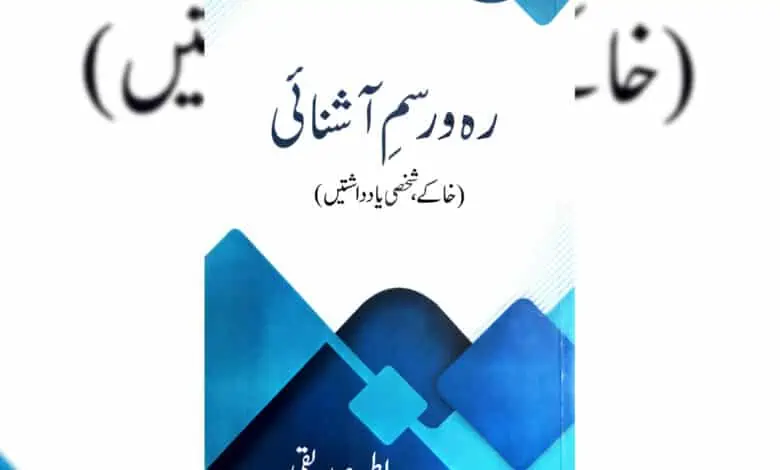
The book Rahe wa Rasm-e-Aashnai (sketches and personal memoirs) provides a quick, candid, exquisite and scrupulous portrayal of those who retain their abiding presence without being physically present in the world.
Professor Athar Siddiqui, a widely recognized scientist, has produced a captivating narrative of his eventful life, Main Keya Meri Hayat kaya, with disarming humility and jotted down travelogues vividly calling attention to down reaching human experiences that frequent foreign travels produce. Interactive media frequently carry intriguing stories featuring commonplace occurrences. The stories with a strong sense of moral tutoring dished out by the digital world need to be shared with non technology conversant Urdu knowing people.
He left Professor Athar Siddiqui to supplement what had been missing and started translating these pulsating stories into Urdu. It was left to Professor Athar Siddiqui to supplement what had been missing, and he translated these pulsating stories into Urdu.
Tahzibul Aklaqh, a prestigious periodical launched by Sir Syed in 1870, started serializing it with a suggestive title Hairat Sarai Ki Kahaniyan (The stories of wonderland), and two volumes of these laconic and absorbing stories have appeared so far.
He meticulously edited two autobiographies of two illustrious alums of Aligarh Muslim University–Dr. Sheikh Mohammad Abdullah (founder of women’s college, AMU) and Nawab Ahmad Saeed Khan Chattari ( former Governor of Uttar Pradesh). He had astutely done over translating books on Shaheryar and Musa Raza.
Athar Siddiqui’s recently published book, Rah-o-Rasam-e – Aashnai,” creatively maps out the accessible and unchartered terrains of thirty-five personalities in candour-driven idiom, and he hardly holds with the popular notion that put a lock on showing the slightest discourtesy to the deceased. The author asserts, “It is widely mentioned that the sketch writer must not use any indecent or improper word for those resting in the peace. If this sort of exhortation is adhered to, then the sketch, personal article and memories will be read as appreciation and admiration-filled text. If history writing sticks to this principle, then the authentic history of any period could not be produced. I do not buy this argument.”
The subtle wised-up mélange focuses on nine creative writers such as Shahryar, Iqbal Matin, Sajida Zaidi, Qazi Abdus Sattar, Professor Mukhtar Uddin Arzoo, Syed Hamid, Lateefuz Zaman and a couple of close relatives, teachers, friends and former vice-chancellors.
Iqbal Matin, whose awe-inspiring artistic sensibility could not get him the recognition across the country he fully deserved, has come in for a refined exploration. Athar Siddiqui’s reminiscence is peppered with unusual but fascinating details about the author. The author living in Aligarh tried desperately to contact Iqbal Matin (Hyderabad) when the letter was the preferred communication medium. He realized that his letters were not delivered to the addressee, who was prone to change houses. Iqbal changed thirty-five houses and bore testimony to his nomadic lifestyle.
Much has been written on Jnanpith awardee and prominent poet Shahryar but a comprehensive and insightful article highlighting his distinctive personal traits and oeuvre is still looked-for. The piece titled “Shahryar as a man and poet” fills the bill with remarkable ease. Athar saheb cites many instances to prove Shahryar’s unflinching loyalty to his friends but never spitting upon the rivals. The voice of modernism with strong traces of neoclassicism, Shahryar never nurtured animosity and did whatever he could for those who looked up to him in their hours of peril. People, even authors and pushover critics tend to read creative texts in the backdrop of personal details; hence when Shahryar suffering from a terminal illness- cancer–composed a couplet; Aasman ab kuch nahi tere karney ke liye/Ham ne sab taiyaariyan karli hain marne ke liye (O sky, now you have nothing to do/I have completed all the preparations for dying) it was considered as the affirmation of impending death. Employing critical acuity, Athar saheb mentioned that the couplet has nothing to do with a nagging sense of personal extinction; the poet laments how we perfected the art of self-destruction reflected in the depletion of Ozone layer manufacturing of weapons of mass destruction.
Athar Siddiqui wrote an immensely readable sketch of Qazi Abdus Sattar, a much overrated and pretentious writer who always took pride in using ornate and florid language in his fiction. His novel Tamam Sultan has been described as magnum opus, but it is hardly more than an oft-repeated titillating story of unrequited love. Athar Saheb and Qazi have had close ties for over fifty years, but Qazi was so intemperate that he pulled ties into pieces as Athar could not attend his facilitation function. It was an act of civility to describe this narcissism as uniqueness of personality.
Prof Zilur Rehman, a widely- respected academician of Unani medicine, is a well-known scholar of Urdu, Persian and Arabic and has more than fifty books to his credit. His books, especially on Ibne Sina, Hakim Ajmal Khan, Sir Ross Masood, Hakim Ehshanullah Khan, and Hakim Abdul Moid, got widespread admiration. In addition to discussing his well-documented and invigorating writings, Athar Siddiqui effortlessly unravels his amenable nature and inimitable passion for books and artefacts. He has a collection of over 70,000 and set up a museum and library, Ibne Sina Academy, which has its website.
Seldom does one attempt to spell out what essentially embodies his wife, going beyond the adulation and berating with a sense of objectivity. This nagging edginess seems to have no bearing on Athar saheb, who painted a stirring wordy portrayal of his wife Zakia Siddiqui, a renowned academician and former principal of Women’s College, Aligarh Muslim University.
One tends to agree with the author when he asserts that during the first ten years wife is treated as the beloved; with the birth of children, she takes over the role of the mother. If harmonious marital life continues, she becomes an inseparable friend who hardly gets perturbed, no matter how annoying one becomes. It is all momentary, and the bond of affinity never weakens.
Athar saheb also evocatively narrated his mother’s life story, and he recollects his memories and anecdotes to document her extraordinary considerate nature. Suhail (son) and Taab (daughter) get pat on the head by the caring and unerring father for their abiding sympathy for others.
The book turns attention to a dozen vice-chancellors and pro-vice-chancellors of AMU, such as Dr Zakir Hussain, Bashir Hussain Zaidi, Badruddin Tyabji, Abdul Aleem, Ali Mohammad Khusro, Syed Hamid, Syed Hashim Ali, Wasiur Rehman, Naseem Farooqui, Mahmoodur Rehman, Hamid Ansari and Abul Hasan Siddiqui.
The author’s appraisal of them looks convincing, but occasionally subjectivity surfaces. The assortment of sketches offers a discerning peep into the life of all who impressed the author. The nuanced and readable prose is used impeccably, and Athar Siddiqui deserves accolades for producing such picturesque vignettes.
Shafey Kidwai is an Indian academic, communication scientist, translator, columnist, and author. He is the chairman of the Department of Mass Communications at Aligarh Muslim University.
source: http://www.siasat.com / The Siasat Daily / Home> Featured News / by Shafey Kidwai / September 26th, 2025
Ather Siddiqi was a researcher of eminence in his field and his research has been nationally and internationally recognised in the scientific world.
Professor Ather H. Siddiqi was born on December 29, 1931, in Saharanpur, Uttar Pradesh. He attained his early education at the Govt. High School, Saharanpur and obtained the degrees of B.Sc. (1950) and M.Sc. (1953) from A.M.U. Topping the university in Science and Zoology, he received two gold medals. He did his PhD in 1956 under the supervision of Professor Babar Mirza from Aligarh Muslim University.
Ather Siddiqi joined the Department of Zoology as a lecturer in 1953. After three years, he joined Purdue University, USA and completed another doctorate in 1958. He became a reader in 1961 and was appointed as a professor in 1977. Prof. Siddiqi also taught at universities in Nigeria and Libya and returned to India in 1980. He served as the Chairman of the Department of Zoology (1985-88) and as the President of the Indian Society for Parasitology. He also served as the Dean of the Faculty of Life Science in 1988-89, finally retiring from his services in 1994.
His scientific work on helminth taxonomy was published by the New York Academy of Sciences in the form of an exhaustive monograph. Despite that, he received his basic training in classical zoology in the early sixties. Later on, he switched to experimental work in parasitology. Ather Siddiqi was a researcher of eminence in his field and his research is nationally and internationally recognised in the scientific world.
Siddiqi’s Immersion in Urdu Writing
Apart from research articles, his popular writing in Urdu started in the 1980s. His first article in Urdu appeared on the life and scientific contribution of his mentor Professor Babar Mirza in the Quarterly “Fikr-o-Nazar” (January 1987). He published two articles in the early years of “Tehzib-ul-Akhlaq”, Aligarh: ‘Ilm-ul-Hayatiat ke Isatiza se Khitab’ (December 1987), ‘Mohammad Babar Mirza-Apnay Chaman ka Aik Deedawar’ (August 1989).
After his retirement in 1994, he devoted himself completely to Urdu writing. His lengthy article, ‘Mashriq say bezar na Maghrib say Hazar Kar’ narrateing the scientific and cultural activities of European countries was serialised in January 2005-June 2006 issues of “Tehzib-ul-Akhlaq”.
Similarly, his Urdu travelogue ‘Saat Haftay Inglistan Main’ (Seven Weeks in England) was published in the June and July 2006 issues of “Tehzib-ul-Akhlaq”. It carried interesting information regarding the scientific and cultural development of England.
His article based on his visit to Spain ‘Undlus Ka Shandaar Mazi’ (The Bright Past of Spain) discussed the scientific and cultural development of medieval Spain.
Ather Siddiqi along with Syed Zillur Rahman, contributed a chapter, ‘Aligarh Muslim University: Development and Progress of Science Teaching and Research, 1877-1947’ in Science and Modern India: An Institutional History, c. 1784-1947 (ed. Uma Das Gupta), Centre for Studies in Civilisation published in 1999.
A Glimpse into his Published Works
He is regularly contributing a literary column ‘Hairat Sarai Ke Kahania’ to “Tehzib-ul-Akhlaq” which consists of the translation of interesting short stories taken from the internet.
Recently, his popular science articles ‘Parasitism: Aik Dilchasp Tareeq Zindagi’ (Parasitism is an Interesting Way of Life) and ‘Yek khuliya Tufailiati Beenariyan’ (Unicell parasitic diseases) appeared in the February 2022 and February 2023 issue, respectively, of the Urdu monthly ‘Aajkal’, Delhi.
After retirement, Ather Siddiqi devoted himself to Urdu writing and authored, translated and edited dozens of books. The names of some of his books are: ‘Kiya aur meri Hayat Kiya’, ‘Lizzat Aabla Pai’, ‘Nishat Aabla Pai’, ‘Hairat Sarai ke Kahaniyan’ (Vol. 1, 2, 3, 4). In 2022, he published “Rah wa Rasam Aashnai”, his last book. He also rendered Retd IAS officer Musa Raza’s book, “Land of Regrets: Kashmir”, in Urdu as “Kashmir Sarzamin Pashemani”.
Ather Siddiqi was one of the best teachers, an internationally acclaimed Zoologist, and a passionate Urdu writer. And above all, he was a wonderful human being. He passed away on 8th November, 2023, in Delhi at the age of 92 years due to old age illness.
References:
Tehzib-ul-Akhlaq, Aligarh (various issues) Science and Modern India: An Institutional History, c. 1784-1947 (ed. Uma Das Gupta), Centre for Studies in Civilisation, New Delhi, 1999.
source: http://www.heritagetimes.in / Heritage Times / Home / by Dr Asad Faisal Farooqui
Mohd Zeeshan, a PMRF and doctoral researcher at Department of Chemistry, AMU, has earned national recognition as one of the Top 40 PMRF scholars across India for his exemplary contributions to cutting-edge research in CO₂ fixation
Aligarh:
Mohd Zeeshan, a Prime Minister’s Research Fellow (PMRF) and doctoral researcher at the Department of Chemistry, Aligarh Muslim University (AMU), has earned national recognition as one of the Top 40 PMRF scholars across India for his exemplary contributions to cutting-edge research in carbon dioxide (CO₂) fixation.
Zeeshan’s research is centred on the development of heteroatom-functionalised linkers and metal–organic framework (MOF)-based materials for CO₂ capture and wastewater remediation. The selection was based on the national impact of his work, which combines experimental innovation with real-world applicability, addressing pressing environmental challenges.
His research has been conducted under the mentorship of Dr. M. Shahid, a noted scientist with over 170 publications.
Zeeshan acknowledged the constant academic and moral support of Professor Zeba N. Siddiqui, Chairperson of the Department of Chemistry, who congratulated him on receiving this prestigious honour. He also thanked Professor Aasim Zafar, PMRF Coordinator at AMU, for his dedicated mentorship, proactive engagement, and seamless coordination.
Zeeshan has authored 13 peer-reviewed research papers published in leading international journals, including Dalton Transactions and CrystEngComm (Royal Society of Chemistry), and Coordination Chemistry Reviews (Elsevier), with impact factors reaching up to 20.3. He has also contributed two book chapters, holds a granted patent, and has received multiple accolades for best poster and oral presentations at national and international conferences.
In recognition of his achievements, Zeeshan has been invited by the Ministry of Education, Government of India, for a high-level interaction with senior officials, where he will represent AMU and share insights on enhancing the PMRF scheme.
source: http://www.radiancenews.com / Radiance News / Home> Latest News / by Radiance News Bureau / June 21st, 2025
Chenibari Village (Darang District) , ASSAM / ITALY :
Dr. Ruhul Amin Hazarika
A young scientist from a small village Chenibari in the Darang district of Assam has brought laurels to the country in global medical research. Dr. Ruhul Amin Hazarika has been appointed as a research scientist at the prestigious University of Calabria in Italy, where he will conduct research on cancer detection and diagnosis with the help of artificial intelligence (AI) and will assist in teaching.
Dr. Ruhul Amin Hazarika is the son of Bashiruddin Ahmed Hazarika and Rabia Khatun, residents of Chenibari village. He received his early education from local Assamese-medium government schools and after matriculation moved to Mangaldoi for further studies.
After passing 12th in Science from Mangaldoi Government Higher Secondary School, he obtained B.Tech, M.Tech, and PhD degrees from North Eastern Hills University (NEHU), Shillong. Due to his hard work and dedication, today he has secured such an achievement which is a matter of pride for the entire state and country.
His main area of research in Italy is to develop AI-based cancer detection systems. This technology can prove helpful in the early detection of cancer and can revolutionize medical science at the global level.
Dr Hazarika believes, “Medium of education and social status are not barriers if the hard work and dedication is genuine.”
He himself studied in Assamese medium government schools from primary to 12th standard and then achieved this position by obtaining a PhD from government universities.
After completing his education, Dr. Ruhul Amin worked as an Associate Professor at Manipal University, Bangalore, where, observing his research work and technical expertise, he received a research invitation from the Italian University.
This achievement of Dr. Hazarika is not just an inspirational message for his family or village but also for the students of Assam and India who dream of touching heights despite limited resources and difficult circumstances.
“With hard work and determination, any obstacle can be overcome. If I can do it, anyone can,” said Dr. Ruhul Amin Hazarika.
His achievement not only strengthens India’s role in the field of medicine and technology but also shows that boundaries cannot stop talent.
source: http://www.awazthevoice.in / Awaz, The Voice / Home> Stories / by Ashad Ali, Mangaldoi / April 2Oth, 2025
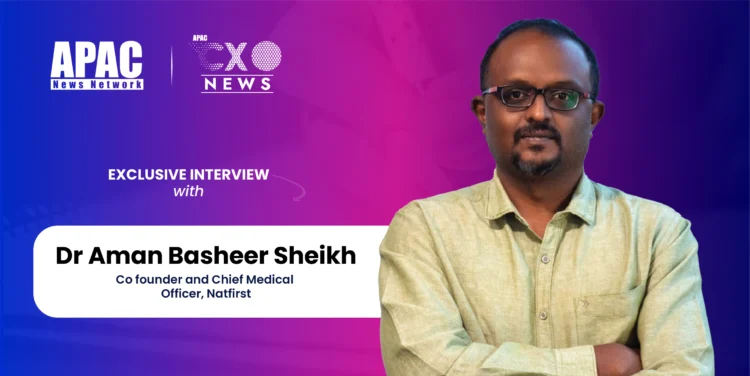
In an exclusive conversation with CXO News and APAC News Network, Dr Aman Basheer Sheikh, Co founder and Chief Medical Officer, Natfirst outlines how they are leveraging AI and data science to disrupt the health tech industry
NatFirst is the parent company of the TruthIn͏͏ app, India’s first consumer product intelligence app, which is the go-to source for understanding packaged food labels. It employs advanced AI,͏͏ including vision models and optical character recognition,͏͏ to͏͏ decode͏͏ product͏͏ labels͏͏ and͏͏ provides consumers with insights͏͏. It analyses the nutritional͏͏ content,͏͏ additives,͏͏ processing level and͏͏ ingredient͏͏ quality by decoding the information disclosed on food labels. A simple barcode scan allows users to access this information. At͏͏ the͏͏ heart͏͏ of͏͏ this͏͏ is͏͏ the͏͏ TruthIn͏͏ Rating͏͏ System,͏͏ which͏͏ translates͏͏ the data͏͏ from labels into͏͏ clear,͏͏ science-backed͏͏ health͏͏ scores.͏͏ These͏͏ insights͏͏ help͏͏ users͏͏ navigate͏͏ a͏͏ market͏͏ flooded͏͏ with͏͏ ultra-processed͏͏ foods͏͏ (UPFs)͏͏, ensuring͏͏ that they͏͏ can͏͏ confidently͏͏ distinguish͏͏ between͏͏ genuinely͏͏ healthy͏͏ options͏͏ and͏͏ deceptive marketing claims.
Natfirst comprises of a multi-disciplinary team of experienced doctors, nutritionists, and tech engineers. This team of experts has developed the TruthIn Rating System (TIRS) by studying best practices of global systems such as Nutri-Score, a nutrition labelling adopted by a few EU countries such as France, Belgium, Germany, Luxembourg, Netherlands, Spain and Switzerland. Other international systems studied include the Health Star Rating system used in Australia and NZ, and Nutri-Grade utilised in Singapore. It has also empanelled an advisory board of eminent multi-disciplinary experts who include, K. Sunitha Premalatha, MSC, RD, PHD, (Cancer Nutrition) and Padmashree awardee Dr Manjula Anagani MBBS, MD (Pathology), MD (Obstetrics & Gynecology), FICOG to ensure the TruthIn Rating methodology is as scientifically accurate as possible. Features in the TruthIn app such as the Match Meter help consumers access personalised guidance by aligning portion sizes with individual health goals, making choosing healthier products much easier.
The innovations͏͏ being developed at Natfirst coincide with the evolving needs of consumers and the demand for healthier, cleaner food products.͏͏ Unlike͏͏ the͏͏ USA or͏͏ EU,͏͏ India͏͏ lacks͏͏ a͏͏ centralized͏͏ database͏͏ of͏͏ packaged͏͏ food͏͏ products. This forced NatFirst͏͏ to build its product dataset͏͏s manually from͏͏ scratch which was a significant challenge but also differentiates Natfirst as one of the few startups in India with such an extensive database.͏͏ With millions of products circulating in the Indian market, the user base of TruthIn has also played an extremely vital͏͏ role in grassroots data͏͏ collection to͏͏ form͏͏ a͏͏ dynamic͏͏ database͏͏ of over͏͏ 16,000͏͏ products which is now set to grow exponentially.͏͏ In that sense, Natfirst is a pioneer in the Indian market with many industry firsts.
Natfirst has also differentiated itself by building a loyal community of users based on trust and consistently promotes its scientifically validated scoring system. Today its flagship product TruthIn, has more than 5 lakh downloads. The brand ambassador of TruthIn is Revant Himatsingka (Food Pharmer), a staunch promoter of scientifically validated information, who has embarked on a mission to educate the average Indian consumer on label literacy. The TruthIn Rating System (TIRS) was specifically designed to help consumers with the most accurate and validated information available to make healthier food choices.
Lastly, to accelerate the process of ensuring that consumers have access to transparent information about all the products, a feature innovation which is very technically challenging is currently being beta-tested. It will enable consumers to analyse products in real-time and TruthIn will become the first app globally to launch such a feature once it goes live.
The 2024 Healthy Snacking report showed that consumers In India are increasingly scrutinising labels. However, the findings of an ICMR NIN report highlighted͏͏ that͏͏ while͏͏ many͏͏ Indians͏͏ read͏͏ food labels,͏͏ they͏͏ rarely͏͏ look͏͏ beyond͏͏ manufacturing͏͏ and͏͏ expiry͏͏ dates—leaving͏͏ them͏͏ vulnerable͏͏ to͏͏ misinformation, unwanted additives͏͏ and͏͏ inaccurate claims.͏͏ This underscores the importance of tech-driven consumer-focused solutions like TruthIn to navigate hundreds of complex food labels that consumers encounter daily.
By analysing product labels͏͏ factoring in things like fats,͏͏ sugars,͏͏ salt,͏͏ chemical additives,͏͏ artificial flavourings, the͏͏ TruthIn͏͏ Rating͏͏ System͏͏ helps users understand their food better. The product rating system developed by TruthIn analyses a lot of complex information and distils it into a 0-5 score that is easily understandable and helps consumers save countless hours deciphering͏͏ complicated͏͏ labels.
An example of this is the flavoured͏͏ yoghurt category; which is very often͏͏ marketed͏͏ as͏͏ a healthy͏͏ snack. However, it may contain synthetic͏͏ colours such as e102, or͏͏ an excess of added sugar.͏͏ TruthIn͏͏ clearly lists all such information,͏͏ connects͏͏ it to͏͏ reputable͏͏ research,͏͏ and͏͏ offers͏͏ healthier alternatives.͏͏ By emphasising transparency, accuracy,͏͏ creation of simplified visuals and decoding complex jargon, TruthIn͏͏ empowers͏͏ consumers to cut͏͏ through any confusion while choosing products.
The importance of tech-driven tools such as TruthIn is becoming evident where over 11% of the population suffers from diabetes and 25% are classified as obese as per the ICMR. NatFirst͏͏ marries͏͏ cutting-edge͏͏ AI͏͏ with͏͏ the͏͏ insights͏͏ of͏͏ doctors,͏͏ nutritionists,͏͏ and͏͏ engineers͏͏ to͏͏ ensure͏͏ that͏͏ health͏͏ recommendations͏͏ are͏͏ both͏͏ scientifically͏͏ solid͏͏ and͏͏ easy͏͏ to͏͏ understand.͏͏ While͏͏ AI-driven͏͏ vision͏͏ models͏͏ decode͏͏ labels͏͏ in͏͏ real-time—exposing͏͏ harmful͏͏ additives͏͏ like͏͏ INS͏͏ 102,͏͏ a͏͏ coal-derived͏͏ dye͏͏ linked͏͏ to͏͏ hyperactivity—human͏͏ experts͏͏ validate͏͏ the͏͏ nutritional͏͏ frameworks͏͏ that͏͏ power͏͏ these͏͏ evaluations. The synergistic approach ensures the recommendations are accurate, easily understandable, and actionable. The nutritional framework under which the TruthIn Rating System (TIRS) has been developed by an expert team of nutritionists and doctors and output including the score is further validated by empanelled experts on an ongoing basis. This is the unique way in which TruthIn blend͏͏s human͏͏ expertise͏͏ and͏͏ AI͏͏ innovation͏͏ to help users͏͏ make͏͏ truly͏͏ informed͏͏ choices͏͏ tailored͏͏ to͏͏ their͏͏ unique͏͏ dietary requirements.
NatFirst͏͏ is͏͏ pushing͏͏ boundaries͏͏ by͏͏ developing͏͏ real-time͏͏ product͏͏ analysis͏͏ and͏͏ looking ahead integrating͏͏ it with Generative͏͏ AI͏͏ (GenAI)͏͏ for͏͏ conversational͏͏ interfaces is something we’re all looking forward to exploring.͏͏ GenAI will enhance the user experience by automating responses, providing instant feedback, and improving decision-making capabilities. This͏͏ will allow users to interact with it seamlessly for real-time guidance. This will solve for efficiency at scale enables͏͏ instant͏͏ insights͏͏ into͏͏ nutritional͏͏ content,͏͏ ingredient͏͏ implications,͏͏ and͏͏ personalized͏͏ dietary͏͏ recommendation. The tech architecture at Natfirst has been developed for quick category expansion to support the rapid addition of new product categories, ensuring timely updates to meet evolving user needs. Expanding͏͏ on the features of the MatchMeter͏͏ and͏͏ adding͏͏ more͏͏ nuanced͏͏ dietary͏͏ filters͏͏ will͏͏ help͏͏ users͏͏ navigate͏͏ the͏͏ explosive͏͏ growth͏͏ of͏͏ UPFs͏͏ and͏ aid consumers to make much more informed decisions.͏͏
By͏͏ staying͏͏ at͏͏ the͏͏ forefront͏͏ of͏͏ AI-driven͏͏ transparency,͏͏ NatFirst͏͏ aspires͏͏ to͏͏ set͏͏ new͏͏ industry͏͏ standards͏͏ and͏͏ guide͏͏ Indian͏͏ consumers͏͏ toward͏͏ healthier,͏͏ more͏͏ informed͏͏ choices. By focusing on these priorities, NatFirst will ensure it stays ahead of trends while remaining aligned with its vision of enabling healthier, more informed choices.
source: http://www.apacnewsnetwork.com / APAC Media / Home> Healthcare & Wellbeing> Interview / by Bhavya Bagga, APAC News Network / December 21st, 2024
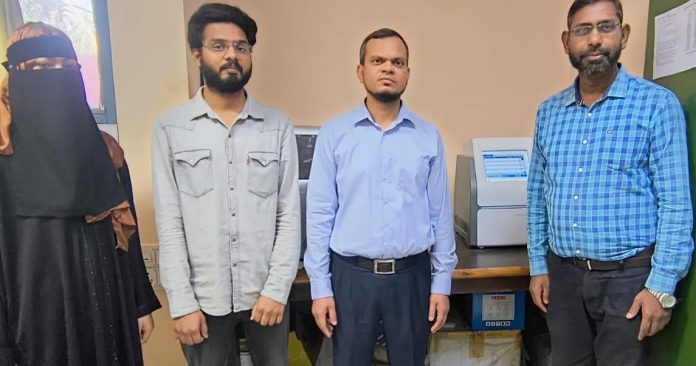
Dr. Mehdi Hayat Shahi with research team comprising Dr. Musheer Ahmad, Arif Ali, Ms. Basree at Brain Research Centre
Aligarh:
In a ground-breaking achievement, the Interdisciplinary Brain Research Centre (IBRC), Faculty of Medicine, Aligarh Muslim University (AMU), has been granted an Indian patent for a novel compound named ARSH-Q. The compound is the result of rigorous research and extensive screening conducted by the Centre in collaboration with the Department of Applied Chemistry.
ARSH-Q has shown exceptional potential in inhibiting brain cancer cells by targeting stem cells, which are major contributors to resistance against radiation and chemotherapy. Given the high recurrence and mortality rates associated with brain cancer, this discovery brings significant hope for more effective treatment options.
Led by Dr. Mehdi Hayat Shahi, the research team, including Dr. Musheer Ahmad, Arif Ali, Mr. Mohd. Muzzammil, Ms. Basree, and Mr. Swalih P., developed ARSH-Q after screening numerous synthesised compounds. Dr. Shahi, whose research on brain tumours has been ongoing since 2005, focused extensively on the Sonic Hedgehog cell signalling pathway – a critical factor in stem cell-mediated brain cancer and other malignancies.
The team’s objective was to develop a compound that surpasses the efficacy of Temozolomide, the current standard chemotherapy drug. After extensive efforts, they successfully synthesised ARSH-Q, which has demonstrated exceptional results in suppressing brain cancer cells in initial studies.
Dr. Shahi and his team are now set to advance their research through pre-clinical studies to validate the efficacy of ARSH-Q. The goal is to develop the compound as either a standalone therapeutic agent or an adjuvant to existing chemotherapy treatments for brain cancer.
The team expressed gratitude to the Vice-Chancellor of AMU, the Dean of the Faculty of Medicine, the Convenor of the IPR Cell, and the Coordinator of IBRC for supporting the patent filing process and facilitating this significant research endeavour.
source: http://www.radiancenews.com / Radiance News / Home> Focus / by Radiance News Bureau / March 22nd, 2025
It is the story of a young boy who once wanted to take his parents to the moon. However, for Sabir Alam, the journey from a small village in Bihar to the one in which he was associated with ISRO’s Chandrayan Mission 3, Moon was a destiny chiselled with grit.
Sabir Ali’s story began in the Chhoghra village in Katihar district, 350 km from Patna, Bihar. Son of a primary school teacher from Seemanchal – one of India’s most underdeveloped regions – this young boy turned his limitations into challenges and life happened to him.
Sabir’s father, Harun Rashid, knew the value of a good education but often wondered how to make his son rise in life with his meagre earnings. “With my limited earnings and the struggle to secure quality education for him, it was a challenging journey,” Harun says.
Sabir Alam having chai
Sabir joined his father’s school, where learning was born from passion rather than resources.
When Sabir cracked the Jawahar Navodaya Vidyalaya (JNV) entrance exam, it was a monumental moment. JNV was a lifeline, offering free education to talented students from rural areas.
He joined the JNV in Kolasi, Katihar, and after his 10th-grade exams in 2012, he shifted to JNV, Puducherry.
Sabir also enrolled in a coaching program run by Avanti, an NGO in collaboration with Tata Motors, to prepare students for competitive exams like IIT–JEE, the gateway to some of India’s most prestigious engineering institutions.
He graduated with a B.Tech in aerospace engineering from the Indian Institute of Space Science and Technology (IIST) in 2018 and then joined the Indian Space Research Organisation (ISRO) at the Vikram Sarabhai Space Centre, Thiruvananthapuram, Kerala.
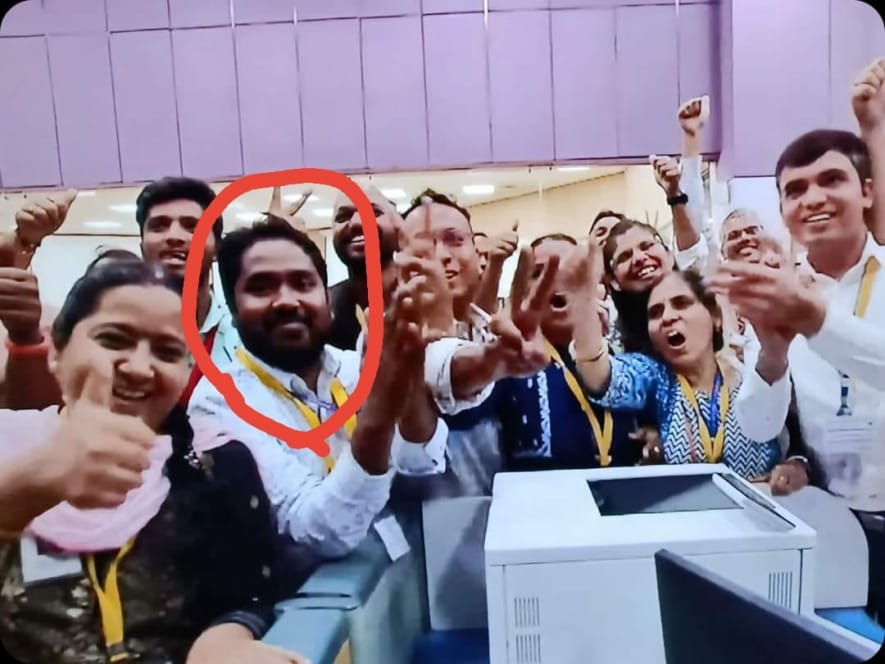
Sabir Alam with fellow scientists celebrating the launch of Chandrayaan-3
Then came the day that would forever etch Sabir’s name in history. On August 23, 2023, when India made its historic landing on the moon’s South Pole as part of the Chandrayaan-3 mission, Sabir stood among the brightest minds who made it possible.
The moment was both joyous and emotional for his family.
“It was like Eid for us,” says Harun Rashid. “People gathered at our house to congratulate us and shower blessings. It felt natural as a young man from a region often associated with poverty and underdevelopment contributed to the country’s successful lunar mission,” he says with palpable pride and happiness.
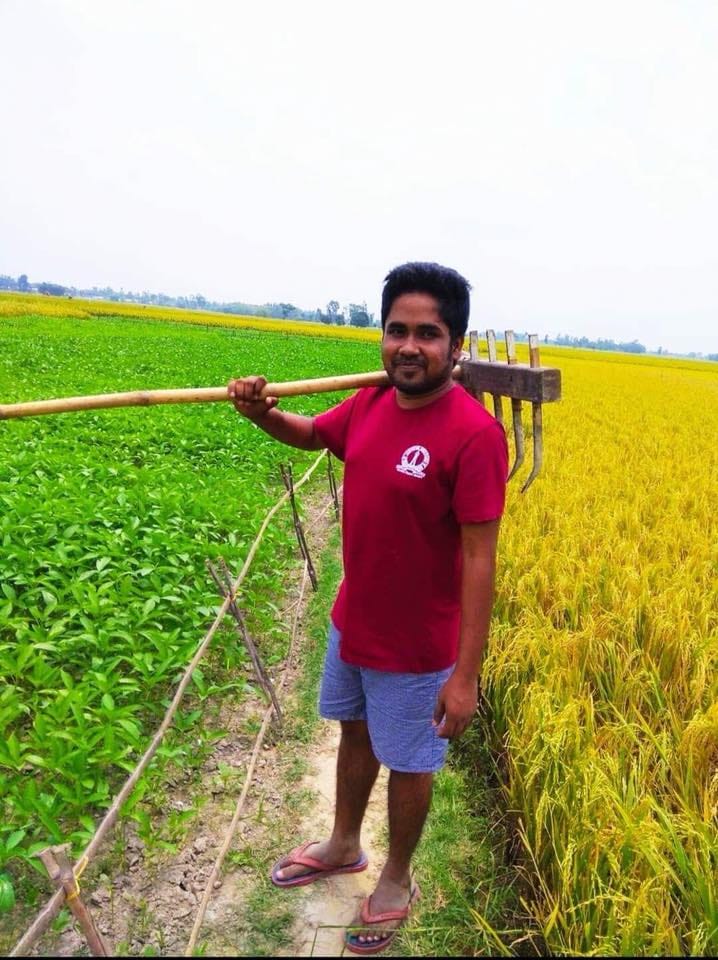
Son of the soil : Sabir Alam in his field in the village
Though his mother, a homemaker, may not fully grasp the enormity of the achievement, she stood in quiet pride, holding back her tears. “As a mother, I cannot put my emotions into words. All I know is that my son has made not just Seemanchal but the entire country proud,” she says, her voice trembling with love and joy.
For the family, Sabir’s rise was not about wealth. “There was no financial investment in his schooling,” his mother said.
Sabir’s education was sustained by the values of hard work, sacrifice, and scholarships. The JNV provided the crucial foundation, and scholarships allowed Sabir to scale the mountain that seemed insurmountable to so many.
Did Sabir’s mother ever imagine he would join ISRO or contribute to such a prestigious national mission? I asked her. “I always knew he would succeed,” she said. “He often joked during his visits home that he would take us to the moon one day.”
Sabir Alam showing a model of the lander at the surface of the moon to his son at ISRO center
Mumtaz Naiyer, a scientist based in the United Kingdom, shares a unique bond with Sabir. Hailing from the same region, he always acknowledged Sabir’s abilities. “Sabir has always been extraordinary. He stands out from other youth in Seemanchal because of his approach, temperament, and determination to learn and succeed. Thanks to Sabir, we, the Surjapuri-speaking (local dialect of the region) people, Seemanchalis and Biharis, are now part of history,” Naiyer says.
“This will certainly inspire the youth of this underdeveloped region to dream big,” Naiyer adds. “I also want to thank Sabir’s parents, as their son has brought immense pride to Seemanchal.”
Yet, despite all his achievements, Sabir has never seen himself as someone extraordinary. In a post on Facebook’s page ‘Humans of Seemanchal’ he wrote, “Honestly, I do not feel that I have achieved anything extraordinary or made any significant breakthrough in my field. I do not need to talk much about Seemanchal – its literacy rate already tells its story. I was just fortunate to find a way around the high cost of education.”
For Sabir, it was never about the prestige of joining ISRO. It is simply a milestone. “There are numerous challenges for those from backward areas, but with dedication, hard work, willpower, and, most importantly, awareness, you can overcome them,” he advises.
source: http://www.awazthevoice.in / Awaz, The Voice / Home> Stories / by Tarique Anwar, New Delhi / February 13th, 2025
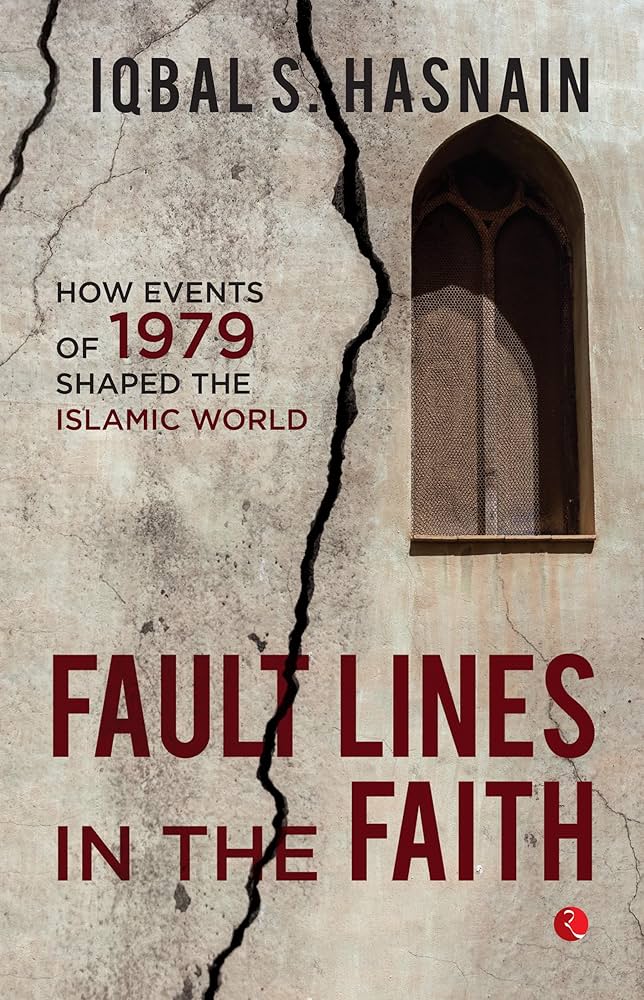
Padma Shri awardee Iqbal Syed Hasnain’s ‘Fault Lines in the Faith: How Events of 1979 Shaped the Islamic World’ was the topic of an animated discussion at Delhi’s IIC earlier this month.
The ‘Fault Lines in the Faith’ book discussion at IIC | Photo: Heena Fatima | thePrint
New Delhi:
A series of three momentous events irrevocably changed the social, religious, and political fabric of the Islamic world. And they all took place in 1979. This is the central argument of Padma Shri awardee Iqbal Syed Hasnain’s book Fault Lines in the Faith, which became the topic of a lively discussion among academics and history buffs at Delhi’s India International Centre on an early February evening.
Presiding over the panel discussion in IIC’s conference room, Hasnain, who is also an eminent glaciologist, elaborated on the three “fault lines” that sent shockwaves far beyond their immediate contexts.
First, the Islamic Revolution in Iran cleaved the Muslim world along sectarian lines with the establishment of the first Shia state. Second, the siege of Mecca ignited the conservative Sahwa (Islamic awakening) movement in Saudi Arabia, blending Muslim Brotherhood and Salafist ideologies. And third, the Soviet invasion of Afghanistan led to the birth of violent extremist groups like al-Qaeda and its offshoots.
“All these three pivotal points led to the surge of fundamentalist or Islamist jihad,” said Hasnain. He added that what began as a “normal struggle between invading forces and local communities” warped from nationalism to a violent ideological shift with devastating repercussions.
Iqbal S Hasnain | Photo: Twitter/@Rupa_Books
Hasnain further elaborated on the global impact of these events by sharing personal anecdotes from his time studying in the UK. He said he encountered strong anti-Western sentiment among students from Middle Eastern countries during his glaciology programme at the University of Manchester in the 1990s.
During Friday prayers in a large hall, he said, student speakers often delivered khutbahs (sermons) against Western culture and American exploitation of their regions, with some even advocating for jihad. As American involvement in the Middle East increased, especially with the invasions of Afghanistan and Iraq in the early 2000s, this hostility intensified.
pix: amazon.in
During the book discussion, audience members raised questions about Hasnain’s narrative. One participant, Sumanjeet Choudhary, a retired corporate executive, inquired why there wasn’t more opposition to jihadist activities despite Islam’s rich history and the presence of prominent leaders.
Hasnain countered this view with the example of Morocco’s King Mohammed VI, who has urged Moroccans worldwide to embrace tolerance and reject Islamist extremism.
“King Mohammed VI came out and he stopped the funding [of madrasas] from Saudi Arabia. He changed the whole narrative in the madrasas,” Hasnain said. He acknowledged, however, that while there is an ongoing debate within Muslim communities and their leadership about how to address extremism, it is “not very visible”.
Ripple effects
Hasnain’s book traces the rise of anti-pluralism, misogyny, and severe intolerance within the Arab world. The 1979 Shia Islamic Revolution in Iran, he said, shook the Sunni Arab world. In response, Saudi Arabia, fearing a Shiite revival, actively promoted puritanical Wahhabi Salafism, a strand of Islam that’s deeply hostile not only to Shias but also to Sunni Sufis. He, however, implicates the West as well. In February 1989, after nearly a decade of occupation, the Soviet army left Afghanistan, leaving behind a fractured nation, where tribal warlords and mujahideen groups engaged in an intense tussle for power. The US, having lost interest, “abandoned” the region, he added, leaving a vacuum for the likes of Osama bin Laden to fill.
Ultimately, Hasnain argues that the events of 1979 triggered a chain reaction, including 9/11, the US invasions of Afghanistan and Iraq, and the rise of al-Qaeda and ISIS. In 2021, in what seems like an eerie echo of the past, the US withdrew its troops from Afghanistan, leaving it with no democratic foundation and back in the grip of the Taliban.
When a participant asked about the impact of the 1979 events on India, Hasnain answered that the after-effects “were not limited to West Asia”, with radicalisation spreading to all corners of the world. “In India, to some extent, it was [mitigated] because India practiced a more moderate form of Islam , Hanafi Sufi Islam, which emphasised trade,” he added.
However, as more Indians went to work in Saudi Arabia, they were influenced by Salafi ideology, Hasnain said. For instance, those who’d grown up celebrating Eid-e-Milad (Prophet Muhammad’s birthday) stopped doing so after stints in Saudi Arabia, where Wahhabis do not observe such festivities.
One of the panel’s members was former Indian ambassador to Qatar KP Fabian. Chiming in, he said that it was important tomonitor developments in Muslim-majority countries, given India’s sizeable Muslim population. There may be political borders but “ideas come without a visa”, he pointed out, and vigilance is essential. He also claimed that Arab countries are keeping an eye on India’s Muslims. “They are watching us,” Fabian said. “They are also discreet.”
(Edited by Asavari Singh)
source: http://www.theprint.in / The Print / Home> Features> Around Town / by Heena Fatima / pix of book edited – source amazon.in / February 29th, 2024