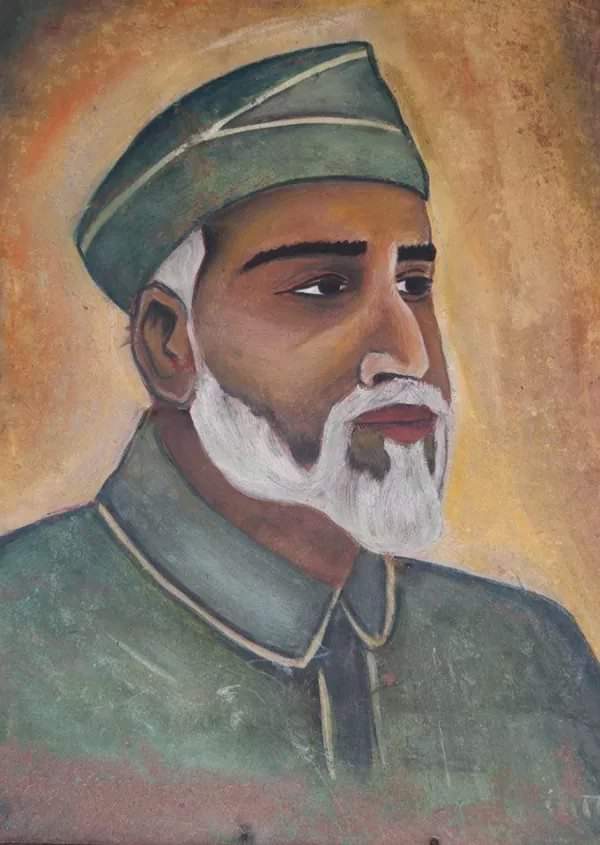
One of the most significant features of the rebellion of 1857-58 was that many scions of the former ruling houses took part in it. One such man was Khan Bahadur Khan (1860), a descendent of Hafiz Rehmat Khan (d. 1774). In this very blog of the Independence Week series, we will be throwing some light on Khan Bahadur Khan and his rebellion. How almost an eighty year old man kept the torch of rebellion against the Company in Bareilly burning.
Very little is known about the early life of Khan Bahadur Khan. It seems that having acquired traditional education in Arabic and Persian and Islamic learning; he joined the Company’s service, rising to the position of Sadar Amin (arbitrator or a native civil judge).
Upon retirement he continued to live at Bareilly where he enjoyed considerable status as grandson of the widely venerated Ruhela chief, Hafiz Rahmat Khan. In 1857 when the rebellion began, Khan Bahadur Khan was well over 82 years of age. During the rebellion, Bareilly became one of the important centers of the rebels under Khan Bahadur Khan’s leadership. In course of time, many rebel leaders came to Khan with a view to continue the struggle against the Company’s Government. A communal harmony was maintained in Bareilly despite the constant efforts of the Company to ignite the flame of hatred amongst the people through Bribery and inciting the Rajputs against Khan. This maintenance of harmony amongst the different classes of people in Bareilly is considered one of the major achievements of Khan despite the constant attack by the Company.
The old farmers of the region were affected badly because of the forceful sale of their lands by the British to suit a “capitalist” concept of property. This constant suppression led the uprising of 1816 when the company imposed the Chowkidari taxes. This uprising was soon crushed but it had led to a widespread range and discontent and people from all other regions came to Bareilly to join the uprising. The Rebellion of Bareilly was not just a religious war against the Company, it was due to the bitterness of those who had lost their lands and the anxiety of those who would be forced to lose them.
The rumors of trouble had started circulating in the region a couple of months before the actual revolt took place. The 18th Infantry Regiments and the 8th Irregular Cavalry were stationed at Bareilly. Of these the 8th Irregular Cavalry consisted almost entirely of Pathans. No European troops were stationed at Bareilly. The artillery branch which had in its ranks, as a subedar, Bakhat Khan, a disciple of Moulvi Sarfaraz Ali, the latter took a leading part in the Rebellion of 1857 and brought numerous Ulema of Delhi to call the struggle against the British as Jihad (holy war). It seems that the rebel sepoys were keen to raise Khan Bahadur Khan the Nawab of Bareilly as their leader but in the beginning he did not respond favourably to their overtures.
Ultimately on May 31, 1857. i.e. twenty-one days after the outbreak of the revolt in Meerut, Bareilly joined the rebellion. On 1 June under the guidance of Bakht Khan, concerted efforts were made by the rebels to persuade Khan Bahadur Khan to assume leadership. How Khan came to be persuaded by the rebels is evident from his own letter to the Governor General dated 14th February 1860 where he states that upon the deterioration in law and order, a deputation of the citizens of Bareilly headed by Syed Miyan Jan, Syed Faizullah, Miran Khan from Nau Mahla Mohalla, accompanied by several other persons and traders of the city approached him to take step to restore order. Syed Miran Jan at last prevailed upon him to move out of his residence.
Khan, now assuming leadership visited the city to restore order once again. He held a Darbar were prominent Hindu and Muslims were present. Like other rebel leaders, Khan Bahadur Khan also issued a proclamation addressed to all the Rajas and others, appealing to their zeal in defending religion. The main thrust of his proclamation was that the Indians’ religions (Hinduism and Islam) were in danger owing to the Company’s pro-Christian policy and attempts at Christianizing Indians. The proclamation also criticized some of the progressive measures taken by the Company’s Government such as the prohibition of Sati and widow- remarriage. The Bareilly proclamation was clearly an attempt to win the support of the Rajputs, a social group which practiced Sati and adoption, and so resented their suppression. The Bareilly proclamation also added that the Muslim leaders had to ban cow slaughter — a step considered of vital importance to maintain communal harmony. This was specially so when the majority of the rebel sepoys consisted of Hindus.
Khan Bahadur Khan was so keen to raise an efficient army that he did not burden the Rebel treasury with the pensions he had been receiving earlier from the Company.
The end of March 1858, Bareilly remained in the able control of Khan Bahadur. Despite a clear state resolution, the British policy, just to incite a division of the rebels assumed a new proportion on the cow slaughter issue. This time some Muslims mongers became active and insisted on slaughter on public places which was unacceptable to the Hindu sepoys. This led Khan hold a meeting of both the prominent Hindus and Muslims. It was attended by 12 Hindus and 20 Muslims. It was a tense atmosphere for obvious reasons and an axious and sad Khan Bahadur intervened saying “O Allah, why is so? Why is there so many squabble and blood-shed among the brothers, Hindus and Musalmans? The Hindus are my right hand and my right ear, because of their support and strength; I am able to sit on this seat. From today I declare that if any Muslim oppresses any Hindu or kills a cow at a forbidden place, he would be punished severely. Hindus and Muslims are the same. This ought to be the slogan of the two communities from this day”. In order to further strengthen the communal harmony, Muhammad flags by Hindus and Mahabiri flags by Muslims were hoisted in Bareilly and people were requested to gather under the respective flags to unite against the British. Khan himself visited different parts of the city to unite people and raised the slogans “Hindu and Muslims are one”, “Ram and Rahim are one”, and the people pledged to oust the British from this country.
One of the reasons for the long duration of the rebel regime at Bareilly was the British pre-occupation with the rebellion at other places. During this period Bareilly became a refuge for rebel leaders from far and near.
The movements of the rebel to and from Bareilly were very closely monitored by the British. The rebels lacked an efficient system of communication and the British on the other hand started communicating with Delhi, Agra, Nainital and Ambala and couriers with areas where they had no complete control. The rebels were fully aware of the danger that they had from the British Army and they made elaborate arrangements for guarding various ferry crossings. They also attempted to dislodge the Company officials from Nainital and other places, capturing Haldwani and Bhamauri (October 1857), and then Bundia on the high road between Haldwani and Bareilly. Their advance was checked by Colonel Mclausland at Baheri. The reverse was enough to persuade Khan Bahadur Khan to change the strategy. He instructed the rebel forces: “Don’t attempt to meet the regular column of the infidels, because they are superior to you in discipline and bandubast. and have big guns, but watch their movements. guard all the ghauts on the rivers, intercept their communication, stop their supplies, cut up their daks and posts, and keep constantly hanging about their camps; give them no rest”.
Though the company’s attempt to put the Rajputs against Khan in Bareilly had failed, they had succeeded in pitting the Rajputs of Dhatiganj in Bafaun against Khan, and Khan on the other hand had to take care of the Shia’s and the Sunni’s at this juncture.
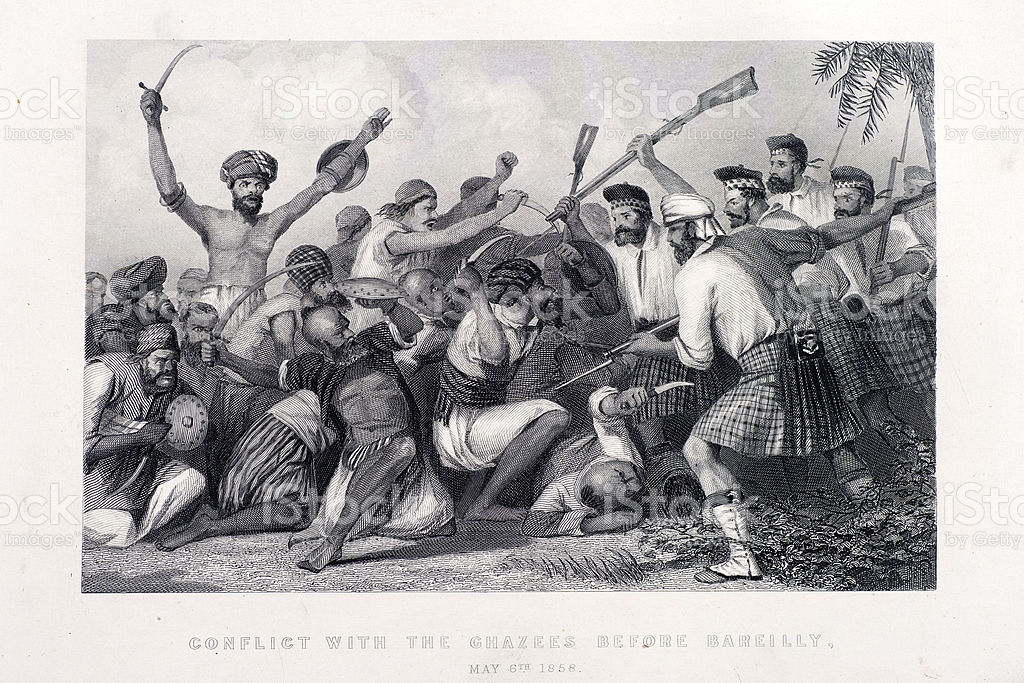
The British in Bareilly had caused an explosion with the help of their agents on 24th March 1858, killing 63 people. At the same time, the strength of the rebels were fast deteriorating due to the constant pressing forward of the company forces. They had recovered areas around Bareilly by the company troops, and the rebels were surrounded from all the sides. The company troops led by Brigadier General Jones surrounded Bareilly on 6th May. Khan Bahadur Khan had no option but to fight a pitched battle. He divided his troops into two lines. The first line was supported by the artillery commanding the bridge. The second comprising the Ghazis, defended the suburbs of the city. The British forces speedily broke the first line. They, however, had to face stiff resistance from the second line which displayed remarkable courage and determination against the enemy’s trained and organized forces. They resisted with such energy and boldness that Sir Colin Campbell was taken by surprise. To quote Russell “…a lot of Gazees got in pass the left of their right wing, attacked Walpole and Cameron, and wounded them……Sir Colin (Campbell) had a narrow escape… The Gazees were fine fellows, grizzly bearded elderly men for the most part, with green turbans and cummerbunds, and every one of them had a silver signet-ring, a long text of Koran engraved on it. They came on with their heads down below their shields, and their tulwars flashing as they whirled them over their heads, shouting, Deen! Deen! And dancing like mad men (6 May 1858)”. Sheer chivalry was, however, futile. The rebels lost the battle. Bareilly was occupied by the British forces on 7 May 1858.
“Conflict with the Ghazees before Bareilly, scence from the Indian Mutiny. Engraving from 1858, Engraver Unkown Photo by D Walker” / Source : https://www.istockphoto.com/vector/battle-at-bareilly-gm172740161-5022003
Having lost the battle, Khan Bahadur Khan took to flight. At this critical moment, the Kurmis around Bareilly provided shelter to the fugitives. From Bareilly, Khan Bahadur Khan moved towards Shahjahanpur with the intention of joining Ahmadullah Shah. Khan kept on moving and attacked the out skirts of Shahjahanpur on 12 June driving in all the pickets posted there.
He, however, could not join Ahmadullah Shah as the latter was treacherously killed by the Raja of Pawayan on 15th June. Ahmadullah Shah’s death left Khan Bahadur Khan alone. The British forces were at their heels. He took shelter in the Terai forest bordering Nepal. He wandered from place to place until Rana Jung Bahadur captured him, in December 1859, near Butwal. For some time he remained a prisoner of the Rana. Subsequently he was brought to Bareilly and confined in the Bareilly fort. He was charged with rebellion and inciting others to rebel and tried by a special Commission of enquiry. He was sentenced to death. He was hanged and laid to rest at the Bareilly Jail on 24 March 1860.
Reference/s :
Bareilly in 1857, Indian History Congress
source: http://www.sanelywritten.com / Sanely Written / Home> Freedom Fighters / by Sanely Written / August 10th, 2020
Sabsit Village (Bagnan Town, Howrah District) , Kolkata, WEST BENGAL :
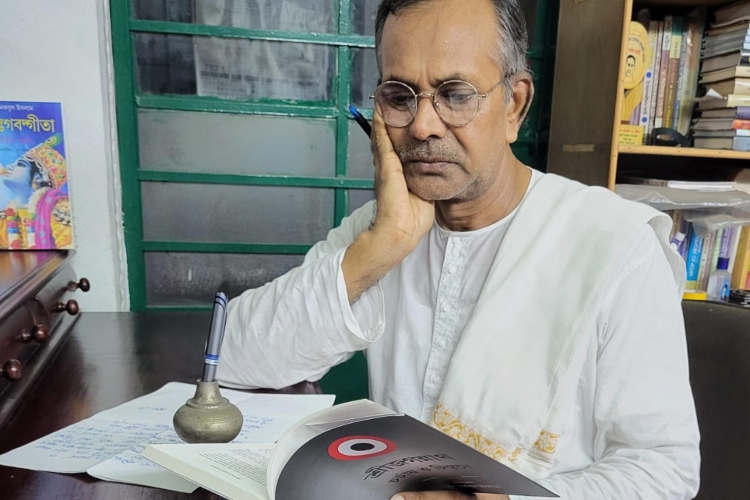
Prof Sheikh Maqbool Islam with his latest book on Lord Jaganath
Meeting Professor Sheikh Maqbool Islam is like sitting in the cool shade of a Banyan tree. In my first meeting with this Kolkata academic in his mid-fifties, my feeling was akin to that of a traveler who finds shade on the banks of a cool river in the middle of his journey on a hot day.
Professor Sheikh Maqbool, Bengali language professor of St. Paul’s College of Kolkata is an expert on Shrimad Bhagwat Gita, the ancient scripture of Hindus as well as the Holy book in Islam the Quran, and of the Christians the Bible.
Besides he is an expert on Bhagwan Jagannath of Puri (Odisha), who is the reigning deity of the Eastern States.
Prof Islam feels he is a born Sufi as he is the son of Sheikh Sajad Ali, a Sufi, and his mother Hazra Khatun. However, growing up he never imagined that one day he would write as many as 65 books.
Sheikh Maqbool Islam in his study
Prof Sheikh Maqbool Islam’s mother tongue is Bengali but he knows Hindi, Hindustani, Bengali, Oriya, Assamese, and English languages.
He says, “When I was two and a half years old, I met Sufi saints in my village. My father Sheikh Sajad Ali was himself a Sufi, so Sufi saints and scholars visited our house.”
“In the village, we had many Sufis and a large number of Vaishnav people. So when I was four and a half years old, I gradually started getting influenced by both. At this age, I also came to know about Shri Jagannath Bhagwan of Puri (Odisha).”
He says, “As I grew up, my mind opened up. I started knowing a little bit about all religions and cultures. “It felt as if I was finding the path to freedom from illusion.”
Prof Islam was born in the Sabsit village of Bagnan town of Howrah district, which is two and a half hours from Kolkata.
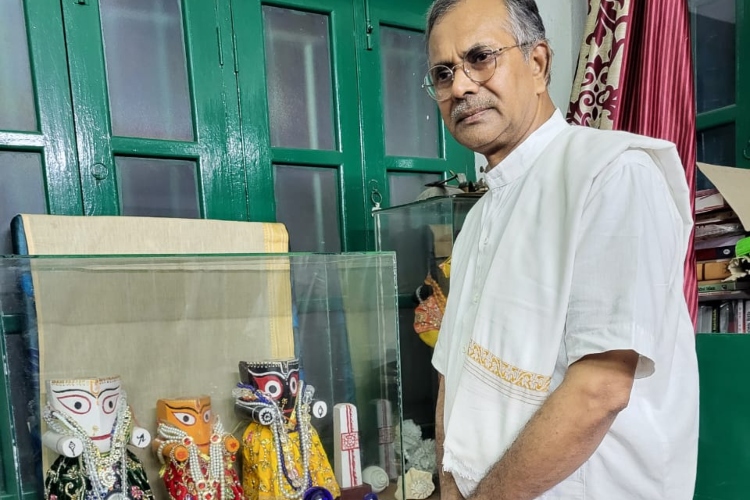
Prof Sheikh Manzoor Islam with Lord jaganath and other deities in his study
He came to the city (Calcutta) in 1985 holding the hands of his father.“I have been living near Howrah station since 1985. I studied all through in Calcutta.”
The author of 65 book, Prof Sheikh Maqbool Islam says he has Surdas (the 16th-century devotional poet who was blind)), Tulsidas, (Author of the epic Ramcharitramans, the story of Lord Ram in the Awadhi language) and Meerabai (the 16th century Saint who is known for her devotion to Lord Krishna close to in his heart.
Some of his most widely read books include ‘Gita-Quran Comparative Study’, ‘Tattva Chinta of Folk Culture’, and research subject ‘Lok Sangeet Vigyan’ .
He holds a D.Litt in ‘India-Odia Cultural Relations’ from Utkal University of Odisha in the year 2015, then PhD in ‘Comparative Study of Bangla-Odia Folk Literature’.
Professor Sheikh Maqbool Islam has also been a ‘Senior Research Fellow’ at the Asiatic Society of Calcutta. It is the largest center of oriental studies in our country.
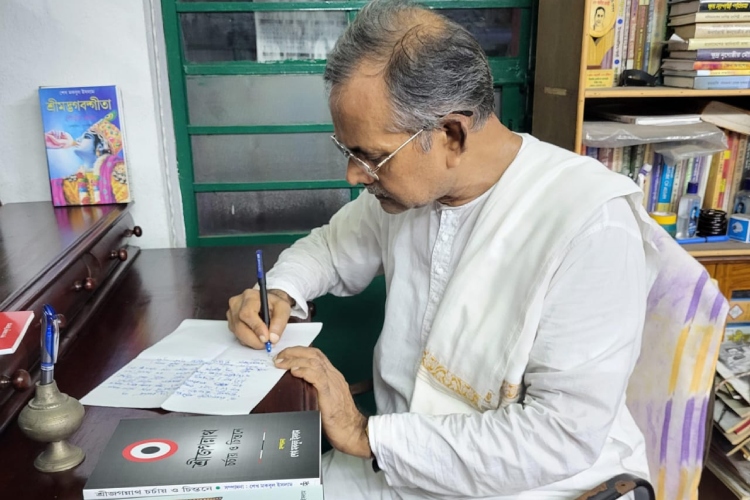
Professor Sheikh Maqbool Islam in his study
Since 1997, he has been working as an Associate Professor at Calcutta’s oldest St. Paul’s Cathedral Mission College. He teaches Bengali language and literature in this college, which was established in 1865.
Professor Sheikh Maqbool Islam believes that the fight over religion is meaningless. The main reason for this is the lack of culture.
He says, “It is very important to have a culture to create brotherhood. It needs to be understood properly, otherwise we will keep fighting.”
Prof Sheikh Maqbool Islam, who has traveled to the Philippines, Thailand, Malaysia, Sri Lanka, Bangladesh, and Nepal, has received many awards.
He was awarded Odisha’s highest honour ‘Navakalevara Award’ in the year 2015 for his research work on Lord Jagannath.
Prof Islam was given this award by Puri’s Shankaracharya Swami Nischalananda Saraswati.
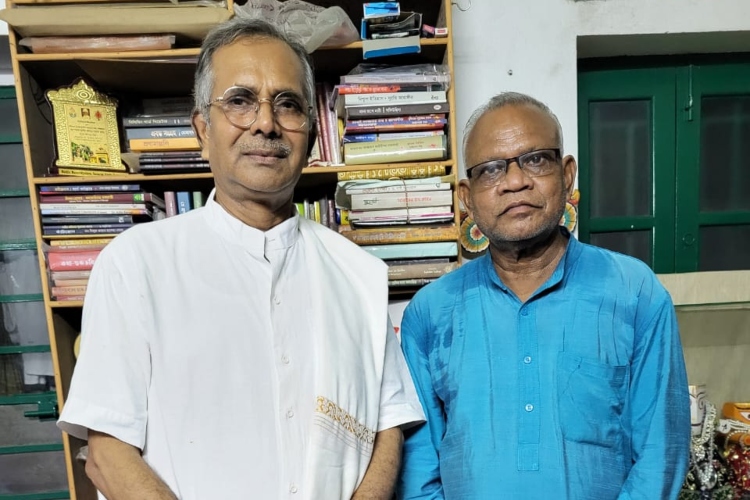
Prof Sheikh Manzoor Islam with the author
He says, “He has a total of 14 books on Jagannath.’ Among these books, ‘Shri Jagannath: Bengali Manas and Lokayat Jeevan’ is the most popular. Professor Sheikh Maqbool Islam has also done research work on Ramakrishna Paramhansa and Sri Chaitanya.
Professor Islam is doing a new research on the spread of Vaishnavism in South Asia and South East Asia
He considers Jagannath, Sri Chaitanya, Tulsidas, and Guru Granth Sahib as his idols, and is currently researching ‘How did Sri Jagannath and our Vaishnavism reach South Asia and South East Asia?’
These countries include the Philippines, Cambodia, Thailand, Indonesia, Malaysia, Sri Lanka, Bangladesh, Nepal, Myanmar, Singapore and Japan. He says, “I have been to some of these countries. Some are still left. I have been engaged in research for a long time.”
Prof Sheikh Maqbool Islam eats vegetarian food. Leaving his library with countless books, I remembered the following lines of Iqbal Sajid:
Suraj Hoon, Zindgi ki ramak choor jauga; Mein Doob bhi gaya tou shafak chod jaonga
(I am the Sun, I will leave behind the joy of life. Even if I set, I will leave behind the dawn)
source: http://www.awazthevoice.in / Awaz, The Voice / Home> Story / by Jayanarayan Prasad, Kolkata / August 18th, 2024
Edited excerpts from an essay by the translator of the renowned writer and poet’s novel ‘Scene 75’.
The first thing I read when I opened Scene: 75 was the ‘Vasiyat’ (‘Will and Testament’). I was so moved, I kept going back to it until, finally, I took a picture and pasted it on my laptop screen so that I could see it every time I opened my computer. At that time, all I knew about Rahi Masoom Raza was that he was a highly respected poet and novelist, though his success as a writer of Hindi films had somewhat overshadowed his literary accomplishments. But what eventually eclipsed everything – at least in the popular imagination – was that he was the writer of the majestic dialogues for the blockbuster TV series Mahabharat. Over time, as I read more and more about him and his life, I realized that the ‘Vasiyat’ was a true mirror of the kind of man he was: an unsparing critic of fundamentalists and hypocrites of every hue, with deep roots in his hometown in Ghazipur, Uttar Pradesh. All this found reflection in his writing, which also had a strong dose of biting humour that made you laugh out loud and wince at once.
Satire about the stars
Scene: 75 itself is a darkly funny, surreal novel in which Rahi sahib casts an unsparing, satirical look at the Hindi film industry of the 1970s and also writes about Hindu–Muslim relations with his customary blistering honesty. The book begins with Ali Amjad, a struggling scriptwriter from Benares, trapped in a lonely Bombay flat, and ends with him still trapped in that lonely flat. But in the middle is a teeming, intertwined, untidy throng of cynical and manipulative characters and their equally fantastic stories, narrated with a no-holds-barred candour by Rahi sahib. Unscrupulous film producers and ambitious clerks rub shoulders with wealthy lesbians and bigoted middle-class social climbers. There are few lovable characters. When I finished the novel, I realized that the only character I cared for was Ali Amjad (Rahi sahib himself, I think) – nevertheless, all of them held my undivided interest. They made me laugh even as I shook my head in disbelief at their doings.
Rahi sahib wrote several novels between 1966 and 1986, the best-known of which is the first one, Aadha Gaon, a vivid, true-to-life depiction of the Shia community in a village, Gangauli, in the United Provinces at the time of Partition. The lives of Muslims in India and their relationship with Hindus formed the central motif in many of Rahi sahib’s works, including the brilliant Topi Shukla (1968) and Os Ki Boond (1970). Even in Scene: 75, this fraught relationship is thrown into sharp focus. Ali Amjad is hunting for a house and can’t find one because he is a Muslim. He is asked to pretend he’s a Sindhi by a prospective landlord, but Ali Amjad refuses:
“‘I am a Muslim and I also work in films,’ Ali Amjad said. He thought it was necessary for him to say this. He was not a religious man. He didn’t believe in Allah. He didn’t do namaz. He didn’t fast during Ramzan. He was an uncompromising critic of organizations like the Muslim League and the Jamate-Islami … But he was not ashamed of the fact that he had been born into a Muslim family. And he did not want to insult himself or his country by hiding his name and identity.”
Dialogue with cinema
Rahi sahib came to Bombay in 1967 to try his luck in Hindi films, and lived and worked there until his death in 1992. He wrote the script and dialogues for over 300 films, including enduring hits such as Mili (1975), Main Tulsi Tere Aangan Ki (1978), Gol Maal (1979), Karz (1980), Lamhe (1991) and many others. But he is best remembered for his dialogues for the 94-episode mega TV series, Mahabharat, in the late 1980s. There’s an interesting story about how Rahi sahib took up this challenging project. According to his close friend and colleague at Aligarh Muslim University (AMU), Kunwarpal Singh, when filmmaker B.R. Chopra requested Rahi sahib to write the dialogues, he declined, saying he didn’t have the time. But B.R. Chopra went ahead and announced Rahi sahib’s name at a press conference anyway. In no time, letters of opposition from self-styled protectors of the Hindu faith arrived: Were all Hindus dead that Chopra had to give this task to a Muslim? Chopra promptly forwarded the letters to Rahi sahib. Ever the champion of India’s syncretic culture, Rahi sahib called Chopra the next day and said, ‘Chopra sahib! I will write the Mahabharat. I am a son of the Ganga. Who knows the civilization and culture of India better than I do?’
He was born in 1927 in Ghazipur in eastern Uttar Pradesh, on the banks of the Ganga, and retained a deep attachment to his childhood home all his life. (Poet and lyricist Javed Akhtar said in an interview that Rahi sahib found a way to introduce his hometown into every conversation, even if it was about the United Nations Security Council.)
After finishing his school education in Ghazipur, Rahi sahib went to Aligarh for higher studies and did a doctorate in Hindustani literature. By the early 1960s, he had got a job as an Urdu lecturer in AMU. Javed Akhtar, in an interview, says, ‘Rahi sahib was a cult figure [on the campus]. He enjoyed a huge fan-following among the students, boys and girls both, owing to his charming and stylish persona. His admirers would walk by his side whenever he roamed [around] in the campus. He would limp a bit, for he had been affected by polio in his childhood, but his elegant sherwani, which he would never button, and the classy kurta, would make it clear that he was no ordinary man. He was a star.’
Moving to Mumbai
If things were going so swimmingly in Aligarh, why did he uproot himself and shift to Bombay? According to Kunwarpal Singh, this decision was triggered by his wedding to Nayyar Jahan in 1965. She had been previously married, but Rahi sahib fell in love with her and, despite opposition, went ahead and made her his wife. A fullblown scandal erupted and Rahi sahib lost his job at AMU (though Kunwarpal Singh says that the scandal merely gave his rivals and foes an excuse: they had always been opposed to his attempts to introduce Hindi courses in the Urdu department and vice versa).
Aadha Gaon had been published by then. It had brought him renown but was of no help in securing a livelihood. Nadeem Khan, Rahi sahib’s son, says that it was filmmaker Ramesh Chandra, an Aligarh acquaintance of Rahi sahib’s (also the older brother of actor Bharat Bhushan), who invited him to come to Bombay and try his luck in the film industry.
And that’s what he did. Initially, there was no work. He tided over that difficult period with the help of his writer friends like Kamleshwar (who was editing the magazine Sarika then) and Dharamvir Bharati (who was editing Dharmyug). His writings were published in their magazines; often they paid him in advance. But slowly, he began establishing himself in the film industry. He worked closely with film-makers such as Raj Khosla, B.R. Chopra, Yash Chopra, Hrishikesh Mukherjee and others. He became acquainted with the art of writing dialogues. Kunwarpal Singh recounts how once Rahi sahib had to write the dialogues for a Raj Khosla film. When the latter came to read the script, he kept saying, ‘Kya baat hai! Bahut khoob!’ as he turned the pages. At the same time, he kept cutting the dialogues. In the end, he kept just two or three lines out of every two pages. Rahi sahib learnt his lesson – in cinema, you don’t need verbosity; pages of dialogue can sometimes be communicated through a single close-up on screen. Over time, he became a consummate practitioner, winning two Filmfare Awards for Best Dialogue (for Main Tulsi Tere Aangan Ki and Mili).
Nadeem Khan remembers how he got his third award. Rahi sahib had written the dialogues for Lamhe and was very disappointed when it performed poorly at the boxoffice. He was proud of the work he had done in the film and had hoped for a Filmfare Award. But soon after Lamhe released, he passed away. He was just 65. Not long after that, Nadeem Khan, who was then working as the cinematographer for a Rakesh Roshan film, King Uncle, got a call from Filmfare. Rahi sahib had won the Best Dialogue Award for Lamhe posthumously. Khan remembers going to the function and collecting the award on his behalf. Jeetendra, the actor, was on stage and started crying. Khan says he felt his eyes welling up too. ‘As I came down, there was B.R. Chopra on one side and Yash Chopra on the other. Both kept hugging me,’ he recalls. ‘I went home and put the award in front of Rahi sahib’s photograph.’
The masterful dialogues for Mahabharat and the decision to make Samay (Time) the narrator were what elevated the series to another plane. The production values and acting left much to be desired, but the powerful dialogues by Rahi sahib made the show the astounding success that it was. He coined new words, such as ‘Pitashri’ and ‘Matashri’, which became so popular that people thought this was how characters must have spoken in ancient times. The truth is that Rahi sahib adapted these words from the way family members are addressed in Urdu – ‘Ammijaan’, ‘Abbajaan’ and so on.
Nadeem Khan says that those years of writing the Mahabharat took their toll on Rahi sahib: ‘He aged fifteen years in that time. It was very stressful – he couldn’t afford to take one wrong step,’ he says. ‘After Mahabharat, he was supposed to write another TV show, Om Namah Shivay (he was a great Shiv bhakt). But that was not to be.’
Excerpted with permission from Scene 75, Rahi Masoom Raza, translated by Poonam Saxena, HarperCollins India.
source: http://www.scroll.in / Scroll.in / Home> Book Excerpts / by Poonam Saxena / December 30th, 2017
Muhammad Faizy Onampilly teaching at Academy of Shariat and Advanced Studies
There are many educational institutions run by the Jamaat or other Muslim bodies all across the country. They go about their job teaching Islamic scripture, Islamic laws, Hadith, and so on.
The Academy of Shariat and Advanced Studies in Thrissur in Kerala (ASAS) in Thrissur in Kerala is however a bit different as its principal is a Sanskrit scholar from Sri Sankara University Kalady (the birthplace of Adi Sankaracharya) and it also teaches Sanskrit and Vedantic texts to its students along with Islamic texts.
Started eight years ago by Samastha, a body of Sufi Sunni Muslim scholars, and its curriculum was redesigned by its principal Onampilly Muammad Faizy to make it one of the most unique institutions in the country.
The principal introduced Sanskrit language and literature as a compulsory part of the curriculum a few years ago.
Students enter the academy after grade X through an entrance test. They complete their intermediate, degree, and post-graduation in Islamic studies and one of the papers is Sanskrit.
Why Sanskrit in an institution which teaches Islamic law? What is the relevance? Are there any takers? Is there no opposition?
There are many more questions but just one answer. “I want students to know everything and be aware of every philosophy and not be isolated,” says the principal.
The Holy Quran and Bhagwat Gita
OnampIlly is well known for his discourses which turn pages of Koran and Upanishads as if they were from a single book. His erudition in both Vedantic thought and the Quran is well known.
“The Indian philosophical scenario is vast and I want students at my Academy to know it and not be cut off from it,’’ he says.
His students at the Academy are about 100 in number. Asked if they or their parents had objections to learning Sanskrit, he said it is an academic subject like any other. I believe that you should learn and know every thought rather than be isolated and restricted to just your religion. Knowledge and awareness breeds understanding,” he says.
Though his talks (available on YouTube) are laced generously with quotes from the Gita and Upanishads, he does not teach Sanskrit at his Academy. “ I feel that the study of a language is also a study of the culture that it represents. So, while we learn a language we are also appreciating the culture of the people who speak it. So, I have three Hindu Sanskrit teachers to conduct the courses. This interaction removes the cultural barricade between the two. I would not be able to communicate the cultural subtleties as a Hindu teacher would be able to,”’ he says.
OnampIlly says the present education system lacks dharma or value-based education. “Without values education is hollow.’’
But given the diversity of religious faiths in India, schools shy away from including anything on religious philosophies in the curriculum. Asked about this he says that is no excuse to deprive students of the rich values that our faiths provide. If his academy can do it, why can’t the schools do it, is the unasked question.
Academy of Shariat and Advanced Studies in Thrissur in Kerala
Education is just a money-making exercise now. There is teaching of texts but no mentoring. Only if you mentor the child, you would expose him to the plurality of faiths and to the common principle that unites all faiths – compassion.
NEP was an opportunity to reform the education system but it failed to bring in any change, he says.
Unless students today are exposed to religion and value-based education, it is not possible to explain to them the beauty of plurality. They should know about differences while they keep their own identities, he says adding that without understanding and awareness, and differences can only lead to hatred and conflict.
He says that embracing plurality doesn’t mean discarding one’s own beliefs. I’m very rigid about my faith. Once I was asked to light a lamp at a function presided over by a Supreme Court judge I refused to do so. And then I told the gathering that even though my action looks shocking, the Constitution supports me in this, he says, adding that our education does not create awareness about even the Constitution.
He cites a Supreme Court verdict that said “Constitution and culture teach us harmony and let us not dilute it.”
The students here complete their UGC-affiliated degree and PG courses along with the Islamic studies courses provided at the Academy. The Sanskrit course is part of the eight-year Islamic Course. It starts with basic grammar,a few shlokas,and simple content at the intermediate level followed by Sanskrit plays at the degree level. In the final year and at the PG level, philosophy and an introduction to Puranas are included.
The main ten Upanishads which have Sankara’s commentaries are included for studies while Mundakopanishad is taught in detail, Abhishek, one of the Sanskrit teachers at ASAS to Awaz-the Voice.
At the PG level, students do a thesis which is usually a comparative study between Koran and Vedantic texts. Onampilly wants us to create an interest in the students as that will lead them to more self-study. The dissertation project also makes them explore texts on their own and stumble upon similarities while improving their analytical skills”.
Abhishek is a postgraduate from the Central Sanskrit University based in Delhi.
“The students are very talented and often point out to me similarities between Sanskrit philosophical content and Koran and other texts”, he says.
Abhishek who just completed his course from the Kerala campus of the CSU and in his first job here, then finds himself reading English translations of the Quranto find those similarities pointed out by students. “So, I’m learning a lot too,” he says.
“The principal himself knows most Sanskrit texts and wants his students also to be knowledgeable. This is something no institution branded as secular would dare to do,especially for all its students, and choose to keep them all in blissful ignorance of both their texts and those of other faiths, ‘’says Abhishek.
A class in progress at ASAS
“So that is our tradition. You keep your identity but accept the other too. By teaching Sanskrit, I’m only promoting this broader outlook among my students,” says OnampIlly.
His dream is to include the study of Syrian, Buddhist, and other streams of philosophy and religious thought in his academy. It may not be possible to do full-fledged courses but at least we can start with lectures and presentations to expose students to world religions and philosophies, he says adding that the most challenging task is to find teachers.
“I want to tell my students that there is a sea of human community around you and you don’t exist in isolation’’, he says.
He says that no other Islamic institution teaches Sanskrit texts or Sanskrit as a course as his academy does.
However, this initiative is done in a smaller way in another institution run by Samastha, the Sufi platform that started this academy. The Dar ul Huda an Islamic University in Chemmad in north Kerala, a deemed university also conducts short programmes on Sanskrit texts and to build awareness among students, says Onampally.
Asked about any resistance from non-Sufi bodies in Kerala, he said that the Jamaat and other Islamic bodies are moving towards openness. “So, I have not faced any objections from anyone so far’’. Besides the study of Sanskrit helps improve their study of their texts. Sanskrit influences Malayalam and we are all products of different influences. Society is all about give and take and so we can’t separate ourselves from other languages and other belief systems, he explains.
Asked about the obscurity of Sanskrit and the consequential ignorance of the philosophical content in Sanskrit even for Hindus, he quotes Ved Vyasa and says dharmasya tattvaṁ nihitaṁ guhāyāṁ mahājano yena gataḥ sa panthāḥ meaning that the dharma tattva or righteousness or the knowledge of the truth resides in a cave. So, walk where the wise men go and realize the right path through them.
source: http://www.awazthevoice.in / Awaz, The Voice / Home> Story / by Sreelatha Menon, Thrissur / November 04th, 2024
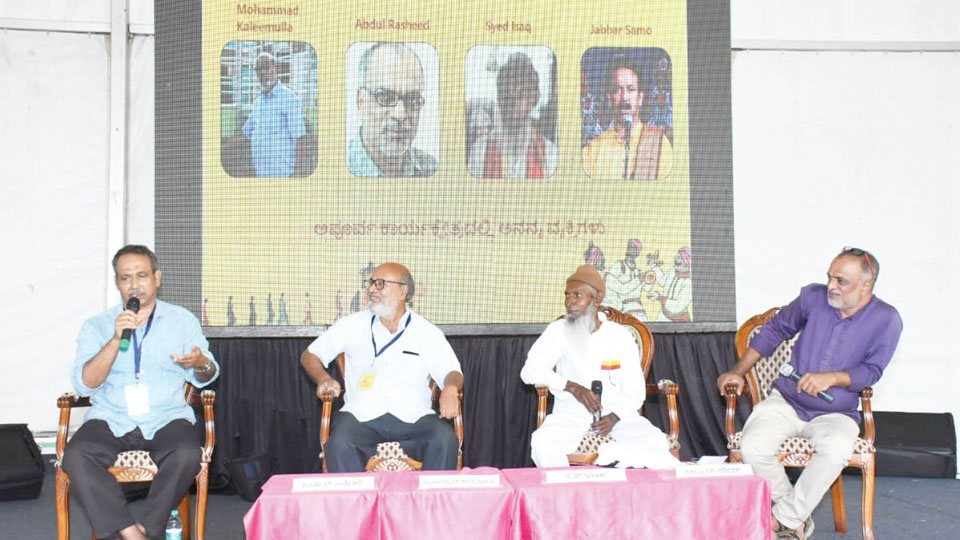
In a unique session, extraordinary individuals from different domains came together for a rare confluence at the Mysuru Literature Festival last evening. They introduced the audience to new perspectives and showcased their talent beautifully.
Abdul Rasheed, Programme Executive, Akashvani, Mysuru, delivered an engaging speech and introduced the audience to the world of new ideas. He explained his journey through various phases of life and how he embraced several individuals from different social strata as his mentors. He expressed his excitement about presenting his distinctive insights, which will provide a more representative portrayal of himself.
Jabbar Samo, a talented Yakshagana artiste from Uttara Kannada district, shared his experiences and motivations. He shed light on the significance of his performances in different aspects of life, both at the societal and personal levels. He also acknowledged the numerous individuals he considers his gurus and how they have influenced him.
He expressed how art flourishes without a specific reason and shared the dedication of Yakshagana artistes, who work without any external motivation. Despite facing difficulties as a member of the Muslim community, Jabbar Samo fearlessly pursued his passion. “Due to the prevailing circumstances, pursuing formal education was not possible, but I found solace in Kannada poems sung at the school, which fuelled my interest in the language,” he recalled.
Mohammed Kaleemulla, a retired teacher from Nagamangala taluk, dedicated his life to the preservation of historical temples, monoliths and hero stones in Mandya district. He explained the architectural aspects of these stones, their current conditions and the ongoing efforts to safeguard them with the support of Shri Kshetra Dharmasthala. “Many hero stones are being used for mundane purposes like drying clothes. I took it upon myself to inform the villagers and engage in the preservation work,” he said.
Syed Isaq narrated how he had built the library with zinc sheet roof at the corner of a playground in Rajivnagar and has been running it for the benefit of the public for 12 years. He also told the audience how the library was burnt down and his efforts to rebuild it.
“I have never been to school but my love for books gave wings to my dream of setting up a library. I built the library with 85 percent of books in Kannada and newspapers of various languages. My Kannada library is located in an area where there is a majority of the Urdu-speaking population and Kannada language must be propagated in areas like these,” he added.
source: http://www.starofmysore.com / Star of Mysore / Home> News / July 03rd, 2024
Bhagvanpur (Vaishali District) BIHAR / Waynad, KERALA :
Ravi Rosan Kumar, hailing from Bihar lost his mother and three other family members in the catastrophic landslide.
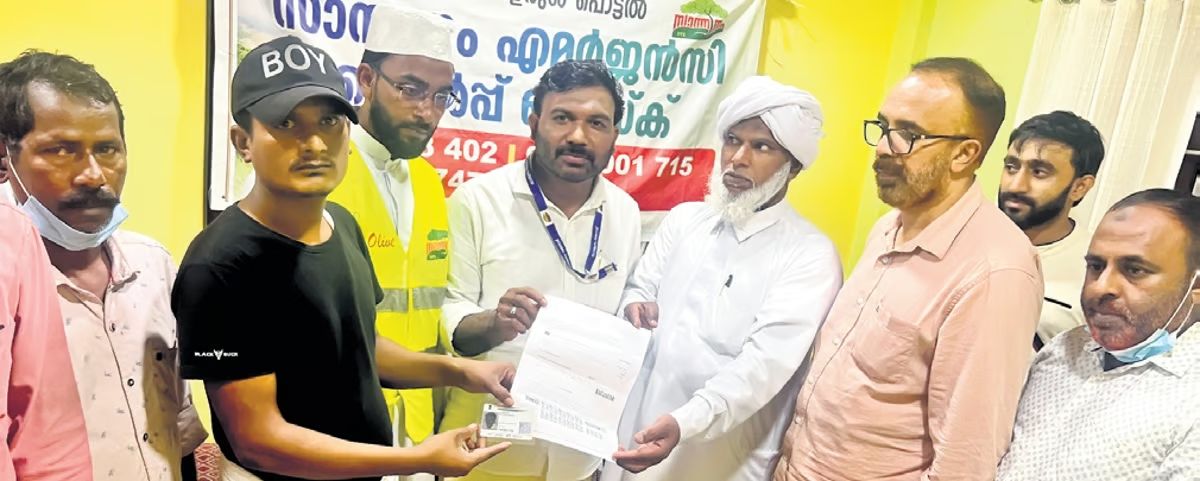
Kerala Muslim Jamaath Wayanad president O K Ahmad Kutty Baqavi, SYS media coordinator S Sharafudheen, district president Basheer Sa’di and other members handing over the flight ticket to Bihar native Ravi Roshan Kumar
Meppadi :
Ravi Rosan Kumar, hailing from Bhagavanpur in the Vaishali district of Bihar, endured an unimaginable tragedy. Kumar had relocated along with his family to Wayanad, after he got a job at the tea factory in Harrison Malayalam Estate. But their lives were shattered in the catastrophic landslide that claimed over 300 lives and obliterated two villages in the district.
Kumar lost his beloved mother, Fulkumari Devi. Three of his family members are still missing.
Ravi’s mother had always dreamt of returning to their birthplace in Bhagavanpur, a wish that she could not fulfill. With no immediate relatives left and having lost all his savings in the tragedy, Ravi stared at a bleak future. However, he was determined to honor his mother’s wish by taking her ashes back to Bhagavanpur for immersion.
Ravi’s plight caught the attention of Santhwanam, a volunteer group under the Sunni Yuvajana Sangham (SYS), a Muslim organization based in Kerala, who stepped in to provide crucial support.
Search operations by different volunteer groups being carried out at Punjirimattom village in Wayanad. (Photo | ENS)
Understanding the gravity of Ravi’s situation, they arranged a flight ticket and other necessary assistance for him to return to Bhagavanpur and fulfill his mother’s final wish by immersing her ashes in the river in their village.
Kerala Muslim Jamath Wayanad President O. K. Ahmad Kutty Baqavi, along with S. Sharafudheen, SYS district president Basheer Sa’di, General Secretary Latheef Kakkavayal, and other members including Santhwanam Emergency Team coordinators C. M. Noushad, Naseer Kottathara, Shameer Thomattuchal, Dr. Muhammad Irshad, and Fazlul Abid, saw off Ravi Rosan Kumar as he embarked on his journey to his native place.
source: http://www.newindianexpress.com / The New Indian Express / Home> Kerala / by Express News Service / August 04th, 2024
Marai Village, Siphajr (Darang District) , ASSAM :
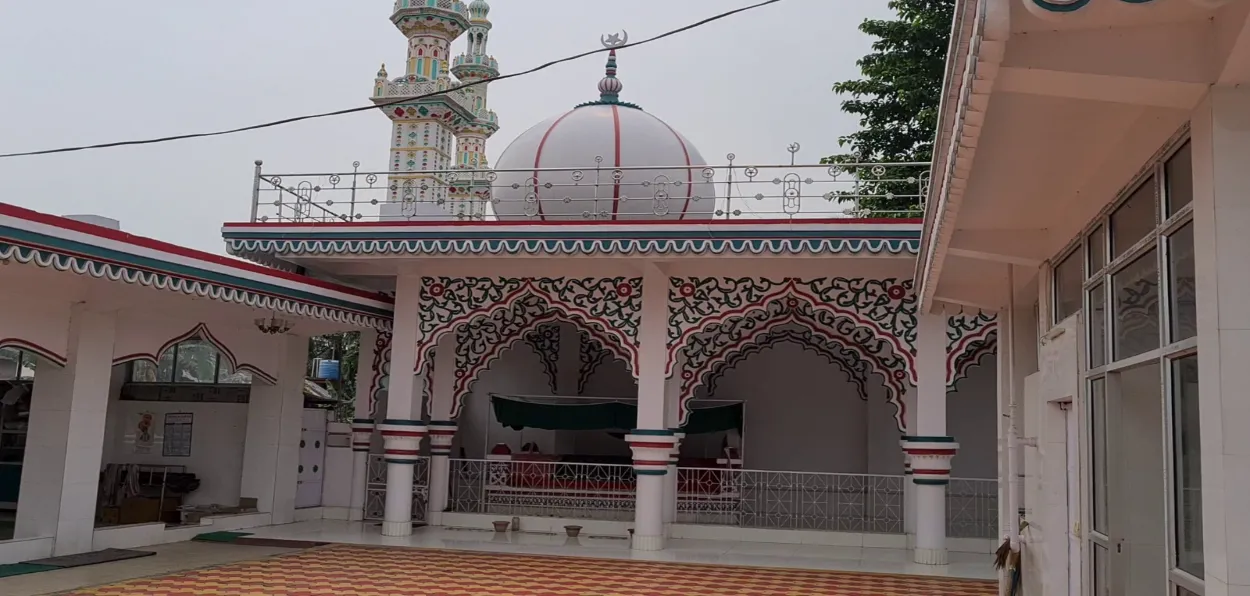
Inside the shrine of Baga Baba
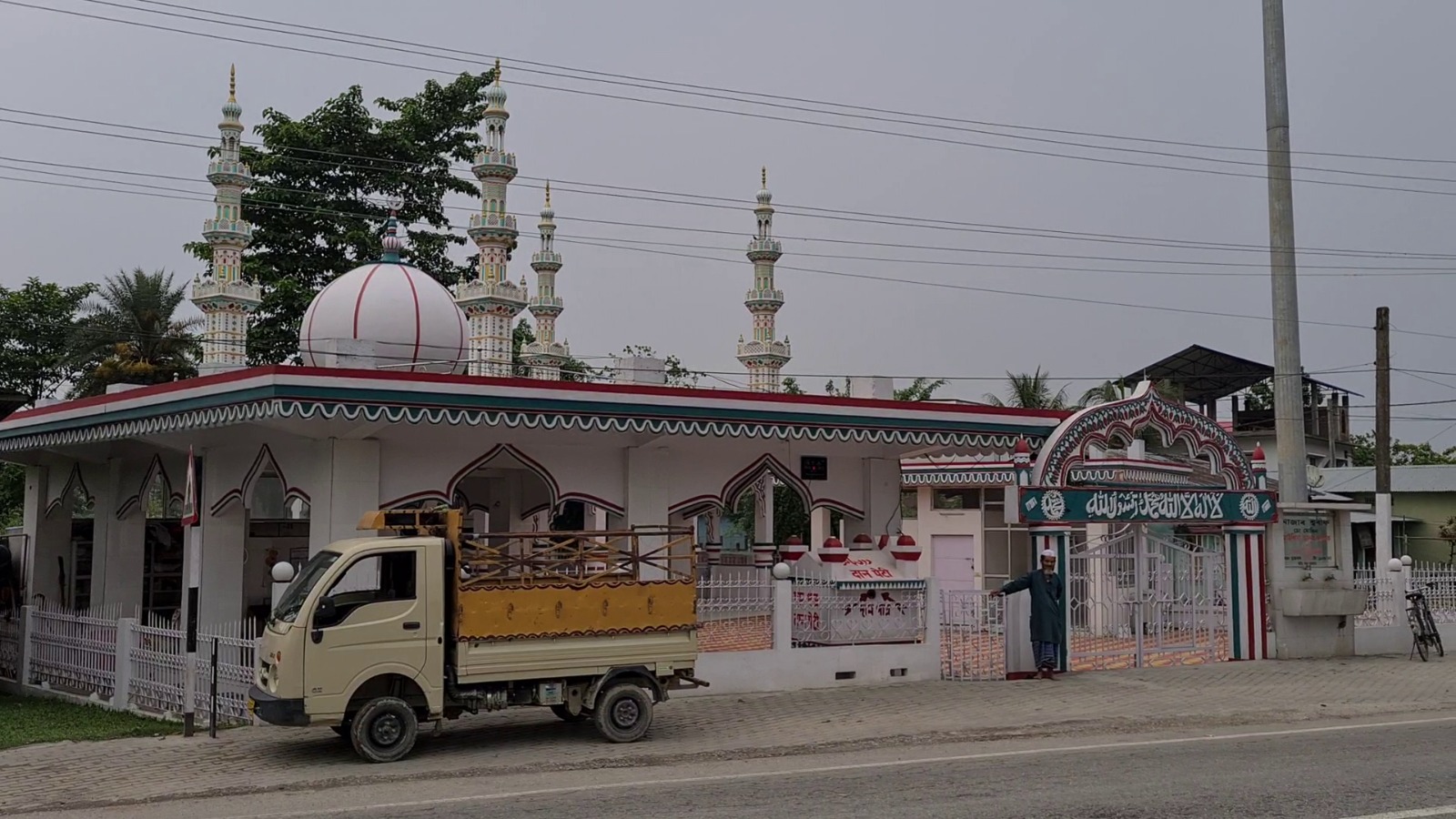
As National Highway-15 traverses through the village Marai of the Darang district in northern Assam, travellers see a shrine that commands the devotion and reverence of both Hindus and Muslims.
This is the shrine of Baba Baga which is visited by people of all faiths, and is especially popular among travelers who have taken the NH-15. Trucks and buses that come from far and wide stop here to offer prayers and make donations. All passenger buses and goods trucks stop here as the shrine management has kept drinking water available.
Baga Baba was born as Abdul Khaleque. He came to Assam in 1916 from the then Sylhet district (now in Bangladesh). Initially, he lived in Gog, Satsali, and Badalguri and finally settled down in Marai village of Sipajhar in 1919.
The shrine of Baga Baba in village Marai
From there, he launched his mission of spreading Islam in the greater Darang district. The Sufi cleric also joined the Indian freedom movement; he was also jailed.
Baga Baba died in 1933 and the locals raised a mausoleum (mazar) on his grave.
Speaking with Awaz-The Voice, Hafiz Ali, secretary of Baga Baba Mazar, said: “The cleric lit the torch of Islam here. Along with preaching the religion, he also spread the message of peace, harmony, and brotherhood. Then he sent Maulana Didaruddin Saheb to be educated as a maulana. Everybody believes Baga Baba to be an Auliya (master of some divine power) of Allah. Hindus and Muslims alike come here and pray.
“At present, people from all over Assam and India who travel through this highway donate at this mazar. Today the village has nine mosques. The inflow of people and pilgrims has increased over the years. Hindus and Muslims have equally contributed to it.
Drinking water facility at the shrine for travellers
The construction work of the mazar was initiated by former president Jiban Baruah. There are still many non-Muslims, such as Bhumidhar Saharia, Himanshu Kalita, and others, in the management committee of the Mazar,” he said.
The shrine hosts Milad sharif every Thursday of the week. In addition, a Urs is held every year on 12 of Magh (late January), the death anniversary of Baga Baba. People from different parts of India participate in the Urs. Although the Baga Baba Mazar is located on the northern side of NH 15, there is also a premises of the Mazar on the southern side of the road.
It is worth mentioning that the Baga Baba Mazar has played a significant role in maintaining Hindu-Muslim unity and harmony in the entire Darang district as well as in the greater Marai Bijulibari area.
source: http://www.awazthevoice.in / Awaz, The Voice / Home> Story / by Ariful Islam, Sipajhar / June 25th, 2024
US Congress honours the life and legacy of Punjabi-origin columnist Ved Nanda.
Ved Nanda. Photo: @SandhuTaranjitS/X
Washington :
Honouring the life of Indian-American columnist Ved Nanda, who was the recipient of the Gandhi-King-Ikeda Award for Community Peace Building in 2004 and the Padma Bhushan in 2018, the US Congress this week described him as a prominent figure and a bridge between the two nations.
A well-known columnist for the Denver Post who taught at the University of Denver for 50 years, Prof Nanda died early this month at the age of 89.
“For over five decades, Prof Nanda uplifted the students of DU and the Indian diaspora community, becoming a prominent figure and a bridge between our two nations. He also served in several illustrious positions, including Chairman of the Board of the Hindu University of America and Vice President of the American Society of International Law,” Congresswoman Diana DeGette said on the floor of the US House of Representatives this week.
According to the Denver Post, Nanda was tireless in pursuing justice and peace for moral and personal reasons. His seminal work for The Denver Post was his 2017 reflection on India’s Partition.
At the time, Nanda was a young child, fleeing for his life at his mother’s side. As a Hindu family in Gujranwala, a Muslim-majority town in Punjab, it was a Muslim neighbour who helped the Nandas escape neighbours who had overnight turned into “animals,” indiscriminately killing any Hindus who remained.
Muslims in east Punjab faced a similar fate as violent mobs forced them into what would become Pakistan, the Post wrote.
“Mr Speaker, I rise today to pay tribute to a distinguished member of Denver’s academic community and a cherished friend, Prof Ved Nanda. His recent passing is a profound loss, not only to the University of Denver and our local community but to many across the US and the world,” DeGette said this week.
“Prof Nanda was more than just an esteemed colleague; he was a kind and passionate individual whose impact on our community extended far beyond the walls of the university. His commitment to education, international law and the promotion of cultural understanding left a mark on all who knew him,” the Congresswoman said.
“Born in 1934 in Gujranwala, Ved Nanda built an exemplary career starting at Punjab University where he received an MA in economics. He went on to receive a law degree from Delhi University, a law degree from Northwestern University, and completed subsequent postgraduate work at Yale University,” she said.
“In 2006, Prof Nanda was honoured with a USD 1 million founding gift from the University of Denver to launch the Ved Nanda Centre for International and Comparative Law, promoting programmes and scholarships in the field of international law. He was also honoured with the prestigious Gandhi-King-Ikeda Award for Community Peace Building in 2004 and the Padma Bhushan in 2018,” the Congresswoman said.
“These accolades are a testament to his significant impact on the field and tireless efforts to advance knowledge and cultural exchange. His work was noticed and rightly honoured for its impact. For more than 30 years, Prof Nanda shared his wisdom with the larger Colorado community through his regular columns in the Denver Post,” DeGette said.
His clear and reasoned explanations of international issues provided important perspectives to readers.
“As we remember and mourn the passing of Ved Nanda, we also celebrate the enduring legacy he leaves behind. I have no doubt his intellectual contributions, passion for education, and love for both India and the United States will continue to inspire us all,” she said.
In an op-ed, the Denver Post wrote that Nanda’s voice for peace would be dearly missed in a world beset with anger and violence, where Ukrainians, Russians, Ethiopians, Yemenis, Israelis and Palestinians are dying in droves.
“In a world where journalists can no longer freely travel to places once safe, like Russia, China and Saudi Arabia. In a world where women in Afghanistan and Iran are more marginalised than ever. We need more men and women like Nanda who follow a clear moral compass towards peace,” the daily said.
source: http://www.tribuneindia.com / Tribune India / Home> Diaspora / January 20th, 2024
Manzoor Khan, 72, a resident of Lari village in Ramgarh district, holds the license for the Ramnavmi procession in accordance with a local tradition of giving such licences to a Muslim.
Chitarpur is a sensitive area of Ramgarh district and adjacent to village Lari, but the area has set an example of communal harmony because of the tradition of giving a licence to a Muslim. Earlier, the licence was issued in the name of Manzoor Khan’s father late Ismayal Khan. After his death, Manzoor Khan took up the task and during the last few years, the licence has been issued in his name.
“I apply to Rajrappa police station for the licence and the deputy superintendent of police’s office issues it. At first we organise a meeting of villagers and they give the work to me. At once, the licence is issued for two and a half panchayats,” he said.
He said, “Once only a single Muslim family of my forefathers was living in Lari village and so the villagers used to select my father for taking the Ramnavmi procession licence. I celebrate all Hindu festivals with the villagers.”
The license of the Ramnavmi procession in the area is issued in his name and he leads the procession not only for Ramnavmi but also for other religious festivals like Durga Puja, Kali Puja. He has always maintained a record of communal harmony. The tradition to get Ramnavmi Procession in the name of a Muslim community man has kicked off years ago.
The story and work of Manzoor Khan are famous throughout Jharkhand. Some time ago, he had to face a little problem from both the Hindu and Muslim communities but with the help of one God belief, he managed everything.
This year the Ramnavmi procession with a grand celebration will be organised at Lari. Manzoor is busy again with lots of enthusiasm. The entire village has worn a Ramnavmi loot and he is the leader of the entire program. All villagers are supporting him. A few Muslims are also busy with him celebrating this memorable festival. Mahaveeri flags are waving and Festival songs are being played in the village.
“As long as I am alive I will organize the procession. I hope my sons will also follow this tradition of their forefathers. They are busy with me to celebrate Ramnavmi in the village,” he added.
source: http://www.lagatar24.com / Lagatar / Home / by Manoj Sinha / March 29th, 2023
In the past 75 years a community of Urdu magazines that used to be read by the entire family has disappeared unmourned, so too their journalists and readers. There is also now no major Urdu newspaper or magazine that is edited by a non-Muslim.p
Last year, Urdu institutions in India celebrated a landmark in the history of that language—the 200th anniversary of the publication of Jam-i Jahan-Numa, the first modern newspaper in Urdu. It debuted on 27 March 1822, carrying a name that was clever and most befitting. It referred to the fabled “world-revealing goblet” of the legendary Iranian monarch, Jamshed, into whose depths the regal eyes could peer and see all that was happening in the world.
A big surprise about the new journal was its place of publication, Calcutta (now Kolkata), not known as a major centre of Urdu language and literature. Surprising also was the identity of its publisher, Harihar Dutta, a feisty upper-class Bengali young man with no ties to the north Indian regions more closely identified with Urdu. His grandfather had been the Dewan at the East India Company’s Custom House for 50 years, a position of some status, later held by his father Tarachand Dutta.
Tarachand is better known in records as the co-founder, with Raja Ram Mohan Roy, of the progressive Bangla weekly Sambad Kaumudi in 1821, and the publisher of Roy’s Persian weekly, Mirat-al-Akhbar, arguably the first newspaper in that language, which came out a month after Jam-i Jahan-Numa. Thus, the father and son can rightly be described as the founders of modern journalism in both Urdu and Persian. My account of the Duttas and their journal is based chiefly on Gurbachan Chandan’s Jam-i Jahan-Numa: Urdu Sahafat ki Ibtida (New Delhi: Maktaba Jami’a, 1992), and Nadir Ali Khan’s Urdu Sahafat ki Tarikh (Aligarh: Educational Book House, 1987).
The editor, Munshi Sadasukh Lal, was an equally remarkable man. Hailing from Agra, which had come under British control in 1803, he had travelled to Calcutta to make his fortune, either as a tutor to some foreign employee of the Company, or as a munshi at some business house, handling their formal correspondence. Besides an expertise in Sanskrit, Hindi, Persian, and Urdu, he had some knowledge of Arabic. He also knew English well enough to read and understand official publications, and later translated many professional texts into Urdu and Hindi.
In a few years [after 1828], with the spread of litho technology, Urdu newspapers began to appear all over North India.
We do not know the significant dates of Sadasukh Lal’s life, but he is known to have left Calcutta some years later, travelling first to Allahabad and then to Agra. At both places, he established a printing business and published newspapers and books in both Urdu and Hindi.
The Duttas were not wrong in expecting some demand for the two journals. Persian was still big in Indian upper circles and in the colonial officialdom, and Calcutta was a major trading centre attracting Iranian, Armenian, and Afghan merchants. It also had Warren Hastings’ madrasa that provided instruction to many Indians in Arabic and Persian, and the College of Fort Williams, which trained British and European employees of the Company in whatever Indian language they needed to “command”. But in the 1820s things were also in flux.
After seven issues exclusively in Urdu, Jam-i Jahan-Numa had to include a column in Persian to attract more readers, and after two more issues, it was entirely in Persian. The Calcutta Journal succinctly commented on the change:
The Hindoostani (sic) is merely a popular language, much employed in colloquial discourse, but little used in writing; the taste for reading newspapers is very little among the natives, and perhaps confined entirely to people who have received a polite education. A native newspaper, therefore, can expect little support from those who know only Hindoostani, and those in better circumstances will naturally prefer a paper written in Persian language, which is a necessary part of the education of every person who has any pretentions to respectability.Quoted in M. Aslam Siddiqi (1947): “Persian Press in India”, Indo-Iranica, I: 2, Calcutta, p. 18.
Some months later, a sheet of Urdu was added as a supplement, and a note in English under the title appealed to non-Indian readers: “European Gentlemen, who may wish to be supplied with this paper, either for their own perusal or from a benevolent desire to diffuse knowledge among the native members of their establishment, may be supplied with it […] at three rupees per month, including Ordoo Supplement.” A few years later, it was again an Urdu weekly, but of more general interest than just the news.
In 1828, however, it stopped publication altogether – just two years before Urdu replaced Persian on the colonial pedestal, thus gaining a special appeal. In a few years, with the spread of litho technology, Urdu newspapers began to appear all over north India.
[W]hat had stayed unchanged for well over a century after the appearance of ‘Jam-i Jahan-Numa’ in 1822 has undergone a drastic change in the last 75 years.
The celebrants in India last year noted with a great deal of satisfaction that the very first newspaper in Urdu was edited and published by two non-Muslims. It confirmed their claim that Urdu was not just the language of Muslims.
Urdu had indeed been just like any other Indian language and not restricted to the adherents of any one religion. Like Tamil or Gujarati. Like Braj, Awadhi, or Rajasthani. But I am not sure if the same is true now. I strongly doubt if any ardent ‘Urduwalla’, asked now to name an Urdu newspaper edited by a Hindu or any Urdu journal catering to the needs of a non-Muslim readership, would be able to name either. I may fervently hope I am wrong, but what had stayed unchanged for well over a century after the appearance of Jam-i Jahan-Numa in 1822 has undergone a drastic change in the last 75 years.
Khwaja Hasan Nizami, a self-made man of many talents and varying reputations, was a widely known public figure in the first half of the last century. His weekly, Munadi, was mostly written by him but read by thousands of his admirers across the country. The latter particularly enjoyed his daily “diary”, selections from his correspondence with the high and low, and his polemic against the antagonist of the week—all done in a literary style that was his own.
In 1937, in the Annual Number of his journal, he offered his readers a long list of the Urdu journals that came to his office every month, presumably in exchange for his own. Much to our benefit now, he also provided some information on each of them, including the names of their editors and his view of their politics. Of the 147 titles, 22 were edited by non-Muslims.
We see that no category was restricted in range. Jains and Sikhs, Arya Samaji Hindus and Sanatani Hindus, even Radha Swamis, all found it worth their while to publish their concerns and considerations in Urdu to reach a sizable portion of their respective faith communities. So was the case with political identity, where even the Hindu Mahasabha found it useful to make its views available, at least in Punjab, in Urdu. There are two “medical’ journals, indicating the extent to which Urdu was used by Punjabi practitioners of both the indigenous traditions, Ayurveda and the Greco-Arabic Tibb. Most of the journals on the list were seemingly flourishing and were of a respectable size and quality.
Nizami’s list is by no means exhaustive. It only tells us what he liked to get in exchange for his own magazine, which he described as “Islamic, Non-Congress.” I would interpret it as: concerned in particular with Islam and Muslims, not affiliated with any political party, and not disloyal to the colonial government. Despite being a prolific, almost compulsive, writer with an unmistakable stylistic charm, Nizami apparently received no Urdu literary magazine – not even Daya Narain Nigam’s Zamana (Kanpur), which was then in its 34th year of publication.
And though he received a few general magazines, including the newly started Musavvir (Bombay), a film plus literature magazine edited by none other than Saadat Hasan Manto, Nizami does not seem to have been getting Mast Qalandar, ‘Sufi’ Prithi Singh’s highly popular monthly, which was then in its 19th year. It boasted as its motto, Hindu hai ek ankh Musalman dusri – “The Hindu is one eye of India, the Muslim the other”, an image first made famous by Sir Syed Ahmad Khan (1817-1898) in a speech at Banaras when he was posted there as a judge (1867–1876). The magazine claimed to have “the largest net sales of any Urdu monthly printed in India”. It also looks like Nizami did not receive ‘Sufi’ Lachman Prashad’s Mastana Jogi, which was no less successful and had been going strong longer.
Nand Kishore Vikram was only 18 when his family left Rawalpindi for India. He followed an uncle to Kanpur and joined another budding journalist, a similar refugee, to bring out a semi-literary Urdu monthly.
Arguably, the entire non-Muslim population, young and old, that had been engaged in Urdu journalism and publishing in West Punjab fled to India in 1947. Some found permanent refuge in East Punjab, in places such as Amritsar, Ludhiana, and Jalandhar. The more notable went directly to Delhi, and took not long to get going again. The younger upcoming ones sought their fortunes further away.
Nand Kishore Vikram was only 18 when his family left Rawalpindi for India. He followed an uncle to Kanpur and joined another budding journalist, a similar refugee, to bring out a semi-literary Urdu monthly. The venture did not last long but it nevertheless settled his career choice. Moving to Delhi, he took up various jobs involving Urdu, and completed his formal education. Eventually, he worked for the Information Bureau of the Government of India and was for decades on the editorial staff of its Urdu monthly, Ajkal. Its editor was a senior émigré, Balmukund Arsh Malsiyani.
After retirement, Vikram began publishing a bi-annual literary journal of his own, Alami Adab, and also produced a torrent of translations in both Urdu and Hindi. I never met him but had a couple of long chats over the telephone a few years ago. On learning that he was compiling three separate lists of the non-Muslim writers of Urdu – Hindu, Sikh, and Christian – I asked him to share them with me, and he most graciously did. He was compiling them mostly from memory, having access only to the books and journals in his own library. Sadly, he passed away soon after. Abdur Rashid of Delhi and I hope to complete the work as best we can.
Vikram identifies for us 70 Sikh, 97 Christian, and 531 Hindu writers of Urdu prose and poetry, and makes a point of identifying the journalists. Christian names are more numerous because he may have had the benefit of two previous works – Ram Babu Saxsena’s European and Indo-European Poets of Urdu and Persian and D.A. Harrison Qurban’s Urdu Ke Masihi Shu’ra. To my knowledge, no similar work exists for the Sikhs, despite such prominent writers as Rajendra Singh Bedi, Kirtar Singh Duggal, Mahendra Singh Bedi ‘Sahar’, and Sampooran Singh Kalra ‘Gulzar’.
Two other reasons may also have contributed: the steely allegiance amongst the Sikhs to Punjabi and the Gurumukhi script, and a preference amongst the Sikh elite for advanced proficiency in Persian, the formal language of the Sikh Durbar, that ended only when the British took over in 1849 and literacy in Urdu became necessary for government jobs.
Maftun told his rags-to-riches story in a page-turner autobiography,’ Naqabil-i Faramosh’, which is as ‘unforgettable’ as its title proclaims. Intriguingly, another equally candid and thoughtful autobiography, Gyan Singh Shatir, subtitled “a biographical novel”, was also written by a Sikh.
Though not many took to Urdu journalism, at least one Sikh scribe, Sirdar Diwan Singh Maftun, made a lasting name for himself. His slick weekly, Riyasat, was for a couple of decades a dreaded scourge of the rajas and nawabs of India as it exposed their peccadilloes and serious crimes. Printed on fine paper, it regularly carried eight pages of pictures and cost four annas – a princely price in the 1920s. It was, however, so popular that even car dealers regularly advertised in it. (The one and only instance I know of in Urdu.)
Maftun told his rags-to-riches story in a page-turner autobiography, Naqabil-i Faramosh, which is as “unforgettable” as its title proclaims. Intriguingly, another equally candid and thoughtful autobiography – by Gyan Singh Shatir, subtitled “a biographical novel” – was also written by a Sikh. Both books deserve to reach new readers through English translations.
Among the 97 Christians, there are very few prose writers. But one name is very important historically. Yesudas Ram Chandra, better known as Master Ram Chandra, was orphaned at a very young age but with the support of his mother and sheer hard work he managed to finish his education at the old Delhi College, specialising in mathematics. He was then appointed to teach at the college. In 1853, when he was 32, he converted to Christianity. During his tenure at the college, he edited and published two journals, Fawa’id-ul Nazirin and Muhibb-i Hind.A useful account of his life and times is Sadiqur Rahman Kidwai’s Master Ram Chandra, published by the Department of Urdu of Delhi University in 1961.
Reading an Urdu daily (Delhi) | Jeremy Graham/Alamy Stock Photo
The first Urdu journal published in Delhi is said to be Dahli Urdu Akhbar. Started in 1837; it was a joint project of a Muslim editor and a Kashmiri Hindu printer and publisher. In 1845, the newly appointed Swiss-German principal of the college, Dr Alois Sprenger, started Qiran-us Sa’dain, a weekly journal containing short essays on social issues, scientific news, and new technology, illustrated with line drawings. Its first editor was Dharma Narain Bhaskar, a “senior scholar” in English at the college. The earnest but preachy journal lasted 10 years, but chiefly on the subscriptions of colonial officers.
Ram Chandra’s first foray into journalism was Fawa’id-ul Nazirin (1845), a fortnightly inspired by Qiran-us Sa’dain, but more outspoken, wider in its range of social concerns, and allowing some space to contemporary Urdu and Persian poets. It regularly challenged the more conservative views of other Delhi papers, and at the height of its popularity had close to 200 subscribers – a notable readership, given that the earlier newspapers were not inexpensive.
Coming to Hindu writers, their sheer number on Vikram’s list sufficiently indicates how significant their role was in the development of Urdu literature.
Three years later, Ram Chandra started Muhibb-i Hind, a monthly of a similar nature. Unfortunately, both journals could not gain enough support from the elite of Delhi and were closed by 1852. A second Christian essayist-poet, Pyare Lal Shakir Merathi, gained prominence in the first half of the last century as the editor-publisher of a literary magazine, Al-’Asr. He also wrote much for younger readers, and several of his poems once had a place in school textbooks. (His short-lived magazine for children is on Nizami’s list.)
Coming to Hindu writers, their sheer number on Vikram’s list sufficiently indicates how significant their role was in the development of Urdu literature. That role becomes crucial when we consider just prose fiction. Nazir Ahmad may have written the first “novel” in Urdu, but the real foundation on which the edifice of Urdu fiction later arose was laid down by a Kashmiri Pundit, Ratan Nath Sarshar, whose episodic sagas were serialised in the pages of Awadh Akhbar, a famous weekly published by Munshi Newal Kishore.
The Urdu word for magazine is risala … a typical risala… normally carried in every issue two or three stories, a dozen pieces of poetry, three or four informative/topical articles, and some regular sections…
No doubt, Hindu journalists wrote in Urdu because it was their preferred means of considered expression, but they also wrote confident in the belief that a large Hindu readership, diverse in its literary tastes, political views, and social concerns, awaited them. (The diversity we glimpsed in Nizami’s categorisation.) There was also something else – a seemingly insatiable demand amongst Urdu readers in general for middlebrow writings, both fictional and factual, that had started in the 1880s and tapered off only after 1950. It gradually created a market for all sorts of magazines. (The first thing Vikram and his friend did after reaching Kanpur was to launch one.)
The Urdu word for magazine is risala (treatise; pamphlet; magazine), and a typical risala, unless further qualified as medical, sectarian, or religious, normally carried in every issue two or three stories, a dozen pieces of poetry, three or four informative/topical articles, and some regular sections, two or three pages each, devoted to “scientific discoveries,” “health news,” “films,” and “entertaining tidbits.” Editorial notes were a must in every issue. They established the tenor of the magazine and also gave it a human identity, to which readers could relate, adversely or in agreement, by submitting letters for the final must-have section: “Letters from Our Readers.”
A simple, all-purpose risala was meant for the whole family. Since some were quite inexpensive, a fairly large number of Urdu reading middle-class families bought one or two every month besides a daily newspaper. ‘Sufi’ Prithi Singh’s Mast Qalandar (Lahore; illustrated; multicolour cover; 90 pages) cost five rupees in 1947 for an annual subscription; “Maulana” Zafar Niyazi’s Kamyab (Delhi; monotone cover; 50 pages) cost only one rupee for 12 issues.
All major journalists, however, sooner or later ended up in Delhi, working for their original journals or for the Information Bureau and the Publications Division of the Government of India.
The large cohort of sharanarthi (refugee) journalists, forced in 1947 to abandon lives and careers in Lahore, Sialkot, Rawalpindi or Sargodha, lost little time in building new lives and careers in Delhi, Amritsar, Ludhiana and Jalandhar. The major publishing outfits already had their branch offices there; the minors took their chance wherever they could. All major journalists, however, sooner or later ended up in Delhi, working for their original journals or for the Information Bureau and the Publications Division of the Government of India.
The famous triad of Pratap, Milap, and Tej probably never lost a publication day. ‘Sufi’ Prithi Singh’s Mast Qalandar, ‘Sufi’ Lachhman Prashad’s Mastana Jogi, and (Ram Rakha Mal Chadda) Khushtar Garami’s Biswin Sadi – all three were perfect examples of a simple risala – were soon reaching the eager hands of thousands of their readers. The last named not only outlasted the two oldies, it grew to be the most popular Urdu risala in post-1947 India. (Two other hugely popular Urdu magazines, Sham’a and Jasusi Dunya, specialised in movies and crime fiction respectively.)
When these seniors left the scene, a younger generation that had come with them and, like them, favoured Urdu, took over. But Urdu’s fate was sealed relative to the very young ones. In economic importance, in Delhi and Uttar Pradesh, Hindi was second only to English, and the long communal tussle for power in Punjab, strategically disguised as a struggle for linguistic rights, made certain that there would be no third generation of Urdu-favouring journalists from amongst the Hindus.
It took six decades, but it happened. In the bicentenary year just ended, there was no major Urdu newspaper or magazine in India that was edited and published by a non-Muslim – and it has been the case for some time. One by one, they took their leave, the “Jolly Jogi” and the “Jolly Qalandar.” The great triad of Tej, Milap, and Pratap, my Delhi friends tell me, still exists but only online – none is seen on newsstands.
The situation, actually, is dire overall. Except for the ones published by a few information bureaus and academic or religious institutions, there is no independent Urdu magazine of any kind that comes out regularly or sells more than a few hundred copies. There is no risala now in Urdu that could claim to be read “in every home and by all members of the household.”
Urdu poetry recitals (musha’ira) may still bring out some enthusiastic non-Muslim participants and connoisseurs, but the prose pages of Urdu newspapers and magazines are starkly devoid of them.
Even the long series of exclusively literary (adbi) monthlies that began with Shaikh Abdul Qadir’s Makhzan (Lahore) in 1901, and continued through Mian Bashir Ahmad’s Humayun (Lahore), Daya Narain Nigam’s Zamana (Kanpur), Shahid Ahmad’s Saqi (Delhi), Ejaz Siddiqui’s Sha’ir (Mumbai), Gopal Mittal’s Tehrik (Delhi), and Abid Suhail’s Kitab (Lucknow), ended with Shamsur Rahman Faruqi’s Shabkhoon (Allahabad) in 2006.
When we turn our gaze away from journalism and take note of the larger literary scene in the 21st century, we see that a much greater and quiet tragedy. There is not a single non-Muslim essayist, literary critic, literary researcher, or fiction writer of significance in Urdu. Urdu poetry recitals (musha’ira) may still bring out some enthusiastic non-Muslim participants and connoisseurs, but the prose pages of Urdu newspapers and magazines are starkly devoid of them.
The present generation of Hindus in north India may well produce some interesting Urdu poets down the line, the likes of Bani, Kumar Pashi, or Manmohan Talkh, but it is certain that we may have to wait a long time for another Joginder Pal, Surendra Prakash, Ram Lal or Balraj Mainra. How this happened, and what it means for Urdu language and literature in India is, of course, a separate sad tale.
This article is dedicated to Nand Kishore Vikram.
C.M. Naim is professor emeritus of South Asian languages and civilizations, University of Chicago. His recent book A Most Noble Life (Orient Blackswan, 2021) is about two remarkable Muslim women of the 19th century.
source: http://www.theindiaforum.in / The India Forum / Home> Culture / by C.M. Naim / February 01st, 2023