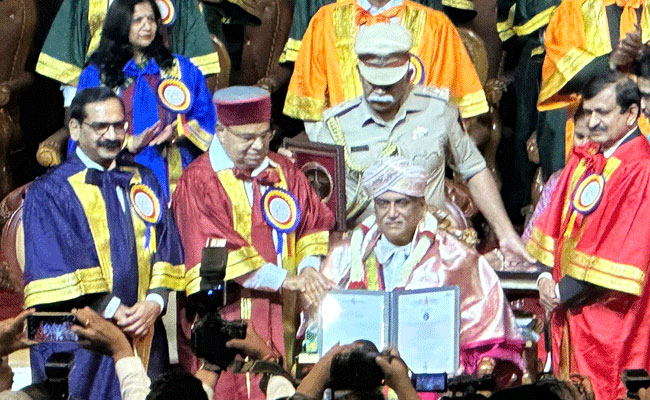
Presidency University Chancellor Nissar Ahmed and two other achievers were awarded honorary doctorates by Karnataka Governor Thaawar Chand Gehlot at the 2nd convocation ceremony of the Bengaluru City University on Monday.
During the program organized at the Jnanajyothi auditorium of the Bengaluru City University, Nissar Ahmed, who is a native of Mangaluru and also chairman of the Presidency Group of Institutions, was awarded a Doctor of Literature (D.Lit) degree.
Writer Tarini Chidananda and social activist Dr. Wooday P Krishna were also awarded D.Lit degrees by the Bengaluru City University during the convocation ceremony on Monday.
Renowned cardiologist and director of the Sri Jayadeva Institute of Cardiovascular Sciences and Research Dr CN Manjunath and Vice-chancellor of the Bengaluru City University Prof. Lingaraja Gandhi were present on the occasion.
source: http://www.english.varthabharati.in / Vartha Bharati / Home> Karnataka / by Vartha Bharati / July 10th, 2023
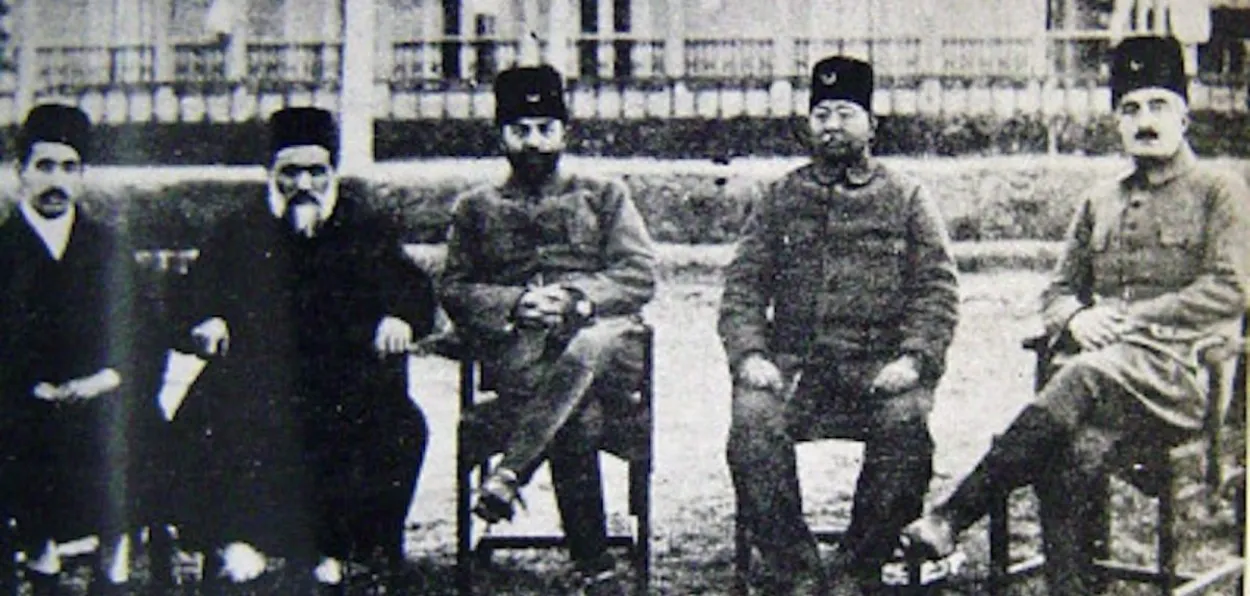
Maulana Obdaiullah Sindhi (Second from left) in Turkey
It’s a little-known fact that Saudi Arabia played an important role in the Indian Freedom Struggle. This country was the only one outside British India to provide support to the Indian revolutionaries during the 150 years of freedom struggle.
At the outset of the Second World War, Netaji Subhas Chandra Bose planned to send his men for Haj, and under that cover, they were to recruit anti-British people in Azad Hind Fauj. At that time Indian revolutionaries were operating from Hejaz (now Saudi Arabia).
Before announcing his fight against the British during World War II, Bose met Maulana Ubaidullah Sindhi in 1939. Sindhi was an Indian revolutionary who had formed a Free India Government in exile with Raja Mahendra Pratap and Barkatullah at Kabul in 1915. After World War I he toured countries like Russia, Germany, Italy, etc to create an alliance for the next war of Indian independence. In the 1930s, Sindhi settled down at Makkah after being granted asylum. However, British intelligence alleged that he was preaching Indian Nationalism among Muslim pilgrims visiting the holy city.
A grand plan was prepared at Makkah. The city provided one of the best communication channels to other parts of the world because of Haj. Sindhi returned to India in 1938. According to a letter written by Maulana Abul Kalam Azad to Maulvi Zahirul Haque, Sindhi had told him that he wanted to send Bose abroad for a final battle against the British. Azad wrote that Bose and Sindhi met in Delhi to talk about the future of the Indian Freedom Struggle. They again met in Calcutta (Kolkata) after a few months. Ubaidullah handed over important letters of reference and documents to be given to the Japanese authorities.
Sindhi wasn’t the first Indian revolutionary to use Saudi as his ground of action. The government he formed in 1915 in Kabul was part of a larger plan known as the Silk Letter Movement. This was a collaboration of Ulema, Ghadarites, Bengali revolutionaries, and others to free India by an armed revolution. The leader of the movement was Maulana Mahmood Hasan. He was arrested in 1916 from Hejaz along with Maulana Husain Ahmad Madani, Anzer Gul, Wahid Ahmad, Hakim Nasrat Husain, and others.
Hasan and Madani were teaching at Makkah and Medina and also influencing pilgrims. They were sent to Malta as Prisoners of War because the British believed, “if they were kept in confinement in the Hedjaz for a long period they might become interesting and exciting objects of pilgrimage or schemes for help or rescue to many fanatical Muhammadans in India and Afghanistan”.
Maulana Mahmood Hasan, the head of Darul Uloom, Deoband, was also a member of this group. Deoband considers Haji Imdadullah as its spiritual head; Imdadullah’s disciples founded the Madrasa at Deoband after 1857 to prepare revolutionaries.
Imdadullah went for Haj in 1845, where another Indian Shah Muhammad Ishaq directed him to fight the British. Imdadullah wrote, “The conditions of India are not hidden as India is my motherland” and returned to India in 1846. In the districts of Muzaffarnagar, Saharanpur, and Shamli, he started raising an army with the help of his students like Hafiz Muhammad Zamin, Maulana Qasim Nanautvi, Maulana Rashid Ahmad Gangohi, Maulana Mazahar, Maulana Munir Nanautvi.
This army led by Imdadullah fought the British forces in 1857 and liberated Shamli. A civil government governed the town for a few days before the British recaptured it. Thousands of people were killed, and Imdadullah took refuge in Makkah. He reached Makkah in 1859 and used it as a ground to preach anti-colonial ideas among the pilgrims.
Why did Ishaq, who lived in Makkah, ask Imdadullah to fight for Indian independence? In 1821, Syed Ahmad Shahid undertook a journey to Makkah and Medina. He was an Islamic scholar and soldier in Maratha forces. When Marathas signed a treaty with the British, Syed left their army and left for Makkah with a group of people. On his return from Haj, he attained martyrdom while fighting the British.
In the 1920s, 30s, and 40s, British intelligence raised several alarms with the Saudi authority to check Indian revolutionaries in Makkah, Medina, and Jeddah. Indian revolutionaries in the name of Haj visited Saudi Arabia to meet each other freely. British intelligence kept an eye on them. Memoirs of all these revolutionaries show that the local Arabs fully supported their cause and mission.
source: http://www.awazthevoice.com / Awaz, The Voice / Home> Stories / by Saquib Salim / July 10th, 2023
Hyderabad, TELANGANA / Boston (Massachusetts), U.S.A.:
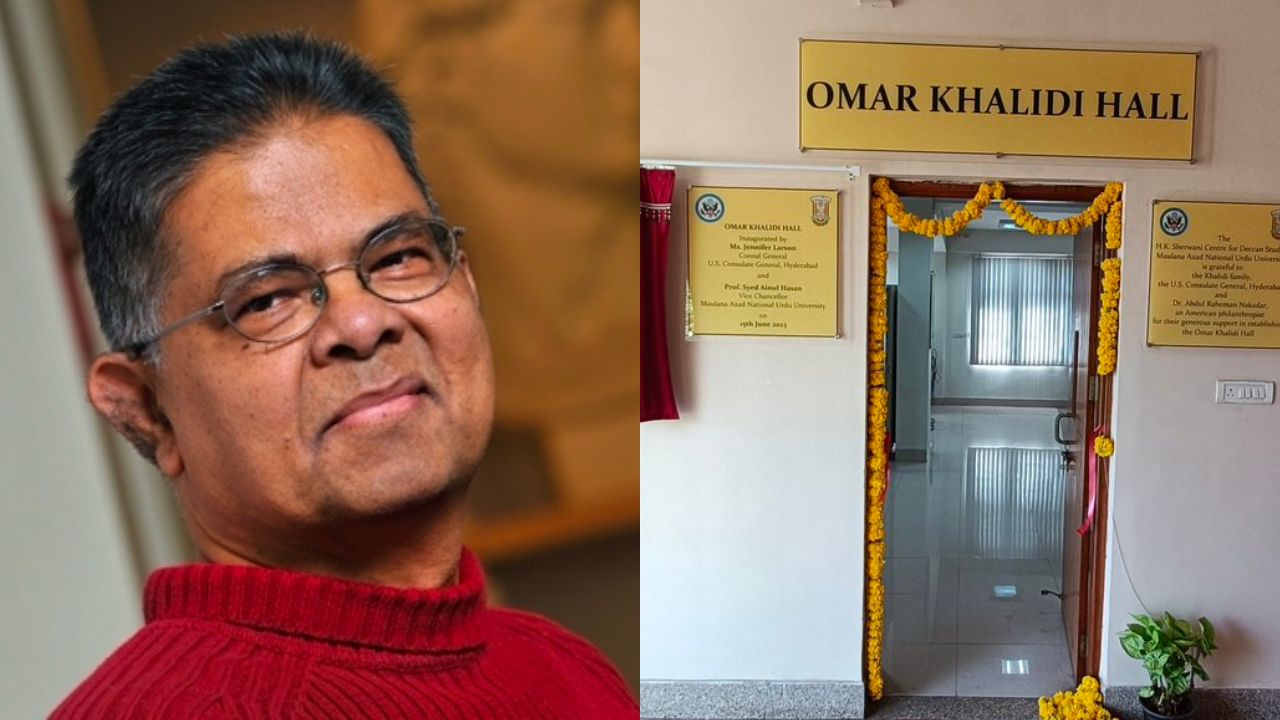
Photo: twitter.com/swachhhyd/
Omar Khalidi Hall, named after the late renowned Hyderabadi scholar, was inaugurated at Maulana Azad National Urdu University (MANUU) on Thursday. The hall, which now houses Khalidi’s personal library comprising scores of rare books, marks a significant milestone for the university.
The collaborative efforts of Khalidi’s daughter Aliya Khalidi, his wife Nigar Sultana Khalidi, historian Prof Salma Farooqui leading MANUU’s H.K. Sherwani Centre for Deccan Studies, the United States Consulate General in Hyderabad, and admirers of the Hyderabad scholar based in the USA made it possible to bring his personal library back to his hometown of Hyderabad.
Khalidi’s library is an impressive collection with over 1,000 Urdu, English, Persian, French, German, and French titles. It covers a wide range of subjects including the history, culture, and administration of the Deccan, Hyderabad State, Golconda, religion, Sufis and Sufism, heritage, and numerous journals. Notably, the collection includes rare books such as L’Inde Anglaise, published in 1845, The Hindu reported.
Khalidi’s strong connection with his hometown led him to compile an exhaustive list of books on Hyderabad’s history, culture, and archaeology. Many of these books were either unknown or had faded from public memory due to the passage of time.
Apart from his personal library, Khalidi was also renowned for his authored works. His book Khaki and Ethnic Violence in India explored the complexities of religious composition within the armed forces and police, as well as the Muslim community. L.K. Advani had verbally attacked Khalidi for the book and reportedly acknowledged that the book provided “inspiration to the Sachar Committee to seek a communal census in the Armed forces.”
Among his other important works were Muslims in Indian Economy and Hyderabad: After the Fall, a collection of essays edited by Khalidi.
Khalidi, who worked at the Massachusetts Institute of Technology as part of the Aga Khan Programme for Islamic Architecture, passed away on November 29, 2010, leaving behind a significant intellectual legacy.
The inauguration of Omar Khalidi Hall at MANUU on Thursday not only celebrates the life and work of this distinguished scholar but also provides a valuable resource for students and researchers. The inclusion of Khalidi’s personal library in the hall will serve as a source of inspiration, enabling a deeper understanding of Hyderabad’s history, culture, and heritage.
source: http://www.thecognate.com / The Cognate / Home> Culture / by The Cognate News Desk / June 16th, 2023
Budding Photographer Mohsin Javed’s Photographs were selected for the France Exhibition, which will be held in Paris from 4 to 13th July 2023.
According to a release by the organizer of the exhibition, 24HourProject, Photographs of 120 photographers will be on exhibition at La Maison Hall.
24-hour Project is a climate action supporting NGO. The income earned through the selling of Photographs will be used for environmental causes.
Mohsin Javed told that his three photographs will be on display at the exhibition. These photographs document many faces of Delhi.
Mohsin Javed’s Photographs were also exhibited at Kirkkonummi, Finland from 13-29 August 2021 and at Hong Kong Exhibition from 3rd December 2022 to 3rd January 2023. AT Hong Kong exhibition introducing Mohsin’s Photograph World famous Photographer P H Yang described it as ” a very exceptional Picture.”
Mohsin, who has a Diploma in Electrical Engineering from Jamia Millia Islamia, realized his passion for photography when he was in class 8 and took it seriously after class 10.
His picture of Humayun’s Tomb was selected for the International Photo contest “Youth Eyes on the Silk Roads” organized by UNESCO’s Silk Road Project 2019. The international selection committee chose his picture as one of the best 60 pictures among 6625 entries.
UNESCO in a letter of appreciation to Mohsin described that his picture was selected by “taking into consideration its quality, creativity, and diversity.” This picture was later published in a coffee book by UNESCO.
Mohsin Javed’s pictures have been widely carried by many national and international agencies and publications including international photo agency Getty Images, Germany’s Public International Broadcaster Deutsche Welle (DW) website, and various magazines in India. He is also contributing to the International news photo agency, Pacific Press Agency (PPA), Philippines.
source: http://www.muslimmirror.com / Muslim Mirror / Home> Indian Muslim> Positive Story / by Muslim Mirror Network / July 01st, 2023
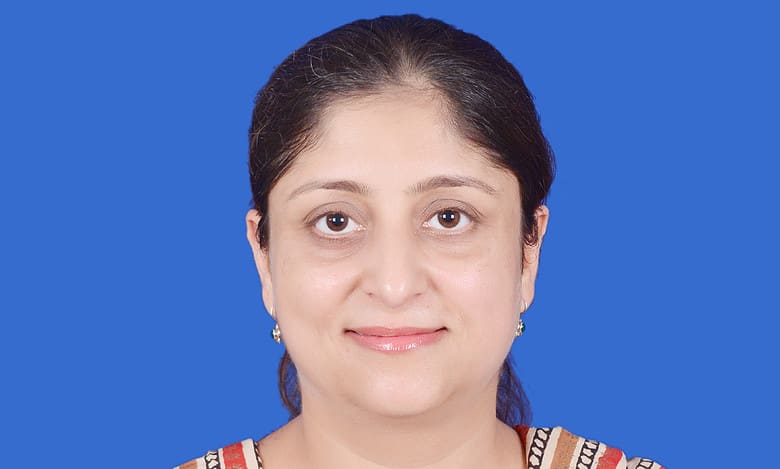
Dr Ayesha Ahmad, Department of Pediatrics, J N Medical College, Aligarh Muslim University received the prestigious Fellowship of The Royal College of Physicians (FRCP), London.
The honour given to her at the fellowship conferment ceremony earlier this year is in addition to her Membership in the Royal College of Pediatrics and Child Health (MRCPCH), for which she qualified in 2015.
According to a press release from the AMU, it may be noted that the Fellows of the RCP are distinguished consultants or SAS doctors and are given the honour of using the FRCP post-nominal.
Dr Ahmad was awarded the European Society for Paediatric Endocrinology Fellowship (ESPE) in 2016 for working in Paediatric Endocrinology in the United Kingdom. Currently, she is involved in developing the Paediatric Endocrinology division in the department, which will address the ever-increasing cases of Type 1 diabetes, thyroid, growth disorders, and other endocrine issues of the paediatric age group. Her main thrust in research and publications covers the fields of Paediatric Endocrinology and General Paediatrics.
source: http://www.siasat.com / The Siasat Daily / Home> News> India / by News Desk / June 15th, 2023
Ahmad’s book, Caste and Social Stratification Among Muslims in India, is celebrated as pioneering work in the field.
Imtiaz Ahmad (1940-2023). Photo: Twitter/@syedurahman
New Delhi:
Imtiaz Ahmad, renowned scholar who taught political sociology at the Jawaharlal Nehru University in India, has died. He was 83.
Ahmad’s book, Caste and Social Stratification Among Muslims in India, is celebrated as pioneering work in the field.
Ahmad got his BA and MA degrees from the Lucknow University in 1958 and 1960 respectively. He started as a senior research analyst at the Institute of Economic Growth at the Delhi University in 1964 and two years later, became a lecturer in sociology in the same university.
After three years as visiting professor of anthropology at the University of Missouri in the US, Ahmad joined JNU as associate professor in political sociology in 1972. He became a professor in the department in 1983 and taught there for three decades.
Among his numerous publications are those which throw light on Muslim empowerment, minority rights, the role of education among Muslims, how Islamic ideologies mesh with social realities, how Muslim women are studied in India and communalism.
Ahmad also wrote critically on the Gujarat riots of 2002 in particular and communal politics in general. His work has been lauded as having shed light on the composite culture of India.
source: http://www.thewire.in / The Wire / Home> Education> Society / by The Wire Staff / June 19th, 2023
The AMU student, Sami Saud, said that by capturing ECG readings remotely, the device wirelessly transmits the data to a cloud-based platform.
Aligarh:
In a novel development, Sami Saud, a final-year M.Tech. student at the Department of Computer Engineering, Aligarh Muslim University (AMU) has developed a portable single lead ECG device as a part of his dissertation.
Sami, who is working on his dissertation under the supervision of Prof. M. Sarosh Umar, worked on the device in collaboration with the industry expert, Arif Shouqi from Google.
He said that the device promises to transform the landscape of remote cardiac healthcare with accuracy records, boasting an awe-inspiring 99 per cent precision compared to traditional medical-grade ECG machines.
“The gadget demonstrates the immense potential of computer engineering in tackling real-world challenges and the functionality of this groundbreaking device is both ingenious and straightforward,” he said.
Sami said that by capturing ECG readings remotely, the device wirelessly transmits the data to a cloud-based platform. On this digital frontier, advanced machine learning algorithms work tirelessly to classify heart conditions and predict the likelihood of heart attacks based on the acquired data. Early detection and proactive management of cardiac issues are now within reach.
Sleek, Portable Design
The portable ECG device embodies usability and convenience, and with its sleek and portable design, it adapts seamlessly to any healthcare environment, making it a versatile asset for hospitals and home monitoring. Through the wireless Bluetooth connectivity, users can access their ECG results in real-time on their mobile or laptop devices. Sustainability and cost-effectiveness have been embedded into the very fabric of this groundbreaking invention.
The device’s rechargeable capability eliminates the need for wasteful disposable batteries, while its impressive 9-day battery life ensures extended usage without constant recharging.
This achievement underscores the transformative power of computer engineering in addressing critical challenges in the medical domain.
Sami’s father, Saud Saghir, is also an alumnus of Aligarh Muslim University.
source: http://www.ummid.com / Ummid.com / Home> Science & Technology / by IANS / June 13th, 2023
Traders from the Middle East introduced the beverage to the Mughal empire but the British made tea the subcontinent’s preferred drink.
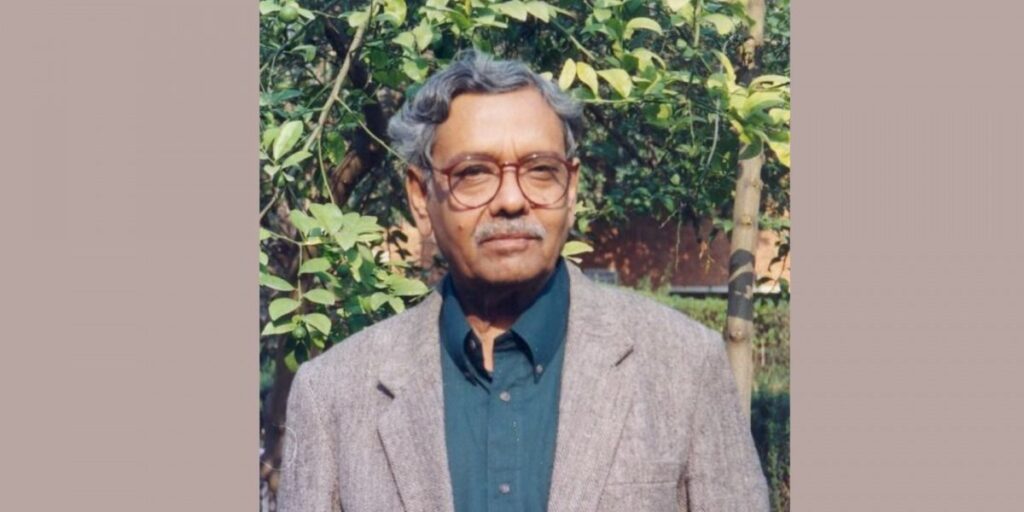
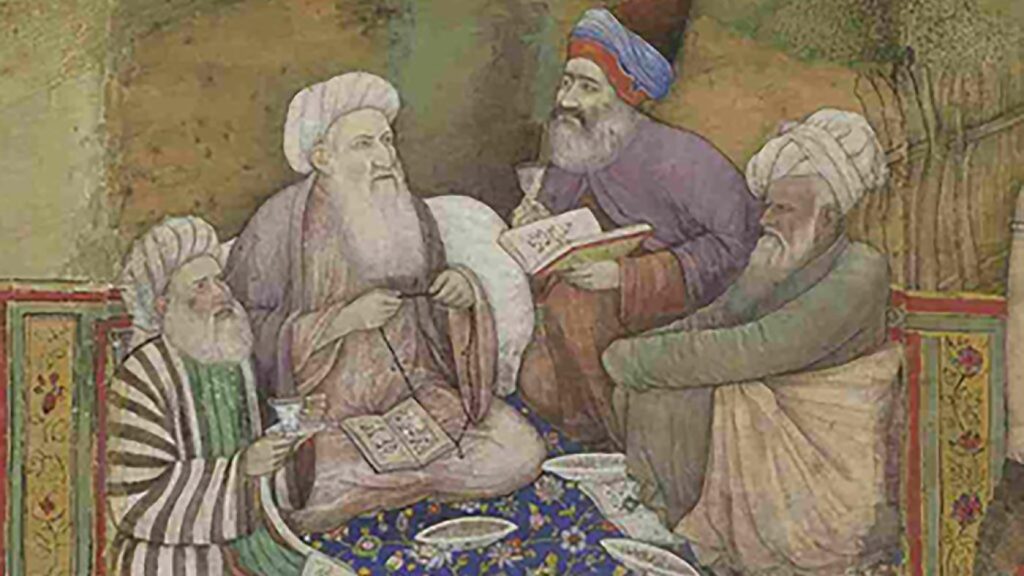
Mughal men drink an unidentified beverage in a 17th century painting later recreated as a drawing by Rembrandt (Public domain)
The sun sets behind regal yet dilapidated Mughal mansions and the magnificent dome of the Jama Masjid as the call for the evening prayer fills the auburn sky in Old Delhi.
Chandni Chowk’s bustling streets reverberate with the sound of honking cycle rickshaws navigating the serpentine lanes.
The sunset marks the beginning of business hours in the neighbourhood, which emerged during Mughal emperor Shah Jahan’s rule; a pocket within the once spectacular walled city of Shahjahanabad, founded in 1648.
Immersed in the soundscape, one’s senses are drawn to the aroma of food being prepared, complemented by the unmistakable scent of masala chai – the Indianversion of spiced tea.
Tea stalls, resembling busy beehives, draw Delhiites patiently waiting for their daily dose of evening tea – some having travelled from the far ends of the city to satisfy their craving.
Tea is without a doubt a national obsession in India. However, the incredible popularity of the drink in the subcontinent is less than two centuries old and only came about as a result of British rule in the region.
It may come as a surprise, but before the arrival of the British, it was coffee that Indians preferred.
Sufis and merchants
Coffee was brought over from the Horn of Africa to Yemenat some point in the 15th century and later spread north into the Near East and then to Europe by the 16th century.
The beverage also spread eastwards, and India’s Mughal elite was quick to adopt it as their beverage of choice.
While the Mughal Emperor Jahangir had a penchant for wine – preferring the Shiraz variety – both Hindu and Muslim nobility in his court freely indulged in coffee.
Edward Terry, a chaplain with the English embassy at Jahangir’s court, mentions that members of the court were captivated by the then-novel qualities of coffee, believing it could “invigorate the spirits, aid digestion, and purify the blood”.
The coffee bean was brought to the subcontinent by Arab and Turkic traders who had strong trade ties with the Mughal Empire.
They not only brought coffee, but also other items, including silk, tobacco, cotton, spices, gemstones, and more from the Middle East, Central Asia, Persia, and Turkey.
By the time Shah Jahan ascended to the Mughal throne, interest in coffee had grown exponentially across Indian society (Public domain)
Such goods would reach the farthest corners of India, including the easternmost region of Bengal. By the time Jahangir’s son, Shah Jahan, ascended to the throne (1628-1658), interest in coffee had spread across society.
Coffee was considered a healthy drink, an indicator of social mobility, and an integral part of Delhi’s elite social life.
Like Terry, another contemporary European visitor, the German adventurer Johan Albrecht de Mandelslo, wroteabout his travels in the east through Persia and Indian cities, such as Surat, Ahmedabad, Agra, and Lahore in a memoir titled The Voyages and Travels of J Albert de Mandelslo.
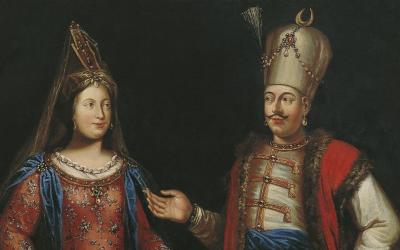
A painting titled ‘The Ottoman Sultan and His Haseki’ by an unnamed artist (Wikimedia)
In 1638, Mandelslo describes kahwa (coffee) being drunk to counter the heat and keep oneself cool.
In his workTravels in The Mogul Empire (1656-1668), Francois Bernier, a French physician, also refers to the large amount of coffee imported from Turkey.
Besides its use in social settings and supposed effects to ward off heat, the drink also had a religious purpose for the subcontinent’s ascetics.
Like their brethren in the Middle East and Central Asia, India’s Sufis consumed coffee before their night-long reverential rituals known as dhikr (the remembrance of God).
Legend has it that a revered Sufi saint named Baba Budhan carried back seven coffee beans in the folds of his robe on his way back from Mecca in 1670, planting the seeds for Indian-origin coffee cultivation in a place called Chikmagalur.
While this story may or may not be true, today the Baba Budhangiri hill and mountain range in the Indian state of Karnataka bears his name and remains a significant centre for coffee production, as well as housing a shrine dedicated to the Sufi saint.
In another variation of the legend, shared by the government’s Indian Coffee Board, the Sufi saint travels to Mochain Yemen and manages to smuggle out the beans discreetly despite strict laws on their export.
Culture of consumption
From the 16th century onwards, India became host to a cafe culture influenced by the one emerging in the Islamic empires to the west, particularly cities such as Damascus, Aleppo, Cairo, and Istanbul.
The nascent coffee culture found expression in Shahjahanabad’s own “qahwakhanas”, or coffee houses.
In her essay Spilling the Beans: The Islamic History of Coffee, food historian Neha Vermani describes the coffee served at the Arab Serai, which was “famous for preparing sticky sweet coffee”.
The Arab Serai became known for its sticky sweet coffee (Wikimedia)
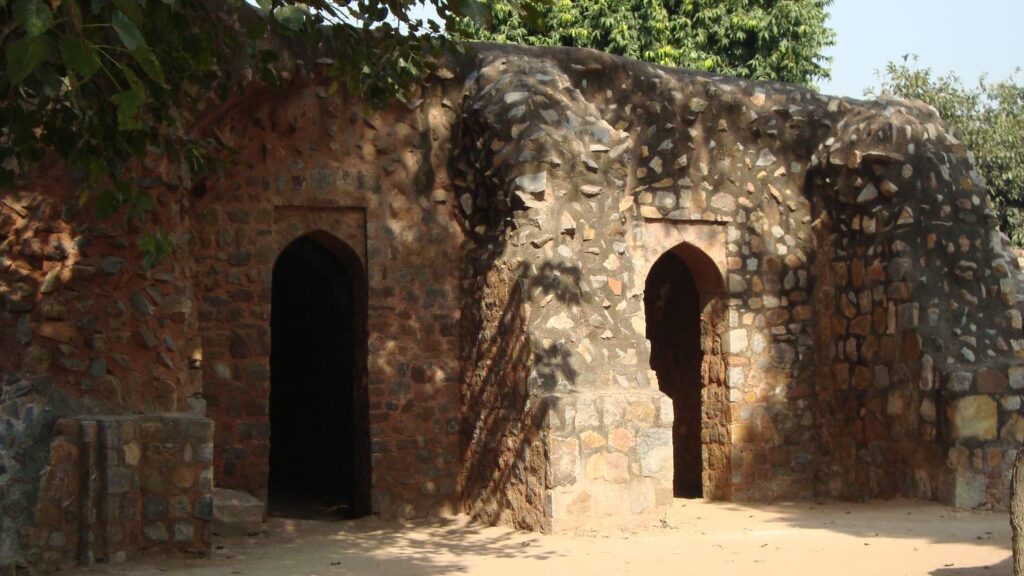
The Serai, which was commissioned in 1560 by Hamida Banu, the wife of Mughal Emperor Humayun, still stands today as part of a Unesco heritage site ; the wider complex of Humayun’s tomb.
Historians say it was used as an inn by Arab religious scholars who accompanied the royal on her pilgrimage to Mecca and that it was also used to house craftsmen from the Middle East who were working for the Mughals.
Historian Stephen Blake in his 1991 workShahjhanabad: The Sovereign City in Mughal India 1639-1739 describes coffee houses as places where poets, storytellers, orators, and those “invigorated by their spirits” congregated.
Blake described how vibrant these coffee houses were, their milieu of poetry recitals, storytelling and debates, long hours of playing board games, and how these activities impacted the cultural life of the walled city.
Coffee houses of Shahjhanabad, like those of Isfahan and Istanbul, accelerated the rise of a culture of consumption and a thriving food culture, with residents frequenting snack sellers offering savouries, naanwais baking bread, and halwais specialising in confectionery.
This is a legacy that continues to be felt in Old Delhi’s Shahjahanabad area to this day.
While Blake’s descriptions paint a picture, there are no extant visual depictions of the interiors of these establishments, and unlike their Ottoman or Safavid counterparts, there are no miniatures or Orientalist artworks depicting what they would have looked like.
Rembrandt depictedMughal men drinking something very closely resembling coffee but the Dutch artist does not identify the contents of their cup, and never visited India. But his images were inspired by Mughal paintings brought over to the Netherlands by Dutch traders.
The man who swore by his Turkish coffee
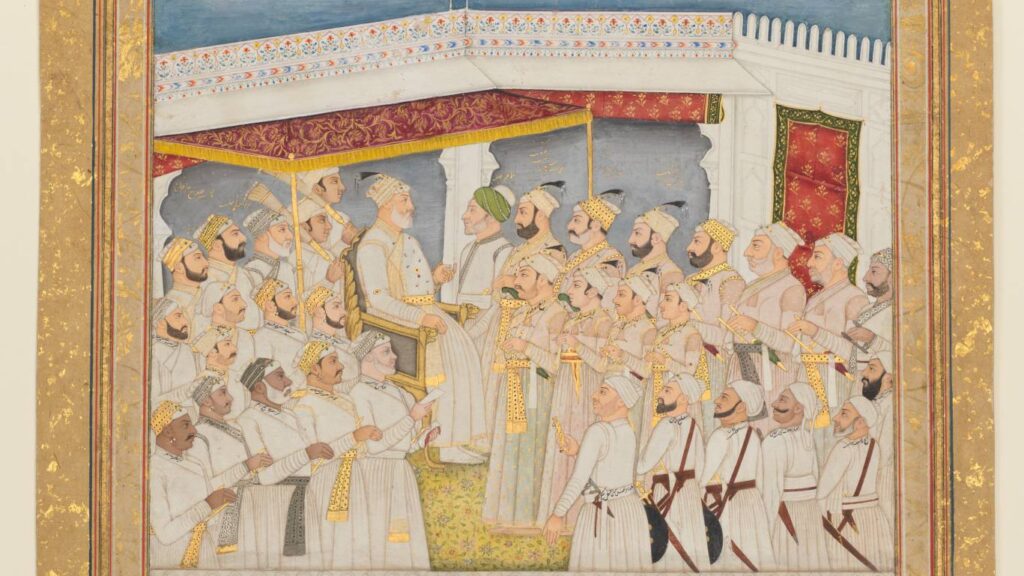
Provincial courts sought to replicate the ambience of Shahjahanabad and embraced the cafe culture on offer there. Among them, none cherished coffee more than Alivardi Khan, the Nawab Nazim of Bengal.
Khan was of Arab and Turkman descent and ruled Bengal from 1740-1756. Known as a diligent ruler, coffee and food were the two biggest pleasures of his life.
Seir Mutaqherin or the Review of Modern Times, written by one of the prominent historians of the time, Syed Gholam Hussein Khan, offers a fascinating description of Alivardi Khan’s routine.
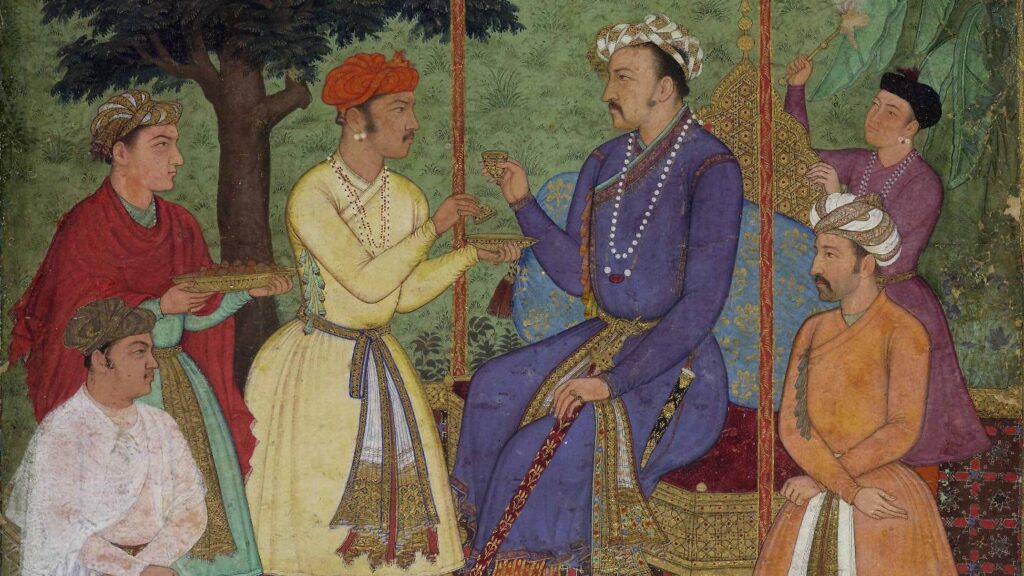
Alivardi Khan, seen here on his throne, liked the finer things in life, including coffee (Metropolitan Museum of Art/Public domain)
He writes: “He always rose two hours before daylight; and after having gone through evacuations and ablutions, he performed some devotions of supererogation and at daybreak, he said his prayers of divine precepts, and then drank coffee with choice friends.
“After that he amused himself with a full hour of conversation, hearing verses, reading poetry or listening to some pleasing story.”
This morning routine was followed by a bespoke Persian dish prepared by the nawab’s personal chef.
Khan’s portrayal presents Nawab as a man of fine taste, who valued the luxuries of courtly life as much as effective governance.
A connoisseur of exquisite food, witty conversations, and premium Turkish coffee, Khan went to great lengths to acquire the best coffee beans, importing them from the Ottoman Empire and bringing them all the way to Murshidabad, his capital.
The coffeehouse ‘is a social space created and shaped by the people themselves’ (MEE)
He believed in nothing but the best for his court. Not only were his coffee beans imported, but his kitchen staff also hailed from places renowned for their culinary excellence, such as Persia, Turkey, and Central Asia.
The royal household employed a diverse range of professionals, including storytellers, painters, coffee makers, ice makers, and hakims (physicians).
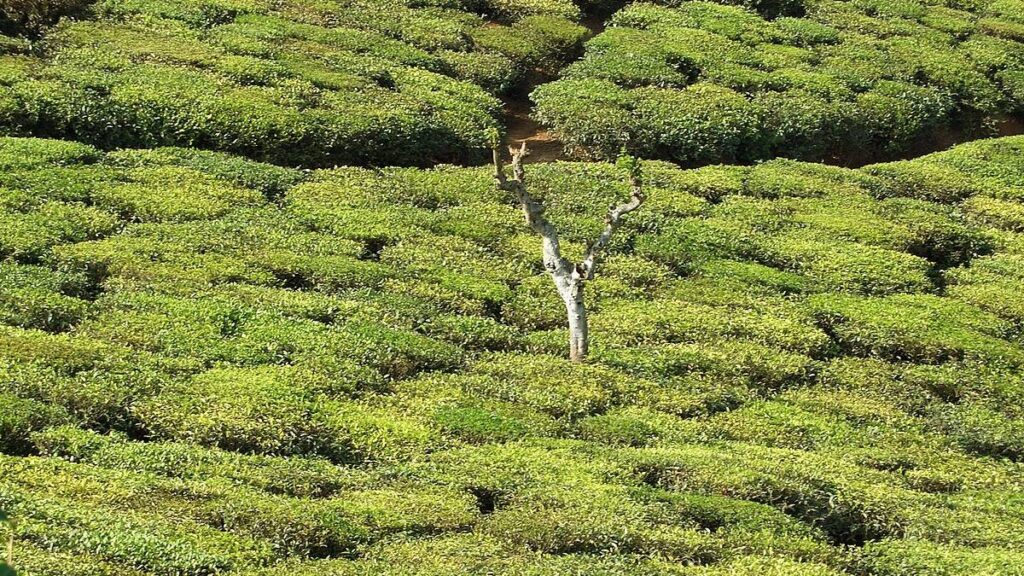
Tea has been grown in India since the 19th century (Wikipedia)
Khan personally handpicked his baristas (qahwachi-bashi), who brought along their specialised coffee-making equipment.
The descriptions paint a vivid picture of courtly culture, a world of opulence, artistry, and a profound affinity with caffeine.
It is puzzling, therefore, to pinpoint exactly when Mughal coffee culture vanished from pre-colonial Bengal, but it likely lasted until at least 1757.
Siraj ud-Daulah, Khan’s grandson and successor, could not live up to his grandfather’s legacy, and faced with threats from the British, the courtly culture swiftly dissipated, along with Bengal’s fortunes.
When Bengal lost the decisive Battle of Plassey in 1757, the East India Company took control of the region, and slowly coffee vanished from public consumption and consciousness.
Tea farming takes over
The rise of the East India Company, which was the primary agent of British control in India, marked the end of the subcontinent’s dominant coffee culture.
Britain’s penchant for tea began in the late 17th century and China was its main supplier.
Lizzy Collingham writesin her book Curry: A Tale of Cooks and Conquerors that between 1811 and 1819 “70,426,244 pounds” out of a total of “72,168,541” pounds of imports from China were associated with the tea trade.
She remarks that Britain, therefore, had an “interest in finding an alternative source for tea”.
The Indian Coffee House is run by Indian worker’s cooperatives and is open to all (Wikipedia)
With its fertile soils and appropriate weather conditions, India was the perfect spot.
In February of 1834, then Governor General William Bentick appointed a committee to look into India’s potential as a place to set up the East India Company’s own tea production unit.
In the native Indian population, they found not only workers who would cultivate and harvest the leaves but also consumers of the beverage.
As coffee production became overshadowed by tea farming, Indian tastes also shifted to the latter.
Further consolidating the decline of Indian cafe culture was the British ban on Indians visiting coffee houses, which were barred to all but Europeans.
Nevertheless, reports of the death of coffee in India were premature.
Regardless of British influence on local culture, the subcontinent was not immune to global trends.
The Indian historian and author, AR Venkatachalapthy, writes in his 2006 book In Those Days There was No Coffee: Writings in Cultural History that there was no escaping the physical effects or symbolism of coffee in late 19th century British India.
“Drinking coffee, it appears, was no simple quotidian affair. Much like history, the nation-state, or even the novel, coffee too was the sign of the modern,” he writes.
Enthusiasm for coffee grew at the turn of the 20th century, and the same book quotes adverts for coffee in south India in the 1890s: “Coffee is the elixir that drives away weariness. Coffee gives vigour and energy.”
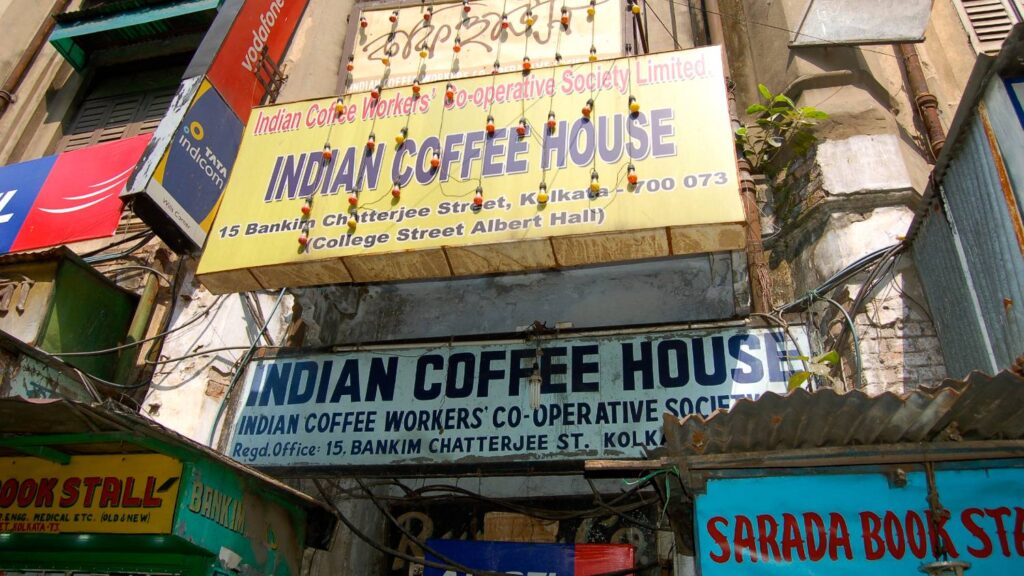
This energy and vigour were first reflected in the east, in the colonial city of Calcutta (present-day Kolkata) where the first Indian-run coffee shop, named Indian Coffee House, opened in 1876.
pix09
Turning into a chain in the 1890s, by the first half of the new century the name Indian Coffee House would be adopted by a growing network of 400 coffee houses run by Indian workers’ cooperatives, with only Indian-origin coffee.
These were the people’s coffee houses where any Indian could walk in without being discriminated against on the basis of their race.
Today, the ambience of the Indian Coffee House reminds one of the inclusivity of coffee shops in historic Shahjhanabad.
The chain is one of many Indians can visit, with others including the Bengaluru-based Coffee Day Global, which now has more than 500 outlets in the country despite only opening its first in 1996.
Six years later Starbucks entered India’s voluminous urban market and the rules of the brew changed forever in the subcontinent.
source: http://www.middleeasteye.com / Middle East Eye / Home> Discover> Food & Drink / by Nilosree Biswas, New Delhi / June 05th, 2023
A minor planet in the solar system, which earlier bore just the number 5718 CD4, has now been named after Kollam based scientist, Dr Sainudeen Pattazhy, reports Ramesh Babu.
Pattazhy was surprised when a representative of the Jet Propulsion Laboratory, run by the space agency NASA, telephoned him on Wednesday evening. “I’m not a space scientist and initially thought someone was pulling my leg,” he told Hindustan Times. “But the official explained that my name was chosen after going through my research papers.”
Pattazhy, who teaches zoology at a local college, has carried out pioneering research on many environment related issues such as the phenomenon of ‘red rain’ —which occurred in Kerala in 2001—the control of mosquitoes, the eco biology of ‘sacred groves’, and the health hazards posed by mobile phone towers.
Pattazhy’s suggestions on the health hazards posed by mobile towers are still pending with the Union Ministry of Environment. According to him, the radiation would affect people residing within 300 metres of the towers.
The minor planet — to be henceforth known as ‘5718 Pattazhy’ — was discovered by US-based space scientist Dr R Rajmohan in 1989. There are around 400,000 ‘minor planets’ or asteroids in the solar system, of which 185,685 have well defined orbits and have been allotted numbers by the International Astronomical Union (IAU). Around 14,000 of them have been given names.
“It seems the discoverer of the planet forwarded my name after going through my work,” said Pattazhy, adding that he had no idea why he was chosen.
source: http://www.hindustantimes.com / Hindustan Times / Home> India News / by Ramesh Babu, Thiruvananthapuram (headline edited) / May 02nd, 2008
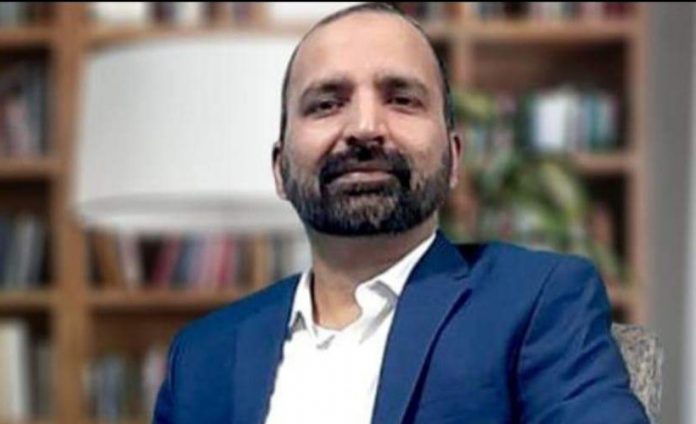
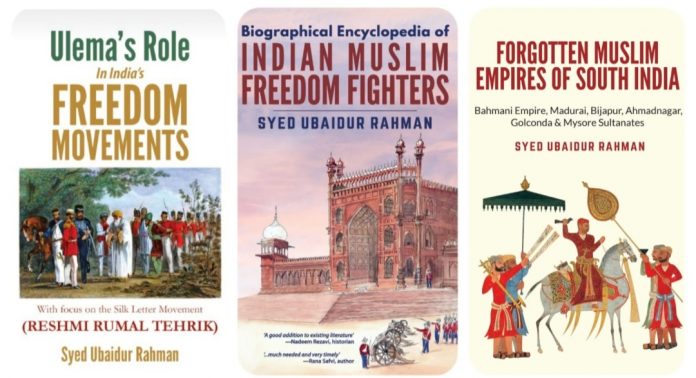
Syed Ubaidur Rahman is an author based in New Delhi who seems to have completely dedicated his life for preserving Indian Muslim history. In the last five years he has authored at least five books, three of which have been highly acclaimed. Among these are ‘Forgotten Muslim Empires of South India: Bahmani Empire, Madurai, Bijapur, Ahmadnagar, Golconda and Mysore Sultanates’, ‘Ulema’s Role in India’s Freedom Movement’, and ‘Biographical Encyclopaedia of Indian Muslim Freedom Fighters’. His objective is to systematically preserve Indian Muslim history. In this interview, we discuss his work and the obstacles he has encountered. Following is an excerpt from his interview.
MM: Why you are trying to preserve Indian Muslim history?
SUR-This is a bitter truth that as a community Muslims are good in forgetting their heroes. If I ask you to name a couple of heroes here from south India, there may not be many people who would be able to name more than a couple of names. And certainly not about the Bahmanis or the Adil Shahis or Nizam Shahis. This is a tragedy of Himalayan proportions and we are paying the price for our ignorance when our own history is being threatened with completely being erased not by other people or other organizations or the government, but by ourselves.
Books on Indian Muslims history penned by Syed Ubaidur Rahman
MM: Muslim history was usually written in Urdu language. Why did you find the need to write in English
SUR: That assumption might not be true. Books have been written on the history of South India, including Bahmani Empire, Adil Shahi, Nizam Shahi, Qutb Shahi and Mysore Sultanates, though in very small numbers. However, most of them are out of print. Haroon Khan Sherwani, a renowned historian from Hyderabad had written an excellent book on the history of Bahmani Empire, besides also writing in detail on the history of the Qutb Shahis of Golconda Sultanate, however, unfortunately these books are out of print and nowhere available. I don’t find any meaningful book written either on the Bahmani Empire or the subsequent Deccani sultanates in Urdu. There are many good books written on the Mysore Sultanate, especially on the life of Tipu Sultan and the best of them are in English. Muhibbul Hasan’s biography of Tipu Sultan is English and it is among the best.
MM: Why you wrote on the history of South Indian Muslims?
SUR: There is no denying the fact that there is a huge population of Muslims down south. However, unfortunately, unlike Muslims in North India, the history of South Indian Muslims, their ruling dynasties and the Muslim empires hasn’t been documented in as much detail as it was needed. Even in the case of north India, the focus has always remained on the history of Mughals who ruled the country for close to three hundred years. The history of the Delhi Sultanates and its different dynasties has been rather very well documented. But other than the Mughals and the Delhi sultanates, not much has been written on different dynasties that have ruled different regions in the North including the ruling dynasties of the Sharqi Sultanate that was based in Jaunpur or the Muslim sultanates of Bengal, that were very powerful and existed for centuries. Similarly the history of ruling Muslim dynasties of sultanates of Gujarat, Malwa and Khandesh hasn’t been given much attention.
I am trying to document the history of Muslims in medieval India and my book ‘Forgotten Muslim Empires of South India’ is the first volume of the series. This book documented Bahmani Empire, Adil Shahi Sultanate of Bijapur, Nizam Shahi Sultanate of Ahmadnagar, Qutb Shahi Sultanate of Golconda and Mysore Sultanate that was founded by Hyder Ali.
The next volume will cover the history of Sultanate of Gujarat, Sultanate of Malwa and also the sultanate of Khandesh, besides a detailed chapter on the Nizams of Hyderabad, inshaAllah.
I must add here that the history of the Muslims in South India is as dazzling as the Delhi Sultanate or the Mughal Sultanate. At one point in early fifteenth century, the Bidar based Bahmani Empire was the most powerful empire not just in South India but across the Indian Subcontinent.
MM: What do you feel about the rewriting of history project in India
SUR: There is no denying that among the many serious challenges facing the Indian Muslim community at the moment, the foremost is preserving their history and heritage. Without any iota of doubt, this has become all the more important given the fact that there are efforts to rewrite Indian history now. And the most important period they intend to rewrite is the medieval period. This project, spearheaded by the Indian Council of Historical Research titled ‘Comprehensive History of India’, is expected to have at least twelve volumes. They have emphasized that while writing these volumes they will not be depending on ‘Euro-centric’ resources and would go by vernacular resources. However there isn’t much literature available on history in vernacular languages even regarding important political events of the medieval period. It may sound completely bewildering to many, but there is no reference at all in any medieval Indian texts regarding the numerous raids conducted by Mahmud of Ghazni deep inside India. Abraham Eraly believes the Indian chroniclers of the time didn’t consider those events worth recording as they were more interested in penning ‘inane romances’.
MM: What is the impact of your work till now?
SUR: It is a rather very short period of time to make any impact felt. It will take time to reach a wider audience and create awareness about our own history and heritage. However, my books on the freedom movements including ‘Biographical Encyclopaedia of Indian Muslim Freedom Fighters’ and ‘Ulema’s Role in India’s Freedom Movements’ have helped create awareness about the Muslim community’s major contributions in India’s different phases of the freedom movement. Without the involvement of the Muslim community, especially the clergy or ulema, the dream for an independent India would have remained a mere pipedream.
Similarly, my latest book ‘Forgotten Muslim Empires of South India’ has brought the history of Muslim kingdoms, sultanates and empires in South India in focus. Many people, who call themselves well-read, have admitted to me personally that they never had any idea that there was a Muslim sultanate in Madurai. Not many thought that a powerful empire ruled a huge swath of land in South India, an empire that stretched from coast to coast. Bijapur’s Adil Shahi sultanates, in the 17th century had taken over the remnants of the Vijayanagar Empire and had become a huge empire in itself. Besides, the beauty and splendour of the Bahmani courts or the courts of the subsequent sultanates was dazzling. The rich history of the Muslims in south India is mesmerising and a revelation of sorts for not just people in the north, but in South India itself.
source: http://www.muslimmirror.com / Muslim Mirror / Home> Indian Muslim> Interview / by Syed Ubaidur Rahman / May 28th, 2023