Tag Archives: Indian Muslims

Muslims witness positive surge in Padma Awards

INDIA:

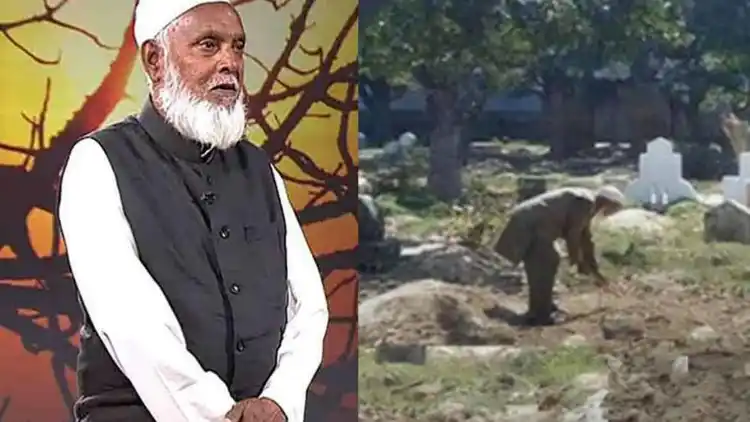
Shareef Chacha who receivedPadma Shri award from President
Shareef Chacha who received Padma Shri award from President

A few days ago, when President Ram Nath Kovind presented Padma Awards, the Social Media went abuzz with claims that the Narendra Modi-led Bharatiya Janata Party (BJP) government has transformed an earlier elite award into a people’s award. Awardees like Tulsi Gowda, Mohammad Sharif, Bhuri Bai, and others represent those who had worked at the grass-root level. Earlier the award was mostly given to a select band of people who had access to corridors of power in Lutyen’s Delhi; many deserving Indians were ignored.

The optics of Padma awards and the chatter around it made me look into the veracity of these claims. As an Indian Muslim, my primary interest was to understand that how Muslims are represented at the Padma Awards over the year and if there was a change in the attitude of the givers of the awards. The first Padma Awards were presented in 1954. So far, 4,827 persons have been conferred the awards. Muslims are under-represented in these awards. With a population share of around 14%, only 7.5% of the awardees were Muslims, including some foreigners. However, the list of awardees for the years 2020 and 2021 that were conferred on recently, Muslims had all the time higher share. The two lists had 24 of the 260 Padma Awardees who are Muslims, 9.23%.
Padma Vibhushan

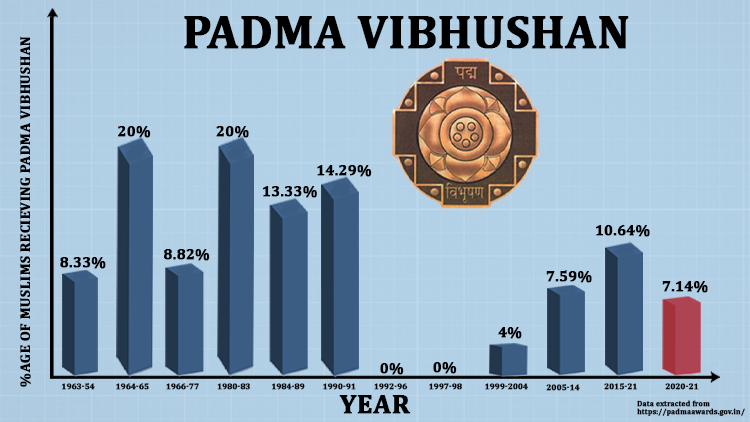
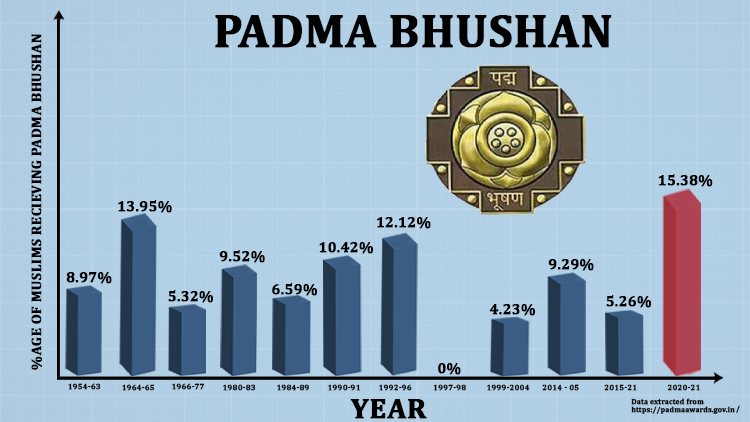
Coming to Padma Awards, the second-highest civilian honour after Bharat Ratna, that and is awarded for exceptional and distinguished services, I worked with figures of Muslims over the years since 1954. So far 321 people have been bestowed upon Padma Vibhushan. If we look at different regimes, it’s interesting to note that Muslims fared worse during the PV Narasimha Rao-led Congress government and Janata Dal governments of 1997 – 98. During these six years, out of a total of 14 Padma Vibhushan, no Muslim name figured in the list of the prestigious awardees. Interestingly, only 2 Muslims receive the award in 9 years of Jawaharlal Nehru’s premiership. One of them was Zakir Husain, who was later awarded a Bharat Ratna as well. Indira Gandhi oversaw 14 Padma award ceremonies during her two spells as Prime Minister and in this period, 7 Muslims were among a total of 73 honoured. Ten years of Manmohan Singh-led UPA government witnessed 6 Muslims receiving the award, while 5 Muslims received it in seven years of the Narendra Modi-led BJP government. Considering a category of PMs who completed a full term, 13.33% of Padma Vibhushan were awarded to Muslims during the Rajiv Gandhi era followed by Narendra Modi, in whose times 10.64% of the awards went to Muslims. 
Padma Bhushan

Padma Bhushan is awarded for distinguished service of higher order. To date, 1281, including 95 Muslims, people have received this award. This is at 7.42%, not commiserating with their population. Like Padma Vidhushan, no Muslim was awarded Padma Bhushan in 1997 and 1998. During Nehru’s time (1954-63) 14 Muslims of the total 156 received the award. The Muslim show was very dismal in the first five years of the present regime with one award for the community. However, in the last two editions, we saw 4 Muslims being awarded Padma Bhushan. Of 26 awardees in the two years, 15.38% were Muslims.
Padma Shri

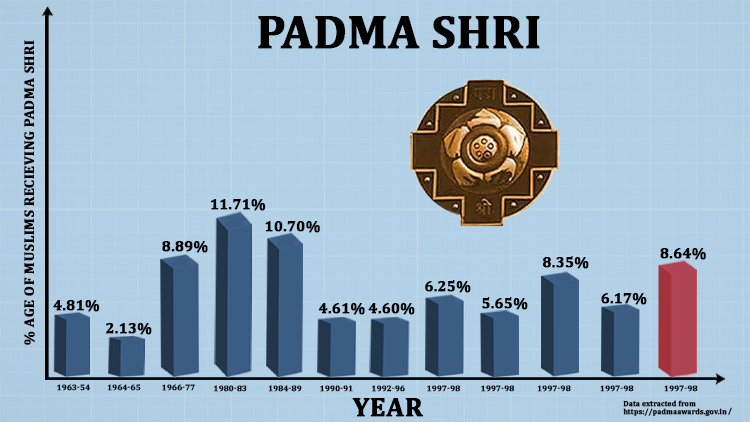
Padma Shri, awarded for distinguished service has since been conferred on 3,225 Persons. In the first 9 editions, only 9 Muslims were among 187 recipients. A period from 1966 to 1983, saw increased representation when 62 (out of 775), awardees were Muslims (9.29%). In the next five years, 23 more Muslims were awarded and it rose to 10.70%. In the 90s, Muslims representation dipped below 5% as fewer Muslims received Padma Shri. In the last two editions, 8.64% of the recipients were Muslims, a very positive surge that creates optimism.

The figures represent only a larger picture. A closer look reveals that a changed nomination policy for Padma Awards is at work. In 2017, the government opened the nominations for the common Indians as against the system of ministers and members of the government forwarding the names and a committee headed by the PM finalising the list of awardees. The government’s social media campaigns encouraged the people to nominate genuinely deserving and unsung heroes. Earlier, the system encouraged the well-connected people with links to the corridors of power to be nominated and get awarded.

In the new policy, people working at the grassroots are being nominated by the common man. As a result, we see people like Ali Manikfan, Abdul Ghafur Khatri, Mohammad Sharif, and Shahabuddin Rathod receiving the Padma awards. Apart from the fact that there is a positive surge in Muslim representation in these awards, the awards have grown to be more inclusive. Muslims from lower castes, backward regions, and non-elite backgrounds are being honoured. Larger participation of communities and people living at the margins, on social media has ensured that people working among them, and from them, are recognized. 

(Saquib Salim is a Writer and a Historian)

source: http://www.awazthevoice.in / Awaz, The Voice / Home> Stories / by Saquib Salim / February 2022
Ibn Sina Academy of Medieval Medicines and Sciences is a legacy in four walls

Aligarh, UTTAR PRADESH:

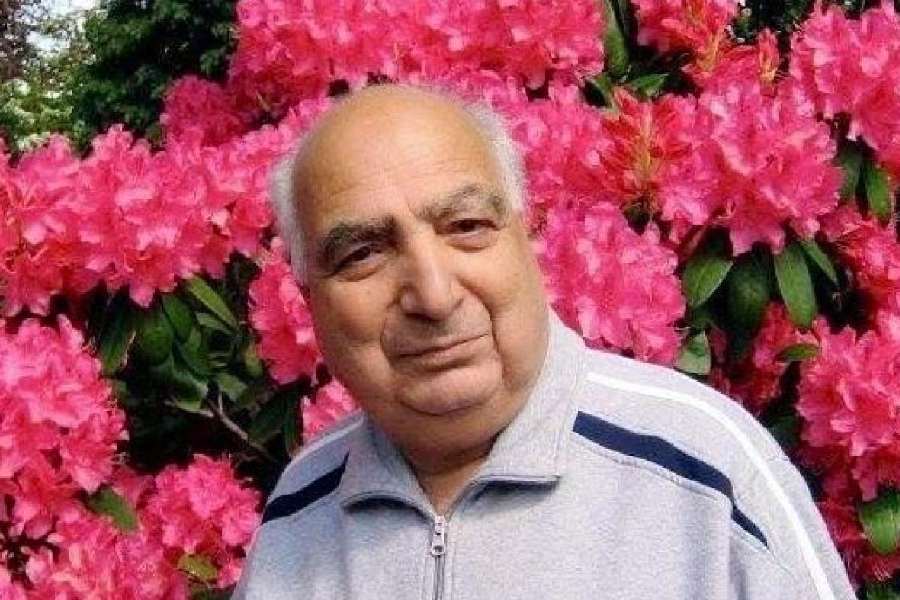
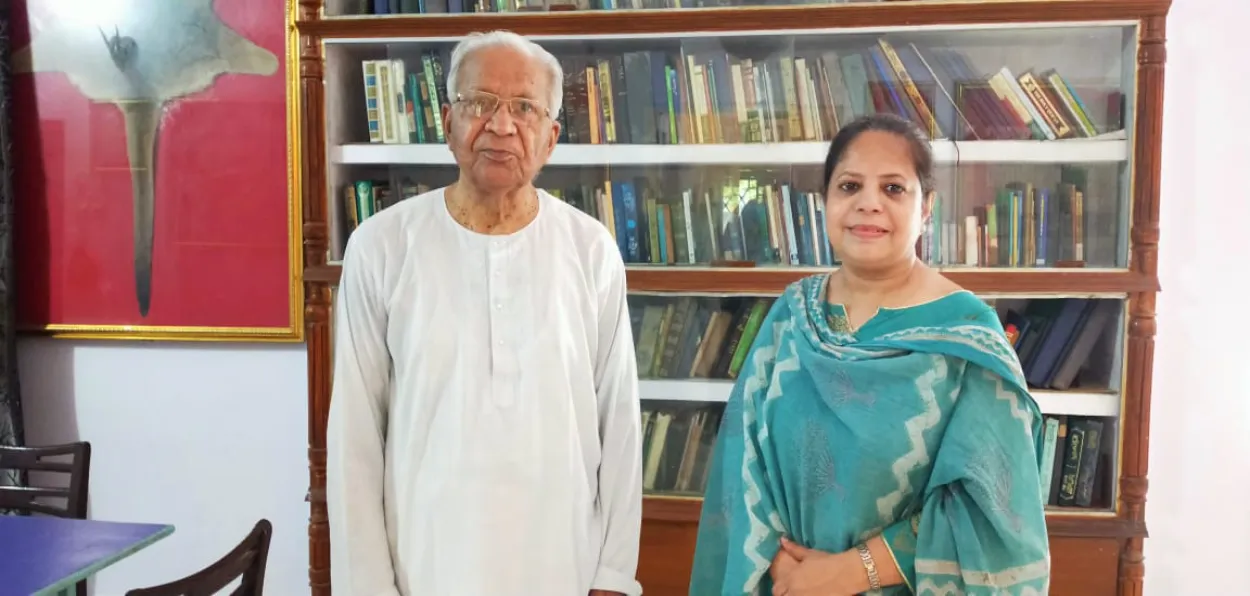
Professor Syed Zillur Rahman, founder,Ibn Sina Academy of Medieval Medicines and Sciences with the author

Known for its locks, Aligarh, a city in Uttar Pradesh, has also locked a legacy in its reserve – for generations to benefit from it. It houses a rare academy and museum called Ibn Sina Academy of Medieval Medicines and Sciences. 

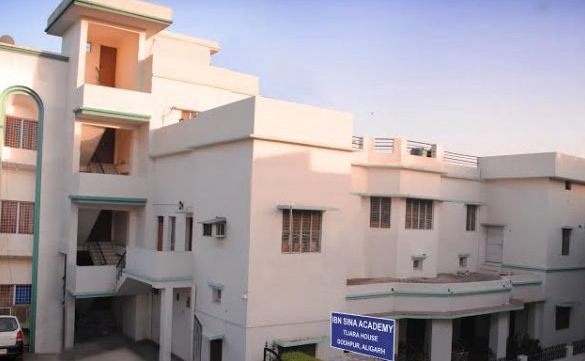
Located at Tijara House, amid a vibrant market place and residential area, Ibn Sina is hailed as the rarest house of legacies in arts and sciences combined under one roof. Named after the legendary scholar of philosophy and medicine Abu Ali Ibn Sina (980 -1037), this academy was accredited to the Ministry of Ayush in 2004 and promoted to Centre of Excellence in 2008.

The institution was established for encouraging and promoting research and studies in medieval sciences, especially Ibn-Sina’s as well as arts, culture, poetry, and other sciences. 

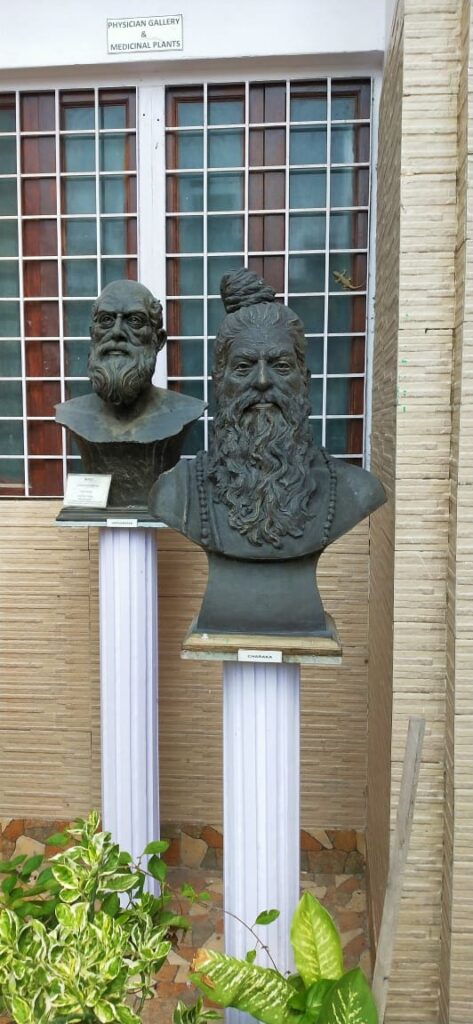
The bust of Ibn Sina with Charak inside the museum

Of Ibn Sina’s four stories, a major attraction is on its second floor which houses the Fazlur Rahman Museum of Orientalism, Art, and Culture. 

It has four main galleries; the crockery gallery has a large collection of oriental and British Indian utensils, hammami plates, bowls, tea sets that belong to prominent personalities such as Hakim Ajmal Khan, Nawab Sultan Jahan, Nawab Shahjahan Begum of Bhopal, Nawab Yusuf Ali Khan of Rampur and many others.

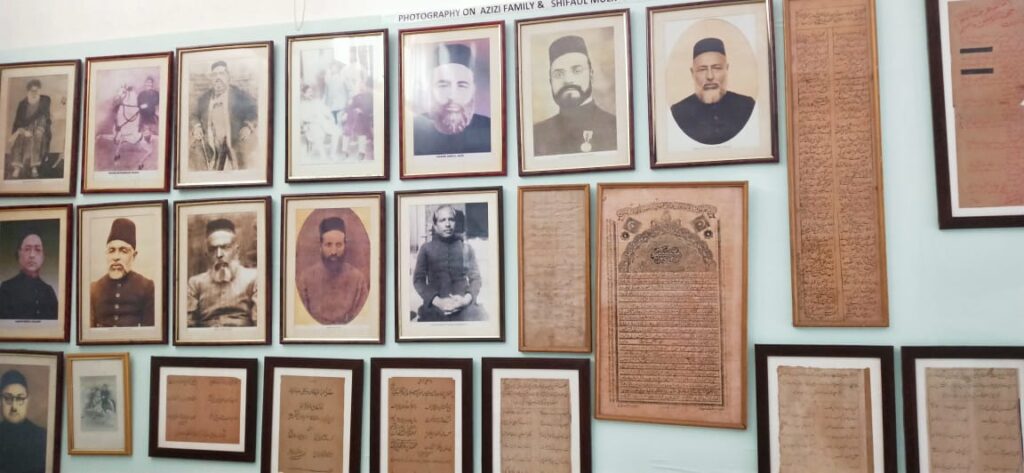
The textile gallery is ornate with attires, garments with gold and silver calicos studded with precious stones, one of which has entire Quranic surah Yaseen embroiled in gold zardozi on it, turbans worn in battles, among many other oriental attires. The picture gallery has prominent personalities of AMU’s pictures, drawings, photography, prints, etc.

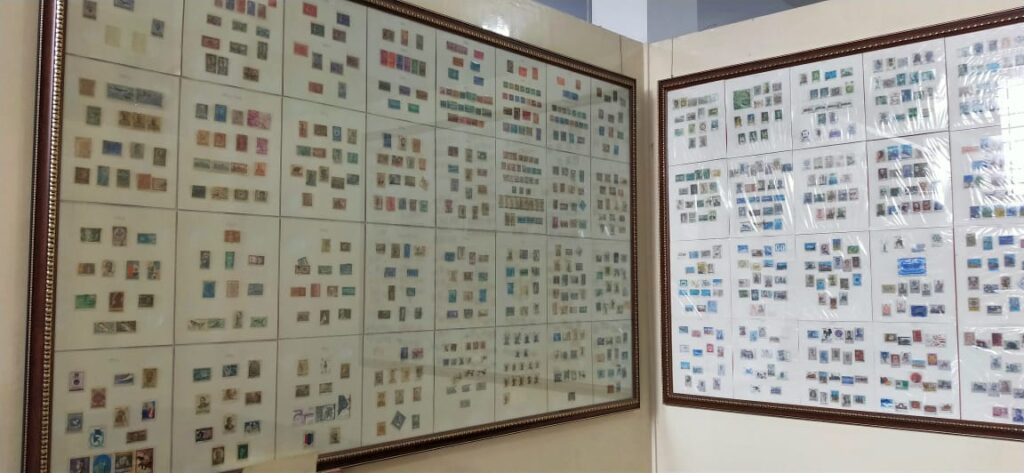
Its miscellaneous gallery has coins, postage stamps, clocks, busts, pens, memes, and relics of prominent personalities. 

“We have over 2 Lakh stamps beginning from ever since the stamps started, from all countries and India. People who were pioneers in the world of arts and culture, education, and freedom fighters on whose names, and stamps were released, we have a collection of the same. shares Dr. Aftab who is a convenor at Ibn Sina.

In addition medical manuscripts, medical philately, medical souvenirs memories of physicians especially those of Nobel laureates are well preserved here.

The wall of fame (Pictorial history of some important Muslim families)

The connecting rooms of the galleries welcome you with a sofa of Raja Jai Kishan, a mirror of the times when they were made of iron sheets. The iron sheets called ‘aaina’ were rubbed so many times that they would become sparkling clear and shining to become a mirror. That’s how the mirror got its name ‘aaina’ Later it got a new name –sheesha – with the change of the material..

The academy is rare for numerous reasons. For avid readers of medicine, science, Urdu, Persian, Arabic, literature, poetry, oriental studies, researchers, students preparing for competitions, and scholars IbnSina is a heaven. It boasts of a rare collection of 32000 books, 17000 magazines, 1100 manuscripts, (makhtootaat), 21 rare Qurans including one pocket size in gold, and much more is in store.

Built by professor Syed Zillur Rahman, a medical academic and passionate Urdu litterateur from Aligarh, Ibn Sina was an extension of his colossal library that he had established in 1960 which soon extended into the world’s rare academy and museum of its kind in the year 2000. 

Collection of stamps 

“Hamare yahn Aurangzeb ke hath ka likha, aur uske bete ke hath ka, likha hua Quran hai,” gleams the professor, sharing the information.

Apart from a separate collection of Muslim women achievers, Ibn Sina boasts of the world’s best collection of Islamic sciences, Islamic medicines, and Islamic philosophy being published across countries such as Iran, Central Asia, Syria, Iraq Turkey, etc. Scholars from across the globe come here to refer to books in this section.

For Ghalib devotees, the academy has a separate section called Ghalib Study Centre. It “Ghalibka collection joh mare paas hai vo duniya mein kisike paas nahi hai,” claims the professor.

Delhi finds a special place here boasting of 7500 books, some as old as 1893, dictionaries as old as 150 years, authentic diwaan on Ameer Khusrau, books on and by the last Mughal Bahadur Shah Zafar, British period –Victorian Era with pictures in Lithographs and much more.

Children using the library

The academy has a library for students especially those preparing for competitive exams. The 100-seater library has the best of books from literature, agriculture, science, math, medicine, etc.

“There is no fee to sit in this library. It opens every day from 10 to 10. This section has over 28000 books including 56 of Professor Rehman on Tibbi and Unnani medicines. there are separate sections for Unani medicine and Sir Syed Movement, biographies,” Dr Aftab Alam, the coordinator of Ghalib Study Centre informed.

There is a reason why the library has most books in Urdu and Persian on Indian history, culture, language, society, education, politics, medicine, etc. “Not much work in English has been done on Muslims. Most work has been done in Urdu and Persian. So this is our helplessness. Our focus is on India – the Hindustan. Indian scholars have done immense work in any domain, philosophy, travelogues, and medicines, especially in Islamic history, the Quran, and hadith that is comparable to anyone in the world, especially the Arabic and Persian world. The problem is we don’t read because we don’t read Urdu,” rues the professor. 

Why Ibn Sina was built has an interesting story. As a young man, Professor Rahman used to watch a bird who had made a nest and would bring food for her newborn, just as the routine was with a cat who had given birth to kittens – at his home. After some months, the birds flew, and the kittens grew and went away with their mothers.

“I thought to myself, ‘Is this the life God has created mankind for? Just be born, eat, sleep, and die like animals? God has created a man to not only take care of his family but also society, language, culture, community, and world.”

Ibn Sina Academy of Medieval Medicines and Sciences

So, he decided to create a legacy that he says would be useful for a generation after 80 years! “We are away from civilization by 80 years. A standard time to develop any civilization is 150 years. So, now people are not able to understand the legacy I have created but the students who read it 80 years later will know what it is. By then we would be a civilization.”

People get worried that the graph of Muslim development is going down. But the Professor feels it is nothing to be worried about. “Every civilization has to go through it. Our graph has risen. We were 10 crores in 1947. After Partition, 7 crore left for Pakistan had 3 crore stayed in India. We were nothing in 1947 but our buzurgs worked very hard to study and became scholars. Now we are making educational institutions, universities, hospitals, media houses, and so on. Most important is that girls are getting higher education and they will change the face of the nation,” he says, satisfied while emphasizing reading Urdu to know a legacy called India and the contribution of Muslims to it.

Rana Siddiqui Zaman is a Delhi-based senior columnist and art reviewer

source: http://www.awazthevoice.in / Awaz, The Voice / Home> Stories / by Rana Siddiqui Zaman / January 10th, 2024

Tableau Bags 1st Prize In Meelad Procession

Mysuru, KARNATAKA:

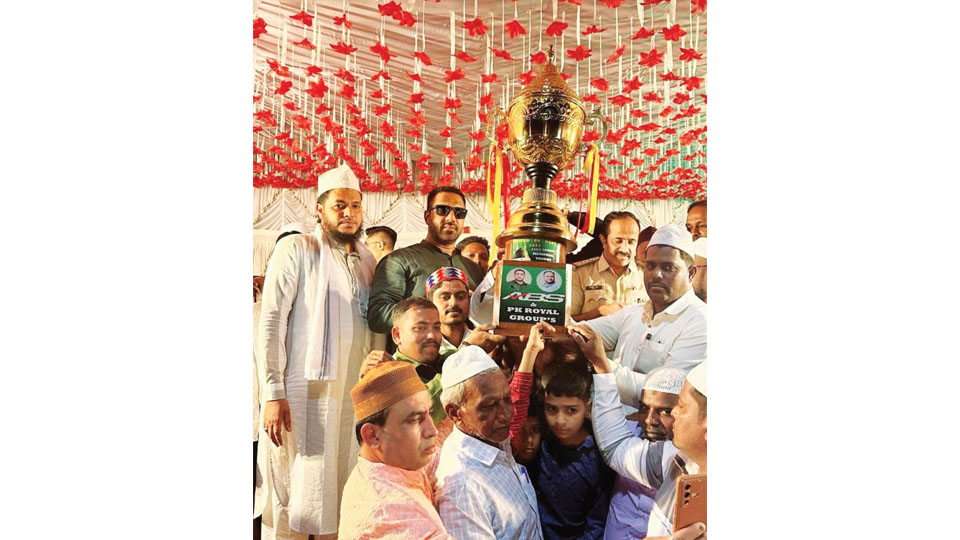
The tableau designed by Masjid-e-Aqsa Meelad Committee, which was taken in a procession along with other tableaux during Eid Meelad celebration in city on Sept. 28, has bagged the first prize.

ABS Abbas, Syed Umar, Zubair Ahmed, Corporator Basheer Ahmed, Zakir, V.V. Puram Inspector Arun Kumar, Moulana Abdul Salam, Khateeb of Masjid-e-Aqsa and others were present at the prize distribution ceremony.

source: http://www.starofmysore.com / Star of Mysore / Home> Photo News / October 05th, 2023

CBSE topper sets his sights on civil service exams

Lilong Haoreibi (Thoubal District), MANIPUR:

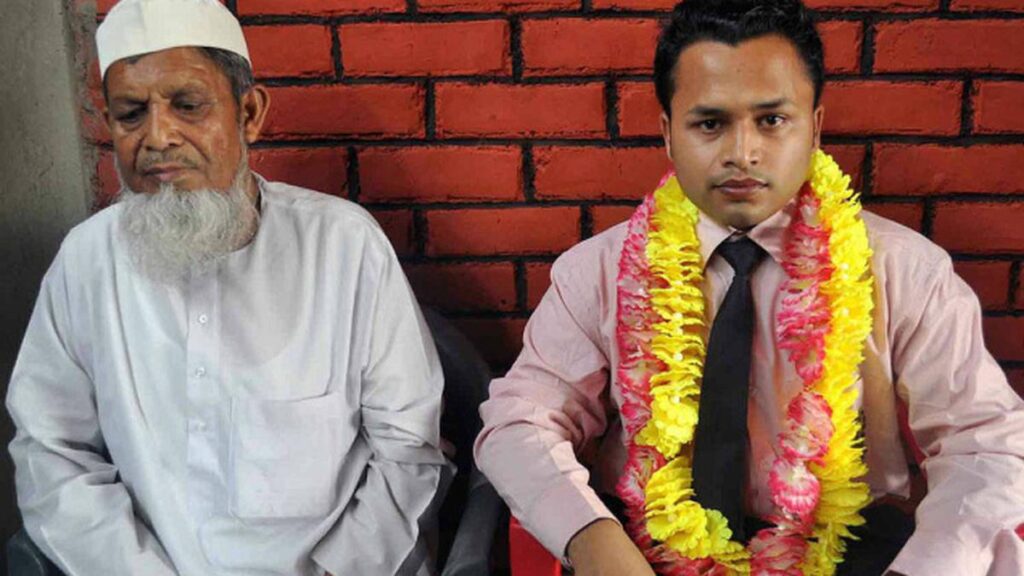
Manipuri boy Mohammad Ismat along with his father who scored the highest mark in the All -India Senior Secondary Certificate Examination.

Mohammad Ismat, the Manipuri boy who has topped the all-India CBSE Class XII Board examinations in the science stream, is nurturing a dream to top the Civil Services Examinations, too.

By way of preparation, he plans to join St. Stephen’s College, Delhi, to do B. Sc. (Honours).

Ismat hails from Lilong Haoreibi in Thoubal district, 15 km from Imphal. The village has very poor electricity supply and no internet connection.

“I also want to become a topper in the Civil Services Examinations conducted by the UPSC. I want to serve my country for peace and communal harmony. For now, I want to take admission to St. Stephen’s College to do B.Sc. (Honours) in Physics,” he told The Hindu .

He brought laurels to his school, Zenith Academy in Imphal, where he joined after completing Class X at Sainik School, also in Imphal. “I studied Class IX and X in Sainik School and passed the Class X board examinations with 92.4 per cent. I left Sainik School because of financial constraints,” he said.

Ismat’s mother died when he was only 18 months. His father, Maulana Bashirur Rahman, is a teacher in a primary school. He is the seventh child and only son of the family; six elder sisters are all graduates.

After school hours, Ismat had to study mostly in candlelight, as electricity is available for hardly three-four hours a day in the village. Ismat scored 495 out of 500 marks, securing centum in mathematics, chemistry, fine arts and home science and 98 in English and 97 in physics.

source: http://www.thehindu.com / The Hindu / Home> News> India> Other States / by Sushanta Talukdar / May 30th, 2012

Sahebaan Welfare Trust organizes ‘Community Welfare Talks Series 2024’ session in Mangaluru

Mangaluru, KARNATAKA:

Mangaluru:

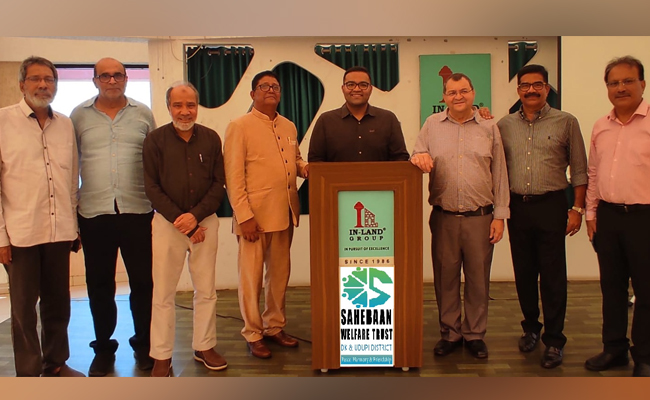
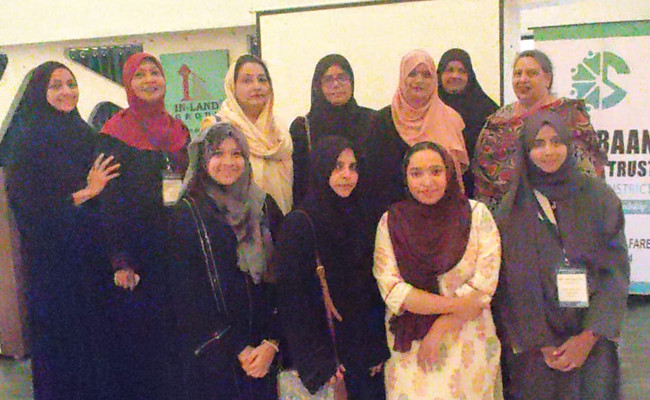
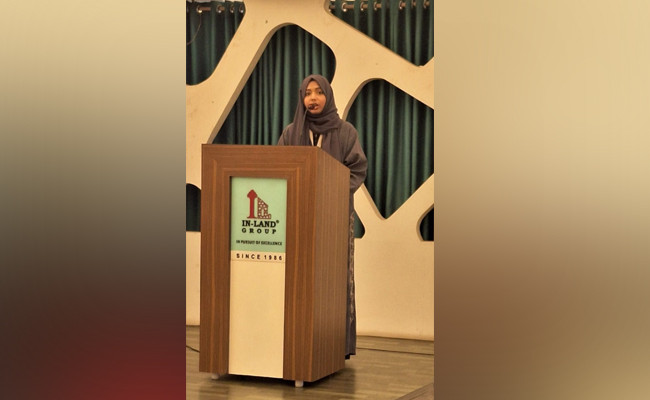
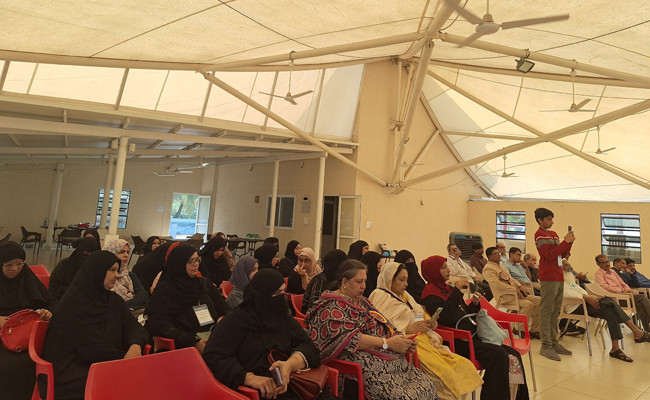
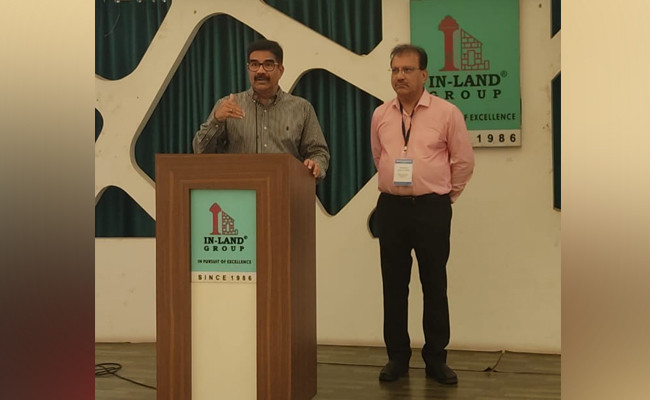
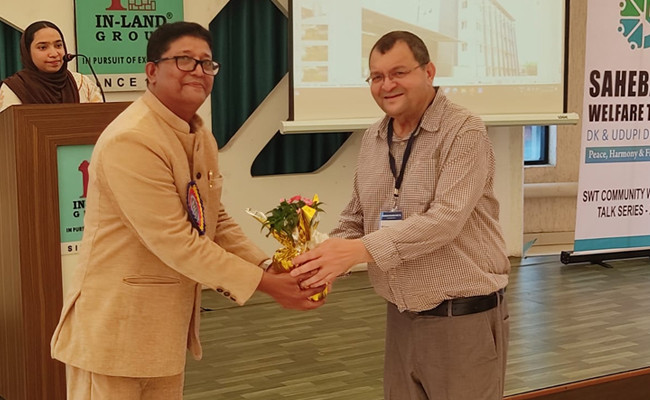
The ladies’ wing of Sahebaan Welfare Trust (SWT) hosted the inaugural session of the ‘Community Welfare Talks Series 2024’ at Senate Hall, Inland Ornate Complex, in the city on January 21, with Siraj Ahmed, Managing Director, Inland Infrastructure Pvt Ltd, inaugurating the event.

Ahmed, in his inaugural address, lauded the efforts of SWT at initiating the talk series for the benefit of the community members as well as the society at large.

Meraj Yousef, Executive Director, Inland Buiders, who spoke on the occasion, pledged his support towards community welfare activities of SWT.

Educationist and Motivational Speaker Obeida Shoukath, who was one of the speakers of the day, spoke on the challenges faced by students on campus and the remedial measures while the second speaker Dr. Mohammed Noorulla, Senior Unani Consultant at the District Wenlock Hospital, Mangaluru, explained on the occasion the history and benefits of AYUSH, the Indian Alternative Medicine system, and the services available at the Ayush Hospital in the city.

Syed Siraj Ahmed, Secretary of SWT, welcomed the gathering on behalf of the President, Afroze Assadi Saheb. The program was ably compered by Zaiba Khatib.

The Qirat was read by Fariha Fathima and Ayesha Shahnaz.

The event was conducted by the Ladies’ Youth Wing of the SWT under the leadership of Amreen Khatib, who was ably assisted by Aliya Imtiaz and Rifaa Sheikh, with the support extended by Ayaan Sheikh and Luqman Tonse.

Umme Kulsum proposed the Vote of Thanks.

Senior Sahebaan Community members and SWT trustees Althaf Khatib, Rafik Assadi and Imtiaz Khatib were present on the occasion.

source: http://www.english.varthabharati.in / Vartha Bharati / Home> Karavali / by Vartha Bharati / January 26th, 2024

A year after receiving Padma Shri, Balti author Akhone Asghar Ali Basharat struggles to get book published

Karkit Tchoo Village (Kargil District), LADAKH:

Balti litterateur  Akhone Asghar Ali Basharat
Balti litterateur Akhone Asghar Ali Basharat

The only Padma Shri Balti writer, Akhone Asghar Ali Basharat from the Kargil district of Ladakh, is struggling to get his anthology of native poetry published.

Akhoon has already published five books and when he was conferred with the Padma Sri by the government of India in 2022, it looked as if his career would take to newer heights. However, a year later, he lacks the resources to get his latest book published.

Speaking to Awaz-the voice from his home in the village Karkit Tchoo, 13 km from Kargil town, Basharat said that he was trying to get the collection of his poetry in Balti language published; he was looking for a means of subsidy. “It is a huge collection of my poems in Balti language; it highlights multiple facets of the language and culture divided by the Line of Control between India and Pakistan.”

The Balti language is spoken in the Gilgit-Baltistan region in the PoK and Kargil.

When the Awaz spoke to him last year, he was working on Aeena-e-Kargil (Reflections on Kargil), unfolding its history, geography, culture, writers and poets, the life of people, their dress, house, common food, following the religion of Islam, religious, social and political organizations.

His book, published this year, dwells upon the plight of the region during the Dogra rule, and also other ‘untouched issues in the post-Independence era’, he said. The 320-page book is a comprehensive account of the life and political issues the Balti-speaking people faced. His efforts in compiling details over more than 15 years have won him appreciation.

People are so impressed by Basharat’s achievements that a local poet Ashraf Ali Sagar, who is also the general secretary of the Association of Baltis in Himalayan Ladakh Territories of India, Kargil, composed a poem praising him. The poem is printed on the back side of the book. One couplet of the poem goes as follows:

“Kis Tarah Pur Soz Hai Tareekh-e-Kargil Kya Khabar

Yeh Basharat Teri Mehannat Ka Samar Honay Ko Hai”

(How vibrant is Kargil’s history, who knew; Basharat this is going to be fruitful for your hard work).

Akhone Asghar Ali Basharat (72), has not been to a school and he has no formal education. He learned Balti, Urdu, Persian, and Arabic languages from his father Sheikh Ghulam Hussain, who had set up a Madrasa in their home in 1972 and taught the children of the village for free.

Inspired by his father, he was attracted to learning, reading, and writing different languages.

His first anthology of Naat (in praise of Prophet Muhammad) and Manqabat (in praise of Allah) was published in the early eighties. His second publication, an anthology of poetry was published in 2002, followed by Waseelai Najaat, based on translations from Persian, which was published in prose form four years later, and, Bazme-Basharat including Naats, Manqabats, and poems on other issues got published in 2011.

Balti language is a Tibetan language spoken in parts of Kargil while it is the second largest language in the Gilgit-Baltistan area across the Line of Control (LoC). It is also spoken in parts of the Nubra Valley of Leh, Ladakh. Some of the Balti-speaking families from Kargil have also settled in the Tral area of Pulwama district in South Kashmir. There are 3.79 lakh Balti speakers in Pakistan, while the total Balti-speaking people in the world are estimated at 4.91 lakh.

The number of Balti speakers in India has shown a decline over the decades; today there are 13,774, Balti speakers in India, as per the 2011 census. It was around 20,053 in the 2001 census and 48,498 in 1981.

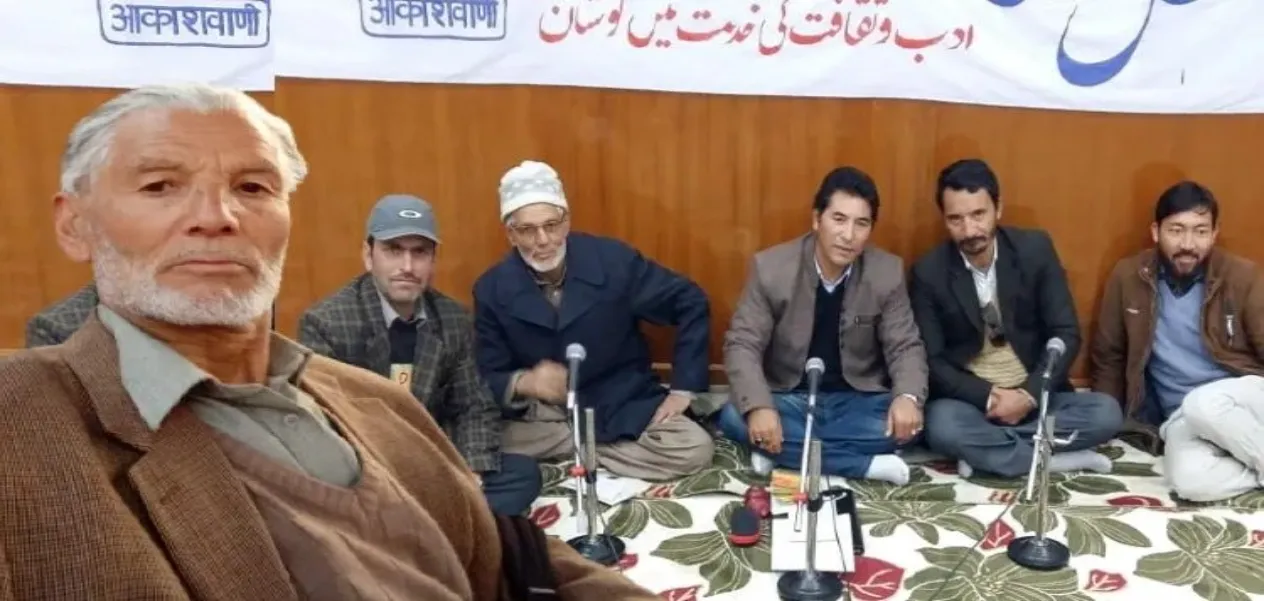
Akhon Asghar Ali Basharat gained popularity when he conducted regular Balti poetry shows on the AIR station of Kargil that took off in 1999. He became a regular participant in the local Urdu Mushairas and other cultural activities.

Basharat told a news portal that his father has been his inspiration. His father was the first published author from Kargil in the decade of 1980s.

“My father is my sole inspiration. He was a well-known social and religious activist. He had a huge collection of religious books. I sometimes feel writing is my inheritance and in my DNA.”

He says AIR Kargil station was of great help to people like him who live in remote areas. “My radio shows made me popular and encouraged me to write more. I am today because of AIR Kargil station.”

He says he fears that the Balti language may become extinct in Kargil. The fear of extinction is more because people across Ladakh tend to speak other languages and not their native ones to sound fashionable.

Bashart says to preserve language and culture, reading and writing books, and holding seminars and cultural programs must be encouraged.

He feels book writing should not be seen as a lucrative profession. “I feel book writing is not a lucrative profession. The author has to spend money to publish his book. Since the reader base is small the youth do not feel encouraged to write in regional languages. He has suggested that government must support writers of smaller languages.

source: http://www.awazthevoice.in / Awaz, The Voice / Home> Story / by Ehsan Fazili, Srinagar / January 07th, 2024

Review of ‘Another India — The Making of the World’s Largest Muslim Minority, 1947-77’ : The original betrayers

INDIA:

Pratinav Anil argues that policies of the Congress and the Muslim elite ended up hurting Indian Muslims the most.

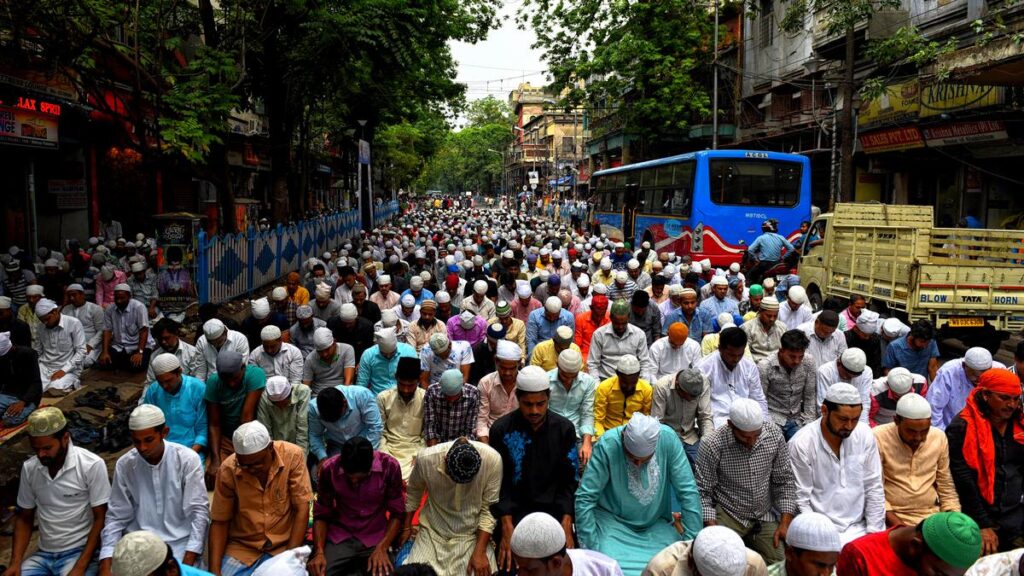
Muslim devotees praying on the street of Kolkata during the holy month of Ramadan. | Photo Credit: Getty Images/ istock

Unobjective commentators have, in the last decade, perfected the art of highlighting the tribulations of being a Muslim in “Hindu India” without contrasting them with the difficulties the same Muslim faced in “secular India” that supposedly existed before 2014.

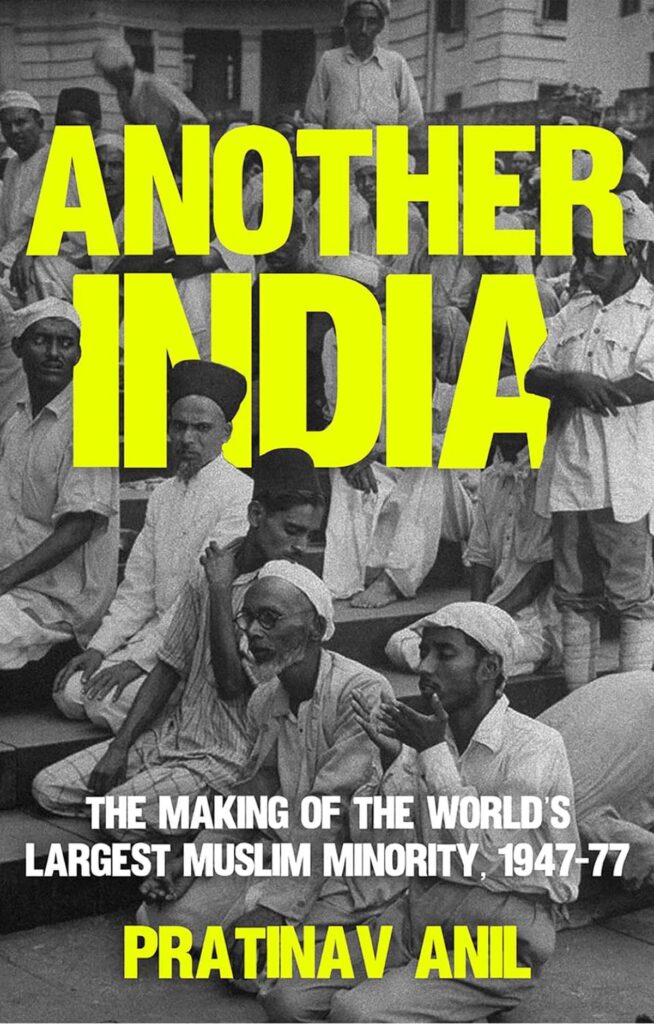
Pratinav Anil is perhaps the only modern historian who has gone against this trend to put right the wilful muting of Indian Muslim history. His new book Another India: The Making of the World’s Largest Muslim Minority, 1947–77 is an in-depth analysis of anti-Muslim violence since Independence that exposes the Islamophobic facet of the country the Congress established in August 1947.

In simple terms, the question that Another India seeks to answer is: Was the Congress’s idea of India genuinely secular and based on communal equality? From the facts it lines up, the answer is ‘no’.

Riots and taunts

Not many know that the “most violent Hindu-Muslim conflagration of postcolonial India” was unleashed in 1964 in which a staggering 800,000 Muslims from Bengal were pushed into East Pakistan.

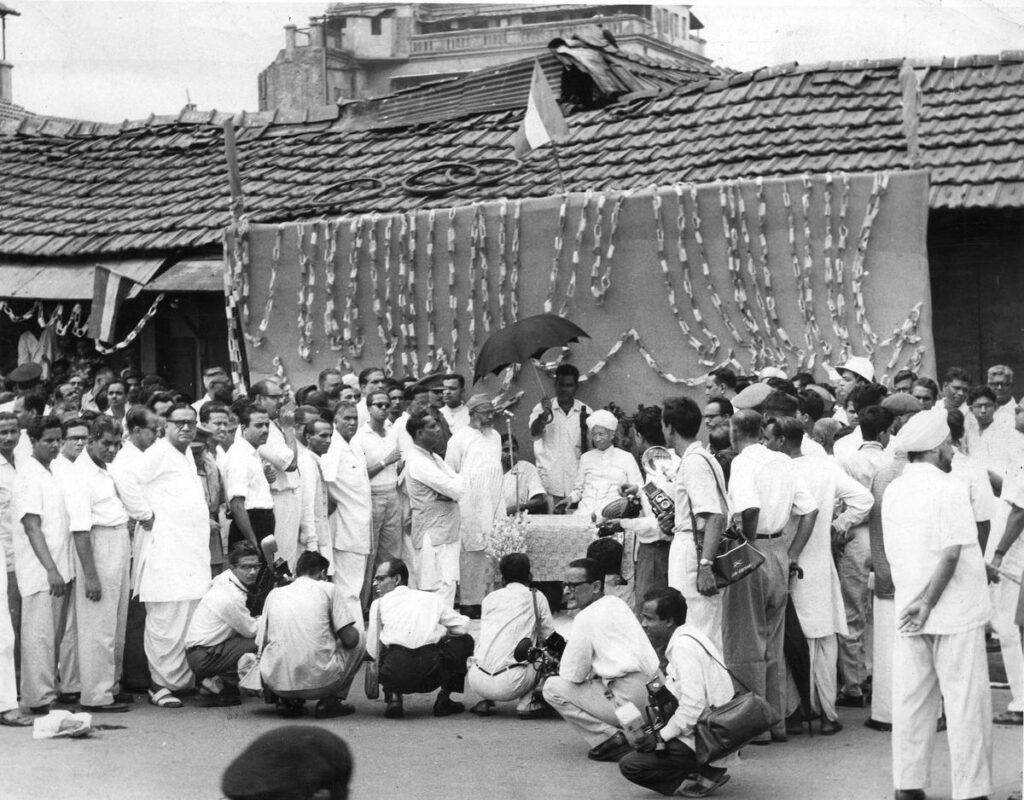
President S. Radhakrishnan visiting Central Calcutta, a predominantly Muslim locality, affected by the January riots. He is seen with the Muslims of the locality (Kalabagan area) on June 30, 1964. | Photo Credit: The Hindu archives

Indeed, it was under the Congress that the derisive “go to Pakistan” taunt was actualised when nearly 2% of the Indian Muslims were sent to Pakistan after being branded infiltrators who had sneaked in to convert Hindus to Islam. Before being expelled, they were dumped in makeshift camps on the border “like herds of cattle”, and forced to “sign papers declaring falsely that they were Pakistanis” when many of them were genuine Indians.

A large number of those who couldn’t be “sent to Pakistan” became the victims of the “riots galore” that dotted Nehru’s rule. The “institutionalised riot system” was so one-sided that Muslims made up 82% of the fatalities and 59% of the injured.

Prepossessed hostility towards Muslims was also the cause of the 1948 police action in Hyderabad which, for Anil, was “a mass pogrom” because it had resulted in the massacre of 40,000 Muslims, the rape of women, loot, arson, desecration of mosques, forcible conversions, and seizure of houses and lands. Nehru hastily suppressed the Sunderlal Report that brought out these facts.

Anil concludes that Nehruvian India was often “an Islamophobic agency” that wore secularism as “a fig leaf” to hide its pro-Hindu bias.

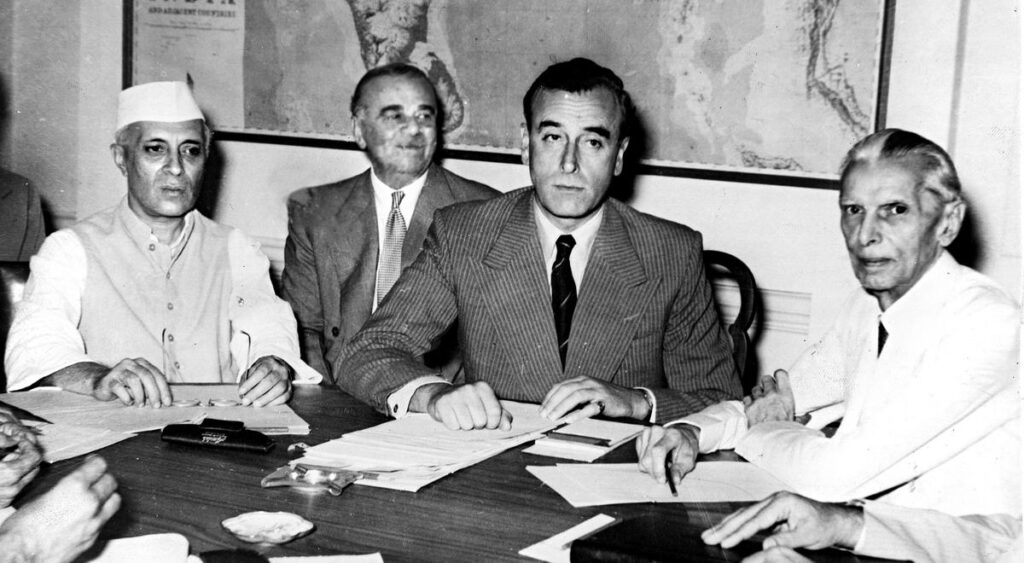
At the historic conference in New Delhi on June 7, 1947, when Lord Mountbatten disclosed Britain’s “partition” plan for India. (left to right) Jawaharlal Nehru, Lord Ismay, Adviser to the Viceroy, Lord Mountbatten, and M.A. Jinnah, President of the All-India Muslim League. | Photo Credit: The Hindu photo archives

The Ashraf betrayal

But how did the Congress get away with its brazen marginalisation of Muslims? With the help of “nationalist Muslims” and “notables”, says Anil.

The former were mostly Muslim Congressmen who harmed their community by conflating India’s progress with that of the Congress; shielding Congress from criticism by blaming Muslim communalists for Partition, and placing the constitutional protection of the shariah above the community’s political rights.

The “notables” comprised upper-class Muslims (the ashraf) such as mutawallis (custodians of waqf properties), waseeqadars (princely pensioners) and waaqifs (dedicators of properties for waqf) all of whom used their aristocratic agency to feather their nests in the guise of working for the community’s economic development.

A major preoccupation of these patricians was “the preservation of distinctive elements of Muslim culture in a non-Muslim environment.” Backing them to the hilt were the ulama, especially those belonging to the Jamiat Ulama-i-Hind which Anil calls a branch of the Congress in all but name.

The “ashrafised” Islam that the ashraf-clergy nexus promoted secured the class interests of the ashrafs and almost totally ignored the plight of common Muslims.

In a scathing attack on the Muslim elite’s obsession with the shariah-based Personal Law, Anil says that it furnished the patriarchs with “a private fiefdom to do as they pleased” without mitigating the community’s “despondent public existence in an Islamophobic society.”

No space for scrutiny

As a consequence, Muslim politics had no room for “trade unions, mass protests, anti-discrimination legislation, and subaltern solidarity” while it had plenty for “high cultural totemic symbols such as the AMU, auqaf, Urdu, and the sharia.” This suited the ruling “Hindu Congress” because a politically empowered non-Hindu group was not in its interest.

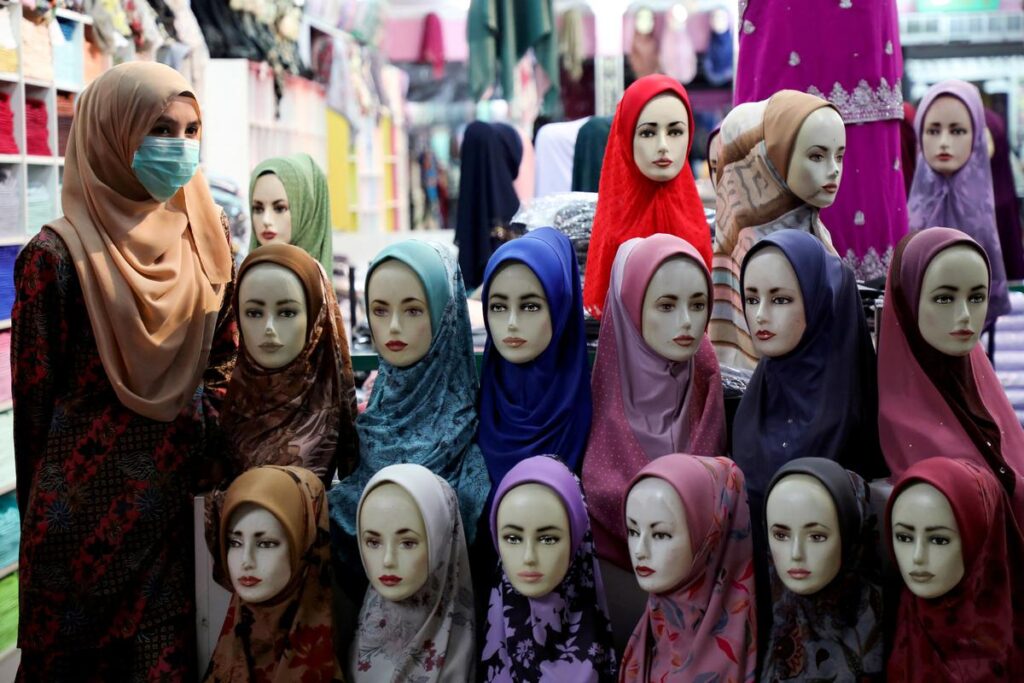
Even today the ashraf-clergy alliance prioritises religion and religious symbolism over social cohesion and political participation. If, for instance, ashraf-backed madrasas are fixated on anachronistic medievalism, many clergy-endorsed secular English medium schools controlled by wealthy Muslims promote religious identitarianism by making the skull cap (for boys) and the hijab (for girls) a mandatory part of the uniform.

At a hijab shop. | Photo Credit: Reuters

This self-ghettoisation, which is nothing short of an attempt to discourage the enrolment of non-Muslims in Muslim schools, sustains itself on the fear of the other and has the potential to render Muslim students incapable of living in multi-religious and multi-cultural societies after graduation.

Given this sad state of affairs, Another India couldn’t have come at a better time. Its neoteric narrative is not just a searing exposé of Congress’ betrayal of trustful Muslims who stayed back in India after rejecting Pakistan; it is also an invitation to Indian Muslims to acquire a sense of critical thinking and break free from the serpentine stranglehold of the ashraf-clergy alliance that is hell-bent on denying them the heaven-ordained right to intellectual liberation.

Another India: The Making of the World’s Largest Muslim Minority, 1947-77; Pratinav Anil, Penguin/ Viking, ₹999.

The reviewer is Secretary-General of the Islamic Forum for the Promotion of Moderate Thought.

source: http://www.thehindu.com / The Hindu / Home> Books> Reviews / by A Faizur Rahman / February 04th, 2024

Poet Farooq Nazki, voice of India in gun-ridden Kashmir valley, dies in Jammu hospital

JAMMU & KASHMIR:

Nazki took over as the director of Doordarshan and All India Radio, Srinagar — the twin propaganda arms of the State — after Lassa Koul, his boss at Doordarshan, was shot dead by militants on February 13, 1990

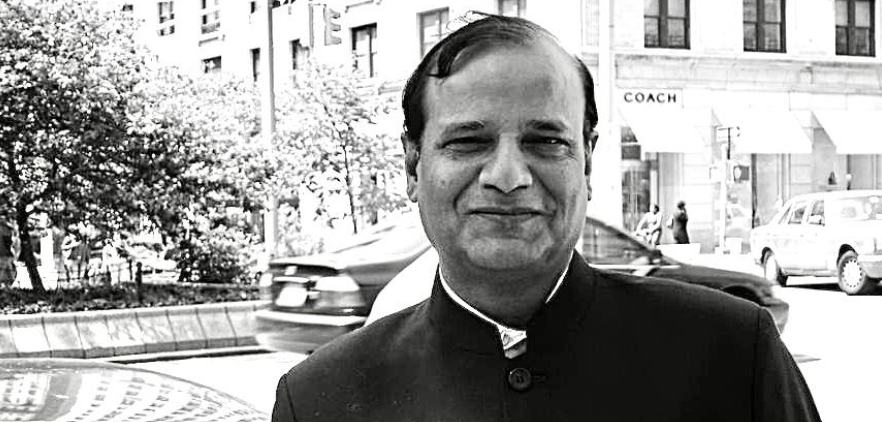
Farooq Nazki / Sourced by the Telegraph

Farooq Nazki, the versatile poet and broadcaster who steered India’s ship in Kashmir during the turbulent 1990s when the Valley was up in arms against the State, passed away on Tuesday at a hospital in Jammu’s Katra.

Nazki was 83 and is survived by his wife, son and two daughters. According to his relatives, he had been battling various health issues, including lung and kidney complications, for the past several years.

“The passing away of a qalander (ascetic or a carefree man) is not to be mourned; his fulfilling life is to be celebrated. For he has left this station after enriching it in many ways. A societal loss which is a personal bereavement. RIP Mir Mohammed Farooq Nazki (1940-2024),” his son-in-law Haseeb Drabu, a former journalist and politician, posted on X.

Politicians, including those from the BJP, National Conference and the People’s Democratic Party, mourned his death.

Nazki took over as the director of Doordarshan and All India Radio, Srinagar — the twin propaganda arms of the State — after Lassa Koul, his boss at Doordarshan, was shot dead by militants on February 13, 1990.

Militancy, which had erupted months earlier, was at its peak and the twin media institutions were its foremost targets, forcing authorities to turn the joint complex into a garrison. Under Nazki’s stewardship, they continued their fierce anti-militancy stand.

“He was like a one-man army, perhaps the lone Kashmiri Muslim who wore his Indian nationality on his sleeves those days, although I do not know how much of that was conviction and how much, compulsion,” a journalist, who covered Kashmir during the troubled 1990s, told The Telegraph.

“He was perhaps the most guarded Kashmiri those days, and he moved in a convoy of security vehicles. They were no ordinary times. National Conference leaders, including Farooq Abdullah, deserted Kashmir, and police too were in a mood of rebellion. Certainly, that did not go well with the people.”

Kashmir was rocked by a police revolt in 1993, forcing the army to storm into their headquarters to crush it. There was, however, no bloodshed.

Early in January 1990, Farooq Abdullah resigned as chief minister in protest against the installation of Jagmohan as governor. The Assembly was dismissed and governor’s rule was imposed, which triggered mass protests.

A former colleague of Nazki said there were no resignations at Doordarshan and AIR when militancy started, unlike in 1953 when Sheikh Abdullah was removed from power.

“He (Nazki) would say that he was doing his job and if there was anybody else, he would have done the same. He was brave enough to do it openly. In his poems, you will find him reflecting on the pain and sufferings of Kashmiris. But it is also true he was against militancy because he thought it would bring us ruin,” he said.

“He continued the parampara (tradition) of hoisting the Tricolour at Doordarshan, and that was no small feat in those days. He retired as deputy director-general, Doordarshan, in 2000, and to my surprise, he was never harmed. I have seen him moving around Lal Chowk without security. That is perhaps because he was a multi-faceted personality.”

Former Doordarshan director Shabir Mujahid, who worked under Nazki, said he was an ace broadcaster and a poet.

“He was a trendsetter at the national level. It is he who gave the concept of soap operas to Doordarshan, starting with Shabrang in the early 1980s. He produced many plays and serials. He was equally a wonderful poet,” Mujahid told this newspaper.

In 1995, Nazki won the Sahitya Academy award in Kashmiri language literature for his book of poetry, Naar Hyutun Kanzal Wanas (Fire in the Eyelashes).

After his retirement, he served as media adviser to two former chief ministers, Farooq Abdullah and Omar Abdullah.

source: http://www.telegraphindia.com / The Telegraph Online / Home> India / by Muzaffar Raina, Srinagar / February 07th, 2024

Dr Farasat Hussain: Remembering a Doctor, Healer and a Remarkable Son of Magadh

Chhapra District / Gaya, BIHAR :

Dr Hussain was the kind of man, that if he himself were to read (or edit) this obituary, he would flinch at the mention of his generosity as a doctor or friend. Good deeds were to be done, he believed, not to be remembered or recounted.

Dr. Farasat Hussain (1952-2023)

This Sunday (August 6) when a group of people assemble to remember Dr Farasat Hussain, in ‘Renaissance’, an aptly named Cultural Centre in Gaya, set up by his lifelong friend, noted litterateur Sanjay Sahay and his wife Durba Sahay, the inter-faith gathering will be much more than a tribute to him. They will of course meet to talk about the good doctor who died on July 28 at the age of 71 in Delhi. But the meeting will embody the very essence of Dr Hussain’s life which was dedicated to bridging divides and building relationships. Be it religious, caste and class, there was not one single divide he had not jumped across.

The meeting will be very personal, no doubt, but it will also be a tribute to the India he inhabited for most of his life, where he was proud to serve as a doctor, live his life as a Magadh ka baashinda, a Bihari, an Indian, and all in all, a lively human being. But it will also be a necessary reminder in these vicious and polarised times of people who with their singular focus on humanitarian work are the secret sauce of what keeps or certainly kept India going.

Born in Bihar’s Chhapra district in 1952, Dr Hussain made Gaya his home soon after he completed his post-graduation in Orthopaedic Surgery at Government Medical College, Ranchi in 1983.

As a young doctor, he would kick-start his Rajdoot motorcycle and ride off to remote villages across Bihar to attend to emergencies. A pioneer in polio corrective surgeries in Bihar, he conducted scores of special camps where he performed more than 3,000 polio surgeries for poor children when he started his work here decades ago. He even conducted Caesarean sections when a gynaecologist wasn’t available.

In a state where public health was never really a thing, doctors like Farasat Hussain were the system. He was anyway an exceptional surgeon who had multiple opportunities and offers to make a career in the lucrative corporate medical sector, but he didn’t even consider it. He stayed in Gaya where he mixed his practice as a doctor with large-scale social work, community building and helped initiate a multi-faith effort to ensure communal harmony across the Magadh region.

But for people there, he wasn’t just a skilful surgeon and an efficient clinician, he was also a psychologist. His unique sense of humour, they suspected, was part of his treatment plan for a patient. Dr Hussain didn’t merely look at the disease of his patients, he treated the person. In a place where health infrastructure had crumbled in the decades of the 80s and 90s, he was an address for the sick where they knew they would surely get help.

He was also closely associated with the upliftment of the disabled population, who remember him as a mentor and benefactor for helping them with their livelihood. Several disabled people travelled from across the region, despite difficulties, and joined his funeral.

In 2010, the government of Bihar honoured Dr Hussain for his work. At that time, he was national president of the Association of Sports Medicine of India. He was honoured for his contribution to promote sports among disabled people, especially polio patients.

Dr Hussain was closely associated with Arpan, an organisation of disabled people in Gaya, where he was instrumental in motivating disabled youngsters to participate in sports and other activities to turn their physical challenges into opportunities that helped them move away from a life merely at the fringes of society.

Dr Hussain mentored Krishna Murari, who subsequently represented India at the sitting volleyball competition in the US.

Several other disabledyoungsters from the Magadh region also attended national sports events in cricket, volleyball and cycling. His focus on encouraging disabled youngsters to take up sports was to help in their inclusion in the social fabric, not as dependents, but as equal partners.

Dr Hussain was an integral part of the inter-faith dialogue, peace and harmony initiatives in the Magadh region.

This is why those who attended his burial say that it aptly exhibited the fruits of his lifelong work to build bridges between communities. Buddhist monks came to pay their respects to him. Hindus and Muslims came and prayed for him. Several disabled men came for the first time into a graveyard, only to express their love for the departed. There were madrassa children, who were helped by him when their institution was in extreme financial distress. A befitting farewell to a man of all persons.

Dr Hussain had been closely involved with one of Bihar’s oldest minority educational institutions – Mirza Ghalib College, where he consistently promoted progressive and secular values. Mirza Ghalib would be proud of all that he upheld there. He was also involved with a number of charity organisations, such as an orphanage at Cherki for more than two decades. This home for poor, underprivileged orphans is one of the biggest in India.

Dr Hussain was an exceptional man, who stood out because he was so restless and always busy, working, helping; a doctor in the truest sense of the word.

I happened to meet him several times, and saw an adoring grandfather to a precocious and thoughtful Farris. His quiet charm, polished demeanour and contagious smile did not mean that he ever held back on his views. A man capable of sharp candour and an openness of the heart, he could surprise you with his diagnosis of the social situation.

Dr Hussain was the kind of man, that if he himself were to read (or edit) this obituary, would frown and take serious umbrage at even a mention of his generosity as a doctor, friend, and human being. Good deeds were to be done, he believed firmly, and not to be remembered or recounted.

He is at eternal rest now. But his life needs to be celebrated for how he lived it and how he wanted the world around him to be. There is a need to nourish his legacy, intangible as it may seem. This is true today more than ever before, as we seem to have a hard time even imagining living a harmonious life as a collective.

He knew very well that there was no magic pill to fix the social fabric, no ready rafoo. But the good doc he was, he knew what it took to keep trying to get there and the importance of keeping all kinds of fevers down.

RIP, Dr Hussain.

source: http://www.thewire.in / The Wire / Home> English> Health> Rights / by Seema Chishti / August 05th, 2023

Impelsys CEO, Sameer Shariff enters elite IRONMAN Club

Bangalore, Mangalore, KARNATAKA / New York, U.S.A :

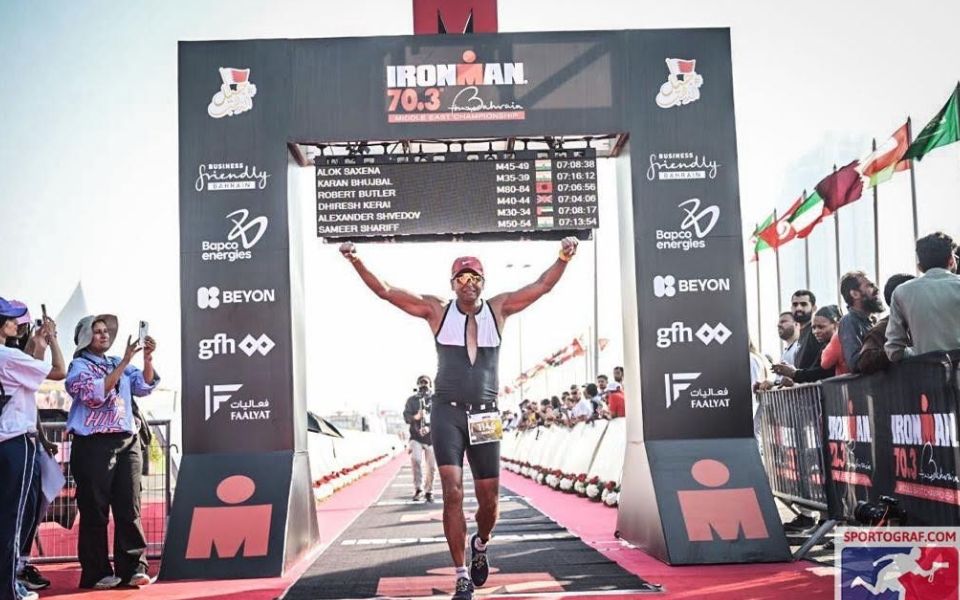
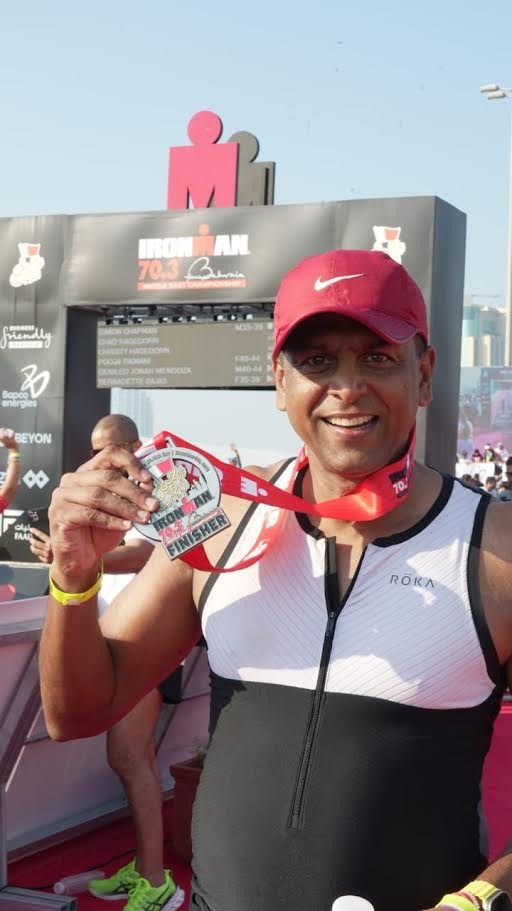
Sameer Shariff, the CEO of Impelsys, a prominent IT company with global offices, including one in Mangalore, successfully completed the IRONMAN 70.3 Bahrain triathlon on December 8, 2023. The challenging event, held at Reef Island, witnessed the participation of over 1500 individuals, with more than 1000 successfully completing it.

By accomplishing the IRONMAN 70.3 course, which comprises a 1.9 KM swim, 90 KM cycling, and a 21.1 KM run, Sameer Shariff joined an exclusive club of global business leaders who have conquered this grueling challenge. Beyond personal achievement, Shariff aims to inspire others to adopt a healthy and active lifestyle. He expressed, “Completing the IRONMAN triathlon pushed my endurance limits, and I believe it sets an example for others. We are making strides with the CEO Fitness Challenge for associates at Impelsys.”

Shariff’s achievement has motivated many colleagues at Impelsys to pursue their fitness goals. Sripad, heading cloud services, shared, “Sameer’s dedication motivated me to run a half marathon in 2023.” Prachi, a project manager, added, “After seeing Sameer’s preparations, I decided to participate in a half marathon. I completed my first half marathon on November 5, 2023, in Mangalore.”

These accomplishments mark the beginning of a broader wellness initiative envisioned by Sameer Shariff. In 2024, Impelsys aims to encourage more participants, extend the challenge to partner organizations and customers, and promote overall well-being. The ‘CEO Fitness Challenge’ is a voluntary program that has seen over a hundred associates engaging in specific health and fitness activities, collectively achieving impressive milestones.

source: http://www.english.varthabharati.in / Vartha Bharati / Home> Gulf / by Vartha Bharati / January 12th, 2024