Bijnor (former Northwest United Provinces) – presently (Moradabad Division), UTTAR PRADESH :
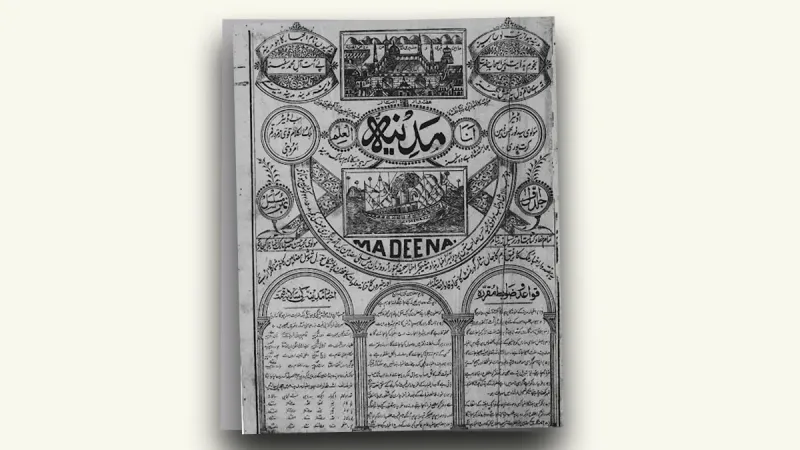
Started as a local bi-weekly newspaper, Madinah soon commanded a massive subcontinent-wide circulation. While most newspapers at the time focused on major colonial urban centres such as Lahore, Delhi or Calcutta, Madinah instrumentalised its place of inception—Bijnor—as a political shield.
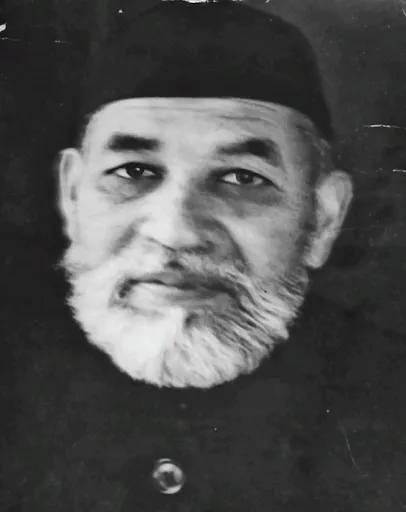
‘Madinah,’ a bi-weekly newspaper founded in 1912 by Mohammad Majeed Hasan, began in his courtyard in the small qasbah of Bijnor in the Northwest United Provinces (present-day Uttar Pradesh). Its inception is later recounted in a dream narrative published in Madinah’s silver jubilee edition in 1939, which describes how Hasan dreamt of “a bright moon shining in the sky, being eclipsed by another moon appearing from behind and drifting away from it, becoming brighter as the dream continued.”
Hasan had been working as a journalist in Lahore while also preparing for a career as a judge. He is said to have had the dream shortly after abandoning his training and returning to Bijnor to continue working for the family newspaper Sahifa, whose modest readership had already begun to dwindle. Hasan later interpreted the dream as a sign that he should start his own newspaper, symbolised by a new shining moon.
Hasan’s first wife, Muhtarma Kaneez Fatimah, whose altruistic nature and firm belief in his venture compelled her to help him start the paper, sold her jewellery to support it. She later proved to be an intelligent and capable assistant in the newspaper’s production, despite being unable to read or write.
It was she who inspired the newspaper to include a separate women’s section named Akhbar-i-Nisvan on one of its last pages. The section frequently appeared during the newspaper’s first three years, from 1912 to 1915, and was intended to serve the interests of Muslim women by including editorials and creative pieces written by both men and women.
Soon, the paper had distinctly identified itself among its audience by creating a space for Muslim women, with a special focus on mothers, to discuss their issues through genres such as poetry and fiction.
The unlikely epicentre: importance of the Qasbah
Started as a local bi-weekly newspaper, Madinah soon commanded a massive subcontinent-wide circulation. While most newspapers at the time focused on major colonial urban centres such as Lahore, Delhi or Calcutta, Madinah instrumentalised its place of inception—Bijnor—as a political shield. In the same year as Madinah’s inception, Maulana Azad, at the age of 23, started the paper Al-Hilal in Calcutta, which was lauded among the Muslim elite and others for its publishing style and genre, soon reaching a pinnacle of readership.
In contrast, Madinah’s unique approach, which embraced the values of the gentry while also appealing to a broad readership beyond the traditional urban elite, distinguished the paper from the incessant urban cynicism that was becoming a prevalent theme throughout the landscape of production. Due to better readership and the greater availability of resources in urban areas, similar endeavours to Madinah redirected themselves to these spaces.
In its founding years, Madinah also addressed British officials, adopting varying strategic and bargaining stances against surveillance and strict government policies through explicit deference to colonial authorities. For instance, Hasan, the proprietor of the newspaper, cited the Ijazat (permission) of the Magistrate and Collector of Bijnor in its inaugural issue. This attentiveness to British intelligence provided the necessary immunity required for the functioning of the newspaper, unlike Azad’s Al-Hilal, which came under heavy scrutiny from the colonial government and had to cease publication by the end of 1914.
Newspapers in urban centres, such as Awadh Akhbar, persisted in their efforts to speak to a broad audience delineated more by language and culture than by religion, while papers such as Madinah reinforced an already rich discursive tradition surrounding religion and identity in the social crevices known as qasbahs (small towns). They also engaged with contested political themes debated by scholars and leaders, including the shaping of early narratives of separatism and communalism among Indian Muslims.
The success of Madinah can be attributed to the spatio-temporal advantages of the qasbah, which can be defined as a place of bureaucratic and market significance where a Muslim minority or majority lived alongside populations from other communities, alongside an influential enclave of intellectual vivacity and economic and political importance for Muslims. Scholar M. Raisur Rahman described qasbahs as “an alternative site for contestation with strong autonomous networks of culture, literature and religion”, while simultaneously defining them as a ‘unique space’ and a ‘microcosm of larger idealized national life’.
These spaces have been significantly important sites in the history of South Asian culture, shaping identities and literary traditions while remaining distinct from the typologies of urban environments, where modernity had already seeped through the sutures of cultural exchanges with the outside world.
Madinah and its role in politics
The political trajectory of Madinah transformed profoundly during the period of World War I, following the Balkan Wars. The paper broadened its purview by juxtaposing the localised ethos and culture of the qasbah with larger international crises, particularly the imminent dismantling of the Ottoman Empire.
Navigating the intricacies of a contested political landscape, Madinah supposedly guarded a global Islamic consciousness through its promotion of the Khilafat Movement and its shared affiliation with Jamiat Ulema-e-Hind. Consequently, its support for the Indian National Congress and its anti-separatist stance against Jinnah became apparent, aligning with Jamiat’s idea of Composite Nationalism, as Madinah continued to anchor itself in the secular, anti-colonial bedrock of Urdu journalism.
According to scholar Gyanendra Pandey, Madinah served as a vital barometer of Muslim public opinion across this shifting timescape. Driven by the ideological synergy of Hindu-Muslim unity during the Non-Cooperation and Khilafat movements, the publication commanded an astounding peak circulation of 12,500 copies by 1922. However, this radical nationalism invited severe repercussions from the colonial state, notably resulting in the paper being banned in Punjab following its courageous and explicit reporting on the 1919 Jallianwala Bagh massacre. Following the ban, the paper was relaunched in August 1919 under a new name—Yasrab (Madinah in Arabic)—as an act of strategic defiance against the colonial government, with a couplet from Iqbal:
Khāk-i Yasrab az do ‘ālam khūshtar ast,
Ā’e khunak shahre ke ānjā dilbar ast
(The dust of Madinah is better than both worlds,
How wonderful is the city where the beloved is.)
As the landscape of production became increasingly fragmented by communal cynicism and the mass political momentum of the early 1920s waned, the paper witnessed a decline in readership, with circulation dipping to 6,500 in 1927 and further to 6,000 by 1931.
Despite this dwindling circulation, Madinah remained a formidable and persistent critic of communal separatism throughout the 1930s and 1940s. Engaging with the contested political themes of the era, the paper sought to dismantle the early narratives of the All-India Muslim League. Pandey highlights a remarkably bold editorial from the 1930s that dismissed the League as being “neither dead nor alive”, asserting that its existence was confined merely to “the brain and mind of Mr. Jinnah”.
By 1942, the newspaper had effectively transformed into an open town hall, enabling ordinary citizens to debate and largely resist the looming Pakistan movement from within the landscape of the qasbah.
The script and scripture
The prevalent Urdu script, Nastaliq, which had been used throughout South Asia for centuries and was imported from Persia, featured intricate details, ornamentation and a complex structural form forged through the meticulous amalgamation of the Naskh and Ta’liq calligraphic traditions. It became the most recognisable Urdu script and developed strong cultural and ideological ties with the Urdu language. However, due to the rise of globalisation and the growing demand to produce literature for the public, it became increasingly difficult to produce works in the script lithographically on a mass scale. By the end of the 1970s, Nastaliq began to advance with the help of Mirza Jamil Ahmad, who created more than 20,000 combinations to bring the script into the digital world under the name Noori Nastaliq.
By the time the digitisation process began, Madinah was already out of business, shutting down its press with its last issue in 1976. During the seven decades that the paper survived, its editors had no keys to the press and no screens to reflect upon. Instead, the issues of Madinah were produced solely by hand, by calligraphers and artists alike.
The Urdu script Nastaliq had been established as the standard for almost every copy of the holy book Quran in South Asia since the Mughal period. By the time Madinah began using the same script as its standard, it already carried connotations of purity, holiness and divinity within the cultural landscape. Combined with the organic practice of producing it by hand rather than by machine, the paper was considered by its readers to embody a deliberate resistance against illegitimate mechanisation and the rising industrialisation of the subcontinent, curating a new political discourse based on the cultural symbolism of the script.
By using and retaining lithographic practices in an era when other papers were increasingly relying on mechanical typography for efficiency, Nastaliq was perceived as a tactile and handcrafted discipline that preserved the inherent spirit of prose, shielding the paper’s contributions from the mechanical and indifferent processes of Western print capitalism.
The inevitable descent
By the 1940s, Madinah had begun engaging in intense print debates with the supporters and proponents of pro-Muslim League newspapers and writers, arguing in a polemical fashion that religion could not be the sole determinant of a nation’s survival. Despite the paper’s persistent efforts to resist the pro-League and separatist stance, it witnessed the partition of the Indian subcontinent into two parts. The social capital of Madinah was on the verge of collapse, as the paper saw affluent members of the Muslim community, who had constantly contributed to its production and editorials, leave for the other side of the border.
The Language Act of 1951 became a huge blow to the publishing house of Madinah, as Hindi was soon adopted as the state language in Uttar Pradesh, mandating officials and government offices to maintain all data in Hindi and extensively replacing Urdu in institutions under the newly formed Indian government. Although the apparent marginalisation of the paper’s foundational language and the loss of its social capital were significant blows in the paper’s history, they were unable to overshadow its continuing legacy.
Madinah, managing to survive, remained a prominent, albeit ageing, symbol of pre-Partition nationalist Muslim political identity, advocating for the preservation of Urdu heritage amid the growing socio-political shifts in Uttar Pradesh. At the same time, it continued to struggle against declining circulation as newer, faster-printed typographic dailies overtook the market. Its reports on the Indo-Pakistani War of 1971 and the creation of Bangladesh vindicated the paper’s historical assertion that religion alone could not hold a nation together, while it also continued reporting on rising communal tensions in the country.
The prodigious endeavour was about to culminate in the years following the Indo-Pakistani War. Near the end of its operational life, the paper’s traditional lithographic format and qasbah roots struggled to attract younger, urbanised readers. The deteriorating health of Hasan finally caught up with him, leading to his death in 1972. The handling of the newspaper remained in the hands of Hasan’s family until its last editor, Syed Hasan, finally ceased publication, quietly closing the press in 1975.
References
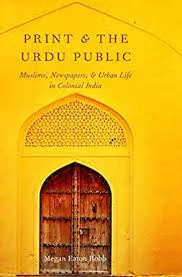
- Jones, J. (2023). Megan Eaton Robb: Print and the Urdu Public: Muslims, Newspapers, and Urban Life in Colonial India. New York: Oxford University Press, 2021; pp. xi + 247. Journal of Religious History, 47, 151–153. https://doi.org/10.1111/1467-9809.12917
- Abduhu, G. R. (1973). The Educational Ideas of Maulana Abul Kalam Azad. Sterling Publishers.
- Rahman, M. Raisur. (2014). “Beyond Centre-Periphery: Qasbahs and Muslim Life in South Asia.” South Asian History and Culture, 5, 163–178. https://doi.org/10.1080/19472498.2014.883762.
- Eaton Robb, M. (2016). “Women’s Voices, Men’s Lives: Masculinity in a North Indian Urdu Newspaper.” Modern Asian Studies. https://doi.org/10.1017/S0026749X15000335
- Pandey, G. (1978). The Ascendancy of the Congress in Uttar Pradesh, 1926–34: A Study in Imperfect Mobilization. Oxford University Press.
source: http://www.maktoobmedia.com / Maktoob Media / Home> Features /by Mohammad Azim / August 30th, 2026