Tag Archives: Masoom Moradabadi

Book on Bhopal’s noted Urdu journalist ‘Arif Aziz – Ek Tajzia’ released

Bhopal, MADHYA PRADESH :
Bhopal: 

When a journalist is eulogized in a function by speakers after speakers wherein a book critically analysing his works and personality is being released then it is but natural that tears of joy start rolling down the journalist’s cheeks.

Such was the case with the well-known Urdu journalist Arif Aziz of Bhopal when at the fag end of the function of releasing the book on him entitled “Arif Aziz – Ek Tajzia” (Arif Aziz – An Analysis) here he was asked to speak after the dignitaries on the dais one by one lauded his journalistic and literary services spanning over 40 years. He was overwhelmed by the occasion as the cup of love was brimming or even overflowing. When he rose to address the assemblage he found his voice virtually chocked and eyes welled up with tears. He was seen sobbing involuntarily while standing mute for a minute or two as volunteers ran helter-skelter to fetch water so that he could wet his parched throat. Another volunteer fetched a tissue paper to help him wipe off his tears and gain composure to be able to speak a few words on the occasion.

Arif Aziz, the “Son of the Soil”, struggling for words told the jam-packed Hindi Bhavan auditorium in a chocked voice that whatever has been said about his works and personality is an exaggeration. He is not an iconic figure to be showered such praises upon him by his well-wishers.

“Whatever I did in my life as a journalist I did it with all my honesty and sincerity and saw to it that the profession to which he belonged does not get blotted by his actions”, he added.

He gave credit for his success to his journalist colleague Ashfaque Mashhadi Nadwi. The book concept on him is the brain child of Ashfaque Mashhadi and Urdu litterateur Dr. Akhlaque Asar. It was brought into reality by another journalist colleague Inamullah Khan Lodhi and Arif Aziz’s daughter Mardia Arif, who is also a writer in her own right, as they painstakingly compiled the write-ups and essays on him, he revealed.

“Hajji Mohammad Haroon, president of Jamiat-e-Ulma-e-Hind, Madhya Pradesh unit, placed the icing on the cake by organising such a grand function for me that I did not deserve”, he remarked.

Without any doubt the book releasing function was a glamorous and glittering with eminent writers, columnists cutting across language barriers, and famed personalities who graced the occasion.

Arif Aziz’s friends, well-wishers and relatives also thronged the venue in large numbers to make it a most memorable occasion. Not only this outstation relatives, fans and Urdu lovers in large numbers too made it a point to attend the function to make it a memorable one. Apart from Delhi people from Indore, Sagar, Vidisha, Ashta, Sironj, Sehore etc. participated in the function. The representatives of a number of literary organisations and individuals poured out their love for Arif Aziz on the occasion and mobbed him with bouquets, garlands and gifts. Congress MLA Arif Aqueel draped him with a shawl around his shoulders to honour him. About a dozen tiny-tots also did not lag behind and felicitated him with flowers.

It is noteworthy that as the function was moving along telephonic congratulatory messages of Arif Aziz’s friends and fans from across the border poured in hailing his exemplary journalistic journey.

It has been seen that one’s services are usually extolled after one’s death but Arif Aziz is fortunate enough that his untiring efforts were recognized in his lifetime and he saw this all with his own eyes.

The 384 pages book “Arif Aziz — Ek Tajzia” is a voluminous bunch of essays on the personality, services and dedication of authentic, revered writer and Urdu journalist Arif Aziz. It has been compiled by journalist Inamullah Lodhi and Mrs. Mardiya Arif.

The function of the release of the book was organised under the aegis of Maulana Barkatullah Bhopali Education and Social Welfare Society, Bhopal with its president Hajji Mohammad Haroon and his team leaving no stone unturned to make the occasion of the book release a big and a grand success.

Arif Aziz is Special Correspondent of “Nadeem”, the oldest Urdu daily of Bhopal. He is a voracious writer and has authored nine books on various subjects. Daily columns written by him are reproduced by over a dozen national and international Urdu newspapers. He has written over 20,000 articles in the last 40 years of his journalistic life. He has been decorated with All India Hakeem Syed Qamarul Hasan Award of Madhya Pradesh Urdu Academy and 30 other national and state level awards.

The books authored by Arif Aziz include: 1. Nabz-e-Dauran — Anthology of more than 70 essays on Political, Social & Current topics (1994); 2. Zikr-e-Jameel — Comprising of 38 Bio-Sketches published by Madhya Pradesh Urdu Academy, Bhopal (1995); 3. Qadr-o-Qeemat — Anthology of more than 45 critical essays and research papers (1997); 4. Talash-o-Ta’assur — 19 Critical and research papers (1999); 5. Masajid-e-Bhopal — Historical facts of the mosques of world & especially of Bhopal (2003); 6. Had-de-Nigah — An Anthology of 51 Essays on political science & current topics ((2004); 7. Suraj, Chand, Sitare — comprising of 47 Bio-Sketches published by M.P. Urdu Academy, Bhopal (2004); 8. Musafir-e-Haram — Hajj Pilgrimage description (2006) and 9. Azad Hind Mein Urdu Sahafat — from 1947 to 2006 under the project of Makhanlal Chaturvedi Patrkarita Vishvidhayalaya, Bhopal (2010).

The function was presided over by renowned theologian (Aalim-e-Deen), Hazarat Maulana Mohammad Saeed Mujaddadi (popularly known as Peer Saeed Miyan), Rector Dar-ul-Uloom, Taj-ul-Masajid, Bhopal while the chief guest on the occasion was Aziz Qureshi, ex-Governor of Uttrakhand, Uttar Pradesh and Mizoram.

Other guests and dignitaries who participated in the function included: BJP-ruled Madhya Pradesh Home Minister Babulal Gaur; BJP Lok Sabha member from Bhopal Alok Sanjar; Congress MLA Arif Aqueel; Urdu litterateur Prof. Afaq Ahmad; Dr. Tariq Zafar, Vice Chancellor Bhoj Open University, Bhopal; Dr. Khalid Mehmood, ex-Head of Urdu Department, Jamia Millia Islamia, Delhi; Barkatullah University Arabic Prof. Hassan Khan; Maulana (Dr.) Iqbal Masood Nadwi (Islamic Centre, Canada); Senior journalists Masoom Moradabadi (Editor, Urdu daily Jadid Khabar, & fortnightly Khabardaar Jadid, Delhi); Siraj Naqvi, (Rashtriya Sahara, Delhi) and Rajkumar Keswani (Bhopal). Introduction about the book was presented by Prof. Afaq Hasan Siddiqui.

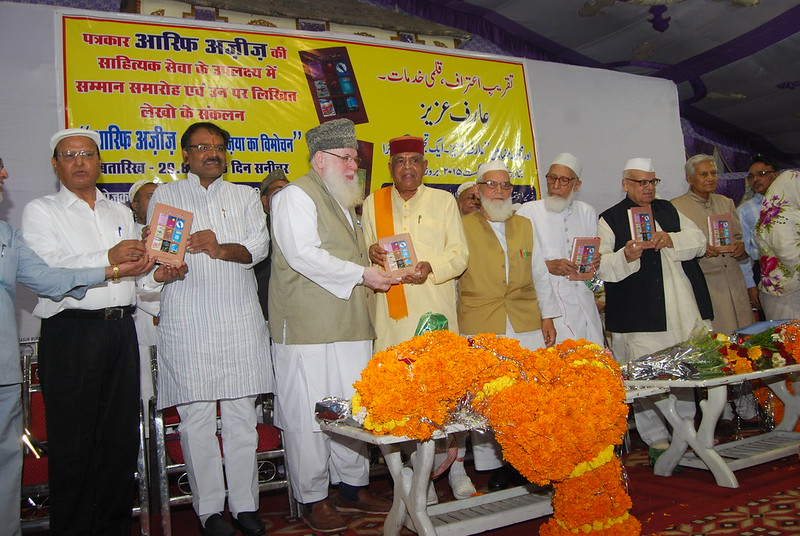
Hazarat Maulana Mohammad Saeed Mujaddadi, Aziz Qureshi, Babulal Gaur, Alok Sanjar, Prof. Afaq Ahmad, Dr. Khalid Mehmood, Alok Sanjar, Dr. Tariq Zafar, and Hajji Mohammad Haroon released the book amidst thunderous applause.

Masoom Moradabadi, Editor of Urdu daily Jadid Khabar & fortnightly Khabardaar Jadid, Delhi, while lauding Arif Aziz and his works strongly pleaded that the veteran journalist be honoured with the Padam Shree award for his yeoman services in the field of Urdu journalism for the last 40 years. He compared him with legendry India’s Freedom Struggle’s first journalist martyr Moulvi Muhammad Baqir, who was editor of Delhi Urdu Akhbar and a great advocate of Hindu Muslim unity. Freedom Fighter Maulvi Baqir was arrested for revolt and without being tried, on September 16, 1957 was tied to the mouth of a canon and was publicly blown up in front of the Khooni Darwaza in Delhi.

Siraj Naqvi, another senior journalist of Rashtriya Sahara, Delhi, also urged that Arif Aziz must be decorated with the Padam Shree award in recognition of his services by the government of the day.

Dr. Tariq Zafar, Vice Chancellor of Bhoj Open University, read out a citation in recognition of Arif Aziz’s services and presented it to him.

Speaking as a chief guest on the occasion Aziz Qureshi while extolling the contribution of Arif Aziz in Urdu journalism and literature lamented that after India’s Independence in 1947 Urdu language has languished due to government’s apathy which history will never forgive. Without batting an eye lid he said that in a calculated move after Independence a campaign was launched to wipe out Urdu. He revealed the campaign was started by the then Union Home Minister Pandit Govind Ballabh Pant, who was responsible for the establishment of Hindi as an official language of the Central government and a few states while dumping Urdu into oblivion. The process started from Uttar Pradesh and is still continuing despite court’s order declaring Urdu as second official language in the state.

In another revelation on the occasion Qureshi informed that after the first war of independence in 1857 the ruler of Bhopal Begum Sikandar Jahan had declared Urdu, in place of Persian, as the official language of her government for the convenience of her Hindu subjects. In the development of Urdu language the contributions of Hindus cannot be ignored, he added.

Maulana Saeed Mujaddadi while presiding over the function blessed Arif Aziz for fulfilling his responsibilities with all sincerity. He prayed he would continue to strive to serve the Muslim community through his journalistic efforts and the Almighty Allah (S) will guide him in all his endeavours.

Home Minister Babulal Gaur, special guest on the occasion, also lauded Arif Aziz’s simple life, his write-ups on social issues and dedication to Urdu journalism. He said he never indulged in yellow journalism for material gains.

At the outset Hafiz Qari Hashim Ansari recited verses from the Holy Quran. Urdu poets Iqbal Baidaar and Zafar Naseemi rendered poetic tributes in praise of Arif Aziz which was applauded by the audience. Khalique Siddiqui and jeweller Sheetal Bhai Soni presented gifts to him on the occasion. In the end Adv. Mohammad Kaleem proposed a vote thanks.

source: http://www.twocircles.net / TwoCircles.net / Home> India News> Indian Muslim> Literature> Top Story / by Pervez Bari, TwoCircles.net / September 04th, 2015
Role of North Indian Muslims in Partition; Ather Farouqui picks holes in that largely held belief

INDIA :

Urdu periodicals, with their dwindling readership, often showcase uninspiring articles, predictable poetry, and pedestrian fiction.

Amidst mediocrity all around, there exists a pressing need for thoroughly researched and academically rigorous articles that challenge erroneous, yet widely accepted notions about the world around us.

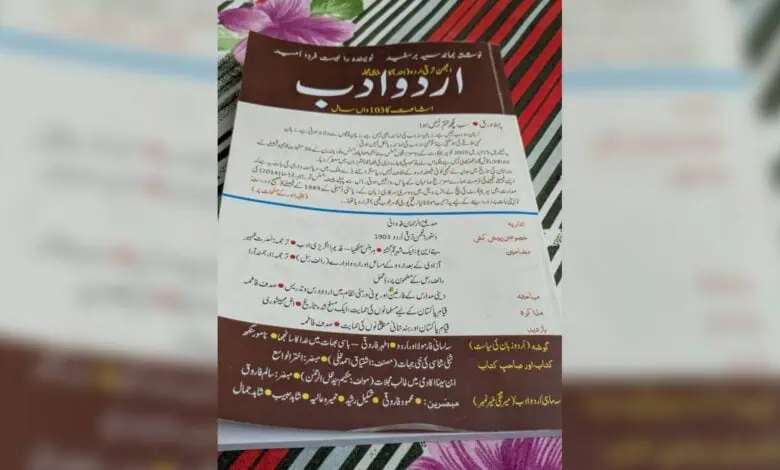
Some literary journals, including Bunyad (Lahore), Urdu Adab (Delhi), Isbaat (Mumbai), and Istefsaar (Jaipur), go beyond what common sense dictates. The latest issue of Urdu Adab, a quarterly publication of Anjuman Tarraqi Hind, bears testimony to this, as its content stimulates the intellect of its readers with a sense of exuberance.

The astutely edited journal by Ather Farooqui features three equally incisive and thoroughly researched articles on the much-maligned role of North Indian Muslims during the Partition, Madrassa students and understanding literature, and Namwar Singh’s tirade against Urdu. Unlike other run-of-the-mill literary journals in Urdu, the journal focuses on the dynamics and politics of language, which refers to the social and political implications of language use and the power dynamics inherent in cultural discourse. Also, it explores consequential questions related to culture and social consciousness. The influence of language on identity and the power dynamics inherent in cultural discourse also come under scrutiny in enriching academic discourse.

The overwhelming support of Muslims in the United Province for the Muslim League in the 1946 assembly elections, which was a sort of referendum on the partition issue, is often regarded as a truism; however, it does not sit well with veteran journalist and author Anil Maheshwari. Urdu Adab presents an article by him, “Support of Muslims for the Formation of Pakistan: A Distorted History: in light of the results of the decisive assembly elections in UP in 1946. Anil’s article, based on archival research, challenges the commonly held belief that the 1946 elections were a clear mandate for the Muslim League. He marshals many pieces of credible evidence that deflates the myth and suggests a more valid interpretation of the results.

Joining Ayesha Jallal (1994) and Christopher Jafferlot (2015), as well as a plethora of celebrated historians, Anil points out that Muslims in the United Province Assembly elections of 1946 did not vote overwhelmingly for the Muslim League. Voters comprising only 5% of the Muslim population cast their votes for the Muslim League, according to the official report of the 1946 elections. Placing the 1946 elections in the context of the universal adult franchise, he points out that only 3% of Indians could vote for the central assembly, while in the provincial assemblies, only 13% were allowed to vote. The article appeared in a reputed periodical, Economic and Political Weekly, laced with incisive interpretation, cogently concludes, “Had the partition of 1947 not occurred, Muslims would have constituted approximately one third of the population of an undivided Indian subcontinent. This demographic would have secured a majority in three to four states, providing them with a substantial and equitable stake in the political framework.”

A promising historian, Muhammad Sajjad, in his perceptive book on Muslim politics in Bihar, also connotes the same conclusion.

With an occasional rhetorical flourish, Anil inveighs against left historians for perpetuating this sort of falsehood.

Irfan Habib, Mazharul Hasan, and Bipan Chandra, too, did not place the onus entirely on Muslims, and HM Serwai’s book, Partition of India: Legend and Reality, provides an alternative understanding.

The article is supplemented with a stimulating critique by Sadaf Fatima, who holds the view that our reputed historians have glossed over the facts, thereby fostering anti-Muslim discourse. One tends to agree with the opinion that Indian Muslims got closely associated with Pakistan. The author seems too harsh when she accuses left historians of holding Jinnah mainly responsible for the partition, as they took Nehru’s side for personal interests.

It is a rare occurrence in Urdu periodicals for an article to spark such a polemical debate as Sadaf Fatima’s piece on madrassa graduates and the teaching of Urdu at universities. There is no denying the fact that most of the Urdu faculty at various universities are the product of oriental syllabi, who lack even rudimentary literary and aesthetic indoctrination. Curiously, the Madrassa’s students get admitted to a postgraduate course in Urdu literature. Sadaf Fatima makes this point pertinently and asserts, “It is incontestable that students are well short of foundational awareness about literature who join university as a postgraduate student of Urdu or opt for Urdu as an optional subject at the graduate level after graduating from a madrasa. Urdu literature does not appear in the syllabi of the madrassas. Urdu literature draws its sustenance from a literary culture that is composed of several local cultures and linguistic practices, reflecting centuries of shared heritage.

A student joining a madrassa at the age of 7 or so has no inkling of the cultural ethos of Urdu, which exists in his milieu.” Her cognate observation sparked controversy, and a smear campaign was launched against her and the editor, Ather Farooqui. Some well-meaning authors and journalists, including Ashar Najmi, Shakeel Rasheed, and Masoom Moradabadi, saw reason in her arguments. It is perplexing to see many vituperative postings on social media.

The author, while expressing deep concern for madrassa-educated students occupying positions in Urdu departments, made it clear that the solution does not lie in prohibiting their direct admission to courses in Urdu literature. There is an urgent need to equip students with literary and aesthetic sensibilities when they join the courses.

An exclusive section is devoted to the politics of the Urdu language, featuring two articles: “Three Language Formula” by Ahter Farooqui and a translation of “Basi Bhaat mein Kuda ka Sanjaha” by the prominent Hindi critic Namwar Singh. An avant-garde Hindi journal, Hans, published Namwar’s highly unreasoned and zealous article in 1987, and Athar Farooqui produced its Hindi text with the translation. In the introductory note, the editor points out that it unfailingly lays bare deep-seated venom against Urdu. Despite being committed to a shared linguistic and cultural legacy, Namwar Singh was bent upon declaring modern Hindi a separate language and restricting Urdu to Muslims only. It is the first instance when a cardholder Marxist critic launched a tirade against Urdu. The editor picked up many holes in the article; this aside, it has the traces of Namwar Singh’s speculative intelligence.

Ather Farooqui spelt out the contours of the three-language formula without taking recourse to official jargon and statutory regulations. An accomplished translator, Arjumand Ara produced an excellent translation of Ralph Russel’s insightful and detailed article on the Problems of Urdu and Urdu Organisations after the partition. Feedback on Russell’s article is also included.

Ather Farroqui deserves accolades for bringing out such an intellectually stimulating function.

source: http://www.siasat.com / The Siasat Daily / Home> Opinion / by Shafey Kidwai / June 21st, 2025

Renowned Journalist Jalaluddin Aslam’s Anthology ‘Naqd-o-Nazar’ Released at Ghalib Academy

INDIA :

New Delhi:

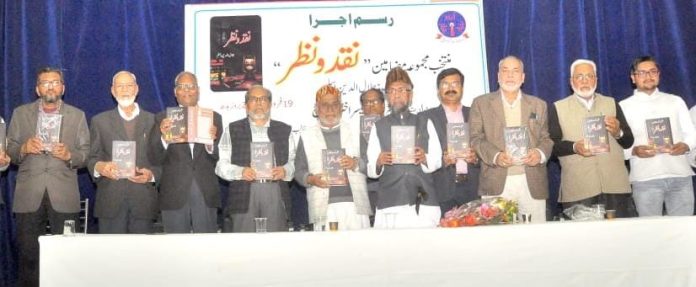
Veteran journalist and writer Jalaluddin Aslam was honored at Ghalib Academy with the release of his selected anthology of essays, Naqd-o-Nazar. The event brought together distinguished scholars, journalists, and literary figures, who acknowledged Aslam’s lifelong dedication to writing and journalism.

Padma Shri awardee Professor Akhtarul Wasey, delivering the presidential address, praised Jalaluddin Aslam’s remarkable contribution to literature and journalism. “He has devoted his entire life to the service of pen and paper. Even in his advanced years, his commitment to writing remains unshaken,” he remarked. Prof. Wasey further emphasized that Naqd-o-Nazar reflects Aslam’s deep thoughts and ideological perspectives and should reach a wider readership.

Renowned journalist Masoom Moradabadi highlighted the humanitarian aspect of Aslam’s life, stating, “The essays in his latest book reflect his deep concern for the nation and community. His life has been marked by selfless service to the needy and deserving.” He underscored that Aslam’s engagement in journalism and literature has always been driven by sincerity rather than financial motives.

Senior journalist Suhail Anjum commended Aslam’s contributions to Urdu language and literature through journalism and writing. “His anthology Naqd-o-Nazar is of archival significance and serves as a valuable resource for researchers,” he stated.

Editor of Urdu Book Review, Mohammad Arif Iqbal, noted that Naqd-o-Nazar contains thought-provoking essays, demonstrating Aslam’s intellectual depth and analytical prowess.

Dr. Syed Ahmed Khan, national president of the Urdu Development Organization, acknowledged Aslam’s silent yet profound contributions to the Urdu language. “Few writers and journalists have served Urdu as selflessly as he has,” he asserted.

Dr. Aqil Ahmed, Secretary of Ghalib Academy, extended his congratulations to the author and urged him to publish his unpublished works as well. Several other prominent figures, including Feroz Hashmi, Javed Rahmani, Dr. Mufti Anwar Javed Dehlvi, and K.L. Narang Saqi, also lauded Aslam’s literary journey.

Among the notable attendees were Maulana Arshad Sirajuddin Maki, Dr. Khurshid Alam, Hakim Aftab Alam, Mohammad Naushad Nadwi, Israr Ahmed Ujini, Danish Rahman, Faizan, Rehan, Zeeshan, Mohammad Owais, Mohammad Hanif, Nadeem Arif, and Mohammad Imran Kannauji.

The event concluded with a vote of thanks by Dr. Abu Zaid.

source: http://www.radiancenews.com / Radiance News / Home> Arts & Culture> Focus / by Radiance News Bureau / February 20th, 2025

Delhi Minorities Commission announces Awards in various fields

NEW DELHI :

Delhi Minorities Commission initiated a scheme of awards to best performers in various fields of human endeavor in NCT of Delhi and beyond.

For 2019-2020, the Commission has decided to offer awards under 14 categories which are as follows:

(for X, XII classes students securing 96+ per cent marks), Communal Harmony, Community Service, Human Rights, Non-Government Organisations, Promotors of Punjabi, Promotors of Urdu, Sports, Supporters of Minorities, Teachers of Substance, Print & Electronic Media persons, Outstanding Schools, Special Awards, Life-Long Achievement. This year 178 awards have been given under these categories.

Two new categories, Special Awards and Lifetime Achievement Awards, have been added to the list this year.

These awards are given mainly to residents of NCT Delhi but in exceptional cases, awards are also been given to persons from outside Delhi. Each awardee will be honoured with a shield.

A booklet containing photo of each awardee with a short introduction about his/her achievements has also been printed and is available at https://archive.org/details/dmc-2019-awards . (Please see below for a short list of the awardees).

The following is the full list of the awardees under various categories:


ACADEMIC EXCELLENCE (students who secured over 95% in High School and Higher Secondary exams in 2019):

Flavia Ekka (St. George’s School, Alaknanda, High School Exams 97.6%), Tracey James (Fr. Angel Sr. Sec School, Senior Secondary Exams 97.4%), Himieka Jain (DPS Mathura Road, High School Exams 97.2%), Garima Jain (DPS Mathura Road, Senior Secondary Exam Exams 97.4%), Kulsum Azad (Hamdard Public School, High School Exams 96.6%), Abeer Mohammad Asad (DPS Mathura Road, Senior Secondary Exams 97%), Mahwash Rizvi (Greenfield School, Senior Secondary Exams 96.8%), Mohd. Sadique Raza (Father Agnel School, NOIDA, High School Exams 98.4%), Afrah Naayaab (DPS Indirapuram, High School 97%), Harjas Kaur (Guru Nanak Public School, Pushpanjali Enclave, High School Exams 96%), Harjyot Singh Sidhu (DPS Mathura Road, Senior Secondary 95.4%), Aliza Alvi (DPS Indirapuram, High School 97%), Ancy A Daniel (ST. George’s School,High School Exams 97%), Anjali Maria Antony (Mater DEI School, Senior Secondary Exams 98.4%), Divya Jain (St Joseph’s Academy, High School Exams 95.4%), Aayush Jain (DPS Mathura Road, Senior Secondary Exams 97.2%), Zainab S. Qazi (Hamdard Public School, High School Exams 96.2%), Ruba Haider (DPS Mathura Road, Senior Secondary Exams 96.8%), Ms Sana (SGGSS Sc 2, Jama Masjid, Senior Secondary Exams 97.6%), Ms. Mantasha Ilma (Jamia Girls Sr. Sec. School, High School Exams 97.6%, Dashmeet Kaur (St Joseph’s Academy, High School Exams98%), Japneet Singh (Springdale’s School Pusa Road, Senior Secondary Exams 97.8%), Harjeet Singh Bedi (DPS Mathura Road, Senior Secondary Exams95.4%), Mahi Singh (Springdale, Sr Sec Exam 96/75%), Namira Rasheed Khan (DPS Ghaziabad, High School 96.6%), Barundeep Singh Gambhir (DPS Mathura Rd, Sr. Sec. Exams 96%).

COMMUNAL HARMONY:

Fr. Dr. M.D. Thomas(interfaith dialogue), Rev. Dr Vincent Manoharan (interfaith dialogue), Tej Lal Bharti(communal harmony), M. Farooq Engineer (communal harmony), Raees Ahmad (journalist and human rights worker), Iqbal Mulla (interfaith dialogue), Baba Hardip Singh-ji (communal harmony), Soul of Humanity (NGO helping needy people), Vishav Satsang Sabha (NGO working for communal harmony), Syed Abdullah Tariq(interfaith dialogue and communal harmony), Jayshree Shukla (promoter of the composite culture, author of photo essays on Old Delhi).

COMMUNITY SERVICE:

Bhadant Buddha Kirti (serving the Buddhist community), Asad Masih (Muneer Social Welfare Society), Reena Charles ((Human rights, community service), Victor (social worker), Fr. Varghese Kunnath (seminar, orientation and training for youth, students, teachers), Rehab Foundation(community service), Karwan Foundation (community service), Sahulat Microfinance Society (national NGO promoting and facilitating interest-free microfinance), Ashwani Kumar Bairwa (president of NGO, social work in Badarpur area), Mohd. Khalid Khan (community service), Dr. Badrul Islam (promoter of Yoga), Sarabjeet Singh (community service), Adv. Abu Bakr Sabbaq(Community Service, human rights defender), Musharraf Husain (community service), Shama Khan (community service, especially in slum areas), Masroor Ul Hasan Siddiqui (community service), Mrs Feroza Jassawalla (community service), S. Gurvinder Singh (helping minority communities through promotion of education of children), Manjeet Singh (Nanak GA Charitable Foundation), Parmeet Singh Chadha (social worker), Mandeep Singh (serving minorities by supporting educational institutions and NGOs), Virasat Sikhism Trust (doing sewa to uplift Sikh Heritage and Punjabi language), Perminder Singh Malik (community service, especially by promoting education), Hasleen Singh Sodhi Adv. (helping minority community legally), Bibi Tarvinder Kaur Khalsa(community service), Avtar Singh (community service), Gagandeep Singh (community service), Inderjit Singh Asth (community service), Jaspal Singh (community service), Swaran Jeet Singh (community service), Ajeet Kaur (community service), Dr. Anju Jain (community service), Manjeet Singh(community service), Tanveer Kazi (community service as the Delhi head of Action Aid India), Ovais Sultan Khan (human rights activist), D. S. Bindra Adv. (regular organiser of langars), Victor (social worker), Adv. H R Khan (human rights and education activist), Manjeet Singh Chugh (RTI activist, PIL).

HUMAN RIGHTS:

Dr. Denzil Fernandes SJ (social scientist working for the human rights), AC Michael(minority rights activist, former Member, DMC), Mrs. Anna Pinto (human rights activist), Farah Naqvi (writer & human rights activist), Armeet Singh Khanpuri (escorted back home 32 Kashmiri girls; saved 15 girls in riots), Mahmood Pracha Adv. (human rights defender), Quill Foundation (human rights of marginalized communities).

NON-GOVERNMENT ORGANISATIONS:

Institute of Objective Studies (research institute and think tank), Haq Educational & Social Welfare Society (vocational training centre), Sikh Youth Organization, Mahakanishk Bodh Vihar Kalyan Samiti, Guru Daami Foundation, Pratyek (networking with 2000 schools in the country), Budhiye Dhamn Charika Samiti Delhi Pardesh, YWCA of Delhi, Action Aid India

PROMOTORS OF PUNJABI:

Punjabi Helpline, AnveetKaur Bhatia

PROMOTORS OF URDU:

Irfan Rahi(poet), Prof. Khalid Mahmood (writer, critic), Musharraf Alam Zauqi (writer, novelist, journalist), Syed Sahil Agha (Dastangoi).

SPORTS:

Mohd. Arif (Para athletics), Mariya Tehreem Khan (Football), Nazma (Judo), Mohd. Sadaqeen (Fencing), Ayesha (Rope skipping), Anushka Samuel (Football), Ronak Jain (Cricket), Adil Nargolwala (marathon runner), Harnaik Singh Sahni (Hockey), Zaorawar Singh (Jump rope), Manjeet Singh (Hockey), Dhavneet Singh Bakshi (Cricket), Tanveer Singh Jubbal (Marathon runner), Vineet Kaur (Air Pistol Shooting), Rahul Sagar (Karate, Taekwondo), Tushar (Karate), Ranveer Singh Saini(Golf)


SUPPORTERS OF MINORITIES:

Bhairav Singh (Ambedkar Samaj Vikas Sangthan), Dr. S. S. MINHAS (holistic development of young students), Gurminder Singh Matharu (Member, SGPC Amritsar), Jagtar Singh (helped repatriation of 32 stranded Kashmiri girls safely to their homes in the Valley), Gurpreet Singh Bindra (helped repatriation of 32 stranded Kashmiri girls safely to their homes in the Valley), Baljeet Singh (helped repatriation of 32 stranded Kashmiri girls safely to their homes in the Valley), Harminder Singh (helped repatriation of 32 stranded Kashmiri girls safely to their homes in the Valley), Jajinder Singh (helped repatriation of 32 stranded Kashmiri girls safely to their homes in the Valley), Msgr Susai Sebastian (former director, Chetanalaya),Victor Henry Sequeira (social worker), Bishop Warris Masih (peace-making in churches society), Franklin Ceasar Thomas (fighter for the rights of Christian and Muslim Dalits), Dr. Fr. P.R. John SJ (Principal, Vidya Jyoti College), Ajit Singh Sehra (Ujjwal Bhavishya NGO), Saleem Baig (worker for community uplift, RTI activist).

TEACHERS OF SUBSTANCE:

Saiby Mathew (Don Bosco School), Mrs. Magdalene Bhat (St. Michael’s Sr. Sec. School), Mrs. Maria Rodrigues (St. Xavier’s School), Ms. Grace David (St. Columba’s School), Mrs. Anne Albin (Mater Die School), Mrs. Tarannum Shoukat Ali (Rabea Girls Public School), Nazia Nikhat (Zakir Nagar 1 Urdu School), Rana Tasleem (Zakir Nagar 2 Urdu School), Mrs Jeanie Naozer Aibara (Principal of Ambience Public School), Pritam Singh (Guru Harkrishan Publicc School, Shahdra), dr. Prabhjot Kaur (educational consultant and motivator), Swarn Singh (Guru Harkrishan Public School, Vasant Vihar), Mr. S. L. Jain (Director, Mahavir Senior Model School), Dr. Haleema Sadia (26 years of experience as teacher, currently Dy. Director (Education), Delhi Waqf Board).

PRINT & ELECTRONIC MEDIA PERSONS:

Gurpreet Singh Sethi (photographer and maker of short films), S. Amrik Singh Kooner (Akaal Channel), S. Gurpreet Singh Bhooi (Akal Channel), Md. Mahtab Alam (The Wire Urdu), Qurban Ali (veteran TV, radio, print and Net journalist), Abhisar Sharma (outspoken and brave TV journalist), Lucy Gabriel Chattopadhyay (All India Radio External Services), Mobin Ahmed Khan (All India Radio), Humra Quraishi (prolific writer, columnist, journalist, book-reviewer and author), Masoom Moradabadi (celebrated Urdu journalist), Suhail Anjum (celebrated Urdu journalist), Muhmamad Anjum (Inquilab), Shaheen Abdulla (committed young journalist), Aditya Menon (journalist committed to the causes of the masses).

OUTSTANDING SCHOOLS:

Hamdard Public School, Talimabad, New Horizon School, Scholar School, Abul Fazal Enclave, St. Xavier’s School, Shahbad Daulatpur, Mater Dei School, Tilak Lane, Don Bosco School, Alaknanda, Dr Zakir Husain Memorial Sr. Sec. School Jafarabad, Rajkiya Pratibha Vikas Vidyalaya, Dwarka (first ranking in government-run day schools in the country).

SPECIAL AWARDS:

Mohd. Rizwan (young inventor), N.M. Theerthe Gowda (arbitrator and advocate), Ms. Khursheed R. Nariman (sculptor), Bhupinder Pal Singh Walia (historian of gurudwaras in Africa), Gobind Sadan, Gadaipur, Mehrauli (Sikh-led interfaith community celebrating all religions).

LIFE-LONG ACHIEVEMENT:

Dr. Manzoor Alam (Chairman, Institute of Objective Studies), S. Rajinder Singh-Ji (Head Granthi, Gurudwara Rakab Ganj), Mary Pat Fisher (author, promoter of interfaith dialogue), Fr. Cedric Prakash SJ (human rights, peace, interfaith and reconciliation activist), Nirmal Kumar Jain Sethi (welfare and promotion of the Jain community), Prof. Haseena Hashia (academia and welfare of the Muslim community), Teesta Setalvad (human rights and rule of law), Prof. Akhtarul Wasey (Islamic scholar with life-long commitment to academia, interfaith dialogue and welfare and promotion of the Muslim community), Mufti Ataur Rahman Qasmi (Islamic scholar, chronicler of Delhi, Haryana and Punjab mosques).


(Full list of DMC Awards 2019 with photographs and more information about each awardee is available here:https://archive.org/details/dmc-2019-awards)

source: http://www.theindianawaaz.com / The Indian Awaaz / Home> Amm/New Delhi / by Indian Awaaz / June 09th, 2020

Let’s talk about how Tablighi Jamaat turned Covid hate against Muslims around

NEW DELHI :

After all those days of hate, there was redemption for Tablighi Jamaat in the end. Some say it was in keeping with what Quran teaches.

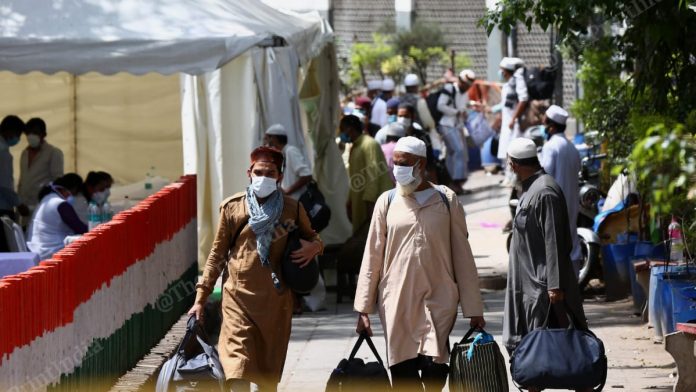
Nearly 4,000, including foreigners, had attended the Tablighi Jamaat event in Delhi (representational image) | Photo : Suraj Singh Bisht | ThePrint


Elisabeth Kubler-Ross’s seminal work, Death and Dying, describes the five distinct stages of grief: denial, anger, bargaining, depression and acceptance. While the Swiss-American psychiatrist was speaking about the series of emotions terminally ill patients go through, the first of the five stages that she postulated possibly holds true for a section of India’s people when the country was trying to come to terms with COVID-19 in the initial days of the pandemic.

The spread of the virus in the early months had then exposed the country’s second-largest religious group to a vulnerability born out of denial. Indiscretion and reckless behaviour by members of the Tablighi Jamaat had purportedly led to a spurt in coronavirus-positive cases, not only in Delhi but also in many other parts of the country.

An international gathering of Tablighis — preachers or a society to spread the faith —had taken place in New Delhi’s Nizamuddin area in March 2020, drawing hundreds of foreign nationals from Thailand, Nepal, Myanmar, Indonesia, Bangladesh, Malaysia, Sri Lanka and Kyrgyzstan. Despite a government order prohibiting large gatherings, more than 4,500 people had assembled at the Tablighi Jamaat Markaz (headquarters).

Media reports had quoted government sources as saying that since 1 January 2020, over 2,000 foreigners from 70 countries had arrived in India to participate in Jamaat activities. As the Covid-19 lockdown came into force on 25 March 2020, over 1,000 were left stranded in Nizamuddin.

Within days, a state of panic had set in as reports of Covid-19 deaths and positive cases started coming in from various parts of the country. By early April, private television news channels had begun insisting that over 30 per cent of the corona-positive cases had the “Tablighi Virus.”

Political factors were at play too. The country was already in ferment over the Citizenship Amendment Act and the National Register of Citizens.

The Tablighis’ state of alleged ignorance was dubbed a “Himalayan” blunder as a heavy dose of media onslaught, Islamophobia and blame game followed. As Najmul Hoda, a Chennai-based IPS officer, lamented on his Facebook wall, Covid-19 looked like a common cold in comparison to the plague of communal hatred.

Tablighi virus, Corona Jihad, stories of discrimination, Quran, divine injunction, Muslim society, deadly virus, Covid-19, Muslim clergy, Indian Muslims, social distancing, community prayers, letter of appreciation.

Political factors were at play too. The country was already in ferment over the Citizenship Amendment Act and the National Register of Citizens. Shaheen Bagh and its women protesters were making international headlines and the February 2020 riots in Delhi had deepened the sectarian divide, exacerbating religious tensions. It was in this situation that the Tablighi Jamaat held its congregation. According to data shared by Equality Labs (a digital human rights group) with TIME magazine, the hashtag ‘Corona Jihad’ appeared nearly 300,000 times.

The online attack became more and more vicious as reports of people leaving for different parts of the country from the Markaz poured in. For days, “Tablighi virus” and “Corona Jihad” trended on Twitter. Our entire focus shifted from fighting and containing COVID-19 to fighting the Tablighis and the Muslims, who the general population started equating as one and the same. Those were the initial days of our COVID-stricken lives, unsure of what awaited us and we were quick to blame the Markaz for all our misery.

The usual practice of portraying Muslims as the other came into play, as did indulging in victimhood.

In the midst of this Islamophobic onslaught, many articles and tweets expressed fears of a Muslim apartheid. The usual practice of portraying Muslims as the other came into play, as did indulging in victimhood.

“Social media, as ever, remained truculent and toxic. Generally speaking, Muslims continue to use social media space to indulge in their victimhood addiction,” observed Najmul Hoda.

While the community needed to address the elephant in the room and could not be absolved of its responsibility for wrongful acts by the Tablighis, the polarised discourse that was unleashed in mainstream media impacted the psyche of the general population. Most Muslims came out against the Jamaat, but the entire community was still clubbed together and labelled the “Superspreader”.

But the way the Tablighi Jamaat’s role and, by extension, of the entire Muslim population’s involvement in the spread of the virus was covered by the mainstream media, it suddenly felt that Covid-19 had a religion.

The Tablighis were guilty for sure for the congregation of thousands of people despite the prohibitory orders, and of not reporting cases, but the wave of hatred failed to see that the Tablighi Jamaat is not the sole representative of India’s 170 million Muslims and its actions should not be linked with the larger community. It is also pertinent to note that the Tablighi Jamaat preaches a narrow interpretation of Islam to some sections of Muslim society.

But the way the Tablighi Jamaat’s role and, by extension, of the entire Muslim population’s involvement in the spread of the virus was covered by the mainstream media, it suddenly felt that COVID-19 had a religion.

Soon, stories of discrimination against the poorer sections among Muslims started coming out. NDTV reported how vendors in Mahoba district of Uttar Pradesh were allegedly targeted and stopped from selling vegetables by people who accused them of being members of the Tablighi Jamaat and of spreading the coronavirus.

Old sociological problems, such as overcrowded ghettos, lack of hygiene and low levels of awareness, became handy tools again to stigmatise the community.

The Bharatiya Janata Party (BJP) MLA from Deoria in Uttar Pradesh, Suresh Tiwari, warned people against buying vegetables from Muslims. The defiant leader was later asked to explain his comment by his party chief.

A video shared widely on Facebook and on Twitter purportedly showed Muslims intentionally sneezing on each other. It was later debunked by the fact-checking website AltNews.

Tablighi virus, Corona Jihad, stories of discrimination, Quran, divine injunction, Muslim society, deadly virus, Covid-19, Muslim clergy, Indian Muslims, social distancing, community prayers, letter of appreciation

Several video clips purportedly showing COVID-positive members of the Tablighi Jamaat misbehaving with hospital staff and other patients found space on prime-time debates. Old sociological problems, such as overcrowded ghettos, lack of hygiene and low levels of awareness, became handy tools again to stigmatise the community.

The reaction from the community was at times defiant, while some took to social media to counter the hate being peddled with tweets that were either equally toxic or full of self-pity.

A closer look at the role the Muslim clergy played reveals a far more constructive engagement than what has been projected by the mainstream media.

It was at this point that the Muslim clergy, intellectuals and other community leaders stepped in. On 2 April, seven signatories — Dr. Zafarul Islam Khan, Chairman, Delhi Minorities Commission; Prof. Akhtarul Wasey, President, Maulana Azad University, Jodhpur; Prof. Mohsin Usmani Nadwi, President, Human Welfare Society; Prof. A.R. Kidwai, Director, K.A. Nizami Center for Quranic studies, AMU; Masoom Moradabadi, Secretary, All India Urdu Editors Conference; Zaheeruddin Ali Khan, Managing Editor, Daily Siasat, Hyderabad, and Prof. Iqtedar Mohd. Khan, Deptt. Islamic Studies, Jamia Millia Islamia, Delhi — issued an appeal to the government to take into consideration the “genuine constraints faced by certain people.” They argued that it was not a time to find fault. “Any attempt to give it a sectarian twist would weaken our battle against the deadly virus,” they said.

A closer look at the role the Muslim clergy played reveals a far more constructive engagement than what has been projected by the mainstream media. As early as 6 March, Maulana Khalid Rasheed Firangimahli, Lucknow-based Imam, Eidgah, had asked mosque-going Muslims to take preventive measures against Covid-19, and told them to avoid congregations and coughing and sneezing in public.

Firangimahli was among many religious heads across the country who issued fatwas saying that the fight against the coronavirus was a religious obligation.

A broad consensus that was worked out decided against special Eid prayers at Eidgahs and at mosques, etc. Islamic seminaries, such as the Darul Uloom, Nadwa and Deoband, issued fatwas asking the faithful to offer Eid prayers at home.

A major challenge came during the month-long period of Ramadan — that began in the last week of April — in terms of enforcing social distancing and avoiding guests at the breaking of fast (iftar) and at community prayers (tarahwih), etc. But enforcing a sense of discipline among 170 million people sharply divided on sectarian and linguistic lines was done with remarkable ease and voluntary compliance.

As Ramadan is closely followed by Eid, suspension of the customary Eid prayer posed another hurdle. However, a broad consensus that was worked out decided against special Eid prayers at Eidgahs (where special Eid prayers are held) and at mosques, etc. Islamic seminaries, such as the Darul Uloom, Nadwa and Deoband, issued fatwas asking the faithful to offer Eid prayers at home.

The results were so good that Uttar Pradesh Chief Minister Yogi Adityanath called up Firangimahli in Lucknow and congratulated him, saying that Eid prayers throughout the state had been observed without any incident of the virus spreading. The state government also issued a letter of appreciation.

Those members of the Tablighi Jamaat who had tested positive for the virus, and have since been cured, came forward in huge numbers to donate their blood plasma — containing anti-viral antibodies — and helped cure many affected people.

Eid ul-Fitr 2020 saw the largest ever participation of women in family prayers. That prompted Najmul Huda, the IPS officer, to say “thanks” to the virus for bringing gender equality to every Muslim home. “May it get institutionalised. Corona, I can’t really say thank you to you, but it’s thanks to you,” he wrote .

There were other positives too. Charity acted as a great succor as appeals were issued to channelise Ramadan and Eid shopping for the needy. Maulana Naeem Ur Rahman Siddiqui, secretary of the Islamic Centre of India, claims that zakat — or charity — saw a rise of over 50 per cent as compared to the previous year.

Not to forget, the redemption and acknowledgement that came after all those days of hate. If the members of the Tablighi Jamaat were guilty of ignorance in the initial phase of the pandemic, they turned adversity they had wrought upon themselves into opportunity in the form of penance. Those who had tested positive for the virus, and have since been cured, came forward in huge numbers to donate their blood plasma — containing anti-viral antibodies — and helped cure many affected people.

Some say it was in keeping with what the Quran teaches — that divine injunction is not for returning evil with good, but with the best. It says: “Good and evil are not equal. Repel (evil) with what is best, and you will see that the one you had mutual enmity with, will become the closest of friends.” (41:34)

Rasheed Kidwai is Visiting Fellow at Observer Research Foundation (ORF). He tracks politics and governance in India. Naghma is Senior Fellow at ORF. She tracks India’s neighbourhood — Pakistan and China — alongside other geopolitical developments in the region. Views are personal.

This article was first published by ORF.

source: http://www.theprint.in / The Print / Home> Opinion / by Rasheed Kidwai and Naghma Sahar / July 12th, 2020

Bahadur Shah Zafar Award given to Prof. Asloob Ahmad Ansari

Aligarh, UTTAR PRADESH :

Prof. Asloob A. Ansari felicitated with Bahadur Shah Zafar Award of Delhi Urdu Academy

Aligarh, :

Delhi Urdu Academy has given its prestigious Bahadur Shah Zafar Award to eminent scholar, critic and educationist, Prof. Asloob Ahmad Ansari, retired professor, Department of English, Aligarh Muslim University.

The award was given to him by Nawab Ibne Saeed of Chhatari and Padma Shri Prof. Akhtarul Wasey, Vice President of Delhi Urdu Academy and Director, Zakir Husain Institute of Islamic Institute, Jamia Millia Islamia, New Delhi.

Addressing the felicitation programme organized at the UGC Academic Staff College, Aligarh Muslim University, Prof. Akhtarul Wasey said that Prof. Asloob Ahmad Ansari has been selected for the prestigious award for his lifetime contribution to the development of literary criticism in Urdu and English. He said that Prof. Ansari has served academics without any lust for name or recognition and the award was a small tribute to his academic dexterity and critical approach. He said Prof. Ansari had an authority on Allam Iqbal.

Mr. Anees Azmi, Secretary, Delhi Urdu Academy said that Prof. Asloob Ansari deserved the award and it was a proud moment for the Delhi Urdu Academy to express its indebtedness to the tall literary figure whose works will keep illuminating minds of scholars and critics in Urdu. He said that Aligarh Muslim University has given the largest number of great literary personalities to the Urdu language and they have also received highest awards and recognitions.

Padma Shri Prof. Hakeem Syed Zillur Rahman said that Prof. Ansari was Aligarh’s pride and Aligarh was recognized around the world being a home city of Prof. Ansari.

Prof. A. R. Kidwai, Director, UGC Academic Staff College highlighted many facets of Prof. Ansari’s life and presented a sketch of his life as a teacher and his academic pursuits.

Prof. Asloob Ansari has published 33 books in Urdu and English. Hehas received Pakistan President’s award for his work on Allama Iqbal and a honorary D. Lit. from Gorakhpur University.

The Governing body member of Delhi Urdu Academy and eminent journalist Masoom Moradabadi proposed a vote of thanks.

source: http://www.muslimmirror.com / Muslim Mirror.com / Home> Indian Muslims / by Muslim Mirror News / May 26th, 2013