Andaleeb Wajid is a Bangalore-based writer who attempts to authentically portray India’s Muslim diaspora through novels that focus on life, food, family and relationships.
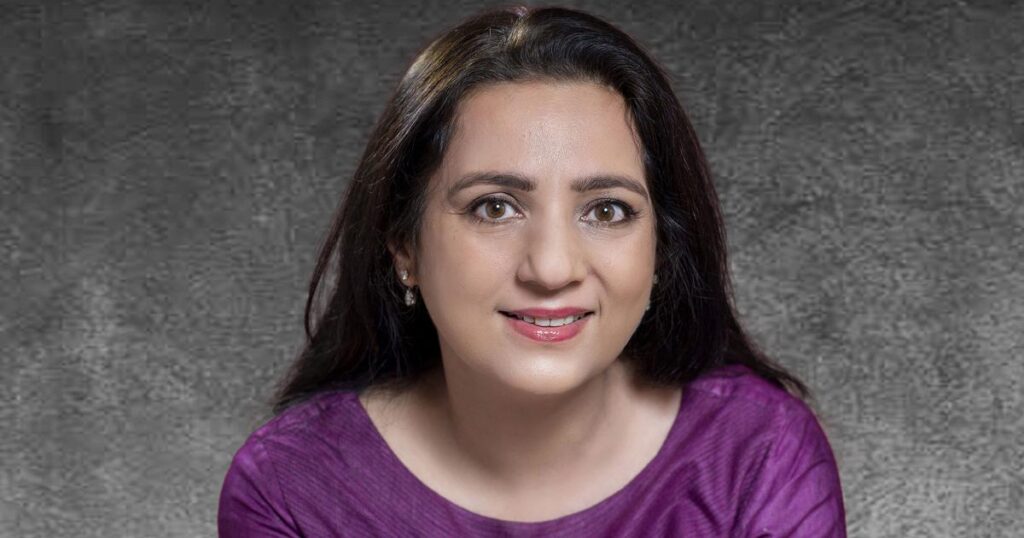
The young Indian Muslim writer Andaleeb Wajid has published five books in almost as many years. Courtesy Andaleeb Wajid
Modestly dressed in a pretty headscarf and shalwar kameez, the Bangalore-based writer Andaleeb Wajid smiles as she talks about her short but successful writing career – she has published five books in six years, most of them featuring a Muslim setting and credibly representing the community in India.
Wajid, 36, says she has been writing since she was 10. Her first book, Kite Strings, was released in August 2009 followed by Blinkers Off (August 2011), My Brother’s Wedding (May 2013) and More Than Just Biryani (January 2014). No Time For Goodbyes, released in April this year, is her latest book and the first in the Tamanna Trilogy series, books on time travel targeted at young adults. The other two will be released in September and December this year.
How did you begin writing?
I have been writing stories since I was 10. When I was in Grade 12, I was left very confused about what I would do with my life. There weren’t many options for girls from orthodox Muslim families. Then it occurred to me to take up writing as a career. I was certain that no one would stop me.
Is there a reason why many of your books have been set in a Muslim milieu?
I’m quite amused with the way Muslims are depicted in Bollywood films and on television in India. My stories attempt to show a slice of Muslim life, which is no different from anyone else’s. I wrote More Than Just Biryani only because I strongly felt that the world has labelled us as just biryani-eaters and I wanted them to be aware of the diversity in Muslim cuisine. Kite Strings discusses the issues a young girl from an orthodox Lababin Muslim [a community from Tamil Nadu] family faces. But a large number of non-Muslim fans also reached out to me, saying how much they identified with the character, which proves that some things transcend religious boundaries.
More Than Just Biryani was conceived as a recipe book. What prompted you to turn it into fiction?
My brother and I had thought of writing a culinary memoir but the idea never took off because I realised early that I could never do justice to non-fiction. Instead I wrote about three women and the role food plays in their lives. Nearly every chapter of the book has a recipe, which is woven into the story.
Have you drawn upon your personal experiences to craft stories?
Yes. Like most writers, I started off writing about what I knew best. In Kite Strings, the protagonist Mehnaz is a rebel without a cause and behaves a lot like I did as a teenager. The story is set in Vellore, Tamil Nadu, where as a child I spent several holidays with my grandparents. In More Than Just Biryani, one of the protagonists loses her father. It was the most painful chapter I have ever written.
What else is in the pipeline?
I have one more young-adult novel in my kitty, about a girl whose mother has left the family. Then there’s another about a crochet teacher and the four women who learn this beautiful craft from her and end up baring their lives to her.
• Andaleeb Wajid’s books are available on Amazon
artslife@thenational.ae
source: http://www.thenationalnews.com / The National / Home / by Priti Salian / July 05th, 2014
Ghazala Wahab explains what it is to be a Muslim, a member of the largest religious minority in India today, and why the community lives in fear as prejudices persist.
The book opens with an unputdownable 42-page introduction that delves into the root of fear and despair among Muslims who have embraced the country as theirs but are polarised because of the identity they bear.
The shock and shame of communal riots, orchestrated mass violence and lynchings that served political agendas and led to societal divisions during the past decades hits you, as journalist Ghazala Wahab lays bare instances from her life.
Balanced narrative
She meticulously balances her narrative because she wishes to build a bridge of conversation. While she addresses fellow Muslims asking them to embrace modernity and be an integral part of positive change, she also alerts non-Muslim Indians about their perception of Muslims based on prejudice and hearsay, not facts.
Self-examining her own community members, she admits it never struck her how an average Muslim struggles to stay alive because she looked at things from her position of privilege. As she researched, she found equal opportunity and justice are only concepts and that law- making and law-enforcing agencies act in contradiction to vilify and stigmatise Muslims.
It is a vicious cycle, writes Ghazala, because the post-partition Muslims have remained an irrelevant votebank and sought security in their ghettos perpetuated by illiteracy, poverty and unemployment. The mullahs and clergy have easily taken them under their religious fold to exploit them. The general backwardness of the community has fed into a sense of loss of identity and unmet aspirations for Muslim youth, men and women.
Personal experience
In the mid-80s, Ghazala’s father shifted from their ancestral home in a middle class mohalla to an upscale Hindu-majority neighbourhood in Agra. His successful business and hobnobbing with the powerful, gave him the comfort of keeping his family under a security net. But that was till Agra was engulfed in violence post-kar seva after BJP leader L.K. Advani rolled out his rath yatra from Somnath to Ayodha in October, 1990, and was subsequently arrested. As sporadic violence spread across north India, Ghazala’s family wondered where they would be more secure — in their new neighbourhood or in a Muslim majority insulated mohalla.
Ghazala’s father called his brothers to safety and her mohalla uncles requested them to move back to the old Muslim locality. Ultimately everybody stayed where they were as fury was unleashed on their community everywhere. A young collegian then, Ghazala, her parents and three siblings were at home when an angry mob led by a neighbour shouted slogans, smashed windows, pelted stones and damaged their car. Desperate phone calls for help went unanswered.
When Ghazala’s father went to the police station to enquire about the adult males who were forcibly picked up from the mohalla during search operations, senior officials known to him avoided him. Those he thought had accepted him treated him as nothing more than a Muslim when it came to communal division. For Ghazala’s father it was not about being a victim but it was more about the humiliation, a betrayal of belief.
Turning point
Her family survived the riots but it left a scar. Her parents chose to go silent and it irked Ghazala that a victim should feel ashamed. She saw the same resignation and defeatist attitude when the Babri Masjid was razed. It unnerved her because she sensed it was a turning point not just for her family but for most Indian Muslims.
“Civility was the first casualty, replaced by communal prejudice and demonstrative religion,” she writes.
Many members in her extended family began to draw comfort from religious conservatism. She talks about a cousin who started wearing a headscarf and told her she was more comfortable with her Muslim friends as they didn’t have to pretend with one another, whereas to her Hindu friends she was a validation of their liberal outlook.
The conversation disturbed Ghazala as she never perceived two distinct identities in herself — a Muslim and an Indian. The issue was complex and so were several disparate questions.
Ghazala leans on poignant narration about the average Muslim being confused and scared through examples of those who have hidden their identity and reverted to Hinduism under perceived coercion. “They could never participate as equal partners in the country’s development. Only 2.6 per cent of Muslims are in senior-level jobs and a small number have achieved a reasonable upward mobility,” she writes.
On a positive note, Ghazala says Muslim society is changing. The protests against CAA/NRC in December 2019, she feels, has given rise to an assertive community even though her 1990 experience returned to haunt her in February 2020 when her paternal aunt’s family panicked as a mob reached their northeast Delhi colony. Anger and helplessness resurfaced when her aunt called her for help and her uncle refused to escape or abandon his life’s savings. The sense of fear doesn’t leave, she says.
Born a Muslim: Some Truths about Islam in India ; Ghazala Wahab, Aleph Book Company, ₹999.
soma.basu@thehindu.co.in
source: http://www.thehindu.com / The Hindu / Home> Books. Reviews / by Soma Basu / May 15th, 2021
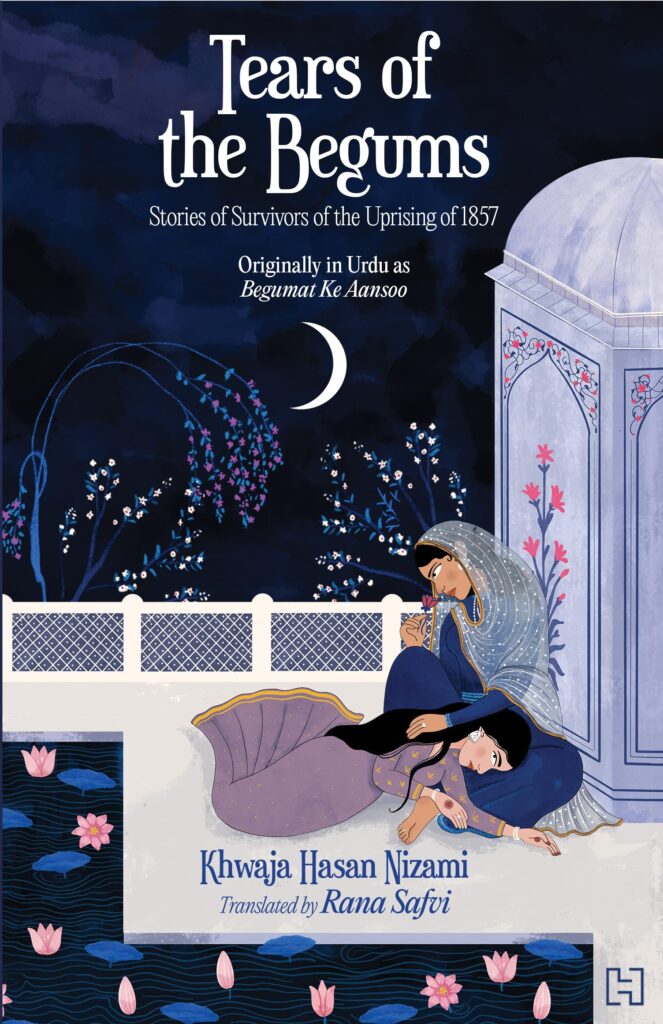
New Book , First ever English translation of Nizami’s invaluable Urdu book Begumat ke Aansoo
pix: amazon.in
Apart from the fifteen years that Sher Shah Suri snatched upon defeating Humayun, the flag of the grand Mughal Empire flew over Delhi undefeated for over 300 years.
But then, 1857 arrived and the mighty sword fell helpless in the face of a mightier British force.
After the fall of Delhi and Emperor Bahadur Shah Zafar’s tragic departure from the Red Fort in 1857, members of the royal Mughal court had to flee to safer places. Driven out from their palaces and palanquins onto the streets in search of food and shelter, the dethroned royals scrambled to survive. Some bore their fate with a bitter pride, others succumbed to the adversity.
Through twenty-nine accounts of the survivors of the Uprising of 1857, Khwaja Hasan Nizami documents the devastating tale of the erstwhile glorious royalty’s struggle with the hardships thrust upon them by a ruthless new enemy.
In vivid and tragic stories drawn from the recollection of true events, Nizami paints a picture of a crumbling historical era and another charging forward to take its place.
With the reminiscence of past glory contrasted against the drudgery of everyday survival, Tears of the Begums – the first ever English translation of Nizami’s invaluable Urdu book Begumat ke Aansoo – chronicles the turning of the wheel of fortune in the aftermath of India’s first war of independence.
source: http://www.amazon.in / Amazon / Home> Books> History> World / as on August 06th, 2022
Tarana Husain Khan doesn’t write women only as damsels in distress, she writes them as women who challenge.
Tarana Husain Khan.
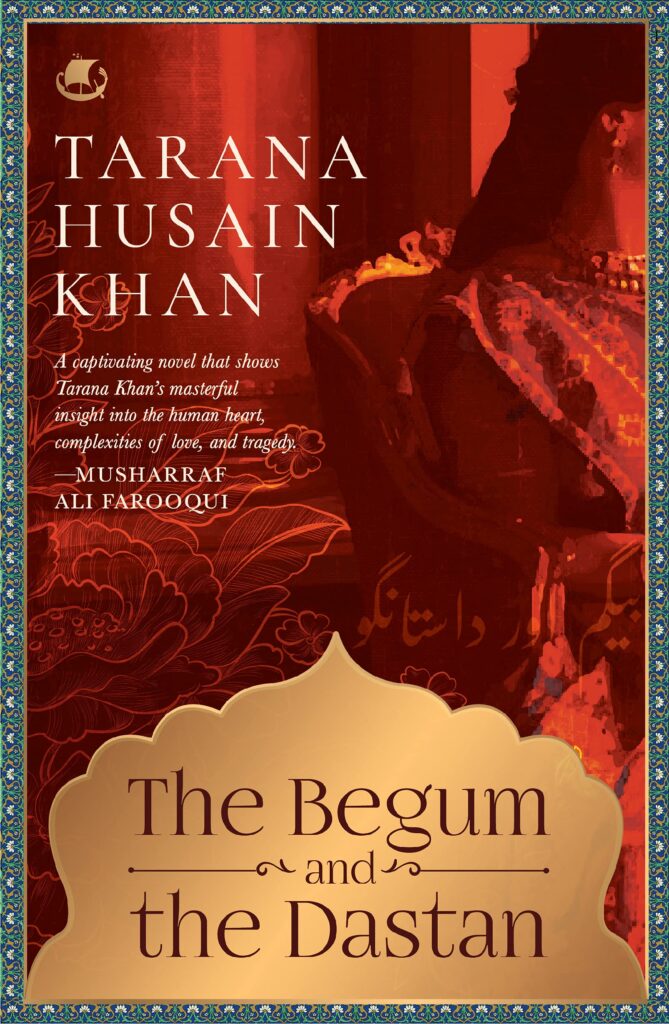
I don’t remember when my mother first told me, “Boys will be boys.” as an explanation. But I trusted it. The 20-year-old I am now knows it’s an eraser. A cleaning towel that wipes away the grim men produce. Over our words. Over our careers. Over our bodies. It’s an explanation that deletes a lived history with a swift and casual swipe. Tarana Husain Khan’s The Begum and the Dastan resists this erasure.
Khan’s character, Ameera’s grandmother, whom she calls Dadi, tells her the dastan about Feroza Begum, Ameera’s great-grandmother. Feroza Begum attended sawani celebrations at Nawab Shams Ali Khan’s Benazir Palace, defying her family, only to be kidnapped by the Nawab. Although the premise sounds simple, Khan crafts the dastan carefully, preserving the dynamics in Sherpur, a princely state, like one would sour pickle in a jar. Her writing serves as a citation for the overused “Show, don’t tell” technique, arranging the elements of time, location and character through a nuanced understanding of history.
She weaves together the stories of three women, Lalarukh, Feroza and Ameera, with the help of three dastangos, about Kallan Mirza, Ameera’s Dadi, and herself. Each story, within another story, surrenders as a cautionary tale. Sometimes, as a spoiler, that hands you the reins to ride through the rest of the story.
Blame slithers across each story, hissing at every woman who defies and exercises her need for independence. During the forced marriage to the Nawab, women around the bride were “tut-tutting over Feroza’s heartlessness”, believing she aborted her pregnancy from her previous marriage. The blame congeals on Feroza, a victim of forced abortion by the Nawab. In the rumours, the Nawab is a man she loves, not her abuser. The cruelty of these women steps outside the realm of gossip, nipping at Feroza’s right to refuse consent to her nikah.
“‘Feroza Begum, daughter of Altaf Khan urf Miya Jan Khan, your wedding has been arranged to Nawab Shams Ali Khan Bahadur, son of Nawab Murad Ali Khan Bahadur for a sum of two lakh rupees as meher. Do you agree?’
What if she just didn’t say anything?
‘She says “yes”!’ A middle-aged woman dressed in her bridal dress, suddenly shouted towards the curtains. Feroza turned towards the woman. The old lady in charge of her elbowed her ribs.
‘Uh?’ she turned sharply towards the offending lady.
‘I heard it too. She said “yes”!’ said the old lady, then another woman joined in bearing witness to her acquiesce and then another.”
“Why wouldn’t a divorced woman who aborted her child marry the Nawab?” is the rhetoric that these women echo. It’s a form of enabling, but Khan exerts dialogue, channelling prose to amplify Feroza’s reaction, forgotten amidst placeholder approval. She choreographs the myth “she asked for it” by excluding the chorus of the maulvi asking for consent thrice, as is tradition, to exacerbate the rumours that enable, and more terrifyingly, erase. Another dialogue chimes in to note this eager “consent” by Feroza. In these instances, Khan’s narrator, Dadi, is not just a storyteller; but an advocate for forgotten history.
But Khan doesn’t write women only as damsels in distress; she writes them as women who challenge. Feroza wears what she wants, despite the word that the patriarchy will impose on her: nautch. Khan examines how the question of her attire serves as a justification for the harassment. When Bibi, Feroza’s maid, asks her to “let it be”, as she was “wearing that dress”, Feroza doesn’t surrender to the blame. Instead, Feroza asks these questions: what if she was one of the common women? What if she was a nautch?
Khan tackles clothing not only as a form of rebellion but as an identifier of communion and the dismissal of “the other”. When Feroza sights a British woman wearing a “strange gown”, she argues that she should’ve worn “our dress” because she’s in “our country”. Other times, this divide is a form of empowerment.
“Strangely, guys don’t pester scarf-wearing girls with ‘I want to be your friend’ proposals. So us scarfed girls choose to talk to guys we like and make boyfriends on our own. It’s pretty cool that way, though I long to throw away the scarf and open up my hair like I used to at St Mary’s.”
Ameera’s perception of the scarf rewrites the reputation of the vilified veil, untying the folds that make it an oppressive tool while recognising how being “the other” means a kind of protection. A woman’s scarf, her dress, and her jewellery make an argument in this novel. But the expectations that pin a scarf around Ameera’s head, and a nath on Feroza’s nose, encourage a misplaced trust in the men in their lives.
Across the three stories in the novel, protagonists expect men to protect, not because they victimise themselves, but because that’s what’s taught to women: dependence is a desired trait. Khan acknowledges how patriarchy dribbles on the men, drawing out how Lalarukh, Feroza and Ameera feel betrayed by the men in their lives for not protecting them. The cadence of this betrayal morphs across the stories as Khan manipulates language like a glassblower does glass.
“I do believe that in this day and age nobody should bully you into selling your property – these are not the Nawab’s times; but if it was Jugnu’s fees and his exams, Abba would sell off the shops and chuck the case in a heartbeat. We females always depend on our fathers or males to rescue us – our default response to a crisis. Imagine, poor Feroza Begum’s father dumped her in the harem and ran away!”
Khan wields the tone of each story, carefully grafting the premise of a woman wronged in different periods and spaces. She uses the first-person perspective to narrate Ameera’s life, crumbling with her family’s negligence towards her, using a voice akin to a teenager simmering with anger. But for Lalarukh and Feroza, Khan, or rather Dadi and Kallan Mirza, uses the third-person perspective, a voice that is omniscient and viscous, dripping of superiority.
They narrate the violence of Nawab and Tareef Khan, Lalarukh’s kidnapper, without embellishments. The abusers are not kings or sorcerers in the chapters that harrow. They are written as, to no surprise, violators. Khan’s treatment of the dynamic between the Nawab and Feroza contradicts this claim sporadically. But when Feroza reciprocates the Nawab’s ‘love’ for her, he continues to dredge her in the limitations of his harem, remaining free himself, further testifying the degree of his abuse. Feroza is a flawed character, but she is not a flawed victim, and Khan asserts that.
Like Khan, both Dadi and Kallan Mirza are biased narrators, intervening to train their listener(s) to root for the protagonist. They collectively fuel a question: How does tradition, along with law, permit the violation of women? Unfortunately, the stories, or rather the lived experiences that ask this question, are muzzled. But the dastangos, both the real and the fictitious, bite through the labour that accompanies such storytelling. The story prompts the question: How can one write history without condoning it? In The Begum and the Dastan, history is an inspiration, a tool, and an anchor, but it is not a justification.
pix: amazon.in
source: http://www.scroll.in / Scroll.in / Home> Book Review / by Isa Ayidh / (book cover image edited in, amazon.in) /June 27th, 2021
As Urdu Day approaches, Hyderabad-based author Jeelani Bano speaks about her bond with the language.
Jeelani Bano(Photo | R Satish Babu)
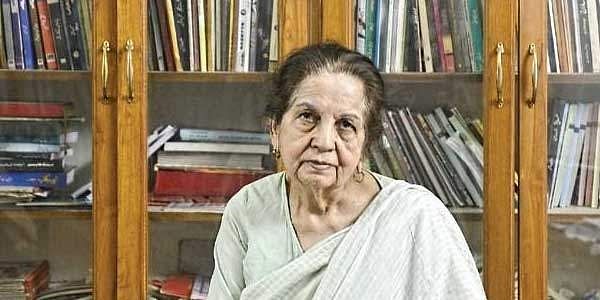
Jeelani Bano, 80, looks frail in her sea green sari with that mop of pepper-and-salt hair. Her demeanour is genteel, but only a talk about her stories on bonded labour, her aapa Ismat Chughtai and Progressive Writers’ Movement lights up her eyes. The decades pass on her soft wrinkled face as she turns pages of her autobiographical book Main Kaun Hoon and takes you back to an era gone by that’s still alive in her Banjara Hills house in Hyderabad, serenely tucked in another time-frame.
As Urdu Day approaches on November 9, she speaks about her association with the language. Many of her stories appear to be of our time. Jagirdari may have gone but capitalistic clutches don’t let go of the bonded slavery. Her story Paththaron ki Barish is heart-wrenching. Bano, who has authored 22 books, says, “A lot of writers of our time revolted against this inhuman system. Something also sparked in me and I wrote such stories. But today also, the situation of daily labourers is the same.”
Her book Aiwan-e-Ghazal, which tells the tales of feudal landlords in Hyderabad, has been translated into 14 languages. She then talks about her dear aapa—Ismat Chughtai—the firebrand writer.
“She was also from Badayun in Hyderabad, where I was born. She was friends with my mother and supported me a lot in writing,” says the 2016 NTR National Literary Award winner showing the letters Chughtai sent to her. Ismat wrote to her, “After marriage, respect your writing as much as you would respect your husband and in-laws.” In ’70s, when Jeelani Bano and her husband Anwar Moazzam, poet and writer, went to Pakistan, famous poets and scholars came to meet them at the border. She shares, “Nobody wants to understand what people of both the nations want. Sarhadein dilon ko nahin baant saktin (Borders can’t divide hearts).”
When once she went to the US, a scholar asked her, “You’re a Muslim woman. How did you get permission to write?” To this, she replied, “Nobody has stopped me from writing. Perhaps you haven’t been to India or else you wouldn’t have asked me this.”
Renowned poets and scholars such as Shakeel Badayuni, Makhdoom Mohiuddin, Jigar Muradabadi and Kaifi Azmi were hosted at her Mallepally home. But, she along with other children weren’t allowed to go to the baithaks. The young Bano would watch these poets, while playing in the courtyard.
source: http://www.newindianexpress.com / The New Indian Express / Home> Magazine / by Saima Afreen / November 05t, 2016
:quality(70)/cloudfront-eu-central-1.images.arcpublishing.com/thenational/ACD5KFPDRSOD3UNOBQCGVOPNHM.jpg)