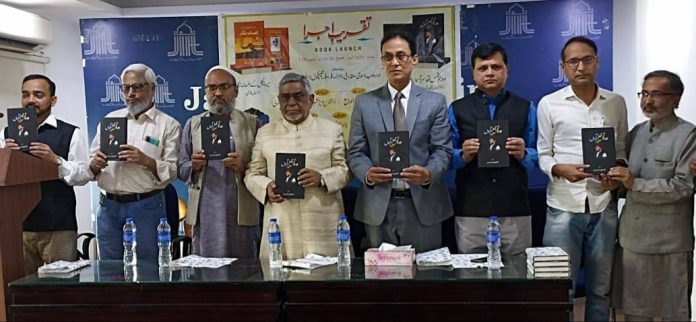
A sense of ‘Think global, act local’ prevailed at the launch of two significant books “Who jo Shams tha Sar-e-Aasmaan” and “Seemanchal ke Afsana Nigar.” The launch was jointly organized by Forum for Intellectual Discourse and Idara Adab-e-Islami, Delhi on Sunday, 7 November, 2021 at the headquarters of Jamaat-e-Islami Hind.
The book “Who Jo Shams tha Sar e Assmaan” was compiled by Dr Noman Qaisar and Mohd Islam Khan and has 41 Urdu articles and six poems on the life and services of journalist Dr Abdul Qadir Shams who died during Covid-19 on 25 August, 2020. It also has four write-ups in English.
Another book “Seemanchal ke Afsana Nigar” is an effort to document the life and works of dozens of fiction writers of Seemanchal.
Presiding over the programme renowned Islamic scholar and former President of Maulana Azad University, Jodhpur, Prof Akhtarul Wasey said that the work done by Abdul Qadir Shams was ‘unusual’. “Shams used to sleep in Delhi but dreamed of Seemanchal.” The void left with his demise would always be felt in my life, said Wasey, who is also the Professor Emeritus of Islamic Studies at Jamia Millia Islamia. Seemanchal ke Afsana Nigar will be an indispensable work in the history of short-story writing. Prof Wasey also congratulated the Forum for Intellectual Discourse stating that the need for such an organization like the Forum could never be felt more strongly than the present times. He wished the Forum success.
Special guest, editor general at NCERT, Dr Perwaiz Shaharyar expressed happiness over organizing a meeting for a journalist in which a large number of people from media were present whose responsibility had grown manifold as the nation was confronted with difficult situations. He called the book a ‘valuable addition to literature’. Prof Abu Bakar Abbad had his reservations for confining any segment of Urdu literature to a specific region as Urdu was a global language. The protagonists, however, had their own arguments for identifying geographical regions, as was also the case with Seemanchal, a region long ignored by most literary aficionado.
Abdul Mannan, editor of monthly Yojana reasoned that the creative facets of Seemanchal remained shrouded because their writers usually shied away from the limelight. In that context, he considered Ehsan Quasmi’s work exceptional.
Chief guest, senior journalist Siraj Naqvi, who had worked with Abdul Qadir Shams for over a decade said that Shams new the art of maintaining relationships. Despite all the difficulties, the smile on his face would dispel worries. Author, critic and famous litterateur Haqqani Al-Qasmi paid a glowing literary tribute to his childhood friend Abdul Qadir Shams which moved the audience. He said Woh jo Shams tha… is not merely a collection of articles but teardrops flowing directly from the hearts.
Dr Waris Mazhari, Assistant Professor, Jamia Hamdard; Dr Khalid Mubashshir, Assistant Professor, Jamia Millia Islamia; Dr Ahmad Ali Jauher, Assistant Professor, Indira Gandhi National Open University; Dr Jasim Uddin Qasmi of Delhi University, Jamshed Adil Alig and Dr Zain Shamsi also shared their views. Uzma Shaheen, daughter of late Abdul Qadir Shams paid a rich tribute to her father.
Manzar Imam of Forum for Intellectual Discourse moderated the three-hour long programme which had begun with Qur’anic recitation of Abdur Rahman, followed by welcome remarks of Dr Mohammad Ajmal, Assistant Professor, Centre for Arabic and African Studies, Jawaharlal Nehru University. It ended with a vote of thanks by journalist Abid Anwar.
source: http://www.muslimmirror.com / Muslim Mirror / Home> Books / by Manzar Imam / November 10th, 2021
Inquilab and Mid-Day founder Abdul Hamid Ansari is an inspiration not just for journalists but millions of youngsters … A special report by Siraj Ali Quadri.
Indian journalist and Muslim nationalist Abdul Hamid Ansari founded Inquilab, an Urdu daily in Mumbai in l937. The newspaper soon became a landmark in Urdu journalism which caught the attention of Muhammad Ali Jinnah, the founder of Pakistan. But when Jinnah asked Ansari to come to Karachi to publish the newspaper in the new country, Ansari said that he would prefer to live in India like the many million Muslims who would rather stay in the country than join Jinnah. Those who joined Jinnah undoubtedly left everything behind. Some flourished while others got established. But that’s another story, which has never ended since l947.
Today’s story is about the veteran journalist, publisher and businessman Khalid A.H. Ansari, son of Abdul Hameed. After passing out from St. Xavier’s in Mumbai, Khalid did his master’s at Stanford University in the US.
Khalid returned to Mumbai to establish Sportsweek, a weekly sports magazine, which became a huge success soon after its launch. The magazine’s immediate success can be attributed to the fact that its founder was himself an excellent sportsman and did a great job with the magazine, in addition to his father’s paper Inquilab.
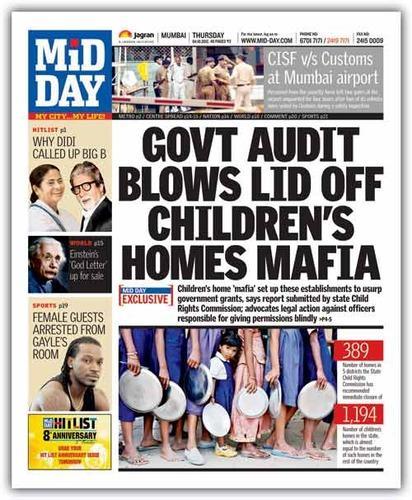
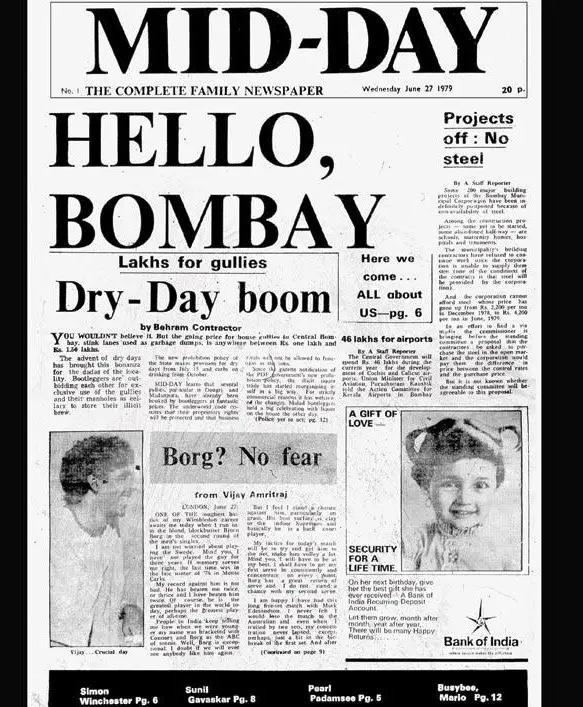
Meanwhile, the idea came to launch India’s first daily tabloid, Mid-Day, which he modelled in many ways after the English tabloids from Fleet Street. During the planning phase of their new venture, he spent hours discussing it with staff and mulled over its format to ensure success, especially since there were already two eveningers in Mumbai, one by The Times of India and the other by the Indian Express. Both suffered from a lack of innovation to attract large numbers of readers. So when Mid-Day appeared with a new face and content, the two old ones just collapsed. Although the ToI eveninger protested the pace of time for a while, it eventually perished as it had already become obsolete.
Mid-Day became a resounding success, with many comparing it to the British Daily Mirror and Daily Mail. However, being an Indian tabloid, it was much quieter and a whole lot more civilized, without the British fondness for nudity and sex, and nonsensical stories of stupidity.
Khalid was helped by his wife, Rukaya. She was very active on the administrative side and contributed to the editorial content and layout, which helped the paper sustain itself in the demanding market of Mumbai. She knew what was going on in the office and in the newspaper that was fast becoming India’s flagship eveninger.
Meanwhile, Khalid accepted an offer to become editor-in-chief of the Dubai-based Khaleej Times, and handed over the paper to his son, Tariq. After a few years in Dubai, Khalid returned to Mumbai and launched Mid-Day in Bangalore and Delhi and a regional Gujarati version for millions of Gujaratis in the country.
He has been involved in various programmes with the Indian government during conferences in Delhi and New York, launching and editing newspapers, and was awarded the Padma Shri in 2001 while continuing to play and write about his old passion, cricket.
Writing about his eveninger, Khalid says, “Mid-Day is a light-hearted, easy-to-read, entertaining, and ‘naughty’ paper that now has a new purpose which is to make work fun. Gives young professionals an entertaining newsbreak. The focus is on young, urban, mobile professionals across India and the company is leaving no stone unturned to engage with them. Today’s workplace’s fast-paced work style and crazy deadlines are full of stress and pressure. Mid-Day as a brand believes in spreading the message of reducing stress and making work fun.”
“What’s on, a host of addictive, fun sections like Hit List Crosswords, Horoscopes, and Fun at Work ensure that the newspaper remains a welcome diversion for young professionals,” he adds.
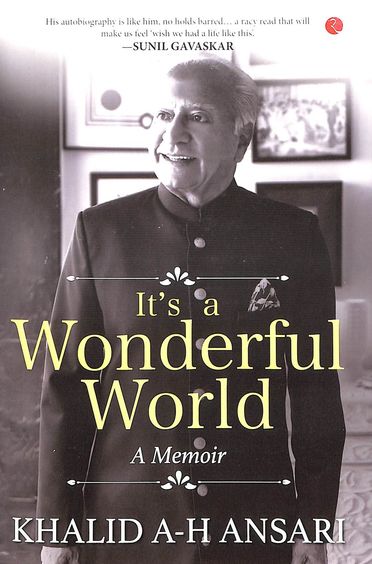
Khalid’s Sportsweek later was shut down with the television boom making it hard to garner advertisements and interest. Khalid has also published his memoir (It’s A Wonderful World) and continues to inspire a stream of journalists apart from various generations to keep the boat afloat and touch new heights.
(The Author is Journalist & associated with Dainik Bhaskar)
source: http://www.asianlite.com / Asian Lite / Home / by Siraj Ali Quadri / October 10th, 2022
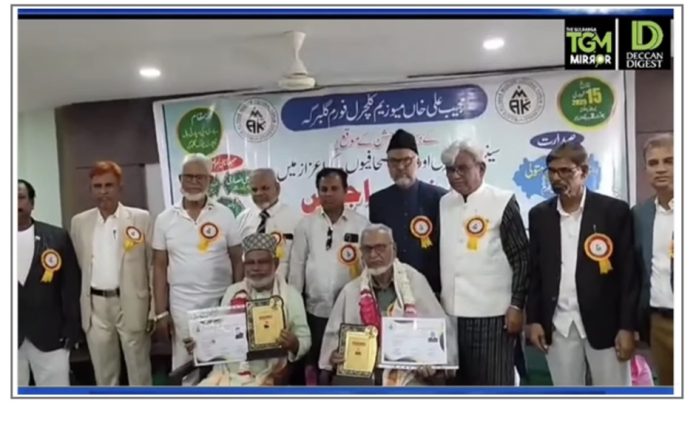
The Mujeeb Ali Khan Museum Cultural Forum marked its 10th anniversary with a tribute to the journalist Mujeeb Ali Khan and media professionals.
Speakers, including senior journalists and intellectuals, praised Mujeeb Ali Khan’s dedication to ethical journalism and truth-seeking. His contributions to responsible reporting were widely acknowledged.
Several journalists and writers were honored for their work.
The event, presided over by Nazeeruddin, Chief Patron of the Gulbarga Cultural Forum, recognized 40 media professionals, including digital journalists.
Honorees included senior journalists MA Hakim Shakir and Azeezulla Sarmasth. Ayathulla Sarmasth, founder of Gulbarga’s first Urdu channel, received special recognition.
The event, hosted by photojournalist Mujeeb Ali Khan, celebrated Mujeeb Ali Khan’s legacy and the role of media in upholding truth.
source: http://www.radiancenews.com / Radiance News / Home> Focus> Report / by Radiance News Bureau / February 18th, 2025
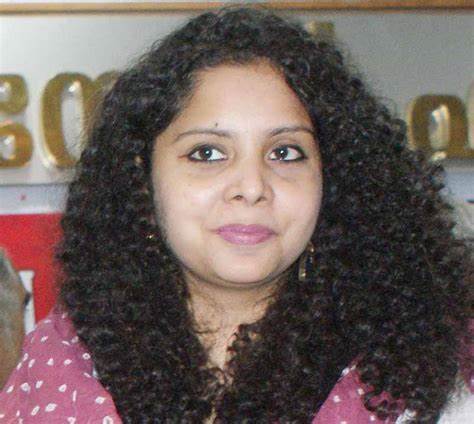
Rana Ayyub, an Indian investigative journalist and Global Opinion Writer at The Washington Post, is the recipient of one of the two coveted 2024 International Press Freedom Awards, as announced by Canadian Journalists for Free Expression (CJFE). She has been named for this award for her reporting that tenaciously upholds press freedom while holding governments accountable.
Ayyub will attend the CJFE Gala: A Night to Celebrate Courage in Journalism, where she will accept the award in Toronto on October 23.
When Ayyub went undercover in 2010 to look into the government’s role in communal violence – which is defined as violence based on race or religion – she established her reputation for fearless reporting. Since then, she has provided news and investigative reports about the persecution of minorities, state-sanctioned violence, and communal politics for a variety of Indian and international publications, such as The Washington Post, The New York Times, The Guardian, The Atlantic, and Foreign Policy. Her best-selling book, Gujarat Files: Anatomy of a Cover-up was released in 2016.
The Modi administration has reacted angrily to Ayyub’s political exposés. Ayyub is one of India’s most harassed and abused reporters, according to the International Centre for Journalists, and the UN special rapporteur has urged Indian government to stop the “relentless misogynistic and sectarian attacks” against her.
source: http://www.radiancenews.com / Radiance News / Home> Pride of the Nation> Awards / by Radiance News Bureau / October 04th, 2024
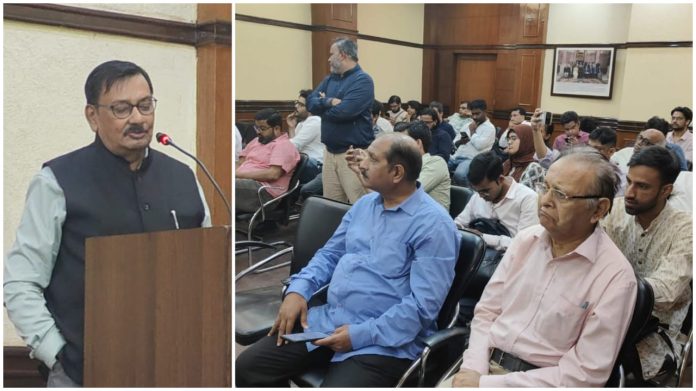
PCI President Gautam Lahiri addressing the gathering
In a significant move, the Press Council of India (PCI) has announced the institution of the Molvi Baqar Award to recognize and honour three outstanding journalists from the Urdu, Hindi, and English media every year.
PCI President Gautam Lahiri revealed this during an event commemorating the life and contributions of Molvi Muhammad Baqar, a pioneering figure in Indian journalism and the first journalist to be martyred during the 1857 Indian Rebellion.
“The criteria for this award will be to encourage journalists to follow in the footsteps of Molvi Baqar, who made the ultimate sacrifice while covering the events related to the 1857 ‘Mutiny’ through his newspaper, Delhi Urdu Akhbar,” said Lahiri in his presidential address. He added that PCI would soon finalize the modalities and constitute a jury to select the awardees.
The event, which focused on “The Life and Times of Moulvi Muhammad Baqir ,” highlighted his role as a patriotic journalist who played a key part in preparing the ground for India’s freedom. Historian and author Dr. Swapna Liddle, the Chief Guest at the event, praised Baqar’s commitment to the nation’s cause, despite the controversies surrounding his role.
“Some confusion exists due to the views of his son, Mohammad Hussain Azad, a renowned Urdu literary figure, who appeared to have taken a contrary position to his father. However, this must be understood in the context of the reign of terror during that time,” said Dr. Liddle, clarifying that Azad’s actions were likely influenced by the pressures of British rule.
Shoib Raza Fatmi, Editor of Hamara Samaj, reinforced this perspective by noting that Azad’s name frequently appeared in Delhi Urdu Akhbar as Editor, Printer, and Publisher, indicating his involvement in his father’s journalistic mission despite the difficult circumstances.
The program also featured a panel discussion moderated by Mahtab Alam, where young Urdu journalists discussed the relevance of Molvi Baqar’s journalism in today’s media landscape. Munazah Shah of News 18 pointed out the striking similarities between the challenges faced by Baqar in his time and those confronting the Urdu media today, particularly financial pressures and the need to foster communal harmony.
“The challenges faced by Molvi Baqar and today’s Urdu media are not very different. We should look to him as a role model for overcoming these obstacles,” said Sohail Akhtar Qasmi of Al Jazeera Arabic.
Tasleem Raja, a journalist with Siyasi Taqdeer and Qaumi Awaaz, echoed this sentiment, emphasizing how much contemporary media could learn from Baqar’s work in covering sensitive and complex issues.
A.U. Asif, a senior PCI member who was instrumental in connecting the Urdu media with PCI initiatives, lauded Molvi Baqar’s pioneering work in investigative journalism. “Molvi Baqar was one of the first to practice on-the-spot reporting and investigative journalism between 1837 and 1857 through his newspaper Delhi Urdu Akhbar, a practice that is now common in today’s media,” said Asif. He congratulated the PCI for unveiling Molvi Baqar’s portrait in its central conference hall, a tribute to his lasting legacy.
The event, organized to mark the martyrdom of Molvi Baqar on September 16, was held a day earlier this year due to the coinciding celebration of the Prophet’s birth anniversary. A large number of journalists attended, and the program concluded with a question-and-answer session.
The institution of the Molvi Baqar Award is seen as a step toward encouraging journalists to adhere to principles of courage and integrity in their work, much like the pioneering figure it honors.
source: http://www.muslimmirror.com / Muslim Mirror / Home> Indian Muslim> Media> Positive Story / by Muslim Mirror Desk / September 16th, 2024
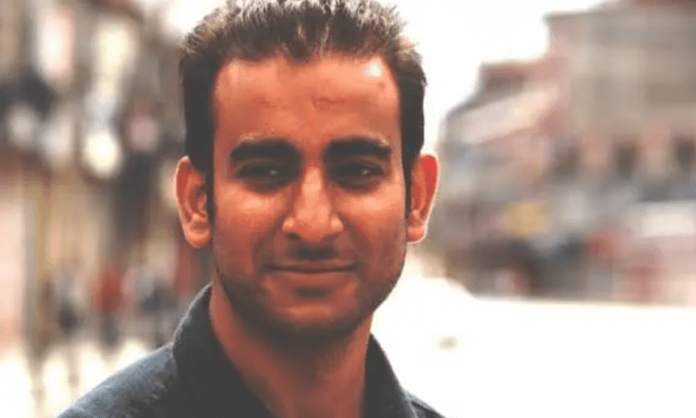
Jailed Kashmiri journalist Irfan Mehraj, who is currently incarcerated under draconian charges, has been honored with the Human Rights and Religious Freedom Journalism Award for 2024.
Mehraj, who won in the Best Video Story category for his impactful work on the heroin epidemic in Kashmir, shared the award with Akanksha Saxena and Khalid Khan of Deutsche Welle, reported Freepress Kashmir.
The awards, organised by the Indian American Muslim Council, a Washington, D.C.-based advocacy group, were presented at a ceremony in Chicago, Illinois. This year, the competition received over 210 entries across four categories.
The prestigious award for ‘Best Video Story on Human Rights and Religious Freedom’ was jointly won, with the top honour going to the three journalists from Deutsche Welle for their impactful documentary, “On Drugs – Kashmir’s Heroin Epidemic.”
The piece stresses upon the growing heroin crisis in Kashmir and lives of people ravaged by addiction in the region.
According to a Human Rights Watch statement issued earlier, said, “While on a professional assignment on 20 March 2023, Mehraj was summoned for questioning and detained by the National Investigation Agency (NIA) of India in Srinagar under provisions of the Indian Penal Code and the Unlawful Activities (Prevention) Act.”
Irfan has been booked under the draconian UAPA. According to the NIA, Irfan was previously summoned to Delhi in a case related to “NGO terror funding”. The NIA in its press note claimed he was a “close associate” of the Kashmiri human rights defender Khurram Parvez.
In June 2023, United Nations experts expressed serious concerns regarding the charges against and arrest of Mehraj and Parvez, stating that their continued detention is ‘designed to delegitimize their human rights work and obstruct monitoring of the human rights situation in Indian-administered Jammu and Kashmir.’
On 7 March 2024, UN experts sounded the alarm on the “harassment and prolonged detention of human rights defenders and journalists” in the country. ( With Agencies Inputs )
source: http://www.muslimmirror.com / Muslim Mirror / Home> Indian Muslim>Media / August 28th, 2024
Vartha Bharati Kodagu District Special Correspondent K.M. Ismail Kandakare has been selected as the recipient of the prestigious PaGo award by the Dakshina Kannada District Working Journalists Association this year. The award-winning report, titled ‘Give way or give way to death,’ was published in the ‘Vartabharati’ newspaper on April 6, 2023.
The selection committee, comprising Senior Journalist Keshav Kunder and Journalism Lecturer Guruprasad T.N., chose Kandakare’s report for its quality and impact. The award includes a cash prize of Rs. 10,001 along with a souvenir.
Kandakare, who holds a certificate course in Diploma in Journalism from Karnataka Open University, has previously been recognized for his journalistic contributions. He has received the Best Sports Reporting Award from both the Kodagu District Working Journalist Association and the Kushalanagar Taluk Working Journalist Association. Additionally, Kandakare’s debut work, ‘Mariam,’ was published in 2021.
Apart from his journalistic endeavors, Kandakare is also involved in football, serving as both a player and coach. He currently works as a referee for the Karnataka State Football Association.
The award ceremony is scheduled to take place on May 9 at 11 AM at the Mangalore Press Club. Mangalore University Vice-Chancellor Prof. P L Dharma will present the award, while senior journalist Chidambara Baikampadi will deliver a speech as the guest speaker. The event will be presided over by Srinivas Naik Indaje, the president of DK District Working Journalists’ Association, with Jitendra Kundeshwar, the general secretary of the association, coordinating the proceedings.
source: http://www.english.varthabharati.in / Vartha Bharati / Home> Karavali / by Vartha Bharati / May 04th, 2024
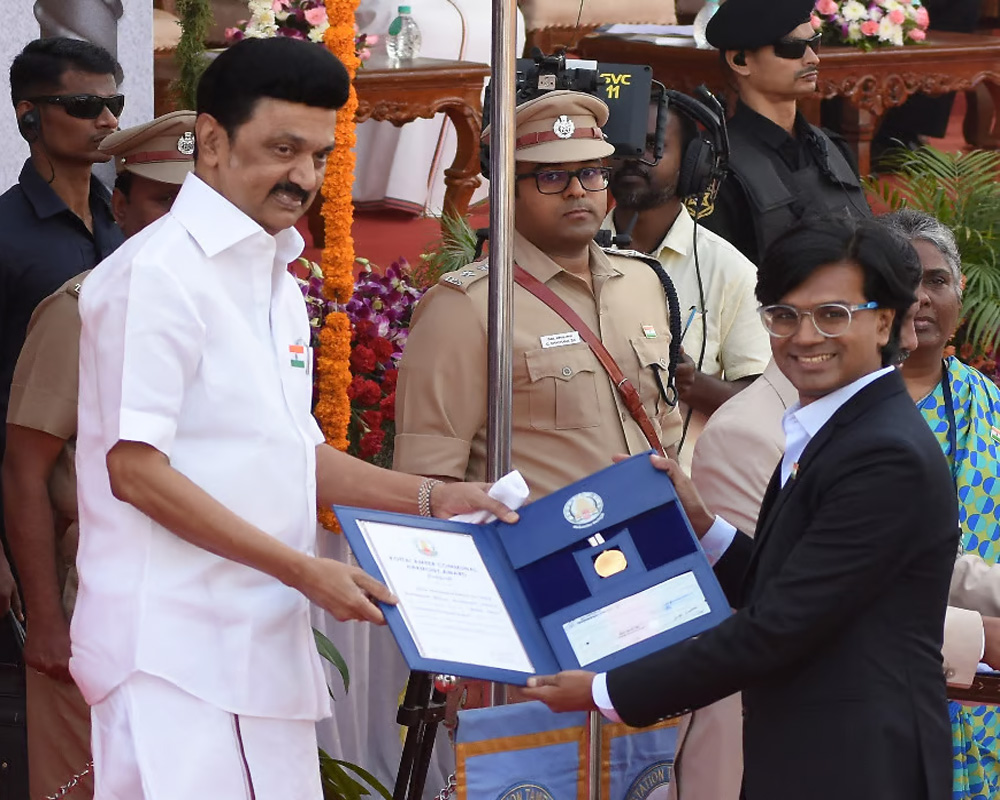
TN chief minister M.K. Stalin with Mohammed Zubair at the awarding ceremony. Photo: Video screengrab.
The government noted that his “work helps prevent the occurrence of violence in society likely to be caused by fake news.”
New Delhi:
Fact-checker and journalist Mohammed Zubair is the recipient of the 2024 Kottai Ameer Communal Harmony Award given by the Tamil Nadu government.
The citation notes that Zubair has been “rendering various services to promote communal harmony.”
It observes that in creating the website Alt News – which he co-founded with Pratik Sinha – Zubair has set up an instrument to analyse the “veracity of the news coming out on social media,” giving primacy to real news.
The government noted that his “work helps prevent the occurrence of violence in society likely to be caused by fake news.”
The citation especially says that in March 2023, when there was a rapid spread on social media of the disinformation that migrant workers were being attacked in Tamil Nadu, Alt News‘s verification of the authenticity of the video was instrumental in proving that the footage was not from Tamil Nadu at all.
It “stopped the spread of rumours against Tamil Nadu and acted to prevent violence caused by caste, religion, race and language in Tamil Nadu,” the government said.
In 2022, Zubair was arrested by the Delhi police for a 2018 tweet in which he shared a screenshot from a 1983 Hindi movie. Six cases were slapped on him during the period of his incarceration until the Supreme Court gave him bail.
Zubair is often attacked online by Hindutva commentators for fact-checking viral claims and disinformation.
source: http://www.thewire.in / The Wire / Home> Media> Government / by The Wire Staff / January 26th, 2024
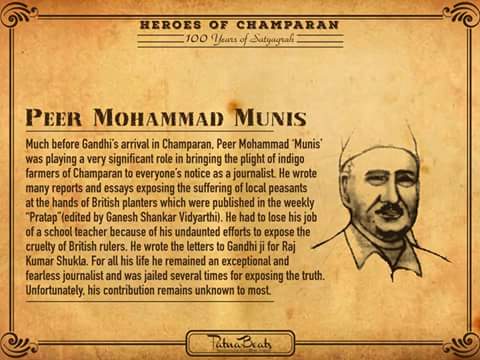
The Champaran Satyagraha is a landmark chapter in India’s history, and an important catalyst for it was journalist Pir Muhammed Munis, whose letter to Gandhi set the stage for the monumental resistance.
In 1917, when British rule prevailed over India, the government prepared a list to keep track of 32 of MK Gandhi’s closest associates. At number 10 was a name that history hasn’t forgotten since.
Pir Muhammed Munis, a journalist known for the power of his pen, was instrumental in his role in the Champaran Satyagraha movement, also touted as India’s first organised act of civil disobedience.
Through his body of work, he scripted a record of heroism that is etched into the sands of time.
To truly appreciate Munis’ role in the struggle for Independence, we trace our steps to 1916, when the British Raj was exercising exceeding control over Indians. One particularly vulnerable group were the farmers in Champaran, Bihar.
The source of contention was the agrarian practices in the region. While the British were intent on the peasants growing indigo, a lucrative cash crop with sizable demand in the markets abroad, the farmers were deprived of land for growing food crops instead. This tussle culminated in a famine, causing the farmers to rise in revolt against the dominion of the British. As the conflict escalated, word reached Gandhi. How?
Pir Muhammed Munis was behind it.
A ‘rouge journalist’
The uprising of the peasants in Champaran wasn’t going unnoticed. The country was reading about it thanks to Munis, who left no stone unturned in letting his views reflect his patriotic feelings. In the years to come, Pir Muhammed Munis would go down in history as the journalist who raised his voice when it was most difficult to be heard.
He chronicled the efforts of the farmers, the unlawful practices of the British and more such news in Hindi — despite the elite class being fluent in Urdu, Persian and English — displaying his ardent love for the language. In his later life, he went on to advocate for Hindi to be propagated amongst the masses. Anecdotes suggest during his later interactions with Gandhi, Munis even went on to teach the legend the language, a skill that greatly helped the latter.
So persistent and vocal was he about his patriotic opinions that he was termed as “notorious”, “bitter” and “dangerous” by the British, eventually being branded as a ‘badmash patrakar (rouge journalist)’.
A British Police document from the Azadi Ke Deewane Museum at Red Fort reads, “Pir Muhammed Munis is actually a dangerous and hoodlum journalist who through his questionable literature, brought to light the sufferings of a backward place like Champaran in Bihar.”
The letter that set the stage for the uprising
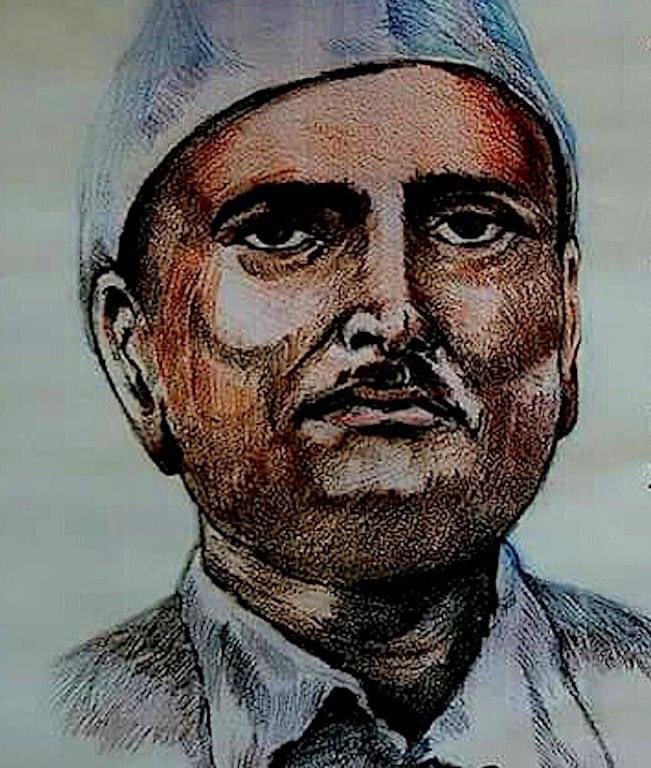
Pir Muhammed Munis fought for the farmers in the Champaran region of Bihar, Picture source: Twitter: Muslims of India
But nothing stopped Munis from continuing to write, his pen a double-edged sword. His works appeared frequently in Pratap, a Hindi weekly, and monthlys such as Gyanshakti and Gorakhpur. He was also on the editorial board of Desh launched and edited by Dr Rajendra Prasad.
The most famous letter among his repertoire of literary works is a letter he penned with local farmer Rajkumar Shukla, intended to be sent to Gandhi on 27 February 1917. Shukla conveyed the grievances of the farming community, while Munis coupled this with his power of words. An excerpt from the letter reads, “Our sad tale is much worse than what you and your comrades have suffered in South Africa”.
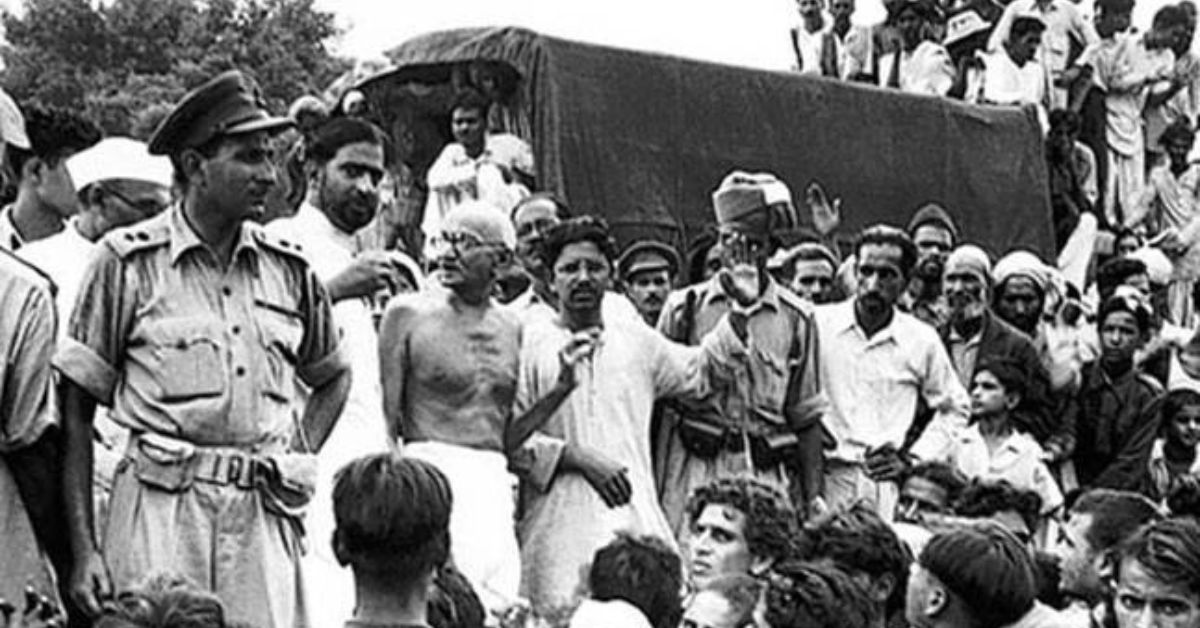
In another letter dated 22 March 1917, Munis once again voiced his concerns about the peasants in Champaran, and asked Gandhi to pay them a visit. And when he did on 10 April 1917, people commended the bond between the two, often calling Munis Gandhi’s pillar as he hatched plans for the Champaran Satyagraha.
As the first Satyagraha movement, it set the stage for future mass protests and uprisings. Gandhi set up schools in the Champaran area, gathered volunteers, conducted village surveys, organised protests, and strikes, and advocated for control over the sale of crops to be given to the farmers. And through this mutiny, Munis was by his side.
This did not go down well with the British. As a letter written by W H Lewis, sub-division officer to the commissioner of Tirhut division indicates, “… Mr Gandhi got offers of assistance, the most prominent is Pir Muhammad. I have not (sic) full details of his career, but either Whitty or Marsham could give them. He is, I believe, a convert to Muhammadanism and was a teacher in the Raj School. He was dismissed from his post for virulent attacks on local management published in or about 1915 in the press. He lives in Bettiah and works as a press correspondent for the Pratap of Lucknow, a paper which distinguished itself for its immoderate expressions on Champaran Questions… Pir Muhammad is the link between this Bettiah class of mostly educated and semi-educated men and the next class, i.e. the Raiyats’ own leaders…”
The result of the tyranny
History never forgets the cries of the just, and the Champaran Satyagraha was proof of this.
The mutiny ended with the British officers agreeing to formulate the Champaran Agrarian Act of 1918. The Act abolished the forcible cultivation of indigo and thus relieved tremendous pressure being put on the farmers here. The event has gone down in history as one of the first major revolts that forced the English to introduce a Bill in favour of the Indians.
With the Tinkathia system being abolished, the farmers thought the worst was over. But the British continued to oppress them in different ways. Fuelled by ending this once and for all, Munis started Raiyati Sabha, a platform that would advocate for and protect the rights of the farming community. For this, Munis faced a six-month jail term.
This wasn’t the last of imprisonment. In 1930 he was imprisoned in the Patna Camp jail for three months for his participation in the Salt Satyagraha of the Civil Disobedience Movement.
However, nothing could deter him from his goal of protecting the rights of his countrymen. In 1937, he led sugarcane producers who were protesting against intermediaries who were pocketing a major part of the earnings. He was also elected member of the Champaran Zila Parishad (District Board) on the Congress ticket and became President of Bettiah Local Board, from which he resigned to join the Individual Civil Disobedience Movement.
Throughout his lifetime, he advocated for rural development, popularisation of Hindi in primary schools and the rights of his fellow Indians. Until his passing away on 23 September 1949 Munis continued to be a leader worth looking up to for his countrymen.
Lauding the efforts of Munis on his passing away, Pratap editor Ganesh Shankar Vidyarthi, wrote in his newspaper, “We have the utmost sorrow that Pir Muhammed Munis of Bettiah, Champaran district has died. We have the privilege to see such souls who are quietly lying aside. The world doesn’t come to know anything about their issues. The lesser these sons of Mother India are renowned, the more profound is their work, the more philanthropic.”
He further wrote, “You recited the dreadful story of Champaran to Gandhi ji and this was a result of your hard-work only that Mahatma Gandhi visited Champaran which made this land a pious place and the place which is unerasable in the pages of history”.
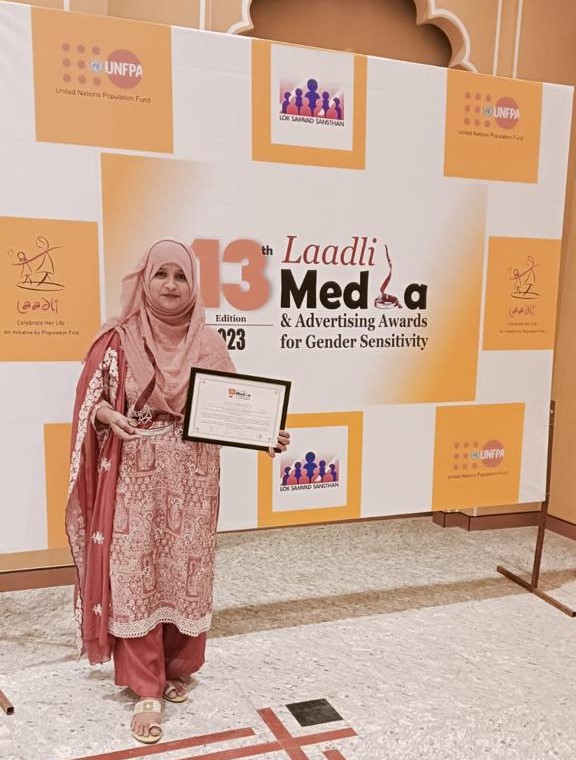
We are happy to announce that TCN’s SEED Fellow Sufi Parween has won the 13th Laadli Media Award for her exceptional contribution to gender-sensitive reporting.