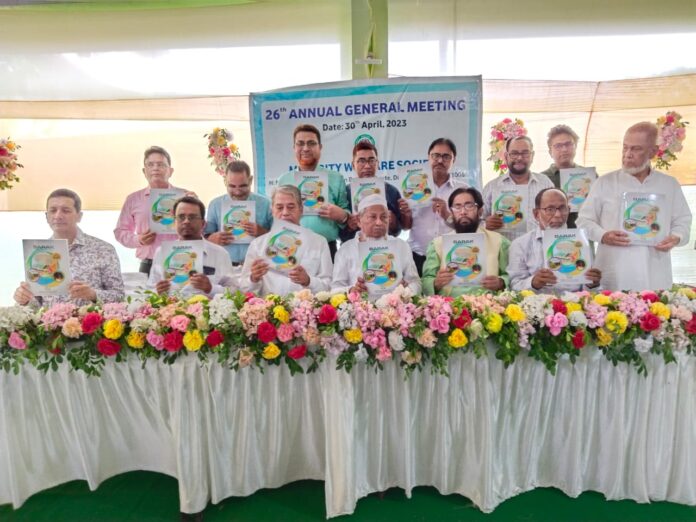
01The annual magazine of the Minority Welfare Society, “Barak”, was unveiled at the Society’s annual general meeting held in Guwahati on Sunday.
Shahidul Alam Choudhury, who had a very humble background, came to limelight in 1985 when he was sworn in as a cabinet minister in the AGP government of Assam. He was the lone minister from the Barak Valley in the cabinet. He shone over the political sky of Barak valley for nearly three decades until his death in November 2012. In order to perpetuate his memory and to keep his service to the community embedded in public mind, Minority Welfare Society (MWS) Guwahati instituted the Annual Sahidul Alom Choudhury Memorial Award in 2014. It may be mentioned here that late Sahidul Alam Choudhury was five times elected as MLA from Algapur Constituency of Hailakandi District and served two times as Cabinet Minister in the Government of Assam. The award is meant for persons of Barak Valley origin for outstanding achievement in their field of activity such as education, literature, social service, science and technology, arts, sports, medicine, health care, professional excellence, journalism, entrepreneurship, etc.
This year’s Sahidul Alom Memorial Award was conferred to Janab Habibur Rahman Choudhury, editor of the daily newspaper “Nababarta Prasanga” published from Karimganj, Assam. Besides being an acclaimed journalist, Habibur Rahman is also an educationist, social activist, and opinion leader who is respected in India and abroad. The award includes a memento, citation, and cash component of Rs 25,000. The award was given away at MWS 26th annual general meeting held in Guwahati on Sunday. Habibur Rahman, however, returned the award amount back to MWS for using the same for humanitarian purposes. Among earlier recipients of the award are Hafiz Rashid Ahmed Choudhury (jurisprudence), Abid Raja Majumdar (literature), Ali Haidar Laskar (history), Dr Baharul Islam (academics), and Dr Md Masoom (medicine & social service).
Earlier in the first session of AGM, the general secretary of MWS, Abdul Karim Choudhury, placed before the house the annual report of the activities of the society for the year 2022–2023.
In the second session, presided over by Abdus Sattar Choudhury, president MWS, three publications of MWS were unveiled in presence of a galaxy of dignitaries including Dr Abu Saleh Nazmuddin, former health minister of Assam and KJ Hilaly, Secretary to the Govt of Assam.
Abdul Waris Chowdhury, Vice President MWS, highlighted the journey of the society and its activities since its formation in 1994.
Various competitions among children were also organised on the occasion.
The event was anchored by Dr Ferdous Ahmed Barbhuiya.
source: http://www.twocircles.net / TwoCircles.net / Home> India News / by TCN News / May 02nd, 2023
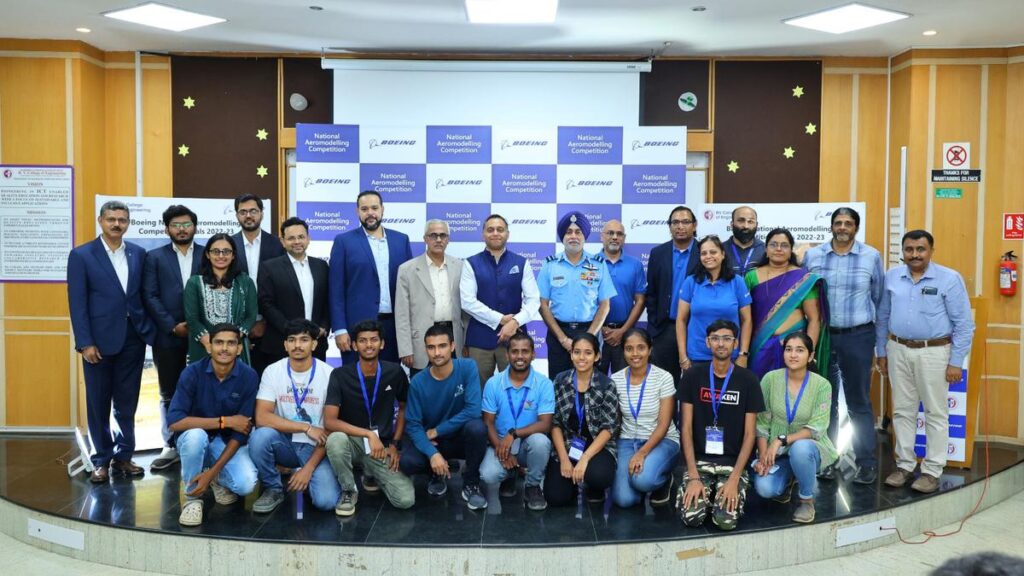
Winners of the 2023 Boeing National Aeromodelling Competition. 39 finalists from 12 teams were selected for the finale, which was held at R.V. College of Engineering in Bengaluru.
Bengaluru:
This year’s competition attracted close to 2,200 students across India.
Boeing announced the winners of the 8th annual Boeing National Aeromodelling Competition in India, on May 3.
This year’s competition attracted close to 2,200 students across India, and saw a two-fold increase in participation across zonal and national rounds. 39 finalists from 12 teams were selected for the finale, held at R.V. College of Engineering in Bengaluru.
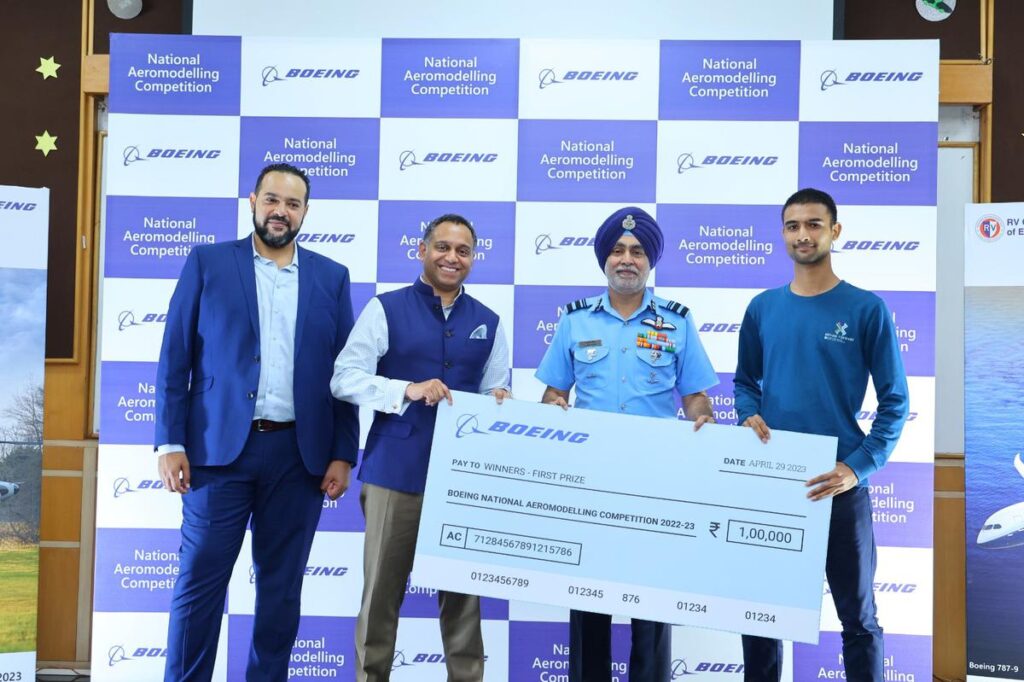
Arshad Khan (right) from Rabindranath Tagore University, Bhopal won the 2023 Boeing National Aeromodelling Competition. The finale was held in Bengaluru
Arshad Khan from Rabindranath Tagore University, Bhopal was declared winner of the competition.
Sharanya Acharya Nishmithe, Aman Kumar Srivastav and Gagan G. Nayak from Nitte Mahalinga Adyanthaya Memorial Institute of Technology (NMAMIT), Nitte, Karnataka bagged the second spot
Divyamshu, Rathan Raj K. Nancy and Anantha Krishna, also from NMAMIT-Nitte, took the third spot.
The zonal rounds of the competition were held at IIT Kanpur, IIT Bombay, IIT Kharagpur, and IIT Madras. The top three teams from each zone then travelled to Bengaluru for the finale.
The competition started as an annual event in 2013 to provide a nationwide platform for students who have a keen interest in aerospace engineering and related fields. The competition allows them to demonstrate their skills and creativity in designing, building, and flying fixed-wing aircraft models of different types and sizes.
Salil Gupte, president, Boeing India, said, “This national aeromodelling competition provides an excellent platform for young aviation and technology enthusiasts to present their creativity, and engineering and design skills. It is a testament to our commitment to encourage engineering talent to pursue careers in aerospace and defence in India.”
Ahmed Elsherbini, managing director, Boeing India Engineering & Technology Center, and chief engineer, Boeing India, said, “Aeromodelling competition plays a crucial role in the aerospace sector. It brings fresh perspectives, new ideas, and a willingness to challenge conventional thinking. With the aerospace industry constantly evolving, student innovation can be a driving force in the development of new technologies and sustainable solutions.”
Over the years, Boeing has strategically invested in developing talent for the aerospace sector in India.
Its programs, including Boeing University Innovation Leadership Development (BUILD) Program, the Boeing HorizonX India Innovation Challenge, and the Accelerated Aircraft Maintenance Engineers (AME) Apprenticeship program, have all helped empower entrepreneurs and contributed to building a skilled frontline workforce for India.
source: http://www.thehindu.com / The Hindu / Home> News> Cities> Bengaluru / by The Hindu Bureau / May 03rd, 2023
The results of the 2nd PU exams in Karnataka were announced on April 21.
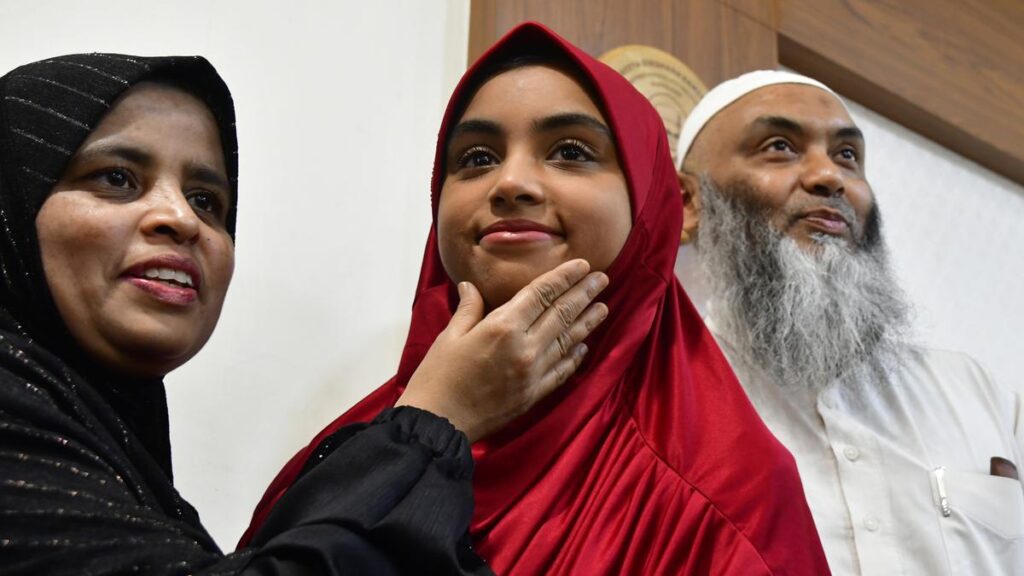
Tabassum Sheikh, 2nd year PU arts topper with her parents Abdul Khaum Sheikh and Parveen Modi, after the results of 2nd PU exams in Karnataka were announced, in Bengaluru on April 21, 2023. Tabassum is a student of NMKRV PU College for Women, Jayanagar. | Photo Credit: Murali Kumar K
The results of the 2nd PU exams in Karnataka were announced on April 21 by Ritish Kumar Singh, Principal Secretary in the Department of School Education and Literacy, and Ramachandran, Chairman of Karnataka School Examination and Assessment Board.
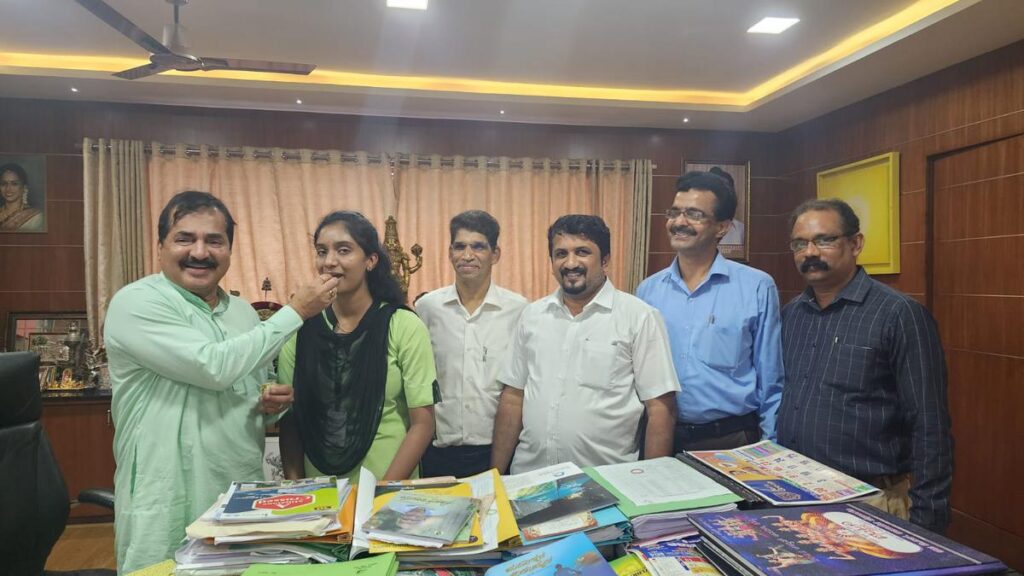
M. Mohan Alva, chairman, Alva’s Education Foundation, Moodbidri offering sweets to Ananya K.A., who topped the commerce stream in the second PU exams in Karnataka. The results were announced on April 21, 2023.
Ananya K.A. , commerce student, Alva’s PU college, Moodabidri is the topper in Karnataka scoring 600 marks out of 600. She hails from Kushalnagar in Kodagu district. She joined Alva’s PU College under the institution’s scholarship scheme
In the arts steam, Tabassum Sheikh, NMKRV PU College, Bengaluru is the topper with 593/600 marks.
S.M. Koushik from Gangothri PU college, Srinivaspura, Kolar district, and Surabhi S. from R.V. PU college, NMKRV campus, Bengaluru are the toppers in the science stream with 596 marks for 600.
How PU students performed as compared to last year
At 74.67%, the pass percentage in the II PU exams shot up by 12% from the previous year.
Of the 7,02,067 students who appeared for the exams, 5,24,209 have cleared them. A total of 4,79,746 (78.97%) regular students, 33,833 (48.42%) repeaters and 10,630 (43.02%) private candidates passed.
The pass percentage in the arts stream (1,34,876 students) was 61.22%, in commerce (1,82,246 students) was 75.89%, and in science (2,07,087 students) was 85.71%.
This year too, the pass percentage of girls is higher than boys — 2,82,602 girls (80.25%) passed against 2,41,607 (69.05%) boys. The performance of rural students was better than those in the urban areas — 1,19,860 (74.79%) rural students passed against 4,04,349 (74.63%) urban.
A total of 1,09,509 students got distinction (above 85%), 2,47,315 students got first class (60% to 85%), 90,014 students got second class (50% to 60%) and 77,371 students secured more than the minimum marks to pass (35% to 50%).
source: http://www.thehindu.com / The Hindu / Home> News> India> Karnataka / by The Hindu Bureau (headline edited) / April 21st, 2023
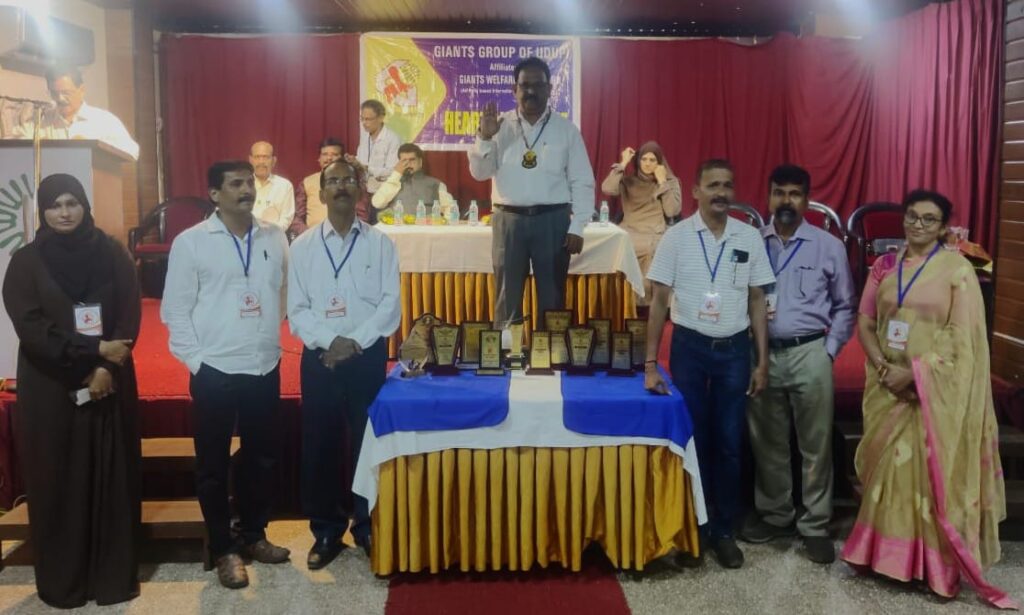
M Manna Iqbal was on Monday reinstalled as the President of the Giants Group of Udupi for the year 2023, in a ceremony held at the Woodlands Hotel here in the city.
Dinkar K Amin, a Central Committee member of the Giants Welfare Foundation was present as the Chief Guest of the event while Vasudev Mahale, Unit Director of Federation 6 was the installation officer at the ceremony.
Former Federation President Jayarajprakash was the keynote speaker at the event while Dr. Junaida Sulthana, Academic Head, MET, Udyavara, Udupi, Tejeshwar Roa, Federation vice-president, and Lakshmikanth Beskoor, Federation coordinator were present as the guests of honor.
Four women – Dildar Akbar – Special Needs School, Udupi, Sushma Gopalkrishna – Police Inspector Udupi Women’s police station, Bindu Thankappan, Advocate, Shaila Amanna, Asha Nilaya, Udupi – were also felicitated for their outstanding services and selfless contribution towards the society.
The new committee of the Giants Group Udupi was also formed. Yashwant Salian and Vincent Saldana were appointed vice-presidents, Roshan Ballal. Director of Administration, Vadiraj, Joint Director of Administration, Ganesh Ural, Director of Finance, Dayanand Kalmady, Joint Director of Finance. Prabhakar Bangera, Liyaqath Ali, Vinay Kumar Poojary, Zeenath, Geetha Rao, and Diwakar Sanil took oath as Directors.
Roshan Ballal presented the annual report while Vivek Kamath proposed a vote of thanks and compered the event.
The event was followed by an Iftaar arrangement for the members and audience.
source: http://www.english.varthabharati.in / Vartha Bharati / Home> Karavalii / by Vartha Bharati / April 18th, 2023
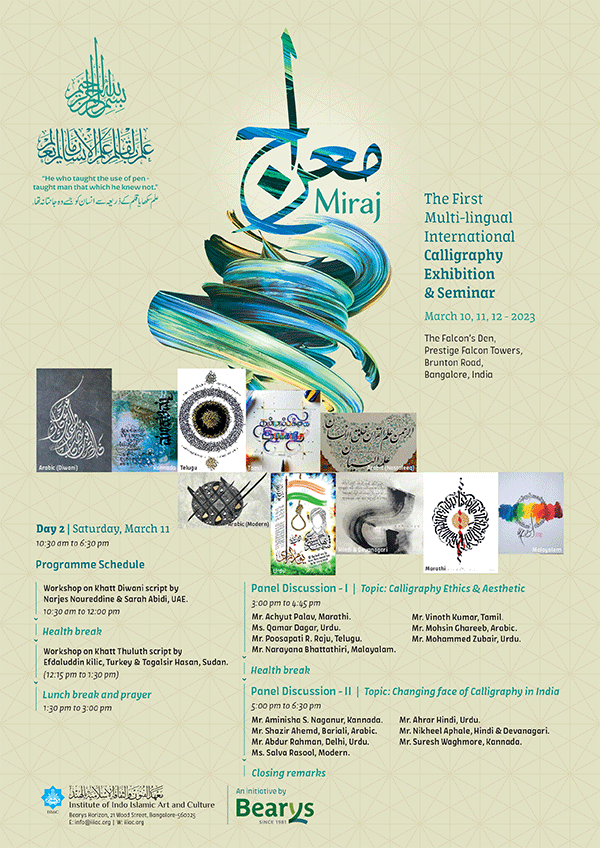
A three-day multilingual calligraphy exhibition and seminar named Miraj will be held in Bangalore from March 10 to 12, 2023.
The event will be held at Falcon’s Den, Prestige Falcon Towers, Brunton Road here in the city.
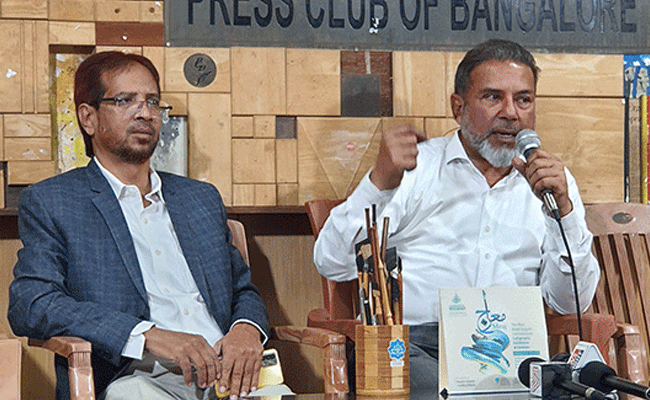
The exhibition and seminar will be first of its kind in Bengaluru, Syed Beary, Chairman of Bearys Group said in a press conference at the Press Club on Wednesday.
The event sponsored by Bearys Group is being organised by Institute of Indo Islamic Art and Culture ( IIIAC), Syed Beary who is also the Chairman and Managing Trustee of IIIAC added.
“More than 50 artists and experts from across the world will take part in this unique event. Calligraphy is a special art. It helps in maintaining balance between your mind, body and your thoughts,” he further added.
“Calligraphy finds its origin in Arabic. But Chinese and Japanese modern calligraphy are also significantly beautiful and pleasing to eyes. Even Indian regional languages have now adopted calligraphy and artists are exhibiting their skills and talents in their respective regional languages,” Syed Beary further stated.
Speaking about the exhibition, he said experts and artists from more than 10 countries including Turkey, Japan, Sudan, and Middle-East will take part in the event. Calligraphy experts in Urdu, Tamil, Malayalam, Kannada, Marathi and other regional languages will also be a part of the event.
“Seminars, Talks, and discussions on various aspects of calligraphy will also be held during this first of its kind three-day event,” he said.
Institute of Indo Islamic Art and Culture’s Principal Muqtar Ahmed also spoke at the press conference and said the exhibition will be inaugurated on March 10 at 10:30 am by Irfan Razack, Chairman and Managing Director of Prestige Group, Bangalore. The seminar will be inaugurated later at 3 pm by Maulana Mufti Sageer Ahmed, Ameer-e-Shariyat, Karnataka, snf Principal & Shaikul Hadees, Darul Uloom Sabeelur Rashad.
Zia Ulla Sharief, Chairman India Builders Corporation, Bangalore, Irfan Razack, Chairman, MD Prestige Group Bangalore, Shabeena Sultana, Consul of the Republic of Tunisia, Bangalore and Pusphamala N, Artist, Sculptor, Writer and Curator will be guests of honor during the inaugural event that will be presided over by Syed Mohamed Beary, Muqtar Ahmed said.
He also spoke about how expert calligraphers of multiple languages will grace the event and share their thoughts and experiences with the participants.
Efdaluddin Kilic, Turkey, Narjes Noureddine, UAE, Dr. Abdullah Fattini, KSA, Tagalsir Hasan, Sudan, Mohsin Ghareeb, Bahrain, Farid Abdur Rahim, Kuwait, Dr. Ali Rabbani, Iran, Yuko Takaji, Japan, Achyut Palav, Marathi, Poosapati Raju, Telugu, Narayana Bhattathiri, Malayalam, Suresh Waghmore, Kannada, Vinoth Kumar, Tamil, Nikheel Aphale, Hindi & Devanagari, Salva Rasool, Urdu are some of the experts who will hold talks on Calligraphy on the first day of the event.
The exhibition will remain open from 10:30 am to 8:00 pm on three days of the event.
The program schedule is as follows:
source: http://www.english.varthabharati.in / VarthaBharati.in / Home> Karavali / by Vartha Bharati / March 08th, 2023
Photographers Dar Yasin, Mukhtar Khan and Channi Anand captured images of protests, police and paramilitary action and daily life in Kashmir.
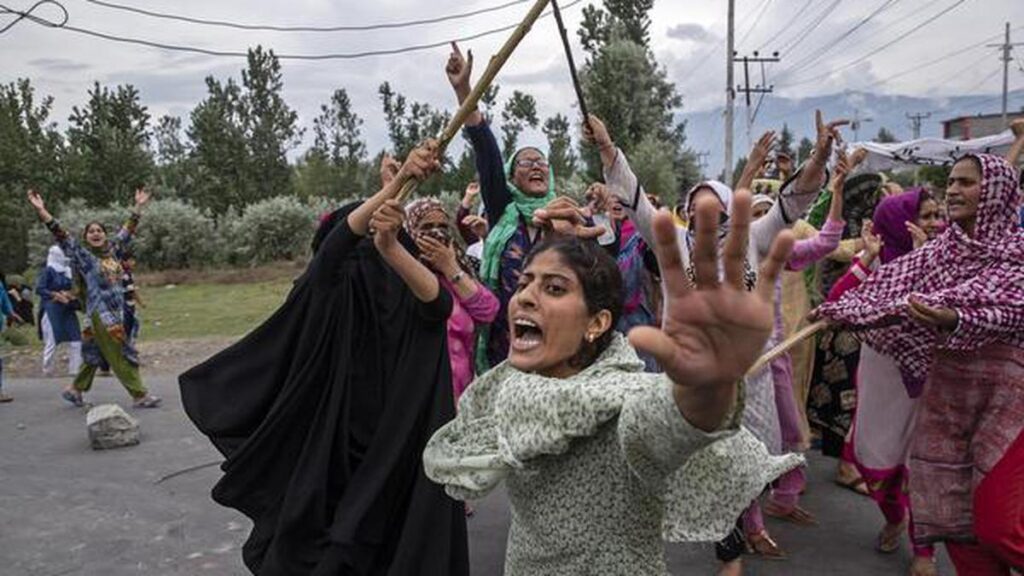
Women shout slogans as the police fire teargas and live ammunition in the air to stop a protest march in Srinagar, Aug. 9, 2019. The image was part of a series of photographs by Associated Press photographers which won the 2020 Pulitzer Prize for Feature Photography.
The story of India’s crackdown on Kashmir last August was difficult to show to the world. The unprecedented lockdown included a sweeping curfew and shutdowns of phone and internet service.
But Associated Press ( AP ) photographers Dar Yasin, Mukhtar Khan and Channi Anand found ways to let outsiders see what was happening. Now, their work has been honoured with the 2020 Pulitzer Prize in feature photography.
Snaking around roadblocks, sometimes taking cover in strangers’ homes and hiding cameras in vegetable bags, the three photographers captured images of protests, police and paramilitary action and daily life — and then headed to an airport to persuade travellers to carry the photo files out with them and get them to the AP ’s office in New Delhi.
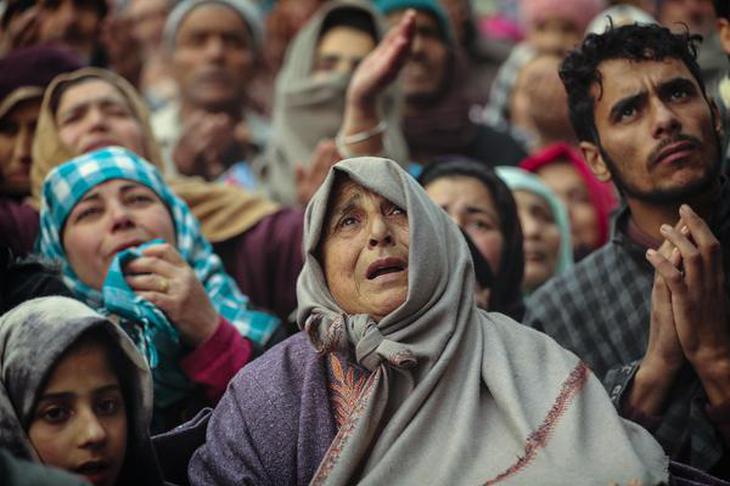
Kashmiri Muslim devotees offer prayer outside the shrine of Sufi saint Sheikh Syed Abdul Qadir Jeelani in Srinagar, Dec. 9, 2019. The image was part of a series of photographs by Associated Press photographers which won the 2020 Pulitzer Prize for Feature Photography.
“It was always cat-and-mouse,” Mr. Yasin recalled on Monday. “These things made us more determined than ever to never be silenced.”
Mr. Yasin and Mr. Khan are based in Srinagar, Kashmir’s largest city, while Mr. Anand is based in the neighboring Jammu district.
Mr. Anand said the award left him speechless.
“I was shocked and could not believe it,” he said, calling the prize-winning photos a continuation of the work he’s been doing for 20 years with the AP .
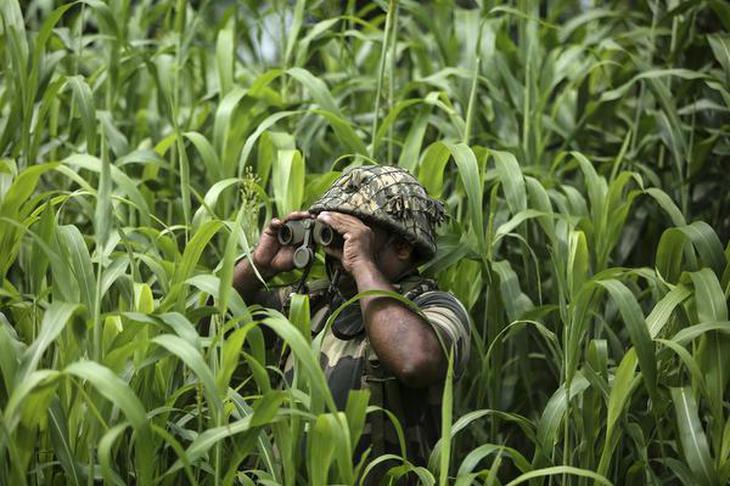
An Indian Border Security Force (BSF) soldier keeps vigil near the India-Pakistan border at Garkhal in Akhnoor, about 35 kilometers (22 miles) west of Jammu, India, Aug. 13, 2019. The image was part of a series of photographs by Associated Press photographers which won the 2020 Pulitzer Prize for Feature Photography.
With communications shut down, these journalists had to find out about protests and other news by finding them in person. Mr. Khan and Mr. Yasin took turns roving the streets in and around the regional capital of Srinagar, Mr. Yasin said, facing mistrust from both protesters and troops. The journalists were unable to go home for days or even let their families know they were doing okay.
“It was very hard,” Mr. Khan said, but “we managed to file pictures”.
After spotting luggage-toting people walking toward the airport, he said, the photographers decided to ask travellers to serve as couriers. Mr. Yasin also recalled how a relative of his, who was also a photojournalist, had told him about delivering film rolls to New Delhi in person as the conflict in Kashmir raged in the 1990s.
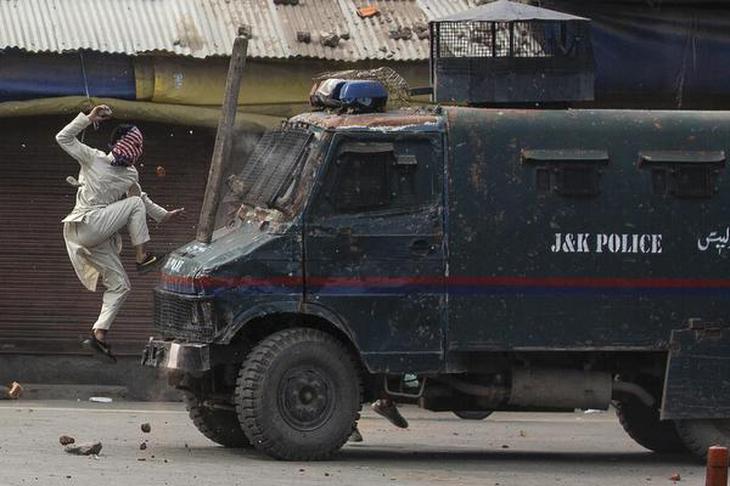
A masked Kashmiri protester jumps on the bonnet of an armored vehicle of Indian police as he throws stones at it during a protest in Srinagar, May 31, 2019. The image was part of a series of photographs by Associated Press photographers which won the 2020 Pulitzer Prize for Feature Photography.
The photographers thus went to the Srinagar airport and sought out strangers willing to carry memory cards and flash drives to New Delhi and call AP after landing in the Indian capital.
Some flyers declined, fearing trouble with the authorities, Mr. Yasin said. But others said yes and followed through. Most of the memory cards and drives arrived.
Mr. Yasin says their prize-winning work has both professional and personal meaning to him.
“It’s not the story of the people I am shooting, only, but it’s my story,” he said. “It’s a great honour to be on the list of Pulitzer winners and to share my story with the world.”
“This honor continues AP ’s great tradition of award-winning photography,” said AP President and CEO Gary Pruitt. “Thanks to the team inside Kashmir, the world was able to witness a dramatic escalation of the long struggle over the region’s independence. Their work was important and superb.”
Pulitzer finalists for breaking-news photography award
In a year when protests arose across the globe, AP photographers Dieu Nalio Chery and Rebecca Blackwell were Pulitzer finalists for the breaking-news photography award for their coverage of violent clashes between police and anti-government demonstrators in Haiti.
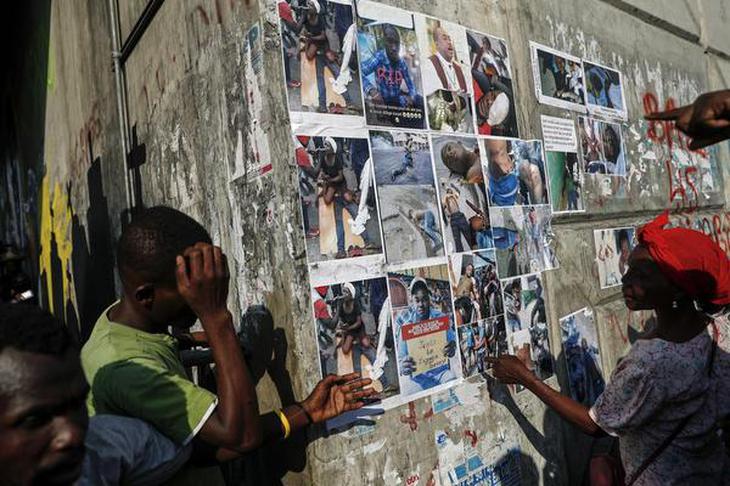
Protesters and passersby look at images of people said to have been injured or killed during the month-long protests calling for the resignation of President Jovenel Moise, in Port-au-Prince, Haiti, Oct. 15, 2019. The image was part of a series of photographs by Associated Press photographers which was named a finalist for the 2020 Pulitzer Prize for Breaking News Photography.
Bullet fragments hit Mr. Chery in the jaw while he documented the unrest. He kept taking pictures, including images of the fragments that hit him.
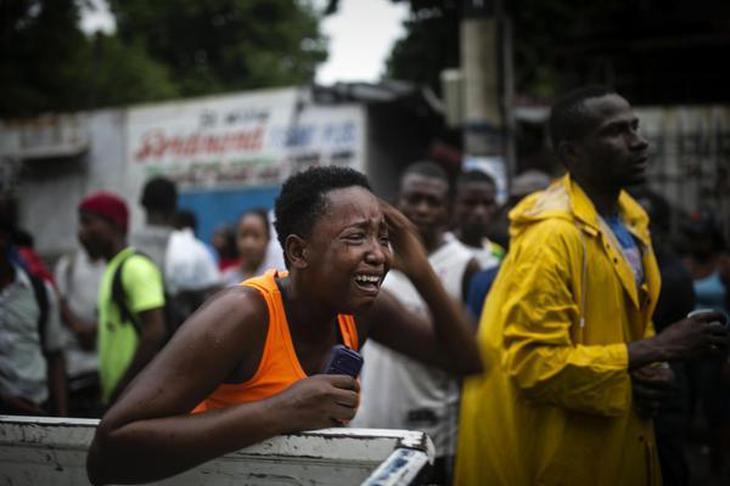
A protest against fuel shortages and demanding the resignation of President Jovenel Moise in Port-au-Prince, Haiti, Sept. 20, 2019. The image was part of a series of photographs by Associated Press photographers which was named a finalist for the 2020 Pulitzer Prize for Breaking News Photography.
“All five of these photographers made remarkable, stunning images despite dangerous and challenging conditions, sometimes at great personal risk,” said AP Director of Photography David Ake. “Their dedication to getting up every morning and going out to tell the story is a testament to their tenacity. The result of their work is compelling photojournalism that grabbed the world’s attention.”
AP Executive Editor Sally Buzbee called the Kashmir prize “a testament to the skill, bravery, ingenuity and teamwork of Dar, Mukhtar, Channi and their colleagues” and lauded Mr. Chery’s and Ms. Blackwell’s “brave and arresting work” in Haiti while many journalism outlets were focused elsewhere.
“At a time when AP ’s journalism is of more value than ever to the world, these journalists’ courage and compelling storytelling show the absolute best of what we do,” Ms. Buzbee said.
The honor for the photographers is the AP’s 54th Pulitzer Prize. The news cooperative last won a Pulitzer last year for stories, photos and video on the conflict in Yemen and the ensuing humanitarian crisis.
source: http://www.thehindu.com / The Hindu / Home> News> World / by Associated Press (AP) / May 05th, 2020
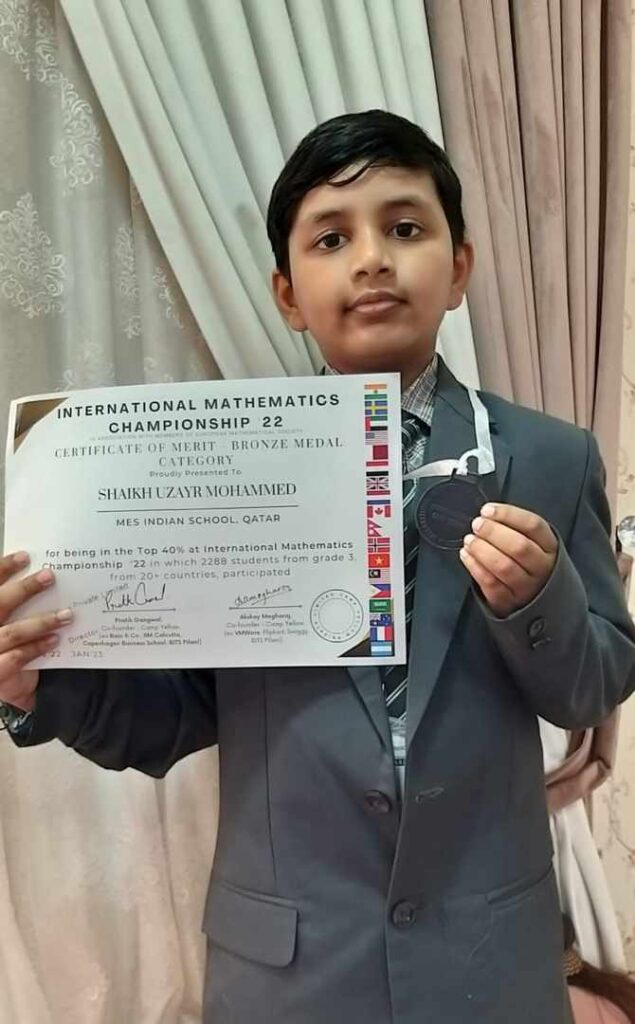
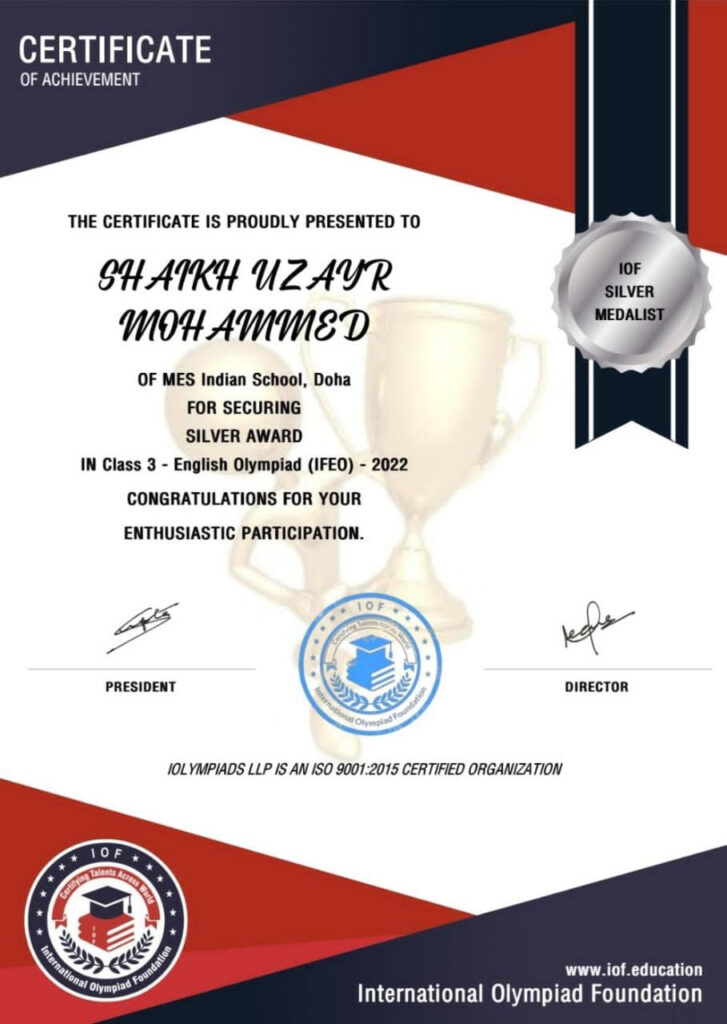
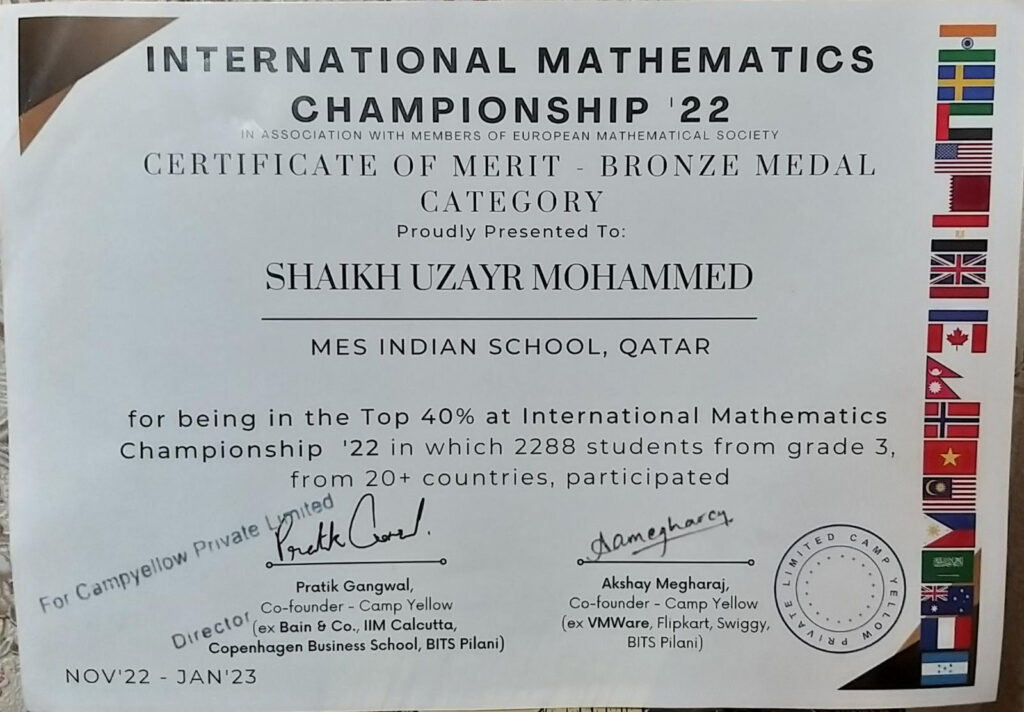
A Mangaluru student, Shaikh Uzayr Mohammed, studying in Qatar has won Bronze Medal at the International Mathematics Championship 2022.
Uzayr is a grade 3 student of MES School, studying in Qatar. He hails from Kankanady in Mangaluru.
The championship was held in December 2022 and the results were announced on Monday, February 20, 2023.
A total of 2288 students from over 20 countries had participated in the championship organised by Champ Yellow, wherein Uzayr secured a place in top 40%, thereby securing a rank in Bronze Medal category.
source: http://www.english.varthabharati.in / Vartha Bharati / Home> Karavali / by Vartha Bharati / February 20th, 2023
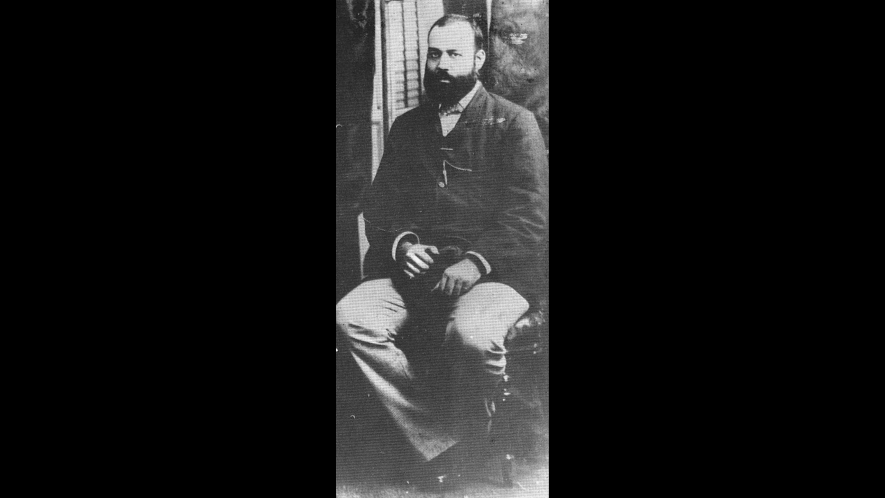
The first Muslim judge of a high court in colonial times, Syed Mahmood’s professional conduct offers a counterpoint to the declining standards in Indian judiciary.
WHEN Justice Abdul Nazeer addressed the 16th national council meeting of the RSS-affiliated Akhil Bharatiya Adhivakta Parishad at Hyderabad last December, he said, “Great lawyers and judges are not born but made by proper education and great legal traditions, as were Manu, Kautilya, Katyayana, Brihaspati, Narada, Parashar, Yajnavalkya, and other legal giants of ancient India.” In the symposium on “Decolonisation of the Indian Legal System”, Justice Nazeer also said the “continued neglect of their great knowledge and adherence to the alien colonial legal system is detrimental to the goals of our Constitution and against our national interests…”.
Perhaps Justice Nazeer should have also recalled 19th-century jurist Justice Syed Mahmood (1850-1903). A pioneer in bold assertions against the colonial judiciary, he produced incisive legal commentaries that reflect an audacious dissenter’s point of view. Writing in an Urdu newspaper, his father, Sir Syed Ahmed Khan, narrates Mahmood’s resignation from the Allahabad High Court in 1893 to “protect the self-respect of Indians against the racism of British judges”.
In that era, conceptions of nationhood were still evolving in India. Indian judges would not muster the courage to contest the racism of the imperial power or fellow European judges. But Mahmood did, in intrepid ways. Khan founded the Mohammedan Anglo-Oriental (MAO) College at Aligarh in 1877 and figures prominently but contentiously, stereotyped as a British loyalist and separatist in debates on contemporary nationalism. Mahmood supported his father’s modern education project, but unfortunately, his contributions are largely ignored by historians and the legal fraternity.
By 1920, MAO College, now Aligarh Muslim University, was the most prominent residential university in the country. Its history department has been a premier centre for advanced studies for a half-century. In 1889, primarily on Syed Mahmood’s initiative and his gifts in terms of books, journals and cash, AMU established a law department. Yet, he was neglected in its research. Only in 1973, seven years after the centenary of the Allahabad High Court, the Aligarh Law Journal brought out Mahmood’s contributions, and legal scholars reflected on his high calibre as a lawyer and judge.
The good news is, in 2004, Alan M. Guenther did his doctoral thesis on Mahmood at McGill University, Canada, which is available online for the public to access. His meticulous and well-researched account touches almost every aspect of Mahmood’s public life. Guenther also published an extended essay in 2011on Mahmood’s views on English education in 19th-century India. (In 1895, Mahmood had written a book on the theme for his speeches at the Educational Conference.)
In 1965, Asaf Ali Asghar Fyzee (1899-1981) complained, “Syed Mahmood’s contributions to the transformation of Muslim law in India have been largely neglected by historians and survive primarily as footnotes in legal texts on Muslim law.” Guenther, too, observes, “…overshadowed by the life and writings of his illustrious father, Ahmad Khan, his legacy has not received the attention it deserves. A large part of his father’s achievements in the reform of education, in fact, would not have been possible without the assistance of Syed Mahmood. But when he reached the age at which his father had made his most significant achievements, [Mahmood] had his life cut short.”
Mahmood had laid out his life plans clearly. S. Khalid Rashid, writing in 1973, reports that Mahmood decided early on that, like his ancestors, he would devote the first third of his life to educating himself, the second to earn a living, and the last to “retired study, authorship and devotion to matters of public utility”. But Guenther writes about how Mahmood’s health had deteriorated through alcohol abuse and disease. He died before he turned 53, broken by forced retirement, estranged from his father (who had died five years previously), stripped of responsibilities at the college he had helped found, separated from wife and son, and in poverty. He was selling personal items to repay debts. “His father’s numerous writings and letters are still republished, but Syed Mahmood’s contributions to Muslim thought are hidden in bound volumes of the Indian Law Reports and brittle files of government correspondence,” Guenther writes.
One aspect of Mahmood’s last years is captured by Prof. Iftikhar Alam Khan’s Urdu books, Sir Syed: Daroon-e-Khana (2006, 2020) and the recent Rufaqa-e-Sir Syed: Rafaqat, Raqabat wa Iqtidar Ki Kashmakash. These accounts expose the smear campaigns of the three companion successors of Sir Syed—Samiullah, Mohsin-ul-Mulk and Viqar-ul-Mulk—against Syed Mahmood as they vied for the secretary’s post at MAO College. Often European members of MAO College conspired with them. Exploiting his weaknesses and eccentricities, they ousted him to get a hold over college affairs, compounding his hurt during his tragic final years.
SYED MAHMOOD’S ROLE IN SIR SYED’S EDUCATIONAL ENTERPRISE
Having returned to India in 1872 after studying in England, Mahmood took time out of his budding legal career to assist his father’s reform work, particularly setting up MAO College. He prepared a detailed plan along the lines of his experiences in Cambridge. His specific aim, explained in February 1872, was to produce future leaders of India through an educational institution whose residential nature would be “as indispensable an education as the course of study itself”. The aim was to create a society of students and teachers quite different from the rest of society.
He travelled with his father to Punjab in 1873 and spoke at a rally to promote the project. In 1889, Sir Syed introduced a motion to nominate Mahmood as joint secretary of the board of trustees of MAO College by highlighting his assistance despite the opposition he faced. In particular, he considered his son’s influence the primary factor that persuaded European professors to come to India and teach there.
European staff members confirmed this around six years later when there was renewed opposition to Mahmood continuing as joint secretary. The principal, Theodore Beck (1859-1899), testified, “Syed Ahmad….acknowledged his reliance on Syed Mahmood for advice in all matters, and his imprint could be noted in the correspondence relating to the school. He declared his firm conviction that Syed Mahmood was the one person who shared his vision for the college, and apart from him, no one would be able to administer the school in keeping with that vision.” However, Samiullah (1834-1908) disagreed with Sir Syed on this count. As a result, a tussle for power began in the college management. The power-play could explain why AMU felt inhibited in bringing out a biography of Mahmood, a research gap that Guenther’s doctoral thesis fills. He has extensively relied on important correspondences of Mahmood preserved in the London India Office (British) Library.
SYED MAHMOOD’S TRYST WITH MUSLIM LAW
Mahmood is a forgotten pioneer of the transformation of Muslim law in modern South Asia. In 1882, at just 32, he became the first Muslim judge of the high courts in British India. He delivered numerous landmark decisions that shaped Muslim law, the law in general, and its administration.
Earlier, he blazed a trail his younger contemporaries followed in their judicial roles in British India. He was one of the first Indian Muslims to study in England and train in the English system of jurisprudence, the first Indian to enrol as a barrister in the High Court of Judicature at Allahabad in 1872, the first appointed as a district judge in the restructured judicial system of Awadh in 1879 and the first Indian assigned as a puisne judge to the High Court at Allahabad. He was the first Muslim in any High Court of India. He cleared a path for Indian Muslims to participate in administering justice in India. But his contribution is not limited to creamy career opportunities for Muslim youngsters. His lasting legacy is how Muslim law is perceived and administered in South Asia today.
CHAMPION OF ACCESSIBLE JUSTICE
An abiding concern of Mahmood was the cost of administration of justice. Court procedures were lengthy and expensive, and the “mass of law” was complicated. Distance from courts was another concern, for which he proposed a network of village courts for “on-the-spot” adjudication. He sought to make justice accessible through unpaid tribunals and honorary munsifs. He prepared a comprehensive draft for this, Guenther informs.
Furthermore, he attacked the [racial] mindset and court fees and stamp duties on legal documents. He ruled in August 1884 and February 1885 that “…if justice costs the same amount [to the] rich and poor, it follows that the rich man will be able to purchase it, whilst the poor man will not.” He declared, more than once, that British judges in India were too quick to find fraud.
In a speech at the Allahabad Bar in April 1885, Mahmood raised the language issue in judicial transactions, saying laws should be in languages intelligible to the masses. He insisted on the vernacular in arguments, pleadings and justice delivery and translated verdicts so that people unfamiliar with English could rest assured that judgments are reasoned. Of course, the issue of judicial language continues to be debated, and for this, acknowledgement is due to Mahmood.
AN INDIAN DISSENTER IN THE HIGH NOON OF BRITISH COLONIALISM
Mahmood is known most for outstanding dissenting judgements. In volume 2 of his 2021 book, Discordant Notes, Justice (retd.) Rohinton F. Nariman writes that Mahmood was known for detailed judgments, some of which stand out for thoroughness and fearless language. Mahmood would refer to the original Sanskrit versions when ruling on Hindu laws and the Arabic texts for Muslim laws, rather than using interpretations of the relevant texts.
From the 1860s to 1880s, during the codification of laws, he sought limits on importing British laws and protested that the local context was getting overlooked. His concern was not just the laws but their efficacy and adaptability within India’s cultural diversity.
Guenther observes, “…throughout his life, he identified himself as a Muslim as well as an Indian and a subject of the British crown, and that he was actively involved in the education and improvement of the Indian Muslim community. At the same time, Mahmood… [made] efforts to promote harmony between people of diverse backgrounds, and…[supported] initiatives that improved the situation of all Indians, regardless of religious affiliation…”
An anecdote from Altaf Hali’s Hayat-e-Javed (1901), cited by Shamsur Rahman Faruqi (2006), is worth sharing. “Contrary to the culture of sycophancy and genuflecting before the English colonial authority….Syed Ahmad Khan and his high-profile and brilliant son Syed Mahmud strived to conduct themselves as if they were equal to the English….Syed Ahmad Khan had stayed away from the [1867 Agra] Durbar because Indians had been given seats inferior to the English. A medal was to be conferred on Syed Ahmad Khan at that Durbar. Williams, the then Commissioner of Meerut, was later deputed to present the award to Syed Ahmad Khan at Aligarh railway station. Willams broke protocol and showed his anger at having to do the task under duress and said that government orders bound him, or he wouldn’t be presenting the medal to Syed Ahmad Khan. Syed Ahmad Khan accepted the medal, saying he wouldn’t have taken the award, except that he too was bound by government orders.”
Indian democracy is an outcome of anti-colonial nationalism, and dissent is its core component: Mahmood’s dissent contributed to nationalism in his time. In 2022, the V-Dem Institute described India as an electoral autocracy where dissent is being criminalised, and the judiciary is failing to contain the majoritarian upsurge. Mahmood’s professional conduct is an encouraging counterpoint to the degeneration in the Indian judiciary.
WHAT DID MAHMOOD THINK OF THE INDIAN NATIONAL CONGRESS?
According to Guenther, though Mahmood never joined the Congress, he was “equally aloof” from the anti-Congress propaganda his father indulged in. “…a rare catholicity characterised his views on most of the controversial questions,” he writes. He adds, “His acceptance among the Hindus [elites] generally was demonstrated by the fact that they tried to send him as their representative to the Imperial Legislative Council, though he never received that appointment.”
Nonetheless, like his father, Mahmood harboured class and regional prejudices. Guenther reveals an article Mahmood wrote in The Pioneer on 4 September 1875, suggesting the government must strive to with the sympathies of the “higher classes of natives”. When challenged to defend his position by “Another Native” in the same newspaper two weeks later, Mahmood responded that people in Punjab and the North-western Provinces [now Uttar Pradesh] were, historically speaking, of “much greater political significance” than those of Lower Bengal. Gunther cites his write-up: “…any educational system that succeeded in ‘attracting the Bengalee and fail(ed) to exercise any influence upon the higher classes of the Rajpoot, the Sikh, and the Mussulman’ must be regarded as a failure.”
Considering the socio-regional composition of top functionaries of AMU, even impartial insiders would testify that it still harbours regional and sub-regional prejudices. The Sir Syed Academy is releasing many publications during the ongoing centenary celebration of AMU. Publishing Guenther’s dissertation may be a fitting tribute to Mahmood, who must be regarded as a prominent co-founder of MAO College.
Mohammad Sajjad teaches modern and contemporary Indian History at Aligarh Muslim University. Md. Zeeshan Ahmad is a lawyer based in Delhi. The views are personal.
First published by Newsclick.
source: http://www.theleaflet.in / The Leaflet / Home> History / by Mohammad Sajjad and Zeeshan Ahmad / April 01st, 2022
Nusrat Noor from Jamshedpur not only cleared the Jharkhand Public Service Commission (JPSC) examination but also secured the highest rank in the list of successful candidates
Ranchi:
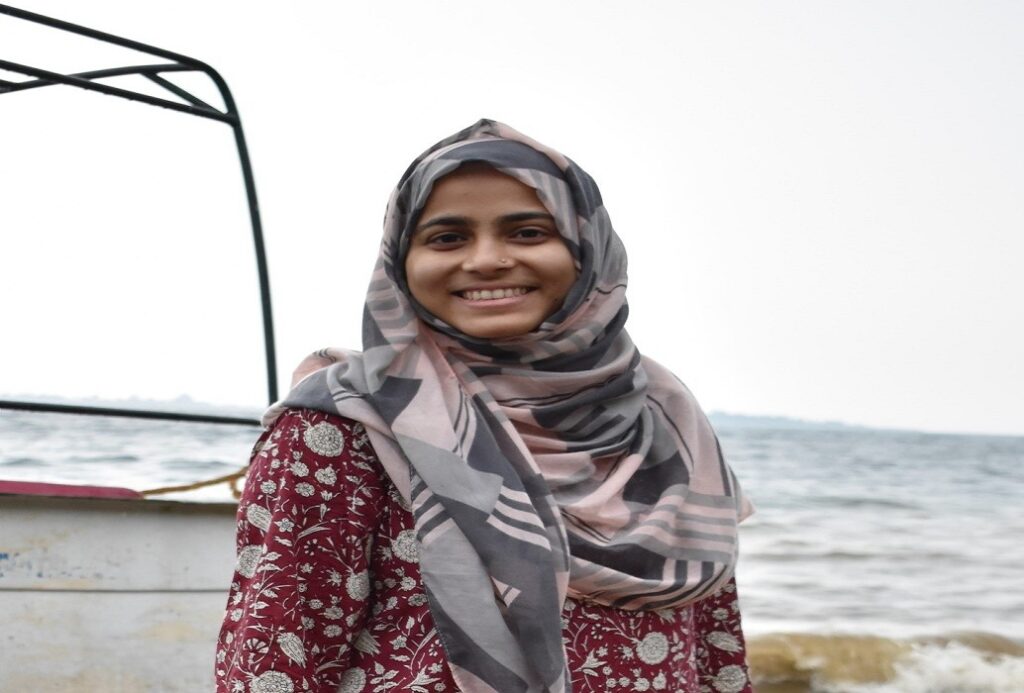
Nusrat Noor has become the first Muslim woman to top the Jharkhand Public Service Commission examination 2022 securing the first rank. She not only cleared the Jharkhand Public Service Commission (JPSC) examination but also secured the highest rank in the list of successful candidates who cleared the coveted examination the result of which was declared two days ago.
Nusrat Noor, 27, applied for the examination a year ago under the medical category soon after application forms were made available on the website. She prepared for the exams with due diligence, appeared for an interview last month, performed brilliantly in the exam and eventually came out with flying colours to become the first Muslim woman to ever top the JPSC examination.
On the empowerment of Muslim women, Nusrat Noor said, “Participation and initiative are key to increasing women’s representation. It doesn’t matter what the result might be, Muslim women should come forward to get into civil services. This is how we can increase our representation and benefit our community and the nation at large.”
The Jharkhand Public Service Commission conducts the state-level civil services examinations to make recruitment for top governmental posts in various departments, including teaching, medical, and healthcare, in the state. It is also responsible to conduct written and verbal examinations to appoint candidates for these prestigious government positions.
On being asked what motivated her to go for civil services, she said, “I noticed that the representation of Muslim women in the government workforce is negligible. It’s high time Muslims got highly educated. Especially our women should be in the forefront when it comes to grabbing the opportunities that come our way from every sector.”
Born and brought up in the Jamshedpur city of Jharkhand, Noor, a mother of one is a medical practitioner with a specialisation in neurology.
After completing her primary education at Sacred Heart Convent School in Jamshedpur, she moved to Ranchi to pursue her degree in medical sciences from the Rajendra Institute of Medical Science.
She completed her degree of MBBS in the year 2020, and consequent to this, she was posted in the same medical college to practice what she refers to as a junior residentship.
During her residentship, she got married. But her marriage has not come in the way of her studies and her dedication to pursue her goals. She lives in a joint family where, she says, everyone is very supportive. Her in-laws never discouraged her from pursuing her dream and goals.
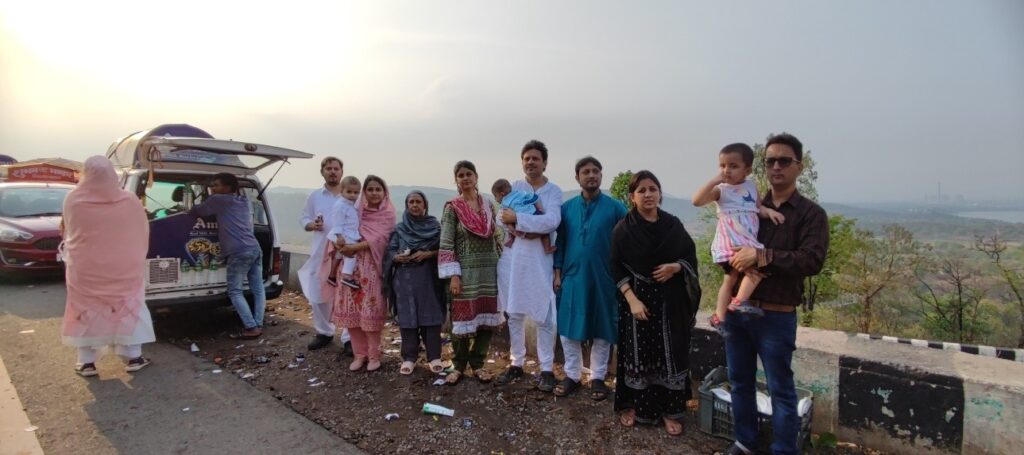
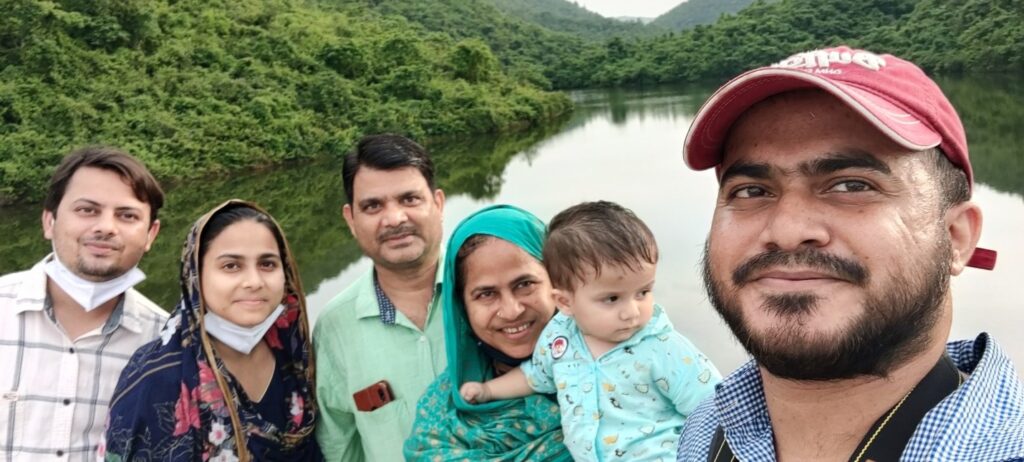
During an outing with her in-laws
She says, “My husband and in-laws are very encouraging and supportive, I am lucky in a way, but this is how it should be in every household. I would say my family is a role model for every other family which treats its daughter-in-law as someone who is no more than a person whose job it is to do all the household chores.”
She looks at her family of more than 10 members as her strength and backbone. “I have a very big family, but it never has been a setback in doing whatever I wanted to do”.
Her husband, Mohammad Umar, is also a doctor and a consultant surgeon. He has always been by her side during her entire journey.
“My husband has always motivated me; he switched roles and helped me in my household chores. He did everything possible to make me achieve my goal, from setting up the timetable for me to study to taking care of our two-year-old child,” she recounts with a sense of gratitude.
With husband Dr. Mohd Umar and son Mohd Saad
Noor’s father, Md. Noor Alam, is in a managerial post at Tata Steel, Jamshedpur while mother Seerat Fatima is a homemaker. She is the youngest in her family. The news of her becoming the first Muslim woman in the entire state to top the JPSC examination makes them proud.
Her elder brother, Mohammad Faisal Noor, is pursuing his research in industrial engineering at the National Institute of Technology, Jamshedpur.
He says, “We were quite confident about her selection, but the news of that she got the first rank was, Alhamdulillah, a pleasant surprise.”
With her elder siblings
The one thing that she will never forget about in her entire journey, right from her school days to becoming a doctor to now cracking the JPSC, is that people and society even in the 21st century don’t consider a woman’s approach to her career as a personal achievement. Society still believes that a woman’s well-being lies in her traditional role as a homemaker.
She recalled the moment she got married, she was told by a friend that getting married ‘on time is an achievement in life and she has achieved it.
She said, “Personal life can be an aspect to achieve the ‘progress’, but there is much more to it. For me, apart from my personal life, achieving goals set by myself counts as progress. Society still needs to evolve to address the needs of today’s generation. My husband’s family, which is mine too, present an example of a ‘just’ and ‘progressive’ society which looks at the woman more than someone whose responsibility is confined to looking after the household.”
Nusrat now aims to start preparing for her post-graduation while taking charge as a medical officer in one of the government hospitals as appointed by the administration. She also looks forward to encouraging and facilitating other women to take up professional and administrative positions.
Proud mother of a two-year-old Mohd Saad
“Women should participate more to come into the mainstream. I also make an appeal to families to encourage their daughters to educate themselves as much as possible, as this is the only way to make them economically independent and socially self-sufficient.”
source: http://www.clarionindia.net / Clarion India / Home / by Ghazala Ahmad, Clarion India / December 11th, 2022
Ghazala Wahab explains what it is to be a Muslim, a member of the largest religious minority in India today, and why the community lives in fear as prejudices persist.
The book opens with an unputdownable 42-page introduction that delves into the root of fear and despair among Muslims who have embraced the country as theirs but are polarised because of the identity they bear.
The shock and shame of communal riots, orchestrated mass violence and lynchings that served political agendas and led to societal divisions during the past decades hits you, as journalist Ghazala Wahab lays bare instances from her life.
Balanced narrative
She meticulously balances her narrative because she wishes to build a bridge of conversation. While she addresses fellow Muslims asking them to embrace modernity and be an integral part of positive change, she also alerts non-Muslim Indians about their perception of Muslims based on prejudice and hearsay, not facts.
Self-examining her own community members, she admits it never struck her how an average Muslim struggles to stay alive because she looked at things from her position of privilege. As she researched, she found equal opportunity and justice are only concepts and that law- making and law-enforcing agencies act in contradiction to vilify and stigmatise Muslims.
It is a vicious cycle, writes Ghazala, because the post-partition Muslims have remained an irrelevant votebank and sought security in their ghettos perpetuated by illiteracy, poverty and unemployment. The mullahs and clergy have easily taken them under their religious fold to exploit them. The general backwardness of the community has fed into a sense of loss of identity and unmet aspirations for Muslim youth, men and women.
Personal experience
In the mid-80s, Ghazala’s father shifted from their ancestral home in a middle class mohalla to an upscale Hindu-majority neighbourhood in Agra. His successful business and hobnobbing with the powerful, gave him the comfort of keeping his family under a security net. But that was till Agra was engulfed in violence post-kar seva after BJP leader L.K. Advani rolled out his rath yatra from Somnath to Ayodha in October, 1990, and was subsequently arrested. As sporadic violence spread across north India, Ghazala’s family wondered where they would be more secure — in their new neighbourhood or in a Muslim majority insulated mohalla.
Ghazala’s father called his brothers to safety and her mohalla uncles requested them to move back to the old Muslim locality. Ultimately everybody stayed where they were as fury was unleashed on their community everywhere. A young collegian then, Ghazala, her parents and three siblings were at home when an angry mob led by a neighbour shouted slogans, smashed windows, pelted stones and damaged their car. Desperate phone calls for help went unanswered.
When Ghazala’s father went to the police station to enquire about the adult males who were forcibly picked up from the mohalla during search operations, senior officials known to him avoided him. Those he thought had accepted him treated him as nothing more than a Muslim when it came to communal division. For Ghazala’s father it was not about being a victim but it was more about the humiliation, a betrayal of belief.
Turning point
Her family survived the riots but it left a scar. Her parents chose to go silent and it irked Ghazala that a victim should feel ashamed. She saw the same resignation and defeatist attitude when the Babri Masjid was razed. It unnerved her because she sensed it was a turning point not just for her family but for most Indian Muslims.
“Civility was the first casualty, replaced by communal prejudice and demonstrative religion,” she writes.
Many members in her extended family began to draw comfort from religious conservatism. She talks about a cousin who started wearing a headscarf and told her she was more comfortable with her Muslim friends as they didn’t have to pretend with one another, whereas to her Hindu friends she was a validation of their liberal outlook.
The conversation disturbed Ghazala as she never perceived two distinct identities in herself — a Muslim and an Indian. The issue was complex and so were several disparate questions.
Ghazala leans on poignant narration about the average Muslim being confused and scared through examples of those who have hidden their identity and reverted to Hinduism under perceived coercion. “They could never participate as equal partners in the country’s development. Only 2.6 per cent of Muslims are in senior-level jobs and a small number have achieved a reasonable upward mobility,” she writes.
On a positive note, Ghazala says Muslim society is changing. The protests against CAA/NRC in December 2019, she feels, has given rise to an assertive community even though her 1990 experience returned to haunt her in February 2020 when her paternal aunt’s family panicked as a mob reached their northeast Delhi colony. Anger and helplessness resurfaced when her aunt called her for help and her uncle refused to escape or abandon his life’s savings. The sense of fear doesn’t leave, she says.
Born a Muslim: Some Truths about Islam in India ; Ghazala Wahab, Aleph Book Company, ₹999.
soma.basu@thehindu.co.in
source: http://www.thehindu.com / The Hindu / Home> Books. Reviews / by Soma Basu / May 15th, 2021