As many as 97 Muslims from across India have appeared in the UPSC Civil Services Interviews after cracking the Civil Services Mains 2024 exams and now looking for a spot in the Final Merit List to be released with results to be declared on upsconline.nic.in and upsc.gov.in any time after April 17, 2025.
[Grok 3 Image for Representation]
UPSC Civil Services Result 2024:
As many as 97 Muslims from across India have appeared in the UPSC Civil Services Interviews after cracking the Civil Services Mains 2024 exams and now looking for a spot in the Final Merit List to be released with results to be declared on upsconline.nic.in and upsc.gov.in any time after April 17, 2025.
UPSC Civil Services 2024 Result Date
The Union Public Service Commission had conducted the Civil Services Main Exam 2024 from September 20 to 29, 2024. According to the Civil Services Main result announced on December 9, 2024, around 2,845 candidates had passed the written exam and were called for Personal Interviews.
The Personal Interview is the final stage of selection for the coveted Civil Services Posts that include IAS, IPS, IRS IFS and others. The candidates are called for Interviews after they clear Civil Services Preliminary exam followed by CSE Mains.
The Personal Interviews of the UPSC Civil Services exams are scheduled from January 7 to April 17, 2025. Accordingly, the UPSC Civil Services 2024 Result could be announced any time after the last interview slot which is April 17.
Muslims Passing UPSC Mains
Out of the total 2,845 candidates who cleared the Civil Services Main 2024 exam and called for Personal Interview, some 97 are Muslims and they are now eying for a place in the final merit list.
This is around 28 less than their last tally in 2023 when some 125 Muslims had cleared the UPSC Main Exam and were called for interview.
On the other hand, around 2,529 candidates had cracked the Civil Services Prelims and Main exams and called for Personal Interviews in 2022. Among them 83 were Muslims .
Th representation of Muslims in UPSC has been consistently between 3 to 4% in decades. The Civil Services result of this year will show if this changes or remains the same.
(Disclaimer: The UPSC does not identify candidates by their religion. The above list has been compiled based on the names of candidates as mentioned in the UPSC Main result released by the Commission. Few names are Muslim sounding but are also used by people belonging to more than one religion. Accrodingly, this list is not final. Also some names might have been missing from the list, or if included, they might not be necessarily a Muslim.)
Year-wise Performance of Muslims in Civil Services
In 2023, a total of 1,016 candidates were recommended by the Union Public Service Commission for different Civil Services posts. Of them 51 were Muslims .
In 2022, a total number of 933 candidates were recommended for IAS, IPS, IFS, IRS and other civil services posts. Of them 30 were Muslims .
In 2021, a total of 685 were recommended in the UPSC Civil Services 2021 Merit List. Of them, 21 were Muslims. This was the worst performance of Muslim candidates in a decade .
On ther hand, a total of 31 Muslims had cracked the Civil Services Exam (CSE), also known as IAS exam, in 2020 when UPSC had recommended 761 candidates for the top CS posts.
In 2019, 42 Muslims had cracked the exam whereas in 2018 just 27 Muslims had made it to the final result.
The years 2016 and 2017 were the brightest period for Muslim candidates. In 2016, 52 Muslims figured in the list of successful candidates whereas in 2017 their tally was 50.
In 2015, 34 Muslims were among the 1,078 candidates recommended by the Union Public Service Commission (UPSC) whereas 38 Muslims were in the list of total 1,236 candidates in 2014.
In 2013, a total of 34 Muslims had cleared the exam, whereas in 2012, 30 Muslims were among the successful candidates, four of them were among top 100.
Similarly in 2012, 30 Muslims were among the successful candidates and in 2011, 31 Muslims were among the 920 selected for the civil services.
Likewise, in 2010 among the 875 successful candidates 21 were Muslims with Dr. Shah Faisal of Kashmir topping the exam at the national level.
In 2009, a total of 31 Muslims were in the list of 791 successful candidates.
As per the past records, the UPSC declares the Civil Services Final Result few days after the final phase of interview. Accordingly, candidates who are aspiring to become future IAS, IFS, IRS and other such posts can expect their result any time after April 17, 2025.
[The writer, Aleem Faizee, is Founder Editor and CEO of ummid.com. He can be reached at aleem.faizee@gmail.com]
source: http://www.ummid.com / Ummid.com / Home> Education & Career / by Aleem Faizee (some editing) / April 15th, 2025
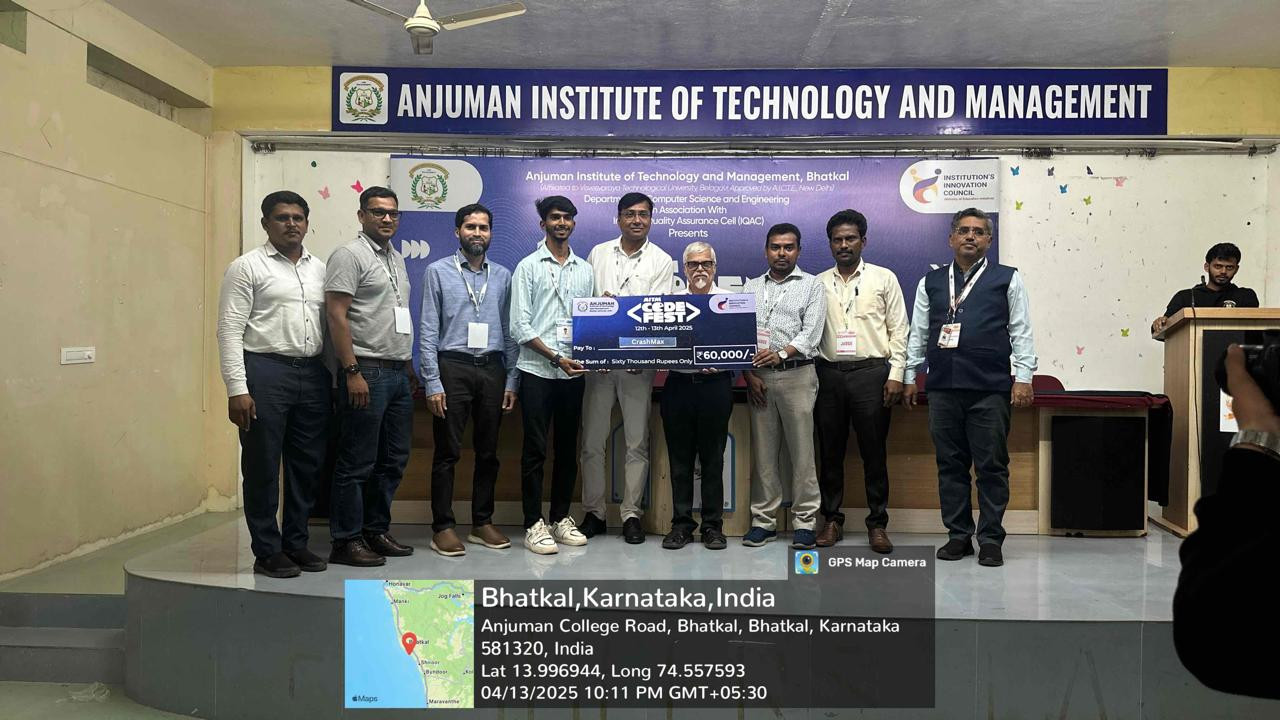
The Anjuman Institute of Technology and Management (AITM), Bhatkal, successfully hosted the AITM CodeFest 2025, a 24-hour national-level hackathon that saw participation from student teams across the country. The event, held on the AITM campus, concluded on Sunday evening with a grand valedictory function celebrating the winners and appreciating all participants for their innovative tech solutions and collaborative spirit.
A total of 30 teams participated in the overnight coding challenge, working intensively on real-world problems to develop creative and impactful solutions.
The results were announced by AITM Principal Dr. K Fazlur Rahman at the valedictory ceremony. Team CrashMax, represented by Abul Khair from Yenepoya Institute of Technology, Mangalore, won the first prize of ₹60,000.
The second prize of ₹30,000 was awarded to Team Cyphernova, comprising Hemanth C S and Mohamed Kamran from the National Institute of Engineering, Mysore.
Team Hustlers.dev, featuring Ahamed Ali Z, Syed Iyanulla, and S Tejas from GM Institute of Technology, Davanagere, secured the third prize of ₹15,000.
Apart from the top three teams, the top ten performing teams also received special cash prizes in recognition of their efforts and exceptional coding solutions.
The judging panel for the hackathon included industry professionals and AITM alumni, including Mohsin Khan, Founder of Niveus Solutions; Mubeen Jukaku, Technology Head at Emertxe Information Technologies; and Waseem Ahmed, Founder of Wynteam Global and Director at RaqMEA. They were joined by Dr. J. Anvar Shathik, Head of the Department of Computer Science and Engineering, and Dr. Daniel Francis, Professor in the same department.
The valedictory ceremony began with a welcome address by Registrar Prof. Zahid Kharuri.
Participants expressed their satisfaction with the event, highlighting the learning experience, teamwork, and mentorship they received. AITM Secretary Mohiddin Ruknaddin congratulated the students and the organizing team, while Event Coordinator Farkhalit Rida delivered the vote of thanks, marking the successful conclusion of the event.
The CodeFest was supported by several sponsors and partners. Niveus Solutions was the Title Partner, DigiScrypt Technologies was the Organizing Partner, and Mohtisham Builders, SproutXP, iTecs Solutions, Emertxe Technologies, Tahoora, and Wynteam Global were Associate Partners.
source: http://www.english.varthabharati.in / Vartha Bharati / Home> Karavali / by Vartha Bharati / April 14th, 2025
In addition to food donations, the initiative also features a charity counter right next to the fridge.
A sign reads ‘Ayyamittu Unn’, a call to “share the food with the needy before you eat”.(Photo | P Ravikumar, EPS)
Chennai :
The lights flicker on as the fridge door opens. A cool burst of air escapes, revealing neatly arranged packets of home-cooked meals, biscuits, and bottled water—the humble bounty waiting for the city’s hungry. There’s no cashier. No question asked. Only a sign reading ‘Ayyamittu Unn’, a call to “share the food with the needy before you eat”.
Launched in 2017 by Dr M Issa Fathima Jasmine, a Chennai-based dentist, ‘Ayyamittu Unn’ has evolved into the city’s very own food-sharing revolution in the last eight years. What started as a single community fridge in Besant Nagar has now spread to 11 locations across Chennai, from Broadway and Mylapore to Kodambakkam, and the most recent addition in Saligramam’s Kaveri Rangan Nagar.
The concept is brilliantly simple: Place a refrigerator in a public, accessible location, allow anyone to donate surplus food and let those in need take what they require. Open daily from 7 am to 8 pm, these fridges accept sealed, fresh, and wholesome items. To ensure safety, strict guidelines are in place: Only packaged or freshly cooked food is allowed, while raw meat, seafood, eggs, alcohol, and half-eaten meals are strictly prohibited. The focus is on ensuring that generosity meets safety without compromise.
In addition to food donations, the initiative also features a charity counter right next to the fridge. Here, residents can donate books, toys, clothes and other essential items for those in need. A register is meticulously maintained for transparency, while a security guard oversees the process to ensure that both food and other donated goods remain in proper condition and are not misused.
In Kaveri Rangan Nagar, it’s a full-blown community affair. The fridge was set up with the active involvement of Dr Sulaikha, a gynaecologist and daughter of social activist MD Ghani. Ghani, who dedicated his life to improving local infrastructure, left behind a legacy of community service that Dr Sulaikha now honours.
In one modest home on KK Salai, a family has generously provided a portion of their premises to house the refrigerator and manage its daily upkeep. Local businesses, too, have thrown in their support; a nearby hotel contributes six breakfast packets every morning, while residents routinely drop off lunch boxes, biscuits, and even occasional sweet treats.
Community effort ensures that the fridge which is affectionately dubbed ‘Akshaya Patra’ never runs empty (Photo | P Ravikumar, EPS)
For many, the fridge is nothing short of a lifeline. “I get food here at least three days a week. My work hours are unpredictable, so I can’t always be here, but when I do manage to come, it saves me from having to buy meals. Earlier, I mostly relied on roadside vendors—this is safer and more reliable,” says R Rengaraj, a loadman working at the Saligramam market. For Rengaraj, and countless others like him, the fridge not only reduces daily food expenses but also provides the reassurance of a proper meal in a city where hunger often goes unnoticed.
Beyond its practical benefits, ‘Ayyamittu Unn‘ taps into something deeper – a sense of community. The initiative is backed by the Public Foundation (an NGO founded by Dr Jasmine), which handles the logistics and coordination. Dr Issa Fathima and Dr Sulaikha sum it up succinctly.
(Photo | P Ravikumar, EPS)
“‘Ayyamittu Unn’ is not just about food – it’s about trust and a collective commitment to social responsibility. Small acts of kindness can create a huge difference.” Community effort ensures that the fridge — affectionately dubbed Akshaya Patra after the legendary vessel that never runs empty — continues to serve as a reliable source of nourishment.
This is a vibrant example of how local solutions can effectively tackle issues like food waste and hunger simultaneously. In a country where a significant amount of edible food is discarded daily, redirecting surplus to those in need is also a step towards environmental sustainability.
As the initiative continues to gain momentum, there are plans to replicate the model in other parts of the city and even in neighbouring districts. This is not charity with strings. It is not aid from a distance; it is how one neighbour looks out for another.
(Edited by Adarsh TR)
source: http://www.newindianexpress.com / The New Indian Express / Home> Good News / by S Kumaresan / edited by Adarsh TR / April 06th, 2025
“My father died of cancer when I was in the 9th grade. My family was in deep grief and faced a mountain of difficulties. My mother worked as a household help to ensure my younger brother continued his studies.
“My conditions inspired me as I took difficulties as an opportunity. I expressed myself through my paintings, which were appreciated.
Today, my paintings and portraits are appreciated in America, Europe, and Gulf countries,” Adnan Ansari, a student pursuing an M.Com degree from Aligarh Muslim University, told Awaz- Voice over the phone.
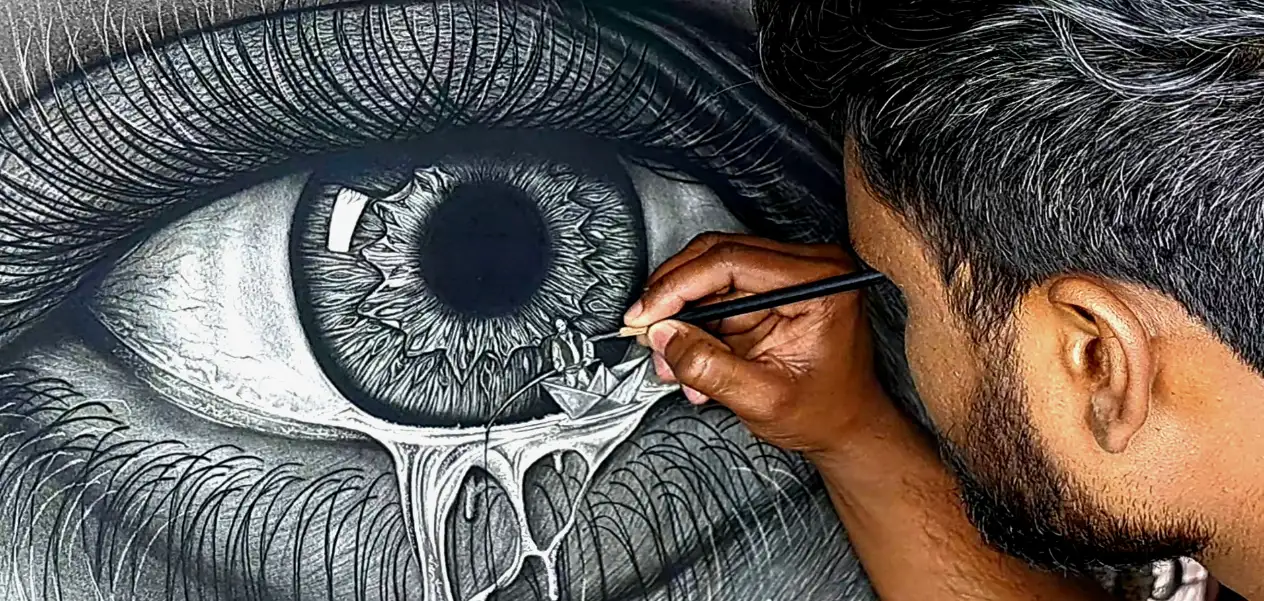
Adnan had been fond of drawing since his school days, and to support his family, he took up his hobby as a profession. After his father passed away, his mother had to take care of the family all by herself. During the COVID-induced lockdown, I worked on my drawing skills at home using a pencil and paper.
Adnan Ansari at work
After this, Adnan created his Instagram page and uploaded his paintings on it. He received appreciation for his art. “Appreciation for one’s work is fine, but I cannot fill stomachs or run the family,” he said.
Soon after, Adnan completed his schooling at Aligarh Public School, one of his juniors placed an order over the phone for his portrait.
“That was my first earning. I received Rs 200 as remuneration. I never looked back. I was encouraged to make better paintings as I realised that I would start earning. My hard work and dedication have paid off, and today I am at a stage where my paintings are in demand even abroad.”
Today his Instagram page is doing well. “My followers are increasing, and I upload all my works for sale on it.”
He receives all his orders through Instagram. “I currently have orders for paintings from America, UK, Canada, and Saudi Arabia,” said Adnan. So far, his most expensive painting has been for Rs 40,000.
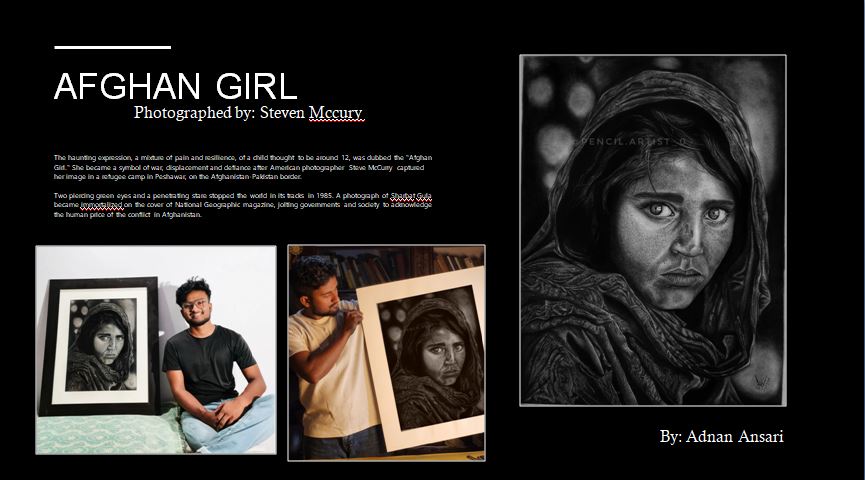
Adnan Ansari with some of his works
Adnan said that he has been trying to understand life from his perspective and process his feelings on canvas. That process makes him serve people through his art. His paintings reflect the maturity of his imagination.
According to him, copying something and making it exactly like it is not the definition of art.
Adnan said that he could make a painting of any kind, even from the oldest torn photographs. “For example, if you give me a colour or black and white photograph, I will make it exactly like the original, which will make you feel that this one is better, no matter how old the photograph is, if there is even 10 to 15 percent imagination in it, then I can make it.”
Adnan told Awaz-The Voice that his mother, Rashida Begum, is not educated and has a small income through doing small household work, which is not enough for the family. His younger brother Bilal Ansari is in school.
Adnan Ansari’s art
Adnan Ansari told Awaz-The Voice that he was thankful to former Aligarh MP Jamal Khwaja for providing him with a place to live. “We do not have a house and a Jamal Khwaja for whom my mother works, has kindly given a portion of his bungalow for my family to live.”
Adnan told Awaz-The Voice that I am currently doing post-graduation from Aligarh Muslim University. Along with this, I am improving my art through social media. However, my work is more understood and liked abroad. But I hope that one day I will get a big honor at the national and international level, and I am working hard for that.
Adnan said, “I started with pencil and sheet, so till now whatever paintings I have made, I have used only charcoal pencil, charcoal powder, eraser, cutter scale, knife. Now that I have money, I am also using canvas, light, computer, camera.”
Adnan said that the youth should bring out the talent hidden within them and try to move forward using whatever facilities are available to them. It is not necessary to have big things to make it big, one should bring out the hidden talent and work hard honestly. One day, success is inevitable.
Adnan Ansari’s works
Adnan said, “I mostly like to make a painting which has a story behind it. I keep looking at the paintings of some international-level artists and photographers to get inspired to do my work.”
Adnan Ansari is also a state-level under-19 football champion; he also edits videos on a freelance basis. Adnan wants to build his studio where he can showcase his art and video editing skills and create digital artwork.
Adnan Ansari says that first he prepares a digital layout and sends it to his clients. He does all this through Touchbook software. After approval, he draws it on canvas with a pencil.
Adnan says the price he prices his paintings as per his assessment of the hard work that has gone into each one. “I earn enough to run my household. I am now buying modern tools for my work. I see myself as a big artist of India in the next 5 years.”
Adnan has received many awards for his art. His works were also on display at the National Art Exhibition, where he received a lot of appreciation. Adnan also actively participates in youth fests and other competitions.
source: http://www.awazthevoice.in / Awaz, The Voice / Home> Stories / by Onika Maheshwari, New Delhi / April 09th, 2025
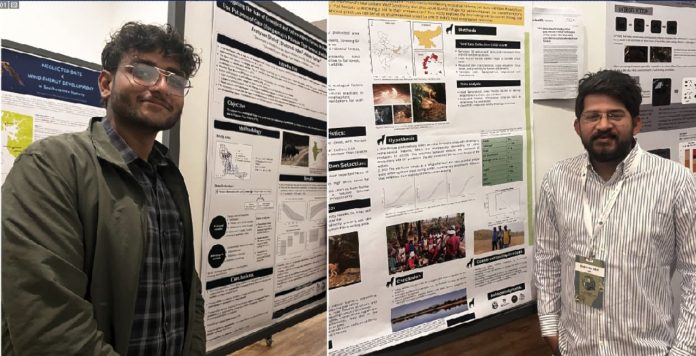
Two AMU research scholars, Arshyaan Shahid and Shahzada Iqbal, brought laurels to India by presenting their innovative research at the 9th European Congress on Mammalogy held in Patras, Greece
Aligarh:
Two research scholars from the Department of Wildlife Sciences, Aligarh Muslim University (AMU), Arshyaan Shahid and Shahzada Iqbal, brought laurels to India by presenting their innovative research at the 9th European Congress on Mammalogy held in Patras, Greece. Guided by Prof. Orus Ilyas, the students were the sole representatives from India and the broader subcontinent at this premier international event, which convenes once every four years and draws the world’s leading mammalogists.
The European Congress on Mammalogy is a renowned platform for sharing advancements in mammalian science, conservation strategies, and ecological research.
Among hundreds of global participants, Shahzada Iqbal presented two posters on wolf conservation in Central India, addressing ecological challenges and species threats. Arshyaan Shahid presented a poster on the behavioural ecology of the Gaur (Indian bison) and also delivered an oral presentation on human-elephant interactions in Jharkhand’s Palamau Tiger Reserve.
Their research received commendation from international experts, who appreciated their scientific rigor and conservation-oriented approach.
“It was an incredible opportunity to share our work with leading mammalogists,” said Shahzada Iqbal. Arshyaan Shahid remarked, “The insights and feedback we gained were invaluable. Representing India on such a platform was truly an honour.”
Prof. Orus Ilyas lauded the students’ accomplishments, noting, “Their success at EUROTHERIUM reflects the research excellence at AMU and signals India’s growing presence in global wildlife science.”
source: http://www.radiancenews.com / Radiance News / Home> Focus> Markers of Excellence> Research / by Radiance News Bureau / April 15th, 2025
The National President of Urdu Development Organisation (UDO), Dr. Syed Ahmed Khan, has welcomed the Supreme Court’s April 15, 2025, decision in favour of Urdu regarding the Maharashtra Municipal Council, calling it historic, encouraging, and promising for the Urdu-speaking public.
It is noteworthy that the Supreme Court, while ruling on the signboard of the Municipal Council Building (Akola), stated that names can be written in Urdu along with Marathi on the signboards. The Supreme Court also clarified that language is not associated with any particular religion, but rather with the people, the community, and the region.
UDO’s National General Secretary Dr. Parwaz Uloom and Dr. Lal Bahadur jointly stated that the Supreme Court’s earlier decision on September 4, 2014, in favour of UDO against the Hindi Sahitya Sammelan, was also historic. However, unfortunately, due to the negligence of the Urdu-speaking public, the governments of the seven states – including Delhi and Uttar Pradesh – where Urdu has the status of a second official language, have neither implemented this status nor initiated any movement in light of the Supreme Court’s ruling.
Now, it is the responsibility of the Urdu-speaking community to benefit from such historic decisions.
source: http://www.radiancenews.com / Radiance News / Home> Latest News / by Radiance News Bureau / April 16th, 2025
Nargis Sultana being felicitated by her neighbours after her she scored a distinction in her matriculation examinations
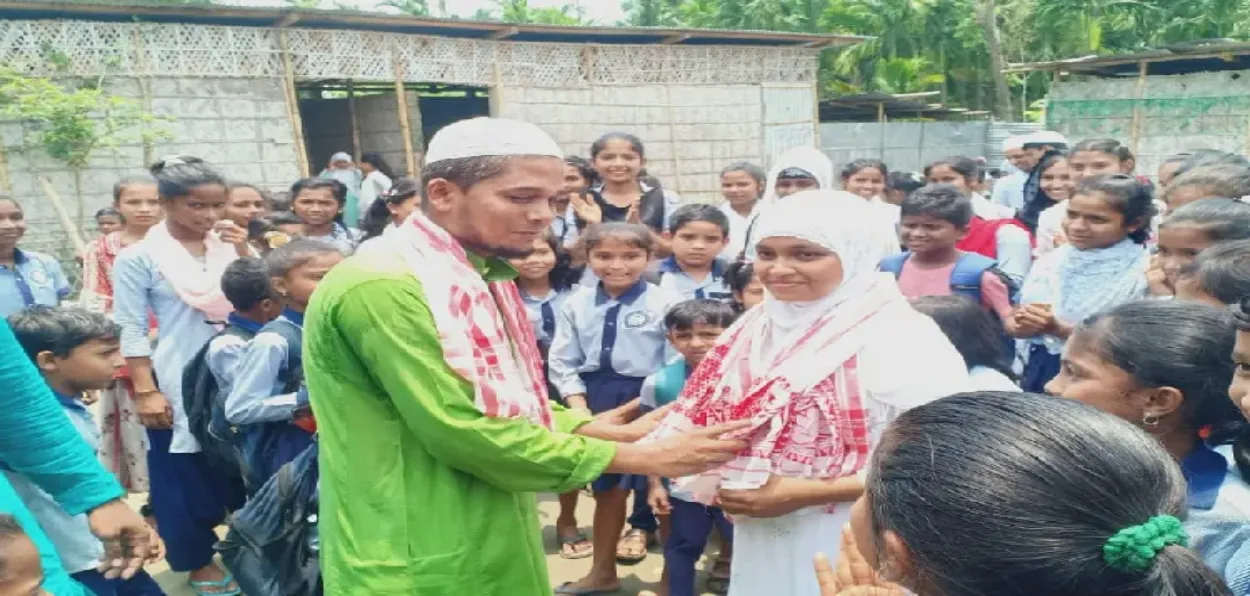
The academic success of the daughter of a Maulana in Assam’s Darrang district has revealed the determination of Indian Muslim women to defeat adversities and break stereotypes for giving wings to their dreams.
Nargis Sultana, the daughter of a Maulana who passed the High School Leaving Certificate Examination or Matriculation examination in 2022 with distinction despite facing various challenges, studies for more than 12 hours to fulfill her dream of becoming a doctor.
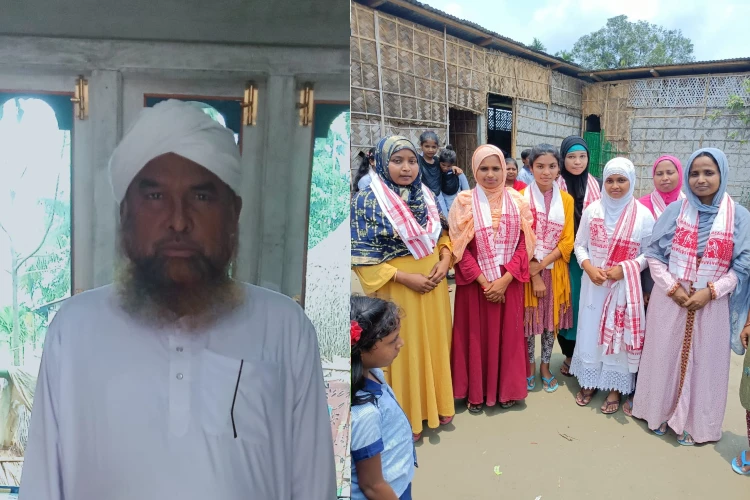
Nargis is the second daughter of Samsher Ali and Nasira Khatoon, residents of Kachari Bheti in Dalgaon in the Darrang district.
Born in a very backward and remote area, Nargis had to walk 5-6 km daily from her home and cross a river to reach her school for her primary education.
Being the daughter of a Maulana, many residents in her village asked her to learn Islamic textbooks including the Holy Quran instead of going to school for modern education. But Nargis was determined to go to school and her parents backed her.
Maulana Shamsher Ali (Left), the father of Nargis (In white dress) and his family
Nargis Sultana told Awaz-the Voice, “I was a student of Anandaram Barua Academy in Siliguri when I appeared for the Matric examination or Class X final in 2022. Besides my hard work and dedication, I want to give credit to the teachers for my success. After knowing my poor financial background they (teachers) helped me to continue my education.”
Anandaram Barua Academy did not charge any fee and provided free tuition from Nargis for her education from the Class ninth and Tenth.
In the Matric exam 2022 Nargis scored 96 (out of 100 marks) in Social Science, 95 in Mathematics, 92 in Assamese, 90 in Elective Subjects, 90 in English, and 78 in General Science.
Nargis got is studying at Ajmal College in Hojai and pursuing a science stream for her higher secondary examination.
“Many people and teachers have helped me financially to continue my education. They have pinned high hopes on me. So, I cannot disappoint them. I am studying more than 10 hours daily so that I can excel in 12th stands due next year. I want to become a doctor. I will try to become a gynecologist and serve the poor people in rural areas by reducing maternal and infant mortality rates among them,” Nargis said.
Nasira Khatoon while expressing gratitude to the almighty Allah and those who have helped her daughter to continue her education, said she is hopeful that “Nargis will become a successful doctor in the future to serve humanity.”
Hafiza Begum (Left) being felicitated
Similarly, another Muslim girl student from Dalgaon in Darrang district Hafiza Begum has also proved that poverty cannot be an obstacle to academic excellence.
Hafiza, daughter of e-rickshaw driver Habib Ullah, has told Awaz- The Voice that she had passed the Matriculation examination from Adarsh Jatiya Vidyalaya, Dalgaon by securing distinction marks.
Hafiza is determined to become a doctor and later prepare for the Union Civil Service Examination.
source: http://www.awazthevoice.in / Awaz, The Voice / Home> Stories / by Munni Begum, Guwahati / May 05th, 2023
University Women’s Polytechnic Students Shine at National Project Competition, Win First Prize at MITAOE, Pune
Aligarh:
Students from the University Women’s Polytechnic, Aligarh Muslim University (AMU), made a mark at the 8th National Level Poster Presentation and Project Competition, TechnoPHILIA’25, held recently at MIT Academy of Engineering, Pune.
Competing against participants from over 25 institutions across India, the AMU team, “LISA VocalTech,” clinched the first prize in the Diploma Category, along with a cash award for their innovative project titled “LISA: A Voice-Controlled Lift.”
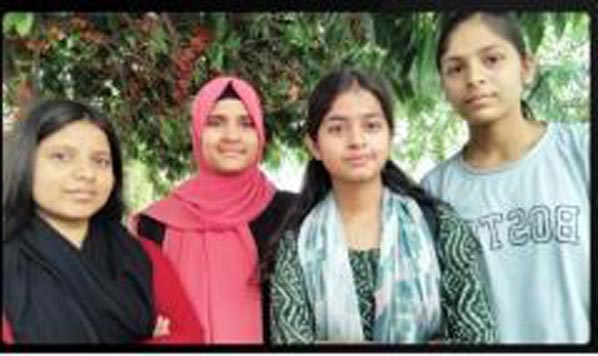
The team comprised final-year Diploma in Electronics and Communication Engineering students – Shalini Kumari, Kashish Khushi, Nargis Khatoon, and Shailly Bhardwaj – who developed the project under the mentorship of Mr. Mohd Kashif. Their creation, a voice-activated lift system, is designed to improve accessibility for the elderly, visually impaired, and physically disabled, earning praise from judges for its practical utility and inventive design.
This achievement highlights AMU’s commitment to academic excellence and its encouragement of student participation in national-level technical events.
source: http://www.radiancenews.com / Radiance News / Home> Education> Focus / by Radiance News Bureau / April 09th, 2025
When he is not writing a novel, he writes stories for children. And, when he is not penning these stories, he may compose poetry for a change of taste or suddenly come up with a book on personalities of his city.
Wakeel Najeeb is not just among the most prominent authors, he is the most prolific writer in the region. For people interested in Urdu litrature across the country, when the conversation shifts to this region, it’s his name that instantly comes to minds.
And a visit to Nagpur is incomplete until one meets him. In the serpentine lanes near his house, ask anyone–an elderly man or a young boy, everyone knows him and can guide you about the address or directly take you to his house.
Th writer is at the centre of Urdu literary activities in Nagpur. On my visit to the town, I tried to locate his house and almost everyone I came across on way, was ready to take me to his place. Apart from novels, he has several collections of stories and short-stories, poems and two travelogues to his name. Also, there is a collection of plays and hold your breath–20 novels.
He is among the few authors who have focused on writing for the children. Many of his novels are for children apart from nazms and stories. Though he started his literary journey with ‘afsana’ [short story], he got more fame because of writing for children as he also gets published in the magazines across India.
“Somehow a label was put on me that I write stories for children and a I am writer exclusively for kids, though I have collections of short stories and have written fiction, not just for children”, he explains. Of course, Najeeb, has written extensively and also writes critical pieces, essays and articles.
His most recent work is a book, ‘Meri Basti, Mere Log’. The book contains his write-ups on interesting personalities he saw around him as he grew up and others in his city. The profiles include people from diverse fields–wrestlers to clerics and writers to sufis. Already hundreds of copies of the book have been sold.
“Frankly, I do my best to publicize my books. When I write, my aim is to make people aware about the book. You see this, he points towards the banner outside his house, which announces publication of his book. People come to know, arrive and buy”, he further says.
That’s a far cry from the writers who bemoan lack of readers or rue that there books are not being sold. Born on July 1, 1946, Wakeel Najeeb, studied at the local Urdu school. He went on to become a teacher and retired as principal of Islamia School. He is socially active, associated with institutions, literary groups and attends their meets. And, literally holds the literary fort in the region.
source: http://ww.newsbits.in / Newsbits.in / Home> Special / by Shams Ur Rehman Alavi, Bhopal / December 22nd, 2021
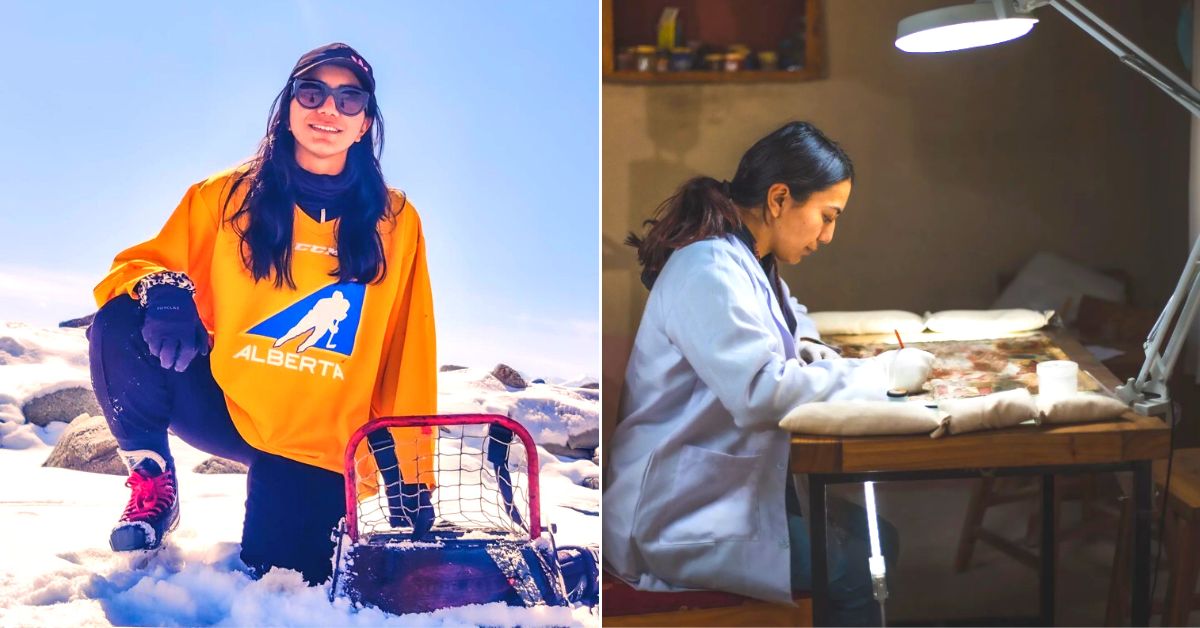
Noor Jahan and her cousin Wajeeda Tabassum co-founded Shesrig Ladakh, an art conservation practice that restores and conserves ancient wall paintings, religious manuscripts, thangka (Buddhist scroll) paintings and metal works.
How do you protect and preserve culture? It’s a question Noor Jahan – a 32-year-old expert in art conservation and heritage management from Leh – has grappled with for a decade.
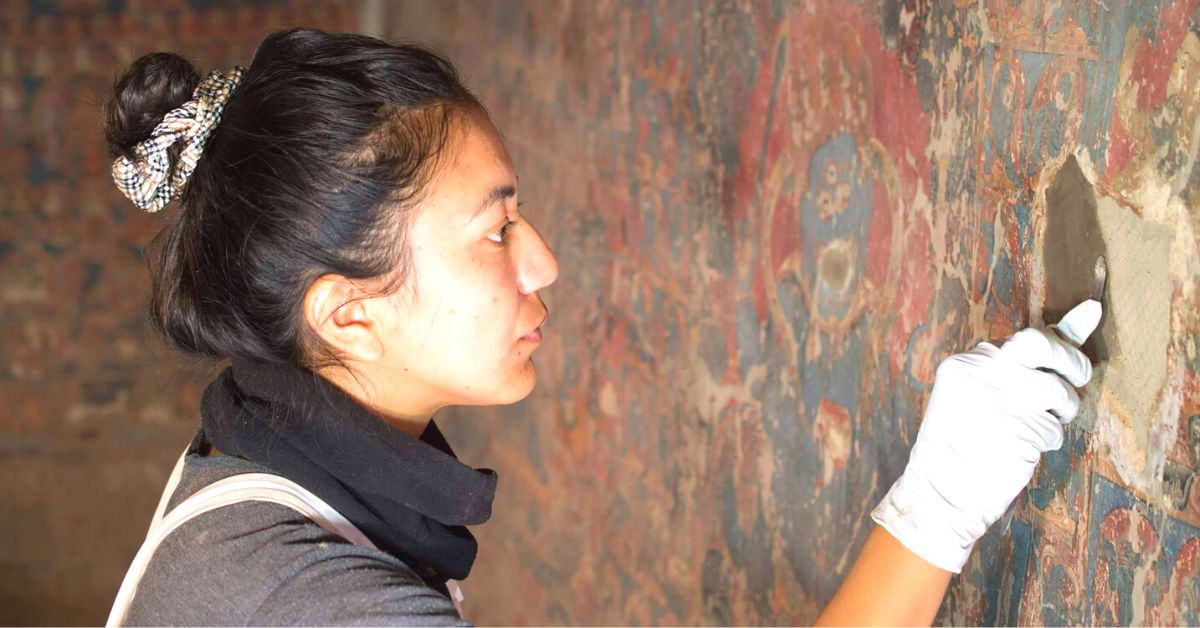
Through Shesrig (meaning ‘heritage’) Ladakh, an art conservation practice she founded with her cousin Wajeeda Tabassum, Noor performs critical restoration and conservation work on ancient wall paintings, religious manuscripts, thangka (Buddhist scroll) paintings and metal works.
“My real interest lies in working on ancient wall paintings and thangka paintings,” says Noor Jahan in a lengthy conversation with The Better India.
Backed by a Master’s degree from the Delhi Institute of Heritage Research and Management (DIHRM) and a PhD from the National Museum Institute, she has worked on wall paintings dating back to the late 8th century and Buddhist thangkas from the 19th century. Also, since 2019, she has run Shesrig on her own following Wajeeda’s departure for foreign shores.
What’s more, Noor is also the goalkeeper for the Indian women’ ice hockey team. Earlier this year, she helped India finish second in the Union Women’s Ice Hockey Tournament in Dubai. Noor reckons that she has a few more years left before she “officially retires” from the sport.
By all accounts, it’s an extraordinary way of life, and this is her story.
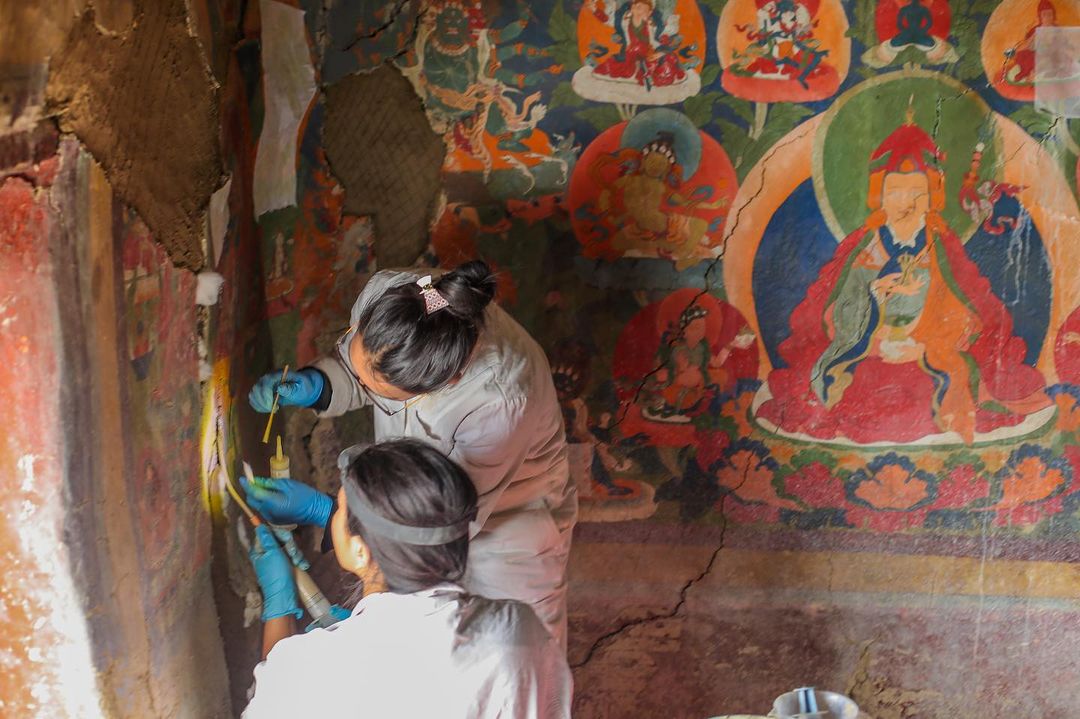
Noor Jahan working on old wall painting in Saspol caves, Ladakh
A serendipitous journey
There was a void in Noor’s life after earning her bachelor’s degree in commerce from Delhi University. Going through the motions, she had no passion for what she was learning. To reflect on what was next and enjoy a short holiday, she left for Leh after graduation in 2011.
It was during a walk through Leh’s crowded old town, when she met a few foreign conservators from the Tibet Heritage Fund working on an old Buddhist temple. Intrigued by what they were doing, Noor engaged in a short chat with them which would change her life.
After returning to Delhi, she began reading up on art conservation and learnt that she could pursue higher studies in this field.
What also sealed the decision to get into this field for Noor were memories from her childhood.
“My mother is from Hunder village in Nubra. Every holiday, we would always visit Nubra to meet my maternal grandparents. The bus would stop at this location called Chamba on the main road from where you had to walk inside the village. This particular route holds great importance in my life now because there are many stupas along the way. Every time I would look up at these pathway stupas, I would see these old paintings. But each passing year, some part of these paintings would disappear. When I applied for this course at DIHRM, the first thing I thought about were these paintings and the conservation work I could do someday,” she recalls.
Allied with a strong desire to come back home, starting this course brought passion back into her life. “Everything I was studying there found a purpose in Ladakh,” she says.
Noor Jahan found purpose in preserving Ladakh’s heritage
Finding Shesrig
Following the first year of her Master’s programme in 2012, Noor and Wajeeda opted to do their internship with the Himalayan Cultural Heritage Foundation (HCHF), a Leh-based non-profit. Helping them find projects to work on was Dr Sonam Wangchok, founder secretary of HCHF.
During this internship, the first major project Noor got involved in was a wall painting at Diskit Gompa, a 14th-century Buddhist monastery in Nubra Valley.
She recalls in an Instagram post, “The internship entailed working on the restoration of wall paintings from the 17th century under the supervision of art conservators from [the] Czech Republic. This was my first hands-on experience where I had the opportunity to conserve sacred Buddhist art and the opportunity to stay at the monastery itself. I think that internship changed my life forever as I not only got to work on the most beautiful wall paintings but gave me the opportunity to meet and interact with the monks at the monastery who took me and Wajeeda in as their own.”
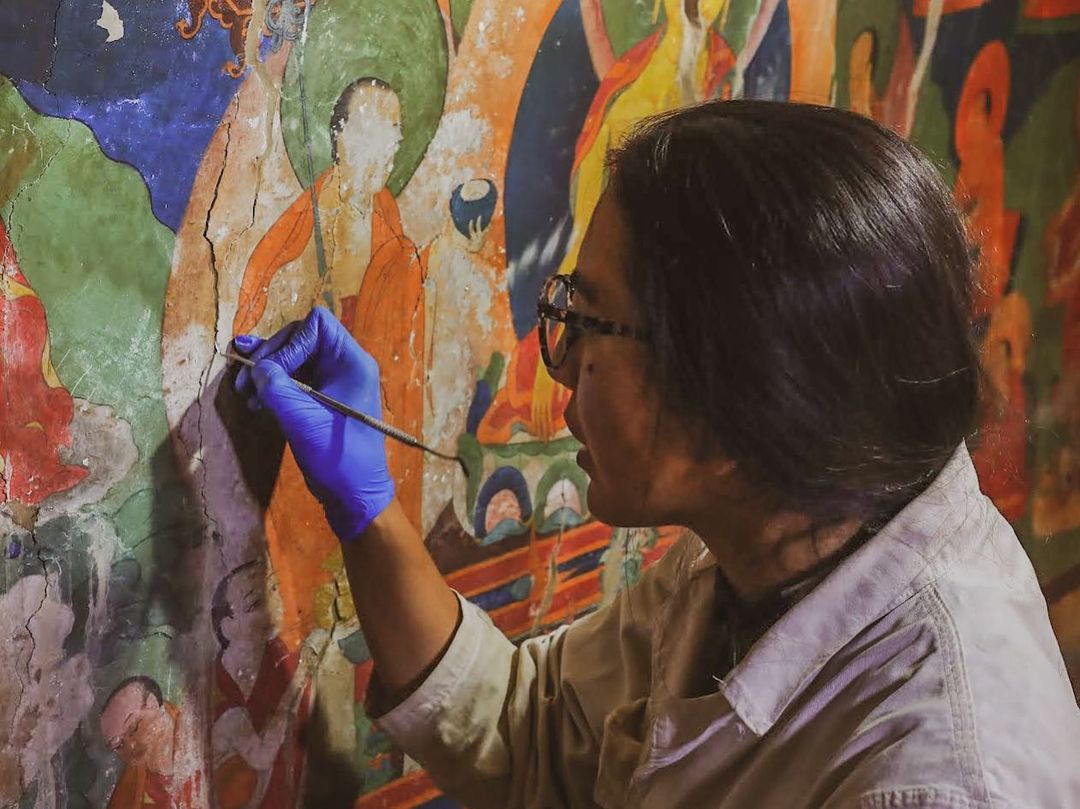
Conserving ancient wall paintings is a delicate process
After completing her Master’s programme in 2013, Noor came back to Leh to work with other organisations like Art Conservation Solutions and Achi Association, amongst others, as a freelancer. In 2014, she worked on her first project outside Ladakh at the Golden Temple in Amritsar with Heritage Preservation Atelier, and also commenced her PhD at the National Museum Institute. Despite these landmark moments, she knew this sort of freelance work wasn’t sustainable.
“Working in these organisations was a great learning experience and helped me to capture some of the finer nuances of conservation. Even today with Shesrig, I collaborate with most of them. But this kind of work wasn’t sustainable, i.e. it was limited to summer months,” she says.
“In the summer, I would work on many projects. But the moment winters came, all these organisations would stop their work in Ladakh. I really wanted to start something of my own in Leh, while working sustainably and throughout the year,” she adds.
Thus, in 2017, Noor and Wajeeda founded Shesrig Ladakh and rented out a historic structure called Choskor House as their base in Leh’s old town, which they had to first restore.
This three-storied structure is located right behind the Jama Masjid (mosque) in the centre of Leh along the hillslope. It belongs to a renowned family of traders, who along with other important families, once led important trade missions to Lhasa from Ladakh.
“Even though Choskor House was really old, we decided to rent it. To restore it, we had initially consulted some architects, but there came a point when it became difficult because of costs and time constraints. That’s when we reached out to Achi Association India, a sister organisation of Achi Association (a Swiss-based organisation), which took over the project of restoring this structure backed by funding from the German Embassy. They helped with establishing the studio in which we currently operate. We started working inside our studio only this year,” says Noor.
“It’s important to see your heritage as an inheritance that has great value,” says Noor Jahan
Conserving ancient wall paintings is a delicate process
Conserving wall paintings
Conservation and restoration are different acts. Noor explains, “In conservation, people do not recreate anything new. So, if there are losses in a given wall painting, there is no recreation but only stabilisation. Restoration, meanwhile, seeks to recreate some of those losses.”
Some of the fundamental challenges in conserving or restoring old artworks include physical access to remote sites and obtaining the necessary materials that they largely import.
Noor gives us an example of a project they worked on in collaboration with the Himalayan Cultural Heritage Foundation in June 2020 to illustrate her point. The site was Chomo Phu, a small one-room Buddhist shrine near Diskit Monastery, Nubra.
“It’s quite a steep hike up from Diskit Monastery, and there is a gorge inside the valley where this shrine is located. There was no place for accommodation. Instead, we pitched tents next to the shrine and had to improvise basic facilities. We camped in that valley for about 25 days since it was not practical or possible for us to hike from there to the monastery or the village every day,” she recalls.
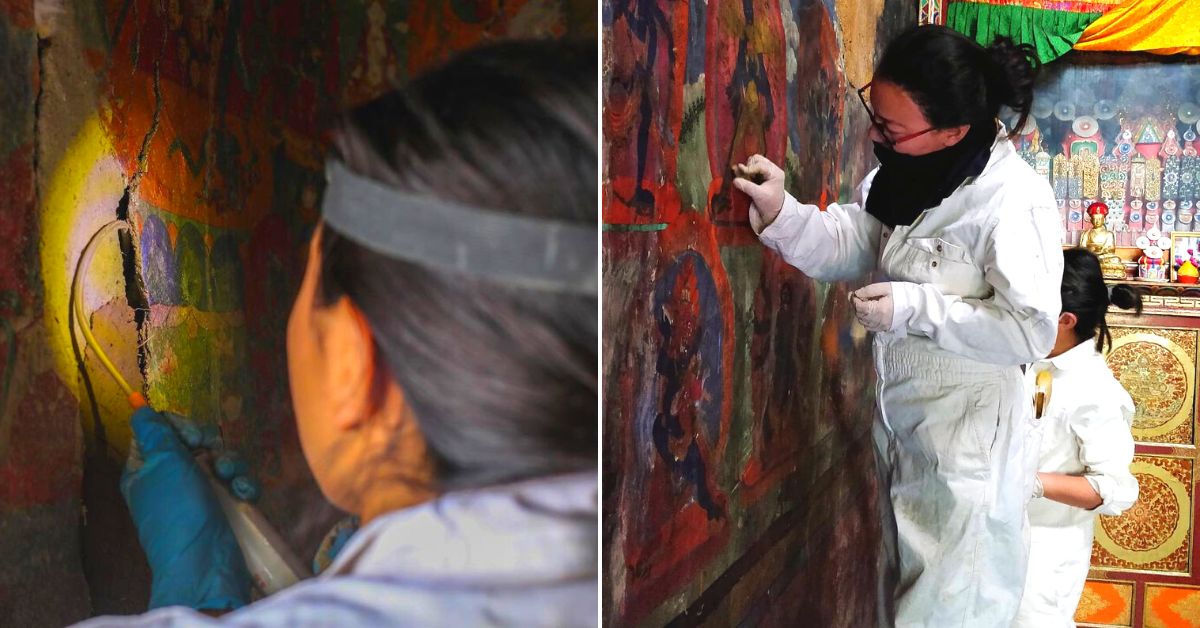
Before, during and after the project, Noor and her team do extensive documentation work. During this phase, they closely examine the kind of deterioration the wall painting has undergone.
In this particular case, there were a lot of over-filling and historical fills done in the past. These fills were done in such a way that it was obscuring a lot of the original painting and sometimes even overlapping it. They had to carefully remove those historic fills.
“Another issue with wall paintings is that there are a lot of detachments. In the event of any structural movement or water seepage, the plaster gets detached from the support, thus creating these hollow areas inside the painting. You can discover these hollow areas through a percussion test (a method for the structural inspection of wall paintings). We then perform grouting, i.e. fill the gaps between the painting and the support structure,” she notes.
Apart from these, there are cases where the paint layer gets delaminated. To address this, they use a consolidant and then stick the paint layer back to the surface.
“Of course, there is cleaning work which is done. The paintings are largely glue-bound tempera (also called secco, which are paintings on dry surfaces). In this kind of technique, the pigment is usually mixed with the binder and then applied to the walls. With water infiltration, the binder becomes weak causing delamination of the paint layer,” explains Noor.
“This damage primarily occurs because of water. We make sure not to perform any wet cleaning, i.e. don’t use any solvents to clean the wall painting. We only employ dry cleaning. There are various types of conservation-grade sponges which we work with and soft brushes to remove the dust or any mud infestations,” she adds.
A major point of contention with wall paintings is retouching work (reworking small areas of a painting to cover damage or to mask unwanted features).
Without getting too deep into the subject, when it comes to wall painting conservation work, Noor and her team largely stick to what she calls “conservation or stabilisation work”.
“It’s important to see your heritage as an inheritance that has great value,” says Noor Jahan
Restoring old thangkas
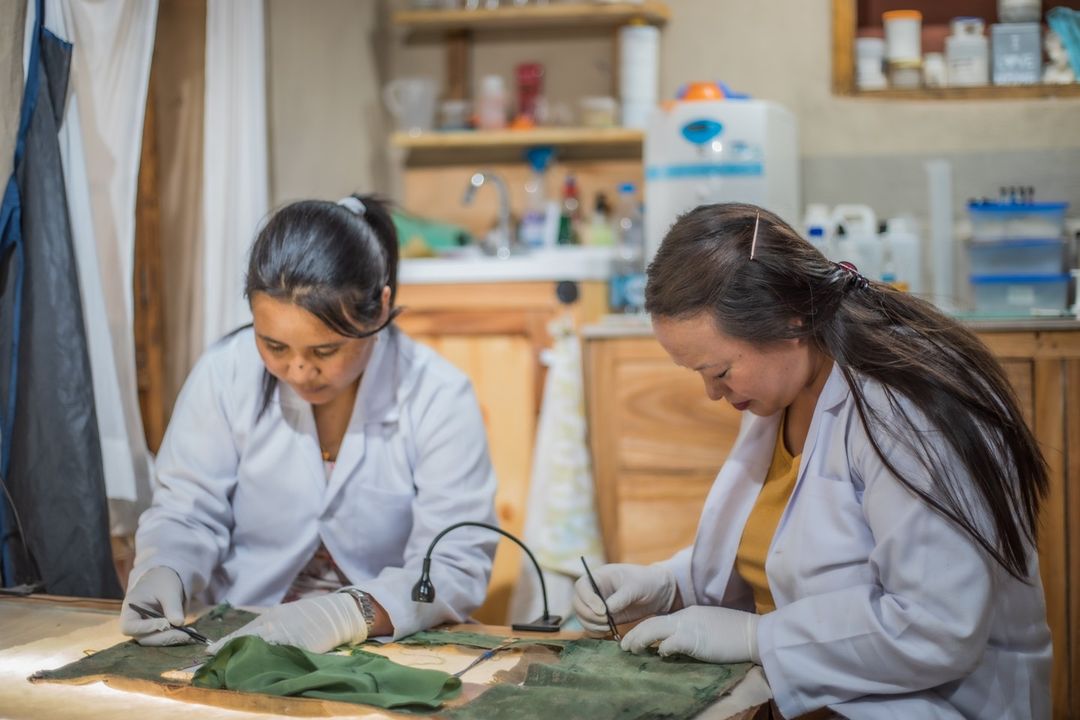
This year most of the thangkas that were brought in for restoration at Shesrig’s studio came from private households. Each thangka arrives in a different condition.
In thangka paintings, you have a textile-based canvas made of cotton fabric or any other material used by the artist in the centre. These thangkas also usually have either silk or brocade borders. Most thangkas they got into their studio this year had silk borders.
Step 1: “Since the thangka has come directly from the chod-khang (prayer room) to our studio, we first take it to a nearby monastery, where a de-consecration ceremony is done,” she says.
Step 2: The next step is to bring the thangka back to the studio, perform extensive documentation work including photographic documentation and understand what kind of problems are visible. Accordingly, they prepare a treatment plan.
Step 3: Usually the centrepiece of the thangka is stitched with a textile border. They separate both elements because the fabric at the border is completely different from the canvas in the centre. Following separation, they work on the border and centre piece canvas separately.
Step 4: Once the separation is done, the first step is cleaning the soot. “In thangkas, there are times (only when required), when we go for mild solvent cleaning but once again dry cleaning methods are preferred. Also, solvents can sometimes be harsh. We have started preparing gels which are much milder and do not adhere to the surface for the cleaning process,” she says.
Step 5: What if there are big losses or tears on the thangka painting? “We make a similar kind of ras-jee (the local term used for the textile canvas of a Thangka painting) in the studio. We use pieces of that ras-jeeto mend the tears. Otherwise, in thangkas, we also see a lot of cracks. To fill the cracks, we use the markalak (local clay mixed with mild adhesive) to fill those cracks because that’s part of the original technique of preparing a thangka. We follow the same methods while restoring it as well,” she explains.
Step 6: Once this is done, if there is any consolidation work required or a paint layer is coming off, they fix those problems. Sometimes, they mend the tears fibre by fibre, which requires very delicate hands. Also, if there are any small losses or paint losses, they do subtle retouching work using natural colours or the colours originally used on the thangka.
Conservation of Thangsham (the local term used for the textile border of a Thangka painting)
Step 7: Meanwhile, there is another team which is working on the textile border known as thangsham locally. There is a particular method of washing the textile using conservation-grade detergents.
“We don’t dip it straight into the water. Instead, we use wet sponges to clean it very meticulously. Sometimes these borders are also torn or otherwise in a bad condition, for which we mend them using patchwork with silk, brocade or whatever material was originally used. We have a stock of raw silk, which is white. We dye it as per the thangka’s requirements. If the thangsham, for example, is blue, we will dye the silk blue and do the patchwork from the inside. We perform the process of dyeing ourselves at the studio,” she explains.
Step 8: Once both elements are ready, they stitch the centrepiece canvas and the border back together, following which a consecration ceremony is done and then returned to the client.
Once again, depending on the state in which the thangka is sent, it takes anywhere between a fortnight to two months or more to restore a thangka. It also depends on manpower.
“Most of the time, we work in groups of two or three women on one thangka, and depending on the scale of the task, it takes about a month or two if the damage is extensive,” she says.
Given that most of the conservation work she does with Shesrig Ladakh relates to Buddhist heritage, questions have emanated from either side of the religious divide.
But is her faith an obstacle in this line of work?
“Most of the time, they don’t see my Muslim faith as an obstacle to the work that I do. For the most part, I’m not treated as an outsider or not from the community. In fact, it has been the opposite, where I am given more respect and love, especially in monasteries,” she says.
However, recently she heard someone say, ‘What is this Muslim girl doing here?’ “Look, this is how the world around us is moving. As Muslims in India, we know what’s going on. But I do not take these comments personally because I have to do what I know how to do,” she says.
Noor Jahan: “I have to do what I know how to do”
But such ad-hominem comments don’t necessarily come from the Buddhist community. She even notes how members of her religious community pass judgement on her line of work.
“Sometimes, people from the community approach my family to complain about my work, but fortunately they have been very understanding,” she notes.
Another struggle Noor deals with is the significant lack of awareness in Ladakh about art and heritage conservation as a field. “Even though they support me, my parents and some friends still don’t understand the kind of work I do. They still think this is a ‘hobby’ to me and don’t take me seriously. Even though the conversation in Ladakh about restoration and conservation has progressed a little, there are still people who think that this work can be done for free. This is something, I hope, changes with time as the conversation around this subject grows,” she says.