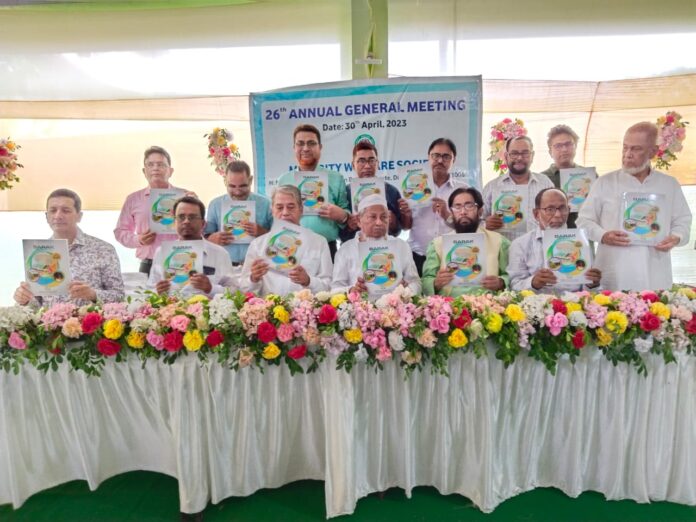
01The annual magazine of the Minority Welfare Society, “Barak”, was unveiled at the Society’s annual general meeting held in Guwahati on Sunday.
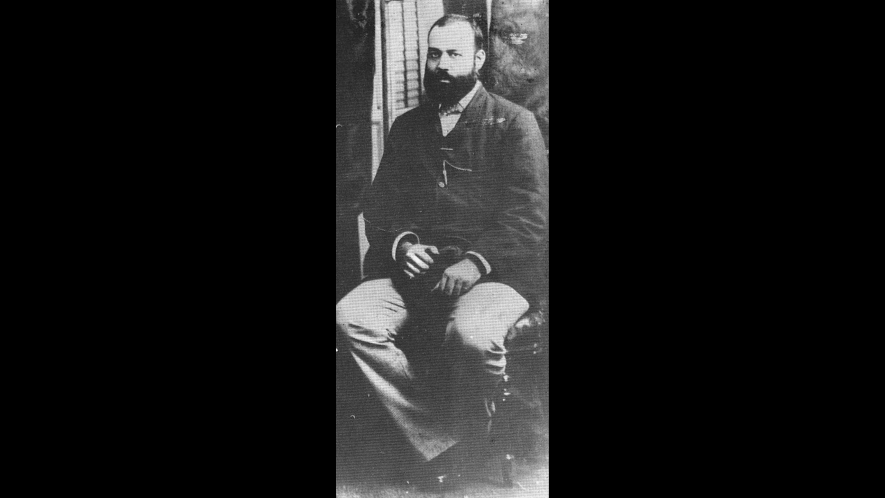
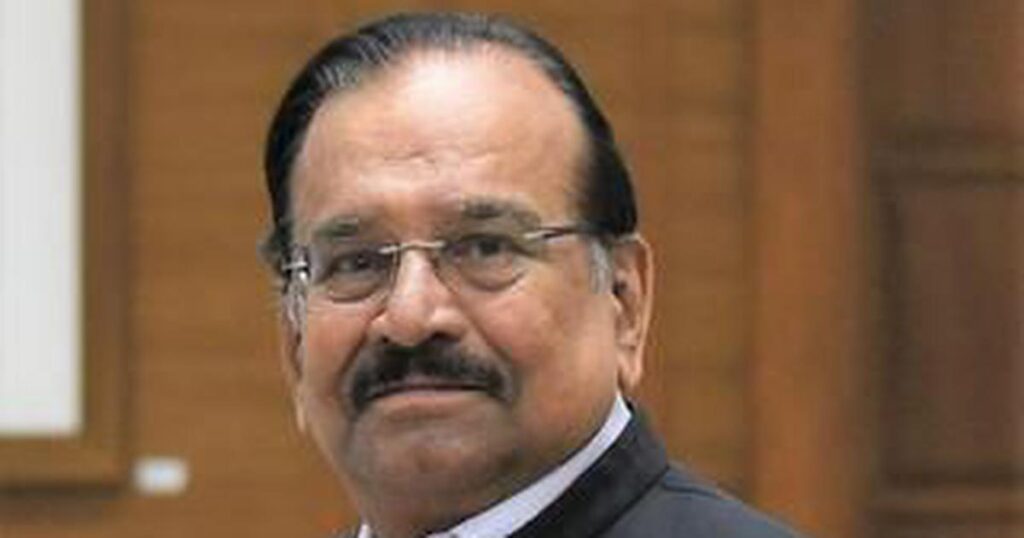
Shahidul Alam Choudhury, who had a very humble background, came to limelight in 1985 when he was sworn in as a cabinet minister in the AGP government of Assam. He was the lone minister from the Barak Valley in the cabinet. He shone over the political sky of Barak valley for nearly three decades until his death in November 2012. In order to perpetuate his memory and to keep his service to the community embedded in public mind, Minority Welfare Society (MWS) Guwahati instituted the Annual Sahidul Alom Choudhury Memorial Award in 2014. It may be mentioned here that late Sahidul Alam Choudhury was five times elected as MLA from Algapur Constituency of Hailakandi District and served two times as Cabinet Minister in the Government of Assam. The award is meant for persons of Barak Valley origin for outstanding achievement in their field of activity such as education, literature, social service, science and technology, arts, sports, medicine, health care, professional excellence, journalism, entrepreneurship, etc.
This year’s Sahidul Alom Memorial Award was conferred to Janab Habibur Rahman Choudhury, editor of the daily newspaper “Nababarta Prasanga” published from Karimganj, Assam. Besides being an acclaimed journalist, Habibur Rahman is also an educationist, social activist, and opinion leader who is respected in India and abroad. The award includes a memento, citation, and cash component of Rs 25,000. The award was given away at MWS 26th annual general meeting held in Guwahati on Sunday. Habibur Rahman, however, returned the award amount back to MWS for using the same for humanitarian purposes. Among earlier recipients of the award are Hafiz Rashid Ahmed Choudhury (jurisprudence), Abid Raja Majumdar (literature), Ali Haidar Laskar (history), Dr Baharul Islam (academics), and Dr Md Masoom (medicine & social service).
Earlier in the first session of AGM, the general secretary of MWS, Abdul Karim Choudhury, placed before the house the annual report of the activities of the society for the year 2022–2023.
In the second session, presided over by Abdus Sattar Choudhury, president MWS, three publications of MWS were unveiled in presence of a galaxy of dignitaries including Dr Abu Saleh Nazmuddin, former health minister of Assam and KJ Hilaly, Secretary to the Govt of Assam.
Abdul Waris Chowdhury, Vice President MWS, highlighted the journey of the society and its activities since its formation in 1994.
Various competitions among children were also organised on the occasion.
The event was anchored by Dr Ferdous Ahmed Barbhuiya.
source: http://www.twocircles.net / TwoCircles.net / Home> India News / by TCN News / May 02nd, 2023
The film ‘Alzahravi’ bagged the best film award in the category of Best Visual Effects and Animation whereas ‘Polymer, the Promise of PDMS’ has been recommended for a citation.
Hyderabad:
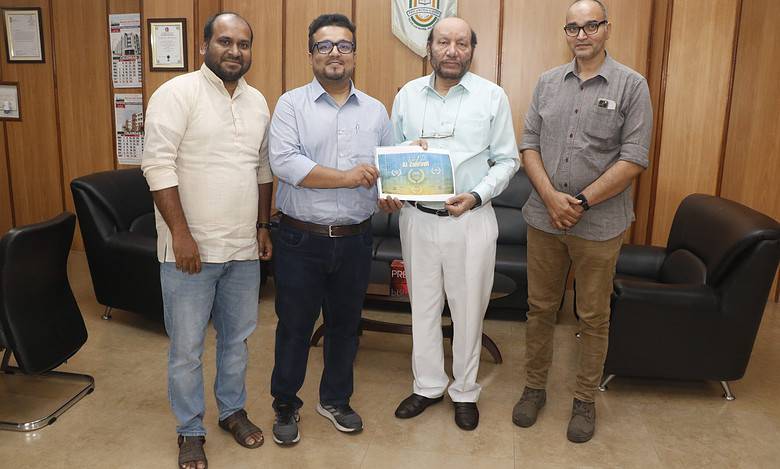
Two films of the Instructional Media Centre, Maulana Azad National Urdu University (MANUU) produced under the MANUU Knowledge Series have won accolades at the 24th CEC UGC Educational Video Festival organized by Consortium for Educational Communication (CEC), an Inter-University Centres set up by the University Grants Commission.
The film ‘Alzahravi’ bagged the best film award in the category of Best Visual Effects and Animation whereas ‘Polymer, the Promise of PDMS’ has been recommended for a citation under the Best Film Documentary award category along with the other three films.
According to Rizwan Ahmad, Director, IMC, the film Alzahravi by Omer Azmi, Producer IMC explores the life, struggles, and achievements of the renowned scholar, Alzahravi, and his contributions to the field of medicine.
Polymer, the Promise of PDMS by Obaidulla Raihan, Cameraperson, is a thought-provoking film based on a research output by researchers from the Central University of Hyderabad, where they have developed a polymeric material which is graphene base media mists smart composite material which will revolutionise the technology in near future.
Prof Syed Ainul Hasan, the Vice-Chancellor, congratulated the centre on this achievement and said IMC is steadily gaining recognition for its unique and thought-provoking approach to digital media. Appreciating the Media Centre Team’s effort who met him today at his office the Vice-Chancellor expressed the hope that the MANUU knowledge Series will continue to inspire and educate audiences and contribute to the growth and development of Urdu and dissemination of knowledge.
Rizwan Ahmad said both films were also selected previously at various film festivals nationally and internationally. This honour is a testament to the hard work and dedication of the directors of the films and the entire team. MANUU Knowledge Series aims to promote the Urdu language and culture, as well as highlight important issues and stories through the medium of film, a press release said.
source: http://www.siasat.com / The Siasat Daily / Home> News> Hyderabad / by Indo Asian News Service (IANS) / April 12th, 2023
The results were announced at the inauguration of an exhibition of photo stories that was shortlisted for the award on Saturday, April 15, in Mangaluru.
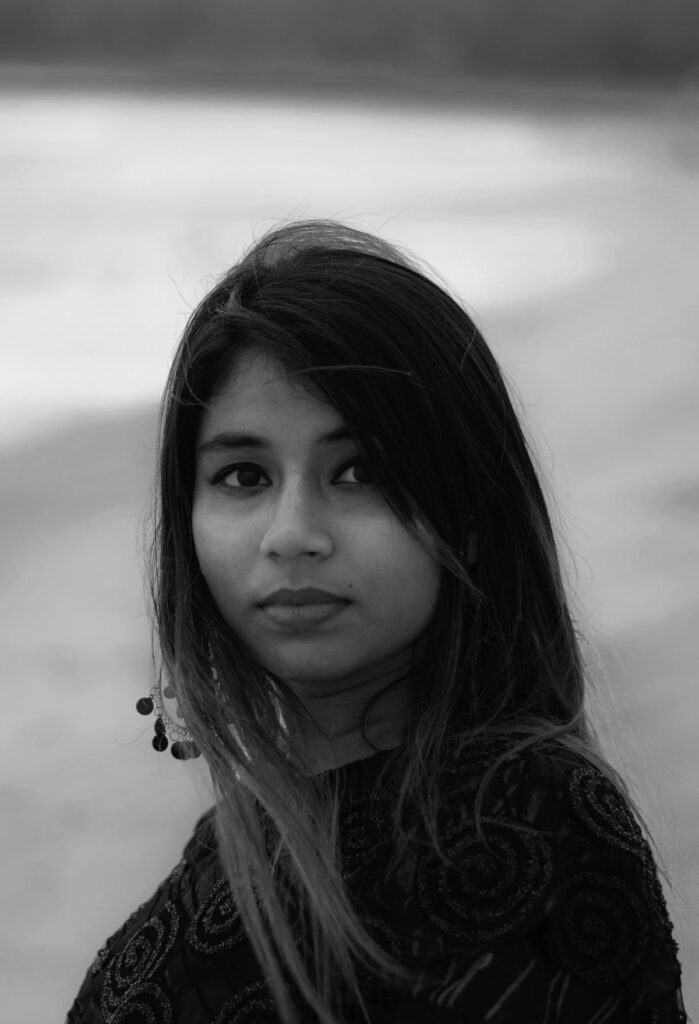
Mariyam Rasheeda | Photo Credit: SPECIAL ARRANGEMENT
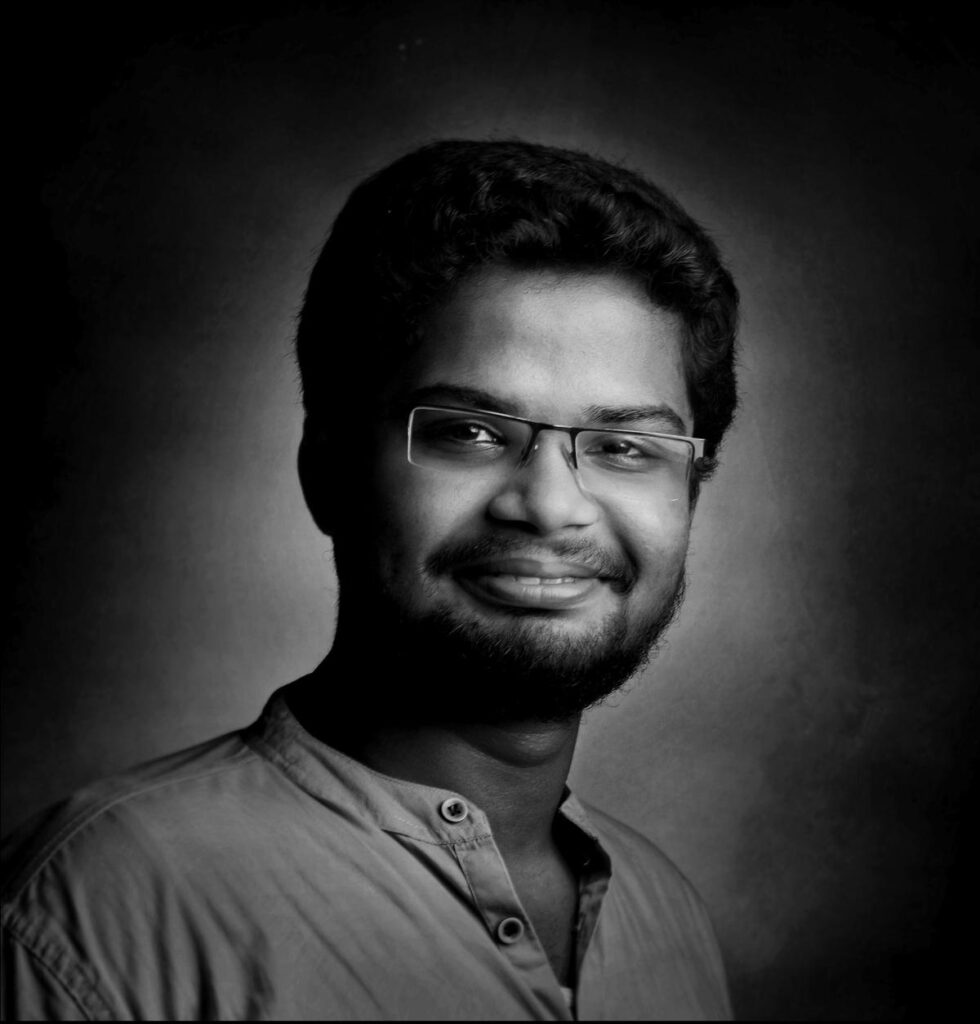
Murali M. Abbemane and K.M. Mariyam Rasheeda were declared winners of the Dr. Krishi Photo Story Award 2022 of the “Under 30 Photo Story Contest” organised by the Mangaluru Chapter of Indian National Trust for Art and Cultural Heritage (INTACH) in association with Art Kanara Trust.
Murali M. Abbemane | Photo Credit: SPECIAL ARRANGEMENT
The results were announced at the inauguration of an exhibition of photo stories that was shortlisted for the award on Saturday, April 15, in Mangaluru.
Pranam Shreedhar and Shravya Manjunath were the finalists. Likhith Raj Gatty and Sowjanya Jogi (joint project), Neel Kote and Vivek Gowda were the shortlisted contestants. The contest was announced in August 2022 and elicited 28 entries, said a release.
Physician and writer B. Srinivas Kakkilaya, photojournalist Yajna and advertising photographer and filmmaker Prakash Braggs, who was one of the jury members, were the dignitaries on the occasion.
Releasing ‘Metaphors of Physical & Emotional Spaces,’ a book on shortlisted entries, Dr. Kakkilaya spoke about his friendship with Late Dr. Krishna Mohan (Dr. Krishi). “Krishna Mohan was one of the first Mangalorean to explore the internet and launch a website, inspiring many others.” During COVID-19, he was active in dispelling myths and creating public awareness by publishing scientific information.
Responding to an audience query, whether a story is required to explain a photograph, Mr. Yajna said, “A single shot photo is a work of art and should speak for itself. But, a photojournalist or a photo storyteller needs to build a context around the single or multiple photos to reach out to the viewers.”
Mr. Braggs explained the ‘less is more’ concept in photography. “It’s not about what you include in the photo, but what you leave out.”
The exhibition of photographs would be open to the public till April 23, between 11 a.m. and 7 p.m at Kodialguthu Centre for Art and Culture, G.G. Road, Ballalbagh.
source: http://www.thehindu.com / The Hindu / Home> News> Cities> Mangaluru / by The Hindu Bureau / April 17th, 2023
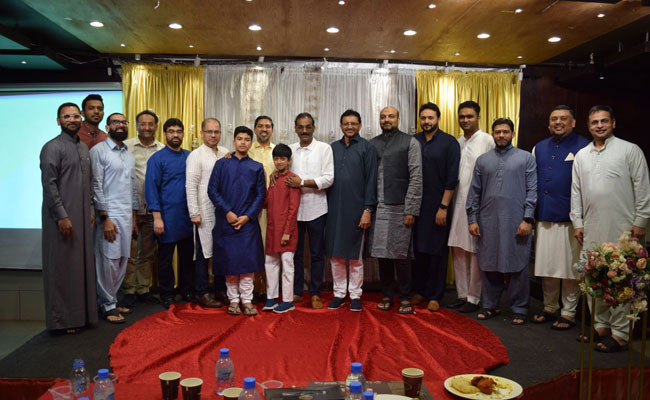
The Karnataka Muslim Cultural Association (KMCA) held its annual general body meeting on April 8th, during which elections were conducted for the executive committee for 2023-24.
The program, held at MRA Restaurant in Doha, began with a recitation of the Holy Quran by Master Rehan Rashid.
Following the dissolution of the executive committee for 2022-23, Ahmed Saeed Assadi, the election commissioner, conducted the process of electing the new committee members.
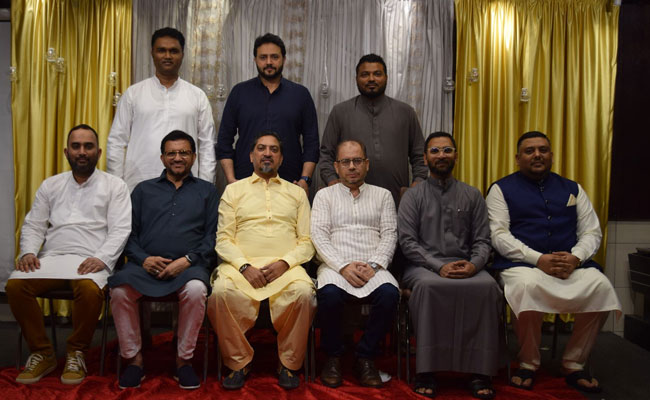
The KMCA has announced that Saquib Raza Khan has been elected as the new president, while Suhaib Ahmed has been elected as the new vice president. Shahim Mohammed Sheikh is the new general secretary, Khaleel Ahmed is the new treasurer, Mohammed Yunus is the new joint secretary, Sayed Ashfaque is the new cultural secretary, and Shakeel Mohammad is the new sports secretary.
In his acceptance address, the newly elected president, Saquib Raza Khan from Mangaluru, put forth the future plans of the KMCA. He also stated that the other office-bearers would be elected soon during the first meeting of the new executive committee.
The outgoing president of KMCA, Fayaz Ahmed, welcomed the gathering, while outgoing general secretary Suhaib Ahmed presented the annual report of the events organized by the KMCA in the last year. Khaleel Ahmed presented the treasure report. Abdullah Moideen was the Master of Ceremony.
The meeting concluded with a vote of thanks by Ahmed Saeed Assadi.
Following the elections, a quiz contest was held, and the top five winners were awarded prizes.
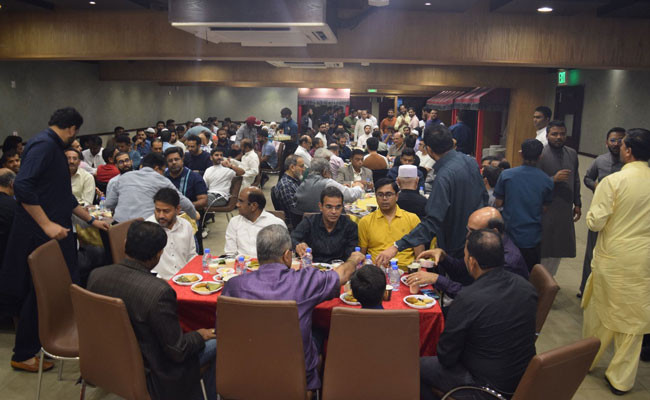
The KMCA also held an Annual Iftar for its members and heads of other organizations, which was attended by approximately 150 people.
Dignitaries from other associations and community leaders, including Hassan Chougle and Ikhlas Farid, ICC President Manikantan, and officials of the ICC, ICBF, and ISC Subramanian Hebbagilu and Deepak Shetty, graced the occasion.
Leaders of Karnataka-based organizations such as Mahesh Gowda, Ravi Shetty, Arun Kumar, Dr. Sanjay Kuduri, Abdul Razzak, Ibrahim Beary, Mumtaz Hussain, Abdul Rahiman Saab, and Abdullah Khatri were also present.
source: http://www.english.varthabharati.in / Vartha Bharati / Home> Gulf / by Vartha Bharati / April 11th, 2023
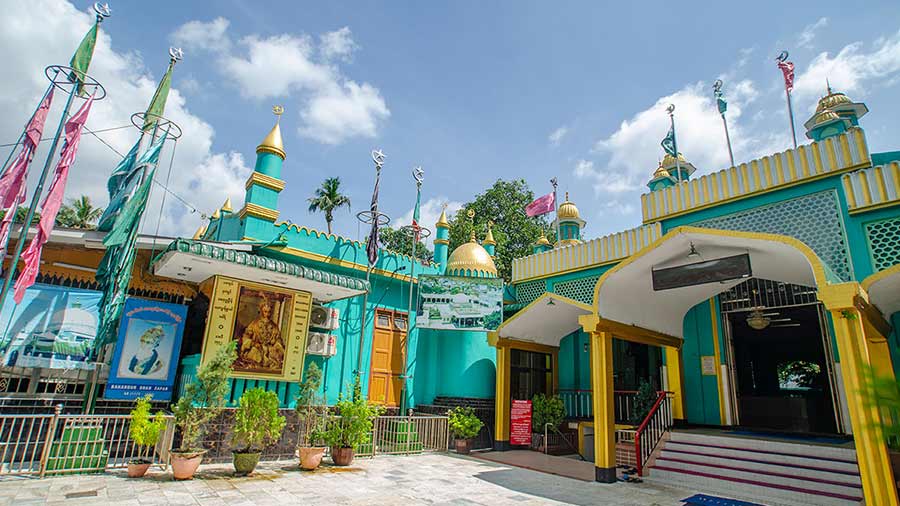
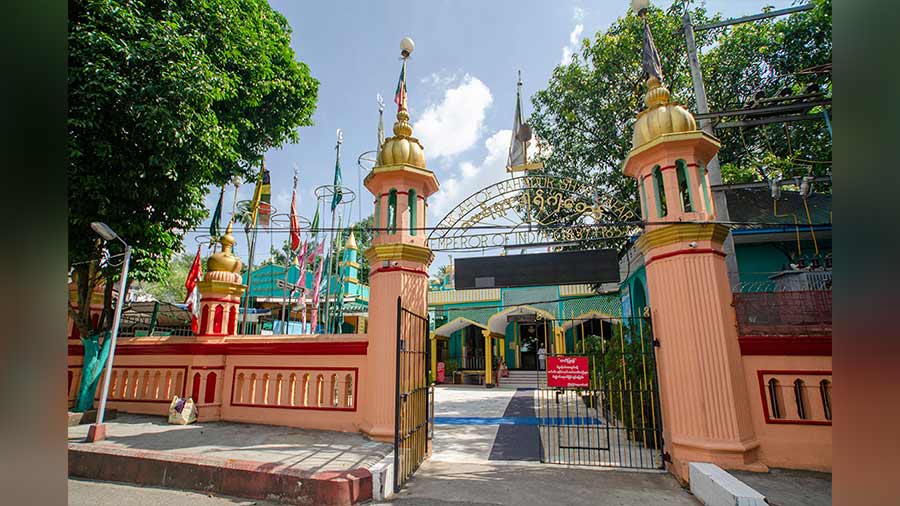
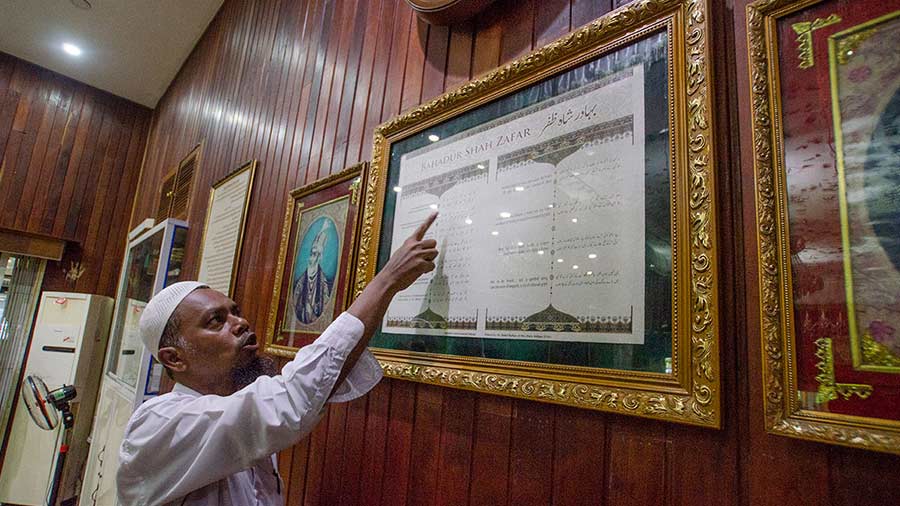
Close to the Shwedagon Pagoda in Myanmar, this dargah is the last tribute to the Mughal ruler and poet.
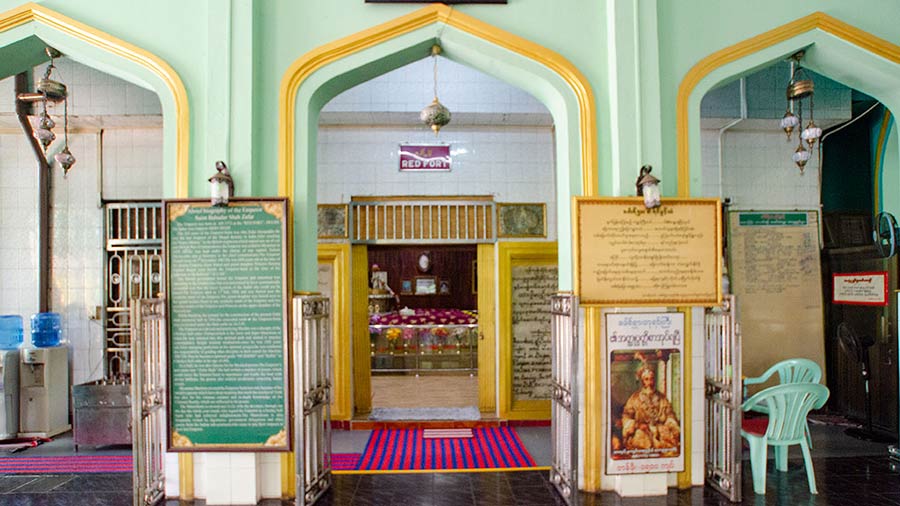
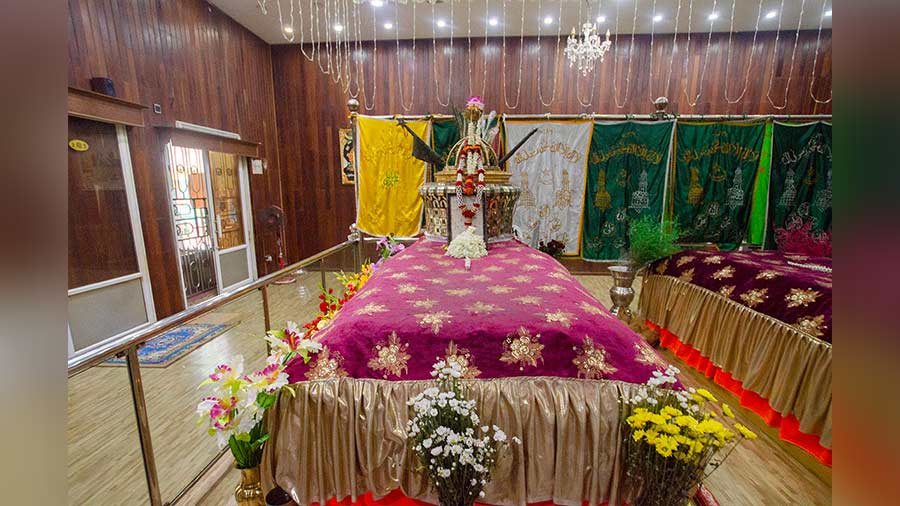
The main hall at the Dargah of Bahadur Shah Zafar Photos: Subhadip Mukherjee
Myanmar (Burma) has some uncanny ties with India when it comes to the freedom struggle. Netaji Subhas Chandra Bose was imprisoned in Mandalay and the last Mughal emperor Bahadur Shah Zafar, who was also imprisoned, later died in Yangon (Rangoon).
If one visits Yangon, then one must visit the Dargah of Bahadur Shah Zafar. It is an irony of sorts when one thinks of the last Mughal emperor not being able to spend the last days of his life in a country where his ancestors once ruled. For the British, Bahadur Shah Zafar was more like a threat; they were constantly worried that he could be used as a proxy leader for another attempt at a revolt in India.
The Dargah of Bahadur Shah Zafar in Yangon
After being arrested from Humayun’s Tomb during the Sepoy Mutiny on September 19, 1857, he was spared the death sentence and negotiated a life in exile instead. They thought it was better to have him sent to exile in Myanmar, and considering his health, they were almost certain that he would never set foot in India again. Bahadur Shah Zafar left Delhi along with his wife, two sons, and some close support staff on October 7, 1858.
More than a rebellious ruler, Bahadur Shah was more into poetry and that’s exactly how he spent the sunset years of his life in Myanmar. The British were paranoid and even prevented him from getting supplies of pen and paper fearing that he would pass messages to his supporters back in India.
Life in Yangon
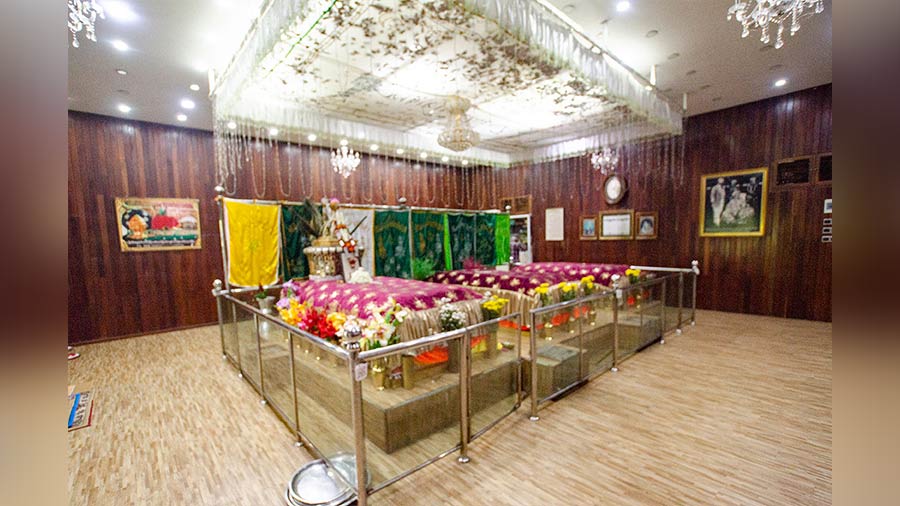
Room next to the main hall, housing the tombs
He lived in a small wooden house that was located very near Shwedagon Pagoda. If you are visiting Yangon, then you’ll find Shwedagon Pagoda as one of the major landmarks in the city. His life was miserable out here with a very limited supply of food and without any pen and paper. So, as a last-ditch attempt, he started using charcoal and scribbled poetry on the wall of his home.
His life came to an end at the age of 87 on November 7, 1862. By then, he was completely bedridden and unable to eat or drink. A very unfortunate end to the last Mughal emperor of India.
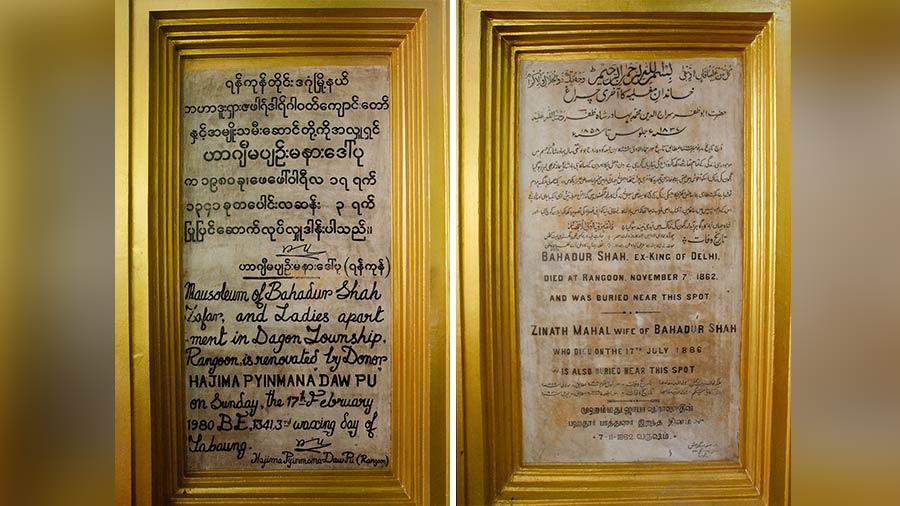
Memorial plaques inside the dargah
Even after his death, the British were paranoid and hurriedly buried him without giving him the last respect that he deserved as the last emperor. Just a small plaque was placed on top of the grave and the rest was kept as simple as possible. This was purposely done to prevent his followers from making this place into a pilgrimage spot.
Four years later, his wife also passed away in Yangon and was buried right next to him.
The Lost Grave
The Lost Grave
With time, people simply forgot about this grave just exactly as the British wanted. To make matters more complicated no official records were kept as to the exact place where he was buried.
The discovery of the grave happened by chance in the year 1991 during an expansion work of a prayer hall that was being carried out by labourers. Two graves were found with small inscriptions on top of them. While one had the name Bahadur Shah Zafar, the one next to it was that of his wife Zinat Mahal.
Further excavation was carried out on the two graves and upon opening up the grave of Bahadur Shah Zafar, the skeletal remains were found wrapped in a silk shroud.
Interiors of Bahadur Shah Zafar Memorial Hall at the dargah
After this discovery and realising the importance of the grave, it was decided to restore and renovate the graves and the surrounding area. With support from the local community, the local government, and further support from the Government of India, a permanent structure was constructed over these two graves. A dargah was constructed at this very spot making it fit for the last Mughal emperor.
Dargah of Bahadur Shah Zafar
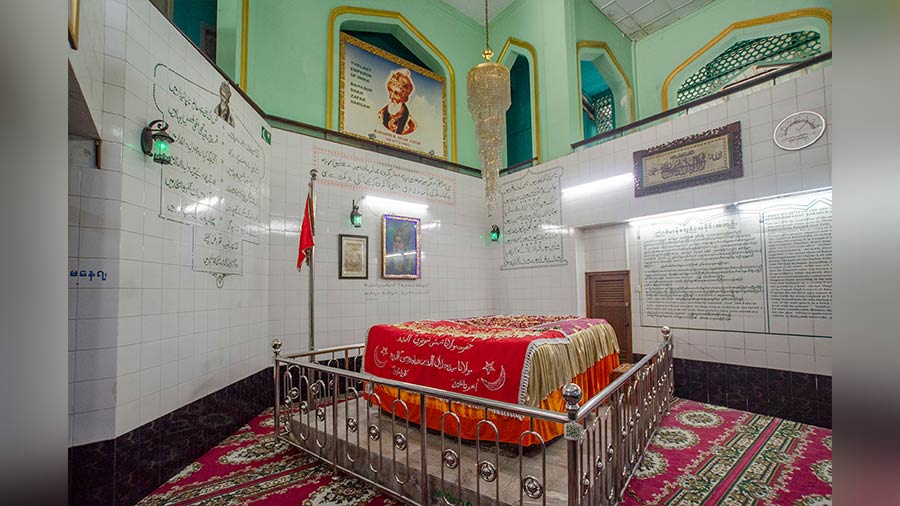
Original grave of Bahadur Shah Zafar at the basement
The dargah has two levels, the top level has a large prayer hall and a room with three decorated tombs. These tombs are that of Bahadur Shah Zafar, Zinat Mahal, and his granddaughter Raunaq Zamani. The surrounding walls in this room have only three known photographs of the emperor and poetry written by him lamenting his life in exile.
Kitnaa hai badnaseeb ‘Zafar’ dafn ke liye do gaz zamin bhi na mili kuu-e-yaar mein
Bahadur Shah Zafar
There is however another secret to this place. There is a room located in the basement of the dargah. This is the room where the original grave of Bahadur Shah Zafar was located when it was discovered. The grave now has been converted into a decorated tomb. This is the very place where the last Mughal emperor was buried and was thought would be forgotten. But as luck would have it, it is now somewhat fit for an emperor. It’s sad that Bahadur Shah Zafar could never return to the country he once ruled. He remained in exile even after he died in Myanmar.
The Kolkata Connection
A representative from the Dargah reading poetry written by Bahadur Shah Zafar
Bahadur Shah Zafar along with his wife Zinat Mahal were also accompanied by their two sons Jawan Bakht and Jamshed Bakht. His sons never left Burma and settled there and ultimately died there only. Jamshed Bakht had two sons. One of his sons, Mirza Bedar Bakht, came back to India and settled in Kolkata. He married Sultana Begum with whom he had five daughters. Mirza Bedar Bakht had a very quiet life living in a slum and earning by sharpening knives and scissors. He died in the year 1980 in this very city and was buried here in Kolkata.
Working for more than a decade in the book retail and publishing industry, Subhadip Mukherjee is an IT professional who is into blogging for over 15 years. He is also a globetrotter, heritage lover and a photography enthusiast.
source: http://www.telegraphindia.com / The Telegraph Online / Home> My Kolkata> Historical Landmark / by Subhadip Mukherjee / April 03rd, 2023
Photographers Dar Yasin, Mukhtar Khan and Channi Anand captured images of protests, police and paramilitary action and daily life in Kashmir.
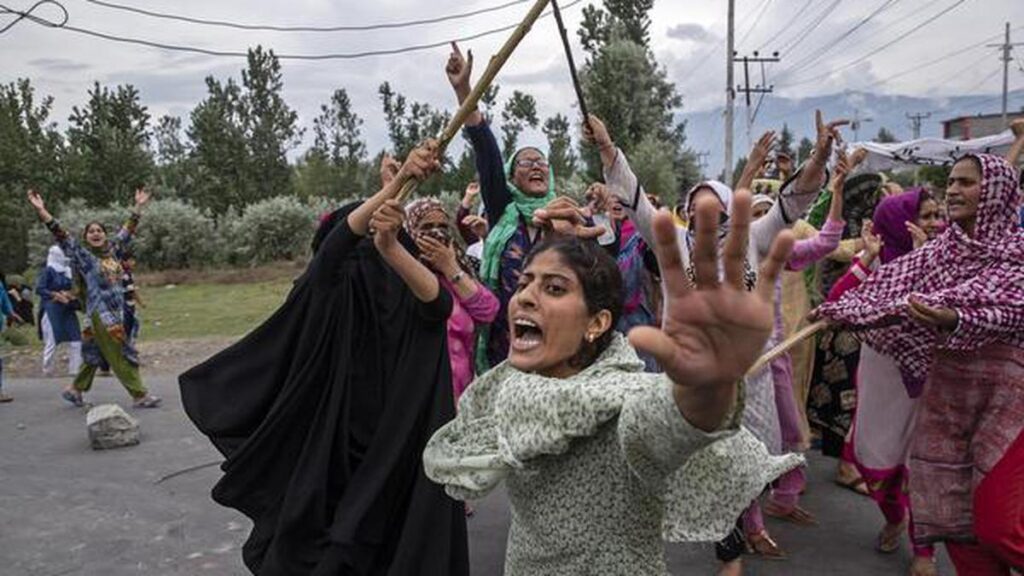
Women shout slogans as the police fire teargas and live ammunition in the air to stop a protest march in Srinagar, Aug. 9, 2019. The image was part of a series of photographs by Associated Press photographers which won the 2020 Pulitzer Prize for Feature Photography.
The story of India’s crackdown on Kashmir last August was difficult to show to the world. The unprecedented lockdown included a sweeping curfew and shutdowns of phone and internet service.
But Associated Press ( AP ) photographers Dar Yasin, Mukhtar Khan and Channi Anand found ways to let outsiders see what was happening. Now, their work has been honoured with the 2020 Pulitzer Prize in feature photography.
Snaking around roadblocks, sometimes taking cover in strangers’ homes and hiding cameras in vegetable bags, the three photographers captured images of protests, police and paramilitary action and daily life — and then headed to an airport to persuade travellers to carry the photo files out with them and get them to the AP ’s office in New Delhi.
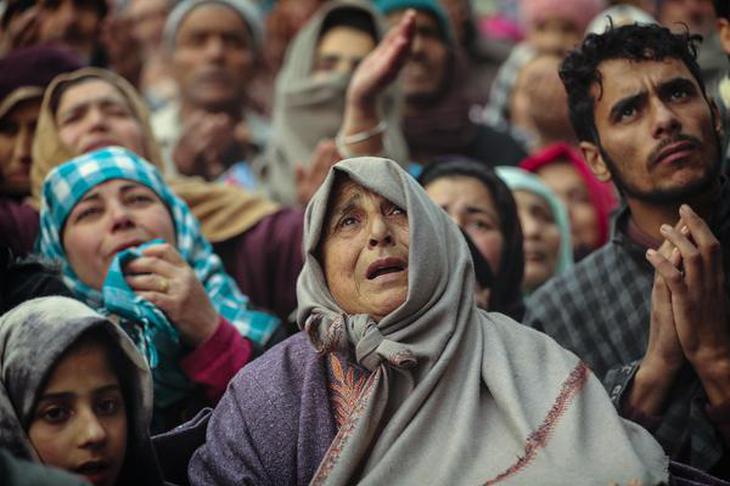
Kashmiri Muslim devotees offer prayer outside the shrine of Sufi saint Sheikh Syed Abdul Qadir Jeelani in Srinagar, Dec. 9, 2019. The image was part of a series of photographs by Associated Press photographers which won the 2020 Pulitzer Prize for Feature Photography.
“It was always cat-and-mouse,” Mr. Yasin recalled on Monday. “These things made us more determined than ever to never be silenced.”
Mr. Yasin and Mr. Khan are based in Srinagar, Kashmir’s largest city, while Mr. Anand is based in the neighboring Jammu district.
Mr. Anand said the award left him speechless.
“I was shocked and could not believe it,” he said, calling the prize-winning photos a continuation of the work he’s been doing for 20 years with the AP .
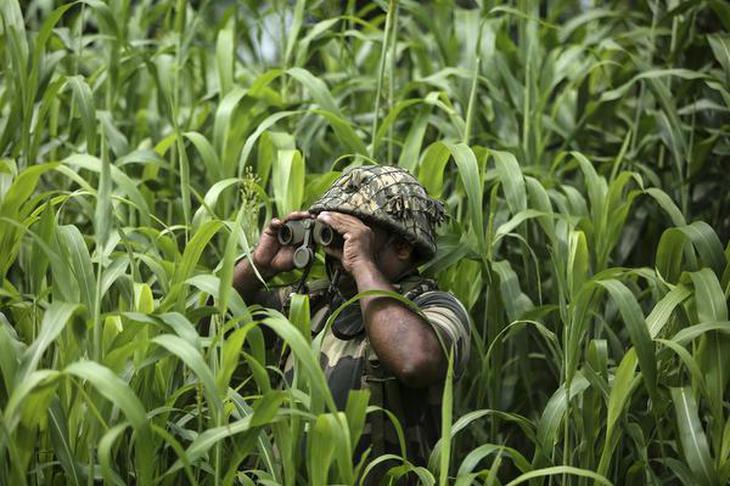
An Indian Border Security Force (BSF) soldier keeps vigil near the India-Pakistan border at Garkhal in Akhnoor, about 35 kilometers (22 miles) west of Jammu, India, Aug. 13, 2019. The image was part of a series of photographs by Associated Press photographers which won the 2020 Pulitzer Prize for Feature Photography.
With communications shut down, these journalists had to find out about protests and other news by finding them in person. Mr. Khan and Mr. Yasin took turns roving the streets in and around the regional capital of Srinagar, Mr. Yasin said, facing mistrust from both protesters and troops. The journalists were unable to go home for days or even let their families know they were doing okay.
“It was very hard,” Mr. Khan said, but “we managed to file pictures”.
After spotting luggage-toting people walking toward the airport, he said, the photographers decided to ask travellers to serve as couriers. Mr. Yasin also recalled how a relative of his, who was also a photojournalist, had told him about delivering film rolls to New Delhi in person as the conflict in Kashmir raged in the 1990s.
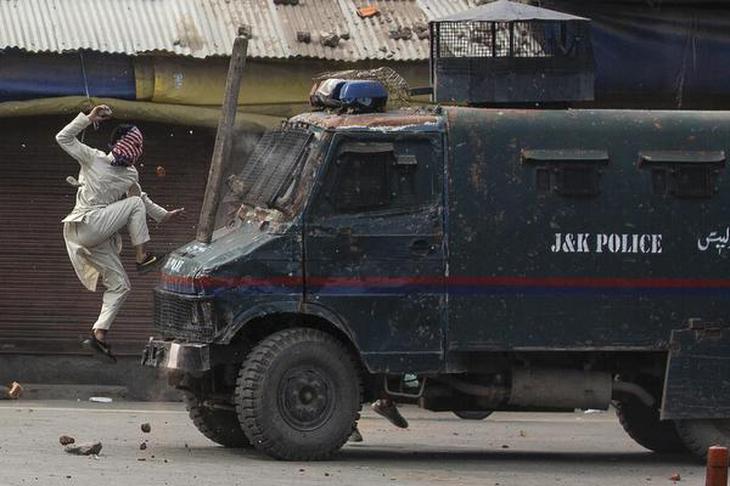
A masked Kashmiri protester jumps on the bonnet of an armored vehicle of Indian police as he throws stones at it during a protest in Srinagar, May 31, 2019. The image was part of a series of photographs by Associated Press photographers which won the 2020 Pulitzer Prize for Feature Photography.
The photographers thus went to the Srinagar airport and sought out strangers willing to carry memory cards and flash drives to New Delhi and call AP after landing in the Indian capital.
Some flyers declined, fearing trouble with the authorities, Mr. Yasin said. But others said yes and followed through. Most of the memory cards and drives arrived.
Mr. Yasin says their prize-winning work has both professional and personal meaning to him.
“It’s not the story of the people I am shooting, only, but it’s my story,” he said. “It’s a great honour to be on the list of Pulitzer winners and to share my story with the world.”
“This honor continues AP ’s great tradition of award-winning photography,” said AP President and CEO Gary Pruitt. “Thanks to the team inside Kashmir, the world was able to witness a dramatic escalation of the long struggle over the region’s independence. Their work was important and superb.”
Pulitzer finalists for breaking-news photography award
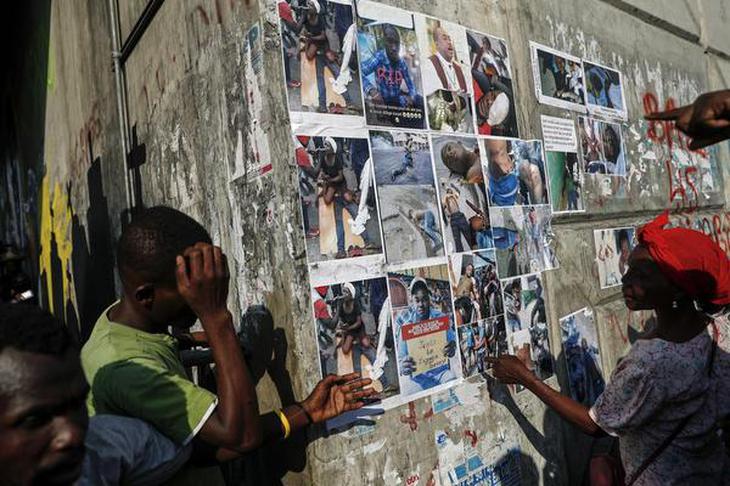
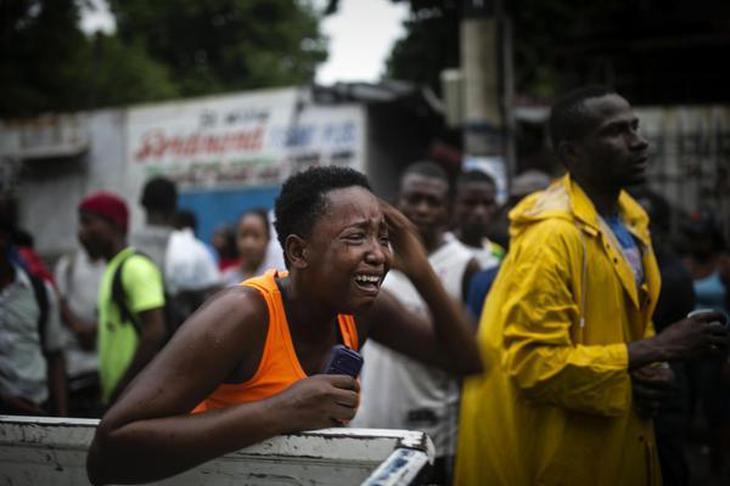
In a year when protests arose across the globe, AP photographers Dieu Nalio Chery and Rebecca Blackwell were Pulitzer finalists for the breaking-news photography award for their coverage of violent clashes between police and anti-government demonstrators in Haiti.
Protesters and passersby look at images of people said to have been injured or killed during the month-long protests calling for the resignation of President Jovenel Moise, in Port-au-Prince, Haiti, Oct. 15, 2019. The image was part of a series of photographs by Associated Press photographers which was named a finalist for the 2020 Pulitzer Prize for Breaking News Photography.
Bullet fragments hit Mr. Chery in the jaw while he documented the unrest. He kept taking pictures, including images of the fragments that hit him.
A protest against fuel shortages and demanding the resignation of President Jovenel Moise in Port-au-Prince, Haiti, Sept. 20, 2019. The image was part of a series of photographs by Associated Press photographers which was named a finalist for the 2020 Pulitzer Prize for Breaking News Photography.
“All five of these photographers made remarkable, stunning images despite dangerous and challenging conditions, sometimes at great personal risk,” said AP Director of Photography David Ake. “Their dedication to getting up every morning and going out to tell the story is a testament to their tenacity. The result of their work is compelling photojournalism that grabbed the world’s attention.”
AP Executive Editor Sally Buzbee called the Kashmir prize “a testament to the skill, bravery, ingenuity and teamwork of Dar, Mukhtar, Channi and their colleagues” and lauded Mr. Chery’s and Ms. Blackwell’s “brave and arresting work” in Haiti while many journalism outlets were focused elsewhere.
“At a time when AP ’s journalism is of more value than ever to the world, these journalists’ courage and compelling storytelling show the absolute best of what we do,” Ms. Buzbee said.
The honor for the photographers is the AP’s 54th Pulitzer Prize. The news cooperative last won a Pulitzer last year for stories, photos and video on the conflict in Yemen and the ensuing humanitarian crisis.
source: http://www.thehindu.com / The Hindu / Home> News> World / by Associated Press (AP) / May 05th, 2020
Andaleeb Wajid is a Bangalore-based writer who attempts to authentically portray India’s Muslim diaspora through novels that focus on life, food, family and relationships.
The young Indian Muslim writer Andaleeb Wajid has published five books in almost as many years. Courtesy Andaleeb Wajid
Modestly dressed in a pretty headscarf and shalwar kameez, the Bangalore-based writer Andaleeb Wajid smiles as she talks about her short but successful writing career – she has published five books in six years, most of them featuring a Muslim setting and credibly representing the community in India.
Wajid, 36, says she has been writing since she was 10. Her first book, Kite Strings, was released in August 2009 followed by Blinkers Off (August 2011), My Brother’s Wedding (May 2013) and More Than Just Biryani (January 2014). No Time For Goodbyes, released in April this year, is her latest book and the first in the Tamanna Trilogy series, books on time travel targeted at young adults. The other two will be released in September and December this year.
How did you begin writing?
I have been writing stories since I was 10. When I was in Grade 12, I was left very confused about what I would do with my life. There weren’t many options for girls from orthodox Muslim families. Then it occurred to me to take up writing as a career. I was certain that no one would stop me.
Is there a reason why many of your books have been set in a Muslim milieu?
I’m quite amused with the way Muslims are depicted in Bollywood films and on television in India. My stories attempt to show a slice of Muslim life, which is no different from anyone else’s. I wrote More Than Just Biryani only because I strongly felt that the world has labelled us as just biryani-eaters and I wanted them to be aware of the diversity in Muslim cuisine. Kite Strings discusses the issues a young girl from an orthodox Lababin Muslim [a community from Tamil Nadu] family faces. But a large number of non-Muslim fans also reached out to me, saying how much they identified with the character, which proves that some things transcend religious boundaries.
More Than Just Biryani was conceived as a recipe book. What prompted you to turn it into fiction?
My brother and I had thought of writing a culinary memoir but the idea never took off because I realised early that I could never do justice to non-fiction. Instead I wrote about three women and the role food plays in their lives. Nearly every chapter of the book has a recipe, which is woven into the story.
Have you drawn upon your personal experiences to craft stories?
Yes. Like most writers, I started off writing about what I knew best. In Kite Strings, the protagonist Mehnaz is a rebel without a cause and behaves a lot like I did as a teenager. The story is set in Vellore, Tamil Nadu, where as a child I spent several holidays with my grandparents. In More Than Just Biryani, one of the protagonists loses her father. It was the most painful chapter I have ever written.
What else is in the pipeline?
I have one more young-adult novel in my kitty, about a girl whose mother has left the family. Then there’s another about a crochet teacher and the four women who learn this beautiful craft from her and end up baring their lives to her.
• Andaleeb Wajid’s books are available on Amazon
artslife@thenational.ae
source: http://www.thenationalnews.com / The National / Home / by Priti Salian / July 05th, 2014
The first Muslim judge of a high court in colonial times, Syed Mahmood’s professional conduct offers a counterpoint to the declining standards in Indian judiciary.
WHEN Justice Abdul Nazeer addressed the 16th national council meeting of the RSS-affiliated Akhil Bharatiya Adhivakta Parishad at Hyderabad last December, he said, “Great lawyers and judges are not born but made by proper education and great legal traditions, as were Manu, Kautilya, Katyayana, Brihaspati, Narada, Parashar, Yajnavalkya, and other legal giants of ancient India.” In the symposium on “Decolonisation of the Indian Legal System”, Justice Nazeer also said the “continued neglect of their great knowledge and adherence to the alien colonial legal system is detrimental to the goals of our Constitution and against our national interests…”.
Perhaps Justice Nazeer should have also recalled 19th-century jurist Justice Syed Mahmood (1850-1903). A pioneer in bold assertions against the colonial judiciary, he produced incisive legal commentaries that reflect an audacious dissenter’s point of view. Writing in an Urdu newspaper, his father, Sir Syed Ahmed Khan, narrates Mahmood’s resignation from the Allahabad High Court in 1893 to “protect the self-respect of Indians against the racism of British judges”.
In that era, conceptions of nationhood were still evolving in India. Indian judges would not muster the courage to contest the racism of the imperial power or fellow European judges. But Mahmood did, in intrepid ways. Khan founded the Mohammedan Anglo-Oriental (MAO) College at Aligarh in 1877 and figures prominently but contentiously, stereotyped as a British loyalist and separatist in debates on contemporary nationalism. Mahmood supported his father’s modern education project, but unfortunately, his contributions are largely ignored by historians and the legal fraternity.
By 1920, MAO College, now Aligarh Muslim University, was the most prominent residential university in the country. Its history department has been a premier centre for advanced studies for a half-century. In 1889, primarily on Syed Mahmood’s initiative and his gifts in terms of books, journals and cash, AMU established a law department. Yet, he was neglected in its research. Only in 1973, seven years after the centenary of the Allahabad High Court, the Aligarh Law Journal brought out Mahmood’s contributions, and legal scholars reflected on his high calibre as a lawyer and judge.
The good news is, in 2004, Alan M. Guenther did his doctoral thesis on Mahmood at McGill University, Canada, which is available online for the public to access. His meticulous and well-researched account touches almost every aspect of Mahmood’s public life. Guenther also published an extended essay in 2011on Mahmood’s views on English education in 19th-century India. (In 1895, Mahmood had written a book on the theme for his speeches at the Educational Conference.)
In 1965, Asaf Ali Asghar Fyzee (1899-1981) complained, “Syed Mahmood’s contributions to the transformation of Muslim law in India have been largely neglected by historians and survive primarily as footnotes in legal texts on Muslim law.” Guenther, too, observes, “…overshadowed by the life and writings of his illustrious father, Ahmad Khan, his legacy has not received the attention it deserves. A large part of his father’s achievements in the reform of education, in fact, would not have been possible without the assistance of Syed Mahmood. But when he reached the age at which his father had made his most significant achievements, [Mahmood] had his life cut short.”
Mahmood had laid out his life plans clearly. S. Khalid Rashid, writing in 1973, reports that Mahmood decided early on that, like his ancestors, he would devote the first third of his life to educating himself, the second to earn a living, and the last to “retired study, authorship and devotion to matters of public utility”. But Guenther writes about how Mahmood’s health had deteriorated through alcohol abuse and disease. He died before he turned 53, broken by forced retirement, estranged from his father (who had died five years previously), stripped of responsibilities at the college he had helped found, separated from wife and son, and in poverty. He was selling personal items to repay debts. “His father’s numerous writings and letters are still republished, but Syed Mahmood’s contributions to Muslim thought are hidden in bound volumes of the Indian Law Reports and brittle files of government correspondence,” Guenther writes.
One aspect of Mahmood’s last years is captured by Prof. Iftikhar Alam Khan’s Urdu books, Sir Syed: Daroon-e-Khana (2006, 2020) and the recent Rufaqa-e-Sir Syed: Rafaqat, Raqabat wa Iqtidar Ki Kashmakash. These accounts expose the smear campaigns of the three companion successors of Sir Syed—Samiullah, Mohsin-ul-Mulk and Viqar-ul-Mulk—against Syed Mahmood as they vied for the secretary’s post at MAO College. Often European members of MAO College conspired with them. Exploiting his weaknesses and eccentricities, they ousted him to get a hold over college affairs, compounding his hurt during his tragic final years.
SYED MAHMOOD’S ROLE IN SIR SYED’S EDUCATIONAL ENTERPRISE
Having returned to India in 1872 after studying in England, Mahmood took time out of his budding legal career to assist his father’s reform work, particularly setting up MAO College. He prepared a detailed plan along the lines of his experiences in Cambridge. His specific aim, explained in February 1872, was to produce future leaders of India through an educational institution whose residential nature would be “as indispensable an education as the course of study itself”. The aim was to create a society of students and teachers quite different from the rest of society.
He travelled with his father to Punjab in 1873 and spoke at a rally to promote the project. In 1889, Sir Syed introduced a motion to nominate Mahmood as joint secretary of the board of trustees of MAO College by highlighting his assistance despite the opposition he faced. In particular, he considered his son’s influence the primary factor that persuaded European professors to come to India and teach there.
European staff members confirmed this around six years later when there was renewed opposition to Mahmood continuing as joint secretary. The principal, Theodore Beck (1859-1899), testified, “Syed Ahmad….acknowledged his reliance on Syed Mahmood for advice in all matters, and his imprint could be noted in the correspondence relating to the school. He declared his firm conviction that Syed Mahmood was the one person who shared his vision for the college, and apart from him, no one would be able to administer the school in keeping with that vision.” However, Samiullah (1834-1908) disagreed with Sir Syed on this count. As a result, a tussle for power began in the college management. The power-play could explain why AMU felt inhibited in bringing out a biography of Mahmood, a research gap that Guenther’s doctoral thesis fills. He has extensively relied on important correspondences of Mahmood preserved in the London India Office (British) Library.
SYED MAHMOOD’S TRYST WITH MUSLIM LAW
Mahmood is a forgotten pioneer of the transformation of Muslim law in modern South Asia. In 1882, at just 32, he became the first Muslim judge of the high courts in British India. He delivered numerous landmark decisions that shaped Muslim law, the law in general, and its administration.
Earlier, he blazed a trail his younger contemporaries followed in their judicial roles in British India. He was one of the first Indian Muslims to study in England and train in the English system of jurisprudence, the first Indian to enrol as a barrister in the High Court of Judicature at Allahabad in 1872, the first appointed as a district judge in the restructured judicial system of Awadh in 1879 and the first Indian assigned as a puisne judge to the High Court at Allahabad. He was the first Muslim in any High Court of India. He cleared a path for Indian Muslims to participate in administering justice in India. But his contribution is not limited to creamy career opportunities for Muslim youngsters. His lasting legacy is how Muslim law is perceived and administered in South Asia today.
CHAMPION OF ACCESSIBLE JUSTICE
An abiding concern of Mahmood was the cost of administration of justice. Court procedures were lengthy and expensive, and the “mass of law” was complicated. Distance from courts was another concern, for which he proposed a network of village courts for “on-the-spot” adjudication. He sought to make justice accessible through unpaid tribunals and honorary munsifs. He prepared a comprehensive draft for this, Guenther informs.
Furthermore, he attacked the [racial] mindset and court fees and stamp duties on legal documents. He ruled in August 1884 and February 1885 that “…if justice costs the same amount [to the] rich and poor, it follows that the rich man will be able to purchase it, whilst the poor man will not.” He declared, more than once, that British judges in India were too quick to find fraud.
In a speech at the Allahabad Bar in April 1885, Mahmood raised the language issue in judicial transactions, saying laws should be in languages intelligible to the masses. He insisted on the vernacular in arguments, pleadings and justice delivery and translated verdicts so that people unfamiliar with English could rest assured that judgments are reasoned. Of course, the issue of judicial language continues to be debated, and for this, acknowledgement is due to Mahmood.
AN INDIAN DISSENTER IN THE HIGH NOON OF BRITISH COLONIALISM
Mahmood is known most for outstanding dissenting judgements. In volume 2 of his 2021 book, Discordant Notes, Justice (retd.) Rohinton F. Nariman writes that Mahmood was known for detailed judgments, some of which stand out for thoroughness and fearless language. Mahmood would refer to the original Sanskrit versions when ruling on Hindu laws and the Arabic texts for Muslim laws, rather than using interpretations of the relevant texts.
From the 1860s to 1880s, during the codification of laws, he sought limits on importing British laws and protested that the local context was getting overlooked. His concern was not just the laws but their efficacy and adaptability within India’s cultural diversity.
Guenther observes, “…throughout his life, he identified himself as a Muslim as well as an Indian and a subject of the British crown, and that he was actively involved in the education and improvement of the Indian Muslim community. At the same time, Mahmood… [made] efforts to promote harmony between people of diverse backgrounds, and…[supported] initiatives that improved the situation of all Indians, regardless of religious affiliation…”
An anecdote from Altaf Hali’s Hayat-e-Javed (1901), cited by Shamsur Rahman Faruqi (2006), is worth sharing. “Contrary to the culture of sycophancy and genuflecting before the English colonial authority….Syed Ahmad Khan and his high-profile and brilliant son Syed Mahmud strived to conduct themselves as if they were equal to the English….Syed Ahmad Khan had stayed away from the [1867 Agra] Durbar because Indians had been given seats inferior to the English. A medal was to be conferred on Syed Ahmad Khan at that Durbar. Williams, the then Commissioner of Meerut, was later deputed to present the award to Syed Ahmad Khan at Aligarh railway station. Willams broke protocol and showed his anger at having to do the task under duress and said that government orders bound him, or he wouldn’t be presenting the medal to Syed Ahmad Khan. Syed Ahmad Khan accepted the medal, saying he wouldn’t have taken the award, except that he too was bound by government orders.”
Indian democracy is an outcome of anti-colonial nationalism, and dissent is its core component: Mahmood’s dissent contributed to nationalism in his time. In 2022, the V-Dem Institute described India as an electoral autocracy where dissent is being criminalised, and the judiciary is failing to contain the majoritarian upsurge. Mahmood’s professional conduct is an encouraging counterpoint to the degeneration in the Indian judiciary.
WHAT DID MAHMOOD THINK OF THE INDIAN NATIONAL CONGRESS?
According to Guenther, though Mahmood never joined the Congress, he was “equally aloof” from the anti-Congress propaganda his father indulged in. “…a rare catholicity characterised his views on most of the controversial questions,” he writes. He adds, “His acceptance among the Hindus [elites] generally was demonstrated by the fact that they tried to send him as their representative to the Imperial Legislative Council, though he never received that appointment.”
Nonetheless, like his father, Mahmood harboured class and regional prejudices. Guenther reveals an article Mahmood wrote in The Pioneer on 4 September 1875, suggesting the government must strive to with the sympathies of the “higher classes of natives”. When challenged to defend his position by “Another Native” in the same newspaper two weeks later, Mahmood responded that people in Punjab and the North-western Provinces [now Uttar Pradesh] were, historically speaking, of “much greater political significance” than those of Lower Bengal. Gunther cites his write-up: “…any educational system that succeeded in ‘attracting the Bengalee and fail(ed) to exercise any influence upon the higher classes of the Rajpoot, the Sikh, and the Mussulman’ must be regarded as a failure.”
Considering the socio-regional composition of top functionaries of AMU, even impartial insiders would testify that it still harbours regional and sub-regional prejudices. The Sir Syed Academy is releasing many publications during the ongoing centenary celebration of AMU. Publishing Guenther’s dissertation may be a fitting tribute to Mahmood, who must be regarded as a prominent co-founder of MAO College.
Mohammad Sajjad teaches modern and contemporary Indian History at Aligarh Muslim University. Md. Zeeshan Ahmad is a lawyer based in Delhi. The views are personal.
First published by Newsclick.
source: http://www.theleaflet.in / The Leaflet / Home> History / by Mohammad Sajjad and Zeeshan Ahmad / April 01st, 2022
Even though there were pockets of tribal-populated areas in Bulsar district, such as Dharampur and Bansda, the district was, by and large, known to be fertile and well served by the monsoon. The southern part of the district contained large tracts of grasslands, mostly owned by the Desais and Parsis. Most of the districts of peninsular Saurashtra, however, had no irrigation facilities. This was before the Narmada Canal took the river water there and solved the problem of both irrigation and drinking, with the rare exception of Junagadh.
I had served in one of the most arid regions of Saurashtra, Surendranagar – rich in history and political leaders and poor in soil fertility and irrigation facilities. Saurashtra was also poorly fed by the monsoons, and since no perennial rivers pass through the region, no large reservoirs, too, could be built to retain substantial quantities of water.
The year 1972 proved a very difficult year for both Saurashtra and North Gujarat. That year the assessment revealed that almost 12,000 out of the 18,000 villages of Gujarat had a harvest of less than 25 per cent. The government, therefore, declared famine conditions in those 12,000 villages, that is two-thirds of the state, and applied the Bombay Famine Relief Code to provide regulated relief.
Since the state faced a major calamity with two-thirds of its population of humans and cattle facing the threat of death by hunger and thirst, the Cabinet met almost every day since the moment the assessment figures came to be known. They had known what had happened in the tragic historical famines in Bengal, Kashmir and Madras, where thousands had perished – parents sold their children, sons abandoned their parents and there were rumours of cannibalism in some pockets. A major famine in Gujarat was quite a scary prospect for the government.
One fine morning, in September of 1972, I was basking in the cool breeze of the sea blowing from the Indian Ocean in the west. After a great deal of persuasion and bribery, my daughter, Gazala, who was all of four years, had agreed to go to school. Then the telephone rang. It was KN Zutshi, the revenue secretary, on the line.
“There was a Cabinet meeting this morning to review the scarcity situation. It was decided to post you as director of famine relief to take charge of the relief operations. You better pack up and move over to Gandhinagar. The chief minister wants you here yesterday. You have 48 hours to reach here. Handover charge to your resident deputy collector,” he ordered me.
Though I had been in Bulsar for more than three years, the normal tenure of a collector, still the sudden transfer came as a surprise. Bulsar was such a pleasant district to govern – open-minded and reasonable people, able and committed staff, and a flourishing club that I had established. When I announced my transfer to my officers as soon as I reached the collectorate, there was all-round consternation. By noon, the whole district had come to know of the transfer. As I was having lunch in my chamber, the peon announced that a delegation of MLAs from the district wanted to meet me.
“Sir, there are so many development works going on. All surplus land has not yet been taken over from the Desais. You cannot leave the task half-completed. You should not move,” they said.
“I have completed my tenure here. If the government wants me at Gandhinagar, I have to move,” I said. Left to myself, I would have liked to serve another four or five years in Bulsar. I learnt later that all the MLAs of the district, including those from the opposition, had driven to Surat. They had persuaded Zinabhai Darji, the president of the state Congress, to accompany them to Gandhinagar to persuade the CM, Ghanshyambhai Oza, to cancel the transfer. One of the MLAs later told me that the CM had asked them only one question.
“Is Mr Moosa Raza unhappy with this transfer? Does he want to stay back in Bulsar?”
“No, sir, but we want him there in the interest of the district.”
“Don’t you think that the larger interest of the state should override the interests of a single district?” the CM had asked reasonably.
They had no answer. The next day, after handing over charge to the resident deputy collector (RDC), I drove down to Gandhinagar to call on the CM. I had known him during my tenure in Surendranagar, his hometown. Having been a member of the Parliament for two terms, Mr Oza was a suave and polished politician, exuding politeness and bonhomie at every movement. He received me graciously, and as I was taking my seat, he pointed to a large pile of telegrams on his table.
“Do you know what they are?” he asked me with a smile. “No, sir,” I replied truthfully.
“Over 500 telegrams from Bulsar district requesting me to cancel your transfer.”
“I had nothing to do with them, sir,” I said. But I would have been less than human not to feel pleased at this show of appreciation from the people I had served.
“But I had to disappoint your fans in Bulsar. The state is facing a severe challenge, and your work in Surendranagar, Surat, Bulsar, and Dangs has convinced the Cabinet that you are the best officer to shoulder the task.”
“We have done a preliminary survey and made an initial assessment of the various requirements. A budget of Rs 120 crore has been sanctioned. Your mandate is to ensure that not a single human life is lost for want of food and water, all cattle are provided fodder, and all villages supplied with water. The Land Revenue Code mandates that the able-bodied villagers are not given doles. That encourages a dependent mindset. You have to organise relief works through which all those who can work are provided employment. The wages should be paid every week. The revenue department will brief you on the organisational arrangements. So, get cracking.”
The next port of call was Mr Zutshi, the revenue secretary. Mr Zutshi, as his name indicated, hailed from a family of Kashmiri Pandits. An old-style civilian, with impeccable credentials, he believed in management by the book. He would not deviate an iota from the rules, and everything had to be put down in black and white before he would commit himself to a course of action. Though he used the telephone as a necessary evil, he would not trust any conversation carried out on that unreliable machine.
One had to go over to his room to discuss even petty issues.
“Bhai, Deolekar has prepared an organisational chart for you. We think you will need around ninety staff to manage this huge operation. I think you should speak with him, and he will help you to get the necessary staff in place. We will ask the various departments to depute the needed staff. The PWD will provide the furniture and other necessary equipment,” he said.
The PWD would naturally dispose of its rejected furniture – broken, roughly repaired and not required by others. Also, the staff would be from those divisions where they had proved their dispensability. I would, therefore, start with a severe handicap, which would never be overcome during my entire tenure as a director of famine relief. Nor would I be able to successfully meet the challenge of the worst famine Gujarat had seen in its decades-old history with rejected equipment and discarded staff.
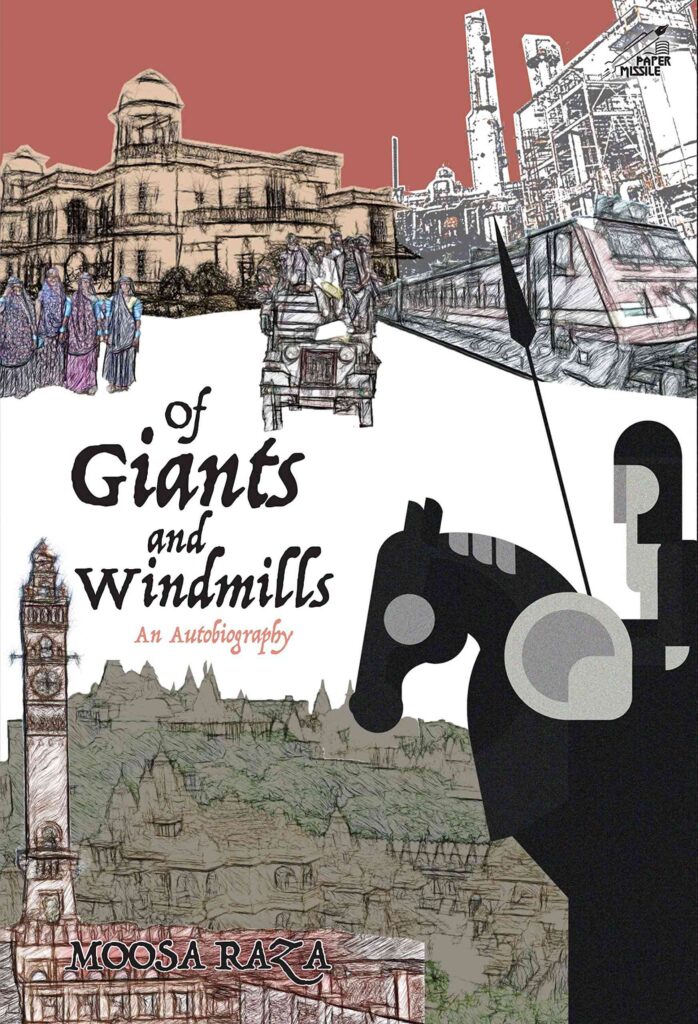
Excerpted with permission from Of Giants and Windmills, Moosa Raza, Niyogi Books.
source: http://www.scroll.in / Scroll.in / Home> Book Excerpt / by Moosa Rooza / December 05th, 2022
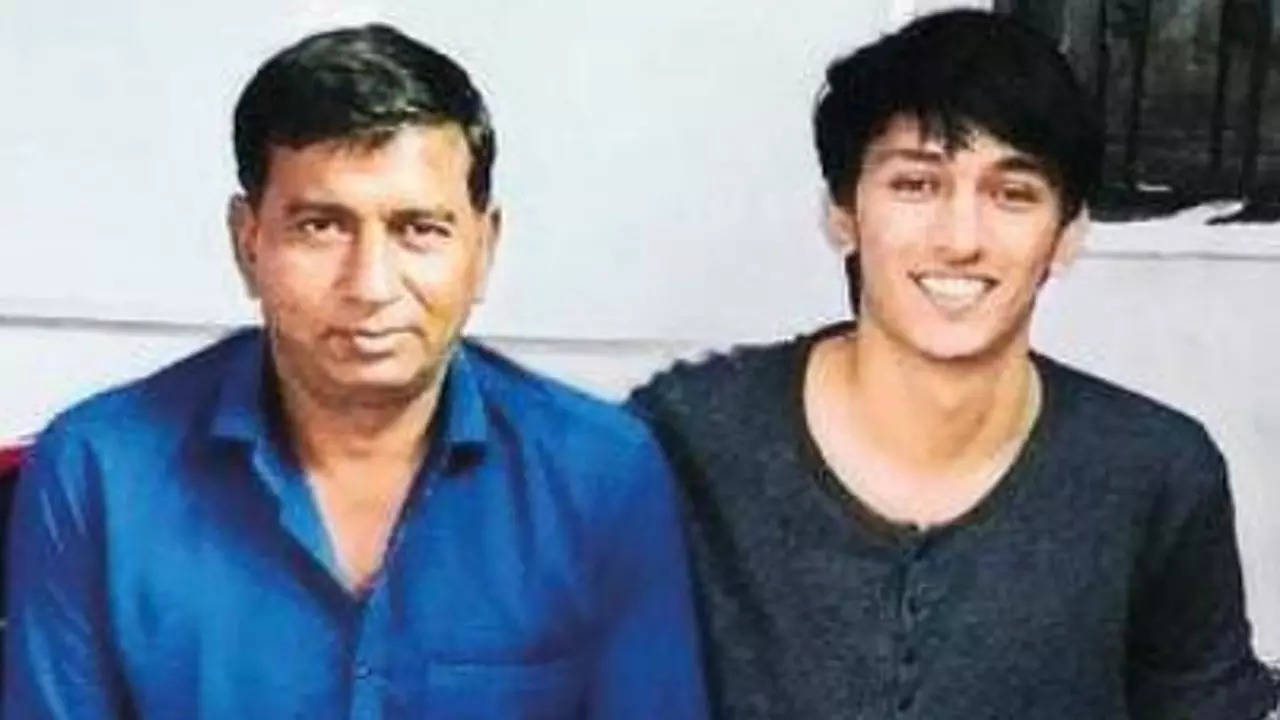
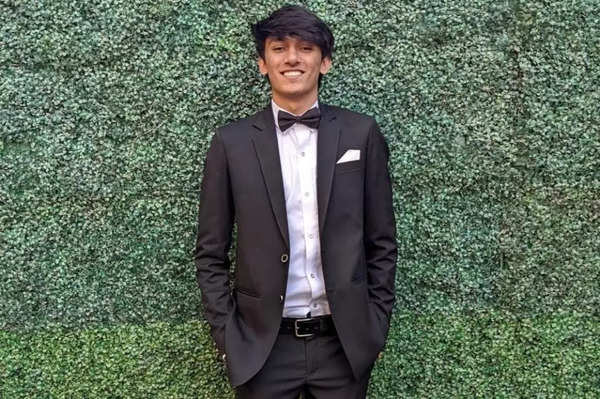
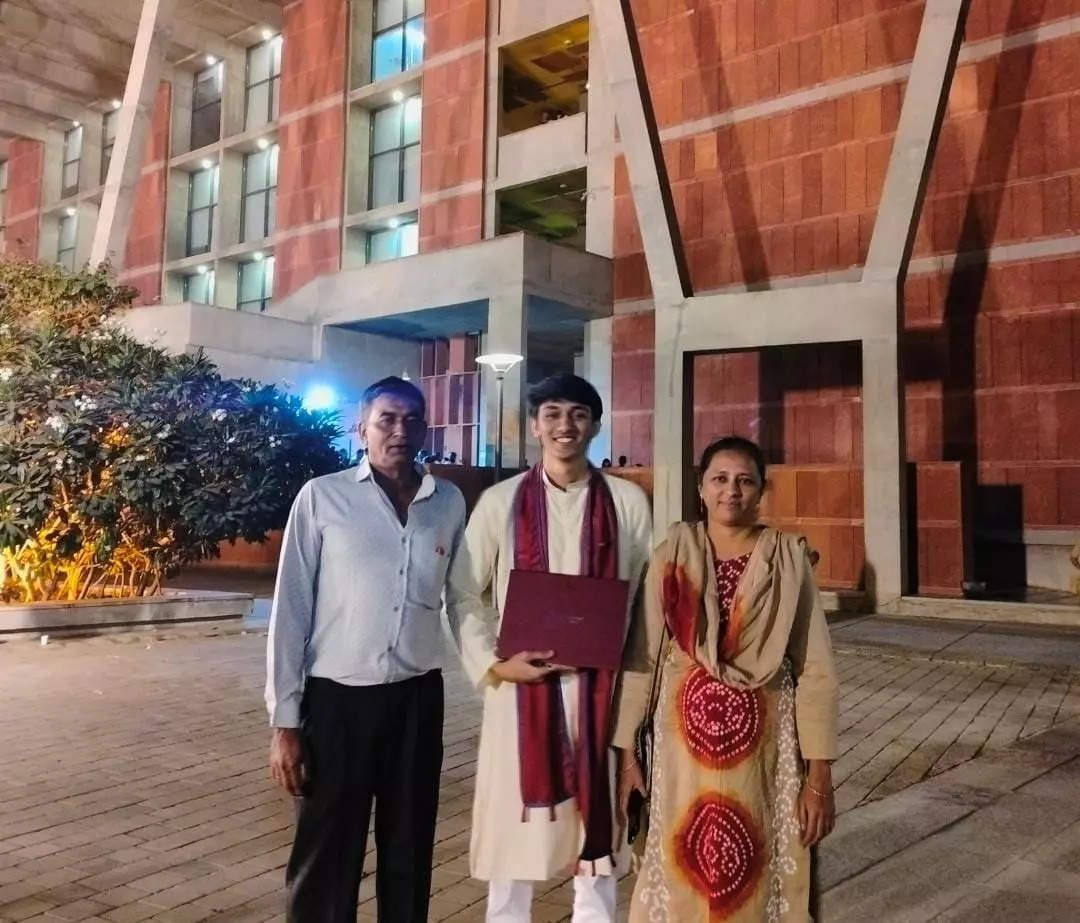
Razin Mansuri, 22, son of an air conditioner repairman and a resident of Ahmedabad, had scored 96.2 percentile in the Common Admission Test ((CAT) 2021 and was eligible for admission in IIM-Udaipur.
But Mansuri was not satisfied with his results so he decided to give it another shot and his efforts paid off as Mansuri scored 99.78 percentile making his chances for an admission in IIM-Ahmedabad or IIM-Bangalore quite high.
Mansuri completed his engineering in IT from Ahmedabad University in May this year. His father earns about 25,000 per month. Razin, his father Irfan Mansuri, mother Sabiha, and his younger brother Rehan live in a one-bedroom house in Juhapura.
Razin Mansuri
As my family’s economic condition is weak, right from high school I have mostly studied on scholarships. After completing high school from CN Vidyalaya, I took admission in Ahmedabad University and completed engineering in IT. I again got a scholarship in AU as my performance was good,” Mansuri told TOI. He said that after he completed engineering he was offered jobs with a Rs 6 lakh annual salary. “I did not take the offer as my dream was to get admission in IIM, preferably in IIM-A or IIM-B.
I started preparing for CAT and took the test in 2021. However, as I did not take any coaching I got 96.20 percentile. I was not satisfied with the result and decided to take the exam again in 2022,” Mansuri said.
He added that he enrolled for a coaching class for CAT 2022 as it charged him only half the fees. “It is an exceptional achievement given his family background and financial struggles. I am sure he will be a great student for any top IIM,” said Satish Kumar, head of the coaching class where Mansuri trained.
Once I pass out from IIM, I want to give back to society what I received from it. I want to help as many students as I can in their education,” Mansuri said.
source: http://www.timesofindia.indiatimes.com / The Times of India / Home> News> City News> Ahmedabad News / by Bharat Yagnik / TNN / December 22nd, 2022
:quality(70)/cloudfront-eu-central-1.images.arcpublishing.com/thenational/ACD5KFPDRSOD3UNOBQCGVOPNHM.jpg)