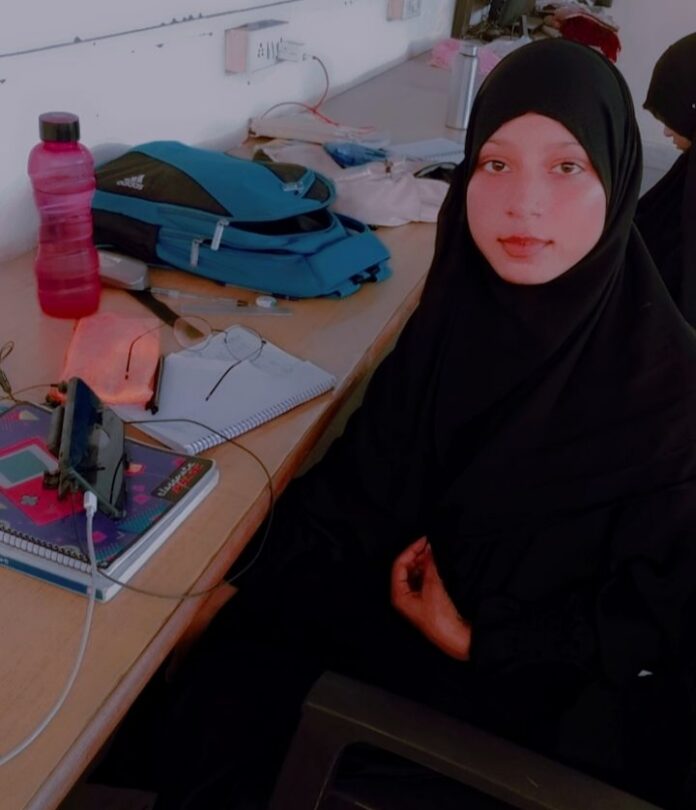
Hijab-clad Alfiya Ansari allegedly faced discrimination at NG Acharya College, the first educational institution in the city that banned wearing headscarves and veils on the campus. Despite the decision reportedly forcing several Muslim women to drop out or discontinue attending classes, she remained dedicated to her education.
Her perseverance and determination led her to achieve the top rank in her class, serving as a powerful testament to her resilience and a strong rebuke to those who “discriminated” against her.
Alfiya’s achievements highlight her unwavering commitment to her goals, demonstrating that “bias” and “prejudice” cannot diminish true talent and hard work.
A Dream of Becoming a Doctor
Living with her parents and two siblings in Mumbai’s Govandi slum, Alfiya’s story is one of remarkable resilience and determination. Her father, a tailor earning Rs 20,000 per month, worked hard to support his family.
As the eldest sibling, Alfiya took her role seriously. She completed senior secondary school from a local English medium school, scoring an impressive 85% and chose to enroll in an aided college for further studies.
From a young age, she aspired to become a doctor. This ambition led her to choose the science stream in junior college, where she began preparing for the National Eligibility-cum-Entrance Test (Undergraduate) or NEET examination.
However, as she advanced to her second year, she decided to focus primarily on her board exams, dedicating much of her time to studying in the library to achieve her academic goals.
Despite facing health issues from eating outside food while spending long hours in the library, Alfiya’s family, particularly her mother, provided unwavering support. Her mother ensured she had home-cooked meals and timely medication, allowing her to maintain her focus.
Alfiya credits her success to her mother’s support, highlighting the crucial role her family played in her academic achievements.
‘Harassment’ at College
Initially cooperative, the staff at Acharya College allegedly changed their attitude drastically once the hijab issue arose. Teachers purportedly began harassing Muslim girls, making them stand outside during lectures and using various other methods.
Alfiya was mentally disturbed for many days. Fifteen-twenty girls, she alleged, stopped attending college.
However, she could not easily give up on her dream of becoming a doctor. With her parents unable to afford another college, she continued at Acharya, removing her hijab outside but still wearing a dupatta.
“This is how I struggled,” she told TwoCircles.net.
Maintaining Focus Amidst Adversity
Alfiya remained focused on her goals despite the challenges. “Life brings many issues, sometimes in the form of the hijab and sometimes due to narrow-minded views about girls,” she said, adding, “When we are focused, problems do not seem as overwhelming.”
She stayed focused on her aim and plans to continue facing challenges head-on without stepping back from her goals.
A Message to Girls
Alfiya has a powerful message for girls: “If we want to change our current situation, education is the most important part. Achieve it, but always remember the importance of both academic and religious knowledge. Only then can you become a better role model in this society. Your identity should be defined by your character, which for a girl is always defined by her modesty. Be whatever you want to be, but stay within the bounds of modesty.”
Advice for Youth
To the youth, Alfiya advises, “You are your own saviours, and your own adversaries. Keep yourself engaged in productive activities, or else negative influences will keep you busy with useless and immoral activities. Use your mobile phones positively but within a specific time limit. Learn skills to keep pace with the present situation.”
Family’s Joy and Support
After the results, Alfiya’s family was overjoyed. “Before 12th grade, I did not receive much financial support from anyone; but after 12th grade, I received immense support from an elder sister, whom I consider an angel. She has been a great source of motivation for me,” she said, though she could not mention her name due to her sister’s request for anonymity.
source: http://www.twocircles.net / TwoCircles.net / Home> Careers / by K K Ahmed, TwoCircles.net / June 10th, 2024
Bengaluru, KARNATAKA / New York, U.S.A / Mumbai, MAHARASHTRA :
Rummana Hussain’s conceptual artistic imprint on the state of India is relevant now more than ever. Dealing in the currency of feminist expression, postcolonial thought and perennial ideas, Rummana’s India is both doubly colourful and doubly dark.
In an inaugural show in its new West Village location, New York’s Institute of Arab and Islamic Art presents The Tomb of Begum Hazrat Mahal an exhibition encapsulating Rummana Hussain’s artistic ruminations about the space our bodies occupy in present and past through one of India’s most prominent Muslim woman.
Bangalore-born Rummana Hussain (1952-1999) was a pioneer in conceptual and performance-based political art in India during the 1980s and 1990s.
She was part of the Sahmat collective, a platform for liberal, secular engagés multidisciplinary artists including Safdar Hashmi, Bharti Kher, and Manjeet Bawa among others.
In this recreation of The Tomb of Begum Hazrat Mahal (1997), the respectful visitor enters a one-room shrine.
“In seeing The Tomb of Begum Hazrat Mahal today, I remembered Hussain’s bold feminist reclamation of her Muslim body through the reincarnated aura of Begum Hazrat Mahal to question monolithic identity, national narratives, and systemic marginalisation”
Various objects signify a site of lamentation, pride, and remembrance.
On the floor, occupying a central location, 12 votive-like papaya halves sit atop a mattress of uncooked rice, evoking both an altar to womanhood and fertility, and a symbolic funerary pyre.
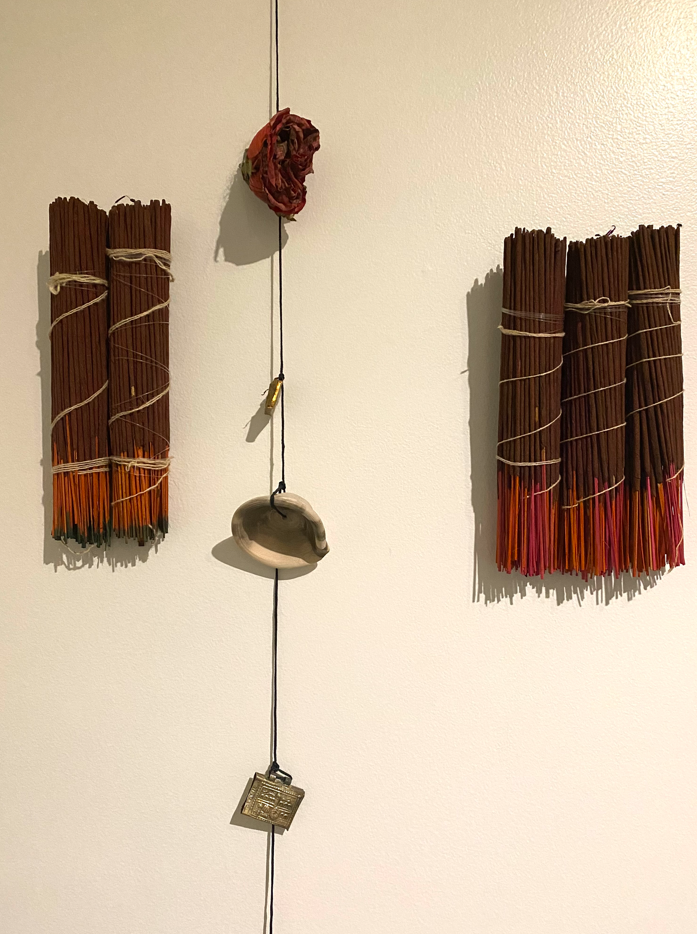
In front of them stands an installation of offerings comprising amulets, dried roses, shells, and incense sticks, tied in a rope.
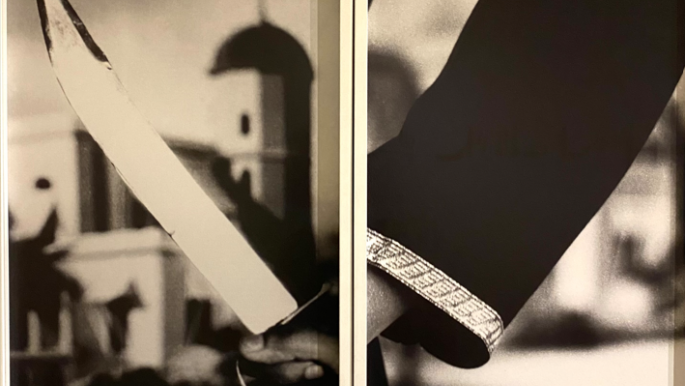
Against the three other walls is a calligraphic sculpture from rusty metal that reminds of a sacred spell and the embodiment of time, and an image frieze of detailed black and white triumphant photographs showing a woman’s arms, wrists, and hands.
In one of these frames, a woman raises her fist up as if calling others to join in. In another, she holds an ominous knife. Images of flames are interjected between the simulacra of archives.
The room is devoted to a woman, an invisible physical body which radiates from each of the static objects. Begum Hazrat Mahal (1820-1879), née Muhammadi Khanum, was born into a poor family.
She was sold and entered the royal harem of art-loving Wajid Ali Shah, the last king of Awadh, a kingdom that occupied the area of the present-day northern Indian state of Uttar Pradesh. Trained as a harem attendant, she would eventually rise to become the king’s concubine – one of his favourites. Beyond her charms, Begum Hazrat Mahal owes her entrance on the historical stage foremost to her political prowess and courage.
The British-owned East India Company operated in Awadh since the early 19th century. The Company increased its grip in 1856, when it directly seized control of Awadh, citing poor governance and the need to uphold the rule of law to justify their annexation (an excuse known as the “Doctrine of Lapse”).
A Chief Commissioner was rapidly appointed. This caused the king to leave Lucknow and seek refuge in Calcutta. The Queen Mother of Awadh petitioned Queen Victoria in person for her son’s rights, in vain. Wives, including Begum Hazrat Mahal were left behind in occupied Lucknow.
After this brutal annexation, discontent grew in several parts of India against the British and the interference of the Company, culminating in a mutiny and revolt in May 1857. Rebels looked to Awadh’s Crown Prince as a successor to his absent father when they captured Lucknow.
But Birjis Qadr, the son of Begum Hazrat Mahal and Wajid Ali Shah, was still a child then, too young to assume power. In his stead, Begum Hazrat Mahal took over Awadh’s revolutionary affairs, actively leading the armed revolt during her regency, towards the reinstatement of Indian rule over Awadh in July 1857.
She continued resisting British rule well after the retaking of Awadh by the occupying troops in 1858, as she refused various offers of collaboration. She died in exile in Kathmandu, Nepal, as an unwavering freedom fighter. Today, a humble stele near Kathmandu’s Jama Masjid marks her tomb.
Rummana Hussain, Living on the Margins, 1995, performance at the National Centre for Performing Arts, Mumbai
When Rummana Hussain first showed The Tomb of Begum Hazrat Mahal to the public in 1997, it was during a period marked by the tragic aftermath of inter-communal violence.
During the 1980s, radical Hindu nationalists campaigned to build a temple on the site believed to be the birthplace of Rama, where a mosque had been erected since the 16th century.
They took to the streets of Ayodhya, Uttar Pradesh, en masse in 1992. Security lost control of the crowd which eventually stormed into the site, demolishing the mosque.
This ignited weeks of violent clashes between Hindu and Muslim communities, causing the deaths of thousands. A later investigation on the destruction of Babri Masjid in Ayodhya pointed out the responsibility of leaders and supporters of the right-wing Bharatiya Janata Party (BJP), the political party of India’s incumbent Prime Minister, Narendra Modi.
Babri Masjid launched a turning point in Hussain’s artistic journey towards a more intimate, politically-conscious form of expression. In Dissected Projection (1993), she explored the multilayered meaning of ruins and dislocation through an allegorical work that exposes a fracture, a shattered piece of terracotta.
In her show Multiples and Fragments (1994), Hussain engaged with historical and domestic oppression in an installation of pigmented pieces of fabric on a clothesline, to denounce the colonial extraction of indigo in India and unpaid housework traditionally performed by women and girls. Labour is always physical and violence first hurts the most vulnerable.
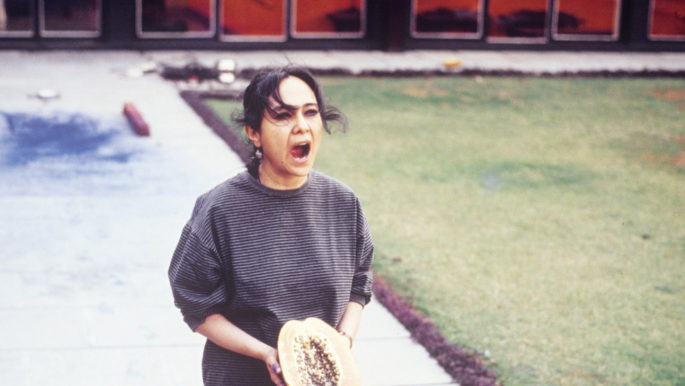
In her 1995 performance Living on the Margins, Hussain screamed while holding papaya halves, shapes that represent a universal vessel and the female anatomy.
Her works have been exhibited in the India Pavilion of the Venice Biennale in 2019, and in multiple institutions across India, Canada, Australia, Mexico, the United Kingdom and the United States during her lifetime and posthumously.
In seeing The Tomb of Begum Hazrat Mahal today, I remembered Hussain’s bold feminist reclamation of her Muslim body through the reincarnated aura of Begum Hazrat Mahal to question monolithic identity, national narratives, and systemic marginalisation. She wanted to say, we can turn the hate in love, we can turn the oppressed, the victims, into heroes they will one day celebrate. We can tell our own stories. They matter.
Outside, scores of brunch-goers live, love, laugh. If it’s dissonance we are meant to acknowledge, I acknowledge it. I closed my eyes in the silent white cube of the Institute of Arab and Islamic Art and saw images of the relentless violence and bullying Muslim women continue to face in Narendra Modi’s India.
In this reconstituted tomb, it’s hard to feel alone. Around me swarmed many other ghosts, of ordinary Muslim women – from Afghanistan to Iran and beyond – crushed and slain in their contemporary defence of freedom and justice against oppressors. Many have been killed in their fight.
A shrine calls for a quiet prayer, I realised.
Farah Abdessamad is a New York City-based essayist/critic, from France and Tunisia.
In the midst of electioneering cacophony, I received an invitation from the moving spirit and ever agile Founder-Chairperson of Mysuru Book Clubs-2015 Shubha Sanjay Urs for an evening of conversation and informal interaction with Saeed Akhtar Mirza yesterday morning. I did not know who this celebrity worthy of Shubha’s attention was but Shubha was quick to throw in a ‘guarantee’ at me of a dinner that would follow the event. The invite was like welcome summer’s rain for me to give a second thought before accepting. I said yes. It was at the Club House of Mysore Race Course.
Out of curiosity, I asked Shubha about the person whose ‘darshan’ I was going to have and also hear the oracle. She simply said, “Uncle, you remember the popular television serial Nukkad? He is the Director of that TV serial.”
Yes indeed, I could instantly connect to this very interesting filmwallah from Mumbai and his achievements with a National Film Award under his belt. What I did not know, however, was that he is also an author of books, rather queer ones — as I heard of the synopsis of them from his talk. He is branded (and touted) as a pioneer of the ‘New Wave’ progressive cinema in India. (One may conclude ‘left liberal of the Lutyen’s Club kind). Other appendices found in his genius are as a writer, traveller and a teacher.
Traveller indeed he is one. After all, the nature of his work would require him to travel. But what left me wondering was that at past 80 years of age he chose to travel by an SUV from Mumbai to Mysuru with one overnight halt at Belagavi. He broke his journey in our city for an overnight stay and the flycatcher of our Mysuru Book Clubs-2015 Shubha succeeded in catching him while on his way to Wayanad in Kerala. I asked him, “Are you on an election survey mission to Rahul Gandhi’s Constituency?” “No” was his response and mumbled about attending a meeting connected with films etc.
One of Mirza’s well remembered film was ‘Albert Pinto Ko Gussa Kyon Aata Hai’? of 1980. I felt nostalgic to learn that he was a student of the Film and Television Institute of India (FTII), Pune, where I used to frequent while in Pune to see the future stars and, of course, the art films by foreign directors like Ingmar Bergman of Sweden who directed ‘Seventh Seal’ or Vittorio De Sica of Italy who produced the all-time classic ‘The Bicycle Thief’.
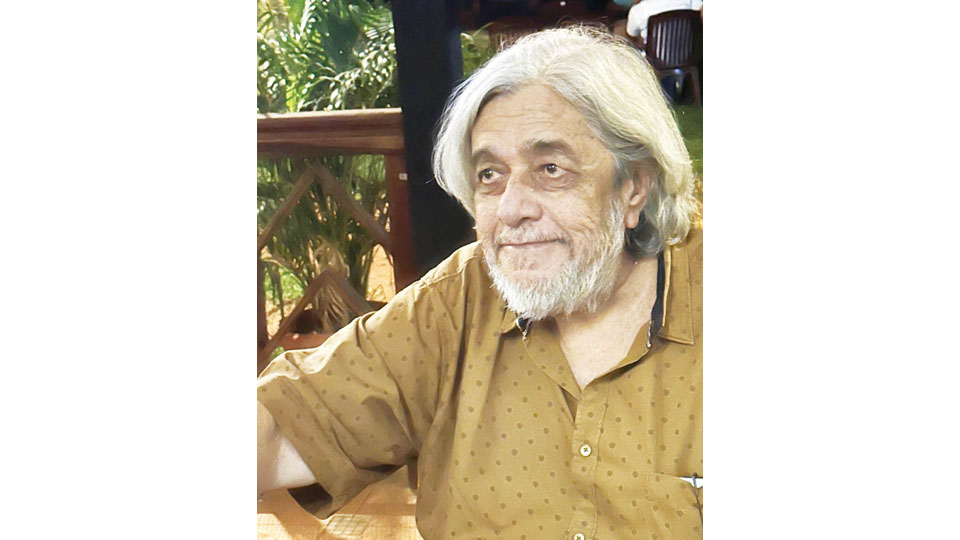
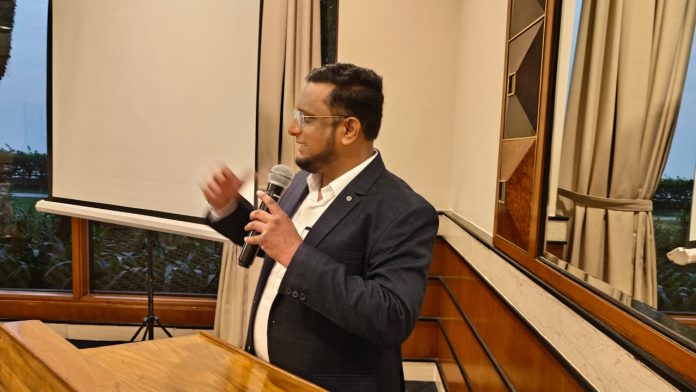
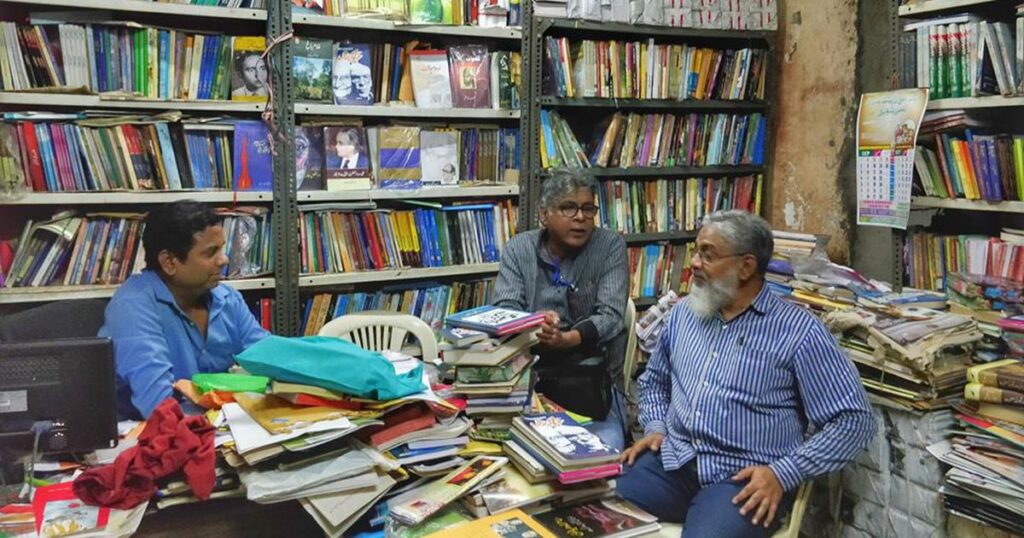
Be that as it may, Mirza Saab ensconced himself on a chair, walking stick by his side and mike in hand. Introduction, mercifully brief and platitudes over, Saeed (I guess he is always addressed as Saeed) began his monologue that revealed succinctly his films and books across the gamut. He is a soft spoken person. He may be an intellectual and a creative person but he indeed has the demeanour with a persona of a philosopher-poet (see picture).
He mourned the 1984 massacre following Indira Gandhi’s assassination. Simultaneously, he alluded to Babri Masjid and its aftermath. The past is the grandfather, the future the grandchild and we witness the passing of an era, he mused kissing into the table-tennis ball of the hand-held microphone. The films are produced like a family tale where facts and fictions are mixed while his books, three of them, are revivalist, he revealed. Then, after a pause, he averred that in the world every civilisation has contributed to the growth of mankind. No one civilisation can claim to be the sole contributor and gave the example of Abbasid civilisation (considered Islamic golden age).
Saeed droned about al-Biruni who wrote and spoke of medieval mathematics, astronomy and astrology of India mentioning the names of Brahmagupta and Aryabhatta of 11th century while reflecting on the past civilisation of mankind. He opined there was much myth-making and also study of science during those bygone days. He said he did not write books as literature, but rather as ideas — whatever it means! Dilating on the theme, he took a jibe at the often heard lament by religious fanatics that their religion is in danger, ‘khatre me hai’ and said it is not true.
At the close of his talk he spoke movingly of his intimate, genius of a friend Kundan Shah who is no more. They were together one evening talking about this mundane world and Saeed mentioned of the peace that prevailed around them. Kundan Shah suddenly got up and urged Saeed to move out with him to the balcony. ‘Dear Saeed, look at the sky. What do you see? A star-studded beautiful, peaceful sky. Right?’
Saeed said, ‘Yes. Indeed.’
‘No, my dear friend. It may be beautiful to look at from here and even appear peaceful. But in reality no. There is turbulence, there is motion and there is no peace.’
Well, I could not fathom what Kundan Shah meant when he said that. But I presume that it was about the inner turmoil of an individual that robs him of peace. Apparently the peace Saeed mentioned to Kundan Shah was unreal, Maya. Let it be.
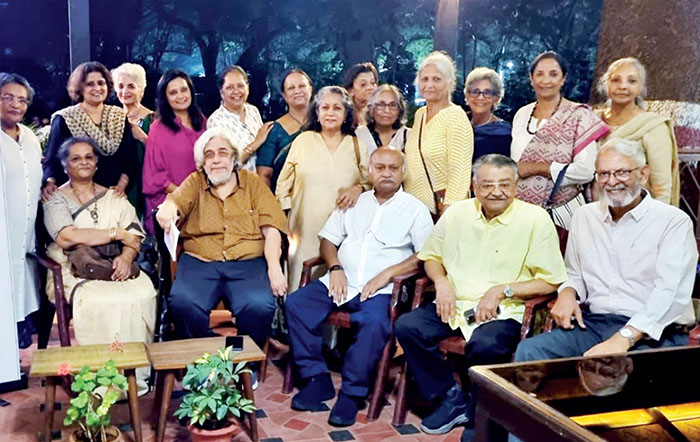
This said, Saeed was ready to field questions from the audience that comprised charming, though not so young, ladies. I counted just four men that included yours truly, Saeed of course, Ravi Joshi and Ashvini Ranjan (see picture).
As for Shubha Sanjay Urs, she kept her words. There was indeed a sumptuous dinner washed down with spirit that elevated our mood.
e-mail : voice@starofmysore.com
source: http://www.starofmysore.com / Star of Mysore / Home> Columns> Abracadabra / by K B Ganapathy / April 22nd, 2024
In a remarkable feat, Habibur Rahman, a resident of Malegaon, has outshined 9,000 candidates to clinch the top position in the recruitment exam conducted by the Maharashtra State Waqf Board. Rahman’s achievement underscores his exceptional performance and dedication towards his goal.
The recruitment exam, aimed at filling vacancies for district officers and junior clerks within the Waqf Board, witnessed rigorous competition from aspirants across the state. Rahman’s success stands as a testament to his hard work and preparation.
Expressing his gratitude, Rahman attributed his accomplishment to divine blessings and the unwavering support of his teachers, parents, and relatives. He highlighted the role of study material provided by Sheikh Qamaruddin, editor of Urdu House in Malegaon, in his exam preparation.
Having completed his education from Sheikh Abdul Wadood Primary School and Junior College in Malegaon, Rahman pursued higher studies at Loni’s Parvaraz World Engineering College. While working in Mumbai, he diligently prepared for competitive exams, a journey that has now culminated in his success in the Waqf Board recruitment exam.
Rahman’s stellar performance, in the written examination, is a testament to his academic prowess and determination. His achievement has not only brought pride to Malegaon but has also positioned him as a shining example of excellence in competitive exams.
With Rahman’s success, Malegaon celebrates yet another milestone, reinforcing its position as a hub of talent and academic excellence. As Rahman prepares to embark on this new chapter in his career, his success serves as an inspiration for aspiring candidates across the region.
source: http://www.radiancenews.com / Radiance News / Home> Latest News> Markers of Excellence/ by Zaina Aman / Radiance News Bureau / March 06th, 2024
Shabnam Shabbir Shaikh of Aambijalgaon, Maharashtra, trashes stereotypes of Indian women. Having picked wrestling as her field, this 28-year-old woman has broken all the shackles that a girl child faces while growing up in a small village.
Hailing from the village Aambijalgaon, Karjat, of the district Ahmednagar Shabnam was born in Jammu where her father Shabbir Sarabhai Shaikh was posted in the Indian Army. She is the third child of her parents and she grew up seeing her mother Rizwana Begum looking after the house and the family. However, Shabnam’s father always wanted his daughter to be brave, self-reliant, and break social stereotypes.
A great votary of women’s education Shabbir Shaikh encouraged his wife Rizwana Begum to complete her MSc degree after their marriage.Due to her father’s frequent postings across the country, Shabnam did her schooling mostly at the Army schools in Ambala, Udhampur, Srinagar, and Ahmedabad. After her father’s retirement, the family settled in their native village and Shabnam joined the local school.
She joined the 11th class in the Dada Patil College, Karjat, in the science stream. despite an irregular and sluggish bus service to Karjat, she somehow managed to study and also attend coaching for wrestling.
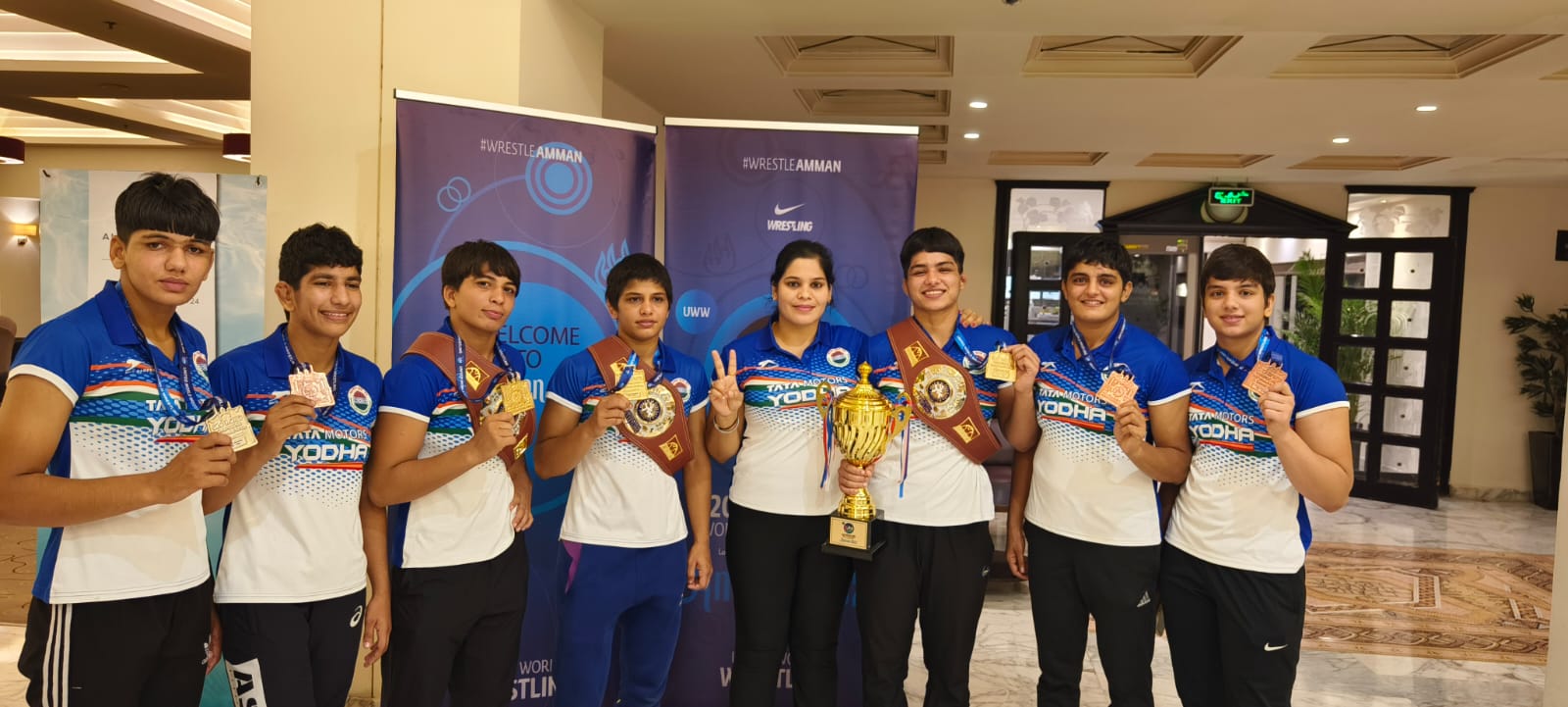
Coach Shabnam with her team
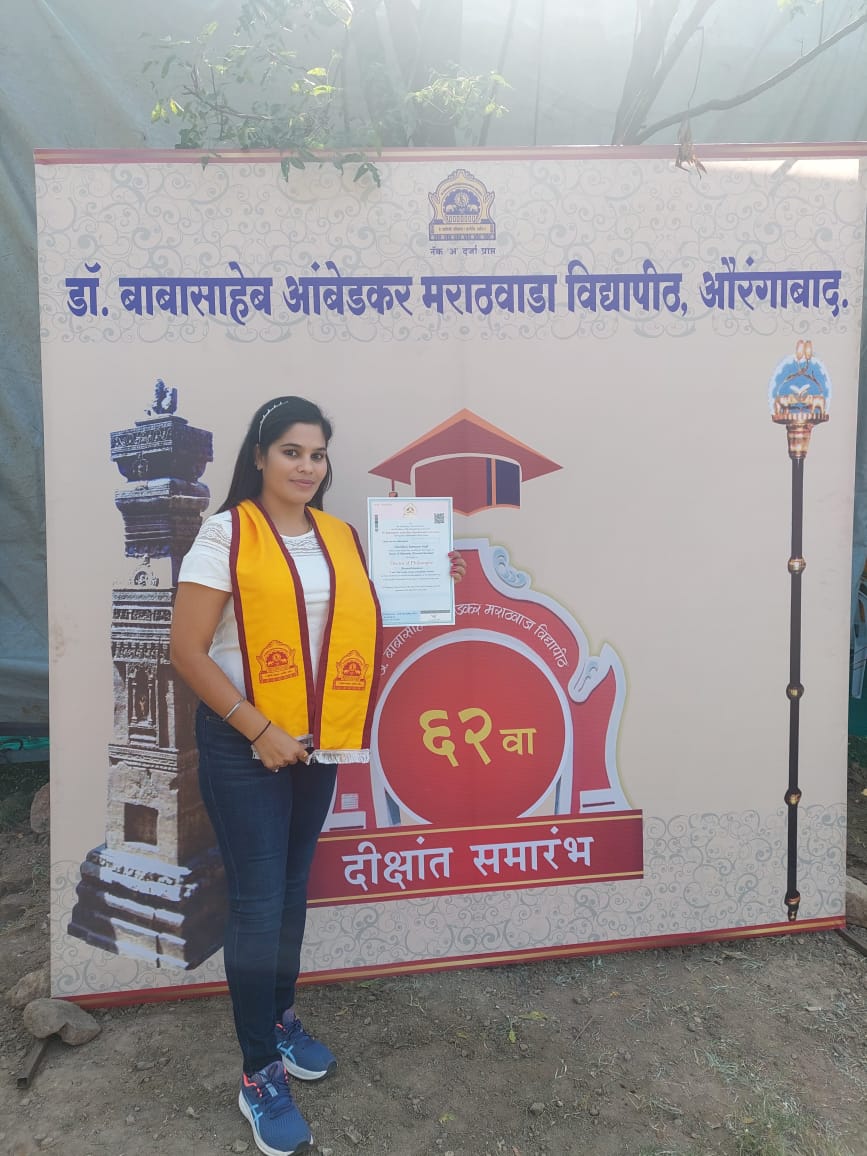
Shabnam completed her Bachelor of Physical Education (BPE) from Aurangabad (Sambhajinagar). She also got a diploma certificate in Coaching from the National Institute of Patiala, Punjab, and later did her Master’s from Babasaheb Ambedkar Marathwada University and then registered for her PhD studies.
Shabnam’s wrestling career began at the age of seven with her father as her coach. Shabnam says, “’My father is my first guru.”
Shabnam came from a family of wrestlers: her grandfather Sadarbhai Shaikh and great-grandfather were well-known wrestlers in the area. Their ancestral house has a wrestling arena where she watched male members of her family and neighbours practice wrestling.
Shabnam had to face the scorn and disapproval of her extended family and relatives when she started practicing wrestling. People even asked her family why she was allowed to wear shorts.
Shabnam at the convocation of the University
Shabnam started with Kabaddi, a game that requires a lot of alacrity and stamina.
Initially, she did not get to enter the arena where her brothers wrestled, so she took to Kabbadi. “I used to think that if I wrestle and win that will be my victory. Even if I lose, it will also be my failure. Will happen… I expressed my desire to wrestle to my father. He responded positively.”
Shabnam’s father had a precondition for training her. He wanted her to concentrate on training and practice for the first two years. She started receiving training from her father and two elder brothers.
Every morning at 4 o’clock she was sent to pick lemons from their farm located about 10 km away. She learned the nuances of wrestling and participated in her first competition in Ludhiana (Punjab). She bagged a silver medal and there started her winning streak.
Shabnam says, “Once in my village, my father came to know about a competition in Delhi. I was just 10 years old at that time. He gave me a paper with the address written on it and a train ticket and wished me good luck for the journey.”
At that time she wondered why she was going alone, ‘Why don’t my parents come with me? But my father always used to tell me that some battles in life have to be fought alone,” she says going down memory lane.
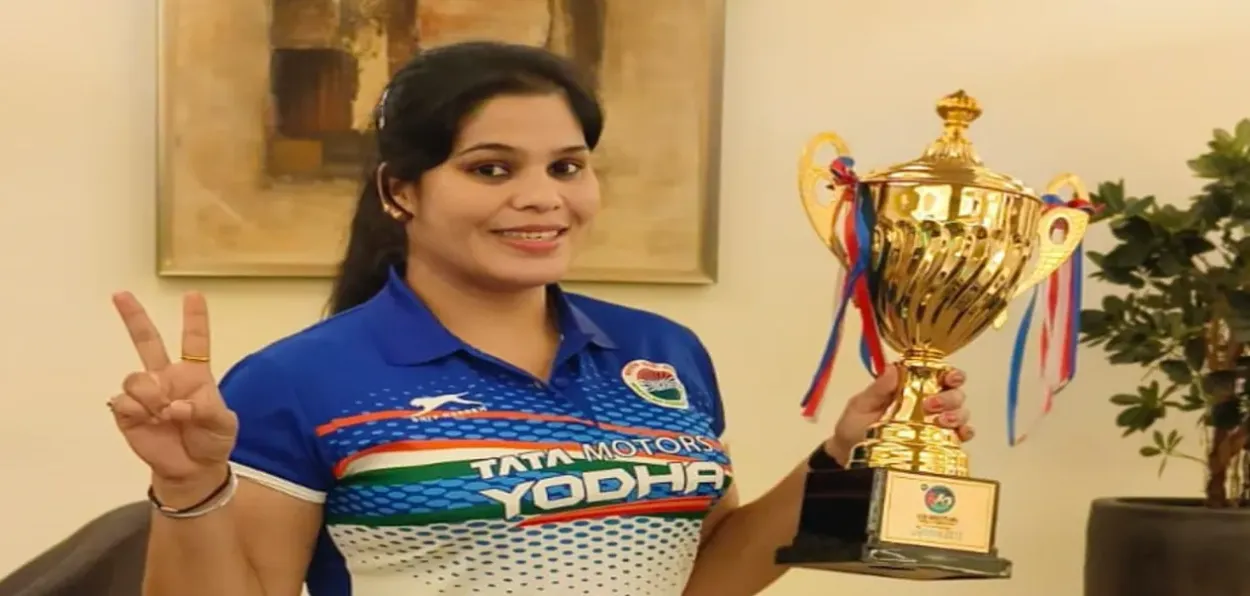
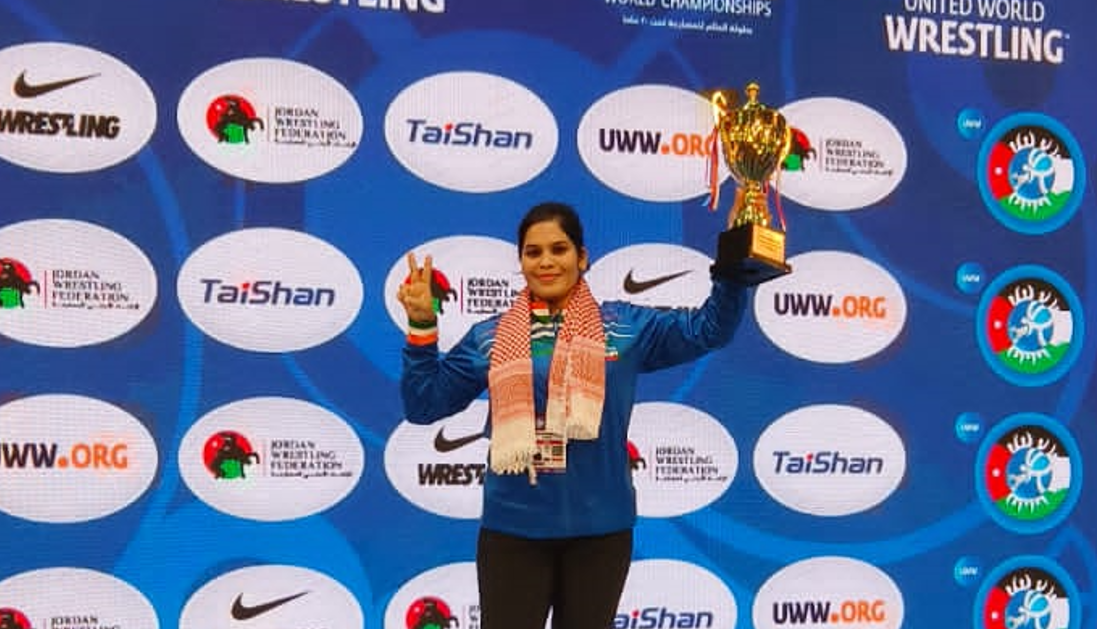
Shabnam Shaikh with her trophy
Shabnam won the title of ‘Women Maharashtra Kesari’ in 2010. She has won the gold medal in ‘Shirdi Kesari’ for three consecutive years since 2009, the gold medal in ‘Latur’ in 2011, gold medal in the ‘Maharashtra State Kustigir Parishad’ competition for six consecutive years.
She has also participated in four inter-university competitions, 10 national competitions, and more than 15 state-level competitions. In the national level ‘Great Bharatkumari Wrestling Competition’, Shabnam is the first winner not only from the Muslim community but also from Maharashtra.
Shabnam says her father taught her that one doesn’t need an outer veil. “Always keep the veil that differentiates between good and bad people in front of your eyes!” he told her.
Shabnam says, “People used to question my parents’ ways. A girl should not play sports like wrestling. Teach her to fast (during Ramazan) and pray. Don’t you want only boys to play wrestling? Hundreds of questions were asked but my parents did not let the pressure of society affect me.
“My father never changed his opinion under the pressure of society. He never let these things affect my game. I always got the support of my parents and my elder brothers.”
Shabnam’s mother Rizwana Begum says, “I have not two, but three ‘sons’! My brothers did not give me a share of our parents’ property. But, I will not let this injustice happen to my daughter. I will give her everything she deserves. Shabnam has brought glory to us. As a mother, I will always be proud of her.”
Shabnam’s thesis for her Ph.D. degree is ‘Comparative study of emotional maturity of rural and urban women wrestlers in Maharashtra’. She toured the entire state for research.
Shabnam is the first woman in India to do a doctorate in sports studies. While doing her Ph.D. in Wrestling, there were often deliberate attempts to embarrass and thwart her effort to earn a doctorate.
In the year 2017, Shabnam was selected as the junior coach of the Wrestling Women’s Association of India; she imparted wrestling training to Anushka Sharma and Salman Khan for the film ‘Sultan‘. Shabnam has represented India in Kazakhstan, and Uzbekistan.
She currently works as a ‘Senior Trainer’ in the ‘Wrestling Women’s Association’ of India. India has never had success in the ‘World Women’s Wrestling Championship’ till now. However, in the ‘Under-20 World Championship’ of 2023 India won seven medals in ‘Women’s Wrestling’. Out of these, three are gold medals.
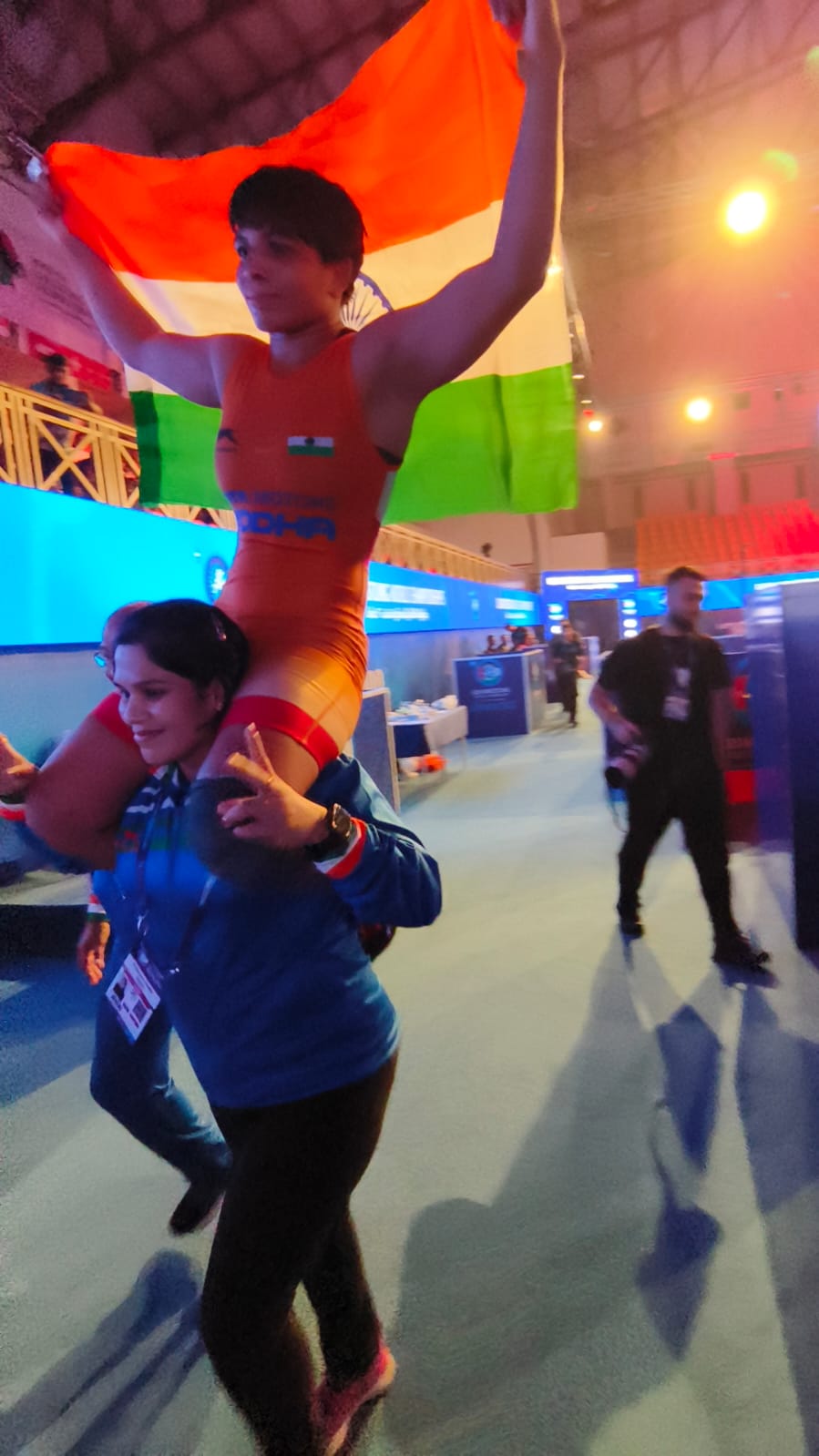
Shabnam Shaikh after her victory in a foreign location
Dr. Shabnam Shaikh is today known as the ‘International Wrestling Coach.
Shabnam says, “I was selected as the coach of ‘Maharashtra Team’ for the national tournament held in Gujarat last year. Twenty-four hours ago, my name was canceled! I was not given any idea about this.”
“Many times, despite having the right credentials and qualifications, I am not given a chance. Probably, because I live with self-respect! I always think that when someone asks me, “How did you get all this?’ I should proudly tell him, ‘I have earned it through my hard work.’
Shabnam says, “Wrestling gave me identity. Sometimes I wonder, ‘Is wrestling a curse or a blessing for me?’ Initially, relatives and other people of the society hated seeing me wrestle.
“Later, when I started winning competitions, people would post the news of my success on their ‘status’ on various social media platforms and write the caption, ‘Congratulations and best wishes to our sister or relative.’
After reading the news of my winning, I became everyone’s relative at that time! But, they speak against me on behind my back! However, now they hesitate to speak against me openly!”
Shabnam says, “Most of the time I am rejected for marriage. I play wrestling. The suitors who come to see as a potential candidate for marriage, see my trophies and see ‘Doctor’ written next to my name. When they go home their answer is, ‘We don’t want such an educated girl.'”
Shabnam continues to work hard to ensure that other girls do not face what she has.
Her advice to the youth: “No matter what happens, do not get tired. Do not give up the fight.” Her dream is to build a wrestling center for girls.
source: http://www.awazthevoice.in / Awaz, The Voice / Home> Story / by Chaya Kaveri / February 29th, 2024
Asif’s mantra, “My life is the purpose of everyone’s work,” resonates deeply within his rich personality. Dr. Khan aptly encapsulates Asif’s unwavering commitment to illuminating the path of education and eradicating societal darkness, echoing the sentiment that Asif’s life is dedicated to serving others.
In the landscape of educators, Asif Iqbal stands as a beacon of inspiration and dedication, reshaping the conventional norms of teaching and community engagement. While the average routine for most teachers comprises daily duties and personal engagements, Asif Iqbal, a 41-year-old teacher, exemplifies an extraordinary commitment that extends far beyond the traditional roles.
His passion for teaching goes beyond the classroom walls. Asif’s dedication spans across various domains, including social work, promotion of Urdu language and literature, active political participation, and tireless efforts toward educational empowerment. Unlike many, his primary focus lies in the upliftment of students and communities, striving to instigate positive transformations in their lives.
Embarking on his journey after completing a Diploma in Education, Asif began his career at a Zilla Parishad primary school in 2001. However, it was his departure from a secure government job in 2010 that marked a pivotal shift. At the young age of 28, he joined a renowned government-aided school in his city, ultimately rising to the position of Head Master at the SSA Urdu Primary School in Solapur.
His responsibilities extend far beyond the confines of an educational institution. As the spokesperson for the City Indian National Congress committee and President of the Lions Club Solapur (Classic), Asif actively engages in diverse social and political roles. Additionally, his affiliations with organizations like the All India Human Rights Association, Khidmate Khalq Organization of India, and various literary bodies underline his multifaceted contributions.
Asif’s devotion to education and his compassionate approach have earned him immense popularity among students and parents alike.
Maaz A. Gafoor Sagri, one of his brightest students currently preparing for NEET, hails Asif as a motivator who consistently creates platforms for students to showcase their talents. Despite the school’s substantial size of nearly 2000 students, Asif manages to establish personal connections with a vast majority, prioritizing character and behavior development.
Dr. A.A. Pagan, a PTA member of the school, lauds Asif Iqbal for his administrative prowess, capacity for work, and forward-thinking attitude. According to Dr. Pagan, Asif’s initiatives have brought about positive changes and regular personality development activities within the school.
In a conversation with Muslim Mirror, Asif reflects on the dearth of educational infrastructure in his city, especially for the substantial Muslim population. He laments the absence of universities and well-equipped campuses, emphasizing the need for investments in education over commercial endeavors like land development and construction projects.
Highlighting the broader educational landscape in Maharashtra, Asif points out the scarcity of institutions offering higher and professional education, while acknowledging the few notable ones like PA Inamdar University in Pune and Anjuman E Islam in Mumbai.
Asif’s vision extends beyond his current commitments. He expresses a strong desire to build an Asian Minority University, a dream he is diligently working towards with the acquisition of a 100-acre land. This envisioned educational hub aims to become a center for Indian Muslims, fostering educational growth and empowerment.
His influence on Urdu literature and poetry is equally significant. As a host to numerous All India Mushairas, including prestigious events like the Delhi Urdu Academy in the presence of Delhi’s Deputy Chief Minister Manish Sisodia, Asif has actively contributed to nurturing Urdu literary talents.
Despite commendations for his leadership potential in politics, Prakash Wale, a senior Congress Party leader, advocates for Asif’s continued presence in the education sector, acknowledging its need for individuals like Asif Iqbal, while cautioning about the intricate nature of politics.
Dr. Asadullah Khan, an eminent figure in the education realm, celebrates Asif Iqbal as a catalyst for educational and social transformation in Solapur. Recognizing Asif’s multifaceted abilities as an educator, poet, and orator, Dr. Khan commends his dedication to service and highlights Asif’s poetic work, “Naya Asman,” as a significant contribution to the world of literature.
Asif’s mantra, “My life is the purpose of everyone’s work,” resonates deeply within his rich personality. Dr. Khan aptly encapsulates Asif’s unwavering commitment to illuminating the path of education and eradicating societal darkness, echoing the sentiment that Asif’s life is dedicated to serving others.
This expansion not only delves deeper into Asif Iqbal’s multifaceted contributions but also elaborates on his vision, impact, and the endorsements he has received from various stakeholders within the education, social, and political spheres.
source: http://www.muslimmirror.com / Muslim Mirror / Home> Education> Positive Story / by Imran Inamdar / December 19th, 2023
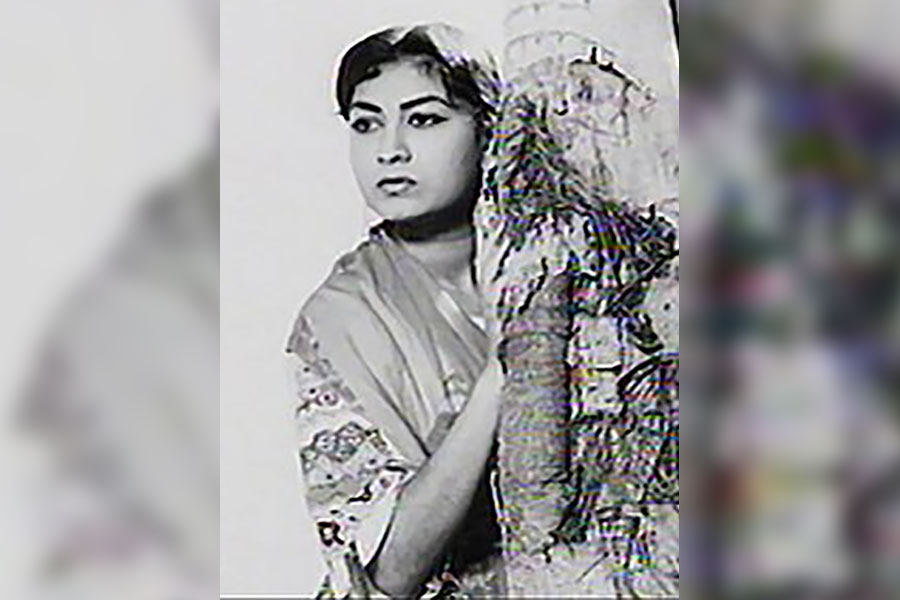
Minoo Mumtaz aka Malikunnisa Ali, the veteran Hindi actor and comedian Mehmood’s sister, died in Toronto in Canada on Saturday.
She was recently diagnosed with cancer and her health deteriorated quickly, leading to her demise, ETimes reported.
Mumtaz’s nephew Naushad, confirming the news to the publication, said, “Since she was old, 80 plus, there wasn’t much to be done. She was one of the loveliest people I had ever met”.
Her younger brother Anwar Ali, who is also part of the film industry and is now a producer, wrote, “Regret to inform that my loving sister Minoo Mumtaz, passed away (in Canada) a few minutes ago… Deep gratitude to the film fraternity, press, media, fans, friends, for decades of love and adulation showered upon her.”
Born to a family of four brothers and four sisters, Mumtaz was the daughter of Mumtaz Ali, a dancer and character artiste in Hindi films in the 1940s. She was renamed Minoo by actor Meena Kumari, her sister-in-law and Mehmood Ali’s wife.
While she started her career as a stage dancer, Mumtaz appeared in several Hindi films in the 1950s and 1960s as a dancer and character actor. She made her debut with Sakhi Hateem, and moved on to play the lead opposite Balraj Sahni in Black Cat (1959) and appeared in several Guru Dutt films including Kaagaz Ke Phool (1959), Chaudhvin Ka Chand (1960) and Sahib Bibi Aur Ghulam (1962). Other Hindi films that she appeared in include Taj Mahal, Alibaba,Ghoonghat, Ghar Basake Dekho, Insan Jaag Utha, Sindbad, Jahanaara, Aladin, Gazal, Dharmaputra. She also appeared in the 2002 television serial Chalo Chale Pardes.
Expressing her condolences on the late actor’s demise, author Bhawana Somaaya wrote, “#MinooMumtaz lead dancer of Hindi movies in the 50s and the 60s dies in Canada. Condolences to #AnwarAli family.”
Actor Nasirr Khan also mourned Mumtaz’s death.
Mumtaz is survived by her husband Sayyed Ali Akbar, son and three daughters who lived with her in Toronto.
Namrata Ganguly is a Correspondent at Silverscreen India, and can be reached by email at namrata@silverscreen.in
source: http://www.silverscreenindia.com / SilverScreen India / Home> Hindi> News / by Namrata Ganguly / October 23rd, 2021
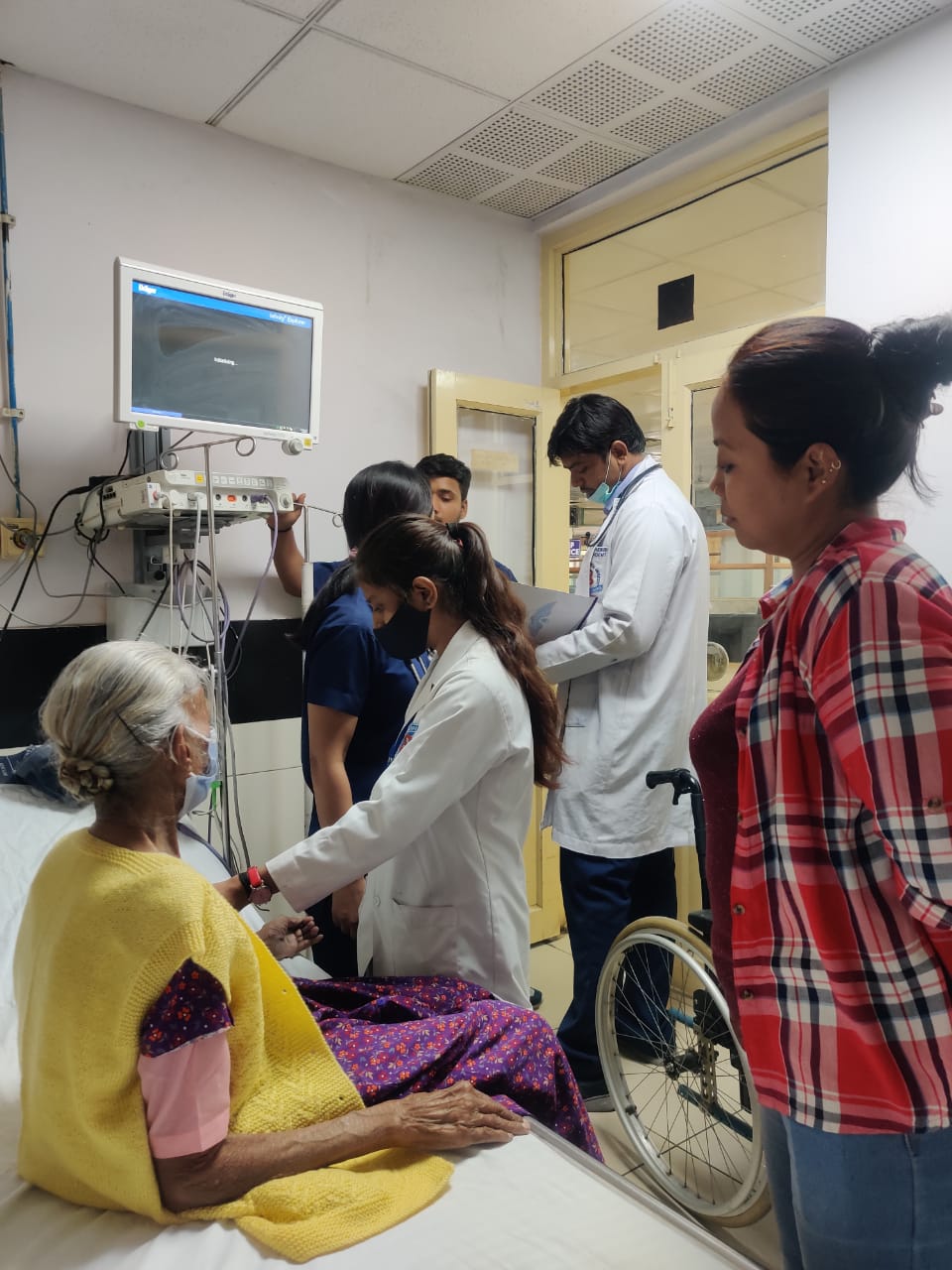
Dr Shaikh Yunus in the I.C.U of King George’s Medical University, Lucknow
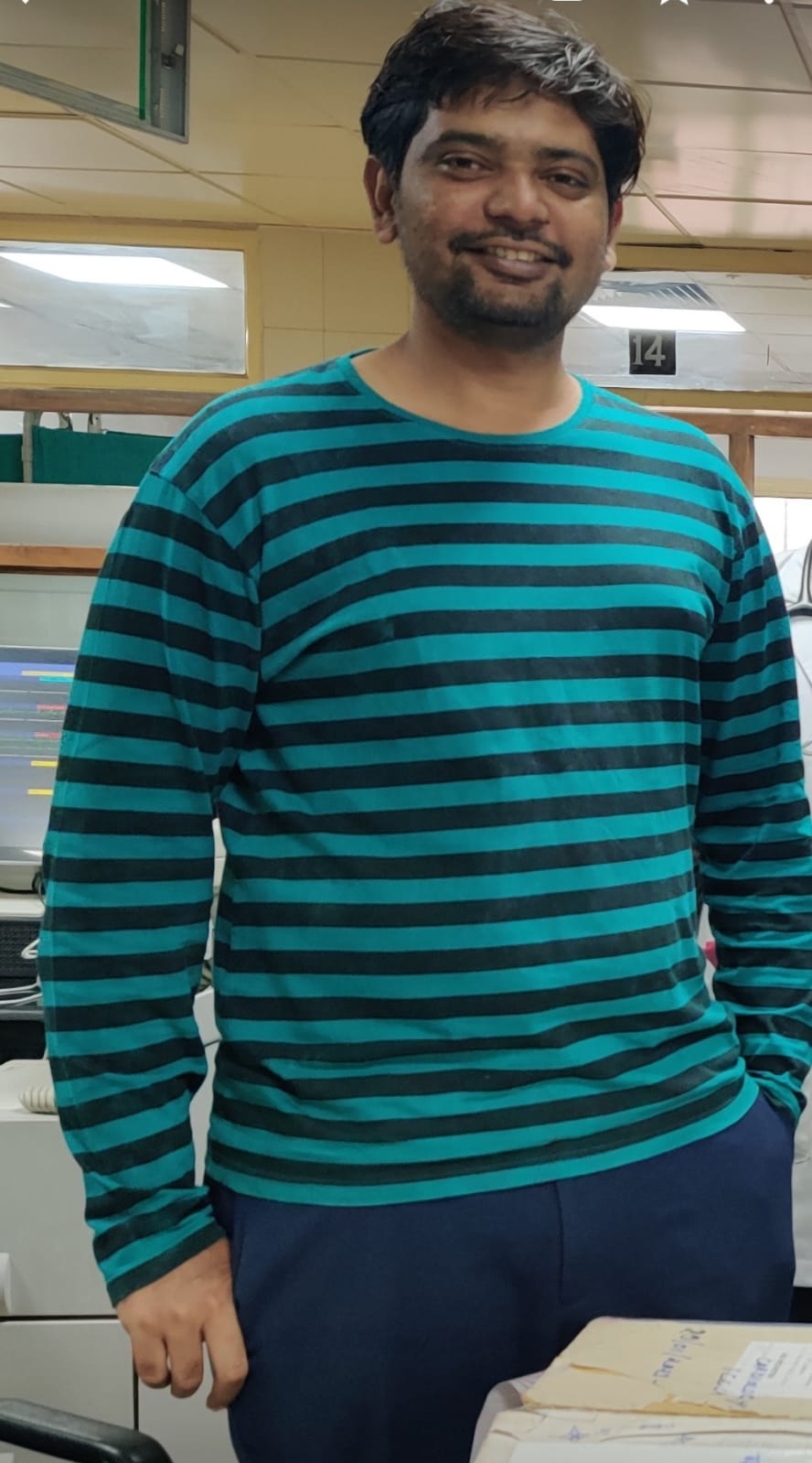
Dr Shaikh Yonus, a Senior Resident in the Cardiology department of the prestigious King George’s Medical University, Lucknow, is the first Muslim doctor from the Jalna district of Central Maharashtra. He completed his MBBS degree in 2015.
This is no small accomplishment for this cheerful 34-year-old doctor who studied in a village school till Class X. His father even borrowed money to fund his medical education.
Shaikh grew up sowing cotton with his father Khudbuddin and elder brother Aslam in their four-acre land in Dadhegaon in Jalna district.
As a schoolboy, he remembers his relatives insisting that he be sent to a Madrasa along with their children. But Shaikh wanted to attend a regular school and his father respected his wish. He was always drawn to the science stream and chose his career path when he was in Class X.
Shaikh says that in his backward village of 800 people there was hardly anyone holding a high post. “Thankfully, my seniors in school had become career-minded and some become teachers. They inspired me to focus on my ambition.’’
Shaikh struggled against all odds and cracked the Medical college entrance test.
Dr. Yunus says, “It was a huge struggle. My father who passed away in August 2022, at the age of 62, was a cotton farmer. Because of the challenges that cotton farmers face in Maharashtra, he was on the brink of starvation. We are four siblings – two brothers, and two sisters. In 2008, my father’s annual income was Rs 30,000. It was difficult for him to pay Rs 3000 for my monthly room rent and living expenses for a year and annual fee of Rs 12,000 for professional coaching in Aurangabad for entrance examination of the medical college.”
Shaikh’s coaching cost Rs 50,000 per year. His father even took a loan of Rs 30,000 to fund his coaching.
This promising cardiologist says students in the village aspiring to study after Class X had to move out. So did Yunus. He then began studying in Ambad Taluk, 20 kilometres away from home, for Class XI and XII.
Although Shaikh managed to get an annual minority scholarship of Rs 25,000 for his six-year MBBS course in Government Medical College, Nagpur, he still had to depend on his father for Rs 3000 every month to meet his living expenses.
Looking back at his struggle, he says, “My father had limited means. Saving money to marry my sisters and having to set aside Rs 2000 for my fee was a huge challenge but he never let it bother me. The annual fee for MBBS was Rs 18,000. The annual hostel fee was Rs 4000. The remaining amount was spent on buying books. I still had to depend on Rs 2000 every month from my father. I could hardly afford to travel to my village. I was homesick but meeting my family members was a luxury. So, once in six months, I would take a 16-hour long journey by train to meet my family.’’
Shaikh’s first earning came after the final year of MBBS at Government Medical College in Nagpur. “During the year-long internship, the government was paying us Rs 6000 a month. After this, I appeared in the NEET examination for MD in Medicine. I got 104th rank in the country. There were only 26 seats for MD in Medicine in Maharashtra. “I got a chance to pursue MD for three years in Government Medical College in Miraj near Pune. I completed MD in 2020,’’ he recalls.
The competition for DM (Doctorate in Medicine) is even more difficult. Out of the 3,000 students who apply for DM in Cardiology every year, only one-tenth get through. KGMU admits only eight students every year after a nationwide selection. Dr Shaikh is among the eight doctors who was selected for DM in Cardiology in KGMU.
Dr Yunus is the only doctor in his extended family. “My father studied till class X but he stood behind me like a rock. He was determined to do whatever he could to help me fulfil my dreams. My sisters who are now married, studied only till Class IV or V. My mother, Shaheen is a homemaker. She too hardly studied. My elder brother did his postgraduation in Hindi from Dr Baba Saheb Ambedkar University in Aurangabad but was not able to find a job. So, he took to cotton cultivation.’’
Although Dr Yunus is satisfied that his hard work helped him crack the examination, he deeply regrets that he was not able to save his father’s life last year. “I was on I.C.U. duty when I got a call from my family that my father was unwell. When I made a video call to the doctor who was attending to him in a private hospital, 50 km from my village home, I realized that he was critical. He had pneumonia. I specialize in treating these diseases but I could not save his life. This is a lifelong regret.’’
Dr Shaikh Yunus (in the lab coat) going through the records of a patient in KGMU, Lucknow
Like most of his colleagues, Dr Yunus who is in the second year of DM, has unbelievable duties in the Cardiology department of KGMU. “The disease burden is huge and the number of patient consultations and admissions is huge. There have been times when my colleagues and I have come for duty on Sunday and left on Friday. On an average, we see 400 patients in OPD (Monday to Saturday) and 200 in emergency who are coming from all over the country and even Bhutan, Nepal and Saudi Arabia.’’
He also wishes that more young students from Jalna district would join the medical stream and become doctors. “ It has been eight years from the time I finished my MBBS but so far, I have come across only two students from my district who were enrolled for MBBS courses in private universities in China or Russia. Only those students who are unable to crack the competitive examination in India, go there. I know how I have studied. I would sleep only five hours. ‘’
In February 2022, Dr. Yunus married Mahjabin, his junior who is now a surgical gynecologist in Bans-Bareilly in Uttar Pradesh. Dr. Yunus’ family who attended the wedding in Bareilly is extremely proud that their son and daughter-in-law are doctors. “ I first accompanied them on the train from Jalna to Delhi. That was the first time they saw the national capital. In so many years, that was the first time that they travelled outside the State. They enjoyed visiting Uttar Pradesh also. It was a 26-hour long journey.’’
Mahjabin who is working at Ram Manohar Lohia Institute of Medical Sciences in Lucknow is deeply appreciative of Dr Yunus’ struggle. “ When I visited my in-laws after my marriage and after my father-in-law’s demise, I felt that they were very proud of the fact that both of us are doctors.’’
Dr. Yunus’s elder brother Aslam Shaikh is very proud of him. Aslam told this correspondent over the phone from his village “Other than my brother, no student from Jalna district has been able to get selected in competitive examination to enroll in MBBS.”
Aslam earns Rs 60,000 a year from cotton cultivation and supports a family of five. “I send my son, Arhaan Aslam Shaikh, 12 km away to study in an English medium school. My daughter, Jiya is only two and a half years old. I want them to become doctors like my brother and his wife. ”
After becoming a specialist, Dr Yunus has not forgotten his roots. He tends to his father’s farmland whenever he visits home. Ths doctor’s heart beats for the farmers of India.
source: http://www.awazthevoice.in / Awaz, The Voice / Home> Story / by Tripti Nath, Lucknow / March 24th, 2023
Discussions and debates, critiques and readings, held at haunts of Urdu books and writing around the country have been interrupted rudely.
(From left) Shadab Rashid, Urdu drama writer Aslam Parvez, and Shakeel Rasheed at Kitabdaar | Mahtab Alam
In Malegaon
On the first Saturday of every month, the textile city of Malegaon in northern Maharashtra used to become home for lovers of Urdu literature, who meet to discuss, debate and critique new writings in the language, mostly by local writers. Organised under the aegis of Anjuman Muhibban e Adab (Association of Literature Lovers), the gathering began at around 9 pm, and went on till midnight.
Between 30 and 50 people – both writers and readers – would come together, a number that would at times go up to as many as 100 or even 150. Asif Iqbal Mirza, the secretary of the Anjuman, said the practice began 25 years ago on the suggestion of local journalist and editor Samiullah Ansari, who published new Urdu fiction in his weekly, Hashmi Awaz.
Over the years, the publication had emerged as a popular local magazine for young and budding writers to publish their works. The weekly, now in its 35th year of publication, had a considerable fan following and readership at the time. Ansari then suggested that admirers of the magazine form a group comprising readers as well as writers.
The group was initially named Anjuman Muhibban e Hashmi Awaz (Association of Admirers of Hashmi Awaz), but within a few years, its following grew to encompass more than just the readers of the magazine, and in 1998 it was rechristened Anjuman Muhibban e Adab, Malegaon. “Ansari sahib formed the Anjuman so that writers could get their new works critiqued by readers before getting them published in the weekly,” Mirza ssid.
Back then, Mirza himself wrote for a local children’s newspaper called Khair Andesh. But his association with the Anjuman helped him grow into a prolific Afsana Nigar, a short story writer. He was 17 when the group was formed; in the past 25 years, he has written and published more than 200 short stories in different publications.
Apart from Anjuman Muhibban e Adab, there are two more literary groups in Malegaon that held regular meetings until the lockdown was declared in March. No such meetings have been held since then. “Unlike earlier, we now have enough time to read and write. But the irony is we don’t have the opportunity to discuss and publish them,” said Mirza, who also runs a printing business. Several local publications had to halt their issues, including Hashmi Awaz, owing to the lockdown.
According to Mirza, although social media outlets such as WhatsApp and Facebook have, to some extent, helped to keep in touch with fellow writers and readers, the literary life of Malegaon has come to a standstill, since a large number of local writers and readers came from the working class and worked in local looms. “The year 2020 is the silver jubilee of my literary career. I had plans to publish a collection of my short stories, but thanks to the pandemic, that will not happen this year,” Mirza said with a great sense of despair.
In Mumbai
Both readers and writers have felt a deep loss during the pandemic. His love of books took Shakeel Rasheed, editor of the Urdu daily Mumbai Urdu News, to various bookshops in and around the Mohammad Ali Road area of Bombay. “Visiting bookshops was a part and parcel of my life. I feel a deep loss when I don’t visit them,” he said. For him, bookstores are not just spaces to buy books, but they also served as addas for readers and writers. As soon as some relaxations were in place, he rushed to the stores. “Par ab pahle wali baat nahi rahi,” said Rasheed. “Things are not as they were before.” The pandemic has made it more difficult to meet new people.
Shadab Rashid’s Kitabdaar publications and bookstore in Temkar Street of Nagpada was one such adda for Urdu writers in Mumbai, as was Maktaba Jamia on Sandhurst Road West. Today, Kitabdaar and a few other bookshops have opened their stores for a few hours every few days, while Maktaba Jamia remains closed. “Due to lack of public transport and fear of the pandemic, people cannot come to Kitabdaar,” Shadab said. He also edits the quarterly literary magazine Naya Waraq, founded by his late father and noted journalist and writer Sajid Rasheed.
Shadab Rashid said the lockdown brought significant hardships and losses to Urdu publishers and distributors. “It is not that people don’t want to read Urdu books anymore – the problem is they cannot buy them,” he said. “I have received lots of online orders, but I cannot fulfill them because I rely on postal services as they are the cheapest means of delivery, but the services are not fully functional yet.” His online Urdu bookshop kitabdaar.com is one of the few digital distribution platforms for Urdu books exclusively in India. Another such platform, urdubazaar.in, was recently launched from Delhi.
Owing to the discontinuation of physical interactions between readers and writers, people have lost touch with each other, since not all Urdu writers are active on social media, Shakeel Rasheed told me. “We have lost many good writers during this period and found out about their demise several days later,” he added. “Moreover, we could not participate in their last journeys.”
In Hyderabad
Another writer recounted similar thoughts after the death of noted Urdu satirist Mujtaba Hussain in Hyderabad on May 27. Hussain was awarded the Padma Shri in 2007 for his contributions to Urdu literature, but in December 2019, he announced he was returning the award to protest the enactment of the contentious Citizenship Amendment Act. “[T]he democracy for which I fought is under attack now and the government is doing that,” he had said, “that’s why I don’t want to associate the government with me.”
In Hyderabad, another centre of Urdu writing, literary activities have come to a similar halt due to the pandemic. Publications like Shagoofa, a monthly magazine of satirical writing, have been temporarily discontinued since the lockdown.
In Delhi
In Delhi, too, the pandemic has left an adverse impact on Urdu writing. Khan Rizwan, a poet and a known “addebaaz” from Delhi, loved participating in and organizing adabi addas (literary gatherings). He misses visiting the Nai Kitab book store, located in one of the many bylanes of Jamia Nagar, which is one of the famous addas for Urdu lovers in the city. Run by veteran writer and publisher Shahid Ali Khan, Nai Kitab is a haven for young and old writers alike, Rizwan said, as Shahid sahib treated them alike. “It is not just a bookshop but an institution where one got to meet noted writers and lovers of Urdu literature,” he said.
Rizwan would visit the shop at least twice a week, and meet a new literature enthusiast or writer, or find out about a new book or risala /parcha (journal/magazine). “I miss the black tea and chips that Shahid sahib served us with love and affection,” he recalled. “He is a storehouse of information, and several veteran writers were his friends, so he would tell us stories all the time.”
I couldn’t agree more with Rizwan. I have been visiting Nai Kitab once every few months for more than a decade now, and on each of my visits, after asking khabar-khairyat, Shahid sahib would say, “Achcha aap bahut dino baad aayen hain, ye nayi kitaabein aayi hai dekh lein (Since you’ve come after a long time, here are some new books).” Last year, when I visited the bookshop around this time, he directed me towards dozens of books written by noted Urdu satirist Fikr Taunsvi and Shaukat Thanvi. I immediately bought all of them, as they were usually out of print and seldom available.
As the person in charge of the Maktaba Jamia, the publication division of Jamia Millia Islamia in Bombay, Shahid Sahib befriended writers and poets like Jan Nisar Akhtar, Meena Kumari, Sahir Ludhianvi and Jagan Nath Azad. Some of them were regular visitors to the Maktaba Jamia. Though he moved to Delhi after serving the Maktaba for several decades, he did not stop hosting literature lovers. He then founded Nai Kitab publishers and a quarterly journal by the same name.
It was in 2007 at his bookshop that I first chanced upon Shamsur Rahman Faruqi’s celebrated novel Kai Chand The Sare Aasman, later translated into English as The Mirror of Beauty by the author himself. The novel went on to become a major critical and commercial success.
Faruqi was also associated with the Nai Kitab journal as chairperson of its advisory council and would visit the shop once in a while. The journal eventually stopped publication owing to Shahid sahib’s failing health, but he continued with the bookstore as it was like “oxygen for him”, he had once told me.
Waiting for freedom
Some writers have managed to turn the lockdown into a creatively productive period. “Personally, the pandemic has proved as a blessing in disguise as I read books I wanted to for years and finish other important work, such as recording videos of Urdu literature lectures,” says Khalid Mubashir, a poet and assistant professor of Urdu literature at Jamia. He quickly added, however, this was not common, as most writers and poets were stuck at home, either because of their age or in fear of the pandemic. “Moreover, not all writers have access to technology and books like I do. I am fortunate enough to have friends who helped me with technology to do something substantial during this period.”
Mubashir’s videos, as many as 60 of them, are each about 30 minutes long, and cover the history, evolution and development of Urdu and its literature in the subcontinent. Though the lectures are prepared keeping in mind the need and syllabus of Urdu literature students, ordinary Urdu lovers can also benefit from them. All lectures are available on the YouTube channel Safeer e Adab.
Similarly, although younger poets like Mohammed Anas Faizi from old Delhi have been trying to keep Urdu literature gatherings going by using social media, online addas do not have the feel and impact of offline and in-person gatherings. “Technology and social media can only help to a certain extent. Online gatherings, mushairas and addas cannot substitute for the real ones, no matter how well they are done,” he said.
With apologies to Faiz Ahmad Faiz, what the Urdu writers, poets and addebaaz seem to be telling the pandemic is:
Gulon Mein Rang Bhare Baad e Nau Bahar Chale Chale Bhi Jao Ki Gulshan Ka Karobar Chale
Mahtab Alam is a multilingual journalist and until recently was the executive editor of The Wire Urdu. His Twitter handle is @MahtabNama.
This series of articles on the impact of the coronavirus pandemic on publishing is curated by Kanishka Gupta.
source: http://www.scroll.in / Scroll.in / Home> Publishing and the Pandemic / by Mahtab Alam / July 14th, 2020
The Pune rapper and producer hails the national spotlight from the reality show as a win for the Indian hip-hop community.
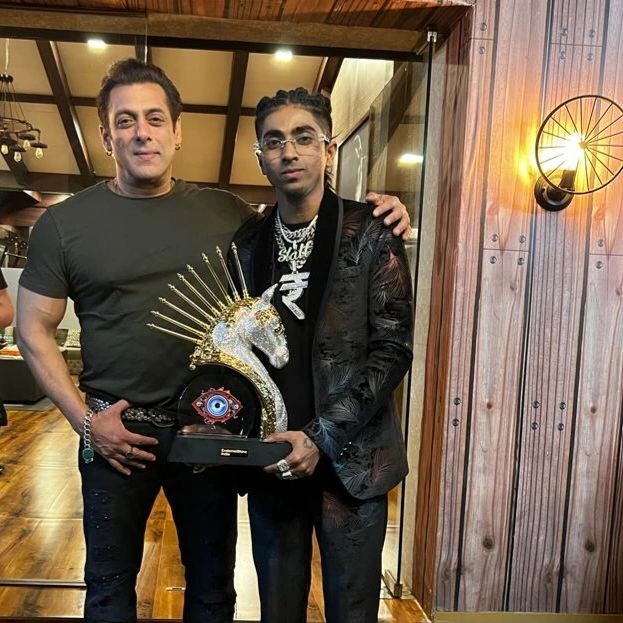
MC Stan with actor and host Salman Khan after winning ‘Bigg Boss’ Season 16. Photo: Courtesy of Endemol Shine India
After four months in the Bigg Boss house, Pune rapper and producer MC Stan aka Altaf Tadavi Shaikh emerged as the winner of Season 16 of the reality show, taking home the trophy and a reported cash prize of ₹31.80 lakhs following public voting. With this, Stan is the first Indian rapper and musician to win the long-running reality show, which has generally been dominated by actors and film industry celebrities.
“The journey has been very powerful. I got a lot of experience,” Stan said in a post-win press conference in Mumbai. After actor and host Salman Khan held up Stan’s hand to judge him the winner, the first photos from his win came with the rapper holding the Bigg Boss horse trophy with Khan.
In an Instagram post celebrating the win, Stan wrote, “We created history, stayed real throughout, repped hip-hop on national T.V. Ammi ka Sapna poora hogaya [My mother’s dream came true]. Trophy P-town aagayi [The trophy has come to Pune].”
Seated amongst press in a black leather jacket, with all his chains and rings in place, Stan was reflecting where Indian hip-hop can reach in terms of public consciousness. “If you go to see, this is a win for a lot of people; the rap community — whoever’s here from the gullies and [those] areas — I don’t know honestly what people saw and liked in me, but I’m grateful for their love,” he said at one point.
Winning and surviving 133 days in the Bigg Boss house through public voting, Stan acknowledged the role that the public played in keeping him in the competition. He adds, “I saw a lot of housemates talk about how they want to win, but I didn’t think I could make that claim, because it’s not in my hands. Woh Hindustan ka haath mein tha [It was in India’s hands].”
By January, it was clear that MC Stan was a top contender to win Bigg Boss Season 16, owing to how he often kept his head down and just went with the flow, although he was occasionally involved in a few fights with other housemates. In addition to his in-house concert with hip-hop acts like Seedhe Maut and Ikka, MC Stan was at first adamant to get done and go home, but eventually stuck it out to win.
source:http://www.rollingstoneindia.com / Rolling Stone India / Home> HomeFlashbox> News & Updates / by Anurag Tagat / February 13th, 2023