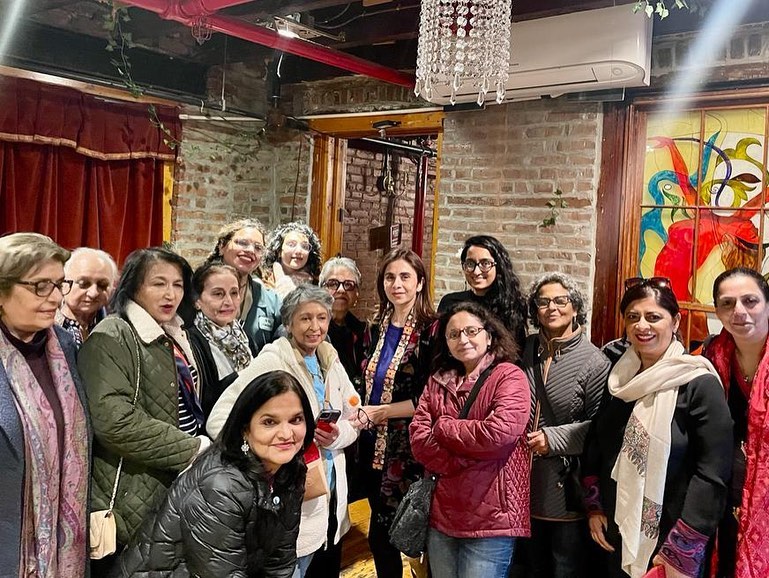
Irshad Mirza, a prominent Kanpur leather industrialist and chairman of Mirza International, has passed away at the age of 95. Irshad Mirza had been ill for a long time. His death has sent shockwaves through Kanpur and the industry.
Kanpur:
Irshad Mirza, chairman of Mirza International, the country’s largest leather exporter, passed away at the age of 95. Irshad Mirza was ill for the past several years. He breathed his last on Sunday in a private hospital in Kanpur. As soon as the news of Irshad Mirza’s death spread outside the hospital, a crowd of people gathered at his residence in Civil Lines.
Irshad Mirza’s contribution to the leather industry can never be forgotten. He has been honored with several awards including Padmashree. Irshad Mirza was also called the pride of Kanpur. Irshad Mirza has also got his name registered in Forbes magazine.
Irshad Mirza founded Mirza International in 1979. Mirza International manufactures leather, finishing, and tanning. The leather produced by Irshad Mirza’s company was in high demand abroad. The leather produced by the company is exported abroad. He was also the former chairman of the Minority Commission. During this time, he contributed to the betterment of society. Irshad Mirza
His passing has caused a wave of mourning in Kanpur and the industry. He had a strong influence not only in the industry but also among social workers, political parties, and leaders. He also worked extensively for the betterment of society in Kanpur. He also taught how to work in the leather industry.
source: http://www.navbharattimes.indiatimes.com / Nav Bharat Times / Home> Hindi News (translated)> State> Uttar Pradesh> Kanpur / by Abishek Shukla / December 04th, 2022
A family of Bani Israel (Sons of Israel), running one of the oldest madrasas in India may sound unbelievable. But in Sambhal district of West Uttar Pradesh, a nondescript locality, Hilali Sarai, boasts of such a seminary run by a family that has roots in ancient Israel.
Madrasa Sirajul Uloom, named after Maulana Siraj Ahmed Israili, who was a renowned aalim of his time and among few Islamic scholars who backed Sir Syed Ahmed Khan, the founder of a modern madrasa (later Aligarh Muslim University), is run by Mohammed Mian Israili Qasmi, the representative of living generation of his family.
The madrasa is affiliated to UP Madrasa Board and runs both traditional Dars-e-Nizami syllabus and modern curriculum prescribed by the board that includes compulsory study of maths, english, hindi and science. Such madrasas are also called ‘model madrasas’ as they are following the government model of madrasa modernisation.
The Israili family traces its lineage to the Jewish companion of Prophet Muhammed, Abdullah bin Salam, who had converted to Islam during the lifetime of the Prophet. Nevertheless, the family has been maintaining its Bani Israel cultural identity all through history.
“The historical records say that our ancestor Abu Ishaque Abul Aja’ib Shah Muhammad Hilali came to India during the time of Mughal Emperor Akbar when the latter started Deen-e-Ilahi and a horde of Islamic scholars descended from Arabia to guide the ‘misguided’ Emperor.
Historian Abdul Qadir Badayuni has mentioned Shah Hilali. He initially settled in Fatehpur Sikri near Agra and later on the insistence of Akbar himself, he moved to Sambhal. Thus, this place came to be known as Hilali Sarai. He had established his maktab (school) here, as was the tradition of the time that scholars used to start learning centres wherever they settled. Since then, our family has been running an educational house here,” says Mian Israili Qasmi, detailing the family history of the Israilis.
A research paper in the Interdisciplinary Journal of Jewish Studies by researcher on Jews in South Asia, Navras Jat Aafreedi, proves the authenticity of Mian Israili’s claim.
“There is a Sunni Muslim clan called Bani Israil in Sambhal (District Mo-radabad) and Aligarh in Uttar Pradesh, members of which consider themselves to be descendants of a Jewish sahaabi (companion of the prophet Muhammad) Hazrat Abdullah Ibn-i-Salaam. They claim that their ancestors settled in India a millennium ago to propagate Islam. Members of this clan generally use Israili as their last name. They reside, in both Sambhal and Aligarh, in a locality, each called Bani Israil Mohalla or Mohalla Bani Israilaan. Many from this clan migrated to Pakistan after its creation in 1947…” writes Aafreedi.
Similarly, one more scholar Joshua M. Benjamin, the author of The Mystery of Israel’s Ten Lost Tribes and the Legend of Jesus in India (2001), mentions having met an Aligarh Muslim University Professor with the Hebrew sounding name Shimoni Israili, a member of this clan.
Similarly classical historian Abdul Qadir Badayuni, writer of notable Muntakhab-ut-Tawarikh, the history of early Mughal period, mentions Shah Hilali Israili as a renowned Islamic scholar of Mughal period. Shah Hilali in Sambhal in fact taught him in the same maktab, which is today Sirajul Uloom.
Narrating more history of the madrasa, Mian Israeli says that as the Mughal rule went into sunset, the madrasa was patronised by Nawab of Hyderabad. The patronage lasted till the fall of Nawab’s Nizamat after the Partition of India.
“Meanwhile, one notable change took place. When Maulana Siraj Ahmed Israeli refused to sign a fatwa against Sir Syed Ahmed Khan, he became very pleased with Maulana and offered him to join as faculty in newly opened Mohammedan Anglo Oriental (MAO) College. Maulana didn’t go himself but sent his son Maulana Khalil Ahmed Israeli to join the college as Professor of Arabic. Maulana Khalil was later conferred the title of Shamsul Ulema (a coveted honour) by the Colonial British government for this contribution in the field of education. While at MAO college, Maulana established the madrasa in a formal registered body in 1902. Since then, it’s been running in a similar fashion,” says Mian Israeli.
Mian Israeli maintains that the madrasa has always maintained a progressive outlook and has guided the Muslim community in very practical way.
“The scholars and patrons of the madrasa have always taken the lead in advising Muslims of siding with rationality and minimising both personal and social conflict. That’s you will not find any controversy ever attached with this seminary. In fact, the stellar history of the madrasa has remained obscured because we haven’t chased limelight and few curious minds have cared to know the silsila (lineage) of scholarship,” says Mian Israili.
Mian Israili lists Moulana Muhammad Manzoor Nomani, Moulana Muhammad Hayat Sambhli, Ghazi Muhammad Aazam, and freedom fighter politician Maulana Ismail Sambhali, among others as part of the blood-line.
Maulana Ismail Sambhali was a noted figure of Jamiat Ulema- e Hind, a body of Indian Islamic scholars who were against division of India on religious lines. Maulana Ismail even fought 1946 election against Muslim League candidate and was among the chosen few who won on the Congress ticket from a reserved Muslim seat.
Maulana Manzoor Nomani, however, however, adopted a different way. He is credited to have turned Syed Abul Ala Maududi, who was a progressive and modern Muslim journalist-writer, into Maulana Maududi, a hardcore religious figure and both of them floated Jamaat- e-Islami. Manzoor Nomani also emerged as one of the tallest Islamic scholars of India in 20th century, and is regarded as an authority on Hadith. Unlike Maududi, he didn’t go to Pakistan and got himself attached with Lucknow-based seminary Nadwatul Ulema. In late 1970’s and 1980’s, his books on Ayatollah Khomeini and Islamic Revolution created a storm in the Indian Muslim community and they are said to be one of the causes of sectarian violence in Lucknow.
Mian Israili did not comment on Nomani’s views, as “they were personal to him”. “As I said, our seminary has always propagated the route of bridging gaps and persuading people to come closer rather than splitting apart. People can do anything in their individual capacity and scholarship,” says Mian Isarili.
He insists that the seminary must be viewed through his views on burning subjects such as triple talaq, halala, etc. So, what are his views? “I think the arbitrary manner of triple talaq is absolutely contrary to the spirit of Quran and is malignant. Halala is haram,” he stresses.
Coming back to the history of the madrasa, Mian Israili says that after the end of Hyderabad’s Nizamat, the madrasa was recognised by the government of India. “However, it was only in 1990’s that it was properly affiliated to the UP-Madrasa Board and it started getting government aid as slated for the seminaries,” says Mian Israil.
According to him, as part of the Madrasa Board, the seminary has to teach compulsory subjects like hindi, maths, english and science. “As part of the Board affiliation, the government also appoints 12 teachers for primary and junior high school level. All these teachers have to have knowledge of Urdu as compulsory as the medium of the madrasa is Urdu,” he says.
When reminded that how come the students taught in Urdu medium compete with those being taught in Hindi or English mediums, he says that keeping this in mind, the teachers are urged to teach Science and Maths in English so that students who want to pursue further studies in a science subject and they might join other schools. Only those who want to pursue religious studies and languages such as Arabic and Persian may stay in the seminary.
“Most of our students pass out after Class 8 and opt for mainstream education in regular government and private schools. Only those boys and girls who want to pursue Theology and languages go for further classes,” says Mian Israili.
According to Israili, there are around 800 students enrolled with the madrasa. Out of them, 250 are girls. The madrasa has residential facilities for 50 students.
“For a modern madrasa, the basic requirement is resources. As being a government-aided institution, we certainly get some teachers on government pay scale, but we don’t get other facilities like building, hostel, classroom, ground and other facilities. For that, we have to depend on chanda (collection and donation from the community),” says Mian Israili.
source: http://www.daijiworld.com / DaijiWorld.com / Home> National-World / by Mohammed Anas / March 15th, 2022
Mehndauri Village (Chail Pargana,Allahabad District), UTTAR PRADESH :
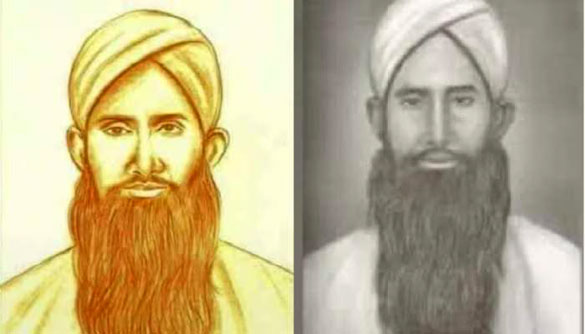
Maulvi Liaquat Ali Qadri, a religious scholar, led the 1857 Allahabad rebellion, uniting communities against British oppression. Declaring jihad, he fought for India’s freedom, faced exile, and died in Kala Pani in 1892, leaving a lasting legacy.
Main Points:
1. Maulvi Liaquat Ali Qadri (1817–1892), born in Allahabad, was a revered religious scholar and freedom fighter.
2. He led the 1857 rebellion in Allahabad, uniting Hindus and Muslims against British rule.
3. Declared jihad, organized public gatherings, and hoisted Bahadur Shah Zafar’s flag.
4. Fought British oppression, faced exile, and continued guerrilla warfare.
5. Sentenced to life in Kala Pani; died in 1892.
———-
Maulvi Liaquat Ali Qadri was born on October 15, 1817, in the village of Mehndauri, Chail Pargana, Allahabad district, to Syed Meer Ali and Aamna Bibi. He was a revered religious figure of his time, embodying the spirit of both spiritual and national liberation. During that era, Islamic scholars viewed the country’s independence and religious freedom as inseparable causes. This conviction led a significant number of religious scholars to participate in the Indian Rebellion of 1857, many of whom attained martyrdom in their fight for freedom.
Maulvi Liaquat Ali was a simple man deeply connected to the struggles of the common people in his region. He was acutely aware of the hardships faced by the masses under British colonial rule. Alongside his profound religious knowledge, he harbored an intense passion for liberating his country from the shackles of foreign oppression. Leading a life of piety and integrity, he consistently advised others to uphold honesty, empathy, and mutual support in times of distress. He considered it the duty of every Indian to strive for the nation’s independence.
The Rebellion in Allahabad
Following widespread looting and arson, Allahabad fell under the control of the rebel Indian forces. Maulvi Liaquat Ali, accompanied by a large number of his followers, threw himself into the struggle against British rule. Seizing the opportunity, he declared jihad against the British, galvanizing thousands to join the fight. Under his leadership, the people of Allahabad (now Prayagraj) united to drive the British out of the city. Maulvi Liaquat Ali delivered a powerful message of unity to both Hindus and Muslims from a public platform in Allahabad. In his sermon, he emphasized, “We are all one. Together, we must confront the foreigners.” With this spirit of unity, he proclaimed the establishment of an independent government in the region and hoisted the flag of Bahadur Shah Zafar, the last Mughal emperor.
The British were not only plundering India’s wealth but also subjecting its people to relentless oppression. Beyond economic exploitation, Christian missionaries, backed by colonial authorities, were attacking India’s religious traditions and sacred texts. They propagated Christianity while attempting to demean Hindu and Muslim scriptures.
Unable to tolerate these affronts, Maulvi Liaquat Ali organized a massive public gathering on June 7, 1857, at Khusro Bagh in Allahabad. The event drew a large number of patriotic Hindus and Muslims. In a fiery speech, he condemned the British for their atrocities, including looting, arson, and desecration of holy texts. Declaring that such oppressors could not be tolerated, he called for jihad against the “sinners.” His impassioned address stirred the hearts of the audience, who were already exasperated by the British’s sacrilegious actions.
Under his leadership, a week-long uprising against the British began on June 9, 1857. Rebels set fire to British bungalows, inflicted casualties, and damaged government property. The widespread unrest created panic among the colonial authorities. However, the British retaliated with heavy shelling and arson, driven by a desire for vengeance. Entire settlements were razed, forcing residents to flee their homes. Maulvi Liaquat Ali, too, was compelled to leave Allahabad and sought refuge in Kanpur.
A Champion of Communal Harmony
Maulvi Liaquat Ali was a firm advocate of Hindu-Muslim unity and cooperation, despite his opposition to Christian missionaries, whose actions, fuelled by colonial arrogance, insulted Indian religions and scriptures. He was among the few leaders who demonstrated through their revolutionary actions that they were fully aware of the socio-political realities of their time. The British, he believed, were not only exploiting India’s resources but also undermining its social fabric. He tirelessly worked to counter their divisive tactics, raising his voice for the dignity of women, religious communities, and the upper classes, earning widespread admiration for his efforts.
Despite his religious persona, Maulvi Liaquat Ali was always ready to take risks for the sake of his country and faith. He never feared for his life or shied away from potential losses. His revolutionary activities were driven by a singular goal: to free India from British rule and rid the sacred land of their oppressive presence. When a Muslim shrine, Bakhtiar Bakhtiyar, and the Telegraph Band were seized by the British, Muslim youths fought to protect them, resulting in losses on both sides. Clashes between Indian rebels and British forces continued across various regions, making it increasingly difficult for the British to maintain their grip on India.
A Lifelong Struggle for Freedom
Maulvi Liaquat Ali swore to dedicate his life to the cause of India’s independence. After leaving Allahabad, he moved to Muzaffarnagar, a stronghold of the freedom struggle, where he joined other revolutionaries. His authority was such that no orders were issued without his approval. Whenever British forces attempted to suppress the rebellion, Maulvi Liaquat Ali, alongside another freedom fighter, Azimullah, embarked on a perilous journey on foot toward Gujarat. Despite facing numerous hardships along the way, they reached their destination and launched guerrilla warfare against the British. For years, their tactics kept the colonial administration on edge.
According to Rakesh Verma, technical assistant at the Regional Archives, “Administrative records written in Urdu titled Naksha Bagiyan Kotwali Allahabad, listing police constables who forcibly took their salaries for May and June 1857 and participated in the revolt, including Hanuman Prasad, Imdad Ali, Ashraf Ali, etc. were hung by Major Henry Court on July 14, 1857,” (From the HT)
The British resorted to various conspiracies to capture him, but Maulvi Liaquat Ali’s stature among freedom fighters only grew. He continued to plan large- and small-scale operations against the British, opening new fronts in the fight for independence.
Imprisonment and Legacy
Ultimately, the Allahabad court sentenced Maulvi Liaquat Ali to life imprisonment in the Andaman Islands, infamously known as “Kala Pani.” Enduring the harsh conditions of imprisonment, this brave son of India passed away on May 17, 1892, bidding farewell to his beloved homeland and the world.
Maulvi Liaquat Ali Qadri’s sacrifices for India’s freedom struggle remain an enduring legacy. His contributions must be remembered and celebrated as an inspiration for future generations, reflecting the indomitable spirit of a man who fought tirelessly for his country’s liberation.
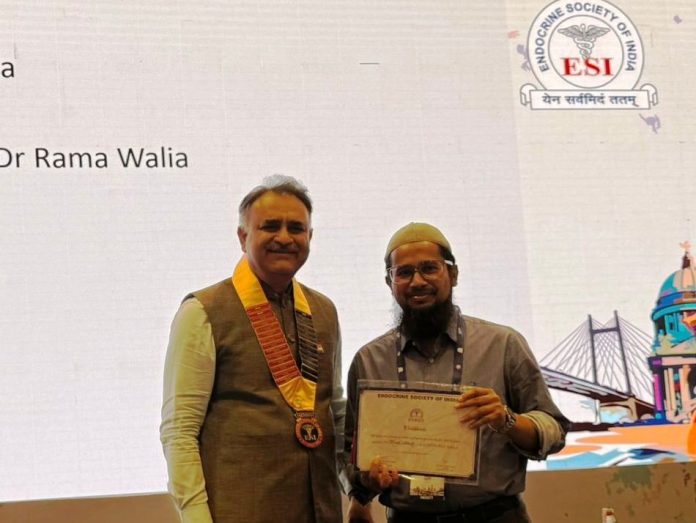
Dr Hamid Ashraf receives the Prestigious A.R. Seth Award for Research on Gestational Diabetes at the 54th Annual Conference of the Endocrine Society of India (ESI), held in Kolkata
Aligarh:
Dr Hamid Ashraf, a distinguished faculty member at the Rajiv Gandhi Centre for Diabetes and Endocrinology, Aligarh Muslim University (AMU), has been honoured with the prestigious A.R. Seth Award at the 54th Annual Conference of the Endocrine Society of India (ESI), held in Kolkata.
The A.R. Seth Award, among the highest recognitions in Indian endocrinology, is conferred annually on researchers and clinicians for outstanding contributions to the understanding and treatment of hormonal and metabolic disorders.
Dr. Ashraf received the award for his pioneering research on maternal health, particularly on identifying early metabolic markers of gestational diabetes mellitus (GDM). His study revealed an alarming trend of dysglycemia in over 40 percent of pregnant women in the region, highlighting the urgent need for reliable predictive markers to ensure early detection and better fetomaternal outcomes.
“This recognition is not mine alone but belongs to the entire team that made this research possible,” Dr. Ashraf said, acknowledging the support of colleagues from the Departments of Obstetrics and Gynecology, and Pediatrics at AMU, along with the contributions of students and patients who participated in the study.
Experts at the conference lauded his findings as a significant step in addressing one of India’s most pressing public health challenges.
source: http://www.radiancenews.com / Radiance News / Home> Pride of the Nation> Awards / by Radiance News Bureau / September 10th, 2025
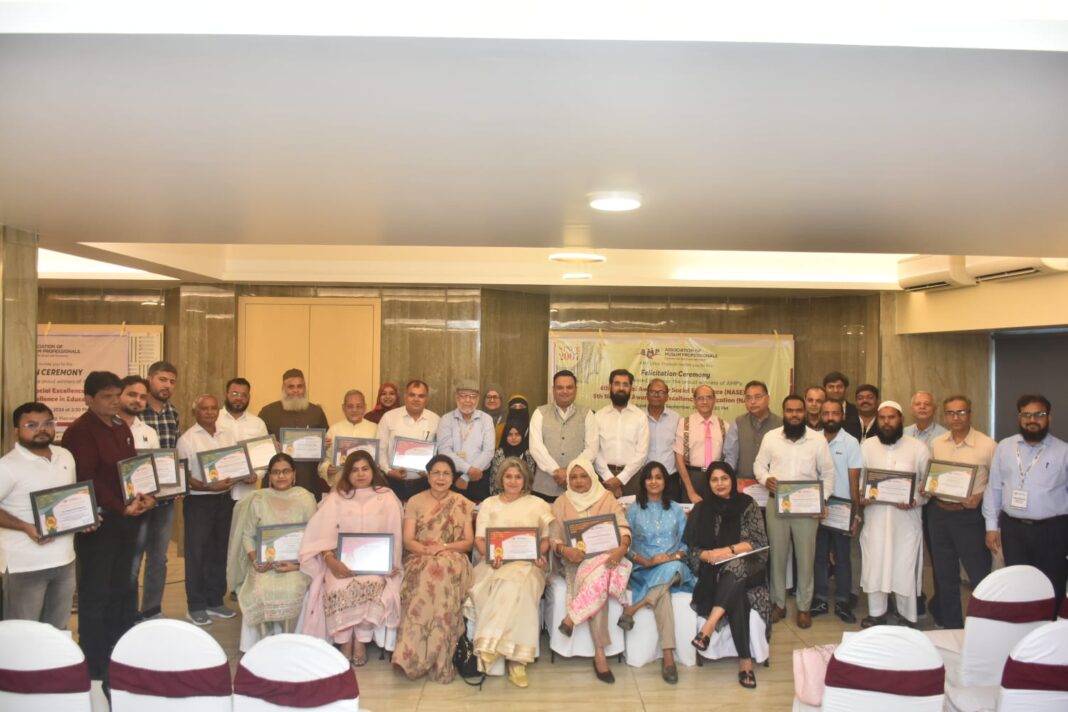
The Uttar Pradesh Chapter of the Association of Muslim Professionals (AMP) organized an ceremony at Hotel Arif Castle for the recipients of the 4th National Awards for Social Excellence and the 8th National Awards for Excellence in Education from Uttar Pradesh.
Among special guests were senior gastro surgeon Dr. Waliullah Siddiqui from Apollo Hospital and Mirza Mubeen Baig from Gautam Budh Nagar. Distinguished educationist and career counsellor Dr. Amrita Das was to attend as the chief guest but could not participate due to health issues, so former senior bureaucrat Zahra Chatterjee filled the role.
The programme began with a recitation from the Holy Quran by Maulana Muhammad Rehan Qasmi.
The welcome address was delivered by AMP’s Zonal Head for Central Zone, Syed Shoaib. AMP’s State Head, Shaheen Islam, introduced the audience to AMP’s objectives and activities, mentioning that this non-governmental, non-political, and non-profit organization was founded in 2007. Over the years, AMP has been engaged in educational, social, economic, and developmental activities aimed at empowering marginalized communities.
Guest of honour Mirza Mubeen Baig emphasized that working for NGOs is becoming increasingly challenging, and only those organizations that serve selflessly and with sincerity will succeed. He stressed the need for collaboration among serious NGOs to benefit from each other’s experiences.
Dr. Waliullah Siddiqui congratulated the awardees for their contributions to education and social services, highlighting that the responsibility for educating and nurturing children lies with both parents and teachers. In today’s changing times, this responsibility has grown even more significant. He shared personal lessons from his life, crediting his parents for playing a central role in his achievements.
Speaking as the chief guest, retired IAS officer Zahra Chatterjee praised AMP’s work and said that every individual’s contribution is crucial for the nation’s development. She stressed the need to reach out to the last individual to ensure educational awareness and economic stability.
Farooq Siddiqui, Head of AMP’s National Coordination Team, addressed the audience, stating that these awards aim to encourage individuals and organizations committed to transforming the nation through their selfless services. He emphasized the importance of collective efforts and mutual cooperation, noting that the welfare of the country and nation lies in unity and partnership.
The vote of thanks was delivered by Mohammad Mohiuddin, Chapter Head of AMP Lucknow, and the event was hosted by Dr. Sumbul Shakeel.
The recipients of the National Awards for Social Excellence included the Best NGO awardees:
Tauheedul Muslimeen Trust, Institute of Social Harmony and Upliftment.
Among the Change Maker Awardees were:
Professor Dr. Nuzhat Hussain from Lucknow, Dr. Mohammad Mubashir, Sabiha Ahmed, Balbir Singh Maan, Dr. Kaleem Ahmed Khan from Kanpur, Dr. Saba Yunus, Shahid Kamran Khan, Sagheer Khaksar from Balrampur, Dr. Saleem Mohammad Khan and Naseem Ahmed Khan from Aligarh, and Ramesh Chandra Srivastava from Ayodhya.
The recipients of the National Awards for Excellence in Education included:
Professor Mirza Mohammad Sufiyan Baig, Professor Naseem Ahmed Khan, Ausaf Azeem Kirmani from Aligarh, Mohammad Shahid Khan, Dr. Mohammad Shamim, Samiullah Ansari from Kanpur, Chitra Maheshwari from Lucknow, Dr. Roohi, and Maulana Mohammad Rehan Qasmi.
Lifetime Achievement Awardees included senior teacher Sheila Lawrence from Lucknow and Jamaluddin Khan from Kanpur.
A large number of attendees were present at the event, including Dr. Anis Ansari (former IAS), Mohammad Khalid Ashu, Mujtaba Khan, Najm-ul-Hasan Rizvi Najmi, Dr. Uzma Mubashir, Syed Abrar, Rizwan Ansari, Mohammad Zeeshan, Mohammad Imran, Javed Akbar Khan Lodi, Shahenshah Ansari, Fahad Mahmood, Ayesha Mahmood, Alma Siddiqui, Ayesha Alvi, Zaheer Baig, and Aqib Rauf.
source: http://www.indiatomorrow.net / India Tomorrow / Home> Education / by India Tomorrow / September 03rd, 2024
Mustafa Kamal Sherwani, was Doctor in Law (LLD), a senior Law faculty in Shia Post Graduate Degree College, Lucknow, belonged to Lucknow in all its totality. He was the Principal of the institution too. He had in himself all. Ingrained in Muslim historical legacy, feudal ancestry grounded to the masses, Muslimness never brooding to exclusiveness and a diehard human rights campaigner-all to the hilt. He passed away to heavenly abode on March 3, 2025, leaving a void, which would never be filled, in a community otherwise resigned to the fate in this present political squall.
He represented the post-Babri Masjid demolition genre and hit the political windscreen as a flag bearer of All India Muslim Forum in 1993, he assiduously pursued the agenda to sensitize Muslim political consciousness, and definitely succeeded to carve a special niche for Muslim space in Lucknow, the citadel of communal cauldron, during the high days of Kalyan Singh, Ram Prakash Gutpa, Rajnath Singh, all Bhartiya Janta Party Chief Ministers and Prime Minister AB Vajpayee.
His able mentorship made Muslims not recede into a cocoon but instead there was hardly a month, which passed, and Lucknow did not witness AIMF protests, on streets, many times opposite Vidhan Sabha. In fact, MK Sherwani, political credibility, is what made it all, as even when there were no mobile phones, MK Sherwani, could mobilize around 100 AIMF workers and supporters in one hour.
I too had interactions with him on many sundry afternoons. Despite political one-upmanship, when he was betrayed by his friends and colleagues, which also is a hallmark of Muslim polity, he never betrayed a sign of acrimony but instead was always with his trademark infectious smile. Yet, surely, the dent was inside. He never would divulge the name of those who passed AIMF meetings information to local intelligence sleuths and onto the political establishment those days. He however was very skeptical to the politicization of Muslim clergy, and would argue, that Hindu religious leaders perpetuate the Hindu political leadership, but instead, Muslim religious personnel kill their own political voices, of course, in exchange for the worldly charms.
His stint as a former Vice Chancellor of Zanzibar University and Department Head of Law and Shariah at the same university, never dimmed the belonging he had for his first love. AIMF. He would tell me that even before he would have tea there, he would log on to all Hindi/Urdu and English newspapers with dateline Lucknow to keep a tab on events back home, and issue statements on it. He made a stint to Finland, for his landmark 75 lecture series, on India’s cultural heritage and diversity. A great feat unto itself.
He was an old Aligarh Muslim University alumina and was once accused of sedition. He had to pass through a 15 years ordeal, which he would transform in a form of a book Secular Horror which is available on Amazon. I had done its review long back. The torment started after he had published an article ‘Secularism vis-à-vis Hindu chauvinism’ in Radiance Viewsweekly, the mouthpiece of Jamaat-e Islami Hind. His treatise Iblees ( Satan) and the Mullas was his uneasy exhortation as to how Muslim political aspirations have been killed at the altar of Muslim clergy machinations. A leaf he took from Allama Iqbal from whom he was greatly influenced. His ceaseless efforts in the form of I am a Citizen of the World, dedicated to Hindu-Muslim unity, Tribute to Hazrat Imam Husain, are still available on his facebook page.
His legal acumen made him a constant figure at the Lucknow bench of Allahabad High Court. He made into a perfect stature who would hog the courts with petitions to safeguard Muslims rights.
He would unequivocally apprise Muslim masses, through his speeches on streets and seminars, as to how assembly seats in UP with sizeable Muslim presence, have been categorized as reserved for Scheduled Caste/Tribes! In stark violation of the Representation of the People Act, 1950.
He was sharp-as-a-tack, who would always dither into narratives with warmth and wit, much always to the laughter and lighting of the mood during his speeches. Masses would start to chuckle on his disarmingly simple eloquence which made even ordinary look like an art. He made everything relevant. His would allure everyone with comfortable ease to make ordinary become extra ordinary. He was in constant search for a tonal alchemy where there was to be a moral entity, and where, justice would ultimately be served (read to Muslims).
There is no denying the fact that he, along with the likes of Saleem Peerzada and Zafaryab Jilani, Muhammed Azam Khan, was a preserve of a tortured genius with traumatic back stories. Hashimpura, Malina, Bhagalpur, Meerut, Babri Masjid riots etc.
He was always by the side of Zafaryab Jilani, on every Babri Masjid demolition anniversary ( December 6, 1992), emphatically on the probe, that the possibility of order be restored. But, then, last but not the least, he belonged to an era where even the best of minds are ordained ( sic) for cynicism and fatalism! Yet he, as were his friends, did not choose escapism. Zafaryab Jilan was the convener of Babri Masjid Action Committee and Saleem Peerzada had founded of Parcham Party of India.
He was a friend of friends. Today he is no more, so are Zafaryab Jilani and Saleem Peerzada. They made a great camaraderie. A coterie which had thronged the Vidhan Sabha street, against the then BJP supported UP CM Mayawati, when she had refused to issue a fresh notification to Central Bureau of Investigation, to restart the case against LK Advani, the then main accused of Babri Masjid demolition, after he was exonerated by the CBI court in 2003, which of course he is now. It is ironic that today, after 40 years; a grandiose Rama Temple has come on the site of demolished Babri Masjid. But, no one demolished it?
Today three of them are not there. Death may be permanent but certainly not defining. The passage of time is however never irrelevant as strive for justice cannot be dampened. The zest for it always feels possible. The mark of hope can never be condescended. MK Sherwani is survived by his wife, two daughters and two sons, Zafaryab Jilani by his wife, a daughter and two sons, Saleem Peerzada did not marry. Three of them were LLM. Muhammed Azam Khan until his first year, before he was arrested during ‘emergency’. Saleem Peerzada was a civil engineer. All the four were from AMU. MK Sherwani will be remembered long time for his LLD thesis Quran and Modern Jurisprudence and it is here yours truly also played a role. I had taken the copy to the publisher to get it published.
Muhammed Azam Khan is right now undergoing a tortuous survival in jail. When will the discontent end? Their lives of struggle will always be the yardstick to give a whiff of element even in the event of hoping against hope.
****
The writer is a former UP State Information Commissioner.
source: http://www.muslimmirror.com / Muslim Mirror / Home> Obituary / by Haider Abbas / August 29th, 202
Raffat Begum was a gifted poet and wrote with the pen name ‘Asmat’ and took advice from Azhar Inayati, a renowned poet of Rampur. She also wrote several barsaati folk songs celebrating monsoons as did Nawab Raza.
The names of brides have vanished from wedding cards in Rampur. So, we are cordially invited to the wedding of ‘Arif Khan, S/o Samiullah Khan to the daughter (no name) of Wahidullah Khan’. Even the names of women are concealed from vocalization by disrespectful male lips. The nameless miasma enveloping our girls is a recent trend in Muslim etiquette of this erstwhile princely state. It negates the ninety year journey the women of the city have traversed–all the tiny and large steps of emerging out of the zenanas, educating themselves and finding a voice. Maybe the unnamed daughter getting married was educated at one of the local women’s colleges established by the erstwhile Nawabs and has ambitions that involve a becoming.
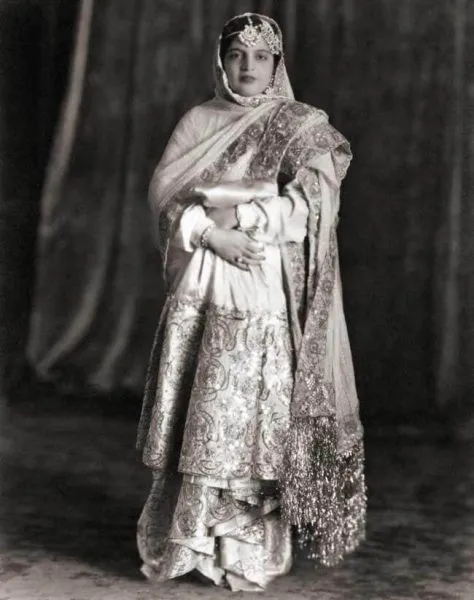
The emancipative journey of Rampur women began with the decision of a queen – Raffat Zamani Begum, wife of Nawab Raza Ali Khan– to leave the confines of the harem and become something more than a name. Nawab Raza (1930-1947), an enlightened ruler fully supported his wife in her decision and was possibly influenced by her in his very western and ‘modern’ outlook. As the princesses and female members of the royal family followed Begum Raffat, there was a filtered down liberation among the women and girls of upper classes, and over the years a snowball effect that touched the lives of the of all classes of Rampur women.
Raffat Begum was the daughter of Sir Abdus Samad Khan, Prime Minister of Rampur under the colonial rule, an impeccable gentleman who traced his antecedents from the Najibabad royal family. She was married to the crown prince, Raza Ali Khan, when she was five and he was six years old. The little bride sat on her grandmother’s lap, her heavy nath supported by her grandmother’s palm as the nikah ceremony was performed. The young daughter in law was granted all the paraphernalia of the future queen while still living with her father and had to attend court on special occasions. At a time when brides were given a new name and a title, her name was changed from Askari Begum to Raffat Zamani Begum.
When Raffat was thirteen, her father in law, Nawab Hamid Ali Khan (1894-1930) demanded that the rukhsati (going away ceremony) be performed. Raffat’s father insisted that they wait at least till the groom had completed his education. Raffat Begum wrote, and is quoted in her sister Jahanara Begum’s memoir, that the relations between the two gentlemen became strained. Finally, Nawab Hamid walked on foot from his Khas Bagh palace to the bride’s house, ‘Rosaville’, and the ceremony which usually took days was performed in a few hours; Raffat Begum left her paternal home amidst songs extolling the valiant Rohilla Nawabs and martyrs of ancient battles.
The teenage couple began their married life often separated by the political intricacies and rules of the harem. Oral history says that they were not allowed to live together for seven years and Raffat Begum was declared infertile after her first son was born. Raza was forced to take a second wife by his father and stepmother. The women of Raffat Begum’s family did not practice strict purda. Her mother was the daughter of the regent of Rampur, General Azamuddin Khan (1888-1891) who had earned the ire of the maulvis of the time for his ‘kristaan’ viewpoint and his championing of female education. Some say he was murdered because of his radical outlook. It is therefore unsurprising that the educated Raffat Begum rejected the claustrophobic harem life she had endured for the first ten years of her married life as soon as Nawab Raza came to power. The couple showed a proclivity towards the ‘modern’ and western lifestyle in all areas and Raffat Begum became a major mover in the drastic transformation of the Rampur durbar, the zenana and Rampur culture. Though not documented in written histories, the influence of Raffat Begum on the dress, cuisine and court etiquettes finds testimony in oral history.
We get a vivid description of the Begum in her stepdaughter , Mehrunnisa Begum’s memoir, ‘An Extraordinary Life.’
Home tutored in English, Persian and Urdu, Raffat Begum entertained distinguished guests at royal banquets and sat for official pictures––the first pictures of women from the royal family. She wore latest western dresses, make up and was a chain smoker –– a ‘modern’ thing to do. In fact, she encouraged her children to smoke as it was considered fashionable. However, some women continued to live in the royal zenana ––more out of lack of choice and under confidence–– but there was no constraint on their movement. Given that Nawab Raza’s predecessor, Nawab Hamid confined his women to a sequestered life behind the laal purda, this was the beginning of a drastic change in the thought process and lifestyle of elite Rampur women.
The young princesses were sent to a boarding school after being brought up by British nannies in a strictly regimented nursery. Emulating the new trend, the elite landowning families and those associated with the court started educating their sons and daughters at boarding schools. So, my mother and her siblings were sent to La Martinere in the 1950s. The 1960’s saw Rampur’s first female doctors, teachers, writers and lawyers ––aspirational models for young girls studying in government colleges now housed in the old palaces and zenanas of yore. Nawab Raza gave a lot of emphasis to education particularly female education and the girls from ordinary families were now sent to girls’ schools in the city after initial misgivings. Covered rickshaws and thelas (carts) transported the burqa clad young ladies to schools. My mother became a doctor in 1967 and the women of my family practiced a flexi-veil where they would cover their heads, sit in curtained cars in Rampur and don sarees and bellbottoms outside of Rampur.
Raffat Begum was a gifted poet and wrote with the pen name ‘Asmat’ and took advice from Azhar Inayati, a renowned poet of Rampur. She also wrote several barsaati folk songs celebrating monsoons as did Nawab Raza. Some of her poetry was published.
Begum Noor Bano, her daughter in law and ex-Member of Parliament, recalls the after-dinner dastan sessions with the children and grandchildren gathered around their beloved ‘Mummy’. The dastans were later written down by a scribe.
Mapara Begum, a court singer, says she would give importance to the lowliest person and welcome everyone with warmth. Which is why she was fondly called Raaj Maata, the queen mother of Rampur.
A few years after Nawab Raza’s death in 1966, Raffat Begum moved back to her father’s place, Rosaville, with her retinue of servants. It was an empty house. Her parents had passed away and her brothers and sisters had left in pursuit of their lives and careers. Life had come a full circle. She passed away at Rosaville in 1986 – an elegant begum, spirited and dignified till the end. Her plaintive lines are still echo on the lips of old timers:
“Aisey beemaar ki dava kya hai,jo batata nahi hua kya hai;
Kaun suntan hai is zamaney mein, kis se kahiye iltija kya hai.”
How can a person who cannot describe her ailment find a cure?
Even if I could find words for my pleas, would my entreaties find listeners.
Receiving yet another invite to the marriage of an anonymous daughter, I tried to remember the names of the wives of acquaintances and distant relatives. I came up with Naeem mamu ki biwi, Munney sahib ki ammi etc. etc. We are all guilty of using the blanket term bhabhi or khala to address the married women of various ages; we are introduced as wives, mothers and granddaughters. I used to laugh at the old style of explaining connections––‘Munney mian ki beti Shaddan Khan ke ghar mein hai’, indicating that Munney mian’s nameless daughter is married to Shaddan Khan. We have accepted an anonymous existence here and it is only logical that our girls get shrouded in namelessness on their wedding day.
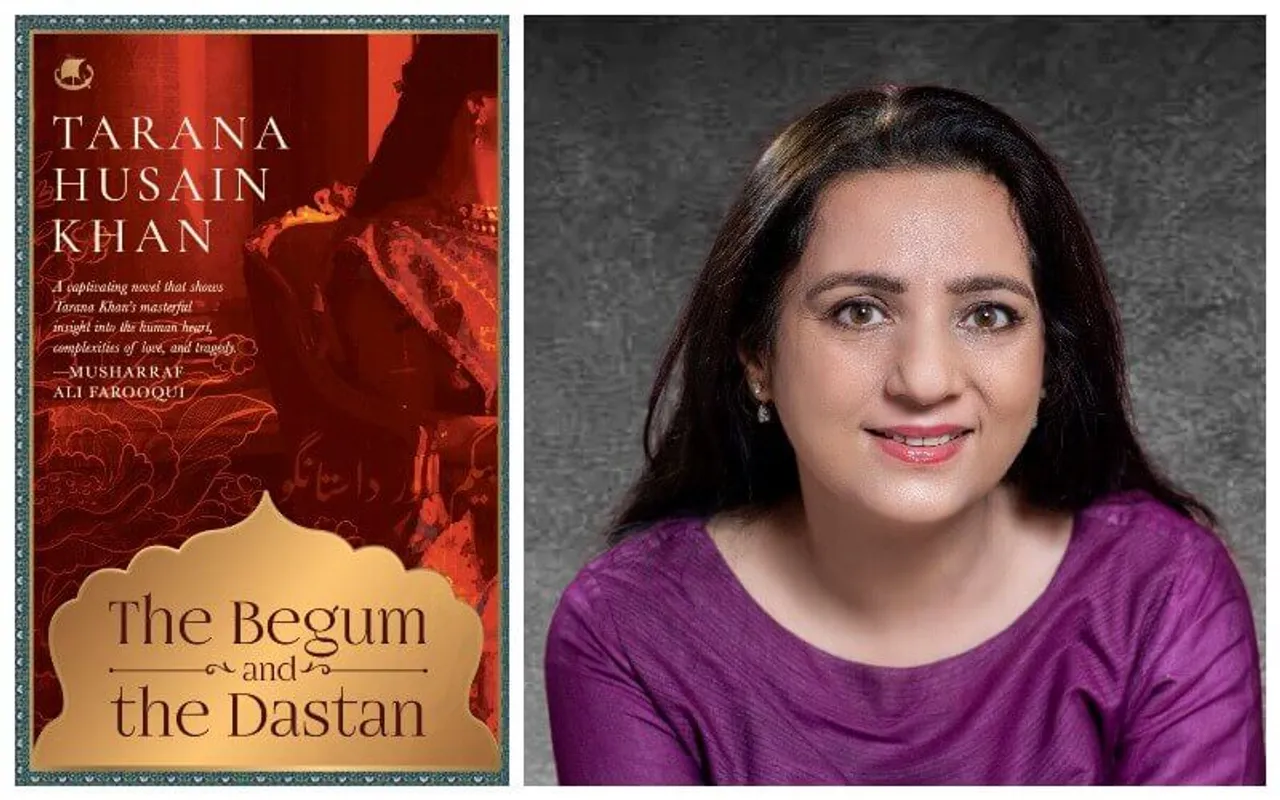
Tarana Husain Khan is a writer and researcher based in Rampur. Her historical fiction ‘The Begum and the Dastan’ has been recently published by Tranquebar. The views expressed are the author’s own.
source: http://www.shethepeople.com / SheThePeople / Home> Books / by Tarana Husain Khan / March 02nd, 2021
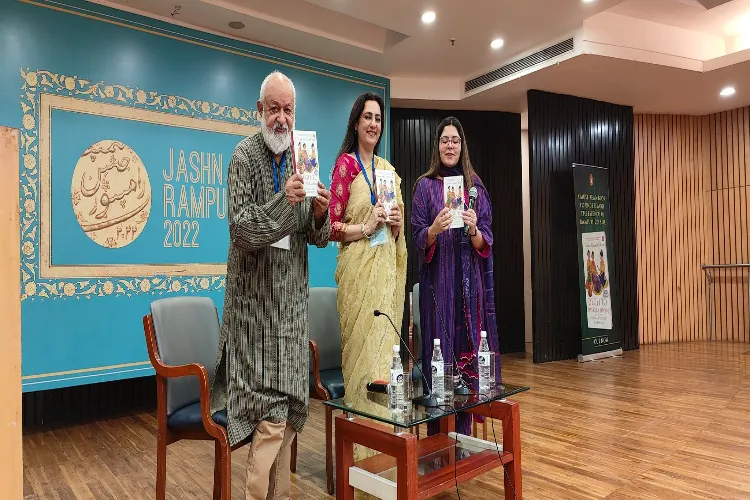
Away from the hustle and bustle of the national capital Delhi, the food lovers gathered in Delhi’s India International Center to discuss the food – delicacies, genres and history – all day. It was for the release of Dr. Tarana Hasan Khan’s book ‘Deg to Dastarkhwan: Stories and Recipes from Rampur.
In this era of pizza, burger, and fast foods, we seems to be forgetting traditions of the Shahi, Mughlai and old delicious food.
Dr. Tarana Hasan Khan is one of the few to write on Dastarkhwan – the Indian cusine. She is also cultural historian.
Dr. Tarana Hasan Khan and her book
Her other book is: The Begum and the Dastan.
Dr. Tarana says It took her three years to cover the forgotten recipes of Rampur for the book. There is a chapter on rice and spices in this book.
Famous food writer Pushpant Pant also participated in the book launch ceremony. The program started with welcome address by Swati Pal, Principal of Janki Devi Memorial College.
She also discussed the problems faced in writing the book on the ‘forgotten foods of Rampur’ were mentioned. Yusuf Saeed and Naseema Naqvi had a long conversation on this subject. This was followed by a discussion on the history of the foods between Dr. Tarana and Pushpant Pant.
Dr. Tarana specially thanked Pushpesh Pant for attending the program and joining the discussion on delicious food. He has written about Pushpent Pant by posting on Twitter:
We celebrated the 100th birth anniversary of Prof Rais Ahmed, the former head of the Physics Department, Aligarh Muslim University and the person to whom I owe a great deal for starting me off on my career path in plasma physics research.
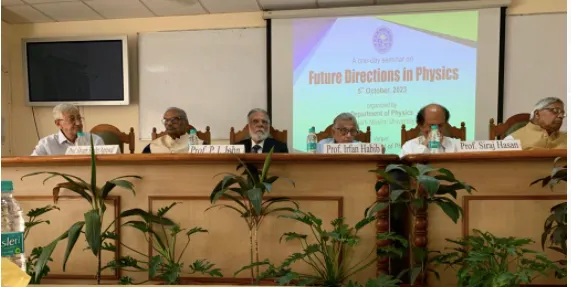
A one-day memorial cum seminar on Future directions in Physics was held at the University on 5th October 2023 Venue. Prof. Irfan Habib, Prof. of History, AMU, Prof. Siraj Hasan (Former Director, Indian Institute of Astrophysics), Prof. Naresh Dadhich (Former Director, IUCAA), Prof. S. K. Singh (Former VC, HNBU), Prof. Wasi Haider and Prof. Shyam Sunder Agrawal (Director General, KIIT Group of Institutions) spoke on the occasion. I spoke about my association with him and the future of Plasma Physics and Thermonuclear Fusion Research in India.
It was a forenoon in July 1964 when I first met Prof Rais Ahmed, who had become the Head of the Department that very year. I had travelled from Kerala seeking an opportunity to do research. He asked me a few questions on Physics, and I suppose I answered them reasonably well. But then he wanted to know why I wanted to pursue research.
I had rather romantic ideas like research leading to new knowledge and our responsibility to seek pure knowledge etc. It was clear that he did not take me seriously as he went on to say that science is what drives social transformation by changing our perception of our relationship with nature. Another observation was about science leading to technology which improves the quality of life.
Our conversation covered many things. I suppose he was gauging my mind and trying to find what kind of person I was. If it was a test, I passed it as he said that I could join for research. He made sure that I had no preference for Nuclear Physics or Spectroscopy, the areas of ongoing work in the department. He talked to me about Plasma Physics as an emerging field and about the work which was going on in Harwell and Oxford on Thermonuclear Fusion Research.
I did not know about Plasma Physics even at an elementary level. However, I was willing to learn and was asked to talk to Prof. D C Sarkar about the thesis work in more detail. I went through an intense learning programme, primarily reading Physical Review and Review of Scientific Instruments. There was no previous laboratory I could walk into and start work and I had to start from scratch. Looking back, I was taking an enormous risk as I had to build an entire laboratory for me to start the thesis work.
I rigged up a Radiofrequency generator with Japanese power tubes scavenged from the Electrical Engineering Department. Prof Venkateswarlu’s lab was full of microwave equipment, which Rais Sab allowed me to borrow. With all this, I set up an experiment and after a struggle of five years, put together a thesis which got me a degree. Almost immediately he gave me a regular job as a lecturer in the department as some vacancies were due to be filled.
As the Head of the Department, he did much to expand research and teaching in Physics in new areas. As Director of Academic Programmes, he organized the Semester System designed to update courses and provide more rigorous instruction to students. He made an alliance with Uppsala University in Sweden for faculty members to do research there. He arranged for PhD scholars to start teaching postgraduate students.
I recalled my interaction with university life during my eight years there. At first, Aligarh gave me a culture shock. My inability to comprehend Urdu was the first barrier to appreciating the culture. The exalted forms of addressing, and the too formal and exaggerated ‘Tehzeeb’, the gestural ‘adaabs’ strewn around were all alien. The food, though delicious, was completely unfamiliar. But the campus was a dream with beautiful buildings, stately halls, verdant lawns, and lush gardens. The library gave me all the books I wanted to read. The accommodation I got at the Sulaiman Hall was quite adequate. The students from central Travancore preferred this. There was a South Indian mess catering our preferred food. Tea at the Paradise restaurant with friends was fun.
Rais Ahmed had interests ranging from his specialization in Electronics to varied areas of science and education. He published over 100 papers on Electronic Circuit Analysis. Analogue Computers. Speech Recognition and Production, and Creative Teaching of Physics. The work he started in the 1970s on speech perception would eventually become an important branch of artificial intelligence and machine recognition of speech.
I recall a symposium he had organized on higher education, where we were asked to be volunteers to help the organization. The attendees were all academics from Universities and IITs and I was fortunate to listen to many of them. The remarkable skill with which Rais Sab generated consensus on many issues which were debated was an eye-opener for me.
In a department seminar, when his student Moonis Ali spoke on the design of an analogue computer system, some of us, ridiculed the idea calling it a paper machine. Rais Sab defended the presentation vigorously, saying that new ideas were what drove science forward and that they had as much importance in science as building new instruments.
His remarkable organizational skills were brought to bear at the prestigious Annual Meeting on High Energy and Nuclear Physics, sponsored by the Department of Atomic Energy. Prof Roy Daniel from TIFR was the coordinator of the meeting, and his being from Kerala, we used to chat about the preparations for the meeting. The participants included bigwigs like Vikram Sarabhai, Prof M G K Menon and Dr Raja Ramanna. The meeting was hailed as very successful thanks to the planning and preparations led by Rais Saheb.
All of us in the department rejoiced when he was made a member of the Science Advisory Committee to the PM, then Mrs Gandhi. After each meeting, he would call all of us to the lawn near the workshop to convey to us the flavour of the meeting. We had the vicarious pleasure of being informed about the thinking in the places of power.
He would call me occasionally to his office to find out how I was doing. In one of these meetings, he advised me to read journals other than those dedicated to pure physics. He cited the Bulletin of Atomic Scientists as an example.
Rais Sab had an abiding faith in Scientific Socialism and felt strongly about the increasing global dominance of the multinationals and about what he saw as a retreat by India from its independent position both in the Economic and Intellectual fields. He had a strong belief that human capital, in the form of expanding knowledge and scientific spirit, held the key to India’s salvation. For this ideal, he worked tirelessly both as an individual and in administrative capacities.
In the 1950’s he was an energetic organizer of the Association of Scientific Workers of India. Once when I asked him about the ethics of unionizing scientific workers, he defended it by saying that collective bargaining need not be about wages and working conditions only. Professional bodies of scientists had a role in influencing public policy.
After I left Aligarh in 1972 to join the Physical Research Laboratory in Ahmedabad, I had occasional interactions with him. He made me a member of the UGC Committee to visit Marathwada University to make an academic assessment. He funded my proposal to have an orientation programme for university teachers in the emerging field of Plasma Physics.
I had an exciting and eventful life contributing to Plasma Physics in India, right from its inception at the Physical Research Laboratory, during the Plasma Physics Programme and its eventual transformation to the Institute for Plasma Research and when India became a proud partner in the ITER project of building the world’s first Thermonuclear fusion reactor in France. I owe a debt of gratitude to Rais Saheb for initiating me into the research path, which made all this possible.
source: http://www.john-pucadyil.medium.com / Medium.com / Home / by John Pucadyil / October 06th, 2023
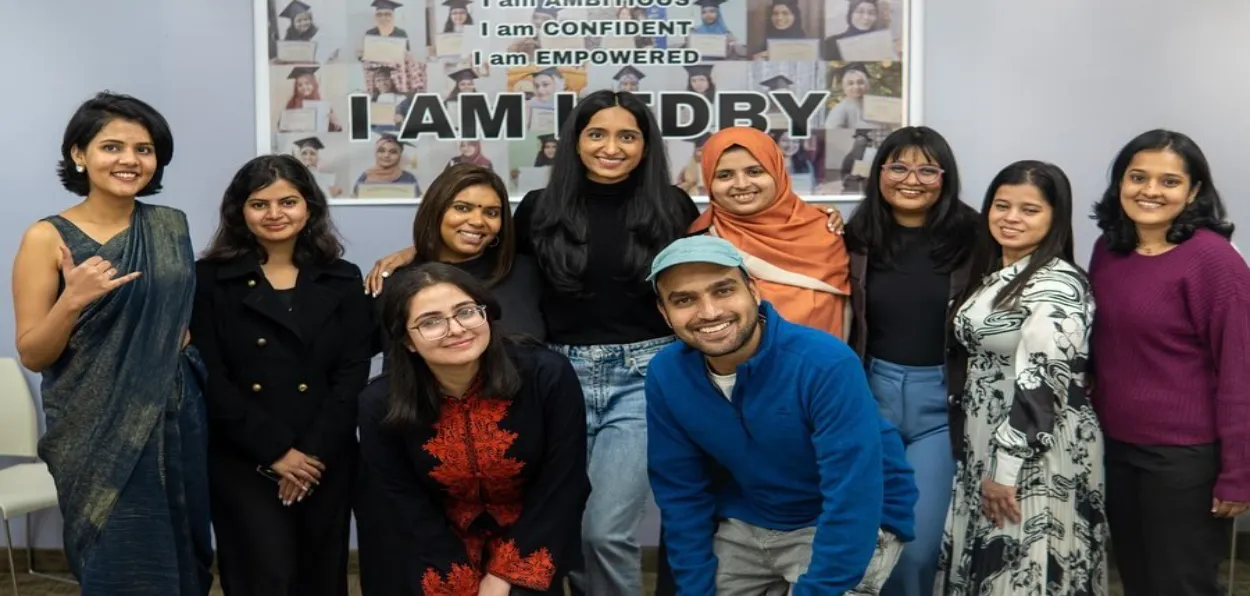
Ruha Shadab in the center (Wearing black top and jeans) with her team
Ruha Shadab acquired a degree in medicine from the Lady Harding Medical College, New Delhi, before joining Harvard University for higher studies. She along with her team at Ledby Foundation are working towards empowering Indian Muslim women to be gainfully employed and become independent. Awaz-The Voice Editor-in-Chief Atir Khan spoke to her about her work. Excerpts:
What was the intent behind starting Ledby Foundation?
There were many reasons why we started Ledby Foundation. The primary reason was that I hardly saw any Muslim women in the offices that I had worked in. Also, the overall socioeconomic indicators of our community made me feel compelled to start this. But the story most close to my heart is that of my mother, who, I think is one of the most intelligent people that I know. Many people like her are there in a community who weren’t able to realize their intellect and develop their professional dreams.
So that was something that influenced me as I started my early career and then went on to do better at Harvard. But I got time to think about what I want to do with my life, and what kind of social impact I needed to create. And I always knew that I wanted to create a social impact for the Muslim community, especially for women. As I spent more time thinking about what I could do for the community I ended up on the idea of professional empowerment of Indian Muslim women and supporting them in the workforce.
Sky was the limit for you at Harvard; you could have chosen to work in any other field. Why did you choose to do what you’re doing?
Even my medical background of becoming a doctor had to do with creating social impact. That was my goal from the beginning. The progression from doing medicine to doing global health to working on policy and helping improve Indian society has just been a natural transition to what I think can have the most impact. And as to why Muslim women, it is one of my core identities, I thought there is a strong need, and if we don’t do it, who else will? I remember when I was 14-year-old I used to tell my mother that I wanted to go to Africa to help people who were suffering from poverty and hunger.
And she said why don’t you first fix your own backyard first? There is so much that needs to be done in India, so much that needs to be done in our community. So, that made me pause and reflect and that’s what brought me here.
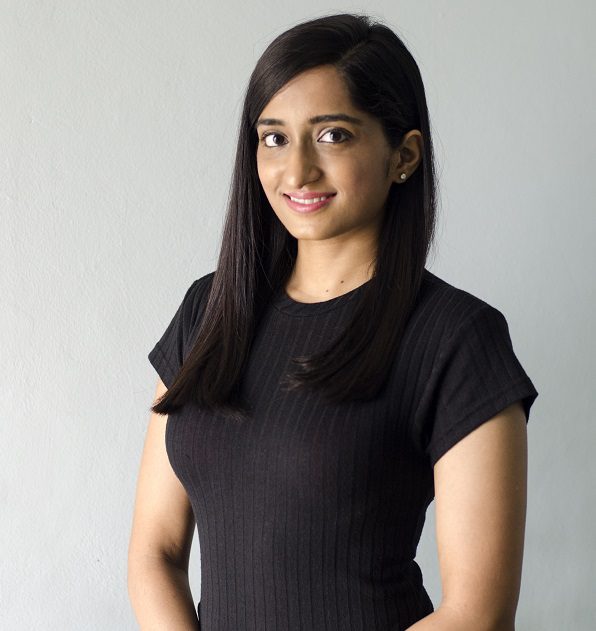
Ruha Shadab
Many people must be asking you why you only choose to work to empower Muslim women. Why not others?
Yes, there have been all combinations of questions. Why Muslim women? Why not Muslim men? Why not Hindu women, and X, Y, Z combination? Right. The truth is that I think of this almost from a doctor’s mindset. So, what is the issue that you’re trying to solve? The issue that we’re trying to solve is underemployment, the lack of job opportunities, and the lack of converting your education into employment.
As a Muslim woman, somebody might say, why don’t you work for the education and employment of women from other communities in India? Why only focus on Muslim women? And that’s true. India has one of the lowest female labor force participation rates in the world. And my answer to that is to think of it as seeing two patients in your clinic.
If both patients show up you can give them paracetamol. But as a doctor, I’m also going to run diagnostic tests on them and try to understand what is the underlying cause, what is the underlying disease that they have and then give them specific treatment.
One might have a bacterial infection; one might have a viral infection. Under different segments, different combinations of communities might be suffering from some of the macro issues we have in India with unemployment and job availability. But the reason is that they are not able to realize those opportunities or those unknown opportunities before us.
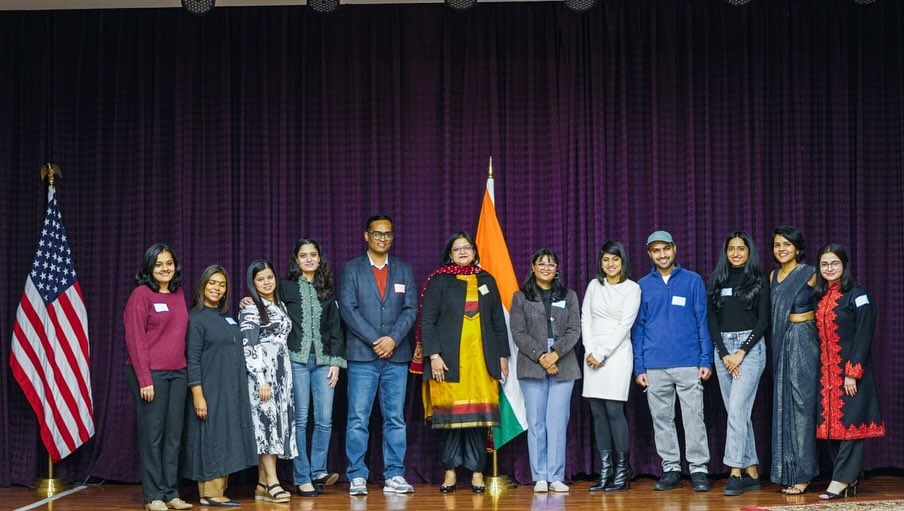
Ruha Shadab (extreme right) with her team members
So, the root causes differ. And then building on this, you don’t have targeted interventions focused on these root causes. You will not be able to meaningfully address them and solve them. You need to have at least focused approaches to solving that unique set of root causes that is hindering them from getting full participation in India’s workforce.
The constitution of your Ledby foundation is quite interesting. Your team members are Hindu and you have people from other faiths for the cause of empowering Muslim women. Isn’t it great? In today’s world where every community is looking inwards and they’re busy thinking about themselves?
It’s very validating. My chief operating officer is not from the Muslim community. 20% of our 120 advisers and residents are non-Muslims. 100 out of 500 of our volunteers are non-Muslims. And that just goes to show that the narrative that we are told about our country and our brethren in the country is not entirely true.
If you put your head, you will be surprised to see how many people are willing to stand up and support you. And I think that is what this shows. It also shows that supporting Indian Muslim women is not just important if you are an Indian Muslim woman, but it is in the interest of every Muslim woman, and every Indian to ensure that this unity can realize its dreams today.
Absolutely. Very important point. You know, it’s the intent and the good leadership, that you have, these are the things that matter the most. And when reach out to people irrespective of their faiths people come and support you. You have to have a good cause; people are always there to support you. Tell us more about your programs at Ledby Foundation.
Sure. So, our programs are completely virtual fellowships that we offer to Muslim women who are either in college or in the early stages of their careers. Think of it as if you are 18 to 20 years old and an Indian Muslim woman, then getting into one of the best professional development programs is probably in your best interest to expedite your professional career. There are several components to it. So, one component is online training programs that help you with, your interpersonal skills, your communication skills, and some of the basics of being able to find jobs, reach out to people, submit an excellent CV, and do interview preps.
Another workshop modules look at improving your negotiation skills. Our negotiation curriculum is developed in conjunction with Harvard professors who interviewed Indian women and developed case studies with Indian Muslim women as protagonists that we use to teach negotiations to our fellows. And then the third part, which is often cited as one of the long-lasting effects of the fellowships is our mentorship program. And our mentorship program is a 360-degree framework so each young Muslim woman who joins gets mentored.
The other aspect of the mentorship program is that each Muslim woman has to then have sessions with people in her class. And I would just say women are from across India. So, we have a very diverse group, even though we say Muslim women, it’s a very diverse Muslim women group and we get to speak to each other. The last part of this mentorship program is coaching at the school level over six months.
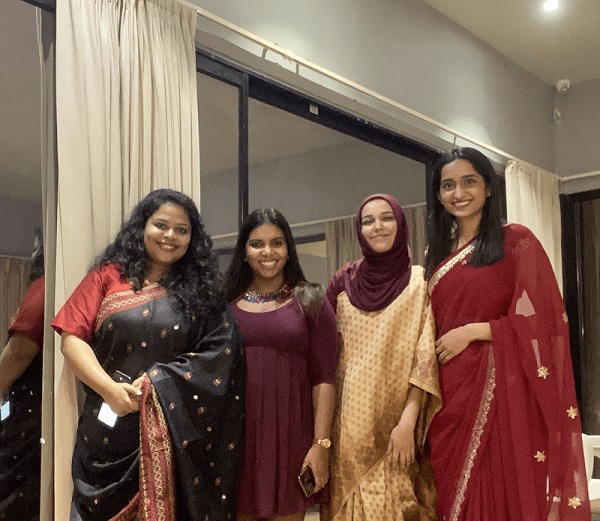
Ruha Shadab with the team of Ledby Foundation at a function
That’s amazing. Tell us how you make these students or candidates job-ready.
Our fellowship is very much about teaching people how to fish rather than giving them fish. So, we teach them how to identify the right opportunity, how to network with folks, and how to help them with an interview. And then we also have them practice interviews with us. They have access to facilitators, who help practice as you continue to progress.
So who are your stakeholders? Of course, the students, then you have the policymakers who are others you reach out to?
So, we try to bridge that supply-demand gap. We are creating a supply of highly skilled professional Indian Muslim women. And then we’re also making sure that there is a demand from companies to intentionally recruit and create a diverse workforce within their organizations. We bridge the gap between our fellows and companies that want to promote religious inclusion in India.
What is the kind of feedback you get from, say, policymakers and the corporate world when you approach them with this kind of information?
So, we usually try to approach them from a very fact-based point of view. We also carry out research to identify what are the barriers to entry and retention of Muslim women in India’s workforce. The research we conduct help a lot of companies see through a fresh perspective. So even if you educate Muslim women, that does not necessarily mean they have the same chances at employment. The company officials tell us that they never thought about this, they were never made to confront this reality. So, we meet them just to reflect.
Ruha Shadab with a support group of her Foundation
So what kind of support and responses you’re getting from people that you’re reaching out to?
Well, overall, it’s been positive. People are interested in understanding what we do, supporting us in even exploring the talent pool that we are creating. And we have several stories of women who’ve gotten recruited through our own pipeline to companies.
That’s wonderful. And there must be some very bright candidates you come across. We see there is an awareness among Muslim families even in small towns for pursuing higher education.
That’s true. There is a very strong drive and fire within the women that we meet. And we try to move more away from urban centers.
Right now, we are more focused on urban centers and ensure that we are able to move farther away from that in the future. And yes, we do see that. See, I think in addition to being pleasantly surprised at how many people from outside of the Muslim community are willing to help us, with very positive insights.
I’m sure that you inspired a lot of Muslim girls, you’re a big success story from India, an Indian who’s doing so well. Do you also think that we need to convey more such success stories to these aspiring girls to inspire them?
Absolutely. And I think what helped was having people believe in me, and we’re trying to make more Muslim women feel that they are heard and that somebody believes in their talent.
You’re doing deep thinking and you’re working in this field, what would be your appeal to the government and the corporate sector for improving the employability chances of Indian Muslim women?
My appeal would be to have intentionality behind getting more Muslim women into the workforce. The truth is that we shy away from talking about religious inclusion in India, which is strange. Because so much of our lived reality is a function of our religious identity. There is no distinction between the personal, the political, and the professional and it is incorrect to create these artificial distinctions.
source: http://www.awazthevoice.in / Awaz, The Voice / Home> Stories / by Atir Khan / February 29th, 2024