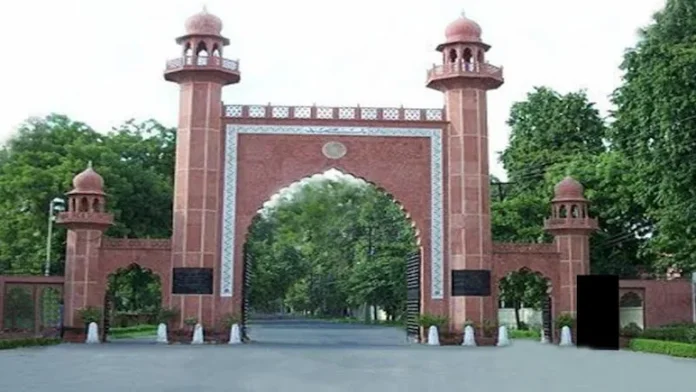
As many as 38 candidates from the Residential Coaching Academy (RCA), Centre for Coaching and Career Planning, Jamia Millia Islamia (JMI) have cracked the UPSC Civil Services Examination 2025 the result of which was declared today i.e. Friday March 06, 2026.
UPSC CSE Result 2025:
As many as 38 candidates from the Residential Coaching Academy (RCA), Centre for Coaching and Career Planning, Jamia Millia Islamia (JMI) have cracked the UPSC Civil Services Examination 2025 the result of which was declared today i.e. Friday March 06, 2026.
Significantly, 04 candidates have secured positions within the top 50 ranks and shine at All India Ranks 7, 14, 24, and 29, becoming top performers from the Jamia Millia Islamia, New Delhi.
Among the 38 candidates from the Jamia RCA UPSC Coaching Centre who have successfully qualified in the examination, securing positions in various All India and Central Services, 15 are women candidates.
“This highlights the important role played by Jamia Millia Islamia in promoting equity and inclusivity within the ‘steel frame of India'”, the university said.
List of JMI RCA UPSC CSE 2025 Toppers
A R Rajah Mohaideen (7)
Surabhi Yadav (14)
Ifra Shams Ansari (24)
Nabiya Parvez (29)
Hassan Khan (95)
Navneet Kaur (111)
Sakshi Saxena (151)
Towseef Ahmad Ganai (254)
Anupriya Rai (258)
Ishita Sharma (268)
Md Ishteyaque Rahman (354)
Shadab Ali Khan (415)
Manmohan Tongaria (425)
Muhammed Swalah T A (429)
Abhishek Jayant (441)
Nazia Parween (478)
Kaali Prasad (516)
Gulfiza (535)
Namita Soni (547)
Hashmi Mohammad Umar (549)
Sharukh Khan (575)
Azeem Ahmad (588)
Saista Parwin (614)
Mohd Irfan Kayamkhani (646)
Mohsina Bano (648)
Ghulam Maya Din (663)
Danish Rabbani Khan (665)
Mohd Abuzar Ansari (671)
Muskan Verma (771)
Sneha Yadav (782)
Eslavath Sri Ram Harsha (823)
Ghulam Haider (832)
Pardhuman Seth (853)
Anshul Singh (873)
Vivek Kumar (882)
Lavanya Sp (891)
Borkar Suresh Liladharrao (912)
Md Shahid Raza Khan (955)
About JMI RCA
The Jamia Residential Coaching Academy is renowned in the field of coaching students for Civil Services exams. The academy provides free coaching and training to candidates from SC, ST, Women, and Minority communities who are preparing for the Civil Services Exams and other competitive examinations.
The Jamia RCA provides free coaching and training to the students with a structured learning environment, including a 24×7 library facility and an ecosystem that is one of the best in the country for aspirants of the Civil Services and other competitive examinations.
The academy has consistently given good results in the past, including the UPSC topper in the Civil Services Examination and other Central and State Services toppers. Since its inception, RCA has given more than 600 selections in Civil Services and other Central and State Services.
UPSC Civil Services Result 2025
The Union Public Service Commission or UPSC announced the Civil Services Final Results Friday March 06, 2026. The UPSC declared the list of the UPSC CSE Toppers 2025 based on the result of the written part of Civil Services Examination, 2025 held by the Union Public Service Commission in August, 2025 and the interviews for Personality Test held in December, 2025 – February, 2026.
As many as 53 Muslims have figured in the list of 958 candidates who emerged toppers in the Civil Services 2025 exams.
Anuj Agnihotri has secured All India Rank 1 (AIR 1), and is UPSC Civil Services 2025 All India Topper. Rajeshwari Suve M has bagged the All India Rank 2 (AIR2) and Akansh Dhull has secured the 3rd position (AIR3).
The toppers have been recommended for various Civil Services posts including Indian Administrative Service (IAS), Indian Foreign Service (IFS), Indian Police Service (IPS) and Central Services, Group ‘A’ and Group ‘B’.
Of the total 958 CSE Toppers 2025, 317 are General candidates, 104 EWS, 306 OBC, 158 SC, and 73 ST.
source: http://www.ummid.com / Ummid.com / Home> Education & Career / by ummid.com news network / March 06th, 2026
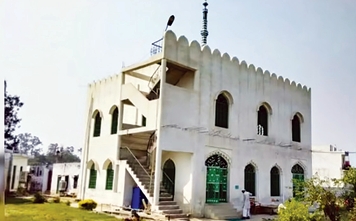
Mosques in Hindi heartland states are an exclusive male preserve. Though Islam doesn’t barentry of women into mosques, they are scrupulously kept away from the holy precincts all across north India. But Amber Mosque in the outskirts of Lucknow challenges this shibboleth. It was founded and built by Ms. Shaista Ambar, a social activist from Lucknow who wouldn’t take such taboos lying down.
Wife of a bureaucrat in Uttar Pradesh, Shaista conceived the idea of a mosque where women could also offer namaz alongside men, in 1995. As a young woman, Shaista would take up social causes during the 1980s and 90s. Construction of a mosque was certainly not on her mental screen. But the rebel in her got awakened when she took a child inside a mosque to introduce him to the collective prayers.
For the imam the sight of woman inside the mosque was no less than a sacrilege. She was ordered out. The outrageous behaviour left a deep imprint on her. Beating a hasty retreat, she vowed to build a mosque where both men and women could pray. She drove straight to Nadwatul Uloom, the world famous centre of Islamic learning in Lucknow seeking an audience with Maulana Ali Miyan, the 7th Chancellor of the seminary and a world re nowned scholar of Islam.
The revered Maulana signalled her to go ahead pledging his full support. Pouring the family’s savings, a 26,000 square feet plot of land was bought in Teli Bagh, 15 kms away from the city centre on the road going to Rae Bareli. She sold away her car and ornaments to raise the required funds. The move gathered support from wider circle of relatives and acquaintances.
Lo and behold! The mosque came up opposite the trauma care centre of the Sanjay Gandhi Post Graduate Institute of Medical Sciences. And it was none other than Maulana Ali Miyan Nadwi who presided over the consecration of the mosque in 1999. (He passed away on December 31, 1999). The mosque can host a congregation of over a thousand persons on a Friday when doughty Shaista Amber ensures her weekly presence.
She presides over the committee taking care of the mosque as the chief mutawalli with several other members of the family. She has resolutely stood against traditional maulvis taking over the management of the mosque. There have been pleas to start a madrassa (Islamic theological school) within the precincts.
She has declined permission and has instead started a dharamshala (stay-homes for wayfarers) within the boundary of the mosque where women attendants of inmates at the Sanjay Gandhi Institute find accommodation at a very reasonable rent. And they could belong to any faith. She says Uttar Pradesh has several thousands of madrassas but no dharamshalas and other such key civic facilities set up by Muslims.
The mosque is open for namaz to Sunnis as well as Shias, the major sects within Muslims. The mosque also runs a counselling centre where family disputes, mainly post-marital, are referred for resolution. Shaista has had differences with the All India Muslim Personal Law Board on several issues pertaining to women’s rights in Islam.
Critical about the rigidity on its outmoded stances, she and several of her supporters set up the All India Muslim Women Personal Law Board nearly a decade ago. The Board has appreciated the law banning the practice of triple talaq at one sitting and has suggested several progressive reforms. One who completed her graduation from the Aligarh Muslim University and later acquired Adib and Kamil certificates, Shaista has willed that her two daughters and son would look after the management of the mosque after her passing away.
Shaista came visiting Bengaluru last May at the invitation of the Azim Premji University for a seminar where this author had a chance meeting as a participant. Log onto www.shaista ambar.com for an overview of her vision and activities.
source: http://www.newstrailindia.com / News Trail / Home / by M A Siraj / October 19th, 2025
Amid our fast-paced lives, there exists a remarkable group of individuals who believe in slow, steady, and consistent efforts to create meaningful change.
These individuals are known as changemakers—people who quietly dedicate themselves to bettering society, far from the spotlight and the noise of daily routine.
They don’t seek fame or recognition. Instead, they focus on making a positive impact in their communities. Often unheard of, these changemakers influence others through their actions, values, and vision for a better world.
Awaz–The Voice is proud to launch a special series starting this Sunday, spotlighting Indian Muslim changemakers of India.
Through their inspiring stories, we aim to shine a light on individuals whose work exemplifies compassion, dedication, and innovation.
Our editorial team has carefully selected these changemakers based on several parameters, including the authenticity of their efforts and the tangible impact they have made.
These are everyday heroes who are addressing pressing social, environmental, and economic challenges—often with limited resources but unwavering commitment.
They are improving access to education, healthcare, and sanitation; they are empowering women, protecting the environment, and uplifting their communities—all without expecting any rewards or recognition. For them, the satisfaction of doing good is reward enough.
Their actions may seem small, but their impact is profound. As the saying goes, “Every drop counts in making an ocean.” Each changemaker is a vital part of the wave of progress that is quietly transforming India.
One of our key criteria in identifying these individuals was whether they are creating tangible change or inspiring others to become changemakers themselves. For us, a changemaker is someone who brings positivity into the world through innovative solutions, leadership, and a commitment to improving lives and systems.
In a world that often celebrates loud success, we believe it’s important to pause and acknowledge those who uphold the highest ideals of humanity. These changemakers serve as a moral compass, reminding us of our own responsibilities to society and to one another.
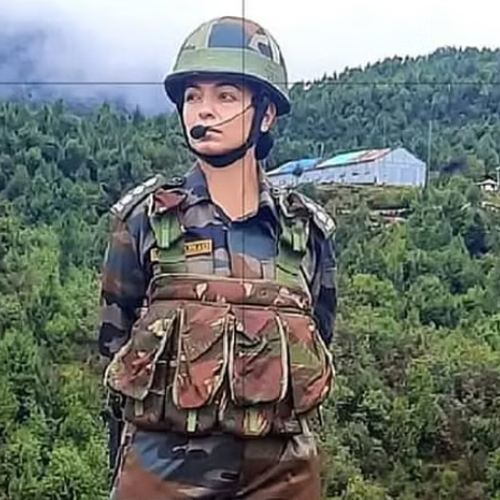
We begin our series with changemakers from Uttar Pradesh, featuring stories like that of Capt. Saria Abbasi, who dreamt of joining the Indian Armed Forces from a young age. After earning her engineering degree and receiving multiple job offers, she chose instead to follow her dream and joined the Indian Army—becoming a role model for countless Muslim women aspiring to serve the nation. She has done challenging missions like serving at Indo-China border post at Tawang in October 2021.
Rubina Rashid Ali, who lives in Aligarh Muslim University’s campus has become a champion for women earning their livelihood out of applique (ornamental needlework in which pieces of fabric are sewn or stuck). She has stood up for them to ensure that these women from poor backgrounds get the wages they deserve.
The changemakers of India
Dr Farha Usmani, a medical practitioner who hails from Aligarh, went to US to pursue her career in the United Nations Population Fund in 2007. Leaving behind her family was a tough call for her. She is the only Muslim woman to have risen to the position of director in the UNFPA. Today, she is making world policies for women’s health and rights. She is the Vice President of SAFAR, an organization that is responsible for the overall advancement and rights of minority and marginalized women and girls in India.
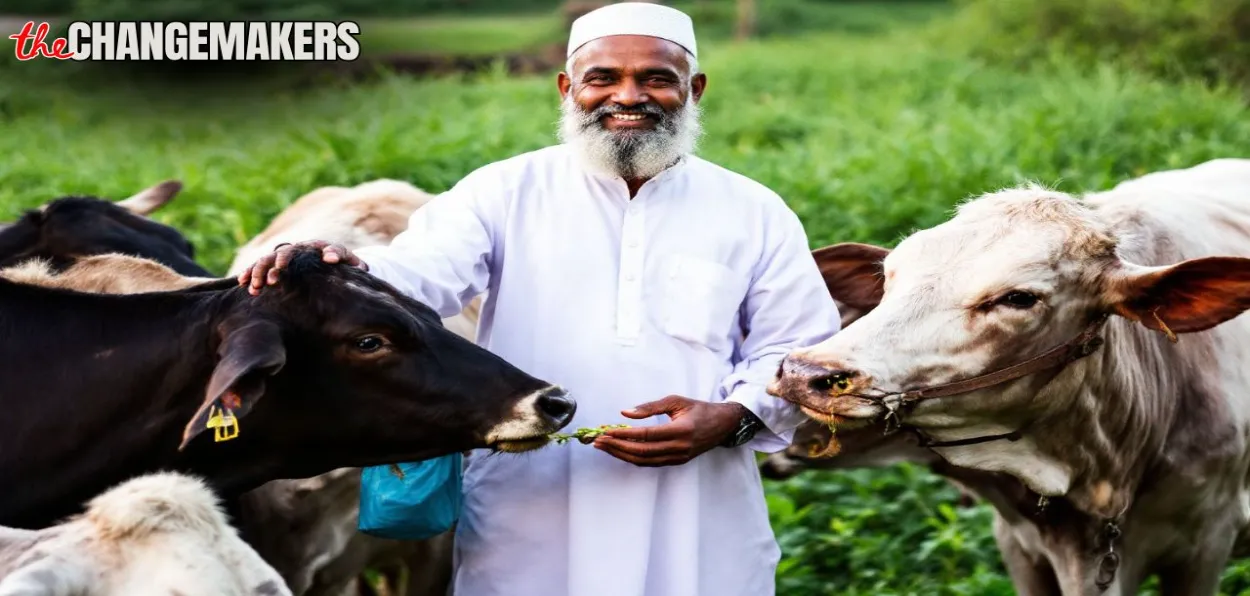
Another inspiring figure is Babban Mian, a businessman who runs a large gaushala (cow shelter) in Bulandshahar, caring for hundreds of cows. Inspired by his late mother’s deep affection for animals, Babban Mian’s work also challenges stereotypes and promotes harmony by offering a different perspective on the Muslim community’s relationship with animal care.
Some of the changemakers will remind you of characters straight from Indian folklore and vernacular literature. People who have been nurtured by Indian civilizational values of compassion and selflessness.
Through these stories and many more, we hope to inspire our readers and celebrate the quiet revolution being led by changemakers who are shaping a better, more inclusive India.
We’d love to hear your thoughts on this series. Write to us at input@awazthevoice.in or engage with us on our social media platforms.
The author is the Editor-in-Chief of Awaz-the Voice portal
source: http://www.awazthevoice.in / Awaz, The Voice / Home> Stories / by Atir Khan, Editor-in-Chief, Awaz-the Voice portal / May 22nd, 2025
Students of the Interdisciplinary Department of Remote Sensing and GIS Applications at Aligarh Muslim University (AMU) have earned prestigious academic admissions and professional placements at leading institutions in India and abroad, underscoring the department’s growing reputation in geospatial sciences.
At the international level, Ms Areena has been selected for a PhD programme at the University of Waikato, New Zealand. Meanwhile, Mr Md Zaid Qamar has secured admission to the International PhD Programme under the UNESCO Chair in Environment, Resource and Sustainable Development at Parthenope University of Naples, Italy.
On the national front, Mr Ahsan Sayeed has gained admission to the PhD programme in Geomatics at IIT Guwahati. Additionally, Ms Mantasha, Mr Tauheed Ahmad Ansari and Mr Zuhail Abdullah have been selected as Junior Resource Persons at the National Institute of Hydrology, Roorkee.
The department’s students have also made notable strides in the corporate sector. Ms Shaista Perween has been appointed Assistant Manager at Tata Steel Limited in Jamshedpur, while Ms Juveriya Aqeel has secured a position with WSP in Bengaluru with an attractive remuneration package.
Congratulating the students on their accomplishments, Dr Haris Hasan Khan, Chairman of the department, said the achievements reflect both the students’ dedication and the department’s strong academic and research ecosystem in remote sensing and geospatial sciences.
source: http://www.radiancenews.com / Radiance News / Home> Education> Latest News / by Radiance News Bureau / February 12th, 2026
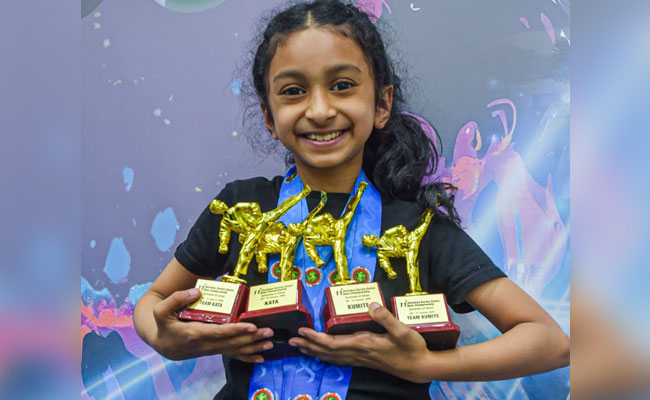
Indian karateka Zaara Vasim Assadi emerged as the standout performer at the International Karate Open Championship held as part of the Muscat Night Festival, clinching four gold medals in a remarkable display of skill and consistency.
The prestigious tournament saw participation from around 400 athletes representing 24 clubs across multiple countries. Amid intense competition, Zaara, aged just 10, created history by becoming the only girl at the championship to secure gold in all four categories she competed in individual Kata, individual Kumite, team Kata, and team Kumite.
Zaara’s achievement adds to her already impressive record. She has remained undefeated in Kata since the age of five, underlining her long-standing dominance in the discipline. Her performances were widely praised for technical precision, discipline, and composure well beyond her age.
Training at The Champ Sports & Arts in Muscat, Zaara’s journey has become a source of inspiration for young martial artists, reinforcing the idea that dedication and passion can overcome age-related barriers in competitive sport.
The championship also served as a platform for cultural exchange, bringing together athletes and spectators from diverse backgrounds and celebrating the unifying spirit of karate.
Zaara Vasim Assadi is the daughter of Vasim Assadi and Hasra Sana and hails from Udupi. She is the granddaughter of Zikriya Assadi.
source: http://www.english.varthabharati.in / Vartha Bharati / Home> Gulf / by Vartha Bharati / February 02nd, 2026
The All India Majlis e Ittehadul Muslimeen has defended newly elected Mumbra corporator Sahar Sheikh amid controversy over remarks described by critics as communal. Party leaders said her words targeted no community and called the backlash an example of selective scrutiny faced by Muslim representatives.
At a press conference, AIMIM state president and former MP Imtiaz Jalil said Sahar Sheikh made no remark against Hindus and issued no call for removal of any group from Mumbra. He said pressure continues for police action despite absence of any offensive content. He said the party stands with its corporator and treats her position as the party position.
The controversy followed remarks made after her election from Panel No. 30 B in Mumbra. AIMIM leaders said sections presented the remarks out of context to create a national level dispute soon after a Muslim woman secured an electoral win.
Jalil said the party will challenge the police notice served on Sahar Sheikh. He said the matter will reach the Supreme Court if required. He also questioned demands for an apology raised by BJP leader Kirit Somaiya. Jalil asked under which authority such demands were made while similar or harsher remarks by ruling party figures drew no response.
He referred to public statements by leaders speaking about entering mosques or issuing threats against Muslims. He asked why police action failed to follow in such cases. He said swift notices appear when Muslim women speak, while silence follows other instances.
Jalil pointed to the presence of Mayur Sarang, a Hindu supporter, at the press conference alongside AIMIM’s five elected corporators from Mumbra. He said such presence reflected the inclusive nature of the party stand.
Sahar Sheikh sat with party leaders and maintained her statement. AIMIM said it will pursue legal remedies and urged calm, asking authorities to address the issue within constitutional limits.
source: http://www.radiancenews.com / Radiance News / Home> Latest News> Report / by Radiance News Bureau / January 29th, 2026
For the first time in the history of Aligarh Muslim University Student politics, three women have won the student union elections. Ghazala Ahmad, Sadaf Rasool and Labiba Sherwani all contested the polls for the first time and all three won posts of cabinet members in the AMUSU.
The results of AMUSU elections sent a positive message about gender equality in an university that had gotten bad press for restricting library access for undergraduate women students.
Ms. Ahmad is final year student of Bachelors of Social Work, Ms. Rasool is in the final year of B.U.M.S. and Ms. Sherwani is in her first year of Bachelors of Social Work.
In 2015, one female student had won the union elections. But this is the first time in the history of AMU that three women have won the polls in their maiden attempt.
Kehkashan Khanam, a student of Ph. D. in Theology had won the post of cabinet in the last AMU student union elections. Ms. Khanam had contested this time for the post of vice-president in the AMUSU.
While talking to The Hindu on phone from Aligarh, Ghazala Ahmad said she held the victory of three girls in their first attempt to be a “sign that students of AMU want to see more girls presence and participation in overall student politics”.
When asked how she convinced a male-dominated electorate to vote for her, Ms. Ahmad said, “I told everybody on the campus that time has come to change outsiders’ perception of AMU. I told them, lets show the outside world that AMU campus is friendly and open to girls.”
The twenty-one-year old Ms. Ahmad said her inspiration was her working mother Nahid Fatima, Principal of a Government Primary School in Aligarh.
The job of a cabinet member is to ensure that the problems faced by the students at the departmental and faculty level, should be conveyed and taken up with the president, vice-president and secretary of the AMUSU. “It is a male-dominated campus but the results show that students on the campus want to more participation from girls. After all girls are also there on campus. Who will represent them. It was a tough competition so I had to work really very hard,” said Ms. Ahmad.
source: http://www.thehindu.com / The Hindu / Home> News> India> Other States / by The Hindu / November 01st, 2016
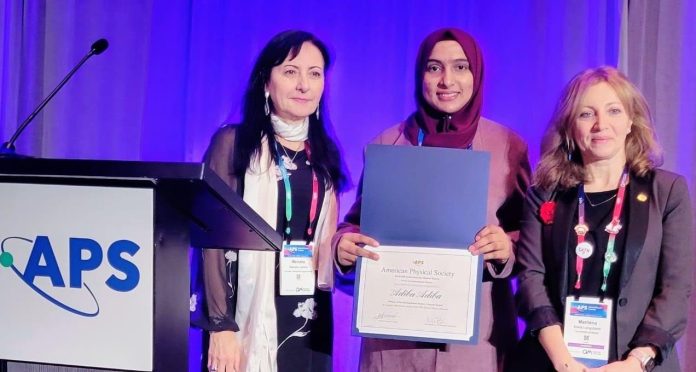
Adiba receiving the Prestigious APS Distinguished Student Award
Aligarh:
Adiba, a PhD student in Physics at Aligarh Muslim University (AMU), has been honoured with the Distinguished Student Award by the American Physical Society (APS) at the APS March Meeting 2025 in Anaheim, California.
Instituted in 2015, the award recognises exceptional early-career researchers from outside the U.S. and supports their participation in APS’s flagship meetings.
Adiba, working under the supervision of Prof Tufail Ahmad, is conducting cutting-edge research on Resistive Random Access Memory (ReRAM) devices for neuromorphic computing – an emerging frontier in physics and artificial intelligence. Her work earned her the prestigious award for outstanding contributions to the field.
Beyond research, she leads as President of the International Centre for Muslim Women in Sciences (ICMWS), championing science education among young women.
Expressing her gratitude to AMU for its role in her success, Adiba said, “Receiving this recognition from APS makes me feel incredibly proud and motivates me to strive even harder.”
source: http://www.radiancenews.com / Radiance News / Home> Latest News> Research> Science & Technology / by Radiance News Bureau / April 08th, 2025
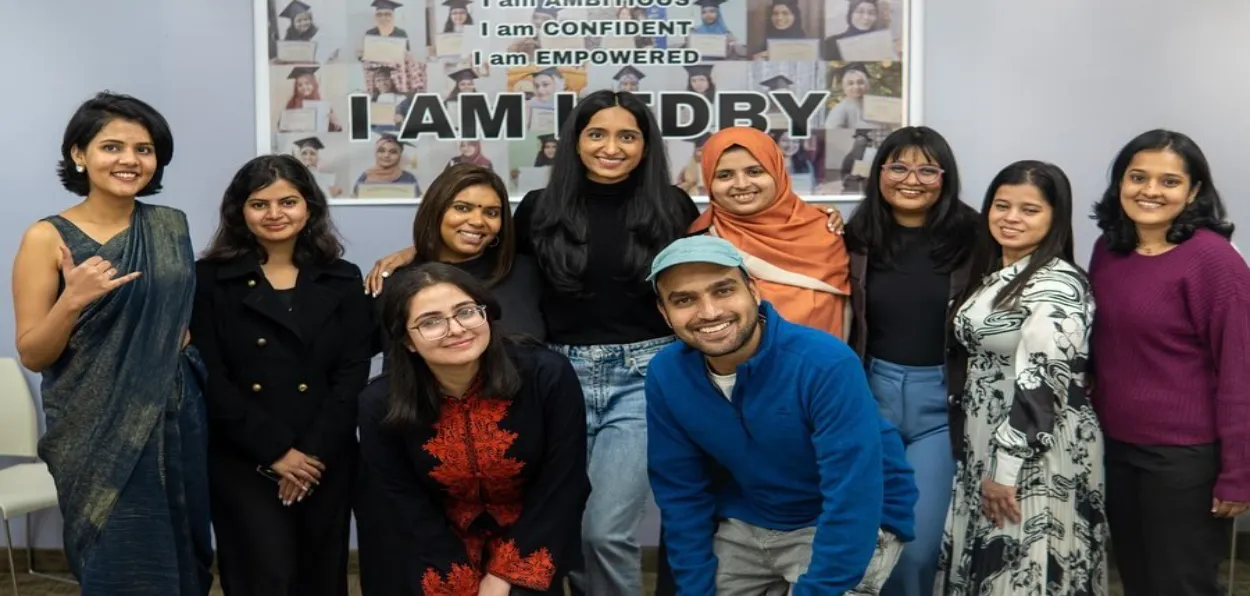
Ruha Shadab in the center (Wearing black top and jeans) with her team
Ruha Shadab acquired a degree in medicine from the Lady Harding Medical College, New Delhi, before joining Harvard University for higher studies. She along with her team at Ledby Foundation are working towards empowering Indian Muslim women to be gainfully employed and become independent. Awaz-The Voice Editor-in-Chief Atir Khan spoke to her about her work. Excerpts:
What was the intent behind starting Ledby Foundation?
There were many reasons why we started Ledby Foundation. The primary reason was that I hardly saw any Muslim women in the offices that I had worked in. Also, the overall socioeconomic indicators of our community made me feel compelled to start this. But the story most close to my heart is that of my mother, who, I think is one of the most intelligent people that I know. Many people like her are there in a community who weren’t able to realize their intellect and develop their professional dreams.
So that was something that influenced me as I started my early career and then went on to do better at Harvard. But I got time to think about what I want to do with my life, and what kind of social impact I needed to create. And I always knew that I wanted to create a social impact for the Muslim community, especially for women. As I spent more time thinking about what I could do for the community I ended up on the idea of professional empowerment of Indian Muslim women and supporting them in the workforce.
Sky was the limit for you at Harvard; you could have chosen to work in any other field. Why did you choose to do what you’re doing?
Even my medical background of becoming a doctor had to do with creating social impact. That was my goal from the beginning. The progression from doing medicine to doing global health to working on policy and helping improve Indian society has just been a natural transition to what I think can have the most impact. And as to why Muslim women, it is one of my core identities, I thought there is a strong need, and if we don’t do it, who else will? I remember when I was 14-year-old I used to tell my mother that I wanted to go to Africa to help people who were suffering from poverty and hunger.
And she said why don’t you first fix your own backyard first? There is so much that needs to be done in India, so much that needs to be done in our community. So, that made me pause and reflect and that’s what brought me here.
Ruha Shadab
Many people must be asking you why you only choose to work to empower Muslim women. Why not others?
Yes, there have been all combinations of questions. Why Muslim women? Why not Muslim men? Why not Hindu women, and X, Y, Z combination? Right. The truth is that I think of this almost from a doctor’s mindset. So, what is the issue that you’re trying to solve? The issue that we’re trying to solve is underemployment, the lack of job opportunities, and the lack of converting your education into employment.
As a Muslim woman, somebody might say, why don’t you work for the education and employment of women from other communities in India? Why only focus on Muslim women? And that’s true. India has one of the lowest female labor force participation rates in the world. And my answer to that is to think of it as seeing two patients in your clinic.
If both patients show up you can give them paracetamol. But as a doctor, I’m also going to run diagnostic tests on them and try to understand what is the underlying cause, what is the underlying disease that they have and then give them specific treatment.
One might have a bacterial infection; one might have a viral infection. Under different segments, different combinations of communities might be suffering from some of the macro issues we have in India with unemployment and job availability. But the reason is that they are not able to realize those opportunities or those unknown opportunities before us.
Ruha Shadab (extreme right) with her team members
So, the root causes differ. And then building on this, you don’t have targeted interventions focused on these root causes. You will not be able to meaningfully address them and solve them. You need to have at least focused approaches to solving that unique set of root causes that is hindering them from getting full participation in India’s workforce.
The constitution of your Ledby foundation is quite interesting. Your team members are Hindu and you have people from other faiths for the cause of empowering Muslim women. Isn’t it great? In today’s world where every community is looking inwards and they’re busy thinking about themselves?
It’s very validating. My chief operating officer is not from the Muslim community. 20% of our 120 advisers and residents are non-Muslims. 100 out of 500 of our volunteers are non-Muslims. And that just goes to show that the narrative that we are told about our country and our brethren in the country is not entirely true.
If you put your head, you will be surprised to see how many people are willing to stand up and support you. And I think that is what this shows. It also shows that supporting Indian Muslim women is not just important if you are an Indian Muslim woman, but it is in the interest of every Muslim woman, and every Indian to ensure that this unity can realize its dreams today.
Absolutely. Very important point. You know, it’s the intent and the good leadership, that you have, these are the things that matter the most. And when reach out to people irrespective of their faiths people come and support you. You have to have a good cause; people are always there to support you. Tell us more about your programs at Ledby Foundation.
Sure. So, our programs are completely virtual fellowships that we offer to Muslim women who are either in college or in the early stages of their careers. Think of it as if you are 18 to 20 years old and an Indian Muslim woman, then getting into one of the best professional development programs is probably in your best interest to expedite your professional career. There are several components to it. So, one component is online training programs that help you with, your interpersonal skills, your communication skills, and some of the basics of being able to find jobs, reach out to people, submit an excellent CV, and do interview preps.
Another workshop modules look at improving your negotiation skills. Our negotiation curriculum is developed in conjunction with Harvard professors who interviewed Indian women and developed case studies with Indian Muslim women as protagonists that we use to teach negotiations to our fellows. And then the third part, which is often cited as one of the long-lasting effects of the fellowships is our mentorship program. And our mentorship program is a 360-degree framework so each young Muslim woman who joins gets mentored.
The other aspect of the mentorship program is that each Muslim woman has to then have sessions with people in her class. And I would just say women are from across India. So, we have a very diverse group, even though we say Muslim women, it’s a very diverse Muslim women group and we get to speak to each other. The last part of this mentorship program is coaching at the school level over six months.
Ruha Shadab with the team of Ledby Foundation at a function
That’s amazing. Tell us how you make these students or candidates job-ready.
Our fellowship is very much about teaching people how to fish rather than giving them fish. So, we teach them how to identify the right opportunity, how to network with folks, and how to help them with an interview. And then we also have them practice interviews with us. They have access to facilitators, who help practice as you continue to progress.
So who are your stakeholders? Of course, the students, then you have the policymakers who are others you reach out to?
So, we try to bridge that supply-demand gap. We are creating a supply of highly skilled professional Indian Muslim women. And then we’re also making sure that there is a demand from companies to intentionally recruit and create a diverse workforce within their organizations. We bridge the gap between our fellows and companies that want to promote religious inclusion in India.
What is the kind of feedback you get from, say, policymakers and the corporate world when you approach them with this kind of information?
So, we usually try to approach them from a very fact-based point of view. We also carry out research to identify what are the barriers to entry and retention of Muslim women in India’s workforce. The research we conduct help a lot of companies see through a fresh perspective. So even if you educate Muslim women, that does not necessarily mean they have the same chances at employment. The company officials tell us that they never thought about this, they were never made to confront this reality. So, we meet them just to reflect.
Ruha Shadab with a support group of her Foundation
So what kind of support and responses you’re getting from people that you’re reaching out to?
Well, overall, it’s been positive. People are interested in understanding what we do, supporting us in even exploring the talent pool that we are creating. And we have several stories of women who’ve gotten recruited through our own pipeline to companies.
That’s wonderful. And there must be some very bright candidates you come across. We see there is an awareness among Muslim families even in small towns for pursuing higher education.
That’s true. There is a very strong drive and fire within the women that we meet. And we try to move more away from urban centers.
Right now, we are more focused on urban centers and ensure that we are able to move farther away from that in the future. And yes, we do see that. See, I think in addition to being pleasantly surprised at how many people from outside of the Muslim community are willing to help us, with very positive insights.
I’m sure that you inspired a lot of Muslim girls, you’re a big success story from India, an Indian who’s doing so well. Do you also think that we need to convey more such success stories to these aspiring girls to inspire them?
Absolutely. And I think what helped was having people believe in me, and we’re trying to make more Muslim women feel that they are heard and that somebody believes in their talent.
You’re doing deep thinking and you’re working in this field, what would be your appeal to the government and the corporate sector for improving the employability chances of Indian Muslim women?
My appeal would be to have intentionality behind getting more Muslim women into the workforce. The truth is that we shy away from talking about religious inclusion in India, which is strange. Because so much of our lived reality is a function of our religious identity. There is no distinction between the personal, the political, and the professional and it is incorrect to create these artificial distinctions.
source: http://www.awazthevoice.in / Awaz, The Voice / Home> Stories / by Atir Khan / February 29th, 2024
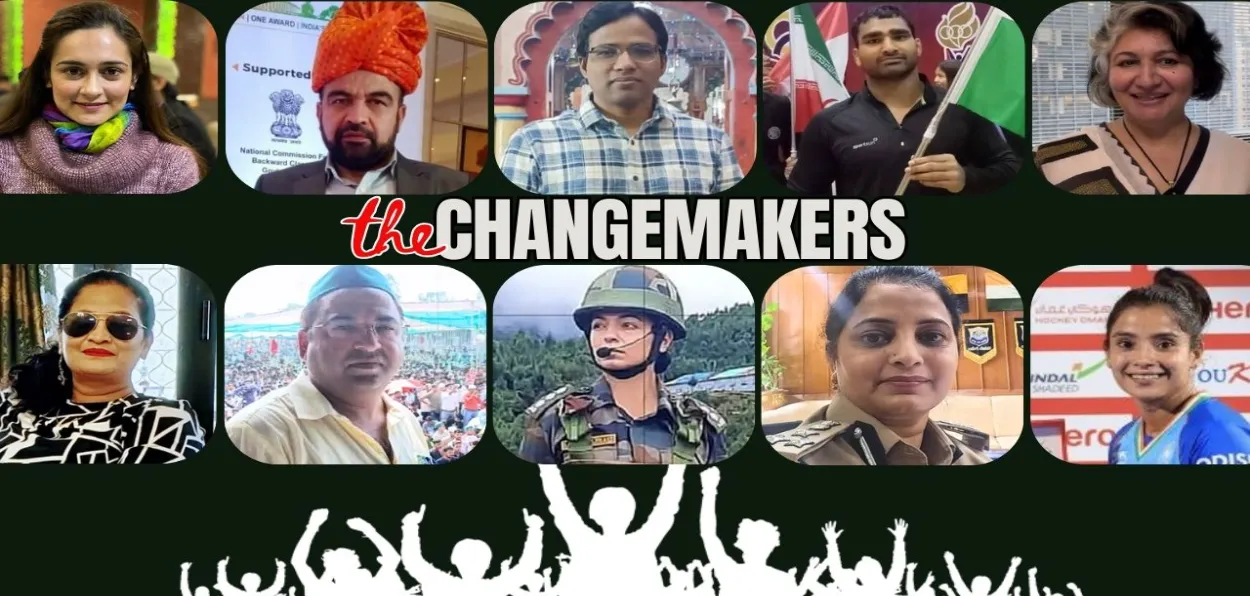
While media spotlight often shines on celebrities and politicians, the real engine of India’s progress runs on the resolve of countless unsung heroes who, away from limelight, quietly transform society.
From national defense to grassroots education, sports, science, and civil service, these individuals from Uttar Pradesh show how courage, compassion, and conviction can drive extraordinary change. Here are 10 such trailblazers whose stories deserve to be heard:
Captain Sariya Abbasi: A Woman in Uniform on the Frontlines
Hailing from a small city of Gorakhpur, Uttar Pradesh, Captain Sayria Abbasi broke every convention to join the Indian Army. A graduate in Genetic Engineering and with plenty of job offers and career opportunities from big companies was not enough for her to pursue in life. The call of service for the motherland was too strong to be sacrificed.
The world noticed her as a soldier deployed at the Line of Actual Control (LAC), India-China temporary border, manning an Air Gun. Today, Sariya leads drone-killer teams and operates L-70 anti-aircraft guns on the border. Her journey from an academic achiever to a defender of the nation’s borders is not just about military precision; it’s about shattering glass ceilings and reshaping how India imagines women in uniform.
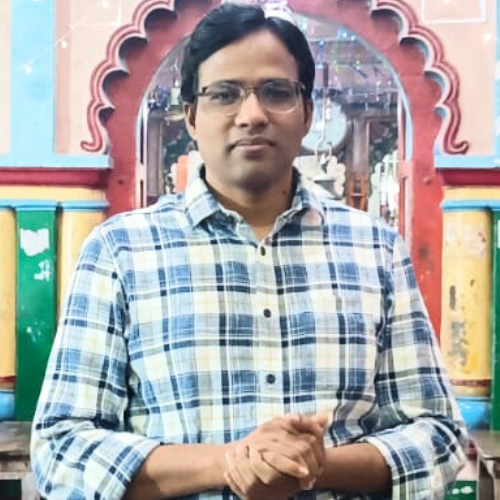
Dr. Faiyaz Ahmad Fyzie: Voice for the Voiceless Pasmanda Community
Dr. Faiyaz Ahmad Fyzie, an AYUSH physician, is more than a healer—he is a public intellectual, columnist, translator, and relentless advocate for the Pasmanda (socially backward) Muslim community. Raised in modest conditions, his rise to national recognition is built on fearless writing and tireless grassroots work.
When even the Prime Minister refers to Pasmanda voices, Fyzie’s years of advocacy resonate. His pen continues to empower those whose struggles were long silenced. His work is a call to conscience—and a roadmap for inclusive discourse.
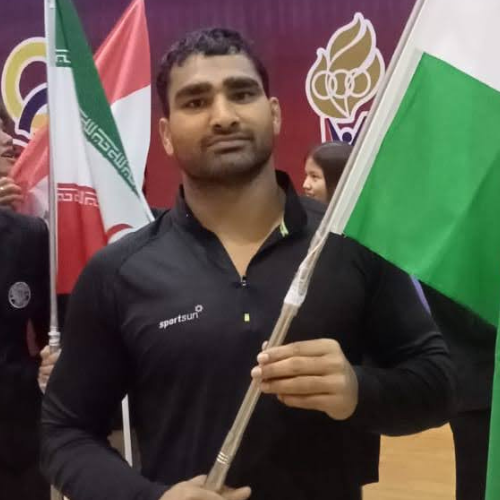
Mohammad Luqman Ali: Wrestling His Way to Glory and Degree
Wrestler Mohammad Luqman Ali, a student of Social Work at Jamia Millia Islamia, is balancing body and brain. Born in Amroha’s tiny village of Mohraka Patti, his father worked on the railways, and his mother gave him religious grounding. Despite limited resources, Luqman’s grit has earned him recognition in India’s wrestling circles.
From the mat to the classroom, his dual commitment shows that excellence doesn’t require compromise. It requires discipline, heart—and a family’s belief in you.
Rubina Rashid Ali: Reviving Mughal-Era Art with a Modern Mission
In a sun-drenched corner of Aligarh, Rubina Rashid Ali has quietly built a movement. Her work in floral appliqué embroidery, a legacy of Mughal art, now supports dozens of women in Aligarh and Rampur. What was once an undervalued craft monopolized by middlemen has been transformed by Rubina into a vehicle for women’s economic empowerment.
Her home resonates not only with the sound of needles and threads but also with the hum of independence. “Real artists were reduced to laborers,” she says. Today, she ensures their hands are not just working — but also earning.
Babban Mian: A Gaushala Keeper Inspired by His Mother’s Love
At Madhu Sudan Gaushalla in Bulandshahr, Babban Mian tends to cows not out of ritual, but reverence — inspired by his late mother Hamidunnisa Begum. “She loved cows like her own children,” he recalls. After she passed away in 2015, Babban vowed to preserve her legacy.
Despite being a Muslim in a Hindu-dominated tradition, he runs a government-recognized shelter rooted in compassion, not controversy. For him, animal welfare is a universal value — not a communal issue. His work quietly redefines what shared culture and interfaith harmony look like.
Khushboo Mirza: From Amroha to the Moon with ISRO
Khushboo Mirza, scientist at ISRO and part of the Chandrayaan-1 and Chandrayaan-2 missions, is a stellar example of perseverance. After her father’s death when she was just seven, her mother raised three children alone, running a petrol pump and defying social norms.
Khushboo earned a Gold Medal in Electronics Engineering from AMU and was the youngest member of the Chandrayaan-1 checkout team. A practicing Muslim and a symbol of India’s scientific aspirations, she turned down corporate offers to reach for the stars—and took a whole generation of girls with her.
Zaheer Farooqui: A People’s Leader with a Vision for Purkazi
In western UP’s Purkazi, Zaheer Farooqui is rewriting what local leadership means. As Nagar Panchayat Chairperson, he donated land worth ₹1.5 crore for the area’s first Intermediate College and modernized local schools into PM Shri-certified institutions.
His initiatives go beyond classrooms. From India’s first double-storey government-run cow shelter to a gym for Muslim women, and one of the most sophisticated rural CCTV networks in the region — Farooqui’s governance is a blend of tradition and tech, equity and empowerment. His Tiranga Yatra revives local history, reminding citizens that patriotism is inclusive and action-oriented.
Dr. Farah Usmani: From AMU to Global Health Leadership
On a cold morning in New York, Dr. Farah Usmani stood outside an apartment, a folder in hand, her eyes bright with resolve. The daughter of Uttar Pradesh, she is today a formidable presence in global health policy.
n M.D. in Obstetrics & Gynecology from AMU, Farah sought impact beyond hospital walls. Armed with a Master’s in Health Policy from LSE and the London School of Hygiene & Tropical Medicine, she’s led transformative health initiatives around the world. Her journey is one of intellect guided by idealism — a doctor who chose not just to heal individuals but to reform systems.
Anjum Ara: Bridging Communities Through Compassionate Policing
Hailing from Azamgarh’s Kamharia village, Anjum Ara, a 2012-batch IPS officer, has redefined the image of policing with a human touch. A computer engineer by training, her journey from Integral University to Senior Superintendent of Police in Shimla has been marked by integrity and reform. Known for her work in cybercrime and her community-focused policing model, Anjum is also a fierce advocate for girls’ education.
Together with her husband, IAS officer Yunus Khan, Anjum adopted the cause of Khushdeep, the daughter of a martyred soldier, pledging to support her upbringing. This act of empathy mirrors her professional ethos, proactive, principled, and deeply people-centered.
Mumtaz Khan: From Vegetable Stall to World Hockey Stage
From the bustling alleys of Lucknow’s Cantt area to the turf fields of South Africa, Mumtaz Khan’s journey is pure grit. Once helping her father at a vegetable stall, a single race at school changed her life when Coach Neelam Siddiqui noticed her speed. That moment set her on a course to become a leading forward in India’s Junior Women’s Hockey Team.
Her standout performance at the 2018 Youth Olympics, where she scored 10 goals, earned her national acclaim. Yet, Mumtaz remains rooted, balancing hope and humility as she eyes the Olympics. She is proof that dreams born in dusty streets can blaze across international arenas.
These ten changemakers hail from Uttar Pradesh, from narrow village lanes to bustling metros, from battlefields to laboratories. But they are united by one thing: quiet, relentless courage. In their lives, we find the India that persists, uplifts, and transforms—not with headlines, but with hard work.