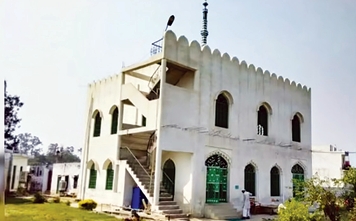
Mosques in Hindi heartland states are an exclusive male preserve. Though Islam doesn’t barentry of women into mosques, they are scrupulously kept away from the holy precincts all across north India. But Amber Mosque in the outskirts of Lucknow challenges this shibboleth. It was founded and built by Ms. Shaista Ambar, a social activist from Lucknow who wouldn’t take such taboos lying down.
Wife of a bureaucrat in Uttar Pradesh, Shaista conceived the idea of a mosque where women could also offer namaz alongside men, in 1995. As a young woman, Shaista would take up social causes during the 1980s and 90s. Construction of a mosque was certainly not on her mental screen. But the rebel in her got awakened when she took a child inside a mosque to introduce him to the collective prayers.
For the imam the sight of woman inside the mosque was no less than a sacrilege. She was ordered out. The outrageous behaviour left a deep imprint on her. Beating a hasty retreat, she vowed to build a mosque where both men and women could pray. She drove straight to Nadwatul Uloom, the world famous centre of Islamic learning in Lucknow seeking an audience with Maulana Ali Miyan, the 7th Chancellor of the seminary and a world re nowned scholar of Islam.
The revered Maulana signalled her to go ahead pledging his full support. Pouring the family’s savings, a 26,000 square feet plot of land was bought in Teli Bagh, 15 kms away from the city centre on the road going to Rae Bareli. She sold away her car and ornaments to raise the required funds. The move gathered support from wider circle of relatives and acquaintances.
Lo and behold! The mosque came up opposite the trauma care centre of the Sanjay Gandhi Post Graduate Institute of Medical Sciences. And it was none other than Maulana Ali Miyan Nadwi who presided over the consecration of the mosque in 1999. (He passed away on December 31, 1999). The mosque can host a congregation of over a thousand persons on a Friday when doughty Shaista Amber ensures her weekly presence.
She presides over the committee taking care of the mosque as the chief mutawalli with several other members of the family. She has resolutely stood against traditional maulvis taking over the management of the mosque. There have been pleas to start a madrassa (Islamic theological school) within the precincts.
She has declined permission and has instead started a dharamshala (stay-homes for wayfarers) within the boundary of the mosque where women attendants of inmates at the Sanjay Gandhi Institute find accommodation at a very reasonable rent. And they could belong to any faith. She says Uttar Pradesh has several thousands of madrassas but no dharamshalas and other such key civic facilities set up by Muslims.
The mosque is open for namaz to Sunnis as well as Shias, the major sects within Muslims. The mosque also runs a counselling centre where family disputes, mainly post-marital, are referred for resolution. Shaista has had differences with the All India Muslim Personal Law Board on several issues pertaining to women’s rights in Islam.
Critical about the rigidity on its outmoded stances, she and several of her supporters set up the All India Muslim Women Personal Law Board nearly a decade ago. The Board has appreciated the law banning the practice of triple talaq at one sitting and has suggested several progressive reforms. One who completed her graduation from the Aligarh Muslim University and later acquired Adib and Kamil certificates, Shaista has willed that her two daughters and son would look after the management of the mosque after her passing away.
Shaista came visiting Bengaluru last May at the invitation of the Azim Premji University for a seminar where this author had a chance meeting as a participant. Log onto www.shaista ambar.com for an overview of her vision and activities.
source: http://www.newstrailindia.com / News Trail / Home / by M A Siraj / October 19th, 2025
The Council of Science and Technology, Uttar Pradesh honoured Dr. Riaz Ahmad, Lecturer at Department of Zoology, Aligarh Muslim University (AMU), with ‘Young Scientist Award’ yesterday. The award has been given to Dr. Ahmad in recognition of his contributions in the area of Biochemical and Molecular Genetics. Besides cash prize of Rs. 25,000/, award carries a certificate, memento and a shawl.
The award was presented to Dr. Riaz Ahmad by Mr. Abdul Mannan, the State Minister for Science and Technology at the Vigyan Samaroh at Sir C.V. Raman Auditorium in Lucknow.
Dr. Ahmad is also a recipient of prestigious Dr. D. S. Kothari Post Doctoral Fellowship from UGC, Young Scientist Project of DST and Scientist of the Year Award-2009 given by the National Environmental Science Academy.
He has a number of research papers to his name published in various scientific journals of national and international repute.
source: http://www.twocircles.net / TwoCircles.net / Home> Indian Muslim / by TCN News / March 30th, 2010
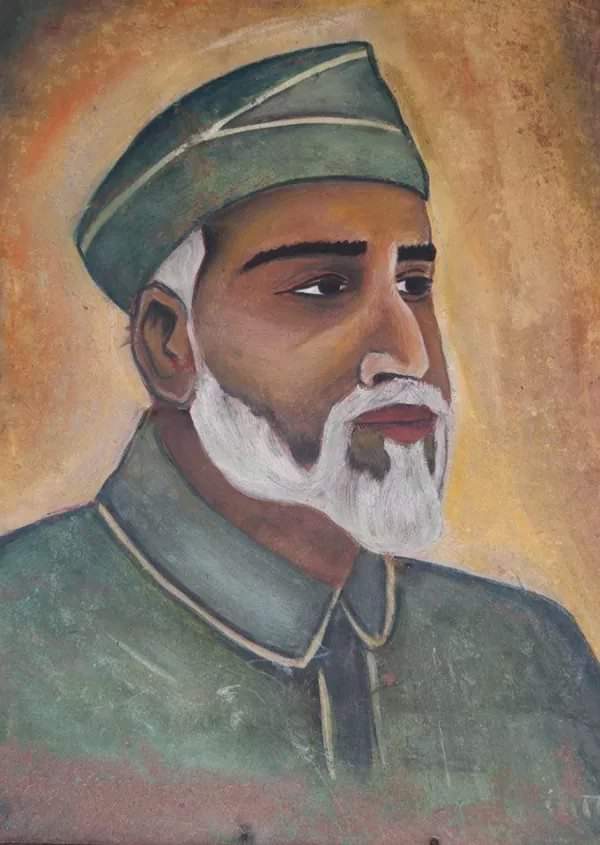
One of the most significant features of the rebellion of 1857-58 was that many scions of the former ruling houses took part in it. One such man was Khan Bahadur Khan (1860), a descendent of Hafiz Rehmat Khan (d. 1774). In this very blog of the Independence Week series, we will be throwing some light on Khan Bahadur Khan and his rebellion. How almost an eighty year old man kept the torch of rebellion against the Company in Bareilly burning.
Very little is known about the early life of Khan Bahadur Khan. It seems that having acquired traditional education in Arabic and Persian and Islamic learning; he joined the Company’s service, rising to the position of Sadar Amin (arbitrator or a native civil judge).
Upon retirement he continued to live at Bareilly where he enjoyed considerable status as grandson of the widely venerated Ruhela chief, Hafiz Rahmat Khan. In 1857 when the rebellion began, Khan Bahadur Khan was well over 82 years of age. During the rebellion, Bareilly became one of the important centers of the rebels under Khan Bahadur Khan’s leadership. In course of time, many rebel leaders came to Khan with a view to continue the struggle against the Company’s Government. A communal harmony was maintained in Bareilly despite the constant efforts of the Company to ignite the flame of hatred amongst the people through Bribery and inciting the Rajputs against Khan. This maintenance of harmony amongst the different classes of people in Bareilly is considered one of the major achievements of Khan despite the constant attack by the Company.
The old farmers of the region were affected badly because of the forceful sale of their lands by the British to suit a “capitalist” concept of property. This constant suppression led the uprising of 1816 when the company imposed the Chowkidari taxes. This uprising was soon crushed but it had led to a widespread range and discontent and people from all other regions came to Bareilly to join the uprising. The Rebellion of Bareilly was not just a religious war against the Company, it was due to the bitterness of those who had lost their lands and the anxiety of those who would be forced to lose them.
The rumors of trouble had started circulating in the region a couple of months before the actual revolt took place. The 18th Infantry Regiments and the 8th Irregular Cavalry were stationed at Bareilly. Of these the 8th Irregular Cavalry consisted almost entirely of Pathans. No European troops were stationed at Bareilly. The artillery branch which had in its ranks, as a subedar, Bakhat Khan, a disciple of Moulvi Sarfaraz Ali, the latter took a leading part in the Rebellion of 1857 and brought numerous Ulema of Delhi to call the struggle against the British as Jihad (holy war). It seems that the rebel sepoys were keen to raise Khan Bahadur Khan the Nawab of Bareilly as their leader but in the beginning he did not respond favourably to their overtures.
Ultimately on May 31, 1857. i.e. twenty-one days after the outbreak of the revolt in Meerut, Bareilly joined the rebellion. On 1 June under the guidance of Bakht Khan, concerted efforts were made by the rebels to persuade Khan Bahadur Khan to assume leadership. How Khan came to be persuaded by the rebels is evident from his own letter to the Governor General dated 14th February 1860 where he states that upon the deterioration in law and order, a deputation of the citizens of Bareilly headed by Syed Miyan Jan, Syed Faizullah, Miran Khan from Nau Mahla Mohalla, accompanied by several other persons and traders of the city approached him to take step to restore order. Syed Miran Jan at last prevailed upon him to move out of his residence.
Khan, now assuming leadership visited the city to restore order once again. He held a Darbar were prominent Hindu and Muslims were present. Like other rebel leaders, Khan Bahadur Khan also issued a proclamation addressed to all the Rajas and others, appealing to their zeal in defending religion. The main thrust of his proclamation was that the Indians’ religions (Hinduism and Islam) were in danger owing to the Company’s pro-Christian policy and attempts at Christianizing Indians. The proclamation also criticized some of the progressive measures taken by the Company’s Government such as the prohibition of Sati and widow- remarriage. The Bareilly proclamation was clearly an attempt to win the support of the Rajputs, a social group which practiced Sati and adoption, and so resented their suppression. The Bareilly proclamation also added that the Muslim leaders had to ban cow slaughter — a step considered of vital importance to maintain communal harmony. This was specially so when the majority of the rebel sepoys consisted of Hindus.
Khan Bahadur Khan was so keen to raise an efficient army that he did not burden the Rebel treasury with the pensions he had been receiving earlier from the Company.
The end of March 1858, Bareilly remained in the able control of Khan Bahadur. Despite a clear state resolution, the British policy, just to incite a division of the rebels assumed a new proportion on the cow slaughter issue. This time some Muslims mongers became active and insisted on slaughter on public places which was unacceptable to the Hindu sepoys. This led Khan hold a meeting of both the prominent Hindus and Muslims. It was attended by 12 Hindus and 20 Muslims. It was a tense atmosphere for obvious reasons and an axious and sad Khan Bahadur intervened saying “O Allah, why is so? Why is there so many squabble and blood-shed among the brothers, Hindus and Musalmans? The Hindus are my right hand and my right ear, because of their support and strength; I am able to sit on this seat. From today I declare that if any Muslim oppresses any Hindu or kills a cow at a forbidden place, he would be punished severely. Hindus and Muslims are the same. This ought to be the slogan of the two communities from this day”. In order to further strengthen the communal harmony, Muhammad flags by Hindus and Mahabiri flags by Muslims were hoisted in Bareilly and people were requested to gather under the respective flags to unite against the British. Khan himself visited different parts of the city to unite people and raised the slogans “Hindu and Muslims are one”, “Ram and Rahim are one”, and the people pledged to oust the British from this country.
One of the reasons for the long duration of the rebel regime at Bareilly was the British pre-occupation with the rebellion at other places. During this period Bareilly became a refuge for rebel leaders from far and near.
The movements of the rebel to and from Bareilly were very closely monitored by the British. The rebels lacked an efficient system of communication and the British on the other hand started communicating with Delhi, Agra, Nainital and Ambala and couriers with areas where they had no complete control. The rebels were fully aware of the danger that they had from the British Army and they made elaborate arrangements for guarding various ferry crossings. They also attempted to dislodge the Company officials from Nainital and other places, capturing Haldwani and Bhamauri (October 1857), and then Bundia on the high road between Haldwani and Bareilly. Their advance was checked by Colonel Mclausland at Baheri. The reverse was enough to persuade Khan Bahadur Khan to change the strategy. He instructed the rebel forces: “Don’t attempt to meet the regular column of the infidels, because they are superior to you in discipline and bandubast. and have big guns, but watch their movements. guard all the ghauts on the rivers, intercept their communication, stop their supplies, cut up their daks and posts, and keep constantly hanging about their camps; give them no rest”.
Though the company’s attempt to put the Rajputs against Khan in Bareilly had failed, they had succeeded in pitting the Rajputs of Dhatiganj in Bafaun against Khan, and Khan on the other hand had to take care of the Shia’s and the Sunni’s at this juncture.
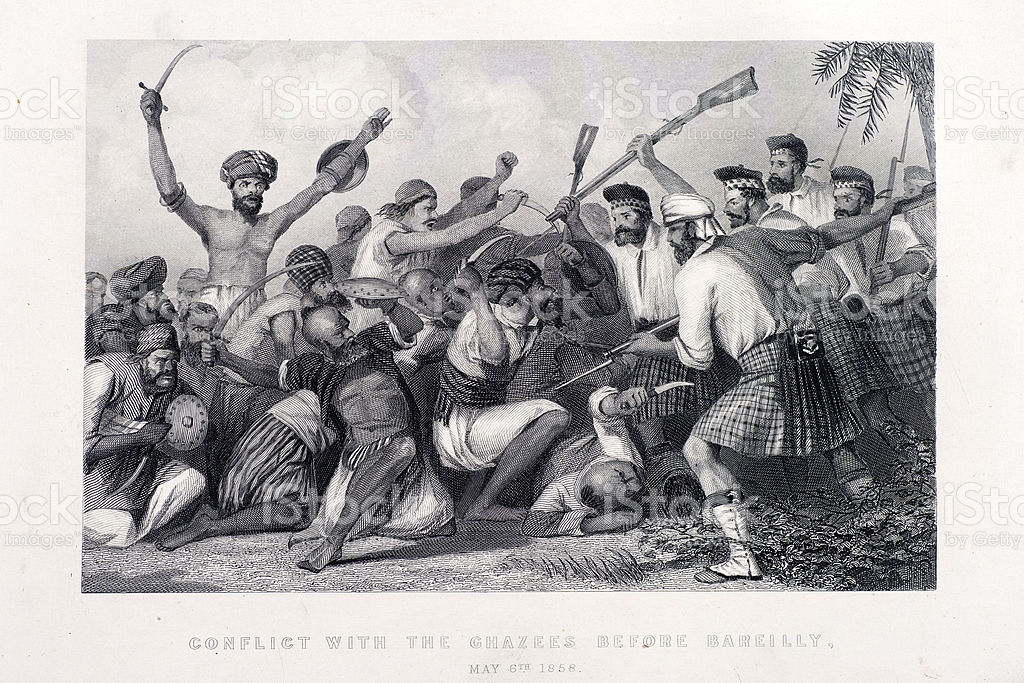
The British in Bareilly had caused an explosion with the help of their agents on 24th March 1858, killing 63 people. At the same time, the strength of the rebels were fast deteriorating due to the constant pressing forward of the company forces. They had recovered areas around Bareilly by the company troops, and the rebels were surrounded from all the sides. The company troops led by Brigadier General Jones surrounded Bareilly on 6th May. Khan Bahadur Khan had no option but to fight a pitched battle. He divided his troops into two lines. The first line was supported by the artillery commanding the bridge. The second comprising the Ghazis, defended the suburbs of the city. The British forces speedily broke the first line. They, however, had to face stiff resistance from the second line which displayed remarkable courage and determination against the enemy’s trained and organized forces. They resisted with such energy and boldness that Sir Colin Campbell was taken by surprise. To quote Russell “…a lot of Gazees got in pass the left of their right wing, attacked Walpole and Cameron, and wounded them……Sir Colin (Campbell) had a narrow escape… The Gazees were fine fellows, grizzly bearded elderly men for the most part, with green turbans and cummerbunds, and every one of them had a silver signet-ring, a long text of Koran engraved on it. They came on with their heads down below their shields, and their tulwars flashing as they whirled them over their heads, shouting, Deen! Deen! And dancing like mad men (6 May 1858)”. Sheer chivalry was, however, futile. The rebels lost the battle. Bareilly was occupied by the British forces on 7 May 1858.
“Conflict with the Ghazees before Bareilly, scence from the Indian Mutiny. Engraving from 1858, Engraver Unkown Photo by D Walker” / Source : https://www.istockphoto.com/vector/battle-at-bareilly-gm172740161-5022003
Having lost the battle, Khan Bahadur Khan took to flight. At this critical moment, the Kurmis around Bareilly provided shelter to the fugitives. From Bareilly, Khan Bahadur Khan moved towards Shahjahanpur with the intention of joining Ahmadullah Shah. Khan kept on moving and attacked the out skirts of Shahjahanpur on 12 June driving in all the pickets posted there.
He, however, could not join Ahmadullah Shah as the latter was treacherously killed by the Raja of Pawayan on 15th June. Ahmadullah Shah’s death left Khan Bahadur Khan alone. The British forces were at their heels. He took shelter in the Terai forest bordering Nepal. He wandered from place to place until Rana Jung Bahadur captured him, in December 1859, near Butwal. For some time he remained a prisoner of the Rana. Subsequently he was brought to Bareilly and confined in the Bareilly fort. He was charged with rebellion and inciting others to rebel and tried by a special Commission of enquiry. He was sentenced to death. He was hanged and laid to rest at the Bareilly Jail on 24 March 1860.
Reference/s :
Bareilly in 1857, Indian History Congress
source: http://www.sanelywritten.com / Sanely Written / Home> Freedom Fighters / by Sanely Written / August 10th, 2020