Tag Archives: Syed Shahabuddin

Syed Shahabuddin’s legacy commemorated by distinguished speakers at Delhi’s Ghalib Academy

BIHAR / DELHI :

New Delhi :

The 19th Memorial lecture commemorating the esteemed Urdu journalist Mahfoozur Rahman was held at the Ghalib Academy in Nizamuddin, Delhi. Mahfoozur Rahman, a distinguished journalist from India, was among the eminent Muslim journalists who passed away on February 6, 2010. Every year, one or two such memorial lectures are organized to honour his invaluable contributions.

This year’s lecture centred on the theme: “Syed Shahabuddin’s National and Milli Services.” Urdu journalist Wafa Azmi of Rashtriya Sahara newspaper, Delhi, delivered a meticulously prepared discourse on this subject. He emphasized that amidst those dedicated to religion, politics, culture, journalism, and social service, the late Syed Shahabuddin remains a prominent ambassador and distinguished IFS officer. Azmi underscored that omitting his name from discussions would be a disservice not only to him but also to society at large.

Wafa Azmi shared that Shahabuddin was born on November 4, 1935, near Gaya in Bihar—though some accounts suggest Ranchi as his birthplace. After completing his early education locally, he moved to Patna for higher studies, earning an MSc from Patna University. He also served there as a faculty member for a few years. During this period, he prepared for the Union Public Service Commission exams, qualified, and secured a high rank in the Indian Foreign Service (IFS).

His diplomatic career began as Deputy Consul General in New York. Over the years, Shahabuddin represented India in various countries, serving as an ambassador and diplomat. In 1978, he voluntarily retired from diplomatic service and ventured into Indian politics to address national issues.

Dr. Zafarul-Islam Khan a senior journalist, scholar and author shared his long-standing association with Shahabuddin, recalling that he was brought into the national fold by him. Initially a journalist, Shahabuddin invited him to participate in the All India Muslim Majlis-e-Mashawarat, where he was soon appointed General Secretary and later President. Dr. Zafarul-Islam praised Shahabuddin’s deep trust in him, both professionally and personally.

He recounted a personal experience from a 2003 trip to Kashmir with Shahabuddin, where sharing a room revealed his inner greatness—his early morning Fajr prayer and recitation of the Quran. Dr. Zafarul-Islam also highlighted Shahabuddin’s unwavering commitment to Indian constitutional principles, always insisting that all actions be within the framework of the Constitution, which he regarded as a sufficient safeguard of rights.

Furthermore, he mentioned that Shahabuddin launched the English-language magazine “Muslim India,” which he published from 1980 to 2000. In 2002, Shahabuddin asked him to resume publication, which he did for two years before halting due to financial constraints. Later, Shahabuddin revived the magazine, which continued to be published for several more years.

Dr. Zafarul-Islam lamented that although “Muslim India” was a quality publication, its readership remained limited, and it often operated at a loss. Despite this, it featured valuable discussions on Muslim and national issues. He revealed that he had compiled Shahabuddin’s editorials into two volumes, which are soon to be published and have been personally proofread by him. He also shared plans to publish a comprehensive volume of all Shahabuddin’s writings.

He clarified that Syed Shahabuddin was not a populist leader—a view reinforced after the demolition of the Babri Masjid. Moreover, Dr. Zafarul-Islam recounted Shahabuddin telling him that the idea of boycotting January 26, the Republic Day or wearing black bands was not his but originated from Azam Khan, and that Shahabuddin was compelled to accept it.

Senior journalist Masoom Moradabadi highlighted Shahabuddin’s heroic role during the Shah Bano case, when the Indian Muslim Personal Law Board launched the largest post-independence movement among Muslims, with Shahabuddin’s speeches drawing crowds in the hundreds of thousands.

Prof. Naseer Ahmad Khan, a close associate of Shahabuddin, expressed regret that despite his stature as a respected leader across educated circles and among the masses, only a modest funeral was held—attended by a few officials from Jamaat-e-Islami Hind, the Muslim League, and other organizations. He contrasted this with the funeral of Maulana Muhammad Ahmad Samar, which saw an estimated two to 2.5 lakh mourners, highlighting society’s oversight of Shahabuddin’s immense contributions.

Father Solomon George, the guest of honour, remarked that the stories and media reports about Shahabuddin barely scratch the surface of his efforts in social welfare and minority rights. As a fellow minority, he emphasized the importance of reflecting on why minority leaders often become vulnerable at critical moments, especially in today’s India.

Mr. Nisar Khan moderated the event, which was attended by notable Urdu personalities and presided over by retired Professor Abdul Haq of Delhi University, an esteemed scholar of Urdu and Persian literature.

In his presidential address, Professor Abdul Haq expressed his gratitude for the opportunity to participate in this gathering. He extended heartfelt congratulations to Shahabuddin, recalling his first meeting with him during Chandrashekhar’s tenure as Prime Minister. He reminisced that Shahabuddin was then a shining star in Muslim politics, actively listening to the Prime Minister’s serious discussions on the Babri Masjid issue.

This event served as a fitting tribute to a truly remarkable leader who left an indelible mark on society through his dedicated service and unwavering principles.

source: http://www.indiatomorrow.net / India Tomorrow / Home> Politics> Society / by Zillur Rahman Haider / December 02nd, 2025
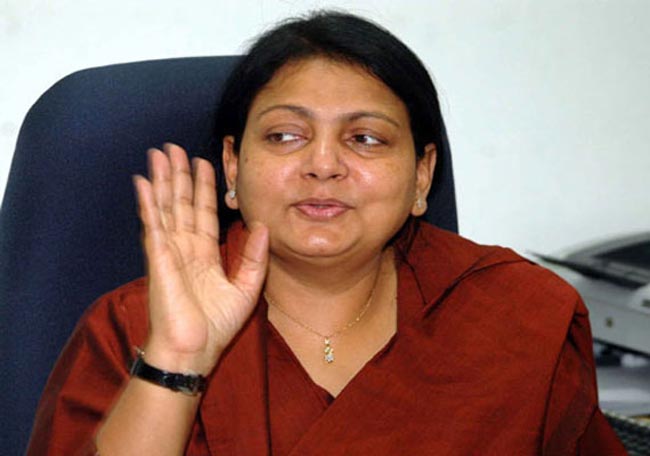
Former Bihar Minister Parveen Amanullah passes away

BIHAR :

Social activist and Former Bihar Minister Parveen Amanullah passed away today in New Delhi. She was suffering from cancer for some time.

The family had moved from Patna to Delhi for treatment. She also went to America for treatment and recovered from there. Her health had deteriorated for two-three days. she passed away today at seven PM.

Amanullah was the daughter of former Kishanganj MP Syed Shahabuddin and the wife of senior Bihar cadre IAS officer Afzal Amanullah.

Before entering politics she was known for her activism, especially in regard to her use of the Right to Information Act, 2005 to bring out the apathy prevalent in government institutions.

Amanullah was elected as a member of the Bihar Legislative Assembly in 2010 from the Sahebpur Kamal constituency in Begusarai district as a candidate of the Janata Dal (United) after defeating Rashtriya Janata Dal’s Shreenarayan Yadav.

She became the Social Welfare minister of Bihar in Nitish Kumar’s government and held the portfolio until February 2014 when she resigned from JD(U) citing “governance issues” and “lack of work satisfaction”. She joined Arvind Kejriwal’s Aam Aadmi Party two days later.

source: http://www.theindianawaaz.com / The Indian Awaaz / Home> Quami Awaaz / by Indian Awaaz / October 01st, 2023

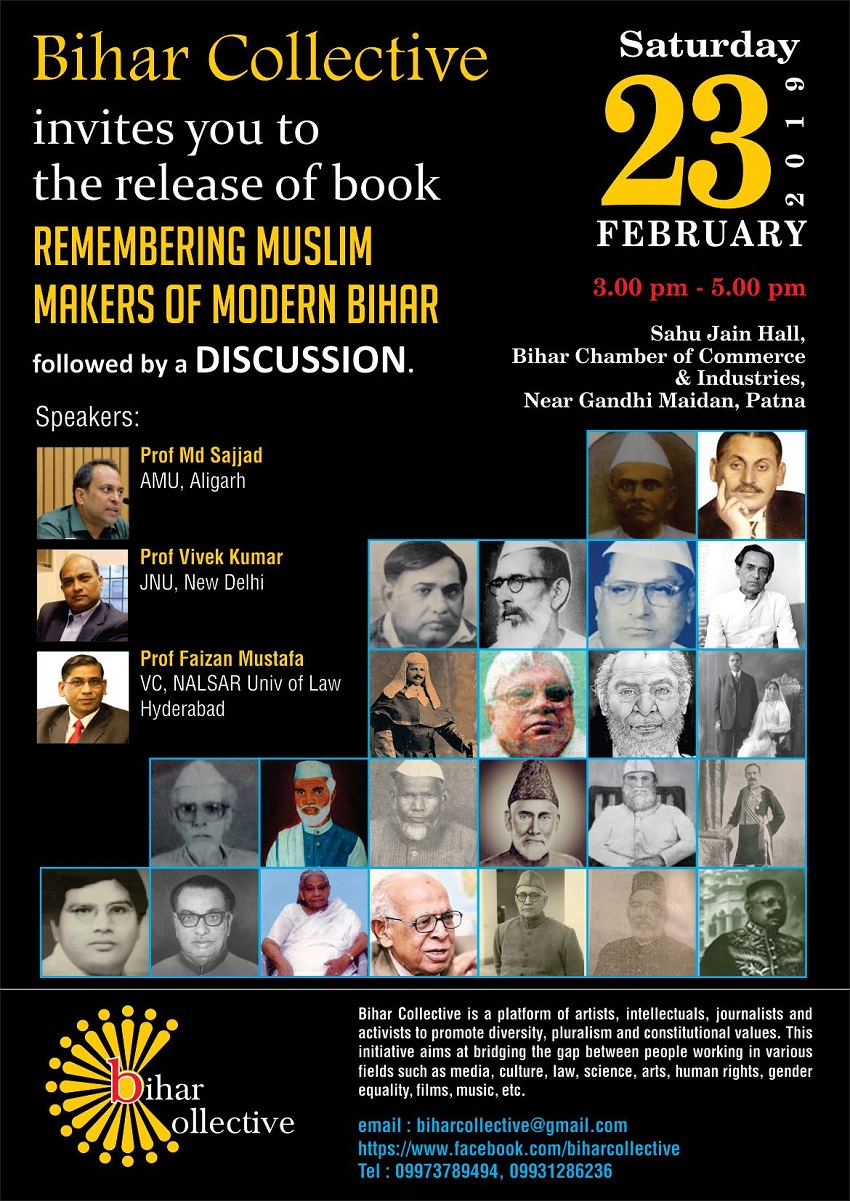
Bihar Collective to Release Booklet “Remembering Muslim Makers of Modern Bihar” in Patna on Feb 23

Patna, BIHAR :

Patna :

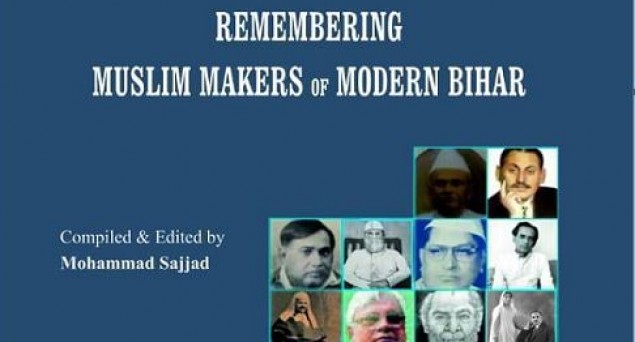
In an era of unprecedented majoritarian ascendance and anti-Muslim hatred, Bihar Collective, a platform of intellectuals and activists, has brought out a booklet highlighting the contribution of eminent Muslims in making the modern Bihar in the last 200 years.

The booklet titled Remembering Muslim Makers of Modern Bihar has been compiled and edited by renowned academician and writer Prof. Mohammad Sajjad on the initiative of Bihar Collective.

The booklet will be released at an event in Patna on Saturday (February 23).

On the occasion, a discussion will also be held with Prof Faizan Mustafa, Vice Chancellor, NALSAR University of Law, Hyderabad; Prof Vivek Kumar, JNU, New Delhi; and Prof Mohammad Sajjad, AMU, Aligarh as panelists.

A Brief about Booklet:


Pre-empting a reasonable question about the title of the booklet, Prof Sajjad, who has compiled and edited it, writes in its preface: “A simple and obvious question that may readily arise is: why only Muslim makers of modern Bihar? Why not others too? This is indeed a valid and pertinent question.”

Responding to the question, he further says: “Candidly put, this is because of an unprecedentedly menacing rise of majoritarianism, bigotry, and anti-Muslim hatred, with open support of the state.

The Muslim identities are ominously threatened. There are also unabated attempts to dilute (or even take away) whatever little accomplishments have been made by the forces of social justice and secularism.

Only the Muslim segment however is threatened by the jingoist, exclusionary, violent nationalists, to be thrown out to another country. As if the other country is a dustbin, owned by these bigots, into which they can throw away everything they dislike! As if only the religious majority constitutes the nation! Notably, these jingoists had aligned with the British and had stayed away from the national movement.”

“Muslim contributions in the nation-making (and in the freedom movement) remain under-acknowledged, forgotten or even omitted. Erasure of their histories and memories seem to have become even more pronounced and vociferous, now, than ever before…The Bihar Collective therefore decided to compile a short profile of these inspiring role models, history-makers…This is small and humble step towards retrieving and restoring the nationalist provincial pantheons bearing Muslim identities,” says Prof Sajjad.

He, however, admits that the list of Muslim heroes of Bihar given in the booklet is not exhaustive as “…many have been left out essentially because of lack of documentations and researches. Not many have left their own accounts/memoirs; the available memoirs/accounts have not written much about all the personalities. In many cases, even otherwise “resourceful” descendants and/or associates of the history-makers have not been able to provide us with adequate (and credible/verifiable) details.”

Prof Sajjad hopes this small exercise may lead to some big academic work on these history-makers. “In short, this kind of venture may be said to be an ongoing exercise. This effort may hope to open up (and obtain) more details about such history-makers and would also get to know about many more of such peoples and processes, we failed to include here in this hastily prepared tiny volume, amidst constraints of resources and time.”

Names of Muslim Makers of Modern Bihar Mentioned in Booklet:
1. Syed Imdad Ali (d.1886]
2. Khuda Bakhsh (1842-1908)
3. Syed Amir Husain (1843-1910)
4. Imdad Imam Asar (1849-1934)
5. Shah Badruddin(1852-??)
6. Syed Ali Bilgrami (1853-1911)
7. Rasheed-un-Nesa (1855-1926)
8. Syed Noorul Huda (1855-1939)
9. Justice Syed Sharfuddin (1856-1921)
10. Shaikh Gulab (1857-1920)
11. Sarfaraz Husain Khan (1860-1931)
12. Maulana Mazharul Haque (1866-1930)
13. Batakh Miyan Ansari (1867-1957)
14. Sir Fakhruddin (1868-1933)
15. Syed Ali Imam (1869-1932)
16. Syed Hasan Imam (1871-1933)
17. Salahuddin Khuda Bakhsh (1875-1931)
18. Shafi Daudi(1875-1949)
19. Khwaja Md. Noor(1875-??)
20. Abdul Wadood (d.1955)
21. Syed Abul Hasan (1878-1960)
22. Sir Sultan Ahmad (1880-1963)
23. Maulana Sajjad (1880-1940)
24. Pir Mohammad Munis (1882-1949)
25. Abdul Bari (1882-1947)
26. Syed Sulaiman Nadvi (1884-1953)
27. Mohammad Yunus (1884-1952)
28. Shah Md. Zubair (1884-1930)
29. Syed Abdul Aziz (1885-1948)
30. Zubaida Begum Daudi (1886-1972)
31. Syed Tafazzul Karim (1886-1964)
32. Mr. Mohammad Shafi (1888-1955)
33. Qazi Ahmad Husain (1889-1961)
34. Dr. Syed Mahmud (1889-1971)
35. Ali Husain Aasim Bihari (1890-1953)
36. Shah Mohammad Umair (1894-1978)
37. Abdul Ahad Mohammad Noor (1894-1975)
38. Hakeem Md. Kabiruddin (1894-1976)
39. Maulana Usman Ghani (1896-1977)
40. Manzoor Ahsan Aijazi (1897-1969)
41. Shah Md Ozair Muni’mi (1899-1961)
42. Maghfur Aijazi (1900-1966)
43. Syed Jafar Imam (1900-1965)
44. Syed Badruddin Ahmad (1901-1983)
45. Mohammad Tahir (1903-???)
46. Syed Jafar Imam (1903-1979)
47. Syed Fida Husain (1904-80)
48. Abdul Qaiyum Ansari (1905-1974)
49. Wajihuddin Minhaji (1907-1984)
50. Syed Md. Aiyub (1910-1964)
51. Abdul Sami Nadvi (1913-????)
52. Abul Hayat Chand (1914-1958)
53. Ahad Fatmi(1915-1980)
54. Zawwar Husain (1916-80)
55. Shafiqullah Ansari (1917-1980)
56. Shah Mushtaq Ahmad (1917-2002)
57. Abdul Ghafoor (1918-2004)
58. Col. Mahboob Ahmad (1920-1992)
59. Taqi Raheem (1920-1999)
60. Zahra Daudi(1923-2003)
61. Shakoor Ahmad (1924-1981)
62. Syed Hasan (1924-2016)
63. Yunus Lohia (1925-2019)
64. Ghulam Sarwar (1926-2004)
65. Syed Shahabuddin (1935-2017)

A Brief about Author:


Prof Mohammad Sajjad teaches late-colonial and post-independent Indian history at the Centre for Advanced Study in History, Aligarh Muslim University. He has written several books including Muslim Politics in Bihar: Changing Contours; and Contesting Colonialism and Separatism: Muslims of Muzaffarpur since 1857.

His articles are published in reputed academic journals from Routledge, Sage, EPW etc. and also in anthologies from the Oxford University Press and Cambridge University Press.

Bihar Collective:
It is a platform of artists, intellectuals, journalists and activists to promote diversity, pluralism and constitutional values. It aims at bridging the gap between people working in various fields such as media, culture, law, science, arts, human rights, gender equality, films, music, etc.
Email: biharcollective@gmail.com
Facebook: https://www.facebook.com/biharcollective

source: http://www.indiatomorrow.net / India Tomorrow / Home> Society / by India Tomorrow / February 21st, 2019

Mushawarat ex-president Navaid Hamid honoured with Qaide Millat Award

NEW DELHI :

Navaid Hamid

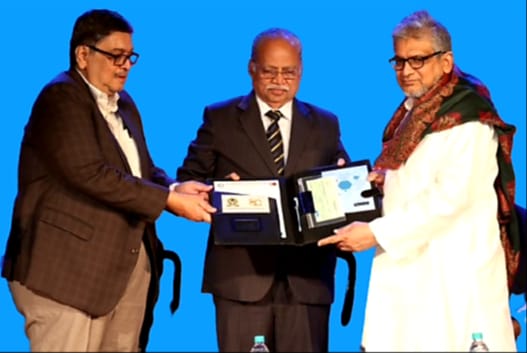
Former president of the All India Muslim Majlis-e-Mushawarat (AIMMM) and general secretary of the Movement for Empowerment of Indian Muslims (MOEMIM), Navaid Hamid, honoured with the Qaide Millat Award.

The award was presented by former Madras High Court judge, Justice KN Basha at an event held at a grand ceremony at the Music Academy on Saturday.

Renowned human rights activist John Dayal, and founder of the Sadbhavana Mission, distinguished scientist Professor Vipin Kumar Tripathi, were also honoured by the southern Indian institution, Qaide Millat Educational and Social Trust (Chennai).

The annual award is given for probity in political/public life and consists of a certificate of appreciation, a cash prize of five lakh rupees, and shawl.

Congratulating the awardees on the occasion, Justice Basha said he felt honoured and privileged to present the awards to individuals who serve as beacons of light amidst the darkness of the current environment while M G Dawood Miyakhan, general Secretary of the trust, said “the awardees are based on their unblemished track record of integrity in political and personal life in India”.

Retired CSI Bishop Dr V Devasagayam said while facilitating the awardees “we are here to recognise your services, support your initiatives and to wish that you continue your fight in spite of all the odds”.

The event was presided over by the president of the Qaide Millat Trust, Qazi Dr Salahuddin Muhammad Ayub, while announcement the awards and introduction of awardees were made by the Trust’s general secretary.

On this occasion, Dr S Sadiq, former Vice-Chancellor of Madras University, and retired CSI Bishop Dr V Devasagayam, were also honoured. General Secretary Dawood Miyan Khan, Treasurer S Mushtaq Ahmed, and Principal of Qaide Millat College, Dr MA Thawab, presented certificates of honour, prize, and shawls to the dignitaries.

The announcement of the 2024 Qaide Millat Award was made in February 2025. The award jury comprised Dr Vasanti Devi (former Vice-Chancellor), Dr V Devasagayam (former Bishop), Paneerselvam (Readers’ Editor, The Hindu), and Dawood Miyan Khan (general secretary, QEST).

Born on June 23, 1963, in the walled city of Delhi, Navaid Hamid has been associated with the All India Muslim Majlis-e-Mushawarat since the late 1980s. He served as its President from 2016 to 2023. A graduate in English from Zakir Hussain College, University of Delhi, Navaid Hamid has been actively involved in political and social work since his student days at the university.

During the UPA Government (2004–2014), he was appointed as a member of the National Integration Council for two terms. He is the founding secretary of the South Asian Council for Minorities (SACM) and also serves as the national general secretary of the Movement for Empowerment of Muslim Indians (MOEMIN). He has worked actively to support and uplift marginalized communities.

In 2008, at the Global Minorities Meet held in New Delhi and attended by delegates from 18 countries, Navaid Hamid was elected General Secretary of the Global Minorities Forum for Justice and Peace.

Previously, the Trust has presented the Qaide Millat Award to eminent personalities, including Teesta Setalvad and Nilakanoo (2015), N. Shankariah and Syed Shahabuddin (2016), Manik Sarkar and Muhammad Ismail (2017), Vice President of India Dr. Hamid Ansari and Aruna Roy (2018), AG Noorani and Thiru V mavalavan (2019), Harsh Mander and Bilkis Bano (2020), Dr Irfan Habib and Samyukt Kisan Morcha (2021), Thiru Veeramani and The Wire news (2022), N Ram (The Hindu) and Dr Abu Saleh Sharif.

The Qaide Millat award is presented in memory of Qaide Millat Maulvi Muhammad Ismail, a selfless servant of the community, freedom fighter, and a distinguished national leader. His significant contributions to the development of the country and community after independence are widely acknowledged.

As a member of the Constituent Assembly, a Member of Parliament in both the Lok Sabha and the Rajya Sabha, and as the founder-leader of the Indian Union Muslim League, his services are considered unforgettable. He was also among the founding members of the All India Muslim Majlis-e-Mushawarat (AIMMM).

The Qaide Millat Trust instituted this award on the 40th death anniversary of Maulvi Muhammad Ismail, and it is awarded annually to distinguished individuals active in public life.

source: http://www.theokhlatimes.com / The Okhla Times / Home> Local / by The Okhla Times / May 01st, 2025

All India Muslim Majlis-e-Mushawarat (Registered) Elects New President in New Delhi

NEW DELHI :

New Delhi :

In a significant development aimed at revitalizing the activities of a prominent Muslim organization, the All India Muslim Majlis-e-Mushawarat (Registered) convened a General Body Meeting on June 9, 2024, at New Horizon School in the Hazrat Nizamuddin area. The primary agenda was to elect a new president and establish a new administrative framework.

The meeting was chaired by the former president, Dr. Zafrul Islam Khan, and attended by 33 members from across India, alongside three additional invitees. Five members participated online via Zoom. The assembly unanimously elected Dr. Zafrul Islam Khan as the president for a two-year term.

In his inaugural address, Dr. Khan underscored the organization’s goal to rejuvenate the All India Muslim Majlis-e-Mushawarat (AIMMM) and reaffirm its role as a premier forum for Muslim organizations and institutions. He addressed the challenges that arose from previous leadership under Mr. Navaid Hamid, which led to internal discord and inactivity.

Dr. Khan recalled the resignation of the late Syed Shahabuddin from the executive committee due to the organization’s adverse direction under the new leadership. He criticized the expulsion of 70 key members and unconstitutional amendments to the organization’s constitution, which marginalized significant voices within the Majlis-e-Mushawarat.

He also mentioned that efforts to merge the Majlis-e-Mushawarat (registered) with the Navaid Hamid group would continue.

Resolutions Passed

Election Satisfaction: The assembly expressed satisfaction with recent general election results, noting a majority of secular votes and urging secular parties to unite for national progress.

Condemnation of Hate Politics: The organization condemned the rise in hate politics over the past decade and advocated for unity and resilience among Muslims against divisive tactics.

Condemnation of Gaza Attacks: The Majlis-e-Mushawarat condemned the ongoing Israeli attacks on Gaza since October 7, 2023, calling for global condemnation and support for Palestinian autonomy.

Addressing Muslim Marginalization: The body highlighted increased efforts to marginalize Muslims since 2014, urging the community to focus on education, trade, and legal recourse against injustices.

Notable attendees included Ms. Uzma Naheed from Mumbai, Muhammad Wazir Ansari (Rtd. IPS), Khawaja Muhammad Shahid (Rtd. IAS), and many other distinguished members and former officials from various parts of India. Some members participated online, including Munir Ahmad Khan from Indore and Dr. Obaid Iqbal Asim.

The meeting signifies a renewed effort to strengthen the organization’s influence and address key issues affecting the Muslim community in India.

source: http://www.radiancenews.com / Radiance News / Home> Latest News / by Radiance News Bureau / June 15th, 2024

Remembering Syed Shahabuddin – Muslim Heart, Indian Mind

Ranchi (JHARKHAND) formerly BIHAR /  NEW DELHI :

His arrival on the political scene as an articulate Muslim leader was no ordinary event in the journey of the Indian republic.

Syed Shahabuddin, 1935-2017. Credit: Youtube

Writing an obituary of the writer, diplomat and politician Syed Shahabuddin is actually an exercise in writing of the journey of Muslims in the Indian republic. The much maligned gentleman was somebody who could never be ignored. As a very bright student of physics in the academically brighter phase of Patna University in the first decade of India’s independence, he drew the attention of his teachers. The memoirs of his professors, Mohsin and Kalimuddin Ahmad, describe Shahabuddin’s promise in glowing terms. Soon thereafter, he became known for the leadership he provided to a student movement in 1955, including leading a 20,000-person march to wave black flags against Jawaharlal Nehru when he visited Patna – in protest against police firing on students.

He managed to get a job as a lecturer at the same time as qualifying for the civil services in 1957. He ranked second among all the aspirants, with a particularly high score in the interview section, and joined the Indian Foreign Service. Many delicious legends were fabricated around the kind of questions he was asked and his witty responses. His success not only inspired many students, but also helped overcome the trepidation among Muslims about their place in India after Partition.

While a section of Hindus looked upon Muslims as potential fifth columnists, a section of Muslims was also not very confident of the inclusionary-pluralist democracy that was being built up under Nehru. Notably, even as a student, Shahabuddin too was contributing towards this task of nation-building. With some ‘socialist’ leanings, though not formally with any party, his activism allowed certain critiques of the Nehruvian consensus to be heard.

He paid a price for this activism, though a minor one. Owing to Shahabuddin’s involvement in the student agitation of 1955, he had to wait for police/intelligence clearance and therefore could join the services a little later than his other batchmates. Legend has it that Nehru himself finally cleared the file.

In the late 1970s, the hegemony of the ruling Congress came be challenged by the socialists, Shahabuddin became restless within the confines of bureaucracy. He decided to quit government service and join politics.

Until then, Indian politics lacked a pan-Indian Muslim leader with well informed and articulate views. Although Maulana Azad had occupied an important position, he was part of the Nehruvian consensus and did not challenge it. Nor were academics looking at the worrying economic and educational locations of Muslim communities and their disproportionately inadequate share in the structures and processes of power. A few exceptions existed, such as the volume on castes among Muslims edited by Imtiaz Ahmad in the late 1960s and the works of Uma Kaura and Mushirul Hasan looking at the marginalisation of Muslims by the Congress under majoritarian pressures in 1970s, but these were rare.

None of the important dissenting voices in Indian democracy, whether Ram Manohar Lohia (1910-67), the defender of the lower castes, Jai Prakash Narayan (1902-79) nor the Left were paying attention to this issue.

Shahabuddin saw this vacuum in Indian politics and adventurously jumped in to fill it. His arrival on the scene as an articulate Muslim politician was no ordinary event in the journey of the Indian republic. As he stormed in, with his enviable articulation and abilities invoking constitutional values and spirit, he was almost matchless. He could not be dismissed, but he could be maligned as a sectarian, conservative and even communal reactionary. Often, he gave his critics grounds to do so. His stand on the gender issue in the Shah Bano case, where he stood on the side of the clerics, and on free speech, by asking for Salman Rushdie’s Satanic Verses to be banned are particularly problematic as the repercussions continue to play out today. On the issue of caste among India’s Muslims too, he was dismissive of pasmanda activists, although unlike many ‘reactionary’ Ashraaf, he never denied the reality of caste-based oppression and discrimination in Indian Islam.

His critics had little time for complexities and he was frequently clubbed with people like Maulana Bukhari, the Shahi Imam of Jama Masjid in Delhi, despite there being little to compare the two in either democratic legitimacy or point of view.

Throughout the 1980s and ’90s, Shahabuddin, through his English monthly, Muslim India, a journal of “Research, Reference and Documentation”, kept articulating and disseminating the concrete (as well as emotive) issues of concern to Indian Muslims, besides contributing  extremely powerful, informed and passionate editorials. Putting together news reports and views from across periodicals, the magazine also carried parliamentary speeches, interventions, government reports, book reviews, personality profiles and statistical data demonstrating the under-representation of Muslims in various sectors of the economy and employment, and many other crucial areas. This was done with candid, coherent, persuasive prose, laced with facts and figures, and at times beautified with apt Urdu couplets.

The title of the monthly he had chosen turned out to be provocative, as this expression is said to have been used in certain documents of the Muslim League in late colonial India. But the sharp (and cunning, if I may say) mind of Shahabuddin had a very strong defence in the English grammar. He explained that in the expression ‘Muslim India’, the former is  an adjective and the latter a noun. Thus, ‘Muslim India’ would grammatically put emphasis on the Indian identity of someone just happening to be Muslim. It was more patriotic than the expression ‘Indian Muslims’, wherein more emphasis was on Muslim (who happened to be Indian). Hence, he preferred ‘Muslim Indian’ to ‘Indian Muslim’.

Besides making interventions in a range of journalistic and academic periodicals, including even the ‘provocative’ English monthly, Debonair, Shahabuddin’s Muslim India carried very powerful editorials on almost every issue which touched the Muslim segment of Indian democracy. Nobody before and after him could muster that much of courage, conviction, energy and determination to do all these, that too all alone. Yet, he found enough time to reply to all the letters he received. He religiously wrote and dispatched letters.

The editorials that had particular impact are worth recalling. In July 1994, he wrote on Lalu Prasad Yadav’s brazen Yadavisation in Bihar at the expense of his core and unflinching support base – Muslims. The argument was well made, even by the standards of Shahabuddin’s characteristic articulation, with so much data damning the Lalu regime on almost every aspect of governance. Predictably, soon after, he left the Janata Dal. In July 2000, he published another editorial on the problems of governance at the Aligarh Muslim University (AMU) and their possible remedies. This was meant as advice from a senior IFS officer to a junior one, Hamid Ansari, who had joined as the vice chancellor of AMU. Yet another important editorial was on the 1988 Act making Jamia Millia Islamia (JMI) a central university. He called the Act a “swansong” for JMI. He later expanded this editorial and wrote a long essay,  ‘How to revive the spirit of Jamia Millia ‘,  in the Milli Gazette in 2010. Focussing on the AMU Act 1981, the lawyer in him kept arguing that the legislated Act did not provide AMU with minority status, though it did have minority character.

In the final years of his life, many of his projects remained unfinished. The tragic and mysterious murder of his only son Parwez (an IIT alumnus and a promising scientist) in the US in 2005 had perhaps broken him from within, even though he did carry on with his life as bravely as ever. He never got around to finishing it but the title he chose for his autobiography was Muslim Heart, Indian Mind. Perhaps that is the best way to remember him by.

Mohammad Sajjad is an associate professor at the Centre of Advanced Study in History at Aligarh Muslim University and the author of Muslim Politics in Bihar: Changing Contours.

source:  http://www.thewire.in / The Wire / Home> Politics / by Mohammad Sajjad / March 09th, 2017