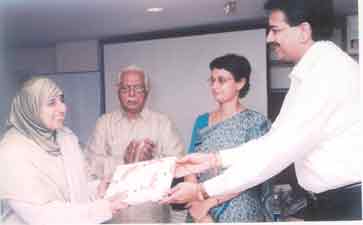
Uzma Naheed, a director of Iqra Education Foundation, Mumbai, has been awarded by Times Foundation in recognition of her exemplary work in the field of education and women’s economic development.
Naheed has conducted Teachers Training programmes in 18 cities in India and in two cities in Bangladesh. These programmes help teachers adopt modern teaching techniques being used in the West. These programmes were basically been designed by Iqra Education Foundation for Muslim children living in pluralistic societies.
Naheed has also conducted inter-faith dialogue seminars under the auspices of Times Foundation and World Conference for Religion & Peace, New York.
She has designed and developed 20 short-duration technical courses for economically poor Muslim women to set up their own home-based businesses.
Naheed, who is grand-daughter of Maulana Qari Taiyyib and daughter of Maulana Salim Qasimi of Deoband, is active in the Indian Muslim women issues and was intrumental in the passage of the model Nikahnama by the All India Muslim Personal Law Board. Her drafts were rejected or deferred many times but she did not give up. Finally the draft was accepted during the last conference at Bhopal.
source: http://www.milligazette.com / The Milli Gazette Online / Home> Awards / by The Milli Gazette Online / Print edition January 2004
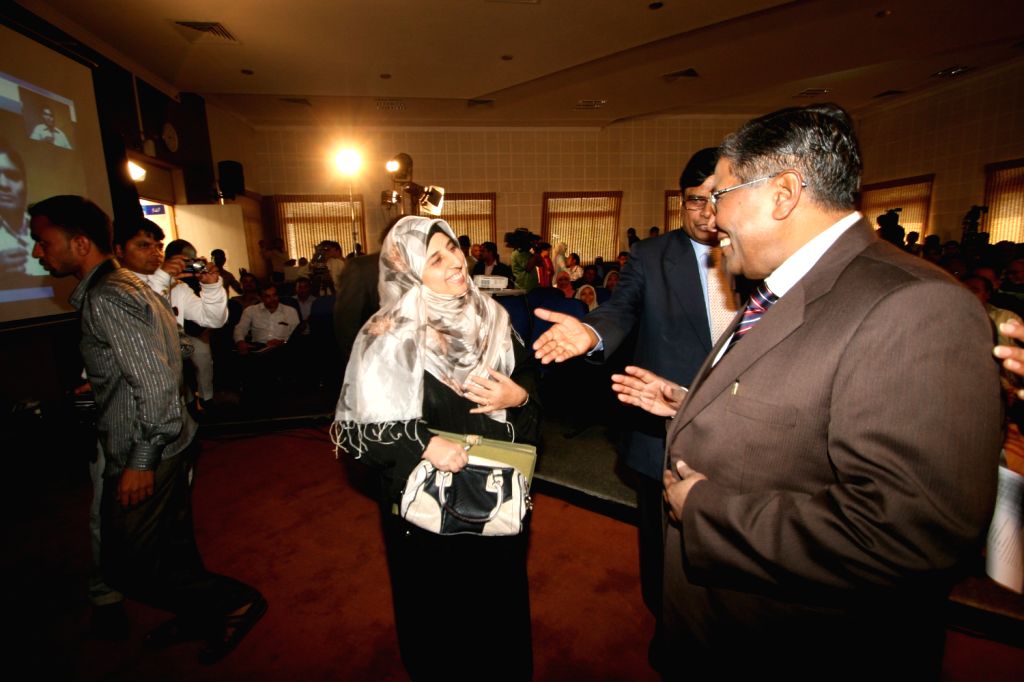
Minority Affairs Minister K Rahman Khan with Uzma Naheed, Member, All India Muslim Personal Law Board at three day interational conference on status of Muslim women in Indian sub-continent at Maulana Azad National Urdu University in Hyderabad on March 8, 2013.
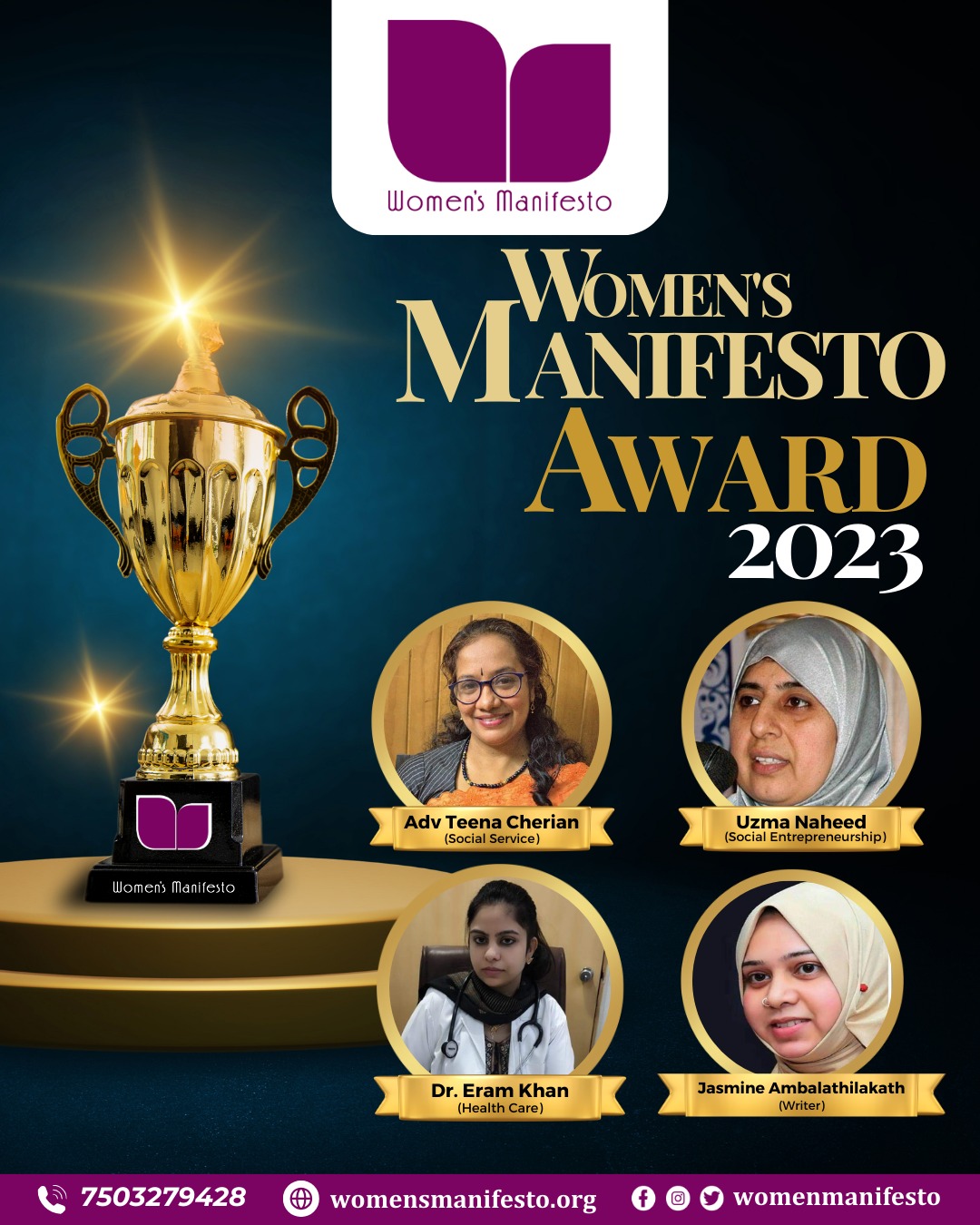
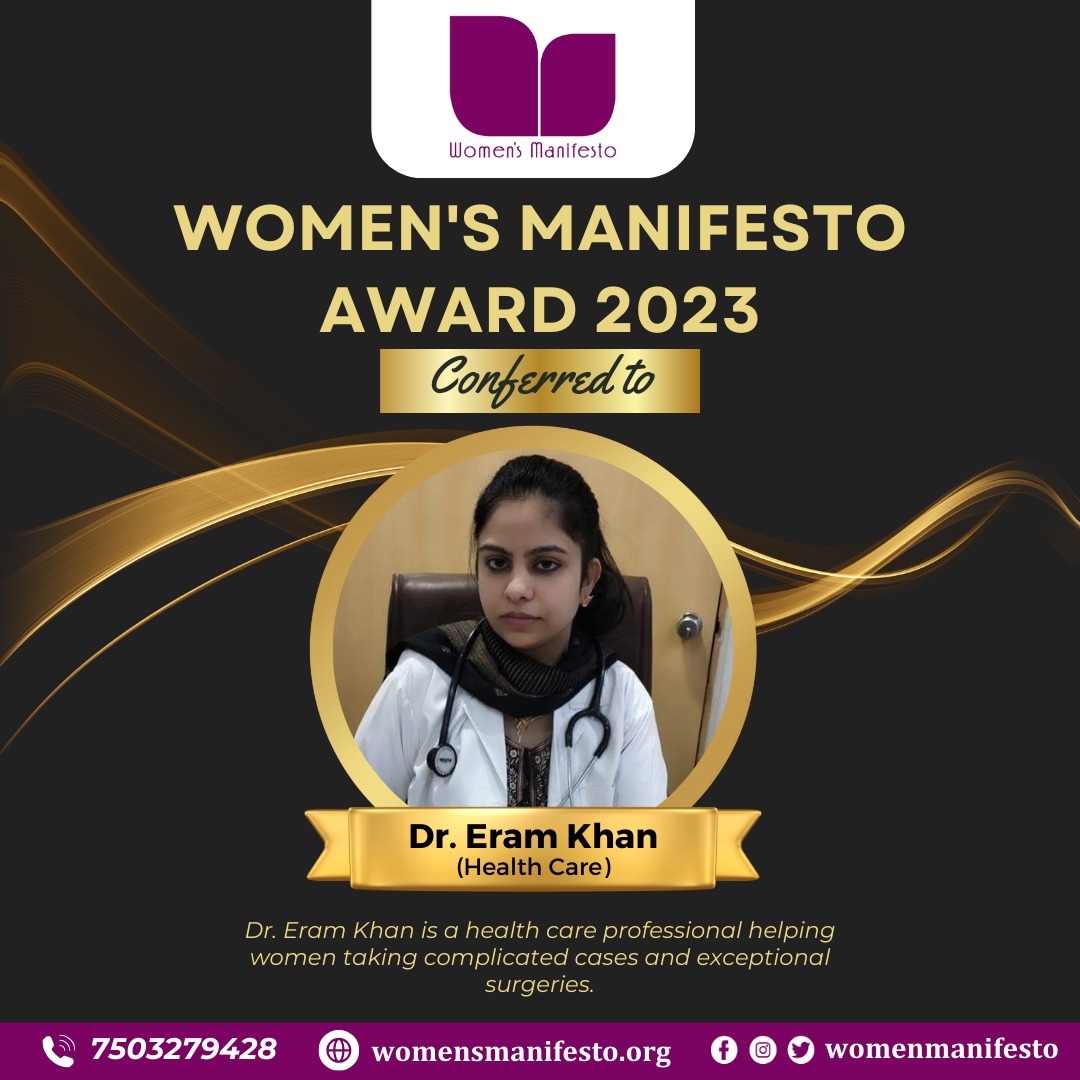
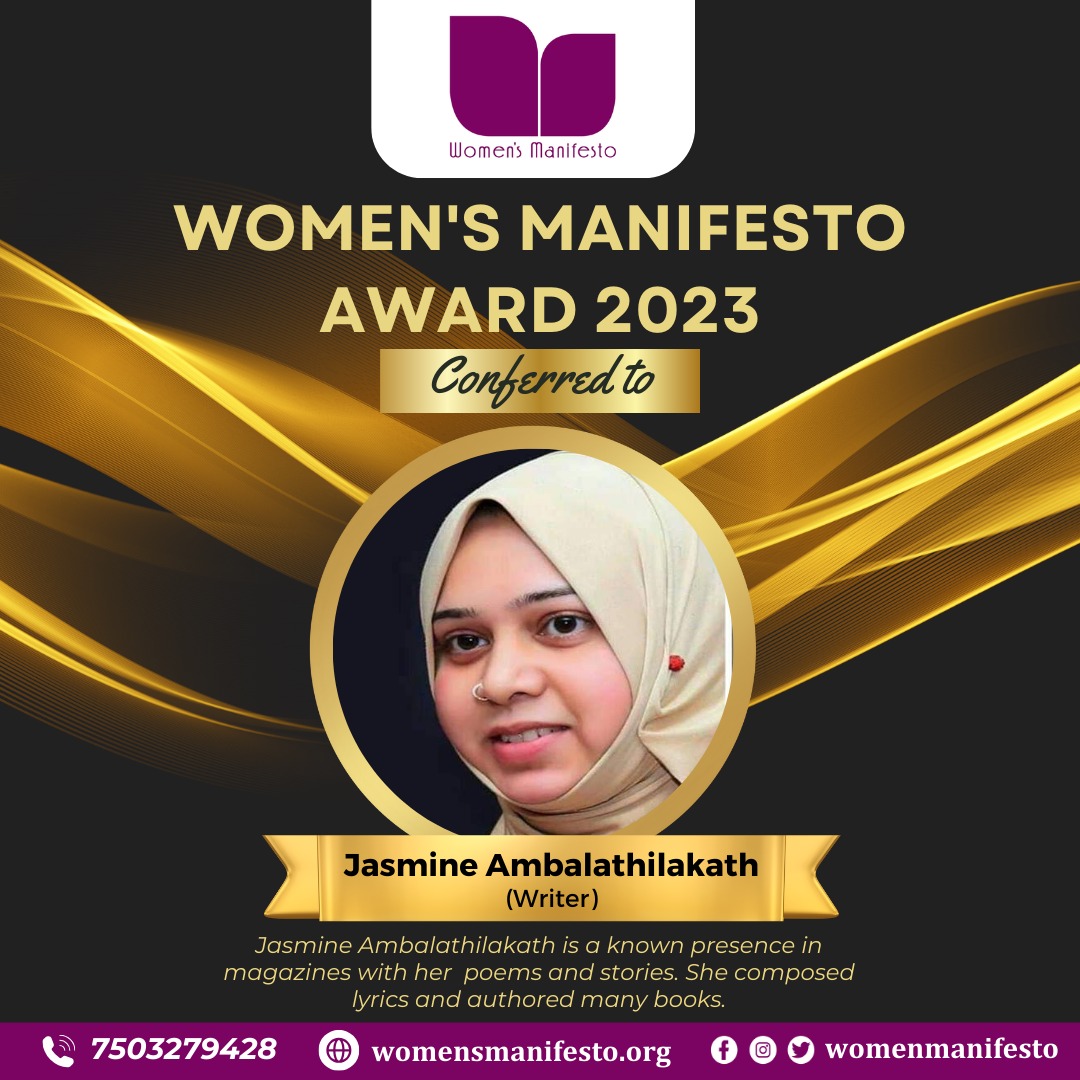
Women’s Manifesto is a national level organization initiated by women in 2014, Since its formation it engages in various activities for empowerment of women and welfare of society. To recognize efforts made by women or women managed organizations for rendering distinguished services for the cause of women and development of the nation, Women’s Manifesto confers Women’s Manifesto Award. It is given considering their excellence in the areas of entrepreneurship/ journalism/ art & culture/ academics/ sports/ literature/ social service. Awardees are selected from the nomination received and shortlisted after verification of information provided. Then it is finalized and selected by a team of three jury members. The candidate will be awarded with memento; certificate and cash prize of rupees ten thousand.
Adv Teena Cherian
She is a dedicated social worker and founder President of Jenika Charity Foundation. With an LLM degree specializing in International Law, she has practiced law for 26 years, focusing on the welfare of women, children, and the mentally ill and disabled. Teena has served in various government projects and as an Internal Committee Member under the POSH Act. She established Jenika Charity Foundation to support and empower traumatized individuals, particularly victims of abuse. Through awareness programs, educational support, vocational training, and advocacy, Teena and her team have made significant strides in aiding survivors of domestic violence and child sexual abuse. Teena’s tireless efforts exemplify her commitment to social service and the well-being of marginalized communities.
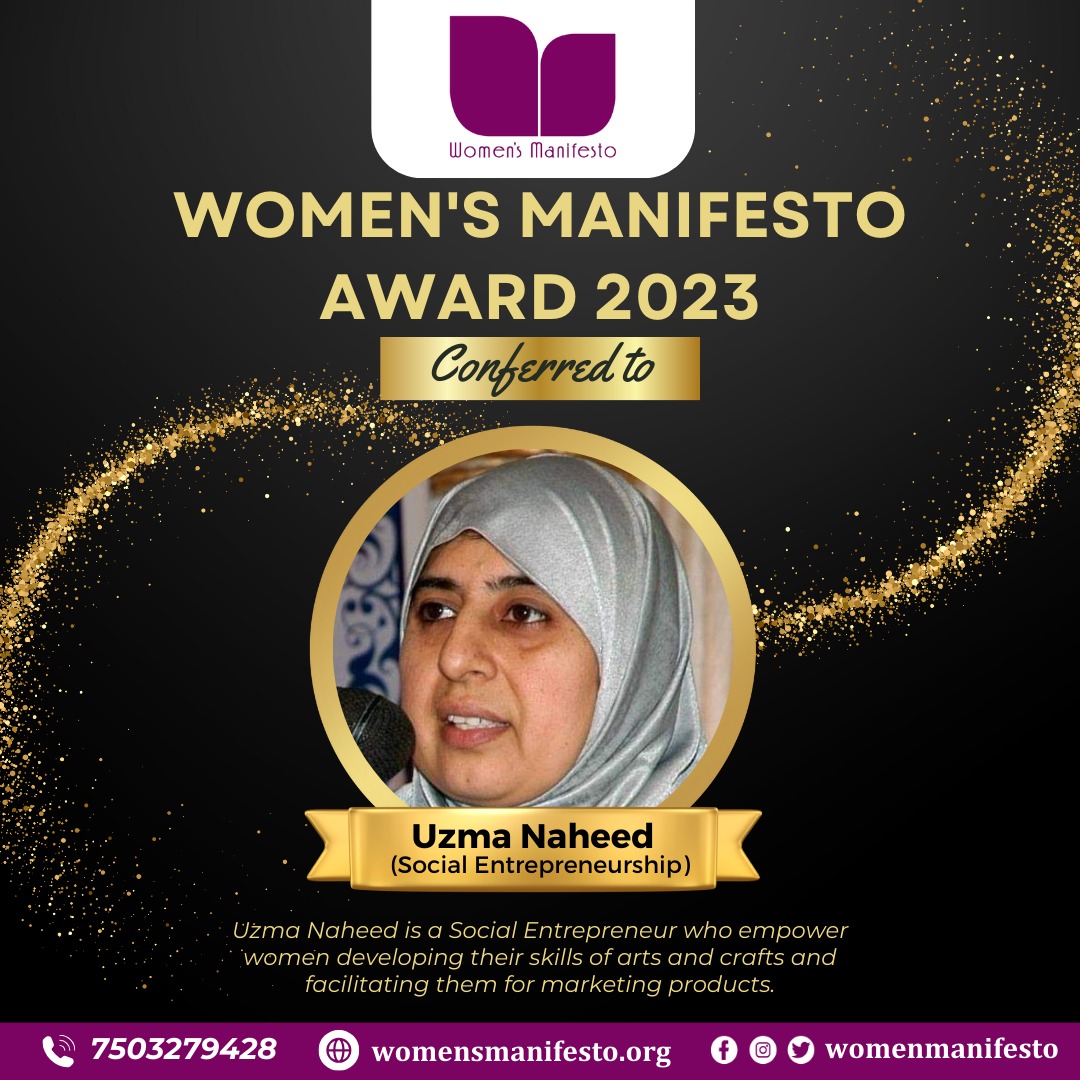
Uzma Naheed
She is a dedicated social worker especially working for empowerment of women. She has been leading a registered NGO called IIWA (Iqra Integral Women’s Alliance) for 35 years. She focuses on leveraging women’s skills in arts and crafts at national level. Through this effort they are modifying and simplifying traditional arts, making them accessible to common Indians who were previously hindered by the high prices of emporiums. Uzma shares that this initiative has empowered 30,000 women across various cities, enabling them to manufacture and trade an impressive array of 150 different items.
Dr. Eram Khan
She is a renowned obstetrician and gynecologist. With an MBBS and MS in Obstetrics and Gynaecology, along with an advanced diploma in infertility from UKSH KEIL, Germany, and a critical care course from VMMC Safdarjung Hospital, Delhi, she is equipped with extensive medical expertise.
Driven by a passion to aid women in need, she undertakes complex medical cases often rejected or unattainable in other medical settings. Her exceptional surgical skills have gained widespread recognition. She was awarded by health minister of Delhi for exceptional surgeries during Covid. Her commitment to serving the community is evident through her dedication in providing medical assistance to needy women at community level. Her profile reflects her unwavering commitment to women’s health and her relentless pursuit of excellence in the field of obstetrics and gynaecology.
Jasmin Ambalathilakath
She is a versatile educator and acclaimed author renowned for her literary contributions. Jasmin’s literary prowess shines through her prolific writing career, spanning poems and stories featured in various magazines and web editions, making her a beloved figure among readers. Jasmin’s literary achievements include the authorship of seven books, showcasing her talent as both an editor and writer. Notable endorsements and awards, including the prestigious Pravasi Bharathi Prathibha Puraskaram in 2024 and recognition from the Universal Record Forum and Sharjah Youth Literature Awards, underscore her exceptional contributions to literature and education.
source: http://www.womensmanifesto.org / Women’s Manifesto / Home> Featured News / March 08th, 2024
The National Federation of Girls Islamic Organisation (NFGIO) organised a national campaign titled “Connecting Hearts Eternally in Relishing Islamic Sisterhood’ (CHERISH)” with the theme المتحابون في الله which translates to ‘those who love each other for the sake of Allah’.
Mumbai :
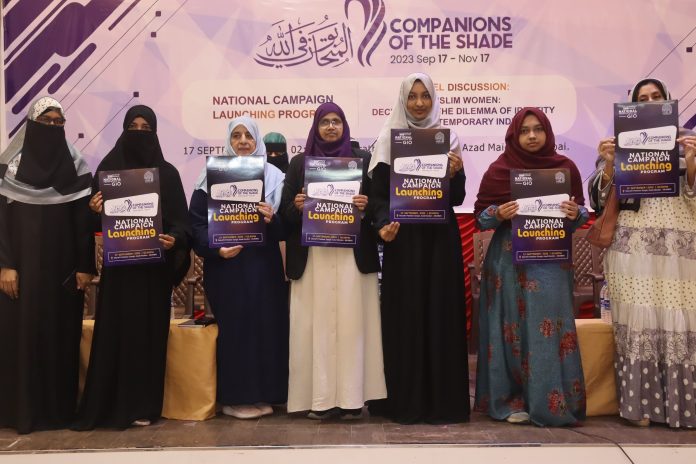
The National Federation of Girls Islamic Organisation (NFGIO) organised a national campaign titled “Connecting Hearts Eternally in Relishing Islamic Sisterhood’ (CHERISH)” with the theme المتحابون في الله which translates to ‘those who love each other for the sake of Allah’. The launching program of the campaign was held at Marathi Patrakar Sangh here Sunday.
The program commenced with the soulful recitation of the verses from the Holy Quran by Uzma Sagri (Regional In-charge, GIO Mumbai Region), followed by the welcoming words by Anamtha Ahmed (General Secretary, GIO MSZ).
Sister Samar Ali (General Secretary, NFGIO) shed light on the aims and objectives of the campaign.
Advocate Sumaiya Roshan, National President NFGIO addressing the program
The launching program was inaugurated by Adv. Sumaiya Roshan, (President, NFGIO), detailing the core intentions planned to be achieved through the campaign.
Adv. Sumaiya explained the goal of the campaign as to establish a secure and encouraging community for Muslim sisters. They must unite to confront the world’s obstacles and thrive with their steadfast faith. Unfortunately, in present times, practising and expressing one’s faith can be arduous and often unaccepted. This leaves many Muslim women feeling alienated from society.
Through sisterhood, women can discover and embrace their authentic selves as creations of the Almighty. They can find their purpose in life and ways to achieve it. The Almutahabbuna Fillah – Companions of the Shade campaign aims to promote righteous friendships among sisters. These friendships go beyond selfish worldly needs and are blessed by Allah. They can be a means of earning His pleasure and becoming successful in both this life and the Hereafter.
The phrase Almutahabbuna Fillah means “those who love each other for the sake of Allah.” It is narrated that on the Day of Judgement, there will be no shade except for the shade of Allah. Among the seven types of people who will be under His shade are two people who love each other for the sake of Allah.
The program further had felicitation addresses by Mrs. Rahmathunnissa A., National Secretary, JIH. She mentioned the contributions put forth by the Girls Islamic Organization from its formation in 1984 in developing and enhancing a healthy society. The organization has been working towards the goal of enhancing the community and developing them to serve for the betterment of the whole of humanity.
It was followed by the address of Mr. Mohammed Zafar Ansari, Secretary, JIH Maharashtra, followed by the concluding address of Khan Shaheen Jattu, Vice President, NFGIO.
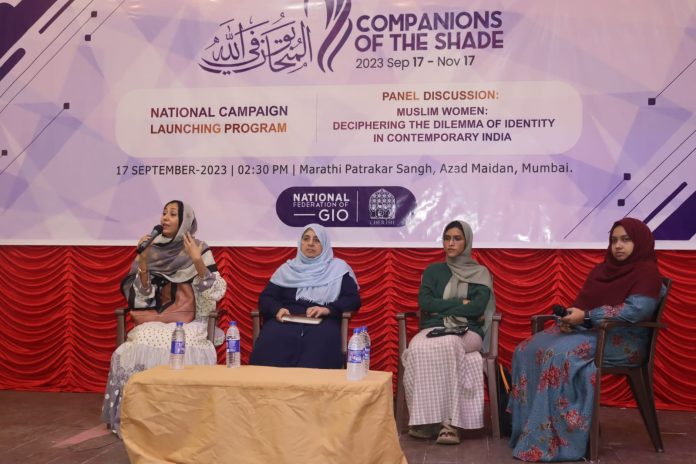
The panel discussion held with Advocate Huriya Patel, Uzma Naheed, Haniya Anwar and Samar Ali
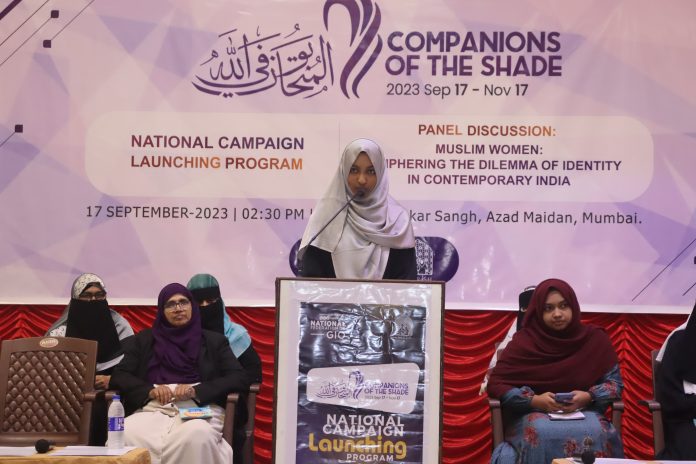
A panel discussion titled “Muslim Women: Deciphering the Dilemma of Identity in Contemporary India” was conducted with Samar Ali as the moderator as part of the event. Samar stated the aim of the discussion as to bring forth powerful and socially engaging Muslim women icons and establish the idea of empowerment through their presence in the public sphere.
The panellists included Mrs. Uzma Nahid (Executive Director, Iqra Education Foundation), Adv. Huriya Patel (Advocate, Bombay High Court) and Ms Haniya Anwar (Student leader, TISS Mumbai).
Uzma Nahid encouraged the audience to be revolutionary thinkers and to focus on getting educated and enlightened on the necessity of financial development for the overall empowerment of women.
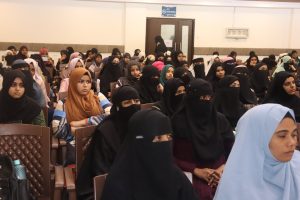
The audience listening to the discussion at Marathi Patrakar Sangh, Mumbai
Adv. Huriya Patel mentioned the lack of legal awareness among the women community and pointed out the importance of embracing one’s identity and beliefs without compromising values and ethics to build successful career platforms.
Haniya Anwar inspiringly brought forth the challenges faced by Muslims in general and women with visible Muslim identity in particular on Indian campuses. She shared her experience faced while contesting for the post of Equal Opportunity Cell of Students Union, TISS Mumbai.
The panel discussion was concluded by Mrs. Rahmathunnissa A., who highlighted that if one is ready to change the society, nothing can stop them.
The program concluded with a vote of thanks by Aamna Khanam (Secretary, NFGIO) who thanked everyone for their enormous support for the historical event.
source: http://www.radiancenews.com / Radiance News / Home> Latest News / by Aaliyah Rumane / September 20th, 2023
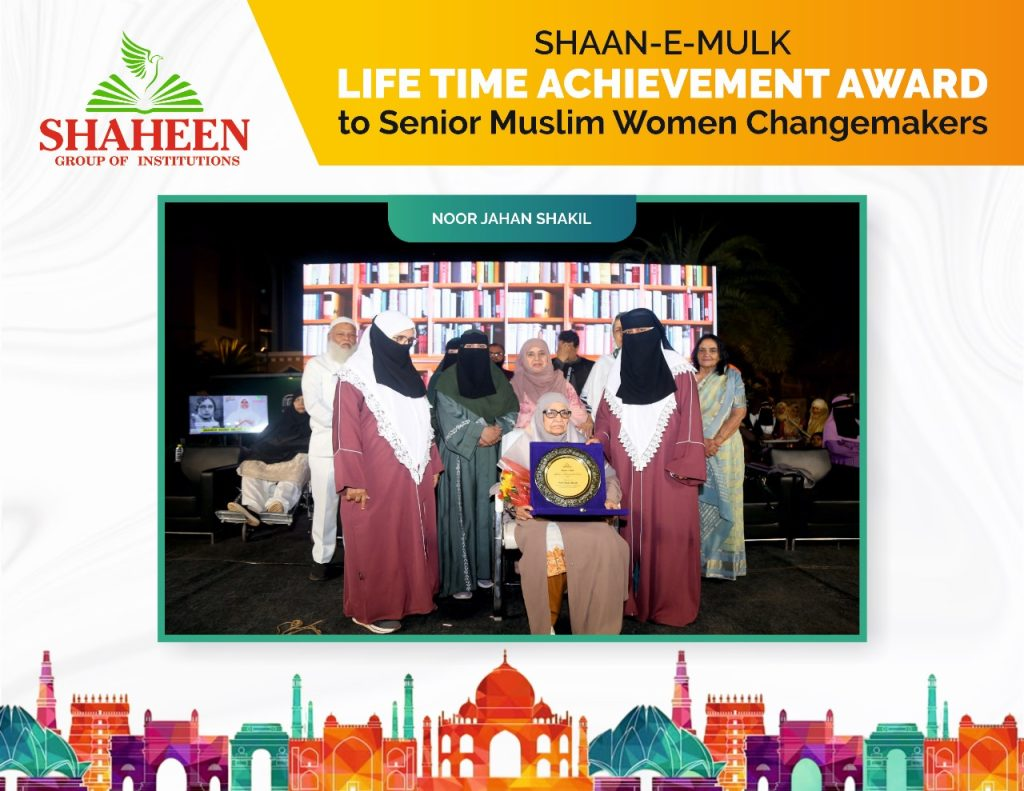
On India’s 76th Republic Day, Shaheen Group of Institutions, Bidar, organized the “Shaan-e-Mulk” Lifetime Achievement Award to honor five distinguished women for their contributions to education, business, humanitarian services, and healthcare.
Dr. Abdul Qadeer, Chairman of Shaheen Group, emphasized the vital role of women in society, stating, “Women are the backbone of families and communities, yet their contributions often go unrecognized. It is crucial to celebrate their achievements and inspire future generations.
Honorees
The award was presented to:
Ms. Shaukat Begum (Institutional Development)
Ms. Noor Jahan Shakeel (Humanitarian Services)
Dr. Rana Noor Siddiqui (Education & Research)
Ms. Uzma Naheed (Entrepreneurship)
Dr. Noor Jahan Sagheer (Healthcare)
The event, attended by thousands of female students, showcased academic performances and aimed to challenge stereotypes, inspire young women, and foster community pride.
Key attendees included Managing Director Abdul Haseeb, Academic Director Abdul Muqeet, and directors Shaista, Wafa, Zakia, Meher Sultana, Afra Naaz, and Munir Deshmukh.
source: http://www.thehindustangazette.com / The Hindustan Gazette / Home> Education / by The Hindustan Gazette / January 29th, 2025
The Waqf Amendment Act 2025, recently passed by the Government of India, has stirred a wave of public discourse. Promising to regulate and modernize the administration of waqfproperties across the country, the law is being introduced as a means to improve transparency and benefit marginalized communities, especially Muslim women.
However, in this swirl of policy language, governance reform, and bureaucratic oversight, we must not forget a foundational truth: Muslim women have always been central to the waqftradition—not as passive recipients, but as active architects of community transformation.
Waqf as a Tool of Empowerment—Before the State Claimed It
Before governments created waqf boards, before institutional frameworks shaped their regulation, and long before women were officially recognized in policy narratives, Muslim women in India were shaping societies through charitable endowments.
They:
• Founded schools and madrasas for girls and boys alike
• Donated lands and properties for the construction of mosques, shrines, and Sufi lodges
• Built hospitals, water fountains, and orphanages
• Funded scholarships, welfare kitchens, and even public rest-houses for travelers.
This was not mere charity—it was strategic social intervention, embedded in Islamic ethics and guided by a vision of communal upliftment.
👑 Queens of Waqf: A Glimpse into Heroines of Charity and Community Leadership
🏛️ Razia Sultana (1205–1240, Delhi)
India’s only woman Sultan, Razia established educational and civic institutions supported by state waqf. Her leadership emphasized justice, learning, and infrastructure.
🏛️ Jahanara Begum (1614–1681, Delhi)
Daughter of Shah Jahan, she created waqf endowments for Sufi shrines, caravanserais, and public gardens. Her waqf documents are among the earliest female-authored ones preserved in India.
🏛️ Roshanara Begum (1617–1671, Delhi)
Sister to Jahanara, she built Roshanara Garden and a Sufi lodge. She maintained religious institutions through royal waqf.
🏛️ Sultan Jahan Begum (1858–1930, Bhopal)
The last Begum of Bhopal, she modernized education, built hospitals, supported madrasas, and legally registered many waqf properties to support her reforms.
🏛️ Begum Hazrat Mahal (1820–1879, Lucknow)
Regent of Awadh, she protected the city’s religious institutions and supported waqf-based welfare during the 1857 Rebellion.
🏛️ Khair-un-Nissa Begum (18th c., Hyderabad)
Established Khairtabad Mosque and other public works through her waqf. One of the early noblewomen to invest in education and water supply systems.
A visionary educationist, she established the Sakhawat Memorial Girls’ School using her own resources and informal waqf practices. A true reformer of women’s rights.
Urdu novelist and educationist who established the Safdariya Girls School through personal endowment. One of India’s earliest women school founders.
🏛️ Princess Durru Shehvar (1914–2006, Hyderabad)
Ottoman princess and daughter-in-law of the Nizam. Founded the Durru Shehvar Hospital, a major maternity and child-care waqf.
🏛️ Princess Niloufer (1916–1989, Hyderabad)
Ottoman royal by birth and philanthropist. Established Niloufer Hospital for women and children in response to maternal health tragedies.
🏛️ Dr. Uzma Naheed (Contemporary, Mumbai)
Thinker and leader who founded the IQRA International Women’s Alliance. Created vocational and educational centers for women through charitable trusts and waqf-like models.
🏛️ Begum Abadi Bano (Bi Amma) (1850–1924)
Mother of freedom fighters Maulana Mohammad Ali and Shaukat Ali, she supported the Khilafat movement and women’s education through charity and informal waqf support.
🏛️ Begum Qudsia Aizaz Rasul (1909–2001)
Only Muslim woman member of the Indian Constituent Assembly. Promoted educational waqfs and women’s legal rights in independent India.
🏛️ Hamida Habibullah (1916–2018, Lucknow)
Educator, politician, and philanthropist who helped establish Talimgah-e-Niswan, a leading girls’ school, partially supported by endowments and community waqf models.
🏛️ Tayyaba Begum (early 1900s, Hyderabad)
Co-founder of Anjuman-e-Khawateen-e-Deccan, she organized women’s welfare through educational trusts and neighborhood charities alongside Sughra Humayun Mirza.
These women are not anomalies in history. They are evidence of a forgotten mainstream—a rich legacy of Muslim women using waqf, education, and philanthropy to shape the public sphere.
What the Law Misses
The 2025 Amendment claims to create better access for women and transparency in waqfgovernance. Yet, many community members raise concerns about:
• Increased government control over waqf boards
• Reduced autonomy of local Muslim stakeholders
• Weak representation of women in decision-making roles
If reform is truly meant to benefit women, it must not just focus on current access. It must honor and preserve the legacy of those women who built the system through vision, sacrifice, and faith.
Reclaiming the Narrative
As students of history and as researchers in the contributions of Muslim women across disciplines—al-Muhaddithat, scholars, judges, educators, warriors, nurses, and philanthropists—we find it essential to reclaim and highlight this tradition in the current discourse.
This document delves into the intersections of gender, history, law, and social development, spotlighting women’s roles in charitable work and community building through waqf and related institutions.
Our goal is not just to preserve history, but to activate it: to inspire current and future generations to recognize the power of service, leadership, and waqf in reshaping communities. The struggle for recognition today stands on the shoulders of those who built with purpose and gave with dignity.
Conclusion: From Past to Future
Muslim women in India have been pioneers of welfare through the waqf system for centuries. Their work wasn’t performed for applause or public acclaim. It was done with quiet resolve, deep faith, and a vision for lasting impact.
As new policies reshape the landscape of waqf, let us not merely react—we must respond with wisdom, rooted in history and hope. Let the legacy of women like Razia, Jahanara, Durru Shehvar, Niloufer, Sughra, and Uzma guide us in reimagining waqf as a tool not only for preservation—but for progressive, inclusive development.
The author is a Social Worker, Student of History and Educator
source: http://www.muslimmirror.com / Muslim Mirror / Home> Education> Positive Story> Waqf> Women / by M A Lateef Atear / June 04th, 2025
In a significant development aimed at revitalizing the activities of a prominent Muslim organization, the All India Muslim Majlis-e-Mushawarat (Registered) convened a General Body Meeting on June 9, 2024, at New Horizon School in the Hazrat Nizamuddin area. The primary agenda was to elect a new president and establish a new administrative framework.
The meeting was chaired by the former president, Dr. Zafrul Islam Khan, and attended by 33 members from across India, alongside three additional invitees. Five members participated online via Zoom. The assembly unanimously elected Dr. Zafrul Islam Khan as the president for a two-year term.
In his inaugural address, Dr. Khan underscored the organization’s goal to rejuvenate the All India Muslim Majlis-e-Mushawarat (AIMMM) and reaffirm its role as a premier forum for Muslim organizations and institutions. He addressed the challenges that arose from previous leadership under Mr. Navaid Hamid, which led to internal discord and inactivity.
Dr. Khan recalled the resignation of the late Syed Shahabuddin from the executive committee due to the organization’s adverse direction under the new leadership. He criticized the expulsion of 70 key members and unconstitutional amendments to the organization’s constitution, which marginalized significant voices within the Majlis-e-Mushawarat.
He also mentioned that efforts to merge the Majlis-e-Mushawarat (registered) with the Navaid Hamid group would continue.
Resolutions Passed
Election Satisfaction: The assembly expressed satisfaction with recent general election results, noting a majority of secular votes and urging secular parties to unite for national progress.
Condemnation of Hate Politics: The organization condemned the rise in hate politics over the past decade and advocated for unity and resilience among Muslims against divisive tactics.
Condemnation of Gaza Attacks: The Majlis-e-Mushawarat condemned the ongoing Israeli attacks on Gaza since October 7, 2023, calling for global condemnation and support for Palestinian autonomy.
Addressing Muslim Marginalization: The body highlighted increased efforts to marginalize Muslims since 2014, urging the community to focus on education, trade, and legal recourse against injustices.
Notable attendees included Ms. Uzma Naheed from Mumbai, Muhammad Wazir Ansari (Rtd. IPS), Khawaja Muhammad Shahid (Rtd. IAS), and many other distinguished members and former officials from various parts of India. Some members participated online, including Munir Ahmad Khan from Indore and Dr. Obaid Iqbal Asim.
The meeting signifies a renewed effort to strengthen the organization’s influence and address key issues affecting the Muslim community in India.
source: http://www.radiancenews.com / Radiance News / Home> Latest News / by Radiance News Bureau / June 15th, 2024