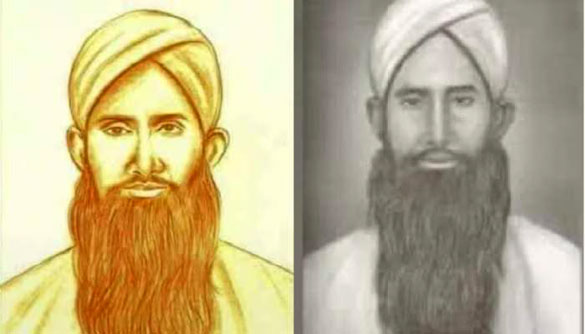
Remembering the fearless freedom fighter, who led thousands of women in civil protests, championed Urdu and education, and defied social evils
Patna :
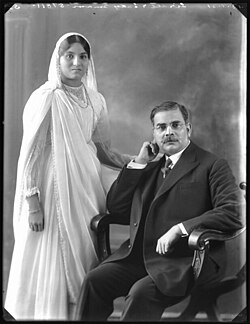
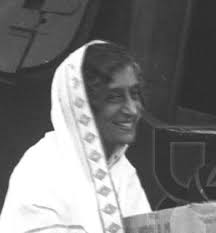
In the midst of the ongoing Bihar Assembly election campaigns, the state pauses to honour a remarkable figure in its history: Anees Fatima, Bihar’s first Muslim woman MLA, a freedom fighter, teacher, and social reformer whose courage and vision continue to inspire generations.
Born in Patna in 1901, Anees Fatima’s early years were marked by a sharp mind and fearless disposition, qualities that distinguished her in a time when women’s education and participation in public life were extremely limited. She completed her primary education at the Badshah Nawaz Rizvi School, also known as Madrasa Islamia, setting the stage for a life devoted to public service and national freedom.
“From childhood, she was determined not to remain silent,” said historian Dr Meena Sharma. “Her courage and intellect made her stand out, and she carried these traits into the freedom struggle, inspiring countless others.”
Anees Fatima’s commitment to India’s freedom movement was evident from her active participation in the Non-Cooperation Movement launched by Mahatma Gandhi in 1920. She fearlessly led protests against liquor shops in Patna, an audacious move for a woman at the time. During the 1930 Civil Disobedience Movement, she and fellow activist Gauri Das led a procession of more than 3,000 women in Patna. When fined ₹201 by the British government for her activism, she refused to pay.
She had to go to jail for her boldness but she neither accepted defeat in front of the British nor did she weaken in front of the cruelty of the British.
Her remarkable leadership earned her national recognition, with the Indian National Congress including her in the delegation sent to England to protest the Montagu-Chelmsford Reforms.
In 1937, Anees Fatima made history as Bihar’s first woman MLA, contesting and winning the election as an independent candidate. Her oratory skills were so compelling that she was awarded the title of “Lady Imam.” She was also an active member of Anjuman Tehreek-e-Urdu, campaigning for Urdu to be recognised as Bihar’s second language.
“Her election was more than a political victory,” said educationist Prof Arif Khan. “It was a statement that women, and especially Muslim women, could lead and shape society.”
Beyond politics, she dedicated her post-independence years to promoting education in Bihar, remaining associated with the Khuda Baksh Oriental Public Library, and advocating against social evils like child marriage and strict purdah practices.
Anees Fatima’s life reflects a deep commitment to service, courage, and women’s empowerment. Married to Sir Syed Ali Imam, she helped lay the foundations for what is considered “Jadid Bihar,” or New Bihar, through her tireless efforts in education, social reform, and public service.
“Anees Fatima showed that courage and dedication know no gender,” remarked local activist Fatima Rizvi. “She not only fought for the nation’s independence but also for the rights of girls and women in society. Her legacy continues to guide us.”
As Bihar celebrates its electoral processes, remembering pioneers like Anees Fatima offers a reminder that true leadership is measured not by position but by service, bravery, and commitment to equality and justice.
source: http://www.clarionindia.net / Clarion India / Home> Editor’s Pick> India> Indian Muslim / by Team Clarion / October 16th, 2025
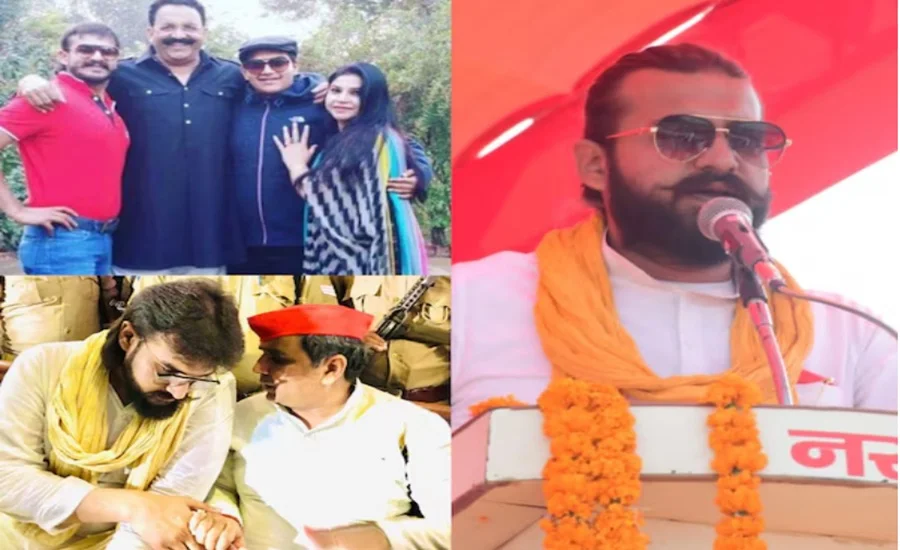
In a significant development in Uttar Pradesh politics, MLA Abbas Ansari has regained his legislative seat following the Allahabad High Court’s stay on his conviction in a hate speech case. The ruling has brought temporary stability to the Mau constituency, ending months of uncertainty surrounding the young leader, whose political journey has both been eventful and turbulent.
The High Court stayed the sentence handed down by the MP-MLA special court which had convicted Ansari for making hate speech. Following the court’s decision, the Uttar Pradesh Assembly secretariat reinstated his membership, averting a potential by-election in the constituency. Political analysts observed that this development sent a clear message about judicial fairness and the resilience of regional political dynasties.
Speaking on his reinstatement, Abbas Ansari expressed relief and gratitude, stating, “I am grateful to the judiciary for its fair judgment. My focus remains on serving the people of Mau and continuing my family’s legacy of public service.” The decision not only reinforced his political position but also stabilised the local political landscape, which had been in flux since his initial disqualification.
Abbas Ansari’s entry into politics is deeply rooted in his family’s longstanding political and social influence in eastern Uttar Pradesh. Born on 12 February 1992, he is the eldest son of the late Mukhtar Ansari, a five-time MLA from Mau whose influence extended across both the Muslim community and the broader electorate. Mukhtar Ansari’s death on 28 March 2024 in Banda due to a heart attack attack left a political vacuum, which Abbas Ansari has stepped in to fill.
Abbas’s grandfather, Dr Mukhtar Ahmad Ansari, was a prominent figure in India’s freedom struggle and held leadership positions in both the Indian National Congress and the All India Muslim League. Dr Ansari also made significant contributions to Muslim education and was among the founding members of Delhi’s Jamia Millia Islamia University.
The political engagement of Abbas Ansari’s extended family further underscores the depth of his inherited influence. His uncles, Afzal Ansari and Sibgatullah Ansari, remain active in regional politics, with the former representing Ghazipur as a Member of Parliament for the Samajwadi Party and Sibgatullah having served twice as an MLA after a career as a teacher. Even Abbas’s great-grandfather, Subhanullah Ansari, held leadership roles in municipal governance. This multigenerational involvement has cemented the family’s influence in the political and social fabric of eastern Uttar Pradesh.
Before entering the political arena, Abbas Ansari distinguished himself as a national-level shooting champion. He specialised in skeet and shotgun shooting and won his first gold medal at a national championship in 2011. Over the years, he became a three-time national champion and represented India at international competitions, including the Shooting World Cups held in Germany and Finland. His dedication to sport, discipline, and achievement in competitive shooting reflect qualities that he later channelled into his political career.
Abbas completed his schooling at GD Goenka World School in Gurugram in 2011 and subsequently earned a degree in Business Management. In 2016, he decided to leave his sports career behind to enter politics, joining the Bahujan Samaj Party (BSP). His sports background helped him build an image of a young, energetic, and disciplined leader, appealing especially to the youth in eastern Uttar Pradesh.
Abbas Ansari’s first political challenge came in the 2017 Uttar Pradesh Assembly elections when he contested from Ghosi on a BSP ticket at the age of 25. Despite losing to BJP’s Fagu Chauhan, the experience provided him with insights into electoral strategy and grassroots politics. In 2022, Abbas shifted to the Suheldev Bharatiya Samaj Party (SBSP), an ally of the Samajwadi Party, and contested from Mau, a constituency traditionally held by his father. He campaigned vigorously, emphasising continuity, public service, and development. “The legacy of my father is a responsibility I carry with pride,” he remarked during the campaign.
The electorate responded positively. Abbas Ansari won the Mau Sadar seat by a margin of 38,116 votes over BJP’s Ashok Singh, officially stepping into the political shoes of his father. At the time of filing his election affidavit, he declared assets worth approximately ₹9.2 crore and stated he had no loans. Although he faced 13 criminal cases, including some linked to family controversies, his sports-oriented image and engagement with youth voters helped him establish credibility across communities.
Abbas Ansari’s political career has been marked by legal turbulence, similar to the experiences of his father. In November 2022, soon after his electoral victory, the Enforcement Directorate (ED) arrested him on charges of money laundering linked to family businesses. He was denied bail and remained incarcerated until 2024, serving time in Chitrakoot and later Kasganj jails. Reports emerged that even while imprisoned, he managed certain business dealings using his wife Nikhat Ansari’s phone and remained in communication with associates.
In May 2025, a special MP-MLA court sentenced him to two years for a hate speech made in March 2022, which led to his immediate disqualification under the Representation of the People Act. This development created uncertainty in Mau, with speculation about by-elections. However, in March 2025, the Supreme Court granted him interim bail in a separate case under the Uttar Pradesh Gangsters and Anti-Social Activities (Prevention) Act, 1986, allowing him temporary relief.
Compounding these challenges, Abbas’s mother, Afshan Ansari, faced multiple criminal cases, prompting authorities to freeze millions in family bank accounts. Afshan remains at large, with a police reward of ₹50,000 announced for her arrest. Despite these challenges, Abbas Ansari maintained a focus on his legislative responsibilities and public image.
The most recent and pivotal development came on 20 August 2025 when the Allahabad High Court dismissed the hate speech conviction and stayed the sentence. This allowed Abbas Ansari to resume his duties as MLA from Mau Sadar. On Monday (8 September), the Uttar Pradesh Assembly secretariat officially restored his membership, effectively halting discussions of a by-election and stabilising the political situation.
Political analyst Shamsher Ali commented, “Abbas Ansari’s reinstatement reflects both judicial fairness and the significant support he continues to enjoy in his constituency. It also demonstrates the resilience of political dynasties in eastern Uttar Pradesh.”
Abbas Ansari’s declared net worth has attracted public and media attention, especially after his reinstatement. According to his 2022 election affidavit, Abbas and his wife Nikhat possess substantial movable and immovable assets. His movable assets included cash, vehicles, jewellery, and firearms valued at over ₹1.12 crore combined. Specifically, Abbas held ₹1,75,000 in cash, a vehicle worth ₹28.89 lakh, gold and diamond jewellery worth ₹12.5 lakh, and firearms valued at ₹43 lakh. His wife Nikhat had ₹75,000 in cash and jewellery valued at ₹19.7 lakh.
In addition, Abbas owns five plots and houses across Mau, Ghazipur, and Lucknow, with a total declared value of ₹8.05 crore. Notably, he had no bank loans at the time of declaration, making the total worth of his declared assets free of debt. Abbas has consistently emphasised transparency in public life, stating, “I have always declared my assets honestly. The people of Mau have the right to know about their representative’s background.”
Beyond politics, Abbas Ansari and his family have been active in social welfare initiatives, especially focusing on education, health, and community development in eastern Uttar Pradesh. Local resident Ayesha Siddiqui said, “The Ansari family has always supported our community. Even amid controversies, Abbas has worked quietly to help families in need, particularly with education and healthcare.” The Ansari family’s social contributions, particularly for Muslim communities, have strengthened their connection with constituents beyond electoral politics.
Despite a career marked by legal and political challenges, Abbas Ansari’s future in Mau politics appears promising. With his legislative membership restored, he can now focus on constituency development, youth engagement, and addressing social welfare issues. Abbas stated, “My priority is the development of Mau. I want to focus on education, infrastructure, and opportunities for youth. Politics is challenging, but I am committed to serving my people with honesty and dedication.”
From national shooting champion to young legislator navigating complex legal, social, and political challenges, Abbas Ansari’s journey illustrates both the opportunities and obstacles faced by political heirs in India. His reinstatement also provides reassurance to Mau voters and the wider Muslim community, who continue to see him as a committed and capable leader.
Abbas Ansari’s story is one of resilience, inherited responsibility, and personal achievement. With a declared net worth of over ₹9 crore, a storied political lineage, and ongoing engagement in public service, he remains a significant figure in eastern Uttar Pradesh politics. The Allahabad High Court’s decision has stabilised his career, allowing him to pursue both legislative work and social initiatives without immediate legal uncertainty. Local observers remarked, “Abbas Ansari’s reinstatement is not just a personal victory; it is a moment of reassurance for Mau’s voters and the larger Muslim community in the region, who see in him a leader committed to their welfare.” Moving forward, his ability to balance political, legal, and social responsibilities will determine the consolidation of his father’s legacy and his long-term impact on the region.
source: http://www.clarionindia.net / Clarion India / Home> Editor’s Pick> Politics / by Mohammad Bin Ismail / September 10th, 2025
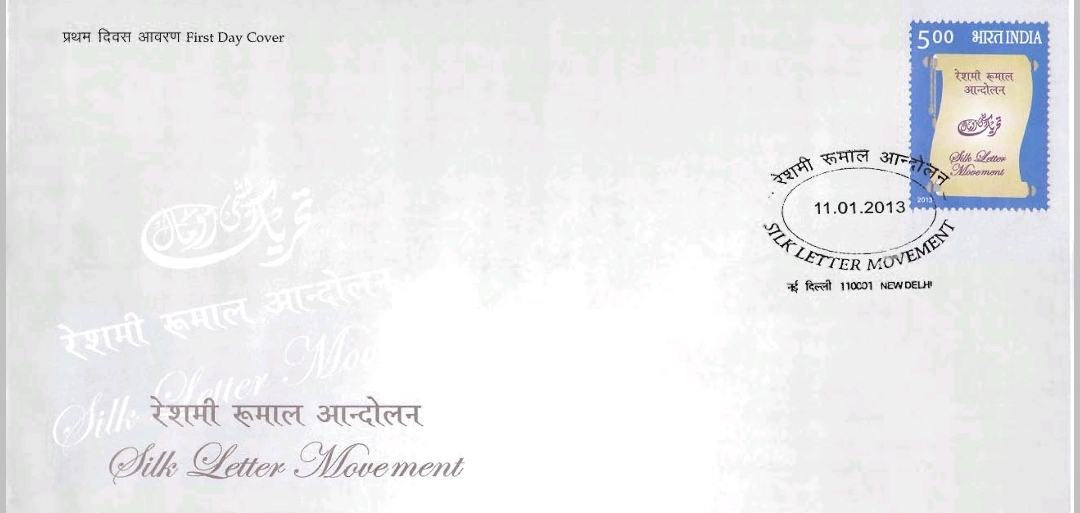
During the First World War, Maulana Mahmood Hasan, and other Islamic scholars planned an armed attack on British India from the Afghanistan frontier. The ambitious plan did not succeed because of the changed geo-political scenario (defeat of Turkey and Germany) and the British getting hold of three silk letters, which gave away the whole planning. After this, 59 people were charged for waging the war against the crown. I am sharing the names of these 59 forgotten heroes of the Indian freedom struggle.
During the First World War, Maulana Mahmood Hasan, and other Islamic scholars planned an armed attack on British India from the Afghanistan frontier. The ambitious plan did not succeed because of the changed geo-political scenario (defeat of Turkey and Germany) and the British getting hold of three silk letters, which gave away the whole planning.
After this, 59 people were charged for waging the war against the crown. I am sharing the names of these 59 forgotten heroes of the Indian freedom struggle.
Silk Letter Movement : A freedom struggle woven in silk
Abdul Aziz Molvi, son of Haya Gul from Itman Zai, Peshawar
Abdul Bari B.A., son of Ghulam Jilani from Lyallpur
Abdul Hai Khwaja, son of Khwaja Abdur Rahman from Gurdaspur
Abdul Haq Shaikh alias Jeewan Das from Shahpur district. He was an official witness.
Abdul Haq Molvi from Rifah-e-Aam Press Lahore.
Abdul Majeed Khan, son of a Risaldar Manager from the 15th Cavalry Battalion of the army.
Abdullah Molvi, son of Nihal Khan from Sukkur district. He was an official witness.
Abdul Qadir B.A., son of Ahmad Deen from Lyallpur.
Abdur Rahim Sindhi Shaikh, son of Lala Bhagwan Das from Hyderabad, Sindh
Abdur Rahim Molvi, son of Rahim Bakhsh, Masjid Cheenian Wali, Lahore.
Abdur Rashid, a migrant student of Mardan and Lahore.
Abdur Razzaq Ansari Hakim, son of Abdur Rahman of Delhi.
Abdul Waahid, son of Siddiq Ahmad from Tanda, United Provinces.
Abul Kalam Azad Molvi, nickname Mohiuddin, son of Maulana Khairuddin from Calcutta
Abu Muhammad Ahmad Molvi alias Molvi Ahmad, son of Ghulam Hussain from Lahore and Chakwal
Ahmad Ali Molvi, son of Habibullah, from Gujranwala district. He was an official witness.
Ahmad Miyan Molvi, son of Abdullah Ansari from Ambetha, district Saharanpur (United Provinces). He was an official witness.
Allah Nawaz Khan, son of Khan Bahadur Rab Nawaz Khan honorary magistrate of Multan, Punjab
Anees Ahmad, B.A. Molvi, son of Idrees Ahmad, assistant secretary at Anglo-Oriental College Aligarh , United Provinces.
Ozair Gul Molvi, son of Shaheed Gul of Durgayee, Northwest Frontier.
Barkatullah Molvi Muhammad of Bhopal and Japan
Fatah Muhammad Sindhi from Rok, Sindh
Fazlul Hasan Molvi alias Hasrat Mohani from Aligarh .
Fazl Elahi Molvi, son of Meeran Bakhsh from Haripur, thana Wazirabad, district Gujranwala, Punjab.
Fazl Mahmood Molvi, son of Molvi Noor Muhammad from Charsadda, Northwest Frontier.
Fazl Rabbi Molvi from Peshawar.
Fazl Wahid Molvi, son of Faiz Ahmad, alias Haji Turangzai, from Northwest Frontier.
Habibullah Ghazi, the son of Ruhullah from Kakori, district Lucknow, United Province.
Hadi Hasan Syed, from Khan Jahanpur, district Muzaffar Nagar, United Province.
Hamdullah Molvi, son of Haji Sirajuddin from Panipat.
Hussain Ahmad Madani Molvi, son of Molvi Habibullah from Faizabad and Medina .
Ibrahim Sindhi, M.A. Shaikh, son of Abdullah from Karachi.
Kala Singh, a migrant from Ludhiana (Punjab)
Khan Muhammad Khan Haji from Peshawar. (died)
Khushi Muhammad, son of Jan Muhammad from Talauli, district Jalandhar, Punjab.
Mahendra Pratap Kunwar, son of late Raja Ghanshiam Singh from Mursan, United Province.
Mahmood Hasan Maulana, former head-teacher at Deoband Madrasa, United Province.
Matloobur Rahman Molvi of Deoband, an employee of the Agricultural Department, UP Govt.
Mohiuddin alias Barkat Ali Molvi from Kasur.
Mohiuddin Khan Molvi from Moradabad. (Qazi of Bhopal)
Muhammad Abdullah B.A., son of Shaikh Abdul Qadir, Secretary Mianwali District Board.
Muhammad Ali B.A. son of Abdul Qadir from Kasur.
Muhammad Ali Sindhi, the son of Habibullah from Gujranwala.
Muhammad Aslam Attar from Peshawar.
Muhammad Hasan B.A. from Lahore whose father was an employee in the Paisa newspaper.
Muhammad Hashim Molvi Syed from Kora, Jahanabad, Fatahpur.
Muhammad Masood Molvi, son of Mazhar Hussain from Deoband, United Province. (Official witness)
Muhammad Miyan Molvi, son of Molvi Abdullah Ansari from Ambetha, district Saharanpur, United Province.
Muhammad Mubeen Molvi, son of Muhammad Momin from Deoband. (Official witness)
Muhammad Murtuza Molvi Syed, son of Bunyad Ali from Bijnor, United Province. (Official witness)
Noorul Hasan Syed from Ratheri, district Muzaffar Nagar U.P.
Obaidullah Molvi alias Buta Singh from Sialkot, Punjab.
Sadruddin alias Dr. Abdul Karim Barlasi, son of Amir Ali of Banaras.
Saifur Rahman Molvi, son of Ghulam Khan from Peshawar district, Northwest Frontier.
Shah Bakhsh Haji, son of Imam Bakhsh Ansari from Hyderabad, Sindh.
Shah Nawaz Khan, son of Khan Bahadur Rab Nawaz Khan, honorary magistrate, Multan, Punjab.
Shujaullah, son of Habibullah from Lahore.
Wali Muhammad Molvi from Futuheewala, district Lahore.
Zahoor Muhammad Molvi from Roorkee, son of Inayatullah of Saharanpur.
source: http://www.heritagetimes.in / Heritage Times / Home / by Mahino Fatima / August 04th, 2024
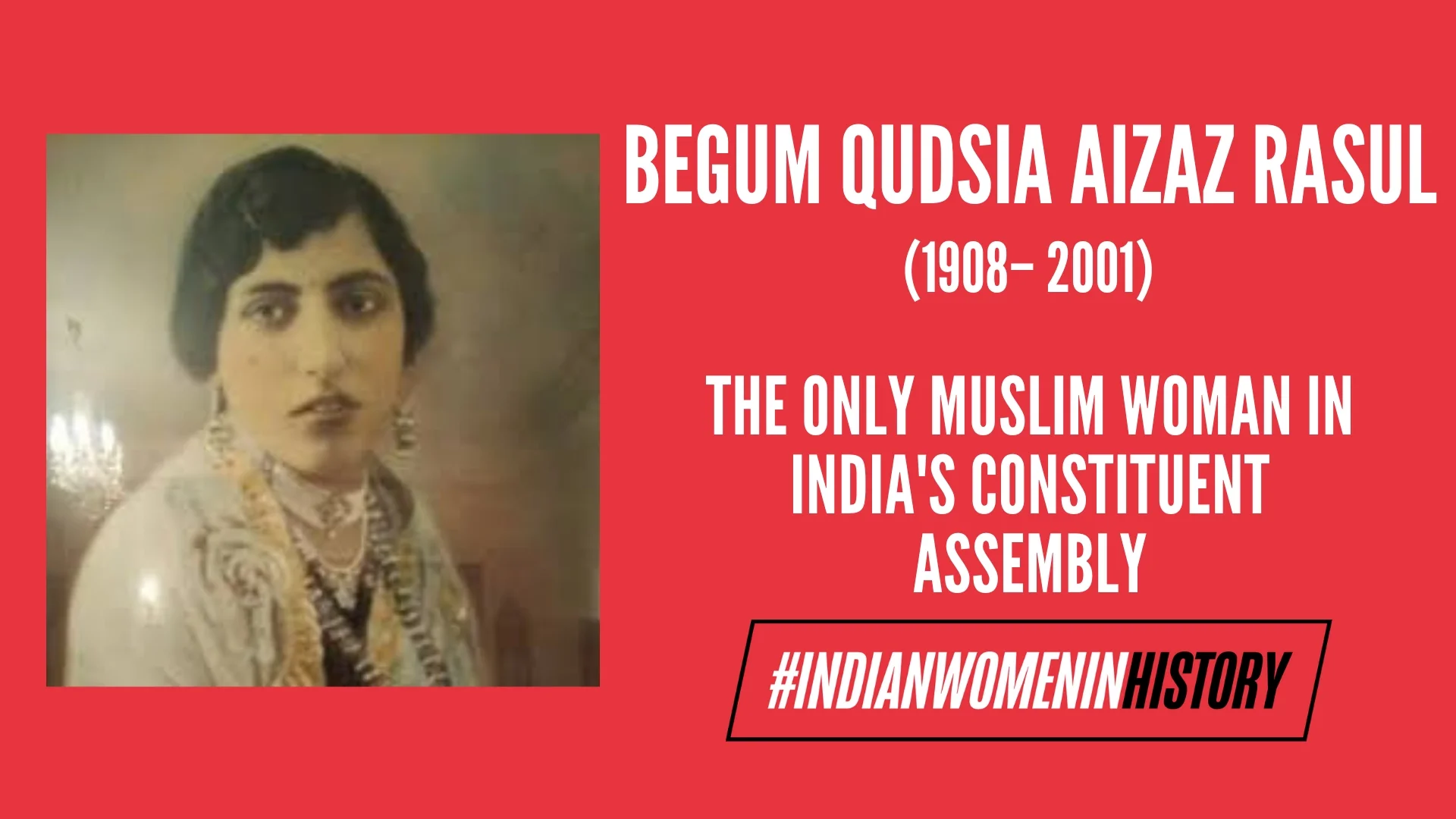
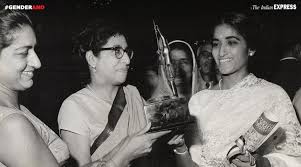
Begum Qudsia Aizaz Rasul was one of the 28 Muslim League members to join the Constituent Assembly of undivided India, and she was the only Muslim woman to be a part of the assembly.
Begum Qudsia Aizaz Rasul was born to the royal family of Malerkotla (situated in erstwhile united Punjab) on 4th April, 1908. Her father was Nawab Zulfiqar Ali Khan. Qudsia had a progressive upbringing and was encouraged from a very early age to lead a modern life, as opposed to several stringent restrictions imposed upon other contemporary Muslim women, such as that of the purdah.
She got married at quite an early age to Nawaab Aizaz Rasul from the erstwhile province of Awadh. Her husband held the position of a taluqdar, or a landowner. Qudsia had political exposure both before and after marriage, and her formal political participation took place after she got married.
Qudsia, along with her husband, joined the Muslim League in mid-1930s, soon after the passing of theGovernment of India Act in 1935. This was also her official entry into electoral politics, as she contested in the elections of 1937 from the U.P. legislative assembly, where she successfully held her seat till 1952. Aizaz was one of the very few female candidates to have contested and won from a non-reserved constituency during the pre-independent times.
“
She was the first Indian woman to achieve such feats, and this was truly commendable and noteworthy at a time when most formal political positions were almost implicitly reserved for men.
“
As an MLA, she also held several important posts, such as the Leader of Opposition (1950 to 1952) and the Deputy President of the Council (1937 to 1940). She was the first Indian woman to achieve such feats, and this was truly commendable and noteworthy at a time when most formal political positions were almost implicitly reserved for men. Moreover, to rise to prominence at a politically significant province such as the U.P. indeed made Qudsia Aizaz Rasul a trailblazer.
She is well known for her progressive, anti-feudal stances, such as the abolition of the zamindari system. Qudsia was a strong advocate for the abolition of communal electorates as well, as she believed it divided the society more than it united – which was counterproductive for the Indian electoral candidates at a time when there was an urgent need of a united Indian front to oppose the colonial rulers. She went on to create a strong and convincing case for the abolition of electoral reservations for religious minorities during her tenure as a member of the Constituent Assembly.
Qudsia was one of the 28 Muslim League members to join the Constituent Assembly of undivided India, and she was the only Muslim woman to be a part of the assembly. Her contributions in the assembly debates remain monumental till date and have been recorded in many official sources.
“
Her contributions in the assembly debates remain monumental till date, and have been recorded in many official sources.
“
After the dissolution of the League, she joined the Indian National Congress, and served as a member of the Rajya Sabha from 1952 to 1958. Later, she became a member of the legislative assembly of Uttar Pradesh from 1969 to 1989.
Other Achievements
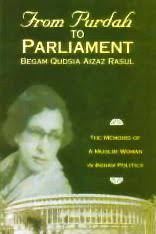
Begum Qudsia Aizaz Rasul is also well known for her autobiography, titled From Purdah to Parliament: A Muslim Woman in Indian Politics. It provides excellent insights into the intersectional aspects of organised politics as it functions in our country. Other than this, she also wrote a travelogue titled Three Weeks in Japan.
Besides her literary prowess, Qudsia had also served as the President of the Indian Women Hockey Federation for over fifteen years, and went on to become the President of the Asian Women’s Hockey Federation.
Begum Qudsia Aizaz Rasul was awarded the Padma Bhushan in 2000 for immense, invaluable contributions to the field of social work.
Sultana Saleem was one of the officers of Azad Hind Fauj, or INA, of Subhas Chandra Bose.
It is a concise compilation of a few of less known Muslim women who took part in the Indian Freedom Struggle.
Begum Mahboob Fatima: On 13 April 1932, two women were arrested at Chandni Chowk in Delhi by the police for commemorating the anniversary of the massacre at Jallianwala Bagh. These two were Begum Mahboob Fatima and Satyawati. On 21 April 1932, Begum Mahboob was sentenced for six months of Rigorous Imprisonment and Rupees 50 of fine. With this she became the first Muslim woman to have been sentenced during the freedom struggle in Delhi.
Sultana Saleem: Sultana Saleem was one of the officers of Azad Hind Fauj, or INA, of Subhas Chandra Bose. Her husband Colonel Saleem, whom she met during the war, also served the INA and Sultana was an officer of Rani Jhansi Regiment. Sultana reached India as part of the first contingent of captured soldiers of Rani of Jhansi Regiment in February 1946. The Indian Express reported on 22 February 1946, “Mrs Sleem felt that there was only one country for her- Hindusthan – and only one nation – Hindustani. She did not believe in either communalism or provincialism. It was the oneness of India that appealed to her most. In East Asia, she said there was no consciousness at all of religious or provincial differences and no untouchability problem. She believed that if India had freedom her many problems could be solved without much difficulty.”
Asghuri Begum: In 1857, when somewhere else Rani of Jhansi and Begum Hazrat Mahal were fighting against the colonial army of the English East India Company, in Muzaffarnagar and Shamli, peasant women had organised themselves in armed bands. The leader was Asghuri Begum. The region had been liberated by the Indian revolutionaries where the women contingent was being led by Asghuri. When Major Sawyer conquered Thana Bhawan, a town in Shamli, in October 1857, Asghuri was also captured. British troops tied her to a pole at a public place and set fire to her alive.
Nishat-un-Nisa: “I appeal to the youth of this country that they sit at the feet of this goddess (Nishat un Nisa Begum) to learn the lessons of independence and perseverance.” These were the words of famous Urdu poet Pandit Brij Narayan Chakbast. Nishat was the first Muslim woman to address a Congress Session and that too without a purdah. Hasrat Mohani, who coined Inquilab Zinadabad, was her husband. Nishat attended the public political meetings without her husband. She wrote articles, led delegations to Viceroy, participated in strikes and was the first woman to move a resolution for complete independence at a Congress session.
Saadat Bano: Saadat Bano whose husband Saifuddin Kitchlew is known as the hero of Jallianwala Bagh was a writer, poet and political activist much before her marriage. She wrote extensively for women rights, patriotism and education. It is a well known fact that people gathered at Jallianwala on 13 April 1919 to protest the arrest of Saifuddin but it is often overlooked that they came to listen to a public address by Saadat. Saifuddin was in jail but Saadat did not sit at home in those times. She used to address meetings, meet political leaders, attend Congress sessions, write in papers and take part in All India Women Conference activities. She was considered orator par excellence.
Amjadi Begum: How important a person would be if Gandhi himself wrote in one of his articles that this ‘brave woman’ led the ‘fundraising campaigns’ from the front ? Almost no history student in India knows Amjadi Begum. They know her as the wife of Maulana Muhammad Ali Jauhar. Gandhi in one of his articles wondered whether she could teach her husband the art of public oratory, where one impressed upon the hearts of the audience in a few words. She is believed to have single handedly led the fundraising campaigns and managed affairs of Jamia Millia Islamia when her husband was in prison.
Moondar: Rani of Jhansi’s movement had an important Muslim woman, viz. Moondar. She was a close aide and assisted her during battles. Robert Hamilton, agent of Governor General to Central India, informed the British government on 30 October 1858, “Rani was riding a horse. There was another Muslim woman riding with her, who used to be her servant as well as companion since many years. Both fell down from the horse with the bullet wounds simultaneously.” Another British officer John Venables Sturt claimed that the body recovered by the British was not of Rani but Moondar’s.
Nani Hakko: Nani Hakko was a jolaha (weaver) woman from Panipat who was impressed by Mahatma Gandhi’s idea of boycott and swadeshi. The she first heard him, Hakko started weaving her own shroud. She willed to be buried in a khadi shroud. When someone asked her what she was weaving, she would reply, ““I am weaving a kafan (shroud) for myself”.
Hakko left this world only the day after completing this khaddar ka kafan. She asked people to bury her in this handwoven shroud (khaddar ka kafan) and boycotted the foreign made cloth even in her death. According to Khwaja Ahmad Abbas, she was the first person to have been buried in khaddar ka kafan as a result of Gandhi’s call to charkha. Khwaja wrote, “she was the first one to be buried in a khaddar ka kafan — a patriot unto death!”
source: http://www.heritagetimes.in / Heritage Times / Home / by Saquib Salim / March 08th, 2025
Mehndauri Village (Chail Pargana,Allahabad District), UTTAR PRADESH :
Maulvi Liaquat Ali Qadri, a religious scholar, led the 1857 Allahabad rebellion, uniting communities against British oppression. Declaring jihad, he fought for India’s freedom, faced exile, and died in Kala Pani in 1892, leaving a lasting legacy.
Main Points:
1. Maulvi Liaquat Ali Qadri (1817–1892), born in Allahabad, was a revered religious scholar and freedom fighter.
2. He led the 1857 rebellion in Allahabad, uniting Hindus and Muslims against British rule.
3. Declared jihad, organized public gatherings, and hoisted Bahadur Shah Zafar’s flag.
4. Fought British oppression, faced exile, and continued guerrilla warfare.
5. Sentenced to life in Kala Pani; died in 1892.
———-
Maulvi Liaquat Ali Qadri was born on October 15, 1817, in the village of Mehndauri, Chail Pargana, Allahabad district, to Syed Meer Ali and Aamna Bibi. He was a revered religious figure of his time, embodying the spirit of both spiritual and national liberation. During that era, Islamic scholars viewed the country’s independence and religious freedom as inseparable causes. This conviction led a significant number of religious scholars to participate in the Indian Rebellion of 1857, many of whom attained martyrdom in their fight for freedom.
Maulvi Liaquat Ali was a simple man deeply connected to the struggles of the common people in his region. He was acutely aware of the hardships faced by the masses under British colonial rule. Alongside his profound religious knowledge, he harbored an intense passion for liberating his country from the shackles of foreign oppression. Leading a life of piety and integrity, he consistently advised others to uphold honesty, empathy, and mutual support in times of distress. He considered it the duty of every Indian to strive for the nation’s independence.
The Rebellion in Allahabad
Following widespread looting and arson, Allahabad fell under the control of the rebel Indian forces. Maulvi Liaquat Ali, accompanied by a large number of his followers, threw himself into the struggle against British rule. Seizing the opportunity, he declared jihad against the British, galvanizing thousands to join the fight. Under his leadership, the people of Allahabad (now Prayagraj) united to drive the British out of the city. Maulvi Liaquat Ali delivered a powerful message of unity to both Hindus and Muslims from a public platform in Allahabad. In his sermon, he emphasized, “We are all one. Together, we must confront the foreigners.” With this spirit of unity, he proclaimed the establishment of an independent government in the region and hoisted the flag of Bahadur Shah Zafar, the last Mughal emperor.
The British were not only plundering India’s wealth but also subjecting its people to relentless oppression. Beyond economic exploitation, Christian missionaries, backed by colonial authorities, were attacking India’s religious traditions and sacred texts. They propagated Christianity while attempting to demean Hindu and Muslim scriptures.
Unable to tolerate these affronts, Maulvi Liaquat Ali organized a massive public gathering on June 7, 1857, at Khusro Bagh in Allahabad. The event drew a large number of patriotic Hindus and Muslims. In a fiery speech, he condemned the British for their atrocities, including looting, arson, and desecration of holy texts. Declaring that such oppressors could not be tolerated, he called for jihad against the “sinners.” His impassioned address stirred the hearts of the audience, who were already exasperated by the British’s sacrilegious actions.
Under his leadership, a week-long uprising against the British began on June 9, 1857. Rebels set fire to British bungalows, inflicted casualties, and damaged government property. The widespread unrest created panic among the colonial authorities. However, the British retaliated with heavy shelling and arson, driven by a desire for vengeance. Entire settlements were razed, forcing residents to flee their homes. Maulvi Liaquat Ali, too, was compelled to leave Allahabad and sought refuge in Kanpur.
A Champion of Communal Harmony
Maulvi Liaquat Ali was a firm advocate of Hindu-Muslim unity and cooperation, despite his opposition to Christian missionaries, whose actions, fuelled by colonial arrogance, insulted Indian religions and scriptures. He was among the few leaders who demonstrated through their revolutionary actions that they were fully aware of the socio-political realities of their time. The British, he believed, were not only exploiting India’s resources but also undermining its social fabric. He tirelessly worked to counter their divisive tactics, raising his voice for the dignity of women, religious communities, and the upper classes, earning widespread admiration for his efforts.
Despite his religious persona, Maulvi Liaquat Ali was always ready to take risks for the sake of his country and faith. He never feared for his life or shied away from potential losses. His revolutionary activities were driven by a singular goal: to free India from British rule and rid the sacred land of their oppressive presence. When a Muslim shrine, Bakhtiar Bakhtiyar, and the Telegraph Band were seized by the British, Muslim youths fought to protect them, resulting in losses on both sides. Clashes between Indian rebels and British forces continued across various regions, making it increasingly difficult for the British to maintain their grip on India.
A Lifelong Struggle for Freedom
Maulvi Liaquat Ali swore to dedicate his life to the cause of India’s independence. After leaving Allahabad, he moved to Muzaffarnagar, a stronghold of the freedom struggle, where he joined other revolutionaries. His authority was such that no orders were issued without his approval. Whenever British forces attempted to suppress the rebellion, Maulvi Liaquat Ali, alongside another freedom fighter, Azimullah, embarked on a perilous journey on foot toward Gujarat. Despite facing numerous hardships along the way, they reached their destination and launched guerrilla warfare against the British. For years, their tactics kept the colonial administration on edge.
According to Rakesh Verma, technical assistant at the Regional Archives, “Administrative records written in Urdu titled Naksha Bagiyan Kotwali Allahabad, listing police constables who forcibly took their salaries for May and June 1857 and participated in the revolt, including Hanuman Prasad, Imdad Ali, Ashraf Ali, etc. were hung by Major Henry Court on July 14, 1857,” (From the HT)
The British resorted to various conspiracies to capture him, but Maulvi Liaquat Ali’s stature among freedom fighters only grew. He continued to plan large- and small-scale operations against the British, opening new fronts in the fight for independence.
Imprisonment and Legacy
Ultimately, the Allahabad court sentenced Maulvi Liaquat Ali to life imprisonment in the Andaman Islands, infamously known as “Kala Pani.” Enduring the harsh conditions of imprisonment, this brave son of India passed away on May 17, 1892, bidding farewell to his beloved homeland and the world.
Maulvi Liaquat Ali Qadri’s sacrifices for India’s freedom struggle remain an enduring legacy. His contributions must be remembered and celebrated as an inspiration for future generations, reflecting the indomitable spirit of a man who fought tirelessly for his country’s liberation.
The alternative historiography and discovery of real heroes of the society is always important in any age or any society.
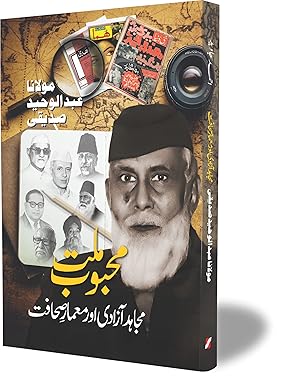
The compilation and publication of “Maulana Abdul Waheed Siddiqui: Mujahide-Azadi Aur Meyma’re-Sahafat” is the result of this realisation.
The book and authors have tried to explore his personality and achievements in the broader context of history and developments of his times.
The contents of the book are documentary in nature.
The commentaries of Maulana Imdad Sabri are the personal observations and experiences of an eminent scholar and historian of Urdu journalism.
Similarly, the articles by Maulana Anzar Shah Kashmiri of Daryl Ulum Deoband, Mr. Parwana Rudaulavi , a senior journalist, Maulana S M Wali Rahmani, Dr. Khalique Anjum, Mr. G D Chandan, Mr. Shariful Hasan Naqvi, Sardar Rachpal Singh, Maulana A M Siddiqui Rahi, Ms. Surayya Siddiqui and Mr. Shahid Siddiqui are observations and experiences of those who saw and experienced him closely. These are also opinions of eminent critics and experts of language, literature, journalism, politics and history.
History and biographies open the windows of experiences and observations to human beings, and gives them the ability to discover themselves, understand their surroundings, see the impact of situations and events, look inside them and build future paths. History is the name of the waves and splashes of water in the river of time from which people emerge and nations are formed.
Maulana Abdul Waheed Siddiqui, the journalist and freedom fighter is a milestone, a bridge and a delicate and difficult chapter of modern Indian history, which holds many lessons, for present and future generations.
Maulana was a visionary, a man with deep roots in Muslim culture and religious ethos but with a very modern and enlightened outlook.
He laid the foundations of free press in post independence India. He gave the confidence to Indian Muslims to stand up and fight for their rights under the Constitution and not.
About 28 years ago, I learnt one of the most fascinating tales of what military rivalry between India and Pakistan has meant for some families.
At a dinner party in New Delhi, an elegant gentleman walked up to me and asked if I was serving in the Indian Army. My haircut perhaps gave this away, as I answered in the affirmative (I was then an instructor at the Indian Military Academy, Dehradun). When I enquired if he had any military connections, he replied ‘yes’; his two elder brothers had both been officers. To this, my natural response was, “What were their regiments?” He then said with a sad smile, “Let me tell you a story.”
And this was the story he narrated to me:
Several years earlier, he had run into the Pakistani military attaché, Brigadier Beg, in India at a circuit house (Dak Bungalow) while driving on the Delhi-Ahmedabad highway. Apparently the attaché had upset him earlier in the day with his lack of road manners, and when informed of the same, to make up, the Pakistani Brigadier invited him for a drink. During the course of their conversation, and on learning that his guest (the gentleman who was narrating the incident to me) was an Indian Muslim, the Pakistani Brigadier said to him that it was only in the 1965 war that he learnt that Muslim officers were also serving in the Indian Army.
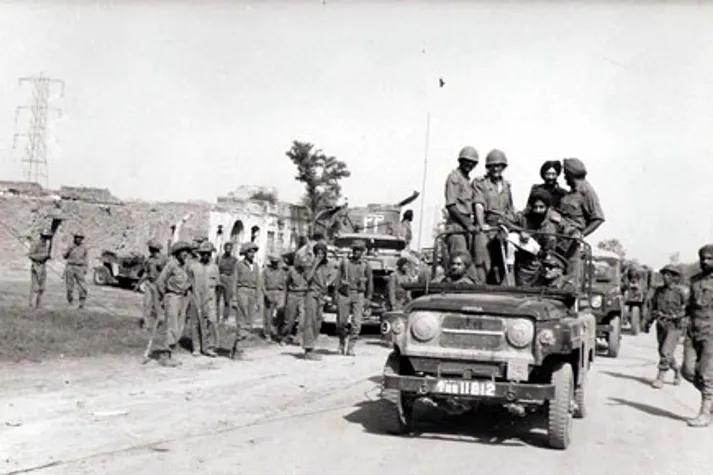
(The Indian Army’s armoured (tank) units had made substantial gains in fierce battles in the Sialkot sector of Pakistan’s Punjab. Many well known armoured regiments were part of India’s 1st Armoured Division’s thrust lines, such as Poona and Hodson’s Horse, 2nd Lancers, 3rd, 16 and 18 Cavalry. Many thought it was only a matter of time that Sialkot would fall to Indian troops, as Pakistan’s Armoured Division, despite its apparently superior tank units, was in retreat. Pakistan’s commanders desperately needed a tactical break to regain some of the momentum of battle.)
It was at this stage of the war—around 8 September 1965—that the Pakistani Brigadier, then a young Lieutenant, was summoned by his Brigadier Commander. He was asked plan and undertake a commando raid that would take him into Indian frontline positions around Sialkot. His task was to eliminate one or more Indian tank commander(s). This would leave that Indian unit briefly without a commander and give Pakistan that brief window of opportunity to break through India’s formidable frontline.
So this Pakistani officer (then a Lieutenant, now a Brigadier) set about preparing for the raid, to sneak in amongst Indian tanks, during darkness, and kill an Indian tank commander who was giving Pakistani troops a rough battle. So, on 8/9 September before dawn, Lieutenant Beg sneaked into his target area as Indian tanks were preparing for another day’s battle around Sialkot. (In those days, in the absence of night vision devices, tank battles were largely fought during day light). He soon identified a Squadron Commander’s tank, and climbed atop it unnoticed in the loud roar of tank engines as they were warming up for battle.
Peering inside the open cupola, he saw a Major in his radio headset who was poring over his maps, planning for another day’s battle. With no time to lose, Lieutenant Beg shot the Indian Major through the head. But before leaving the wounded Indian officer, Lieutenant Beg decided to take along some proof of having accomplished his mission. He quickly unbuttoned the shoulder flaps of the Indian Major, and pulled out the cloth epaulets of his ranks from his shoulders. On this was also embroidered ‘16 CAV’, the title of his regiment. And in the breast pocket of the Major, he also found a holy pendant that some Muslims carry on them as a good luck charm. His job done, this young Lieutenant with his raid party then quickly crossed back over into the territory that Pakistani troops were still holding onto, before dawn broke.
Lieutenant Beg then immediately went to see his Brigade Commander, who had sent him on the raid. He met him in the early hours of the morning, where he proudly reported that he had accomplished his mission. His Brigade Commander asked him if he had any proof of it. The young Lieutenant pulled out the epaulettes of the rank badges of the Indian Army Major he had shot, and handed it over to his Brigade commander. Then he suddenly saw the Brigadier become tense. Lieutenant Beg said to the Brigadier that he had possibly killed an Indian Muslim officer, as he handed over the holy pendant he had recovered from the dead Major’s pocket. As an afterthought, he added that he was quite surprised that India’s army also had Muslim officers who were fighting with such commitment and valour against Pakistan.
At that point his Brigade Commander’s hands began to shake and he couldn’t control his emotions any more. His voice became heavy and his eyes filled with tears as he slumped into a chair. Lieutenant Beg asked the Brigadier, with due respect, what the problem was. In a voice choked with emotion, he replied: “Young man, I have just realised from the evidence you have provided that I had tasked you to kill my younger brother.” The Commander kept shaking his head and then went on to add, “I hadn’t the foggiest idea that it was the 16 Cavalry that was directly pitted against us, because Major MAR Sheikh, whom you have just killed, was my younger brother and one of its squadron commanders. And he was their only Muslim officer.” Lieutenant Beg could say little else, as he saluted and took his commander’s leave.
And when Lieutenant Beg finished telling this story to the man who had related it to me, this gentleman told the Pakistani officer, “Brigadier, it may surprise you to know that the two brothers you have spoken about were both older to me… I am the youngest of the three brothers.”
And as the Brigadier stared at him in disbelief, the narrator of this tale requested Brigadier Beg to visit his family home—which was only a few hour’s drive from where they were—to meet his aged mother, who had always wanted to meet someone who had fought against her son! When the Pakistani Brigadier met the old begum the next day (who didn’t know that her son had died of wounds inflicted by the Brigadier), she seemed pleased that the enemy thought well of him!
Records show that Major Sheikh died of wounds in his head sustained in battle near Sialkot on 10 September 1965. He was posthumously awarded the gallantry award of a Vir Chakra. His brother, the Brigadier, rose on to become a General in Pakistan.
source: http://www.openthemagazine.com / Open / Home> Web Exclusive / by Maroof Raza / August 27th, 2015
Let us not forget him in a hurry. Let us not reduce him to a paragraph in history books. Instead, let us pass on his memory like a worn volume of Pavangal, read and reread, loved and lived, whispered from one generation to the next.
Vakkom Majeed (1909-2000). Photo: From KM Seethi’s archive.
Vakkom Majeed passed away on July 10, 2000.
“He never went out without a book under his arm, and he often came back with two.”
— Victor Hugo, Les Misérables
In the long and rolling corridors of memory, some lives stay like verses, opening out slowly, sentence by sentence, chapter by chapter, never quite closing. Vakkom Majeed’s was one such life. A life commemorated not only by its fearless engagement with history, but by its quiet, intense companionship with books. On the 25th anniversary of his passing, as we also mark the 100th year of Pavangal, the Malayalam translation of Victor Hugo’s Les Miserables , it feels almost providential to recall him through the pages he so often inhabited.
Majeed Sahib, as many called him with reverence, moved with a book always kept under his arm, a bulwark against ignorance, a lamp in times of doubt. And among the many volumes he read and reread, Pavangal held a sacred space. Nalapat Narayana Menon’s 1925 translation of Hugo’s masterpiece was more than literature to him. It was revelation. He had devoured the original edition in his youth, and its characters never left him – Valjean’s anguish, Javert’s moral rigidity, the revolt in the streets of Paris, the quiet dignity of suffering souls. When he spoke of Pavangal, it was with a fervour one reserves for scripture. He did not read the novel, rather he lived it.
A.P. Udayabhanu, a veteran freedom fighter of Kerala, once described Majeed as a “moving encyclopaedia with at least one book in his hands.” But Majeed Sahib was more than a repository of knowledge. He was a seeker, a provocateur of conscience, a gentle fire that never flickered out. I have the sweetest of memories of my time spent with him, from childhood itself, I remember the rhythm of his voice as he discussed Bertrand Russell’s three-volume autobiography, Churchill’s sprawling accounts of World War II, or the 10-volume correspondence of Sardar Patel. There was never a trace of vanity in his learning. He read not to impress but to illuminate. And when he shared his readings – Azad’s Tarjuman al-Qur’an, Muhammad Asad’s Road to Mecca, M. N. Roy’s The Historical Role of Islam, Arthur Koestler’s The Yogi and the Commissar, or Hugo’s Pavangal, like many – he spoke with the urgency of a man who felt truth must never be hoarded.
Born on December 20, 1909, in the storied Poonthran Vilakom family of Vakkom near Chirayinkil (Travancore), S. Abdul Majeed inherited a legacy of reform and resistance. His uncle, Vakkom Abdul Khader Moulavi, had already lit the flame of renaissance among Kerala Muslims. From his schooldays at St. Joseph’s High School, Anjengo, young Majeed was pulled into the vortex of reform movements and the call of the Indian freedom struggle. By the time the Quit India movement broke out, he was already a marked figure in Travancore, arrested, jailed, and later jailed again for resisting the plan of “Independent Travancore.”
But what set him apart – what made him more than just another freedom fighter – was the deep moral imagination that animated his politics. His understanding of rebellion was not ideological. It was profoundly ethical. Like Victor Hugo, he believed that human dignity must stand unshackled before the majesty of any state or creed. He condemned the ‘two-nation theory’ not because it was politically inconvenient but because it was morally vacuous. To him, the soul of India was plural, secular, and indivisible.
In 1948, he was elected unopposed to the Travancore-Cochin State Assembly from Attingal. But when his term ended in 1952, he walked away from practical politics, choosing instead the solitary path of reading, reflection, and moral clarity. While others sought power, Majeed Sahib sought wisdom. And in doing so, he became more relevant with age. Over the next decades, he would immerse himself in the philosophical and historical writings of Bertrand Russell, the radical humanism of M. N. Roy, and the emancipatory visions of Narayana Guru. He called for a “return of Ijtihad”, a freedom of thought within Islamic traditions, and dreamed of a society beyond caste and creed.
He never became rigid in doctrine. His politics was never a fixed ideology, but a conversation between ideas and reality. In our many conversations, I recall his thoughtful analysis of the Malabar Rebellion. He agreed with the thesis that it was fundamentally a revolt born of agrarian injustice but he was deeply saddened by its later communal turn. For him, the tragedy of history was when righteous anger was manipulated into sectarian hatred.
And always, there was a book in his hand. Always, a passage to quote. Always, a memory to share.
The last three decades of his life were his most contemplative. He reread the classics, interrogated nationalist histories, and engaged with young minds who came to him for guidance. To them, he gave not slogans but questions. When he spoke of Jean Valjean’s redemption, it was a commentary on our prison system. When he discussed Javert’s suicide, it became a parable about the dangers of legalism without compassion. When he recalled Fantine’s fall, it was a scathing critique of social hypocrisy.
He never forgot the moment when he visited the Indian National Army hero Vakkom Khader in the Madras Central Jail. It was Majeed Sahib who brought back Khader’s last letter to his father before his hanging, a task that broke his heart and steeled his resolve.
In 1972, when the nation celebrated the silver jubilee of independence, Majeed was awarded the Tamrapatra by Prime Minister Indira Gandhi. Later he was deeply perturbed by the excesses of Emergency.
There was no trace of ceremony in his life. No pursuit of fame or favours. He lived in quiet dignity, read in solitude, and died in obscurity, on July 10, 2000. He left behind not an estate, not a political dynasty, but an idea of what it means to live ethically, read deeply, and act justly.
Today, as we remember him, the centenary of Pavangal seems to carry the tenor of prophecy. One hundred years since Jean Valjean entered Malayalam letters, and twenty-five since Vakkom Majeed left this world, the two seem braided, one fictional, one real, both intensely human. Majeed Sahib was Kerala’s own Valjean: hunted by regimes, misunderstood by many, but ultimately redeemed by the fire of truth and the grace of humility.
Let us not forget him in a hurry. Let us not reduce him to a paragraph in history books. Instead, let us pass on his memory like a worn volume of Pavangal, read and reread, loved and lived, whispered from one generation to the next.
For in remembering Vakkom Majeed, we remember the best of what we once hoped to be.
K.M. Seethi is director, Inter University Centre for Social Science Research and Extension (IUCSSRE), Mahatma Gandhi University (MGU), Kerala, India. Seethi also served as Senior Professor of International Relations, Dean of Social Sciences at MGU and ICSSR Senior Fellow.
source: http://www.thewire.in / The Wire / Home> History / by K.M. Seethi / July 11th, 2025
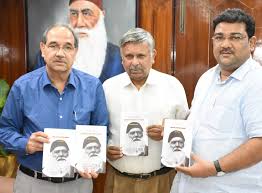
Aligarh Muslim University (AMU) Vice Chancellor, Professor Tariq Mansoor today released the Hindi translation of Sir Syed Ahmad Khan’s ‘Asbab-e-Baghawat-e-Hind’ along with a special reprint of the book in Urdu. The translation has been done by Dr Jasim Mohammad.
The book was released in the presence of Professor Shafey Kidwai (Member-in-Charge, Public Relations Office, AMU).
On the occasion, the Vice Chancellor said that Sir Syed Ahmad Khan took upon himself the challenge of educating the masses by pushing ahead common people towards over all development with the most modern and scientific education. He added that it is imperative that the teachings Sir Syed should reach all corners of world through translations in various languages.
Dr Jasim said that the idea behind the translation of ‘Asbab-e-Baghawat-e-Hind’ is to educate people on how Sir Syed with his nationalistic approach towards problems and controversies prevailing at that time took the unimaginable step of speaking against the British rule.
Dr Jasim has authored 26 books including ‘Sir Syed Ahmad Khan aur Aligarh Movement’, Aligarh Muslim University Minority Character: A Comprehensive Study’ and ‘Urdu Mass Media aur Rabta-e-Aama’. He regularly writes articles and opinion pieces in Hindi, Urdu and English languages for national dailies. Dr Jasim is also a recipient of Bharat Gaurav Samman, Acharya Hasthi Karuna Institutional Award and Rais Uddin Rais Award.
source: http://www.indiaeducationdiary.com / India Education Diary / Home> Academics> Competition> Edu Events> National News / by India Education Diary Bureau / pic: edited – facebook.com/proamuofficial / September 09th, 2017