Captain Fatima Wasim’s historic role as the first female medical officer in an operational post at the Siachen Glacier is a remarkable achievement. The nation commends Captain Fatima Wasim for her groundbreaking accomplishment.
Captain Fatima Wasim makes history as the first female medical officer deployed at Siachen Glacier. / Image Source : INDIA TV /
Captain Fatima Wasim has etched her name in history by becoming the first female medical officer to be deployed on an operational post at the formidable Siachen Glacier. After undergoing rigorous training at the Siachen Battle School, she received her posting at an operational post situated at an altitude of 15,200 feet.
Historic deployment
Captain Fatima Wasim’s appointment as the first woman medical officer on an operational post at Siachen Glacier is a groundbreaking achievement. Following intensive training at the Siachen Battle School, she assumed duties at the operational post located at a challenging altitude of 15,200 feet.
Siachen warriors’ Captain
The Fire and Fury Corps of the Indian Army shared a video on social media platforms, underscoring the milestone achieved by Captain Fatima Wasim. The video celebrated her as the first medical officer to be stationed at an operational post on the Siachen Glacier, emphasising her indomitable spirit and high inspiration.
Captain Fatima Wasim’s deployment at 15,200 feet is a testament to her resilience and serves as a source of immense inspiration. The challenging conditions of Siachen Glacier make this assignment not only historic but also a reflection of her unwavering dedication.
Acknowledgment by the Indian Army
The Fire and Fury Corps of the Indian Army acknowledged Captain Fatima Wasim’s historic posting through a video shared on social media platforms. The caption emphasised her role as a Siachen warrior and celebrated her as the first female medical officer in an operational post at the Siachen Glacier.
Inspiration and determination
Captain Fatima Wasim’s deployment at such a formidable altitude symbolises her unyielding determination and serves as an inspiration for others. Her historic posting is not only a personal achievement but also a significant stride in breaking gender barriers within the armed forces.
source: http://www.indiatvnews.com / India TV / Home> English News> India / by Nitin Kumar / December 11th, 2023
Zareefa Jan has created a “language of circles” to help her document her poems. Only she can decode them.
Zareefa Jan handed me a piece of paper on which several circles were scribbled in pencil. It was only on closer look that I could make out the small differences between them – some were larger, some were not as perfectly circular, some were closer to each other, some seemed circled over and over again. They were laid out neatly in a line. As I continued trying to decipher them, she fished out a pencil and added some lines of circles on a fresh piece of slightly crumpled paper – writing from right to left, the way Urdu and Kashmiri scripts are written.
“Nobody in the world can read those lines except my mother,” Shafaat Lone, Zareefa’s son, told VICE.
Those “lines” are actually Zareefa’s very own coded language, one that she has developed as a means to archive her poetry.
“Nobody in the world can read those lines except my mother, “Shafaat Lone, Zareefa’s son told Vice.
The 65-year-old sufi poetess living in north Kashmir’s Bandipora district in India never went to school. And so, even though she can speak her native Kashmiri language, she can’t read or write in it.
Sufism is a mystical form of Islam, an unorthodox school of practice that focuses more on the esoteric aspects of religious life, and in which Sufis strive for direct, personal experiences with God.
“This is my language, the language of circles,” she tells me proudly. “I’ve developed it over the years.”
Zareefa’s initiation into poetry started a few years after she got married, when she was in her late thirties. She had gone to fetch water from a nearby brook, when she claims she lost all sense of the world around her and fell into a kind of a trance. When she came to, she’d lost her pitcher, but also felt like a different person altogether.
“When I regained my senses, a gazal just came out of my mouth,” she said.
A “gazal” is a poem or an ode that originated in Arabic poetry, and often has to do with themes like love, longing and loss. “Until then, I had no idea of what poetry was because I had never read it. But ever since, I have written hundreds of poems and gazals.”
(I didn’t destroy my youth as a fire kept nourishing me. My youth is insubstantial in the transient world.)”
Zareefa reading out one of her poems
When Zareefa realised that she had a penchant for poetry, her children were in school. They were learning how to read and write in English and Urdu. But her poems would come to her in Kashmiri – a neglected language whose use is declining, even in Kashmir.
“It would have been futile and unjust to ask them to learn another language. And who would have taught them? Kashmiri, as a subject, was not part of their school curriculum like English and Urdu,” she said. “Also, I wasn’t sure whether to share my poetry with them at all.”
It took her a few years to muster the courage to tell, first, her husband, and then her children, about her poems. To her surprise, they were amazed at the content of the poems. However, she could memorise and remember only a few of her works; most were lost to memory since she had no way of documenting them.
Initially, Shafaat tried to record them on tape. Then, her elder daughter, Kulsum, tried to write them down with the little Kashmiri she knew. But Zareefa was unhappy with both ways of archiving.
If a thought occurs to Zareefa out of nowhere, she grabs the nearest pen and writes it down, even if its on her hand itself.
“I can’t take my children with me everywhere I go to read my poetry and ask them to whisper my own lines into my ear so that I can say them out loud for others,” she said. “Also, my children can’t be with me every time I have a thought and want to record it, either on tape or on paper.”
So, she devised another technique.
Whenever she had a thought, she’d grab a page and draw different shapes of things on it. Most of it would be literal. “If there was an apple as a word in my poem, I’d draw an apple; if there was a heart, I’d draw a heart,” she said.
Later, whenever her daughter had the time, Zareefa would decode those shapes and Kulsum would write down the poem in conventional script.
“But I am illiterate, and I had never held a pen before,” said Zareefa. “So everything I drew was just a different shape and size of a circle. Like, even if I drew a banana, it would be circular!”
Still, those odd, circular shapes proved to be a good cue for her to remember her lines until her daughter could note them down. That, however, came to a stop three years ago, with Kulsum’s sudden passing.
In grief, Zareefa neglected to document her poems for a time, until she decided to revisit those circular shapes.
Zareefa Jan while reading her coded poetry
She realised that the many years of assigning her own meaning to her circles meant she had created an alphabet of sorts. Only she could read it, but she was content with that. It’s not even a fixed lexicon where one shape always stands in for a particular meaning. It keeps evolving as she gives the circles meaning that only she can remember and decode.
Now, those pages filled with squiggly circles lie inside books that hold them together, a repository of some 300 poems she has thus written. Her family is trying to get them all published in both her coded scripture and its conventional transliteration side by side.
Some of her coded as well as decoded works
Some experts believe that Zareefa could well be the first poet in the world to have created her own alphabet to preserve her creations.
“As a student and teacher of poetry, I haven’t seen this kind of thing anywhere in the world of poetry,” said Seraj Ansari, an Urdu teacher. “If what she is saying is true, then she is probably the first poet in the world to do so.”
However, Zareefa’s son tells me how some people doubt his mother’s claim that her circles carry meaning that only she can decode. They suspect that she really remembers her poetry and only pretends to read it from her circles.
But one of the oldest and most revered sufi poets in Kashmir, Ab Kareem Parwana, believes Zareefa.
“No poet in the world can remember everything they have written,” he told VICE. “I have not seen or heard of anyone in my lifetime saying they remember their entire poetry collection. She is a mystic poet, and in mysticism, everything is possible.”
In a conversation with FII, Moumita Alam discusses how she began writing poetry, and what it is like being a Muslim woman in a Hindu majoritarian state and how the voices of certain minorities have been silenced throughout Indian history.
Moumita Alam is a teacher based in West Bengal whose political poetry, over the past few years, has gained incredible popularity in South Asia due to its powerful messages and themes. As a Muslim woman, through her poems, essays and opinion pieces, she attempts to bring out the atrocities faced by the women of her community alongside critiquing the larger issue of rising Islamophobia in India. Her first and only book, The Musings of the Dark was published in 2020.
In a conversation with FII, Moumita Alam discusses how she began writing poetry, what it is like being a Muslim woman in a Hindu majoritarian state and how the voices of certain minorities have been silenced throughout Indian history, particularly in West Bengal ever since the 1947 partition.
FII: You have, over the past few years, used your poetry to both raise awareness about and protest against the Islamophobia propagated by the ring wing in our country. Would you like to shed some light on what your writing journey has been like?
Moumita: I began my poetic journey after 2019. In 2019, on the 5th of August, the abrogation of Article 370 happened. I had a friend who lived in Kashmir, so I lost connection with him. He was an aspiring advocate who would regularly speak with me. I, as a teacher and a single mother, would share my life journey with him in return. But in 2019, when I could no longer talk to him, a sense of guilt began haunting me — how could a land become a prison where the people couldn’t even make a phone call to the ones in the outside world?
At some point in time, I thought of writing a letter to him, but receiving a letter from here could land him in trouble. He was much younger than me but was my only friend who would listen to my feelings, my happiness, my sorrows. So, I began writing.
I am against the use of the term “migrant labourers,” because India is our own country, so how can its citizens be called migrants? — to come on the grounds and walk for miles and miles to reach their homes.
Moumita Alam
That same year, in December 2019, the Anti-CAA-NRC movement started and we suddenly became aware of our religious identities. Everyone around me would ask me, “Are you legal? Are you a Bangladeshi?” But, believe me, I was born and raised in West Bengal. I have never even seen or visited Bangladesh. Every Muslim I know — whether practising or non-practising — was being asked this question. So, after my Kashmiri friend, I lost my other friends too because their questions would hurt me. I wrote about those feelings too.
Source: Moumita Alam’s FB
And then again in March 2020, we saw how the unplanned lockdown forced the workers of the unorganised sector — I am against the use of the term “migrant labourers,” because India is our own country, so how can its citizens be called migrants? — to come on the grounds and walk for miles and miles to reach their homes. I could not sleep for days because I live in a village and many of my relatives and fellow villagers used to work in Kerala and Delhi as labourers. So, I also started to write poems about their plights and sufferings.
One of my friends asked me to send my poems for publication, which had never crossed my mind because I stay far away from Delhi and its so-called “English literary circle.” But I still emailed a publisher who agreed to publish and then, my first and only book, The Musings of the Dark came out in August 2020.
FII: Since your poems usually focus on the theme of gendered Islamophobia or the issues that Muslim women face in our country, what is it like being a Muslim woman in a country governed by the right-wing?
Moumita: In 2021, I got to know that a few right-wing fanatics had created an app to sell Muslim women and had named it ‘Bulli Bai.’ I was so disturbed after reading the news about this because this is such a heinous thing to do — how can anyone do this in a democratic country like India?
So, I wrote this poem, “I am a Muslim woman and I am not for sale.” This poem was translated into many languages — in Telugu, Assamese, Bengali, Tamil, Kannada, and others — and was also published on various platforms.
If you follow the news, you would know that in 2022, hijab was banned in schools across the country. Even if I don’t wear hijab, you can’t ban other women who do from getting an education. As women, we are a minority in many ways — first, as Muslims in this country and then, because of our gender. We have to bargain our choices and sometimes, we have to compromise in front of our families by saying, “I will work hard, I will wear a hijab, please let me go to the doors of education.”
When a man is interpreting religious scriptures for you, he will — whether consciously or unconsciously — view religion through a patriarchal lens. They might not allow us to gain an understanding of the equal rights that Islam gives to Muslim women.
Moumita Alam
After becoming independent, I, as a Muslim woman, can decide for myself whether or not I wish to wear a hijab. But, you can’t put a blanket ban on hijab like that.
While I do write poems on the rising Islamophobia in our country, I also write about the oppression we Muslim women face within our own communities. Look, our society is based on patriarchal notions which means that even a lot of religious preachers are men. When a man is interpreting religious scriptures for you, he will — whether consciously or unconsciously — view religion through a patriarchal lens. They might not allow us to gain an understanding of the equal rights that Islam gives to Muslim women.
FII: Have you ever faced censorship for having political themes and highlighting the various injustices particularly on the basis of religion, in your work?
Moumita: Thankfully, we still have some platforms that provide a space to people like me where we can raise our voices. I am thankful to the Editor of LiveWire, who recently resigned. She was an immense pillar of support for me because she never censored my work — she either accepted it or denied it from being published, but never censored it. Even the Editor of Outlook is brilliant that way.
Source: Moumita Alam’s FB
Sometimes, however, my poems get rejected by other platforms because they say my work is too political, but I think we are living in a time during which one can’t be apolitical. If you are, then you are indirectly standing with people who are unleashing injustice towards minorities.
FII: As a poet who writes in both English and Bengali, you have often talked about how the voices of certain minorities have been neglected even within Bengali literature and poetry — an example of which can be the Marichjhapi massacre in 1979. Is there anything that you would like to discuss about the domination of certain elite classes and castes in Bengal?
Moumita: You might have noticed that for the non-Bengalis, West Bengal is equal to Kolkata — all of Bengal is just Kolkata for most people who aren’t from Bengal. This suggests a very Kolkata-centric attitude that most people have about Bengal. The literary world is, of course, not an exception — it’s so Kolkata-centric that people like me who are living in the margins find it almost impossible to reach the centre that is Kolkata.
Also, the Bengali literary world has been dominated by upper-class, upper-caste people for a very long time. So, they write about only those issues that they know about and that suit their narrative. Things are changing, some voices are getting spaces. However, we still have a long way to go. »
FII: When we usually talk about the India-Pakistan partition, the discussion inevitably gets centred around the division of what is present-day Punjab with little being said about how the refugees of Bengal, particularly the oppressed even among the displaced, were impacted. As someone who has written articles on this theme for both English and Bengali publications, can you tell us a little about your understanding of the same?
Moumita: Yes, I agree with you that the pains and sufferings of the Bengali refugees haven’t found expression in the so-called mainstream literature, particularly English literature. When I’m talking about “Bengali,” I mean both Hindus and Muslims. The plights of the oppressed class like the Namasudra community who were forced to migrate to West Bengal from the then East Pakistan is missing from the literary narrative. Equally, even the traumas and voices of the Muslims who stayed back while the other members migrated to East Pakistan are missing from the literary imagination.
Source: Moumita Alam’s FB
Most importantly, after partition, no political establishment tried to heal the wounds of the refugees. We all understand how the various European governments attempted to heal the wounds of the holocaust survivors after the second world war, but the same did not happen in India, even though the partition is often compared to the Holocaust.
Instead, every political party tried to gain political mileage from the religious fault lines. If I am not mistaken, nothing much has yet been written about internal migration. How many partition museums do we have?
FII: Every time your poems about the Babri Masjid demolition or about Kashmir get published, there are a lot of derogatory things that are often said by right-wing people— such as a lot of Kashmiri Pandits who end up claiming that their own stories need to be heard over yours. Since you have been doing what you believe in for so many years, is there any advice that you’d like to give to the young girls of our country about how they can voice their thoughts fearlessly even when they are intimidated?
Moumita: We are living in a critical juncture of time. As witnesses of this time, we can’t let the fascists win. How are they winning? They are winning through their narrative — a narrative of hatred towards minorities, towards women. We have to tell our own stories, we have to counter their narrative by our narrative.
So, here is my message for all women:
I wish you,
Oh women,
A savage fury
To throw all the
Dos and don’ts
Under a ravaging bus.
And begin from the beginning
All-new, all equal.»
FII: You write and publish your creative works and political thoughts as a freelancer, which means there is very little for you to gain from it as a poet. If anything, your poems and articles have mostly just led people to threaten you. What is it that motivates you to continue writing even when things don’t entirely work in your favour?
Moumita: Silence is not an option. The hatred that engulfed my friends still haunts me. I am a villager and I know how common people are suffering every day. The silence of the intellectual people saddens me. I want to jolt them, wake them up from their hibernation.
I am a villager and I know how common people are suffering every day. The silence of the intellectual people saddens me. I want to jolt them, wake them up from their hibernation.
Moumita Alam
You know, potatoes are the only profitable crop in my village. This year, the poor farmers incurred a heavy loss and couldn’t repay the loans they had to take from private microfinance companies at heavy interest rates. I asked a very old farmer how they plan to survive after this loss? And he replied, “Next year we will get some profit.” I was just amazed at his belief and relentlessness. I believe we can bring a change. We have to hope because we don’t have any other option.
The interview has been paraphrased and condensed for clarity.
source: http://www.feminisminindia.com / Feminism In India / Home> Interview / by Upasana Dandano / June 09th, 2023
When Mahatma Gandhi said “Assamese women are born weavers, they can weave fairy tales in their cloth”, he wasn’t exaggerating. The words of the Father of the Nation are well reflected in Jajori, an Indigenous Assamese Muslim-dominated village in central Assam’s Nagaon and Morigaon districts. The only source of livelihood for the villagers is the handwoven clothes made by the Muslim women. These clothes are sold in Assam and rest of India.
There were three Burmese invasions of Assam between 1817 and 1826, during which time the Kingdom of Assam (then ruled by the Ahoms) came under the control of Burma from 1821 to 1825. It is believed that the ancestors of Jajori started settling in the village during the Burmese invasion.
Even though weaving was the only source of income for villagers in Jajori since the Ahom Empire it gathered momentum when Mahatma Gandhi gave the call of boycotting all foreign goods during India’s freedom struggle in 1905. Now the entire village is dependent upon weaving.
A weaver at work in the Jajori village of Assam
Cotton, Muga, Pat (mulberry silk), and Eri (endi) are the main fabrics that are woven in Jajori village. Textiles like shawls, saris, furnishings, and bedspreads are usually woven from pure Assamese cotton. Chadars and Mekhalas – which is the traditional dress worn by indigenous Assamese women – are also made from this cotton.
The Muslim women in Jajori also weave out the traditional Gamosha (white towel with red patterns on both ends) which is given to elders and dear ones as a mark of respect and love on different occasions.
Initially, the Muslim artisans of the Jajori village were personally involved in weaving. In 1960-61, some local elders tried to organize these artisans and the late Jamiat Uddin, and Majlul Haque formed the Jajori Muslim Village Weaving and Cutting Cooperative Society..
A weaver diaplaying handloom cloth
The cooperative society has been run by Nechima Begum alias Mary Begum since 1980.
Gulnaha Begum, a craftswoman, said she has provided education to her two sons and arranged marriage for her daughter by weaving and selling clothes. The women of the village including Chimim Sultana, Nazima Begum, Runu Begum, Maria Nesa, Alea Begum, and Punang Begum have been involved in the weaving industry for a long time.
The state government has not provided any major financial assistance to the weavers except one-time assistance under the Din Dayal scheme.
Abdul Khayer Ahmed, a prominent social worker in Jajori village, said that when Mahatma Gandhi called for a boycott of foreign textiles in 1905, the artisans of the village cut their yarn and wove clothes for themselves and others.
The fairytale designs woven in cotton
The women of this area weave saris, gamochas, rihas, chadars-mekhelas, tablecloths, etc.
Even though there is an office of the Handloom and Textiles Department at Dalang Ghat near Jajori. However, the response of the department is not as expected. But the weavers are not looking towards the government.
source: http://www.awazthevoice.in / Awaz, The Voice / Home> Story / by Daulat Rahman, Guwahati / December 06th, 2023
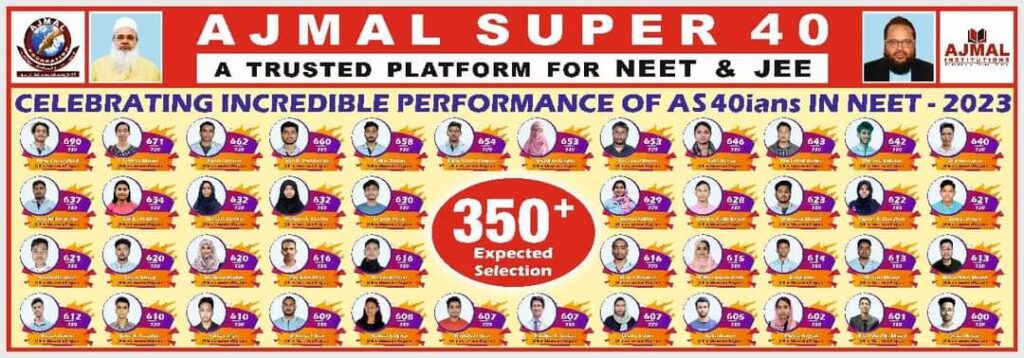
Syed Bismah and Syed Sabiya, twin daughters of an Imam from Damhal Hanjipora in Kulgam district, south Kashmir, have achieved success by qualifying the Undergraduate National Eligibility Cum Entrance Test (NEET) in their first attempt.
The NEET results for 2023 were recently announced, and Bismah and Sabiya secured impressive marks of 625 and 570, respectively.
When asked about their achievement, the siblings expressed their gratitude towards their parents, highlighting their unwavering support throughout their journey to qualify for this prestigious examination. Their parents played a vital role in encouraging and guiding them, making it possible for Bismah and Sabiya to achieve this notable milestone.
“They provided us with whatever we needed to study from childhood. They made a big sacrifice for our future”, Sabiya told local media.
Twin sisters, Daughters of local Masjid Imam from Watto Kulgam Qualified NEET 2023 in their first attempt with flying colors.#NEETUG2023pic.twitter.com/X5ZLjkJGvU
— Meer Irfan ( میر عرفان ) (@JournoIrfan) June 14, 2023
She emphasized the importance of focus in order to qualify for the NEET examination.
“If you want to appear in NEET, you should first check your level and identify your weaknesses. You should discuss your weaknesses with your teachers and also take help from internet to overcome them,” she said.
The father of Bismah and Sabiya, an Imam from Damhal Hanjipora, expressed his immense pride in his daughters’ accomplishment. He acknowledged that he had faced struggles and worked tirelessly to provide support to his daughters throughout their journey. His dedication and hard work were aimed at ensuring that his daughters had the necessary resources, guidance, and encouragement to pursue their dreams of qualifying for the NEET examination. The father’s commitment and efforts played a significant role in enabling Bismah and Sabiya to achieve their goals, and he takes great pride in their success.
“My advice to every parent is that you should provide the best opportunities to your wards for their better future,” he said.
source: http://www.muslimmirror.com / Muslim Mirror / Home> Education> Indian Muslim> Positive Story / by Muslim Mirror Staff / June 14th, 2023
A peek into a precious wardrobe of strange outfits that are fast becoming invisible from Delhi evenings.
Ghararas, too, are fast becoming invisible from Delhi evenings, although Rakhshanda Jalil is often spotted wearing it in literary gatherings.(Mayank Austen Soofi / HT Photo)
The other day, we spot a strange outfit. It is neither a skirt, nor a gown, and definitely not a sari. It is also not a pajama.
What is it, we ask.
“It is gharara,” says author Rakhshanda Jalil, pronouncing the ‘gh’ from the base of the throat.
We are at Ms Jalil’s home in central Delhi. Her most precious wardrobe is a treasure-house of about two dozen ghararas. Most have been passed on to her from her mother and mother’s mother; a few are even older.
Indeed, Ms Jalil has a fascination for souvenirs of the past. One of her many books is titled Invisible City: The Hidden Monuments of Delhi. Ghararas, too, are fast becoming invisible from Delhi evenings, although Ms Jalil is often spotted wearing it in literary gatherings.
Years ago, she had worn a pink gharara for her wedding. Her two young daughters also wear it on during special occasions such as… well, weddings, particularly in Uttar Pradesh, where more people are likely to be similarly attired.
It is not unusual in Delhi weddings to see women in gharara’s sister dresses, such as the lehenga and the sharara — which is like flared pants. The gharara is more complicated. Each leg is comprised of two parts. The first goes down from the waist to the knee, and the second, which is much wider, begins from the knee and goes down to the foot.
Truth be told, Ms Jalil prefers saris and trousers for ordinary outings. But the gharara was the daily costume of her maternal grandmother, Zahida Suroor, who lived in the university town of Aligarh. “In my grandmother’s time, it was common for women to wear cotton ghararas made of chintz (called chheent by Urdu speakers) at home,” says, Ms Jalil. “Silk or satin ghararas were worn on formal occasions. And the heavy brocade, called kamkhaab, was worn at weddings.”
Each gharara should have its own kameez and dupatta, though these days one has more liberty to mix and match. Ms Jalil says that back in the day an entire gharara was sewn in four or five days. Each piece was stitched by hands. The entire hem was turned in with tiny invisible stitches. Sparkling bits of gold lace were tagged to camouflage the joints at the knees.
Ms Jalil’s mother, Mehjabeen, recently hand-stitched a red gharara for her. The happy daughter gave it a trial run at a dinner in her own home. There was much applause. The gharara came with a short white shirt. The red dupatta was lined with gold frills.
In the old days, women of a family gathered together to sew a gharara if it had to be made for a bride’s trousseau. Neighbours and friends also chipped in. Opinions were eagerly sought on the design, and the leftover cloth was never thrown away — it was used to make an accompanying batua (wallet), or jootis (sandals).
There was a time when a few cities were known to make special types of ghararas, says Ms Jalil. Benares was famous for its brocade ghararas, with master-weavers painstakingly transporting the design to lighter gauzier material for the accompanying dupatta. Lucknow favoured a patchwork design called chatapati. Delhi specialized in something called ‘farshi’, with a long train that women were supposed to hold delicately in their arms.
Perhaps the most ideal way to study this old-world costume is to ask the wearer to sit still. On request, Ms Jalil settles down beside a window with an Eric Segal novel. While the book belongs to her elder daughter, Aaliya, the gharara belongs to her great grandmother. Made of atlas (no relation to the book of maps), the fabric is so fragile that it can tear at the slightest tug. It has a blue background with yellow, orange and pink flowers. At one point, Ms Jalil looks out of the window. Her gharara ceases to be a dying tradition, and seems very much a part of the present.
source: http://www.hindustantimes.com / Hindustan Times / Home> News> Cities>Delhi News / by Hindustan Times / by Mayank Austin Soofi / October 09th, 2017
Nasreen Anshad’s brand SAWB makes beautiful garments specially created for Namaz with dreamy designs.
Nasreen Anshad
Picture this. The next time you offer Namaz, you are in a single, free-flowing, comfortable garment adorned with flowers or stars and sometimes even polka prints. The prayer dresses or Jilbabs may not be that familiar to people in Kerala . However, 28-year-old Nasreen Anshad is bringing Jilbab into vogue among the women here through her venture SAWB.
The whole idea is to offer dresses for Muslim women that they could wear with elegance during prayers. An MCA graduate, Nasreen’s foray into garment designing happened by chance. It all started last year when Nasreen was just searching for modest wear on the web. “I came across the prayer dresses on my search. But these weren’t available here. So I thought of making one for myself. I designed a Jilbab and my mother stitched it. After a few trials, we eventually got the attire right,” says Nasreen.
Nasreen started getting some customers for this specially designed prayer garment. And soon it turned into a huge business with over 1,000 pieces of Jilbabs getting sold every two weeks. Usually, women wear an Abaya and a Makhana while praying. The Jilbab comes as a single piece, making it a convenient garment for the prayers. It is also easy to carry as well. “A lot of people prefer buying Jilbab because it is comfortable and convenient. It is also beautiful and elegant to wear and is travel friendly,” says Nasreen.
The prayer dresses that Nasreen makes are modelled after the kinds available in Dubai. Nasreen says the style of these dresses changes according to the country. “The prayer dresses made in London or Indonesia are completely different. The reason Jilbab isn’t available here is since it is very pricey to even import. I wanted to make them and offer them to everyone at an affordable price,” says Nasreen.
The main challenge the novice designer faced was to convince people of the faith that wearing a colourful dress while praying was okay. “There is a misconception that you should wear only white. But this is nowhere mentioned in the Quran. What the Quran says is that one should wear the best dress while offering prayers,” says Nasreen.
So, Nasreen’s Jilbabs come in a grand array of colours and patterns, all designed by her. When she started out, it was her mother who used to stitch the garments. Now she has employed a women’s collective to stitch the garments. The Jilbabs are available in three sizes — for kids, teens and adults. The garment is made out of soft crepe and will last for three to four years, she says. “I feel so happy and proud now. This is a venture that happened by chance and people have embraced it. I want to incorporate more styles into the Jilbab, like the different versions available in various countries,” Nasreen says.
source: http://www.indulgexpress.com / The Indian Express – INDULGE / Home> Fashion / by Aathira Haridas / April 13th, 2022
My Life in Indian Politics is co-authored by Mohsina and journalist Rasheed Kidwai.
Mohsina Kidwai
Mohsina Kidwai calls herself a reluctant writer. Despite that, the 90-year-old politician, who has been one of the leading figures of the Indian National Congress (INC), felt it was time to pen her memoir after observing certain shifts in the political climate of the country. “Everyone has a book in them and perhaps I am no exception. I was a reluctant writer, often wondering, weighing over a range of political, ethical, and personal issues. But as I became less active in public life and saw various trends and shades in our country’s polity, I firmed up my mind to write my memoir.
This book is a story of my life but in many ways, it is also a journey of our post-Independence beloved country. As a political worker, it is clear to me that challenges have always been multiple and intricate but not unsurmountable,” says the former politician.
My Life in Indian Politics, the book in question, is co-authored by Mohsina and journalist Rasheed Kidwai. Rasheed took up the project to co-write the memoir because he felt Mohsina’s story is an interesting one to share. “Normally there are various ways that books of eminent political personalities are written. I have authored a few independent autobiographies of political figures. This was the first time I was dabbling in a joint venture. Mohsina spoke to me at length about her life and her career. Essentially, the book is the narration of her life carved by a wordsmith, which was my role. She has been a participant in Indian politics for over six decades, I felt this was a fascinating project to be a part of,” says Rasheed, who ensured that Mohsina approved every word in the book.
Throughout her career, she always believed that Muslims can live harmoniously in a multicultural, independent, and secular Indian society. During Rasheed’s days spent in close proximity with Mohsina, he noticed her being disturbed at the present political and social situation our country finds itself in. “She has greatly exercised her critique of the current political identity because this is not the idea of India that she cherishes. In her career in Uttar Pradesh (UP), she won elections from Azamgarh (Eastern UP) and Meerut (Western UP).
Anyone remotely connected with the socio-economic condition of UP and the caste matrix would vouch that finding acceptability in these two diverse regions is a rather insurmountable task. But today, it is difficult for a Muslim politician to do that. We can see that the number of Muslim candidates has been on a steady decline and you don’t see such examples anymore. Mohsina was never looked at as a Muslim candidate even though she is an ardent practitioner of Islam,” Rasheed says, adding that she had always preferred being judged as an Indian, and her core electoral team always had a mix of people from different communities.
Mohsina is known for her assessment of the INC. Rasheed believes that if at certain times the political leadership had heard her out, then perhaps the history of the party might have been different. “She had opposed former PM PV Narasimha Rao’s politics, not just about his handling of the Babri Masjid case but several other things. She also had a different view on the Shah Bano case. She stood firm with what she thought was right even if her party didn’t agree,” says Rasheed.
Hailing from a conservative, aristocratic Muslim family of Awadh, Mohsina holds the distinction of winning Lok Sabha thrice — in 1978, 1980, and 1984. According to noted French scholar Christophe Jaffrelot, Muslim women face discrimination in a double bind: for their religion as well as their gender.
Data suggests that barely 20 Muslim women have made it to the Lok Sabha among nearly 9,000 MPs voted since 1951. The grounds for discriminating Muslim women are still a prevalent reality. Rasheed feels Mohsina’s memoir can come as a comforting account of hope for fellow Muslim women thinking about venturing into politics.
“The representation of Muslim women in politics is still marginal. Even though some might argue against it, democracy is all about numbers. With the meagre numbers at hand, how can you justify the representation? Her story is about courage, conviction, and integrity. For example, when she retired from politics in 2016, she did not have a house in Delhi. There are so many examples of people with much shorter duration in politics having houses everywhere. She never did despite being the Housing Minister for the country. That’s how a political leader should be,” concludes Rasheed.
source: http://www.indulgexpress.com / The New Indian Express – INDULGE / Home> Society / by Tunir Biswas / November 08th, 2022
Shahina was one of the first Indian journalists to be charged under the draconian Unlawful Activities (Prevention) Act for her work in Tehelka magazine.
Indian journalist and senior editor of Outlook magazine Shahina K.K. is one of the journalists honoured in this year’s International Press Freedom Awards given by the Committee to Protect Journalists.
Shahina, the CPJ points out, was one of the first Indian journalists to be charged under the draconian Unlawful Activities (Prevention) Act for her work in Tehelka magazine. The CPJ note continues:
“She has continued her reporting in various posts despite awaiting trial for a case opened in 2010, when local government officials in Karnataka state sought to criminalize her reporting published in Tehelka, a prominent investigative magazine where she worked at the time. Her report cast doubt on a police investigation into 2008 bomb blasts in Bengaluru, alleging that the police had fabricated witness statements to arrest a local Muslim cleric.
She faces three charges under the penal code, including criminal intimidation, intent to commit a criminal act, and criminal conspiracy, and one count under UAPA pertaining to threatening witnesses. As of June 2023, Shahina is out on bail pending trial. If convicted, she faces a maximum of three years in prison and a fine.
A Muslim by birth, Shahina has also been subjected to extensive harassment by Indian right-wing groups seeking to silence her reporting on religious minorities and vulnerable caste groups. She has faced persistent online harassment and lewd threats, and in 2020, several right-wing publications falsely implicated her in that Bengaluru bombing.
Based in Kochi, in the southern state of Kerala, Shahina has worked as a reporter, production associate, and news anchor with well-known news outlets including Asianet News, Janayugom, Open, and The Federal. She also has contributed to The Washington Post.”
The CPJ has said in its note announcing Shahina’s win that this also highlights “India’s increasingly repressive environment for press freedom, with the targeting of journalists under draconian security laws, and toxic online campaigns particularly aimed at vilifying women journalists and ethnic or religious minorities.”
Other awardees for this year include Nika Gvaramia from Georgia (founder and director of independent broadcaster, Mtavari Arkhi), María Teresa Montaño from Mexico (investigative reporter and founder and editor of The Observer, a fact-checking and investigative website) and Ferdinand Ayité from Togo (head of L’Alternative, one of Togo’s top investigative outlets).
This year’s Gwen Ifill Press Freedom Award from CPJ, which goes to “an individual who has shown extraordinary and sustained achievement in the cause of press freedom”, has been awarded to Alberto Ibargüen, who recently announced he is stepping down as president of the Knight Foundation after 18 years at its helm. “Under his leadership, the foundation invested over $2.3 billion in journalism, arts, economic development, and research. Ibargüen is the former publisher of the Miami Herald and El Nuevo Herald. During his tenure, the Miami Herald won three Pulitzer Prizes and El Nuevo Herald won Spain’s Ortega y Gasset Prize for excellence in journalism. He served on the board of CPJ from 1993 to 2005,” CPJ has said.
source: http://www.thewire.in / The Wire / Home> Media / by The Wire Staff / November 20th, 2023
Lucknow topper Alisha Ansari has remained distant from social media sites to score 94% in board exams.
Class 10 student Alisha Ansari has secured the first rank in Lucknow and ninth in Uttar Pradesh with a score of 94 per cent. Apart from sheer hard work and support from parents, Alisha has had remained distant from social media websites, including Facebook, Twitter, and Instagram to attain this position.
Alisha, who comes from a middle-class family, has a younger brother and an elder sister. Her father, Mohammad Rizwan Fazli, is a teacher in a private engineering college and her mother, Shabana Ansari, is a housewife.
Kanti Mishra, Principal, Bal Nikunj Inter College, said, “Alisha has been a hardworking student. Also whenever she had a doubt in the subject, she would immediately ask school teachers.”
Appreciating her hard work and talent, her mother, Shabana Ansair, told, “We have always given our daughters equal opportunities to study.”
Moreover, she shared that she would want her daughter to become a doctor and it is just the beginning of her journey of success.
Also, her father, Mohd. Rizwan Fazli, expressed his happiness, saying that he is extremely proud of her daughter.
source: http://www.indiatoday.in / India Today / Home> News> Education Today> News / by Ashish Srivastava, Lucknow (UP) / June 27th, 2020