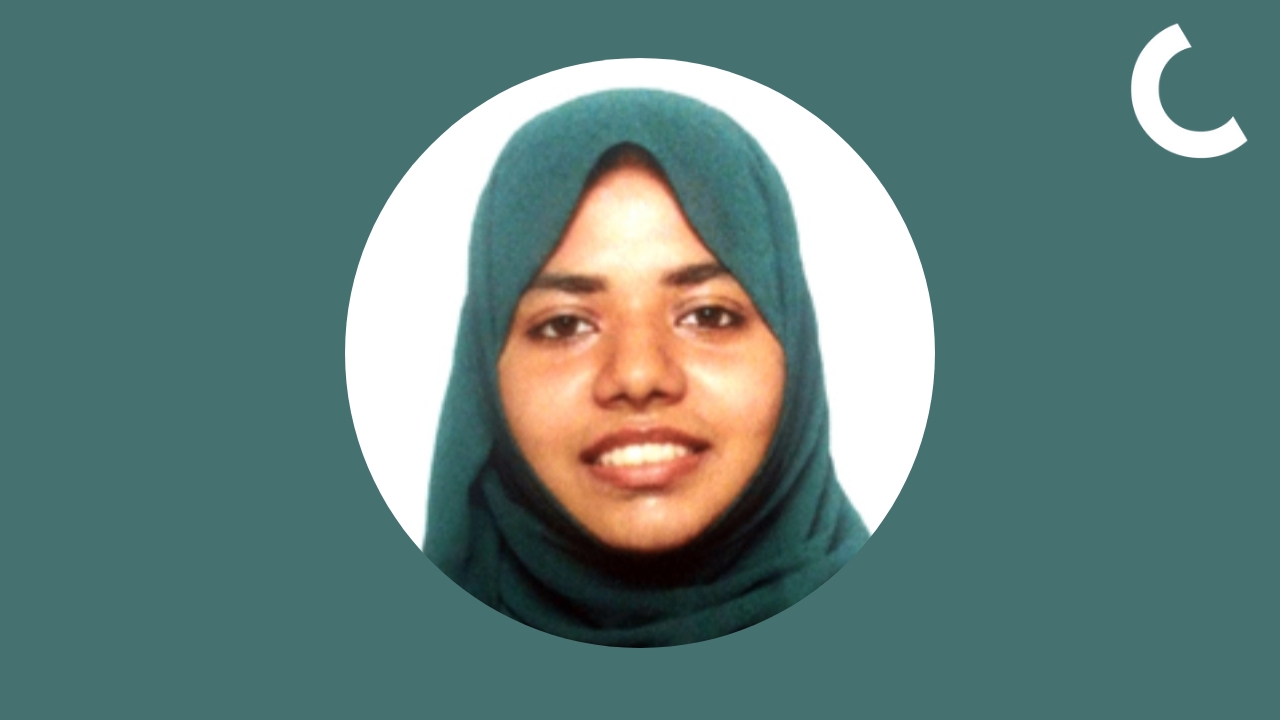
23-year-old Aamna Kausar, an MSc Medical Anatomy student at the Manipal Academy of Higher Education in Udupi has topped the university in the final year examinations.
Aamna, who is also the President of the district unit of the Girls Islamic Organization, scored 8.6 CGPA, the highest in this year’s examinations.
Daughter of Mohammad Iqbal, a businessman and Wajida Tabassum, a homemaker, the hijabi student wants to pursue a PhD in Human Anatomy.
She told The Cognate, “I am planning to do PhD next year on a topic related to human anatomy. Meanwhile, I will be working for a year.”
Aamna who has secured a job as a faculty to teach anatomy to medical students. However, she aims to get into the research field.
Notably, Aamna is a hijabi student from Udupi which was the hotbed of the hijab controversy a few months back.
“Being a hijab-wearing student in our university, I have seen difficult times during the controversy. I was actively participating in discourses surrounding the hijab row through GIO,” she said.
“The way hijabi students were treated in the district was really bad. But now, moments like these prove to them that education is the right of everyone and if students are given proper education, they will reach heights,” she added.
source: http://www.thecognate.com / The Cognate / Home> Education / by Rabia Shireen / September 26th, 2022
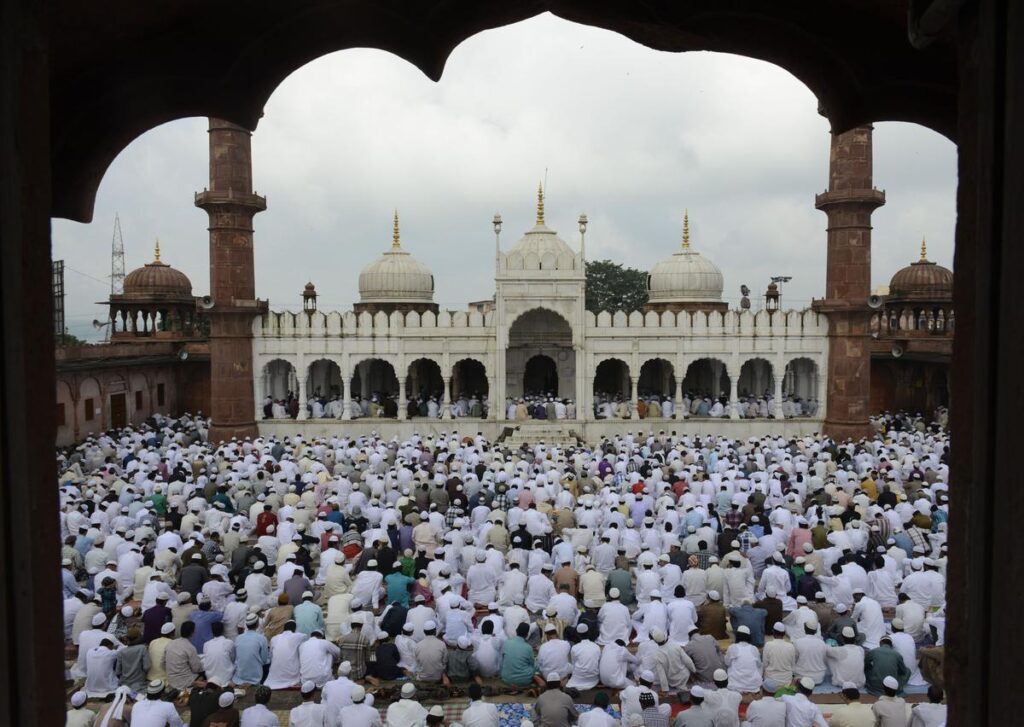
The Moti Masjid in Bhopal. | Photo Credit: FARUQUI A. M.
Tracing the history of a city where four Muslim women ruled for over 107 years
As the capital of one of the largest States, Bhopal has flown under the radar. It has little of the financial muscle associated with Mumbai, even less historicity to rival that of Kolkata. It has neither the earthiness of Patna nor the niceties of Lucknow. Yet, Bhopal in its own understated way has enough accomplishments to fill up a mantelpiece.
Among all the States, cities and towns of imperial and modern India, Bhopal has done more for women empowerment than probably all States put together. True, back in the 13th century Delhi had a woman ruler, Raziya Sultan, who ruled from 1236 to 1240, but little else.
Bhopal has been ruled by four Muslim women for 107 years. The Begums of Bhopal did not shy away from calling themselves the Nawabs of Bhopal.
Shaharyar Khan, Shobhan Lambert-Hurley and Vertul Singh have authored or edited books on the city, which on the one hand capture its history, and on the other reveal the streak of women dominance for more than a hundred years.
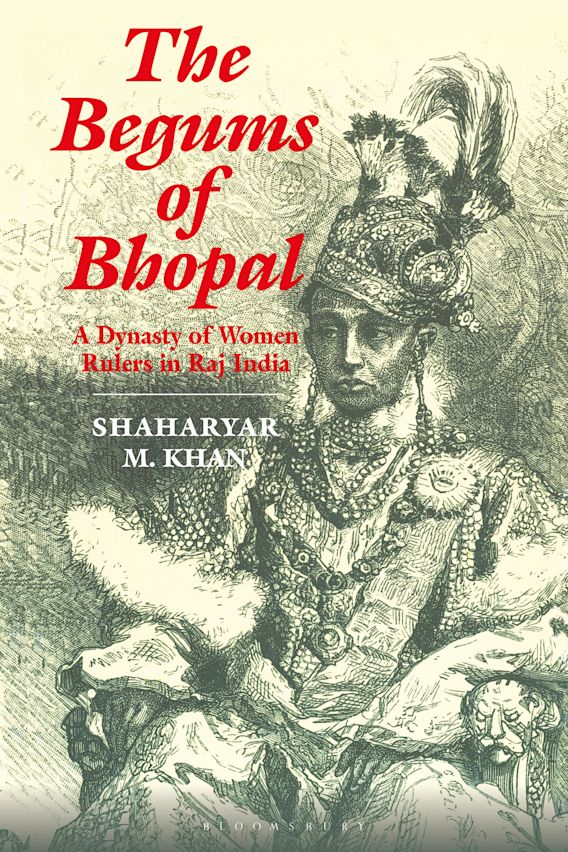
pix: bloomsbury.com
Khan’s The Begums of Bhopal is the most detailed work. Like an artist fills his canvas with colour, Khan fills his pages with details of the city, its illustrious history, and its formidable Begums, now reduced to a faint memory. Khan’s Bhopal was founded by Dost Mohammed Khan. As the author reminds us, “In 1707, before Dost Mohammed Khan arrived in Malwa, central India, Bhopal was a small village on the banks of the River Banganga. An old fort, lying in ruins, was a testimony to Bhopal having known more prosperous times in the distant past.”
Tales of Bhojpal
The earliest reference to Bhopal though dates back to 640 AD when it was ruled by the Parmar dynasty. Its name is derived from that of Raja Bhoj who, as legend has it, contracted leprosy and was advised to build a lake with water from 365 rivers and bathe in it. Raja Bhoj did as advised. The lake was called Bhoj Tal (or Bhoj’s lake). Over time, it got corrupted to Bhojpal, then Bhopal.
The State was formed in 1715. It was the second largest Muslim princely state in pre-Independence India, wherein 90% of the population was Hindu. Interestingly, the Begum of Bhopal, Nawab Sikandar Begum, as Lambert-Hurley writes in the introduction to A Princess’s Pilgrimage, supported the British during the Revolt of 1857.
After the Revolt had been suppressed, this loyalty was rewarded in the Queen’s Proclamation of 1858 in which Sikandar was granted the title of Nawab to rule over Bhopal in her own right as well as given a 19-gun salute, the return of territory lost to a neighbouring prince and the Grand Cross of the Star of India. “This honour made her, at the time, the only female knight in the British Empire besides Queen Victoria, a position that underlines her unique status, as well as her close relationship with the British,” writes Lambert-Hurley.
The story of Bhopal though began not with Sikandar Begum’s rise or the reign of her mother Qudsia Begum or her own daughter Shah Jahan Begum, but with an intrepid young man called Dost Mohammed Khan. As Shaharyar Khan writes, “The story of Bhopal begins with Sardar Dost Mohammad Khan, founder of the state and of the Bhopal dynasty. Born in 1672, Dost was a strapping, handsome, brash and ambitious young man. Like all Pathan noblemen, he had been brought up in the warrior tradition of his clan…Dost’s only ambition was to enlist in Aurangzeb’s army and make his future in the service of the Mughal Empire. Around 1697, Dost was in his mid-20s and a brash, dare-devil, buccaneer of a character. He was restless and ready to seek his fortune by crossing the Khyber Pass into India.” Head to India he did, but it was far from an easy ride.
As he traversed through Jalalabad, Karnal and Delhi, on more than one occasion, he almost kissed death, but he proved a survivor, qualities which came in handy when he got to play a pivotal role in Bhopal.
Though he arrived in Bhopal practically a brigand, he worked his way up, working with a number of local kingdoms and fiefdoms — Rani Kamlapati is said to have sought his protection after the death of her husband Nizam Shah and even tied a rakhi on his hand.
He built the famous Fatehgarh Fort in 1716, including the famous Dhai Seedi ki Masjid, as Vertul Singh writes in BhopalNama: Writing a City. Incidentally, Fatehgarh was probably named after Fateh Bibi, a Rajput princess he married. Fateh was no ordinary woman; she paid ransom for her husband’s release when he was held captive by his own troops in Gujarat, Singh writes.
Khans to Begums
How did Bhopal transition from the Khans to Begums? After Khan’s death, Bhopal was attacked by many mercenaries when Mamola Bai, said by some to be the first Begum, took the help of British General Goddard to repel such forces. Then came Qudsia Begum whose perseverance and wisdom saved the “state from being gobbled up by the Scindias and the Bhonsles”, as Singh states. Her daughter Sikandar took statecraft to another level. Sikandar’s daughter Shah Jahan Begum added fine touches of poetry, art, music to turn Bhopal into a throbbing centre of the arts. Yet, the most maternal approach towards the subjects was displayed by the fourth Nawab, Sultan Jahan, known for administrative reforms, including several measures for the welfare of her subjects. So much so that she came to be addressed as Sarkar Amma.
This succession of matrilineal rulers gave Bhopal a unique identity. They did what a man could never have dreamt of.
For instance, Sultan Shah Jahan Begum initiated the building of a hospital exclusively for women, with women doctors, nurses and other staff. The facility came to be known as Sultania Zenana Hospital.
Likewise Sikandar Begum started the practice of schools for girls, inviting scholars from Yemen, Turkey and Arabia.
Incidentally, she penned her own experience of Hajj to Mecca and Medina in ‘A Pilgrimage to Mecca’ which now forms part of Lambert-Hurley’s A Princess’s Pilgrimage. Sikandar Begum’s was no ordinary trip as Hajj those days was a life-challenging exercise with possibilities of being robbed, injured or killed by marauders along the way.
After Sikandar, Sultan Jahan concentrated on girls’ education. As Singh writes, “Sultan Jahan’s contribution to women’s education is in no way lesser than that of Sir Syed Ahmed Khan.”
Incidentally, she was the only woman chancellor of Mohammedan Anglo-Oriental College which was to become the Aligarh Muslim University.
All the Begums worked well and lived long. Once, all the four queens of Bhopal were alive at the same time with Qudsia living to breathe alongside three of her successors. That’s an interesting footnote in the history of a city where male heirs have been few and far between. Their absence was seldom felt.
source: http://www.thehindu.com / Hindu / Home> Books / by Ziya Us Salam / book cover pix: by bloomsbury.com / September 12th, 2022
The idea for creating the app came to Hana while watching a documentary about the importance of the parent-child relationship.
Abu Dhabi:
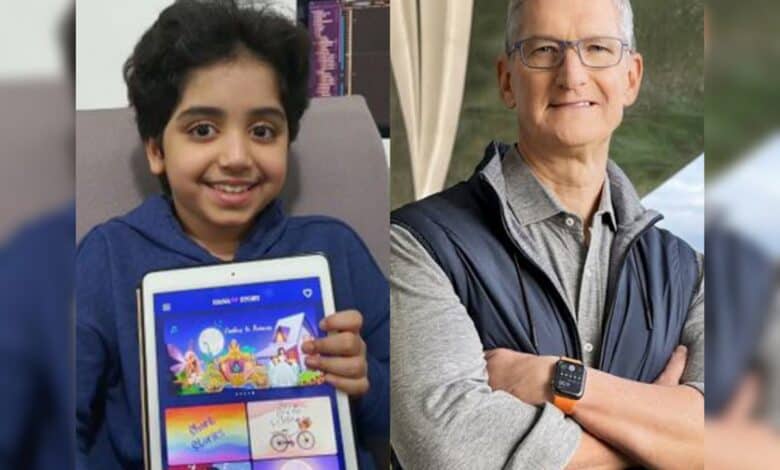
A 9-year-old Dubai-based Indian girl who developed an iOS app receives appreciation from Apple CEO Tim Cook for her achievement at such a young age.
Hana Muhammad Rafeeq had initially emailed Tim Cook claiming to be the youngest iOS developer.
In his reply, Tim Cook wrote to her “Congratulations on all of your impressive achievements at such a young age. Keep at it and you will do amazing things in the future.”
Hana Muhammad Rafeeq, when she was 8-year-old developed ‘Hanas’— storytelling app, which allows parents to record stories in their voices for their kids, Hana handwrote more than 10,000 lines of code.
The idea for creating the app came to Hana while watching a documentary about the importance of the parent-child relationship. “If the parents are busy with work, they can record the stories so that the children can listen to them before bed,” Hana told Gulf News.
source: youtube.com / Hanas iOS Mobile App preview
Hana and her 10-year-old sister Leena are both self-taught coders who got inspired by their parents.
As per reports, sisters are now experts in coding languages HTML, CSS, C, C++, Swift and the latest SwiftUI. They are also learning human languages English, Spanish German, Arabic, Hindi and Malayalam.
source: http://www.siasat.com / The Siasat Daily / Home> News> Middle East / by Sakina Fatima / September 24th, 2022
Aliah University is a state government-run autonomous university having three campuses in New Town in West Bengal. | Picture by arrangement
The inaugural batch of the nursing course in a university in West Bengal, designed especially for women, has achieved this success.
West Bengal:
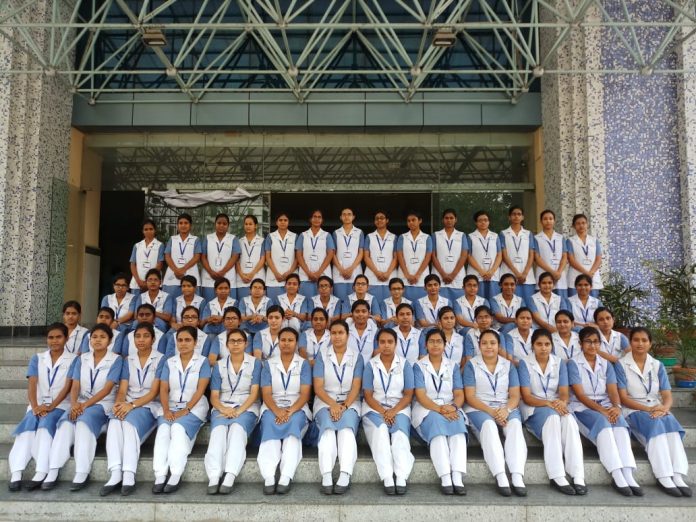
Almost the entire batch of this year’s graduates of the B.Sc Nursing course at Aliah University have got job placements. Fifty-three out of fifty-four graduating students, mostly Muslim women have been selected as nursing staff in various medical colleges and hospitals run by the government of West Bengal.
This is the inaugural batch of the nursing course designed especially for women. It is for the first time that almost an entire batch of a program in Aliah University has gotten placement.
Aliah University is a state government-run autonomous university having three campuses in New Town in West Bengal. It offers undergraduate and postgraduate programs in different Engineering, Arts, Science, Management, and Nursing subjects. Previously known as Mohammedan College of Calcutta, it was elevated as a university in 2008. It is a minority institution and hence a majority of its students come from marginalized groups and communities like Muslims and lower castes.
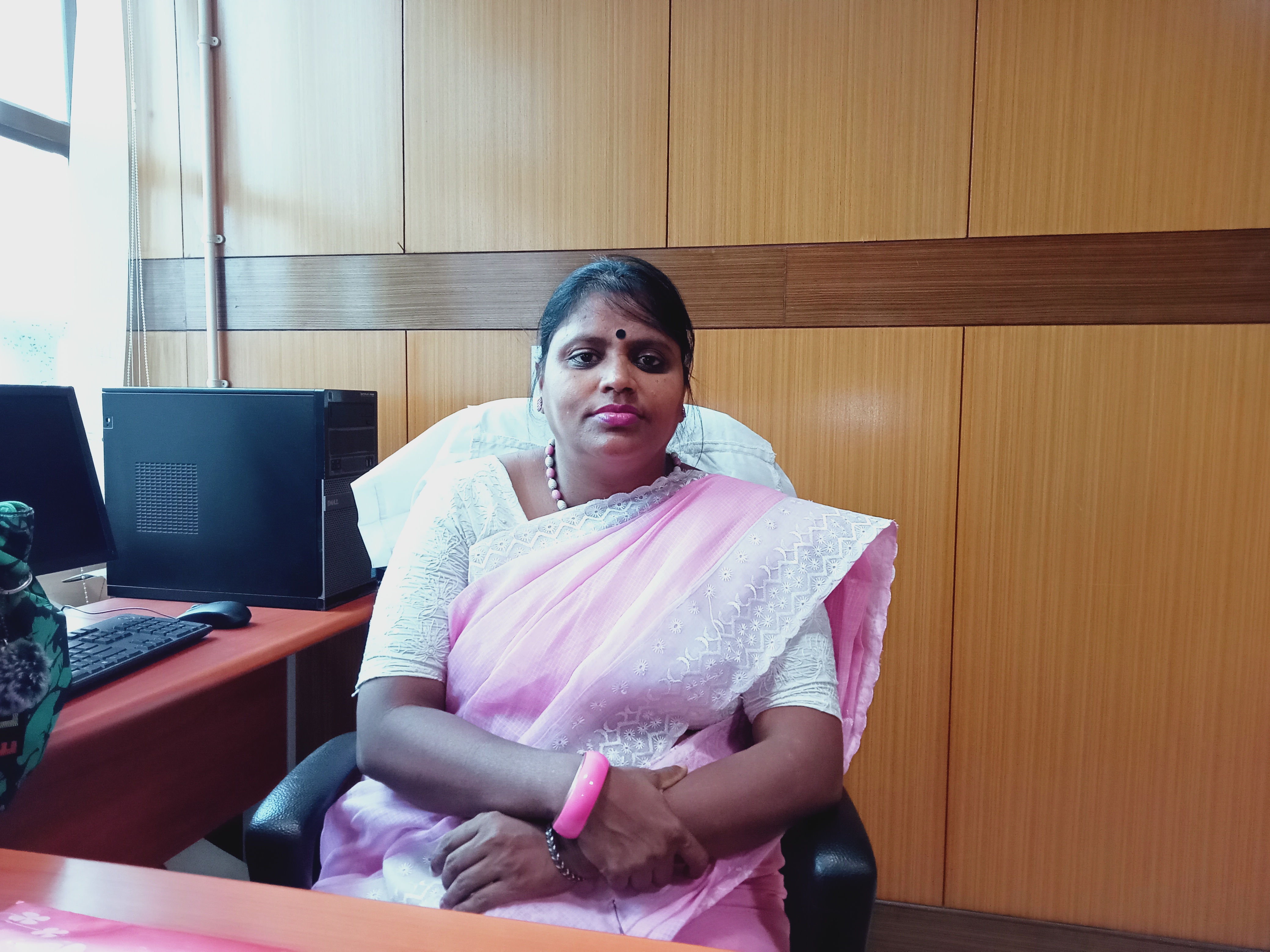
Usha Mallick, the head of the department of nursing told TwoCircles.net, “This is an unprecedented success for the department of nursing because these are the first batch of graduates. We at Aliah University are extremely proud of our graduates who worked hard.”
“This kind of placement will get us a great standing in the state as well as the country. This is great news also because all the girls in this department, like most students of Aliah university, come from extreme socio-economically backward families living in remote rural districts of West Bengal,” she added.
Usha Malick is head of the department of nursing at the university. | Photo by author arrangement
“We are thankful to the Mamata Banerjee government for helping the university start the course, and to the National Medical College for providing practical training for nursing students,” she said while adding that Aliah is the only state university that runs a nursing course without its medical college and hospital facilities.
Educating kids from extremely backward districts like Murshidabad The news brought cheers to several young women. Lutfa Khatoon is from Murshidabad, a densely Muslim populated area (67%) where the state of education is extremely poor. According to Census 2011, the literacy rate of the district is 66.60%, which is far below the national average of 74.04% and the state’s average of 77.08%. The district holds the bottommost position in the rank of literacy rates since the Census 1951.
“In Murshidabad education is not the priority in general, let alone education of girls. When I got admission to the course, people in my area said I am getting training to become a nursemaid. My placement has broken that impression,” Khatoon told TwoCircles.net. She is posted in Murshidabad medical college and hospital.
Firoja, Lutfa’s batchmate, told TwoCircles.net that studying was not the only thing she invested hard work in. “These four years of the course people would come to my house in Murshidabad and taunt my parents that your daughter will be ruined because they gave me the freedom to move to Calcutta to study,” said Firoja who is posted at Anup Nagar primary hospital, Murshidabad.
She mentioned that she faced financial hardships but thanked the university for providing her scholarship.
Aatika, Lutfa’s classmate told TwoCircles.net that people in the rural areas of West Bengal say that “sending girls to the city for education is like providing them with opportunities to be spoiled.” But her getting a nursing job has broken the patriarchal mindset and inspired many parents to send their daughters to study.
“In my village, most people marry off their daughters after they pass the tenth class. I am very lucky that my family supported me. It is because of them that I got a very respectful job,” she added.
Oldest modern style educational institute in Asia The university is one of the oldest educational institutes in Asia. Established by Warren Hastings, the British governor-general of East India Company in 1780. Calcutta Mohammedan College, as it was called by Hastings. Established in the form of a madrasa school, it is one of the oldest modern-style educational institutions in Asia and the first of its kind in India. It taught Natural Philosophy, Grammar, Logic, Arithmetic, Astronomy, Geometry, Arabic, Persian, Theology and Islamic Law, and Theory and Rhetoric.
Good career placement not new for Aliah University Dr Mohammad Reyaz, assistant professor of journalism at the university told TwoCircles.net that good career placements are not new to the university.
“Earlier it used to be a Madrasa. Not many people know that it has been turned into a university which offers courses in Engineering, Electronics and Communication, Business Management and nursing among other subjects. So these kinds of placements do help break the stereotype which tries to reduce the image of this premier institution as a madrasa. Not only do the students of nursing and engineering departments get good placements but students of the Arabic department also get jobs in prestigious firms like Amazon,” said Dr Reyaz.
Sufi Parween is a fellow at SEEDS-TCN Mentorship Program. Shentweets at@sufiparween84
source: http://www.twocircles.net / TwoCircles.net / Home> Lead Story / by Sufi Parween, TwoCircles.net / August 08th, 2022
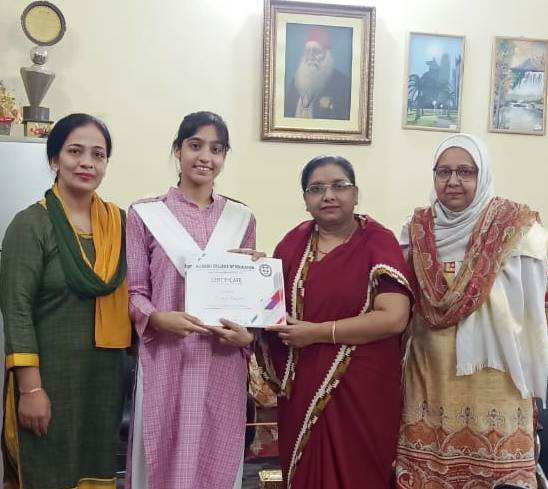
Zahra Hashmi, a Class XII-Arts student of the Aligarh Muslim University (AMU) Girls’ School was declared the ‘Best Debater’ of the debate contest on ‘Online Education is better than Offline’ held at the AMU Girls’ School.
She has also received a cash prize of Rs 5, 000, informed Amina Malik (School Principal).
source: http://www.amu.ac.in /Aligarh Muslim University (AMU) / Home> AMU News / by Public Relations Office, AMU / September 17th, 2022
Saba is the only candidate of Indian origin among 19 elected members from the state of Illinois. She came to the United States in 2007 and after initially working as an employment consultant, began promoting yoga in America by training yoga teachers.
Uttar Pradesh :
Saba Haider, an Indian-Muslim woman from Ghaziabad in Uttar Pradesh, has been nominated by US president Joe Biden for the state board member election from DuPage County in Illinois and given a ticket by his Democratic party.
Her website describes Saba as a community organizer, small business owner, a wife and a mother to a 14 and an 10-year-old. She has been running her business in the health and wellness area for over a decade. She provides wellness consulting services to corporate clients and local businesses and organizations from the Chicago-land area.
Biden appreciated Saba’s social work, especially during the worst phase of Covid-19 pandemic in the US.
More than one million voters will vote to elect their board members in this election, which is to be held on November 6 this year. The election is an important one as this state-level board directly makes public welfare policies in the state. There are a total of 19 members on the state-level board and 11 of them are democrats.
Saba is the only candidate of Indian origin among 19 elected members from the entire state. She came to the United States in 2007. After initially working as an employment consultant, began promoting yoga in America by training yoga teachers. She continued doing this for nearly 10 years.
Saba has described the opportunity as “a very important one”. She said that she is an ordinary citizen who has been playing the role of a mother, sister, wife and small business-woman until now. “Being given this opportunity in politics is a completely new and huge responsibility,” she said.
Saba is considered a strong candidate who is getting support from her Democratic party allies Sadia Covert and Don Dessert, who are contesting the same election from other districts. Being a Yoga trainer, she has emphasized mental health in her campaign and commended the American people for showing mental strength during the worst periods of the Covid-19 pandemic.
If Saba wins the election, she will replace Amy Shavez, a democrat whose term ends in December.
Family elated at her success Her family lives in Vijay Nagar, a posh area of Ghaziabad in Uttar Pradesh. She is the eldest daughter of her family. Her father was an engineer in Uttar Pradesh Water Department and her mother runs a school in Ghaziabad.
Her two younger brothers, Abbas Haider and Zeeshan Haider are elated with their sister’s achievements.
Expressing happiness during an interview, Saba’s younger brother Abbas Haider said that “Saba has always been active in social work as she believes in helping people.”
“In America, she has always stood with people who needed help of any kind. It didn’t matter whether the person was Indian, American or of any other country, she has always stood with others,” he said.
Abbas said that Saba was active during the Covid-19 pandemic period. “She helped people in many ways during Covid. She feels that politics is a good way to improve the society and help the people as a whole and hopefully she will win the elections,” he said.
He called her nomination a matter of great pride for the family and the entire country
www.sabahaider.com
source: http://www.twocircles.net / TwoCircles.net / Home> Lead Story / by Aas Mohammad Kaif, TwoCircles.net / September 12th, 2022
At least ten Madrasa pass-outs called Hafiz have cleared the NEET examination after receiving coaching from the Shaheen Group of Institutions of Bidar, Karnataka, and four of them have scored above 600 marks and my most likely be eligible for admissions to the coveted government medical colleges.
According to a spokesperson of the Shaheen group of Institutions, these ten students were admitted to the “Academic Intensive Care Unit for the dropouts” – an abridged course that prepares these students for entrance examinations. He said they came to them with knowledge of Arabic and Urdu languages.
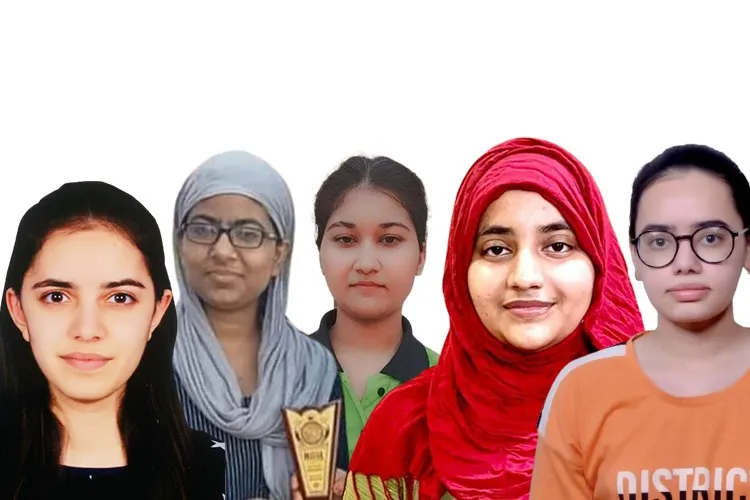
The Shaheen Group of Institutions has released this poster on the Twitter about the success of four Madrassa students:
The Shaheen group of Institutions prepares Hafiz (pass-outs of Madrasa) for competitive examinations for medicine and other professional colleges.
Like the previous years, this year also the Shaheen group of Institution’s result for the NEET examination is impressive. The management is expecting that more than 450 students will get admissions into government medical colleges.
Dr. Abdul Qadir, Head of the Shaheen group said that 12 students who completed the Hafiz course in Madrasa studied for a basic course in the Shaheen group of institutions by doing a bridge course and have done well in the NEET.
Besides the Madrasa pass-outs, a large number of students who cleared the NEET are from the government schools, Kannada medium, and, rural areas.
Madrasa graduate Mohammad Ali Iqbal said, “I am very happy because I have got 680 marks in NEET.” He had completed his Hafiz course and emerged as a topper in Shaheen College and s all set to realize his dream of getting admission into a Medical college after studying in the Shaheen Institutions.
Muslims girls who have qualified from Sikhawati region who cleared NEET
Shekhawati Region(RAJASTHAN):
At least five Muslim girls from the Shekhawati district of Rajasthan have cleared the entrance examination for the Medical colleges through NEET-2022.
In comparison with the other parts of Rajasthan, the trend of women’s education, especially among the minority community, has been on the upswing in the Shekhawati district for the last two-three decades.
Zainab Malwan, daughter of Professor Raj Malwan of the Government College, Sikar, has secured 870th position in the All India list of the NEET result. Ishrat Khan from Bissau has secured 667th rank in All India and Farhana from Nuh village has secured 8336th rank in NEET.list of successful candidates. Rizwana of Balod Bade village has secured 4871st rank, and Tanjim Bano of Modawasi village has secured 5981 ranks in the final list of successful candidates for the NEET examinations.
source: http://www.awazthevoice.in / Awaz, The Voice / Home> India / by Ashfaq Kayamkhani / September 098th, 2022
Students of Hubballi and Dharwad have done well in the National Eligibility cum Entrance Test for admission to medical courses, with several students scoring above 600 marks
Students of Hubballi and Dharwad have done well in the National Eligibility cum Entrance Test (NEET) for admission to medical courses, with several scoring above 600 marks.
Gagan Thimmanagoudar of KLE Society’s P.C. Jabin PU College has secured 681 out of 720 marks topping in the college. Vachana Ammanagi has secured 541 marks, Principal V.R. Waghmode has said in a release.
Ananya Karpur, of Veman Vidyavardhak Sangha’s K.H. Patil PU Science and Commerce, College, Hubballi, has scored 670 out of the 720, securing the All-India Ranking of 1,451.
Prerana Residential PU College, Hubballi, has once again registered good results in NEET. Three students, Fiza Anzum (641), Shreyas Fakkirswamy (637), and Vishal Sakri (600) have crossed or touched the 600 mark. Other toppers of the college are K. Chetan (595), Poojya Munyal (591), Sahana (564), Prachi Darak (558), Meghana Patil (553), Chinmay Salmani (547), Basavaraj Ijeri (540), and Ankita Jantli (528).
Aman Shanbhag of JSS R.S. Hukkerikar Arts, Commerce and Science PU College, Dharwad has secured 624 marks and Suraj has secured 607.
Students of Sana Shaheen PU College, Ayesha Siddiqa Dharwad (574), Mohammed Taha (541), Madiha Oomorose (524), and Umme Hifza Bilepasar (512) have topped the college.
source: http://www.thehindu.com / The Hindu / Home> News> India> – Karnataka / by Special Correspondent / Hubballi – September 10th, 2022
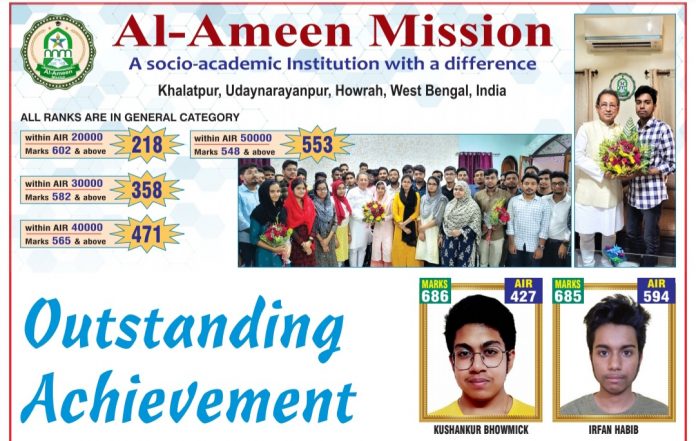
More than 500 students from the Al-Ameen Mission’s 70 branches in West Bengal passed the National Eligibility-cum-Entrance Test (NEET) 2022 with flying colours.
M Noorul Islam, head of the Institution said, “I have had the biggest success this year, as the number of Al Ameen Mission students who have secured 600 and above points in the NEET is around 200.”
Last year, 510 Al Ameen coaching academy students passed the NEET and were accepted into various medical colleges.
According to Islam, the number is likely to be higher this year as his team finalises the list.
Islam said that that the majority of the students are from rural areas and come from remote villages throughout West Bengal.
Kishankur Bhumika, a non-resident student, is this year’s Al-Ameen topper. He received 686 out of 720 points in the NEET and was ranked 427 at the All India level.
Irfan Habib, son of farmer Abdul Subhan of Devcharai village in Tafanganj, Cooch Behar, has received the highest marks among the mission’s resident students. He received 685 points and is ranked 594th in the all-India list. Aside from that, many Al Amneen Mission students scored more than 650 points on the NEET.
Akhtari Parveen, a female student at Al-Ameen Mission, is among the achievers . She has been a student at Al Ameen Mission’s Khalatpur campus since Class VII. She got 653 marks in NEET with the help of Al Ameen Mission and her all-India rank is 3915.
Al-Ameen Mission, based in Howrah, has produced over 3500 doctors (MBBS & BDS) and 3000 engineers, in addition to scores of researchers, administrative officers, teachers, and professors.
Nurul Islam founded the organisation, which now operates 70 coaching institutes in 20 West Bengal districts.
The organisation educates 17,000 residential students and employs over 3000 teachers and non-teaching staff. The main campus of Al-Ameen Mission is in the West Bengal district of Howrah, at Khalatpur (Udaynarayanpur).
“We utilize Zakat and Sadaqah funds to achieve our goal and play our role in nation building. We urge the community members to support our efforts ” Islam told Muslim Mirror.
“Most of the students who have qualified NEET from Al Ameen Mission belong to very poor backgrounds and weaker sections of society. We nurture their talent, develop their intellect and provide them a good environment so that they could come out with their best,” he said.
source: http://www.muslimmirror.com /Muslim Mirror / Home> Indian Muslim> Positive Story / by Muslim Mirror / September 10th 2022