Tag Archives: Muslims of Uttar Pradesh

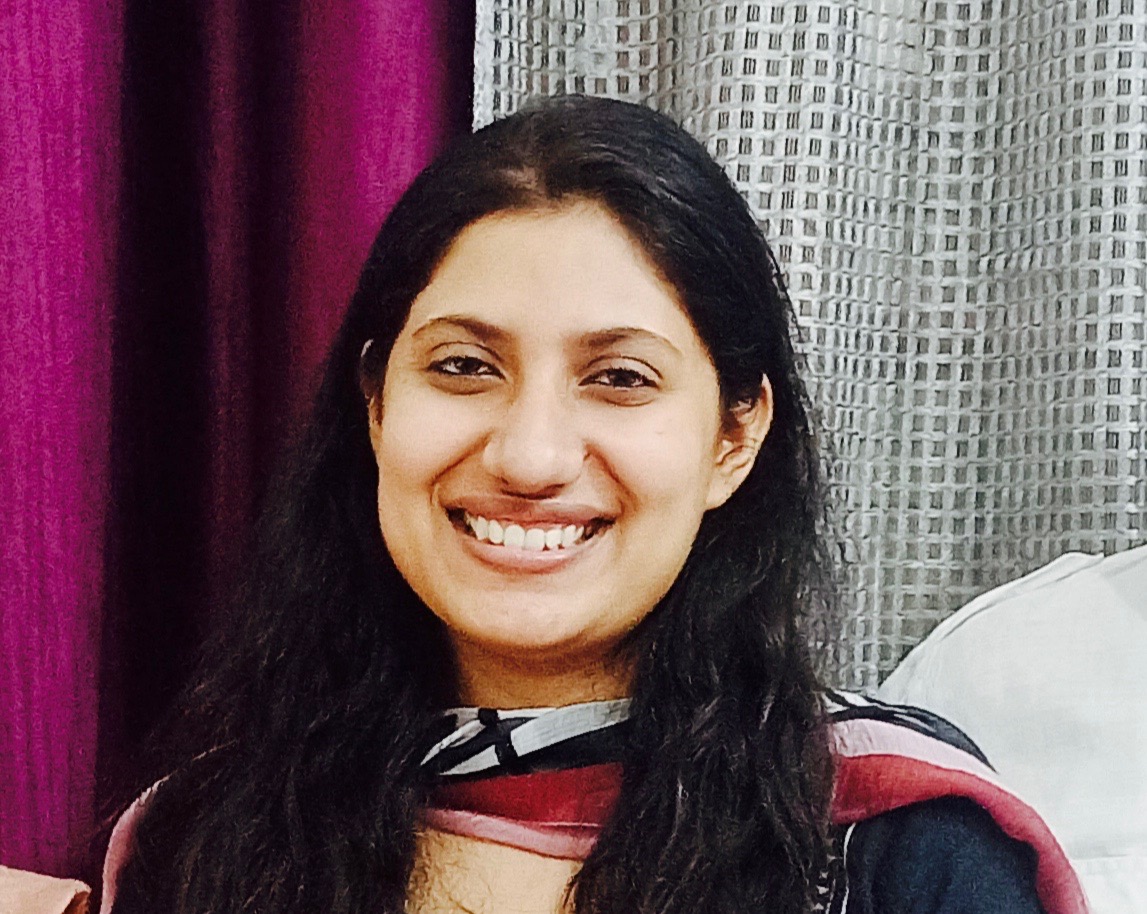
Turning Failures into Success: UP’s Anjum Ara Tops Judicial Service Exam

Prayagraj, UTTAR PRADESH :

Educated at Allahabad University, the daughter of a State Bank of India officer credits self-study, family support and disciplined preparation to secure first rank
New Delhi :

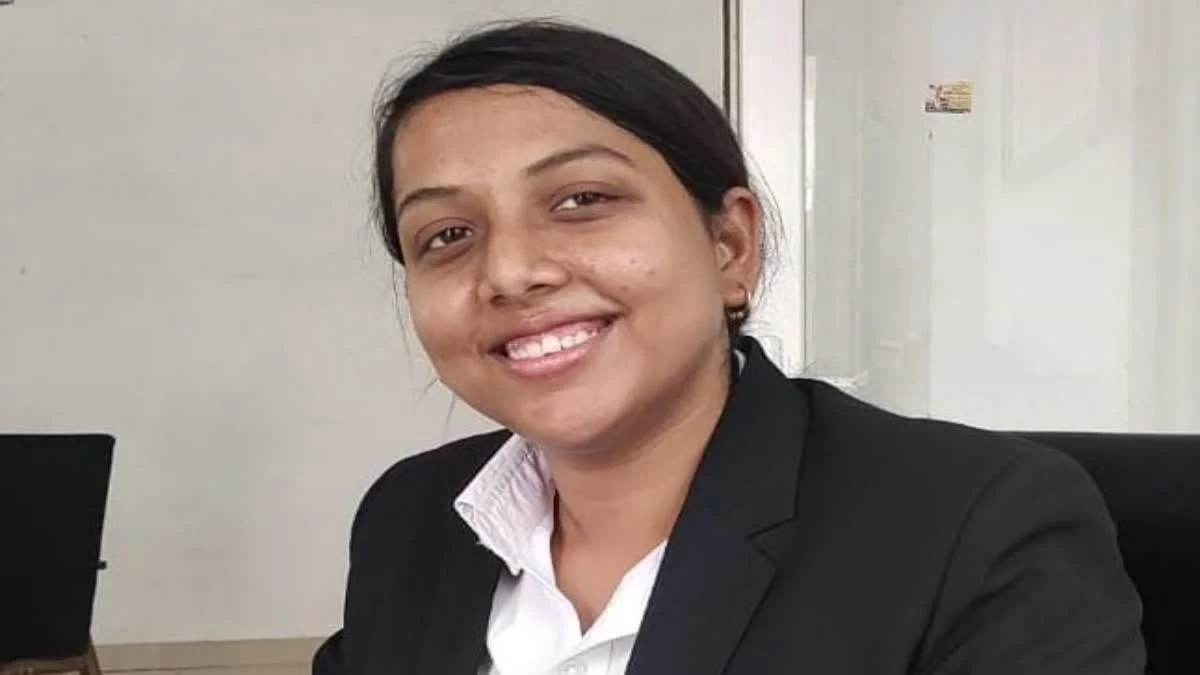
In a story of determination, faith and steady hard work, Anjum Ara from Prayagraj in Uttar Pradesh has secured first rank in the Chhattisgarh Provincial Judicial Service Examination, becoming a judge and bringing pride to her home state. Her success has been widely celebrated in Prayagraj, where neighbours and well-wishers described her achievement as a moment of honour for the city.

Anjum, who comes from an educated Muslim family, said her journey was shaped by a personal loss that changed the direction of her life. Her uncle, whom she lovingly called Bade Abu, served as an Additional District Judge. His death left a deep impact on her and inspired her to choose the path of judicial service. “I used to call him Bade Abu,” Anjum recalled. “After he passed away, I made up my mind that I would become a judge like him and serve society.”

She completed her early schooling at Central Academy in Jhunsi town in Prayagraj District before pursuing her BA and LLB from the University of Allahabad. Reflecting on her university years, Anjum said the Law Faculty played a major role in shaping her approach towards legal studies. “The Law Faculty taught me to understand the law, not just memorise it,” she said. “Our professors focused on practical learning. That helped me a lot in the judicial exams.” She added that because of the strong academic environment at the university, she did not feel the need to rely on costly coaching institutes. “If your basics are clear, you can prepare on your own,” she said.

Her father, Shamim Ahmed, works as an assistant manager at the State Bank of India, while her mother, Akhtari Begum, is a homemaker. Anjum described her parents as her biggest support system. She said her preparation was entirely self-driven and disciplined. “I studied five to six hours every day with full focus,” she explained. 

For the mains examination, she focused strongly on judgment writing. She regularly practised answer writing and carefully studied judgments delivered by local courts in Chhattisgarh to understand how decisions are framed. “I practised writing answers regularly. I also studied judgments from local courts in Chhattisgarh to understand how decisions are structured,” she said. She also credited her habit of reading newspapers daily for helping her during the interview stage. “Current affairs helped me respond confidently,” she added.

At home, her family ensured that her studies were never disturbed. “They made sure there was no noise while I studied. They always encouraged me, especially when I failed in the Rajasthan and Delhi judicial exams,” Anjum said. Her father said the family never allowed disappointment to take over. “We always believed in her ability. Failure is part of life. We told her not to lose hope,” he said. Her mother added, “She worked very hard day and night. We only tried to give her a calm environment.”

Before achieving success in Chhattisgarh, Anjum faced setbacks in other states. She admitted that those failures were painful but also important lessons. “Failures taught me where I was lacking,” she said. “Instead of getting upset, I improved my answer writing and strengthened my understanding of the law.” Her perseverance paid off when the results were declared and she secured the top rank in the state.

Residents in Prayagraj expressed pride in her achievement. A neighbour said, “This is a proud moment for the entire area. She has shown that with hard work, anything is possible.” A former teacher from the University of Allahabad said, “Anjum was always sincere and focused. Her success proves that strong academic grounding and discipline make a real difference.”

Now appointed as a judge, Anjum says her goal is to carry out her duties with honesty and integrity. “I want to fulfil my responsibilities towards society through the judiciary with sensitivity,” she said. “Justice should be fair and humane.” Her achievement is being seen as an inspiration, particularly for young women from minority communities who dream of entering the judiciary.

Anjum also shared advice for aspirants preparing for judicial services. She urged students to build a strong grasp of the basic language of law. She advised regular answer writing practice for the mains examination and stressed the importance of understanding how court judgments are read and written. She encouraged students to maintain a routine of five to six hours of focused study daily and not to lose heart in the face of failure. “There is no easy way,” she said. “You have to stay focused and believe in yourself.”

From the classrooms of Prayagraj to securing the top rank in Chhattisgarh, Anjum Ara’s journey reflects discipline, patience and family support. As she prepares to take her place on the bench, many young aspirants now look to her story as proof that steady effort and belief in one’s goal can turn a dream into reality.

source: http://www.clarionindia.net / Clarion India / Home> Editor’s Pick> Indian Muslims / by Mohammad Bin Ismail / February 23rd, 2026
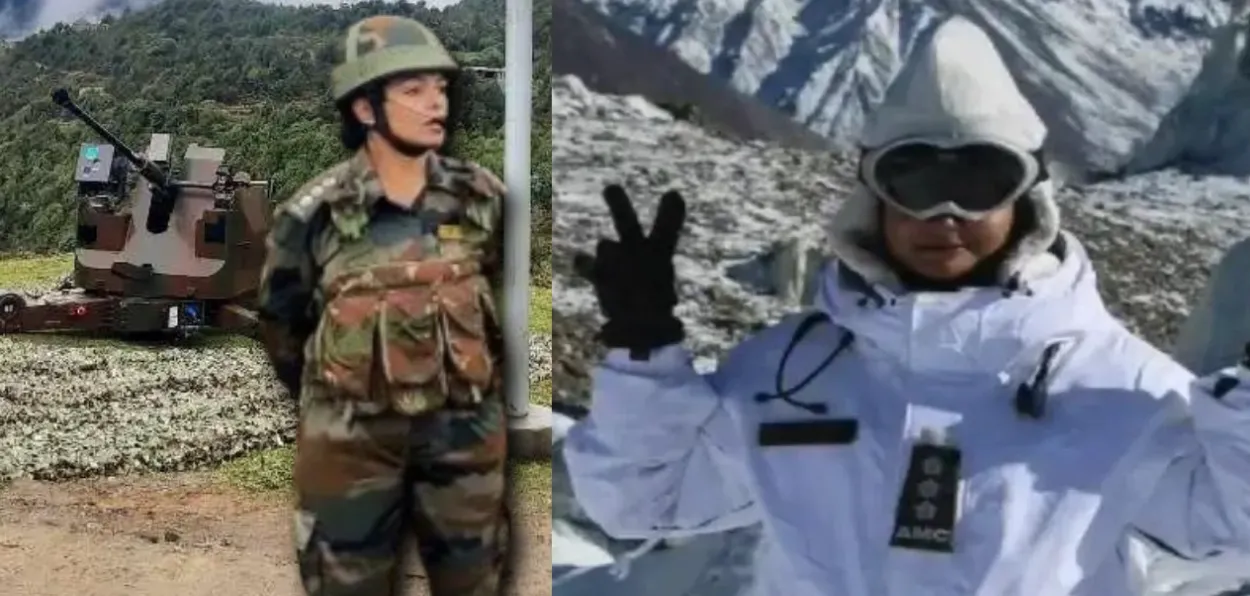
Army officers Saria Abbasi, Fatima Wasim show women power in Army

INDIA :

Captain Saria Abbas and Captain Wasim

New Delhi :

If you thought that the marching of an all-women tri-services contingent in the Republic Day Parade was just a show-off, you need to know about two women in the Indian Army to realise how women are not only joining the Military but also get the toughest assignments by being posted on treachrous terrains and hostile borders of India.

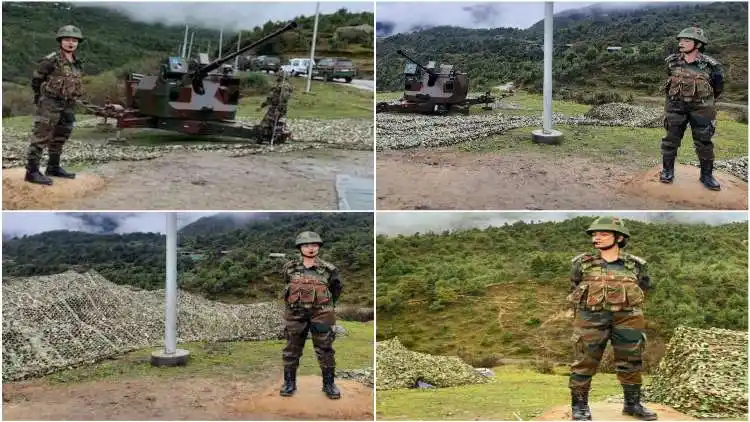
Captain Saria Abbasi and Captain Fatima Wasim are two women army officers whose names surfaced on social media. Abbasi is posted on the post on the Line of Actual Control (LAC) the contentious working boundary with China and Fatima Wasim on a post in Siachen, the world’s highest and coldest battlefield along Pakistan.

Captain Saria Abbasi’s picture surfaced on social media after a visit of the media team to the Tawang border where India had deployed its latest acquisition anti-aircraft gun L70.

Capt Saria Abbasi on duty

Capt. Saria Abbasi briefed the media on the merits of the L-70 anti-aircraft gun with its deployment, which can target all types of unmanned aerial vehicles, helicopters, and drones.

Capt Abbasi hails from Gorakhpur, Uttar Pradesh, and had dreamt of wearing the Army uniform as a child.

This one video and some pictures caught the attention of the entire country as people were awed by a woman in that role and the gender parity in the Indian army.

Abbasi’s unit is one of the first AD regiments in the country, equipped with 70 guns. India has deployed anti-aircraft guns L70 in Tawang, Arunachal Pradesh, amid ongoing tensions on the Indo-China border in eastern Ladakh and Arunachal Pradesh.

Saria Abbasi’s father Dr. Tehseen Abbasi is associated with All India Radio, and her mother Rehana Shamim is a junior high school teacher.

The second woman whose image also captured the imagination of the country’s men is Captain Fatima Wasim of the Siachen Warriors. She created history by becoming the first woman medical officer to be deployed to an operational post on the Siachen Glacier.

Capt Fatima Wasim at Siachen

Her posting was proclaimed by the Indian Army’s Fire and Fury Corps in a post on X.

“She (Captain Fatima Wasim) was inducted to a post at an altitude of 15,200 feet after undergoing rigorous training at Siachen Battle School, which speaks of her indomitable spirit and high motivation,” Fire and Fury Corps posted on X.

The Indian Army’s Fire and Fury Corps also uploaded a video in the post to further highlight Captain Fatima Wasim’s achievement and celebrate it.

Earlier this month, Captain Geetika Koul from the Snow Leopard Brigade became the first woman medical officer of the Indian Army to be deployed at the world’s highest battlefield, Siachen, after completing the induction training at Siachen Battle School.

Siachen Glacier is known as the highest-altitude battle site in the world and is situated near the Indo-Pak Line of Control.

It is the largest glacier in India and the second-largest in the world. It is the highest battleground on earth.

Back to Saria Abbasi’s story: she is a graduate of Genetic Engineering and joined the army four years ago. She said she had no interest in engineering and was always dreaming of becoming an army officer as some of her relatives were. She was attracted to donning the olive green after listening to the stories of valour from her ‘fauji’ relatives.

Capt Abbasi with L70 Gun (released by Army)

She rejected all the job offers from big companies and focused on clearing the Combined Defence Service (CDS) competitive examination conducted by the UPSC for taking in officers for the Military.

There were only 12 seats for women and Saria cleared her examination in her second attempt. After passing the ongoing interviews held over several tours, she was selected for the training that is considered to be the toughest of all.

source: http://www.awazthevoice.in / Awaz, The Voice / Home> Stories / by ATV / posted by Aasha Khosa / January 30th, 2024

AMU Remote Sensing and GIS Students Achieve National, Global Recognition

Aligarh, UTTAR PRADESH :

Aligarh:

Students of the Interdisciplinary Department of Remote Sensing and GIS Applications at Aligarh Muslim University (AMU) have earned prestigious academic admissions and professional placements at leading institutions in India and abroad, underscoring the department’s growing reputation in geospatial sciences.

At the international level, Ms Areena has been selected for a PhD programme at the University of Waikato, New Zealand. Meanwhile, Mr Md Zaid Qamar has secured admission to the International PhD Programme under the UNESCO Chair in Environment, Resource and Sustainable Development at Parthenope University of Naples, Italy.

On the national front, Mr Ahsan Sayeed has gained admission to the PhD programme in Geomatics at IIT Guwahati. Additionally, Ms Mantasha, Mr Tauheed Ahmad Ansari and Mr Zuhail Abdullah have been selected as Junior Resource Persons at the National Institute of Hydrology, Roorkee.

The department’s students have also made notable strides in the corporate sector. Ms Shaista Perween has been appointed Assistant Manager at Tata Steel Limited in Jamshedpur, while Ms Juveriya Aqeel has secured a position with WSP in Bengaluru with an attractive remuneration package.

Congratulating the students on their accomplishments, Dr Haris Hasan Khan, Chairman of the department, said the achievements reflect both the students’ dedication and the department’s strong academic and research ecosystem in remote sensing and geospatial sciences.

source: http://www.radiancenews.com / Radiance News / Home> Education> Latest News / by Radiance News Bureau / February 12th, 2026

Muslims who dominated headlines in 2021

INDIA :

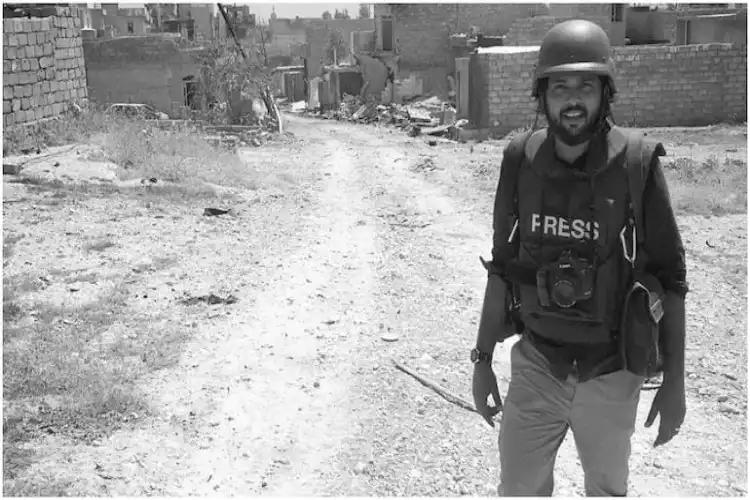
Danish Siddiqui in Afghanistan

As the year draws to an end, we have compiled a brief list of the Indian Muslims who have been in news during 2021.

Danish Siddiqui :

Danish Siddiqui was a Pulitzer Award winning photojournalist from New Delhi, who was killed by Taliban while covering the war in Afghanistan. An alumnus of Jamia Millia Islamia, Siddiqui was one of the country’s most well known photographers who documented the Rohingya refugee crisis, Covid deaths and the Delhi riots to win several awards. In July 2021, Reuters assigned him documentation of the Afghanistan War as an embedded journalist with Afghan Special Forces. On July 16, Siddiqui was killed in action. Governments of India, USA, Afghanistan and United Nations expressed grief and shock on his death and thousands joined his funeral procession in DelhI.

Dr Shahid Jameel :

Dr. Shahid Jameel is a world renowned virologist and is one of the leaders of India’s fight against Covid-19. The Covid-19 outbreak has thrown new challenges to the scientific community. When the Government of India set up an Indian Sars-Cov-2 Genomics Sequencing Consortium (INSACOG), which consists of 38 laboratories to monitor the genomic variations in the SARS-CoV-2, Jameel was appointed as the head of its scientific advisory group. He served the INSACOG in this position till May, 2021 and still advises different government and non-government bodies in strategising the war against Covid-19. 

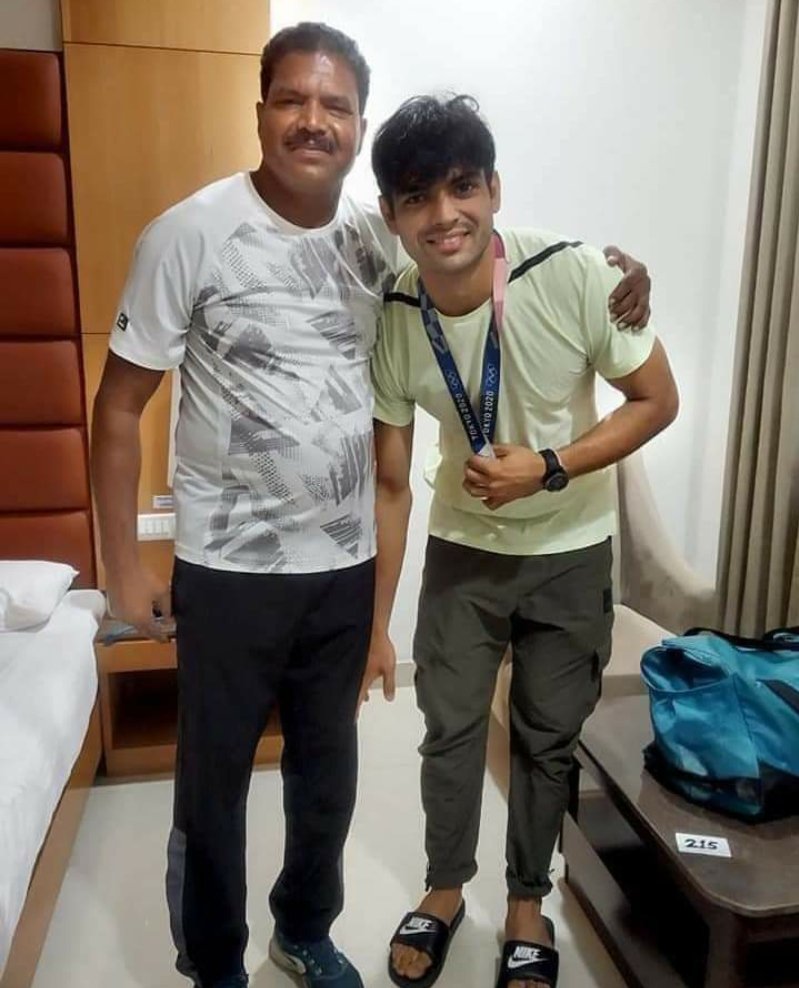
Coach Naseem Ahmed with Olympian Neeraj Chopra

Naseem Ahmed :

Naseem Ahmed: On 7 August, 2021, Neeraj Chopra threw Javelin for 87.58 mts. and became the first Indian to win an Olympic Gold in track and field events. With this success, Naseem Ahmed of Panchkula also hit the headlines. Ahmed was his first coach, who coached Chopra for almost six years at Tau Devi Lal Sports Complex in Panchkula. It was under his guidance that Chopra turned into an athlete from a chubby child. After returning to India, Chopra went to meet and receive blessings from his coach.

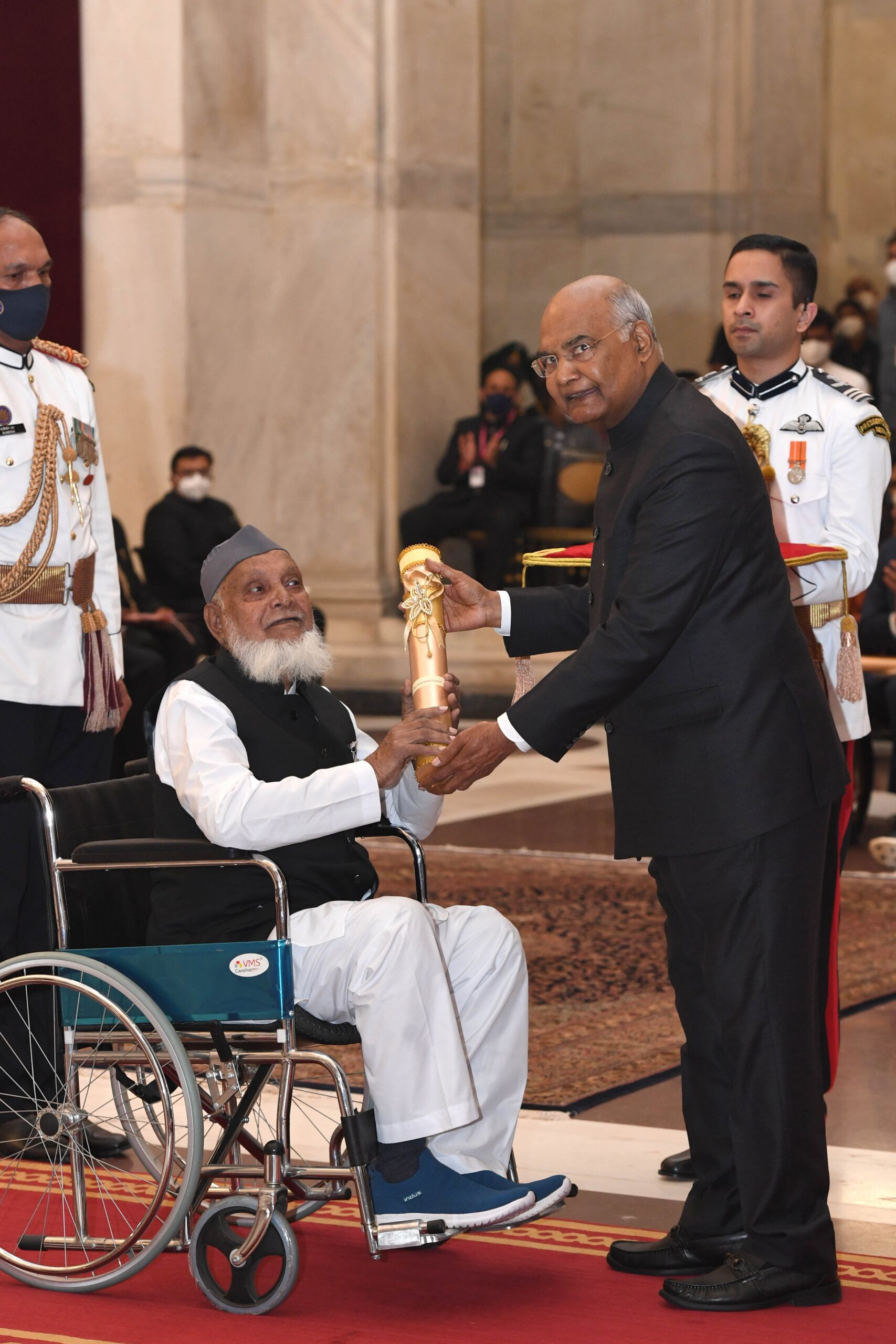
Mohammad Shareef alias Shareef Chacha receiving Padma Shri from President Ran Nath Kovind

Mohammad Shareef :

Mohammad Shareef is a bicycle mechanic from Faizabad, Ayodhya and hit the news headlines this year for receiving Padma Shri, the fourth highest civilian award in India, from the President Ram Nath Kovind. In 1992, his son was murdered and was eaten by animals as nobody claimed it. This incident moved him so much that he took it upon himself to perform the last rights of unclaimed dead bodies. In the last 28 years, he has performed the last rights of more than 25,000 unclaimed dead bodies according to their religions.

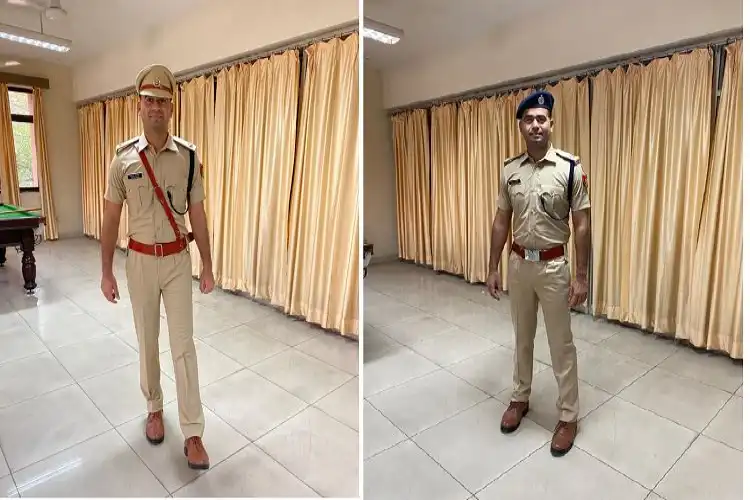
Firoz Alam as an IPS officer (Left) and as a Constable of the Delhi Police (Right)

Firoz Alam :

Firoz Alam’s story is straight out of a fiction, where his character bears resemblance to those played on screen by several film stars. Alam, a resident of Hapur in U.P, was a constable with Delhi Police since 2010. In 2014, he started preparing for UPSC CSE. The work pressure and family responsibilities did not allow him to devote full time to the studies, like many availing coachings could do. After five unsuccessful attempts, in his sixth attempt he qualified UPSC CSE and joined as an IPS officer. His inspiring journey from a constable to IPS had taken the nation by a storm when he joined the training after leaving the job as constable.

Sadaf Choudhary 

Sadaf Choudhary :

Sadaf Choudhary came into limelight when the UPSC CSE results were declared in September and she secured 23rd rank. She was the highest rank holder among Muslims this year and will become an IAS officer. It must be kept in mind that since independence only 179 Muslims have secured ranks to get IAS allotted to them.

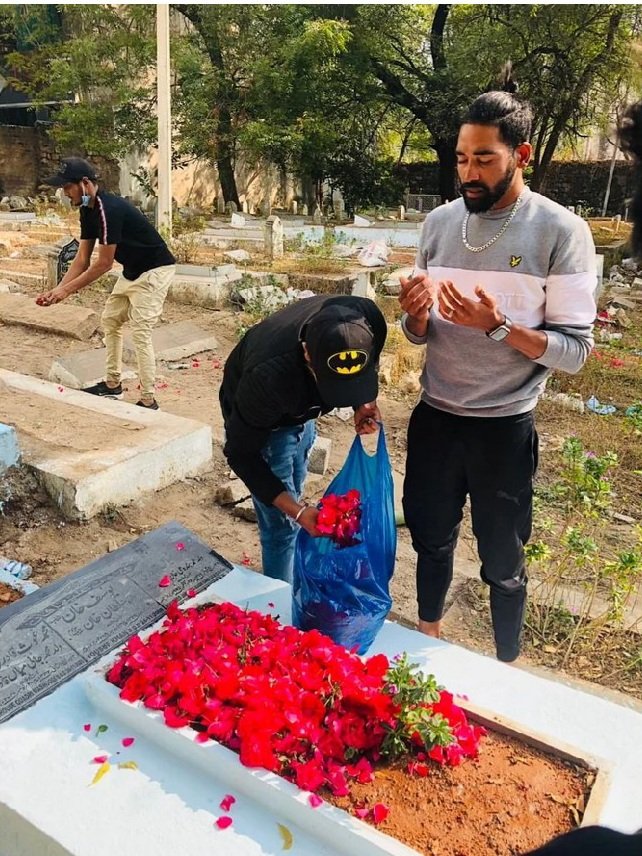
Mohammed Siraj praying at the gave of his father

Mohammed Siraj :

Mohammed Siraj is an Indian cricketer from Hyderabad who made it to the headlines in January by becoming the highest wicket taker from India during the India – Australia Test Match Series in Australia. To claim his 13 scalps, he played only three of the four tests in the series. The fact that his father had died just before the series and he was given an option to return to the country, which he declined citing his commitment to the nation made it even more special.

In the last test match at Brisbane, he bagged five Australian wickets to script a historic win and became a national hero. The headlines of the sports column were filled with his heroics, commitment and ability. Since then he has been a regular feature of the Indian Cricket team as a pacer. 

source: http://www.awazthevoice.in / Awaz, The Voice / Home> Stories / by Saquib Salim / December 30th, 2021

AMU Engineers Develop Innovative Panel to Keep Homes Cooler by 15°C

Aligarh, UTTAR PRADESH :

Engineers at Aligarh Muslim University have developed a Ferro Cellular Insulated panel to reduce indoor heat during peak summer. The innovation comes from the Civil Engineering Department and offers an energy efficient alternative to brick walls.

The research team includes Prof Abdul Baqi, Dr Mohammad Rehan Sadiq, and research scholar Yasir Khan. They designed the 90 mm corten cement panel using cement and cardboard. A gap between two layers traps air, which works as insulation. The panel keeps indoor temperatures at 25 to 27°C when outdoor heat reaches 40 to 42°C. This means a drop of nearly 15°C.

Researchers say the panel reduces the need for air conditioners and coolers. It also blocks external noise, improving indoor comfort. Dr Sadiq said the team focused on durability and structural strength while introducing a material not widely used in India.

Cost comparisons show long term savings. Building a 10×10 foot room with bricks costs around ₹1 lakh. Using the insulated panel raises the cost to about ₹1.15 lakh. However, annual electricity expenses for a brick room reach around ₹22,651 due to cooling needs. A panel built room requires about ₹10,251 per year. This results in savings of nearly ₹12,400 annually.

Researchers also found electricity use remains lower throughout the year in panel built rooms. The lighter panels reduce structural load, which improves building safety.

The team plans to introduce the technology to the market. With rising temperatures and higher energy demand, this panel offers a practical option for heat prone regions. It also reduces dependence on bricks and mortar, lowering environmental impact.

source: http://www.radiancenews.com / Radiance News / Home> Uncategorized / by Radiance News Bureau / February 12th, 2026

Ikram Hussain’s brass carvings fascinated PM Modi

Moradabad, UTTAR PRADESH :

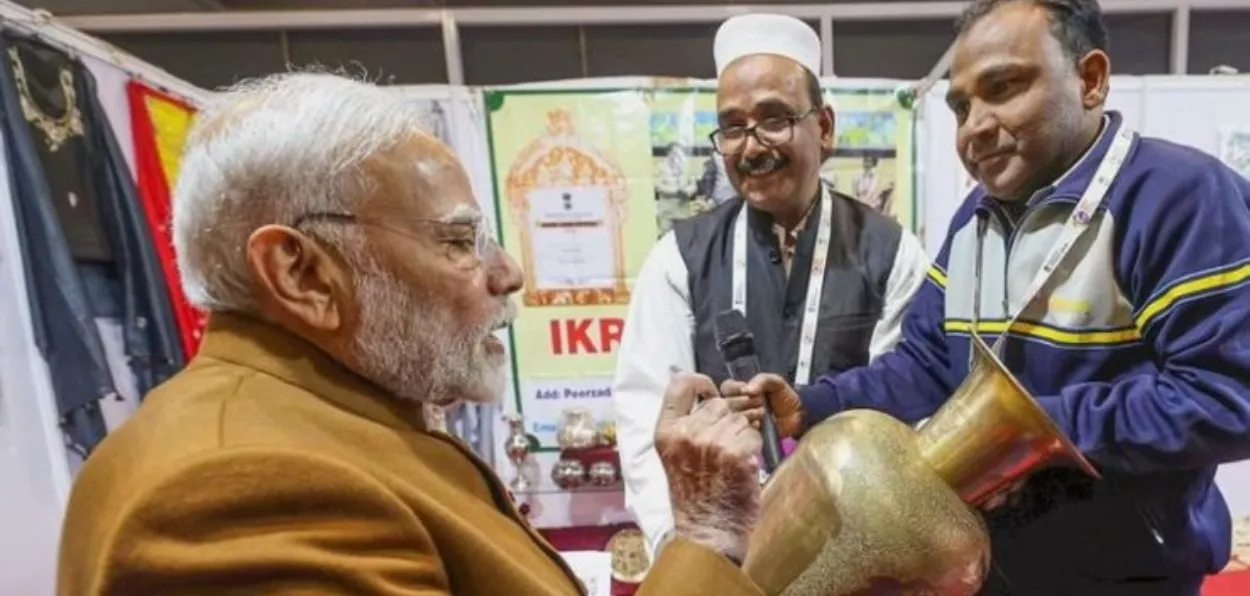
Ikram Hussain (wearing a cap) with Prime Minister Narendra Modi at Bharat Mandapam, New Delhi

Ikram Hussain was 15 years old when the manager of the Eidgah Gurdwara in Moradabad, UP, asked him to engrave his mother’s name on an aluminium plate. The young boy had never gone to school but had picked up the skill of metal carving from his father. The young boy felt embarrassed and told the manager that he must write the name for him since he was illiterate.

He engraved the name beautifully onto the plate and received Rs 10 for this work. This amount gave him confidence, and he decided to pursue his work seriously.

Today, Ikram Hussain, 61, from Moradabad, Uttar Pradesh, is a national award winner. None other than Prime Minister Narendra Modi praised him for his art.

One of the glorious moments of his life was when Prime Minister Narendra Modi was impressed and moved by his beautiful carvings at the The 12th Grameen Bharat Mahotsav  at Bharat Mandapam, New Delhi last year.

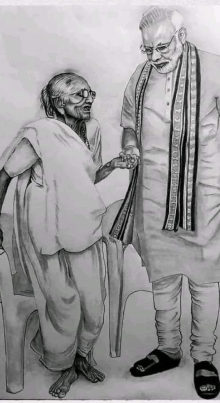
Ikram was carving a piece depicting Prime Minister with his late mother on a 3-feet brass jar. Prime Minister intently watched his carvings and patted him for his work and dedication. He displayed this work at the festival.

Moradabad, known as the “Brass City,” is renowned for its exquisite brass artefacts. Ikram Hussain says he could not study due to financial constraints at home. However, he never lost hope.

At a young age, he began assisting his grandfather and father in their brass engraving work. His father, Haji Abdul Hamid, and his uncle, Razak Medal winner Haji Ghulam Nabi, were well-known brass engravers in Moradabad. Ikram started learning this art at the tender age of seven.

Even today, his eyes well up with tears when asked why he couldn’t complete his studies. He explains that his family’s financial situation was extremely precarious. To help support the family, he had to leave school and start working.

The family worked day and night, yet they could barely earn five to seven rupees a week. Even that amount was hard to come by those days. Despite this, Ikram never let his circumstances become a weakness.

While working, he meticulously learned the intricacies of engraving. His hard work and dedication resulted in him gradually mastering the art of working with brass to the point where he could accurately engrave the likeness of any person’s face.

His engravings display emotion, depth, and lifelike detail. This is why his art has equally impressed people from all communities—Hindus, Muslims, Sikhs, and Christians alike.

His hard work paid off, and in 2004, he received an award from the Uttar Pradesh government for his outstanding carving skills. He also received a cash prize of 5,000 rupees.

At that time, five thousand rupees was a considerable sum of money. Ikram recounts that when he went to deposit the check at the bank, the bank manager even offered him tea. This recognition was like a dream come true for him. There was an atmosphere of joy in his family, and his morale was boosted manifold.

Today, Ikram Hussain is recipient of honours and awards from various parts of the country.

He runs his company, which he started with a bank loan. This craftsman, who once earned just five rupees a week, is now providing jobs and training to many.

Ikram Hussain’s story is not just a success story of a craftsman, but an example of struggle, perseverance, and self-confidence. He proved that with determination and hard work, a lack of formal education cannot be an obstacle to success.

The master craftsman is recognised throughout the country for his art and social message. The demand for his brass products is high, and his business is worth millions.

The Bihar government has hired him to train the artisans. He trained more than 400 artisans at the Upendra Maharathi Shilp Anudan Sansthan.

Ikram Hussain inherited his passion for this art form, as his father also trained people in the same craft. His exceptional carvings have earned him a place in the Guinness Book of World Records.

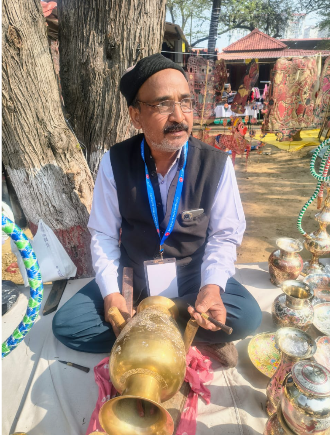
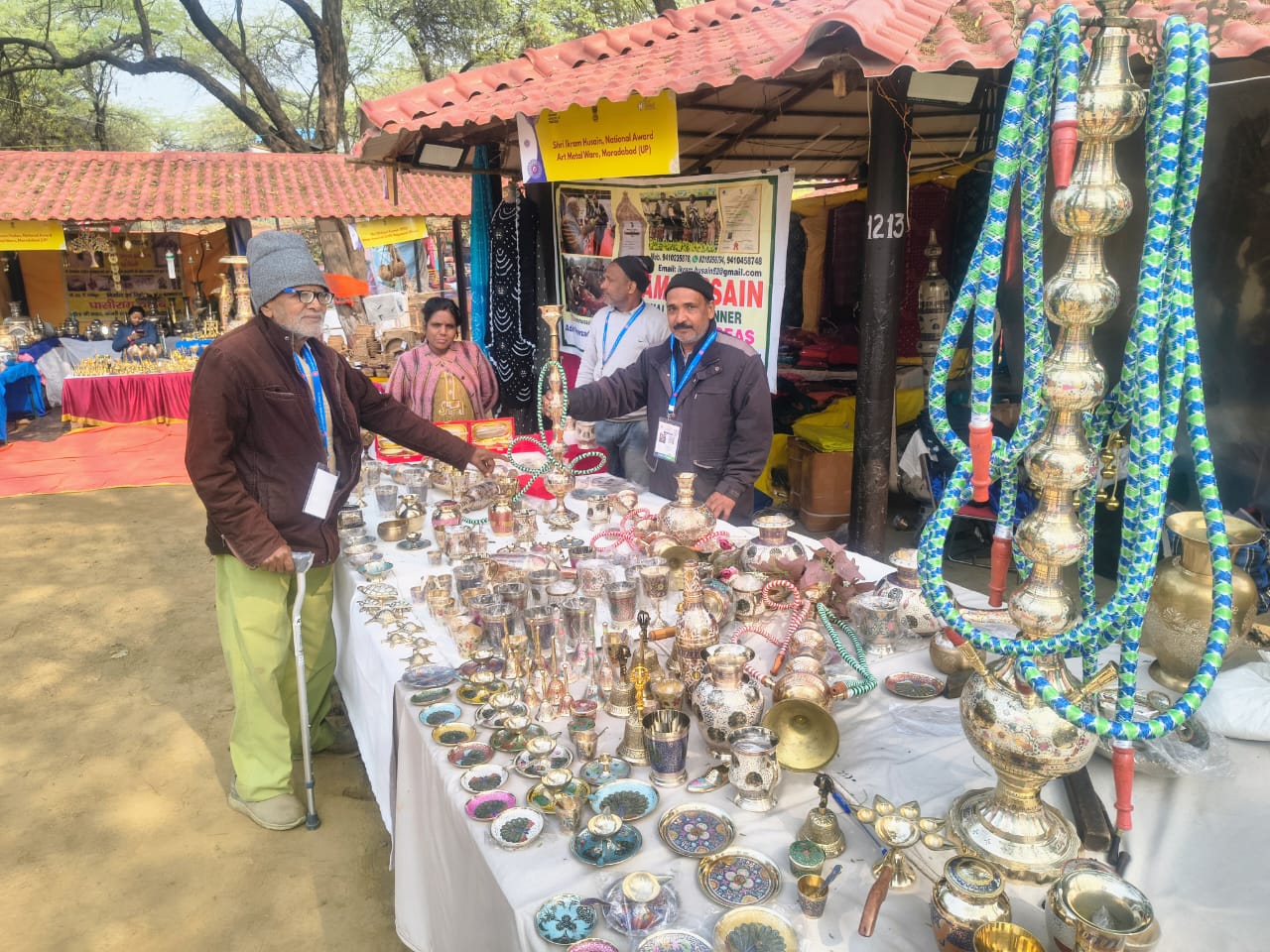
Ikram Hussain at his stall at the Surajkund Festival

Craftsman Ikram Hussain has conveyed a message of communal harmony by engraving symbols of Hindu, Muslim, Sikh, and Christian religions on his brass products.

He was honoured with a National Award in 2022 for his art and for promoting brotherhood in society.

Ikram Hussain believes that all religions are part of the same family and that we should rise above caste and creed to strengthen love and brotherhood. “We are all flowers of the same branch, only our colours are different. We should promote love and brotherhood, not hatred.”

His carving of the Ram Temple on a vase and his work on a 40-inch vase at the Golden Temple can be seen up close at the Lucknow Museum.

He has received numerous awards, including the State Award Second from Uttar Pradesh, the Bhim Rao Ambedkar Award, the Dr Ram Manohar Lohia State Award, the National Award Second from Union Minister Piyush Goyal, two honours from the Assam government, and an honour from the Prime Minister.

Overall, he has received 20 national and international awards. His work and contributions have also earned him a place in the Guinness Book of World Records.

source: http://www.awazthevoice.in / Awaz, The Voice / Home> Stories / by Dayaram Vashisth / February 05th, 2026

Dr. Riaz Ahmad of AMU gets Young Scientist Award

Aligarh, UTTAR PRADESH :

pix source: amu.ac.in

Aligarh:

The Council of Science and Technology, Uttar Pradesh honoured Dr. Riaz Ahmad, Lecturer at Department of Zoology, Aligarh Muslim University (AMU), with ‘Young Scientist Award’ yesterday. The award has been given to Dr. Ahmad in recognition of his contributions in the area of Biochemical and Molecular Genetics. Besides cash prize of Rs. 25,000/, award carries a certificate, memento and a shawl.

The award was presented to Dr. Riaz Ahmad by Mr. Abdul Mannan, the State Minister for Science and Technology at the Vigyan Samaroh at Sir C.V. Raman Auditorium in Lucknow.

Dr. Ahmad is also a recipient of prestigious Dr. D. S. Kothari Post Doctoral Fellowship from UGC, Young Scientist Project of DST and Scientist of the Year Award-2009 given by the National Environmental Science Academy.

He has a number of research papers to his name published in various scientific journals of national and international repute.

source: http://www.twocircles.net / TwoCircles.net / Home> Indian Muslim / by TCN News / March 30th, 2010

AMU PhD Scholar Adiba Receives Prestigious American Physical Society (APS) Distinguished Student Award

Aligarh, UTTAR PRADESH :

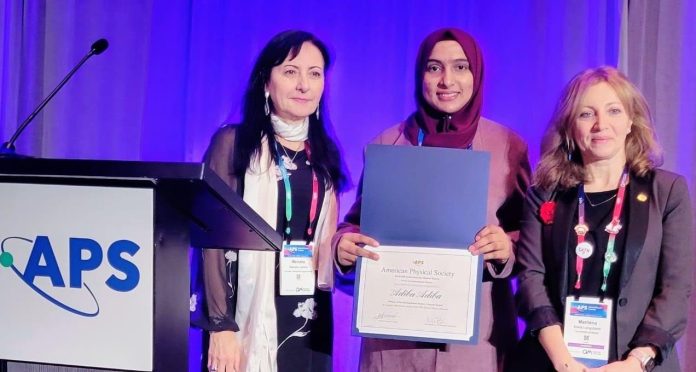
Adiba receiving the Prestigious APS Distinguished Student Award

Aligarh:

Adiba, a PhD student in Physics at Aligarh Muslim University (AMU), has been honoured with the Distinguished Student Award by the American Physical Society (APS) at the APS March Meeting 2025 in Anaheim, California.

Instituted in 2015, the award recognises exceptional early-career researchers from outside the U.S. and supports their participation in APS’s flagship meetings.

Adiba, working under the supervision of Prof Tufail Ahmad, is conducting cutting-edge research on Resistive Random Access Memory (ReRAM) devices for neuromorphic computing – an emerging frontier in physics and artificial intelligence. Her work earned her the prestigious award for outstanding contributions to the field.

Beyond research, she leads as President of the International Centre for Muslim Women in Sciences (ICMWS), championing science education among young women.

Expressing her gratitude to AMU for its role in her success, Adiba said, “Receiving this recognition from APS makes me feel incredibly proud and motivates me to strive even harder.”

source: http://www.radiancenews.com / Radiance News / Home> Latest News> Research> Science & Technology / by Radiance News Bureau / April 08th, 2025

Irshad Mirza: Famous leather exporter of Kanpur, Irshad Mirza passes away, industry mourns

Kanpur, UTTAR PRADESH :

Irshad Mirza, a prominent Kanpur leather industrialist and chairman of Mirza International, has passed away at the age of 95. Irshad Mirza had been ill for a long time. His death has sent shockwaves through Kanpur and the industry.

Kanpur: 

Irshad Mirza, chairman of Mirza International, the country’s largest leather exporter, passed away at the age of 95. Irshad Mirza was ill for the past several years. He breathed his last on Sunday in a private hospital in Kanpur. As soon as the news of Irshad Mirza’s death spread outside the hospital, a crowd of people gathered at his residence in Civil Lines.

Irshad Mirza’s contribution to the leather industry can never be forgotten. He has been honored with several awards including Padmashree. Irshad Mirza was also called the pride of Kanpur. Irshad Mirza has also got his name registered in Forbes magazine.

Irshad Mirza founded Mirza International in 1979. Mirza International manufactures leather, finishing, and tanning. The leather produced by Irshad Mirza’s company was in high demand abroad. The leather produced by the company is exported abroad. He was also the former chairman of the Minority Commission. During this time, he contributed to the betterment of society. Irshad Mirza

His passing has caused a wave of mourning in Kanpur and the industry. He had a strong influence not only in the industry but also among social workers, political parties, and leaders. He also worked extensively for the betterment of society in Kanpur. He also taught how to work in the leather industry.

source: http://www.navbharattimes.indiatimes.com / Nav Bharat Times / Home> Hindi News (translated)> State> Uttar Pradesh> Kanpur / by Abishek Shukla / December 04th, 2022

Madrasa with Jewish roots lights up a new path in western UP

Sambhal District, UTTAR PRADESH :

New Delhi : 

A family of Bani Israel (Sons of Israel), running one of the oldest madrasas in India may sound unbelievable. But in Sambhal district of West Uttar Pradesh, a nondescript locality, Hilali Sarai, boasts of such a seminary run by a family that has roots in ancient Israel.

Madrasa Sirajul Uloom, named after Maulana Siraj Ahmed Israili, who was a renowned aalim of his time and among few Islamic scholars who backed Sir Syed Ahmed Khan, the founder of a modern madrasa (later Aligarh Muslim University), is run by Mohammed Mian Israili Qasmi, the representative of living generation of his family.

The madrasa is affiliated to UP Madrasa Board and runs both traditional Dars-e-Nizami syllabus and modern curriculum prescribed by the board that includes compulsory study of maths, english, hindi and science. Such madrasas are also called ‘model madrasas’ as they are following the government model of madrasa modernisation.

The Israili family traces its lineage to the Jewish companion of Prophet Muhammed, Abdullah bin Salam, who had converted to Islam during the lifetime of the Prophet. Nevertheless, the family has been maintaining its Bani Israel cultural identity all through history.

“The historical records say that our ancestor Abu Ishaque Abul Aja’ib Shah Muhammad Hilali came to India during the time of Mughal Emperor Akbar when the latter started Deen-e-Ilahi and a horde of Islamic scholars descended from Arabia to guide the ‘misguided’ Emperor.

Historian Abdul Qadir Badayuni has mentioned Shah Hilali. He initially settled in Fatehpur Sikri near Agra and later on the insistence of Akbar himself, he moved to Sambhal. Thus, this place came to be known as Hilali Sarai. He had established his maktab (school) here, as was the tradition of the time that scholars used to start learning centres wherever they settled. Since then, our family has been running an educational house here,” says Mian Israili Qasmi, detailing the family history of the Israilis.

A research paper in the Interdisciplinary Journal of Jewish Studies by researcher on Jews in South Asia, Navras Jat Aafreedi, proves the authenticity of Mian Israili’s claim.

“There is a Sunni Muslim clan called Bani Israil in Sambhal (District Mo-radabad) and Aligarh in Uttar Pradesh, members of which consider themselves to be descendants of a Jewish sahaabi (companion of the prophet Muhammad) Hazrat Abdullah Ibn-i-Salaam. They claim that their ancestors settled in India a millennium ago to propagate Islam. Members of this clan generally use Israili as their last name. They reside, in both Sambhal and Aligarh, in a locality, each called Bani Israil Mohalla or Mohalla Bani Israilaan. Many from this clan migrated to Pakistan after its creation in 1947…” writes Aafreedi.

Similarly, one more scholar Joshua M. Benjamin, the author of The Mystery of Israel’s Ten Lost Tribes and the Legend of Jesus in India (2001), mentions having met an Aligarh Muslim University Professor with the Hebrew sounding name Shimoni Israili, a member of this clan.

Similarly classical historian Abdul Qadir Badayuni, writer of notable Muntakhab-ut-Tawarikh, the history of early Mughal period, mentions Shah Hilali Israili as a renowned Islamic scholar of Mughal period. Shah Hilali in Sambhal in fact taught him in the same maktab, which is today Sirajul Uloom.

Narrating more history of the madrasa, Mian Israeli says that as the Mughal rule went into sunset, the madrasa was patronised by Nawab of Hyderabad. The patronage lasted till the fall of Nawab’s Nizamat after the Partition of India.

“Meanwhile, one notable change took place. When Maulana Siraj Ahmed Israeli refused to sign a fatwa against Sir Syed Ahmed Khan, he became very pleased with Maulana and offered him to join as faculty in newly opened Mohammedan Anglo Oriental (MAO) College. Maulana didn’t go himself but sent his son Maulana Khalil Ahmed Israeli to join the college as Professor of Arabic. Maulana Khalil was later conferred the title of Shamsul Ulema (a coveted honour) by the Colonial British government for this contribution in the field of education. While at MAO college, Maulana established the madrasa in a formal registered body in 1902. Since then, it’s been running in a similar fashion,” says Mian Israeli.

Mian Israeli maintains that the madrasa has always maintained a progressive outlook and has guided the Muslim community in very practical way.

“The scholars and patrons of the madrasa have always taken the lead in advising Muslims of siding with rationality and minimising both personal and social conflict. That’s you will not find any controversy ever attached with this seminary. In fact, the stellar history of the madrasa has remained obscured because we haven’t chased limelight and few curious minds have cared to know the silsila (lineage) of scholarship,” says Mian Israili.

Mian Israili lists Moulana Muhammad Manzoor Nomani, Moulana Muhammad Hayat Sambhli, Ghazi Muhammad Aazam, and freedom fighter politician Maulana Ismail Sambhali, among others as part of the blood-line.

Maulana Ismail Sambhali was a noted figure of Jamiat Ulema- e Hind, a body of Indian Islamic scholars who were against division of India on religious lines. Maulana Ismail even fought 1946 election against Muslim League candidate and was among the chosen few who won on the Congress ticket from a reserved Muslim seat.

Maulana Manzoor Nomani, however, however, adopted a different way. He is credited to have turned Syed Abul Ala Maududi, who was a progressive and modern Muslim journalist-writer, into Maulana Maududi, a hardcore religious figure and both of them floated Jamaat- e-Islami. Manzoor Nomani also emerged as one of the tallest Islamic scholars of India in 20th century, and is regarded as an authority on Hadith. Unlike Maududi, he didn’t go to Pakistan and got himself attached with Lucknow-based seminary Nadwatul Ulema. In late 1970’s and 1980’s, his books on Ayatollah Khomeini and Islamic Revolution created a storm in the Indian Muslim community and they are said to be one of the causes of sectarian violence in Lucknow.

Mian Israili did not comment on Nomani’s views, as “they were personal to him”. “As I said, our seminary has always propagated the route of bridging gaps and persuading people to come closer rather than splitting apart. People can do anything in their individual capacity and scholarship,” says Mian Isarili.

He insists that the seminary must be viewed through his views on burning subjects such as triple talaq, halala, etc. So, what are his views? “I think the arbitrary manner of triple talaq is absolutely contrary to the spirit of Quran and is malignant. Halala is haram,” he stresses.

Coming back to the history of the madrasa, Mian Israili says that after the end of Hyderabad’s Nizamat, the madrasa was recognised by the government of India. “However, it was only in 1990’s that it was properly affiliated to the UP-Madrasa Board and it started getting government aid as slated for the seminaries,” says Mian Israil.

According to him, as part of the Madrasa Board, the seminary has to teach compulsory subjects like hindi, maths, english and science. “As part of the Board affiliation, the government also appoints 12 teachers for primary and junior high school level. All these teachers have to have knowledge of Urdu as compulsory as the medium of the madrasa is Urdu,” he says.

When reminded that how come the students taught in Urdu medium compete with those being taught in Hindi or English mediums, he says that keeping this in mind, the teachers are urged to teach Science and Maths in English so that students who want to pursue further studies in a science subject and they might join other schools. Only those who want to pursue religious studies and languages such as Arabic and Persian may stay in the seminary.

“Most of our students pass out after Class 8 and opt for mainstream education in regular government and private schools. Only those boys and girls who want to pursue Theology and languages go for further classes,” says Mian Israili.

According to Israili, there are around 800 students enrolled with the madrasa. Out of them, 250 are girls. The madrasa has residential facilities for 50 students.

“For a modern madrasa, the basic requirement is resources. As being a government-aided institution, we certainly get some teachers on government pay scale, but we don’t get other facilities like building, hostel, classroom, ground and other facilities. For that, we have to depend on chanda (collection and donation from the community),” says Mian Israili.

source: http://www.daijiworld.com / DaijiWorld.com / Home> National-World / by Mohammed Anas / March 15th, 2022