Tag Archives: Positive News of Muslim Women of Uttar Pradesh

Sabahat Afreen curated a women’s world sans fear and restrictions in her stories

Siddharthnagar District / Lucknow, UTTAR PRADESH:
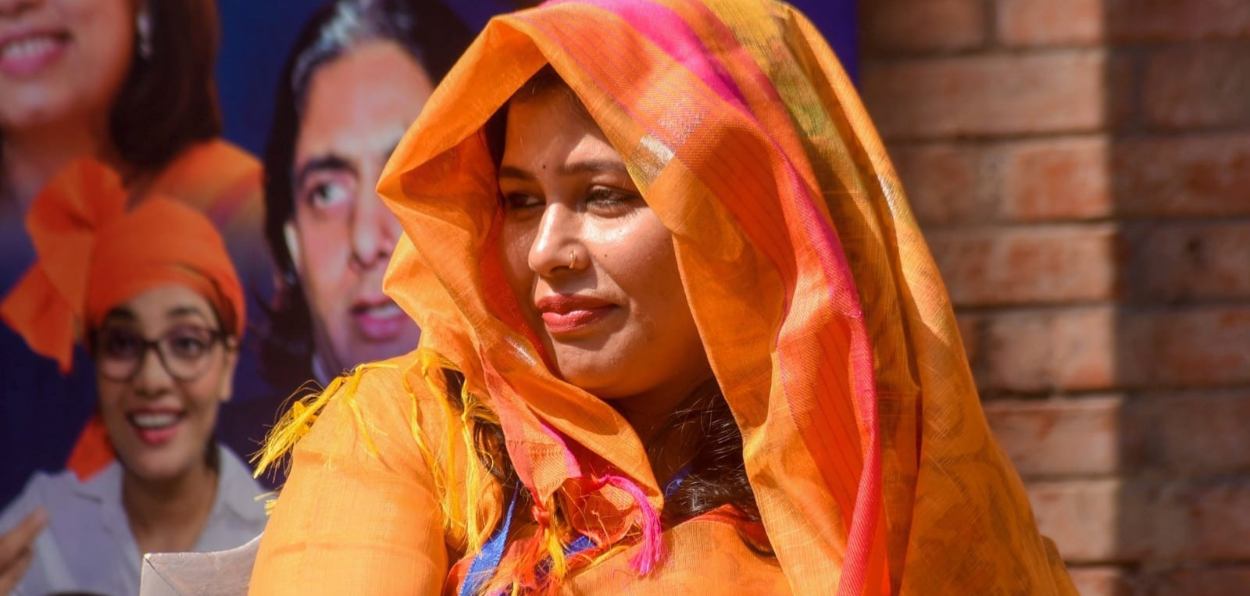
Author Sabahat Afreen

Sabahat Afreen’s life will make you believe in the adage: where there is a will there is a way. Being born into an educated and prosperous family, Sabahat realized early in her life that her family was not open to women coming out of the four walls of the house, bracing against all odds to create their identity. She was raised seeing all women in her family in purdah.

However, somewhere in her heart, Sabahat Afreen was like a Secret Superstar of the Hindi movie by that name. Afreen was raised in a small village in Siddharthnagar district of Uttar Pradesh by her advocate father and a homemaker mother.

Sabahat Afreen started living in purdah in 10th class and after passing her 12th standard, She was not supposed to move out of the house alone. This resulted in her not attending college and opting for home study and writing examinations as a private student for her graduation years.

She was completing her master’s degree when she got married. Her husband’s family was politically connected and prosperous. She could have easily lived in comfort; Sabahat did not like to dress up like a doll wearing jewelery and expensive sarees and lounging around all day.

She said, “My mother was fond of reading and writing. She had an impact on me too. I used to write poems and stories in my childhood. Mom and Dad always encouraged me. It is a different matter that my works were never sent for publication as they didn’t believe in getting a picture of their daughter printed in the newspaper.”

Sabahat Afreen with her book

She also realized the environment in her in-laws’ house was less conservative. “My father-in-law knew that I write, so he used to gift me a diary and pen; my husband also supported me.” She told Awaz-the Voice.

After marriage, she opened a secret account on Facebook and did not use her pictures for the DP. “I started writing stories on Facebook, my posts went viral. Someone suggested that I should send my stories to Neelesh Misra, (Editor, Gaon Connection, lyricist, and storyteller). His storytelling was popular. I emailed my story to him and he liked it. From that point, I was in his circle.”

Like Insia Malik (Played by Zaira Wasim) of Aamir Khan’s 2017 film Secret Superstar, she revealed her talent to the world by hiding her identity. Soon Sabahat Afrin was writing audio series, stories, and books for magazines and many apps across the country. She moved her two little daughters out of the closed environs of the village to Lucknow.

As it happens in such cases, most of the people who had opposed her once now praise and respect her. Her family is proud of her.

Recently her first story collection Mujhe Jugnuon Ke Desh Jaana Hai (I Want to Go to the Land of Fireflies)(Rujhan Publications, Rajasthan) was released. In it, Sabahat imagines in this country of fireflies women are also enjoying the same freedom as men, the doors of their hearts cannot be guarded, they too have the freedom to remarry after divorce, and they have the right to decide if they want to return to their husband’s house after feeling unwanted there.
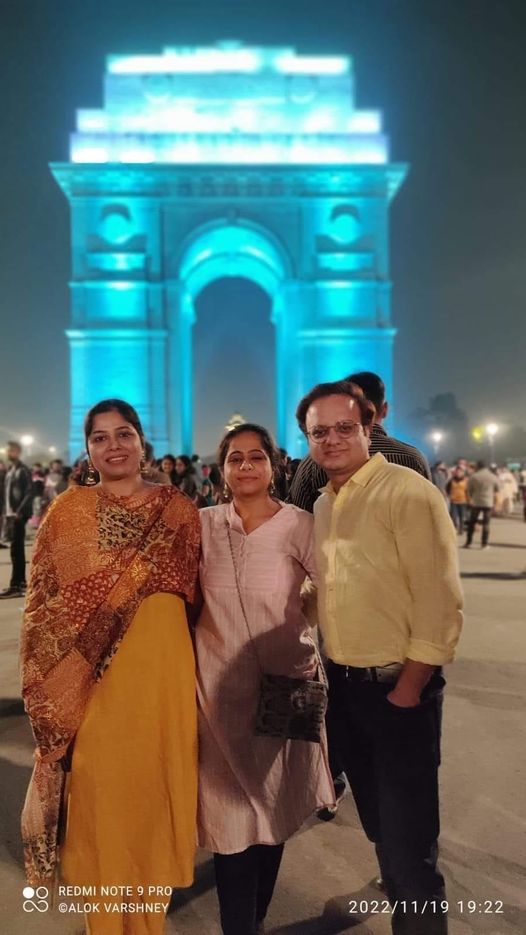
Sabahat Afreen with friends

Her stories are set in the backdrop of Muslim culture, but she manages to show that when it comes to the status and rights of women, it’s the same every year. Sabahat wants to free the fireflies from the clenched fists of Afreen women.Her first remuneration of Rs 30,000 as a writer was encouraging for Sabahat. She felt that being financially strong should be the priority of a woman. Now she shares her pictures on social media and with her stories.

Sabahat has written amazing stories that she must have picked up from around her and kept in the secret chamber of her heart to let them metamorphose into another form. Her stories look familiar to readers; after reading each one of her stories, the reader feels that he has seen these incidents.

Sabahat has adapted one such incident into a captivating story. The story Khoobsurat auratein (Beautiful Women) starts with this sentence – “even good looks are like a punishment, wherever she went people’s eyes were fixed on her.’ The heroine of the story, Alia, is very beautiful.”

Sabahat Afreen with her daughters

Women are at the center of all Sabahat’s stories. The joys and sorrows of a woman, her dreams, her desire to fulfill them and social restrictions are the key elements in her stories. Sabahat is seen breaking these restrictions and traditions. Women in her stories are silent protesters except for Alia from her story Beautiful Women. However, they encounter opposition and in some cases, it’s also effective.

Sabahat becomes emotional while narrating her stories. She wishes to create a world for women where they have the freedom to fulfill their wishes and make their dreams come true. Her stories reflect her progressive thoughts.

Sabahat says that she never went to the market alone and yet when people knew about her through her stories, she felt confident to move to a big city with her daughters. “I reached Lucknow and rented out an apartment and enrolled my daughters in a good school. Today my daughters are studying, and life has become a bit easier for all three of us.”

source: http://www.awazthevoice.in / Awaz, The Voice / Home> Story / by Onika Maheshwari, New Delhi / January 03rd, 2024
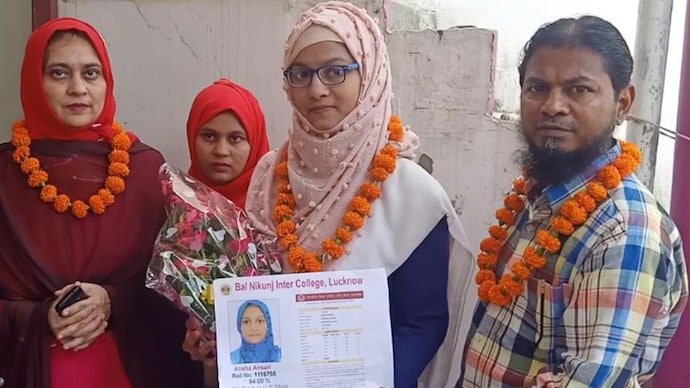
Lucknow topper Alisha Ansari scores 94% in UP Board Class 10 exams, shares secret

Lucknow, UTTAR PRADESH:

Uttar Pradesh Class 10 Result 2020:

Lucknow topper Alisha Ansari has remained distant from social media sites to score 94% in board exams.

Lucknow topper Alisha Ansari scores 94% in UP Board Class 10 exams, shares secret

Class 10 student Alisha Ansari has secured the first rank in Lucknow and ninth in Uttar Pradesh with a score of 94 per cent. Apart from sheer hard work and support from parents, Alisha has had remained distant from social media websites, including Facebook, Twitter, and Instagram to attain this position.

Alisha, who comes from a middle-class family, has a younger brother and an elder sister. Her father, Mohammad Rizwan Fazli, is a teacher in a private engineering college and her mother, Shabana Ansari, is a housewife.

Kanti Mishra, Principal, Bal Nikunj Inter College, said, “Alisha has been a hardworking student. Also whenever she had a doubt in the subject, she would immediately ask school teachers.”

Appreciating her hard work and talent, her mother, Shabana Ansair, told, “We have always given our daughters equal opportunities to study.”

Moreover, she shared that she would want her daughter to become a doctor and it is just the beginning of her journey of success.

Also, her father, Mohd. Rizwan Fazli, expressed his happiness, saying that he is extremely proud of her daughter.

source: http://www.indiatoday.in / India Today / Home> News> Education Today> News / by Ashish Srivastava, Lucknow (UP) / June 27th, 2020

Who was Nishat un Nisa Begum who discarded purdah during freedom movement

UTTAR PRADESH:

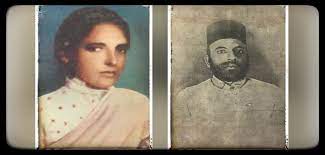
“I appeal to the youth of this country that they sit at the feet of this goddess (Nishat un Nisa Begum) to learn the lessons of independence and perseverance.” Famous Indian writer Brij Narayan Chakbast wrote this in 1918 about the freedom fighter Nishat un Nisa Begum.

People knew more about her husband Maulana Hasrat Mohani, who coined the slogan Inquilab Zindabad (Long live revolution). Historians have kept Nishat, like many other women, at the margins of historical narratives. She existed not as a protagonist but as a supporting actor in a play that had her husband as the protagonist.

This happened even though Hasrat admitted that he would have remained an apolitical editor if he had not married her. Maulana Abul Kalam Azad likened her to “a mountain of determination and patience.” Mahatma Gandhi also acknowledged a key role in the Non-Cooperation Movement. By no stretch of the imagination, she was a dependent woman and owed her existence to Hasrat.

Born in Lucknow in 1885, Nishat was home tutored, as was the custom of those times. She knew Urdu, Arabic, Persian, and English. Even before she married Hasrat in 1901 was teaching girls from backward sections of the society at her home. Marriage exposed her to the world of politics. Nishat and Hasrat were among the first Muslims in India to join Bal Gangadhar Tilak’s extremist group of Congress and open a Swadeshi shop in Aligarh. In 1903, the couple started a nationalist Urdu newspaper ‘Urdu e Mualla’. The British did not like it and jailed Hasrat in 1908. After his release, the couple resumed the newspaper. The newspaper had only two employees – Nishat and Hasrat.

Hasrat was again jailed during the First World War. Nishat, who like other Muslim women of her times, used to take a veil, came out in public to defend her husband in the court trial. She wrote letters to leaders, and articles in newspapers, and removed her veil while visiting courts. To go out of one’s house without a purdah was a courageous act.

Hasrat’s friend Pandit Kishan Parshad Kaul wrote, “She (Nishat) took this courageous step at a time when the veil was a symbol of dignity not only among Muslim women but among Hindu women as well”.

In those times Congress and other organizations used to raise public funds to help the families of jailed freedom fighters. Nishat declined to accept her share from it. Pandit Kishan Parshad recalled later that in 1917 when he once visited her in Aligarh he saw her living in abject poverty. Being a friend of Hasrat, he offered her money. Nishat told him, “I am happy with whatever I have”. She later asked him if he could help her in selling the Urdu books printed by their defunct press.

Kishan Parshad told Shiv Prasad Gupta, another prominent freedom fighter from Lucknow about Nishat’s condition. Gupta didn’t take a moment to write a cheque to purchase all the books from Nishat.

When Edwin Montagu visited India in 1917, Nishat was among the representatives of the All India Women’s Conference (AIWC) to meet him. In the meeting, she demanded that all the freedom fighters be released from jail.

Nishat had abandoned the purdah for good. In 1919, she attended the Amritsar Congress session after the Jallianwala Massacre and impressed everyone with her passionate speeches. A Muslim woman, without purdah and participating in politics at par with her husband, she was noticed as a “comrade of Hasrat.”

Nishat and Hasrat were sure that asking for concessions from the British was futile. They moved a resolution for Purna Swaraj (Complete Independence) and not a dominion status at the Ahmedabad session of Congress in 1921 as the party’s goal. Nishat spoke in support of the motion. The resolution was defeated as Mahatma Gandhi opposed the idea. Eight years later, Congress adopted the Purna Swaraj as its goal.

Hasrat was again jailed in 1922 and this time Nishat attended the Congress Session at Gaya without him. She eloquently opposed the participation of Congress members in the Legislative Councils. She said those who wanted complete independence from British rule could not dream of entering the assemblies formed by them.

According to Prof. Abida Samiuddin, Nishat’s politics did not depend on Hasrat alone. She was the first Muslim woman to address a Congress Session. Her work for the popularisation of Swadeshi, the All India Women Conference, correspondences with the nationalist leaders, articles in newspapers, public speeches, and other political activities are proof that she carried her identity in the Indian Freedom Struggle. She was active in workers’ movements till her death in 1937.   

source: http://www.awazthevoice.in / Awaz, The Voice / Home> Stories / by Saquib Salim / May 14th, 2023

Ghazal Khan”s dedication helped disabled cricket come of age in India

Agra, UTTAR PRADESH:

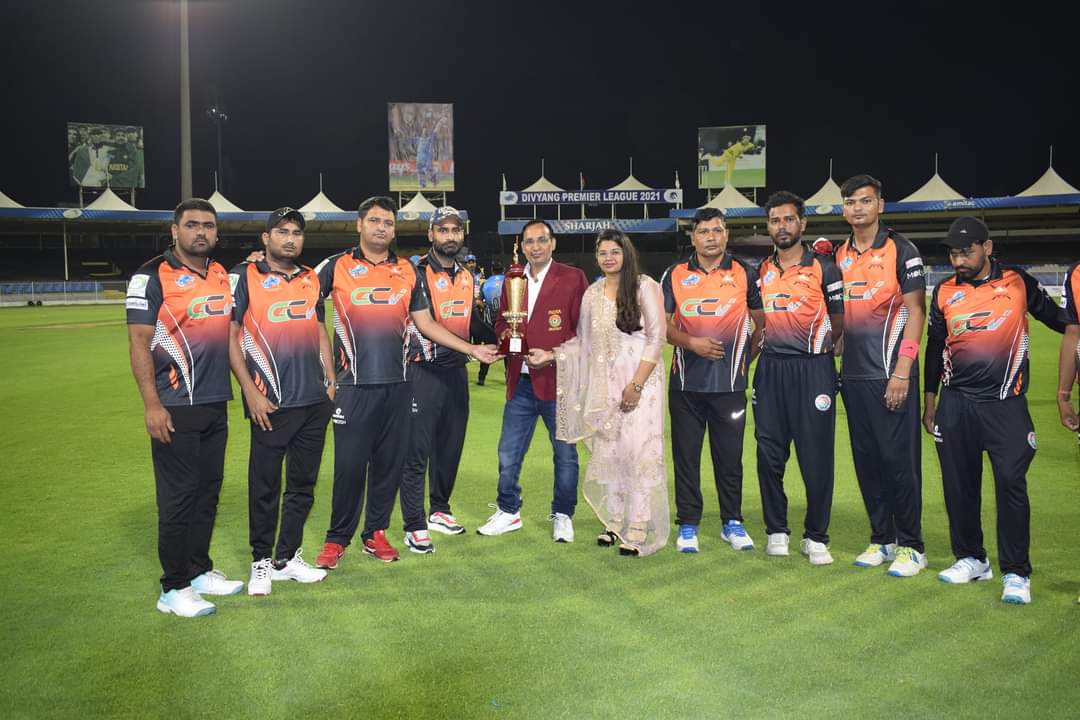
Ghazal Khan with a trophy

“I dedicated my second life to specially-abled people; especially helping the wheel-chair bound cricketers make their careers. Nowadays they are the talk of the town; they are scoring runs and playing well,” Ghazal Khan, CEO of Divyang Cricket Control Board of India (DCCBI), says.

Ghazal Khan, 28, from Agra, Uttar Pradesh, is the youngest woman in the world to be involved in the promotion of wheelchair cricket. She is also the Vice Chairperson of the International Council of Wheelchair Cricket and the Secretary of International Affairs of the International Cricket Council for the Physically Challenged.

Ghazal Khan narrated an incident from her childhood that changed the course of her life,

At the age of 21, Ghazal had a close shave with death. “On 22 December 2015 when I was preparing for the examination of the second semester of the MBA my blood pressure suddenly fell. I was riding a scooter when it happened. I fainted and fell off it. I opened my eyes after 9 days in the ICU of a hospital in Agra.”

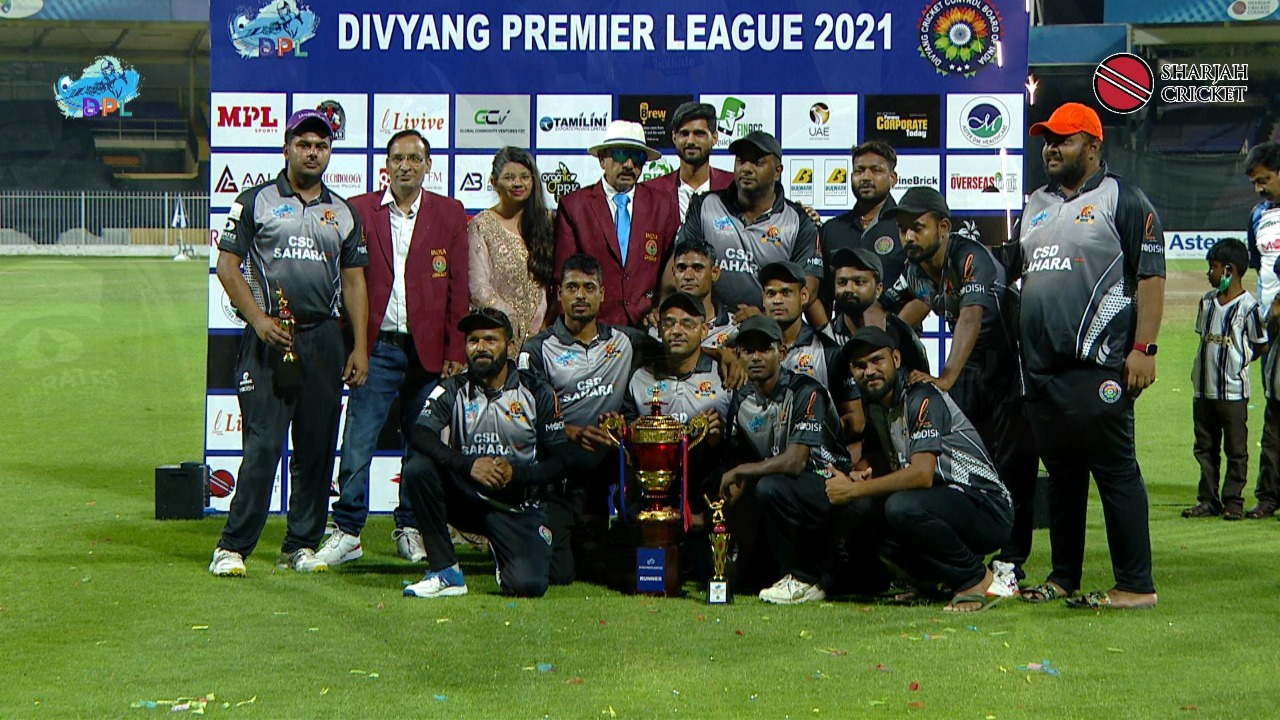
Ghazal Khan with the winning team after a tournament

Ghazal spent 20 days in the ICU. He was told that she was in critical condition and on a ventilator for 2 days. Doctors had declared her almost dead and given her only a 2% chance of survival.

“I was reborn on December 24 that year on my birthday. I had been in a coma for 9 days. My face was sewn up to close the injuries. I lost the beauty of my face. When I looked in the mirror, I couldn’t recognize myself.”

After this experience, Ghazal wondered why she survived even after doctors had given her a 2 percent chance.

“I asked myself, why did He (Allah) save me..? During this period, I received several calls from disabled cricketers from my father’s association.”

Ghazal Khan with her father Haroon Rashid (right) and another official

Ghazal’s father Haroon Rashid was a famous pacer of the Indian team. He too met with a mishap and had to give up cricket on doctors’ advice.

He founded the Divyang Cricket Control Board of India (DCCBI) to enable cricketers facing disabilities to pursue their interests. He is the general secretary of the Board and Ghazal the CEO.

Ghazal says, “I volunteered to help them during the first Asia Cup in 2015. It also helped me develop a good relationship with disabled cricketers.

“I realized that I had lost the beauty of my face, but they lost their body parts and yet they are very happy and thankful to the almighty. So, why should I be ashamed of my ugly face?

 “I realized that Allah has saved me for a reason; I decided to prepare for UPSC civil services examination and become an IFS officer.

“I was sure of cracking the examination on the first attempt. However, I day before my preliminary exam, I fought with my fiancé. Thereafter I became depressed and was diagnosed with severe clinical depression. 

Ghazal Khan posing with officials and the winning team

“Suddenly I behaved like a child of 8-9 years’; had a loss of memory. Biologically, I was 23 but mentally I was 8 years old. I had lost all senses.

 “One day while playing with the wheelchair cricketers before the IWPL tournament, a miracle happened. I felt normal. It was a pleasant shock for my family.”

Ghazal decided to work for the disabled cricketers. “This was the moment when I realized why Allah saved me. From that day till now I have given all my time and energy to Divyangjan’s cricket.

Ghazal is also Vice President of the International Council for Wheelchair Cricket (ICWC) and is secretary, International Affairs in the International Council for the Physically Challenged Cricket (ICPCC).

Almost four years ago she launched the Divyang Premier League DPL T-20.

Ghazal says she aims to elevate disabled cricketers to the status of others. Due to her efforts, on the lines of IPL, the Divyang Premier League IPL was played between 6 teams in 2021 at the Sharjah International Cricket Stadium in Dubai.

Ghazal Khan with players

She gives the credit for her success to her father.

Ghazal Khan said she is also influenced by Prime Minister Narendra Modi. She was impressed by Modi’s remarks in o address ‘Mann Ki Baat’ on December 27, 2015, which said that physically challenged people have a divine ability and for this, they should be called Divyangjan and not disabled.

Ghazal Khan recently received the Global Excellence Award from the Samarth Seva Sansthan of Rajasthan. Last year she received the Icons of Asia Award.

Ghazal Khan told Awaz-The Voice that she is also planning to work for women’s disability cricket, improving the commentary of the game and setting up a sports business industry.

source: http://www.awazthevoice.in / Awaz, The Voice / Home> Story / by Onika Maheshwari, New Delhi / March 29th, 2023

Shotgun WC: India’s Areeba Khan wins silver in junior skeet

Aligarh, UTTAR PRADESH:

Areeba Khan

Osijek (Croatia):

At the 2022 International Shooting Sport Federation (ISSF) Shotgun World Championship, which was held on Monday in Osijek, Croatia, Indian shooter Areeba Khan took home the silver medal in the individual women’s junior skeet event.

Areeba Khan hit 29 of her 40 shots in the final, missing her final attempt, while Sophie Herrmann of Great Britain scored 30 shots to win the gold.

Raveca-Maria Islai of Romania took home the bronze medal after striking 20 shots, while Muffaddal Zahra Deesawala of India placed fourth after hitting 12 targets.

After Shapath Bharadwaj, Shardul Vihan, and Arya Tyagi won gold in the junior trap men’s team competition, this is India’s second medal in the shotgun competition.

After a shoot-off, Areeba Khan came in third place in the qualifying round. She then won her ranking match to advance to the final.

The 19-year-old Indian shooter competed for India’s junior women’s skeet squad in 2021, which won a gold medal.

No Indian shooter qualified for the ranking matches in the junior men’s individual skeet later in the day.

In qualifying, Bhavtegh Singh Gill, Abhay Singh Sekhon, and Ritu Raj Bundela came in at positions 32, 33, and 36, respectively. The ranking matches are limited to the top eight competitors. 

source: http://www.awazthevoice.in / Awaz The Voice / Home> Sports / Ocotber 05th, 2022