The Sarojini Naidu Centre for Women’s Studies in collaboration with the Dr Zakir Hussain Institute of Islamic Studies, Jamia Millia Islamia, hosted a special extension Lecture titled, “Unpacking the Myths: Separating Fact from Fiction about Women in Islam” on April 24, 2025, at Mir Anis Hall of Jamia Millia Islamia.
The lecture was delivered by noted British Islamic Scholar Dr Shiekh Mohammad Akram Nadwi. Formerly the Dean of Cambridge Islamic College and currently the Principal of the Al-Salam Institute and famous for his multi volume book Al-Muhaddithat, which documents female scholars in Islamic history, he is a leading authority on Islamic jurisprudence and Hadith, inspiring global audiences with his teachings.
The event opened with a soulful recitation of the Holy Quran, followed by a warm welcome from the honorary director of SNCWS Prof Nishat Zaidi.
The introduction of the speaker was given by Prof. Habibullah Khan, Honorary Director of the Dr Zakir Hussain Institute of Islamic Studies. Prof Habibullah praised Dr Nadwi’s globally recognised contributions to Islamic scholarship, particularly his work on gender and Hadith.
Dr Nadwi’s lecture captivated the large audience present in the hall as the urging open dialogue to dismantle stereotypes about women in Islam.
Referencing his monumental 40-volume work, Al-Muhaddi that: the Women Scholars of Islam that chronicles the contributions of female Islamic scholars.
The speaker presented a compelling case for re-evaluating historical narratives, generalisations, myths and patriarchal notions through rigorous scholarship and proper understanding of Islam. His call for mutual respect and understanding across cultures sparked vibrant discussions among attendees, reinforcing the lecture’s relevance in today’s diverse world.
The lecture was followed by the presidential remarks by the Vice-Chancellor, Prof. MazharAsif, who emphasised Jamia’s commitment to inclusive discourse and highlighted the pivotal role of women in shaping Muslim society.
He urged audience to practice equality of women in their lives and shape a society that respects women.
Among the attendees were Prof Mohammad Muslim Khan (Dean, Faculty of Social Sciences), Prof Iqtidar Khan (Dean, Faculty of Humanities and Languages),Prof Kausar Mazhari , faculties and staff of SNCWS and Dr Zakir Hussain Institute of Islamic studies besides teachers, researchers and students from across the faculties of the Social Sciences, Humanities and Languages and from various Centers of the University.
Dr Tarannum Siddiqui of the Sarojini Naidu Centre for Women’s Studies convened and moderated the program. Dedicated volunteers, including Vaibhav, Zoyba, Gargi Mishra, Shubhangi, RaiyahQamar, and Fatima Zohra from MA Gender Studies of SNCWS ensured a seamless experience.
“Dr Nadwi’s lecture is a clarion call to challenge misconceptions and embrace informed dialogue,” said Prof Nishat Zaidi while thanking the speaker. She further said: “His scholarship inspires us to bridge tradition and modernity in pursuit of equity and understanding.”
The session concluded with pertinent Q&A session in which students satisfied their curiosities by asking relevant questions to the speaker.
A formal vote of thanks was presented by Gargi Mishra, student of MA Gender studies. Students and particularly girls who attended the talk were well impressed to know about the historical contributions of women in shaping society and their contributions in nation building.
source: http://www.theokhlatimes.com / The Okhla Times / Home> JMI-EDU / by theokhlatimes / April 29th, 2025
The Rampur Nawabi family with former Prime Minister Dr. Manmohan Singh
In December 2021, I came across a report in a newspaper that said, “After almost 50 years of legal battle, the Rampur District Court has ruled in the Rampur Nawab family’s property dispute. The property will now be divided among 16 legal heirs. Raza Ali Khan, the last Nawab of Rampur, died in 1966. After a long legal battle, the court has announced the division of his property worth Rs 2,664 crore.”
The Nawab family of Rampur with its glorious history is still important played in Rampur and its surrounding districts. While the family ruled the state for a long time, its members joined the institutions of independent India like Parliament and legislative Assembly. Former Members of Parliament Mickey Mian and Noor Begum belong to the family. Many members of this Royal family have played an important role not only in politics but also in promoting the culture, patronizing poets, writers, musicians, and other creative artists.
Khandaan
The Nawabi family of Rampur State
Before the independence, India was dotted with small states and one of them happened to be the state of Rampur, located in today’s state of Uttar Pradesh. It was founded by Nawab Ali Mohammad Khan, a Pushtun leader on 7 October 1774. There have been 11 Nawabs in the state including Nawab Faizullah Khan, Nawab Hafiz Rehmat Khan Barish, Nawab Muhammad Ali Khan, Nawab Ghulam Muhammad Khan, Nawab Ahmad Ali Khan, Nawab Muhammad Saeed Khan, Nawab Yusuf Ali Khan, Nawab Club Ali Khan. Nawab Muhammad Mushtaq Ali Khan, Nawab Hamid Ali Khan.
Raza Ali Khan was the last Nawab of Rampur. Rampur was one of the important States of the British in India as its rulers were plaint and supported the Raj even during the 1857 revolt. It was a 15 cannons gun salute State and its rulers owned a lot of wealth.
Before the independence, the Nawabs of Rampur used to have their own railway station with two special coaches always in readiness in the service of the Royal family. Whenever the Nawab family had to travel by train to Delhi, Lucknow, or elsewhere, they would board their coach and that was added to the passenger train. During the tenure of the ninth Nawab, Hamid Ali Khan the railway line was laid in the district. At that time, he had built a separate railway station for his use. It was close to the main railway station.
The Royal Coach full of Luxuries and modern appliance
Interestingly the two railway coaches that have immense historic and antique value today are among the assets sought to be distributed among the progeny of the Raza Ali Khan. These were originally valued at Rs. 117.42 million. However, due to almost no maintenance, the price was halved.
Interestingly, these coaches had so many modern conveniences that even the heads of the state today can’t dream of. The coaches were equipped with 33mm and 16mm cinema projectors, cameras, imported radio transistors, and tape recorders. These provided all the luxuries like Bedding, chair, carburetor pillow, seat, silverware, glass, whiskey, beer bottles, English crockery, large cigarette and cigar box, silver footstep, eagle, silver canteen set, silver hooka, silver bed, sword, and various kinds of guns, etc.
The Nawab family’s properties include 1073 acres of land, mansions, palaces like Khas Bagh, Kothi Benazir, Lakhi Bagh, Kanda, and Nawab Railway Station, and immovable assets like arms, jewelry, etc. The valuables include silverware like six silver beds, 20 silver pandans, six khasdans, and 20 cigar boxes, and four hookas. Former Member of Parliament Begum Nurbano says that when she came to Khas Bagh in 1956 as a bride she slept on a silver bed. Khas Bagh was India’s first air-conditioned palace.
Khas Bagh Palace was the first air-conditioned palace in India.
Khas Bagh Palace, Rampur
The state of Rampur was not only a political state but also a great patron of education, art, and culture. Nawab Yusuf Ali Khan was a friend of knowledge and also gave scholarships to scholars and students. He made Mirza Ghalib his consultant on literary matters and he became a student of Ghalib. He used to send a reasonable amount of money to Mirza as a stipend. In addition, hundreds of poets, including Mirzadagh Dehlavi, were patronized by the Nawabs of Rampur.
The Library
The Nawab of Rampur was a friend of knowledge. The symbol of his friendliness of knowledge is Raza Library which was once the largest library in India and it is still very important today. Thousands of rare books and manuscripts in Urdu, Persian and Turkish languages are available here.
The Nawab of Rampur was also an epicurean. He had a whole army of cooks and chefs. These chefs would spend the whole day preparing high-quality food and experimenting with new flavors. Elders were invited to the Nawabi Dastkhwan. After the dissolution of the state, it became difficult for the Nawab to continue the Dasthar Khan.
The Nawabs of Rampur patronized traditional music at their court. Mehboob Khan was one of the greatest thinkers of the royal court of Rampur state. This tradition was followed by his sons Inayat Hussain Khan and Inayat’s brother-in-law Haider Khan and Mushtaq Hussain. It was here that the Rampur-Sahswan family of Indian classical music was born. Sahswan is in the present Badaun district.
One of the Palaces of rampur Nawab family
After independence, the Nawab family took an active part in politics and Major Nawab Syed Zulfiqar Ali Khan Bahadur was the first from the family to be elected to the Lok Sabha. He was known as Mickey Mian. He was the second son of Nawab Sir Syed Raza Ali Khan Bahadur. In 1984 and 1989, he was elected to the Rampur Lok Sabha seat on a Congress ticket. It is also interesting to note that Mickey Mian represented Rampur in Lok Sabha for a long time but never spoke in the House.
After Mickey Mian, his wife Begum Noor Bano served as Member of Parliament in the 11th and 13th Lok Sabha. She was elected from Rampur on a Congress party ticket. Begum Noor Bano alias Mehtab Zamani Begum was born to Nawab Aminuddin Ahmed Khan who was the last ruling Nawab of Loharo (Bhiwani-Haryana). She was educated at Maharani Gayatri Devi Girls Public School, Jaipur.
She joined the All India Congress Committee in 1992 and was elected to the Lok Sabha in 1996. In the next election, she lost to BJP’s Mukhtar Abbas Naqvi. An aficionado of music and dance, Noor Banu is the patron of the Devi Foundation and the Rampur family. Bano is interested in historical and cultural Persian and Arabic books and research on environment and forest protection. She enjoys reading, painting, gardening, and music and is a member of several sports clubs across the country.
Micky Mian and Noor Bano with their children
Micky Mian and Begum Noor Bano have three children. One of them is Nawabzada Syed Muhammad Kazim Ali Khan Bahadur. He was elected MLA several times and is also a Congress candidate in the current Assembly elections. His son Nawabzada Syed Haider Ali Khan Bahadur is also contesting the Assembly elections 2022.
In the current elections in Uttar Pradesh, the reputation and honour of the Royal family is also at stake. Samajwadi Party veteran Azam Khan, who has been elected an MLA from Rampur city nine times is contesting from inside the jail against his traditional rival from the Royal family Mohammad Kazim Ali Khan. Kazim Khan popularly known by his nickname of Navid Miyan is contesting as a candidate of Congress Party and is hoping to defeat the ‘tainted’ Azam Khan.
Besides, Azam Khan’s son Abdullah Azam is contesting from the Suar constituency where he is pitted against Naveed Mian’s son Hamza Mian.
The Nawab of Rampur
Azam Khan has dominated the politics of Rampur for 42 years. He has also held ministerial positions in the Samajwadi government four times. He has also been Leader of the Opposition and Member of Rajya Sabha. On the other hand, the Nawab family has also a great influence on Rampur. Naveed Mian Sawar has been MLA four times from the Tanda seat. Once he was also elected to Legislative Assembly from Bilaspur and was a minister too.
His father Nawab Zulfiqar Ali Khan alias Miki Mian has been a Member of Parliament five times and his mother Begum Noor Bano has been a Member of Parliament twice. Both the Congress and the SP have given tickets to the members of the Rampur Royal family. This time, Congress has given tickets to former MLA Naveed Mian as well as his son Haider Ali Khan alias Hamza Mian.
source: http://www.awazthevoice.in / Awaz, The Voice / Home> Stories / by Ghaus Siwani / February 04th, 2022
Hina Saifi’s remarkable journey from rural roots to Climate Change Champion is an inspiring example of empowering change.
Hina Saifi pioneering Global Change Advocate reshaping rural realities
A youthful dreamer and a climate change activist named Hina Saifi has lit the route to long-term reform in the heart of Uttar Pradesh. She was born and reared in Sisola, a humble village in Meerut district. Her journey from a low-income family to a trailblazing advocate for climate education and action exemplifies the spirit of leadership that crosses borders. Hina Saifi’s United Nations association in the campaign known as #WeTheChangeNOW led her to be part and face of the campaign among the list of 17 climate change leaders.
Early Life and Education
Hina Saifi, Meerut’s resident, hails from Sisola, where education for girls is a formidable challenge.
Hina, the young climate leader, is currently pursuing MBA from the Bharti Institute of Technology, Meerut. She has reached this stage in life with her true dedication and willingness to break the stereotypical barriers of her village and change the existing mindsets.
Considering the situation of Sisola, an underdeveloped village in Uttar Pradesh, Hina couldn’t even imagine pursuing her studies post-8th grade, over a decade ago.
Managing to achieve complete school education, along with higher studies, Hina has showcased her limitless power and outshined on a national level for Women Climate Crusaders among 16 other women.
Hina Saifi, Women Climate Collective’s crucial member, has made a remarkable turn in her life. Her trajectory seemed predestined by the harsh realities of her village, where education was a luxury and the pursuit of higher learning was rare.
However, against all odds, Hina’s mother recognized the value of education and facilitated her journey to knowledge.
At such a young age, her thoughts align with personal as well as environmental growth and sustainability, which sets her apart from today’s youth.
“Poverty is rampant in my underdeveloped village, and child labor is common here. I, too, was advised to stop studying after I finished the eighth standard. However, I stuck to my decision to study further. To support myself through school and to help my family, I also worked part-time in a football factory”.
—– Hina Saifi
Hina Saifi: Championing Climate Education
22-year-old Hina Saifi’s journey into climate advocacy began with a realization that education was the cornerstone of addressing the multifaceted challenges troubling her village.
Armed with this insight, she set out on a quest to motivate children to attend school, thereby causing a small wave of awareness.
Partnering with local NGOs and the ‘Women Climate Collective’ (WCC), she found her voice in discussions about climate change, clean energy, and sustainability.
She was the first one from her village to move to Lucknow and be part of the Climate Agenda Initiative 2018.
Proud to be a member of Women Climate Collective, she supports the notion that addressing the climate crisis and fighting climate change is a collective responsibility of the people and not just that of the government alone.
Hina has also achieved an international recognition by her association with #WetheChangeNOW campaign by United Nations(UN) in India. The campaign showcases the climate based solutions devised by 17 young Indians that are innovative, sustainable and equitable, further focusing on strengthening engagements with governments and society.
The Hina Saifi Chronicles of Grassroots Change
Hina’s endeavors extended beyond education, culminating in the ‘Suraj Se Samriddhi’ campaign, launched by herself that spotlights solar power’s potential and advocates for cleaner energy solutions.
Her grassroots approach, encompassing workshops, speeches, and dialogues, has led to tangible change: cleaner streets, waste-free water bodies, and enhanced greenery. She acknowledges the intrinsic link between education and climate, recognizing their mutual capacity for transformation.
Hina’s belief in micro-behaviors as agents of monumental transformation underscores her leadership philosophy. By engaging with the village Pradhan and initiating innovative projects, she showcases the potential of individual actions to revolutionize communities.
Her involvement in the ‘100% Uttar Pradesh’ initiative reflects her dedication to the larger cause, emphasizing that collective progress stems from local commitment.
Hina Saifi: Empowering Change Through Climate Advocacy
Hina Saifi’s journey, stemming from her village’s challenges, inspires hope for a greener future. As a catalyst for change, her efforts stimulate broader dialogues concerning the representation of women’s voices in climate advocacy. Through platforms like the Women Climate Collective, her voice resonates beyond geographical boundaries, exemplifying the power of unity in tackling global challenges. From her humble origins in Sisola to her pivotal role within the Collective, Hina embodies the leadership needed for a brighter tomorrow. Her story showcases how determination and knowledge can bring about significant change.
source: http://www.leaderbiography.com / Leader Biography / Home> Featured> Featured Women / by Rahul Iyer
University Women’s Polytechnic Students Shine at National Project Competition, Win First Prize at MITAOE, Pune
Aligarh:
Students from the University Women’s Polytechnic, Aligarh Muslim University (AMU), made a mark at the 8th National Level Poster Presentation and Project Competition, TechnoPHILIA’25, held recently at MIT Academy of Engineering, Pune.
Competing against participants from over 25 institutions across India, the AMU team, “LISA VocalTech,” clinched the first prize in the Diploma Category, along with a cash award for their innovative project titled “LISA: A Voice-Controlled Lift.”
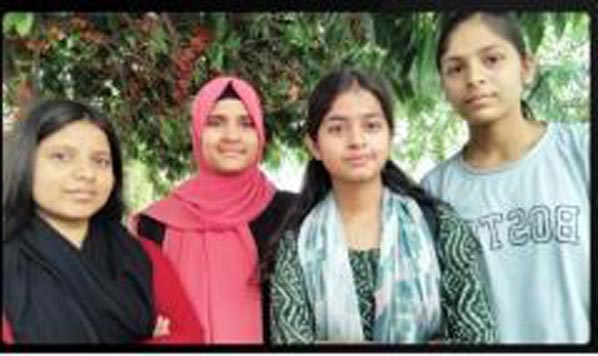
The team comprised final-year Diploma in Electronics and Communication Engineering students – Shalini Kumari, Kashish Khushi, Nargis Khatoon, and Shailly Bhardwaj – who developed the project under the mentorship of Mr. Mohd Kashif. Their creation, a voice-activated lift system, is designed to improve accessibility for the elderly, visually impaired, and physically disabled, earning praise from judges for its practical utility and inventive design.
This achievement highlights AMU’s commitment to academic excellence and its encouragement of student participation in national-level technical events.
source: http://www.radiancenews.com / Radiance News / Home> Education> Focus / by Radiance News Bureau / April 09th, 2025
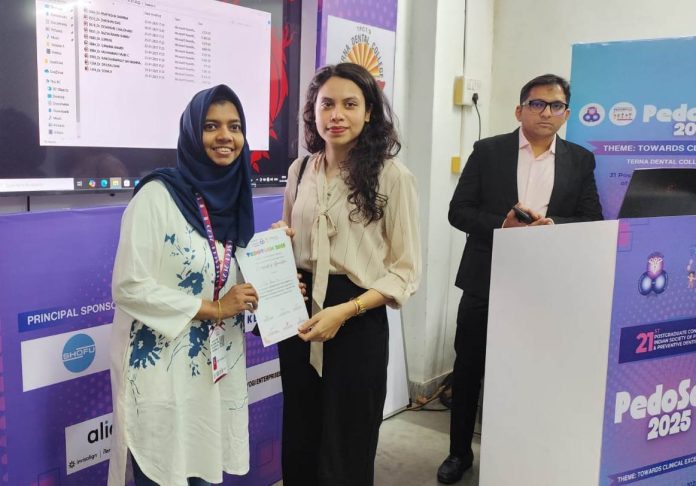
Dr. Fasna K receiving the best paper award at Mumbai
Aligarh:
Dr. Fasna K, a Junior Resident-III in the Department of Pediatric and Preventive Dentistry, Dr. Z.A. Dental College, Aligarh Muslim University got the Best Paper Award at the 21st National Postgraduate Convention of the Indian Society of Pedodontics and Preventive Dentistry (PedoSoch 2025), held in Mumbai, recently.
Her Guide, Prof Saima Yunus Khan, Chairperson of the department congratulated Dr. Fasna on the achievement.
source: http://www.radiancenews.com / Radiance News / Home> Pride of the Nation> Awards> Latest News / by Radiance News Bureau / February 05th, 2025
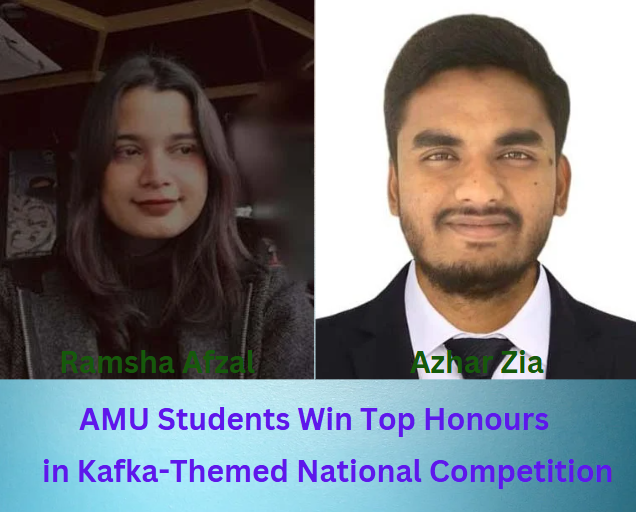
Students from the Department of Foreign Languages at Aligarh Muslim University (AMU) secured top prizes in a national competition organised by the Department of German, University of Mumbai, under the theme “100 Years of Kafka.”
Ramsha Afzal, a Master’s student in German Studies, won first place in the Comic Strip category for her creative take on Kafka’s novella Die Verwandlung (The Metamorphosis), highlighting themes of alienation and transformation. Azhar Zia, a final-year undergraduate, clinched first prize in the Short Films category for his cinematic interpretation of Kafka’s narrative Gibs auf! (Give it Up!), reflecting a nuanced grasp of existential themes.
Professor Muhammad Azhar, Chairman of the Department, commended the students, stating, “These achievements showcase the academic excellence and creativity nurtured at AMU, reaffirming the importance of foreign language studies.”
Assistant Professor Syed Salman Abbas applauded the winners, emphasising their engagement with German literature and culture.
source: http://www.radiancenews.com / Radiance News / Home> Education> Latest News / by Radiance News Bureau / January 23rd, 2025
All six Muslim Lok Sabha candidates fielded by mainstream parties in Uttar Pradesh have emerged victorious.
Among the winners is Imran Masood, who contested from Saharanpur on a Congress ticket. “This victory is not just mine, but of every individual who believes in secularism and democracy,” Masood stated emphatically after his win.
Similarly, Maulana Muhibullah Nadvi, representing the Samajwadi Party, also secured a win in Rampur. “The people’s faith in us has been reaffirmed, and we will work tirelessly to honour their trust,” Nadvi said after trouncing Ghanshyam Singh Lodhi of the BJP with a total of 4.81 lakh votes, a margin of 89,370 votes.
Ziaur Rehman Barq, who contested from the Sambhal Lok Sabha seat, is on the path to victory as well. The Congress party’s candidate from Amroha, Kanwar Danish Ali, also achieved victory.
Reflecting on his triumphant journey, Ali said his suspension from the Bahujan Samaj Party was a turning point. “The support from the Congress party and the voters of Amroha has been overwhelming,” he said.
Afzal Ansari, a Samajwadi Party candidate, is leading in Ghazipur. Iqra Hasan, another Samajwadi Party candidate from the Kairana parliamentary seat, has also registered victory.
Before the elections, Imran Masood was affiliated with the Samajwadi Party, and Afzal Ansari was a Bahujan Samaj Party Member of Parliament. Danish Ali, formerly with the Bahujan Samaj Party, was suspended and later nominated by the Congress party, which led to his victory in Amroha.
Despite this success, the Bahujan Samaj Party, which fielded around 22 Muslim candidates, did not secure any seat. This outcome highlights a broader issue of representation, as only 78 Muslim candidates contested across the country under the Congress and other parties’ tickets. The Congress party itself offered tickets to just 19 Muslim candidates nationwide in this election.
With vote counting continuing, early trends indicate that the ruling NDA would form the next government. Nonetheless, the victory of these six candidates marks a noteworthy moment in this Lok Sabha election.
source: http://www.clarionindia.net / Clarion India / Home> India Votes> Indian Muslims> Politics / by Mohammad Alamullah, Clarion India / June 04th, 2024
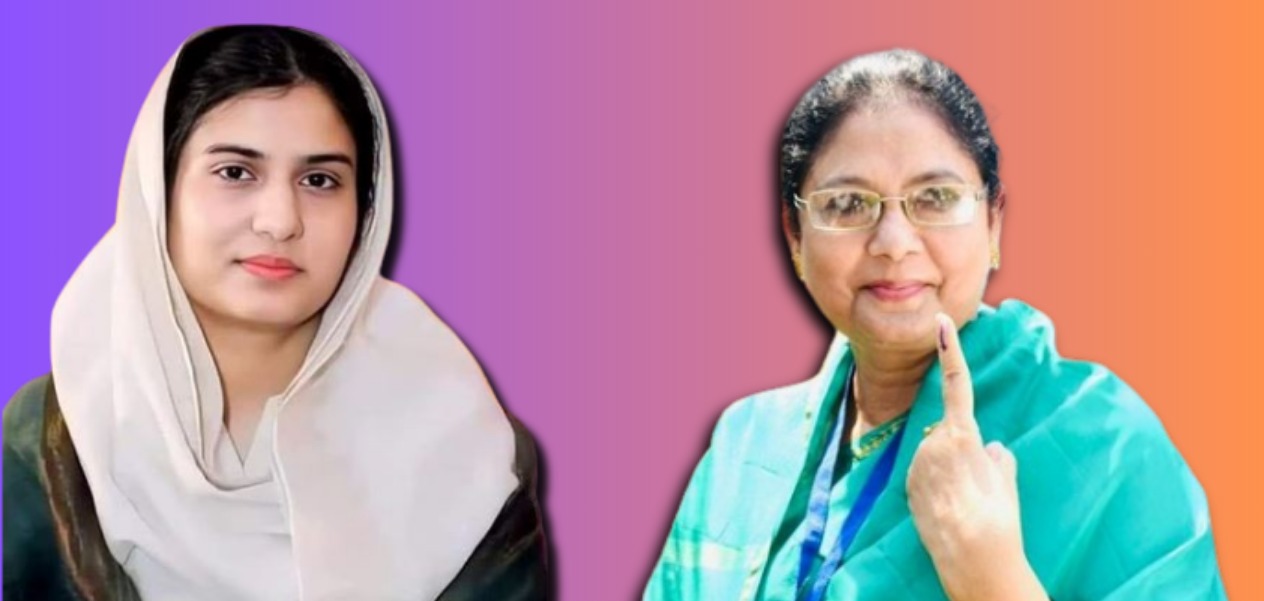
Sajda Ahmed of the Trinamool Congress (TMC) and Iqra Munawwar Hasan Chaudhary of the Samajwadi Party are among the 24 Muslim members who have been elected to the 18th Lok Sabha in the just concluded election.
The entry of 24 Muslims in the Lok Sabha is seen as a positive move towards the participation of India’s second-largest religious community in Parliamentary democracy.
While the 27-year-old year Iqra is a law graduate who won from the Kairana constituency in Western Uttar Pradesh on the ticket of the Samajwadi party Sajda Ahmed is a veteran leader who has won for Lok Sabha election a third time.
Sajda Ahmed has been re-elected from the Uluberia constituency where she secured 694,945 votes and defeated her nearest rival of the BJP Arun Uday Pal Chaudhary.
Iqra, a debutant defeated her nearest rival BJP’s Pradeep Kumar by 69,116 votes in a closely contested election.
Iqra, an alumnus of the Lady Sri Ram College of New Delhi – she also graduated in law from the UK – hails from a political family of Shamli.
The number of Muslims elected to Lok Sabha doesn’t look as low as was feared by the Community. Muslims have been complaining about their diminishing presence in India’s political spectrum.
However, this time political parties had fielded only 78 candidates from the Muslim community as against 115 in the 2019 election.
The most well-known Muslim who successfully contested elections is cricketer Yusuf Pathan. He not only won his maiden political battle as the candidate of the Trinamool Congress (TMC) from the Baharampur constituency of West Bengal, he also turned out to be a giant killer as he defeated Congress veteran Adhir Ranjan Chaudhary.
Muslim leaders like the two former Chief Ministers of Jammu and Kashmir – Mehbooba Mufti and Omar Abdullah – were defeated in their respective constituencies. Omar was defeated by an independent candidate Abdul Rashid Sheikh who is known by his nickname of Engineer Rashid, whose campaign was run in absentia by his two sons.
Engineer Rashid, whose real name is Abdul Rashid Sheikh won the Baramulla seat by securing 4.7 lakh votes against his main rival Omar Abdullah, former Chief Minister and vice-president of the National Conference. He too is a giant killer in this election.
Interestingly, Engineer Rashid’s campaign was carried on by his two sons as he has been in Delhi’s Tihar Jail for five years facing trial for his alleged involvement in supporting terrorists in Kashmir.
In Jammu and Kashmir’s Anantnag-Rajouri seat, National Conference’s Mian Altaf Ahmed defeated Mehbooba Mufti by 2,81,794 votes, and in the Srinagar constituency, NC candidate Aga Syed Ruhullah Mehndi got 3,56,866 votes against PDP’s Wahid Para.
From Ladakh, Independent candidate Mohammad Hanifa won by a margin of 27,862 votes.
In Uttar Pradesh, Samajwadi Party’s Maulana Mohibullah fought the election for the first time and he won on the ticket of the Samajwadi Party from the Rampur seat by securing 4,81,503 votes.
Ziaur Rahman of the Samajwadi Party from Uttar Pradesh has been elected from the Sambhal constituency.
Afzal Ansari has won from the Ghazipur on the ticket of the Samajwadi party. He is the brother of the gangster Mukhtar Ansari who died while serving a sentence for murder in the jail.
Imran Masood of Congress won against his BJP rival Raghav Lakhanpal from Saharanpur.
From Hyderabad (Telangana) Asaduddin Owaisi of the All India Majlis-e-Ittehadul Muslimeen(AIMIM) won against BJP’s K. Madhavi Latha. He has won the Lok Sabha election for the fifth time.
In the 16th Lok Sabha, there were only 22 Muslim Members while the highest number of Muslims elected to the lower house – 49 – was in 1980 and most of them were from Congress. In the last General election 115 Muslim contested while only 22 won.
As against this, in the 2024 elections, only 78 Muslim candidates were fielded and 24 of them won.
West Bengal has elected the highest number of Muslim MPs in the just concluded elections. They are: Khalilur Rahaman, Jangipur, Yusuf Pathan, Baharampur, Abu Taher Khan, Murshidabad, S K Nurul, (Basirhat), Sajda Ahmed, (Uluberia), Isha Khan Choudhary, (Maldaha Dakshin).
Bihar: Muhammad Javed Kishanganj and Tariq Anwar Katihar (Congress)
Assam: Raqib Hussain Dhubri
Kerala: Shafi Parambil (Vadakara), ET Muhammad Basheer (Malappuram) and Dr. MP Abdul Samad Samdani (Ponnani)
Lakshdeep: Muhammad Hamdullah Saeed
Tamil Nadu: Nivas Kinis Ramanathapuram
source: http://www.awazthevoice.in / Awaz, The Voice / Home> Story / posted by Aasha Kosa / June 05th, 2024
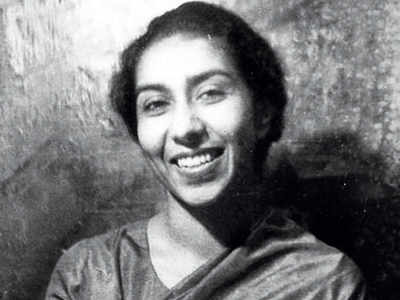
Asiya Siddiqi (1928-2019) (Pic Courtesy: Obaid Siddiqi)
Siddiqi also broke new ground by studying 20,000 HC insolvency records to recreate the lives of an array of 19th-century city inhabitants.
In an age that sometimes overrates quantity and is beguiled by grandiloquence, economic historian Asiya Siddiqi, who passed away on Monday morning, went against the grain.
A chronicler of 19th century India, she wrote just two books. But each was a culmination of decades of painstaking original research, presented in prose that many might describe as being quietly elegant. In between working on the two books, she edited a volume on trade and finance in colonial India.
She broke new ground in both her books by closely reading new or underutilised primary sources. In the second book, Bombay’s People, 1860-1898: Insolvents in the City, published in 2017 by the Oxford University Press, she not only tapped a voluminous new source, namely about 20,000 insolvency records in the high court, but also incorporated the innovative conceptual approach of microhistory to illuminate the past.
She admired the work of one of microhistory’s founding scholars, Italian historian Carlo Ginzburg, especially his book ‘The Cheese and the Worms: The Cosmos of a 16th Century Miller’. Microhistory focuses on small units of research, such as a village, a single event or an individual, instead of large ones such as nations, kingdoms and cities. Siddiqi’s chapter, ‘Ayesha’s World’, the story of an unlettered butcher’s wife, is a gem of this genre.
“She was a first-rate historian, approaching her work with a craftlike precision,” said Mariam Dossal, a friend of hers who is an urban and maritime historian of 18th and 19th -century Mumbai and a former professor at the University of Mumbai, where Siddiqi worked for everal years. “In Bombay’s People, her view was so rich and broad that it covered every kind of person who inhabited the city, from the wealthy Jamshetji Jejeebhoy all the way to Ayesha. One marvelled at her beautiful use of language, through which she recreated the worlds of these inhabitants. For Asiya, everybody deserved a history.”
Her early work on the 19th-century opium and cotton trade based in Mumbai was also influential, in particular her article ‘The Business World of Jamshetji Jejeebhoy’, which appeared in the Indian Economic and Social History Review in 1982. She worked for years on the private papers of the merchant who was a central figure in those two trades to offer a finely-etched view of the entrepreneurial climate of that period, while also shedding light on the ways in which Mumbai supported the growth of the British economy.
A large portion of these papers consisted of letters in which Jejeebhoy had recorded both his business dealings and social life in great detail. Because the papers were disintegrating in the heat and humidity of Mumbai, she got them laminated with help from her uncle Saiyid Nurul Hasan, who was then the union minister of state for education, Dossal recalled.
Asiya Siddiqi’s first book, Agrarian Change in a Northern Indian State: Uttar Pradesh, 1819 to 1833, published in 1973 by Oxford Clarendon Press, grew out of the thesis she did for her DPhil at Oxford University. In what became a classic of South Asian economic history, she analysed the relevant records with characteristic rigor, becoming one of of the earliest to show how colonial trade policies contributed to a severe agricultural depression in the region.
She grew up in Lucknow, and from 1962 worked in and on Mumbai for four decades. She moved in the late 1990s to Bangalore, where her daughter said she passed away peacefully in her sleep. Her husband was the eminent biologist Obaid Siddiqi, who founded the biology department at the Tata Institute of Fundamental Research in Colaba and the National Centre for Biological Sciences in Bangalore. He passed away in 2013.
Asiya Siddiqi balanced her research with bringing up four accomplished children: the eldest Imran, a leading plant biologist based in Hyderabad; Yumna, a professor of English in the US; and fraternal twins, Diba, a visual artist and high school social science teacher in Bangalore, and Kaleem, a computer scientist in Canada.
Siddiqi seemed happiest working by herself in the archives, as an independent researcher, although she had two productive teaching stints: one at Aligarh Muslim University, where she met her husband just after getting a bachelor’s degree at Oxford University, and the other at Mumbai University.
She quit teaching when, at one point she found it difficult to commute from her home in south Mumbai to the university campus in Kalina while also keeping up with her research and and raising four children.
Disclaimer: The views expressed here are the author’s own. The opinions and facts expressed here do not reflect the views of Mirror and Mirror does not assume any responsibility or or liability for the same.
source: http://www.mumbaimirror.indiatimes.com / Mumbai Mirror / Opinion > Columnist / by Sumana Ramanan / October 11th, 2019
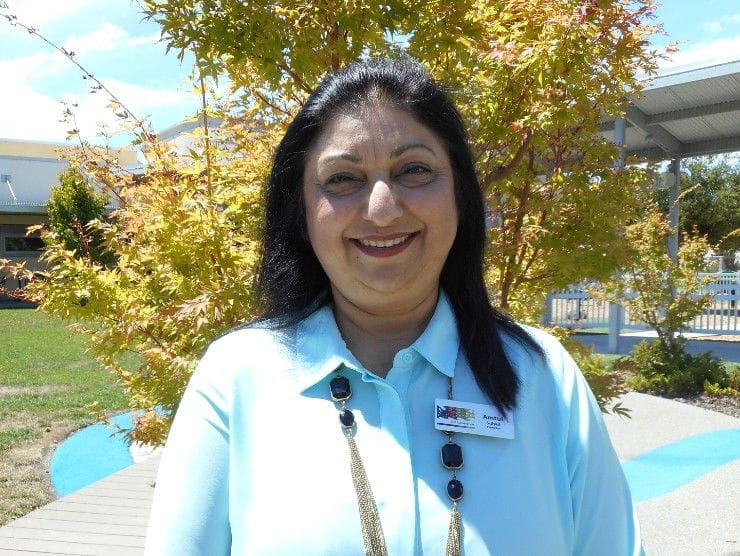
Amtul Suhail, Executive Director at 2nd Generation at Allerton in South San Francisco, CA, is one of one hundred Indian Muslim women across the globe to receive a nomination from Rising Beyond the Ceiling for her contributions and accomplishments in the field of early childhood education.
Rising Beyond the Ceiling is a non-profit organization focused on supporting and promoting Indian Muslim women and their leadership and contributions in their respective fields. Each year they spotlight one hundred Indian Muslim women who have made their mark in countries across the world. All the women have done their initial studies in India, but later moved to other countries where they received accolades and success in their professions.
“I am elated. This is a pure and pleasant surprise,” said Amtul. “I have been working for decades to make a difference in the community by helping one child, one family, one group and mission at a time. I never expected anything in return.”
Working the field of education since 1985, she migrated to the United States in 1990, leaving behind her family on a quest to pursue her dream of caring for and teaching children. Amtul joined Bright Horizons in 2013 and is currently the Executive Director at Bright Horizons Allerton where she oversees the center operations and its programs.
“My passion is children. Every single thing I do, I think “how would this impact a child?’’ This passion that drives me is because of my mother who always taught me what I call the ’golden rule‘ – when things go wrong, you do not go wrong,” said Amtul. “I lead with honesty, transparency, accountability and joy. My mom encouraged me to choose a career to work with children so I can make the difference for children and adults in the community where I work and live.”
Amtul has a Masters in Mass Communication from Aligarh Muslim University. She also volunteers her time and talent for her University Alumni Association of Northern California. She is a guiding force behind the alumni association’s mission and has been involved as a coach and student trainer.
Amtul adds: “My vision is to foster love and compassion for early childhood educators. When they decide to join the education field and under my supervision, they feel empowered, autonomous and committed. I truly believe that consistency and continuity of care is extremely important.”
To learn more about Rising Beyond the Ceiling, visit here.