Tag Archives: Positive News of Muslims of India

Dr Farasat Hussain: Remembering a Doctor, Healer and a Remarkable Son of Magadh

Chhapra District / Gaya, BIHAR :

Dr Hussain was the kind of man, that if he himself were to read (or edit) this obituary, he would flinch at the mention of his generosity as a doctor or friend. Good deeds were to be done, he believed, not to be remembered or recounted.
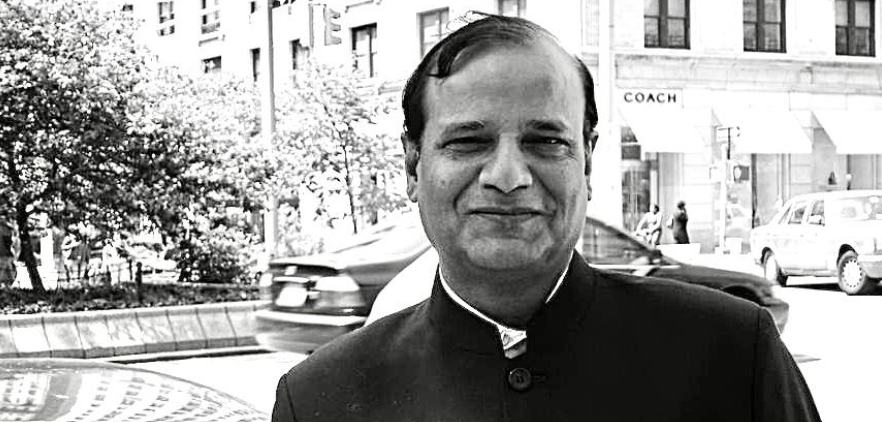
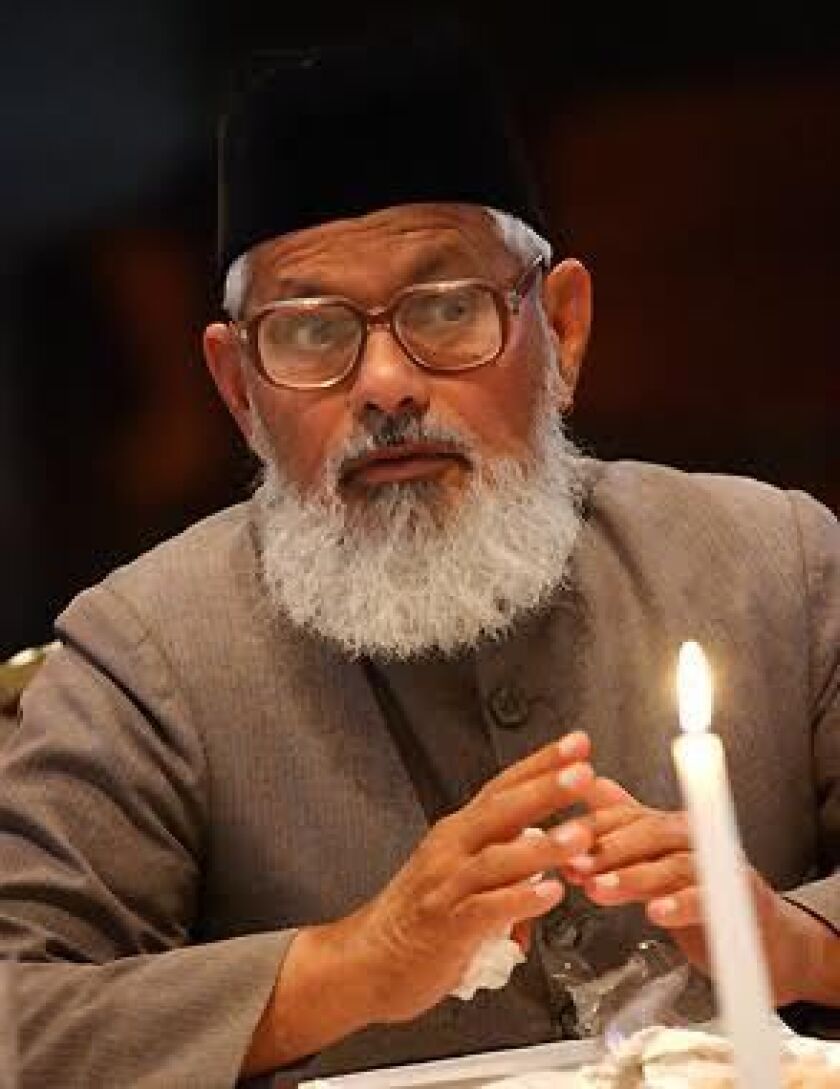
Dr. Farasat Hussain (1952-2023)

This Sunday (August 6) when a group of people assemble to remember Dr Farasat Hussain, in ‘Renaissance’, an aptly named Cultural Centre in Gaya, set up by his lifelong friend, noted litterateur Sanjay Sahay and his wife Durba Sahay, the inter-faith gathering will be much more than a tribute to him. They will of course meet to talk about the good doctor who died on July 28 at the age of 71 in Delhi. But the meeting will embody the very essence of Dr Hussain’s life which was dedicated to bridging divides and building relationships. Be it religious, caste and class, there was not one single divide he had not jumped across.

The meeting will be very personal, no doubt, but it will also be a tribute to the India he inhabited for most of his life, where he was proud to serve as a doctor, live his life as a Magadh ka baashinda, a Bihari, an Indian, and all in all, a lively human being. But it will also be a necessary reminder in these vicious and polarised times of people who with their singular focus on humanitarian work are the secret sauce of what keeps or certainly kept India going.

Born in Bihar’s Chhapra district in 1952, Dr Hussain made Gaya his home soon after he completed his post-graduation in Orthopaedic Surgery at Government Medical College, Ranchi in 1983.

As a young doctor, he would kick-start his Rajdoot motorcycle and ride off to remote villages across Bihar to attend to emergencies. A pioneer in polio corrective surgeries in Bihar, he conducted scores of special camps where he performed more than 3,000 polio surgeries for poor children when he started his work here decades ago. He even conducted Caesarean sections when a gynaecologist wasn’t available.

In a state where public health was never really a thing, doctors like Farasat Hussain were the system. He was anyway an exceptional surgeon who had multiple opportunities and offers to make a career in the lucrative corporate medical sector, but he didn’t even consider it. He stayed in Gaya where he mixed his practice as a doctor with large-scale social work, community building and helped initiate a multi-faith effort to ensure communal harmony across the Magadh region.

But for people there, he wasn’t just a skilful surgeon and an efficient clinician, he was also a psychologist. His unique sense of humour, they suspected, was part of his treatment plan for a patient. Dr Hussain didn’t merely look at the disease of his patients, he treated the person. In a place where health infrastructure had crumbled in the decades of the 80s and 90s, he was an address for the sick where they knew they would surely get help.

He was also closely associated with the upliftment of the disabled population, who remember him as a mentor and benefactor for helping them with their livelihood. Several disabled people travelled from across the region, despite difficulties, and joined his funeral.

In 2010, the government of Bihar honoured Dr Hussain for his work. At that time, he was national president of the Association of Sports Medicine of India. He was honoured for his contribution to promote sports among disabled people, especially polio patients.

Dr Hussain was closely associated with Arpan, an organisation of disabled people in Gaya, where he was instrumental in motivating disabled youngsters to participate in sports and other activities to turn their physical challenges into opportunities that helped them move away from a life merely at the fringes of society.

Dr Hussain mentored Krishna Murari, who subsequently represented India at the sitting volleyball competition in the US.

Several other disabledyoungsters from the Magadh region also attended national sports events in cricket, volleyball and cycling. His focus on encouraging disabled youngsters to take up sports was to help in their inclusion in the social fabric, not as dependents, but as equal partners.

Dr Hussain was an integral part of the inter-faith dialogue, peace and harmony initiatives in the Magadh region.

This is why those who attended his burial say that it aptly exhibited the fruits of his lifelong work to build bridges between communities. Buddhist monks came to pay their respects to him. Hindus and Muslims came and prayed for him. Several disabled men came for the first time into a graveyard, only to express their love for the departed. There were madrassa children, who were helped by him when their institution was in extreme financial distress. A befitting farewell to a man of all persons.

Dr Hussain had been closely involved with one of Bihar’s oldest minority educational institutions – Mirza Ghalib College, where he consistently promoted progressive and secular values. Mirza Ghalib would be proud of all that he upheld there. He was also involved with a number of charity organisations, such as an orphanage at Cherki for more than two decades. This home for poor, underprivileged orphans is one of the biggest in India.

Dr Hussain was an exceptional man, who stood out because he was so restless and always busy, working, helping; a doctor in the truest sense of the word.

I happened to meet him several times, and saw an adoring grandfather to a precocious and thoughtful Farris. His quiet charm, polished demeanour and contagious smile did not mean that he ever held back on his views. A man capable of sharp candour and an openness of the heart, he could surprise you with his diagnosis of the social situation.

Dr Hussain was the kind of man, that if he himself were to read (or edit) this obituary, would frown and take serious umbrage at even a mention of his generosity as a doctor, friend, and human being. Good deeds were to be done, he believed firmly, and not to be remembered or recounted.

He is at eternal rest now. But his life needs to be celebrated for how he lived it and how he wanted the world around him to be. There is a need to nourish his legacy, intangible as it may seem. This is true today more than ever before, as we seem to have a hard time even imagining living a harmonious life as a collective.

He knew very well that there was no magic pill to fix the social fabric, no ready rafoo. But the good doc he was, he knew what it took to keep trying to get there and the importance of keeping all kinds of fevers down.

RIP, Dr Hussain.

source: http://www.thewire.in / The Wire / Home> English> Health> Rights / by Seema Chishti / August 05th, 2023
Mountaineer, AI scientist, among 19 children awarded with PM Rashtriya Bal Puraskar 2024

INDIA:

source: pib.gov.in

New Delhi:

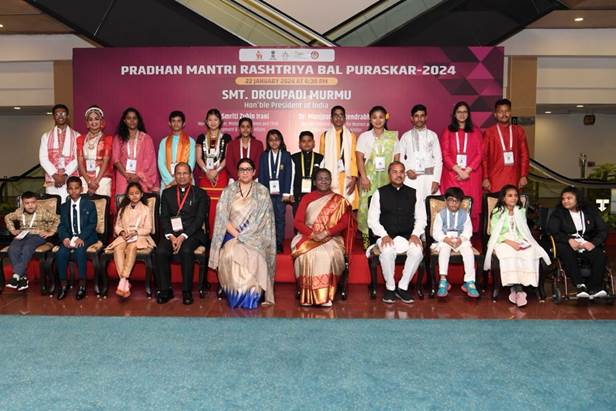
A nine-year-old mountaineer, a young AI scientist, a specially abled painter and a ‘Google boy’ were among the 19 children who were conferred with the Pradhan Mantri Rashtriya Bal Puraskar 2024 on Monday.

President Droupadi Murmu presented the national awards to them for their exceptional achievements.

Among the winners is Aaditya Vijay Brahmane, 12, from Maharashtra, who was awarded posthumously for his extraordinary act of courage. He sacrificed his life to rescue his cousins Harsh and Shlok from drowning in a river while playing.

Aryan Singh, 17, from Rajasthan is another remarkable recipient of the award. Singh ingeniously developed an Agrobot, an artificial intelligence-powered robot aimed at simplifying the lives of farmers by integrating cutting-edge technologies such as the Internet of Things (IoT).

In Chhattisgarh, Armaan Ubhrani, also known as the ‘Google boy’, has earned the award for his outstanding prowess in mathematics and science. At the tender age of six, Ubhrani has achieved numerous milestones, including becoming the youngest author of a book series and solving 100 multiplication sums, garnering recognition both nationally and internationally.

In the domain of art and culture, eight-year-old Anushka Pathak from Uttar Pradesh has established herself in ‘Katha Vachan’ (religious text narration). Following in her esteemed father’s footsteps, Pathak has captivated audiences across 22 states with her performances, becoming a recognised figure in the spiritual realm.

Arijeet Banerjee, 13, from West Bengal, a prodigy in playing the traditional Pakhawaj, has made an indelible mark on the cultural landscape. Having performed at prestigious events like the International Dhrupad Festival, Banerjee has received accolades such as the Bharat Ratna M S Subbulakshmi Fellowship and the Asia Book of Records.

Despite facing severe cerebral palsy, 13-year-old Hetvi Kantibhai Khimsuriya from Gujarat has displayed extraordinary artistic abilities, creating 250 works of free-hand painting, receiving numerous awards, and selflessly donating her monthly disability pension to support differently abled children.

Ishfaq Hamid, 12, from Jammu and Kashmir has become a maestro of Rabab and Matka, receiving accolades during various festivals and being honoured with the Bhai Mardana National Award in 2020.

Md Hussain, 16, from Bihar has excelled in handcrafted arts, winning accolades in state and national-level competitions, and even presenting his indigenous toys to Prime Minister Narendra Modi during the ‘Pariksha Pe Charcha’ programme.

Pendyala Laxmi Priya, 14, from Telangana is a Kuchipudi dancer, winning the Kala Utsav National Award 2023 in the classical dance category and holding titles like ‘Laasyapriya’.

In the realm of innovation, 16-year-old Suhani Chauhan from Delhi has developed ‘SO-APT’, a solar-powered agriculture vehicle, offering an impressive solution for sustainable farming.

Despite obstacles associated with Down syndrome, nine-year-old Avnish Tiwari from Madhya Pradesh trekked Mount Everest base camp at the age of seven and received the Shresth Divyang Bal Puraskar in 2022 for his exceptional social service.

Nine-year-old Garima from Haryana, a visually impaired girl, is dedicated to providing education to underprivileged children through her initiative called ‘Sakshar Pathshala’.

AWARDEES OF PRADHAN MANTRI RASHTRIYA BAL PURASKAR-2024

Sr. No.NameStateCategory
1.Aaditya   Vijay             Bramhane (posthumous)MaharashtraBravery
2.Anushka PathakUttar PradeshArt & Culture
3.Arijeet BanerjeeWest BengalArt & Culture
4.Armaan UbhraniChattisgarhArt & Culture
5.Hetvi Kantibhai KhimsuriyaGujaratArt & Culture
6.Ishfaq HamidJammu & KashmirArt & Culture
7.Md HussainBiharArt & Culture
8.Pendyala Laxmi PriyaTelanganaArt & Culture
9.Suhani ChauhanDelhiInnovation
10.Aryan SinghRajasthanScience                    & Technology
11.Avnish TiwariMadhya PradeshSocial Service
12.GarimaHaryanaSocial Service
13.Jyotsna AktarTripuraSocial Service
14.Saiyam MazumderAssamSocial Service
15.Aaditya YadavUttar PradeshSports
16.Charvi AKarnatakaSports
17.Jesicca Neyi SaringArunachal PradeshSports
18.Linthoi ChanambamManipurSports
19.R Surya PrasadAndhra PradeshSports
source: youtube.com / pib.gov.in

source: http://www.millenniumpost.in / Millennium Post / Home> Nation / by Team MP (headline edited) / edited with inclusion of full chart of awardees and you tube video and photograph source – pib.gov.in / January 22nd, 2024

‘Quran in Embroidery’ a hand crafted phenomenon in 604-pages of velvet cloth – The Miracle of two Bengaluru sisters – Bibi Tabassum and Suraiya Quraishi

Bengaluru, KARNATAKA:

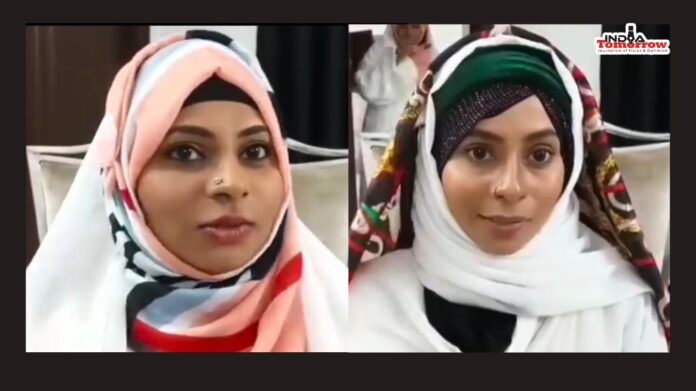
Bibi Tabassum and Suraiya Quraishi who embroidered the Quran.

Bengaluru :

This is a miracle. An awe-inspiring phenomenon took place in this city a few days back, as two sisters- Bibi Tabassum and Suraiya Quraishi- embroidered the sacred Quran onto 604 pages of plush velvet cloth.

Showing excellent craftsmanship, they used needles and threads to meticulously prepare an embroidered holy Quran. This embroidered Quran, prepared under the watchful guidance of an Alim-e-deen (religious scholar), is not only easily legible but also heavenly captivating.

Bibi Tabassum, the younger of the two sisters, holds a great fondness for doing embroidery ever since she was a child. In the beginning, she used to embroider only small verses of the Quran, but one day, an idea graced Bibi Tabassum’s mind – to intricately embroider the entire holy Quran. This took her on a laborious journey, one fueled by love and devotion.

Expressing extreme gratitude to Allah for giving them the opportunity to prepare this embroidered Quran, Bibi Tabassum says that she aspires to gift this embroidered holy Quran to a library in the holy city of Madina.

Venturing on this embroidery voyage of the Quranic verses along with her elder sister Suraiya Quraishi, Bibi Tabassum started with the first inaugural Surah of the Quran i.e. Surah Al-Fatiha, and continued diligently. The last surah- Surah An-Nas marked the culmination of their hard labour.

This embroidered holy Quran is divided into five volumes, and each volume consisting of six chapters. It went through a meticulous binding process by the skilled hands of its creators.

Initially, in the detailed process of embroidery, Bibi Tabassum used to inscribe the verses of the Quran with a pencil on the velvet cloth, followed by both the sisters intricately weaving threads along those sacred lines.

Carrying on the demands of daily life, both sisters, driven by unwavering dedication, used to finish their household chores and then engage in the embroidery work of the holy Quran.

To ensure the utmost accuracy of the embroidered work, a learned religious scholar closely scrutinized each verse upon the completion of a page. Bibi Tabassum says, ‘After completing every page of the embroidered holy Quran, we would show that to our scholar and do any correction if required.”

In the aftermath of this big achievement, family members are thoroughly elated for the two sisters. They say that the two sisters have utilized their time for a very noble endeavour. Extending heartfelt gratitude, they thank Allah for the manifestation of this lovely artwork, which stands as a testament to the beautiful blending of devotion and artistry.

source: http://www.indiatomorrow.net / India Tomorrow / Home> News> Society / by India Tomorrow (headline edited) / February 05th, 2024

Tamil Nadu Govt Honours Fact-Checker Mohammed Zubair With Communal Harmony Award

Bengaluru, KARNATAKA:

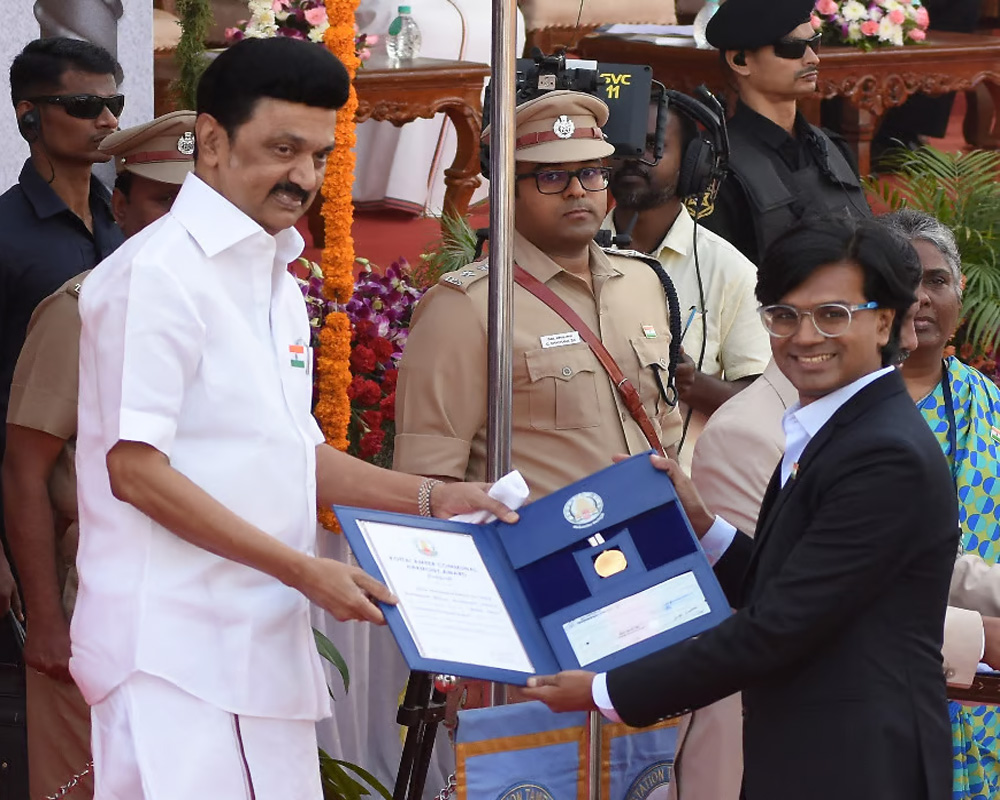
TN chief minister M.K. Stalin with Mohammed Zubair at the awarding ceremony. Photo: Video screengrab.

The government noted that his “work helps prevent the occurrence of violence in society likely to be caused by fake news.” 

New Delhi: 

Fact-checker and journalist Mohammed Zubair is the recipient of the 2024 Kottai Ameer Communal Harmony Award given by the Tamil Nadu government.

The citation notes that Zubair has been “rendering various services to promote communal harmony.”

It observes that in creating the website Alt News – which he co-founded with Pratik Sinha – Zubair has set up an instrument to analyse the “veracity of the news coming out on social media,” giving primacy to real news.

The government noted that his “work helps prevent the occurrence of violence in society likely to be caused by fake news.”

The citation especially says that in March 2023, when there was a rapid spread on social media of the disinformation that migrant workers were being attacked in Tamil Nadu, Alt News‘s verification of the authenticity of the video was instrumental in proving that the footage was not from Tamil Nadu at all.

It “stopped the spread of rumours against Tamil Nadu and acted to prevent violence caused by caste, religion, race and language in Tamil Nadu,” the government said.

In 2022, Zubair was arrested by the Delhi police for a 2018 tweet in which he shared a screenshot from a 1983 Hindi movie. Six cases were slapped on him during the period of his incarceration until the Supreme Court gave him bail.

Zubair is often attacked online by Hindutva commentators for fact-checking viral claims and disinformation.

source: http://www.thewire.in / The Wire / Home> Media> Government / by The Wire Staff / January 26th, 2024

Kamran Khan, first Kashmiri gets prestigious Australia Day achievement Medallion

JAMMU & KASHMIR / Chennai, TAMIL NADU :

First slide

Srinagar: 

In a momentous stride towards recognition, Kamran Khan, a distinguished Kashmiri currently based in Chennai, has been honoured with the Australian Government’s prestigious Australia Day Achievement Medallion.

Bestowed on January 26, 2024, this accolade is a recognition for exceptional performance in government projects or core duties, by Australian Government departments and agencies.

Presently Kamran serves as Senior Director for South Asia for Australian Trade and Investment Commission, Australian Government.

He has been a diligent student at the revered Burn Hall School in Srinagar.

In 1992, he left Kashmir to pursue his remaining education and graduated in Automotive Engineering at the University of Madras, where he ranked 3rd across the state of Tamil Nadu, showcasing his academic prowess.

Since 2010, his strategic acumen has been pivotal in shaping the infrastructure industry and fostering foreign direct investment into Australia as part of the Australian Trade and Investment Commission, under the Australian Federal Ministry of Trade and Investment, exemplifying his commitment to economic growth and global collaboration.

As the first Kashmiri to receive the Australia Day Achievement Medallion, Kamran stands as a symbol of pride for Jammu and Kashmir, showcasing the immense talent emerging from the region.

Beyond the accolades and titles, Kamran Khan embodies the spirit of a reformer, committed to ushering in positive change for his community and country.

His recognition by the Australian government not only celebrates Kamran’s achievement but also serves as an inspiration for the entire Jammu and Kashmir community and symbolizes the possibilities that arise when perseverance meets opportunity.

source: http://www.risingkashmir.com / Rising Kashmir / Home / by RK News / February 02nd, 2024

Bhuj quake pushed Masroor Alam into launching mission to help humans in distress

Chhowsia, Islampur (Uttar Dinajpur District), WEST BENGAL :

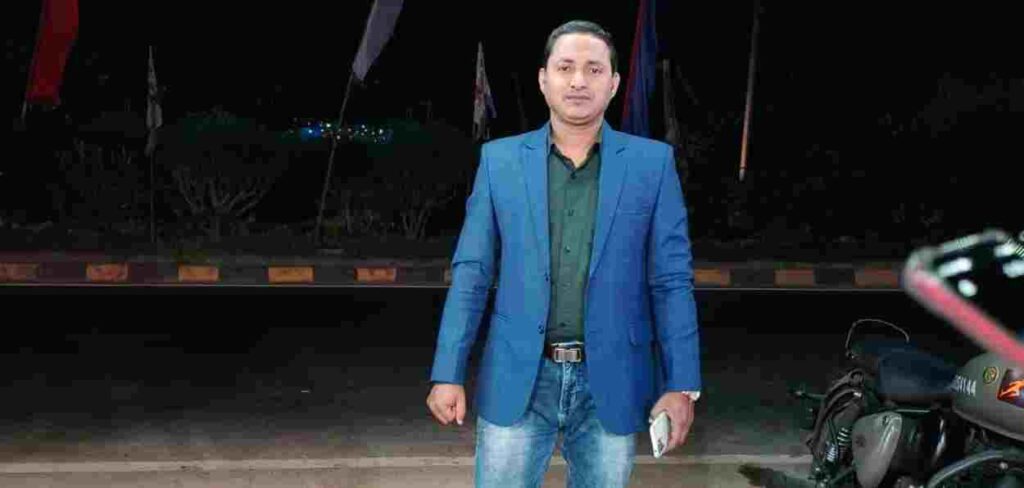
Mohammad Masroor Alam during a campaign

Mohammad Masroor Alam’s life took him through a different route in Gujarat in 2001 when he was enrolled for a computer course and the horrific Bhuj Earthquake shook the state on 26 January at 08:46 in the morning killing 20,023 people, injuring about 167,000 while bringing about 340,000 buildings down to rubble. 

As a young man, he was shaken by the massive devastation. Stirred by the voluminous urgent need for assisting hands, he rose out of compassion and got involved with a team of people to help the people ravaged by the wreckage. The victims were people from all communities – Hindus, Muslims, Christians, etc. living in makeshift tents. 

They all received food, utensils, clothes, blankets, and many other provisions through the efforts of Masroor Alam and all the others in the busy team.

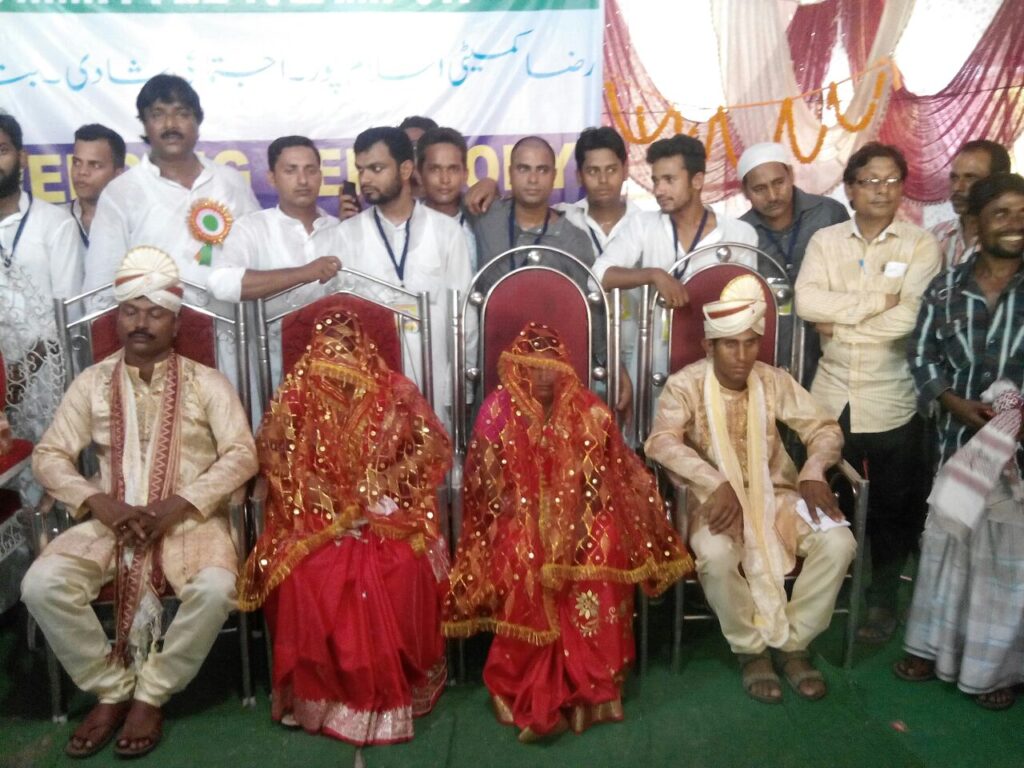
A group wedding organised by Masroor Alam’s group

In a turbulent world of survival of the fittest where each looks for their own, it’s hard to find people like Masroor Alam. 

The 34-year-old social activist is the son of Md Rakimuddin and Najrun Nisha of Chhowsia, in the Uttar Dinajpur district in Islampur, West Bengal. He has five brothers and one sister and his parent’s deep values on humanity instilled an indelible root of compassion in him.

He held degrees of M.A. and LLB at the time of being in Gujarat to study computers at the time of the earthquake.

Md Masroor Alam shared, “It felt good not only to give and relieve them from their sufferings but also add a blanket of warmth to our hearts, and we also felt better and happier when we did good deeds for them.”

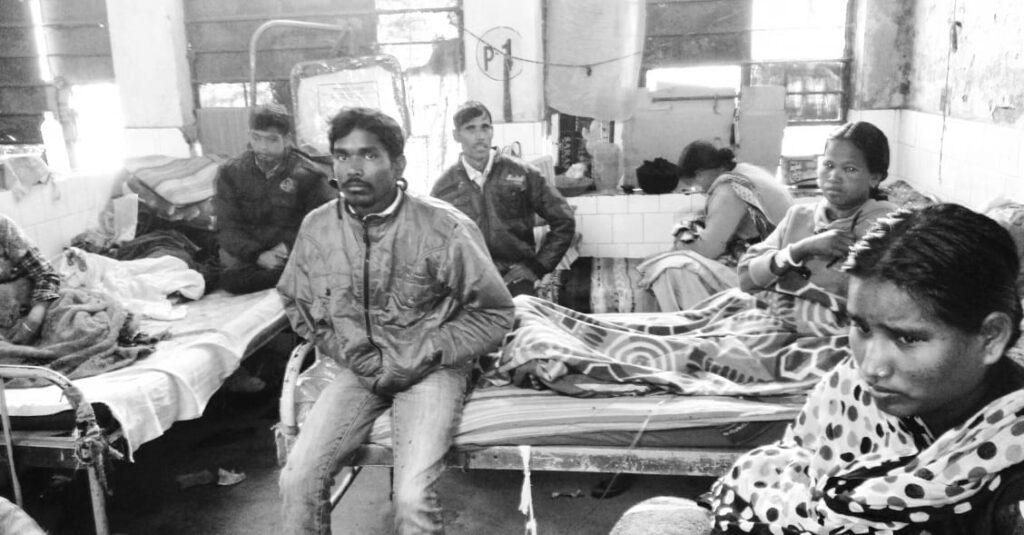
Victims of cylinder blast

The urge to start a proper Non-Government Organization to help the needy started churning in his heart. He said, “I saw people using NGOs for their benefits, just to meet their own needs without really helping the deprived people, I saw it as a sort of corruption in one way. I wanted to help the people desperately crying for help because I noticed they were overlooked many times. I also believe we must help all people equally, not looking at religion, caste, or race.” 

In 2007, Md Masroor Alam became the President of the All India Raza Committee. They held a massive Blood Donation Camp in 2007 during April with a total of 152 blood donation camps and the work involved was stupendous.

During the time of the floods that engulfed the Kishanganj district, he and the team reached out to 26 villages serving them cooked hot khichdi (rice and lentils porridge) as well as giving them lentils, rice salt, wheat flour, sugar, tea leaves and other commodities. 

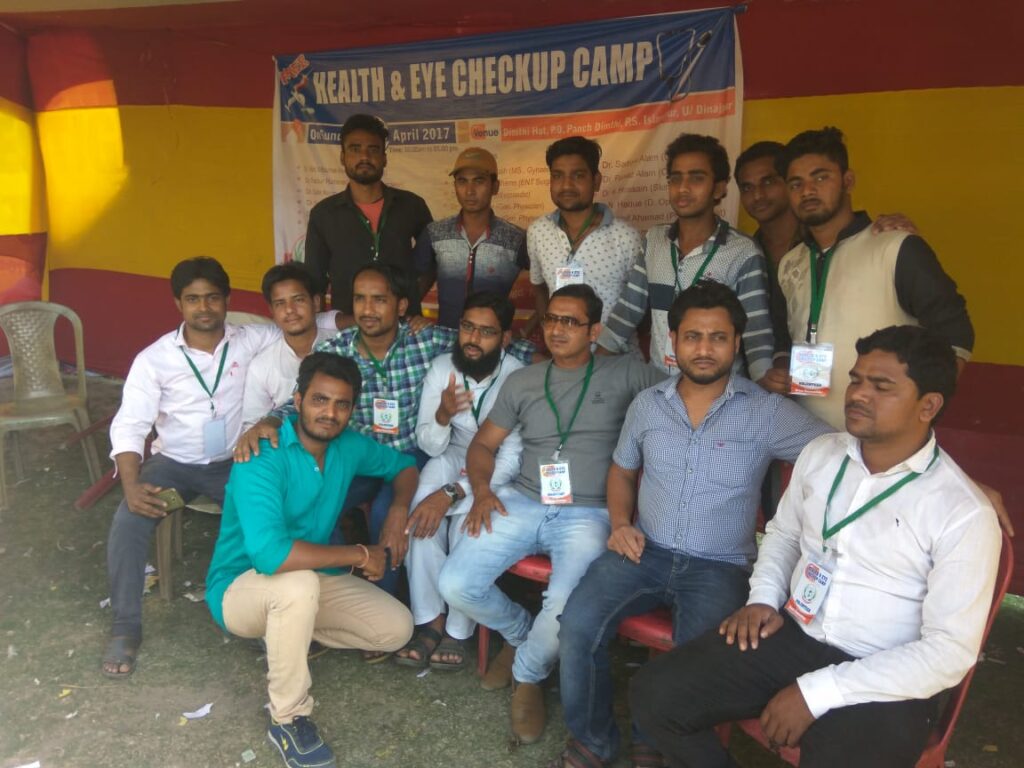
Md Masroor Alam with members of his group at a health camp

It was a tenuous hard labour pushing through swarming waterlogged regions which threatened to sweep away anyone at a moment. The grateful victims called them messengers of good tidings. In another instance, during a gas cylinder blast in the Islampur area, where 37 families were burnt and two men were struggling to live, Masroor Alam and the crew gave them all the help and provided their requirements during that difficult time.

One particular defining time for Md Masroor Alam was working with politicians and understanding how much help they too give during times of disaster. At that time, they helped people to get their ration cards and gifted warm blankets and food to members of some caste communities. 

Sometimes, a village would suddenly catch on fire either due to dry twigs or some sudden accident and the group would rush to those areas to help with food, plates, utensils, glasses, and even pressure cookers as some families had their entire homes burnt to ashes.

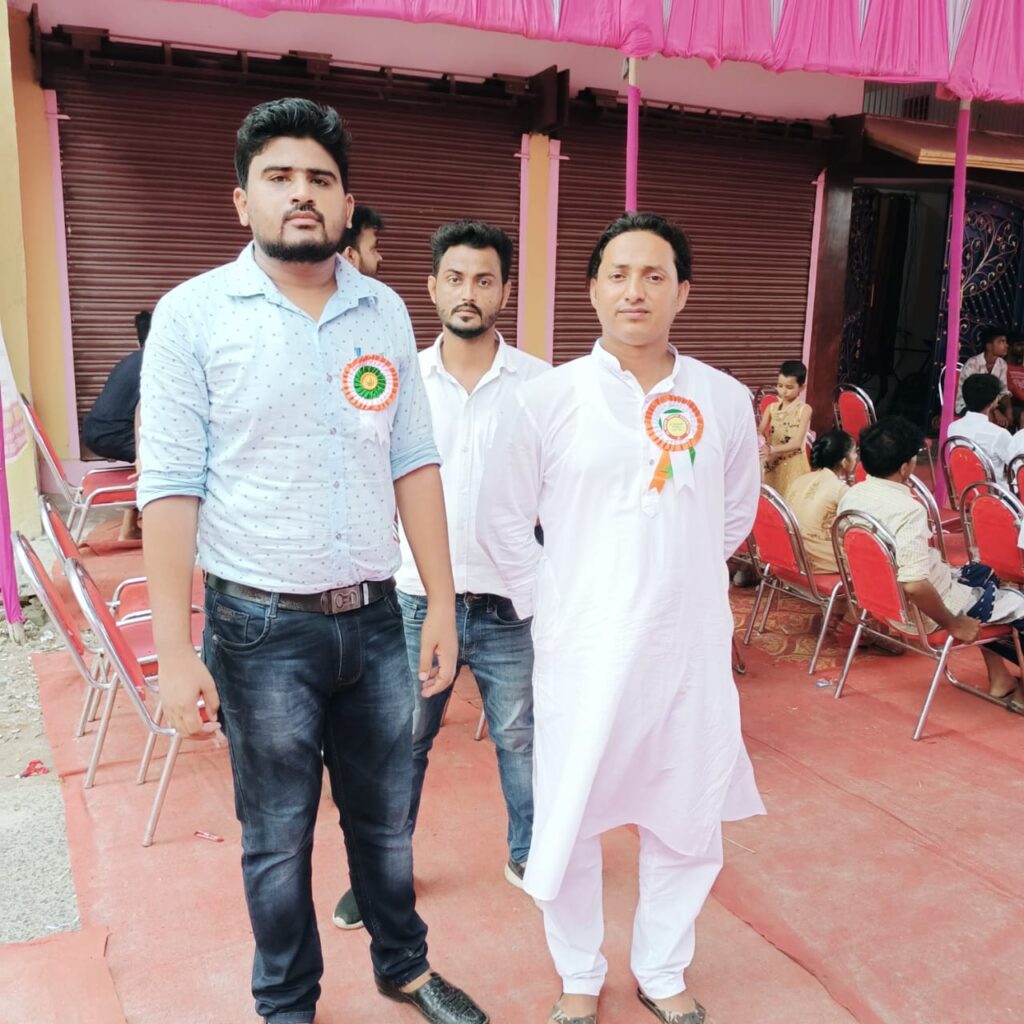
Masroor Alam (In white Kurta-Pajyama) with a volunteer

The time of COVID-19 pandemic heightened food insecurity in India, leading to a hunger crisis affecting extensive rural regions and certain urban areas with job losses and reduced incomes. Activists monitoring coronavirus-related fatalities have reported that over 300 individuals have lost their lives due to starvation, exhaustion, and accidents apart from dying from the pandemic. 

During this time, Md Masroor Alam and the team visited the people in the village and advised them to stay indoors, taught them about masking and sanitation, and gave food to over 8000 families, mostly labourers and truck drivers.

Another help they rendered in 2014 was organising and funding ten poor Muslim girls’ mass weddings and in 2015, they assisted six girls, which was a big financial relief for their parents.

Masroor Alam expressed that ever since he was a child, he was deeply concerned about the suffering of others and always wanted to do something significant to make a difference. 

While he was studying computers in Gujarat, after the Bhuj Earthquake, his life was steered in a new direction and he started to get more deeply involved in helping all people of all communities during times of distress giving dal, rice, atta, tea leaves, sugar and many such food commodities during famines and earthquakes as well. 

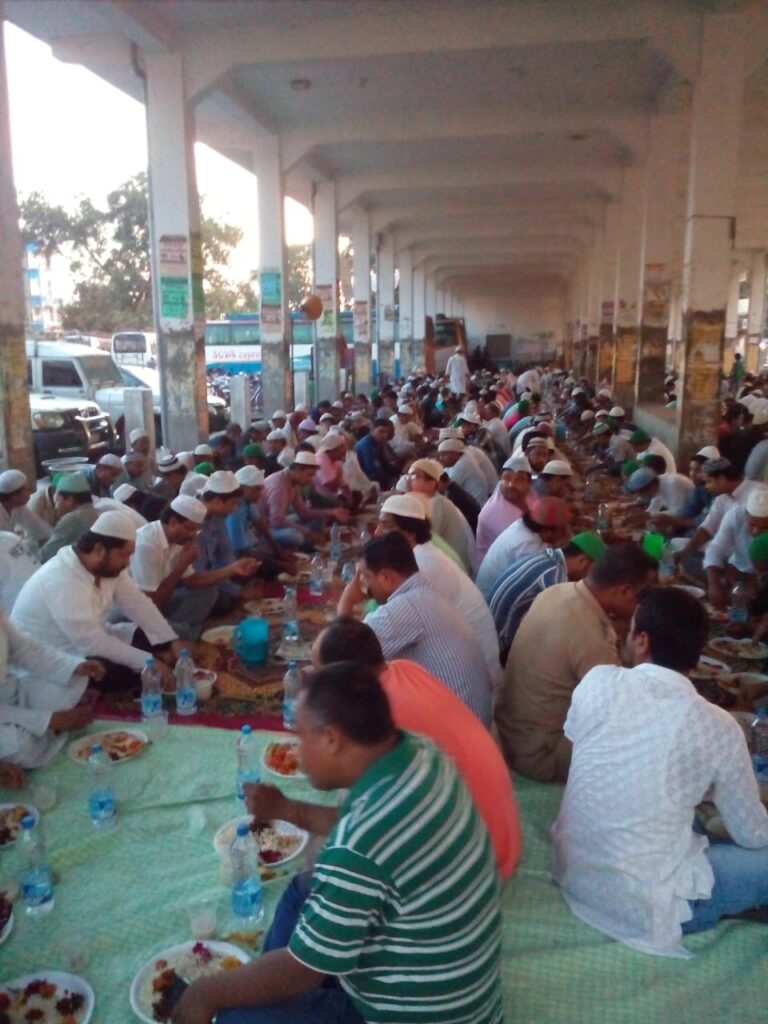
Feeding those in need

The beautiful aspect of Md Masroor Alam’s life and help is his along with the team’s outreach to all people of all communities without ever thinking of the differences of religion or caste. This is the language of humanity. 

All India Raza Committee runs an old people’s home where the very poor beggars, sick, and old people can live in dignity. Most of them are rescued from the grips of begging out on pavements, streets, and near garbage dumps. 

He says that Islampur is still an impoverished region, underdeveloped and there are many poor people there. During the winter, it is very cold and the NGO started to give warm clothes and blankets to the poor families. 

Masroor Alam (in the center) holding a meeting with his volunteers

As the president of All India Raza Committee which is a Sunni Muslim Islamist group based in Maharashtra, India formed in 1978 by Alhaj Mohammed Saeed Noori. Md Masroor has reached out to help people in all parts of India such as Gujarat, Maharashtra, Karnataka, West Bengal, and many other states.

Inspired by the Holy Quran which says in Surah 17:70, “Because everyone is created by God Almighty, the Maker of all, humans must treat one another with full honour, respect, and loving-kindness.” In another ayat, it is written, “Help one another in acts of piety and righteousness.”

Md Masroor Alam is inspired by this one line, “Be certain that you do not die without having done something wonderful for humanity.”— Maya Angelou. This is the philosophy by which he lives and those waves resound loudly wherever he goes sending out a good message.

Rita Farhat Mukand is an independent writer in West Bengal

source: http://www.awazthevoice.in / Awaz, The Voice / Home> Stories / by Rita Farhat Mukund / February 01st, 2024

After 33 years, the Madhya Pradesh Assembly has two Muslim legislators

MADHYA PRADESH:

Arif Aqueel and Arif Masood

India’s first ‘Happiness Minister’ among 13 BJP Ministers who lost in the state elections.

Bhopal :

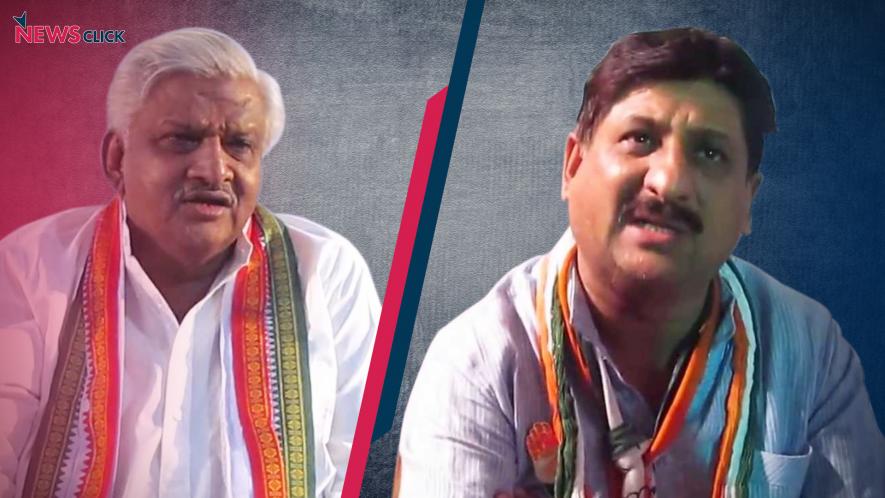
After 33 years, the Madhya Pradesh Assembly has two Muslim legislators — Arif Aqueel and Arif Masood. Since 1998, Aqueel was the lone Muslim MLA in the 230-member legislative Assembly, winning from Bhopal North. In the recently held state polls, he has been joined by Masood, who represents Bhopal Madhya. Both are Congress candidates.

In the 2018 Assembly elections, Aqueel defeated BJP’s Fatima Rasool with a margin of 35,000 votes, while Masood won from Bhopal Madhya constituency by defeating BJP’s Surendranath Singh with a margin of 15,000 votes.  

There were a total of four Muslim candidates in the fray from the BJP and the Congress. Two women and two men. Congress had given ticket to three Muslim leaders including a women Masarrat Shahid from Sironj seat who failed to win, while BJP only gave a ticket to only one. The Muslim population in the state is estimated at 8-9% of the total population.

Happiness Minister ‘Unhappy’

Tuesday turned out to be unhappy for Madhya Pradesh’s Minister for Happiness, Lal Singh Arya, who was one of the 13 BJP Ministers who lost the Assembly elections.

Arya was the first Minister of Madhya Pradesh’s Happiness Ministry, and also the country’s first, modelled on the national happiness index used by Bhutan.

The Assembly elections result were declared on December 11, and ruling Bharatiya Janata Party (BJP) secured 109 seats out of 230 seats, while Congress secured 114, Samajwadi Party 1, Bahujan Samaj Party 2 and four independents.

With the support of other parties and independent MLAs, Congress staked claim to form the government before the Governor Anandiben Patel on Wednesday afternoon.

In a neck-and-neck fight between Congress and BJP, 13 out of 20 sitting ministers of BJP failed to retain their seats. Some top ministers who lost are Minister of Happiness Lal Singh Arya, Higher Education Minister Jaibhan Singh Pawaiya, Revenue Minister Umashankar Gupta, Medical Education Minister Sharad Jain, Finance Minister Jayant Malaiya, Health Minister Rustam Singh, School and Technical Education Minister Deepak Joshi,

In addition, Animal Husbandry Minister Antar Singh Arya, Women and Child Development Minister Archana Chitnis, Backward Class and Minority Welfare Minister Lalita Yadav, New and Renewable Energy Minister Narayan Singh Kushwaha and Food, Civil Supply Minister Om Praksh Dhurwey and state minister Balkrishna Patidar also lost their seats.

Most of these minister lost with a margin of 10,000 votes while New and Renewable Energy Minister Narayan Singh Kushwaha and Finance Minister Jayant Malaiya lost with a margin of only 200 to 300 votes.

After losing the Gohad seat, an unhappy Happiness Minister blamed Chief Minister Shivraj Chouhan for his defeat. He said, “I should not have lost from the seat where I had given pace to the development but CM’s ‘koi mai ka lal reservation kahatam nahi kar sakta’ ( no one can ever endreservation) remark had played a key role in losing my seat.”

Besides BJP, Congress stalwart and leader of opposition in the Assembly Ajay Singh also lost th party’s traditional seat Churhat with a margin of 6,000 votes.

CM Chouhan registered a comfortable victory from his traditional seat, Budhni, by defeating Congress’s heavyweight leader Arun Yadav. But the margin of victory was narrower this time by 20,000 votes.

Taking full responsibility for the defeat, Chouhan said, “I’m the one who is fully responsible for the defeat because we failed to reach out to the rural voters.”

He further said, “I’m sure the Congress will fulfill what it has promised in its manifesto. Aaj se ham chowkidar ke bhumika nibhayenge (from today, we will play the role of watchmanand BJP will play a constructive role of opposition.”

source: http://www.newsclick.com / NEWSclick / Home / Home / Kashif Kakvi / December 13th, 2018

Adil Qadri’s ‘attar’ concept creates waves in ‘Shark Tank India 3’

Bilimora, GUJARAT:

Adil Qadri's 'Attar' Concept Makes Waves on 'Shark Tank India 3' | - Times  of India

Mumbai (IANS) :

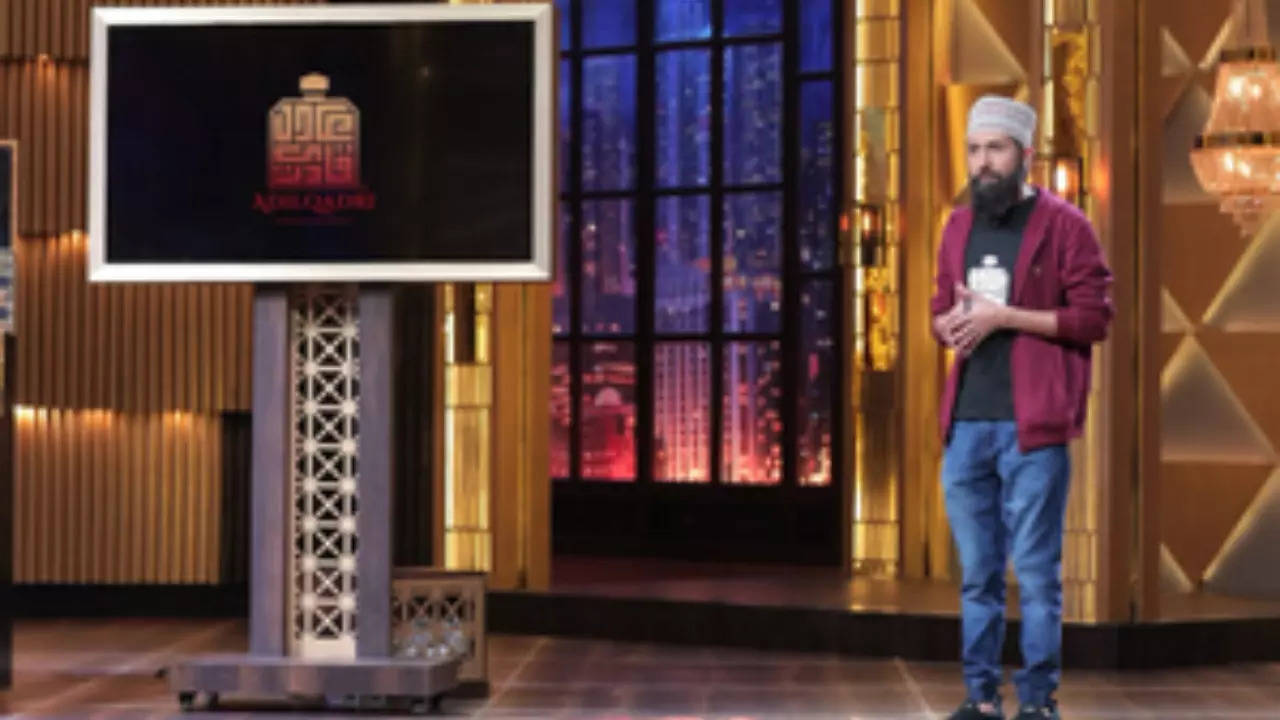
The season three of the business reality show ‘Shark Tank India’ will see a self-made entrepreneur Adil Qadri, who has introduced the Sharks to a desi way of using attars.

Despite failing school in fourth grade due to asthma, Adil’s business has processed a whopping 10 lakh orders, averaging 3,000 per day.

From a software repairer to an SEO expert, he’s now the face of a brand that’s putting Bilimora on the map. Indeed, Adil proceeded to establish a business, defying the odds posed by his asthma.

His brand ‘ADILQADRI’ introduces a new way of using attars, emphasising long-lasting effects and premium packaging. However, Rs 6 crore debt sparks conflict among the Sharks.

Talking about his experience on ‘Shark Tank India’, Adil Qadri (Founder and CEO) said: “Appearing on Shark Tank India with our brand ADILQADRI was a whirlwind, a roller coaster of emotions and opportunities. The intense pitch sharpened my ability to face sharks’ questions and honed my strategic thinking.”

“Their feedback provided invaluable insights for refining my business model. The experience underscored the importance of composure in high-stakes situations, molding me into a resilient and articulate entrepreneur,” he added.

‘Shark Tank India 3’ will soon air on Sony LIV.

–IANS / sp/prw

source: http://www.bhaskarlive.in / Bhaskar Live / Home> Entertainment / by IANS / January 18th, 2024

Meet Mangaluru’s Mubeena Banu who secured government job after 13-year-long legal battle

Hokkodgoli (Arambodi Village, Belthangady Taluk) Mangaluru, KARNATAKA:

Mangaluru:

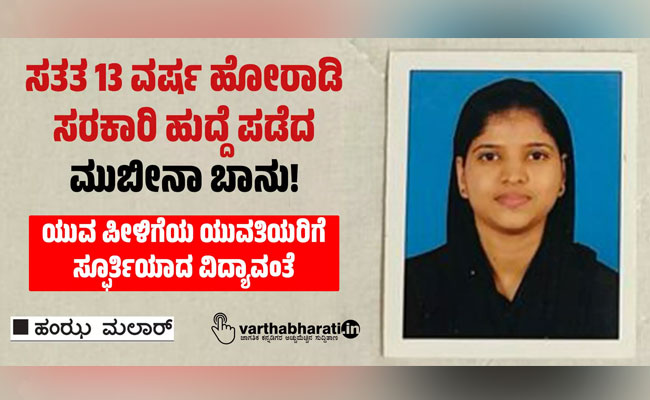
In a remarkable tale of perseverance and determination, Mubeena Banu, a Muslim woman from Hokkodigoli in Arambodi village, Belthangady taluk, has secured a government post after a 13-year-long legal battle.

Mubeena Banu, the tenth child of Muhammad H, a beedi contractor, and D. Zainaba, pursued her education in her village from 1st standard to 2nd PUC. She later completed her graduation from a private college in Moodbidri and earned her post-graduation (MA) from Mangalore University, Konaje. In 2008, with the aim of fulfilling her parents’ dream, she applied for the post of Supervisor in the Women and Child Welfare Department.

Despite her qualifications, she faced a setback when she was not selected for the post in 2010. Undeterred, Mubeena Banu investigated the reason for her exclusion and discovered a discrepancy in her marks. Her BA degree marks were recorded incorrectly as 71.79% instead of the actual 75.36%. Despite facing resistance from senior officers, Mubeena persisted in her efforts, seeking support from former MLAs Vasant Bangera and Ramanatha Rai.

Having relocated from Mittabailu to Melkar and working as a lecturer in a private educational institution, Mubeena approached Speaker UT Khader for assistance in her final attempt. She filed a complaint with the Lokayukta and approached the Karnataka Administrative Tribunal (KAT). Through persistent efforts, KAT ruled in favor of Mubeena Banu.

On January 10, 2024, the Women and Child Welfare Department issued an appointment order to Mubeena Banu for the position of Supervisor at the Office of Child Development Project Officer, Bantwal Taluk. Mubeena, who initially applied from Arambodi village, is now in Sajipa Muda village of Bantwal taluk with her husband, marking the culmination of her arduous journey.

Reflecting on her journey, Mubeena expressed gratitude to her late father, a social worker who emphasized education, and her mother for their unwavering support. She acknowledged the financial assistance from her parents and husband Ismail Khader during her numerous trips to Bangalore Vidhana Soudha and departmental offices. Mubeena also highlighted the crucial support from Lokayukta officer Amanullah, Speaker UT Khader, and his close assistant Libzat.

In her own words, Mubeena Banu said, “UT Khader always supported my persistence and struggled to get that government post, which I missed due to the mistake on the part of the officials. Maybe it can be said that after he intervened, the path of my struggle became easier.”

source: http://www.english.varthabharati.in / Vartha Bharati / Home> Karavali / by Vartha Bharati / January 22nd, 2024

Irfan Ahmad Khan, Islamic scholar who promoted interfaith ties, dead at 86

Sahranpur, UTTAR PRADESH / Markham (Illinois, Chicago) , U.S.A:

unnamed_291.jpg
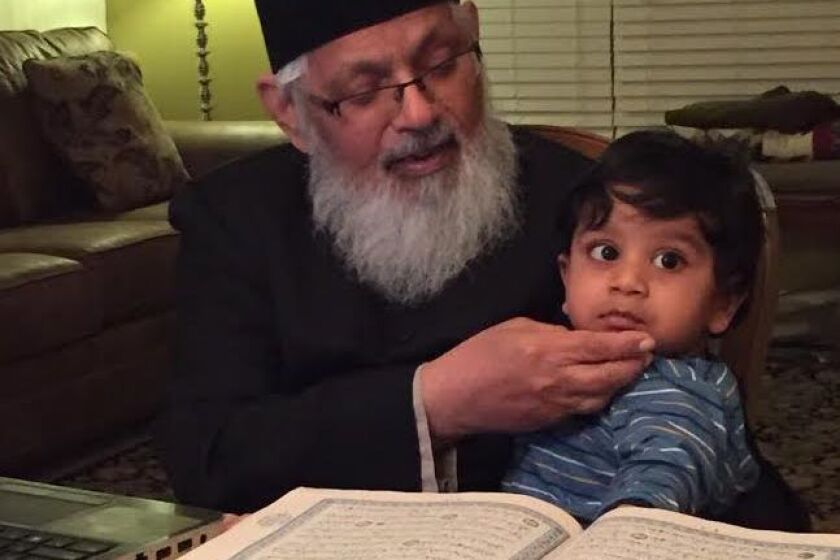
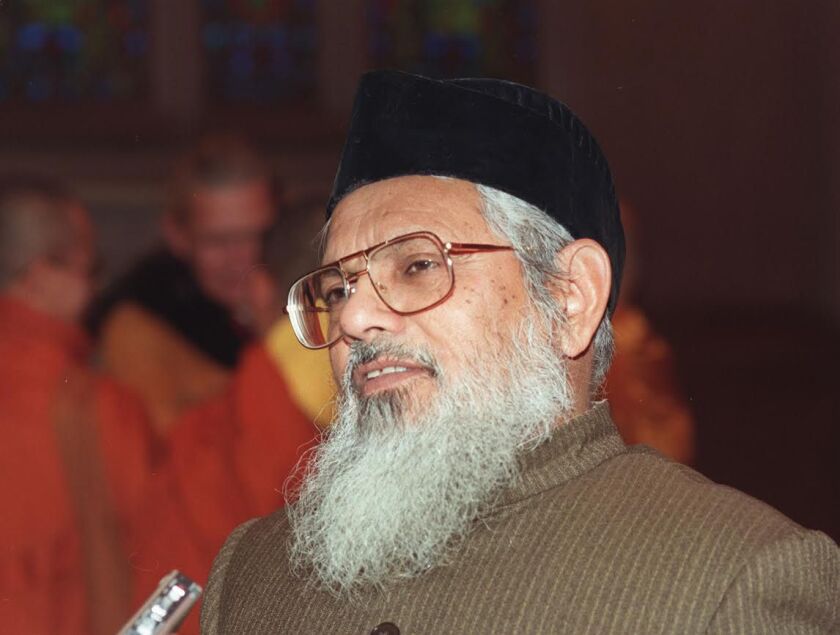
Irfan Ahmad Khan taught many people about the Quran, including his great-grandchild Sulayman Ahmed Ansari. | Provided photo

Irfan Ahmad Khan wrote books, taught college classes, gave lectures and counseled inmates after their release from jail to help people learn about the Quran.

One of the best-known Quranic scholars in Chicago’s South Asian Muslim community, he also worked to promote understanding among different religions through interfaith groups.

“My father’s aim was not for material gain or fame,” said his daughter Humera Hai. “Spiritual peace and harmony was his main aim.”

He would go hours out of his way to drive medicine to a sick person or to resolve disputes, Hai said.

Mr. Khan, 86, who had been having heart problems, died April 3 in Chicago, said his grandson Saeb Ahsan.

Irfan Ahmad Khan in 1996. | Sun-Times files

Mr. Khan, who lived in Markham, spoke and wrote in English, Urdu, Hindi and Arabic. He also could read and write in Farsi and Latin.

His books included “An Introduction to Understanding the Quran,” “An Exercise in Understanding the Quran” and “Reflections on the Quran.” He also edited a journal on Islamic thought.

He was born in 1931 in British India, in Saharanpur in the state of Uttar Pradesh. His father was a well-to-do merchant and landlord. He expected his son to take a role in the family businesses, but “He wanted to study,” said his daughter.

In 1952, he earned a degree in physical sciences from India’s Aligarh Muslim University and continued his Islamic studies in the city of Rampur. He taught at the Indian university from 1958 to 1973.

Irfan Ahmad Khan and his wife Shamim. | Provided photo

Mr. Khan married Shamim Akthar Khan in 1957.

“He was always so gentle, so kind,” his wife said.

In 1974, he arrived in Chicago to study at the University of Illinois at Chicago. His wife, who was raising their seven children in India, had to await immigration clearance and wasn’t able to join him full-time until 1981, Hai said. “Both of them struggled” with being apart, their daughter said.

Mr. Khan, who admired the philosophers Immanuel Kant and Rene Descartes, earned a master’s degree in philosophy from UIC in 1977 and a doctorate in philosophy in 1986, according to the university.

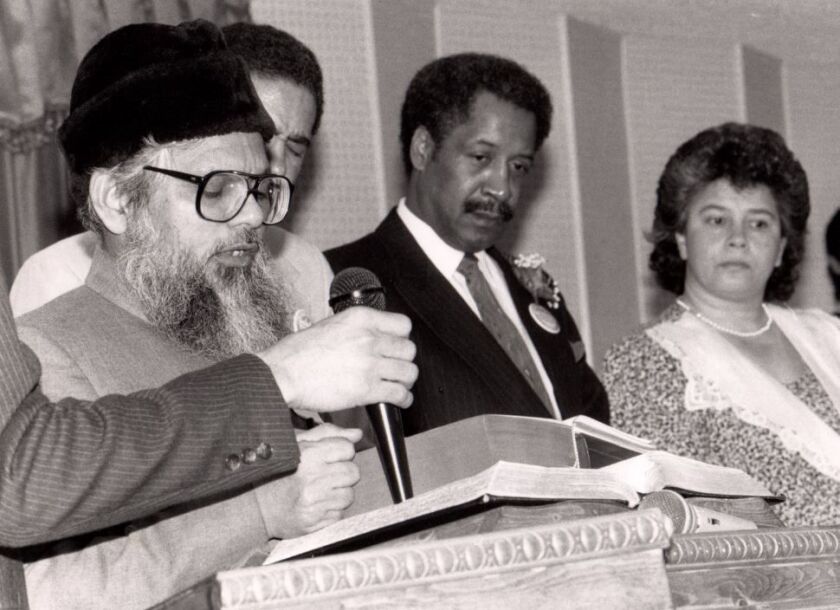
Irfan Ahmad Khan, with then-Mayor Eugene Sawyer in the background. | Provided photo

He taught Islamic philosophy at UIC and lectured at schools including the University of Chicago, the School of the Art Institute of Chicago and the University of Iowa, his family said.

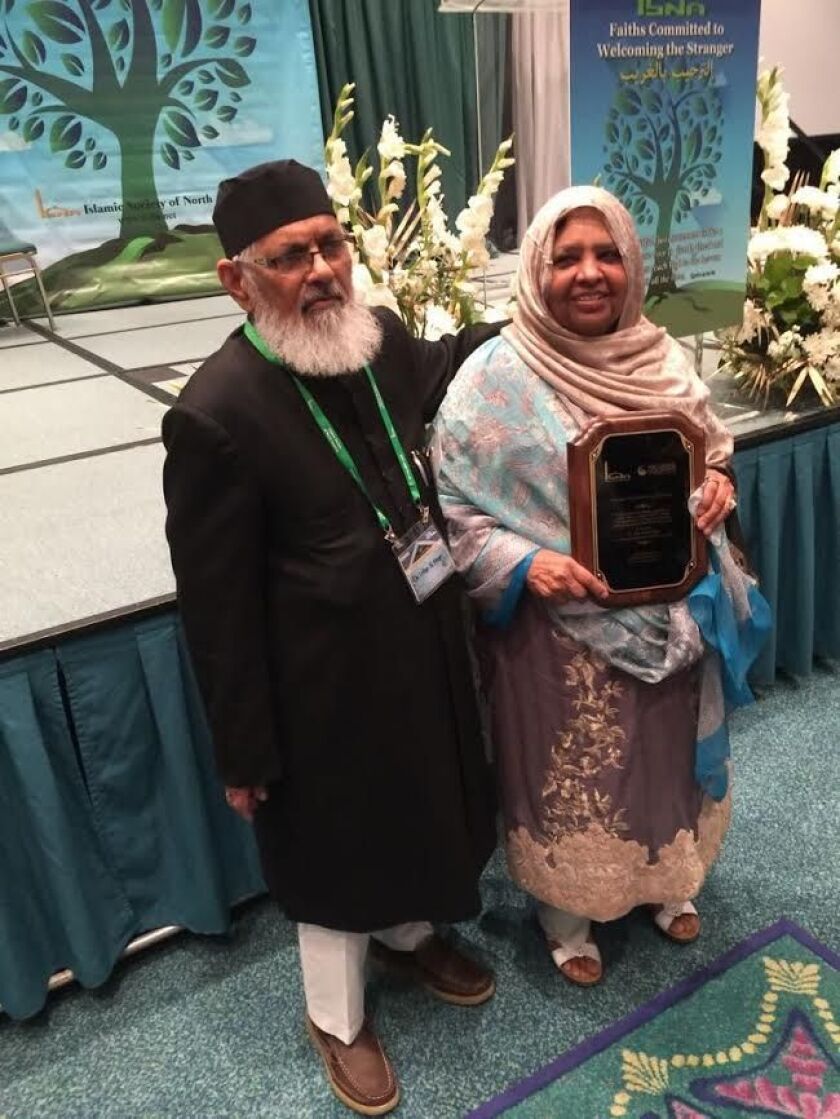
He was founder and president of the World Council of Muslims for Interfaith Relations, an emeritus board member of the Parliament of the World’s Religions, founding president of the Interreligious Engagement Project for the 21st Century and director of the Association for Quranic Understanding.

“His message was that there was a commonality in many faiths — a commitment to justice and fairness,” said Abdullah Mitchell, a lawyer and friend who said Mr. Khan was known for his outreach to the African-American Muslim community.

His lectures were delivered with energy and humor, and he always was approachable, said another friend, Afaq Mujtaba.

Mujtaba said young people in the South Asian Muslim community referred to him as “Uncle,” a term of affection and respect.

When Mujtaba’s mother died, “The way he consoled me, I will remember for the rest of my life,” he said.

Mr. Khan made multiple pilgrimages to Mecca and traveled to educational and interfaith conferences in Asia, Africa, Australia and Europe.

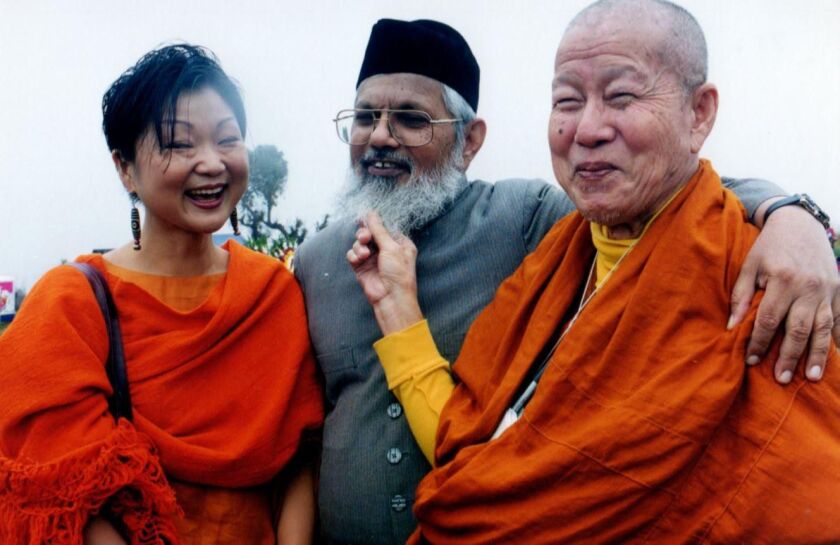
Islamic scholar Irfan Ahmad Khan worked to build relationships with other religions and interfaith groups. | Provided photo

His grandson said Mr. Khan would tell him, “Develop your relationship with God” and “Keep your studies’ focus; don’t necessarily get married too early.”

He enjoyed Red Lobster, Reza’s Restaurant on Ontario Street and anything that tasted of mango, his grandson said. Every morning, he ate toast and drank strong English breakfast tea with milk and lots of sugar. He liked it in a china cup and saucer, the hotter the better.

Once, when a student brought him tea, he removed his topi — a traditional hat — and placed it atop the drink like a tea cozy to keep it warm. But Mr. Khan forgot where the tea was. So the student brought him a second cup. “He picked up his hat,” said his son Farhan, “and he found the other tea.”

Irfan Ahmad Khan. | Provided photo

He always made sure his sherwani — a formal, knee-length coat — was pressed and crisp.

Though he usually focused on philosophical questions and lectures, his family found it endearing when Mr. Khan would catch a glimpse of an Indian or Pakistani soap opera on TV and then comment, with serious deliberation, on the motivations of the characters.

“This person is not being honest,” he’d say. “They are trying to take advantage.”

He is also survived by daughters Nusba Parveen, Husna Ahmad, Bushra Islam and Saba Khan, son Salman, brothers Ehtasham, Afzal, Iqbal and Rehan, sisters Ayesha Jamal and Rehana Bilquis and 21 grandchildren and two great-grandchildren. Services have been held.

source: http://www.chicago.suntimes.com / Chicago Sun*Times / Home> Obituaries> News> Religion / by Maureen O’Donnell / April 14th, 2018