The band is set to make its World Premiere debut at the Tanweer Festival on 21 November in Sharjah, United Arab Emirates.
Rahman earlier dropped the teaser of the band on his Instagram account, which shows the band members dressed in purple, with headscarves covering their hair | By special arrangement
New Delhi:
Academy and National Award-winning composer A R Rahman announced the launch of Rooh-e-Noor, a six-member all-women band, formed under the leadership of his daughter, Khatija Rahman. The band has been launched under Rahman’s KM Musiq audio label, with Kannika Urs heading the project.
Rooh-e-Noor is set to make its World Premiere debut at the Tanweer Festival on 21 November in Sharjah, United Arab Emirates.
Apart from Khatija, the ensemble comprises musicians Pooja Tiwari, Sana Aziz, Shaoni Mojumdar, Amina Rafiq, and Shifa Ruby. Tiwari and Mojumdar are the vocal trainers, Rafiq and Ruby will lead music supervision, and production will be carried out by Sana Aziz, Sarthak Kalyani and Nakul Abhyankar. Rooh-e-Noor means “Soul of Light”, and it has been created to focus on the idea that women’s voices are transformative and can heal, inspire, and uplift.
“Rooh-e-Noor isn’t just a band, it’s a light that connects hearts. Each of these women carries the confidence of modern artistry. Their collective voice is pure, powerful, rooted, and futuristic,” said AR Rahman.
Rahman earlier dropped the teaser of the band on his Instagram account, which shows the band members dressed in purple, with headscarves covering their hair. Khatija is the only member who has also opted to wear a hijab in the video.
A rare sight in the music industry
All-girl bands in India are still few in the music industry. Music producer Mikey McCleary created the band W.I.S.H in 2021, which released their first single Lazeez last year. The last time a girl band took over the Indian music scene was in 2002 when Viva was created.
But soon after its launch, band member Seema Ramchandani left, and the remaining members continued without her for another year.
Rahman’s band—a new step in the world of Indian girl bands, for its distinctive aesthetic—seeks to bring reimagined classics, film compositions, and spiritual renditions.
The teaser shows the girls performing the whirling dervish, a Sufi form of devotional dance. Earlier, Rahman spoke of his own spiritual journey as well as embracing Sufism and its influence on his life and music.
(Edited by Saptak Datta)
source: http://www.theprint.in / The Print / Home> Features> Around Town / by Shubhangi Misra / February 19th, 2025
The Malabar Resistance of 1921 is a deeply contested historical event that was born out of the crackdown against the Khilafat movement. The book ‘Musaliar King’ has tried to decolonise it.
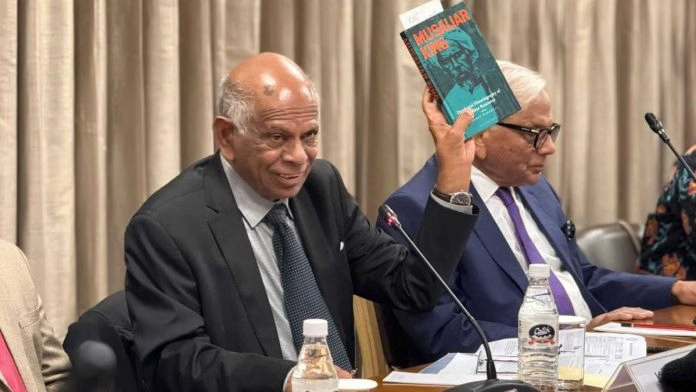
KP Fabian with Abbas Panakkal’s book Musaliar King | Special arrangement
New Delhi:
On a mission to decolonise the narrative around the Malabar resistance of 1921, author Abbas Panakkal has relied on oral histories, and other accounts in Ottoman, French, Australian, and Indian libraries. A recent gathering of academics at the India International Centre saw a passionate discussion on the book Musaliar King: Decolonial Historiography of Malabar’s Resistance.
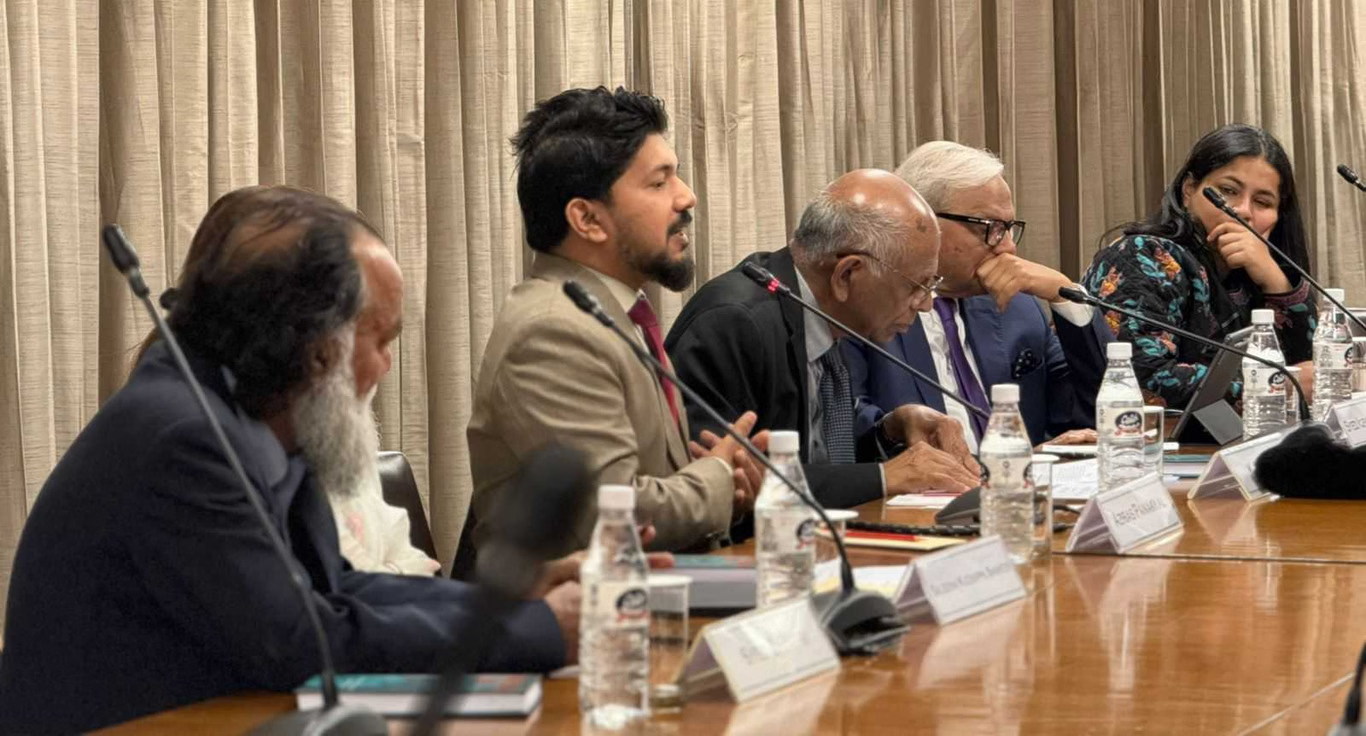
Star-studded panelists of academics and scholars, including former diplomat KP Fabian, Padma Shri Syed Iqbal Hasnain, dean of Jamia Hamdard, Saleena Basheer, Pallavi Raghavan, professor at Ashoka University and professor Syed Jaffri Hussain of Delhi University critiqued and added layers of historical context to Panakkal’s work.
The Malabar Resistance of 1921 is a deeply contested historical event that was born out of the crackdown against the Khilafat movement, and saw an uprising of peasants against the landlords who were primarily Hindus and enjoyed British support. The British historiography reduces the rebellion to a Hindu-Muslim clash, and the resistance hasn’t found a place in the national conversation of revolts against the British colonists.
The author maintains that the peasantry contained both Hindus as well as Muslims and that Muslim houses were also targeted.
In 2021, RSS National Executive Committee member Ram Madhav had said that the Malabar Rebellion was the first manifestation of the ‘Talibani’ thought in India. In the same year, there were also Right-wing protests against celebrating the centenary anniversary of the revolt.
The Hindu Right maintains that the ‘uprising’ or ‘revolt’ was a communal incident, and takes offence to declare one of the leaders of the rebellion Variyamkunnath Kunjahammed Haji as a martyr.
“Historians rely on repositories to provide evidence for accounts. In this project, my repository was also my family, neighbours, and village. When I grew up and learned English, I understood that the British version of the history of the Malabar rebellion was very different from what I had grown up hearing. The popular history was very different from the personal story of the people of this region,” Panakkal said, addressing an audience of academics, students, and historians.
“This book is not just research of 3-4 years, these are stories that I grew up hearing. I have to tell the story of my native place. It is my obligation,” he said.
Panelists discussing Malabar rebellion of 1921 | Special arrangement
Oral history or nationalistic take?
Growing up, Panakkal said he had met and acquainted himself with Hindu and Muslim families who maintained an oral history of how Muslims and Hindus both rescued each other during the uprising. He added that the Malabar region, especially Tirurangadi, has a lot of communal peace.
Dr Syed Iqbal Hasnain said that the Malabar or Moplah revolt was an uprising against the British that was “woven with the threads of unity binding Hindu and Muslim to safeguard the throne of Hindu king Zamorin of Calicut.”
“Muslim communities thrived under the patronage of Hindu kings, who they considered protectors who ensured the preservation of Islamic law and culture,” Hasnain said.
Saleena Basheer, while commending Panakkal’s work, didn’t hold back on her critique of the book, which she said could be non-accessible to people who don’t have a lot of awareness about the revolt. She also questioned if the book was over-reliant on oral histories.
“Does the book deconstruct colonial narratives or does it ignore them in favour of nationalistic storytelling,” Basheer asked.
The academics also wondered how radical the decolonial approach could be, as British versions of history are sometimes the only version of historical accounts available in the pre-Partition era, and have to be relied on by historians while writing about history.
Syed Jaffri Hussain, who has written extensively on the revolt of 1857, said the British version of events has to be challenged. He also praised Panakkal’s work. “Indian rebels like Bahadur Shah Zafar, Jhansi ki rani, Rana Beni Madho Singh are described as badmash, this needs to be read between the lines,” Hussain said about British repositories, adding that such language was never used for Australian rebels or Irish convicts.
The British left but their mentality has stayed with us,” he added.
Hussain maintained that Moplah rebellion oral history needed to be urgently recorded.
“What is accepted by us as an oral history in the realm of Dalit history, women’s history, should also be accepted in terms of Moplah history,” said Hussain.
(Edited by Ratan Priya)
source: http://www.theprint.in / The Print / Home> Features> Around Town / by Shubhangi Misra / February 19th, 2025
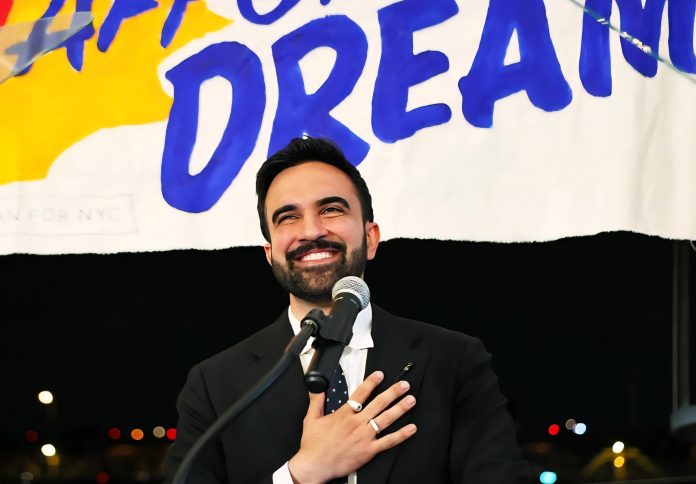
“I am a Democratic Socialist, I am a Muslim… I am not apologizing for either.” With these words, Zohran Mamdani declared victory in the New York City mayoral race, a symbolic global capital of commerce and culture. His triumph rekindled hope among conscientious citizens in New York and resonated worldwide, especially amid the rise of populist, authoritarian-leaning leaders who thrive on division and privilege wealthy allies.
Only a year prior, Mamdani was widely seen as an underdog. Yet he defeated Andrew Cuomo, the former governor who ran as an independent and received informal support from prominent national figures, including the sitting president. Mamdani garnered just over 50 percent of the vote, becoming the youngest mayor in a century and the first Muslim and South Asian to hold the office. His campaign also achieved one of the highest voter turnouts in New York City since 1969, signalling renewed civic engagement for a progressive, inclusive agenda.
Political Polarization and Economic Context
While such a victory might appear routine in an established liberal democracy, it must be understood against the backdrop of deep U.S. political polarization since the Trump era. Divisive rhetoric and exclusionary policies fractured communities and workplaces, stifling dreams and limiting opportunity.
During the Trump administration, harsh immigration enforcement via ICE and other agencies fuelled fear in immigrant communities. Arbitrary detentions, wrongful arrests, and forced family separations became emblematic of policies that disregarded due process and human dignity. At the same time, tariffs and trade disputes increased living costs, particularly in metropolitan areas like New York. Rising rents and price hikes strained households across demographics, as economic hardship transcends ethnicity, citizenship, or geography. Some commentators noted that the political climate during Mamdani’s election was marked by tension between the federal administration and certain Democratic-led cities. Debates around federal funding, social welfare programs, and executive rhetoric heightened the stakes of the mayoral race, creating a context in which Mamdani’s message of local accountability and inclusion resonated strongly with voters.
The Socioeconomic Landscape of New York
New York City, with a population of approximately 8.48 million as of 2024, is among the world’s most diverse urban centres. Over 30 percent of residents are foreign-born, representing more than 100 nationalities. Yet the city struggles with high income inequality, reflected in a Gini coefficient of 0.555. Housing shortages, rising rents, and long commutes—averaging 41 minutes—have made the city increasingly unaffordable for lower- and middle-income households, prompting out-migration to suburbs.
Employment levels have recovered post-pandemic, with private-sector jobs growing 2.8 percent in 2024–25, yet the income gap continues to widen. Households in the highest quintile earn more than twenty times those in the lowest quintile. Policies favouring high-income earners during prior administrations exacerbated this structural inequality.
A Campaign Grounded in Inclusion
Mamdani’s success can be attributed to his focus on everyday concerns of New Yorkers: affordability, public transportation, universal childcare, housing, and progressive taxation. He positioned himself against divisive political rhetoric, resonating across New York’s diverse communities and appealing to those marginalized economically or socially helping unite both conservatives and liberals as economic hardship doesn’t see political allegiance.
A defining moment in his campaign was his emphasis on local priorities. During a mayoral debate, while other candidates pledged their first visit abroad to Israel, Mamdani highlighted his responsibility to New Yorkers first, reinforcing his commitment to municipal governance over symbolic foreign policy gestures.
He also navigated sensitive international issues with nuance, affirming support for the safety and rights of Jewish residents while criticizing the humanitarian crisis in the occupied Palestinian territories. His stance on human-rights accountability, including adherence to ICC mechanisms, underscored a principled approach that strengthened his political credibility.
Major New York City billionaires marshalled tens of millions of dollars to thwart Zohran Mamdani’s mayoral campaign, deploying deep-pocketed political machinery in support of his opponents. For instance, former Mayor and billionaire Michael Bloomberg is reported to have donated approximately US$8.3 million to the pro-Andrew Cuomo super-PAC Fix the City. Hedge-fund billionaire Bill Ackman contributed at least US$1 million to the anti-Mamdani PAC Defend NYC, and additional sums to Fix the City.
Concurrently, opposition efforts against Mamdani involved advertisements and mailers that his campaign denounced as blatant Islamophobia. For example, a mailer circulated by the pro-Cuomo super-PAC Fix the City was reported to have altered his appearance, darkening his beard and lightening his skin, a move Mamdani characterized as racially and religiously discriminatory. In addition, opponents sought to question his political allegiances, falsely portraying him as a supporter of Hamas and suggesting that he did not recognize Israel’s right to exist—claims that his campaign firmly rejected as misleading and defamatory.
Engaging Communities on the Ground
Mamdani’s outreach strategy was multifaceted and culturally inclusive. Campaign messaging spanned multiple languages, reaching New Yorkers across diverse linguistic and ethnic backgrounds. Beyond digital platforms, he visited places of worship, including Hindu temples, Jewish synagogues, and Christian churches, reinforcing interfaith solidarity.
He also engaged with ethnic food outlets and small businesses, highlighting immigrant contributions to the city’s cultural and economic life. This ground-level engagement translated into broad support across communities—Muslims, Christians, Jews, and secular groups alike—demonstrating a shared alignment with his vision for an inclusive, socially just New York.
Diasporic Resonance and Global Context
Mamdani’s heritage evokes transnational connections to India and Uganda, reflecting the experiences of diaspora communities navigating multiple cultural and political identities. His election elicited reactions from segments of Indian nationalist (Hindutva) movements, including online circulation of Islamophobic commentary. In contrast to widely celebrated Indian-origin figures such as Rishi Sunak, Kamala Harris, Tulsi Gabbard, and Usha Vance—often cited as symbols of India’s soft power abroad—Mamdani’s identity as a Muslim and his candid critique of the 2002 Gujarat riots have positioned him outside these narratives. He has reflected thoughtfully on the experiences of Muslims in New York, observing that “to be Muslim in New York is to expect indignity,” while emphasizing that such challenges do not define the broader community. His principled approach extends to global issues as well; his measured stance on the Israel–Palestine conflict underscores a commitment to human rights and ethical governance, reinforcing his reputation as a leader guided by conscience and social justice rather than partisan or sectarian considerations.
Zohran Mamdani’s unapologetic assertion of his identity, faith, and commitment to the public good offers a potential model for Indian Muslims and other marginalized communities confronting the rise of militant Hindutva and an increasingly adversarial state. His example demonstrates that principled, assertive engagement—grounded in inclusivity and social justice—can effectively challenge exclusionary and sectarian politics. Secular political parties in India, which in recent years have often sidelined Muslim voices in public life, might draw lessons from Mamdani’s approach: defeating divisive politics requires active, unapologetic advocacy for inclusion and pluralism, rather than silence or timidity. In essence, countering the forces of social and political exclusion demands a combination of ethical clarity, strategic assertiveness, and public visibility.
A Template for Inclusive Politics
Domestically, Mamdani’s rise occurs amid American ideological polarization and Democratic Party struggles to counter authoritarian rhetoric. His unapologetic advocacy for inclusive, pluralistic, and redistributive policies offers a potential model for progressive politics, reinforcing democratic values while countering divisive populism.
Mamdani’s victory, therefore, represents more than a personal or partisan success: it is a reassertion of democratic ideals, a rejection of exclusionary politics, and a renewed belief in a morally grounded, economically just, and inclusive vision that resonates far beyond New York City.
Diasporic Resonance and Global Context
Mamdani’s heritage evokes transnational connections to India and Uganda, reflecting the experiences of diaspora communities navigating multiple cultural and political identities. His election elicited reactions from segments of Indian nationalist (Hindutva) movements, some of whom circulated Islamophobic commentary online.
In contrast to celebrated Indian-origin figures such as Rishi Sunak, Kamala Harris, Tulsi Gabbard, and Usha Vance—often cited as symbols of India’s soft power—Mamdani’s identity as a Muslim and his critique of the 2002 Gujarat riots positioned him outside such narratives. He has reflected on the experiences of Muslims in New York, noting that “to be Muslim in New York is to expect indignity,” while emphasizing that these challenges do not define the broader community. His principled, humanitarian approach extends to global issues, with a measured stance on the Israel–Palestine conflict that underscores his commitment to ethical governance and human rights.
A Model for Marginalized Communities
Mamdani’s unapologetic assertion of his identity, faith, and commitment to the public good offers a potential model for Indian Muslims and other marginalized communities confronting militant Hindutva and adversarial state policies. His example demonstrates that principled, assertive engagement—grounded in inclusivity and social justice—can effectively challenge exclusionary politics. Secular political parties in India, which in recent years have often sidelined Muslim voices, might draw lessons from Mamdani’s approach: defeating divisive politics requires active advocacy for inclusion and pluralism rather than silence or timidity.
A Template for Inclusive Politics
Domestically, Mamdani’s rise occurs amid increasing ideological polarization in the U.S. and ongoing struggles within the Democratic Party to counter authoritarian and exclusionary rhetoric. His unapologetic advocacy for inclusive, pluralistic, and redistributive policies offers a potential model for progressive politics, reinforcing democratic values while challenging divisive populism.
Ultimately, Mamdani’s victory represents more than a personal or partisan success: it is a reaffirmation of democratic ideals, a rejection of exclusionary politics, and a renewed belief in a morally grounded, economically just, and inclusive vision—one that resonates far beyond New York City.
source: http://www.muslimmirror.com / Muslim Mirror / Home> Opinion / by Mushtaque Rahman / November 11th, 2025
For the first time in the history of Aligarh Muslim University Student politics, three women have won the student union elections. Ghazala Ahmad, Sadaf Rasool and Labiba Sherwani all contested the polls for the first time and all three won posts of cabinet members in the AMUSU.
The results of AMUSU elections sent a positive message about gender equality in an university that had gotten bad press for restricting library access for undergraduate women students.
Ms. Ahmad is final year student of Bachelors of Social Work, Ms. Rasool is in the final year of B.U.M.S. and Ms. Sherwani is in her first year of Bachelors of Social Work.
In 2015, one female student had won the union elections. But this is the first time in the history of AMU that three women have won the polls in their maiden attempt.
Kehkashan Khanam, a student of Ph. D. in Theology had won the post of cabinet in the last AMU student union elections. Ms. Khanam had contested this time for the post of vice-president in the AMUSU.
While talking to The Hindu on phone from Aligarh, Ghazala Ahmad said she held the victory of three girls in their first attempt to be a “sign that students of AMU want to see more girls presence and participation in overall student politics”.
When asked how she convinced a male-dominated electorate to vote for her, Ms. Ahmad said, “I told everybody on the campus that time has come to change outsiders’ perception of AMU. I told them, lets show the outside world that AMU campus is friendly and open to girls.”
The twenty-one-year old Ms. Ahmad said her inspiration was her working mother Nahid Fatima, Principal of a Government Primary School in Aligarh.
The job of a cabinet member is to ensure that the problems faced by the students at the departmental and faculty level, should be conveyed and taken up with the president, vice-president and secretary of the AMUSU. “It is a male-dominated campus but the results show that students on the campus want to more participation from girls. After all girls are also there on campus. Who will represent them. It was a tough competition so I had to work really very hard,” said Ms. Ahmad.
source: http://www.thehindu.com / The Hindu / Home> News> India> Other States / by The Hindu / November 01st, 2016
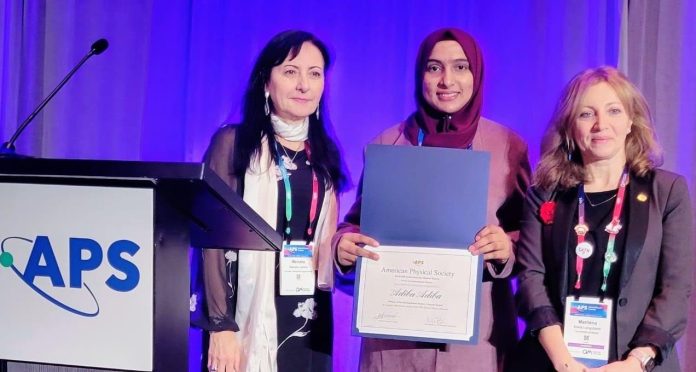
Adiba receiving the Prestigious APS Distinguished Student Award
Aligarh:
Adiba, a PhD student in Physics at Aligarh Muslim University (AMU), has been honoured with the Distinguished Student Award by the American Physical Society (APS) at the APS March Meeting 2025 in Anaheim, California.
Instituted in 2015, the award recognises exceptional early-career researchers from outside the U.S. and supports their participation in APS’s flagship meetings.
Adiba, working under the supervision of Prof Tufail Ahmad, is conducting cutting-edge research on Resistive Random Access Memory (ReRAM) devices for neuromorphic computing – an emerging frontier in physics and artificial intelligence. Her work earned her the prestigious award for outstanding contributions to the field.
Beyond research, she leads as President of the International Centre for Muslim Women in Sciences (ICMWS), championing science education among young women.
Expressing her gratitude to AMU for its role in her success, Adiba said, “Receiving this recognition from APS makes me feel incredibly proud and motivates me to strive even harder.”
source: http://www.radiancenews.com / Radiance News / Home> Latest News> Research> Science & Technology / by Radiance News Bureau / April 08th, 2025
Mecca, (Ottoman-SAUDI ARABIA / Kolkata, WEST BENGAL / DELHI :
Abul Kalam Ghulam Muhiyuddin (November 11, 1888-February 22, 1958), better known as Maulana Azad, was a writer-activist-statesman.
Historian S Irfan Habib speaks on Maulana Azad on his birth anniversary at an event organised by the Maulana Azad College alumni association in Calcutta on Tuesday / The Telegraph
Historian S. Irfan Habib, while delivering his Maulana Abul Kalam Azad memorial lecture titled “Revisiting Maulana Azad in Contemporary India” on Tuesday, rued how in today’s India, anytime he posts anything on social media on the freedom fighter, 80 per cent of the comments comprise hateful abuse.
“Full of abuse… 80 per cent of the comments. And from people who have no idea of who he was, what he stood for, and what he did for India,” said Habib, whose lecture on the Maulana on the icon’s 137th birth anniversary was organised by the Maulana Azad College alumni association to mark the college’s centennial.
Abul Kalam Ghulam Muhiyuddin (November 11, 1888-February 22, 1958), better known as Maulana Azad, was a writer-activist-statesman.
One of Mahatma Gandhi’s most trusted lieutenants and the youngest president of the Indian National Congress, he made crucial contributions to the freedom movement. He was also Independent India’s first education minister.
“I will speak about those issues relevant for today’s India. What he did for education, how he defined nationalism — today all those who have no idea of what nationalism is are nationalists — and how he defined Islam…. Islam too is in danger when we see what we believers have done to our own faith,” said Habib, former Maulana Azad Chair at the National University of Educational Planning and Administration, New Delhi.
Maulana Azad’s family moved from Mecca to Calcutta when he was two. He spent several decades of his life in this city, his residence on 5 Ashraf Mistry Lane of Ballygunge now a museum.
November 11 is celebrated as National Education Day to recognise his contribution in establishing the education foundations of India — from the Indian Institutes of Technology, the University Grants Commission, the All India Council for Technical Education, the Council of Scientific and Industrial Research, the Indian Institute of Science, and the Sahitya Akademi, the Sangeet Natak Akademi and the Lalit Kala Akademi, besides the Indian Council for Cultural Relations.
“Patriotism, nationalism and humanism, the difference between them Maulana tried to look at. In this (the belief in the culmination in humanism) he was very close to Gurudev Rabindranath Tagore, and he actually writes about it, that he believes in the idea of nationalism which was pitched by the idea of Tagore’s humanism and universalism,” said Habib.
“True relationship is only one, where the entire earth is one’s native land. This is necessary is today’s India, where we indulge in othering among own citizens, in the name of religion, caste, language, all sorts of issues, all sorts of divisive tools we use to divide Indians, while Maulana says mankind is one family and all humans are brothers, this is the idea of humanity of nationalism which Maulana left behind,” he added.
Habib underscored how the Maulana began as a pan-Islamist, speaking against the subjugation of Muslim nations by imperialist powers — a sentiment expressed strongly in his papers Al-Hilal and Al-Balagh, and it was because of his role as a fiercely upright journalist that the British Raj viewed him as one of the most dangerous persons in India.
Habib stated that after the Maulana was released from exile in Ranchi in 1920, he was torn between reading and writing in seclusion, or public life and the freedom struggle. It was soon after coming out of exile that the Maulana met Gandhi on January 18, 1920, for the first time.
“The meeting seemed to have had a profound impact on both… and they remained inseparable for the rest of his (Gandhi’s) life,” he said.
According to Habib, the Maulana fought on multiple fronts, not only against the British, but also Hindu and Muslim communalists.
“Maulana stressed on indivisible or composite nationalism, where he went back to early Islamic history, when the Prophet (Muhammad) created the first Muslim nation in Medina by aligning with the Yehudis (Jews). He saw no reason why Muslims could not join hands with Hindus and others in nation-forming…. He was appalled with communalists busy with sectarian campaigns when the need was to fight the British as a composite nationalist group,” Habib said.
“Maulana stood for a united India and remained steadfast in this resolve till the end. We are amid polarising politics where religion has become a distinct marker of identity…. The majoritarian nationalism being flaunted today runs contrary to the idea of composite nationalism espoused by Maulana all his life,” he added. “Maulana found the demand for Pakistan absurd as he was conscious of the fact that religion cannot be a binding factor for a nation.”
source: http://www.telegraphindia.com / The Telegraph Online / Home> West Bengal / by Meghdeep Bhattacharyya / November 12h, 2025
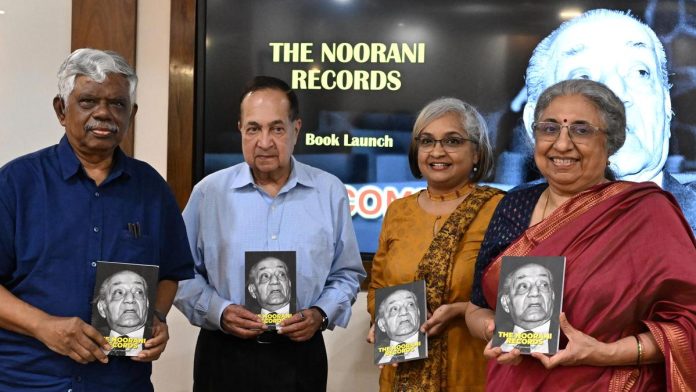
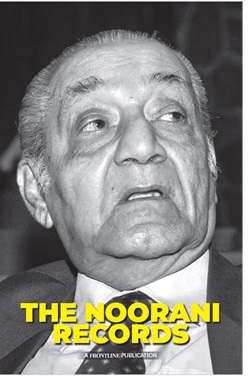
The Hindu Group’s Frontline magazine has launched The Noorani Records, a collection of essays by the late lawyer and constitutional expert A.G. Noorani (1930–2024). The book was released at The Hindu’s head office in Chennai on November 11. N. Ram, Director of The Hindu Publishing Group, presented the first copies to retired Madras High Court judges Justice K. Chandru and Justice Prabha Sridevan.
Justice Chandru praised Noorani’s ability to explain complex legal and political ideas in simple language that appealed to both experts and lay readers. Citing Noorani’s writings on the Rashtriya Swayamsevak Sangh (RSS) and Mahatma Gandhi, he urged that such essays be introduced to students to counter historical distortion and promote constitutional awareness. He also recalled Noorani’s detailed account of the trial of the Ali brothers during the Khilafat Movement, which reflected Hindu–Muslim unity.
Justice Sridevan remarked that Noorani’s work could inspire reflection and change among readers. She said his clarity of thought and disciplined writing offered valuable lessons for young lawyers.
N. Ram described Noorani as a passionate journalist and an uncompromising voice in legal and political commentary. He recalled that Noorani preferred handwriting his articles, ensuring precision and punctuality in his contributions to Frontline. Editor Vaishna Roy called him an erudite jurist whose essays combined intellectual depth with accessibility.
pix: thehindu.com
The book, released on the first anniversary of Noorani’s passing, compiles some of his finest columns for Frontline. It is available for purchase through The Hindu’s online bookstore.
source: http://www.radiancenews.com / Radiance News / Home> Latest News> Report / by Radiance News Bureau / November 13th, 2025
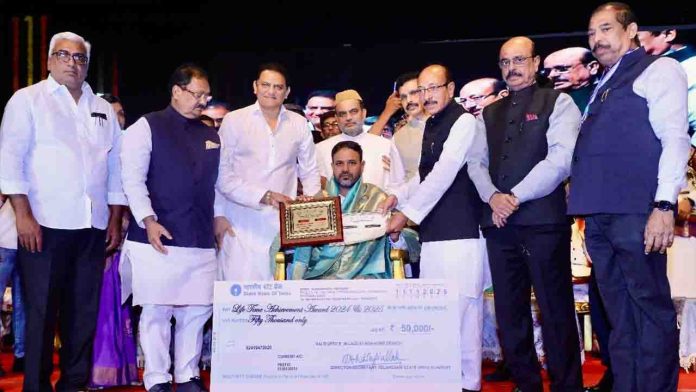
The Telangana Urdu Academy celebrated Minority Welfare Day at Ravindra Bharathi by presenting the first-ever Lifetime Achievement Award in the Digital Media category to veteran journalist Mohammed Akram Ali, popularly known as Azad Reporter Abu Aimal.
The award, instituted under the Revanth Reddy-led Congress government, marks the growing recognition of digital journalism’s role in promoting awareness and preserving Urdu culture. The award includes a memento, a citation, and a cash prize of Rs. 50,000, presented by Minister for Minorities Welfare Mohammed Azharuddin.
Mohammed Akram Ali was honoured for his decades-long contribution to digital journalism and his consistent efforts to advance Urdu language and literature through online media platforms. His work has been widely regarded as instrumental in connecting Urdu-speaking audiences with contemporary issues through accessible and credible digital channels.
The event was attended by several senior officials and community leaders, including Advisor for Minorities Welfare Md Ali Shabbir, Secretary of Minorities Welfare Department B. Shafiullah, Urdu Academy President Taher Bin Hamdan, Haj Committee Chairman Khurso Pasha, and CMFC Chairman Deepak John.
Syed Ghouse Mohiuddin, General Secretary of the Digital Media Publishers and Broadcasters Federation, congratulated Abu Aimal and praised the government for acknowledging digital media professionals.
The Telangana Urdu Academy announced plans to continue recognising contributors in emerging digital sectors to motivate younger generations and strengthen Urdu’s presence in modern media spaces.
source: http://www.radiancenews.com / Radiance News / Home> Latest News> Report / by Radiance News Bureau / November 12th, 2025
Irshad Mirza, a prominent Kanpur leather industrialist and chairman of Mirza International, has passed away at the age of 95. Irshad Mirza had been ill for a long time. His death has sent shockwaves through Kanpur and the industry.
Kanpur:
Irshad Mirza, chairman of Mirza International, the country’s largest leather exporter, passed away at the age of 95. Irshad Mirza was ill for the past several years. He breathed his last on Sunday in a private hospital in Kanpur. As soon as the news of Irshad Mirza’s death spread outside the hospital, a crowd of people gathered at his residence in Civil Lines.
Irshad Mirza’s contribution to the leather industry can never be forgotten. He has been honored with several awards including Padmashree. Irshad Mirza was also called the pride of Kanpur. Irshad Mirza has also got his name registered in Forbes magazine.
Irshad Mirza founded Mirza International in 1979. Mirza International manufactures leather, finishing, and tanning. The leather produced by Irshad Mirza’s company was in high demand abroad. The leather produced by the company is exported abroad. He was also the former chairman of the Minority Commission. During this time, he contributed to the betterment of society. Irshad Mirza
His passing has caused a wave of mourning in Kanpur and the industry. He had a strong influence not only in the industry but also among social workers, political parties, and leaders. He also worked extensively for the betterment of society in Kanpur. He also taught how to work in the leather industry.
source: http://www.navbharattimes.indiatimes.com / Nav Bharat Times / Home> Hindi News (translated)> State> Uttar Pradesh> Kanpur / by Abishek Shukla / December 04th, 2022
SP MLA Rais Shaikh counters BJP minister Nitesh Rane’s claim with historical evidence of Muslim chieftains in Shivaji’s forces.
SP MLA Rais Shaikh presents historical records listing Muslim chieftains in Chhatrapati Shivaji Maharaj’s army, challenging BJP minister Nitesh Rane’s statement. (Image: Facebook)
Mumbai:
To counter BJP minister Nitesh Rane’s claims that Muslims were not part of Chhatrapati Shivaji Maharaj’s army, Samajwadi party MLA Rais Shaikh has dashed off a letter to the saffron party leader listing out 10 Muslim chieftains in the legendary Maratha king’s forces.
In the letter to Rane, the SP MLA has given the names of 10 Muslim chieftains of Chhatrapati Shivaji Maharaj. These are Siddi Hilal and his son Siddi Wahwah, who supported the Maratha king in the siege of Panhalgad, cavalry chief Noor Khan Beg, Sardar Shama Khan, navy chief Ibrahim Khan, bodyguard Siddi Ibrahim, navy official Daulat Khan, trusted servant Madari Mehtar and lawyer Qazi Haider. Shaikh has also added evidence of historical sources to back up the names of these chieftains.
“Like Saint Tukaram and Saint Ramdas, Shivaji Maharaj also respected the Muslim Saint Baba Yakut of Ratnagiri. Shivaji Maharaj’s rule was not a religious war. He continued the tradition of gifting Pir, Dargah, and Mosque, as is documented in historical sources. These references are also provided in the letter, along with details of primary historical sources,” said Shaikh.
The SP MLA has also gifted Rane two books ‘Chhatrapati Shivaji: Kaal Aani Kartrutva’ (Times and Achievements of Chhatrapati Shivaji) by the renowned historian Jadunath Sarkar and ‘Who Was Shivaji?’ by Govind Pansare. “Minister Nitesh Rane should read objective history so that he does not make prejudiced statements distorting history, which could further increase rifts between communities,” said Shaikh.
Rane, while speaking at a meeting in Sangameshwar, Ratnagiri, had claimed that Shivaji Maharaj never appointed a Muslim chieftain and his war was against Muslims.
When asked, Rane said he was yet to receive Shaikh’s letter and he will comment on it after reading it. “But whatever I have said is true. Muslims were never a part of Chhatrapati Shivaji Maharaj’s army,” he said.
source: http://www.deccanchronicle.com / Deccan Chronicle / Home> Nation / by Bhagwan Parab / March 24th, 2025