Tag Archives: Positive Stories of Indian Muslims

Pir of Pagaro of Sindh sacrificed for India’s Freedom

SIND, BRITISH INDIA :

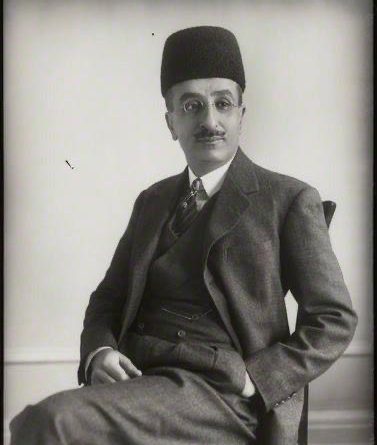
Pir Pagaro of Sindh
Pir Pagaro of Sindh

Indians and other historians have either tried to whitewash the revolutionary movements for freedom or presented these as disjointed localised efforts.

Even the largest movement of Azad Hind Fauj led by Netaji Subhas Chandra Bose has been narrated in a staggered manner and an episodial manner like the battle of Burma (Mayanmar) and the battle of Imphal. The picture thus presented is of an army fighting at a frontier with no support elsewhere. This history needs to be revisited.

In 1930, Sayyid Sibghatullah Shah Al-Rashidi called Pir of Pagaro, a Muslim Saint from Sindh with a huge following, was arrested by the British Government for ‘creating disturbances’. He was accused of instigating anti-colonial feelings among his followers known as ‘Hurs’ (literally meaning free). The decision to send him to a prison away from Sindh rather shaped this anti-colonial Muslim saint into a nationalist revolutionary. 

In the Bengal hail, he met several revolutionaries and realised that what he had experienced in his area was the same being experienced by others. He understood that British colonialism was destroying the nation and Hindu-Muslim unity was the only weapon to fight them.

From the prison, he started preaching nationalist messages. Sarah F. D. Ansari of the University of London in her book Sufi Saints and State Power: The Pirs of Sind, 1843 – 1947, writes, “messages strongly coloured with a radical nationalist tinge were smuggled out in the form of notes written in the margins and between the lines of books and magazines. They condemned the British for treating ‘Indians like donkeys’, loading them down with ‘England’s burdens’, and pointed out that the only reason why the British were able to rule over 300,000,000 people was that Indians were ‘cowards’.”

In 1936, when he returned to his seat at Khairpur in Sindh, Pir of Pagaro had turned a revolutionary.

He started establishing links with revolutionary leaders of Bengal as well as those living in Europe, especially Germany. He started inviting Congress leadership to his area and organise Hindu-Muslim unity meetings. We must keep in mind that it was 1938 and Subhas Chandra Bose was the President of Congress. Unsurprisingly when Subhas formed Forward Bloc after his famous differences with Mahatma Gandhi, Pir of Pagaro asked his followers to back Forward Bloc and denounced the stand of Congress. 

In 1939, the centuries-old Hindu-Muslim unity of Sindh was severely shattered over the Manzilgah mosque dispute and the riots that followed. Pir of Pagaro ordered his large following of armed followers known as ‘ghazis’ to save Hindus from the Muslim fanatics. Sarah F. D. Ansari writes, “In his newspaper, the Pir-jo-Goth Gazette, he (Pir of Pagaro) called for Hindu-Muslim unity: ‘My forefathers’, he wrote, ‘treated Hindus and Muslims alike as a sacred trust. The same is my principle . .. Allah is the same as Parmatma, though with different names. I will be happy when I see temples and mosques together with only a wall dividing them and everyone [worshipping] according to their rights so that no one may have a grievance against the other’. In a similar vein, he denounced the Hindu Sabha and the Muslim League as divisive communal movements. Only when Hindus and Muslims combined would ‘peace . . . be achieved and satanic deeds . . . stopped’: Indians had to be ‘national minded’ and regard India as a country which belonged to all its inhabitants.”

An intelligence report dated October 1940 says, “Pir of Bharchundi is not liked by the Pir Pagaro, who disrespected the Pir of Bharchundi and sent him away from his ‘Kot’ when the Pir of Bharchundi last visited the Pir Pagaro… the reason for such treatment of the Pir to the Pir of Bharchundi was that the Pir of Bharchundi would not assist in getting the murderers of Hindus arrested.” 

It further says, “Pir Pagaro has won great sympathy of the Hindus.” Sarah also points out how the Pir came out in support of a Muslim man’s right, who had earlier converted into Islam from Hinduism, to reconvert into Hinduism. “

Another intelligence report noted that Pir of Pagaro has enlisted at least 6,000 militants to fight with an oath to die for the cause. These militants were called ghazis. Ghazis had paraded and displayed their military skills in front of him during his visits to Jaisalmer and Jodhpur as well. The nationwide presence was a threat for the British. The report further noted, “the Pir was renewing his contacts with terrorists (terrorists was a term used by the English for revolutionaries) who had been in prison along with him in Bengal. His visits to Calcutta (Kolkata) were, it is said, performed for no other reason.”

The British apprehension was not wrong. Pir Pagaro had contacts with Bengali revolutionaries and Subhas. If Subhas raised an army on Eastern Front, Pir of Pagaro raised another on the Western Front. An intelligence report from 1941 noted, “He (Pir of Pagaro) has got his electric plant and radio set at which he and his followers hear Hindustani programs from Germany and then spread the German news in the villages which has a disquieting effect on the local people.” The report also pointed out that “the villainous activities of the Pir and his growing contempt of authority are becoming a byword throughout India”.

Pir of Pagaro was running an independent government in that region of Sindh with the help of his militia. The British Government arrested him in Karachi on the pretext of holding talks with him. His ghazis would not stop and kept attacking the British infrastructure. They were so much feared that the Legislative Assembly members did not want their names to become public for voting in favour of an act against Hurs (followers of Pir of Pagaro).

Sarah notes, “The level of fear which existed in Sind at the time even inside the Legislature was reflected in the session being held in camera. Members of the Assembly were not prepared to vote openly in favour of the act ‘lest they were marked down for the Pir’s future vengeance’.” The fear was not unfounded as soon after Ghazis killed the son of Hidayatullah, one of the tallest Sindh leaders in that Legislative Assembly, by derailing a train. 

It did not take much time and within weeks Martial Law was declared. The British had to open a war front at the time of World War II. Sarah writes, “The area north of Sanghar and the Thar desert (Rajasthan) were thoroughly reconnoitered from the air; paratroopers and bombs were used against bands of armed men. Hur villages were raided, wells stopped up and their cattle herded into other districts.” On the other hand, the Pir was being tortured to ask his followers to put down their weapons. 

Did the nationalists concede defeat? No. The Pir of Pagaro, Sibghatullah, embraced martyrdom at the gallows on 20 March 1943, after a sham of a court trial. Hurs kept fighting the British till 1946 even after their Pir was gone. 

source: http://www.awazthevoice.in / Awaz, The Voice / Home> Culture / by Saquib Alim / July 23rd, 2022
These youngsters want to make Hyderabad the hub of robotics

Hyderabad, TELANGANA :

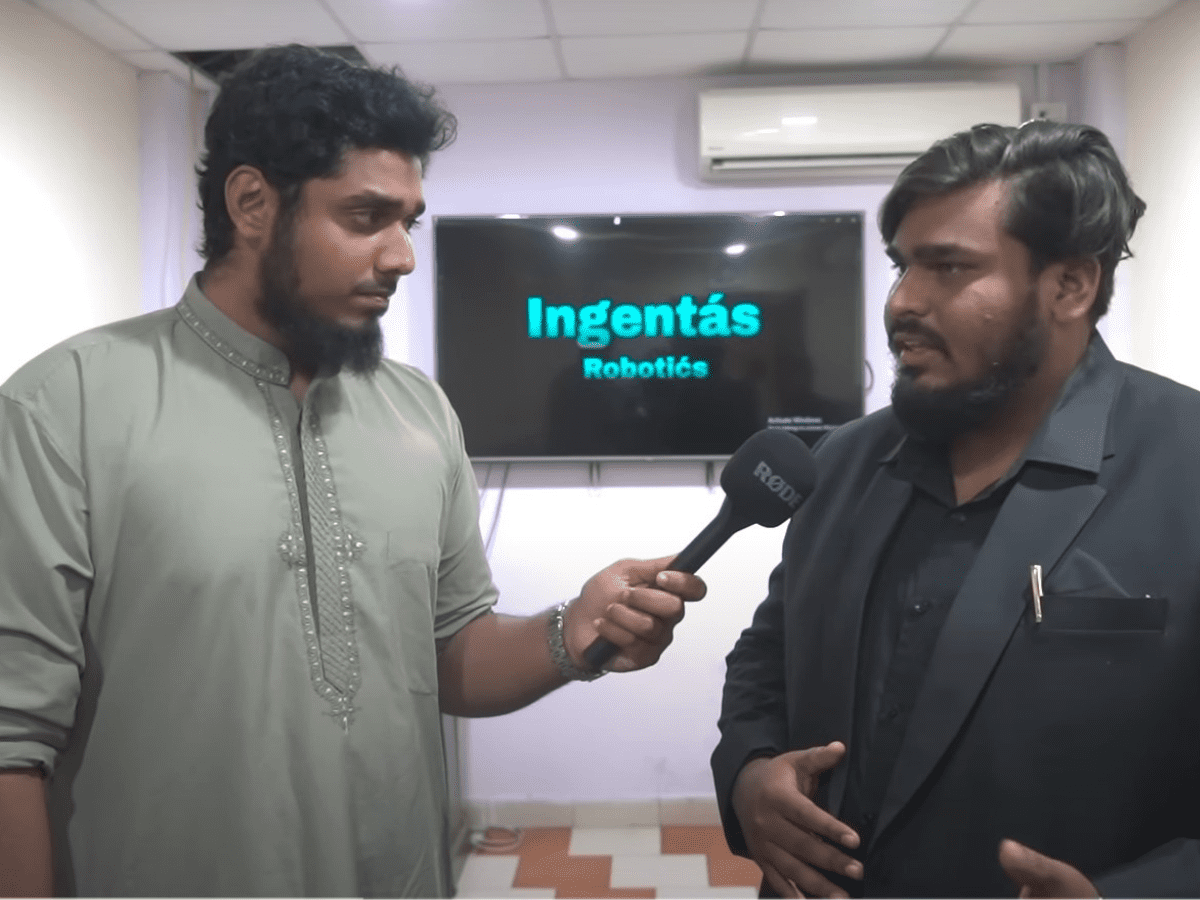
Ingentas is teaching people everything from basic batteries, jumper wires, buzzers, and sensors to the robotic arm, NASA’s Mars rover, and A.I.-driven drones.

Hyderabad: 

Realizing that any type of access to learning robotics and artificial intelligence is not available to most people, Ingentas started off in 2021 with its vision to empower local communities by teaching them technologies that will be more relevant in the future. It’s a first-of-its-kind workshop in Hyderabad, completely run by engineering graduates and students that aims to make the city a hub of robotics.

Tahami Mundewadi, who has been in the field of robotics for the last four years is the founder and CEO of Ingentas. Speaking to Siasat.com, he said that joining the Robotics club at Muffakham Jah College of Engineering (MJCET) helped him learn and grow more in the pursuit of his passion.

“Everything from a vacuum cleaner to the robotic arm used to build cars, all are based on robotics and artificial intelligence, we are living in an interesting time where even surgeries are being performed by robots,” Mundewadi remarked.

He further added that the world is moving at a very fast pace in this direction and that we have to be in this race and compete with the others.w

Ingentas is teaching people everything from basic batteries, jumper wires, buzzers, and sensors to the robotic arm, NASA’s Mars rover, and A.I.-driven drones.

Mundewadi stated, “you don’t necessarily have to be an engineering student to learn robotics, anything with passion can come.”

Furthermore, the CEO of Ingentas added that he believes that in 50 years everything will be based on robotics. “And to make anything mainstream in society we have to begin from the school level and that’s why we have classes from third-grade level all the way to advanced post-graduate level,” he remarked.

source: http://www.siasat.com / The Siasat Daily / Home> News> Hyderabad / by Usama Hazari / August 06th, 2022

Girls Islamic Organization elects its first national president and general secretary

NEW DELHI / KARNATAKA / KERALA :

New Delhi: 

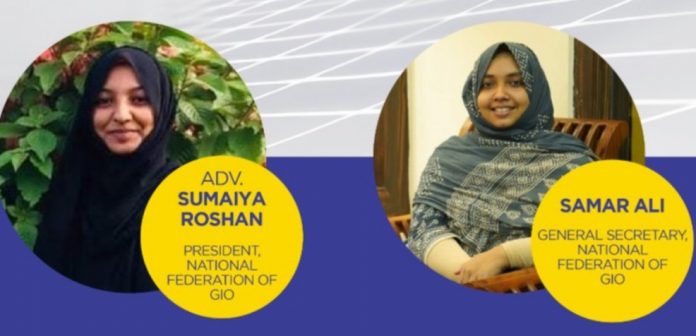
Girls Islamic Organization (GIO), one of the foremost women’s organizations  of India, elected its first National President and General Secretary. On the 30th of July 2022, Advocate Sumaiya Roshan (from Karnataka) became the first President of the National Federation of GIO, and Samar Ali (from Kerala) became the General Secretary.

In a significant development, GIO, which earlier worked at the level of state councils, was consolidated and formed into a National Federation. The new dispensation will be headed by a National President and General Secretary and will comprise a Federal Committee having representatives from all GIO states for a term of two years. The Federal Committee meeting was conducted from 29th to 31st July.

Girls Islamic Organization is the girls students organization of Jamaat-e-Islami Hind.

GIO  is a non-profit organization and has been actively engaging on various issues regarding women in general and Muslim women in particular across the country since1984. The organization has a presence in almost every state in India. Over the past few years, GIO at the state level has been working on the overall development of Muslim women and will continue to do so.

At the National level, the objectives of the Federation will be to coordinate interaction and sharing of ideas between the states, and to address and give voice to the prominent issues of National concern. GIO aims to provide space for women to come together, express, and nourish themselves while preparing them to fight the challenges of society. Its scope of work will revolve around the said objectives, not limited to Muslim issues but women issues in general and issues of national importance.

Being part of the largest democracy in the world, every citizen of the country must be provided with equal opportunities to evolve themselves and attain their highest potential. Despite immense efforts and development, women in India continue to face discrimination in all possible manner.

Even after forty years since the Mandal Commission recommendations, there remains gross inequality among the opportunities provided for Other Backward Communities(OBC). 

The organization focuses on enabling educational upliftment, progress in socio-political conditions, entrepreneurial advancement, and equal space for the women of marginalized communities. The organization will make conscious efforts to develop a free and open space where anyone can raise their voice and question the injustice faced by them.

source: http://www.muslimmirror.com / Muslim Mirror / Home> Indian Muslim / by Muslim Media Network / August01st, 2022

A Shia Mirza Ismail constructed a Sunni mosque

Bengaluru / Mysuru, KARNATAKA :

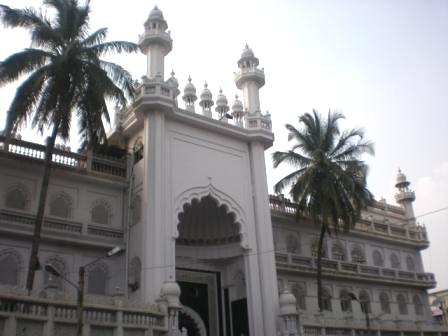
“I believe deep down in my heart that the great reality of spiritual revelation given to humanity by the Prophet (blessed be His name) is an infinitely greater thing than any sectarian difference (Shia & Sunni) imposed upon it by subsequent human feeling and by lesser vision than his of the inner realities from which the external life of humanity has developed.” Mirza Ismail, a Shia Muslim by faith, who was the Prime Minister of Mysore had spoken these words at the inauguration of Jamia Mosque, a Sunni mosque, in Bengaluru on 30 May 1941.

Jamia Masjid, Bengaluru

Mirza Ismail remained one of the most important politicians in India as he held the position of Prime Minister (PM) of the second wealthiest state, Mysore, from 1926 to 1941 after which he became PM of Jaipur and Hyderabad.

A Shia by his faith whose foreparents had migrated from Iran and stayed in India, Ismail remained committed to the unity of humans. He believed that Shia and Sunni, Hindu and Muslim, or any caste difference among humans could not stop them from living together harmoniously. 

Ismail inaugurated the mosque at Bangalore, which was one of the most important cities in Mysore state, as his last public ceremony in the capacity of the PM of Mysore after resigning from the post. On the occasion he noted, “I am particularly happy that this function, which is the last of my period of service as Dewan of Mysore, gave me the opportunity of expressing an ideal of my life which has been foremost in the past and will remain foremost in the future.” 

What was the ideal Ismail talking about? Making a mosque or something else?

The ideal he was talking about was the unity of Shia and Sunni as one Muslim community. He told the people gathered there that the non-Muslims observing this ceremony would not think much about it. In their view a Muslim had come to lay the foundation stone of a mosque of his fellow Muslims. “But to you”, Ismail argued, “fellow-Musalmans, it is not so simple. You know that in the historical development of Islam I belong to a section of the organised expression of the Faith that for centuries has been in sharp opposition to the section to which you, who are going to build this mosque, belong.” He expressed satisfaction that Sunnis had invited him for this event. He told the people that since its very inception he had taken “the greatest possible interest” in this mosque where Sunni Muslims would pray in the manner they wanted. 

Ismail went on to tell the people;

“At the centre of Islam is the teaching and practice of brotherhood. You would have been false to the truth of life if, because I am a Shia by birth, you had not invited me to this function, and I would have been equally false to the brotherhood of Islam if, because you are Sunnis, I had not accepted your invitation. Our differences are transient, even trivial, in comparison with the spiritual reality which these differences tend to obscure and weaken.”

Ismail went on to state that love and peace are the essence of Islam and Muslims should stop fighting among themselves as well as with their coreligionists in the country. The mosque is one of the most important mosques in Bengaluru today.

(Author is a neurobiologist with a keen interest in history, society and culture of India)

source: http://www.heritagetimes.in / Heritate Times / Home> Featured Posts> Heritage> Leaders / by Mahino Fatima / March 08th, 2022

“Education abroad” was the theme of Star Talk held in Guwahati

ASSAM :

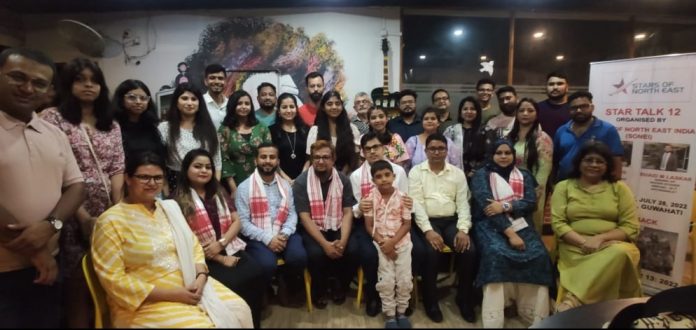
Members of SONEI along with guests pose for a group photo on the sidelines of the ‘Star Talk-12’ event held in Guwahati on Thursday.

Guwahati :

‘Star Talk-12’, an initiative of the Stars of North East India (SONEI), a registered public charitable trust and talent hunt platform, was held in Guwahati on Thursday.

The first appointed speaker of the event was Aman Wadud, a young lawyer who recently got his Masters in Law from the University of Texas under a Fulbright Scholarship. Besides sharing his American experience, Aman Wadud gave a very informative presentation of the evolution of Civil Rights in the USA.

The second appointed speaker, Suaid M Laskar, Head of Pan-India Sales, Admissify made a presentation to clear the common doubts people have about studying abroad. Laskar, who has been instrumental in facilitating overseas studies of more than 350 students from Assam, over the last five years, in countries like Australia, Germany, UK and USA, informed the audience that 93 per cent of the students who go abroad for studies belong to middle class families.

Abhishek Kumar, a graduate from Guwahati Commerce College, who is all set to study his Masters in Supply Chain Management at Cranfield University, UK also shared his experience on the occasion.

Alemoon Nessa of Bongaigaon, who recently received two national MSME awards along with a cash component of Rs eight lakh from the hands of Prime Minister Narendra Modi, was felicitated on the occasion.

Dr Faizuddin Ahmed, a physicist from Dhubri, who has made it to the Stanford list of world’s top 2% scientists, was also honoured on the occasion.

Shahnaz Islam, a budding poet whose book “Midnight’s melancholy” was launched from Sikkim recently, enthralled the audience by reciting a few poems from her book.

Mirza Arif Hazarika’s short film “Sorry” starring Barasha Rani Bishaya and Ravi Sharma is now live on Disney+Hotstar, a rare honour for an Assamese short film. Mirza shared his experiences of making the film.

Priyanka Paul Banerjee, an upcoming PR practitioner, was also felicitated along with other achievers at the event.

SONEI will complete eight years of its existence in September 2022 during which new projects will be announced in addition to its existing programmes in the field of education, promotion of skills, and social service.

The event was hosted by Samima Sultana Ali and Sharique Hussain.

source: http://www.muslimmirror.com / Muslim Mirror / Home> Education> Positive Story / by Special Correspondent / July 29th, 2022

Bhopal: Dr. Zaheer-ul-Islam, a pioneer in sex reassignment surgery, dies

Bhopal, MADHYA PRADESH :

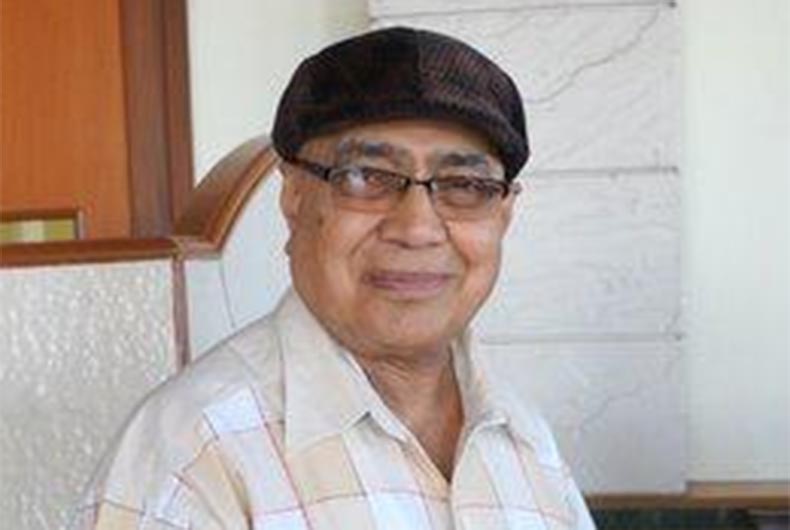
People bade a tearful adieu to Bhopal’s first plastic surgeon Dr. Zaheer-ul-Islam when he passed away here on Wednesday last.

Bhopal: 

People bade a tearful adieu to Bhopal’s first plastic surgeon Dr. Zaheer-ul-Islam when he passed away here on Wednesday last. He was in his late eighties. He is survived by his wife and a large number of relatives and friends to mourn his loss.

Dr. Zaheer-ul-Islam was laid to rest in the graveyard near Bhopal Talkies late in the evening after his Namaz-e-Janaza was performed in the courtyard of historic Sufiya Masjid.

Hundreds of people of Bhopal expressed their heartfelt tributes to him. He was known for his work as well as his cheerful behaviour and smiling face.

Education and Career

Dr Zaheer took his MBBS degree from Indore Medical College and did specialisation in Plastic Surgery from Patna Medical College.

In the cases of plastic surgery, 40 years ago, when different types of techniques were not available, in that era, the record of successful operation of big plastic surgeries remained in the name of Dr. Zaheer.

Pioneer in sex reassignment surgery

He was a pioneer and credited with Madhya Pradesh’s first sex reassignment surgery which was the biggest achievement of his life.

In 1977 he performed a surgery to change the sex of a girl to make her a boy. He changed the gender of a girl named Munnibai to Munnalal.

In the history of plastic surgery, Dr. Zaheer, who was honoured with many conferences and awards at international level, was also called abroad.

Dr. Zaheer served in Bhopal’s Hamidia Hospital associated to Gandhi Medical College (GMC), for nearly 30 years. Along with this, he also taught at GMC. From there he took voluntary retirement.

A poet and aerial photographer too

Apart from this he was a multifarious personality with a poetic blood flowing in his veins. He paid poetic tributes to his near and dear ones who departed this world by composing “Qata’t” which was published in Nadeem, an Urdu daily newspaper. Just 24 hours before he went to eternal sleep he recited the last “Qat’a’” of his life in a video recording saying:

“Mere janaze pe pura shahar tha sharik; ek tum nahin the jiska mujh ko intezar tha”.

He was also an expert aerial photographer with a passion to document the evolving city of lakes.

GMC golden jubilee celebrations were held in 2005. Dr. Zaheer was scriptwriter for the documentary ‘Down the memory lane’. For the poet it came naturally. His passion for aerial photography made him many friends and some dubbed him as ‘would be pilot’.

Dr. Zaheer’s aerial photography of Bhopal dates before the age of the internet and satellite imagery. He welcomed anyone who wanted to use his pictures for publication. As early in 2000, Dr Zaheer digitized his collection for preservation. He also was one of the first to use videos in medical conferences for demonstration.

According to GMC’s Assistant Professor Dr. S. K. Patne plastic surgeon Dr. Zahir was one of our favourite teachers in the medical college and was the first to showcase aerial photographs of the GMC campus, proving college building was designed in shape of medical cross from the top.

source: http://www.ummid.com / Ummid.com / Home> Inda / by Pervez Bari / July 30th, 2022

The Muslim Martyrs of Royal Indian Naval Mutiny of 1946

BRITISH INDIA :

After the Second World War, soldiers of the Azad Hind Fauj (Indian National Army) were captured by the British forces. They were charged with treason and tried by tribunals as war criminals. Indians protested against this treatment given to the freedom fighters of Azad Hind Fauj.

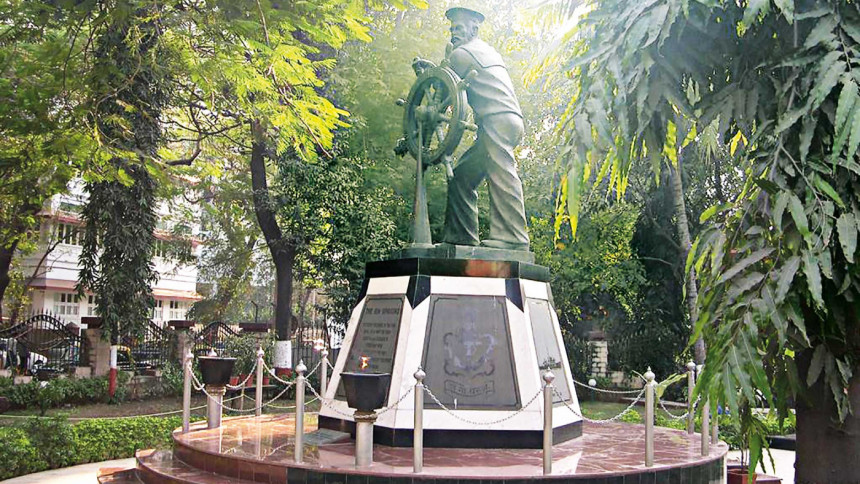
In February, 1945, soldiers and officers of the Royal Indian Navy mutinied in Mumbai and Karachi. English officials including the Viceroy took this mutiny as a sign of leaving India. The British forces killed many to quell the mutiny, many of which were Muslims.

Here, we are sharing names of the few Muslims we know, who attained martyrdom for taking part in the mutiny or supporting it.

Abdul, Ali, Din Mohammad: born 1929, took part in the popular demonstrations in support of the revolt by ratings of the Royal Indian Navy, received a bullet wound in firing by the police at Nagpada, Bombay, on 23 February 1946, died the same day.

Abdul Aziz: born 1921, domestic servant, hit by bullet in the premises of his employers as a result of firing by the police at Bombay on people demonstrating in support of the revolt by ratings of the Royal Indian Navy on 22 February 1946, died the same day.

Abdul Razak: born 1916, took part in the popular demonstrations in support of the revolt by ratings of the Royal Indian Navy, received a bullet wound on 22 February 1946 in firing by the police near Crawford market, Bombay, died on 24.2.46.

Abdul Rehman: born 1911, employee of private firm, hit by a bullet as a result of firing by the police at Doctor’s Street, Bombay, on people demonstrating in support of the revolt by rating of the Royal Indian Navy on 22 February 1946, died the same day.

Abdul Gani: born 1901, took part in the popular demonstrations in support of the revolt by ratings of the Royal Indian Navy, received a bullet wound in firing by police at Bombay on 22 February 1946, died the same day.

Abdul Karim: born 1926, took part in the popular demonstrations in support of the revolt by ratings of the Royal Indian Navy, received a bullet wound in firing by the police near Crawford Market, Bombay, on 22 February 1946, died the same day.

Abdul Sattar, Mohmmad Umar: born 1924, took part in the popular demonstrations in support of the revolt by ratings of the Royal Indian Navy, received a bullet wound in firing by the police on 22 February 1946 at Bombay, died the same day.

Abdulla, Abdul Kadar: born 1921, took part in the popular demonstrations in support of the revolt by ratings of the Royal Indian Navy, received a bullet wound in firing by the police at Bern- bay on 22 February 1946, died the same day.

Abdulla, Safi: born 1933, took part in the popular demonstrations in support of the revolt by ratings of the Royal Indian Navy, received a bullet wound on 22 February 1946 in firing by the police at Fort, Bombay, died in hospital the same day.

Adamji, Mohamed Hussain: born 1924, son of Allauddin Adamji, took part in the popular demonstrations in support of the revolt by ratings of the Royal Indian Navy, received a bullet wound on 22 February 1946, in firing by the police at Bombay, died in hospital.

Ali Mohammad: born 1906, hit by bullet in firing by the police at Dadar, Bombay, on people demonstrating in favour of the revolt by ratings of the RIN on 22 February 1946, died the same day.

Anwar Hossain: a student of Lahore College, hoisted the flags of revolt in the rating vessel Bahadur in Karachi, died with flags in hand on 23 February 1946.

Asgar Ismail: born 1934, received a bullet wound in firing by the police on people demonstrating in support of the revolt by ratings of the Hoyal Indian Navy on 23 February 1946, near the Paxsi Statue, at Byculla, Bombay, died on the spot.

Asghar Miya, Nawsati: born 1916, took part in the popular demonstrations in support of the revolt by ratings of the Royal Indian Navy, received a bullet wound in firing by the police near the J. J. Hospital, Bombay, on 23 February 1946, died in hospital.

Aziz, Chhotu: born 1921, took part in the popular demonstrations in support of the revolt by ratings of the Royal Indian Navy, received a bullet wound in firing by the police at Bombay on 23 February 1946, died in hospital the same day.

Dilawar, Abdul Malik: born 1931, son of Dilawar Muzawar, student, hit by bullet in firing by the police at Dongri, Bombay, on people demonstrating in support of the revolt by ratings of the Royal Indian Navy on 22 February 1946, died the same day.

Fida Ali, Kayam Ali: born 1933, received a bullet wound in firing by the police near J. J. Hospital, Bombay, on people demonstrating in favour of the revolt by ratings of the Royal Indian Navy on 23 February 1946, died the same day.

Gulam Hussain, Ali Mohammad: born 1906, took part in the popular demonstrations in support of the revolt by ratings of the Royal Indian Navy, received a bullet wound in firing by the police’ at Bombay on 22 February 1946, died the same day.

Haroon, Hamid: born 1931, took part in the popular demonstrations in support of the revolt by ratings of the Royal Indian Navy, received a bullet wound in firing by the police at Bombay, on 23 February 1946, died the same day.

Ibrahimji, Yusufali: born 1910, received a bullet wound in firing by the police at Bombay on people’s demonstrations in support of the revolt by ratings of the Royal Indian Navy on 22 February 1946, died the same day. 

Ismail Hussain: born 1932, hit by bullet as a result of firing by the police at Bombay on people demonstrating in support of the revolt by ratings of the Royal Indian Navy on 22 February 1946.

Ismail, Rahimtulla: bom 1911, took part in the popular demonstrations in support of the revolt by ratings of the Royal Indian Navy, received a bullet wound in firing by the police near the Imperial Bank, Abdul Rehman Street, Bombay, on 22 February 1946, died the same day.

Jamal Mohammed: born 1926, took part in the popular demonstrations in support of the revolt by ratings of the Royal Indian Navy, received a bullet wound in firing by the police at Bombay on 22 February 1946, died the same day.

Khuda Bakhsh, Pyare: born 1876, hit by bullet as a result of firing by the police at Bombay on people demonstrating in support of the revolt by ratings of the Royal Indian Navy on 23 February 1946, died the same day.

Manzoor Ahmed: born 1906, took part in the popular demonstrations in support of the revolt by ratings of the Royal Indian Navy, received a bullet wound; in firing by the police at Bombay on 22 February 1946, died in hospital the same day.

Mohammed, Aboobakar: born 1928, took part in the popular demonstrations in support of the revolt by ratings of the RIN, received a bullet wound in firing by the police near Crawford Market, Bombay on 22 February 1946, died in hospital the same day.

Mohammed Aziz: born 1911, took part in the popular demonstra- lions in support of the revolt by ratings of the Royal Indian Navy, received a bullet wound in firing by the police at Bombay on 22 February 1946, died in hospital the same day.

Mohammed Hussain: born 1931, son of Mulla Gulam Ali Abdul Hussain, took part in the popular demonstrations in support of the revolt by ratings of the Royal Indian Navy, received a bullet wound in firing by the police near J. J. Hospital, Bombay, on 22 February 1946, died the same day.

Mohammed Sheik, Sayed Hassan: born 1921, took part in the popular demonstrations in support of the revolt by ratings of the Royal Indian Navy, received a bullet wound in firing by the police near Null Bazar police station, Bombay, on 22 February 1946, died the same day.

Mohiddin, Sheik Ghulam: born 1928, took part in the popular demonstrations in support of the revolt by ratings of the Royal Indian Navy, received a bullet wound in firing by the police at Parel, Bombay, on 22 February 1916, died the same day.

Mohmed Samikh, Taja-Urkh: born 1920, hit by bullet as a result of firing by the police at Kamathipura, Bombay, on people’s demonstration in support of the revolt by ratings of the Royal Indian Navy on 23 February 1946, died the same day.

Moula Bakhsh, Abdul Aziz: born 1906, took part in the popular demonstrations in support of the revolt by ratings of the Royal Indian Navy, received a bullet wound in firing by the police at Kamathipura, Bombay, on 22 February 1946, died the same day.

Siddik Mohamed: born 1921, son of Isak Mohamed, took part in the popular demonstrations in support of the revolt by ratings of Royal Indian Navy, received a bullet wound in firing by the police at Kamathipura, Bombay, on 23 February 1946, died the same day.

Sulemanji, Zakiuddin: took part in the popular demonstrations in support of the revolt by ratings of the Royal Indian Navy, received a bullet wound in firing by the police at Bombay on 22 February 1946, died in the hospital the same day.

Taj Mohamed, Fazal Mohamed: born 1930, took part in the popular demonstrations in support of the revolt by ratings of the Royal Indian Navy, received a bullet wound in firing by the police near the Salvation Army office at Bombay, on 22 February 1946, died the same day.

Vazir, Mohamed: born 1891, took part in the popular demonstrations in favour of the revolt by ratings of the Royal Indian Navy, received a bullet wound in firing by the police near Hindmata Cinema, Bombay, on 22 February 1946, died the same day.

source: http://www.heritagetimes.in / Heritage Times / Home> Featured Posts> Freedom Movements / by Mahino Fatima / August 14th, 2021

The forgotten mutiny for India’s independence

BRITISH INDIA :

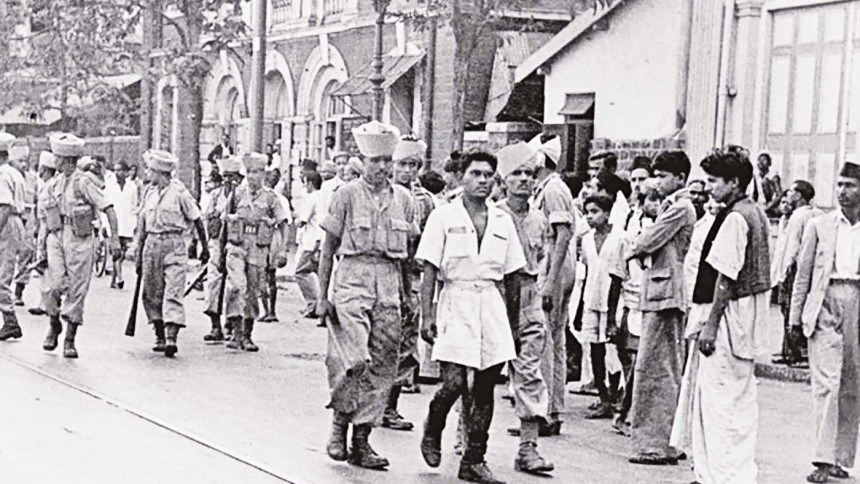
A sailor being arrested after the Naval mutiny.

One of the most important but undervalued events of India’s independence movement was the naval revolt of 1946, about which Indian historian Sumit Sarker wrote, “Had this insurrection succeeded, India’s struggle for freedom might have taken a different turn.” From February 18 to 23 that year, more than 20,000 ordinary sailors, known as ratings, and low-ranking officers of 74 warships and 20 installations took part in a strike, which was termed as a mutiny or rebellion.

After Bengal lost its independence at Palashi’s Mango grove in 1757, the British Raj in India faced two major armed revolts: the first one was exactly after one hundred years, the military revolt of 1857, and the second one was 189 years later, the naval mutiny. Both in 1757 and 1857, the freedom fighters were defeated by the arms and tactics of the British rulers, but the naval mutiny failed because of the politicians in India then. It was not only the ratings’ mutiny that the political leadership had decided not to support – the civilian uprising triggered by the naval mutiny, too, was condemned by them. The scale of the civilian uprising, if it happened in a post-colonial era, would have created a revolution or at least caused the fall of the government of the day.

Three days after the mutiny ended and the civilian uprising was crushed with brutal force, the then British Prime Minister Clement Atlee told the House of Commons on February 26, 1946, “I regret to inform the House that grievous loss of life, injury and destruction of property have resulted from all these disturbances. In Bombay, there have been 223 deaths and 1,037 persons have been injured. The total damage includes the looting or destruction of nine banks, 32 government grain and cloth shops which the public can ill-afford to lose, 30 other shops, 10 post offices, 10 police stations and 1,200 street lamps. The number of vehicles destroyed is not yet estimated. In Karachi, there have been seven deaths and 21 cases of injury. In Madras, up to last night, one person has been killed and another seriously injured” (Source: Hansard). 

Mr Atlee in his statement said, “Both Congress and Muslim League leaders cooperated in condemning and attempting to stop the disturbances, but the Communist Party issued a manifesto at midnight on Thursday thanking the public for its support.” It perhaps explains why, to this day, the political classes of the three countries born from the partition of India are not willing to admit their failure and give those mutineers and civilian martyrs their due credit. Therefore, in 2021, there was no big event in the subcontinent to mark the 75th anniversary of the naval revolt.

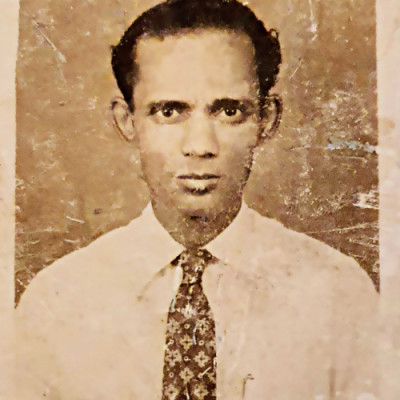
Mohammad Dewan Ali Nazir, Royal Indian Navy, Index no: 34499.

On a personal level, it’s ironic that, despite studying history at the country’s two top universities, I, too, did not take much interest in it during my student life. When I first heard of the rebellion from a mutineer, I had already taken a job and started my professional journey devoid of in-depth history. The mutineer I am talking about was my father, who spoke about his role and feelings about the lost cause during one of my short home visits. My father, Mohammad Dewan Ali Nazir (Royal Indian Navy, RIN, Index no: 34499) was one of the last 3,500 sailors and 300 sepoys who refused to surrender until the last on board of HMIS Akbar.

They were detained after surrendering and were released in August of that year. The mediation and the assurances given by the leaders of both Congress and Muslim League turned out to be nothing but betrayal. Though the uprising was a challenge to the Empire, shaking up the British imperial order, the leaders of the nationalist movement waiting to form an interim government through negotiations were not ready to derail that prospect.

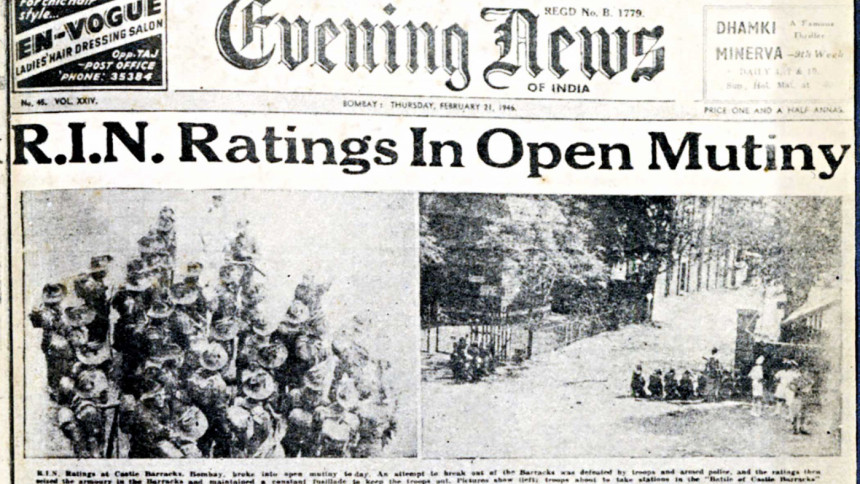
Newspaper clipping of the Evening News.

The leaders of the Congress and the Muslim League did not want a revolution – they wanted a peaceful transfer of power. Among the leading politicians, only Congress leader Aruna Asaf Ali extended her support to the ratings’ strike and tried to persuade her party leaders to take a stand in favour of the strikers, but failed in the face of opposition from Vallabhbhai Patel. On February 22, Vallabhbhai Patel sent a message to the rebels to surrender. Only the Communist Party of India came forward in support of the naval revolt and called a general strike. Reading the memoir of one of the key figures of the revolt, Balai Chand Dutt (BC Dutt), and a few other publications, one can easily imagine how much frustration and pain those mutineers felt because of the national leaders’ silence, which they saw as a betrayal. Perhaps it explains why my father, too, lost interest in politics and didn’t speak much about the heroic uprising that ended in a tragedy. 

Those nationalist leaders, including Gandhi, Jawaharlal Nehru and Muhammad Ali Jinnah, advised them “not to mix up ‘political demands along with service demands’; to ‘remain calm’ and to formulate to the naval authorities their service demands.”

But from the very beginning, those naval ratings were raising political demands – particularly, the Quit India slogan.

Their Charter of Demands asked for: 1. Release of all Indian political prisoners; 2. Release of all Indian National Army personnel unconditionally; 3. Withdrawal of all Indian troops from Indonesia and Egypt; 4. British nationals to leave India; 5. Actions against the commanding officer and signal bosonshead for rough treatment of the crew; 6. Release of all detainees (naval ratings); 7. Speedy demobilisation of the RIN ratings and officers; 8. Equal status with the British navy regarding pay, family allowances and other facilities; 9. Best class of Indian food; 10. No return of clothing kit after discharge from service; 11. Better treatment from officers to subordinates; and 12. Installation of Indian officers and supervisors. (Source: Meanings of Failed Action: A reassessment of the 1946 Royal Indian Navy uprising by Dr Valentina Vitali, University of East London, UK.)

Autobiographies of two rebels  – BC Dutt and Biswanath Bose – suggest that the then (undivided) India could have been a different place if the revolt of that day had succeeded. The rise of communal politics, the division and instability that is spreading in the states and society, would not have happened.

BC Dutt was one of the organisers of the HMIS Talwar, the ship where the mutiny started. He was arrested and tried for writing a new slogan on a ship on February 1, three weeks before the start of the February 18 mutiny. His book, The Mutiny of the Innocents, contains details of how political literature and pro-independence activities were organised much before their strike.

Biswanath Bose’s RIN Mutiny, 1946 also gives detailed descriptions of how the revolt unfolded. But politicians argued that the revolt was mostly due to the resentment among Indian ratings over low wages, poor quality of food and housing, which was lower than that of the Whites, and racial discrimination.

After the mutiny of 1857, the British rulers banned the entry and discussion of political leaflets in all forces, but BC Dutt used to secretly discuss political documents in the ship HMIS Talwar. Two months before the mutiny, on the Naval Day on December 1, when it was open for public visit, they wrote various slogans, including “Quit India” and “Jai Hind” on the ship. Explaining the reason why the mutiny failed, BC Dutt wrote that while all Europeans and Indians were stunned by the course of events and wondering if it was a revolt, unfortunately the political parties had nothing to say. When it was time to lower the British Union Jack and fly the Indian flag, they felt unprepared.

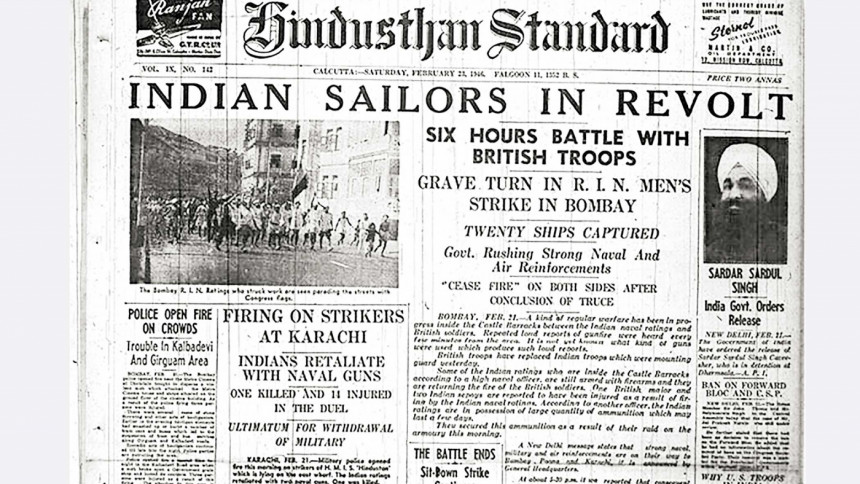
Newspaper clipping of the Hindusthan Standard

On February 22, 1946, when the nationalist leaders were busy arranging the ratings’ surrender, Prime Minister Clement Attlee told the parliament that the sailors had given political slogans and demanded that a political leader be given a chance to speak. He also said in the statement that Congress had nothing to do with the insurgency, but the communists and leftists could try to exploit sympathy.

William Richardson, a British researcher, writes in The Society for Nautical Research that the political movement for India’s independence was at the root of the revolt (The Mutiny of the Royal Indian Navy at Bombay in February 1946, May 1993).

Author of the book 1946: The Unknown Mutiny, Promod Kapoor wrote that the navies fell between the two aspirations of the two rulers. One side wanted their impending departure not to be tarnished by the stigma of rebellion. On the other hand, when power was imminent, the other rulers were anxious to see if there were any signs of chaos in the armed forces. Because in the future, they would have to manage these forces. 

Politicians assured that no one would be punished, no compensation would be paid, and steps would be taken to meet the demands. In reality, the opposite had happened. Rebel leaders were arrested, tried and punished. Other rebels were told to grab third-class train tickets to return home and to never return to Bombay again. Showing various excuses, deductions were made from salary arrears even for minor damages in their uniforms.

Biswanath Bose’s book gives a glimpse of how frustrated and angry these rebels became with the behaviour of the government and the breach of promises by the political leaders. He wrote, “If patriotism is a crime, then we must be criminals.” Expressing his frustration for not being reemployed in the Indian Navy, he wrote a letter to Prime Minister Nehru asking if there was any law banning his return to the force due to dismissal for taking part in the freedom movement, and how, as a leader of the Congress, Nehru could be the prime minister.

Nationalist leaders were so reluctant to give the mutineers their due credit, that the Indian government banned the Bangla play Kallol (Sound of the Wave), based on the mutiny, by playwright Utpal Dutt, and he was imprisoned. The play was first performed in 1965 in Calcutta at the Minerva Theatre and it drew large crowds.

At the beginning of the naval strike, a Central Strike Committee (NCSC) was formed by the representatives of the ships stationed in Bombay. The committee renamed the Royal Indian Navy as The Indian National Navy. The committee was chaired by Signalman MS Khan, and Madan Singh was the vice-president. One remarkable element of the naval rebellion was the unity of various faiths among both the naval force and the civilians who took to the street. They raised slogans “Hindu-Muslim unite” and “Inquilab Zindabad” on the streets of Bombay.

BC Dutt’s book also speaks of this communal harmony. He wrote, “We are from different regions, and from families of Hindu, Muslim, Christian and Buddhist, but after spending years in the Navy, we sailors have become Indians. The irony is that the politics of communal division and hatred is now intensifying across the subcontinent.

(After leaving the job of a naval instructor, my father joined the office of Indian Civil Supply, and after a short stay in Kolkata, he was transferred to East Bengal. He retired as a magistrate and died on August 29, 2001.)

Kamal Ahmed is an independent journalist and writes from London, UK. His Twitter handle is @ahmedka1

source: http://www.thedailystar.net / The Daily Star / Home> In Focus / by Kamal Ahmed / July 25th, 2022

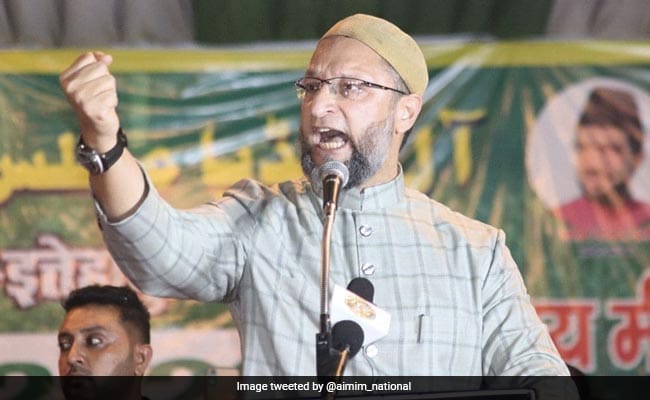
Asaduddin Owaisi’s AIMIM Wins 7 Seats In Madhya Pradesh Local Body Polls

Hyderabad, TELANGANA / MADHYA PRADESH :

Madhya Pradesh local body elections: In the first phase of the local polls held on July 6, Asaduddin Owaisi’s AIMIM won four seats.

Asaduddin Owaisi's AIMIM Wins 7 Seats In Madhya Pradesh Local Body Polls
Asaduddin Owaisi’s AIMIM contested civic body polls in BJP-ruled Madhya Pradesh for the first time

Bhopal: 

The All India Majlis-E-Ittehadul Muslimeen (AIMIM) on Wednesday won three seats in the civic body elections in Madhya Pradesh, taking its overall tally in the local polls held earlier this month in the state to seven.

In the first phase of the local polls held on July 6, the Asaduddin Owaisi-led party had won four seats, while in the second phase conducted on July 13, the counting of votes for which is currently underway, it won three seats so far, officials said.

The Hyderabad-headquartered party won these three seats in the Khargone Municipal Council (KMC).

This is for the first time AIMIM contested civic body polls in BJP-ruled Madhya Pradesh.

AIMIM’s Aruna Bai won from ward number 2 of KMC by defeating her nearest rival and BJP candidate Sunita Devi by a margin of 31 votes.

Aruna Bai, who belongs to the Scheduled Castes (SC) community, said she joined AIMIM as she was influenced by Mr Owaisi’s views on Dr Babasaheb Ambedkar.

Two other winners from the AIMIM are Shakeel Khan from ward 15 and Shabnam from ward 27 in KMC.

The BJP won 18 seats in the KMC, the Congress three and independent candidates eight.

In the first phase results on Sunday, the AIMIM won four seats – two in Jabalpur and one each in Burhanpur and Khandwa.

Mr Owaisi had addressed public meetings in Khandwa, Bhopal and Jabalpur to campaign for his party’s candidates for the polls held earlier this month.

The local body elections in Madhya Pradesh for 413 municipal bodies, including 16 municipal corporations, 99 municipal councils and 298 Nagar Parishads, were held in two phases – on July 6 and 13.

(Except for the headline, this story has not been edited by NDTV staff and is published from a syndicated feed.)

source: http://www.ndtv.com / NDTV / Home> All Indian / by Press Trust of India / July 20th, 2022

Mohammed Shakeb: Preserver of Mughal Archival Documents and Reconstructor of Libraries

Kokori, UTTAR PRADESH /Hyderabad, TELANGANA / London, U.K :

A tribute to a polymath historian who recently passed away.

Dr Ziauddin Ahmed Shakeb at the Qutb Shahi tombs in Hyderabad, October 2013. Photo: Author provided

I first met Dr Mohammed Ziauddin Ahmed Shakeb in the summer of 2011, as a naïve PhD student who’d arrived in Hyderabad from Los Angeles wanting to “read Shah Jahan’s documents”. He asked me the very standard question asked of research students in India, “What is your topic?”

I only had a rather incoherent answer to give to Shakeb, the man who had, among other things, created the Mughal Record Room, in what is today known as the Telangana State Archives. Located in a nondescript building at the periphery of the Osmania University campus in the dusty precinct of Tarnaka, this institution has undergone numerous transformations over the course of a half-century of its existence in Hyderabad. But institutions were often narrow and unimaginative places for sustaining a towering figure such as Shakeb. He went on to have a long and eclectic life and career that consistently defied the logic and constraints of institutions, for he was himself an institution. The loss of Shakeb is thus far more than the loss of an individual.

His was a formidable generation of post-Independence intellectuals from different parts of the subcontinent who, from the 1950s, devoted themselves to preserving its languages, repairing and reconstructing our scattered archives and libraries, and re-imagining our past(s) long before colonialism. Shakeb embodied, above all, a boundless curiosity coupled with a complete disregard for trends, ‘schools,’ cliques, and fancy theories.

He was not interested in being a Marxist or a nationalist nor in chasing the Western academy’s greener pastures. In some ways, his foremost allegiance was to the detritus of the past itself – to what paper, ink, and materiality mean and what they can tell us about our past and present selves. He asked, what a document or manuscript had gone through over centuries, how had it come to be, and how can we best preserve thousands of paper fragments for future generations so we can continue to tell their stories?

This rare commitment to the study and preservation of archival knowledge led him to write the landmark catalog, Mughal Archives Vol I: A Descriptive Catalogue of the Documents Pertaining to the Reign of Shah Jahan, in 1977, followed by many publications for The British Library, State Archives Andhra Pradesh, and other repositories, universities, and auction houses. I remember asking Shakeb once why he was so committed to creating reference tools to access rare historical materials, and he answered, “because I know no one will care to read them in the future!” In some ways, he was right.

Today, when the stakes for writing about the subcontinent’s pasts are fraught and closely tied to an ongoing project of hollowing out academic institutions, it’s worth remembering a very different kind of Indian historian.

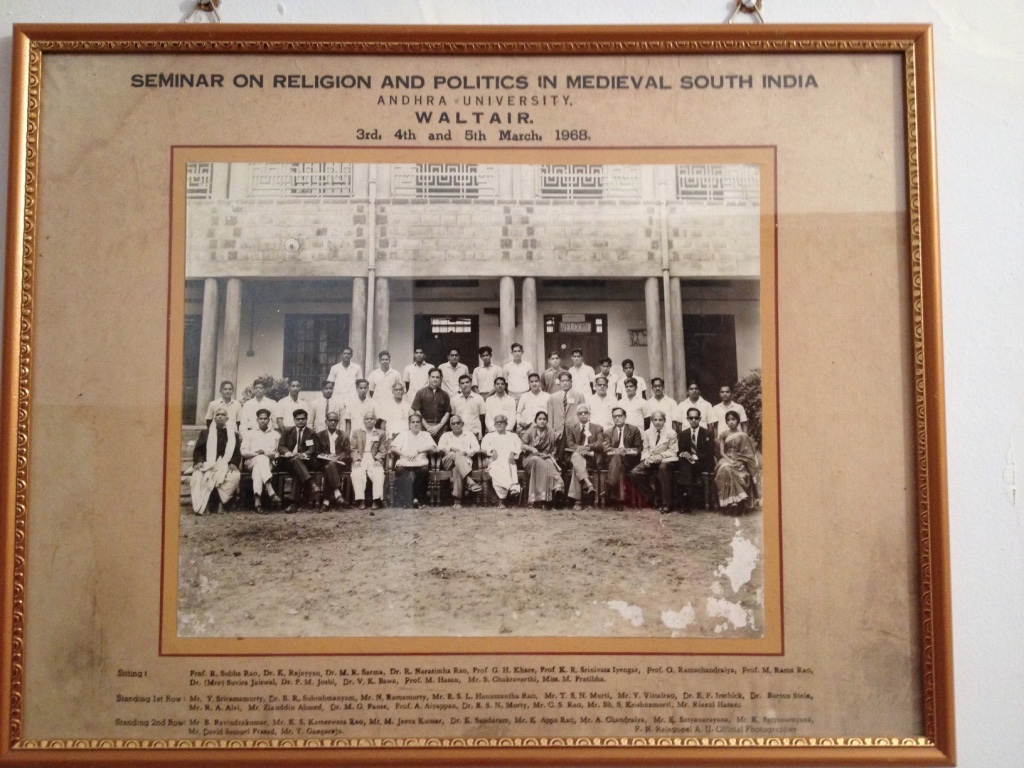
Shakeb standing in the second row, in a group photo from a conference in March 1968 at Andhra University, Visakhapatnam. Also pictured are G.H. Khare, Mohibbul Hasan, V.K. Bawa, P.M. Joshi, Suvira Jaiswal, Burton Stein, and Eugene Irschick, among others. Photo: Author provided

Born on October 21, 1933, Shakeb grew up in Hyderabad and Aurangabad. He studied Political Science and English at Osmania University before heading to Aligarh Muslim University in 1956 for his Masters, where he was taught by Mohammed Habib and S. Nurul Hasan. In 1962, he returned to the south where he was employed as an archivist at what was then known as the State Archives Andhra Pradesh. There, Shakeb acquired the unique training of deciphering documents and identifying their categories, genres, and forms from the last generation of the traditional jagirdari staff of the Nizam’s state who were retiring when he joined the archives. He also worked under Yusuf Husain Khan who had begun the work of processing Mughal administrative documents. The archives thrived under the directorship of committed scholar-administrators such as Hadi Bilgrami and V.K. Bawa.

As rich documentary caches from families, Sufi shrines, and samsthanams were discovered and deposited into state institutions, post-independence archivists and historians confronted challenges, including the reluctance of individuals to part with materials that had been in their homes for centuries. Debates and disputes ensued about what constituted a ‘valuable’ manuscript or document, how to classify materials, and to which regional-linguistic nationalism a remnant ‘belonged.’

These were debates that had already begun in the pre-Independence period, in the work of institutions like the Indian Historical Records Commission. Recent studies of the debates between Jadunath Sarkar and the Maratha historians have traced the longer history of such tensions. Part of the problem was the mutual suspicion between scholars oriented to modern social sciences and those with a more ‘traditional’ orientation and training. Shakeb, the archivist-historian, was at once both and neither.

At a distance from the halls of JNU and Aligarh, where the Mughal state’s merits were being debated, Shakeb inhabited yet another set of worlds. He was at ease reconstructing the household library of Chishti Sufi Abu’l Faiz Minallah in Bidar, discussing the southern India Cholas with the American historian Burton Stein, and discovering a shipwreck off the coast of Masulipatnam in the late 1960s.

Based on newly-processed materials, in 1976, he would complete his doctorate under P.M. Joshi at Deccan College in Pune, a connected history that examined circulation and political diplomacy between Safavid Iran, Mughal India, and the Golkonda sultanate. Shakeb’s study brought the question of mobility and exchange to the centre stage at a time when the norm was to study either the Mughal heartland (often synonymous with Delhi or the northern Indian plains) or select one province of the empire. After many years in archives and universities, Shakeb charted his own path beyond academia. His forensic ability for assessing manuscript provenance, material objects, and documentary genres, allowed him to thrive in other professional contexts, leading to work as a consultant for Christie’s in London.

But, to restrict myself to Shakeb the historian would fail to capture the range of subjects, languages, and disciplines over which he had complete mastery – Persian and Urdu literature, Islamic studies, geography, philosophy, linguistics, and art history. Shakeb always kept the historian’s arrogance in check by reminding her of the literary critic’s skills. The study of prosody and poetics was just as important for making sense of an India without and before English.

Dr Ziauddin Ahmed Shakeb (L) with his friend Dr Leonard Lewisohn (R) at Bidar fort in January 2012. Photo: Author provided

Literary circuits would light up the minute Shakeb landed back in Hyderabad (as they often would in London). He had been working for many years on translating Iqbal’s Persian poetry into Urdu. He was equally committed to the study of Bedil, Ghalib, Dagh, and Amir Minai. He would unveil to students the unique phonetics and cadence of Dakani, the pan-regional literary idiom of southern India, with many living poets and a long literary history, which he emphasised, is yet to be fully understood for its role in shaping classical and modern Urdu.

When he published his dissertation, Relations of Golkonda with Iran, in book form in 2017, he dedicated it to his grandchildren – Itrat, Taha, Mahamid, Khadija, Tawsin, Mahd, Istafa, Fatima, ‘Ali, Nuha – all of whom embody their dadasaab’s fortitude and resilience. I haven’t sufficient words to describe the patience of his wife, Farhat Ahmed, and the enormity of what she has taught me over many years about balancing the scholarly life with everyday living. It was this reminder that grounded Shakeb’s engagement with multiple worlds. His hands that treated every piece of archival paper like a newborn child. Lethal scoldings hurled at junior scholars too convinced of their own greatness. And, never forgetting to make fun of people who take themselves too seriously. With Shakeb’s passing, we are reminded how fragile the threads are that connect us to the past, and how dependent we are on a handful of such individuals. It’s difficult to imagine what, if anything, might come after such larger-than-life figures.

Subah Dayal is Assistant Professor at New York University’s Gallatin School of Individualized Study. Her research is on social and cultural histories of the Deccan and the Indian Ocean world.

source: http://www.thewire.in / The Wire / Home> English> Culture> History / by Subah Dayal / February 10th, 2021