In what is being called a historic day for the regional and national political landscape, Maulana Ahmed Wali Faisal Rahmani, Chief of Imarat-e-Shariah, led a powerful and united voice from Gandhi Maidan in Patna against the controversial Waqf Amendment Act under the banner of the “Waqf Bachao Dastoor Bachao” campaign.
Speaking to TwoCircles.net, Dr. Asma Zehra, a senior member of the All India Muslim Personal Law Board (AIMPLB), said, Maulana Rahmani has emerged as a bold and relevant figure in Indian Muslim leadership. His persistent campaign to protect Waqf properties—especially by mobilizing over 5 crore emails and launching district-level awareness efforts—brought unprecedented national attention to the issue. His approach, characterized by planning and ground-level execution, quickly gained respect across the country.
However, his rise was met with resistance. After facing internal pressures and being sidelined from the All India Muslim Personal Law Board (AIMPLB), he intensified his fight for the community. When he boycotted the official Iftar hosted by the Bihar government during Ramadan, it triggered political tremors. The response was swift and harsh—on the eve of Eid-ul-Fitr, Imarat-e-Shariah faced an orchestrated attack allegedly instigated by clerics backed by Nitish Kumar’s allies. The result was not just a physical assault but also a brutal attempt at character assassination, with questions raised about his position as Ameer-e-Shariat.
This division within the community gave political actors a chance to push the controversial Waqf Amendment Bill forward. With Nitish Kumar and Chandrababu Naidu’s support crucial to the BJP-led central government, the bill moved closer to becoming law. The betrayal left Muslims across India shocked and disillusioned. Yet, a ray of hope emerged: over 230 MPs, including members of the Joint Parliamentary Committee (JPC), stood firm in opposing the bill.
Despite being relatively new to high-profile political leadership, Maulana Rahmani demonstrated remarkable vision. He organized training workshops, built networks across districts, included youth voices, and effectively utilized media through the platform Fikr-o-Nazr, under the stewardship of Fazlur Rahim. His campaign became a grassroots movement aimed at protecting masajid, kabristan, and the constitutional rights of Indian Muslims.
When another attempt was made to seize control of Imarat-e-Shariah before Eid al-Adha, Maulana Rahmani countered with the bold decision to organize a mass gathering in Patna. Inviting Muslims from across the nation, the conference became a thunderous response to efforts aimed at weakening the Waqf and dividing the community.
While some believed this move was politically risky—especially with ongoing legal cases and criticism from within the AIMPLB—his resolve remained firm. With the support of his brother Fahad Rahmani (noted for Rahmani 30), community elders, political leaders, and religious groups, Maulana Rahmani mobilized thousands to raise a unified voice.
The contrast between his proactive approach and the passive stance of others was stark. Even as AIMPLB continued its meetings, its decision to not make Waqf a poll issue was seen by many as a concession to Nitish Kumar. In contrast, Maulana Rahmani’s stand was clear: Waqf and constitutional rights must be election issues to awaken political accountability.
The grand success of the Gandhi Maidan rally—graced by leaders from Congress, RJD, AIMIM, and Samajwadi Party—marked a new chapter. Maulana Rahmani himself spoke little, allowing the unity of voices to speak louder than words. His behind-the-scenes work and tireless engagement had already laid the foundation.
The rally was more than just a political gathering—it was a spiritual and symbolic moment of unity, resistance, and hope. It signaled the birth of a new phase in Muslim leadership in India, one rooted in vision, grassroots activism, and fearless advocacy.
May Allah protect Imarat-e-Shariah, strengthen the All India Muslim Personal Law Board, and unite the Ummah to resist all forms of division and oppression.
source: http://www.radiancenews.com / Radiance News / Home> Latest News> Report / by Radiance News Bureau / June 30th, 2025
Urdu periodicals, with their dwindling readership, often showcase uninspiring articles, predictable poetry, and pedestrian fiction.
Amidst mediocrity all around, there exists a pressing need for thoroughly researched and academically rigorous articles that challenge erroneous, yet widely accepted notions about the world around us.
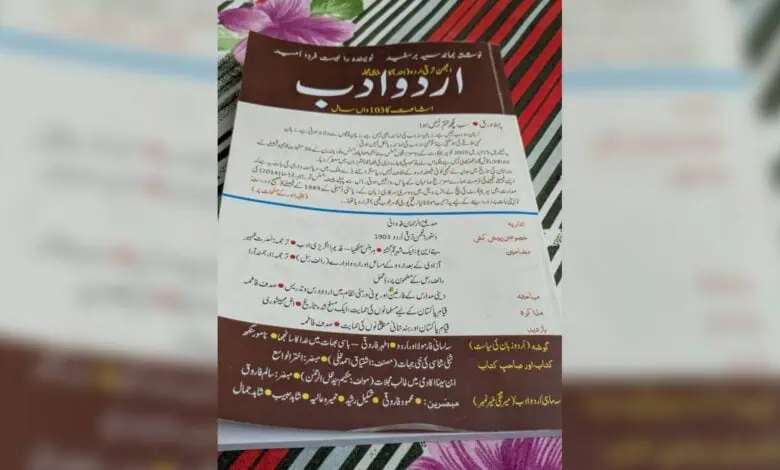
Some literary journals, including Bunyad (Lahore), Urdu Adab (Delhi), Isbaat (Mumbai), and Istefsaar (Jaipur), go beyond what common sense dictates. The latest issue of Urdu Adab, a quarterly publication of Anjuman Tarraqi Hind, bears testimony to this, as its content stimulates the intellect of its readers with a sense of exuberance.
The astutely edited journal by Ather Farooqui features three equally incisive and thoroughly researched articles on the much-maligned role of North Indian Muslims during the Partition, Madrassa students and understanding literature, and Namwar Singh’s tirade against Urdu. Unlike other run-of-the-mill literary journals in Urdu, the journal focuses on the dynamics and politics of language, which refers to the social and political implications of language use and the power dynamics inherent in cultural discourse. Also, it explores consequential questions related to culture and social consciousness. The influence of language on identity and the power dynamics inherent in cultural discourse also come under scrutiny in enriching academic discourse.
The overwhelming support of Muslims in the United Province for the Muslim League in the 1946 assembly elections, which was a sort of referendum on the partition issue, is often regarded as a truism; however, it does not sit well with veteran journalist and author Anil Maheshwari. Urdu Adab presents an article by him, “Support of Muslims for the Formation of Pakistan: A Distorted History: in light of the results of the decisive assembly elections in UP in 1946. Anil’s article, based on archival research, challenges the commonly held belief that the 1946 elections were a clear mandate for the Muslim League. He marshals many pieces of credible evidence that deflates the myth and suggests a more valid interpretation of the results.
Joining Ayesha Jallal (1994) and Christopher Jafferlot (2015), as well as a plethora of celebrated historians, Anil points out that Muslims in the United Province Assembly elections of 1946 did not vote overwhelmingly for the Muslim League. Voters comprising only 5% of the Muslim population cast their votes for the Muslim League, according to the official report of the 1946 elections. Placing the 1946 elections in the context of the universal adult franchise, he points out that only 3% of Indians could vote for the central assembly, while in the provincial assemblies, only 13% were allowed to vote. The article appeared in a reputed periodical, Economic and Political Weekly, laced with incisive interpretation, cogently concludes, “Had the partition of 1947 not occurred, Muslims would have constituted approximately one third of the population of an undivided Indian subcontinent. This demographic would have secured a majority in three to four states, providing them with a substantial and equitable stake in the political framework.”
A promising historian, Muhammad Sajjad, in his perceptive book on Muslim politics in Bihar, also connotes the same conclusion.
With an occasional rhetorical flourish, Anil inveighs against left historians for perpetuating this sort of falsehood.
Irfan Habib, Mazharul Hasan, and Bipan Chandra, too, did not place the onus entirely on Muslims, and HM Serwai’s book, Partition of India: Legend and Reality, provides an alternative understanding.
The article is supplemented with a stimulating critique by Sadaf Fatima, who holds the view that our reputed historians have glossed over the facts, thereby fostering anti-Muslim discourse. One tends to agree with the opinion that Indian Muslims got closely associated with Pakistan. The author seems too harsh when she accuses left historians of holding Jinnah mainly responsible for the partition, as they took Nehru’s side for personal interests.
It is a rare occurrence in Urdu periodicals for an article to spark such a polemical debate as Sadaf Fatima’s piece on madrassa graduates and the teaching of Urdu at universities. There is no denying the fact that most of the Urdu faculty at various universities are the product of oriental syllabi, who lack even rudimentary literary and aesthetic indoctrination. Curiously, the Madrassa’s students get admitted to a postgraduate course in Urdu literature. Sadaf Fatima makes this point pertinently and asserts, “It is incontestable that students are well short of foundational awareness about literature who join university as a postgraduate student of Urdu or opt for Urdu as an optional subject at the graduate level after graduating from a madrasa. Urdu literature does not appear in the syllabi of the madrassas. Urdu literature draws its sustenance from a literary culture that is composed of several local cultures and linguistic practices, reflecting centuries of shared heritage.
A student joining a madrassa at the age of 7 or so has no inkling of the cultural ethos of Urdu, which exists in his milieu.” Her cognate observation sparked controversy, and a smear campaign was launched against her and the editor, Ather Farooqui. Some well-meaning authors and journalists, including Ashar Najmi, Shakeel Rasheed, and Masoom Moradabadi, saw reason in her arguments. It is perplexing to see many vituperative postings on social media.
The author, while expressing deep concern for madrassa-educated students occupying positions in Urdu departments, made it clear that the solution does not lie in prohibiting their direct admission to courses in Urdu literature. There is an urgent need to equip students with literary and aesthetic sensibilities when they join the courses.
An exclusive section is devoted to the politics of the Urdu language, featuring two articles: “Three Language Formula” by Ahter Farooqui and a translation of “Basi Bhaat mein Kuda ka Sanjaha” by the prominent Hindi critic Namwar Singh. An avant-garde Hindi journal, Hans, published Namwar’s highly unreasoned and zealous article in 1987, and Athar Farooqui produced its Hindi text with the translation. In the introductory note, the editor points out that it unfailingly lays bare deep-seated venom against Urdu. Despite being committed to a shared linguistic and cultural legacy, Namwar Singh was bent upon declaring modern Hindi a separate language and restricting Urdu to Muslims only. It is the first instance when a cardholder Marxist critic launched a tirade against Urdu. The editor picked up many holes in the article; this aside, it has the traces of Namwar Singh’s speculative intelligence.
Ather Farooqui spelt out the contours of the three-language formula without taking recourse to official jargon and statutory regulations. An accomplished translator, Arjumand Ara produced an excellent translation of Ralph Russel’s insightful and detailed article on the Problems of Urdu and Urdu Organisations after the partition. Feedback on Russell’s article is also included.
Ather Farroqui deserves accolades for bringing out such an intellectually stimulating function.
source: http://www.siasat.com / The Siasat Daily / Home> Opinion / by Shafey Kidwai / June 21st, 2025
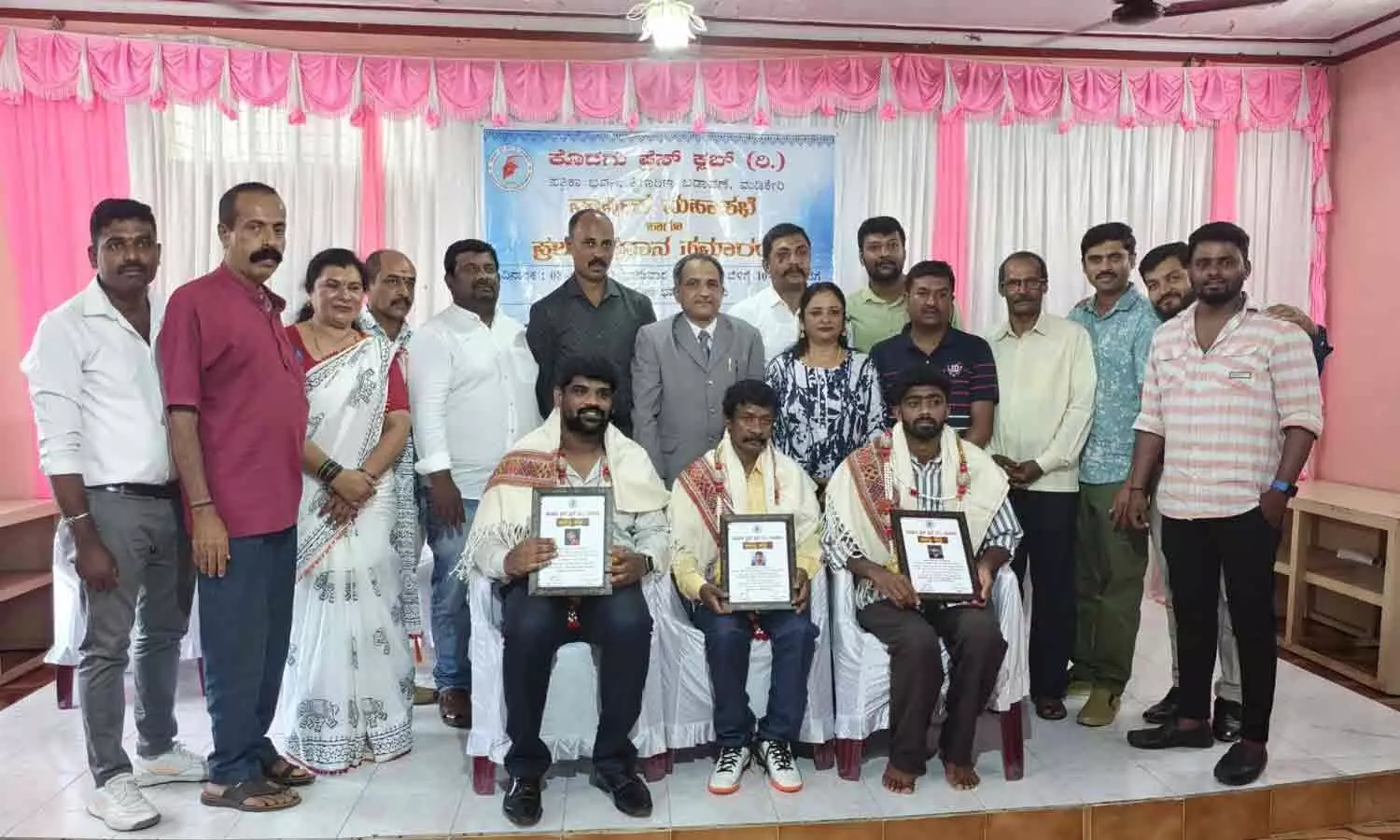
Journalist K.M. Ismail Kandakere has been conferred the Coovercolly Pushpalatha Chandrashekar Media Award by the Kodagu Press Club for his compelling human-interest report titled “The roof of Meena’s house is leaking.”
Madikeri :
Journalist K.M. Ismail Kandakere has been conferred the Coovercolly Pushpalatha Chandrashekar Media Award by the Kodagu Press Club for his compelling human-interest report titled “The roof of Meena’s house is leaking.”
The report narrates the harrowing story of Meena (16), an SSLC student from Mutlu village in Somwarpet taluk, who was brutally murdered by her fiancé Monnanda Prakash on May 10, 2024. Although the couple was engaged in April, Meena had opposed an early marriage to continue her education. Enraged by her resistance, Prakash allegedly attacked and killed her with a sickle at her home.
Ismail’s story went beyond the crime to highlight Meena’s dire living conditions. Her house, dilapidated and leaking during the rains, symbolized the poverty the family endured. The report resonated across Karnataka, prompting public outrage and swift political response.
Moved by the family’s plight, Madikeri MLA Dr. Mantar Gowda visited the bereaved parents in May 2024 and pledged to build a new home for them at an estimated cost of ₹8.5 lakh. True to his word, the house was completed and handed over to Meena’s parents on May 9, a day before her first death anniversary.
The award was instituted by senior journalist Coovercolly Indresh, along with his siblings Savitha, Sundresh, and Chandresh, in memory of their parents B.V. Chandrashekar and Pushpalatha. A corpus fund of ₹1 lakh was deposited with the Kodagu Press Club to support the annual award. The recognition includes a cash prize of ₹5,000 and a memento.
Ravishankar Nanaiah, Special Officer of Kodagu University, presented the award during a ceremony held at Patrika Bhavan in Madikeri on Sunday.
source: http://www.thehansindia.com / Hans India / Home> News> State> Karnataka / by Hans News Service / June 09th, 2025
When Ibrahim Saeed breathed his last in the quiet hours between May 26 and 27, 2007, it was not merely the passing of a leader – it was the end of an era. For the people of Karnataka, particularly those in the fold of Jamaat-e-Islami Hind (JIH), his death marked the departure of a towering moral force, a bridge-builder, and a man whose words carried the weight of wisdom and the warmth of sincerity.
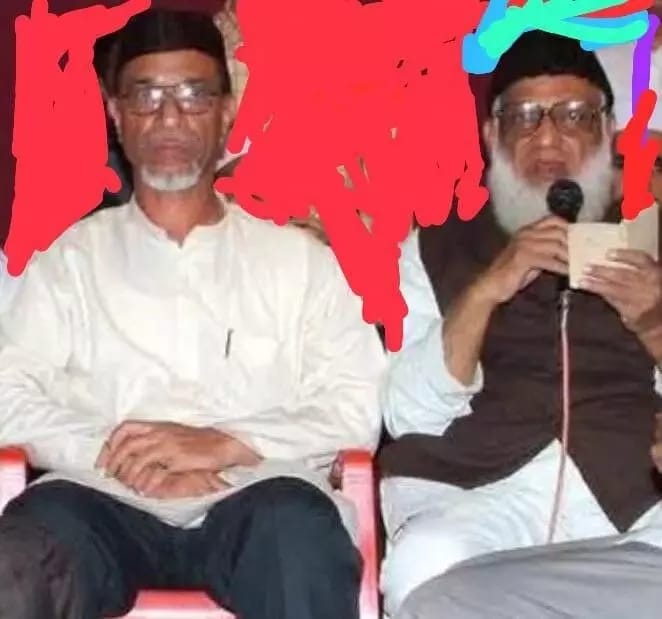
Ibrahim Saeed(L) with Maulana Sirajul Hasan, then Ameer Jamaat-e-Islami Hind
As a former President of JIH Karnataka, Ibrahim Saeed was not just a man of designation – he was a man of deep dedication. He led with humility, served with sincerity, and above all, connected with people at the human level. His leadership was rooted not in authority, but in affection.
A Childhood of Values, A Youth of Vision Born in coastal Karnataka, Ibrahim Saeed grew up in an environment where religious grounding and intellectual openness walked hand in hand. From an early age, he was drawn to the Qur’an, not merely as scripture to be recited, but as a message to be understood and shared. This foundational attitude remained the hallmark of his life-long da’wah journey.
His eloquence in Kannada and Urdu, coupled with a rare sensitivity to social realities, made him a powerful communicator. He spoke not to impress, but to illuminate. For young Muslims and for non-Muslim listeners alike, he offered Islam not as an ideology to be defended, but as a path of truth, mercy, and justice.
A Da’ee Who Belonged to All Perhaps the most defining feature of Ibrahim Saeed’s personality was his deep affection for all people, regardless of faith or background. His relationship with non-Muslim brothers and sisters was truly extraordinary. Whether it was participating in interfaith programmes, comforting victims of injustice, or simply walking the narrow streets of Mangalore or Udupi, greeting people with a smile – he was universally loved and respected.
He was never one to see da’wah as monologue. To him, it was dialogue – rooted in respect, empathy, and sincerity. His tone was always soft, yet his message never diluted. Non-Muslim intellectuals and activists often remarked on how deeply they admired his character, and how Islam seemed more beautiful when explained by Ibrahim Saeed.
His inclusive vision of Islam was most evident in the way he reached out to Dalit communities across Karnataka. He would often visit Dalit colonies, organising interactions with men and women in their own neighbourhoods. On one such occasion, a woman asked him plainly, “You are a Muslim. Why do you come to our colony and conduct programmes?” He replied with characteristic humility, “Dalits are the most marginalised communities in India, and Islam teaches that every human being is equal. I want to convey that you and I are the same – no discrimination, no untouchability.”
This brief yet profound exchange summed up the essence of his mission: to live and preach the Qur’anic message of human dignity, social justice, and equality.
Leading Without Holding On During his tenure as President of JIH Karnataka, Ibrahim Saeed steered the organisation with clarity of purpose and a focus on grassroots empowerment. He built bridges across regions, across communities, and across hearts. His vision was long-term: develop not only structures but people – individuals with integrity, faith, and commitment to social transformation.
What set him apart was his ability to let go. Even as his health declined due to terminal cancer, he made it a point to travel to Bangalore to formally hand over his responsibilities to his successor. It was a gesture that reflected his humility and organisational discipline. He believed in nazam or system, not in personality cults.
Courage in the Shadow of Death When the diagnosis of Stage IV lung cancer came, he did not flinch. His calm reply – “Alhamdulillah” – shocked even the doctors. He rejected aggressive treatments, choosing instead to accept Allah’s decree and live his remaining days with dignity and devotion.
Despite his declining health, he continued to write, meet people, and offer guidance. He even addressed national-level meetings, delivered Qur’anic lectures in towns like Uppinangady, and met with activists who sought his counsel. His final I’tikaf – spent in the Kutchi Memon Masjid – fulfilled a long-held yearning and marked a full spiritual circle.
His close friends recall that even in moments of physical weakness, his humour remained intact. His conversations were never heavy with sorrow. They were light with grace.
A Funeral Like No Other When the end came, the grief was personal and collective. People poured in from every district of Karnataka. The Janazah at Central Juma Masjid in Mangalore drew an unprecedented crowd – cutting across class, creed, and political affiliations. Senior leaders like H.D. Kumaraswamy, Mallikarjun Kharge, Jaffer Sharif, and Roshan Baig came to pay their respects. Rahman Khan embraced his son and said what many felt in their hearts: “We’ve lost a rare gem.”
A Legacy of Light Today, Ibrahim Saeed lives on – not only through his family and writings, but through the countless people he inspired. He lives in the students who remember his compassionate words. He lives in the non-Muslim neighbours who saw Islam’s beauty through his actions. He lives in the members of JIH Karnataka who still consider him a moral guide and fatherly mentor.
In a time when voices grow louder but less sincere, when leadership is often reduced to branding and bravado, the life of Ibrahim Saeed stands as a timeless example of principled activism, prophetic wisdom, and universal compassion.
His passing left a void that perhaps no one can fill – but his legacy lights the path for those who dare to walk it.
[With input from Mohammed Markada and Ameen Hassan]
source: http://www.radiancenews.com / Radiance News / Home> Focus> Pride of the Nation> Personality / by Mohammed Talha Siddi Bapa / May 30th, 2025
Amna Asim receiving the best paper award at Jesus and Mary College, DU
Aligarh:
Amna Asim, a first-year MA History student at the Centre of Advanced Study, Department of History, Aligarh Muslim University, won the Best Paper Prize at the release event of Maazinama Volume IV, held at Jesus and Mary College, University of Delhi.
Her research paper, titled “Memory and Resistance: Tracing India’s Counter-Monumental Legacy through Jallianwala Bagh,” was also published in Maazinama Volume IV, the annual academic journal of the Department of History, Jesus and Mary College. The paper explores the concept of counter-monuments as powerful symbols of collective memory and resistance, with a focused analysis of Jallianwala Bagh’s historical and cultural legacy.
Judges Dr. Devika Mittal and Dr. Bipasha Rosy Lakra appreciated her research and the methodology employed.
Prof. Hassan Imam, Chairperson and Coordinator of the Centre of Advanced Study, Department of History, AMU, congratulated Amna Asim on her achievement and praised her for earning this scholarly recognition.
source: http://www.radiancenews.com / Radiance News / Home> Pride of the Nation> Awards / by Radiance News Bureau / May 16th, 2025
The discovery of 1,700 Mysore rockets belonging to the 18th century gives a fillip to the argument that Tipu Sultan was a progressive king who made great advances in arms technology and was a formidable bulwark against the British East India Company in south India.
Rudrappa Shejeshwara, the curator of the Government Museum (Shivappa Nayaka Palace), Shivamogga, showing the rockets.
THE Congress-Janata Dal (Secular) coalition government in Karnataka has decided to continue the commemoration of the 18th century Mysore ruler Tipu Sultan’s birthday on November 10 as Tipu Jayanti. Ever since the Tipu Jayanti celebrations began in 2015 when the Congress, headed by Siddaramaiah, was in power in the State, the Bharatiya Janata Party (BJP) and right-wing Hindutva groups that accuse Tipu Sultan of being a religious bigot have opposed them vehemently.
As preparations for this year’s event began, Pratap Simha, the BJP Member of Parliament from Mysuru, asked Chief Minister H.D. Kumaraswamy not to go ahead with Tipu Jayanti as it hurt Hindu religious sentiments.
The allegations that Tipu Sultan was a religious bigot were examined in detail in the previous issues of Frontline . The article titled “Contested legacy” (December 11, 2015) provided an overview of Tipu Sultan’s reign and his role in fighting the British East India Company. The article “Tipu–Fact & Fiction” (January 6, 2017) discussed the accusation that Tipu Sultan had forcibly converted Kodavas of Kodagu, and “Tipu in Malabar” (January 5, 2018) examined the charge that the Mysore ruler had committed religious excesses in what is today north Kerala.
Tipu Sultan and, before him, his father, Hyder Ali, ruled Mysore for a brief period, between 1761 and 1799, but left a lasting impression on society and polity in the region. Both of them consistently opposed the British and fought four wars (known as the Anglo-Mysore Wars) against the East India Company. Hyder Ali was a perceptive and ambitious leader, but Tipu Sultan’s fame transcended that of his father. Tipu Sultan died on May 4, 1799, battling British soldiers, thus establishing his legacy as one of India’s earliest fighters against colonialism. It is for this reason that he is still feted.
Ever since Tipu Jayanti began to be marked, there has been an overwhelming focus on Tipu Sultan’s religious policies, with scores of articles written on the theme, but what has not been examined substantially is another important aspect of his reign. During his brief rule, he attempted to bring about significant modernisation in a number of areas through the establishment of an industrial state. This includes advances in arms technology, a continuation from Hyder Ali’s time that would eventually have a global impact.
Of all the advances that Tipu Sultan and Hyder Ali made in creating a modern army with lethal weapons, the rockets that were used against the British during the Anglo-Mysore Wars have left an indelible impression for two reasons. First, the rockets caused tumult and bedlam in enemy ranks. English soldiers have chronicled this aspect of Tipu Sultan’s warfare. For instance, the use of these rockets was the chief reason for the victory of the Mysore Army in the Battle of Pollilur (1780) in the Second Anglo-Mysore War. Rockets were also used subsequently, as documents show. Tipu Sultan’s army even had dedicated companies of rocket men. Colonel Bayly, a British officer, writes vividly about the havoc these Mysorean rockets caused as his regiment faced off Tipu Sultan’s army on April 5, 1799.
He wrote: “The ground of encampment was on the upper part of an inclined plane, at the foot of which, on the opposite bank of the River Cauvery, stood the proud fortress of Seringapatam, at three miles’ distance, from whence they already began to throw shot from guns of a huge calibre, and so pestered were we with the rocket boys that there was no moving without danger from these rocket missiles…. The rockets and musketry from upwards of 20,000 of the enemy were incessant. No hail could be thicker. Every illumination of blue lights was accompanied by a shower of rockets, some of which entered the head of the column, passing through to its rear causing deaths, wounds and dreadful lacerations from the long bamboos of twenty or thirty feet, which are invariably attached to them. The instant a rocket passes through a man’s body it resumes its initial impetus of force, and will thus destroy ten or twenty until the combustible matter with which it is charged becomes expended. The shrieks of our men from these unusual weapons was terrific; thighs, legs, and arms left fleshless with bones protruding in a shattered state from every part of the body, were the sad effects of these diabolical engines of destruction” (“Diary of Colonel Bayly: 12th Regiment” by Colonel Bayly, 1896).
The second reason is that Tipu Sultan’s rocket was the progenitor of the superior “Congreve” rocket, which was subsequently used by the British in the 19th century. The Mysorean rockets were found after the fall of Srirangapatnam and were transported to England, where they were studied closely.
About this, Roddam Narasimha, an aerospace scientist, writes that the Mysore “…rockets made an extraordinary impression on the British, and led, from 1801, to what would now be called a vigorous research and development programme (at the Royal Woolwich Arsenal). Sir William Congreve made systematic studies of propellants, analysed performance applying Newton’s laws, developed a series of rockets of different sizes and characteristics, made a comparative cost analysis and published three books on the subject. Rockets were soon systematically used by the British during the Napoleonic Wars and their confrontation with the U.S. during 1812-14.” ( Rockets in Mysore and Britain, 1750-1850 A.D. by Roddam Narasimha, 1985.)
Monumental find
Considering that these rockets marked a profound moment in the history of armaments, there were surprisingly few extant samples available. Only five iron-case Mysore rockets were known to be available for more than two centuries. Of these, three were housed at the Government Museum, Bengaluru, while two were at the Royal Artillery Museum, Woolwich Arsenal, in England. The three kept in Bengaluru were incomplete as they were mere shells. So, when in July this year a cache of 1,700 iron-case Mysore rockets from Hyder Ali’s or Tipu Sultan’s era was found, it was nothing short of a monumental discovery.
“The rockets were found in and around a large well owned by a farmer named Nagaraja Rao in Nagara village,” said Rudrappa Shejeshwara, the curator of the Government Museum (Shivappa Nayaka Palace) in Shivamogga. Nagara is around 80 kilometres from Shivamogga town in western Karnataka and was an important town in the 18th century. The site was chosen for excavation as a chance discovery at the same location a few years ago had revealed 160 rockets. They were not identified immediately, but were recognised subsequently as the famed Mysore rockets of Hyder Ali and Tipu Sultan. The State’s Department of Archaeology, Museums and Heritage, sanctioned an expedition and this led to the discovery of a larger cache of rockets.
The rockets are housed at the Government Museum in Shivamogga. They are not uniform and vary in length, measuring between half a foot and one foot. The small ones weigh about half a kilogram while the larger ones can almost weigh up to 2 kg. While some can be grasped easily, there are a few that are so thick that it is not possible to grasp them. It is remarkable that the farmer did not sell the rockets, which look like unusual pestles, as scrap. Nagaraja Rao actually had the foresight to communicate the information to the Archaeological Department.
While the fact that the Mysore rockets were a pioneer in arms technology is known, detailed tests on the rockets had not been conducted before simply because there were not enough samples to conduct tests. With the Shivamogga find, it became possible for the first time to conduct a thorough examination to find out what made these projectiles provide a fillip to the strength of the Mysore Army. Nidhin G. Olikara, an independent researcher based in Shivamogga, and Shejeshwara have sought to study just this aspect. They have co-authored a paper on their recent findings (“Rockets from Mysore under Haidar Ali and Tipu Sultan: Preliminary Studies of ‘Tipu Rockets’ from the Nagara Find” by Rudrappa Shejeshwara and Nidhin G. Olikara published in Journal of the Arms and Armour Society , Vol. XXII, No.6, September 2018).
Olikara explained how the rockets worked. He picked up a piece of paper and made a cylinder out of it. “Steel plates were folded into cylindrical tubes like this. Then, they were coated with clay, as this would act as a thermal insulator, and then stuffed with saltpetre and sealed at both ends with metal discs,” he said, as he cut two circular strips of paper and wedged them on the ends of his paper tube.
Pointing to the rockets, in which a tiny hole that has been sealed can be discerned, he said: “A fuse, most probably made of silk as these rockets were used even during the rainy season, was then tightly inserted perhaps by using a tool, which we found at the site. The rocket would then be tied to a bamboo staff with leather strips,” Olikara said. He pointed to a painting by Robert Home, called “Mysore rocket man”, which is currently in the collection of the Victoria and Albert Museum in London. “Once the fuse was lit, the rocket would travel for two to three miles,” he said.
The Mysore rulers, he said, used different kinds of rockets. While some would fly through the air before landing on enemy ranks, others would whoosh through the enemy lines at knee level. There were also swords attached to some of these bamboo poles, thus making them deadlier as they scythed through the disciplined lines of East India Company soldiers.
What is more interesting about these rockets is that they were not cast from a mould but forged from steel sheets that contained a very low level of carbon, which in itself was a grand technological advancement for the time.
Olikara and Shejeshwara write: “There can be no doubt that the Mysorean Rocket with its ferrous metal case and deployment in large numbers was unparalleled anywhere else in the world. It represented the pinnacle of Mysore’s technological prowess and its capability to experiment and innovate. It also showed that Mysore possessed the prerequisites to manufacture iron-cased rockets on an industrial scale. As a consequence of such qualities, Mysore was able to stem the colonial tide for twenty years whilst internecine strife was sweeping most other Indian states into the subjection of Britain.”
Why were so many rockets found in Nagara? Nagara was an important town of the Keladi empire. Hyder Ali conquered it in 1759, expanding the power and wealth of the Mysore kingdom substantially. Thus, it is not surprising that Hyder Ali and, subsequently,Tipu Sultan set up a manufacturing unit in the region.
T. Venkatesh, Commissioner, Karnataka’s Department of Archaeology, Museums and Heritage, who oversaw the discovery in July, concurred with this. He said: “While we are not yet certain about why the rockets were found at this location, we strongly suspect that a manufacturing unit must have been located in the vicinity.”
Ajay Kumar, an independent researcher based in Shivamogga, painstakingly began to work with the knowledge that a manufacturing unit had to be present in the region. Using Google satellite imagery, he identified spaces close by that had large quantities of iron slag. Going back and forth from contemporary chronicles of the 18th century to travelling around in the region, Ajay Kumar took six months to piece together his findings.
“To manufacture these rockets, you needed iron ore, saltpetre, bamboo, silk wicks, strips of leather, limestone, charcoal and clay. Based on my research, I have identified five sites in the villages of Tammadihalli and Chittihalu [pronounced as Chattanhalli by locals], which are 60-65 km from Nagara, as possible manufacturing units. We can also see pieces of iron in these iron slags that must have been part of the tuyere required for iron smelting,” he said.
It is unclear why these rockets were discarded in a well, but the serendipitous finding tangibly reinforces the idea of Tipu Sultan as a progressive king who used modern weapons. He was the last bulwark against the East India Company’s push to rule India directly.
At an event held in Bengaluru on October 30, the BJP’s national spokesperson, Sudhanshu Trivedi, said Tipu Sultan was a killer of Hindus. He said he would urge the Union Railways Minister to rename Tipu Express, which runs between Bengaluru and Mysuru.
The BJP’s opposition to the celebration of Tipu Sultan’s legacy stems from his Muslim identity. But it is not possible to disregard the various contributions he made to the region and to rocket technology. Hyder Ali and Tipu Sultan made a deep impact in the area of southern Karnataka, which formed the nucleus of their kingdom.
source: http://www.frontline.thehindu.com / The Hindu / Home> India> Discovery of Mysore Rockets / by Vikhar Ahmed Sayeed recently in Shivamogga / November 08th, 2018
In Tamil Nadu, opposing illegal mining can be fatal. Most murders are buried as accidents, while the mafia thrives on political backing.
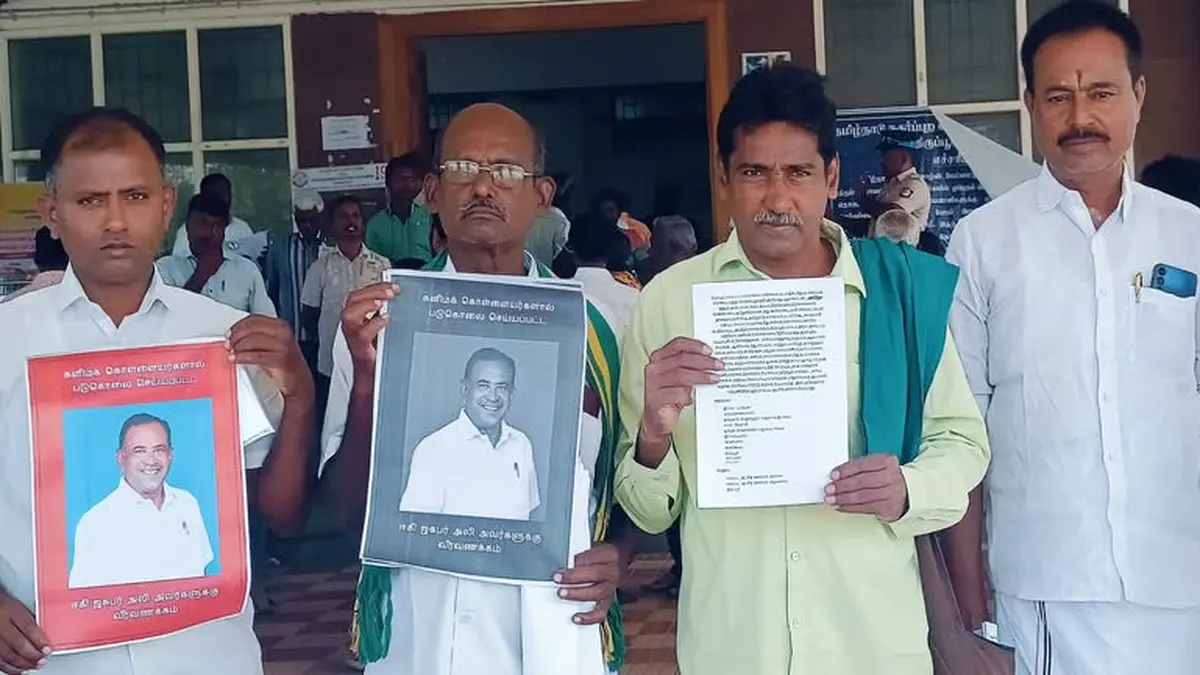
Anti-quarry activists carrying portraits of Jagabar Ali, who was killed by the mining mafia, at Tiruppur Collectorate. | Photo Credit: By Special Arrangement
Tamil Nadu has seen a spate of cold-blooded murders of activists who oppose mining across categories—whether the mining of stone, granite, river sand, or beach sand. Powerful gangs operate these businesses, concentrated in Madurai, Pudukottai, Tirunelveli, Erode, and Krishnagiri districts, and they deal with all opponents ruthlessly, whether they are residents, activists, whistle-blowers, or officials. There is an enormous amount of money at stake, which ensures that concerns about ecological damage, biosphere disruption, or the loss of livelihoods and habitats barely register.
Frontline studied a list of deaths and found an ominous pattern of targeted violence, official apathy, and impunity for the mining mafia. The first sinister pattern is that monstrous 40 tonne or 60 tonne dumper and tipper trucks are the most common dispensers of death. Paid killers are used sometimes, but most of these mafia-orchestrated murders are staged to look like hit-and-run accidents. In many cases, they are quietly recorded as such, leading to widespread allegations of collusion between the Tamil Nadu Police and the gangs.
The killing of 58-year-old Jagabar Ali, whose story our lead piece records, followed the same script: he was run over by a tipper lorry on January 17, 2025. After offering namaz at a mosque, Ali was returning home on his motorcycle when a truck rammed into him head-on on an otherwise deserted street. He was killed instantaneously.
Ali is the latest in a growing list of deaths of those who fight the mining mafias. R. Jeganathan, a farmer from Kuppam in Karur district, who had demanded the closure of illegal stone quarries in his neighbourhood, was run over by a quarry truck near K. Paramathi in September 2022.
The incident took place one day after the quarry, located at Kalipalayam village near Kuppam, was shut down. The truck that rammed into his scooter and killed him on the spot belonged to the same quarry.
R. Jeganathan, a farmer from Karur, who had demanded the closure of illegal stone quarries in his neighbourhood, was run over by a truck in 2022. | Photo Credit: By Special Arrangement
Activists such as R.S.A Mughilan, convenor of the Tamil Nadu Environment Protection Movement, as well as Jeganathan’s family and friends staged a series of protests in Karur demanding a probe. The police finally arrested three people, including the quarry owner, detaining them under the Goondas Act.
In 2022, an activist named Mani was run over by a lorry at Kavalkinaru in Tirunelveli district. The case was closed after being labelled an accident. On May 12, 2024, Natarajan, a farmer from Sarkar Kathankanni village near Uthukuli in Tiruppur district, narrowly escaped a similar attempt on his life.
The Uthukuli Police initially refused to even register a complaint. After five hours of persistence, the police gave Natarajan a CSR (Community Service Register) copy. When there were further protests, the police reluctantly registered an FIR on August 26, 2024, 100 days after the attempt on his life. “The police are now pressing me to sign a document claiming that the culprits are ‘untraceable’. I have refused. They are very much here, loitering in the neighbourhood. I live in fear,” he told Frontline.
B. Tamilselvan, an environmental activist from Erode district, escaped death when thugs hired by illegal quarry miners assaulted him in 2022. | Photo Credit: By Special Arrangement
On May 4, 2022, B. Tamilselvan, an environmental activist from Ekkadampalayam in Chennimalai in Erode district, escaped death when thugs, hired by illegal quarry miners, assaulted him with iron rods at an Internet centre. Tamilselvan had raised the issue of illegal quarrying at a village gram sabha meeting, which led to the closure of a quarry. Police filed a case against some unidentified people the next day. Nothing happened thereafter, and illegal quarrying continued.
Tamilselvan claimed that a local All India Anna Dravida Munnetra Kazhagam (AIADMK) functionary who owned the quarry was behind the attack. He told Frontline: “We knew the assailants. But the police did not take it seriously. We had to fight to get the FIR registered. I am still suffering from the injuries I sustained on my shoulders and head.” The Tamil Nadu Police have closed many such cases as “accidents”. “We have to fight to even get them registered as ‘suspicious deaths’,” said Venkalapalayam Natarajan, an anti-quarry activist.
It is not just stone quarry operators—illegal river sand smugglers also adopt the hit-and-run method to eliminate those who challenge their operations, with their victims even including high-ranking government officials and police personnel. For instance, in April 2003, Revenue Inspector R. Shanmugasundaram was run over and killed by a lorry transporting sand illicitly mined from the Palar riverbed near Palayaseevaram in Kancheepuram district.
In September the same year, Tahsildar G. Punniyakodi lost his life when he tried to stop a lorry illegally transporting blue metal from Erumaiyur, also in Kancheepuram. He too was run over.
On December 11, 2004, R. Venkatesan, Deputy Tahsildar of Tirukazhukundram, was killed when a sand-laden lorry ran him over at Manapakkam village.
On July 20, 2014, G. Kanakaraj, 43, a head constable attached to Thakkolam Police Station near Arakkonam in Vellore district, was run over by a lorry when he attempted to stop a tractor that was transporting sand illicitly mined from the Kosasthalaiyar river. Five officials, including the Tahsildar of Aavudaiyarkoil, Ravichandran, and four of his assistants, had a miraculous escape when a lorry rammed into their car near Pudukottai in September 2014.
Similarly, the killing of Srivaikundam’s Village Administrative Officer, Y. Lourdu Francis, on April 25, 2023, by a river sand mafia sent shock waves across the State and led to widespread protests by revenue officials. Francis, an upright officer, was opposing illegal quarrying in the Thamirabarani river and had registered a case against illicit sand miners in the village.
In the case of Francis, the police completed the investigation quickly and filed a charge sheet, with legal proceedings also moving quickly, and the Principal District Judge of Thoothukudi awarding life imprisonment to two miners on September 15, 2023. But this was one of the rare cases where the police, revenue, and mining departments worked in tandem to bring the culprits to justice.
Most of the time, the killers get away scot-free. Not surprising, given that a background check on those behind most of the attacks and murders often reveals the surreptitious involvement of individuals with political affiliations or links to their cronies.
If Jagabar Ali was a member of the AIADMK, the farmer Jeganathan was a Dravida Munnetra Kazhagam (DMK) supporter who served as the party’s branch secretary and was also a close associate of senior party functionaries. But, as in Ali’s case, the DMK maintained a stony silence over Jegannathan’s murder.
The truth is that the lucrative business of mining stone, granite, and beach and river sand is in the hands of individuals who have strong connections to politicians of all hues.
source: http://www.frontline.thehindu.com / The Hindu / Home> Environment> Illegal Mining / by Ilangovan Rajasekharan / April 23rd, 2025
Chhotu Chaiwalla was in Nahur when burglars broke into his Wadala house.
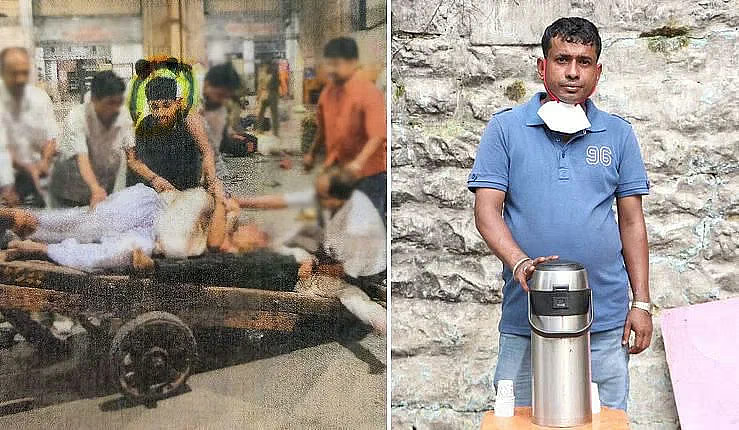
Burglars broke into the house of 26/11 hero Mohamed Taufiq Sheikh, popularly known as Chhotu Chaiwalla, and stole the tthe trophies he had received for his bravery during the 2008 Mumbai terror attack. They also took away a TV, jewellery, cash and documents from Sheikh’s house in Wadala.
According to the FIR registered by Sheikh, he has two houses – one in Wadala and the other in Nahur. On October 31, Sheikh had left his Wadala house to live in Nahur as he was scheduled to attend a wedding in Kalyan on November 2.
At 11 am on Monday, Sheikh received a call from his neighbour in Wadala about the suspected theft in his house. The neighbour told him that the door of his house appeared to be dented
“I was about to leave for Kalyan when I received the call. I immediately cancelled the plan, and headed to Wadala. On reaching Wadala, I found that the latch of the door was broken and the door was dented. I then opened the lock and entered the house only to find it ransacked. The iron cupboard had been broken. A lot of items were missing from the house, , including two trophies that I had received after 26/11 terror attack. Other items that the burglars took away included a TV, gold earrings, some cash, brass utensils, clothes that I had bought recently and documents of my children”, Sheikh said.
Sheikh told Mirror that there could be other items, too, missing from the house as he has not able to assess the damage since his wife and children are away.
Shaikh approached the police which registered an FIR under relevant sections of Indian Penal Code for housebreaking and theft.
Sheikh said that he was already in financial stress due to the lockdown, and the burglary has added to his problems. “I am most hurt by the loss of the trophies which were so dear to me.”
Mirror had earlier reported how after being driven to frustration by lack of business and mounting debt, Sheikh was all set to wind up his life in Mumbai and return to Bihar.
Sheikh, who took the injured from CSMT’s long-distance section on a hand-cart to St George’s Hospital while Ajmal Kasab and Ismail Khan were still targeting people in the suburban section of the station, had not only seen his life’s savings disappear during the lockdown, but also a debt of over Rs 3 lakh accumulate.
Sheikh had a narrow escape in the 26/11attack. He was standing outside the station master’s cabin when Kasab and Khan began firing. He hid in the cabin and played dead when Kasab came in spraying bullets.
source: http://www.mumbaimirror.indiatimes.com / Mumbai Mirror / Home> Mumbai> Crime> 26/11 Hero / by Sachin Haralkar and Vallabh Ozarkar / November 03rd, 2020
The famous chai wala is now grappling with a significant setback in his tea business, burdened by loans amounting to approximately ₹20 lakh.
Mohammad Taufik Shaikh | File pic
Mumbai:
Mohammad Taufik Shaikh, also known as Chhotu Chai Wala (38), gained recognition for his heroic actions during the 26/11 attacks when he saved around 10 individuals. Unfortunately, he is now grappling with a significant setback in his tea business, burdened by loans amounting to approximately ₹20 lakh.
Chottu chai wala’s heroic tale
Operating a tea stall near Saint George Hospital outside Chhatrapati Shivaji Maharaj Terminus, Shaikh was aged 25 during the Mumbai terrorist attack. Initially thinking the loud sounds were firecrackers due to an India vs South Africa cricket match, he soon realised the severity of the situation. Taking swift action, he closed the ticket counter gate, warned others, and evacuated the area, claiming he faced three bullets fired by Kasab.
Recalling the incident, he mentioned, “The first bullet broke the office window, the second hit the table, and then I had to lie down on the floor. Later, I called my wife, telling her I was in danger and might not survive. I contacted the Railway police on the phone.”
He continued, “After some time I came out of the station and saw people lying on the floor, bullets had hit them. I carried those who were alive.” He also assisted an injured officer and admitted him to the Railway Hospital in Byculla.
The subsequent pandemic dealt a severe blow to his business, almost shutting it down. To survive, he borrowed money, accumulating a debt of around ₹20 lakh. Despite attempting to mortgage his MHADA home, banks refused to provide loans. Struggling, he shared, “Currently, I am doing my business on credit.”
Financial support promised post 26/11
Post the 26/11 incident, promises of financial support poured in, with many railway officers assuring him of a job. Despite being felicitated by the Railway in Delhi, he realized later that the job offer never materialized.
Reflecting on the experience, Shaikh emphasized the need for individual alertness, stating, “Terrorists do not have any religion, they have the mentality to die or to kill people. I pray that an attack like this never occurs again.”
Residing in Nahur with his family, Shaikh came to Mumbai at an early age from Mujhaffarpur, Bihar, due to financial difficulties after losing his mother.
source: http://www.freepressjournal.in / The Free Press Journal / Home> Mumbai / by Megha Kuchik / November 23rd, 2023
University Women’s Polytechnic Students Shine at National Project Competition, Win First Prize at MITAOE, Pune
Aligarh:
Students from the University Women’s Polytechnic, Aligarh Muslim University (AMU), made a mark at the 8th National Level Poster Presentation and Project Competition, TechnoPHILIA’25, held recently at MIT Academy of Engineering, Pune.
Competing against participants from over 25 institutions across India, the AMU team, “LISA VocalTech,” clinched the first prize in the Diploma Category, along with a cash award for their innovative project titled “LISA: A Voice-Controlled Lift.”
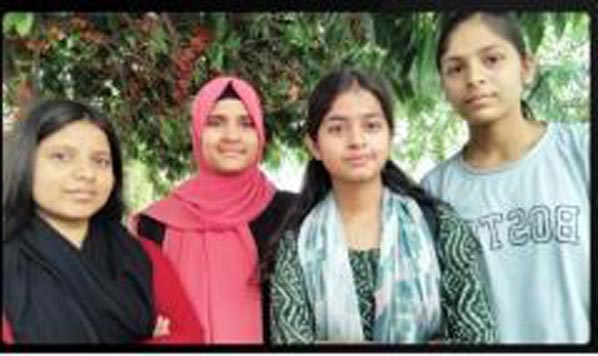
The team comprised final-year Diploma in Electronics and Communication Engineering students – Shalini Kumari, Kashish Khushi, Nargis Khatoon, and Shailly Bhardwaj – who developed the project under the mentorship of Mr. Mohd Kashif. Their creation, a voice-activated lift system, is designed to improve accessibility for the elderly, visually impaired, and physically disabled, earning praise from judges for its practical utility and inventive design.
This achievement highlights AMU’s commitment to academic excellence and its encouragement of student participation in national-level technical events.
source: http://www.radiancenews.com / Radiance News / Home> Education> Focus / by Radiance News Bureau / April 09th, 2025