Category Archives: Women/Girls(since May26-2021)

22 Muslim girls who cracked NEET- 2020 fail to take admission in medical colleges

DELHI :

New Delhi :

As many as 23 female students of a government school in Jamia Nagar had qualified NEET exam but 22 out of them were not fortunate enough to take admission in any medical institute.

The students told Muslim Mirror that they were not eligible to take admission in any government college as their scores were lower than cut-off ranks issued by the institutes.

However, they were eligible to take admission in private medical colleges but they couldn’t do so because they could not afford education fees mandated by them.

“We are from middle-class family. We cannot afford their fees,” said Madiha, one of the 22 students.

The students were enrolled in Sarvodaya Kanya Vidyalaya, Noor Nagar, Okhla, New Delhi. They are among 569 students of government schools in Delhi who have cleared NEET exam this year.

In October, Delhi ministers had praised the efforts of the NEET qualifiers. Deputy Chief Minister Manish Sisodia had categorically mentioned the Noor Nagar school for the remarkable performance of its students.

X

Tasneem Parween, one of the students from the aforementioned school, has managed to take admission in B. Pharma at Meera Bai Polytechnic, a government college in South Delhi. However, the remaining 22 students failed to take admission in any college this year but their efforts have gone in-vain totally.

Jamia Cooperative Bank has come out to help these students get proper coaching and perform better in the next exam. The bank has selected top 10 students and paid their fees [Rs. 40,000 per student] to help them take admission in Aakash Institute. Adiba Ali, Shiza Ali, Bushra Midhat and Ariba are some of the lucky students who has got admission in Aakash with the support of the cooperative bank.

Moreover, Dr Shabana Nadim, former principal of the aforementioned school, has provided financial help to two more students to get coaching from Aakash.

Speaking to Muslim Mirror, the school’s vice principal Mudassir Jahan lauded the efforts of Jamia Cooperative Bank and Mrs Nadim.

The remaining students have also started preparation to appear for the next NEET exam. They are considering to take admissions in various coaching centres at their own, said Ms Sadaf Rais, one of the school teachers.

source: http://www.muslimmirror.com / Muslim Mirror / Home> Indian Muslim / by Hasan Akram / December 29th, 2020

Hajrah Begum Was a Communist Like no Other

INDIA :

A person of immense courage, resilience, simplicity and sacrifice, this communist leader is a beacon in the movement for women’s rights in India.

Hajrah Begum. Photo: By arrangement.

I sometimes feel that when future generations remember all of you, will they ever think of Alys (Faiz Ahmad Faiz’ wife) or me. We have always walked with you, although you were a step ahead of us. Sometimes you would look back to perhaps make sure that we were still there, following behind you. And we would reassuringly smile back although our hearts would cry out in pain.

– Excerpt from a letter by Razia Sajjad Zaheer, wife of Sajjad Zaheer, to Faiz Ahmad Faiz in June 1951 when Faiz and Zaheer had been imprisoned in the Rawalpindi conspiracy case.

In the opening pages of her novel, Aakhir e Shab ke Humsafar, the writer Qurratulain Hyder depicts a scene in a crumbling old house in the early 1940s in the old city of Dhaka where the protagonist (a young Bengali Muslim woman, Deepali) and her Christian friend (Rosie Banerjee) are welcomed by a young man called Mahmood ul Haque. In the conversation that follows, Rosie (a reverend’s daughter), is shown as possessing progressive ideals yet holds biases regarding Muslims; she thought of them as fanatics, toadies of the British and womanisers, not always in that order. So, while speaking to the mostly young Muslim men in this gathering Rosie is surprised to notice that many among them had Left leaning political views.  

A back and forth ensues while Rosie’s hosts share a list of names of Muslim revolutionaries and radicals in India and elsewhere, like the Indian student Mirza Abbas who had been taught how to make bombs by the Russians, and of the great Indian revolutionary who died penniless in the US, Maulana Barkatullah. The Muhajareen, which included people like Shaukat Usmani, Fazal Ilahi Qurban and Ferozzuddin Mansoor, who had traveled to the Soviet Union in the early 1920s to study at the University of Eastern Toilers, were mentioned. Finally, Dada Amir Haider’s (the seaman/lashkar who became the member of the communist party in the US) name was added. 

Hyder may have emphasised this history to situate herself as a Muslim in post-colonial India – in a post Nehruvian era – and to re-remember why Indian Muslims also had a right to be proud of their nationalist pasts; hidden and obscure histories of those Muslims who were part of India’s freedom movement and who followed radical nationalist politics. I present a glimpse from a more complex and important piece of writing to suggest that even in Hyder’s sympathetic treatment of the Muslim Left (at least in the earlier part of the novel) she forgets to mention radical Muslim women like Hajrah Begum, Razia Sajjad Zaheer and Rashid Jahan in her recounting of names. It may be possible that these women (and many more) had not become part of the national imagination by the early 1940s, the period in which the novel is situated. By the end of the novel, we also see Haider providing an implicit critique of the Left, where class positions may have trumped radical politics. 

To be sure, Dr. Rashid Jahan has lately received much attention in print (Rakshanda Jalil 2014), and Razia Sajjad Zaheer’s daughter (Noor Zaheer) has recently published her mother’s biography (Alys Faiz and Tahera Mazhar Ali should be added to this list). In contrast, Hajrah Begum, the protagonist of this essay, a pioneer of the women’s movement in late colonial India and the first South Asian woman to become the member of the Communist Party of Great Britain (CPGB), has received negligible attention by historians and archivists alike. My preliminary effort here is to remember a person of utmost conviction and generosity of spirit as she navigated decades of politics in the communist movement in colonial and post-colonial India. To write about her, I delved into multiple forms of archives; the interviews she gave, her writings, the writings and experiences of her contemporaries, oral history with family members, memoirs, scraps of evidence available in “discarded” letters and more. 

Hajrah Mumtazullah Khan was born in 1910 to Mumtazullah Khan and Natiqa Begum, in Sahranpur, (western Uttar Pradesh) where Mumtazullah Khan was then a tehsildar. She was second of six siblings, the eldest being Zakaullah Khan (the famous Pakistani architect, Kamil Khan Mumtaz’ father). There was another son Ikramullah Khan, between her and her sister, Zohra Sehgal (the famous performer and actor), and then Uzra Butt (another famous actor and performer), Amina Begum (founded Happy Dale School in Karachi) and Sabra Begum. The family traced its lineage to the Rohilla Pathans who had settled during the 18th century in Western UP in the areas of Najibabad, Moradabad Bedayun, Bareilly, Saharanpur and Rampur. Both parents, who were first cousins, were closely related to the ruling nawabs of Rampur. 

Hajrah Begum with her father, sisters and niece. Photo: By arrangement with her family.

Hajrah begum at the age of 10 was sent to the Queen Mary College in Lahore, where she was followed by her younger sisters. This was a segregated school for girls from elite households and although Mumtazullah Khan, their father, was a senior government servant the sisters may have been admitted due to their relations with the princely state of Rampur. While the girls were in school, their mother passed away. Until she completed her matriculation at the age of 17, the school’s close political atmosphere was partially balanced by her interaction with her elder brother Zakaullah Khan who was at Aligarh by the mid 1920s and would talk to young Hajrah during school holidays about how she should not stand up when ‘God Save the King’ was sung at her school as the British were not their real masters. A confusing time for Hajrah indeed, as at school, the Prince of Wales was portrayed as the most charming person in the world, while at home the brother was speaking about freedom from the British. In college and in his work life, Zakaullah Khan (who received an engineering degree from UK) was not perceived as politically active, but for a purdah observing Hajrah Begum, he was a godsend, bringing into her life ideas about a future freedom and struggles, the anti-colonial struggle, the struggle for economic and social justice. In contrast, while at school with a strict and segregated English medium education, the little that came from the outside was what the day scholars would share, songs related to the stage of the nationalist movement in the 1920s. 

Charkha kaato to beda paar hai

Charkha swadeshi talwar hai. 

Boli amma Mohammad Ali ki 

Jaan beta Khilafat main de do. 

In her interview (from the early 1990s) archived at the Nehru Memorial Library, Hajrah Begum speaks about her brother and K M Ashraf (who deserves a major biography of his own), who were close friends from Aligarh days and had gone to study together to UK in the late 1920s, as major influences in her emerging understanding of anti-British Nationalism, if not her eventual tilt toward communism.

Soon after she passed her matriculation exams, Hajrah Begum was married to her paternal aunt’s son, Abdul Jamil Khan who was a DSP in the police service. In her interviews she suggests that she resented that she was not asked about whether she wanted to get married or not and this feeling persisted throughout the very short marriage of three to four years. Being unhappy in her marriage (she could not adjust to the spousal life of an officer in the elite police service), she started spending time in Meerut where her father was now posted as a magistrate. This was the time (1929-1933) when the Meerut conspiracy case was ongoing against Indian trade unionists and three Englishmen for organising an Indian railway strike. At the culmination of the trial, 27 trade union leaders were convicted under a lawsuit based on the charge that in 1921, the leftist trade unionists, S.A. Dange, Shaukat Usmani and Muzaffar Ahmad with the help of several others had conspired to establish a branch of the Communist International in India.

In Meerut, her father’s house was frequented by people like Mahmud uz Zafar (of Angarey fame. He was her maternal uncle’s son and a future member of the Communist Party of India. He later married Rashid Jahan) who would discuss the case with her brother, Zakaullah Khan. It is during this period in the early 1930s that she told her husband that she wanted to end the marriage as she had become more interested in the people who were being tried in the conspiracy case and their cause. She did not see herself in a world where she would be entertaining wives of high British officials.

Her brother Zakaullah Khan also understood the situation and suggested that if she wanted to opt out of the marriage, then she needed to be economically independent. After her separation, rather than stay with her father, she went to live with her brother in Aligarh where K.M. Ashraf was a frequent visitor and would offer her books to read, like the Intelligent Woman’s Guide to Socialism and Capitalism by Bernard Shaw. Both, her brother and Ashraf, persuaded her to get advance training as a montessori teacher from England. She sold some of her jewellery and with partial financial support from her family, left for the UK with her son.

Her arrival in London in 1933 meant a lot of adjustments, including the care of little Sami (later, Lt. General Sami Khan, a much-decorated officer in the Indian Army) who was about a year-and-a-half-old at that time. While in London, she met with Sajjad Zaheer (a family friend, one of the founders of the Progressive Writers Movement and the future secretary general of the Communist Party of Pakistan), then a student and the leader of the underground group of left oriented students in London, Cambridge and Oxford. Through Sajjad Zaheer she reconnected with K.M. Ashraf, who had returned to the UK to complete his PhD. Others in the group were Shaukat Omar (the father of the late Pakistani journalist, Kaleem Omar, also the eldest son of Zafar Omar of the Indian Police Service and the writer of the Urdu detective novels, Neeli Chattri) and Z.A. Ahmad (later the secretary general of Communist Party of India of UP and member of the Upper House of the Indian parliament). 

Hajrah Begum was the only woman member of this small group of Indian students. There were weekly study groups and conversations along with attempts to bring out newsletters to influence the Indian student population then residing in UK. Hajrah Begum, young and inexperienced at the time, was initially a quiet participant during these meetings. This changed when she visited the Soviet Union after answering an ad in the journal, Daily Worker. Her two weeks in the Soviet Union in the mid-1930s gave her first-hand knowledge of the transformations that the country was going through. According to her, it was not a paradise, but she was impressed by the spirit of the people who were not colonised, like India. People were striving to attain a modicum of economic and social emancipation. On her return, she became more confident in participating in group discussions and people started deferring to her in terms of her views and experience. Around this time, according to Z.A. Ahmad’s memoirs, Hajrah Begum along with Sajjad Zaheer and Ahmad were inducted as members of the Communist Party of Great Britain (CPGB). This was of course kept as a secret as the Communist Party in India was banned and there was strict surveillance of communist party members and supporters.

There is an incident that is worth sharing from her presence in London. In her interviews Hajrah Begum mentions how on May 1, 1934, she attended a worker’s event in Hyde Park, while there she was photographed with a red flag in her hand, and the image was published in the international Kodak magazine. The magazine captioned her photo as how South Asian women were being radicalised. The magazine also circulated in India and when it was seen by relatives and by her father there was much apprehension about what she was doing in Britain – studying or taking part in subversive politics. 

During her time in London, she met Ben Bradlee, who was one of the defendants in the Meerut conspiracy case and a member of the CPGB and Shapurji Saklatwala (the famous Indian communist leader who was related to the Tata family and had given up his wealth to pursue communist politics in Britain). She also traveled to Brussels with Sajjad Zaheer as part of the delegation of students to the conference on the struggle against war and fascism. Ishaat Habibullah (father of the writer Muneeza Shamsie and grandfather of the novelist Kamila Shamsie) was the leader of this group. In the conference, the Indian student’s delegation took the position that there should be a broad front to fight not only against the approaching war and fascism in Europe, but also against imperialism and colonialism. This position was rejected by the conference, dominated by European attendees. As a protest, the Indian group walked out of the final sessions. 

In 1935, the Seventh International Congress of the Communist International in the Soviet Union among other issues decided that the anti-colonial policy for communist parties and movements was to work with national anti-imperial forces against the rising threat of imperialism and fascism. Within the Indian context, the Indian National Congress was considered a bourgeois and nationalist party, the directive to Indian communists was to work in a broad front; a unity of all progressive forces in which the communist would collaborate and work with all who were anti-imperialist while retaining their distinct identity and work among workers and peasants. 

With this understanding which was conveyed to the group by the then secretary general of CPGB, Harry Pollit, most members of the student group returned to India after completing their studies. A few months after reaching India, Sajjad Zaheer called a meeting of the “London Group”, and each one was asked about how they would like to proceed in their anti-imperialist politics. On her return, Hajrah Begum had taken a job in Karamat Hussain Girls College’s junior section in Lucknow. According to Z.A. Ahmad’s memoir, Sajjad Zaheer had started to practice law in Lucknow and was committed to the still underground communist party, K.M. Ashraf had started teaching, but was committed to the party’s directive, Mahmuduzzafar (Hajrah Begum’s cousin) was teaching at Islamia College in Amritsar, and he opted to be a party whole timer. Z.A. Ahmad left his job as the principal of a college in Hyderabad (Sindh) and decided to work for the party. Other members like Shaukat Omar, who was working for the Saigol Tea Company, for personal reasons did not want to leave his position but was willing to contribute to the party fund and provide other support. After this meeting, Hajrah Begum like her cousin Mahmud uz Zafar also became a whole timer. Hajrah Begum was recruited to work in the party office in Lucknow (typing, preparing notes, and documentation) under the directed supervision of the party’s secretary general, P.C. Joshi, whose identity was not known to her.

The entire extended clan in India around the late 1970s in Z.A. Ahmad’s official residence in Delhi. He was member of the Rajya Sabha in those days. Photo: Radha Khan.

Hajrah Begum and Z.A. Ahmad had known each other in London and eventually returned on the same ship from Britain with her son Sami. A growing understanding and common political commitments eventually led to their marriage on May 20, 1936. The marriage was solemnised by K.M. Ashraf (who had completed his PhD in Islamic history) and took place in  Sajjad Zaheer’s home in Lucknow. The famous poet, Raghupati Sai Firagh Gorakhpuri was one of the witnesses. Soon the couple moved to Allahabad, as Ashraf and Z.A. Ahmad, along with other progressives like Rammanohar Lohia were given positions in Nehru’s kitchen cabinet when he was the president of the All-India Congress Committee. This was in keeping with the political line that members of the communist party (underground as it was) should work with anti-colonial forces. While Hajrah Begum continued her work with the underground communist party, she along with Rashid Jehan was also involved in organising the first All India Conference of the Progressive Writers’ Movement (Lucknow, 1936) where the famous writer Munshi Prem Chand gave the presidential address. 

In Allahabad, she was part of a core group of young leaders who were working with the Congress Socialist Party (which was not banned), along with Z.A. Ahmed, K.M. Ashraf and Rammanohar Lohia; all of whom except Lohia were also members of the underground CPI. In this respect she had become one of the few early female members of the CPI. In Allahabad, she became active in organising railway coolies and press workers. By the late 1930s, she was working with the biri union, hawkers’ union, shop workers union, tin workers union and in eastern Uttar Pradesh (Azamgarh), and used this experience to organise tannery and textile workers in Kanpur. She was one of the first women from the communist party to work among farmers. She narrates in her interviews how she would walk miles in rural areas, travel the lowest class on trains, and sleep in mud huts on the floor with a single sheet. She always wore khadi (handloom) saris and lived and experienced the life of the people she was politically linked to, the underclass of towns and villages of British India. Speaking about women working on looms in villages of eastern UP (belonging to the Muslim julaha or weaver caste), she mentions how these women made the best saris, they were the bread earners of the family. Yet, like any other woman, the workers had to cook, take care of the children, attend to the demands of their husbands and in-laws and suffer all kinds of social oppression. It is these women she would organise for domestic rights, for better compensation of their products and for linking them with other women workers (industrial and rural) across the province.

In 1940, she became the organising secretary of the All-India Women’s Conference (AIWC), an organisation founded by educated and elite women committed to educational reform for women and children and to struggle for women’s rights. This was due to Hajrah Begum’s commitment to the cause of equal rights for men and women, rights for women in marriage and divorce, and equal compensation for women, especially in the industrial sector. In public forums, she raised issues related to the vagaries of housework and demanded the provision for creches in workspaces, along with maternity benefits for women workers. It is during this time that a debate also ensued within the now legal Communist Party (the ban on the party was lifted in 1942) on forming a women’s organisation. Although CPI’s all-male leadership would argue for women’s rights, they did not see a need for a separate group or women’s organisation. Even when senior leaders (like E.M.S. Nambroodripad, later the first elected chief minister of Kerala on a CPI ticket) circulated a paper within the party, advocating for women organisations and for the provision of lavatories and baths in rural areas, it was sarcastically referred as the “latrine document”. In contrast, Hajrah Begum in her writings in CPI outlets like People’s War (Quami Jang) would argue for an all-India organisation for women that necessarily may not be a communist women’s organisation, but consist of women from the working classes, the peasantry, the lower middle classes, the teachers and ordinary people. 

Hajrah Begum with Chinese delegates. Photo: Public domain.

Such an organisation was formed during the Bengal famine in the shape of the Mahila Atma Rakhsha Samiti (MARS) in Bengal. She travelled to Bengal during this time and reported first hand on the relief work done by the MARS, incorporating all classes of women, housewives, aunts, unmarried girls, the Calcutta elite and the peasant women from Barisal and Noakhali (both districts in East Bengal). While their men were at war, these women were committed to provide relief work and join the anti-colonial struggle. The famine and ensuing death and destruction in Bengal in the mid 1940s had opened the question of social justice and equality for all these women and they were ready to participate in their patriotic duty for justice and rights. This was not a unique case, Hajrah Begum had also witnessed and supported similar organisations, such as the Punjab Women’s Defence League based in Lahore which had similar aims as that of MARS. 

It is during this time that she also edited the Urdu-Hindi Language organ of AIWC, Roshni. It is inspiring to read the fresh tone of editorials even almost 80 years after its publication. During the Partition violence, her editorials in Roshni were in solidarity with the plight of women, especially in Punjab. Her writings also made people aware of the need to unite against those who were dividing the people of the land. She emphasised that despite the violence and the division of the country, our commitment to the service for women will be the same and that we will continue to struggle against oppression of women on either side of the border. 

After the division of British India, she and her husband did not migrate to Pakistan. It was a very difficult period for her as many close friends and family members (along with her elder brother whom she was very close to) did. Comrades like Syed Sajjad Zaheer were sent by the Party to Pakistan (he then returned in the 1950s after the decision on the Rawalpindi conspiracy case). K.M. Ashraf also came to Pakistan in 1948 and then left for the UK. But Z.A. Ahmad and Hajrah Begum continued to work with the CPI. Ahmad became the secretary general of the UP CPI and later represented the Party in the Indian parliament from the 1950s onwards for many years. Hajrah Begum herself continued to work within the Party and in the mid-fifties she ran for a position in the central committee of CPI. She eventually served as a member of the Central Control Commission of the Party; it was the top committee that deliberated on all complaints of anti-party behaviour. As a member of the Party, she was a participant at the World Peace Conference in Vienna in 1952 and became one of the founders of the National Federation of Indian Women (the women’s wing of CPI, as finally the Party had come around to the idea) and served as its general secretary from 1954 to 1962. Post-Independence in the 1950s and 60s she had several international travels representing the Party and continued to struggle against inflation and for women’s right to work. 

§

The life of a revolutionary couple is never easy. Throughout the late 1930s and the 1940s (even after Independence) both Hajrah Begum and Z.A. Ahmad were either organising peasants and workers, doing Party work or were being persecuted by the authorities. Their daughter Salima Raza (radio artist, theatre director, performer, writer, who lives in Mumbai) was born in 1939. In her interviews with me, she narrated how, till they moved to Delhi, in the mid 1950s, when her father became a parliamentarian, the family could only afford a one-room (not one bedroom) apartment. The storage room would at times serve as a kitchen. Further, due to her parent’s political activity she hardly lived in her own home until she completed her matriculation in the mid 1950s, studying in at least 14 schools and staying with dozens of family members, family friends and strangers. In the early 1940s she lived in Lahore with her paternal grandparents. This was a time when Z.A. Ahmad was imprisoned in the Deoli Camp and Hajrah Begum was working on other political fronts.

Hajrah, Salima and Ahmad. Photo: By arrangement with her family.

Salima Raza shared a story of when Hajrah Begum was arrested in 1949 (Nehru had decided to crack down on all communist activities) – she was a young girl of 10. Z.A. Ahmad was also underground and due to the radical leftward shift in CPI politics (under the influence of the then secretary general B.T. Ranadive) he had been suspended from party membership. One morning, Hajrah Begum, while living in Lucknow, asked her daughter to serve tea to the gentleman who was waiting for her to change. Soon Hajrah Begum emerged, gave the child Rs 5 and instructed the cycle rickshaw driver standing outside to take her daughter to Yashpal’s house (the famous Hindi writer). She instructed Salima Raza not to cry when she saw her mother leave in the parked car and told her that she should keep on raising the slogan “inquilab zindabad”. Hajrah Begum then got into a car that was waiting for her. She was in jail for the next five months and her daughter lived with family friends. Salima Raza remembers tears running down her cheeks, yet she continued to raise the slogan as long as she could see her mother’s car. 

Despite hardships and the absences, there remained a deep bond of affection and care within the family and between Hajrah Begum and Z.A. Ahmad. In the late 1940s, when Ahmad was suspended from the party and was living underground in Lucknow, a friend arranged for the couple to meet. When they met, Hajrah Begum (who was still under the Party discipline) told Ahmad that the Party leader, Ranadive had ordered her to divorce Ahmad as he was not considered a true communist, but a revisionist. When Ahmad asked what Hajrah Begum had decided to do, she answered, “Marrying you was my own decision, the Party did not dictate me to marry you, and it cannot force me to divorce you either.” Ahmad writes in his memoirs how today this seems like a trivial issue, but in those days, it was unthinkable to not follow the Party directive. 

Hajrah and Ahmad. Photo: By arrangement with her family.

This long-lasting relationship of political commitment, care and companionship ended with Ahmad’s passing in 1999. Salima Raza, while talking to me, mentioned an anecdote about her mother that exemplifies her deep affection for her husband. Once after the death of her father, Salima Raza asked her mother (who was slowly losing her memory), what her name was. She answered, “Hajrah Begum.”

Salima Raza said, “But your name is Hajrah Begum Ahmad.

“No my name is Hajra Begum,” the answer came back.

“Where is Dr. Ahmad?” her daughter asked. The reply was, “He may have gone to the parliament, or perhaps he may have gone to a meeting.”

Her daughter persisted, “But there is no meeting. People say that he has passed away, but what do you say?”

Hajrah Begum replied, “No, this has not happened, if it was so, he would have told me… If nothing else, he would have sent me a post card.”

Hajrah Begum, a person of immense courage, resilience, simplicity and sacrifice, passed away on January 20, 2003, after a prolonged period of illness. These few lines from a longer poem, My Nani Amma, by her grandson Aamer Raza, captures her beautifully. 

But how many nanis risked their lives for freedom and justice

And walked till the blood ran all over their feet?

How many nanis defied all tradition

With utmost respect for all those around them. 

How many nanis have lived their lives with absolute belief in the correctness of their convictions, yet never indoctrinated their children? 

And how many nanis have done really cool stuff, like conquering the British Empire,

And leading women’s movements.

Not many, I imagine. I wouldn’t have known of those things, 

For you wouldn’t give the game away

All I knew was that I was lucky to have you.

Kamran Asdar Ali teaches anthropology at the University of Texas, Austin.

Note: An earlier version of the piece had misidentified Abdul Jamil Khan. The error has been corrected.

source: http://www.thewire.in / The Wire / Home> English> Analysis> History / by Kamran Asdar Ali / August 16th, 2025

Fatima Academy in Jharkhand’s Itki is a Shining Example of Balanced Education

Itki Village (Itki CD Block, Ranchi Sadar Subdivision, Ranchi District, JHARKHAND :

Founded by Maulana Naseem Anwar Nadwi and his wife Tabassum Fatima, the academy educates hundreds of boys and girls with modern CBSE schooling and strong Islamic values in a safe and disciplined setting

Ranchi :

In the quiet green hills of Itki, about 25 km from the bustling capital of Jharkhand, a special school has grown from very modest beginnings into something much larger. Fatima Academy, which educates both girls and boys, is more than just another school. It is a place where Muslim families in rural areas can send their children for a quality modern education alongside proper Islamic learning, all in a secure and caring environment.

The academy is located in Fatima Nagar, Itki Jawhar. It was founded on 8 January 1998, at a time when modern schools were hard to find in this part of the countryside. Back then, many families—especially those with daughters—faced social pressure and economic hardship that made education difficult. Maulana Naseem Anwar Nadwi, the academy’s director and chairman of the Fatima Educational and Health Trust, decided to change that.

Speaking to Clarion India, Maulana Nadwi said, “When we came to Itki, there were almost no proper educational facilities for children, particularly girls. Social barriers and limited thinking in the rural area made things very difficult. But we believed that education is the way forward for our community.”

He and his wife, Tabassum Fatima, who serves as principal of the girls’ section, devoted everything they had to this work. Maulana Nadwi donated all his personal property and resources to the mission. His wife sold her jewellery to help raise funds for the school. Their sacrifices laid the foundation for what stands today.

Tabassum Fatima explained, “Both of us studied in Lucknow. When we arrived in Itki, we saw that girls were mostly confined to household work. We did not want that. We wanted them to become independent, confident, and strong in their faith as well as in modern knowledge. The early days were very hard, but with the help of Allah, we persevered.”

The academy began in a small rented hall with just 17 girls. There was no large building, no proper facilities, and plenty of doubt among locals. Yet the couple worked with patience and dedication. Gradually, as parents saw the positive results, strong discipline, and a safe Islamic environment, trust grew.

Today, around 600 boys and girls study at Fatima Academy. The school operates under the Fatima Educational and Health Trust, which focuses not only on academics but also on health awareness, moral training, social responsibility, and developing well-rounded personalities.

The campus spans five acres of green land, surrounded by hills and forests. This peaceful setting supports children’s mental and physical growth. There are separate buildings for different needs. The girls’ hostel is a three-storey structure covering about 15,660 square feet and can accommodate around 300 girls. The boys have their own separate and secure hostel. A three-storey classroom building of roughly 13,860 square feet houses smart classrooms, science laboratories, a computer lab, a library, a conference hall, offices, and guest rooms. There is also a dedicated prayer area for girls and a separate three-storey building for intermediate boys covering about 15,000 square feet.

What makes Fatima Academy stand out is its dual education system. Students follow the CBSE pattern in English medium for modern subjects while also learning Islamic sciences. This includes memorisation of the Holy Quran, its Tafseer (explanation), Hadith, Fiqh (Islamic law), and strong moral training. Education goes from nursery up to Class 10 and then to the intermediate level (+2). Both English and Urdu mediúms are offered. Classrooms, activities, and hostels remain completely separate for boys and girls, which gives parents, especially those sending daughters, a high level of confidence and security.

Tabassum Fatima said, “Teachers here do more than just teach from books. They guide every child in mental, moral, and educational growth. We have enough female teachers for the girls’ section. Girls can memorise the whole Qur’an in about 22 months while keeping up with their regular studies and doing well in both.”

The school puts a strong focus on the all-around development of the students. Besides regular classes, students take part in scientific experiments, educational tours to places like Science City and Fun Castle, drawing, painting, poetry sessions, and other cultural and moral programmes. 

The academy also holds Qur’an and Tafseer competitions at the All Jharkhand level, where students from madrasas across Jharkhand and even Odisha take part. These activities help build confidence, discipline, and social awareness among the children.

Academic results have been consistently strong, showing that the dual system works well. In Class 10 board examinations, the academy recorded a 100 per cent pass rate, with many students scoring very high marks. Top performers included Juwairiya R with 99.20 per cent, Noreen Fatima with 98.40 per cent, Zuha Fatima with 96.80 per cent, Sadra Taqdees with 97 per cent, Bushra Arsh with 94 per cent, Ayesha Parveen with 92 per cent, and others. Class 12 results were also excellent, with a 100 per cent pass rate. Thirty students secured first division, 25 got second division, and 18 achieved third division. Many intermediate students, particularly from the science stream, go on to join good colleges in Ranchi such as Xavier College, Marwari College, Arsh Line Convent Girls College, Gossner College, and Women’s College.

Maulana Nadwi said with pride, “These results show the success of combining modern education with Islamic values. Our students are not only passing exams but are also becoming responsible members of society.”

The fee structure is kept reasonable so that families from different economic backgrounds can afford it. For the 2025-26 session, girls pay a one-time admission fee of 8,000 rupees, monthly tuition between 400 and 800 rupees depending on the class, and mess charges of 2,000 rupees per month. For boys, the admission fee is 10,000 rupees, with lodging and food at 3,200 rupees monthly. Boys memorising the Qur’an can get a reduced admission fee of 5,000 rupees. The academy offers free admission or fee concessions for poor and needy students. 

Tabassum Fatima noted that the school is working to add more female teachers in the girls’ section to make the environment even safer and more comfortable. 

Parents speak highly of the academy. On Justdial, it holds a 4.8-star rating based on about 70 reviews. One parent wrote, “The security is very good, so I feel safe sending my daughter. The fees are reasonable, there are no hidden costs, and the Islamic atmosphere is excellent.” Another review mentioned the experienced staff and the overall discipline.

Maulana Nadwi has been honoured with the Academic Excellence and Community Leadership award for his services to education in Jharkhand.

Looking to the future, Maulana Nadwi has clear plans. He wants to expand the academy so more boys and girls can benefit. He aims to strengthen the intermediate classes, prepare students better for higher education, and develop the campus further.

Tabassum Fatima added, “We want girls not only to get educated but also to play a positive role in society. Our focus on personality development and moral training will continue.”

She said, “We hope Fatima Academy becomes a model for the whole region, producing a generation that is conscious, morally upright, and successful in both religious and worldly matters.”

source: http://www.clarionindia.net / Clarion India / Home> Editor’s Pick> India / by Mohammad Alamullah / April 28th, 2026

Shahela Khan, who revived the near-extinct Rampur Gharara

RAMPUR, UTTAR PRADESH / Okhla, DELHI :

Shahela Khan

New Delhi :

“Gharara is not just a dress; it is a cultural legacy of my city. The Rampur gharara was once worn by the Nawabs of the state, who adorned it to enhance their regal and graceful appearance. It is, truly, a royal garment.”

This was said by Shehla Khan, widely credited with reviving the Rampur gharara in the modern fashion world, in a special interview with Anjali Ada of Awaz-the Voice. Shehla describes the gharara as an ancient attire that was once on the verge of extinction.

Tracing its origins, she explains that in 1774, Nawab Faizullah Khan brought skilled craftsmen to Rampur, giving rise to this intricate art form. However, over time, the craft began to fade away.

Reflecting on her own journey, Shehla Khan says her entry into fashion was purely accidental. “I am not just a fashion designer; I am also a lawyer and a social worker. I have even contested elections. During my campaign, I travelled extensively and came across artisans engaged in fine embroidery. When I spoke to them about their lives, I realised how difficult it was for them to make ends meet. It deeply moved me.”

Determined to help, she discussed her ideas with her husband. Initially, her family was sceptical, unsure if she was suited for this field. “But I was clear in my mind. I began working with artisans and started selling my creations on Instagram under the name Rampur ke Gharare. Gradually, orders started coming in. Eventually, my family accepted my new role and extended their full support.”

Shehla recalls that when she began her revival efforts in 2017, she was shocked to find that only one artisan remained. “I informed the administration, and they stepped in to support the craft. Even prison inmates were trained in this skill to help them find employment after release. I also worked towards including it in the One District One Product (ODOP) scheme, and efforts are now underway to secure a GI tag for Rampur gharara.”

Traditionally, the gharara was beyond the reach of common people due to the use of gold and silver threads. “Today, we use alternatives like steel and other metals, making it more affordable. We create bridal wear at reasonable prices, bringing this royal attire to the masses.”

Speaking about her growing reach, she says, “I now have clients across the world. Though my Instagram following is modest, my work has reached nearly 15 million people. I receive orders from across India and abroad. My showroom is in Shaheen Bagh, Okhla, Delhi, and I plan to expand further.”

Her initiative has also generated employment for numerous artisans, helping sustain the craft and their livelihoods.

Explaining the distinction, she notes, “The gharara is more traditional and regal compared to the sharara. Since 2018, ghararas have made a strong comeback in fashion. While designs may be copied, the vision behind them cannot be. My goal is not just business, but to create employment and secure a future for artisans and their children.”

Shehla’s clientele includes several well-known personalities. “Among them are Sana Rehman, Zareen Khan, and Abu Azmi. We have also presented a shawl to Uddhav Thackeray. Our creations are worn across the world, with significant demand from Canada, the United States, Dubai, and London. We also have a large number of Sikh clients. After all, clothing has no religion.”

Shehla credits her mother as her greatest inspiration. “She taught me how to cut and stitch ghararas. Today, I understand the finer nuances of this craft. My family, including my children, has been a constant source of support.

source: http://www.awazthevoice.in / Awaz, The Voice / Home> Stories / by Aasha Khosa / April 29th,2026

Riot-hit Northeast Delhi’s Muslim Girl Student Shines In CBSE Exams

DELHI :

New Delhi :

Vision-2026, a project of NGO Human Welfare Foundation (HWF) has announced to bear all the future educational expenses of Muslim girl, who was a victim of Delhi riots but scored excellent marks in her Std XII examinations.

A labourer’s daughter, Nargis Nasim(17), who studied in Std XII in a government school in Northeast Delhi scored 62 per cent marks in two subjects of the Central Board of Secondary Education (CBSE) examination bringing smiles on the faces of her family members and relatives.

HWF’s chief executive officer(CEO) Mohammed Naufal said that the house of the girl that was completely gutted during the riots was reapired by the Jamaat-e-Islami Hind(JIH( at a cost of about Rs. 1.84 lakhs. “Our MNGO will now financie the educational cost of the girl”, said Naufal.

Regarding the score, Nargis is surprised saying that she had thought of merely passing the exam and the first class score had left her wonderstruck. “Initially, I thought that clearing the exams alone would be difficult and during my second thought, I felt that I would only get through the exam,” she said.

Her house located in Khajuri Khas was burnt down the next day of February 24 when riots broke out in the locality. She had stepped out of her house along with her relative to appear for the physical education examination and returned home safely. However, the next day the rioters burnt her house and the entire family was forced to take shelter in a rented room in Chandu Nagar where other riot victims were also provided temporary relief shelters as protection from the mayhem and destruction. All her books were lost in the fire set to her house by the rioters. Her family members through donations managed to provide her news book for study.

Nargis could manage to appear only for two subjects-political science and physical education-as the outbreak of COVID 19 led to suspension of the exams till further notice.

Narrating about her harrowing experience, she said “I was with my relative at the time of appearing for physical education at Gokulpuri government school when I saw violence taking place in the area. We reached home at 4 pm but after a lot of struggle wading through the lanes as public transport had shut down,” she said.

On her impressive score, Nargis explained that an NGO helped her with books and guided her in studies which helped her appear in the exams with confidence. “During normal times, I would have done better than my current performance. The CBSE board has now declared that the students can reappear for the cancelled subjects. It is too late and one does not know how long it would take for the conduct of the exams by the board. Right now, I am preparing myself for the college admission,” she said.

Her uncle Salim, who stood rock-solid behind the family during the crisis, said, “ Her achievement is commendable as despite the odd and difficult situation, Nargis scored 60 percent. Her achievement is very important for the family as we have been running helter-skelter seeking shelter and survival during such dangerous and trying time”, he said.

source: http://www.indiatomorrow.net / India Tomorrow / Home> Cover Story> Society / by India Tomorrow Special Correspondent / July 21st, 2020

Only 18 Muslim women elected to Lok Sabha since 1947; five terms had none 

INDIA :

A majority, 13 of the 18 came from political families, and no southern state, including Kerala, Tamil Nadu, Karnataka, Andhra Pradesh, or Telangana, has ever elected a Muslim woman to the Lok Sabha.

Amid demands for reservation for Muslim and OBC women triggering sharp exchanges in the House, the stark underrepresentation of Muslim women is evident, with only 18 elected to the Lok Sabha since 1947 despite Muslims comprising about 7.1% of the population, and five Lok Sabhas having no Muslim woman MP at all. 

A majority, 13 of the 18 came from political families, and no southern state, including Kerala, Tamil Nadu, Karnataka, Andhra Pradesh, or Telangana, has ever elected a Muslim woman to the Lok Sabha.

The issue is documented in the book “Missing from the House,  Muslim Women in the Lok Sabha” by Rasheed Kidwai and Ambar Kumar Ghosh, which profiles these 18 leaders. 

“It is a shockingly abysmal figure,” Kidwai notes, pointing out that in five of the 18 Lok Sabhas constituted till 2025, there was not a single Muslim woman member.

In the current Lok Sabha, there is only one Muslim woman MP,  Iqra Hasan Choudhury of the Samajwadi Party.

The list of Muslim women MPs includes Mofida Ahmed of the Congress (1957), Zohraben Akbarbhai Chavda of the Congress (1962–67), Maimoona Sultan of the Congress (1957–67), Begum Akbar Jehan Abdullah of the National Conference (1977–79; 1984–89), Rashida Haque of the Congress (1977–79), Mohsina Kidwai of the Congress (1977–89), Abida Ahmed of the Congress (1981–89), Noor Bano of the Congress (1996; 1999–2004), Rubaab Sayda of the Samajwadi Party (2004–09), Mehbooba Mufti of the People’s Democratic Party (2004–09; 2014–19), Tabassum Hasan of the Samajwadi Party, Lok Dal and Bahujan Samaj Party (2009–14), Mausam Noor of the Trinamool Congress (2009–19), Kaisar Jahan of the Bahujan Samaj Party (2009–14), Mamtaz Sanghamita of the Trinamool Congress (2014–19), Sajda Ahmed of the Trinamool Congress (2014–24), Ranee Narah of the Congress (1998–2004; 2009–14), Nusrat Jahan Ruhi of the Trinamool Congress (2019–24), and Iqra Hasan Choudhury of the Samajwadi Party (2024–present). 

On Thursday, a confrontation began in Lok Sabha when SP MP Dharmendra Yadav demanded that Muslim and OBC women be included within the reservation framework, saying the party would oppose the Bill otherwise and arguing that delinking delimitation from the Census was unconstitutional.

His remarks drew strong objections from the Treasury Benches, with Union Home Minister Amit Shah and Parliamentary Affairs Minister Kiren Rijiju asserting that reservation on religious grounds is unconstitutional. Rijiju said quota cannot be granted on the basis of religion and urged members to “talk about women of the whole country.”

SP president Akhilesh Yadav countered by asking whether Muslim women were not part of the “aadhi aabadi” and questioned whether the government was avoiding a caste census.

source: http://www.maktoobmedia.com / Maktoob Media / Home> India / by Maktoob / April 16th, 2026

Why We Felt the Need for a Muslim History Month

DELHI :

At its core, Muslim History Month is about building an archive, one that reflects the richness and diversity of Muslim experiences across time, space and geography. For me, as an Indian Muslim woman, this work is inseparable from the present moment.

A calligraphic panel installation. Photo courtesy: Karim Jabbar

As an Indian Muslim woman, I had long felt the dissonance of being spoken about rather than being listened to as an equal. In my experience, even in spaces that claimed to centre Muslim issues, Muslim voices, especially those of women, are often sidelined. The authority to narrate our own histories has routinely been denied. This experience is not mine alone.

When I began conversations with my friend and colleague Dr Ashwini K.P., a Dalit woman human rights advocate, and now UN Special Rapporteur on Racism, we quickly recognised the parallels in our experiences. Caste and religion operate differently, but both structure exclusion in similar ways, by determining whose knowledge counts, whose histories are archived, and whose voices are amplified.

Muslim History Month, launched in 2020 by our co-founded organisation, Zariya, emerged from this shared understanding and we celebrate it during the month of Ramadan/Ramzan. It is a community-led initiative that creates space to document, explore, and celebrate the diverse histories, cultures, and contributions of Muslim communities across the world. Through essays, articles and storytelling, it seeks to reclaim narrative authority by centring Muslim voices and highlighting perspectives that are frequently overlooked or misrepresented in mainstream discourse. In recent years, Islamophobia in India has shifted from the margins to the mainstream. It is visible not only in policy debates or organised hate, but also in everyday language, media representation, and cultural production. The repetition of distorted narratives, whether through films like Kerala Story 2 or everyday hate crimes, begin to replace reality. Against this backdrop, the absence of self-represented Muslim narratives becomes more than a gap, it becomes a form of erasure.

Muslim History Month was an attempt to counter this, by shifting the focus from what is said about Muslims to what Muslims say about their own histories, cultures, and lives, globally. The idea of dedicating a month to Muslim histories was inspired by earlier initiatives like Black History Month and Dalit History Month, movements that have long demonstrated the importance of reclaiming histories from erasure and distortion. These efforts remind us that history is not neutral. It is shaped by power, by who gets to record, interpret, and disseminate it. Muslim History Month builds on this legacy by creating a platform where Muslims, alongside allies, reflect on the diversity and complexity of Muslim histories and cultural practices.

One of the most meaningful aspects of this journey has been witnessing how contributors engage with the platform, not just as writers, but as individuals seeking space to reflect. One of our contributors this year, Mai Zarkawi, a Palestinian jewellery designer and visual storyteller, tells me she was inspired to contribute to Muslim History Month because “it creates space to reflect on the depth and diversity of Muslim cultural practices, beyond dominant or simplified narratives.”

The urgency of this work is evident in the dedication of its contributors. Writing from Beirut, Islamic art historian Rima Barakat chose to participate despite being the middle of the ongoing conflict. She reflects that war compels cultural action, noting that, like artists in past world wars, creative expression becomes a way to endure, sustain community, and measure survival through artistic resilience.

Across its three editions, the initiative has evolved in both scope and depth. The first edition brought together reflections on everyday practices and overlooked communities, challenging narrow understandings of what constitutes “history.” Contributions from authors who identified as Pasmanda, Roma, Uyghur and Tsakhur all featured in this edition. The second focused on Muslim women whose contributions have been marginalised or forgotten, seeking to address the gendered erasures that shape historical memory, from Haleema Beevi to Fatima Al-Fihri.

The third edition, which is currently underway, turns to Muslim art and architecture, but in a way that deliberately expands these categories beyond monumental structures or common artistic traditions. Performative arts, art as a means to resistance, light calligraphy, geometry and varied Quranic scripts all form part of this series. Academics, experts and activists in this edition have written about subjects varying from Roghan Art and Islamic Geometry to the importance of Amulets and devotional performative traditions.

The three editions have had contributions from authors from over 15 countries. From Sudan, Egypt and Palestine to India, Nepal, Tunisia and Canada. This global participation is central to the project. Muslims are often treated as a monolithic group in public discourse. Muslim History Month actively resists this by foregrounding differences in language, culture, geography, and lived experience. In the age of AI and tools such as Chat GPT, referencing and footnoting form an important part of these pieces.

This initiative tries to disrupt the idea that history belongs only to grand events or celebrated figures alone. It insists that culture, whether in the form of calligraphy, craft, food, identity, ritual, or storytelling, is central to understanding how communities endure and evolve. For me, this work is inseparable from the present moment. It is shaped by the realities of Islamophobia globally, by the distortions of media and popular culture, and by the urgent need to create alternative spaces of knowledge and expression. But it is also shaped by hope, the belief that by telling our own stories, we can begin to shift how we are seen, understood, and remembered.

As Karim Jabbari, a world renowned Tunisian light and calligraphy artist tells us in his interview, for him, “Calligraphy is the anchor of our history. It is the way our ancestors transmitted knowledge into written form, and it is the link that keeps us grounded. If we understand it, stay faithful to it, and keep our connection with it alive, we are essentially maintaining a living connection with our own history.’

At its core, Muslim History Month is about building an archive, one that reflects the richness and diversity of Muslim experiences across time, space and geography. For me, as an Indian Muslim woman, this work is inseparable from the present moment. It is shaped by the urgency of ensuring that future generations inherit something more than stereotypes about Muslims. We are more than the vengeful, violent, anti national beasts that we are shown to be by the media.

Because beyond the noise of headlines and the weight of propaganda, there exists another set of stories that need to be documented and preserved and this is a humble attempt towards this direction.

Mariya Salim is co-founder of Zariya. She is a human rights activist and an international sexual- and gender-based violence expert based in Delhi.

source: http://www.thewire.in / The Wire / Home> LiveWire / by Mariya Salim / March 19th, 2026

Muslim Girl Students in Aligarh Excel in CBSE Exams

Aligarh, UTTAR PRADESH :

Parents and educators celebrate as girls achieve top marks, breaking educational barriers.

Aligarh :

Muslim girl students in Uttar Pradesh’s Aligarh have defied traditional challenges, excelling in the Central Board of Secondary Education (CBSE) Class X and XII exams. Their success has ignited joy and optimism in the community, encouraging parents to support higher education for their daughters.

Among the top achievers is Uzma Khan from Iqra Public School, who scored 96.8% in her Class X exams. “The marks met my expectations. I thank my parents and teachers for their support,” Uzma said. She now aims to prepare for the NEET exam.

Motida Nayab, the school’s second topper, secured 96.4%. “My parents are thrilled, and my teachers’ guidance was invaluable,” she said.

Iqra School’s principal, Tarannum Masroor Chowdhry, expressed pride: “Our results are consistently excellent. Our students’ hard work and the support from parents and teachers have been remarkable.”

source: http://www.clarionindia.net / Clarion India / Home> Editor’s Pick> Indian Muslims > Women / by Clarion India / May 18th, 2024

Exploring Faith: Hidhaaya Students Take Lead in Interfaith Research

Chennai, TAMIL NADU:

In an innovative educational endeavour that takes place in Chennai, Aalimah students gain exposure to the study of comparative religion through a disciplined approach.

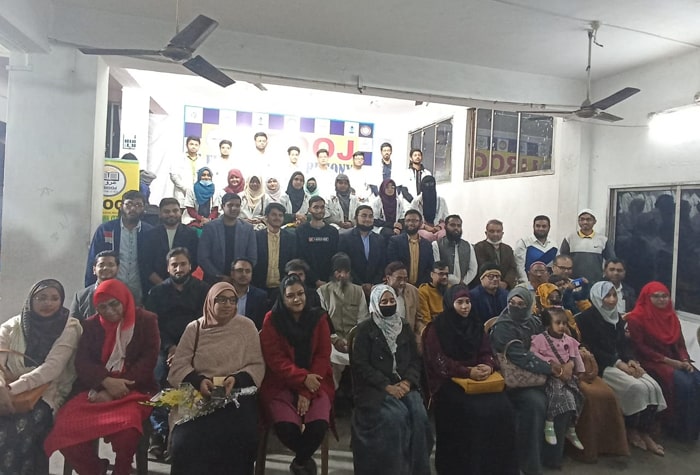
Chennai: A momentous academic occasion took place at Hidhaaya Islamic College for Girls, as third year Aalimah students plunged themselves into researching world religions. As a part of their course curriculum for the fifth semester, the students conducted research about world religions, which culminated in the submission of research papers in the sixth semester.

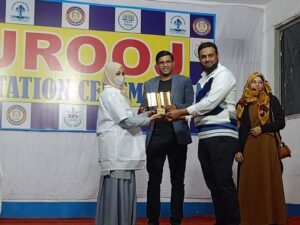
To begin with, the session started off on a tranquil note with recitation from the Holy Qur’an done by third year Aalimah student Hameera. The session was chaired by Burooj Association President and third year Aalimah student Arshiya. She addressed the participants and Guests with an opening welcome speech.

The presentations were evaluated by distinguished guests including, Dr. K.V.S. Habib Mohammad, eminent scholar of Islam, writer and Shura member of Jamaat-e-Islami Hind (Tamil Nadu) and Mr. Jalaluddin, Correspondent of Good Word Public School and Vice President of JIH Tamil Nadu and chairman Nazeer Ataullah of Hidhaaya Islamic College for girls.

With regard to the study of Sikhism, Judaism, Christianity, Buddhism, and Hinduism, five of the students made a commendable effort to understand the beliefs, holy books, and rituals of each religion. Their understanding showed in their thoughtfully prepared PowerPoint presentations. The analysis was enriched by yet another five students who compared the five religions mentioned above with Islam.

The whole exercise was an exemplar in both research and intellectual engagement. The evaluation panel acknowledged the effort of the students and suggested ways to improve the academic methodology and presentation style.

Pointing out the importance of such exercises, Dr. Habib Mohammad described it as a groundbreaking initiative by Hidhaaya Islamic College for Girls. This is truly a commendable and progressive initiative. Stating the necessity of comparative study of religions, he commented:

“Comparative study of various religions is very important to develop a better understanding. It is just the beginning of a long academic journey which needs to be taken further with sincerity and respect.”

He also recommended that students take up specialisation in one religion for greater knowledge and suggested that they should refer to the primary source of any religion to acquire true knowledge. He exhorted students to adopt an open mind with respect and regard for all religious beliefs.

This project represents a milestone effort towards the creation of enlightened and thoughtful women who have a proper understanding of the complexities of a pluralistic world.

In acknowledging the significance of this endeavour, Dr. Habib Mohammad mentioned how much the participants seemed to know about their disciplines, which was evident from their active involvement with the literary and intellectual aspect of religion. He also commented on how this programme reflects the institution’s academic excellence and hints at the future success of graduates.

Likewise, Mr. Jalaluddin appreciated the high calibre of performances and gave useful advice regarding improvements in terms of language skills and presentation techniques.

The event concluded with a warm vote of thanks offered by student Ashiqua, one of the 3rd Aalimah students.

“When knowledge is guided by understanding and compassion, it becomes a force that not only enlightens minds but also unites humanity.”

[Dr. Rabia Basri is Correspondent and Principal of Hidhaaya Islamic College for Girls, Chennai]

source: http://www.radiancenews.com / Radiance News / Home> Latest News> Report / by Dr Rabia Basri / April 29th, 2026

Adnan, Ashraf, Azim, Fatema among JAM 2026 Toppers, check full list

Mumbai, MAHARASHTRA / INDIA :

Syed Adnan Shafi, Afimol Ashraf, Ryan Azim Shaikh, Muskan Fatema, and Arisha Tauqeer are among the JAM 2026 toppers the list of which was released by the Indian Institute of Technology Bombay (IIT Bombay) Thursday.

JAM 2026 Toppers List: 

Syed Adnan Shafi, Afimol Ashraf, Ryan Azim Shaikh, Muskan Fatema, and Arisha Tauqeer are among the JAM 2026 toppers the list of which was released by the Indian Institute of Technology Bombay (IIT Bombay) Thursday.

The Joint Admission Test for Masters (JAM) is the entrance exam conducted for admission to top-tier postgraduate programs.

The JAM 2026 exam this year was conducted on February 15, 2026. JAM 2026 result was announced on March 19, 2026. The scorecard of the candidates along with the list of subjectwise toppers was released today i.e. Thursday March 26, 2026.

As per the JAM toppers list released today, Syed Adnan Shafi is among the Physics toppers, Afimol Ashraf is one of the toppers in Chemistry subject, Ryan Azim Shaikh is one of the toppers in Mathematics subject, whereas Muskan Fatema and Arisha Tauqeer are among the Biotechnology toppers.

JAM 2026 Top 10 List

JAM 2026: Physics Toppers

AIR Registration ID Name
1 PH811A336 Sarvesh Gupta
2 PH321A435 Jatin Yadav
3 PH620A193 Ankur Saha
4 PH811A310 Anmol Mehrotra
5 PH515A041 Varun Singh Gautam
6 PH407A501 Debarshi Das
7 PH304A048 Sudhanshu Sethi
8 PH407A250 Pratyush Yadav
9 PH406A092 Dinabandhu Maji
10 PH322A088 Syed Adnan Shafi

JAM 2026: Chemistry Toppers

AIR Registration ID Name
1 CY303F047 Ayushi Agrawal
2 CY301B011 Deepak Poonia
3 CY620F051 Soumo Pal
4 CY620F403 Anubrata Chatterjee
5 CY316F111 Nancy
6 CY113F052 Afimol Ashraf
7 CY314F199 Pihu Roy
8 CY616F277 Rahul Guchhait
9 CY320F148 Jaspreet Singh
10 CY406F235 Sourav Gorai

JAM 2026: Economics Toppers

AIR Registration ID Name
1 EN319A149 Suryoday Sethi
2 EN320A120 Raghav Khera
3 EN811A086 Tanvi Jaiswal
4 EN320A088 Arpit Gupta
5 EN321A386 Uttam Tiwari
6 EN319A357 Akshet Gupta
7 EN315A449 Dev Sharma
8 EN803A205 Divyansh Solanki
9 EN320A240 Rachit Gupta
10 EN501A123 Vedansh Agarwal

JAM 2026: Mathematics Toppers

AIR Registration ID Name
1 MA102F217 Madhur Agrawal
2 MA701F055 Sarath Chandra Reddy Poreddy
3 MA102F223 Naveen Kumar G
4 MA521F293 Khushpreet Singh
5 MA620F236 Barun Roy
6 MA102F177 Kalmanje Avyaktha Achar
7 MA620F054 Ayush Baran Sen
8 MA710F098 Surya Raju
9 MA217F235 Shubham P Pimple
10 MA319F112 Ryan Azim Shaikh

JAM 2026: Geology Toppers

AIR Registration ID Name
1 GG615F085 Hrushikesh Nahak
2 GG603F163 Prachee Ray
3 GG610F090 Ayushman Barik
4 GG601F461 Subhashri Sahoo
5 GG321F105 Om Kumar
6 GG520F068 Ranjan Raj
7 GG321F081 Ansh Kashyap
8 GG521F109 Shubham Kushwaha
9 GG519F088 Nimisha Mishra
10 GG315F013 Anushka

JAM 2026: Mathematical Statistics Toppers

AIR Registration ID Name
1 MS620A508 Koustav Chowdhury
2 MS403A014 Simran Kumari
3 MS213B057 Soham Rajesh Surve
4 MS104A034 Lavanis A
5 MS104A106 Darsh Jain
6 MS620A320 Arnab Das
7 MS521A342 Suryansh Pandey
8 MS711A081 Sharmilee Dhanasekaran
9 MS414A066 Hrishiraj Roy
10 MS316A075 Tanirikaa Gandhi

JAM 2026: Biotechnology (BT)

AIR Registration ID Name
1 BT805A034 Sakshi Nijwala
2 BT202A270 Rit Vipinbhai Patel
3 BT102A209 Reshma Ganesh Hegde
4 BT212A323 Aaryan Manish Nigudkar
5 BT202A091 Gajra Kashishben Bhaveshbhai
6 BT307A163 Diya
7 BT604A108 Muskan Fatema
8 BT411A152 Shashwata Chatterjee
9 BT212A301 Advait Raman Shankar
10 BT502A076 Arisha Tauqeer

Candidates who have qualified in the examination will be eligible to apply for admission to 89 postgraduate programes across 22 IITs for the academic year 2026-27 through the JAM Online Application Processing System (JOAPS 2026) from March 27 to April 15. The first admission list is scheduled to be released on May 25. The second, third and fourth admission lists will be respectively released on June 08, 16 and 27, 2026. Additional list if any will be published on July 03, 2026, IIT Bombay said.

source: http://www.ummid.com / Ummid.com / Home> Education & Career / by ummid.com news network / March 27th, 2026