Tag Archives: Muslims of Maharashtra

A Madrasa Like No Other: Inside India’s First Inclusive Madrasa for the Deaf, Mute and Blind

Pune, MAHARASHTRA :

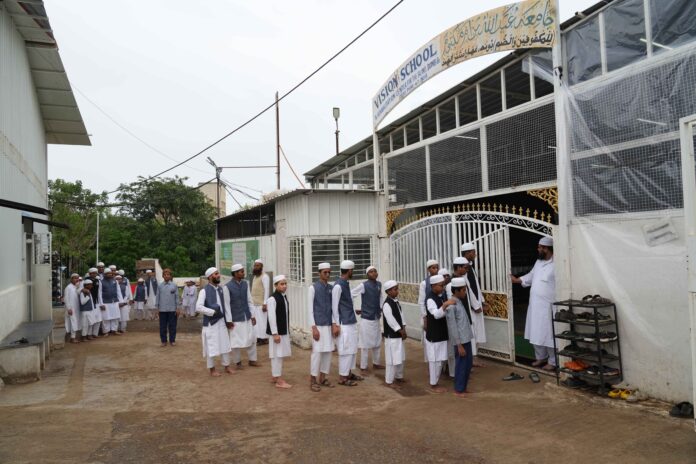
Students at Jamia Abdullah Ibne Umme Maktoom, India’s first inclusive madrasa for differently-abled children in Pune, Maharashtra, walk in a queue as they enter the Vision School campus. The madrasa provides free Islamic and contemporary education to mute, deaf and visually impaired students from 17 states across India.

In Pune, Maharashtra, Jamia Abdullah Ibne Umme Maktoom offers free Islamic and contemporary education to mute, deaf, and blind children from across 17 states—proving that disability is no barrier to dignity, faith, or ambition.

Pune (Maharashtra): 

In a small park in Maharashtra’s Pune, on a Thursday morning in May, a group of well-dressed uniformed students stood barefoot, wearing white skull caps. Many of them were mute or visually impaired. As the national anthem played in the background, the students stood in solemn attention, while others – mute and deaf – used sign language to express the lyrics. It turned the moment into a display of patriotism and unity.

This is the usual beginning of the day at Jamia Abdullah Ibne Umme Maktoom (a religious seminary in Pune), where hundreds of mute, deaf and blind students receive free Islamic and contemporary education.

“It took us years to convince families of the importance of education for their special children,” says Nayeem Ahmad Qasmi, a secretary of the madrasa.

The institution was founded in 2013 with only two children with the vision to uplift differently abled children from across India through inclusive education.

According to the Census of 2011, approximately 2.2% of the population, around 26.8 million people, were identified as living with disabilities.
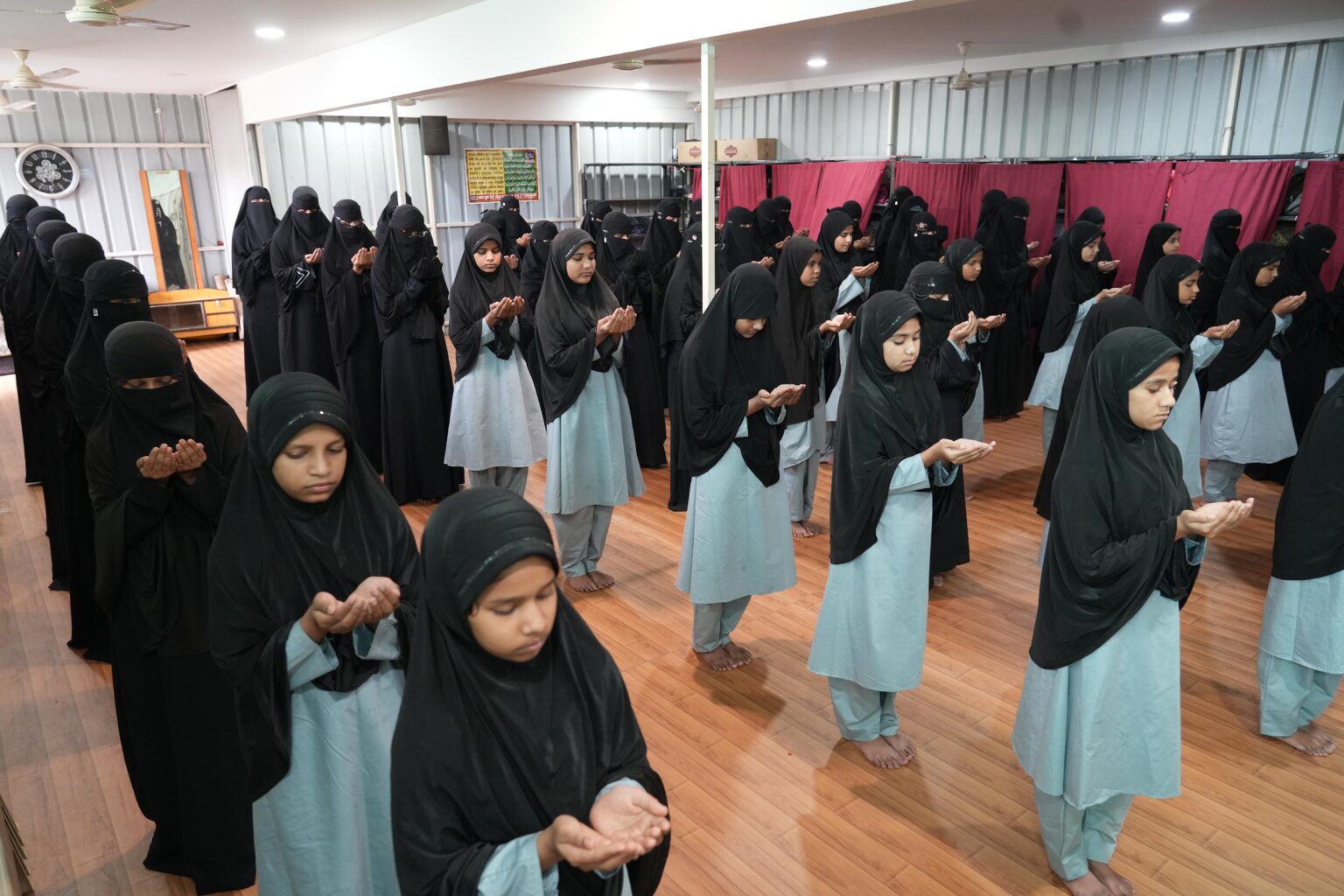
Female students at Jamia Abdullah Ibne Umme Maktoom in Pune, Maharashtra, offer prayers during school hours. The madrasa currently educates over 70 differently-abled girls – many of whom are mute, deaf or visually impaired – providing them with a safe and inclusive environment for both Islamic and contemporary learning.

Unfortunately, many families abandon differently abled children or keep them confined at home – considering them a burden.

“It is the duty of every person to support differently abled children so they can prove their capabilities,” he adds.

Many students come from rural areas in different states, where families often do not know the value of education or the opportunities available to them.

“Before coming to Jamia, I did not know anything about Islamic and contemporary education,” says 18-year-old Rehan Saleem from Jalgaon in Maharashtra.

Many students have received opportunities to present their skills on different platforms across India. Several have represented their school and secured positions in various sectors.

“By the grace of God, I have completed the Hifz-e-Quran (memorisation of the entire holy Quran) at this Jamia and got the opportunity to perform Umrah,” says Rehan.
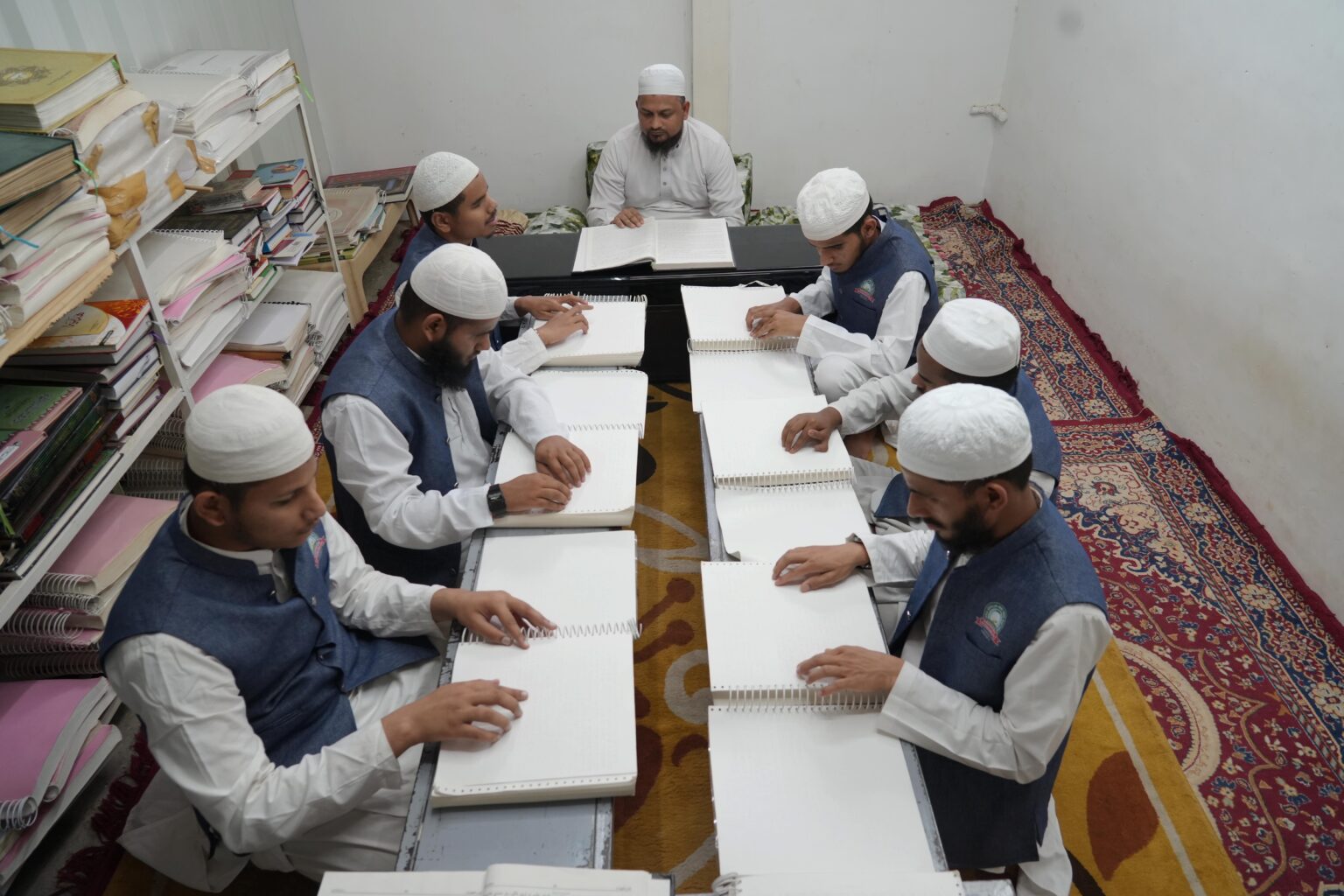
Students at Jamia Abdullah Ibne Umme Maktoom in Pune attend a classroom session where they receive both Islamic and contemporary education, guided by their teacher.

Today, the Jamia hosts 210 mute, deaf and blind students from 17 states across India. The seminary provides free education from Grade 1 to Grade 12, including subjects like science, computers, Islamic studies and advanced education.

Many students have gone on to study at various universities and colleges. For those unable to attend in person, the madrasa has launched an online education programme. Children here are provided with education, food, accommodation and even uniforms free of cost.

“Our mission is to see these children represent the country on every platform one day,” says Qasmi.

Despite the struggle, they have succeeded in building a thriving institution. In 2021, the madrasa launched separate sections for mute, blind and deaf women to ensure inclusive learning environments. Women’s education is just as important as men’s, and this initiative reflects that commitment.

Mubashira Sadiya Khan, who teaches specially abled girls at the madrasa, says, “Women’s education is equally important as male education. These girls are usually occupied with household work at their homes, but we are giving them better education and showing them the purpose of life.”
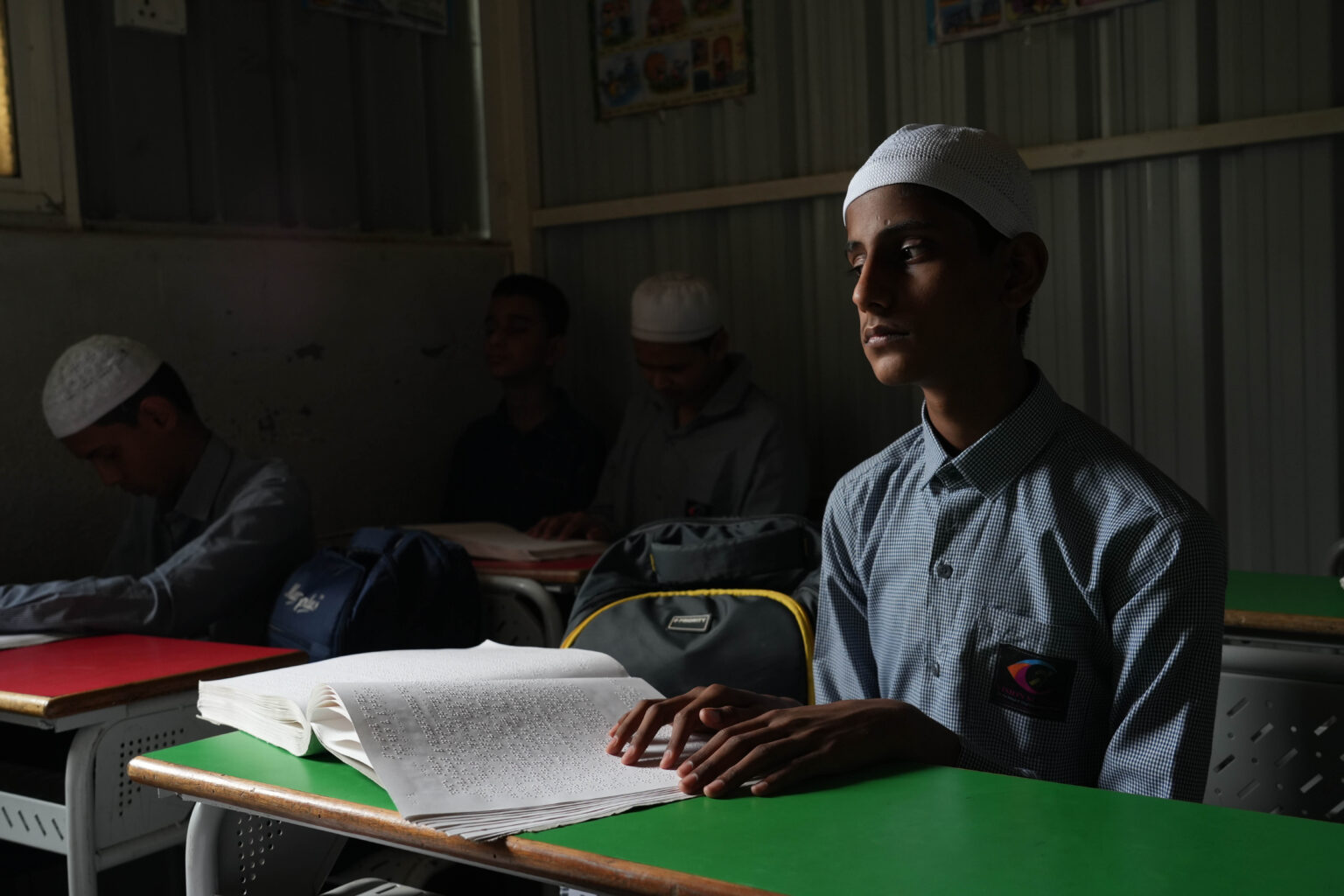
A young visually impaired student sits attentively in class, beside a Braille slate and stylus used for writing. At Jamia Abdullah Ibne Umme Maktoom, visually impaired children are given tools and support to receive religious and formal education in an inclusive environment.

Since safety is a major concern for women in the country, the madrasa has provided separate rooms for them, with all female helpers to ensure a secure learning environment.

Mubashira adds, “Usually, women are not safe in the country, but here we have created a safe space where they can learn and grow with confidence.”

Despite progress in education, children with disabilities in India often remain invisible – excluded from schools, denied opportunities and treated as burdens. Many end up begging or isolated at home, not by choice, but because society offers them no alternatives.

“We often see them begging on the roads, not because they want to, but because the society has failed to give them a chance,” says Qasmi.
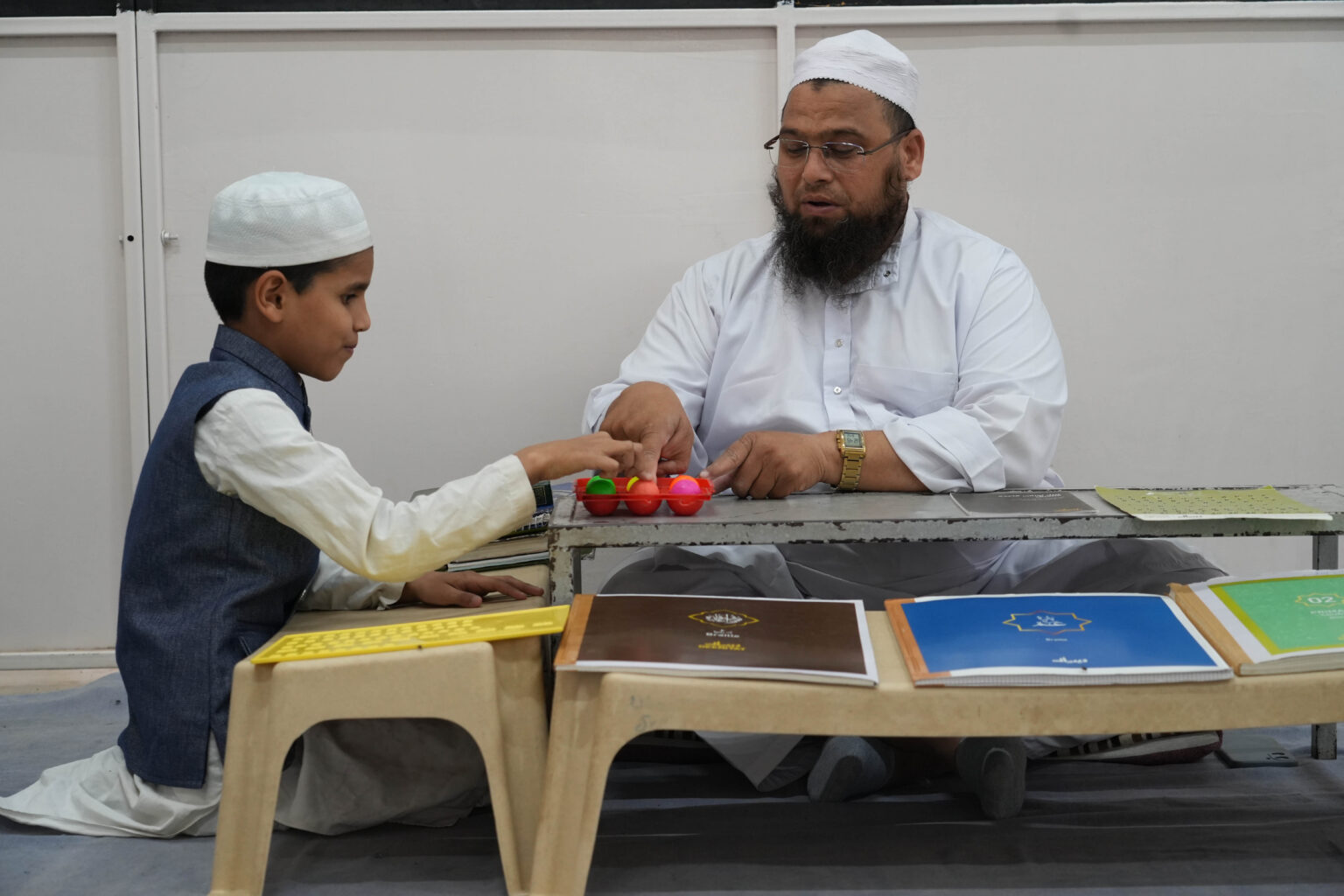
Students in uniform attend class at Jamia Abdullah Ibne Umme Maktoom in Pune, where multiple sessions are held simultaneously in a shared hall to support inclusive learning.

The Jamia has been working to ensure that students with disabilities receive quality education, access to proper infrastructure and opportunities to engage in play and creative activities on campus. Its vision is to provide them with equal opportunities so they can compete and thrive like any other student.

“Our goal was simple – give them dignity, knowledge and a future,” Qasmi explains.

The Jamia is already offering digital learning tools, smart boards and inclusive facilities to ensure that the students receive a modern and accessible education. The institution continues to innovate and expand its reach through technology and tailored teaching methods.

“We have introduced smart boards, digital tools and inclusive classrooms because every child no matter their ability deserves access to quality, modern education,” says Qasmi.

In the current political climate in India, the Muslim community has often been portrayed in a negative light, and madrasa education is frequently misunderstood or dismissed. Despite these challenges, Jamia Abdullah Ibne Umme Maktoom continues to provide quality Islamic and contemporary education to differently-abled children, aiming to empower them with knowledge and confidence.

source: http://www.twocircles.net / TwoCircles.net / Home> Disability / by Suhail Bhat, TwoCircles.net / June 21st, 2025
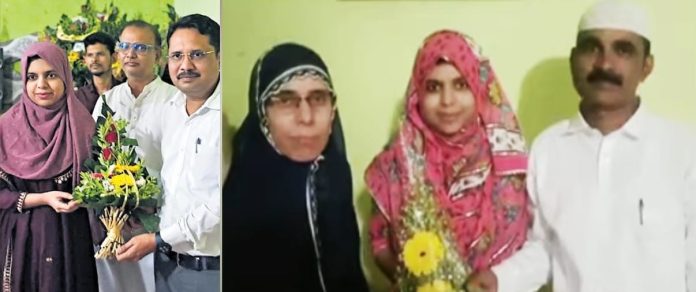
In a first, Maharashtra gets first Muslim female IAS officer – Adeeba Anam Ashfaque Ahmed

Yawatmal (Vidharba Region), MAHARASHTRA :

Do it again and again. Consistency makes the raindrops create holes in the rock. Whatever is difficult can be done easily with regular attendance, attention, and action. Perhaps imbibed by the words of Israelmore Ayivor, an inspirational writer, blogger and LifeSkills Entrepreneur, Adeeba Anam Ashfaque Ahmed from Yavatmal in Maharashtra created a record of sorts to become the first female Muslim IAS officer after successfully clearing the civil services with All India Rank 142.

The success saga of Adeeba only proves the awareness shown by Muslim girls to take up civil services exams breaking the barriers.

On cloud nine are Adeeba’s parents, relatives, friends and more particularly her teachers on seeing her victory after three failures. She came out with flying colours in her fourth attempt after getting the necessary guidance and coaching from Jamia Millia Residential Coaching Academy in Delhi.

Can’t imagine a girl hailing from a parched and drought-prone Yavatmal district bringing glory to her native. All because of her patience and consistency as to the quote of American business honcho Robert Kiyosaki – “Successful people don’t fear failure but understand that it’s necessary to learn and grow from.” It is learnt that Maharashtra hardly witnessed any female Muslim IAS officers in the last one decade or so.

Kudos to her dad Ashfaq Ahmed, an auto driver, who despite financial constraints strained his nerves to make his daughter’s civil service dream a reality. Of course, her mom and uncle were very supportive in ensuring she achieved her IAS after successive failures. Adeeba started her early education at Zafarnagar Zilla Parishad Urdu Primary School, where she studied from Class 1 to Class 7. Thereafter, she finished schooling from Class 8 to 10 at Zilla Parishad Government Girls High School. And she completed her 11th and 12th grades at Zilla Parishad Ex-Government College in Yavatmal.

Armed with BSc Mathematics from Inamdar Senior College in Pune, she joined a coaching academy in Pune to take UPSC foundation classes based on the advice of her maternal uncle Jan Nizamuddin Sahib, who works as secretary at Seva NGO.

She got interested after meeting a few IAS officers and was determined to become an IAS. The road to civil services wasn’t smooth for her as she faced many obstacles. However, she was firm and worked relentlessly to taste success.

Noteworthy to mention that her dad Ashfaq Ahmed dropped out of school after tenth standard due to family circumstances. But decided not to let her daughter face the same fate, left no stone unturned and encouraged Adeeba to do her UG. Right from her school days, she had a fascination for civil services inspired by the young IAS officers’ remarkable feat through newspapers. Since then, she has been working towards her civil service dream.

In an interview to a local television channel, she is reported to have said that studying isn’t easy, especially for girls in patriarchal communities like Muslim, but her parents stood by her. She expressed her gratitude to mom, who extended support for her in her endeavours. The community was against girls pursuing higher studies, but her dad told her not to worry about society, and focus on her goal.

It is interesting to infer that she chose Urdu Literature as her optional subject despite having a science background. However, she displayed her prowess in clearing the civil services with confidence. A total of 32 candidates from Jamia Millia Islamia and 3 from Aligarh Muslim University (AMU) Residential Coaching Academy (RCA) have figured in the UPSC Civil Services 2024 Merit List. Of the 1009 candidates selected, only two Muslim candidates figured in the top 100.

She said that IAS is the first step to serve the society and added that her area of interest is to work for the underprivileged, more specifically girls. And she wanted to contribute to the education and health sector as a civil servant. Jamia Millia Islamia (JMI) and Aligarh Muslim University (AMU) RCAs are renowned academies in the field of coaching students for Civil Services. They provide free coaching and training for preparing for the Civil Services Examination for candidates from SC, ST, Women, and Minority communities.

source: http://www.radiancenews.com / Radiance News / Home> Focus> Markers of Excellence / by M Rafi Ahmed, Radiance News Bureau / April 28th, 2025

Dr. Iqbal Urdu Primary and Middle School Adds Another Feather to Its Cap

Malegaon (Nashik District), MAHARASHTRA :

Malegaon:

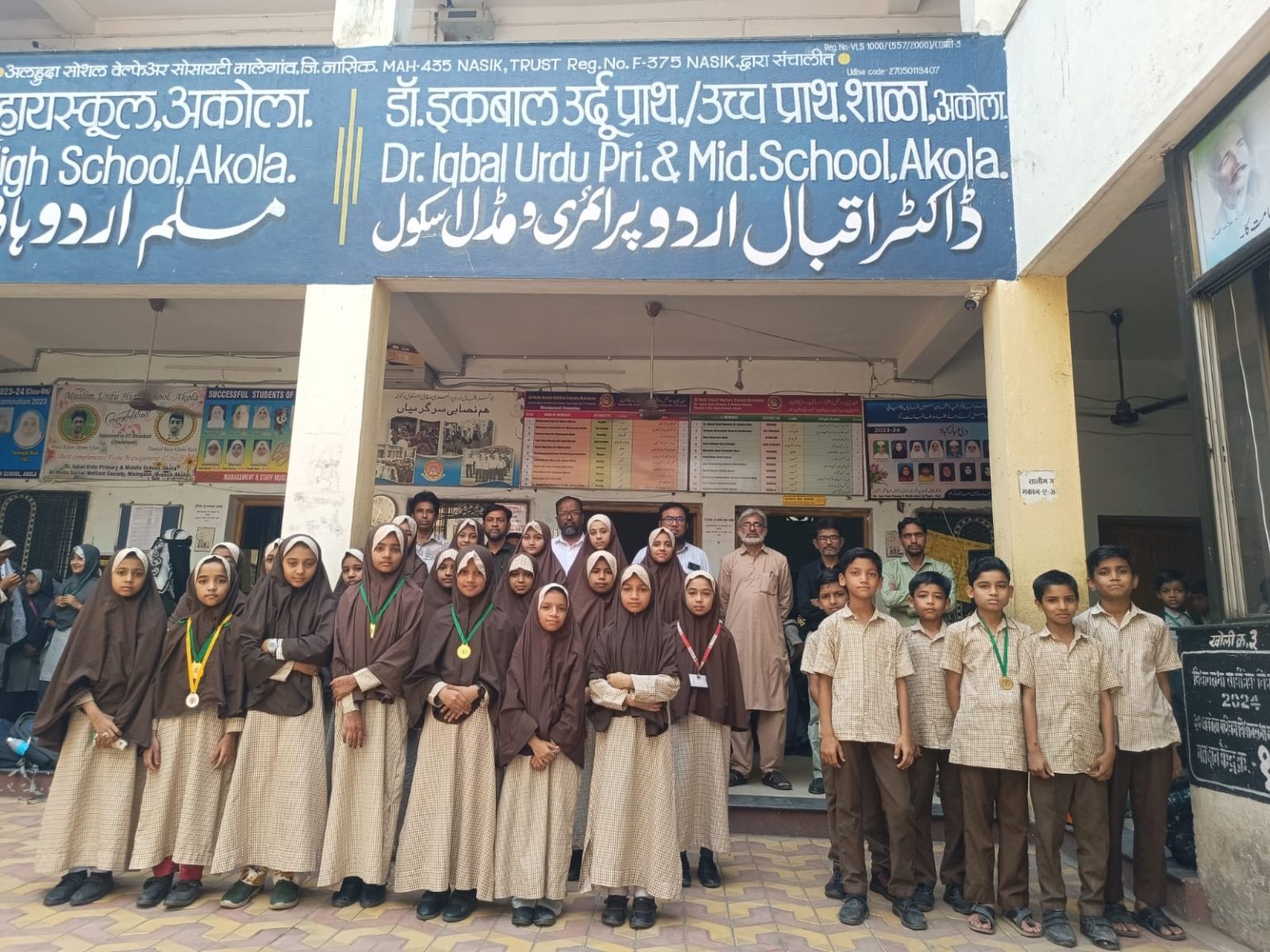
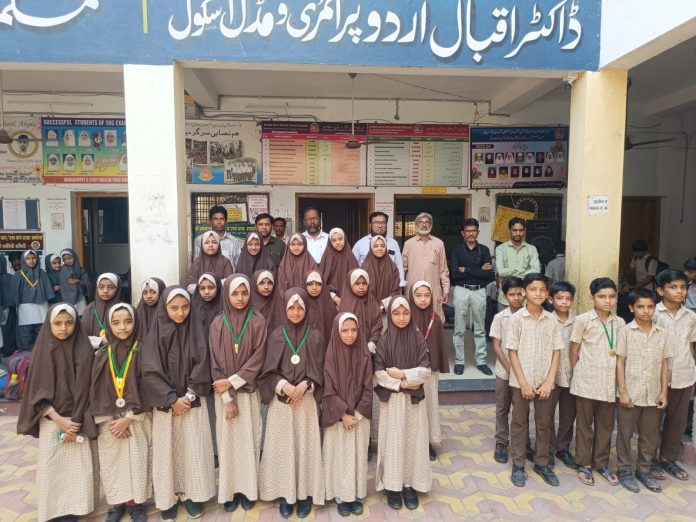
Every year, the Government of Maharashtra conducts a scholarship examination for students of Grade 5, in which lakhs of students from across the state participate. Recently, interim results of this exam were announced. In this examination, 48 students from Dr. Iqbal Urdu Primary School – a renowned and quality institution run by Al-Huda Social Welfare Society, Malegaon, District Nashik – participated. Out of these, 31 students achieved outstanding success.

Hafsa Saman Mohammad Mujahid secured 212 marks out of 300. Fatima Sitwat Azhar Hussain and Zobia Anam Mohammad Mujahid both secured 188 marks respectively, while Sheikh Umar Sheikh Sabir obtained 186 marks.

The school administration always strives not only to encourage students to participate in competitive exams but also to ensure their thorough preparation. For this purpose, the school arranges special classes throughout the year specifically for scholarship students, providing them with extensive practice.

Behind this success lies the significant role of competent and dedicated teachers. The school has expert teachers for this competitive scholarship activity, and the Headmaster is always ready to guide the students. In addition, the parents extended full support.

The institution’s President Dr. Ahmed Urooj, Vice President Khwaja Nizamuddin, Secretary Riyaz Khan, Headmaster Mohammad Ateeque ur Rahman, and the school staff congratulated the students and their parents and expressed their best wishes for great success in the future.

source: http://www.radiancenews.com / Radiance News / Home> Education> Latest News / by Radiance News Bureau / April 26th, 2025

Wakeel Najeeb: Prolific author who leads the Urdu literary caravan in Vidarbha

Nagpur, MAHARASHTRA :

When he is not writing a novel, he writes stories for children. And, when he is not penning these stories, he may compose poetry for a change of taste or suddenly come up with a  book on personalities of his city.

Wakeel Najeeb is not just among the most prominent authors, he is the most prolific writer in the region. For people interested in Urdu litrature across the country, when the conversation shifts to this region, it’s his name that instantly comes to minds.

And a visit to Nagpur is incomplete until one meets him. In the serpentine lanes near his house, ask anyone–an elderly man or a young boy, everyone knows him and can guide you about the address or directly take you to his house.

Th writer is at the centre of Urdu literary activities in Nagpur. On my visit to the town, I tried to locate his house and almost everyone I came across on way, was ready to take me to his place. Apart from novels, he has several collections of stories and short-stories, poems and two travelogues to his name. Also, there is a collection of plays and hold your breath–20 novels.

He is among the few authors who have focused on writing for the children. Many of his novels are for children apart from nazms and stories. Though he started his literary journey with ‘afsana’ [short story], he got more fame because of writing for children as he also gets published in the magazines across India.

“Somehow a label was put on me that I write stories for children and a I am writer exclusively for kids, though I have collections of short stories and have written fiction, not just for children”, he explains. Of course, Najeeb, has written extensively and also writes critical pieces, essays and articles.

His most recent work is a book, ‘Meri Basti, Mere Log’. The book contains his write-ups on interesting personalities he saw around him as he grew up and others in his city. The profiles include people from diverse fields–wrestlers to clerics and writers to sufis. Already hundreds of copies of the book have been sold.

“Frankly, I do my best to publicize my books. When I write, my aim is to make people aware about the book. You see this, he points towards the banner outside his house, which announces publication of his book. People come to know, arrive and buy”, he further says.

That’s a far cry from the writers who bemoan lack of readers or rue that there books are not being sold. Born on July 1, 1946, Wakeel Najeeb, studied at the local Urdu school. He went on to become a teacher and retired as principal of Islamia School. He is socially active, associated with institutions, literary groups and attends their meets. And, literally holds the literary fort in the region.

source: http://ww.newsbits.in / Newsbits.in / Home> Special / by Shams Ur Rehman Alavi, Bhopal / December 22nd, 2021

Ayan Sheikh Gets 12th Rank in GATE Exam, Dreams of Joining IIT Bombay

Mumbai, MAHARASHTRA :

Mumbai student overcomes cramped living conditions to achieve national success in the prestigious entrance exam.

Mumbai:

Ayan Sheikh, a 20-year-old student from a modest 96-square-foot house in Byculla, has achieved an extraordinary feat by securing the 12th rank in the Graduate Aptitude Test in Engineering (GATE) in his first attempt. Ayan, currently in his third year of a computer science degree, hopes to follow in his elder brother’s footsteps and secure admission to IIT Bombay for his master’s degree.

Living in a cramped chawl in Mustafa Bazaar’s Haji Alana with his parents and elder brother, Ayan’s journey to success is a testament to determination and hard work. With limited space at home, Ayan and his brother Aman, who previously cracked the Joint Entrance Examination (JEE) and graduated from IIT Bombay, often studied on a makeshift platform built in their small house.

“My success is the result of my parents’ prayers and their constant hard work,” Ayan told Clarion India. “Even with a limited income, my father tried his best to give both of us brothers a better and higher education. Despite the lack of space, we made the most of what we had. This platform has been our study spot for years, and it holds a special place in our hearts.”

Ayan scored an impressive 89.04 percent marks in the exam, which is considered one of the toughest national-level entrance tests for postgraduate engineering courses. Out of 1.8 lakh candidates who appeared for the exam, Ayan’s 12th rank is a remarkable achievement.

His father, Akhtar Sheikh, a senior fitter at BEST’s Mumbai Central Depot, expressed his joy and pride. “Ayan’s result is like the blessings of Ramadan for us,” he said. “One lakh 80 thousand students appeared for the GATE exam, and Ayan secured the 12th position. This is a huge achievement for our family.”

Ayan’s academic journey has been marked by consistent excellence. He scored 90% in his SSC exams from Enza English High School in Byculla and 78% in his HSC exams from Peace College in Dadar. He is currently pursuing a computer science degree at DJ Sanghvi College in Vile Parle and will complete his four-year course next year.

Ayan’s elder brother, Aman Sheikh, is an inspiration for the family. Aman secured 90% in SSC and 89% in HSC before cracking the JEE exam with a rank of 1,023 out of 1.5 lakh candidates. He went on to complete his B.Tech and M.Tech in electrical engineering from IIT Bombay and now works for an American company in Bengaluru with an annual package of Rs 12 lakh.

“I hope to get admission to IIT Bombay, just like my brother,” Ayan said. “This platform in our house has been our study corner for years. Even today, I sit here and study for three to four hours daily. It’s a part of our lives.”

Ayan’s story is a shining example of how perseverance and family support can overcome even the most challenging circumstances. As he prepares to take the next step in his academic journey, his family and community are filled with pride and hope for his future.

source: http://www.clarionindia.net / Clarion India / Home> India> Indian Muslim / by Team Clarion India / March 24th, 2025

Khwaja Tamboli’s Inspiring Journey from Village Cricket Lover to Bat-Making Entrepreneur

Wadala Village (Solapur), MAHARASHTRA :

Solapur man turns passion into business, crafting custom Cricket Bats for players across India.

Wadala Village (Solapur) :

Khwaja Tamboli’s story is one of grit, determination, and an unshakable belief in hard work. Hailing from a modest family in Wadala village, North Solapur, the 28-year-old entrepreneur has turned his childhood love for cricket into a thriving business—’KT Bats’—producing high-quality tennis ball cricket bats tailored to players’ needs across India.

Khwaja’s journey was far from easy. His father, Ajmuddin Tamboli, had to stop working 14 years ago due to mental illness, leaving his mother, Rashad, as the sole breadwinner. “I’ve seen many difficulties,” Khwaja recalls. “My mother sold household items and managed weekly markets just to keep us afloat. Poverty doesn’t stop dreams, but hard work is needed to fulfil them.”

After completing a B.Sc in Chemistry, Khwaja developed an allergy to chemicals, closing doors to traditional employment. But his passion for cricket opened another. “I was always fascinated by bats,” he says. “When I couldn’t find a job, I decided to start small—selling sports goods from a shop given by the Gram Panchayat.”

Initial struggles tested his resolve. Big companies refused to supply goods without bulk orders, and his first attempt at rebranding cheap bats with his own stickers failed. “Customers didn’t like them, and I faced losses,” he admits. Undeterred, Khwaja travelled to Kashmir to study wood types and bat-making techniques.

Returning with newfound knowledge, he invested in a machine and began crafting bats himself. “I realised if market bats weren’t good, I’d make better ones,” he says. The gamble paid off—his business took off, with players appreciating the customised quality.

Khwaja doesn’t just sell bats; he engineers them. Studying player preferences, he adjusts weight and balance based on playing style. “A 970-gram bat suits aggressive players hitting all around the ground,” he explains. “For those who play ‘V’ shots, a heavier bat (1030-1050g) with weight at the bottom works best.”

His bats now cater to players in Maharashtra, Karnataka, Uttar Pradesh, Chhattisgarh, Gujarat, and Jharkhand. But success hasn’t made him forget his struggles. “I’ve seen poverty, so if a player can’t afford a bat, I give it at a lower price,” he says, recalling how he recently gifted a ‘Player Edition’ bat to a needy cricketer from Gujarat.

Rashad Tamboli, Khwaja’s mother, beams with pride. “He loved cricket since childhood. I invested my savings in his dream, and he proved himself,” she says.

Today, ‘KT Bats’ sells 100-200 bats monthly, priced from ₹2,000 to ₹3,500. But Khwaja dreams bigger. “I want ‘KT Bats’ stores across India,” he says. “My brand should be recognised in every state.”

From a struggling student to a role model for young entrepreneurs, Khwaja Tamboli’s journey proves that with perseverance, even the most humble beginnings can lead to extraordinary success.

source: http://www.clarionindia.net / Clarion India / Home> India> Indian Muslim / by Team Clarion / April 04th, 2025

Forgotten martyrs: Nawab Kadar Ali, his companions were hanged by British at Sitabuldi fort in Nagpur

Nagpur, MAHARASHTRA :

More than seven decades after India achieved independence, the role of innumerable martyrs and freedom fighters who gave their blood and offered lives for the motherland, needs to be remembered. 

Many of them got harsh punishments, didn’t get proper last rites, remain forgotten and even those whose sacrifices are known, don’t have monuments or memorials built in their memory.

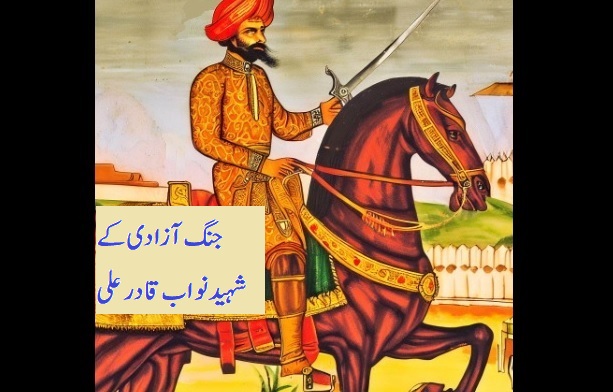
The martyrdom of Nawab Kadar Ali, and his companions, who planned attack on residency and to take on the East India Company forces in Nagpur, also needs to be recalled. They were hanged here for their role in 1857–the first war of independence.

Though there is no monument named after them and no big memorial, they remain heroes in public memory. The fort that had been a base of 118 Infantry Battalion for years, is opened on three days including August 15 and January 26. Thousands of people arrive on these days, and also pay visit to the grave and offer their respects.

The flame for independence was already lit. History books mention that soon after Meerut, the anger was palpable among soldiers and citizens in this region too. On June 13 1857, a large gathering took place near Mission High School. The soldiers too were anxious and ready. 

Scared, some of the East India Compnay officials ran towards Kamptee Cantonment, while others went inside the Sitabuldi Fort. It was due to treachery that the attack plans had been leaked and the news reached British officers. More EIC forces were called from other places to control and overpower the rebels.

Rani Baka Bai, wife of late Raghoji II, was supporting the British and issued a warning that anyone abetting or aiding the revolutionaries would be arrested and handed to the East India Company. It’s a long story and how the soldiers and citizens suffered, refused to name the leaders of the movement. 

Historical texts say that the signal of a fire balloon was decided. But after the traitors gave information to East India Company officers, Plowden, the commissioner, ordered a regiment to move into the city. The irregular calvary at Tali was dismayed. Major Arrow tried to get information from ring leaders but no one gave names.

Baka Bai summoned all her relations, and dissuaded them with threats. This chilled the spirit of public. However, later when Company officials’ strengthened their hold, the rebels were identified. Arms were collected and after inquiry, Dildar Khan, Inayatullah Khan, Vilayat  Khan and Nawab Kadar Ali were tried and executed.

KILLED, HANGED, BURIED IN A COMMON PIT

The Gazetteer briefly mentions that ‘tucked away between the easter walls of the inner fort and the barracks is a large grave known as Nav Gazah Baba…the grave of Nawab Kadar Ali…and his eight associates..who were killed and hanged by the ramparts of the fort due to their role in the war of independence”. 

“They were all buried in a common pit, nine yards long. The fort recalls to our mind the memory of the brave soldiers who fought in an attempt to preserve the independence of the mother land”. It was treachery that was responsible for the arrests and the punishment.  Those who helped the British, got ‘jagirs’ as rewards.

Ghulam Rasool ‘Ghamgeen’, the poet, wrote these lines in Farsi :

Choo.n Qadar Ali Khan Ameer Kabeer
Shud-az-tohmat, ahl-e-balwa aseer

Bajurm shiraakat girafaar shud
Chau mansoor, Hallaj, bar-daar shud

Duaa’e shahaadat ba-raahe Khuda
shab w roz mi kard aa.n mahtada


Khirad guft ee.n misra-e-silk-e-noor
Za-daar-e-jafaa shud ba-daar-e-suroor

The last couplet of this long Persian verse, brings out the ‘tarikh’, the year of execution. The complete verse is mentioned in Dr Mohammad Sharfuddin Sahil’s book ‘Tarikh-e-Nagpur’. It shows the impact of the hangings on the people in the region. Nagpur is geographillcally considered to be a part of Central India and is the biggest city in Vidarbha region of Maharashtra.

The fort for a long period remained the base of 118 Infantry Battalion of Territorial Army. Every year, on August 15 and January 26, fort is opened for public so that it can pay respect to the freedom fighters. It’s also opened on May 1 i.e. Maharashtra Day. [Illustration is representive]

source: http://www.newsbits.in / NEWS Bits / Home> Top News / by Shams Ur Rehman Alavi / August 15th, 2021

Grand Inauguration of the New Batch at Noori Academy, Malegaon in the Presence of Experts, Teachers, and Student

Malegaon, MAHARASHTRA :

Inauguration of the New Batch at Noori Academy, Malegaon

Malegaon:

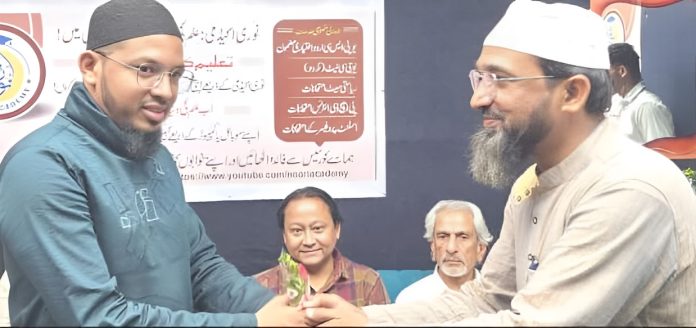
Noori Academy, a beacon of knowledge, continues its academic journey under the leadership of Dr. Ataur Rahman Noori. On January 28, 2025, after Maghrib prayers, the inaugural session of the UGC NET June 2025 batch was held at the academy’s headquarters with great enthusiasm. The event witnessed the participation of distinguished educationists, researchers, and scholars, while thousands of students from across India watched it live.

Noori Academy is not just an educational institution but a stronghold for the promotion of Urdu language and literature. Over the years, it has helped more than 500 students clear UGC NET, State SET, PhD entrance, and assistant professor exams, significantly contributing to Urdu research and teaching.

The session began with Quranic recitation, followed by speeches from eminent scholars. Mufti Mujeeb Sir highlighted the academy’s exceptional results, urging students to seize this opportunity. Linguist Saleem Shehzad spoke on modern and postmodern literary discourse, while Dr. Muhammad Husain Mushahid Rizvi called Noori Academy a guiding light for Urdu education.

Dr. Ataur Rahman Noori emphasized the academy’s mission, showcasing its success in both traditional and digital platforms. With 8 million+ YouTube views and a thriving mobile app, Noori Academy continues to shape the future of Urdu education.

source: http://www.radiancenews.com / Radiance News / Home> Education> Focus / by Radiance News Bureau / February 05th, 2025

Vogue Theater Committed to Promoting Urdu Language, Theatre, and Creative Activities

Mumbai, MAHARASHTRA :

Mumbai:

The sixth annual festival, “Discover,” celebrated young creative talents with enthusiasm, recognizing efforts to provide them a platform.

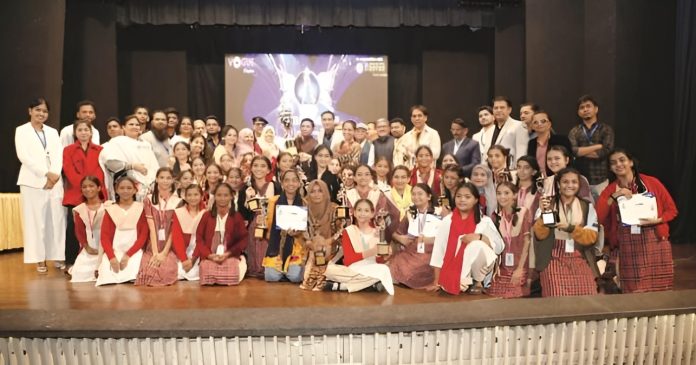
Organized by Vogue Theatre in collaboration with Bharatiya Vidya Bhavan, the state-level Urdu drama competition and children’s festival successfully took place at Bharatiya Vidya Bhavan. The event showcased the richness of Urdu language and literature while offering young talents an opportunity to express their creativity. Schools from Mumbai, its suburbs, and other districts participated, making it a vibrant confluence of artistic expression.

Engr. Adnan Sarkhot, President of Vogue Theatre, who has been associated with Urdu theatre for over 30 years and actively works for children’s creative development, led the event to its grand success. Notable guests, including Padma Shri Dr. Zaheer Kazi, IPS Qaiser Khalid, Dr. Sheikh Abdullah, Zahid Khan, and Zakir Khan, lauded Team Vogue’s initiative, emphasizing the importance of such programs in preserving Urdu for future generations.

As in previous years, “Discover” featured various competitions, including drawing, mono-acting, Urdu and English story writing, quizzes, and drama. More than a contest, the festival served as a learning experience, building confidence and refining students’ artistic skills. The participants’ creative performances left a lasting impression on the audience.

Experts from Mumbai, Bhiwandi, and Solapur judged the competitions.

Awardees included Principal Saba Patel, who received the Innovative Principal Award, while Raja Baghban (Solapur) and Sajid Dolar (Malegaon) were honored with the Lifetime Achievement Award for their contributions to education and literature. Additionally, for their outstanding performances in Urdu drama and academic excellence in SSC exams, Zara Feroz Shaikh (Mira Road) and Aashna Wahid Ansari (Mumbra) received the Rising Star Award.

source: http://www.radiancenews.com / Radiance News / Home> Arts & Culture / by Radiance News Bureau / February 08th, 2025

Qayyum Nadvi Honored with “Aamhi Bharti” Award

Aurangabad, MAHARASHTRA :

Aurangabad:

Social and educational activist Mirza Abdul Qayyum Nadvi received the “Aamhi Bharti” award for his contributions to education and literature. The Balwant Rao Varale Memorial Foundation selects three awardees from Maharashtra each year for their efforts in social work, education, and literature.

Nadvi, President of Read and Lead Foundation Aurangabad, runs the Mohalla Bal Pustakalaya Abhiyan, providing books to children of laborers in streets, slums, and huts. Other awardees included social worker Asha Sirsat and Vidya Sagar Dornalikar, recognized for their contributions to education and literature.

At the event, Nadvi emphasized that unity, integrity, and brotherhood are essential for the nation, aligning with the constitutional spirit of “We the people of India.” He expressed gratitude to the foundation for the honor.

The award ceremony featured Dr. Rajendra Gonakar as the special guest and was presided over by Malti Varale. All three awardees shared their thoughts and pledged to continue their work.

The event was moderated by Sudha Varale and Manisha Ghatge, while Varsha Ghoble spoke about Balwant Rao Varale’s contributions. Advocate Indumati Varale introduced the program. Chetan Chopra, Kunal Varale, and Ajay Dehade performed, and Parakshit Varle, Dhamma Wahul, Buddha Bhushan More, Abhishek Suradkar, and Prithvi Magre contributed to the program’s success. Sunita Ghatge delivered the vote of thanks.

source: http://www.radiancenews.com / Radiance News / Home> Pride of the Nation> Awards> Focus / by Radiance News Bureau / February 03rd, 2025