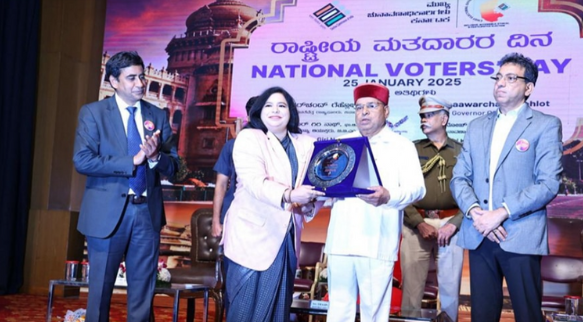
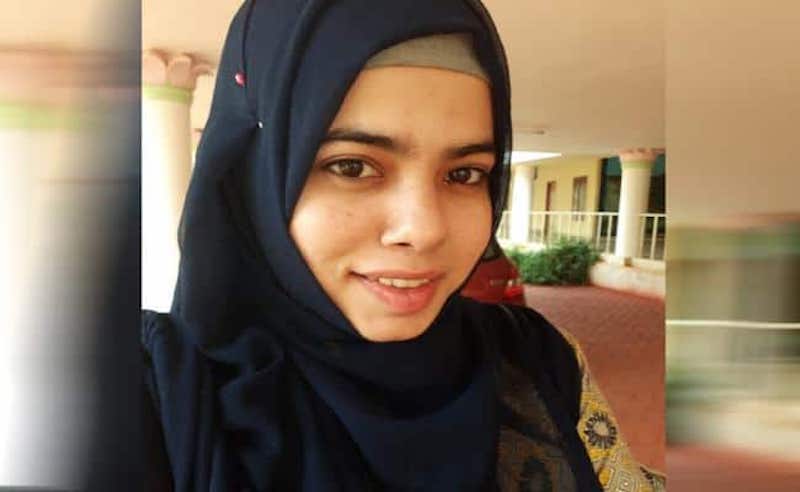
Anjum Tabassum, Tahsildar of Humnabad in Bidar district of Karnataka was presented with an award for her excellent performance as Assistant Electoral Registration Officer during Parliamentary elections 2024.
State governor Thawarchand Gehlot gave away the award to her on National Voters’ Day in Bengaluru on January 25.
This prestigious recognition is a testament to her outstanding efforts and dedication during the Lok Sabha Elections 2024. Her hard work has paid off, and this award is a well-deserved acknowledgment of her commitment to ensuring free and fair election.
Anjum Tabassum Lashkari from Gulbarga cracked the Karnataka Administrative Services (KAS) in 2014. She did her masters from Gulbarga University and had schooling earlier in Shahbad town.
source: http://www.radiancenews.com / Radiance News / Home> Pride of the Nation> Awards> Latest News / by Mohammed Atherulla Shariff / January 27th, 2025
Human trafficking is the illegal process of moving or luring a person from one place to another using deception, threats, pressure, duress, or other abusive means for financial gain. Most of them trafficking children are pushed into the sex trade.
Fifteen years before, she was a victim of human trafficking. Today, leaving her past behind, Naseema Gain, 28, has rescued more than 4,000 women from the flesh trade and is helping them lead a normal life, reports Awaz The Voice.
“It was 2009. I remember there was a Puja function at my school on that day. I was happy. I have known him since childhood, as his uncle lived in our village. I and my friend happily sat in his car when he offered to drop us at our place. Little did I know this incident was going to change my life. When I regained consciousness, we found ourselves at an unfamiliar place. I had no idea where I was.” The 13-year-old Naseema Gain had no idea that she had landed in the net of human traffickers.
Born in Maslandpur, West Bengal, Naseema Gain had a happy childhood till an acquaintance kidnapped her on the pretext of offering her a ride to school.
Fortunately, she was released after 10 months. However, she faced a bigger tragedy on her return home when she found people looked at her and treated her differently. Due to prejudices, people didn’t treat her as a victim.
Naseema didn’t give up. Today she is helping hundreds of girls who are victims of human trafficking by rescuing and rehabilitating them.
Narrating the incident of her kidnapping, Naseema says, “He asked me and one of my friends if we would like to go home in his car. There was also another person in the car. Not knowing his intentions, we happily sat in the car. He took us to a deserted place and dropped us saying that he would return after some time.
“After a while, a person came in another car and said that he would drop us home. It was dark, so we accepted his offer least knowing that this lift would turn was going to change our lives.”
They sold Naseema and her friend in Bihar. On her life in a brothel, Naseema says, “They taught us to dance and sing. If anyone did not obey them, they were beaten, tortured, and made to starve. We had lost all hope of returning home.”
She says violence, torture, and starvation were routine punishments for the inmates of a brothel. One day Naseema and her friend were sold as maids. This gave them a chance to escape.
Naseema worked as a house help for a professor. “Slowly I started following their language. One day I told him about my story of being kidnapped and sold and asked him to help me return to my home. I somehow managed to gather the courage to tell this to him.”
She also told the professor that if he didn’t help them and sent them back to the agency, the girls would face torture and be resold.
The professor asked her to provide him contact number of her home. Naseema didn’t remember hers but her friend had memorised her telephone number. The kind-hearted professor called the number and both the girls were rescued with the help of the police.
However, before the police and the parents could reach Naseema and the other girl, the trafficker came to know about this. He called the Professor who shifted them to different secret locations for safety. After tracking them for several weeks, Naseema and her friend were finally freed after 10 months.
Naseema says, “It still feels surreal to be rescued and taken home. I had lost all hope, but our and the police’s efforts would be successful. I am very grateful to those professors.”
Her family was happy at her rescue and return home but the villagers were not ready to accept her.
“This is the sad truth of our society. I was a victim of circumstances, and yet had to face ostracism.” She adds, “Parents would tell their children not to speak with us,” she says.
She said, “We were not allowed to go to school because the school refused to admit us.”
“Ten months of torture and then this kind of treatment from society alienated me. I didn’t leave my house for the next five years,” she says, “Even after coming out of the quagmire of human trafficking, I was saddened by the ostracism by society.”
Naseema’s parents contacted an NGO which was into counselling of human trafficking survivors. Naseema says that counselling gave her a lot of strength. She was convinced that she could only counsel those who had survived this inhuman quagmire. She contacted girls and women who had been rescued from human traffickers and brothels and helped them.
Naseema says, “I have tried to build a life with whatever I have. Call it courage, hope, or luck. That is why I dare to help others. To help more girls like me, I started working with ‘Utthan Collective’, an organisation that provides training, counselling, and support to girls and victims.
She says victims like her are treated like criminals even after their rescue. She wants to create a new identity for all such victims.
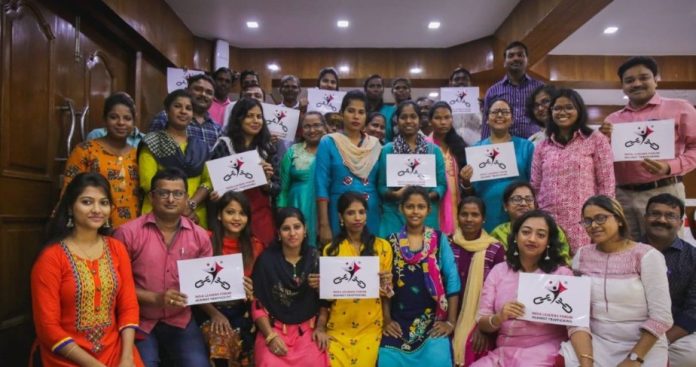
In 2019, Naseema co-founded the Indian Leadership Forum Against Trafficking (ILFAT) with similar anti-trafficking groups across the country. The organisation’s work spans across nine states and has given a new direction to the lives of more than 4500 victims.
She adds, “A person who has gone through such a situation needs a lot of care, love, and respect. In the process of trafficking, they have lost all their self-esteem. Often, society rejects them; in many cases, even their families disown them. We provide them with the necessary help and shelter.”
The organisation trains victims in various skill-based jobs and helps them earn a livelihood. “We reach out to victims and provide them with mental health support and counselling. Through outreach programmes, their trauma and grief connect. So, they don’t feel any loss there. This helps them move forward,” Naseema says.
About her work, Naseema says, “Many times different NGOs approach me and learn how ILFAT and Utthan work. This is a huge inspiration and victory for me.” She adds, “With the organisation, I want to create a safe environment for the victims, ensure that the culprits get proper punishment and all the surviving girls are rehabilitated.”
Naseema, along with her colleagues, helps improve the mental health of the girls who have been rescued from the quagmire of human trafficking, provides compensation, makes the girls aware of their skills, and nurtures them by giving them necessary training.
source: http://www.radiancenews.com / Radiance News / Home> Education> Latest News / by Mohammed Atherulla Shariff, Radiance News Bureau / January 28th, 2025
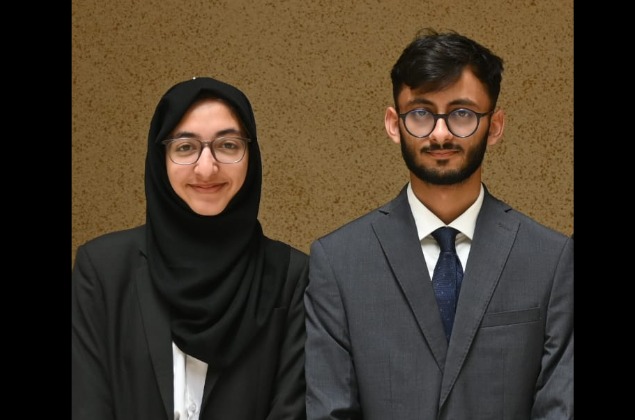
Zainab-ul-Kubra (3rd year), and Intizar-ul-Islam (4th year), Prize winners from NUSRL
Ranchi:
Students of National University of Study and Research in Law (NUSRL), have secured first place in the International Arbitral Award Writing Competition. Two university students, Intizar-ul-Islam (4th year) and Zainab-ul-Kubra (3rd year), achieved the top honour in the 5th Surana & Surana RGNUL International Arbitral Award Writing Competition 2024.
This is a significant achievement for the university, as the duo won this accolade by outperforming participants from some of the most renowned universities in India and abroad. The competition was organised by Center for Alternative Dispute Resolution (CADR) at Rajiv Gandhi National University of Law (RGNUL), Punjab, in collaboration with Surana & Surana International Attorneys.
Participants were tasked with drafting an arbitral award based on a hypothetical legal problem.
More than 72 contestants took part, including students pursuing BA-LLB, LLM, PhD, MPhil, or other law-related courses. The competition deadline was October 30, 2024, and the results were announced in January.
Based on their exceptional skills, Intizar and Zainab not only secured the first position but also received a cash prize of ₹25,000 for their victory. Their success highlights their dedication and expertise in the field of law. The competition served as an excellent platform for students to showcase their legal writing abilities.
The Vice-Chancellor of the university, Professor Dr. Ashok R. Pal, congratulated Intizar and Zainab on their achievement.
source: http://www.radiancenews.com / Radiance News / Home> Pride of the Nation> Awards> Latest News / by Radiance News Bureau / January 21st, 2025
Khazima practised 12 hours daily for months to prepare for the championship.
Deputy CM Udhayanidhi Stalin awarding Rs1 crore cash to M Khazima (Photo | Express)
Chennai :
Three TN women dominated the Women’s Carrom World Championship. M Khazima (18), the youngest world champion, who competed in doubles and team events, received Rs 1 crore from the state government. Mithra (17) and Nagajothi (26), who won the doubles and team events, received Rs 50 lakh each from Deputy Chief Minister Udhayanidhi Stalin in a felicitation conducted by Sports Development Authority of Tamil Nadu (SDAT).
Khazima practised 12 hours daily for months to prepare for the championship. Mehaboob Basha (her father), an autorickshaw driver, runs the Cherian Nagar Carrom Coaching Club with 45 members. “This is a huge recognition,” Khazima said.
“My brother, Abdul Rahman (26), a Junior National Champion, quit playing due to our financial condition. We live in a rented house, and my father’s club is also in a rented space.” She added that the government has promised to improve the club and revealed that she plans to buy a house with the money.
Mithra’s father also drives an autorickshaw. She learned carrom when she was in Class 5. She said her father bought her a carrom board since none of the people playing carrom in her compound included her. She expressed her dream of buying a house and supporting other players.
Nagajothi was part of the winning team in the Asian Cup. She works as an Income Tax Inspector, selected through the sports quota.
source: http://www.newindianexpress.com / The New Indian Express / Home> Tamil Nadu / by Subhashini Vijayakumar / December 19th, 2024
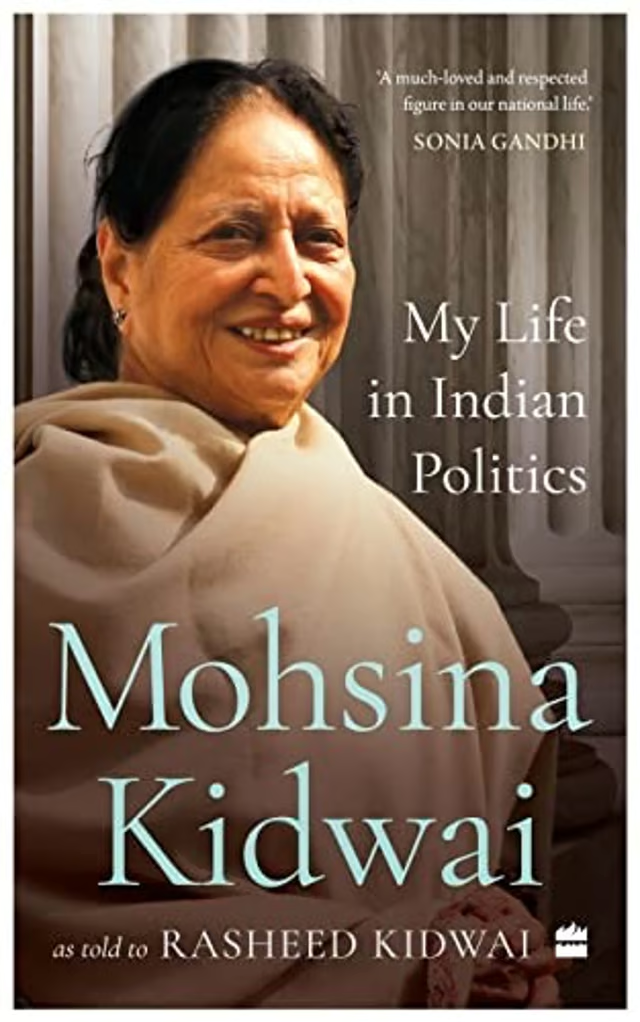
This is just not another memoir of a politician happily or unhappily bounds to look back; the author, instead, talks like a grandmother narrating a story of post-independent India somewhat interlinked with the Congress.
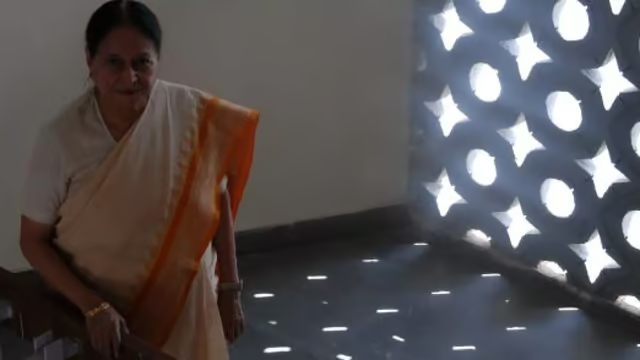
Mohsina Kidwai, author of the book ‘My Life in Indian Politics’
Book Review: Non-fiction (Memoir)/2022; My Life in Indian Politics by Mohsina Kidwai (As told to Rasheed Kidwai); HarperCollins, 300pp (Hardback)
Indian politics is a sort of ‘wonder’ and its unique existential positioning can’t be imagined without people behind its ups and downs. Reading the memoirs, especially of those who served in public life for long, is amongst the rewarding pastimes of a reader. I read Mohsina Kidwai’s memoir as a manuscript, and of course, I reread it even more carefully in its print version. Here is a candid account of a prominent political figure of India who dispels the stereotyped traditional notions that are usually expected to be self-centred and being extra boastful in the first person narrative.
Mohsina Kidwai has been in public life as a member of the Indian National Congress for over six decades. A cabinet minister in several successive central governments and a senior office-holder in the Congress, she has had a ringside view of Indian politics for almost the entire span of independent India’s existence. She has witnessed, and been a participant in, the tenures of prime ministers from Jawaharlal Nehru to Indira Gandhi and Rajiv Gandhi, and was a member of parliament until 2016, one of only twenty Muslim women to have been elected to the Lok Sabha since 1951. She has had a prolific track record that can’t be compared with her fellow women politicians, more so, from the Muslim community.
My Life in Indian Politics by Mohsina Kidwai
The book reflects well on her long and eventful life in politics and covers quite skilfully her contributions to public life, and also succeeds in providing an honest appraisal of the turn in fortunes of the political party she has remained a loyal member of over the decades. The author along with co-author and senior journalist Rasheed Kidwai, endow the readers with rare glimpses to homes, lives and hurly-burly of election campaigns from bygone era when Congress dominated the political landscape at centre and in the states.
One such memorable one was the Azamgarh bypoll in 1978, which Mohsina Kidwai won as Uttar Pradesh Congress Chief, and which signalled a revival of the Congress’s fortune after its spectacular defeat in the post-Emergency general elections of 1977. The book’s cover informs you and inside, the details and rich and beautifully presented.
We get to see little known facts about India’s Prime Ministers Pandit Jawaharlal Nehru, Lal Bahadur Shastri, Indira Gandhi, Rajiv Gandhi and P V Narsimha Rao. Similarly, she is forthright in accepting that her move to join the breakaway Tiwari Congress in 1995 was a mistake.
Here is a quick recap of a few of them:
Mohsina Kidwai talks about an incident which happened when Lal Bahadur Shastri had visited Barabanki sometime in the early 1950s. “A few years after marriage, I saw Shastriji, who had come to meet my father-in-law. Jameel ur Rahman Kidwai Saab had stood for elections and Shastriji was canvassing for him. Shastriji was a simple man. Our domestic help, who did not recognize him, asked him where he was from. Shastriji, by then already a Union minister, replied that he had come in connection with the election and wished to meet Jameel Saab.
“He will return home in the evening,” the domestic help told Shastriji and asked him to wait. Shastriji waited. The servant served him tea.
In the evening, when my father-in-law returned, he saw Shastriji waiting.
A little embarrassed, my father-in-law scolded the servant for not informing him about the guest. After that Shastriji became a member of our extended family.” Some rarest accounts on Indira Gandhi:
“Indiraji was extremely caring and attentive. I can go on talking about many instances. Sometime after the 1977 Lok Sabha polls when Indira ji was in opposition, she planned to visit Badrinath for puja. I and Narayan Dutt Tiwari and I accompanied her. It was an October month. We were told that puja starts at 4 am. Asking us to wait, she went to the temple for Puja. We were to start at 6 am on the return journey to New Delhi. At 5 am, Indiraji returned from the temple and checked whether all the vehicles of our convoy were ready. The pundit of the temple offered us breakfast. When we were having breakfast, the drivers were heating the engines of their respective vehicles. I told Indiraji, we had breakfast but poor drivers must be hungry. They have not even had tea as they were busy heating vehicle engines. I suggested we stop at the first tea shop in return for the drivers to have tea. She agreed.
Indiraji had the habit of carrying some snacks with her in a basket during travel. After a while I saw her taking out some biscuits from the basket kept beneath her seat. She tore the biscuits in four pieces and asked the driver to pick the pieces one by one from her hand while driving. She extended her hand carrying biscuit pieces and the driver did what he was told to do. Indiraji used to enjoy such affection and spontaneous display of it that it often stunned me and used to fill my heart with admiration and pride for my leader.”
“Indiraji could also sense what people around her were feeling. Once we were traveling by an overnight train to Gorakhpur and I suddenly realised I was alone with the Prime Minister in the first-class coupe. She sensed that I was a little uncomfortable and directed me to turn my face towards the wall and go off to sleep,” adds the author.
Undeniably, the book is written with honesty and simplicity, and should be better known as a work to assess an entire era in Indian politics. This is just not another memoir of a politician happily or unhappily bound to look back. She, instead, talks like a grandmother narrating a story of post-independent India somewhat interlinked with the Congress. The book is essential reading for anyone interested in knowing India, its democracy and the foundational stories of a remarkable journey.
(The author is a policy professional, columnist and writer with a special focus on South Asia. Views expressed are personal.)
source: http://www.outlook.com / Outlookindia.com / Home> Culture & Society> Book Review / by Atul K Thakur / January 07th, 2023
Wahdina Village / Sringar, KASHMIR / JAMMU & KASHMIR :
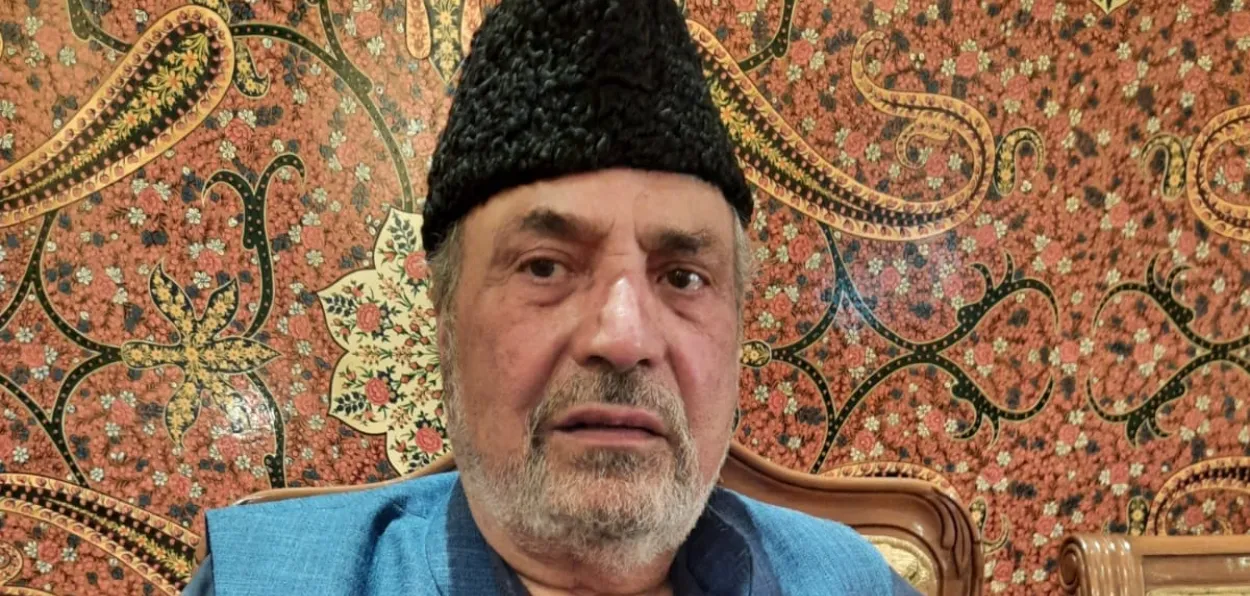
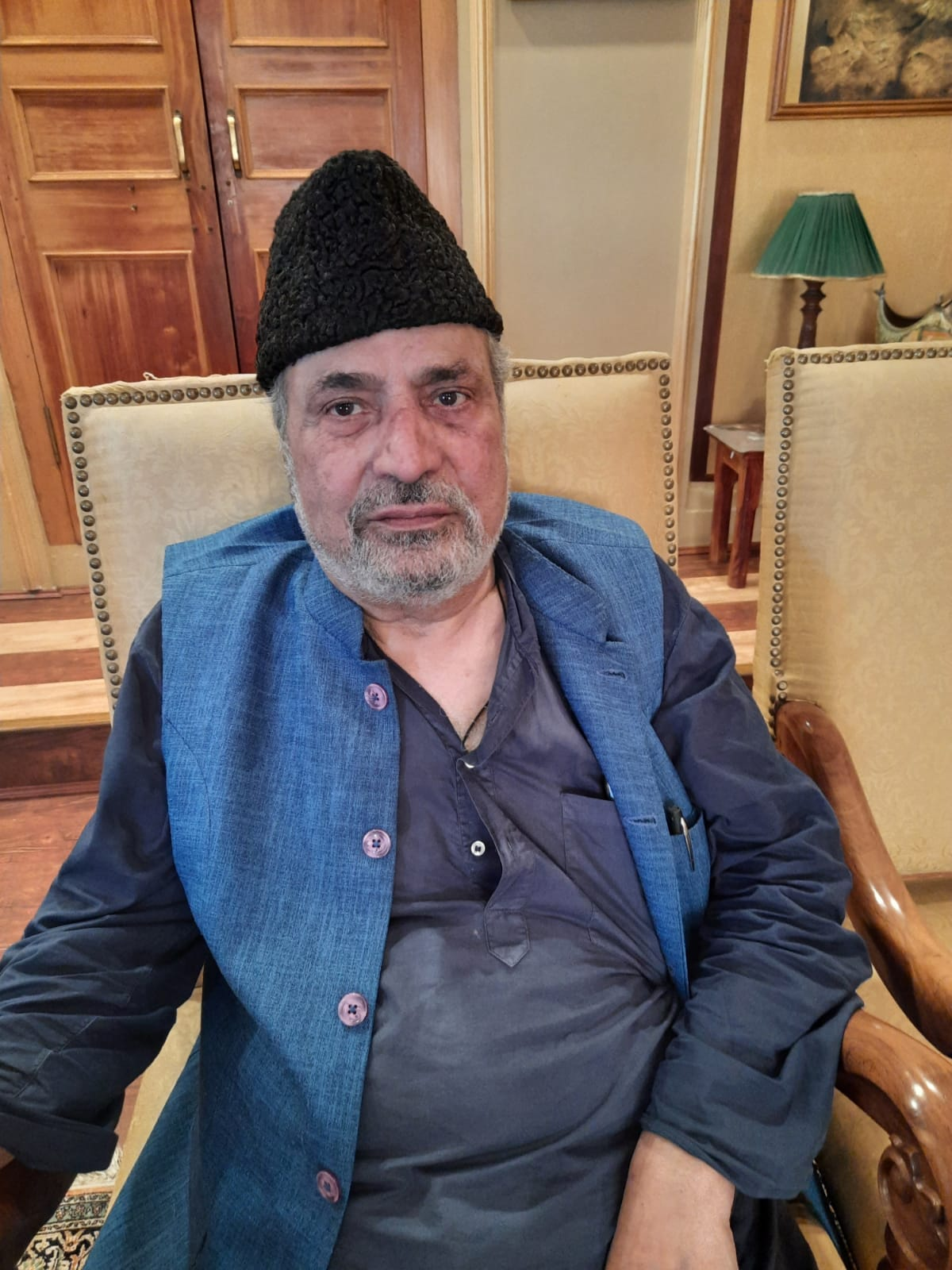
Muzaffar Hussain Baig at his home
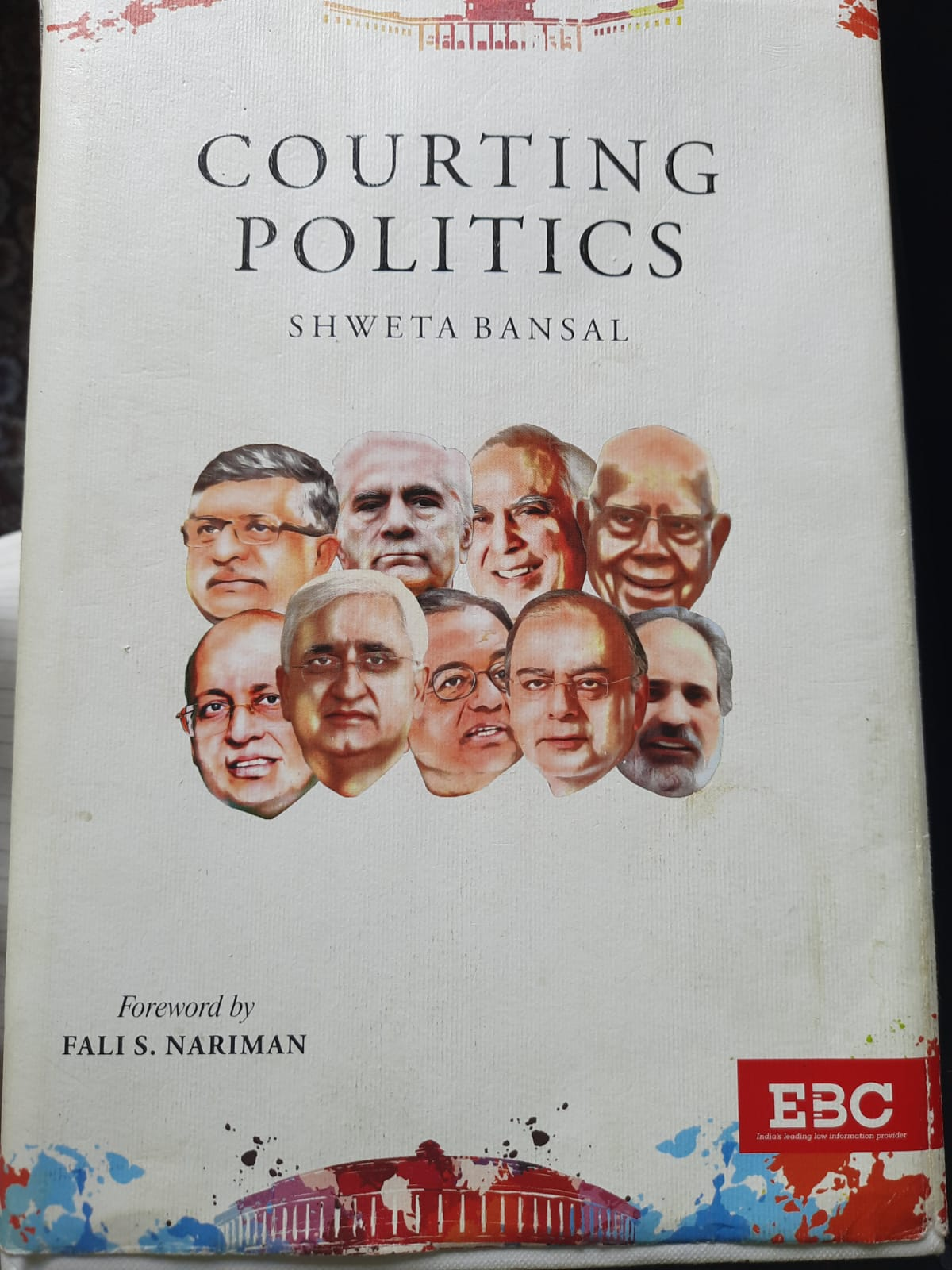
Muzaffar Hussain Baig is among nine top Indian legal luminaries who also took to politics. He figures in the book Courting Politics by Shweta Bansal, along with other well-known legal bigwigs like Ram Jethmalani, Shanti Bhushan, P Chidambaram, Kapil Sibal, Arun Jaitley, Salman Khurshid, Ravi Shankar Prasad, and Abhishek Manu Singhvi.
Baig, a recipient of Padma Bhushan (2020), who held several top positions in the government – Advocate General of J&K, Deputy Chief Minister, Law Minister, a member of Lok sabha – has risen in life wading through extremely difficult circumstances and yet never allowed anything do diminish his thirst for knowledge and limit his genius.
Having studied Law at the Harvard in the USA after graduating from the Delhi University’s School of Law, he also practiced in the US and Supreme Court of India before shifting to Kashmir. He was keen to make a difference to society and contested Lok Sabha elections as an independent candidate. However, with the onset of the Pakistan-backed insurgency in Kashmir in the summer of 1989, Baig jettisoned his dream of pursuing a political career.
Muzaffar Hussain Baig
Baig is credited with drafting the anti-defection law of the J&K and his legal genius is reflected through the important cases he won in the Supreme Court of India and the J&K High Court.
Baig, 78, was born as the second of eight siblings in Wahdina village near Baramulla in North Kashmir. Though the family had a rich and royal legacy, he lived a life of penury. Baig speaks of he footing two km distance to school barefoot.
At the school, he was seen as a determined and hard-working student. One of his teachers Mohammad Maqbool Shah encouraged him to participate in activities like drama and speech making. Baig also taught to younger students in the school.
He learned the English alphabet in his 6th standard as was the norm those days. Soon, he started speaking in the English language with a “thick Kashmiri accent”. He topped the Board examination of the State in the 8th standard (Middle).
He shifted to Baramulla town,15 km away from home, to study further.
There was no stopping for this genius from then onwards till he joined Delhi University for his LLB and topped the examination. He then joined Harvard, USA, for higher studies and again topped the examination.
“You will find all over the world that there is an inbuilt desire in the minds of people to join politics, not to become Government functionaries but to secure some change for the society”, Muzaffar Hussain Baig told Awaz-The Voice at his residence, overlooking Dal Lake in Srinagar.
The Cover of the Book Courting Politics
He said, “I wanted to see the welfare of people…. had this desire to represent society. I did not even charge anything from my clients for whom it was unaffordable”, he said. “Politics, for me, was not just a profession but a mission to represent my society”.
Baig’s maiden attempt in politics, and as a distinguished lawyer having practiced in the US and Supreme Court of India, brought him to the notice of several political leaders including the then Congress leader and a former Minister, Abdul Ghani Lone, and the National Conference leader and former Chief Minister Farooq Abdullah and also former union Minister Mufti Mohammad Sayeed.
Lone had later constituted the Peoples Conference in the 1970’s, after quitting Congress. “Abdul Ghani Lone, with the idea of some change in Jammu and Kashmir, had become important as a political leader”, with mass support in Kupwara. North Kashmir. Lone extended his support to Baig in a couple of subsequent Lok Sabha elections. Baramulla constituency, then comprising Baramulla district of the entire North Kashmir, now comprises three districts, Kupwara carved out in 1979 and Bandipore carved out in 2007.
Describing Abdul Ghani Lone a rebel, who was among several others after having been educated at the Aligarh Muslim University (AMU), Baig said that he (Lone) enquired “about my interest in politics. I was already contesting as an independent candidate, he assured me of his support in Kupwara”, he said.
Muzaffar Hussain Baig as a student in Harvard
Baig added that both of them almost belonged to a similar “deprived background”, and had to suffer together for many years. Abdul Ghani Lone represented his home constituency of Handwara in 1967, 1971 (Cong), 1977 (JP), and Karnah, 1983 (Peoples Conference) both constituencies in the Kupwara district. Things changed with the eruption of militancy late in 1989, leading to a political vacuum.
Having been at the forefront of political activities in Jammu and Kashmir since the Peoples Democratic Party (PDP) was launched by the former Chief Minister, Mufti Mohammad Sayeed in 1999, Baig had “good relations” with top political figures including former PMs, Atal Behari Vajpayee and Dr Manmohan Singh. He opines that Vajpayee was “extraordinarily intelligent” and Dr. Manmohan Singh was the most “humble and efficient person”.
Baig equally holds the Prime Minister Narendra Modi in high esteem for his sincerity and clarity of approach. “A Statesman thinks about the next generation and a politician thinks for next elections.’ he said.
On his experiences in the Lok Sabha as a PDP MP from Baramulla between 2014 and 2019, Baig lays importance on the “substance and sincerity in speech” adding that one has to say “things openly for the (welfare of) people”. He hailed the high political qualities of former union Ministers, Ms Sushma Swaraj and Arun Jaitley.
Muzaffar Hussain Baig in his younger days
Given his distinguished legal background, Baig’s association was sought by Mufti Mohammad Sayeed to frame the Constitution of a new political party, which later took the shape of the Peoples Democratic Party (PDP) in 1999. There was a need to float a new party while the Congress and National Conference were the only two national and regional level active political parties in the erstwhile State of Jammu and Kashmir. Mehbooba Mufti, elected from the home constituency of Beijbehara in Anantnag district in 1996, was the CLP leader in the State Assembly.
Apart from practicing in the US after his post-graduation in the Law, Baig, being a senior counsel practiced extensively in J&K High Court, Delhi High Court, and Supreme Court of India Some of the important cases he had dealt with include the case of Reliance Petrochemicals in the SC, while he was associated with Shardul and Pallavi Shroff & Co in Bombay.
The case about Compulsory Convertible Debentures was being opposed by the senior Advocate, Ram Jethmalani. Quoting a ruling from the House of Lords, London, Baig, appearing for Ambanis asserted on the plea that no person should appear in public in any case while it is sub-juidice. The verdict was in favor of his plea, while the senior lawyer, Ram Jethmalani withdrew from the case. The legal luminaries present included N A Palkivala, Fali S Nariman, and Soli Sorabji.
He soon returned to Kashmir and decided to contest the elections as an independent to “work for the welfare” of the people. In J&K he is known for the Anti-Defection Law, following the new government formation by G M Shah in July 1984. A close associate of Sheikh Mohammad Abdullah and his son-in-law, G M Shah formed the Government after some of the NC MLAs defected to him from the Chief Minister, Farooq Abdullah. Shah was the J&K Chief Minister from 1984 to November 1986, before Farooq Abdullah again took over after the Rajiv-Farooq Accord.
On the personal front, Baig got married to Safina in 2007, who is the first elected woman Chairperson of the J&K Haj Committee and also the DDC Chairperson of Baramulla.
source: http://www.awazthevoice.in / Awaz, The Voice / Home> Story / by Ehsan Fazili, Srinagar / August 23rd, 2024
Mumbai, MAHARASHTRA / Chennai, TAMIL NADU / INDIA :
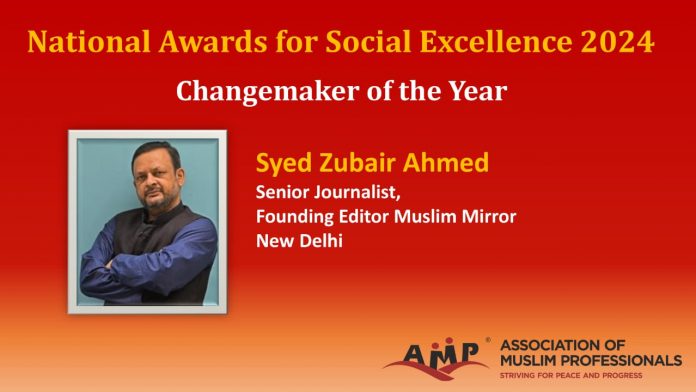
Syed Zubair Ahmad, the founding editor of Muslim Mirror, has added another feather to his cap by being declared one of the prominent Changemakers of 2024 by the Association of Muslim Professionals (AMP). The prestigious recognition was announced during a grand event held at the B.S. Abdur Rahman Crescent Institute of Science & Technology, a deemed university in Chennai, Tamil Nadu. The event was graced by honorable guests and attended by a large gathering of participants from across India.
Ahmad, a distinguished journalist, is known for his powerful advocacy for the rights and representation of marginalized communities, particularly Muslims, in India. Over the course of his career, spanning more than two decades, he has built a reputation for his unwavering commitment to truth, justice, and journalistic integrity.
The Association of Muslim Professionals (AMP) is Mumbai based pan India non-profit organization dedicated to the socio-economic empowerment of the Muslim community in India. Through initiatives in education, employment, and community development, AMP works to foster leadership, skill-building, and social welfare, connecting professionals and organizations nationwide for collective progress.
“In a memorable ceremony, 100 inspiring individuals were honored with Changemaker Awards, and 100 state-level NGOs were recognized in the Best and Jury categories. Additionally, 10 organizations were celebrated in prestigious national categories,” said a press statement issued by AMP.
Notable national NGO awardees include;
ALTNEWS
APCR (Association for Protection of Civil Rights)
IMRC (Indian Muslim Relief & Charities??)
Institute of Objective Studies (IOS),
Allana CSR
Pataka CSR and
Seethakathi Trust
Some of the prominent Changemaker awardees included;
Syed Zubair Ahmad (Muslim Mirror)
Mohammed Wajihuddin (Times of India)
Aslayah Kallakath (Maktoob Media)
Abdur Rahman IPS (Retd.)
Akramul Jabbar IRS (Retd.)
Hammad Rahman
Adil Meraj and
Syeda Ruksheda.
The Lifetime Achievement Award was posthumously bestowed upon the Late Moosa Raza, IAS (Retd.), which was received by his family.
The Omar Khatani Memorial Award was presented to the Tarraqi I Foundation, while BSA Crescent Institute of Science & Technology received the Partner of the Year Award.
Mrs. Mariam Habib, Trustee of B.S. Abdur Rahman Crescent Institute of Science & Technology, served as the Chief Guest and commended AMP’s efforts in education, employment, and empowerment. She emphasized the role of NGOs in bringing about significant societal change in collaboration with policymakers, and she noted that the legacy of the late B.S. Abdur Rahman is being continued with great dedication by the current leadership.
Dr. N. Raja Hussain, Registrar of B.S. Abdur Rahman Crescent Institute of Science & Technology and Guest of Honour, praised AMP’s work in recognizing and motivating various organizations and individuals. He highlighted the ongoing collaboration between the university and AMP in developing students and faculty through guest programs. The event was presided over by University Vice-Chancellor Prof. Dr. T. Murugesan.
Motahar Hosain, Chief Executive and Guest of Honour, congratulated AMP for instituting these much-needed awards to acknowledge the contributions of individuals in the development sector. He remarked that despite the sacrifices made by these individuals in service to others, they seldom receive the appreciation they deserve, making these awards a significant recognition of their efforts.
Mr. Farooq Siddiqui, Head of the AMP National Coordination Team and the driving force behind these awards, stated, “AMP believes in collaboration and has been working alongside multiple organizations since its inception. Through the AMP NGO Connect project, we are connected with over 7,000 social organizations across nearly all districts of India, helping them with capacity building and implementing AMP’s social welfare projects in their regions. These awards are our way of appreciating their efforts and motivating them to continue their impactful work.” He also thanked the AMP Chapter and state teams for mobilizing massive nominations and captivated the audience at the packed Crescent Convention Center Hall with his superb and engaging awards announcement.
Ms. Shereen Sultana, State Head – AMP Tamil Nadu, in her address, shared details about AMP’s initiatives and invited everyone to join hands for the betterment of society and nation-building. She expressed her gratitude to the management and staff of B.S. Abdur Rahman Crescent Institute of Science & Technology for their cooperation in hosting the event and mentioned how she took up the challenge of organizing the awards ceremony in Chennai.
AMP Tamil Nadu State Executive Team member Mr. Yahya Rasheed welcomed the guests and successfully hosted the event with the support of Prof. Ansar.
The awards process for the NASE was multi-layered, with state, central, and a 9-member distinguished jury led by A.R. Khan, IAS (Retd.), President of A.R. Welfare Foundation, Dr. Syed Zafar Mahmood, Founder & President of Zakat Foundation of India, Dr. Farah Usmani, Founder & Chairperson of Rising Beyond The Ceiling, Prof. Zubair Meenai, Professor & Former Head of the Dept. of Social Work, JMI, Prof. Naseem Ahmed Khan, Chairman of the Dept. of Social Work, AMU, Dr. Shazia Manzoor, Head of DSW, University of Kashmir, Sherin Ali, Global Lead – Corporate Social Responsibility, WNS, Sajid Ali, COO of Tech Mahindra Foundation, and Gulzar Hussain, Head of Government Partnerships, UN World Food Program (India).
The success of the 4th edition of the awards was attributed to the collaborative efforts of key AMP team members, including Sajjad Parvez, AMP Zonal Head – South India; Dr. B. Raja Hussain, State Secretary; Syed Faheem, Chennai Chapter Head; and Syed Deen, Chennai Chapter Secretary. Their contributions, along with the support from the back-office teams at the Central Offices in Mumbai and Vaniyambadi, were instrumental in making the event a success.
source: http://www.muslimmirror.com / Muslim Mirror / Home> Indian Muslim> Media> Positive Story / by Muslim Mirror Desk / August 22nd, 2024
In a district-level speech competition organized by the Umeed Foundation, Malkapur’s Al-Huda Urdu Girls School and Junior College student, Nazifa Namus, emerged victorious, securing the first position.
Daughter of Tariqullah Khan, Namus impressed judges and spectators alike with her eloquence.
She was awarded an honorary certificate and a cash prize of eleven thousand rupees.
The event, held on Sunday, garnered attention from dignitaries such as Abdul Karim Salar, President of the Education Society, and Rajesh Akde, a prominent member of the Provincial Assembly.
Also present were Maulana Ashfaq Qasmi, Haji Rasheed Khan and senior police officials from the city.
source: http://www.radiancenews.com / Radiance News / Home> Education / by Zaina Aman (headline edited) / Radiance News Bureau / March 06th, 2024
Our Prime Minister Narendra Modi fondly refers to girls as Bharat ki Beti. One such Bharat ki Beti Uzma Fatima, 26, an assistant engineer at the Srisailam Power Plant in the Telangana State left a blazing trail of bravery as she saved 4 of her colleagues from the fire reportedly caused due to short circuit a few days ago.
Modi also says: Beti Bachao, Beti Padhao (Save girl child, educate girl child). Young Hyderabadi Uzma’s bravery can make us say: Beti Padhao, Beti Bachaati (Educate girl child, she will save you)!
Thousands of girls have been raped and burnt to death. Many others have been burnt to death for dowry. But when girls get a chance, they save the families and the nation. Uzma Fatima was a notch higher in the sense that she saved those 4 colleagues, who were not even her own family. She put humanity first!
Uzma Fatima’s father Mohammed Zubair runs a footwear business at Chappal Bazar in Hyderabad. He has three daughters and a son. The elder daughter is married. Uzma Fatima was his second daughter and was unmarried. His youngest daughter is in the eighth standard.
Mohammed Zubair’s son Mohammed Minhaj who is a degree college student told that his family is in a state of shock due to the sudden tragedy. According to him, Uzma Fatima was working in Srisailam Power Station as an Assistant Engineer for the past four years. The CCTV footage of the fire accident shows that Uzma had come out of the fire engulfed place. According to the survivors, she saved 4 (four) of her colleagues. She went back to bring out the other assistant engineers trapped there. She could not come of the tunnel along with eight other colleagues. The brave engineers perished in the fire.
It may be recalled that women were finally given combat roles in the Indian Army after a long struggle. Uzma’s sacrifice proves that women are second to none in bravery. Women are our best bet to save our country within and on our borders. Rani Laxmi Bai of Jhansi proved her bravery in the battlefield against the British. Every girl in our country is a potential Rani Laxmi Bai. They prove it when they get chances. Our Prime Minister Narendra Modi may certainly be feeling proud about the sacrifice of Bharat ki Beti Uzma Fatima.
A fitting tribute to Uzma’s memory would be institute a gallantry award her name and also rechristen Srisailam Power Plant as Uzma Fatima Power Plant. It will not only generate electricity but it will also generate bravery for our future generations of girls to emulate.
The Telangana Chief Minister K. Chandrasekhar Rao (KCR) should pay tribute to Telangana’s daughter Uzma Fatima by naming a major road in Hyderabad after her. The Malakpet Railway Station near her residence can be named as Uzma Fatima Railway Station. Are Modi ji and KCR Garu listening?
source: http://www.beyondheadlines.in / Beyond Headlines / Home> Real Heroes / by Dr. Ahmed Moinuddin Siddiqui / August 25th, 2020
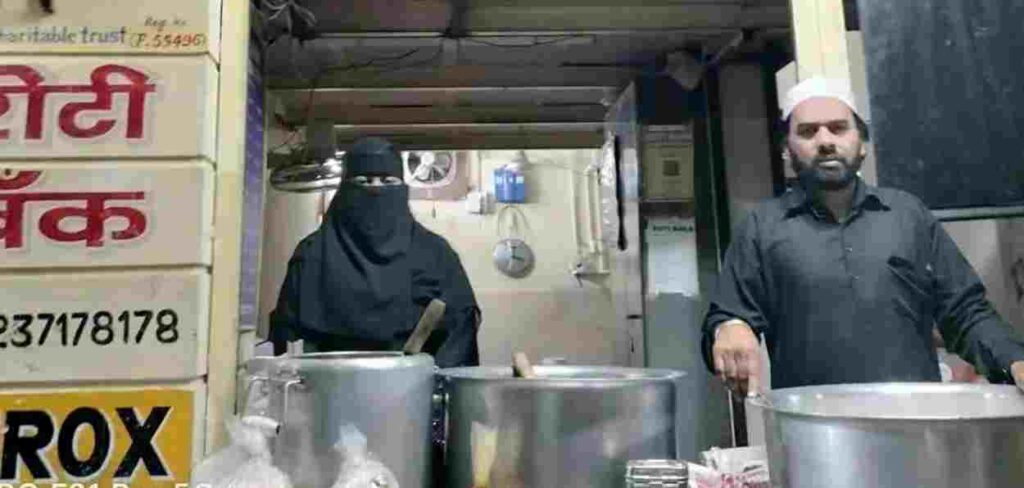
Following the Islamic principle that ‘if your neighbors sleep hungry while you are there, then you are not a true Muslim,’ neighbours in Pune Kondhwa in Maharashtra have replicated the initiatives of “Roti Bank” (bread bank) across many Indian cities and soup kitchens run by religious organization in the West, to address the hunger in the IT hub.
“Ark Charitable Trust’ was launched in August 2019 when many people in the city had lost jobs or livelihoods due to the COVID and hunger was rampant.
The trust was set up by a Kondhwah couple Aliya Shaikh and Nasir Shaikh from their house. The trust has been running a “Roti Bank” to and feeding widows and destitute women who are forced to wander around in search of food of alms to buy it.
Gradually, the Shaikhs realized that feeding people was a temporary solution to the problem of poverty and they started focusing on its root – lack of education. The trust got involved in educating children wandering on streets picking trash and leftover food and enrolled them in various schools
The trust has also provided job works to many widows whom they came in contact with while distributing food.
The Trust distributes food among people of all castes and religions.
Aliya Shaikh says she completed her 12th from Abeda Inamdar College in Lashkar area of Pune.
“I wanted to study, but I got married early, so I could not and then I realized what if I did not study? I can teach the girls living around me. My children today are doing well; studying in schools but what about those who do not have money? That is why I am trying to ensure that no one’s education stops due to financial constrains.”
Nasir also completed his schooling from Moledina High School in Lashkar area. Though he joined class eleventh he had to drop out due to financial problems at home. He started working as a commercial painter.
Nasir says, “Food satisfies the hunger of the stomach, while education satisfies the hunger of the mind. That is why both are considered basic needs.”
After seeing the work of Nasir and Aliya, a neighbor Ayesha Shaikh also joined them.
Ayesha, 65 has retired from a good position in a multinational company. Aliya, 30, works as a beautician and Nasir, 40, is a building contractor. All three work for ‘Ark’ while handling their business and family responsibilities.
In many weddings a lot of food is left over. To ensure this food doesn’t end in trash bins of the city, the Trust has displayed boards in key points in the city with this statement printed on these: ‘If you have leftover food, contact us… We will deliver this food to the hungry stomachs.’
‘Ark’ also gets financial support from various people and institutions on their auspicious occasions.
The three started this work from their homes without any funds. For the first eight days, Aliya used to cook food while Nasir distributed it. For the next eight days, Nasir took to cooking and Aliya to distribution. They would alternate their responsibilities ensuring that no single person has to take workload.
Aliya says, “We kept reaching out to the needy. As the work progressed, other people came forward to help us. Some started helping us financially, other by donating rations like oil, grains, etc.”
Soon many others more people had joined Ark.
Nasir empathises more with poor and says they are very sensitive. Instead of doling out food, the trio started a ‘Roti Bank’ to give dignity to those needing food.
Nasir says, “The work of ‘Roti Bank’ is not a one-day job. We cannot do one program in one month and then do the next program the next month. It has to be continuous work.
“It’s a challenge to feed their children and send them to school. But it’s also satisfying to see that someone’s life is changing because of you.”
“We have seen people cooking using paper as the only fuel. We have seen them struggling to satisfy their hunger,” says Ayesha. Food is provided to 50 families every day through ‘Ark’. Children’s education fees are paid.”
Aliya, Ayesha and Nasir deliver food to the people of Kondhwa, Bhagyodayanagar area. But the needy people of Hadapsar and Katraj area are not able to reach them every day, nor is it possible for Aliya, Ayesha and Nasir to take food boxes there every day.
So all three of them go to that area and distribute enough ration for at least two months on the basis of the given identity card. They also offer ‘Sehri’ and ‘Iftari’ facilities during Ramzan. A satisfied Ayesha says,
“It is a pleasure to be able to reach out and help the needy. Because of the work of Aliya and Nasir, I am associated with a good organization.”
source: http://www.awazthevoice.in / Awaz, The Voice / Home> Stories / by Chhaya Kavire, Pune / April 04th, 2024