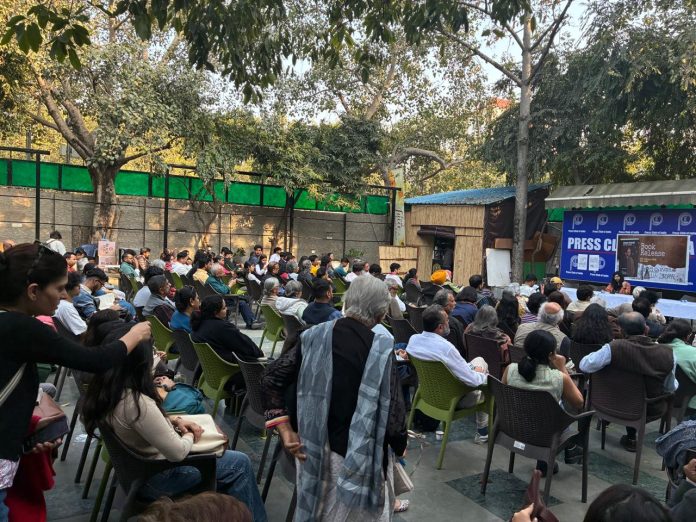
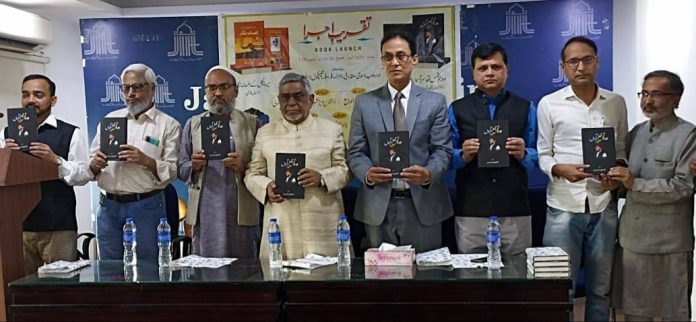
An overflowing audience of the young and the very old at the Press club of India, New Delhi, on Tuesday witnessed the release of a book on Umar Khalid, a JNU scholar now in jail these last six years.
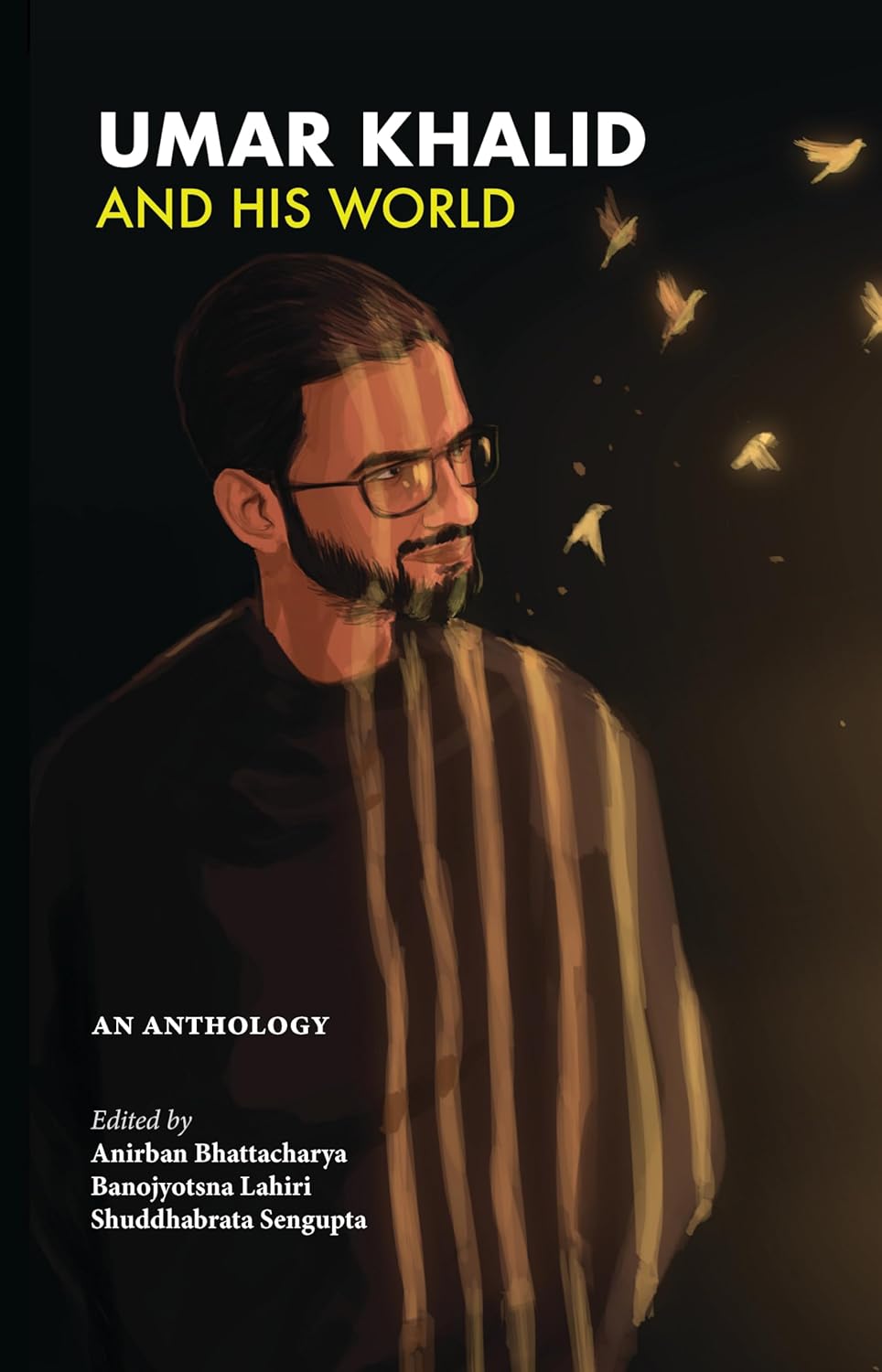
The book titled Umar Khalid and His World: An Anthology, published by Three Essays Collective, is edited by Anirban Bhattacharya, Banojyotsna Lahiri, and Shuddhabrata Sengupta.
It is an anthology of writings by and about the incarcerated activist, featuring contributions from various public figures, intellectuals, and friends. The anthology is curated by researcher/activist Anirban Bhattacharya, writer and activist Banojyotsna Lahiri (who is also Umar Khalid’s partner), and artist/writer Shuddhabrata Sengupta.
The book features letters, essays, and reflections, including writings from Umar Khalid himself, along with contributions from Romila Thapar, Ramachandra Guha, Anand Teltumbde, and Kunal Kamra. It highlights themes of resistance, the injustice of prolonged detention, and the political atmosphere in India.
source: http://www.radiancenews.com / Radiance News / Home> Review Article> Book Release> Focus / by Radiance News Bureau / February 17th, 2026
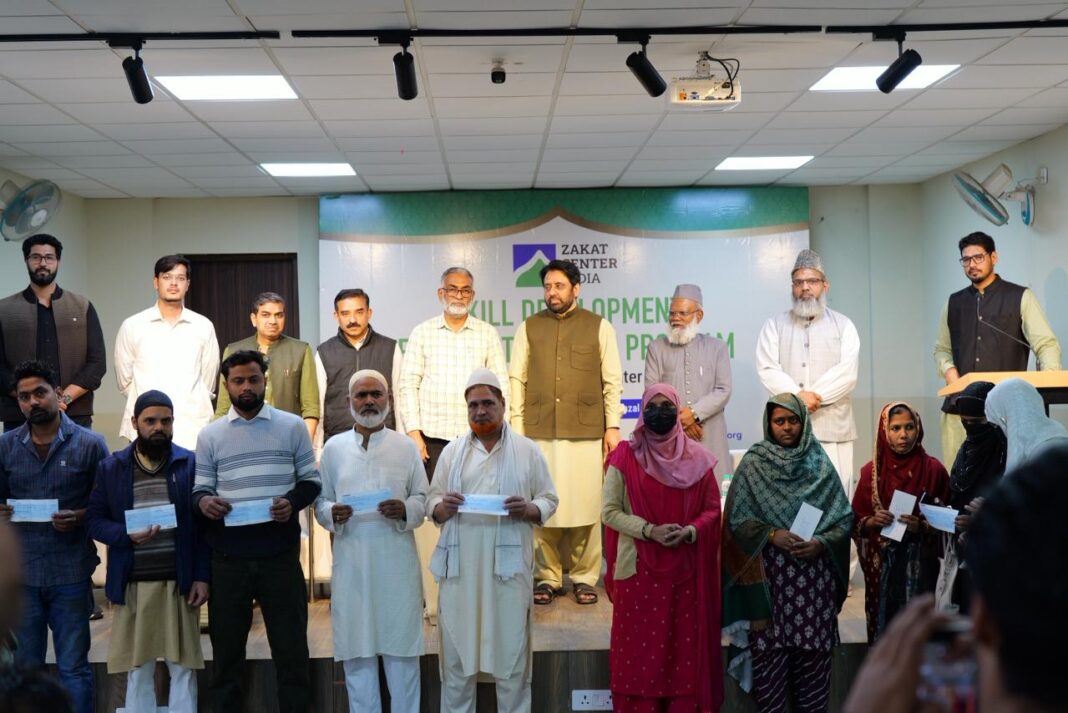
Zakat Center India (ZCI) disbursed Rs. 6 lakh among 14 deserving beneficiaries in Delhi during a Skill Development Fund Distribution Programme held at the Scholar School Conference Hall, Jamia Nagar, for the financial year 2025–26.
The programme was attended by several prominent dignitaries, including Okhla MLA Amanatullah Khan, who graced the event as chief guest. Representatives from social, religious, and community organizations were also present.
ZCI, a pan India non-profit organization dedicated to poverty alleviation and social welfare, focuses on the transparent and efficient utilization of Zakat. The initiative aims to help beneficiaries establish micro-businesses and sustainable livelihoods, enabling them to transition from Zakat recipients to self-reliant earners within a short period.
Addressing the gathering, MLA Amanatullah Khan appreciated ZCI’s organized and institutional approach to Zakat management and assured his continued support for such welfare initiatives. He noted that structured and transparent Zakat systems can significantly contribute to social upliftment and economic justice.
In his keynote address, ZCI Chairman and Jamaat-e-Islami Hind (JIH) Vice President S. Ameenul Hasan emphasized the importance of channeling Zakat into productive sectors such as livelihood generation, education, and skill development. He said that when managed strategically, Zakat becomes a powerful tool for long-term economic empowerment rather than temporary relief.
JIH Secretary Dr. Mohiuddin Ghazi highlighted Qur’anic guidance on economic justice and social responsibility, stressing Islam’s emphasis on equitable distribution of wealth. Human Welfare Foundation (HWF) CEO P.K. Noufal acknowledged the collaborative spirit behind the programme.
Delivering the welcome address, ZCI’s National Operations Director Shoaib Islam underscored the need for a technology-driven, transparent, and impact-oriented Zakat ecosystem that ensures scalability and lasting socio-economic transformation.
“This initiative reflects ZCI’s commitment to transforming Zakat from seasonal charity into a structured, dignity-based economic intervention,” he said.
Rs. 6 Lakh Distributed to 14 Beneficiaries
Providing details, Shoaib Islam said that 14 beneficiaries including six women, received financial assistance totalling Rs. 6 lakh. According to him, most beneficiaries were given Rs. 50,000 each while some received Rs. 20,000, and others were granted up to Rs. 60,000 based on their specific business needs. The funds are intended to help establish or strengthen micro-enterprises and promote financial stability, he added.
When asked about the nature of businesses supported, Shoaib Islam said the ventures include battery rickshaw services, electrical shops, tailoring units, grocery stores, resin art businesses, painting workshops, and other self-employment initiatives.
“The objective is not merely financial relief but sustainable livelihood creation, enabling families to move from dependency to self-reliance,” the ZCI official said.
He confirmed that all beneficiaries are residents of Delhi, including areas such as Kanchankunj, Jamia Nagar, Seelampur, and Old Delhi.
Thorough Scrutiny Before Assistance
Responding to a query about the selection and identification of deserving persons, the ZCI official said ZCI follows a rigorous and transparent mechanism. Beneficiaries are identified through social media outreach, public advertisements, recommendations from local Unit Advisory Committees, and coordination with local NGOs. Applications are verified through field visits and background checks are done before final approval. Once assistance is provided, beneficiaries typically begin earning daily income and, in most cases, achieve self-sufficiency within months, he added.
Awarded Shariah Compliance Certificate
The ZCI Operations Director also shared ZCI’s Shariah Audit Certificate. The Shariah Council of Jamaat-e-Islami Hind awarded ZCI the Shariah Compliance Certificate for the financial year 2024–25. The certificate, signed by Shariah Council President Dr. M. Iqbal Masood Nadvi and Secretary Dr. Mohammad Raziul Islam Nadvi, confirms that ZCI’s operations and accounts comply with Shariah principles. The certification remains valid until the next Shariah audit for the financial year 2025–26.
Clarifying common doubts and misconceptions prevalent in society regarding transparency and Shariah compliance of such institutions, Shoaib Islam stated that ZCI conducts regular audits and presents its financial statements and balances in its annual report before the public.
He said this practice shows a high level of transparency and strict adherence to Shariah principles, further strengthening ZCI’s credibility and reaffirming its commitment to accountability and Shariah-based ethical operations.
From 5 Pilot Units to 37 Units Across 11 States
The ZCI official further stated that since its inception in 2022, ZCI has expanded from five pilot units to 37 units across 11 states over the past four years, covering both North and South India, supported by a network of over 600 dedicated volunteers. He described the growth as evidence of increasing community trust and the effectiveness of a collective, transparent, and Shariah-compliant Zakat management system.
Across India, ZCI, with the generous support of its donors, has served over 3,525 beneficiaries in 2025. ZCI has reached numerous distressed families, with nearly 60 percent of Zakat funds allocated to livelihood support and 20 percent to education. The organization prioritizes productive, empowerment-focused spending over purely consumptive relief.
“This expansion reflects the trust of the community and the dedicated efforts of our teams and partners,” he added.
Comprehensive Welfare Model
According to Shoaib, ZCI operates under three major categories: Livelihood Projects, Education Schemes, and Mawasat (Food Ration & Pension Schemes).
Under Livelihood Projects, ZCI supports the poor in establishing businesses, shops, carts, cattle farming units, and other self-employment ventures to generate sustainable income.
Under Education Schemes, the Centre provides scholarships, fee assistance, mentoring, and training to deserving students from economically weaker sections.
Under Mawasat (Food Ration & Pension Schemes), ZCI offers monthly support to widows, persons with disabilities, elderly women, and orphans in the form of rations, food supplies, pensions, and medical assistance.
The organization currently supports nearly 5,000 needy individuals through its livelihood initiatives. ZCI typically disburses amounts ranging from Rs. 20,000 to Rs. 50,000, with nearly all collected Zakat distributed among beneficiaries and only minimal funds used for essential administrative expenses.
ZCI’s core objectives include mobilizing and managing Zakat and Ushr in accordance with Qur’anic guidance, promoting awareness about the social and spiritual benefits of organized Zakat, providing livelihood and welfare support, establishing institutions for Zakat recipients, and conducting research to strengthen and modernize Zakat management systems.
source: http://www.indiatomorrow.net / India Tomorrow / Home> Economy / by India Tomorrow / February 20th, 2026
As the year draws to an end, we have compiled a brief list of the Indian Muslims who have been in news during 2021.
Danish Siddiqui :
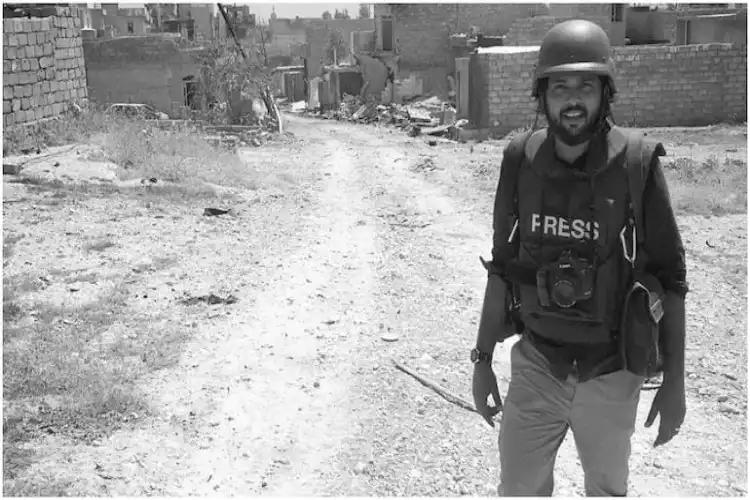
Danish Siddiqui was a Pulitzer Award winning photojournalist from New Delhi, who was killed by Taliban while covering the war in Afghanistan. An alumnus of Jamia Millia Islamia, Siddiqui was one of the country’s most well known photographers who documented the Rohingya refugee crisis, Covid deaths and the Delhi riots to win several awards. In July 2021, Reuters assigned him documentation of the Afghanistan War as an embedded journalist with Afghan Special Forces. On July 16, Siddiqui was killed in action. Governments of India, USA, Afghanistan and United Nations expressed grief and shock on his death and thousands joined his funeral procession in DelhI.
Dr Shahid Jameel :
Dr. Shahid Jameel is a world renowned virologist and is one of the leaders of India’s fight against Covid-19. The Covid-19 outbreak has thrown new challenges to the scientific community. When the Government of India set up an Indian Sars-Cov-2 Genomics Sequencing Consortium (INSACOG), which consists of 38 laboratories to monitor the genomic variations in the SARS-CoV-2, Jameel was appointed as the head of its scientific advisory group. He served the INSACOG in this position till May, 2021 and still advises different government and non-government bodies in strategising the war against Covid-19.
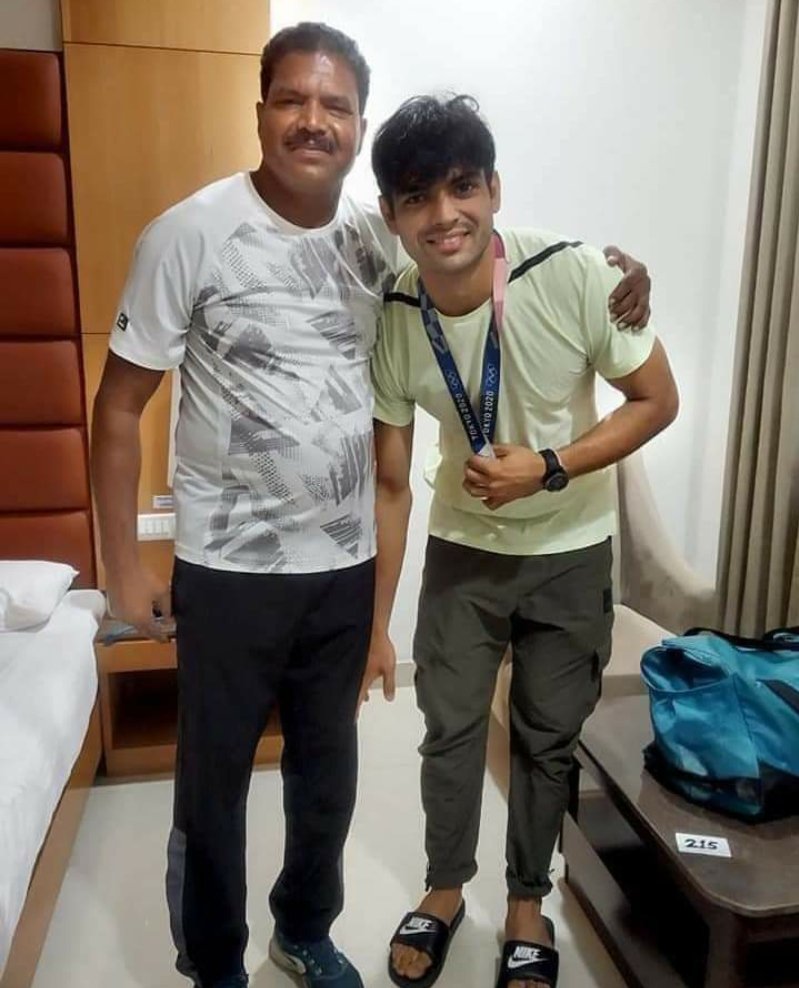
Coach Naseem Ahmed with Olympian Neeraj Chopra
Naseem Ahmed :
Naseem Ahmed: On 7 August, 2021, Neeraj Chopra threw Javelin for 87.58 mts. and became the first Indian to win an Olympic Gold in track and field events. With this success, Naseem Ahmed of Panchkula also hit the headlines. Ahmed was his first coach, who coached Chopra for almost six years at Tau Devi Lal Sports Complex in Panchkula. It was under his guidance that Chopra turned into an athlete from a chubby child. After returning to India, Chopra went to meet and receive blessings from his coach.
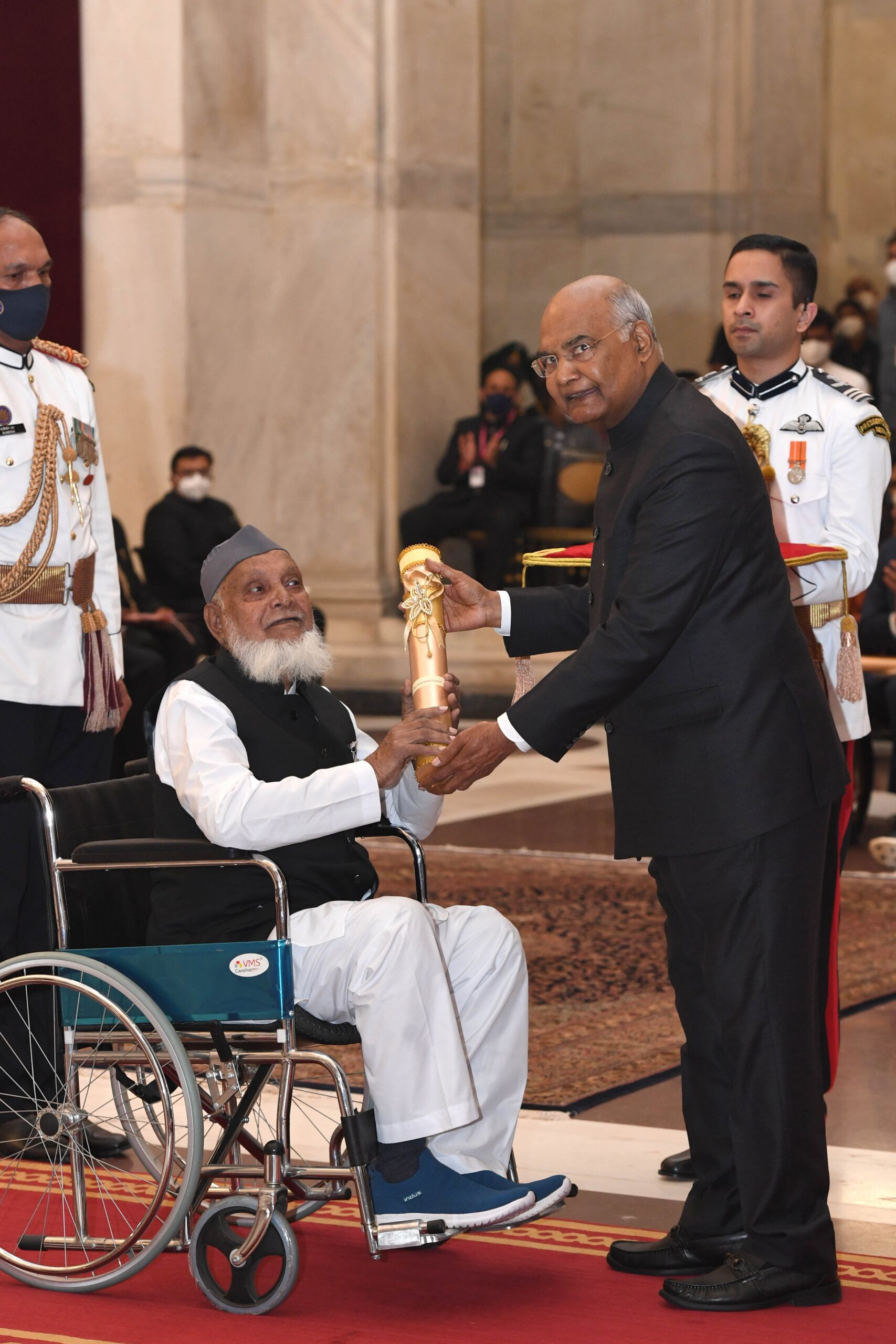
Mohammad Shareef alias Shareef Chacha receiving Padma Shri from President Ran Nath Kovind
Mohammad Shareef :
Mohammad Shareef is a bicycle mechanic from Faizabad, Ayodhya and hit the news headlines this year for receiving Padma Shri, the fourth highest civilian award in India, from the President Ram Nath Kovind. In 1992, his son was murdered and was eaten by animals as nobody claimed it. This incident moved him so much that he took it upon himself to perform the last rights of unclaimed dead bodies. In the last 28 years, he has performed the last rights of more than 25,000 unclaimed dead bodies according to their religions.
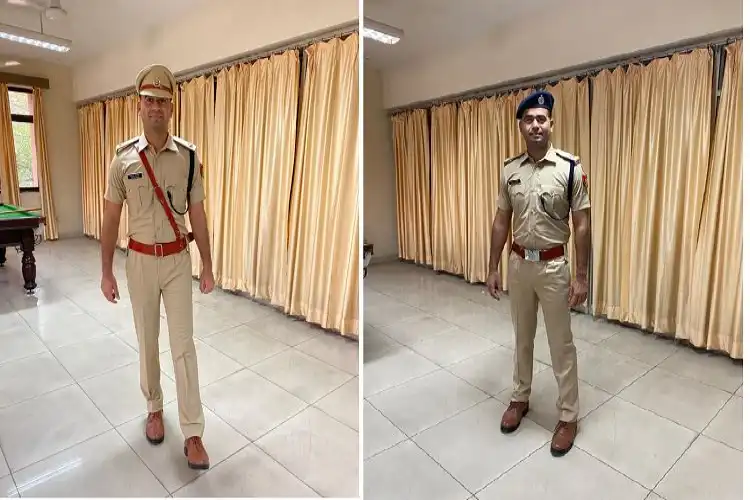
Firoz Alam as an IPS officer (Left) and as a Constable of the Delhi Police (Right)
Firoz Alam :
Firoz Alam’s story is straight out of a fiction, where his character bears resemblance to those played on screen by several film stars. Alam, a resident of Hapur in U.P, was a constable with Delhi Police since 2010. In 2014, he started preparing for UPSC CSE. The work pressure and family responsibilities did not allow him to devote full time to the studies, like many availing coachings could do. After five unsuccessful attempts, in his sixth attempt he qualified UPSC CSE and joined as an IPS officer. His inspiring journey from a constable to IPS had taken the nation by a storm when he joined the training after leaving the job as constable.
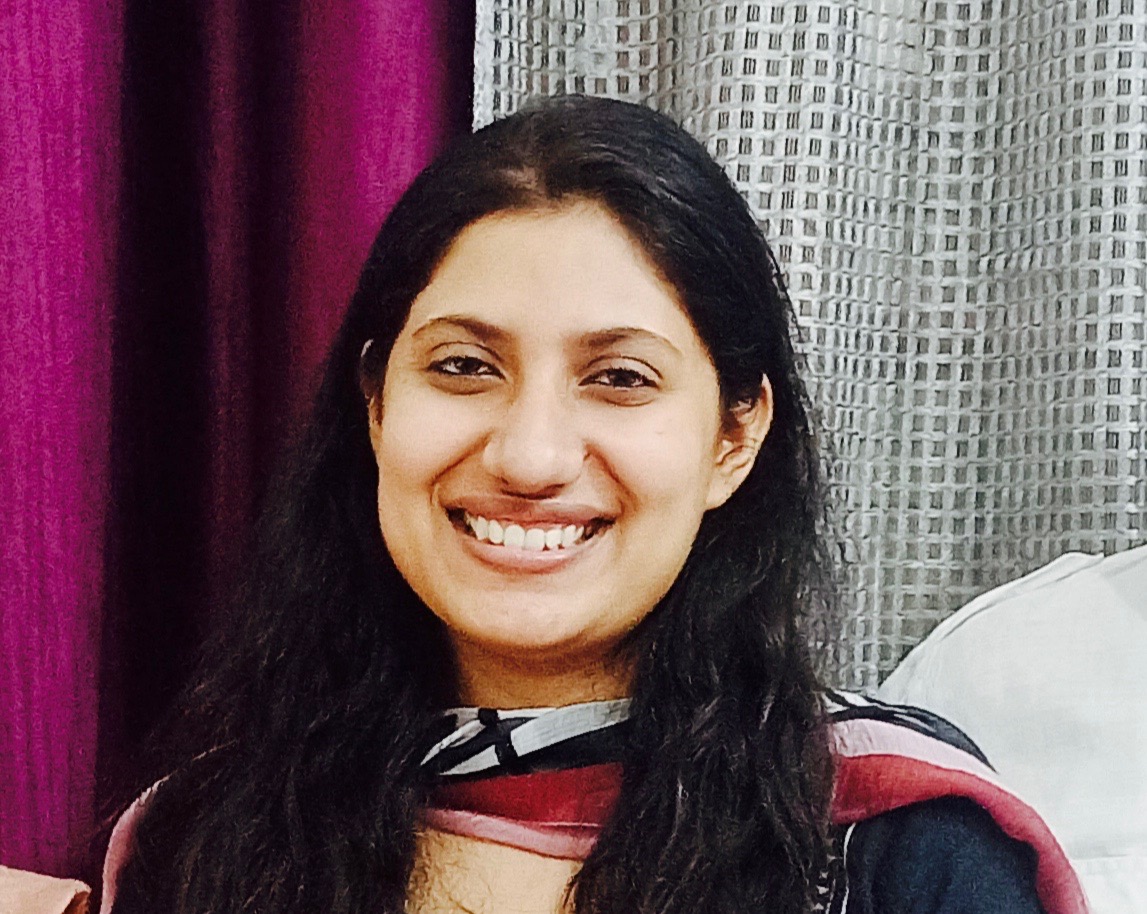
Sadaf Choudhary
Sadaf Choudhary :
Sadaf Choudhary came into limelight when the UPSC CSE results were declared in September and she secured 23rd rank. She was the highest rank holder among Muslims this year and will become an IAS officer. It must be kept in mind that since independence only 179 Muslims have secured ranks to get IAS allotted to them.
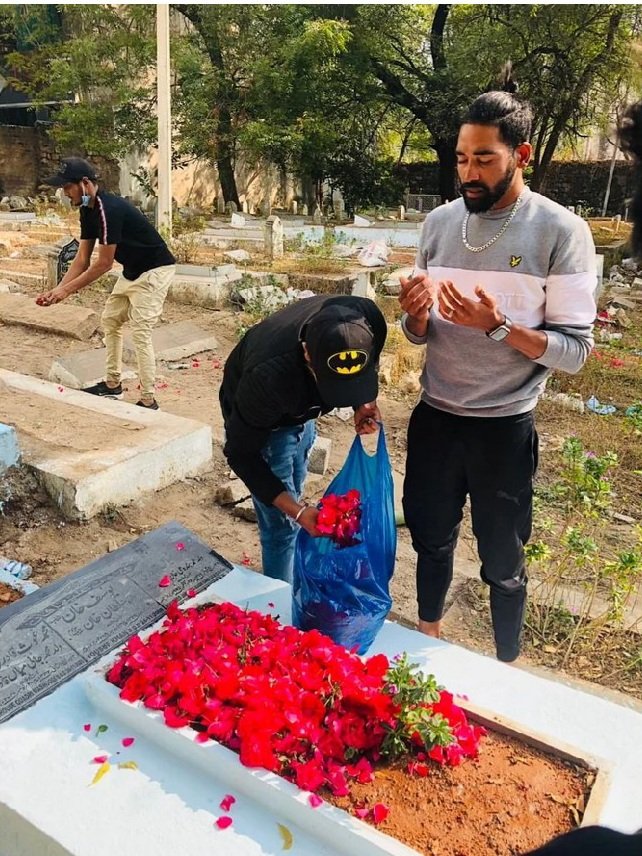
Mohammed Siraj praying at the gave of his father
Mohammed Siraj :
Mohammed Siraj is an Indian cricketer from Hyderabad who made it to the headlines in January by becoming the highest wicket taker from India during the India – Australia Test Match Series in Australia. To claim his 13 scalps, he played only three of the four tests in the series. The fact that his father had died just before the series and he was given an option to return to the country, which he declined citing his commitment to the nation made it even more special.
In the last test match at Brisbane, he bagged five Australian wickets to script a historic win and became a national hero. The headlines of the sports column were filled with his heroics, commitment and ability. Since then he has been a regular feature of the Indian Cricket team as a pacer.
source: http://www.awazthevoice.in / Awaz, The Voice / Home> Stories / by Saquib Salim / December 30th, 2021
Renowned Scholar and Former Jamia Dean Recognized for Five Decades of Academic and Social Contributions
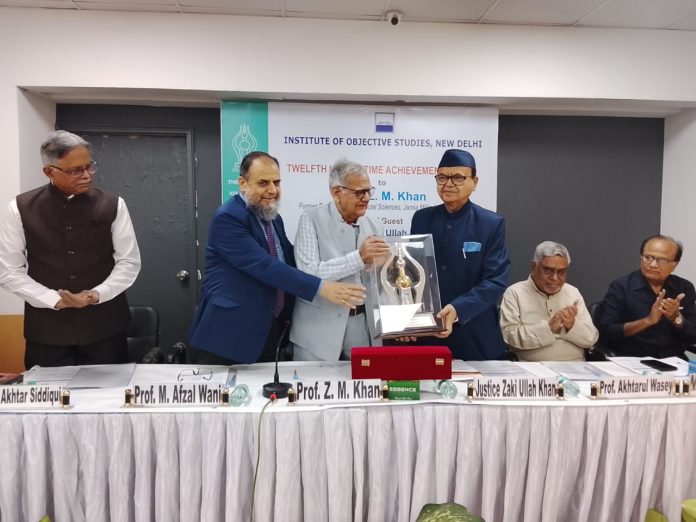
In a grand ceremony held in the capital, the Institute of Objective Studies (IOS) conferred the prestigious IOS Lifetime Achievement Award upon Professor Zahoor Mohammad Khan (Z.M. Khan)— an eminent scholar, researcher, author, and former Dean of Social Sciences at Jamia Millia Islamia.
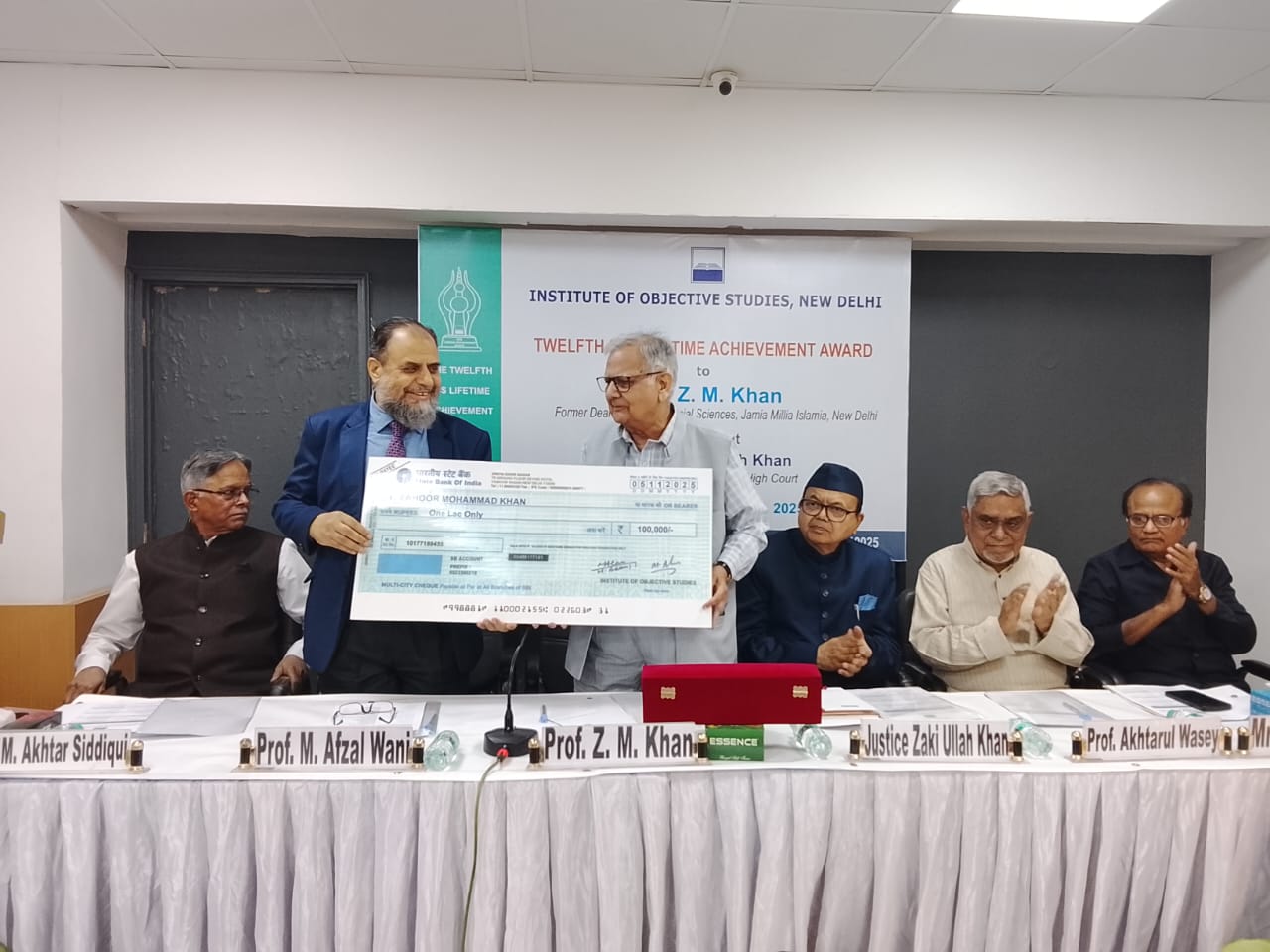
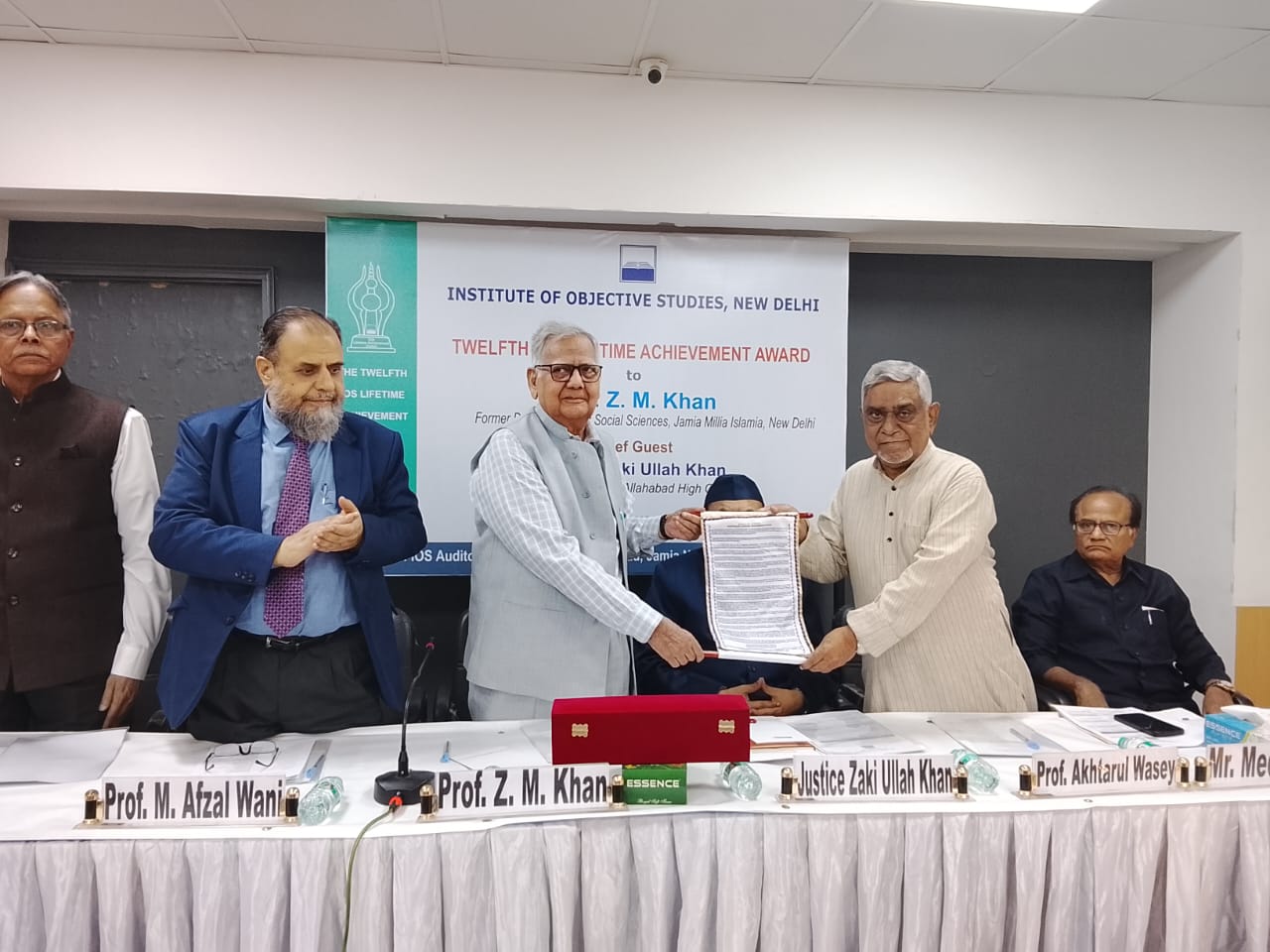
Prof. Khan, who also served as the former Secretary General of IOS, was presented with a citation, memento, and a cash prize of ₹1 lakh in recognition of his outstanding services to education, research, and social development.
Prof. Khan’s illustrious career spans over five decades, marked by his multifaceted roles as an academician, researcher, author, and institution builder. He has authored eight books and dozens of research papers, contributing significantly to the study of political science and sociology in India. During his 23-year tenure as Secretary General of IOS, the institution evolved from a modest initiative into a nationally respected think tank. He also played a pivotal role in launching the IOS Scholarship Programme, which has supported numerous students and researchers over the years.
The IOS Lifetime Achievement Award, instituted in 2007, aims to recognize individuals, organizations, or voluntary groups who have rendered exceptional service to the nation and society, irrespective of religion, caste, or creed.
Previous recipients of this distinguished award include former Chief Justice of India A.M. Ahmadi, Dr. A.R. Kidwai, Prof. B. Sheikh Ali, A.G. Noorani,, Prof. Akhtarul Wasey, Prof. Mohsin Usmani Nadwi Maulana Hakim Abdulllah Mughaisi, and K. Rahman Khan, among others. Prof. Khan’s inclusion in this eminent list was greeted with enthusiastic applause from the audience.
Expressing his gratitude upon receiving the honour, Prof. Z.M. Khan said, Faith in God and the spirit of service are the most precious blessings one can receive. Faith brings with it a sense of responsibility and accountability to the Creator — that is the greatest reward of life. He also acknowledged the crucial role of institutions such as Delhi University, Jawaharlal Nehru University, Jamia Millia Islamia, and the Institute of Objective Studiesin shaping his academic journey.
The ceremony was chaired by Prof. M. Afzal Wani, Chairman of IOS, and graced by Justice Zakiullah Khan (former Judge, Allahabad High Court) as the chief guest.
Distinguished guests included Prof. Akhtarul Wasey (Jamia Millia Islamia & former Vice Chancellor, Maulana Azad University, Jodhpur), Prof. M. Akhtar Siddiqui, Mr. M. Afzal (former MP), and Prof. Furqan Ahmad.
The event began with a recitation from the Holy Quran by Dr. Nighat Husain Nadwi, a welcome address by IOS Secretary General Mohammad Alam, and was conducted by Prof. Hasina Hashia Vice Chairperson of IOS, who also delivered the vote of thanks.
The event not only celebrated Prof. Khan’s extraordinary contributions but also reaffirmed IOS’s commitment to honouring individuals who have significantly influenced India’s intellectual and moral landscape.
source: http://www.radiancenews.com / Radiance News / Home> Latest News> Report / by Radiance News Bureau / November 07th, 2025
Much before I became an admirer of Ustad Zakir Hussain, I was a devoted fan of Ustad Shafaat Ahmed Khan. The reason was simple. Growing up in New Delhi, I had the chance to see the tabla maestro regularly when I was a teenager, often with luminaries like santoor monarch Pandit Shivkumar Sharma, flautist Pandit Hariprasad Chaurasia and sarod maestro Ustad Amjad Ali Khan.
After moving to Mumbai, I continued to attend Khan’s shows, and interacted with him twice as a music journalist. It came as a huge shock when he passed away on July 24, 2005, at the untimely age of 51, after a bout of hepatitis. Among classical music lovers, memories of Khan’s music remains fresh. Coming Wednesday, on his 14th death anniversary, Pancham Nishad is organising a tribute concert at the Veer Savarkar auditorium, Shivaji Park. It will feature vocalist Sanjeev Chimmalgi and tabla maestro Swapan Choudhuri, whose performance was a highlight of the Ustad Allarakha birth centenary celebrations on April 29.
I first heard Khan perform in 1977 when I was 14, at the Shri Ram Centre, New Delhi. He was accompanying Shivkumar Sharma on Raag Bhoopali. It was the first time I heard the santoor and the experience was magical. I didn’t understand the technicalities, but was totally enraptured. Both Sharma and Khan became my heroes. The same show also featured violinist N. Rajam and vocalists Rajan and Sajan Mishra, with different tabla accompanists. So imagine my joy. I told my parents to take me to more concerts, and very often, Khan would perform.
Senior aficionados often talked about Khan representing the Delhi gharana, and Hussain being associated with the Punjab school. It made no difference to me, until I started writing about them. I also had the good fortune of seeing tabla players like Kishen Maharaj, Anindo Chatterjee and Suresh Talwalkar perform.
My first meeting with Khan took place in the early 2000s, when he was to perform at the Gunidas Sangeet Sammelan at Nehru Centre, Worli. While the interview was formal, he was delighted to see an ardent admirer like me. “People normally try to find fault in my technique. You are different,” he had joked. The second encounter was at Sharma’s birthday celebrations in 2004. It was a select gathering of about 25 people. This was where I discovered what a fantastic mimic Khan actually was.
He narrated hilarious incidents about musicians. One of them was about a senior instrumentalist who was yelled at by an elderly foreign lady at the Amsterdam airport because he was humming the notes of Raag Bageshri a tad loudly.
When Sharma pointed out that he was mimicking those not present at the party, prompt came the reply, “If I mimic you, you won’t let me play at your shows. My career will finish,” stated Khan clearly.
source: http://www.thehindu.com / The Hindu / Home> Entertainment> Music / by Narendra Kusnur / July 18th, 2019
A sense of ‘Think global, act local’ prevailed at the launch of two significant books “Who jo Shams tha Sar-e-Aasmaan” and “Seemanchal ke Afsana Nigar.” The launch was jointly organized by Forum for Intellectual Discourse and Idara Adab-e-Islami, Delhi on Sunday, 7 November, 2021 at the headquarters of Jamaat-e-Islami Hind.
The book “Who Jo Shams tha Sar e Assmaan” was compiled by Dr Noman Qaisar and Mohd Islam Khan and has 41 Urdu articles and six poems on the life and services of journalist Dr Abdul Qadir Shams who died during Covid-19 on 25 August, 2020. It also has four write-ups in English.
Another book “Seemanchal ke Afsana Nigar” is an effort to document the life and works of dozens of fiction writers of Seemanchal.
Presiding over the programme renowned Islamic scholar and former President of Maulana Azad University, Jodhpur, Prof Akhtarul Wasey said that the work done by Abdul Qadir Shams was ‘unusual’. “Shams used to sleep in Delhi but dreamed of Seemanchal.” The void left with his demise would always be felt in my life, said Wasey, who is also the Professor Emeritus of Islamic Studies at Jamia Millia Islamia. Seemanchal ke Afsana Nigar will be an indispensable work in the history of short-story writing. Prof Wasey also congratulated the Forum for Intellectual Discourse stating that the need for such an organization like the Forum could never be felt more strongly than the present times. He wished the Forum success.
Special guest, editor general at NCERT, Dr Perwaiz Shaharyar expressed happiness over organizing a meeting for a journalist in which a large number of people from media were present whose responsibility had grown manifold as the nation was confronted with difficult situations. He called the book a ‘valuable addition to literature’. Prof Abu Bakar Abbad had his reservations for confining any segment of Urdu literature to a specific region as Urdu was a global language. The protagonists, however, had their own arguments for identifying geographical regions, as was also the case with Seemanchal, a region long ignored by most literary aficionado.
Abdul Mannan, editor of monthly Yojana reasoned that the creative facets of Seemanchal remained shrouded because their writers usually shied away from the limelight. In that context, he considered Ehsan Quasmi’s work exceptional.
Chief guest, senior journalist Siraj Naqvi, who had worked with Abdul Qadir Shams for over a decade said that Shams new the art of maintaining relationships. Despite all the difficulties, the smile on his face would dispel worries. Author, critic and famous litterateur Haqqani Al-Qasmi paid a glowing literary tribute to his childhood friend Abdul Qadir Shams which moved the audience. He said Woh jo Shams tha… is not merely a collection of articles but teardrops flowing directly from the hearts.
Dr Waris Mazhari, Assistant Professor, Jamia Hamdard; Dr Khalid Mubashshir, Assistant Professor, Jamia Millia Islamia; Dr Ahmad Ali Jauher, Assistant Professor, Indira Gandhi National Open University; Dr Jasim Uddin Qasmi of Delhi University, Jamshed Adil Alig and Dr Zain Shamsi also shared their views. Uzma Shaheen, daughter of late Abdul Qadir Shams paid a rich tribute to her father.
Manzar Imam of Forum for Intellectual Discourse moderated the three-hour long programme which had begun with Qur’anic recitation of Abdur Rahman, followed by welcome remarks of Dr Mohammad Ajmal, Assistant Professor, Centre for Arabic and African Studies, Jawaharlal Nehru University. It ended with a vote of thanks by journalist Abid Anwar.
source: http://www.muslimmirror.com / Muslim Mirror / Home> Books / by Manzar Imam / November 10th, 2021
Yusufpur (GhazipurDistrict), UTTAR PRADESH / NEW DELHI / London, U. K :
Begum Zohra Ansari sold away ‘Dar-us-Salam’ to raise party funds and worked for the victory of the candidates of the Indian National Congress and for the defeat of the candidates of the Muslim League, who wanted partition.
Begum Zohra Ansari, an activist of the Indian National Movement whom Mahatma Gandhi addressed as “Vasthad Bi, was born in Delhi. She was the adopted daughter of freedom fighters, Dr. Mukhtar Ahmed Ansari and Begum Shamsunnisa Ansari.
Besides playing an important role in the National Movement, her parents provided hospitality to leaders and a cadre of the Indian National Movement and scholars and people of repute in different walks of life in their residence ‘Dar-us-Salam’. It was very spacious like a royal palace.
While Begum Shamshunnisa Ansari was busy in these responsibilities, Zohra helped her. Thus she had an opportunity to see from close-quarters leaders such as Mahatma Gandhi, Pandit Motilal Nehru, and the Ali Brothers and to serve them. Right from childhood she evinced interest in literature, history, and social sciences. She also gained proficiency in Urdu, Arabic, Persian, and Hindi.
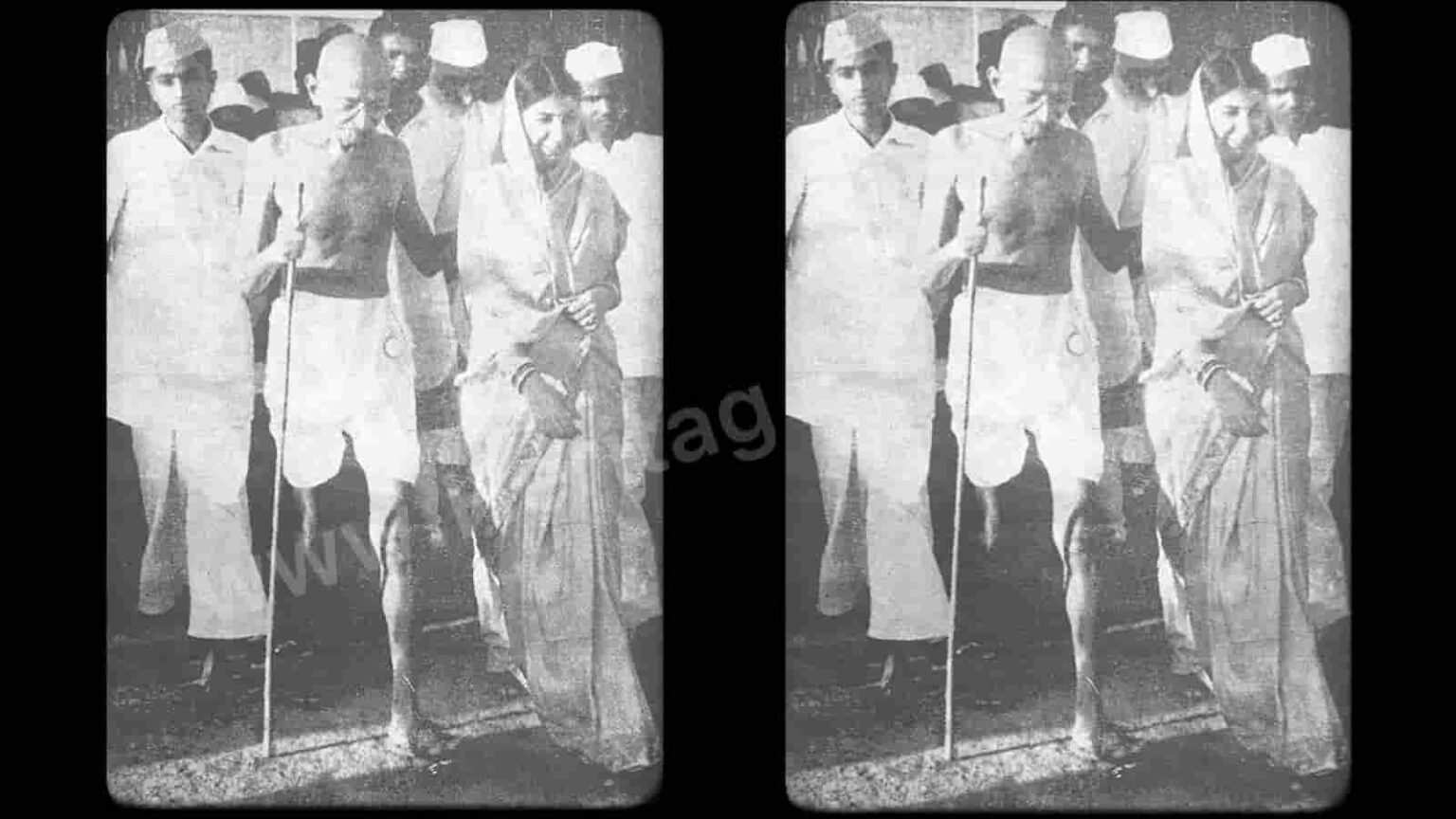
Zohra Ansari and Mahatma Gandhi
Zohra Ansari rendered her services in Wardha Ashram for a long time. Mahatma Gandhi came to know about her command over Urdu and started learning the language from her. He used to address her in his letters as ‘Vastad Bi’ and ‘Beti.
Zohra Ansari and Mahatma Gandhi used to have regular correspondence on various issues. In his letter dated 22 December 1932 to Dr Ansari, Gandhiji remarked that he used to look forward to Zohra’s letter every week. When Zohra expressed her desire to go to jail as a part of the National Movement, like her parents, Gandhiji asked her to wait and promised to allow her to go to jail.
Begum Zohra Ansari married Dr Shaukatulla Shah Ansari (1908-1972) who was her relative and leader of the Indian National Movement. Begum Zohra Ansari lost her father in 1936 and mother in 1938. She took an active part in the Freedom Struggle along with her husband. Both wife and husband opposed the partition of India.
She sold away ‘Dar-us-Salam’ to raise party funds and worked for the victory of the candidates of the Indian National Congress and for the defeat of the candidates of the Muslim League, who wanted partition. Post Independence, Begum Zohra Ansari led a simple life and passed away on 28 July 1988 in England.
source: http://www.heritagetimes.in / Heritage Times / Home / by Syed Naseer Ahamed / December 12th, 2023
The centuries-old Islamic educational centre, birthplace of the Urdu Qur’an translation, struggles to protect its legacy amid growing Hindu-led development projects.
New Delhi :
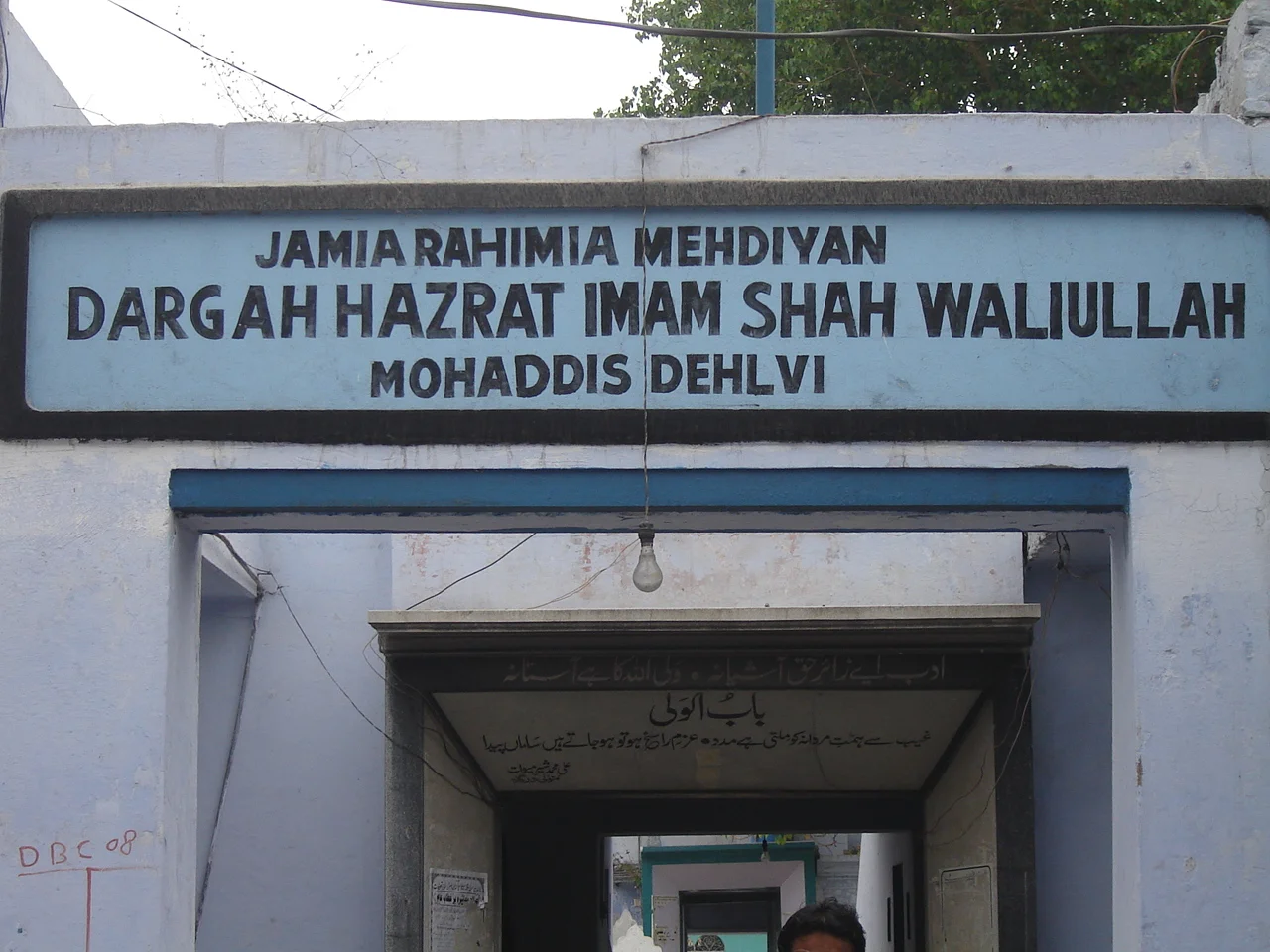
Hidden along the busy Bahadur Shah Zafar Highway, Mehdiyan — home to the revered Madrasa Rahimiya, also known as Jamia Rahimia — stands as one of Delhi’s oldest Islamic learning centres. Established by Shah Abdul Rahim, father of the famed scholar Shah Waliullah Muhaddith Dehlvi, this madrasa has for centuries served as a vital institution nurturing Islamic scholarship. However, today its existence is threatened by creeping urban development dominated by Hindu groups, threatening to erase a vital piece of Muslim heritage.
“Madrasa Rahimiya was not just a school; it was a movement to bring Muslims closer to the Qur’an’s true teachings,” explains Mufti Muhammad Sabir, a Hadith instructor at the madrasa. “But its history is being erased by those who prioritise development over our heritage.”
Madrasa Rahimiya holds a proud place in history, especially for pioneering the first Urdu translation of the Qur’an. In the late 1700s, Shah Abdul Qadir, a key scholar educated under his father and others, undertook the translation project at the Akbarabadi Mosque. This effort laid the foundation for making Islamic scripture accessible to millions of Urdu-speaking Muslims across India, who were otherwise unable to understand the original Arabic text.
“Shah Abdul Qadir’s translation was revolutionary, yet it faced strong opposition from scholars who considered translating the Qur’an sacrilegious,” says Maulana Sabir. “Despite this, his work endured and shaped generations.”
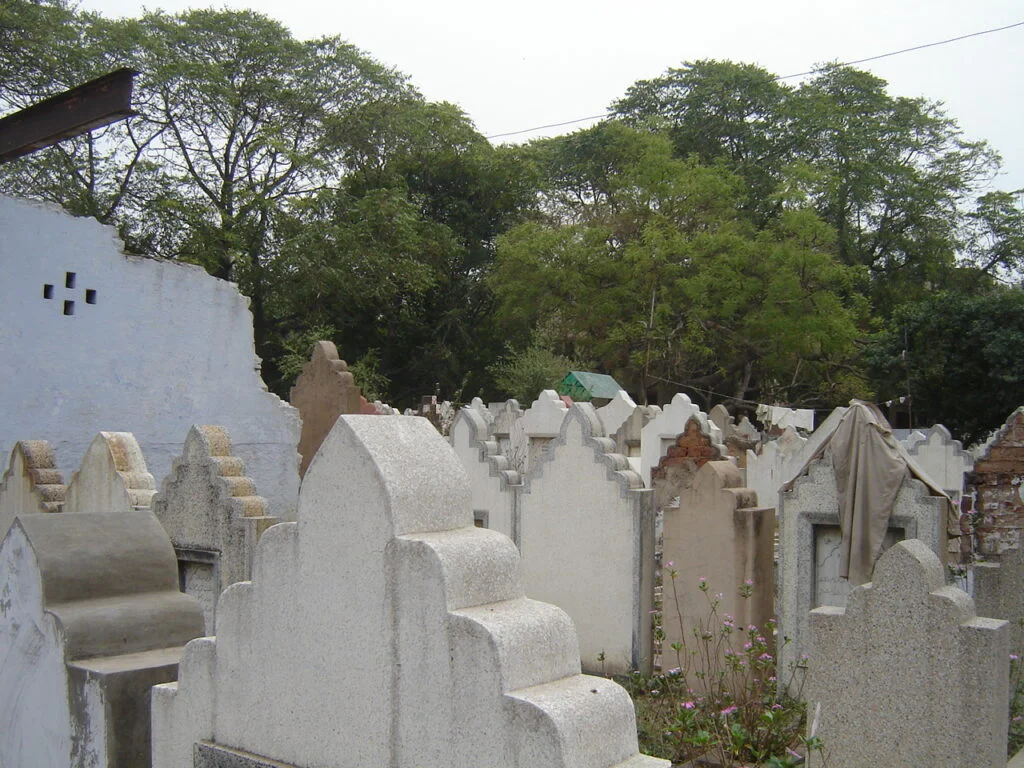
But this rich history has not been free from hardship. After the 1857 War of Independence, British colonial forces destroyed the Akbarabadi Mosque and shuttered the madrasa. The adjoining Mehdiyan cemetery, the resting place of Shah Waliullah and his family members, was drastically reduced. Historian Rana Safavi laments, “Mehdiyan was once a vast necropolis for saints and commoners alike. Now, much of it is lost to encroachment, with what remains used merely as a washing place.”
In the 1960s, Delhi’s expanding urban sprawl posed new threats. Plans to demolish Mehdiyan to build flats and houses were only halted because of the heroic resistance of Ali Muhammad, known locally as Sher-e-Mewat. “He lay down in front of bulldozers and even Pandit Nehru’s car to protect these sacred shrines,” recalls resident Bilal Ahmed. “He broke his leg but ensured our heritage survived.” Jawaharlal Nehru himself was moved by Ali Muhammad’s determination and ordered the preservation of these sites, which were later enclosed by a boundary wall.
Yet, the madrasa’s survival is once again at risk. Critics point out that the latest wave of urban planning, heavily influenced by Hindu groups, disproportionately targets Muslim heritage areas. Historian Zafar Khan asserts, “Hindu groups have long viewed places like Mehdiyan as obstacles to their vision of a ‘modern’ Delhi. This is not just about land — it’s an attempt to erase Muslim identity.”
Local Muslims feel the marginalisation acutely. “Our history is being systematically sidelined,” says Ayesha Begum, a teacher at Jamia Rahimia. “While Hindu temples receive government protection and funding, our sacred sites are neglected, ignored, or demolished.” She highlights the glaring lack of state support for the madrasa compared to the ample aid granted to Hindu religious institutions.
Despite the ongoing pressures, Madrasa Rahimiya endures as a symbol of resilience and faith. Its small mosque and student quarters continue to operate, preserving the teachings that Shah Waliullah and his predecessors established centuries ago.
“We teach the same Qur’an and Hadith that Shah Waliullah did,” says Mufti Sabir. “No matter the encroachment or neglect, that legacy will not disappear.”
The battle to save Mehdiyan reflects wider tensions in India, where Muslim cultural and religious heritage frequently confronts Hindu nationalist agendas. For now, the madrasa stands firm — a testament to Delhi’s Muslim scholars’ enduring spirit and their steadfast commitment to preserving Islamic knowledge and identity.
source: http://www.clarionindia.net / Clarion India / Home> Culture> Editor’s Pick> India / by Mohammed Bin Ismail / May 24th, 2025
The annual meeting of the Executive Council of Rahmaniya Education Society was held at Darul Uloom Rahmaniya (a branch of Nadwatul Ulama, Lucknow), located in Sangam Vihar, New Delhi, under the chairmanship of Maulana Muhammad Khalid Nadwi Ghazipuri. In this meeting, renowned social figure and medical expert Dr. Syed Ahmad Khan was unanimously elected as the new President.
On this occasion, after presenting the Secretary’s report, Maulana Muhammad Khalid Nadwi Ghazipuri congratulated Dr. Syed Ahmad Khan on his new responsibilities and extended best wishes to him. The meeting conducted a thorough review of the educational and training activities of the madrasa and deliberated on its infrastructural needs. Additionally, the proposal for the annual increment in the salaries of the madrasa’s teachers and staff was approved.
The meeting also considered the inclusion of certain necessary contemporary subjects in the madrasa’s curriculum. In light of this need, a structured plan of action was prepared and a proposal was made to implement it.
Special participants in the meeting included Maulana Shamsul Haq, Dr. Obaidur Rahman, Haji Syed Zahid Ali, Abdul Ahad, Muhammad Ishaq Khan, Muhammad Sabir, and Me’raj Khan Nadwi, all of whom shared their thoughts and emphasised the importance of expanding educational and training programmes at Darul Uloom Rahmaniya.
The meeting concluded with an emotional prayer led by Maulana Muhammad Khalid Nadwi Ghazipuri, and a vote of thanks was delivered by Maulana Me’raj Ahmad Nadwi.
source: http://www.radiancenews.com / Radiance News / Home> Latest News / by Radiance News Bureau / July 07th, 2025
Dr. Syed Ahmed Khan, National President of Urdu Development Organisation, felicitating Shariya Fatima Sherwani on securing 100% marks in Urdu in the CBSE Class 10 exams
New Delhi:
Dr. Syed Ahmed Khan, National President of Urdu Development Organisation (UDO), personally visited the home of Shariya Fatima Sherwani, daughter of renowned journalist Sadiq Sherwani, to congratulate her and encourage her on achieving exceptional results in the CBSE Class 10 exams.
It is noteworthy that Shariya Fatima Sherwani secured 100% marks in Urdu, not only setting a new record but also serving as a strong rebuttal to those who hold negative views about the Urdu language.
Similarly, Omar Habib, son of Dr. Habibullah – CMO Unani at the Department of AYUSH, Government of Delhi, posted in Tihar Jail – achieved a remarkable 96% score.
In addition, Samiq Raza, son of senior journalist Syed Izharul Hasan, scored 88.4% in Class 12 at Delhi Air Force School.
The Urdu Development Organisation expressed happiness over the achievements of these students, extended its congratulations, and announced its decision to further encourage more successful and talented students from the community on World Urdu Day, on November 9.
source: http://www.radiancenews.com / Radiance News / Home> Latest News> Markers of Excellence / by Radiance News Bureau / May 15th, 2025