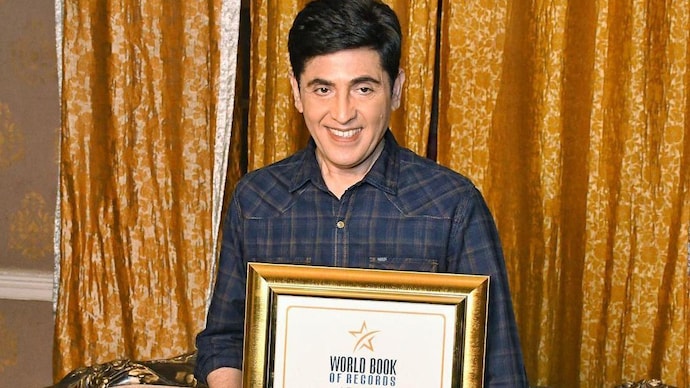
Aasif Sheikh has been honoured by the World Book Of Records for playing 300 different characters on Bhabiji Ghar Par Hai. The actor shared his picture with the certificate on social media.
Aasif Sheikh holding his certificate from World Book of Records.
Who doesn’t love Bhabhiji Ghar Par Hai’s Vibhuti Narayan Mishra? With his quirky ways of flirting with the neighbour’s wife to portraying different hilarious characters, Vibhuti is the show’s favourite. Did you know that Aasif Sheikh, who plays the role of Vibhuti, has also portrayed 300 different characters on the show? The actor has now been bestowed with a special certificate from the World Book of Records, London, for crossing 300 characters in Bhabiji Ghar Par Hain.
Aasif Sheikh Honoured by World Book of Records
Aasif Sheikh has won a million hearts with his constant hard work and amazing comic timing. He has now received a special award for portraying various characters on Bhabhiji Ghar Par Hai. Aasif posted his picture with the certificate on his Instagram account and wrote, “Thank you guys for making it happen. Crossed 300 different characters in bhabhiji ghar par hai (sic).” In the picture, the actor looks elated holding his certificate while wearing a blue check shirt.
Saumya Tandon is ‘Super, Super Proud’ of Aasif Sheikh
Saumya Tandon, who earlier played the role of Anita bhabi on the show congratulated Aasif Sheikh and commented, “Huge Congratulations, no one else deserves this more than you. It’s all the years of hard work , labour of love and passion for your craft. Super proud (sic).”
About Aasif Sheikh
Aasif started his journey in 1984 with India’s first TV serial Hum Log. He then appeared in a number of TV shows and Bollywood films. The actor featured in popular shows such as Yug, Champion, Tanha, Muskaan, Gul Sanobar, Chandrakanta, Yes Boss, Dill Mill Gayye, CID and Chidiya Ghar to name a few.
source: http://www.indiatoday.in / India Today / Home> News> Television> Celebrity / by Grace Cyril, Mumbai / October 21st, 2021
Jasovar Village (Mirzapur District), UTTAR PRADESH :
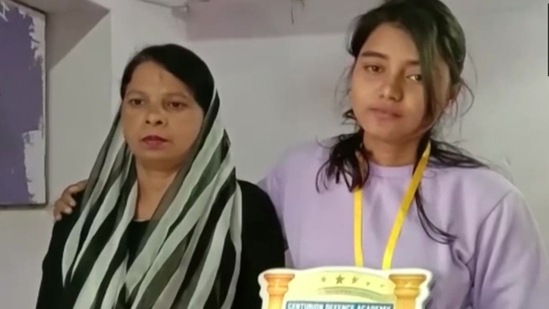
Sania Mirza of Uttar Pradesh’s Mirzapur district earned this position by passing the National Defense Academy 2022 examination (NDA) exam.
On December 27, Sania Mirza will join NDA Khadakwasla in Pune.(ANI)
Sania Mirza, daughter of a TV mechanic from Mirzapur, has been selected to become a fighter pilot in the Indian Air Force and would be the country’s first Muslim girl and the state’s first IAF pilot.
Sania Mirza is a resident of Jasovar village under the Mirzapur Dehat Kotwali police station area. She secured this position by passing the NDA exam. She has brought laurels not only to the district but also to the state and the country.
Sania, who studied in a Hindi medium school, said that Hindi medium students too can achieve success if they are determined. On December 27, she will join NDA Khadakwasla in Pune.
The parents as well as the villagers are feeling proud at her.
Sania’s father Shahid Ali said, “Sania Mirza considers the country’s first fighter pilot Avni Chaturvedi as her role model. From the beginning, she wanted to be like her. Sania is the second girl in the country who has been selected as a fighter pilot.”
She studied from primary to Class 10 at Pandit Chintamani Dubey Inter College in the village itself. After that, she went to Guru Nanak Girls Inter College in the city. She was the district topper in the 12th UP Board. She started her preparations at Centurion Defense Academy.
She gives the credit for success to her parents as well as to the Centurion Defense Academy.
She said that only two seats were reserved for women in fighter pilot in National Defense Academy 2022 exam . “I could not grab a seat in the first attempt but I have found a place in my second attempt.”
Sania’s mother Tabassum Mirza said, “Our daughter has made us and the entire village proud. She fulfils the dream of becoming the first fighter pilot. She inspired every girl in the village to follow their dreams.”
In the National Defense Academy 2022 examination, there were a total of 400 seats including male and female. In which there were 19 seats for women, and two seats were reserved for fighter pilots. In these two seats, Sania managed to get a place on the strength of her talent.
source: http://www.hindustantimes.com / Hindustan Times / Home> India News / by ANI / posted by Lingamgunta Nirmitha Rao / December 23rd, 2022
December 19 is celebrated as ‘Mewat Day’, for it was on this day in 1947, soon after the partition of India, that Mahatma Gandhi’s appeal to the Meo Muslims living in what is today the border areas of Haryana, UP, and Rajasthan, made them shun their desperation to move to Pakistan.
The community members were all packed with some belongings after facing harassment and violence at the hands of officials in the post-partition mayhem that had gripped both India and Pakistan. Lakhs of Mewatis got together and declared they would go to Pakistan when Mahatma Gandhi came on the scene. He assured to protect the life and property of Mewatis and give them full respect.
At the time of the partition of India, Mewat, Gurgaon, and Faridabad of Haryana were ruled by the British, and Alwar, Bharatpur of Rajasthan by the kings. At the time of partition, like other parts of the country, Mewat also saw communal violence.
At this stage freedom fighters Abdul Hai, Himmat Khan, and a few other Muslim leaders came to know of a conspiracy to force Mewati Muslims to leave India for Pakistan and they met Mahatma Gandhi and invited him to visit Mewat.
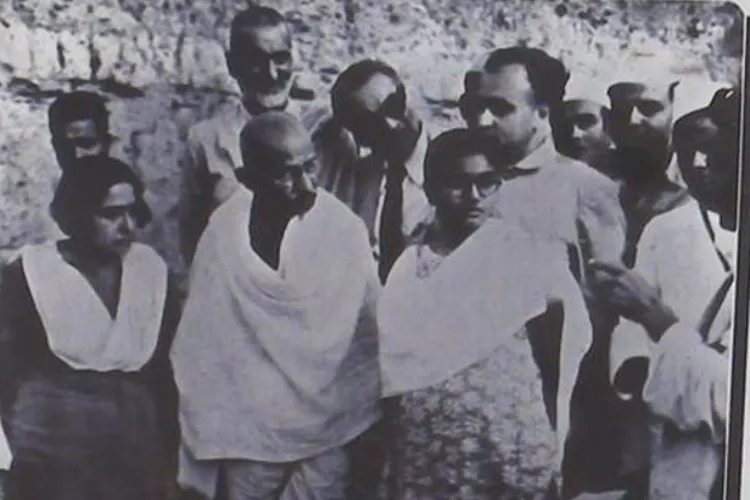
Mahatma Gandhi reached Ghaseda village of Mewat on 19 December 1947. He was accompanied by many leaders including the then Chief Minister of Punjab Gopi Chand Bhargava, Ranbir Singh Hooda, father of former Chief Minister Bhupinder Singh Hooda.
Mahatma Gandhi’s speech on 19th December 1947 in the village of Ghaseda before lakhs of Mewatis is historic. He said, “Today my sayings do not have the same power as it would have earlier.
“But what I say any as much impact as it would have earlier, today not a single Muslim would need to leave the Indian Union, nor would any Hindu-Sikh be required to leave their homes in Pakistan and seek refuge in the Indian Union.
A sorrowful Bapu said: “My heart is filled with sorrow after hearing what is happening here. All around arson, looting, killing, coercive religious conversion and kidnapping of women, and demolishing temples, mosques and gurudwaras is madness. If this is not stopped, both communities will be annihilated.”
Historian Siddiq Ahmed Meo, who has 10 books on the history of Mewat to his credit, says, “Gandhiji also read out the complaints sent to him by Mewati Muslim representatives to the assembled crowd.”
He assured the Mewatis that they would be given full respect. If any government official commits any atrocity with the Mewatis, then the government will take strict action against him. Gandhiji said, “I will be happy if my words can console you a little.”
He expressed grief over the Muslims who were expelled from the princely states of Alwar and Bharatpur.
Gandhiji said in his speech, “A time will come in India when all hatred will be buried in the ground and both societies will be able to live in peace.”
Mewat’s social worker Fajruddin Besar says, after Gandhiji’s assurances, the Muslims reversed their decision. “If they were not stopped at that time, there would be not a single Muslim in Haryana and Rajasthan today.” He says Gandhiji did a big favour to the Muslims by stopping them from going to Pakistan. “Today, Muslims in India are living a life of more peace and respect than in Pakistan. In Pakistan, there is always fighting among Muslims.”
In 2007, chief minister Bhupinder Singh Hooda declared Ghaseda an ideal village and renamed it Gandhi Gram Ghaseda. He also released about Rs 10 crore for development works in the village.
This year Congress leader Rahul Gandhi will also reach the village on December 22 and celebrate Mahatama Gandhi’s visit to the village on that day.
source: http://www.awazthevoice.in / Awaz, The Voice / Home> India / by Yunus Alvi, Nuh (Haryana) / December 19th, 2022
The dargah Hazrat Syedina Shaikh Badruddin Shah Arif Chishti is in possession of several archival records, but its real claim to fame is a copy of the Holy Quran calligraphed by Mughal Emperor Aurangzeb Alamgir.
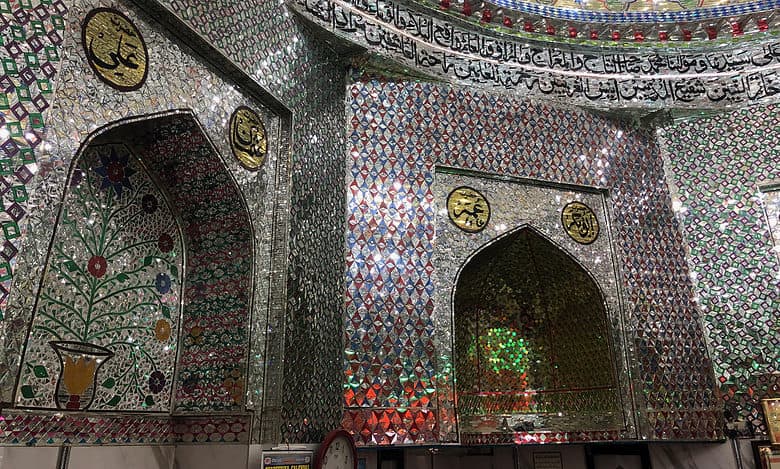
The shrine of Shaikh Badruddin Chishti in Belgaum recently underwent renovation with some scintillating Persian glass work. (Image: Shafaat Shahbandari).
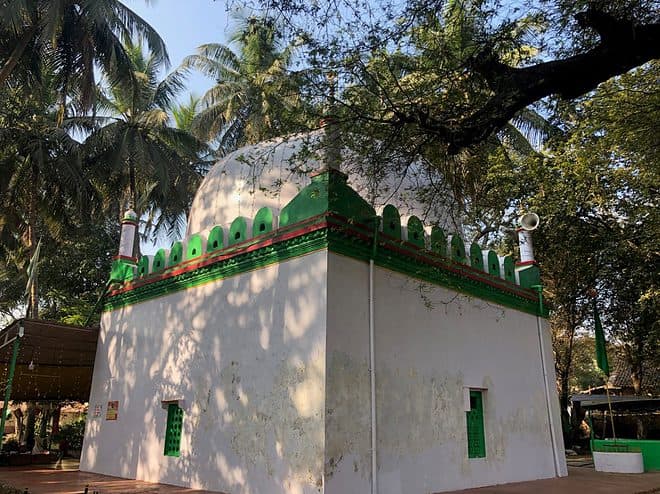
The historic town of Belgaum is home one of Karnataka’s oldest Dargahs. Located within the ancient fort of Belgaum, the dargah Hazrat Syedina Shaikh Badruddin Shah Arif Chishti is believed to be more than eight centuries of old.
Among the first sufi saints to settle in the region, Shaikh Badruddin travelled across south India spreading the message of peace and harmony. The historic tomb in Belgaum is still a great symbol of harmony in the city.
“Hazrat Syedina Shaikh Badruddin Shah Arif Chishti arrived in Deccan more than 800 years ago. He travelled extensively across southern India to spread the message of peace and love. He was among the first sufi saints to settle down in this region,” said Rafeeq Ahmed Ghawwas, caretaker of the Dargah in Belgaum.
Located in the historic Belgaum Fort, the mausoleum of Shaikh Badruddin Chishti was revered by rulers from various dynasties irrespective of their faith. (Shafaat Shahbandari)
Origins
Originally from Delhi, Shaikh Badruddin he was a disciple of Hazrat Shaikh Qutubuddin Bakhtiyar Kaki, who was a 12th century saint and scholar based in Delhi. According to Ghawwas, Shaikh Badruddin migrated to the Deccan in Belgaum on the advice of his spiritual master. He was the one who introduced the Chishti order of the revered saint Khwaja Muinuddin Chishti in the south.
“Our ancestors were the disciples of Shaikh Badruddin and we have been in the service of this place since the earliest times. I took over as the caretaker of this dargah from my uncle Khattal Ahmed, who had taken over from my father Abdur Raheem Mujawar. Before him our grandfather Ebrahim Ahmed was the caretaker, who took over from his father Shaikh Jangu Mian,” said Ghawwas, who has been the caretaker of the dargah for more than 30 years.
Venerated by kings, ministers and commanders of all faiths, the dargah and the saints of this order have had close ties with several dynasties across its history of almost 800 years.
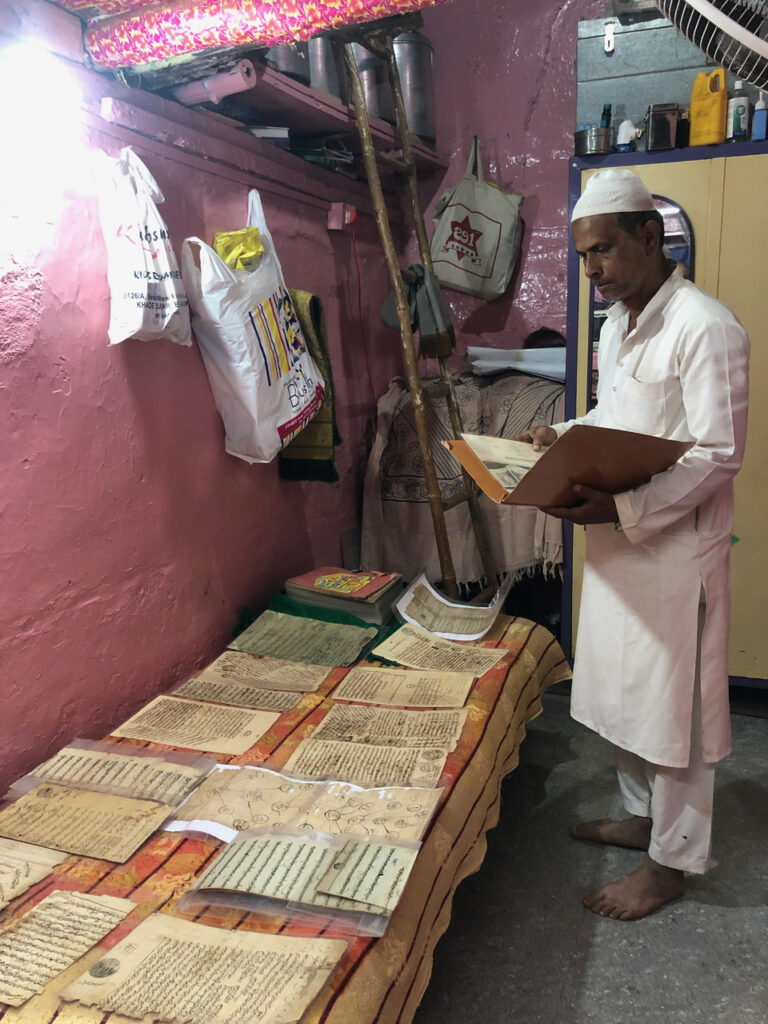
Ghawwas with some prized remnants of Maratha, Mughal and Adil Shahi heritage. (Shafaat Shahbandari)
The Aurangzeb connection and the Quran
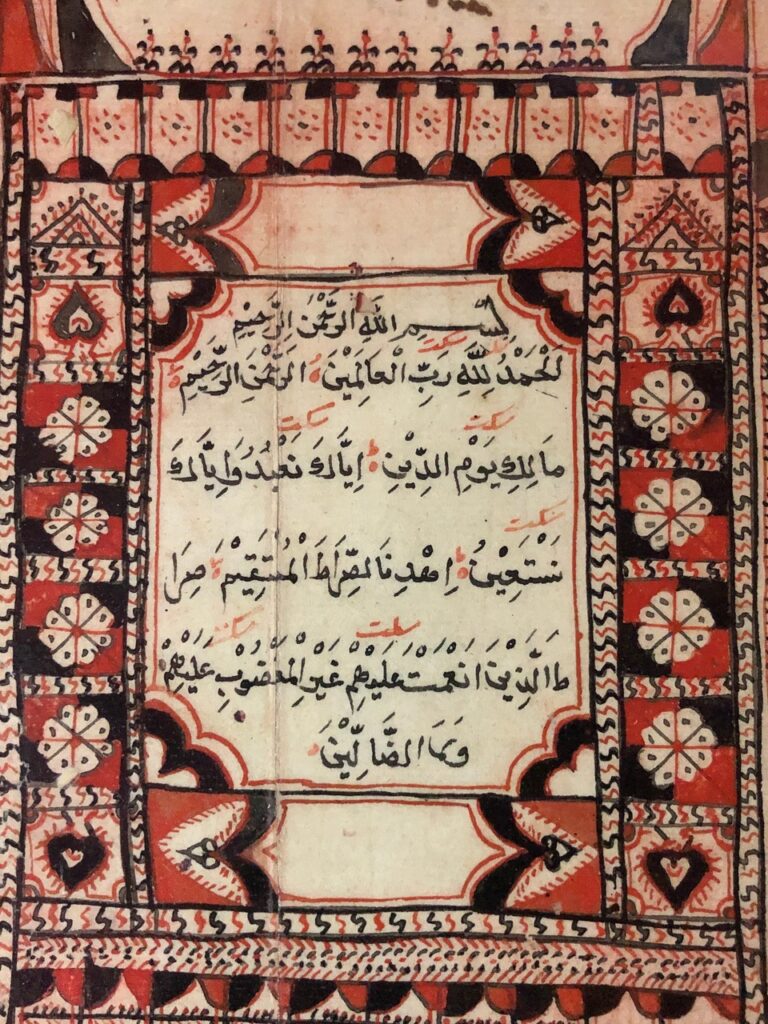
More interestingly, the dargah Hazrat Syedina Shaikh Badruddin Shah Arif Chishti is in possession of several archival records that reflect its rich and vibrant history. And among its biggest inheritances is a 16th century copy of the Holy Quran that was calligraphed and gifted by the sixth Mughal Emperor Aurangzeb Alamgir.
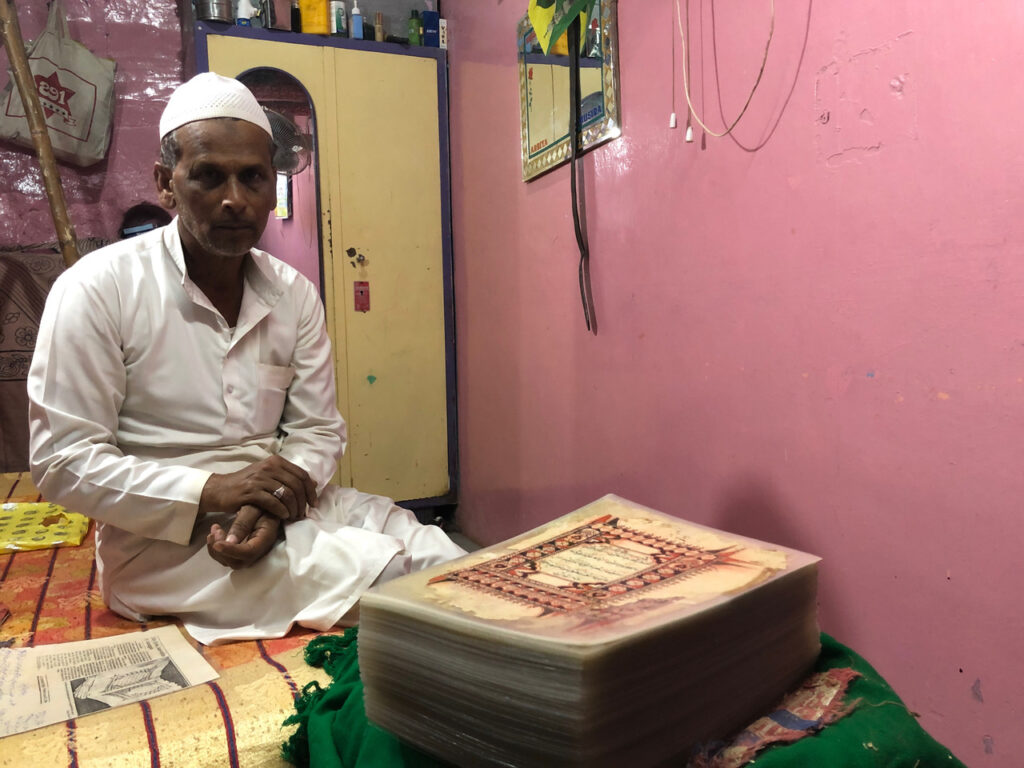
Rafeeq Ahmed Ghawwas with his prized possession – a 17th century calligraphed copy of Quran. (image: Shafaat Shahbandari)
“The emperor had actually gifted the copy to the dargah of Khwaja Muinuddin Chishti in Ajmer, but we are not sure how and when it reached into the possession of our ancestors. We feel fortunate to have this blessed copy and we are doing our best to preserve it for posterity,” added Ghawwas, who has preserved the copy with great care.
According to local history, after his travels across South India, Shaikh Badruddin arrived in Belgaum and settled within the premises of the then newly built fort. The fort was originally built in 1204 AD by Raja Jaya Raya of the Ratta Dynasty and Shaikh Badruddin lived here until his death in 1251 AD.
This mausoleum was built in the early 16th century by the Adil Shahi general and the then governor of Belgaum Asad Khan Lari. The structure has been preserved with some renovation and restoration. Recently, the interiors of the dargah went through a facelift with Iranian glasswork adorning the walls, the dome and the ceilings.
Throughout its long history in Belgaum, the has received patronage from the rulers irrespective of their faith. The caretaker is in possession of several firmans and sanads issued by the Maratha rulers who venerated Shaikh Badruddin and offered their patronage.
The ornamented page of the calligraphed work representing the first chapter of the Holy Quran. (Image: Shafaat Shahbandari)
“This dargah has always been the abode of peace and harmony and we are continuing with our age-old motto of love for all,” added Ghawwas.
source: http://www.siasat.com / The Siasat Daily / Home> News> Bangalore / by Shafaat Shahbandari / December 13th, 2022
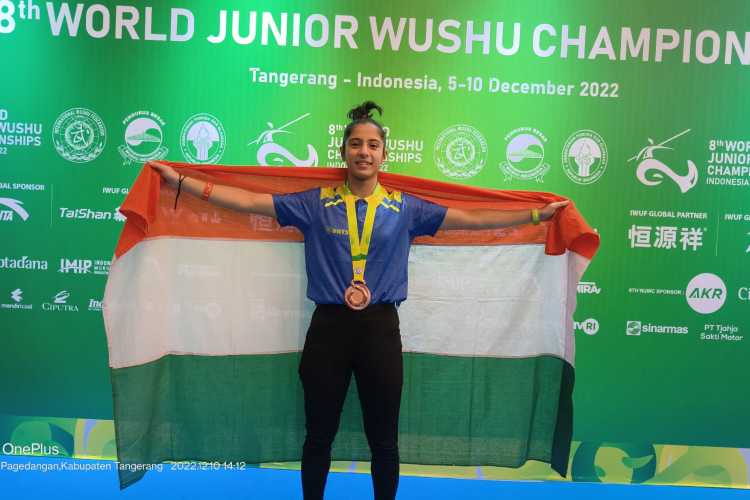
Ayeera Chisti, the first Kashmiri girl to win a medal at the World Wushu Championship
Ayeera Chisti, the Wushu wonderkid from the Kashmir valley added another feather in her rising career by winning a bronze medal at the World junior Wushu championship this weekend.
With this achievement she has become the first girl from Jammu and Kashmir to win a medal at this prestigious championship.
Among the first to congratulate her was JK Sports Council.
The 8th world junior Wushu championship was held in Banten, Indonesia from December 2 to 11.
Speaking to Awazthevoice.in, Ayeera’s coach, Asif said, “This is just the beginning. This is the result of years of hardwork, dedication, patience and discipline. There are many targets we have to achieve”.
Before departing for the championship, Ayeera had exuded confidence of doing well at the event. “I will come back with a medal”, she had told Awazthevloice.in.
The 11th class student of Amira Kadal Higher Secondary School, Srinagar had already etched her name in history books by becoming the first girl from Srinagar to represent the country in the world championships.
Khelo India congratulated Ayeera on becoming the first girl from JK to win a medal at this level.
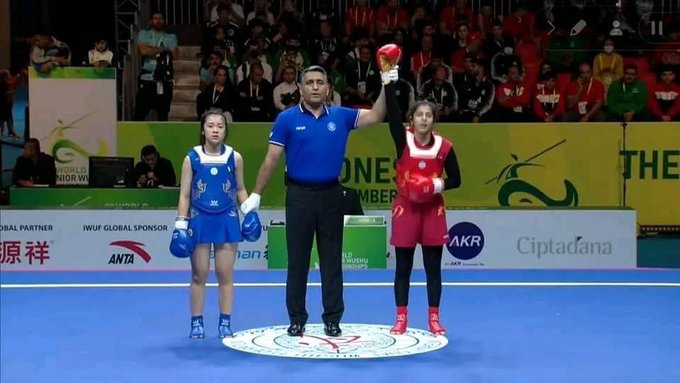
Ayeera had lost to Malak Ossama of Egypt in the semifinal.
She had earlier defeated her rival from Macau in the last-eight stage.
The Indian contingent finished with a record eight medals, including three golds in the championship. Apart from the yellow metal, India also won three silvers and two bronze medals.
source: http://www.awazthevoice.in / Awaz, The Voice / Home> Sports / by Nakul Shivani, New Delhi (headline edited) / December 12th, 2022
With petrol prices increasing, Asad Abdullah conceptualised the idea of developing an electric cycle in which six people can be accommodated.
Innovation on a dozen wheels by ITI-trained diploma engineer in electricals, Asad Abdullah. (Photo | EPS)
Innovation on a dozen wheels
All that innovation needs is a brilliant mind and passion coupled with the patience to apply it. Asad Abdullah, 22, of Azamgarh proved it by developing a 6-seater electric cycle. Asad’s innovation got recognised by none other than Anand Mahindra, chairman of Mahindra Group, who tweeted a small video of the cycle and made the innovation so viral that the video crossed 1 million views since December 1.
Mahindra tagged the chief design officer of the auto sector of his company asking if this device could find global application. With petrol prices increasing, Abdullah conceptualised the idea of developing an electric cycle in which six people can be accommodated.
He used scrap material and the motor of an old battery-operated. two-wheeler to develop the cycle in a month’s time at a cost of Rs ₹10,000-12,000. “I want to make it commercial and sell it to others at an affordable price,” says Asad Abdullah, an ITI-trained diploma engineer in electricals.
Lucknow touches zero covid mark
After a long span of 32 months, the city of Nawabs touched zero Covid figure mark as the last patient recovered from the ailment and no new case was reported, claim health authorities. The last patient who recovered and was discharged on Tuesday had tested positive last week. “This zero is a precious figure and we are making all efforts to sustain the status in Covid,” said Dr Manoj Agrawal, Lucknow CMO.
Lucknow has never had a status of zero Covid active cases since the 2020 pandemic. The first case in the state capital was reported in the third week of March 2020. Lucknow’s first Covid-19 patient was a doctor who returned from Canada. The second case reported was also that of a doctor and the third one was of a Bollywood singer Kanika Kapoor, who turned out to be a mass spreader after returning from the UK.
10 UP heritage sites up for adoption
UP Archaeological directorate has shortlisted 10 heritage sites up for adoption under the ‘Adopt Heritage Scheme.’ These sites include the Alambagh building of Lucknow, Potrakund in Mathura, Kalpa Devi and Astik Baba temples in Sitapur, Caves of Devgarh of Lalitpur, Raj Mandir Guptar Ghat in Ayodhya, Lakshmi temple in Jhansi, Fort of Tahrauli in Jhansi, Fort of Balabehat in Lalitpur, Digragarhi in Jhansi and Shiv temple of Bithoor in Kanpur.
Those interested in adopting the heritage site would be known as Smarak Mitra who would sign a memorandum of understanding (MoU) with the department and work towards the conservation of the site. Smarak Mitras will also be responsible for arranging logistics for the tourists at the site.
source: http://www.newindianexpress.com / The New Indian Express / Home> Nation / December 07th, 2022
Ghazala Wahab explains what it is to be a Muslim, a member of the largest religious minority in India today, and why the community lives in fear as prejudices persist.
The book opens with an unputdownable 42-page introduction that delves into the root of fear and despair among Muslims who have embraced the country as theirs but are polarised because of the identity they bear.
The shock and shame of communal riots, orchestrated mass violence and lynchings that served political agendas and led to societal divisions during the past decades hits you, as journalist Ghazala Wahab lays bare instances from her life.
Balanced narrative
She meticulously balances her narrative because she wishes to build a bridge of conversation. While she addresses fellow Muslims asking them to embrace modernity and be an integral part of positive change, she also alerts non-Muslim Indians about their perception of Muslims based on prejudice and hearsay, not facts.
Self-examining her own community members, she admits it never struck her how an average Muslim struggles to stay alive because she looked at things from her position of privilege. As she researched, she found equal opportunity and justice are only concepts and that law- making and law-enforcing agencies act in contradiction to vilify and stigmatise Muslims.
It is a vicious cycle, writes Ghazala, because the post-partition Muslims have remained an irrelevant votebank and sought security in their ghettos perpetuated by illiteracy, poverty and unemployment. The mullahs and clergy have easily taken them under their religious fold to exploit them. The general backwardness of the community has fed into a sense of loss of identity and unmet aspirations for Muslim youth, men and women.
Personal experience
In the mid-80s, Ghazala’s father shifted from their ancestral home in a middle class mohalla to an upscale Hindu-majority neighbourhood in Agra. His successful business and hobnobbing with the powerful, gave him the comfort of keeping his family under a security net. But that was till Agra was engulfed in violence post-kar seva after BJP leader L.K. Advani rolled out his rath yatra from Somnath to Ayodha in October, 1990, and was subsequently arrested. As sporadic violence spread across north India, Ghazala’s family wondered where they would be more secure — in their new neighbourhood or in a Muslim majority insulated mohalla.
Ghazala’s father called his brothers to safety and her mohalla uncles requested them to move back to the old Muslim locality. Ultimately everybody stayed where they were as fury was unleashed on their community everywhere. A young collegian then, Ghazala, her parents and three siblings were at home when an angry mob led by a neighbour shouted slogans, smashed windows, pelted stones and damaged their car. Desperate phone calls for help went unanswered.
When Ghazala’s father went to the police station to enquire about the adult males who were forcibly picked up from the mohalla during search operations, senior officials known to him avoided him. Those he thought had accepted him treated him as nothing more than a Muslim when it came to communal division. For Ghazala’s father it was not about being a victim but it was more about the humiliation, a betrayal of belief.
Turning point
Her family survived the riots but it left a scar. Her parents chose to go silent and it irked Ghazala that a victim should feel ashamed. She saw the same resignation and defeatist attitude when the Babri Masjid was razed. It unnerved her because she sensed it was a turning point not just for her family but for most Indian Muslims.
“Civility was the first casualty, replaced by communal prejudice and demonstrative religion,” she writes.
Many members in her extended family began to draw comfort from religious conservatism. She talks about a cousin who started wearing a headscarf and told her she was more comfortable with her Muslim friends as they didn’t have to pretend with one another, whereas to her Hindu friends she was a validation of their liberal outlook.
The conversation disturbed Ghazala as she never perceived two distinct identities in herself — a Muslim and an Indian. The issue was complex and so were several disparate questions.
Ghazala leans on poignant narration about the average Muslim being confused and scared through examples of those who have hidden their identity and reverted to Hinduism under perceived coercion. “They could never participate as equal partners in the country’s development. Only 2.6 per cent of Muslims are in senior-level jobs and a small number have achieved a reasonable upward mobility,” she writes.
On a positive note, Ghazala says Muslim society is changing. The protests against CAA/NRC in December 2019, she feels, has given rise to an assertive community even though her 1990 experience returned to haunt her in February 2020 when her paternal aunt’s family panicked as a mob reached their northeast Delhi colony. Anger and helplessness resurfaced when her aunt called her for help and her uncle refused to escape or abandon his life’s savings. The sense of fear doesn’t leave, she says.
Born a Muslim: Some Truths about Islam in India ; Ghazala Wahab, Aleph Book Company, ₹999.
soma.basu@thehindu.co.in
source: http://www.thehindu.com / The Hindu / Home> Books. Reviews / by Soma Basu / May 15th, 2021
The young nurses believe that more Muslim girls across the country should opt for the nursing profession to serve society.
Patna (Bihar) :
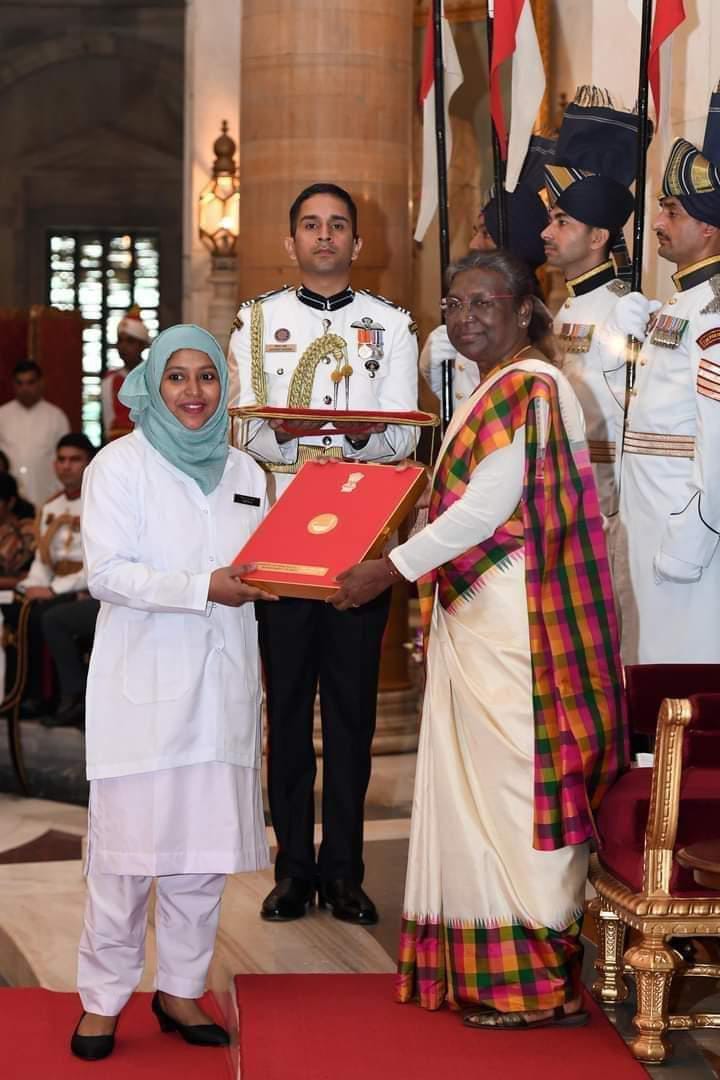
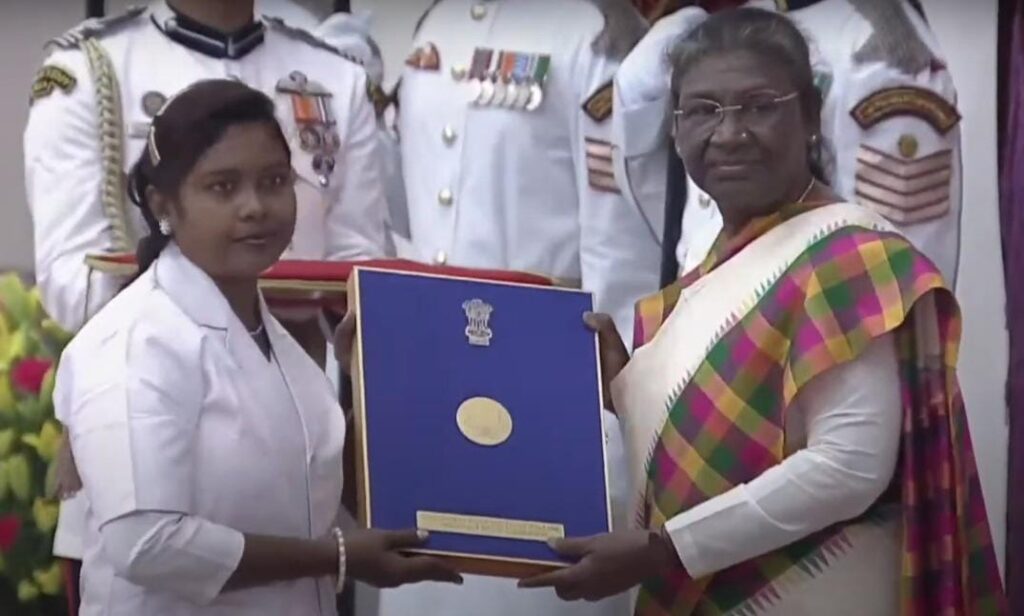
Two Muslim nurses Naziya Parveen and Shabrun Khatun from Bihar were awarded this year’sNational Florence Nightingale Awards (NFNA) by the President of India, Droupadi Murmu at Rashtrapati Bhavan earlier this month.
The National Florence Nightingale Awards (NFNA) were instituted in 1973 by the Government of India’s Ministry of Health and Family Welfare as a mark of recognition for the meritorious services rendered by nurses and nursing professionals to the society.
Sajeeda Banu of Karnataka, Ahmedullah Wani of Jammu & Kashmir, and Mohammed Kasim AB of Lakshadweep are the other Muslims who were awarded this year.
She was among 51 people from around the country who were awarded in different categories by the President. Her citation states that she has contributed to the establishment of the labor room and for helping in preparing the standard operating procedure.
32-year-old Naziya Parveen receiving the award from the President Murmu. | Picture by arrangement
Hailing from Sultanganj, Bhagalpur, Naziya is the eldest of three sisters. She is married to a microbiologist Mohammad Shams of Gaya. After completing her high secondary education in Dumka, Jharkhand she studied nursing for GNM at JawaharLal Medical College, Bhagalpur, and worked with Jamia Hamdard in New Delhi for six years. It was challenging to move from Delhi to Araria but her family supported her as “there isn’t much scope of work in Sadar Hospital.”
“I feel quite proud to be awarded as our society does not recognize the work of nurses. I am elated for being a Muslim awardee as we don’t get nominated for such awards. I was asked if I was from Kashmir as I was wearing a hijab,” she said.
Mother of two kids, Naziya has inspired other Muslim girls to take admission to nursing courses. Local newspapers in the state ran stories featuring her.
“We need to change our attitude towards this profession. It is a good job and one can draw good income from it. The nursing course is such that even if one does not opt for a job, they can get the chance to serve from home and earn. I am of the view that more Muslim girls should study nursing as a profession,” she said.
28-year-old Shabrun Khatun was awarded in the ANM (Auxiliary Nurse and Midwife) category. | Picture by arrangement
28-year-old Shabrun Khatun was awarded in the ANM (Auxiliary Nurse and Midwife) category. She works at Darbhanga Sadar primary health center. She had applied for the award previously but it was her work during Covid-19 that won her an award this year. She recalled how she went for a door-to-door screening of Covid-19 in April 2020 while being on fast and continued to work in 2021.
Shabrun told TwoCircles.net that receiving the award from President Murmu was quite encouraging.
Her journey to success has not been smooth. She had to work in local hospitals to support her family but this experience helped her. “I was good at studies in school and got prizes for my co-curricular activities. I wanted to be a medical doctor. I was selected for MBBS at a private medical college but did not have enough money to take admission. I also wished to be an officer in administration but my father’s proximity to doctors got me into nursing.”
Shabrun’s father Mohammad Akhtar is a tailor who would stitch clothes for operation theaters of hospitals nearby. She had cleared the preliminary test for selection in the police department but finally settled for a nursing course after her graduation in Zoology from her hometown of Rosera Bazar in Samastipur district in Bihar.
Shabrun said that she had to face unfriendly treatment in society after she chose to become a nurse. “But seeing my success now, everyone is happy,” she said.
She is of the view that Muslim girls who are not able to qualify for MBBS should consider nursing as a career as “it gives the satisfaction of serving humanity in one small way.”
In December this year, she would be felicitated on the foundation day of the Darbhanga district.
Sami Ahmad is a journalist based in Patna, Bihar. He tweets @samipkb
source: http://www.twocircles.net / TwoCircles.net / Home> Lead Story / by Sami Ahmad, TwoCircles.net / November 25th, 2022
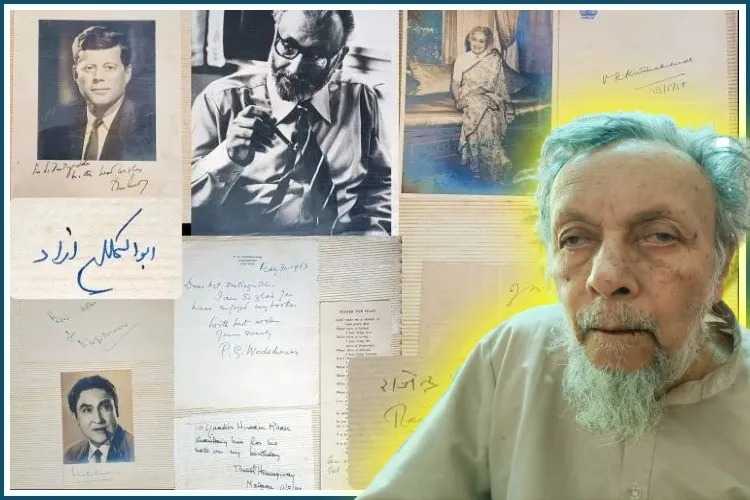
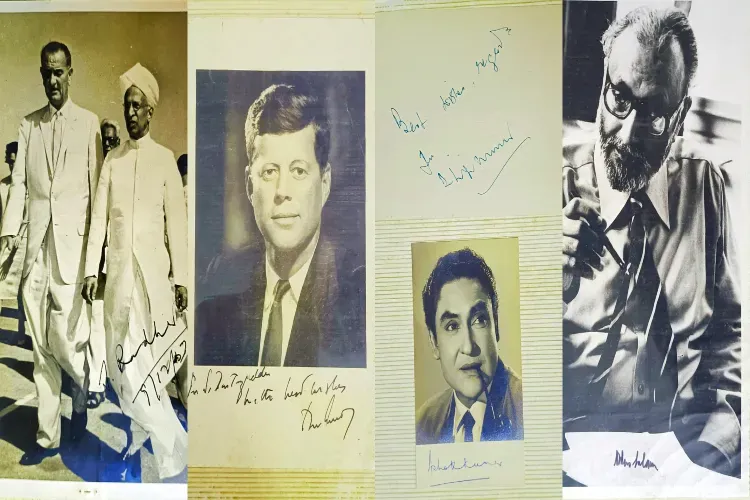
Syed Imtiazuddin with his collection of autographs
Syed Imtiazuddin of Hyderbad has turned his hobby of collecting autographs of famous personalities into a body of work that is bound to be of great historic value for the future generations.
His collection of autographs of important world and Indian personalities has reached up to 200 so far.
The famous people whose signatures are part of Syed Imtiazuddin’s proud collection include Nobel laureates, politicians, writers and poets of Urdu and English, the heads of state and prime ministers of many countries, and film stars.
His passion for collecting the signatures of important and famous people transcends borders. Syed Imtiazuddin says he had to be patient while waiting for the signatures of famous personalities to whom he wrote letters requesting the same inside India and abroad.
Syed Imtiazuddin narrated an interesting incident from his student days. He was a 7th-grade student at Gandhi Bhavan Middle School, Nampally, Hyderabad. He says it was triggered when he was learning a chapter on India’s renowned Nobel laureate, Physicist-scientist Sir C.V. Raman. Dr. Raman discovered what is now known as the ‘Raman Effect.’
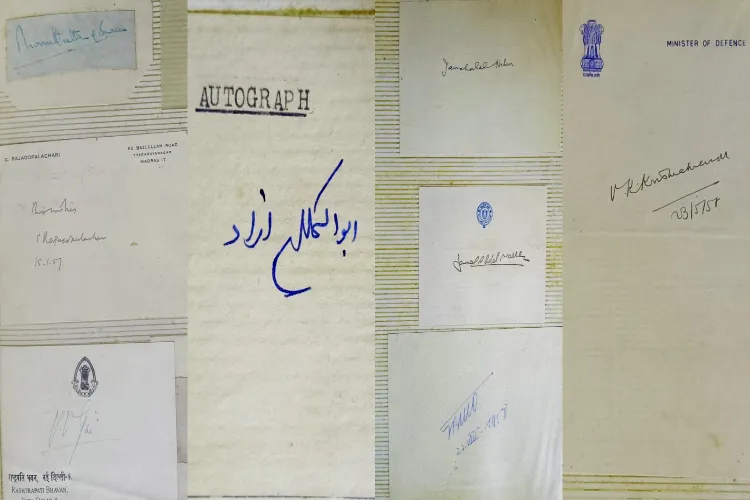
Dr Rajendra Prasad’s signature in Urdu
When the school teacher was imparting the lesson on the life of Sir C. Raman in the classroom, Imtiaz Ahmed thought of if only he could write to the great scientist. He tried to search for his mailing address with no success.
Finally, he did write to Sir C V Raman and posted it to on the address: Sir CV Raman, Bangalore.’ In the postcard addressed to the scientist, he wrote, ‘I was very impressed when I read about you today and I want your signature.’
To his pleasant surprise, a few days later he received a letter from Sir CV Raman. Dr Raman appreciated his passion.
Syed Imtiazuddin says that this was the first ‘happy and memorable day’ for him and it sparked his passion for getting autographs from celebrities.
After receiving Raman’s reply letter and signature, his happiness knew no end.
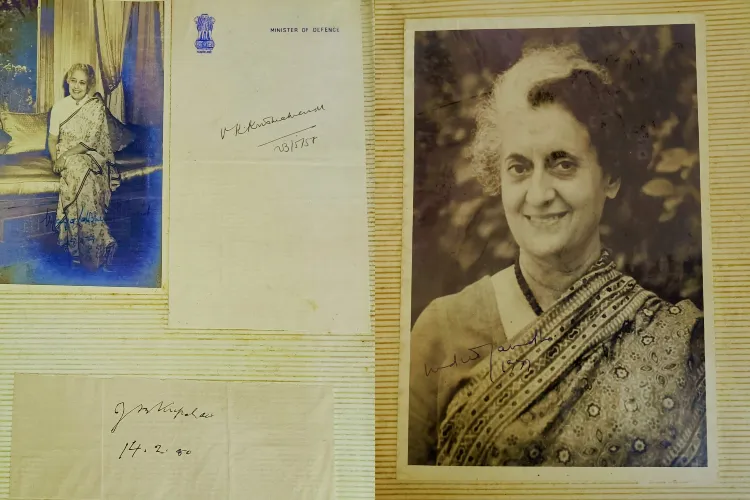
Prime Minister Indira Gandhi’s signature
Syed Imtiazuddin said that he passed the class 10 examination from a famous school – Chadar Ghat High Schoo and graduated from Osmania University.
He worked in the Andhra Pradesh State Electricity Department (APSEB) and simultaneously completed his MBA. He retired as Superintending Engineer in year 2001.
The famous poet of Hyderabad, Shaz Tamkant was Syed Imtiazuddin’s elder brother. Shaz Tamkunat was invited to mushairas in Delhi, Lucknow, and other states of the country
Syed Imtiazuddin says, “When Shaz went to Delhi to participate in Mushaira, he also carried an autograph book with him, in which he obtained the signatures of many well-known poets.”
Seeing this, I also decided to follow him. In late 1957, I wrote to the former President of India Dr. Rajendra Prasad expressing my desire to meet him. I received a reply from the Rashtrapati Bhawan that the President is due to visit Hyderabad in June 1958 and I would come to him there at his residence.”
A glimpse of Syed Imtiazuddin’s collection
“As the day of my meeting with Dr Rajendra Prasad was approaching, my anxiety knew no bounds. When I got the message that Rajendra Prasad had come to Hyderabad, I reached Hyderabad Resident with my elder brother Shaz Tamkant and met Rajendra Prasad. I was very happy to meet him. Even Rajendra Prasad appreciated my passion. He had already kept his signatures – in Hindi and English – on an expensive paper ready for me.”
The President also penned his signature in Urdu on his request.
Syed Imtiazuddin is fond of Allama Iqbal’s poetry. He is invited for delivering talks in the ‘Mahfil Iqbal Shanahi’ held every Wednesday.
Syed Imtiazuddin obtained the signatures of more than 200 personalities including Lord Mountbatten, the last Viceroy of India and first Governor-General of India.
Apart from them, the forty-second president of the United States, Jimmy Carter, the second president of Egypt, Gamal Abdel Nasser, the former president of Yugoslavia Josip Broz Tito, the Thirty-fifth US President John F. Kennedy, Indonesia’s first President Abdul Rahim Sukarno.
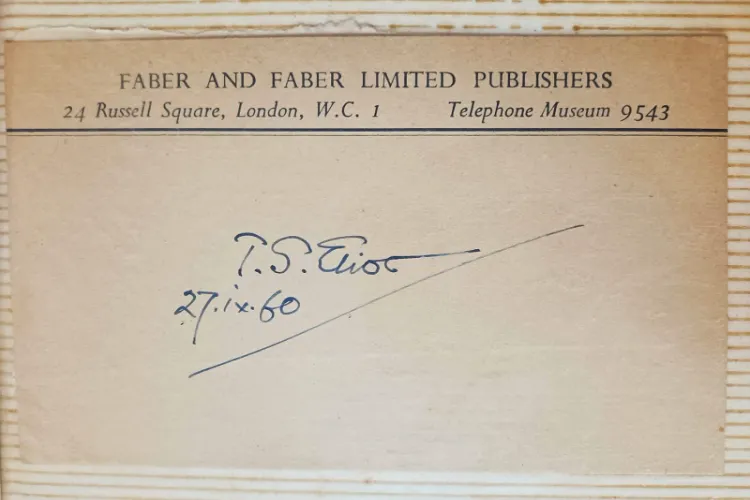
Signature of Writer T S Eliot
Israel’s first Prime Minister David Ben-Gurion, former King Hussein bin Talal of Jordan, famous American actress Elizabeth Taylor, her husband, famous Hollywood actor Richard Burton, Mother Teresa, and Charlton Heston, the hero of the famous American film The Ten Commandments.
Syed Imtiazuddin also obtained signatures from Pakistan’s first Nobel laureate Dr. Abdus Salam. Many of these personalities presented him with their photo as a gift.
Among the Indian leaders’ collection, Syed Imtiazuddin has the signatures of Pandit Jawaharlal Nehru, Indira Gandhi, Dr. Zakir Hussain, Maulana Abul Kalam Azad, Vijaya Lakshmi Pandit, VK Krishna Menon, Moraraji Desai, V. V. Giri, Dr. Sarvapalli Radhakrishnan, Neelam Sanjeeva Reddy.
Syed Imtiazuddin says he feels literature, film, and sports are close to human life and this is the reason why most of his collection relates to personalities from these fields.
He has an unenviable collection of signatures of TS Eliot, American writer John Steinbeck, British mathematician and Nobel laureate Bertrand Russell, Novelist Ernest Hemingway, Dr. AJ Cronin (Scotland), American writer Pearl S. Buck, English writer Aldous Huxley, Josh Malihabadi, Rashid Ahmad Siddiqui, Jigar Moradabadi, Faiz Ahmed Faiz, Khalilur Rahman Azmi, Sohail Azimabadi, Ahmad Nadeem Qasmi, Makhdoom Mohiuddin, Qaratul Ain Haider Krishna Chandra, Rajendra Singh Bedi, Maulana Syed Abul Hasan Ali Nadvi and Maulana Abdul Majid Dariyabadi.
Besides he has the signatures of Bollywood legends Dilip Kumar, Ashok Kumar, Sunil Gavaskar, Sachin Tendulkar, and Amitabh Bachchan.Syed Imtiazuddin said he used to study at an American library near the famous Muazzam Jahi Market in Hyderabad. While going through the book “Who’s Who in America” made him familiar with many top personalities.
Syed Imtiazuddin says success comes only if a person has passion and true dedication to a cause.
source: http://www.awazthevoice.in / Awaz, The Voice / Home> India / by Abdul Rahman Pasha, Hyderabad / by awazthevoice.in / November 26th, 2022