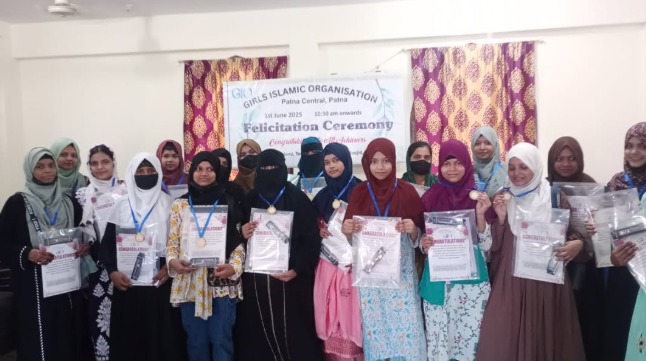
Girls Islamic Organisation (GIO), Sultan Ganj Unit, Patna, organised a felicitation ceremony on Sunday at Markaz-e-Islami, Tekari Road, to honour over 100 meritorious students who secured excellent marks in Class 10 and 12 examinations. The achievers were awarded medals and congratulatory cards in recognition of their academic accomplishments. The event also included guidance sessions to support their future educational journeys.
The chief guest, Mohammad Shehzad from Allied IAS, delivered a comprehensive guidance talk under the theme Care and Guidance, sharing professional and academic opportunities from an Islamic perspective along with practical insights.
Motivational speaker Shazia Ahsan emphasised the value of hard work, self-confidence, and positive thinking in her inspiring speech aimed at empowering the students.
Dr. Zubiesh Firdous, Secretary Women’s Wing Jamaat-e-Islami Hind Bihar, delivered a thought-provoking address on the topic Balancing Deen and Dunya (religion and worldly life). She stressed the need for a harmonious blend of religious and secular education.
Umme Kulsoom, President of GIO Sultan Ganj Unit, introduced the organisation and highlighted its mission of empowering girls and women through education and awareness.
The event was attended by teachers, students, and parents who appreciated the efforts taken by the organisation.
The program began with a spiritual reminder from the Qur’an by Anjum Mukhtar. A soul-stirring na’at (poem in praise of the Prophet ﷺ) was beautifully rendered by Musheerah Fatima, filling the atmosphere with a spiritual essence. Saima Parveen presented an emotionally resonant poem, which was well received by the audience.
The event concluded with closing remarks and a vote of thanks delivered by Shagufta Bano, City Secretary of Patna .
source: http://www.radiancenews.com / Radiance News / Home> Education> Report / by Radiance News Bureau / June 01st, 2025
In a celebration of academic excellence and community empowerment, The Siasat Daily hosted a grand felicitation ceremony to honour 373 Intermediate BiPC students who scored above 90% in their board examinations. The event, held at the Siasat Auditorium on Tuesday, is part of a larger educational upliftment initiative spearheaded by Congress MLC Amer Ali Khan.
Addressing the packed hall, Amer Ali Khan declared, “This is not just a function—it is a movement. A campaign to build an atmosphere of academic pride and ambition among Muslim youth.” His powerful words echoed the core message of the ceremony: education is the most effective tool to uplift India’s Muslim community and ensure a dignified future.
Over 1,500 students had responded to an open call, out of which 373 were selected for recognition. Notably, 43 top performers scoring between 99% and 99.6% were awarded cash prizes, certificates, medals, and boAt smartwatches under the tagline “Smart Watches for Smart Students.” An additional 204 students scoring above 95% also received smartwatches as a token of encouragement.
The students were honoured in the following score brackets:
43 students with 99% and above
97 students with 98% and above
49 students with 97% and above
36 students with 96% and above
33 students with 95% and above
27 students with 94% and above
29 students with 93% and above
19 students with 92% and above
98 students with 91% and above
19 students with 90%
Speaking with heartfelt emotion, Amer Ali Khan reminded students of their heritage: “Knowledge is noor (light), and hard work is ibaadat (worship). With Allah’s help, even the impossible becomes possible.” He urged them to emulate Islamic historical figures such as Muhammad bin Qasim, Salahuddin Ayyubi, and Imam Bukhari, who once were students and later transformed the world through their knowledge and leadership.
The event emphasized the importance of both male and female education. Faiz-e-Aam Trust Secretary Iftekhar Hussain passionately appealed to parents to support their daughters’ education. “Girls often outperform boys. We must break the practice of marrying them off immediately after exams,” he said.
The ceremony began with the recitation of the Quran and concluded with the distribution of awards. Despite his busy schedule, Amer Ali Khan remained present throughout, personally honouring each student and motivating their families.
Other dignitaries present included Asghar Ali Khan, M.A. Hameed (Career Counselor), Zahed Farooqui (Director, Siasat Hub), N. Snehith, and Sai Sree (Managers). The event proceedings were conducted by senior journalist Mohammed Riyaz Ahmed.
With applause reverberating through the auditorium, the atmosphere brimmed with pride, inspiration, and a strong sense of community direction. The initiative reinforced the idea that education is not just a means to employment, but a path to dignity, empowerment, and leadership.
source: http://www.radiancenews.com / Radiance News / Home> Education> Latest News>Markers of Excellence / by Radiance News Bureau / June 06th, 2025
Noted writer, poet, women and transgender rights activist Salma alias Rokkaiya Malik from Thuvarankurichi in Trichy district developed a passion for reading and writing in her teens to become an accomplished writer. As an active member of DMK, she served as chairperson of the Tamil Nadu Social Welfare Board and presently DMK Media Wing joint secretary.
I raise up my voice – not so I can shout, but so that those without a voice can be heard. So said women rights activist Malala Yousafzai, the youngest Nobel Peace Prize recipient in 2014 for championing the cause of girls’ right to education. Not unusual to witness Muslim women-folk breaking the glass ceiling to reach dizzy heights in their chosen line of interest.
Meet 58-year-old Salma alias Rokkaiya Malik from Thuvarankurichi in Trichy district who has been nominated to Rajya Sabha as MP by the DMK party. A recognition for her active involvement as an accomplished poet, writer and women’s rights activist. Presently, she is a joint secretary in DMK media wing. Her life wasn’t all that rosy as she had to face the odds to become what she is now.
More often than not known by her pen name Salma, she received global acclaim for her writings in contemporary Tamil literature. In fact, she developed an interest for writing right from her teenage years, inspired by Russian literature more so the translated works of Fyodor Dostoevsky and Leo Tolstoy. Ultimately, Nelson Mandela and Che Guevara became her icons.
Really heart-rending to read her story as she was betrothed to a cousin named Malik at the age of 13 and she got into wedlock after she turned 19 due to her mom’s pressure. Following marriage, Salma was granted the name of Rokkiah Begum and had two children. Her interest in literature continued in her married life and was seen as akin to insanity by her family.
At 22, Salma wrote her maiden poem, Oppandham, as an outlet for her frustration and anger with her situation. Forced to hide her passion from her family, she would write while sitting on the toilet, on pieces of paper ripped from calendars and notebooks. It is learnt that she was subjected to abuse by her husband because of her desire to write and he would often destroy her work. Her mother eventually helped her by smuggling out poems from her home and getting them published in a Tamil weekly.
Salma hogged the limelight in literary circles during the nineties. Later, she signed with the Kalachuvadu publishing house and was invited to a number of literary conventions around Tamil Nadu which she visited under the guise of medical visits. Since a woman travelling alone was frowned upon in her social setting, her mother accompanied her on her first event in Chennai city.
Brushing aside the criticisms, she contested the local body elections in 2001 and was elected president of Ponnampatti panchayat. Since the seat was reserved for women, she could easily win the polls and carved a niche for herself in discharging the responsibility bestowed upon her by the villagers. Seizing the opportunity, she created awareness among the Muslim women on the importance of education.
Going the extra mile in her chosen line of interest, Salma got her anthology of short stories titled Saabam published in 2009, which was translated by N Kalyan Raman into English as The Curse: Stories. In 2016, she published her second novel Manaamiyangal, which narrated the parallel lives of two women named Mehar and Parveen. In a review by the Hindustan Times, the novel was described as having captured Hélène Cixous’s “feminine practice of writing”. [It was translated from Tamil into English by Meena Kandasamy under the title of Women, Dreaming.
It is interesting to infer that her novel “Irandaam Jaamangalin Kadhai” in 2004 was described as a semi-autobiographical work which depicted the life and hardships faced by a young girl called Rabia born in an orthodox Muslim minority community. Noteworthy to mention that Salma’s life was documented by Kim Longinotto in her documentary Salma, which is described as a journey of an under-educated housewife who was subjected to an effective form of house arrest and became an acclaimed Tamil literary figure. Longinotto herself described Salma as an “extraordinary beacon of hope”. The documentary, which was screened in 2013, received several awards and was seen in eleven countries. The quote of Elizabeth Cady Stanton, the American writer and activist who was a leader of the women’s rights movement in the US during the mid-to late-19th century – “The best protection any woman can have is courage” is relevant to Kavingar Salma.
source: http://www.radiancenews.com / Radiance News / Home> Features> Latest News / by M Rafi Ahmed / May 26th, 2025
A 23-year-old Sarah Aziz from Kolkata won the prestigious UK’s The Press Award for investigative reporting. Armed with BA English, she is pursuing her Master of Science in Journalism at Columbia University Graduate School of Journalism in New York in the US. Interestingly, she started filing stories even while doing her UG in Kolkata during 2023. Her in-depth report on Rohingya Muslim refugees in Bangladesh for Voice of America (The American Multimedia Broadcasting Network) fetched her the highly commended “Young Journalist of The Year Award”.
Be bold, be curious, and be unyielding in your pursuit of the untold stories. Yes, this applies to 23-year-old Sarah Aziz from Kolkata in West Bengal, who had put up a brave face to report from the field about the inhuman treatment meted out to Rohingya Muslim refugees in Bangladesh for Voice of America, part of American Multimedia Broadcasting Network. This, in fact, fetched her the “Young Journalist of the Year” this year.
Armed with BA English from Loreto College in Kolkata, she is now pursuing her Master of Science in Journalism at Columbia University Graduate School of Journalism in New York in the US. Interestingly, she started filing stories as a freelancer even while doing her UG in Kolkata during 2023. To top it all, she has been a contributing reporter for The Guardian, The Telegraph (UK), South China Morning Post (SCMP) and The Christian Science Monitor besides others.
In November 2024, Aziz published an investigative report in The Telegraph (UK), exposing the truth behind the “mysterious” death of a Rohingya child who had been detained by the Indian government in New Delhi. The multimedia report not only delved into the medical negligence and abuse faced by the child in detention, but also revealed the wider pattern of the mass arbitrary detention and torture of Rohingya Muslims seeking refuge in India.
Earlier in the same year, Aziz had exposed the hidden scandal of rape and sexual abuse faced by incarcerated women in India, particularly in West Bengal. The investigative report, published in The Guardian, laid bare the tactics used by authorities to cover up crimes against some of the most vulnerable women in the country.
Aziz has extensively covered the persecution faced by Rohingya Muslims in India and Bangladesh for multiple international news outlets like The South China Morning Post, Voice of America and The Guardian. Her investigative breaking news reporting on the 2025 Bangladesh student protests was published in The Times (UK).
On cloud nine, Sarah Aziz is reported to have said, “My interests lie in investigative reporting on human rights issues of national and global importance. Some beats I have covered extensively are women’s health, the Rohingya refugee crisis, human trafficking and Indigenous affairs both in India and the U.S. It’s a great honour to receive the Highly Commended “Young Journalist of the Year” instituted by The Press Awards (2025) and the Thomson Foundation.
Sarah Aziz dedicated this award to her dad Sheik Azizur Rahman and her seventh grade English teacher who motivated her to be what she is now. She will be graduating from Columbia University with an MS in Journalism in August 2025. Glad to learn that Sarah Aziz is a poet, translator, and artist based in Kolkata, India. In 2021, her translation of Bangladeshi activist and author Pinaki Bhattacharya’s “History of Bengal: from Ancient to British Rule” got published receiving rave reviews.
Established in 1962 by The People and World’s Press News, the first award ceremony for the then-named Hannen Swaffer Awards, named after journalist Hannen Swaffer, was held in 1963. This got transformed from British Press Awards to The Press Awards which is being given under the aegis of Haymarket Media Group on behalf of the News Media Association.
Some of the categories include Business and Finance Journalist of the Year, Campaign of the Year, Cartoonist of the Year, Columnist of the Year, Critic of the Year, Environment Journalist of the Year, Excellence in Diversity Award, Feature Writer of the Year, Foreign Reporter of the Year, Front Page of the Year, Health Journalist of the Year, Interviewer of the Year, Investigation of the Year, News Podcast of the Year, News Website of the Year, Newspaper of the Year, Photographer of the Year, Political Journalist of the Year, Science and Technology Journalist of the Year, Scoop of the Year, Specialist journalist of the Year, Supplement of the Year, The Hugh McIlvanney Award for Sports Journalist of the Year, Travel Journalist of the Year, and Young Journalist of the Year.
[The author is former Indian Express and Deccan Chronicle chief]
source: http://www.radiancenews.com / Radiance News / Home> Pride of the Nation / by M Rafi Ahmed / May 31st, 2025
Picture shows Foundation President Rekha Srinivas, Nazarbad Nataraj, Mahadev, Ramesh Ramappa, Ravichandra and Sujatha along with the nurses.
City’s Sri Durga Foundation celebrated the birth anniversary of Florence Nightingale by felicitating nurses Rashmi, Rasheeda, Komala and Poornima during International Nurses Day function on May 12 at Jeevadhara Blood Bank.
source: http://www.starofmysore.com / Star of Mysore / Home> Photo News / May 14th, 2025
In the recently announced SSLC results, Karwar Educational District has achieved a remarkable feat by securing the 3rd rank in the state, improving from its 5th position last year. Sirsi Educational District also showed progress, rising from 8th to 7th position this year.
Among the top achievers, Shagufta Anjum of Urdu English Medium High School, Sirsi, topped the state with a perfect score of 625/625, bringing immense pride to the district. Tanushree, also from Sirsi, secured the second rank with 624 marks.
From Karwar, Rutuja earned the third position with 623 marks, followed by Neha Anvekar, who scored 622. Other notable scorers from the district include Bhumika Hegde from Kumta (624), Sameera (623), Kritika (622), and Manohar Nayak from Bhatkal (622), all contributing to the district’s outstanding performance.
source: http://www.thehindustangazette.com / The Hindustan Gazette / Home> Latest News / by The Hindustan Gazette / May 03rd, 2025
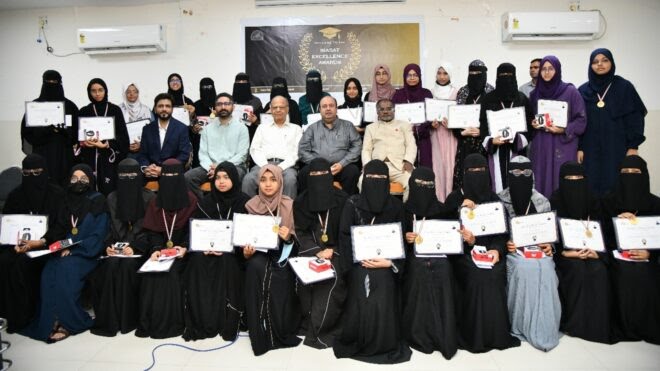
The excellence awards ceremony and annual meet – 2025 of the Muslim Educational Institutions Federation (MEIF) of Dakshina Kannada and Udupi districts, held at Barakah International School, Adyar Mangaluru, on May 22.
Speaking on the occasion, Dr Mohan Alva, chairman of Alva’s Education Foundation, Moodbidri, said, “Education institutions should not be limited to one community. Education institutions should not be confined to the community that founded them. Instead, schools should reflect a “mini-India” that transcends barriers of religion, caste, and ethnicity. Everyone should have access to education. An atmosphere must be created where all are included. Just as India is home to various castes, religions, languages, and ethnicities, schools too should represent this diversity and become a mini-India. Schools should be a reflection of society, imparting education that builds communities rather than dividing them”
Praising the achievements of MEIF, Dr Mohan Alva also promised assistance in providing scouts and guides training to students in MEIF schools.
MEIF honorary president Umar T K delivered a keynote address, and MEIF president Moosabbi P Bary presided over the event.
A booklet detailing the federation’s annual programmes for 2024-25 was unveiled by Y Abdulla Javed, director of Yenepoya Group.
President of the Baraka Group of Institutions Ashraf Bajpe and Unni Haji, , along with Bahrain Sinan Zakariya, were honored during the ceremony.
National trainer Rajendra Bhat also shared his thoughts.
The event also included a felicitation ceremony honoring students who achieved outstanding results in PUC and SSLC examinations.
Outstanding SSLC performers from MEIF schools who were felicitated include Sumaiyya Nuha (619), Dakshin S Salian (618), Nidha Khadeeja Noor (617).
PUC toppers honored include Prithvi Acharya (585), Ayesha (584), Ayesha Shamran (584), Farahath M A (591), Maheen Fathima (590), Ayesha Falak (563), Aleemath Sayida (556), and Nafia T N (556).
From MEIF SSLC Kodagu – Fizah V (618), MEIF SSLC Chikkamagaluru – Taheen Fathima (597), and Karnataka SSLC state topper Shagufta Anjum from Sirsi (625) were also felicitated with mementos and cash awards.
Vice president of the Presidency Group of Institutions Suhail Ahmed and president of the Manipal HPR Group of Institutions Hariprasad Rai, were present as chief guests and extended their best wishes.
MEIF East Zone vice president Mustafa Sullia welcomed the gathering. General secretary Riyaz Ahmed K B and secretary Mohammad Sharik announced the names of the award-winning students. Farvez Ali delivered the vote of thanks, and lecturer Abdul Razak Anantadi compered the event.
MEIF Kodagu chapter president K A Shadli, Chikkamagaluru chapter president Zameer Ahmed, vice president Shabih Ahmed Qazi, and treasurer Nisar Fakir Mohammad were also present on the occasion.
source: http://www.daijiworld.com / Daijiworld / Home> Karnataka / by DaijiWorld Media Network – Udupi (TP) / May 23rd, 2025
Sadaravan Village (Sitapur District), UTTAR PRADESH :
Girls outperform boys in Jamia Millia Islamia’s internal examinations, and Umaima’s performance has emerged as a shining example
New Delhi :
Reflecting dedication and discipline, Umaima Bano, a student from a small village in Sitapur, Uttar Pradesh, has made her mark in the results declared by Jamia Millia Islamia. Scoring 96.4 per cent in the Class 10 board examinations, Umaima becomes one of the top 10 rank holders this year.
The Class 12 and 10 results were released on 14 and 15 May, respectively. This year, girls have notably outperformed boys in Jamia’s internal examinations, and Umaima’s performance has emerged as a shining example.
Umaima hails from Sadaravan, a remote village in Sitapur district. Her father, Kamal Ahmed, is the principal of a private intercollege, and her achievement has brought pride not only to her family but also to her entire village.
Despite her modest background, Umaima demonstrated excellence across all subjects. According to the official marksheet, she scored 97% in Hindi, 98% in English, 99% in Mathematics, 93% in Science, 95% in Social Science, 96% in Urdu, and 95% in Islamiyat.
Her performance reflects a well-rounded grasp of both academic and language-based subjects. Speaking to local media, her father expressed pride in her efforts:
“Umaima has always been a disciplined and hardworking child. We had faith in her, but her achievement has exceeded our expectations,” Kamal Ahmed said.
Umaima’s academic journey has been marked by determination. She completed her primary education from New Vision Public Inter College in Muhammadabad, Uttar Pradesh. She then appeared for Jamia Millia Islamia’s national-level entrance test, securing an impressive 45th rank.
This feat earned her a place in the prestigious university, where she now lives in a student hostel to pursue her studies with greater focus.
“I want to become an IAS officer and serve my country,” Umaima shared when asked about her future goals. “My parents’ sacrifices inspire me every day to work harder.”
The news of Umaima’s success spread quickly across her village, where neighbours and well-wishers gathered to congratulate the family. Local teachers and community leaders praised her for being a role model for rural students.
“Umaima’s success has shown that even students from small villages can reach great heights with sincerity and support,” said Feroz Khan, a teacher from her former school.
Jamia officials also acknowledged the importance of recognising merit from all backgrounds.
“At Jamia Millia Islamia, we are committed to nurturing talent from every corner of the country. Umaima’s story is a testament to the power of equal opportunity and hard work,” said an official from the university’s examination board.
This year’s results have also highlighted the consistent rise of girl students at Jamia. University records indicate that in both Class 10 and 12 results, girls have performed better than boys in average marks and top positions.
With her academic brilliance and strong moral foundation, Umaima Bano has not only brought laurels to her family and community but has also become a symbol of hope and empowerment for girls in rural India.
As celebrations continue in Sitapur, many hope that Umaima’s journey will inspire others to dream big, work hard, and break through social and geographic barriers.
source: http://www.clarionindia.com / Clarion India / Home> Editor’s Pick> Indian Muslims / by Mohammad Bin Ismail / May 18th, 2025
Mulki Town ( Mangalore Taluk, Dakshina Kannada Distirct) , KARNATAKA / Dubai, U.A.E :
Mulki :
A public blood donation camp was successfully organised on Sunday in memory of Safwan Kolnad, a 25-year-old youth who tragically passed away on May 10, 2025, due to sudden cardiac arrest in Dubai. The camp was held at Mahila Samudaya Bhavan, located near the Kolnad Government School, and was jointly conducted by Kolnad Friends Kolnad (R) and Blood Helpline Karnataka (R), in collaboration with Wenlock District Hospital, Mangalore.
The event began with a dua and blessings from Sharif Darimi Al-Haitami, Khatib of Shafi Juma Masjid, Kolnad. The program was presided over by Manjunath B.S., Circle Inspector of Mulki Police Station.
Dr. Ayisha Suhana, Consultant Ophthalmologist and Chief Eye Surgeon at Srinivas Institute of Medical Sciences and Research Centre, Mukka, was the chief guest. In her address, she highlighted the critical importance of blood donation and how a single unit of blood can help save up to three lives. She also explained how regular blood donation contributes to better health by reducing the risk of heart attacks, strokes, and certain cancers, while also controlling cholesterol, blood pressure, and iron levels. She advised donors to stay hydrated and avoid strenuous activity after donating blood.
As a tribute to the late Safwan Kolnad, Dr. Ayisha Suhana announced that she will perform five free cataract surgeries with premium intraocular lens implantation for underprivileged patients. She has conducted similar charitable surgeries in the past, in association with NGOs including the Naushad Haji Suralpady Memorial Charitable Trust (R).
This was the second blood donation camp organised by Kolnad Friends Kolnad (Reg) Charitable Trust, and a total of 62 units of blood were collected, including 52 male and 10 female donors.
The organisation continues to serve as a ray of hope for underprivileged patients, providing financial assistance for dialysis and cataract surgeries, and also supporting economically weaker students.
During the event, both Manjunath B.S. and Dr. Ayisha Suhana were felicitated by the organisers.
The program concluded with remarks from Yasir Arafat and a vote of thanks delivered by Abbas Ali.
source: http://www.english.varthabharati.in / Vartha Bharati / Home> Karavali / by Vartha Bharati / May 20th, 2025
Shezah Fatima, Sumbul Khan, Tarannum Rangrez and Mohammed Ashhad are four Muslims who have figured in the MPBSE Madhya Pradesh 10th List of Top 10 for the year 2025 released along with the result Tuesday.
[Representative image by Grok 3]
MP Class 10 Result 2025:
Madhya Pradesh SSC 2025 Toppers List: Shezah Fatima, Sumbul Khan, Tarannum Rangrez and Mohammed Ashhad are four Muslims who have figured in the MPBSE Madhya Pradesh 10th List of Top 10 for the year 2025 released along with the result Tuesday.
Shezah Fatima from Jabalpur bagged a total of 498/500 marks and secured the 3rd rank in Madhya Pradesh.
On the other hand, Sumbul Khan of Sagar district and Tarannum Rangrez of Damoh district bagged a total of 496/500 and secured the 5th rank in the MPBSE 10th Toppers List 2025.
Also in the Madhya Pradesh SSC Merit List 2025 is Mohammed Ashhad. Ashhad bagged 495 out of the total 500 marks and stood 6th in whole of Madhya Pradesh.
The state topper in the MPBSE SSC 2025 board exam is Pragya Jaiswal of Singrauli district. She has scored 500 out of 500 marks i.e. 100% marks to secure the top rank in the MP Class 10 board exams 2025 held from February 27 to March 19, 2025.
MPBSE 10th Toppers 2025
The top three students in the Madhya Pradesh board SSC Merit List 2025 are:
Rank 1: Pragya Jaiswal from Singrauli (500 marks)
Rank 2: Ayush Dwivedi from Rewa (499 marks)
Rank 3: Shezah Fatima from Jabalpur (498 marks)
Girls have preformed excellently well across the board.
According to the 10th result announced today, a total of 212 students have featured in the Madhya Pradesh SSC Merit List 2025. Notably, 144 of them are girls.
MP 10th Result 2025 – Top 10 Districts
Narsinghpur district has topped in terms of pass percentage in both MP 10th exam, followed by Mandla district. The list of top 10 districts are:
Narsingpur 92.73% of regular students pass
Mandla 89.83%
Balaghat 88.07%
Anooppur 87.66%
Neemuch 87.29%
Shajapur 86.22%
Sehore 85.54%
Hoshangabad 84.08%
Dewas 84.05%
Jhabua 83.88%
MPBSE 10th 2025: Division wise Result
Over 4 lakh students have passed MP 10th SSC 2025 exam with 1st division.
First division: 4,290,42 students
Second division: 1,821,72
Third division: 2,200
Pass division: 0
Details of Regular Students
Registered: 8,100,19
Absent: 5,087
Appeared: 8,049,32
Cancelled: 125
Withheld: 39
Result declared for: 8,047,68
Pass: 6,134,14
Failed: 1,91,354
Pass percentage: 76.22 per cent
The state has registered an overall pass percentage of 76.22%. It is the best result in the past 15 years, the MP board said.
Steps to Check MP board Class 10 HSC Result 2025
Click here to go official MPBSE official website: “mpresults.nic.in“.
Click on “HSC (Class 10th) Exam Result 2025”.
Enter roll number and name.
Click on “Submit”.
The results will be displayed on the screen.
Save the results and take a print out for further reference.
The students can check their MPBSE Class 10 or HSC results 2025 along with Class 12th HSSC Vocational Exam 2025 on the official website www.mpresults.nic.in, mpbse.mponline.gov.in, mpbse.nic.in, ExamResults.net, MPEducation.net indiaresults.com results.mpeducation.net, knowyourresult.com.
MP Board Previous Year Toppers
In 2024, the MP board Class 10 exam, the state had registered an overall pass percentage of 58.10%.
In 2023, the MP Board Class 12 Exams were held from March 2 to April 01, 2023, at various test centers across the state.
A total of 7,29,426 students had registered for the Class 12 MP Board exams. Out of them 7,27,044 appeared in the exam and 4,01,366 (55.20%) were declared passed. The pass percentage of boys in 2023 was 51.91% and that of the girls stood at 58.69%.
Narayan Sharma (488 marks), Gaurav Mourya (486 marks), Ritin Lodhi (486 marks) and Prachi Patel (485 marks) were toppers in Science stream.
On the other hand, the MP Board Class 10 Exams last year were held from March 1 to March 27, 2023, at various test centers across the state.
A total of 8,20,014 students had registered for the Class 10 MP Board exams. Out of them 8,15,364 appeared in the exam and 5,15,955 (63.29%) were declared passed. The pass percentage of boys in 2023 was 60.26% and that of the girls stood at 66.47%.
source: http://www.ummid.com / Ummid.com / Home> Education & Career / by ummid.com news network / May 06th, 2025