INDIA :
That women’ s bodies and choice of clothing are ostracized and politicized, is not new discourse. Much discussion on the subject has ensued in recent decades by liberals, feminists, progressives and conservatives alike. Add to that visible religious practices, such as head covers (Hijab) and face veiling (Niqab) among Muslim women, and the scrutiny is further exponentialized. So much so, that it disrupts the principles of liberal and western feminists, and suddenly women’s rights to choose what they want to wear begins to be rephrased, and women’s agency to choose to cover themselves is questioned and looked down upon as ignorance or backwardness. As such, Muslim women who practice various degrees of visible modesty, from Hijab to Niqab navigate feelings of discomfort, unwelcome, as well as (c)overt violence when accessing public spaces, including schools, workplaces, markets, restaurants and more. They are often perceived as beings without agency and intellect, and far removed from the mainstream intellectual public realm. Their choice to dress themselves in accordance with their religious and spiritual goals makes their presence in public unwelcome and politicized.
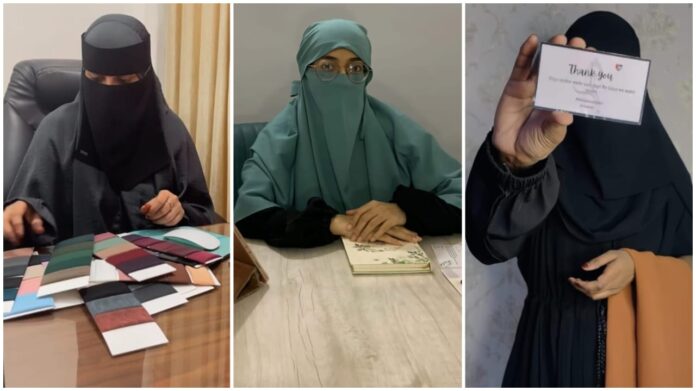
In this article, through interviews with three Niqab-observing Muslim women who have successfully curated , established, and operate their own faith-based businesses primarily selling products through digital means,we draw attention not only on the discomfort and challenges faced by Muslim women in public spaces and traditional office workplaces, but we also highlight the agency embodied by these women to pursue their professional goals in accordance with their personal religious beliefs.
Residing and operating their businesses in India, our interviewees – Kehkashan, Asma Nafis Ansari and Mantasha – have been able to capitalize on the growing adaptation of digital technologies in recent years and produced workspaces for their businesses that offer them the safety and flexibility to pursue their multifaceted aspirations holistically. Rather than waiting for space to be given to them or created for them, they have taken the initiative upon themselves, and are doing so with grit, faith and vision. In doing so, they not only benefit themselves, but also provide employment opportunities, inspiration, and alternative workplace options to others who may find themselves facing similar challenges of discomfort in the public realm.
Faith as an anchor
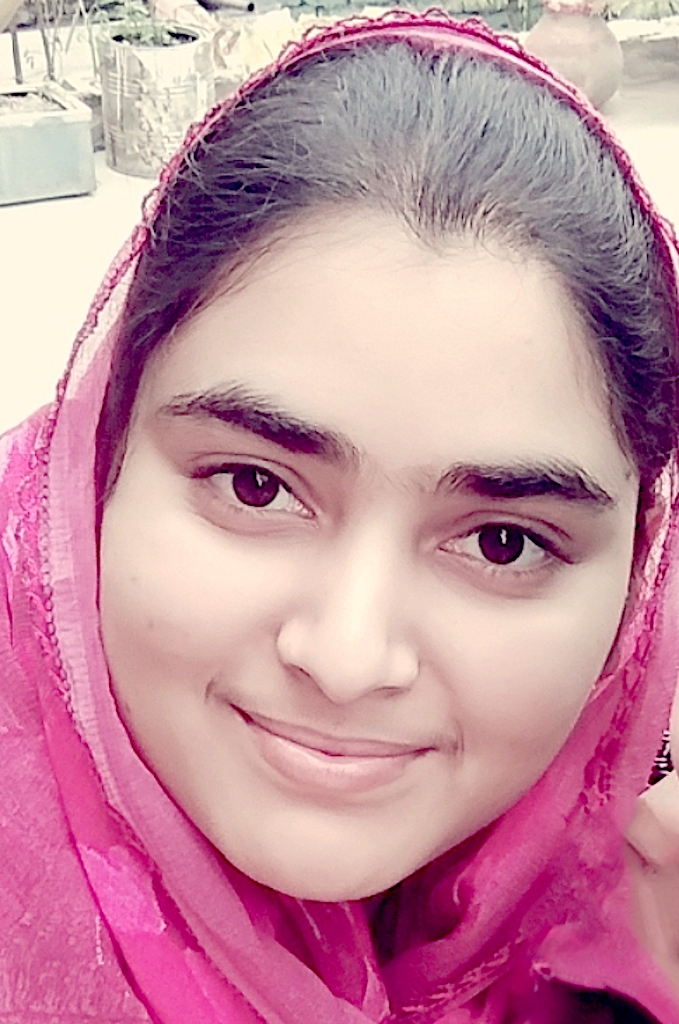
For these three muslim women, faith is not just a silent actor, but the compass that guides their journeys. Kehkashan, who co-founded ‘Shop Taaseen’ with her business partner Saida Moin, says that they started with a small product, an Umrah dua card in 2024. Today, Shop Taaseen offers a range of faith-based lifestyle products—designed to make Islamic knowledge and reminders part of everyday routines, especially for young Muslims in India. Early on in her academic life, Kehskashan says, she recognized a desire in her to create something of her own but did not know what it would be. She describes herself as someone who has always leaned into creativity with a strong sense of self – “Whatever I do, I want it to be for the sake of Allah.” she shares. That clarity guided her decisions, especially when the spaces around her were not accommodating to her identity. When asked what helped her stay rooted in her vision, Kehkashan said, “the Niqab became my north star. It shaped how I wanted to show up in the world.”
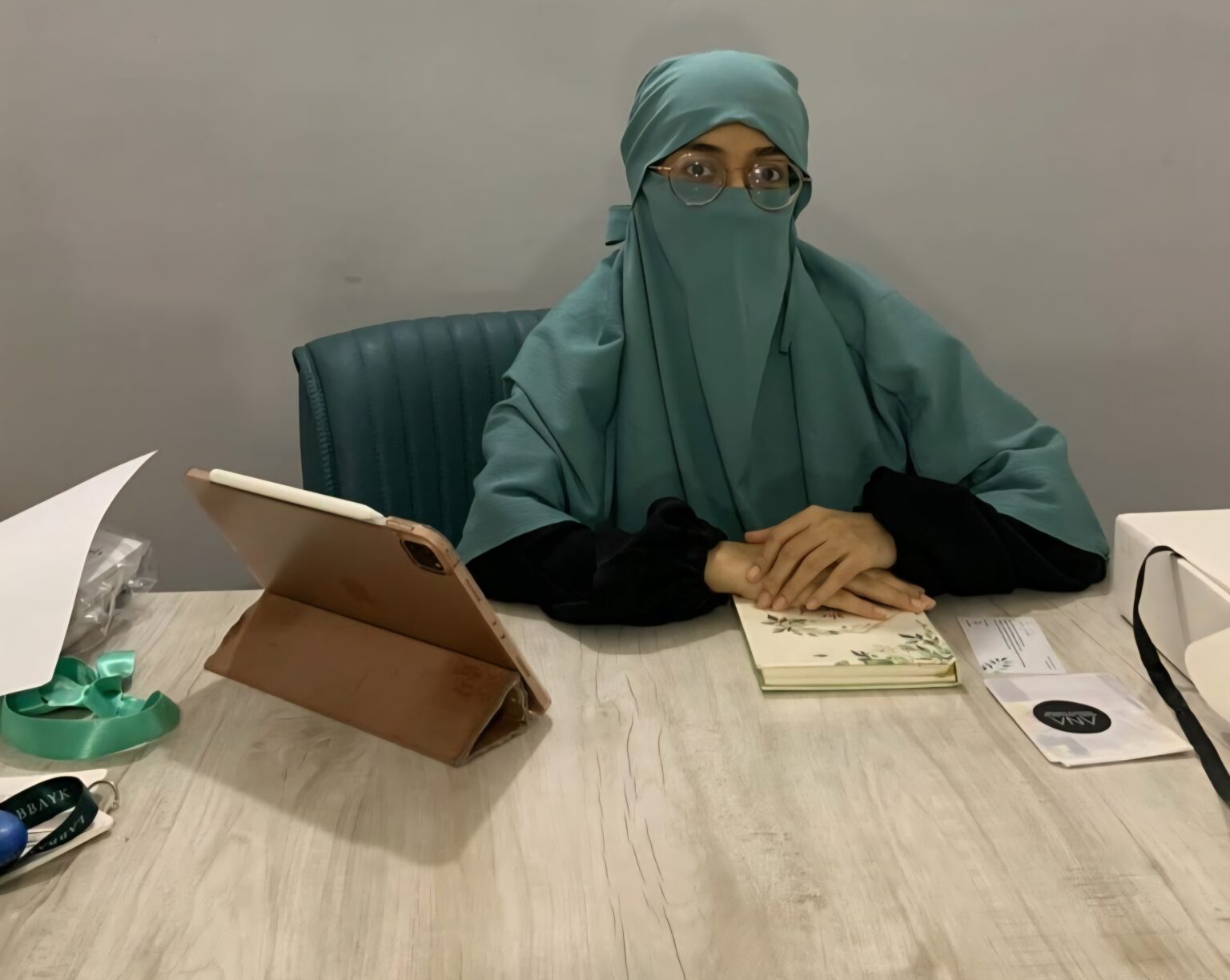
Kehkashan co-founder of Shop Taaseen
Similar to Kekhashan, our second interviewee, Asma Nafis Ansari, founder of ANA, a modest wear brand, spoke of her strong aesthetic sense, shaped by her training at the National Institute of Fashion Technology (NIFT) Kolkata. As a student at NIFT, Asma developed a signature style for her designs over the years, eventually winning her school’s Graduation Award in her final year, for her knitwear collection inspired by the mid-20th century style, Brutalism. Before launching ANA, Asma began a more intentional journey of reconnecting with the Qur’aan. It was during her study of Surah An-Nur, she says, that her personal understanding of purdah or veiling/modesty deepened. “That connection with the Qur’aan gave me clarity…” she says, “… I didn’t just want to work in fashion —I wanted to create something deeply rooted in modesty and meaning.” Today, ANA is not just a clothing brand, but a value-aligned space for modest fashion.
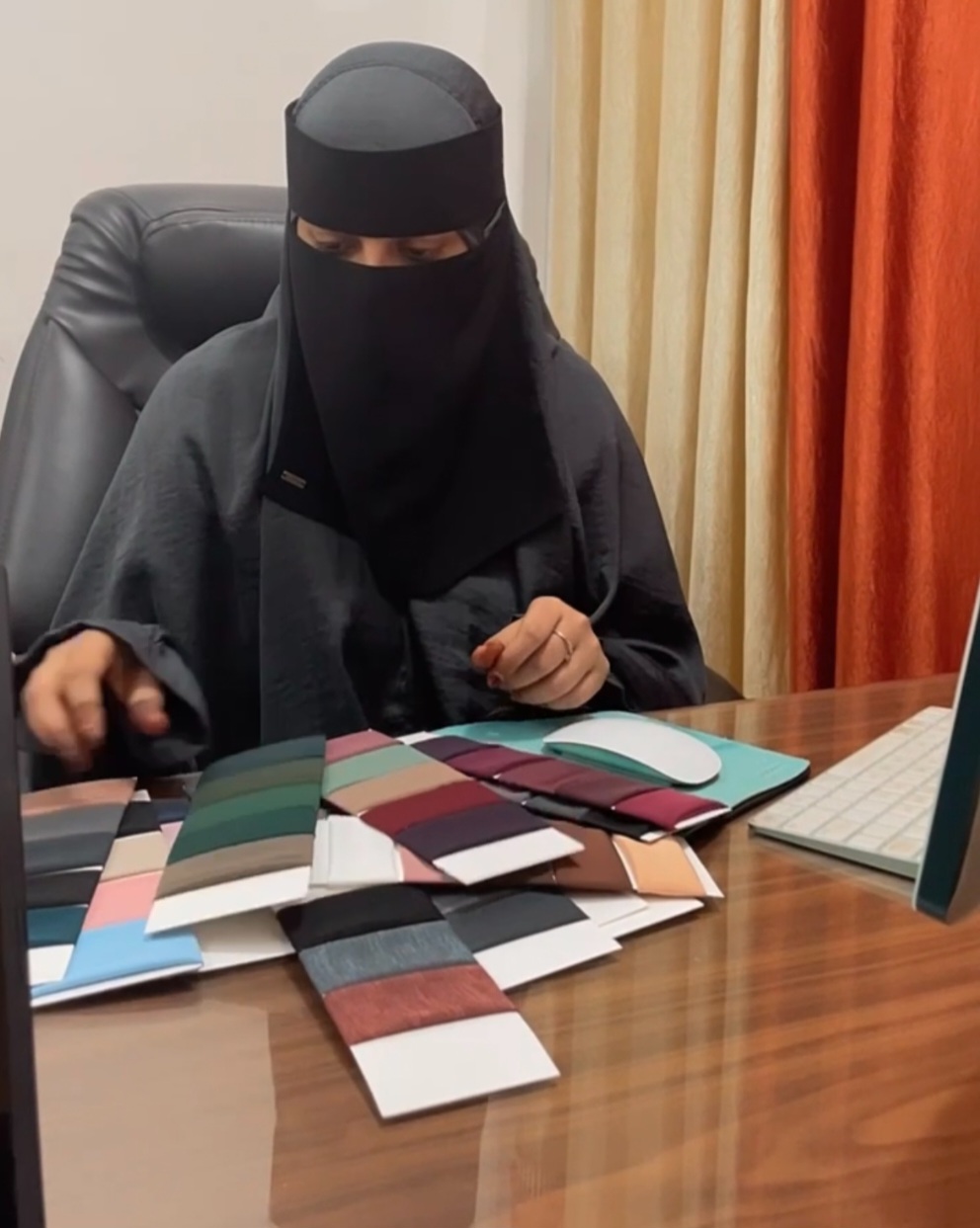
Asma Nafis Ansari the founder of ANA.
Our third interviewee, Mantasha, who holds a postgraduate degree in development communication from Jamia Millia Islamia, launched Shaheen Hijabs after realizing that mainstream, traditional workspaces would not be welcoming of her niqab. After post-graduation, she accepted a position in the development sector that involved extensive fieldwork. While her supervisor remained supportive, she realized that navigating public-facing roles as a Niqabi came with quiet, persistent tensions. “In that environment, personal identity played a critical role…” she reflects, “… people advised me to remove my niqab temporarily—saying it was not obligatory. But no matter how practical their advice sounded, I could not bring myself to do it.” She underscores that, “My niqab is not just a piece of cloth, it is a reflection of my faith.” What followed was a phase of uncertainty, reflection, and quiet resistance. Eventually, she decided to start something of her own and launched Shaheen Hijabs.
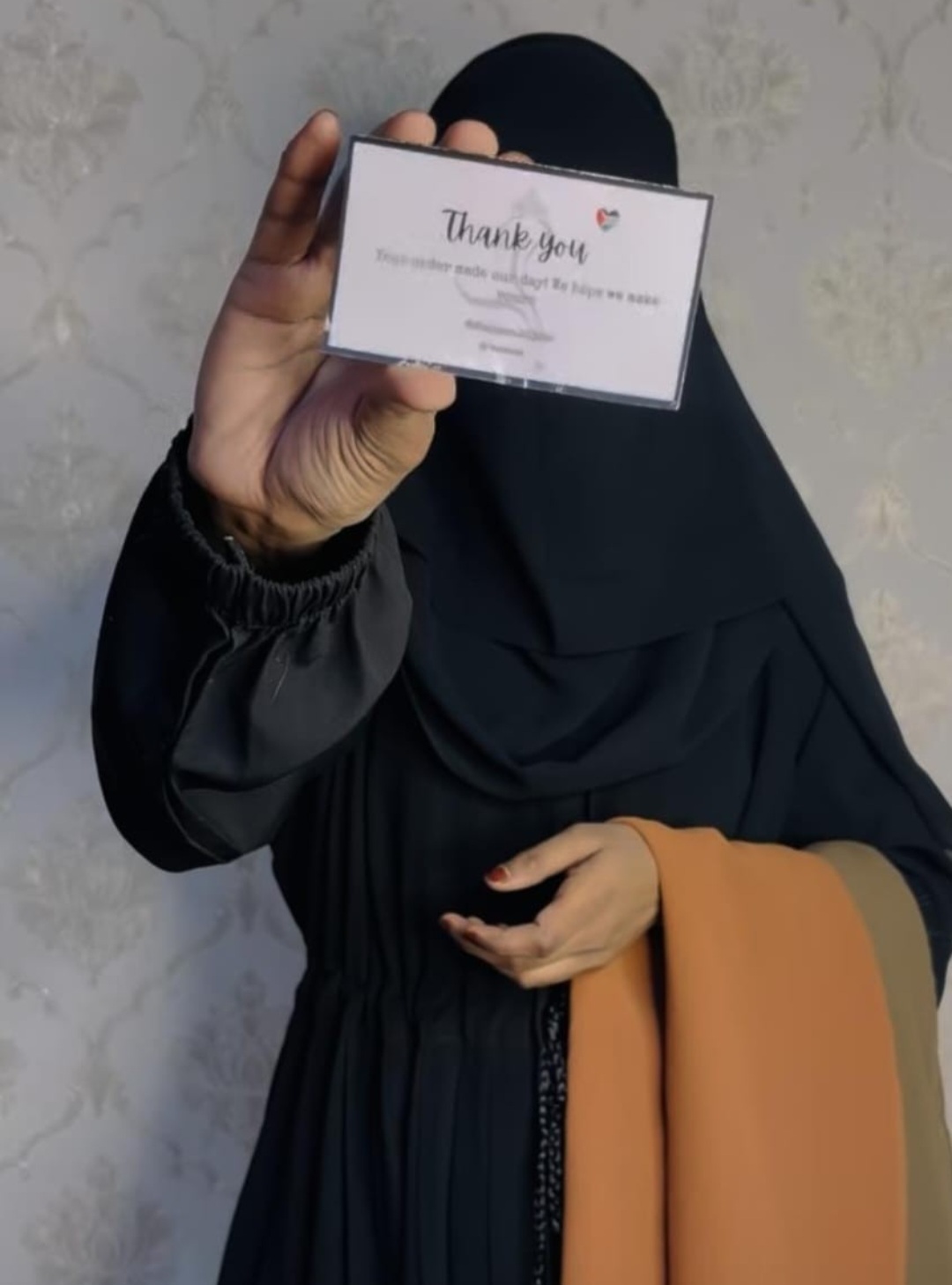
Mantasha, the owner of Shaheen Hijabs
For these women, faith is not just their religious belief. It is the guiding principle in their work. They refused to be reduced to stereotypes or forced into palatable molds, and instead have each chosen to build businesses that reflect their aspiration, purpose, religious, spiritual, and personal values.
(In)visible Practices of Faith
For Muslims, religious faith is embodied and practiced in a myriad of ways. Some aspects remain quietly held within—like Taqwa (consciousness of God) or Tawakkul (trust in divine will) – are inward practices that guide one’s principles.
However, there are other religious practices that present more visibly, like offering Salah or dressing modestly in accordance with religious guidelines. Similarly, for many Muslim women who adorn the hijab or niqab, their choice to do so is rooted in faith, devotion and identity.
For Kehkashan, the tension between her visible and invisible religious practices became apparent during a fellowship she had joined before Shop Taaseen. She recalls, “Her cohort of Fellowes were mostly non-Muslim, but they were respectful and very welcoming towards me. I felt seen.” But that feeling did not last long for her. She goes on to say, “[However,] The founder would question my practices, compare me to other Muslims. Many times I was subjected to tokenism disguised as inclusion.” She says that her choice to wear the niqab was repeatedly framed as a limitation – “I was told that niqab will hinder my growth. That it would isolate me and hold me back professionally.” It was in these moments of subtle exclusion — more than overt rejection —that she became more certain that her faith would not be negotiable.
In such ways, niqab-practicing women face exclusion, rejection, humiliation and suppression in traditional workplaces, particularly from those in higher and more powerful positions. These unwelcoming experiences inevitably discourage women from either practicing their faith wholeheartedly, or pursuing their professional aspirations wholeheartedly, pushing them to pick between one or the other.
In Asma’s story, we see a higher degree of exclusion from the public realm. After her graduation from NIFT, Asma was placed at a company in Gurgaon along with two other peers. The three of them then began to look for housing in the vicinity of their new workplace. Through an online portal, they found a potential apartment, and one of her two peers visited the flat, viewed it, and sent a video of the apartment to Asma. Satisfied with the place, Asma and her peers agreed to put down a deposit on the flat. Asma emphasizes that the management knew that someone named ‘Asma’, a common Muslim name, would be moving in. However, when she arrived with her sister at the apartment on a rainy day, they were stopped at the gate and denied entry because of their appearance as veiled Muslim women. “There are many Muslims here… ” the guard told her, “… but they do not dress like you.” It did not matter that she was a skilled designer or that she was simply looking for a place to live. Her Niqab and possibly her Abaya/Burqa ascribed her a communal and/or political identity, and that identity was decidedly excluded . She recalls being told, “If you want to live here, you can’t wear these things.” In that moment, Asma became a symbol of something “other,” something unwanted. Eventually, Asma had to find other housing accommodations. This is the quiet violence many veiled Muslim women face: being tolerated only if they erase or soften visible parts of their identity. It is an expectation that to belong, one must visibly look less Muslim or act less Muslim, and appear more as everyone else. This kind of politics of visibility relies on the erasure of visible culture and tradition that is not just harmful to Muslims, but all social groups and cultures that present more visibly. These stories give us an insight into the direct co-relations between degrees of unwelcome in public space and degrees of visible practice of religious faith. Therefore, much dialogue is needed on the reception of visible practices of faith in a society that portrays itself as a democratic and egalitarian one.
Agency X (Niqabi) Women
Women’ s struggles for agency are multifold. On the one hand, historically, women have had to fight for the right to vote, to be in the workforce, for banking rights, financial freedom, and more. On the other hand, women who exercise agency over their lives have to deal with persistent undermining of their achievements and independent decision making. This kind of undermining is further exacerbated for Niqabi Muslim women, with the most common assumption made about them that they wear it on orders from a male member of family – like a father, husband, or brother – rather than of their own convictions. They are often presumed to be voiceless, passive, or lacking autonomy. To be visibly Muslim, for veiling women, is to constantly push back against the erasure of one’s intellect and agency.
The veil has widely been painted as a symbol of restriction and oppression. Like the other two interviewees, Asma rejects this thinking and instead describes her choice to veil as an expression of deep personal identity. “People see me with respect,” she says, describing how clients and collaborators from across India engage with her during business travel. Her presence, veiled, carries authority. But that authority is also questioned and undermined by others. For instance, at an award ceremony where she was being honored as women entrepreneur of the year, a senior government official turned to her husband and asked, “She is doing such good work, why have you made her cover her face? “, to which her husband responded, “This is her choice. It wasn’t imposed on her by me.” This attitude is not uncommon, and is reflective of how, even in spaces meant to celebrate her success, the assumption of male control and female subservience still lingers. These narratives uncover deeper problems concerning women’s rights, often held by those with saviour complexes, without a true commitment to the cause. It victimizes the Muslim woman and villainizes the Muslim man, framing the problem as ‘saving muslim women from muslim men’. Not only does it misrepresent social issues, it further exacerbates the actual problems Muslim women face by consciously ignoring them. Furthermore, in denying women their proven potential, it highlights the discomfort society still holds about women who achieve success while staying true to their self and not following orders set by and within patriarchal frameworks – that a woman can be successful and devout, that she can lead and be veiled, that she can dress in faith and still possess sharp, unshakeable agency.
Although this article highlights the stories of three Niqab-wearing Muslim women, similar experiences are faced by the broader veiling, Muslim women community. From unwelcoming experiences to rejections, Niqabi women are forced to navigate a number of identity-based hindrances in their personal, professional, and spiritual journeys.
To compensate for their perceived incompetence, many feel forced to overperform, overachieve in comparison to their peers for the same level of acceptance.
Our three interviewees have shown that they do not seek validation in the language or frameworks of others. Their choices are not compromises—their decisions anchored in faith, and carried out with purpose. Agency, for them, is not about abandoning identity to gain access. It is about bringing their whole selves into every space—and reshaping what power, intellect, and leadership look like. What sets these women apart is not just their ability to navigate exclusionary spaces, but their refusal to be defined by them. In centering their faith, they have not only claimed their agency but have also carved out paths of success that are deeply rooted in service to their communities. Women like Asma, Kehkashan, and Mantasha are writing a different story—one where agency is not hidden beneath their veil, but asserted through it.
Kehkashan, through Shop Taaseen, is cultivating a space of belonging. The Taaseen Tribe, a growing digital initiative, brings together Muslim women from across the walks of life to reflect, learn, and connect.
It is a community that echoes Kehkashan’s own journey—a space for young Muslim women to feel seen, intellectually engaged, and emotionally supported.
Asma, from her small town of Mau in Uttar Pradesh, established ANA, that not only reaches customers across India and abroad but also creates livelihood for a team of about 30, consisting of kaarigars, accountants, managers, and assistants. In a world that often parades notions of diversity and inclusivity, but then almost exclusively produces urban, English-speaking workspaces and equates them with success, Asma’s journey redefines what inclusivity looks like. ANA prides itself in maintaining a balance of 1:1 ratio of men to women across their workforce. She is proof that one can build while holding fast to faith, staying rooted in place, and uplifting others along the way.
Mantasha’s story is one of resilience, where she was willing to risk uncertainty to preserve her identity and stay true to herself, rather than diluting her identity to fit in. With no prior business experience, she started Shaheen Hijabs teaching herself the ropes of the business along the way. “I rushed into it… ” she says. “… there were mistakes. I’m still learning. But I’m doing it in a way that doesn’t require me to compromise on who I am or how I want to live my faith.”
So, what then does it mean, to navigate public spaces where one is made hyper-aware of themselves, simply for living in accordance with their faith, which in a democracy, is apparently their fundamental right? What does it mean to carry the weight of assumptions—about agency and intellect—before one even speaks? What could our society look like if we stopped incessantly asking Muslim women to prove their worth, and instead, started paying attention to how they are already building, leading, and transforming the world around them? And more importantly, what could our society look like if we stopped tokenizing identity in the name of (pseudo) diversity and (pseudo) inclusivity, and started creating truly inclusive and democratic spaces for all?
****
About the Authors
Aazeen Ghaus is a Development Communication practitioner & freelance writer, based in India.
Saba Fatima is an architect based in Albuquerque, USA. She is an incoming PhD student (Fall 2025) in the Built Environments program at the University of Washington, Seattle
source: http://www.muslimmirror.com / Muslim Mirror / Home> Exclusive Reports> Positive Story> Women / by Aazeen Ghaus and Saba Fatima / July 03rd, 2025