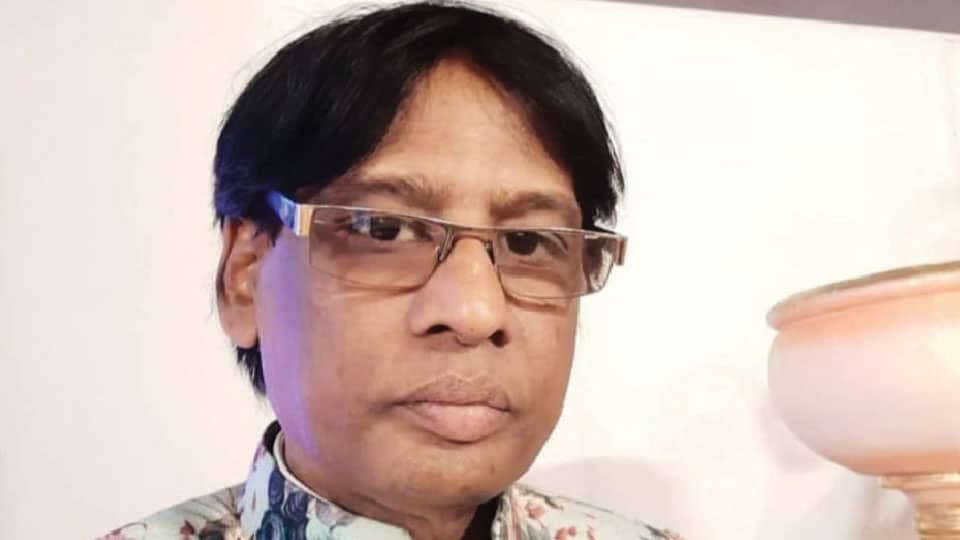
Till recently whenever the 45-year-old Muslim Ansari drove his autorickshaw through the officers’ colony of the city, he was overawed by the luxurious bungalows. He visualized living in one of these houses with his family.
His dream is about to come true as his daughter is on the verge of becoming a Deputy Collector and being entitled to such an official accommodation in the Officers’ colony.
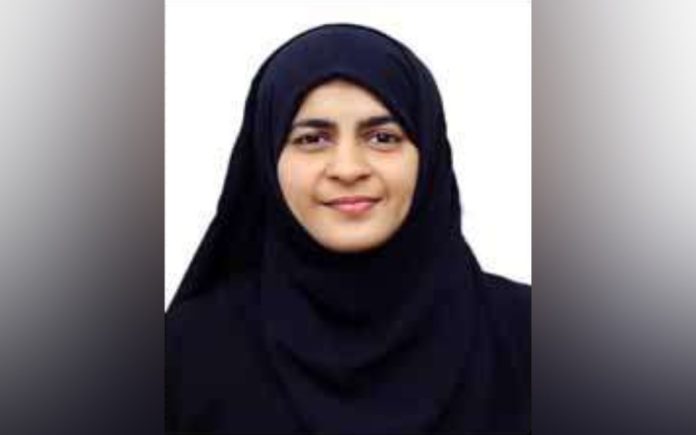
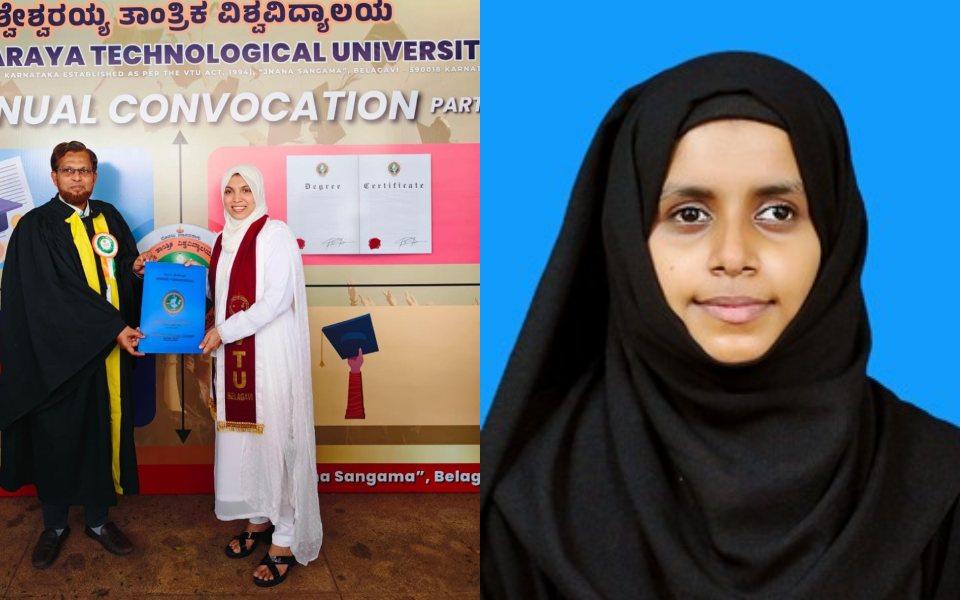
In the recent result of the Madhya Pradesh Public Service Commission examination, Ayesha Ansari of Rewa district has secured 12th rank in the state.
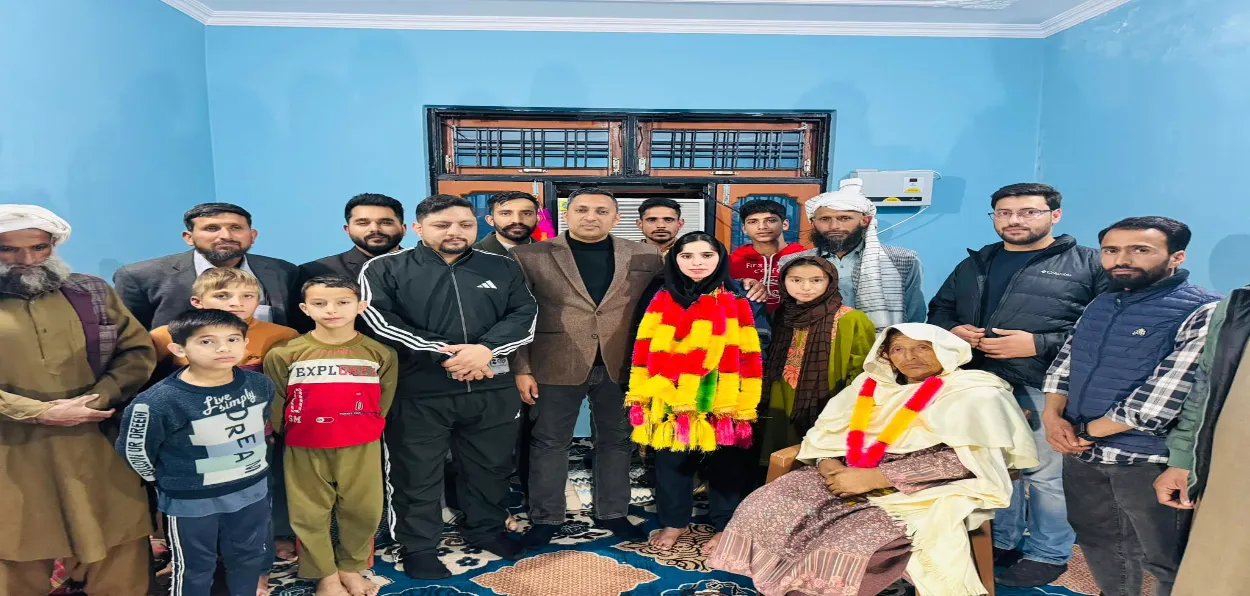
Ayesha Ansari being being congratulated by visitors at her house
She has been selected for the post of Deputy Collector. Her success is being celebrated across the district. Although she is yet to get orders for her posting, her family is already looking at good days.
Ayesha Ansari was born in a middle-class Muslim family. Her father, Muslim Ansari put in all his efforts to make his daughter’s dream come true. Ayesha credits her parents for her success. She says that her father used to walk every morning through the Police Line Colony and read the nameplates of officers living in the bungalows.
Her father manifested and visualized a big future for her daughter and his dream has come true.
Ansari often told his daughter, “I wish someone in our family had a big bungalow to his name.”
Ayesha with relatives
Wanting to make her father proud, Ayesha focused on her education and decided to make his dream come true.
Ayesha Ansari believes success comes only with dedication and hard work. She never joined any coaching class.For the preparations, Ayesha used her mobile phone to access study material and did a home study.
He said he worked hard to provide for his family and ensure that Ayesha got everything she needed for her important examinations and education.
Muslim Ansari says, “I had no idea about the civil services, but always dreamt of my daughter getting a good position.”
Ansari says he drove his auto rickshaw even when he was ill so that his daughter’s studies were not affected.
Ayesha Ansari’s success has sent a wave of joy in her family and neighbourhood. There is a beeline of people outside their house with everyone wanting to meet and congratulate Ayesha.
Ayesha believes that the youth should leave no stone unturned in their hard work and keep trying to secure their goals. She asks them to stay away from social media and distractions.
Muslim Ansari said, he never thought that his daughter would reach such high a high point in her life.
“Our life was full of struggle, but now we can proudly say that our daughter has achieved this feat with her hard work.”
Ayesha who belongs to the marginalised Pasmanda community has thus become a sources of inspiration for many who otherwise believed that lack of resources was an impediment to their drowth and realisation of their dreams.
source: http://www.awazthevoice.in / Awaz, The Voice / Home> Story / by Abdul Wasim Ansari, Rewa, MP / January 23rd, 2025
MANUU VC Syed Ainul Hasan presenting mementos to Lakshmi Devi Raj, Shahid Husain Zuberi, Mazhar uz Zaman Khan, Syed Jafar Amir Rizvi, and Oudesh Rani Bawa
Hyderabad:
Urdu lovers exist and MANUU will bring them to its platform and honour them, said Prof. Syed Ainul Hasan, Vice-Chancellor, Maulana Azad National Urdu University (MANUU).
He was honoring five eminent personalities from Hyderabad as “Sitara-e-Urdu” (Doyens of Urdu). The university presented Lakshmi Devi Raj, Syed Jafar Amir Rizvi, Shahid Husain Zuberi, Oudesh Rani Bawa and Mazhar uz Zaman Khan with a memento, a shawl, and a flower plant in recognition of their contribution towards Urdu language, literature and culture on Monday.
The ‘Sitara-e-Urdu’ programme was organized by Centre for Urdu Culture Studies on the occasion of Teacher’s Day at CPDUMT auditorium.
source: http://www.siasat.com / The Siasat Daily / Home> News> Hyderabad / by News Desk X / September 05th, 2022
Sunday saw an impressive flag-off ceremony for two determined cyclists, Akbar Ali Bandukwala and Rishabh Jain, who set off on an extraordinary journey of 1500 kilometers from India Gate in New Delhi to the Gateway of India in Mumbai, all in the name of promoting cleanliness and health as part of ‘Swachh Bharat, Swasth Bharat’ vision on this Republic day.
The ceremony, hosted at Vasant Kunj, South Delhi, was marked by high enthusiasm as local councillors Jagmohan Mahlawat and Dharamveer Singh waved the Indian tricolour to send the cyclists on their mission.
Sister Falak BK, who organized the ceremony, highlighted the cyclists’ remarkable journey, nicknamed “G2G” (India Gate to Gateway of India), as a symbol of their dedication to spreading awareness on fitness and cleanliness across the country. The cyclists will travel through several cities, raising awareness about health and cleanliness in schools, public spaces, and communities along the way.
On this occasion, a large number of participants, including notably another host Rakesh Kothari and their enthusiastic team of supporters, warmly welcomed both cyclists with great enthusiasm and fervour.
Later on Sunday, Judicial Magistrate Rishabh Tanwar also joined at India Gate, helping to kick-start the journey with the rallying cry: “Let’s pedal towards a cleaner, healthier India!”
On this occasion, Akbar Ali Bandukwala, an iron trader turned fitness enthusiast, shared his inspiring story at the ceremony. Originally from Udaipur, Rajasthan, Akbar’s life took a dramatic turn after a severe spinal injury in 2013, which led doctors to warn him that he would be restricted to only baby steps for the rest of his life. However, driven by his indomitable spirit, Akbar defied the odds. After months of rehabilitation, he began running again. His journey from bedridden to marathon runner became a story of triumph.
By 2015, Akbar completed a half marathon, and soon after, he participated in marathons across India and China. In 2018, he organized the Bandukwala Marathon, inviting his family to run alongside him. The crowning achievement came in June 2023, when Akbar ran an astounding 50 kilometers to celebrate his 50th birthday. The event saw thousands of supporters join him in solidarity, running in cities across the world. According to him, his wife Tasneem Bandukwala is his biggest supporter and motivator.
Akbar has pushed his limits further. In January 2024, Akbar participated in the ‘Fundraiser Ultrathon for Gaza,’ where he achieved yet another milestone. He completed a gruelling 70-kilometer Vertical Trail Run, covering a total distance of 78.14 kilometers in 15 hours and 40 minutes, taking an astounding 101,258 steps in Guangzhou, China. The trail was incredibly challenging, with vertical, uneven, rocky, and steep terrain, making the task extraordinarily difficult. Yet, for Akbar, it was just another feather in his cap.
Earlier last year, Akbar also promoted the ‘Swachh Bharat Abhiyan’ under the Guangzhou Consulate General of India and emerged as a pioneer in strengthening India-China public relations. He was also awarded the Parvasi Bhartiya Award.
Later in 2024, he turned 51, he cycled 151 kilometers non-stop, battling heavy rainfall and completing the feat in just 6 hours and 15 minutes. This remarkable achievement has led him to embark on the G2G journey, spreading Prime Minister Narendra Modi’s message of ‘Swachh Bharat, Swasth Bharat’ with every pedal. Akbar is now strongly committed to inspiring others to follow his path toward better health with cleanliness drive.
From Iron Trader to Ironman, Akbar Ali Bandukwala is now embarking on the “G to G” journey, covering 1500 kilometres by bike from India Gate to the Gateway of India. In his own words, “Chalo aur kuch toofani karte hai, Delhi to Mumbai ab cycle par chalte hai.”
This Republic Day, Akbar aims to express his love for his nation through the campaign, ‘Swachh Bharat, Swasth Bharat.’”Good health and cleanliness are life’s greatest blessings, and they cannot be bought but can only be earned through enduring,” Akbar shared at the flag-off ceremony.
Through his G to G journey, Akbar is dedicated to promoting Swasth Bharat. Along the way, he plans to visit schools, collaborate with NGOs and health organizations, and engage with people from all walks of life. His mission is to educate citizens about the critical connection between physical health and mental well-being, and the importance of living a long, active life without being dependent in old age. In his own words, “Chalo aur kuch toofani karte hai, Delhi to Mumbai ab cycle par chalte hai.”
Rishabh Jain, Akbar’s cycling partner and fellow fitness fanatic, is no stranger to endurance challenges. An Ironman finisher and certified fitness expert, Rishabh has completed numerous grueling cycling and marathon events, including the Manali to Leh ride and a 1450km ride from Udaipur to Mumbai. He runs the Triform Fitness and Adventure Club in Udaipur and has coached many fitness enthusiasts, including Akbar, who was a novice cyclist just a year ago. Under Rishabh’s guidance, Akbar has transformed into a cycling enthusiast.
Sharing details of their epic 1500-kilometer journey, Rishabh Jain on this occasion, disclosed that they are undertaking this ambitious ride from India Gate in Delhi to the Gateway of India in Mumbai. They will cover the entire distance in just 7 days, spreading the message of Swachh Bharat and Swastha Bharat as part of their campaign for cleanliness and health.
According to their cycling itinerary, after departing Delhi, they will reach Jaipur on January 20, Bhilwara in Rajasthan on January 21, and Udaipur’s Kherwara on January 22. From Kherwara, they will head to Godhra, Gujarat on January 23, and embark on their journey to Surat on January 24. They will continue to Manor on January 25, before concluding their ride at the iconic Gateway of India in Mumbai on January 26.
Rishabh shared that along the way, they will participate in various awareness programs in cities and towns, focusing on cleanliness and health. They will also visit schools to raise awareness about fitness, health, and the importance of sports among children, students, and adults alike.
Reflecting on his own experiences, Rishabh noted that he has always enjoyed long cycling adventures and connecting with people. He also shared the story of Akbar, who just a year ago knew little about cycling but approached Rishabh for training. After months of hard work and dedication, Akbar has transformed into an avid cycling enthusiast, proving that with determination, anyone can achieve their fitness goals.
As the cyclists progress on their 7-day journey, they will organize health awareness programmes in schools and collaborating with NGOs to spread the message of fitness and hygiene. The duo’s cycling itinerary spans 1500 kilometers, with the final destination being the iconic Gateway of India on Republic Day, January 26th. Along the way, they will meet communities, educating people about the importance of fitness in maintaining good mental health and a long, healthy life.
In a bid to encourage the younger generation to adopt a healthier lifestyle, Akbar and Rishabh are determined to leave a lasting impact on everyone they encounter, from school children to senior citizens. Their journey is not just about cycling, it’s about motivating people to take small steps towards a healthier and cleaner future of the country.
source: http://www.indiatomorrow.net / India Tomorrow.net / Home> National Interest / by admin indiatomorrow.net / January 20th, 2025
Zainab-ul-Kubra (3rd year), and Intizar-ul-Islam (4th year), Prize winners from NUSRL
Ranchi:
Students of National University of Study and Research in Law (NUSRL), have secured first place in the International Arbitral Award Writing Competition. Two university students, Intizar-ul-Islam (4th year) and Zainab-ul-Kubra (3rd year), achieved the top honour in the 5th Surana & Surana RGNUL International Arbitral Award Writing Competition 2024.
This is a significant achievement for the university, as the duo won this accolade by outperforming participants from some of the most renowned universities in India and abroad. The competition was organised by Center for Alternative Dispute Resolution (CADR) at Rajiv Gandhi National University of Law (RGNUL), Punjab, in collaboration with Surana & Surana International Attorneys.
Participants were tasked with drafting an arbitral award based on a hypothetical legal problem.
More than 72 contestants took part, including students pursuing BA-LLB, LLM, PhD, MPhil, or other law-related courses. The competition deadline was October 30, 2024, and the results were announced in January.
Based on their exceptional skills, Intizar and Zainab not only secured the first position but also received a cash prize of ₹25,000 for their victory. Their success highlights their dedication and expertise in the field of law. The competition served as an excellent platform for students to showcase their legal writing abilities.
The Vice-Chancellor of the university, Professor Dr. Ashok R. Pal, congratulated Intizar and Zainab on their achievement.
source: http://www.radiancenews.com / Radiance News / Home> Pride of the Nation> Awards> Latest News / by Radiance News Bureau / January 21st, 2025
At The Hindu Lit for Life 2025, Amal Allana speaks about her father Ebrahim Alkazi, who led the modern theatre movement in India with an extraordinary vision.
Amal Allana in conversation with Ritu Menon at The Hindu Lit for Life 2025. | Photo Credit: R. Ragu
Theatre director Amal Allana, who recently released a riveting biography of her father Ebrahim Alkazi: Holding Time Captive gave a racy account of Alkazi’s revolutionary contributions to arts and culture in the creative landscape that was emerging in pre-independence India into the later decades.
She said the title of her book was apt as she found the words scribbled by her father in his notes that read ‘I wish I could live longer to hold time captive.’
A six-minute documentary on Alkazi charting the journey of his quest for a liberal approach to the arts in the Indian sub-Continent preceded Amal Allana’s conversation with Ritu Menon at The Hindu Lit for Life session on the second day.
Setting the narrative in Bombay of the 1940s when Alkazi came as the son of a migrant trader from Saudi Arabia, Amal spoke about how his innovative ideas from the young age of 22 coupled with daring new experimental projects transformed the theatre movements pan-India and later led to the establishment of the National School of Drama in Delhi in the 1960s. It was the time when creative history was under-researched and Alkazi strode the stage with arrogance, resoluteness, and brilliance.
As the daughter, Amal brought a personal perspective to the intangible landscape of Alkazi’s passions as she step-by-step unfolded the layers of his cultural, artistic and nationalistic identity. “His pedagogical skills took form as a response to the social and political life. He introduced language in theatre and nationalised it,” she said.
With Sultan Padamsee (elder brother of filmmaker Alyque Padmasee) and other independent-minded creative individuals, he broke boundaries and embraced the radical and precarious theatre life. They were all progressives and reinforcing each other. Amal narrated how Alkazi went overseas to study modern theatre and took Nissim Ezekiel along. He had the disposition of taking people along with and their idea of total theatre included all forms of arts feeding into one another.
“So with music, lights, costumes, literature, discussions and brochures he created dramatic experiences translating, producing and directing plays from the Western pantheon,” Amal said and added Alkazi was particularly influenced by Tagore’s concept of Santiniketan integrating liberalism with fine arts.
Not only was Alkazi interested in training a body of thinking actors but he also trained audiences to appreciate modernity in theatre, she said.
The Hindu Lit for Life event is presented by KIA India and is in association with Christ University. Associate Partners: LIC, RR Donnelley, Blue Star, Brigade Group, NITTE Deemed-to-be University, PROchure, Singer, Chennai Port Authority & Kamarajar Port Ltd, Uttarakhand Tourism, Vajiram and Ravi, Indian Bank, Akshayakalpa and ICFAI Group. Realty Partner: Casagrand. Bookstore Partner: Crossword. Food Partner: Wow Momo, Beverage Partner: Beachville, Radio Partner: Big FM, TV Partner: Puthiya Thalaimurai Gift Partner: Anand Prakash. Supported by: US Consulate, Chennai, Water Partner: Repute
source: http://www.thehindu.com / The Hindu / Home> Lit for Life / by Soma Basu / January 19th, 2025
Asma Memorial Trust felicitates 80 educators including retired ones and specially-abled who served without recognition.
(Clockwise) Noor alam with Afaf Jameel, Junaid Kamal, Sangita Gurang (red sari) and the felicitated ones
Kolkata:
When the name of Junaid Kamal was announced, a 32-year-old man, with the help of two crutches, tried to stand up from his seat and began moving towards the stage to be felicitated at Asma Memorial Trust’s function. Soon, the fine art teacher was assisted in walking to receive a memento, a plant, and a set of notebooks and pens.
It was the first time in his 13-year teaching career that the art teacher, who is associated with four different organizations in Kolkata and serves the community, was recognized as a specially-abled person (left leg and right paralysed).
“I am thankful for the felicitation. For someone like me, it is not only difficult to study, but getting a respectable job is another challenge. Even when you succeed, it is rare that people appreciate it in this fast-paced life,” the Academy of Fine Arts graduate told eNewsroom.
Junaid was not alone; at least 15 retired educators, from both government and private schools, were also felicitated at the event.
Dr Umar Khyyam (70) of Maulana Azad College, Mobark Ali Mobarak (65) from Bankura district Urdu School, Nurul Hoda (62) of Kankinara Himayatul Ghurba High School (underprivileged), and Ashraf Ahmad Jafri (65) of Karaya School, Kolkata, were among them.
There were also current teachers, such as Afaf Jameel of Frank Anthony Public School, Sangita Gurung of Assembly of God Church School, Michael A Panja of GD Goenka Public School, Dr Khalid Hossain of Monu Memorial Institution (Kolkata), Debashish from Well and Gold, Md. Shahnawaz of Noble Mission School, Mubashshreen Shakil of KS Consultancy & Academy, Shaguta Adnan, who teaches French, and Manwar Sultana of Sir Syed English Medium School, among the total 80 teachers who were felicitated.
The felicitated and the felicitetors together after Asma Memorial Trust’s event
Teachers from South Point, East West, Goenka, Albani Hall, Islamia, Mohammed Jan, Flair International, and Izma International schools were also honored.
Noor Alam, the founder of NEET Basket, who also established the Asma Trust in memory of his wife to promote value-based education and encourage those involved in it, told eNewsroom, “We used to celebrate Education Day on the birthday of India’s first education minister, Maulana Abul Kalam Azad. But this year, we started the celebration earlier and began by felicitating educators who have served society but have not received any recognition for it.”
Alam, the Rashtriya Shiksha Ratan Award winner also pointed out that during the felicitation, a plant was given to each honoree to symbolize how educators nurture children. Just as trees benefit society in many ways, a well-nurtured child can positively impact the community.
The chief guest, Indian Revenue Service (IRS) officer Shamsher Ahmad, who took voluntary retirement and started Crescent School in one of Kolkata’s ghettos—Topsia—shared his journey as an educator. “When I started the school in Topsia (in 2002), I decorated the building very well. People asked me why I was doing so. I told them that to build confidence in the Topsia students, they must study in a place that is not inferior to other major schools in the city.”
“In later years, to boost their confidence to appear for the Union Public Service Examinations, I used my contacts and made my school a center for the UPSC exam, which produces IAS and IPS officers. As a result, today our school produces doctors and students who pursue higher education after graduating from Crescent,” Ahmad said to the gathering.
Sangita Gurung of Assembly of God said a one liner for the teachers, “Teach what your preach and preach what you teach, is the motto remained in my career and it should be with every teacher.”
Dr Sarfaraz Adil, founder of Izma International School , reminded attendees of the importance of education in Islam and how it has been emphasized. “Getting an education is one of the fundamentals of Islam. It not only includes religious education but also opens doors to physics, astronomy, and chemistry. Before Islam, there was no scientific temperament in religion. Only the rich could study, but Islam made education accessible to everyone. Prophet Muhammad announced that any slave who learned and became educated would be freed. Later, a slave named Hazrat Barira became educated and declared that she should be freed, according to the Prophet’s word. And she was freed. Although it was difficult because she was married to an uneducated slave, she wanted her freedom and to be separated from her husband, so she was granted it.”
Dr Adil also had a message for today’s teachers: “Information is easily shared among students. So, what is important for teachers is to teach students skills and show them
source: http://www.enewsroom.in / E Newsroom India / Home> Bengal> Education / by Shahnawaz Akhtar / September 16th, 2024
Tasneem Fathima Khaleel has had a successful career in academia. However, quite remarkably, she came back to where she started – teaching. M A Siraj reports.
Few people end their careers where they first began; Professor Tasneem Fathima Khaleel is among those few. “I am excited about the opportunity to finish my career in the classroom. And, with a little help, I will be teaching in a new state-of-the-art…facility,” says Tasneem, the first-ever woman to have obtained a doctorate in the State of Mysore in 1970. Prior to returning as a professor of Botany, she served as the dean of faculty at College of Arts & Sciences for a decade at the Montana State University at Billings (MUSB).
Paving a new path
Tasneem has been teaching Botany in the United States for over 40 years and has received many awards for her teaching and research. She has headed, or has been a member on as many as 23 different academic bodies or advisory councils in the US. For her contribution to research, with nearly 50 research publications on subjects ranging from cyto-embriology to plant reproduction, she was awarded the ‘Outstanding Research Award’ in 1995 by the Montana Research Academy and has also won the Faculty Excellence Award five times.
The year 2014 was a special year for Tasneem – she had the rare honour of an award being named after her, for mentoring at the MUSB. Reno Charette, director for American-Indian Education, was adjudged the winner of the first ‘Prof Tasneem Fathima Khaleel Award for Mentoring’.
Tasneem studied in Bengaluru, before heading to the US in 1975 after marriage. An alumna of Central College, Bengaluru, she has coveted every opportunity to visit her ‘City of Gardens’ – which she ruefully admits is more a part of nostalgia rather than reality.
A passionate researcher, she recalls that very few women could be seen in higher studies in those days. Only a couple of them were pursuing PhD while she was registered in Bangalore University as well as teaching biology as an assistant professor at the University of Agricultural Sciences at Hebbal between 1968 and 1975. Her study of ‘Flora at the GKVK Campus’ and ‘Weeds in Karnataka’ are still quoted as seminal works.
Writing her own destiny
Tasneem had finished her BSc and MSc by the time she was barely 19 years old. Wanting to be a teacher, she had put in her application, but was rejected, as the dean told her, “You look like a school girl, how would the students take you seriously?”
Instead, he directed her to register for a PhD programme, which had just been started in the Bangalore University. The Doctorate took longer than usual to complete because there was lack of guidance and direction, and the programme had several fits and starts.
Finally, at 26 when she got her her doctorate, she was being looked as ‘a confirmed spinster’ in her own cultural surroundings. Marriage was nowhere on her mental radar. It took her brother several sittings to convince her of getting married.
Tasneem travelled a long and twisted path – one shaped by her culture and her drive to excel, to become the distinguished professor that she is today. For most Americans who had only preliminary idea of Islam, a woman with covered head and such drive for excellence and perseverance was a combination of incongruities. “Women have rights in Islam. Muslim women didn’t even have to fight for those rights. The religion has given them those rights,” she says.
Dr Stn Waitr, her successor, says, “Dean Khaleel has raised the level of rigour, excellence and success in the College of Arts & Sciences to a standard that should serve as a model for the entire institution.” Interestingly, Tasneem even built a herbarium at the MUSB, which has around 17,000 specimens and is currently engaged in digitising it. She recalls with pride that she was the most productive member on the faculty of science at the MSU, which has nearly 22,000 students today in two campuses. Tasneem’s most significant discovery was the finding of mammalian steroids in plants, which she says, are responsible for sex expression in plants.
Author of four books, 10 external and 17 internal grants at the MSUB, Tasneem is excited about beginning her teaching career once again. “It had never ended. I had maintained a room in my department building, even while I headed the faculty,” she says.
source: http://www.deccanherald.com / Deccan Herald / Home> Content / by M.A. Siraj / June 26th, 2015
After teaching for over 40 years, Dr. Tasneem Khaleel is retiring
MSUB readies to part with long-time Professor Dr. Khaleel
Retirement party in honor of Dr. Khaleel set for 2 p.m., April 26 in the Beartooth Room in the Student Union Building. Food and refreshments will be served.
MSU BILLINGS NEWS SERVICES — Hanging on the wall in Dr. Tasneem Khaleel’s office are the many awards and accolades marking the dedication and service she has given to Montana State University Billings over the past several decades.
Khaleel is retiring at the end of this semester and her presence and legacy will be with the science department and University for years to come.
Dr. Christine Shearer, dean of the College of Arts and Sciences, said that without the dedication and perseverance of Khaleel, the College and its students would not be where it is today.
“Dr. Khaleel has devoted her professional career to Montana State University Billings in a variety of capacities. She has been a tireless researcher and developer of the internationally-renowned Herbarium, a deeply committed advocate for the sciences and science education, a leader of a complex and diverse unit, and has been a staunch supporter and mentor of female scientists and academic professionals in all disciplines,” Shearer said. “Her tenacity and resilience advanced the College of Arts and Sciences and its programs, including the establishment of the Women’s and Gender Studies Center, which serves the university and the community. Her involvement in Girls-n-Science impacted hundreds of young women planning STEM careers.”
Khaleel has been paving the way for women in STEM since the beginning of her career. She has the honor of being the first woman recipient of a Ph.D from Bangalore University, India, where she graduated with a degree in Botany in 1970.
In 1976, Khaleel would begin her tenure with MSUB, as would her signature project: the establishment, maintenance, and management of the internationally known MSUB Herbarium.
“The Herbarium is one of my professional accomplishments that I am most proud of,” Khaleel said.
Dr. Tasneem Khaleel, center, assists Heidi Carter, left, and an unknown student during a lab experiment. (Photo circa 1980)
Post-retirement, she will continue being involved in the herbarium, which includes some 16,000 vascular plant specimens, some of which date back to the late 1800s and early 1900s. The Herbarium serves as a tool for basic research in plant systematics, ecology, phytogeography, and evolution.
While Khaleel’s career is highlighted by the 11 years she served as dean for the College of Arts and Sciences, from 2004 to 2014, she has no regrets to returning to the classroom before retirement.
Throughout her time on campus, she moved up from an assistant professor to department chair and says coming full circle made her last two years with students, “the best.”
“I wanted to retire as a faculty member,” Khaleel said. “Having that time as Dean allowed me to hear so many perspectives that my focus shifted when I returned to the classroom. My focus shifted from teaching to learning, to becoming a mentor and being more supportive.
For the last eight years the Tasneem and Shafiq Khaleel Endowment for Scholarships to Science has provided $1,000 awards to two students.
source: http://www.msubillings.edu/ucam/releases.2017/2017apr19Khaleel.htm / University Communications and Marketing / April 19th, 2017 / Montana State Univeristy Billings
My Ph.D is from India, at Bangalore University and I was the first woman to get a Ph.D from that university. I started education at a very young age because I started school when I was about 3. In those days there was not an age limit to start school, when your parents felt you were ready they took you to school. From then on it was up to you. When I started off, there was no kindergarten or pre-school, it was first grade. I sat on the teacher’s lap most of the time because I was so little.
Why did you study botany?
When I was a student in India, botany was a man’s field. They did not really take women in graduate courses for botany because they look at botany as a field science. Since the graduate seats were so limited they didn’t take a whole lot of graduate students. They thought if they took in a girl student, the only option for her would be to teach botany, not go out to the field. They still looked at women in those days as better at home and in the classroom than in the field. That was a challenge for me. I just wanted to prove to them one could be in the field as well.
When did you know you wanted to become an educator?
Oh I loved teaching right from the beginning. One of the reasons you do your masters in any discipline in India was so that you can teach in college. When I graduated with my masters degree in botany, I was 19 years old at the time and so I went off to find a job. There was one person who was in charge of recruiting and allocating all of the lecturer positions. So I talked to him and said, I need a job but he took one look at me and said, you look like you just came out of high school. He didn’t think I would be impressive enough in front of a classroom and to be able to control a classroom, the kids wouldn’t take me seriously. So I sat there and cried, I wanted the job and he refused to give me something that I had a passion to teach. I didn’t want to keep all the knowledge to myself. So then he said how about if you went and did a Ph.D. and then came back a few years later and by then you will have grown up a bit. I took him up on that option but there was no Ph.D. program at the university so he said he would help start one, which he did. And then we got the university grant fellowship to support me and I did my Ph.D. By then I wasn’t interested in going to him anymore to teach because people were after me to come and teach being I was the first woman with a Ph.D. there.
Tell us about your passion, building the herbarium at MSUB?
The value of the herbarium is based on what plant collections you have in it. When I first came here there were just two wooden cabinets here, with maybe 500 specimens. And they said, this is your herbarium. It was shocking because where I came from there is a whole building dedicated to the herbarium. So I challenged myself to build a herbarium here. The very first grant I wrote was to buy herbarium cabinets. The next step I did was to call out to local agents here who had small collections to see if they were willing to consolidate to a central location. The US Forest Service, United States Department of Agriculture, Bureau of Land Management and Rocky Mountain College were all very willing to give collections and we incorporated those in our herbarium. Over the years, the herbarium is a part of the national database with about 16,000 specimens.
Of the classes you teach, what is your favorite?
All of my classes are my favorite classes. I love teaching. I teach freshman biology, in fact that’s one of my most favorite classes to be honest. That’s when students are first starting out and I’m introducing them to biology for the first time and to get them excited about that. I really enjoy doing that and it gives me opportunities to mentor students because they’re just starting out. My second most favorite is plant systematics, they are both equally enjoyable classes for me. I just love teaching botany.
source: http://www.msubillings.edu/snapshots/2015-16/Khaleel.htm / msubillings.edu / by Cassie Winter, University Communications and Marketing / October 09th, 2015 / Montana State Univeristy Billings
Professor Tasneem Khaleel is an extraordinary educator, who has set the standard for excellence among her peers and captured the hearts and impacted the lives of her students through exceptional teaching and caring.
For four decades, Professor Khaleel’s leadership in the Department of Biological and Physical Sciences has been innovative and visionary, influencing generations of science students.
Her absolute passion for supporting her students as well as MSUB’s mission have been recognized with numerous honors and awards. But, this year Dr. Khaleel is the recipient of an award she says she is proudest of—the inaugural Faculty Award for Exceptional Support of Students with Disabilities.
Tasneem’s positive nature and friendly manner are a welcoming presence, explained by her student nominator.
“Dr. Khaleel’s guidance has helped me adapt to college life. She patiently taught me how to use lab equipment and spent extra hours in the lab helping me with my assignments. I have talked to other students with disabilities, and they agree that she goes the extra mile to assure they have a fair chance,” her student nominator said.
“This reward is very meaningful to me,” she said. “These students are special to me. Anybody can teach an ‘A’ student—they just need pointed in the right direction. But to bring a student who has no confidence in their abilities due to his/her disability, who has to compete with the ‘A’ students in class, and to have the courage to come to class everyday. I think this is the biggest reward of teaching.”
She adds that she thinks it takes more courage on the part of the student than that of the instructor.
“The least the instructor can do is be supportive and give these students the self assurance they need to perform. Nothing is beyond their abilities.”
She is an example of someone who does not treat her role simply as a checklist of duties, but a mentor who uses her position to educate, inspire and encourage those around her.
As one colleague notes, “Tasneem is an exemplary educator and leader: She is innovative, she thinks about teaching and learning far beyond her own discipline, and she inspires others to do the same.”
source: http://www.msubillings.edu/faculty/2016/khaleel.htm / Montana State University Billings