As many as 97 Muslims from across India have appeared in the UPSC Civil Services Interviews after cracking the Civil Services Mains 2024 exams and now looking for a spot in the Final Merit List to be released with results to be declared on upsconline.nic.in and upsc.gov.in any time after April 17, 2025.
[Grok 3 Image for Representation]
UPSC Civil Services Result 2024:
As many as 97 Muslims from across India have appeared in the UPSC Civil Services Interviews after cracking the Civil Services Mains 2024 exams and now looking for a spot in the Final Merit List to be released with results to be declared on upsconline.nic.in and upsc.gov.in any time after April 17, 2025.
UPSC Civil Services 2024 Result Date
The Union Public Service Commission had conducted the Civil Services Main Exam 2024 from September 20 to 29, 2024. According to the Civil Services Main result announced on December 9, 2024, around 2,845 candidates had passed the written exam and were called for Personal Interviews.
The Personal Interview is the final stage of selection for the coveted Civil Services Posts that include IAS, IPS, IRS IFS and others. The candidates are called for Interviews after they clear Civil Services Preliminary exam followed by CSE Mains.
The Personal Interviews of the UPSC Civil Services exams are scheduled from January 7 to April 17, 2025. Accordingly, the UPSC Civil Services 2024 Result could be announced any time after the last interview slot which is April 17.
Muslims Passing UPSC Mains
Out of the total 2,845 candidates who cleared the Civil Services Main 2024 exam and called for Personal Interview, some 97 are Muslims and they are now eying for a place in the final merit list.
This is around 28 less than their last tally in 2023 when some 125 Muslims had cleared the UPSC Main Exam and were called for interview.
On the other hand, around 2,529 candidates had cracked the Civil Services Prelims and Main exams and called for Personal Interviews in 2022. Among them 83 were Muslims .
Th representation of Muslims in UPSC has been consistently between 3 to 4% in decades. The Civil Services result of this year will show if this changes or remains the same.
(Disclaimer: The UPSC does not identify candidates by their religion. The above list has been compiled based on the names of candidates as mentioned in the UPSC Main result released by the Commission. Few names are Muslim sounding but are also used by people belonging to more than one religion. Accrodingly, this list is not final. Also some names might have been missing from the list, or if included, they might not be necessarily a Muslim.)
Year-wise Performance of Muslims in Civil Services
In 2023, a total of 1,016 candidates were recommended by the Union Public Service Commission for different Civil Services posts. Of them 51 were Muslims .
In 2022, a total number of 933 candidates were recommended for IAS, IPS, IFS, IRS and other civil services posts. Of them 30 were Muslims .
In 2021, a total of 685 were recommended in the UPSC Civil Services 2021 Merit List. Of them, 21 were Muslims. This was the worst performance of Muslim candidates in a decade .
On ther hand, a total of 31 Muslims had cracked the Civil Services Exam (CSE), also known as IAS exam, in 2020 when UPSC had recommended 761 candidates for the top CS posts.
In 2019, 42 Muslims had cracked the exam whereas in 2018 just 27 Muslims had made it to the final result.
The years 2016 and 2017 were the brightest period for Muslim candidates. In 2016, 52 Muslims figured in the list of successful candidates whereas in 2017 their tally was 50.
In 2015, 34 Muslims were among the 1,078 candidates recommended by the Union Public Service Commission (UPSC) whereas 38 Muslims were in the list of total 1,236 candidates in 2014.
In 2013, a total of 34 Muslims had cleared the exam, whereas in 2012, 30 Muslims were among the successful candidates, four of them were among top 100.
Similarly in 2012, 30 Muslims were among the successful candidates and in 2011, 31 Muslims were among the 920 selected for the civil services.
Likewise, in 2010 among the 875 successful candidates 21 were Muslims with Dr. Shah Faisal of Kashmir topping the exam at the national level.
In 2009, a total of 31 Muslims were in the list of 791 successful candidates.
As per the past records, the UPSC declares the Civil Services Final Result few days after the final phase of interview. Accordingly, candidates who are aspiring to become future IAS, IFS, IRS and other such posts can expect their result any time after April 17, 2025.
[The writer, Aleem Faizee, is Founder Editor and CEO of ummid.com. He can be reached at aleem.faizee@gmail.com]
source: http://www.ummid.com / Ummid.com / Home> Education & Career / by Aleem Faizee (some editing) / April 15th, 2025
In addition to food donations, the initiative also features a charity counter right next to the fridge.
A sign reads ‘Ayyamittu Unn’, a call to “share the food with the needy before you eat”.(Photo | P Ravikumar, EPS)
Chennai :
The lights flicker on as the fridge door opens. A cool burst of air escapes, revealing neatly arranged packets of home-cooked meals, biscuits, and bottled water—the humble bounty waiting for the city’s hungry. There’s no cashier. No question asked. Only a sign reading ‘Ayyamittu Unn’, a call to “share the food with the needy before you eat”.
Launched in 2017 by Dr M Issa Fathima Jasmine, a Chennai-based dentist, ‘Ayyamittu Unn’ has evolved into the city’s very own food-sharing revolution in the last eight years. What started as a single community fridge in Besant Nagar has now spread to 11 locations across Chennai, from Broadway and Mylapore to Kodambakkam, and the most recent addition in Saligramam’s Kaveri Rangan Nagar.
The concept is brilliantly simple: Place a refrigerator in a public, accessible location, allow anyone to donate surplus food and let those in need take what they require. Open daily from 7 am to 8 pm, these fridges accept sealed, fresh, and wholesome items. To ensure safety, strict guidelines are in place: Only packaged or freshly cooked food is allowed, while raw meat, seafood, eggs, alcohol, and half-eaten meals are strictly prohibited. The focus is on ensuring that generosity meets safety without compromise.
In addition to food donations, the initiative also features a charity counter right next to the fridge. Here, residents can donate books, toys, clothes and other essential items for those in need. A register is meticulously maintained for transparency, while a security guard oversees the process to ensure that both food and other donated goods remain in proper condition and are not misused.
In Kaveri Rangan Nagar, it’s a full-blown community affair. The fridge was set up with the active involvement of Dr Sulaikha, a gynaecologist and daughter of social activist MD Ghani. Ghani, who dedicated his life to improving local infrastructure, left behind a legacy of community service that Dr Sulaikha now honours.
In one modest home on KK Salai, a family has generously provided a portion of their premises to house the refrigerator and manage its daily upkeep. Local businesses, too, have thrown in their support; a nearby hotel contributes six breakfast packets every morning, while residents routinely drop off lunch boxes, biscuits, and even occasional sweet treats.
Community effort ensures that the fridge which is affectionately dubbed ‘Akshaya Patra’ never runs empty (Photo | P Ravikumar, EPS)
For many, the fridge is nothing short of a lifeline. “I get food here at least three days a week. My work hours are unpredictable, so I can’t always be here, but when I do manage to come, it saves me from having to buy meals. Earlier, I mostly relied on roadside vendors—this is safer and more reliable,” says R Rengaraj, a loadman working at the Saligramam market. For Rengaraj, and countless others like him, the fridge not only reduces daily food expenses but also provides the reassurance of a proper meal in a city where hunger often goes unnoticed.
Beyond its practical benefits, ‘Ayyamittu Unn‘ taps into something deeper – a sense of community. The initiative is backed by the Public Foundation (an NGO founded by Dr Jasmine), which handles the logistics and coordination. Dr Issa Fathima and Dr Sulaikha sum it up succinctly.
(Photo | P Ravikumar, EPS)
“‘Ayyamittu Unn’ is not just about food – it’s about trust and a collective commitment to social responsibility. Small acts of kindness can create a huge difference.” Community effort ensures that the fridge — affectionately dubbed Akshaya Patra after the legendary vessel that never runs empty — continues to serve as a reliable source of nourishment.
This is a vibrant example of how local solutions can effectively tackle issues like food waste and hunger simultaneously. In a country where a significant amount of edible food is discarded daily, redirecting surplus to those in need is also a step towards environmental sustainability.
As the initiative continues to gain momentum, there are plans to replicate the model in other parts of the city and even in neighbouring districts. This is not charity with strings. It is not aid from a distance; it is how one neighbour looks out for another.
(Edited by Adarsh TR)
source: http://www.newindianexpress.com / The New Indian Express / Home> Good News / by S Kumaresan / edited by Adarsh TR / April 06th, 2025
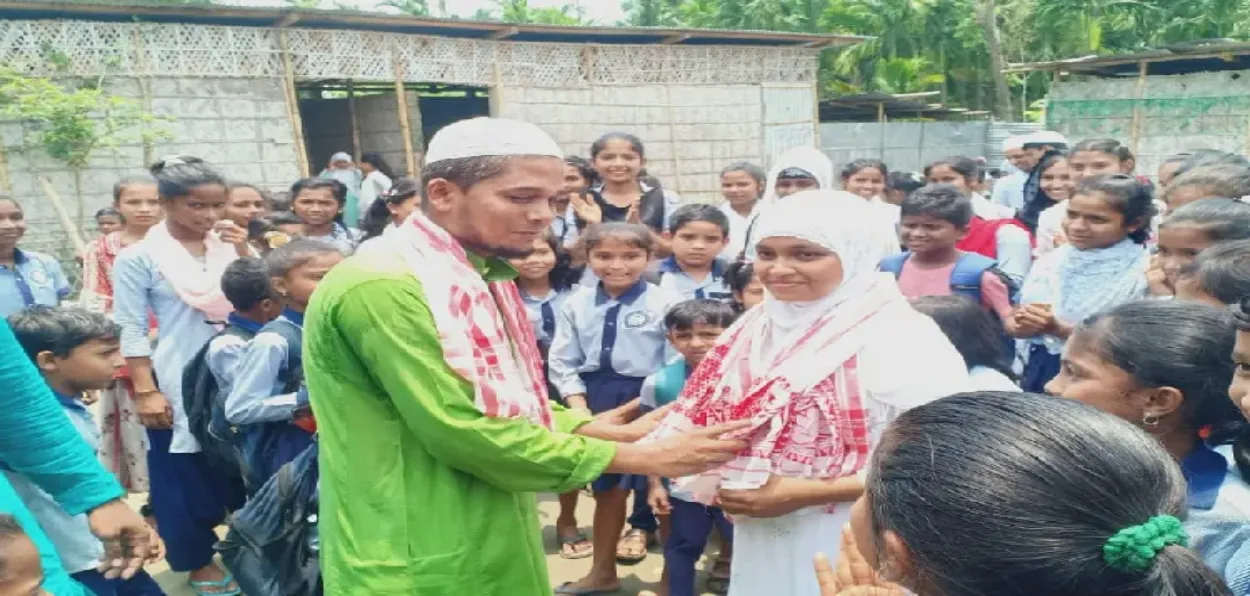
Nargis Sultana being felicitated by her neighbours after her she scored a distinction in her matriculation examinations
The academic success of the daughter of a Maulana in Assam’s Darrang district has revealed the determination of Indian Muslim women to defeat adversities and break stereotypes for giving wings to their dreams.
Nargis Sultana, the daughter of a Maulana who passed the High School Leaving Certificate Examination or Matriculation examination in 2022 with distinction despite facing various challenges, studies for more than 12 hours to fulfill her dream of becoming a doctor.
Nargis is the second daughter of Samsher Ali and Nasira Khatoon, residents of Kachari Bheti in Dalgaon in the Darrang district.
Born in a very backward and remote area, Nargis had to walk 5-6 km daily from her home and cross a river to reach her school for her primary education.
Being the daughter of a Maulana, many residents in her village asked her to learn Islamic textbooks including the Holy Quran instead of going to school for modern education. But Nargis was determined to go to school and her parents backed her.
Maulana Shamsher Ali (Left), the father of Nargis (In white dress) and his family
Nargis Sultana told Awaz-the Voice, “I was a student of Anandaram Barua Academy in Siliguri when I appeared for the Matric examination or Class X final in 2022. Besides my hard work and dedication, I want to give credit to the teachers for my success. After knowing my poor financial background they (teachers) helped me to continue my education.”
Anandaram Barua Academy did not charge any fee and provided free tuition from Nargis for her education from the Class ninth and Tenth.
In the Matric exam 2022 Nargis scored 96 (out of 100 marks) in Social Science, 95 in Mathematics, 92 in Assamese, 90 in Elective Subjects, 90 in English, and 78 in General Science.
Nargis got is studying at Ajmal College in Hojai and pursuing a science stream for her higher secondary examination.
“Many people and teachers have helped me financially to continue my education. They have pinned high hopes on me. So, I cannot disappoint them. I am studying more than 10 hours daily so that I can excel in 12th stands due next year. I want to become a doctor. I will try to become a gynecologist and serve the poor people in rural areas by reducing maternal and infant mortality rates among them,” Nargis said.
Nasira Khatoon while expressing gratitude to the almighty Allah and those who have helped her daughter to continue her education, said she is hopeful that “Nargis will become a successful doctor in the future to serve humanity.”
Hafiza Begum (Left) being felicitated
Similarly, another Muslim girl student from Dalgaon in Darrang district Hafiza Begum has also proved that poverty cannot be an obstacle to academic excellence.
Hafiza, daughter of e-rickshaw driver Habib Ullah, has told Awaz- The Voice that she had passed the Matriculation examination from Adarsh Jatiya Vidyalaya, Dalgaon by securing distinction marks.
Hafiza is determined to become a doctor and later prepare for the Union Civil Service Examination.
source: http://www.awazthevoice.in / Awaz, The Voice / Home> Stories / by Munni Begum, Guwahati / May 05th, 2023
University Women’s Polytechnic Students Shine at National Project Competition, Win First Prize at MITAOE, Pune
Aligarh:
Students from the University Women’s Polytechnic, Aligarh Muslim University (AMU), made a mark at the 8th National Level Poster Presentation and Project Competition, TechnoPHILIA’25, held recently at MIT Academy of Engineering, Pune.
Competing against participants from over 25 institutions across India, the AMU team, “LISA VocalTech,” clinched the first prize in the Diploma Category, along with a cash award for their innovative project titled “LISA: A Voice-Controlled Lift.”
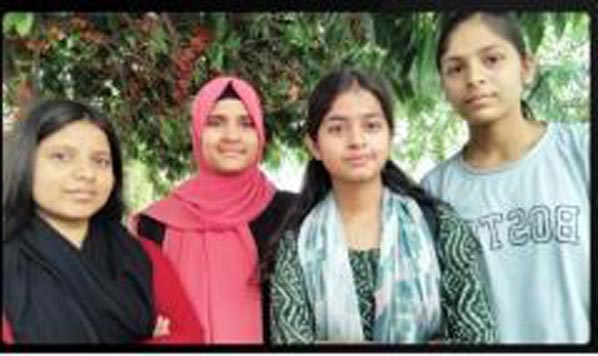
The team comprised final-year Diploma in Electronics and Communication Engineering students – Shalini Kumari, Kashish Khushi, Nargis Khatoon, and Shailly Bhardwaj – who developed the project under the mentorship of Mr. Mohd Kashif. Their creation, a voice-activated lift system, is designed to improve accessibility for the elderly, visually impaired, and physically disabled, earning praise from judges for its practical utility and inventive design.
This achievement highlights AMU’s commitment to academic excellence and its encouragement of student participation in national-level technical events.
source: http://www.radiancenews.com / Radiance News / Home> Education> Focus / by Radiance News Bureau / April 09th, 2025
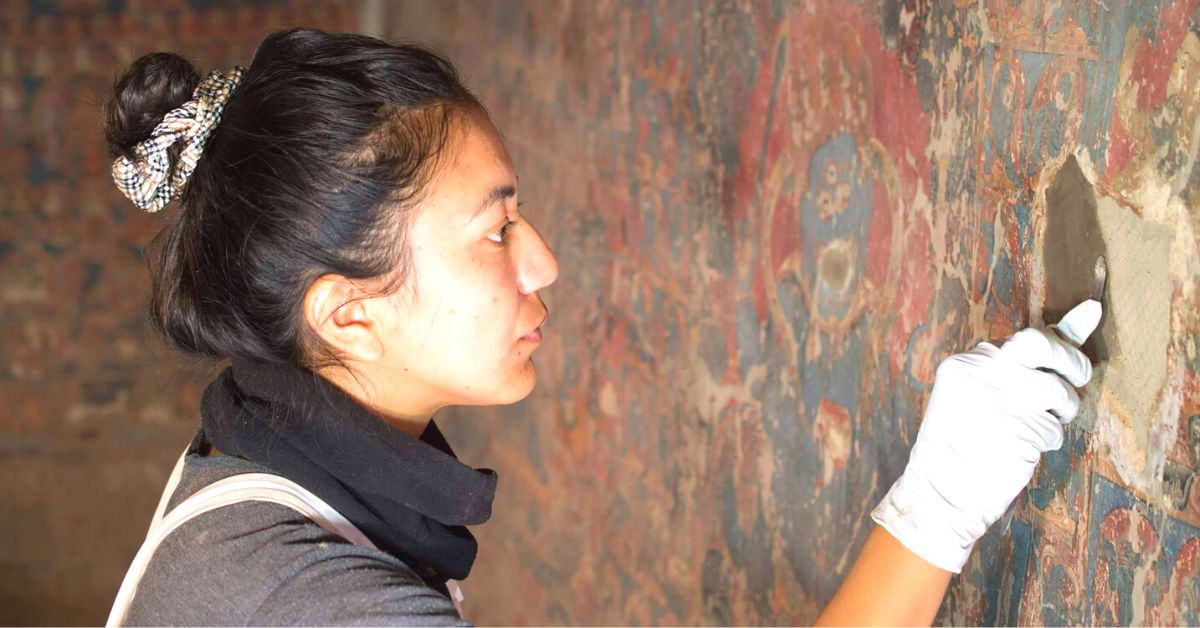
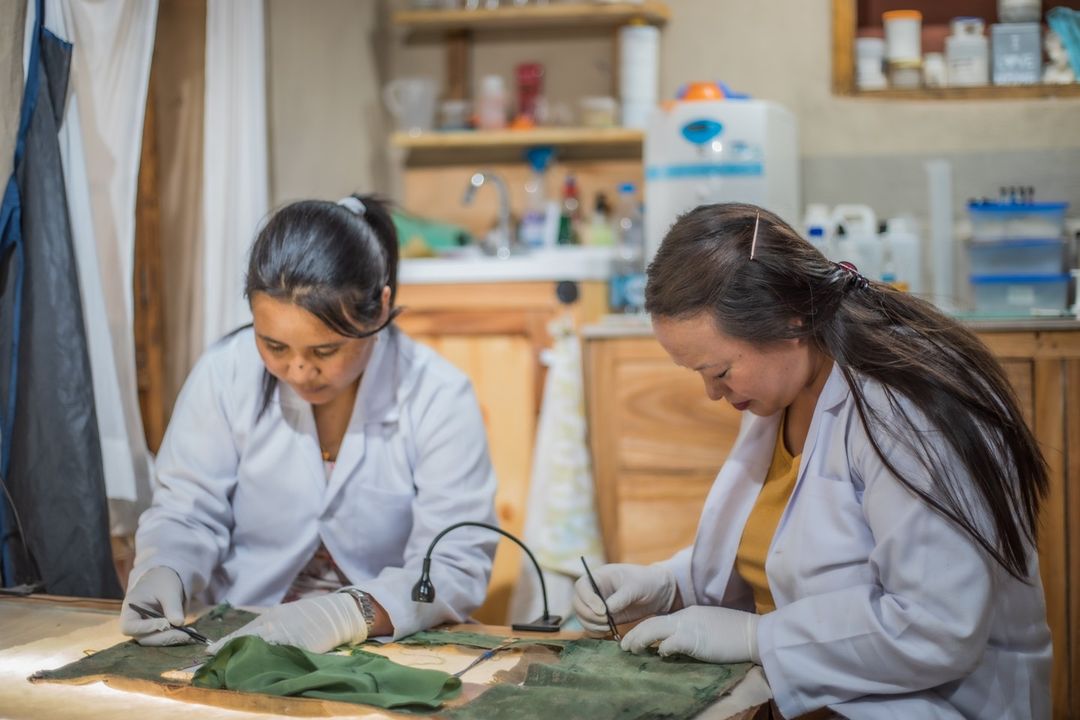
Noor Jahan and her cousin Wajeeda Tabassum co-founded Shesrig Ladakh, an art conservation practice that restores and conserves ancient wall paintings, religious manuscripts, thangka (Buddhist scroll) paintings and metal works.
How do you protect and preserve culture? It’s a question Noor Jahan – a 32-year-old expert in art conservation and heritage management from Leh – has grappled with for a decade.
Through Shesrig (meaning ‘heritage’) Ladakh, an art conservation practice she founded with her cousin Wajeeda Tabassum, Noor performs critical restoration and conservation work on ancient wall paintings, religious manuscripts, thangka (Buddhist scroll) paintings and metal works.
“My real interest lies in working on ancient wall paintings and thangka paintings,” says Noor Jahan in a lengthy conversation with The Better India.
Backed by a Master’s degree from the Delhi Institute of Heritage Research and Management (DIHRM) and a PhD from the National Museum Institute, she has worked on wall paintings dating back to the late 8th century and Buddhist thangkas from the 19th century. Also, since 2019, she has run Shesrig on her own following Wajeeda’s departure for foreign shores.
What’s more, Noor is also the goalkeeper for the Indian women’ ice hockey team. Earlier this year, she helped India finish second in the Union Women’s Ice Hockey Tournament in Dubai. Noor reckons that she has a few more years left before she “officially retires” from the sport.
By all accounts, it’s an extraordinary way of life, and this is her story.
Noor Jahan working on old wall painting in Saspol caves, Ladakh
A serendipitous journey
There was a void in Noor’s life after earning her bachelor’s degree in commerce from Delhi University. Going through the motions, she had no passion for what she was learning. To reflect on what was next and enjoy a short holiday, she left for Leh after graduation in 2011.
It was during a walk through Leh’s crowded old town, when she met a few foreign conservators from the Tibet Heritage Fund working on an old Buddhist temple. Intrigued by what they were doing, Noor engaged in a short chat with them which would change her life.
After returning to Delhi, she began reading up on art conservation and learnt that she could pursue higher studies in this field.
What also sealed the decision to get into this field for Noor were memories from her childhood.
“My mother is from Hunder village in Nubra. Every holiday, we would always visit Nubra to meet my maternal grandparents. The bus would stop at this location called Chamba on the main road from where you had to walk inside the village. This particular route holds great importance in my life now because there are many stupas along the way. Every time I would look up at these pathway stupas, I would see these old paintings. But each passing year, some part of these paintings would disappear. When I applied for this course at DIHRM, the first thing I thought about were these paintings and the conservation work I could do someday,” she recalls.
Allied with a strong desire to come back home, starting this course brought passion back into her life. “Everything I was studying there found a purpose in Ladakh,” she says.
Noor Jahan found purpose in preserving Ladakh’s heritage
Finding Shesrig
Following the first year of her Master’s programme in 2012, Noor and Wajeeda opted to do their internship with the Himalayan Cultural Heritage Foundation (HCHF), a Leh-based non-profit. Helping them find projects to work on was Dr Sonam Wangchok, founder secretary of HCHF.
During this internship, the first major project Noor got involved in was a wall painting at Diskit Gompa, a 14th-century Buddhist monastery in Nubra Valley.
She recalls in an Instagram post, “The internship entailed working on the restoration of wall paintings from the 17th century under the supervision of art conservators from [the] Czech Republic. This was my first hands-on experience where I had the opportunity to conserve sacred Buddhist art and the opportunity to stay at the monastery itself. I think that internship changed my life forever as I not only got to work on the most beautiful wall paintings but gave me the opportunity to meet and interact with the monks at the monastery who took me and Wajeeda in as their own.”
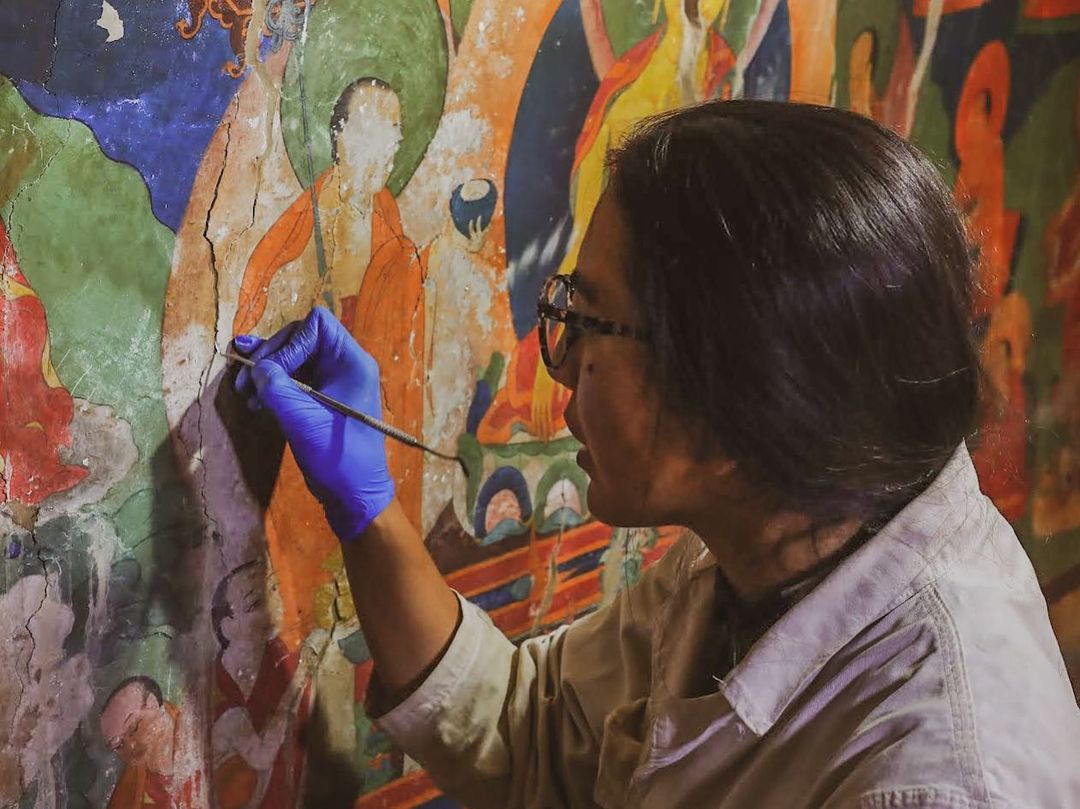
Conserving ancient wall paintings is a delicate process
After completing her Master’s programme in 2013, Noor came back to Leh to work with other organisations like Art Conservation Solutions and Achi Association, amongst others, as a freelancer. In 2014, she worked on her first project outside Ladakh at the Golden Temple in Amritsar with Heritage Preservation Atelier, and also commenced her PhD at the National Museum Institute. Despite these landmark moments, she knew this sort of freelance work wasn’t sustainable.
“Working in these organisations was a great learning experience and helped me to capture some of the finer nuances of conservation. Even today with Shesrig, I collaborate with most of them. But this kind of work wasn’t sustainable, i.e. it was limited to summer months,” she says.
“In the summer, I would work on many projects. But the moment winters came, all these organisations would stop their work in Ladakh. I really wanted to start something of my own in Leh, while working sustainably and throughout the year,” she adds.
Thus, in 2017, Noor and Wajeeda founded Shesrig Ladakh and rented out a historic structure called Choskor House as their base in Leh’s old town, which they had to first restore.
This three-storied structure is located right behind the Jama Masjid (mosque) in the centre of Leh along the hillslope. It belongs to a renowned family of traders, who along with other important families, once led important trade missions to Lhasa from Ladakh.
“Even though Choskor House was really old, we decided to rent it. To restore it, we had initially consulted some architects, but there came a point when it became difficult because of costs and time constraints. That’s when we reached out to Achi Association India, a sister organisation of Achi Association (a Swiss-based organisation), which took over the project of restoring this structure backed by funding from the German Embassy. They helped with establishing the studio in which we currently operate. We started working inside our studio only this year,” says Noor.
“It’s important to see your heritage as an inheritance that has great value,” says Noor Jahan
Conserving ancient wall paintings is a delicate process
Conserving wall paintings
Conservation and restoration are different acts. Noor explains, “In conservation, people do not recreate anything new. So, if there are losses in a given wall painting, there is no recreation but only stabilisation. Restoration, meanwhile, seeks to recreate some of those losses.”
Some of the fundamental challenges in conserving or restoring old artworks include physical access to remote sites and obtaining the necessary materials that they largely import.
Noor gives us an example of a project they worked on in collaboration with the Himalayan Cultural Heritage Foundation in June 2020 to illustrate her point. The site was Chomo Phu, a small one-room Buddhist shrine near Diskit Monastery, Nubra.
“It’s quite a steep hike up from Diskit Monastery, and there is a gorge inside the valley where this shrine is located. There was no place for accommodation. Instead, we pitched tents next to the shrine and had to improvise basic facilities. We camped in that valley for about 25 days since it was not practical or possible for us to hike from there to the monastery or the village every day,” she recalls.
Before, during and after the project, Noor and her team do extensive documentation work. During this phase, they closely examine the kind of deterioration the wall painting has undergone.
In this particular case, there were a lot of over-filling and historical fills done in the past. These fills were done in such a way that it was obscuring a lot of the original painting and sometimes even overlapping it. They had to carefully remove those historic fills.
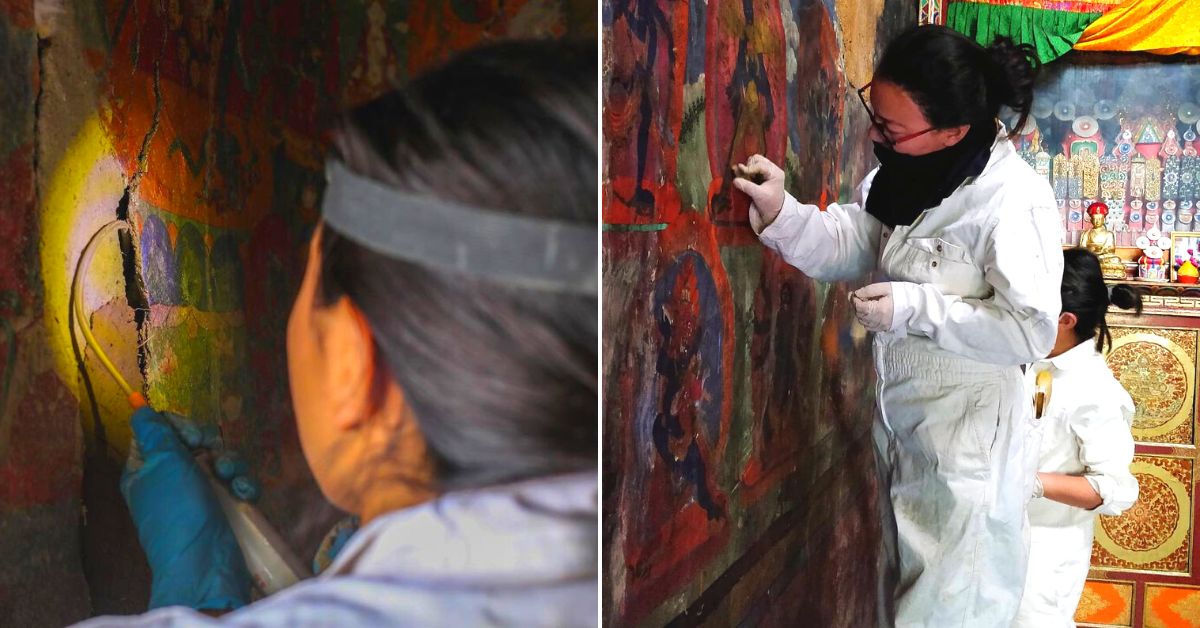
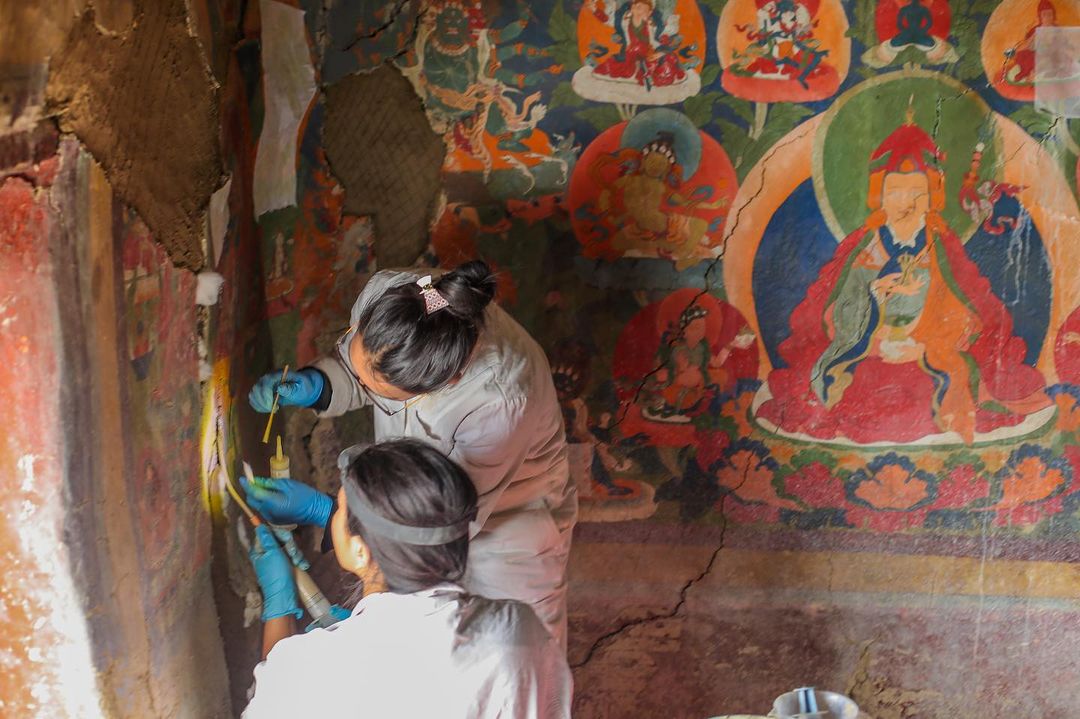
“Another issue with wall paintings is that there are a lot of detachments. In the event of any structural movement or water seepage, the plaster gets detached from the support, thus creating these hollow areas inside the painting. You can discover these hollow areas through a percussion test (a method for the structural inspection of wall paintings). We then perform grouting, i.e. fill the gaps between the painting and the support structure,” she notes.
Apart from these, there are cases where the paint layer gets delaminated. To address this, they use a consolidant and then stick the paint layer back to the surface.
“Of course, there is cleaning work which is done. The paintings are largely glue-bound tempera (also called secco, which are paintings on dry surfaces). In this kind of technique, the pigment is usually mixed with the binder and then applied to the walls. With water infiltration, the binder becomes weak causing delamination of the paint layer,” explains Noor.
“This damage primarily occurs because of water. We make sure not to perform any wet cleaning, i.e. don’t use any solvents to clean the wall painting. We only employ dry cleaning. There are various types of conservation-grade sponges which we work with and soft brushes to remove the dust or any mud infestations,” she adds.
A major point of contention with wall paintings is retouching work (reworking small areas of a painting to cover damage or to mask unwanted features).
Without getting too deep into the subject, when it comes to wall painting conservation work, Noor and her team largely stick to what she calls “conservation or stabilisation work”.
“It’s important to see your heritage as an inheritance that has great value,” says Noor Jahan
Restoring old thangkas
This year most of the thangkas that were brought in for restoration at Shesrig’s studio came from private households. Each thangka arrives in a different condition.
In thangka paintings, you have a textile-based canvas made of cotton fabric or any other material used by the artist in the centre. These thangkas also usually have either silk or brocade borders. Most thangkas they got into their studio this year had silk borders.
Step 1: “Since the thangka has come directly from the chod-khang (prayer room) to our studio, we first take it to a nearby monastery, where a de-consecration ceremony is done,” she says.
Step 2: The next step is to bring the thangka back to the studio, perform extensive documentation work including photographic documentation and understand what kind of problems are visible. Accordingly, they prepare a treatment plan.
Step 3: Usually the centrepiece of the thangka is stitched with a textile border. They separate both elements because the fabric at the border is completely different from the canvas in the centre. Following separation, they work on the border and centre piece canvas separately.
Step 4: Once the separation is done, the first step is cleaning the soot. “In thangkas, there are times (only when required), when we go for mild solvent cleaning but once again dry cleaning methods are preferred. Also, solvents can sometimes be harsh. We have started preparing gels which are much milder and do not adhere to the surface for the cleaning process,” she says.
Step 5: What if there are big losses or tears on the thangka painting? “We make a similar kind of ras-jee (the local term used for the textile canvas of a Thangka painting) in the studio. We use pieces of that ras-jeeto mend the tears. Otherwise, in thangkas, we also see a lot of cracks. To fill the cracks, we use the markalak (local clay mixed with mild adhesive) to fill those cracks because that’s part of the original technique of preparing a thangka. We follow the same methods while restoring it as well,” she explains.
Step 6: Once this is done, if there is any consolidation work required or a paint layer is coming off, they fix those problems. Sometimes, they mend the tears fibre by fibre, which requires very delicate hands. Also, if there are any small losses or paint losses, they do subtle retouching work using natural colours or the colours originally used on the thangka.
Conservation of Thangsham (the local term used for the textile border of a Thangka painting)
Step 7: Meanwhile, there is another team which is working on the textile border known as thangsham locally. There is a particular method of washing the textile using conservation-grade detergents.
“We don’t dip it straight into the water. Instead, we use wet sponges to clean it very meticulously. Sometimes these borders are also torn or otherwise in a bad condition, for which we mend them using patchwork with silk, brocade or whatever material was originally used. We have a stock of raw silk, which is white. We dye it as per the thangka’s requirements. If the thangsham, for example, is blue, we will dye the silk blue and do the patchwork from the inside. We perform the process of dyeing ourselves at the studio,” she explains.
Step 8: Once both elements are ready, they stitch the centrepiece canvas and the border back together, following which a consecration ceremony is done and then returned to the client.
Once again, depending on the state in which the thangka is sent, it takes anywhere between a fortnight to two months or more to restore a thangka. It also depends on manpower.
“Most of the time, we work in groups of two or three women on one thangka, and depending on the scale of the task, it takes about a month or two if the damage is extensive,” she says.
Given that most of the conservation work she does with Shesrig Ladakh relates to Buddhist heritage, questions have emanated from either side of the religious divide.
But is her faith an obstacle in this line of work?
“Most of the time, they don’t see my Muslim faith as an obstacle to the work that I do. For the most part, I’m not treated as an outsider or not from the community. In fact, it has been the opposite, where I am given more respect and love, especially in monasteries,” she says.
However, recently she heard someone say, ‘What is this Muslim girl doing here?’ “Look, this is how the world around us is moving. As Muslims in India, we know what’s going on. But I do not take these comments personally because I have to do what I know how to do,” she says.
Noor Jahan: “I have to do what I know how to do”
But such ad-hominem comments don’t necessarily come from the Buddhist community. She even notes how members of her religious community pass judgement on her line of work.
“Sometimes, people from the community approach my family to complain about my work, but fortunately they have been very understanding,” she notes.
Another struggle Noor deals with is the significant lack of awareness in Ladakh about art and heritage conservation as a field. “Even though they support me, my parents and some friends still don’t understand the kind of work I do. They still think this is a ‘hobby’ to me and don’t take me seriously. Even though the conversation in Ladakh about restoration and conservation has progressed a little, there are still people who think that this work can be done for free. This is something, I hope, changes with time as the conversation around this subject grows,” she says.
Remarkable achievements highlight talent and determination in Bihar’s intermediate results.
New Delhi :
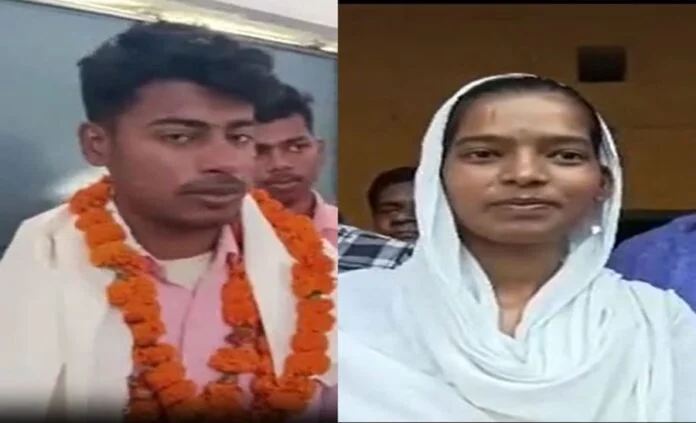
The Bihar School Examination Board (BSEB) on Tuesday revealed the 2025 Class 12 exam results, and this year, two Muslim students from modest backgrounds have made headlines by securing the first and second positions. Shakib Shah from Buxar district and Rukaiya Fatima from Begusarai have not only made their families proud but also demonstrated the power of hard work and ambition in overcoming challenges.
Shakib Shah, a student at Plus Two High School Koransarai in Buxar, achieved an impressive 473 out of 500 marks, securing the top position in the Arts stream. His 94.6% score has ignited celebrations in his village, with locals and teachers praising him as a source of inspiration. “I studied hard every day, and my teachers supported me throughout. My dream is to crack the Bihar Public Service Commission (BPSC) exam and serve as an administrative officer,” Shakib told Zee Media, his determination evident in his words.
Following the announcement of his results, Shakib received a flood of congratulations at his home in Koransarai. Teachers from his school, along with the District Education Officer, visited the school to honour their star student. “Shakib has always been a focused student. His success is a testament to his hard work and the guidance he received here,” said one of his teachers, beaming with pride.
Meanwhile, Rukaiya Fatima, a student at BN High School Teyai in Begusarai’s Teghra subdivision, earned the second position with 471 marks, achieving 94.2% marks. The daughter of Mohammad Abu Salem, a bidi trader from Kolkata, Rukaiya comes from a family of seven sisters, where she is the third child. Despite her father’s modest income and the challenges of supporting a large family, Rukaiya’s resolve to excel never wavered. “I want to become an IAS officer and work for the poor. Education is my way to change my family’s future,” she shared with local reporters.
Rukaiya’s success has brought joy to her community in Begusarai. Her school principal described her as a diligent and bright student who balanced her studies with household responsibilities. “She would often stay back after classes to clear her doubts. Her success shows what girls can achieve with determination,” the principal remarked.
The Bihar Board 12th exams, held between 1 and 15 February 2025, saw over 12.92 lakh students appear across 1,677 centres in the state. This year’s results reflect an overall pass percentage of 86.50%, with the Arts stream recording 82.75%. Shakib and Rukaiya’s stellar performances stand out, not only for their academic brilliance but also for their powerful message of resilience and hope.
For Shakib, topping the state is just the beginning. Growing up in a simple family in Koransarai, he credits his family’s encouragement and his own disciplined routine. “My parents never let me feel any pressure. They just told me to do my best,” he said. His ambition to join the administrative services stems from a desire to uplift his community and tackle local issues like education and employment.
Rukaiya’s journey is equally inspiring. Despite growing up in a family with limited resources, she often studied by candlelight during power cuts. Her father, Mohammad Abu Salem, expressed his pride over the phone from Kolkata: “I always knew Rukaiya was special. She has made us all proud, and I hope she achieves her dream of becoming an IAS officer.” Rukaiya’s six sisters also look up to her, with the youngest saying, “I want to study hard like Rukaiya Apa.”
The success of these two students has also highlighted the untapped potential within Bihar’s Muslim community, which often faces socio-economic challenges. Local leaders and educators have hailed their achievements as a beacon of hope. “Shakib and Rukaiya have shown that talent knows no boundaries. Their success will inspire countless others,” said a senior official from the BSEB during the result announcement press conference in Patna.
However, their triumphs stand in contrast to the broader narrative in Bihar, where tensions between communities have occasionally erupted. Critics have often pointed to the state’s history of communal friction, exacerbated by divisive politics and economic disparities. Some have accused Hindu groups of marginalising minority achievements in educational settings. Yet, Shakib and Rukaiya’s success challenges these narratives, proving that merit and perseverance can overcome prejudice.
To celebrate their achievements, the BSEB has announced cash prizes and scholarships for the toppers, with Shakib set to receive £2 lakh and Rukaiya £1.5 lakh, along with laptops to support their future academic pursuits. These rewards, doubled from last year, reflect the state’s commitment to nurturing talent. “We are proud of all our students, and these two have set an exceptional standard,” said BSEB Chairman Anand Kishore.
As Bihar celebrates its top achievers, the stories of Shakib Shah and Rukaiya Fatima resonate beyond their exam results. Their journeys embody the dreams of millions in a state where opportunities are scarce, and their success serves as a shining example of the transformative power of education. For now, the spotlight remains on these remarkable individuals, whose stories are only beginning to unfold.
source: http://www.clarionindia.net / Clarion India / Home> Editor’s Pick> Indian Muslim / by Mohammad Bin Ismail, Clarion India / March 26th, 2025
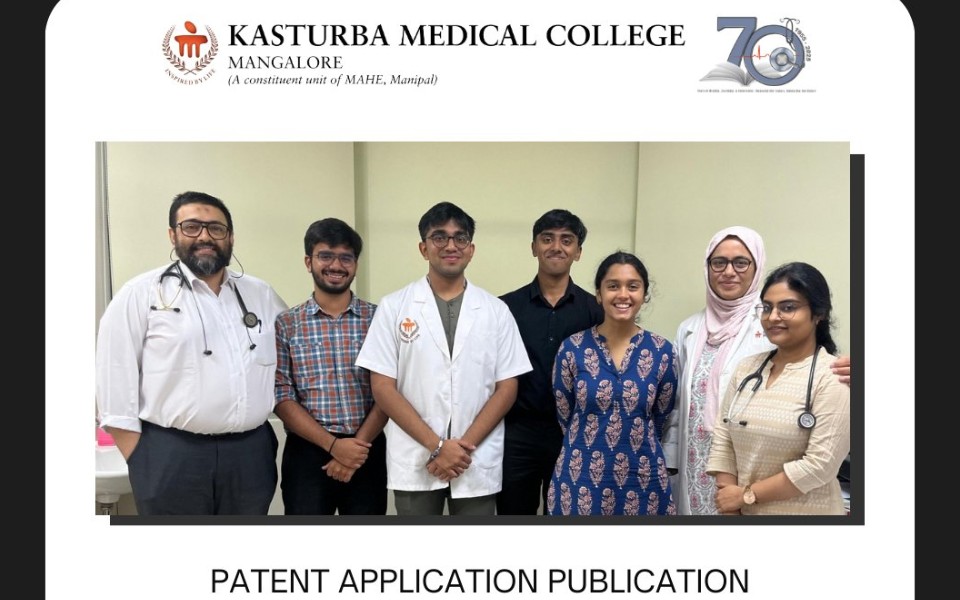
Developed by KMC Mangalore team led by Dr. Haroon, Dr. Sameena, Dr. Chiranjith
Mangalore:
A patent application for a groundbreaking medical device, Device for Monitoring Gynaecological Disorders, has been officially published, marking a significant achievement for the team of doctors and student inventors from Kasturba Medical College (KMC) Mangalore.
The device is designed to enhance early detection and diagnosis of gynaecological disorders. It incorporates a flexible probe, a rotational brush for effective sampling, and an enzyme-coated detection system, improving precision and efficiency in clinical examinations.
The innovation is credited to Dr. Haroon H, Dr. Sameena H, and Dr. Chiranjit Ghosh from MIT, along with student inventors Krisha Janaswamy, Shashank Sanjay, Adithya Harikrishnan Namboothiri, and Shubham Bhusari.
The official Twitter handle of KMC Mangalore also recognized the accomplishment, congratulating the team for their work in medical innovation.
Dr. Haroon is son of M. Hussain and late Akhila Begum from Arehalli village in Hassan while Dr. Sameena Haroon is daughter of KA Sadiq and Maimoona.
Chandanpatti Village (Darbhanga District) BIHAR / Hyderabad, TELANGANA :
Hyderabad:
Here is an amazing story of a single mother and her only child who brought tears of joy to her eyes by securing the first rank in the UGC-NET JRF examination.
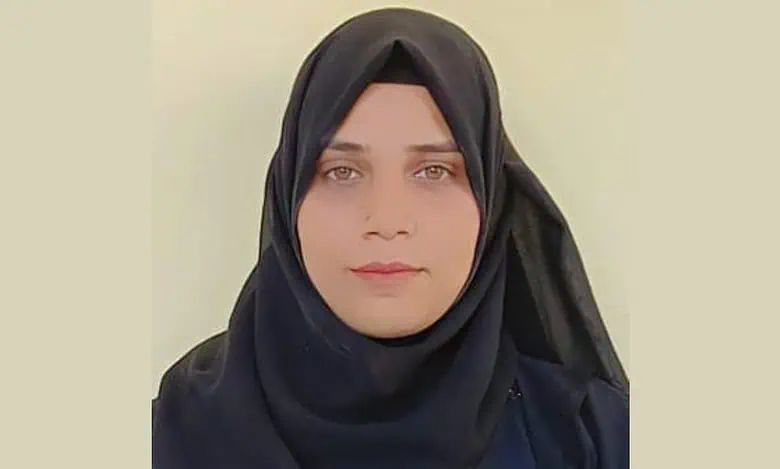
Anam Zafar, 25, secured the 100 percentile in the examination. Her mother, Rehana Khatoon, lives in Chandanpatti village, Darbhanga district in Bihar. When Rehana Khatoon heard about the feat achieved by her daughter she could not stop tears flowing down her cheeks.
Anam Zafar is in the last leg of her M Ed fourth semester at Maulana Azad National Urdu University.
The Department of Education and Training felicitated Anam Zafar at a special event organised on Wednesday, two days after the news broke out. Faculty members, students, and university officials gathered to celebrate her exceptional accomplishment.
During the ceremony, the faculty members praised Anam Zafar’s dedication, perseverance, and commitment to excellence. Her achievement was highlighted as a role model for aspiring researchers.
Prof Shaheen A Shaik, Head of the Department, commended her hard work and stated, “Anam Zafar’s achievement is a testament to the high academic standards and research culture at MANUU. Her success will inspire many students to aim for excellence.”
Alongside Zafar, the department also felicitated other students who successfully qualified for UGC-NET and JRF. Their accomplishments were celebrated as a collective success of the university’s academic environment and the faculty’s dedicated mentorship.
Anam’s mother was divorced by her husband when the girl was only eight years old. Working as a teacher at a private school for Rs 800 a month, Rehana Khatoon enrolled her child in a school that worked under the Central Board of Education.
According to sources at MANUU, except for Anam’s uncle (her father’s brother), no one checked on her condition during her difficult years. Treading a difficult social and economic path her mother enrolled her in B Ed at the Centre for Teachers’ Education of MANUU in Darbhanga. Her obvious next step was joining M Ed of the University at Hyderabad.
In the meantime, she was married to Johar Ali, a technocrat working with a private firm in Hyderabad. The couple lives in the Lingampally area, close to the MANUU campus.
Anam says she could not have trodden the difficult road so far if her mother had not encouraged her at every step. “Now my husband has joined my mother and wishes me to complete PhD,” she said.
Anam, as a research fellow is expected to get about Rs 45,000 per month.
She expressed gratitude to her mother, mentors, faculty members, and family for their continuous support and encouragement and credited the university’s academic environment and guidance from her professors as key factors behind her success.
source: http://www.siasat.com / The Siasat Daily / Home> News> Hyderabad / by Mir Ayoob Ali Khan / February 26th, 2025
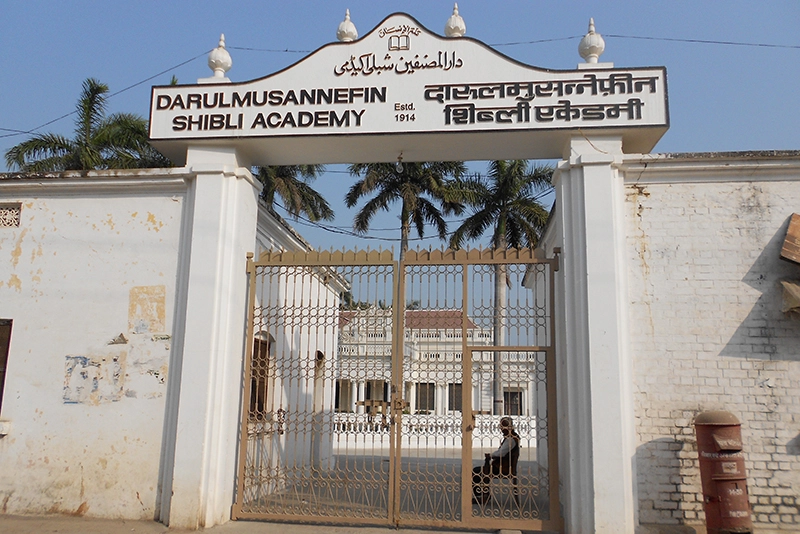
Darul Musannefin, an institute established to propagate the rich cultural heritage of Urdu, Arabic and Persian texts through the institute’s publications and magazine, was established in 1914 by Maulana Shibli Nomani
Darul Musannefin, an institute established to propagate the rich cultural heritage of Urdu, Arabic and Persian texts through the institute’s publications and magazine, was established in 1914 by Maulana Shibli Nomani.
However, over the years like many other institutes associated with the Muslim community in India, this institute has fallen on bad days courtesy the apathy of the governments and the community’s disinterest with anything associated with its cultural and academic heritage.
When we talk about the rich heritage of Urdu books, then every Urdu lover bemoans that the government is not doing enough for saving and promoting the Urdu language – a language which binds at least 70% of Indians, socially and literally.
Yet, few of us ponders that what the Urdu lovers themselves are doing for saving and promoting the language. Their concern becomes abundantly clear by the everyday decreasing sales of Urdu books and newspapers. Further, what they are doing to save institutions which have been the flagbearers in propagating and saving the language by publishing books on different topics in Urdu. The answer is pretty obvious: nothing concrete except bemoaning and using hollow words.
One such institution is Darul Musannefin or Shibli Academy, just like the Rampur raza library of Rampur or the Khuda Baksh Library of Patna, in addition to a vast repertoire of books in private collections of individuals and organisations throughout India.
Darul Musannefin or Shibli Academy is a research academy based in Azamgarh, Uttar Pradesh. Its aim was to add authentic historical literature in Urdu so that people could have easy access to history. It was started as Darul Musannefin but later it was named after its founder Shibli Nomani.
Maulana Shibli Nomani, a Sunni Muslim scholar established it in Azamgarh in February 1914; after failing to establish the Academy in Lucknow, it was established in Azamgarh at Nomani’s mango orchard. It started working on 21 November 1914, 3 days after Maulana Nomani’s death under the guidance of Maulana Hamiduddin Farahi. Other founders included Maulana Syed Sulaiman Nadvi, Maulana Abdus Salam Nadvi and Maulana Masood Ali Nadvi.
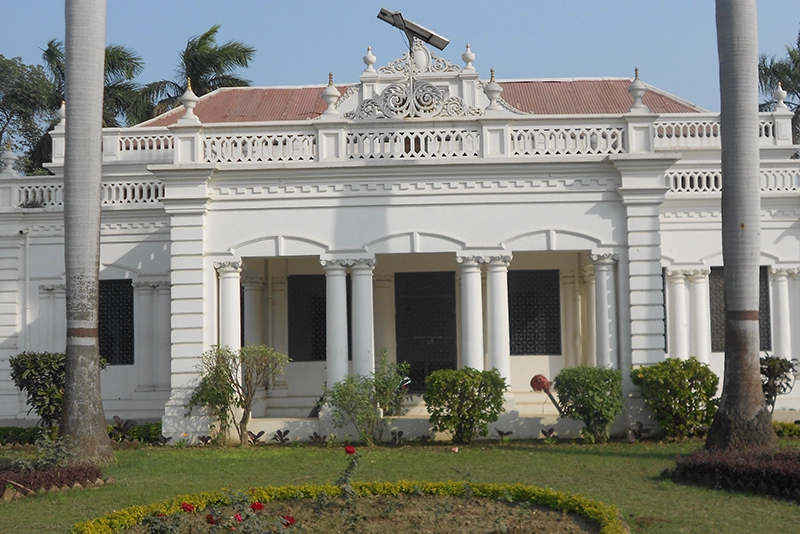
Established just three days after Shibli’s death in 1914, the Academy is a leading institution of Oriental, Islamic and Mediaeval Indian Studies, and Azamgarh’s pride. It occupies nine acres donated by Shibli and his relatives. The centrepiece is a beautiful whitewashed building housing a massive library of over 1.5 lakh books and around 700 manuscripts, some of them rare, and an office.
Staff residences, the mosque and a conference hall stand apart.
Shibli Academy: A Treasure Trove
The Academy’s library is a treasure trove. Its spacious central hall is furnished with sofas and chairs, which have been graced by personalities ranging from Mahatma Gandhi, to Jawahar Lal Nehru, Indira Gandi or in other words virtually every Indian Prime Minister and President, except the present dispensation, and scores of other Indian and foreign dignitaries. “Here have sat dozens of famous dignitaries,” Academy’s senior fellow Mohammed Umair Siddique Nadvi, told me on my recent visit to the acclaimed institute.
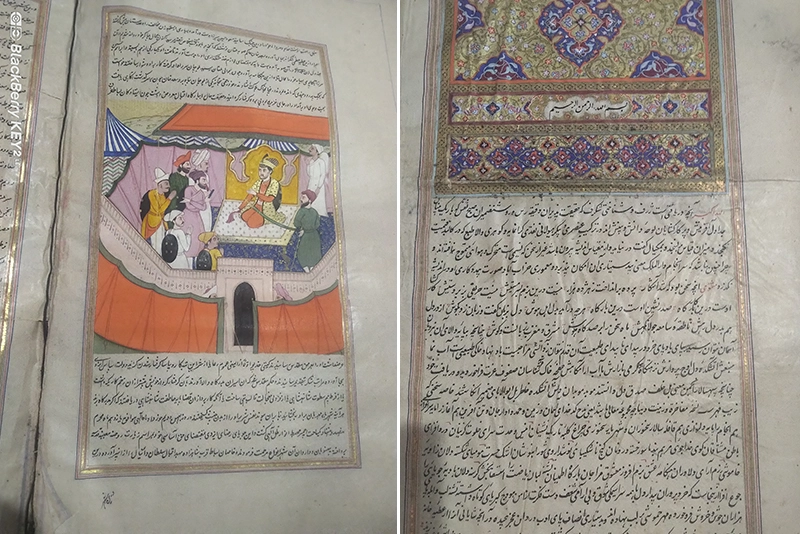
Mohammed Umair showed me rare books and manuscripts, including Persian translations of Ramayan and Mahabharata, and Sirr-e-Akbar, Persian translation of the Upanishads by Mughal prince Dara Shikoh, a great scholar. The excellent condition in which most of these rare books have been preserved over the years shows the dedication of the institution’s staff despite meagre resources. The gold embossed titles and pages decorated with gold border still retain their sheen.
[Akbar Nama (L) and Monsiual Arwah]
Another gem is Monisul Arwah, a book on Sufi saint Khwaja Moinuddin Chishti by Dara’s sister Jahanara. “This is our most prized possession which Maulana Shibli found at an old bookshop in Lucknow and bought for Rs 100 in 1906. It was very dear to him and travelled to an international exhibition of rare manuscripts in Paris,” says Nadvi.
There’s a section where testimonies of some famous visitors, including Mahatma Gandhi, Madan Mohan Malaviya and Maulana Azad, are kept. Motilal Nehru and Jawaharlal Nehru, stayed at the Academy several times during their visits to Azamgarh. When Gandhi first visited it in the 1920s, the Academy’s founding secretary, Maulana Syed Sulaiman Nadvi, showed him the library by lantern light since electricity supply was erratic.
Another famous visitor was Bi Amma, mother of Muhammad Ali Jauhar and Shaukat Ali, freedom fighters and Khilafat Movement leaders better known as the Ali brothers. But while the Academy is Azamgarh’s pride, it faces a severe financial crunch. It has only one librarian, 48-year-old Saleem Javed, son of the Academy’s former director Maulana Ziauddin Islahi, to look after the vast collection.
“I do whatever I can, but it is not possible for one person to look after so many books. I opened my eyes on this campus and have been working here for around 25 years, and will continue to do so.” says Javed, apparently resigned to his and the institute’s fate.
The funding crunch prevents the management from hiring more staff and expediting translation and digitisation of titles from Arabic, Persian and Urdu into other Indian languages and English.
Future of Darul Musannefin
The Academy’s primary purpose is to protect and propagate the scientific, authentic history and rational interpretations of Islam. It also upholds Hindu-Muslim harmony, or the much talked about Ganga-Jamuni Tehzeeb, and sheds light on the life and times of Maulana Shibli, yet so far no one has come forward to help the institute and its committed staff to restore the institute to its former glory. Before Independence, it received grants from Nizam of Hyderabad, Nawab of Bhopal, and others. But now that those streams have dried up, many say the cash-starved institution should look beyond its four walls.
Maulana Shibli had donated his own land with a mango orchard and persuaded close relatives to donate parcels of their land for Darul Musannefin, the library, printing press and publication of Maarif, the monthly journal founded in July 1916.
Since Urdu is shrinking, the library’s patrons have dwindled over the years.Today, it would help if more people started subscribing to Maarif for Rs 10,000 as a life member or even if subscribing to the same for Rs 400 or Rs 1800 towards annual or five years subscription, as a corpus of Rs 10 crore can bail out the institution and help implement its future development plans. In this regard any of the big business houses can also help, as part of their CSR responsibility.
(The writer, Asad Mirza, is a New Delhi-based senior commentator on national, international, defence and strategic affairs, environmental issues, an interfaith practitioner, and a media consultant.)
source: http://www.ummid.com / Ummid.com / Home> Special Report / by Asad Mirza / February 25th, 2025
Heart Lamp is one among the 13 books chosen by the 2025 International Booker Prize judging panel, headed by Max Porter.
Banu Mushtaq. File | Photo Credit: The Hindu
“It is an honour for Kannada that a work written in our language is getting this recognition,” said Hassan-based Kannada writer, advocate and activist Banu Mushtaq, whose collection of stories Heart Lamp, translated by Deepa Bhasthi, has found a place in the long list for the International Booker Prize 2025.
Heart Lamp is one among the 13 books chosen by the 2025 judging panel, headed by Max Porter. The judges made their selection from 154 books submitted by publishers. The shortlist of books will be announced on April 8 and the winner will be announced on May 20.
Heart Lamp, is a collection of 11 short stories written by Banu Mushtaq between 1990 and 2023. “So far I have brought out six collections of short stories in Kannada. Among them, 11 were chosen for the collection Heart Lamp,” said Ms. Mushtaq.
What judges said
The judge panel, in its comment on the collection, stated, “Written in a style at once witty, vivid, colloquial, moving and excoriating, it’s in her characters – the sparky children, the audacious grandmothers, the buffoonish maulvis and thug brothers, the off-hapless husbands, and the mothers above all, surviving their feelings at great cost – that Musthaq emerges as an astonishing writer and observer of human nature, building disconcerting emotional heights out of a rich spoken style.”
Earlier, an English translation of a collection of her short stories Haseena and Other Stories won English PEN translation award for the year 2024. That was also translated by Deepa Bhasthi.
Early years
Ms. Mushtaq began writing in the progressive literary movement in Karnataka in the 1970s and 1980s, which gave voice to several people from dalit and minority communities, including strong women’s voices in Ms. Mushtaq.
Some of her early writings were published in Lankesh Patrike, for whom she also worked as a correspondent for some years. The writer remains a committed voice in the progressive circles, and remained critical of forces that divide people among lines of caste, class, gender and religion.
Among her important works are Hejje Moodida Haadi, Benki-Male, Edeya Hanate, Badavara Magalu Hennalla (short stories), Kubra (novel) Odde Kannina Baagina (poetry), Ibbaniya Kaavu (essays) and Kautumbika Daurjanya Kayide (on Domestic Violence Act). Haseena has also been made into a film, directed by Girish Kasaravalli.
The late Kannada writer and Jnanpith awardee U.R. Ananthamurthy was also nominated for Man Booker International Prize in 2013, but did not win it.
source: http://www.thehindu.com / The Hindu / Home> Books> Author / by The Hindu Bureau / February 26th, 2025