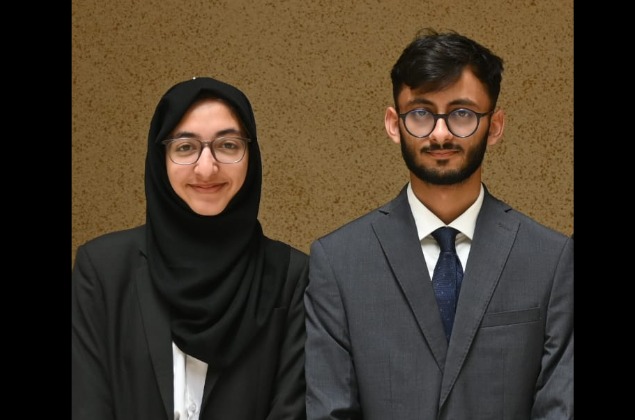
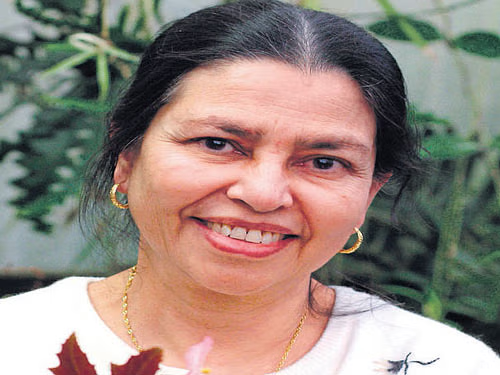
Zainab-ul-Kubra (3rd year), and Intizar-ul-Islam (4th year), Prize winners from NUSRL
Ranchi:
Students of National University of Study and Research in Law (NUSRL), have secured first place in the International Arbitral Award Writing Competition. Two university students, Intizar-ul-Islam (4th year) and Zainab-ul-Kubra (3rd year), achieved the top honour in the 5th Surana & Surana RGNUL International Arbitral Award Writing Competition 2024.
This is a significant achievement for the university, as the duo won this accolade by outperforming participants from some of the most renowned universities in India and abroad. The competition was organised by Center for Alternative Dispute Resolution (CADR) at Rajiv Gandhi National University of Law (RGNUL), Punjab, in collaboration with Surana & Surana International Attorneys.
Participants were tasked with drafting an arbitral award based on a hypothetical legal problem.
More than 72 contestants took part, including students pursuing BA-LLB, LLM, PhD, MPhil, or other law-related courses. The competition deadline was October 30, 2024, and the results were announced in January.
Based on their exceptional skills, Intizar and Zainab not only secured the first position but also received a cash prize of ₹25,000 for their victory. Their success highlights their dedication and expertise in the field of law. The competition served as an excellent platform for students to showcase their legal writing abilities.
The Vice-Chancellor of the university, Professor Dr. Ashok R. Pal, congratulated Intizar and Zainab on their achievement.
source: http://www.radiancenews.com / Radiance News / Home> Pride of the Nation> Awards> Latest News / by Radiance News Bureau / January 21st, 2025
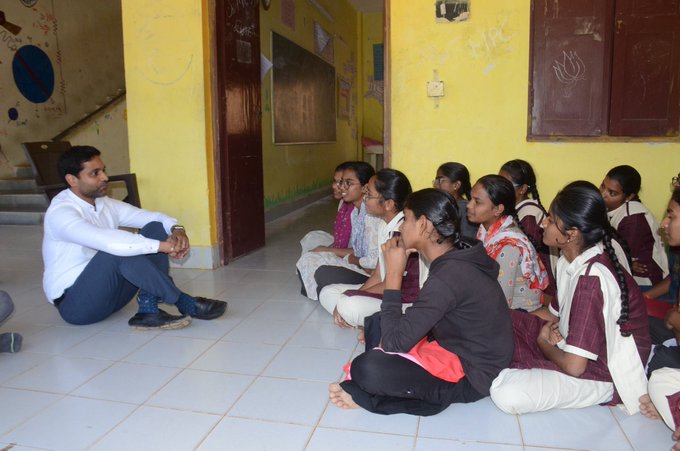
Khammam district Collector Muzammil Khan stepped beyond formalities to sit down on the floor with students to interact with them during his inspection of Dr. B.R. Ambedkar Centenary Social Welfare Residential Girls’ Junior College.
The Collector’s gesture created an open and approachable atmosphere. The interaction was marked by genuine curiosity and encouragement as Muzammil Khan listened to their aspirations and challenges.
This simple yet heartfelt gesture bridged the gap between authority and youth, inspiring the students to share their thoughts with confidence. The Collector advised students to utilise educational opportunities to achieve great heights.
The Collector reviewed online coaching for IIT and JEE and emphasised providing expert career guidance. He discussed improving facilities, addressing issues like insufficient toilets and kitchen leaks and suggested setting up gym equipment and planting greenery as batch markers. He encouraged students to focus on their goals, support others after achieving success, and maintain good health. The visit concluded with the Collector and officials joining students for lunch.
Muzammil Khan, an IAS officer of 2017 batch, is son of Abdul Khayyum Khan, retired Indian Police Service (IPS) officer, who served as Director General of Anti-Corruption Bureau (ACB).
Muzammil Khan had secured 22nd rank at all India level and top rank in Telangana in UPSC exam.
After retirement Abdul Khayyum Khan had also served as the advisor to the state government during BRS rule.
Muzammil’s grandfather Abdul Kareem Khan was also an IAS officer.
source: http://www.radiancenews.com / Radiance News / Home> Latest News> Report / by Radiance News Bureau / January 21st, 2025
Farooq Ganai’s approach to recycling food waste is benefitting him and the community too. Fayaz Wani highlights Ganai’s eco-friendly entrepreneurship.
Jammu & Kashmir :
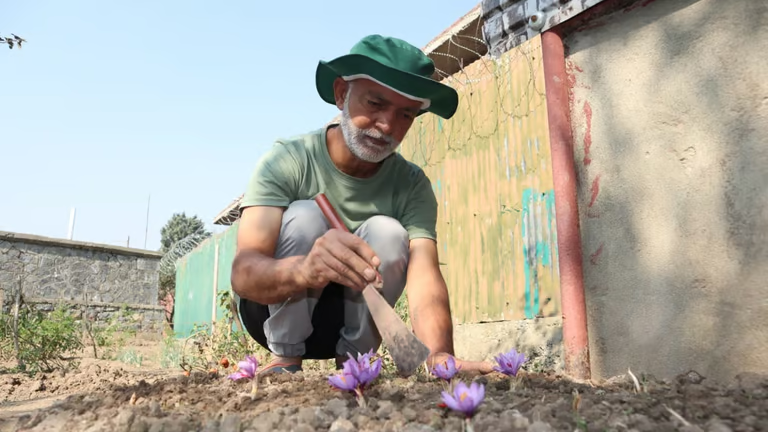
A lawyer by profession and a former sarpanch Farooq Ahmed Ganai, who is also known as a ‘garbage man’, has successfully grown saffron by using compost made from vegetable scraps generated at his home.
His actions have a message that not only can discarded waste contribute to a cleaner and greener environment but it can bring wealth as well.
He is leading a “quiet revolution” of turning waste into wealth and now, wants to educate people about the incredible potential of managing waste.
“I had started the initiative ‘give me garbage, I give you gold coins’ in my village (Sadiwara in Anantnag district) when I was sarpanch of the hamlet. The motive behind the initiative was to attract people and inform them as to how worthy the waste is,” Farooq told The Morning Standard.
Now, with this latest effort, he has been stressing behavioural changes – segregating waste at source, i.e. dividing waste into multiple categories but mainly organic (food waste) and recyclable (plastic, paper etc.)
“From the last year, I have been working on it. People usually throw the domestic waste in rivers and nallahs, and it leads to choking of drains and unhealthy living conditions during the rainy season,” Farooq said.
“I segregate whatever waste is generated in my home. The onion, potato, banana and orange peels, and egg shells; whatever has to be discarded in the form of domestic waste, I segregate it from non-organic waste,” he said.
The primary objective of this, he said, is to promote source segregation of waste at the household level and use the food waste for composting. Now, this effort has led to the successful cultivation of saffron in his garden.
Saffron, known as red gold, is traditionally grown in Pampore and adjoining areas in south Kashmir’s Pulwama district. It requires specific climatic conditions, and its cultivation has remained confined to some areas of the district.
Recalling how he got the idea of growing saffron in his village, Farooq said when he had to say “no” to a friend who had asked him if saffron is grown in his village.
“It pinched me and also motivated me to grow saffron,” he said. “I got some saffron corn from a farmer from Awantipora in Pulwama. He provided me 60 corns on October 2 this year, and I sowed those corns using the domestic waste and other things,” the lawyer-cum-farmer mentioned, holding back the excitement.
Farooq said what followed was nothing short of miraculous. “Within just 19 days, the first saffron flower bloomed. And I have harvested 85 saffron flowers so far,” Farooq said.
According to him, the result proves two things – with proper management, organic waste can be turned into wealth and traditionally climate-specific crops like saffron can be grown in different parts.
“If we can grow saffron using domestic waste as compost, we can turn all the waste in our surroundings into a resource, which will not only make our environment clean but also help us monetarily,” Farooq said.
He now plans to adopt four households in every village and teach the villagers about source segregation, which he hopes will lead to behavioural change.
Through education, community involvement, and transformative potential of waste, Farooq is hoping to pave the way for a cleaner, greener and wealthier Kashmir.
source: http://www.newindianexpress.com / The New Indian Express / Home> The Sunday Standard / by Fayaz Wani / November 24th, 2024
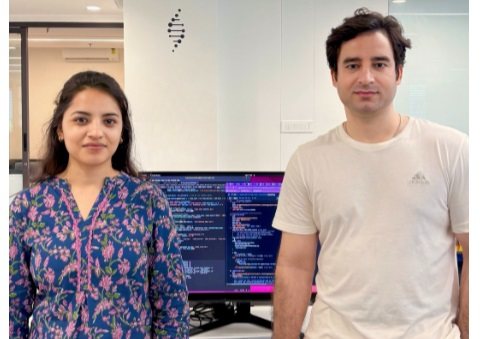
In a landmark achievement, the Government of India has recently awarded Patent No. 556810 to Jamia Millia Islamia (JMI) scholars Dr. Tanveer Ahmad, an Assistant Professor, and his PhD student, Miss Nisha Chaudhary, from the Multidisciplinary Centre for Advanced Research & Studies (MCARS) at JMI.
The patent granted on December 24, 2024, recognises their pioneering invention titled “A SYSTEM AND METHOD FOR GENOMIC MARKERS AND DIGITAL PATHOLOGY IMAGE-BASED PREDICTION OF ORAL MALIGNANT DISORDERS.”
Their innovative methodology, developed in collaboration with partners, leverages artificial intelligence (AI) and digital pathology to enhance the diagnosis and prediction of oral cancer.
Miss Nisha Chaudhary and Dr. Tanveer Ahmed
This advanced system can study tissue images to identify if they are linked to oral submucous fibrosis (OSMF), oral leukoplakia (OLL), oral lichen planus (OLP), or oral squamous cell carcinoma (OSCC). For OSCC, it can also determine how severe the cancer is—welldifferentiated, moderately differentiated, or poorly differentiated—using AI technology. The system predicts the chances of OSMF or OLP/OLL developing into OSCC, giving doctors helpful information about risks. By using genetic markers and digital tools, it provides clear treatment insights and lowers diagnostic costs compared to traditional methods. This invention is set to transform oral cancer detection by making it more affordable and accurate.
In addition to the patent, the research team has recently achieved another significant milestone with their publication in Scientific Data, a high impact factor (9.8) journal from the Nature Publishing Group. Their paper, “High-resolution AI image dataset for diagnosing oral submucous fibrosis and squamous cell carcinoma,” highlights the dataset underpinning their innovation, offering a valuable resource for researchers worldwide.
This accomplishment is shared with distinguished collaborators, including Dr. Akhilanand Chaurasia, Dr. Arpita Rai, Dr. Deepika Mishra, and Dr. Charbel Darido, whose contributions have been pivotal.
Together, these achievements have significant implications for medical treatment, underscoring the transformative potential of AI-driven solutions in digital pathology and oral cancer research, marking a significant leap toward improved diagnostic and prognostic outcomes.
Professor Mohammad Husain, Director of MCARS at JMI, congratulated all who were part of the study and expressed pride in the achievement.
source: http:/www.jmi.ac.in / Jamia Millia Islamia / Home / by Public Relations Office / December 31st, 2024
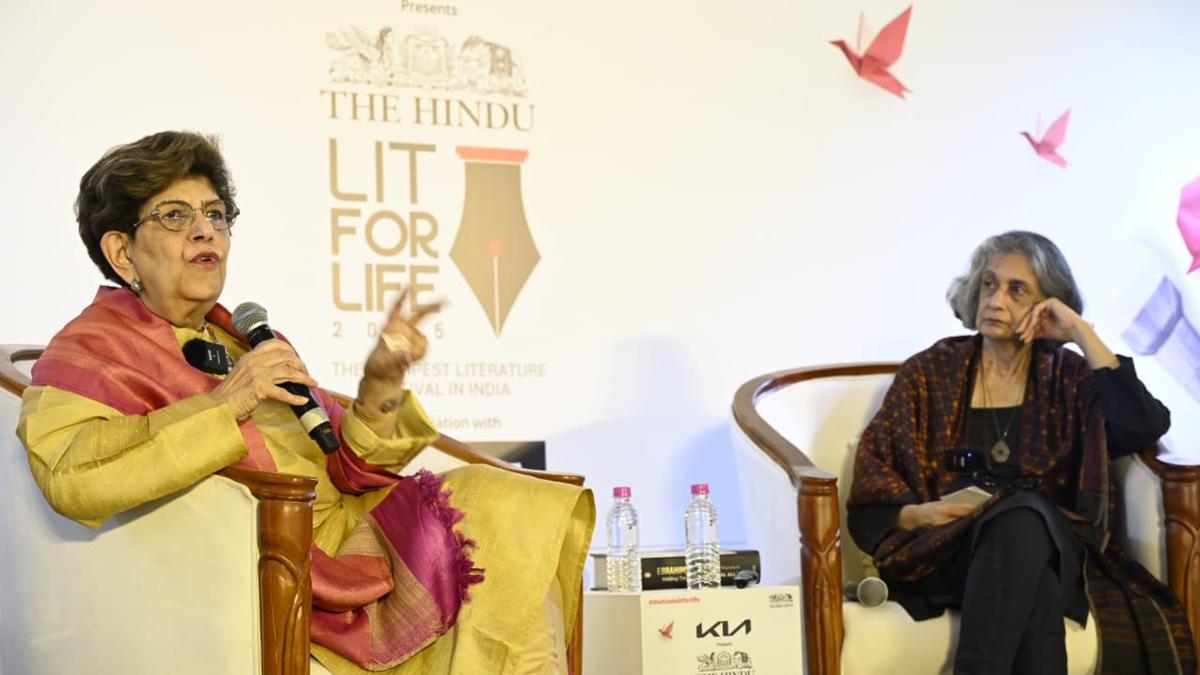
At The Hindu Lit for Life 2025, Amal Allana speaks about her father Ebrahim Alkazi, who led the modern theatre movement in India with an extraordinary vision.
Amal Allana in conversation with Ritu Menon at The Hindu Lit for Life 2025. | Photo Credit: R. Ragu
Theatre director Amal Allana, who recently released a riveting biography of her father Ebrahim Alkazi: Holding Time Captive gave a racy account of Alkazi’s revolutionary contributions to arts and culture in the creative landscape that was emerging in pre-independence India into the later decades.
She said the title of her book was apt as she found the words scribbled by her father in his notes that read ‘I wish I could live longer to hold time captive.’
A six-minute documentary on Alkazi charting the journey of his quest for a liberal approach to the arts in the Indian sub-Continent preceded Amal Allana’s conversation with Ritu Menon at The Hindu Lit for Life session on the second day.
Setting the narrative in Bombay of the 1940s when Alkazi came as the son of a migrant trader from Saudi Arabia, Amal spoke about how his innovative ideas from the young age of 22 coupled with daring new experimental projects transformed the theatre movements pan-India and later led to the establishment of the National School of Drama in Delhi in the 1960s. It was the time when creative history was under-researched and Alkazi strode the stage with arrogance, resoluteness, and brilliance.
As the daughter, Amal brought a personal perspective to the intangible landscape of Alkazi’s passions as she step-by-step unfolded the layers of his cultural, artistic and nationalistic identity. “His pedagogical skills took form as a response to the social and political life. He introduced language in theatre and nationalised it,” she said.
With Sultan Padamsee (elder brother of filmmaker Alyque Padmasee) and other independent-minded creative individuals, he broke boundaries and embraced the radical and precarious theatre life. They were all progressives and reinforcing each other. Amal narrated how Alkazi went overseas to study modern theatre and took Nissim Ezekiel along. He had the disposition of taking people along with and their idea of total theatre included all forms of arts feeding into one another.
“So with music, lights, costumes, literature, discussions and brochures he created dramatic experiences translating, producing and directing plays from the Western pantheon,” Amal said and added Alkazi was particularly influenced by Tagore’s concept of Santiniketan integrating liberalism with fine arts.
Not only was Alkazi interested in training a body of thinking actors but he also trained audiences to appreciate modernity in theatre, she said.
The Hindu Lit for Life event is presented by KIA India and is in association with Christ University. Associate Partners: LIC, RR Donnelley, Blue Star, Brigade Group, NITTE Deemed-to-be University, PROchure, Singer, Chennai Port Authority & Kamarajar Port Ltd, Uttarakhand Tourism, Vajiram and Ravi, Indian Bank, Akshayakalpa and ICFAI Group. Realty Partner: Casagrand. Bookstore Partner: Crossword. Food Partner: Wow Momo, Beverage Partner: Beachville, Radio Partner: Big FM, TV Partner: Puthiya Thalaimurai Gift Partner: Anand Prakash. Supported by: US Consulate, Chennai, Water Partner: Repute
source: http://www.thehindu.com / The Hindu / Home> Lit for Life / by Soma Basu / January 19th, 2025
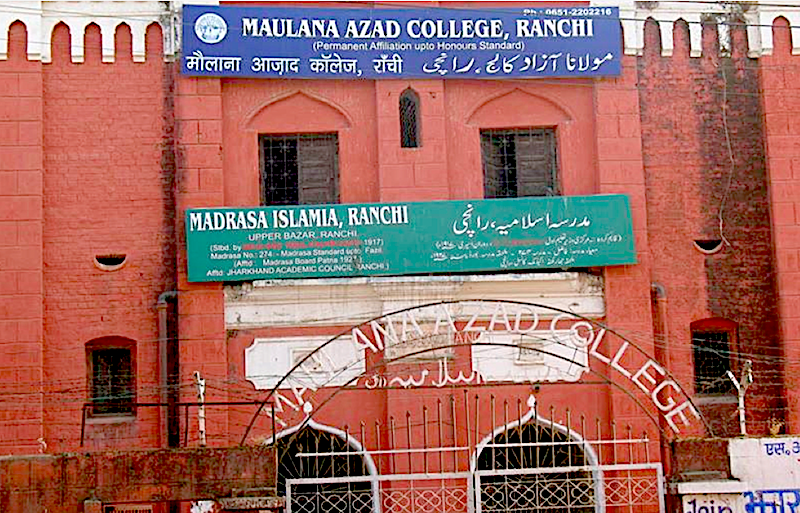
It is ironical that, just in the year of its centenary, the historic Madrasa Islamiya of Ranchi, founded by Maulana Azad (1888-1958) in 1917, is facing extinction. The BJP government of Jharkhand is reportedly contemplating to strangulate it to death by withdrawing its affiliation/recognition as well as fund. Much of the land of the institution has either been encroached upon or been sold out, by the self-serving Muslims, influential in the management of the Anjuman-e-Islamiya, which runs almost 12 subsidiary institutions, including the Madrasa Islamiya. In 1987, it formed a subsidiary called, “Muslim Higher Education Society”, which added a degree college named after Maulana Azad. This Muslim minority college is recognised and funded by the government of Jharkhand. It has got around 500 students.
The management of the Anjuman-e-Islamiya stands divided between two warring factions, respectively by Haji Ibrar and Haji Nesar. The latter is supposed to be making too much of interferences into the functioning of the Anjuman-e-Islamiya. Sections of local population admire Haji Ibrar for having done a lot for the Anjuman; they are supposed to have recently purchased a land few kilometres away from Ranchi, where the Azad College is likely to be shifted.
Because of this dispute, mainly around composition of the electoral college of the Anjuman, election for the managing committee of the Anjuman has not been held since last November. According to the bye-laws of the Anjuman, every three years elections are supposed to be held. Convenor for the election from the provincial government is the Chairman, Jharkhand Waqf Board. The government has not appointed any Chairman since 2014. In its place, an ad hoc CEO is there for the Waqf Board. He has not shown much interest in resolving the dispute, and convening elections, as per the bye-laws of the Anjuman-e-Islamiya. There are various petitions lying before the CEO regarding the composition of the electoral college. The factionalism is also around caste (Biradri). Haji Ibrar is supposed to be representing the Ashrafiya Muslims, whereas Haji Nesar is supposed to be representing Pasmanda (mainly the community of Kalaal) Muslims.
The property (including the buildings) of the Anjuman-e-Islamiya, located in the commercially significant, prime location of the city of Ranchi, has got around 200 shops. Because of self-serving factionalism within the Anjuman-e-Islamiya, the rent of the shops is kept so very nominal and unrealistic that the Anjuman deprives itself of huge revenue. The Anjuman-e-Islamiya also runs a 60 bed, relatively better-furnished, hospital, besides the RahmaniyaMusafirkhana, existing since the days of Maulana Azad. This is a separate (now a four-storey) building. Few years ago, with some fund from the Local Area Development Scheme of the local Parliamentarian, this building has been renovated. It has added a library, a study circle, etc.
There has been some efforts towards getting the main building of the Anjuman-e-Islamiya declared as National Monument, but to no avail, as yet.
The Madrasa Islamiya, at present, has got 900 students, some of them are boarders too. This is an educational institution recognised and funded by the government of Jharkhand’s body, the Jharkhand Academic Council (JAC). Before the creation of the province of Jharkhand in 2000, this was recognised and funded by the Bihar State Madrasa Education Board (BSMEB, Patna), a statutory body of the government of Bihar. There were 126 such madrasas falling in what became Jharkhand. All the 126 madrasas continue to get fund from the Jharkhand government.
After the creation of the province of Jharkhand in 2000, the Anjuman-e-Islamiya, with its ‘autonomy’, has been functioning under the administrative supervision of the Jharkhand Waqf Board.
A Proud History of Anti-colonial Assertion
It is worth re-visiting the historical context in which the Madrasa Islamiya was founded and the ideal objectives its founder envisioned. For this, let us benefit from some historians, such as S. Irfan Habib and Rizwan Qaiser.
For his revolutionary activities, he was into, right since his early ages, Azad was externed from Calcutta in March 1916 under the Defence of India Regulation. In April 1916 he was sent to Ranchi. Influenced with Shyam Sundar Chakravarty (1869-1932) and Aurobindo Ghosh (1872-1950), the Maulana was involved in revolutionary struggle and was preparing for a violent overthrow of British rule. His “continuous exhortation of the Muslims towards education including political education which essentially meant building up self-confidence to resist British rule”, was inviting anxious watch of the colonial regime on him, says Qaiser.
During his internment at Ranchi, for nearly four years (1 April 1916-31 December 1919), Azad established an organization Anjuman-e-Islamiya in August 1917 which started the Madrasa Islamiya. In a list of thirty one donors, headed by Rai Saheb Thakur Das, Rais-i- Ranchi and Babu Jagatpal Sahai, vakil, were also there, among other people, from all walks of life, including Sheikh safdar Ali of Milki (Gaya), informs Prof. Rizwan Qaiser, in his research on the subject. He says that behind all these activities of Azad, the guiding motive was to spread the Islamic education among the less fortunate co-religionists at Ranchi and to mobilise his co-religionists towards the freedom movement. According to Qaiser, Maulana Azad had been thinking around the issues of education in sciences, and also on the medium of instruction, since as early as in 1902, as it comes out of some of the correspondences of Azad.
For the Madrasa Islamiya, a 200 page long document of curricula was prepared by the Maulana Azad; the subjects such as English, mathematics, Indian geography, Indian history, history of Islam and sciences had to be introduced to bring it at par with the government run schools. Azad was very clear about the fact that no system of education could be complete unless the elements of Government University system were also to be introduced. Maulana Azad highlighted the importance of producing more educationists (Mutallemeen), rather than teachers (Muallemeen) alone. The education had to inculcate mazhabi ham-aahangi (mutual religious understanding) and rawadari (tolerance). He addressed from the Jama Masjid on every Friday, teaching them in Hubb-ul-Watani (patriotism), qaumi yekjahti (integration of nationalities), and Mushtareka Wataniyat (composite nationalism). The curricula were actually a part of the one prepared by Maulana Azad for the Madrasa Aliya of Calcutta (established in 1780 by Warren Hastings, mainly to study Arabic, Persian and Muslim Law; during 1826-36, it also taught medical sciences till the Calcutta Medical College was established in 1836; in 2007 it was upgraded as University)
S. Irfan Habib tells us that under Ibn Khaldun’s influence, unquestioning acceptance of theology was something Azad wanted to rectify. Azad found the curricula in the pre-existing Islamic madrasas fundamentally narrow. Its significant omission was mathematics, which is the basis of science and technology. Azad agreed with Rousseau in his advocacy of the children’s necessity and ability to grasp the truth through their own insight.
Another significant influence on Maulana Azad, in the context of science and education was Sir Syed Ahmad Khan Bahadur (1817-98), which attracted Azad towards modern education and modern science for the Muslims, as admitted by Azad, in his very eloquent convocation speech (February 1949) in the Aligarh Muslim University. This is another matter that on political questions, Azad had sharp differences against Sir Syed.
By way of recollection and re-dissemination, Azad’s profound contributions were put together when the National University of Education Planning and Administration (NUEPA), New Delhi, convened a seminar in 2009, and the essays were published in 2010. In the seminar, the then Speaker, Lok Sabha, Somnath Chatterjee, had described that Maulana Azad had re-emphasized the fivefold programme for the expansion of education in the country: These were (a) Universal compulsory basic education for all children of school age, (b) Social education for our adult illiterates, (c) Measures for improvement in the quality of and expansion of facilities for secondary and higher education, (d) Technical and scientific education on a scale adequate to the nation’s needs, and (e) Measures for the enrichment of the cultural life of the community by encouraging the arts and providing facilities for recreation and other amenities.
It is not without any reason that Nehru preferred to take Azad along, as his Education Minister, where he served with great distinction till his death in 1958. It is a lesser known fact that ever since Gokhale proposed in 1910 for right to compulsory free education, it was Azad who pursued it in the Constituent Assembly. Though, it was only as late as in 2009-10, that such a legislation (RTE) could actually be enacted.
During the colonial period unlike Uttar Pradesh, in Bihar, essentially speaking, there was not much of a difference between the votaries of modern education and those of the traditional learning. The Muslim elites of both the streams in Bihar cooperated with each other in imparting both kinds of education. Thus, a modern educated elite, a judge, Nur-ul-Hoda (1854-1935; son of Shams-ul-Hoda) set up the Madrasa Shams-ul-Hoda, at Patna in 1912. It endures till date with buildings constructed in colonial architectural styles, and have got good hostels too. It was recognised by the Government of Bihar in 1919, which affiliated Madrasas across the province, in the capacity of serving as the Bihar State Madrasa Education Board, BSMEB, Patna; the Board was made a statutory body by the Karpuri Thakur led government during 1977-79 ). In 1927, it affiliated the Madrasa Islamiya, Ranchi as well. Ever since then, this Madrasa remains a government recognised and funded institution.
Its syllabi, till Fauqaniya (class X), has all the modern subjects of Natural Sciences, Mathematics, Social Sciences and Literatures of Indian and English language. It has board examination at Middle (Wastania) level as well, which is class VIII. After Independence, this Board became a statutory body.
Interestingly, both the Madrasas (of Patna and of Ranchi) had one person in common, in preparing the curriculum—-Syed Sulaiman Nadvi (1884-1953). The Madrasa Shams-ul-Hoda of Patna produced many students and teachers who participated in the Quit India Movement; after independence some of its students joined the Indian Administrative Services and Indian Police Services.
Another Gift of Maulana Azad’s Stay at Ranchi
Besides the Madrasa Islamiya, another enduring gift of Azad’s stay at Ranchi is the foundation of Imarat-e-Shariah (in 1921, at Phulwari Sharif, Patna) in collaboration with Maulana Sajjad (1880-1940), and the Anjuman-e-Ulema-e-Bihar (founded in June 1917), a precursor of the Jamiat-ul-Ulema-e-Hind. The Sufi shrines—Khanqah-e-Rahmaniya (Monghyr) and Khanqah-e-Mujibiya (Phulwari Sharif, Patna) extended its support.
Maulana Azad elaborated upon this scheme of mobilizing Muslims against the anti- colonial struggle in his Urdu weekly, Paighaam (November 25, 1921).
The Imarat-e-Shariah went on to unwaveringly resist the communal-territorial separatism of the Muslim League. Azad’s protégé, Maulana Sajjad, also talked of confining religion into private spaces, and wrote many letters to Jinnah raising serious questions against his divisive [Pakistan] Resolution of Lahore, 23 March 1940.
He consistently remained in touch with the masses and also edited an Urdu weekly, Naqeeb, (after its fortnightly Imarat was gagged by the colonial state during the Civil Disobedience Movement 1930-34). On 14 April 1940, he wrote in Naqeeb against Jinnah’s scheme of dividing India, Muslim India aur Hindu India Ki Scheme par Ek Aham Tabserah (reprinted in the Naqeeb, 10 January 1946). The Patna historian, Papiya Ghosh (1953-2006), wrote an elaborate academic essay (1997) on the history of Imarat-e-Shariah, 1921-47.
Maulana Sajjad wrote letters to Jinnah asking pertinent questions. Jinnah never responded back. Sajjad, therefore, brought the letters in public circulation, specifically of 26 December 1938 and of 23 January 1939.
Maulana Sajjad also advocated the idea of confining the religious processions and rituals into private spaces rather than a public display of it causing disharmony and group violence. His pamphlet to this effect was captioned, Firqa Warana Ma’amlaat Ka Faisla Kin UsuloN Par Hona Chahiye? (Naqeeb, 20 February 1940)
He launched a political outfit, Muslim Independent Party (MIP) in 1936, with agrarian issues being its chief concern. In 1937, in collaboration with the Congress it contested the provincial elections and emerged second largest party. As the Congress, the largest party refused to form ministry on certain issues of discretionary powers vested in the Governor according to the Act of 1935, it was MIP which formed a provisional ministry, which ran for four months (April-July 1937). Barrister Md. Yunus (1884-1952) was the premier. In its short tenure, it performed very well on all counts, including its agrarian concerns such as irrigation facilities, soft loans, river embankments, etc.
Today, the Imarat-e-Shariah runs charitable institutions of education and health. In its self-proclamation, its jurisdiction extends to Jharkhand and Orissa as well. Should not it look upon the Madrasa Islamiya, Ranchi, in order to resuscitate and revitalise it?
However, this is also a puzzle for the local population that ever since Maulana Azad left Ranchi in 1920, he never looked back towards it. It is something like Gandhiji’s visit to Champaran in 1917. Even though he did re-visit, yet, the three schools established by Gandhiji in Champaran could not survive. As against this, the Madrasa at Ranchi did survive and endures till date.
The Maulana Azad Educational Foundation (MAEF) of the Union government in its existence of about three decades (founded in 1988 to commemorate Azad’s birth centenary) is doing a lot in the stated direction of education. Should not it make an intervention into it to rescuing this wonderful legacy facing extinction? Recognizing the historical significance of Azad’s stay at Ranchi, the then Prime Minister, Rajiv Gandhi, had inaugurated Maulana Azad Research Centre, on the Tagore Hills, Ranchi. It subsequently disappeared with no traces even of the stone plaque testifying the inauguration by Rajiv Gandhi. In January 2015, however, the then Chancellor (of the Ranchi University) cum Governor of Jharkhand, took note of it and persuaded the Ranchi University to establish Maulana Azad Research Centre. Its incumbent Director, Prof. Manzar Husain, has now made it functional, with a library in its building. Besides, the Senate Hall of the University is also named after Maulana Azad, as a token of gratitude.
In 2009-10, Qaiser had also highlighted the sorry state of the institution and gross negligence of the Madrasa by the Muslim dominated management. Yet, it continues to languish in disarray. Qaiser concluded, “There are people who swear by Maulana Azad and his association with Ranchi but have not been able to accord the level of respect that an institution such as Madrasa-i-Islamia deserves”.
Mention may be made specifically of Najma Heptullah, claiming to be a descendant of Azad. Till very recently she was the Union Ministry of Minority Affairs in the cabinet of Narendra Modi. Shall she really make a meaningful intervention to draw attention of the provincial and the Union governments to rescue this dying institution? The then Chairman, Jharkhand State Minority Commission, had approached the minister, Najma Heptullah. She sent her emissary to obtain first-hand knowledge about the state of affairs and requirements of the institution. Nobody knows what really happened to this. Then she no longer remained the minister. People have also been approaching Najma Heptullah’s successor, Mukhtar Abbas Naqvi.
The problem afflicting the Anjuman-e-Islamiya is not convening election of its management committee. The government of Jharkhand and its ad hoc functionary, Hasib Akhtar (CEO, Jharkhand Waqf Board, who is by rules, Convenor of election for the Anjuman-e-Islamiya), rather than convening election, is now contemplating to just withdraw the funding (and recognition) of the historic educational institution, Madrasa Islamiya, sources in the ministry of education, confide.
It is worthwhile recalling that delay in granting affiliation by the government of Jharkhand had compelled the Muslim minority managed Kabir Women’s Degree College (Jamshedpur) to close down. It had more than sufficient infrastructure in comparison to most of the other constituent colleges in the state. But it was forced to pull its shutter down, after having functioned for over two decades.
The local Muslims feel helpless at this attitude of the BJP government of Jharkhand. With a sense of hopeless-ness, they say, ‘this is the kind of era we are living in’. Local media, particularly, ETV Urdu, has been exposing all these details, which fall on the deaf ears of the government of Jharkhand. Let it be said that even the Union government of BJP is keeping such bodies head-less. For instance, the National Commission for Minorities, had become defunct, owing to vacancies. It is only few weeks ago that the Chairman and its members have been appointed. The National Commission for minority Educational Institutions (NCMEI) has got no Chairman, with vacancy of one member too. Yet another testimony that the dominant political wisdom of the day believes in peripheralising the minorities!
(This article was first published in August 2017. It is being republished because of PM Modi’s Madrasa modernisation push)
source: http://www.beyoundheadlines.in / Beyond Headlines / Home> History / by Mohammad Sajjad / June 19th, 2019
Asma Memorial Trust felicitates 80 educators including retired ones and specially-abled who served without recognition.
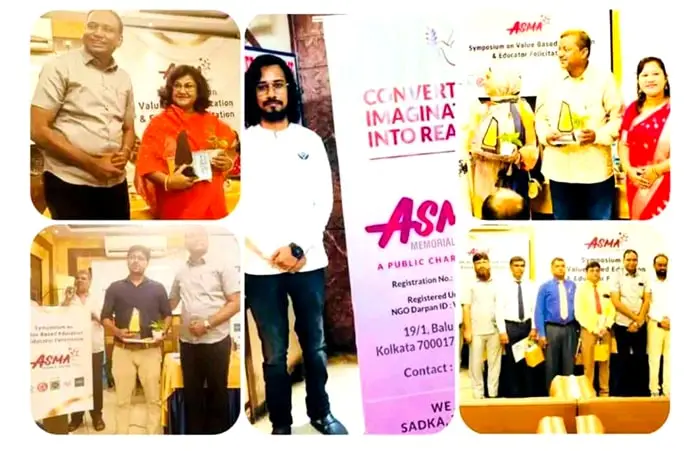
(Clockwise) Noor alam with Afaf Jameel, Junaid Kamal, Sangita Gurang (red sari) and the felicitated ones
Kolkata:
When the name of Junaid Kamal was announced, a 32-year-old man, with the help of two crutches, tried to stand up from his seat and began moving towards the stage to be felicitated at Asma Memorial Trust’s function. Soon, the fine art teacher was assisted in walking to receive a memento, a plant, and a set of notebooks and pens.
It was the first time in his 13-year teaching career that the art teacher, who is associated with four different organizations in Kolkata and serves the community, was recognized as a specially-abled person (left leg and right paralysed).
“I am thankful for the felicitation. For someone like me, it is not only difficult to study, but getting a respectable job is another challenge. Even when you succeed, it is rare that people appreciate it in this fast-paced life,” the Academy of Fine Arts graduate told eNewsroom.
Junaid was not alone; at least 15 retired educators, from both government and private schools, were also felicitated at the event.
Dr Umar Khyyam (70) of Maulana Azad College, Mobark Ali Mobarak (65) from Bankura district Urdu School, Nurul Hoda (62) of Kankinara Himayatul Ghurba High School (underprivileged), and Ashraf Ahmad Jafri (65) of Karaya School, Kolkata, were among them.
There were also current teachers, such as Afaf Jameel of Frank Anthony Public School, Sangita Gurung of Assembly of God Church School, Michael A Panja of GD Goenka Public School, Dr Khalid Hossain of Monu Memorial Institution (Kolkata), Debashish from Well and Gold, Md. Shahnawaz of Noble Mission School, Mubashshreen Shakil of KS Consultancy & Academy, Shaguta Adnan, who teaches French, and Manwar Sultana of Sir Syed English Medium School, among the total 80 teachers who were felicitated.
The felicitated and the felicitetors together after Asma Memorial Trust’s event
Teachers from South Point, East West, Goenka, Albani Hall, Islamia, Mohammed Jan, Flair International, and Izma International schools were also honored.
Noor Alam, the founder of NEET Basket, who also established the Asma Trust in memory of his wife to promote value-based education and encourage those involved in it, told eNewsroom, “We used to celebrate Education Day on the birthday of India’s first education minister, Maulana Abul Kalam Azad. But this year, we started the celebration earlier and began by felicitating educators who have served society but have not received any recognition for it.”
Alam, the Rashtriya Shiksha Ratan Award winner also pointed out that during the felicitation, a plant was given to each honoree to symbolize how educators nurture children. Just as trees benefit society in many ways, a well-nurtured child can positively impact the community.
The chief guest, Indian Revenue Service (IRS) officer Shamsher Ahmad, who took voluntary retirement and started Crescent School in one of Kolkata’s ghettos—Topsia—shared his journey as an educator. “When I started the school in Topsia (in 2002), I decorated the building very well. People asked me why I was doing so. I told them that to build confidence in the Topsia students, they must study in a place that is not inferior to other major schools in the city.”
“In later years, to boost their confidence to appear for the Union Public Service Examinations, I used my contacts and made my school a center for the UPSC exam, which produces IAS and IPS officers. As a result, today our school produces doctors and students who pursue higher education after graduating from Crescent,” Ahmad said to the gathering.
Sangita Gurung of Assembly of God said a one liner for the teachers, “Teach what your preach and preach what you teach, is the motto remained in my career and it should be with every teacher.”
Dr Sarfaraz Adil, founder of Izma International School , reminded attendees of the importance of education in Islam and how it has been emphasized. “Getting an education is one of the fundamentals of Islam. It not only includes religious education but also opens doors to physics, astronomy, and chemistry. Before Islam, there was no scientific temperament in religion. Only the rich could study, but Islam made education accessible to everyone. Prophet Muhammad announced that any slave who learned and became educated would be freed. Later, a slave named Hazrat Barira became educated and declared that she should be freed, according to the Prophet’s word. And she was freed. Although it was difficult because she was married to an uneducated slave, she wanted her freedom and to be separated from her husband, so she was granted it.”
Dr Adil also had a message for today’s teachers: “Information is easily shared among students. So, what is important for teachers is to teach students skills and show them
source: http://www.enewsroom.in / E Newsroom India / Home> Bengal> Education / by Shahnawaz Akhtar / September 16th, 2024
Mr Farhan Khan, an alumnus of Aligarh Muslim University has been awarded the prestigious Global Talent Visa (Tier 1) by the United Kingdom under the endorsement of Arts Council, England.
This coveted recognition honours the exceptional talent and leadership quality of individuals in their respective fields, and this award to Khan establishes him as a global icon in the field of fine art photography.
Khan’s inspiring academic journey began at the Syedna Tahir Saifuddin (STS) School, followed by his XII from Saiyyid Hamid Senior Secondary School, AMU, and his formative years at AMU cultivated in him a strong sense of discipline, creativity and excellence, which paved the way for his future success.
After graduating from Jamia Millia Islamia (JMI), in Architecture (B.Arch.), he developed a passion for photography and completed a Postgraduate Diploma in Still Photography and Visual Communication from JMI with a gold medal. Later, he developed advanced skills in photography and visual storytelling, with his works being featured in prominent exhibitions.
Khan earned a Master of Arts in Photography: Image and Electronic Arts from the prestigious Goldsmiths, University of London, with Merit and gradually excelled in photography and designing by working out at diverse photography projects across architecture, real estate, interiors, food, and product photography.
He is currently employed as a Photography Specialist and Brand Ambassador at Fujifilm House of Photography, London, where he drives innovation, delivers high-quality results, and engages in client training.
His work has been exhibited globally, including notable exhibitions like Nexus & Now (2022): Degree Show at Goldsmiths, London; International Art Exhibition 3D Gallery (2020): Berlin, Germany; Postcards to Gandhi (2020): A narrative on climate change, JMI, New Delhi and Freedom to Live (2019): Photo series at Modoo Gallery, Brazil.
His evocative art has garnered numerous accolades, including a Top 5 Shortlist for the Historic Photographer of the Year Award (2020) and the First Prize in the National Photography Competition on Urban Eco-Systems (2018). His works have also been featured in esteemed publications like The Week Junior UK, Outlook India, and Outlook Traveller.
Khan’s passion extends beyond photography to teaching and mentorship. He has conducted 44+ beginner photography workshops in London and delivered lectures on innovative topics such as surrealism and graphic design in photography. His interactive and student-focused pedagogical approach empowers young artists to thrive in creative fields.
source: http://www.radiancenews.com / Radiance News / Home> Art & Culture> Latest News / by Radiance News Bureau / January 12th, 2025
Tasneem Fathima Khaleel has had a successful career in academia. However, quite remarkably, she came back to where she started – teaching. M A Siraj reports.
Few people end their careers where they first began; Professor Tasneem Fathima Khaleel is among those few. “I am excited about the opportunity to finish my career in the classroom. And, with a little help, I will be teaching in a new state-of-the-art…facility,” says Tasneem, the first-ever woman to have obtained a doctorate in the State of Mysore in 1970. Prior to returning as a professor of Botany, she served as the dean of faculty at College of Arts & Sciences for a decade at the Montana State University at Billings (MUSB).
Paving a new path
Tasneem has been teaching Botany in the United States for over 40 years and has received many awards for her teaching and research. She has headed, or has been a member on as many as 23 different academic bodies or advisory councils in the US. For her contribution to research, with nearly 50 research publications on subjects ranging from cyto-embriology to plant reproduction, she was awarded the ‘Outstanding Research Award’ in 1995 by the Montana Research Academy and has also won the Faculty Excellence Award five times.
The year 2014 was a special year for Tasneem – she had the rare honour of an award being named after her, for mentoring at the MUSB. Reno Charette, director for American-Indian Education, was adjudged the winner of the first ‘Prof Tasneem Fathima Khaleel Award for Mentoring’.
Tasneem studied in Bengaluru, before heading to the US in 1975 after marriage. An alumna of Central College, Bengaluru, she has coveted every opportunity to visit her ‘City of Gardens’ – which she ruefully admits is more a part of nostalgia rather than reality.
A passionate researcher, she recalls that very few women could be seen in higher studies in those days. Only a couple of them were pursuing PhD while she was registered in Bangalore University as well as teaching biology as an assistant professor at the University of Agricultural Sciences at Hebbal between 1968 and 1975. Her study of ‘Flora at the GKVK Campus’ and ‘Weeds in Karnataka’ are still quoted as seminal works.
Writing her own destiny
Tasneem had finished her BSc and MSc by the time she was barely 19 years old. Wanting to be a teacher, she had put in her application, but was rejected, as the dean told her, “You look like a school girl, how would the students take you seriously?”
Instead, he directed her to register for a PhD programme, which had just been started in the Bangalore University. The Doctorate took longer than usual to complete because there was lack of guidance and direction, and the programme had several fits and starts.
Finally, at 26 when she got her her doctorate, she was being looked as ‘a confirmed spinster’ in her own cultural surroundings. Marriage was nowhere on her mental radar. It took her brother several sittings to convince her of getting married.
Tasneem travelled a long and twisted path – one shaped by her culture and her drive to excel, to become the distinguished professor that she is today. For most Americans who had only preliminary idea of Islam, a woman with covered head and such drive for excellence and perseverance was a combination of incongruities. “Women have rights in Islam. Muslim women didn’t even have to fight for those rights. The religion has given them those rights,” she says.
Dr Stn Waitr, her successor, says, “Dean Khaleel has raised the level of rigour, excellence and success in the College of Arts & Sciences to a standard that should serve as a model for the entire institution.” Interestingly, Tasneem even built a herbarium at the MUSB, which has around 17,000 specimens and is currently engaged in digitising it. She recalls with pride that she was the most productive member on the faculty of science at the MSU, which has nearly 22,000 students today in two campuses. Tasneem’s most significant discovery was the finding of mammalian steroids in plants, which she says, are responsible for sex expression in plants.
Author of four books, 10 external and 17 internal grants at the MSUB, Tasneem is excited about beginning her teaching career once again. “It had never ended. I had maintained a room in my department building, even while I headed the faculty,” she says.
source: http://www.deccanherald.com / Deccan Herald / Home> Content / by M.A. Siraj / June 26th, 2015
After teaching for over 40 years, Dr. Tasneem Khaleel is retiring
MSUB readies to part with long-time Professor Dr. Khaleel
Retirement party in honor of Dr. Khaleel set for 2 p.m., April 26 in the Beartooth Room in the Student Union Building. Food and refreshments will be served.
MSU BILLINGS NEWS SERVICES — Hanging on the wall in Dr. Tasneem Khaleel’s office are the many awards and accolades marking the dedication and service she has given to Montana State University Billings over the past several decades.
Khaleel is retiring at the end of this semester and her presence and legacy will be with the science department and University for years to come.
Dr. Christine Shearer, dean of the College of Arts and Sciences, said that without the dedication and perseverance of Khaleel, the College and its students would not be where it is today.
“Dr. Khaleel has devoted her professional career to Montana State University Billings in a variety of capacities. She has been a tireless researcher and developer of the internationally-renowned Herbarium, a deeply committed advocate for the sciences and science education, a leader of a complex and diverse unit, and has been a staunch supporter and mentor of female scientists and academic professionals in all disciplines,” Shearer said. “Her tenacity and resilience advanced the College of Arts and Sciences and its programs, including the establishment of the Women’s and Gender Studies Center, which serves the university and the community. Her involvement in Girls-n-Science impacted hundreds of young women planning STEM careers.”
Khaleel has been paving the way for women in STEM since the beginning of her career. She has the honor of being the first woman recipient of a Ph.D from Bangalore University, India, where she graduated with a degree in Botany in 1970.
In 1976, Khaleel would begin her tenure with MSUB, as would her signature project: the establishment, maintenance, and management of the internationally known MSUB Herbarium.
“The Herbarium is one of my professional accomplishments that I am most proud of,” Khaleel said.
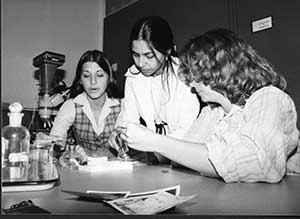
Dr. Tasneem Khaleel, center, assists Heidi Carter, left, and an unknown student during a lab experiment. (Photo circa 1980)
Post-retirement, she will continue being involved in the herbarium, which includes some 16,000 vascular plant specimens, some of which date back to the late 1800s and early 1900s. The Herbarium serves as a tool for basic research in plant systematics, ecology, phytogeography, and evolution.
While Khaleel’s career is highlighted by the 11 years she served as dean for the College of Arts and Sciences, from 2004 to 2014, she has no regrets to returning to the classroom before retirement.
Throughout her time on campus, she moved up from an assistant professor to department chair and says coming full circle made her last two years with students, “the best.”
“I wanted to retire as a faculty member,” Khaleel said. “Having that time as Dean allowed me to hear so many perspectives that my focus shifted when I returned to the classroom. My focus shifted from teaching to learning, to becoming a mentor and being more supportive.
For the last eight years the Tasneem and Shafiq Khaleel Endowment for Scholarships to Science has provided $1,000 awards to two students.
source: http://www.msubillings.edu/ucam/releases.2017/2017apr19Khaleel.htm / University Communications and Marketing / April 19th, 2017 / Montana State Univeristy Billings