AMU-RCA students succeed in cracking prestigious national-level examinations
Aligarh:
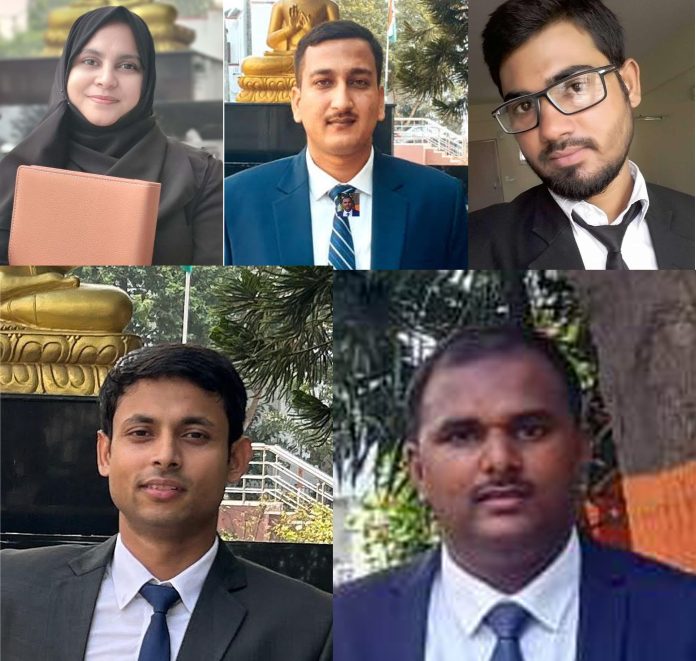
Mohd Faisal Khan, Mohd Zaid Masab and Manawwar Hussain, who have been preparing for the civil services examination at the Residential Coaching Academy of the Aligarh Muslim University, have been selected for the post of Revenue Officer, Supply Inspector and Finance Administrative Officer, respectively, through the integrated 69th Combined Competitive Examination conducted by Bihar Public Service Commission (BPSC). The result of this examination was declared on November 26.
Meanwhile, another two students of RCA, Mohd Shams Raza and Habiba Bukhari have succeeded in cracking the 32nd Bihar Judicial Services Examination to become Civil Judge (Junior Division), with a ranking of 30 and 176, respectively at the coveted examination conducted by the BPSC, Patna. The result of the examination was made public on November 28.
AMU Vice Chancellor Prof Naima Khatoon and the Registrar, Mr Mohammad Imran (IPS) have congratulated these students on their selection, adding that their success will serve as an impetus to other students who are preparing for national-level examinations.
The RCA Director, Prof Saghir Ahmad Ansari thanked Mr Mohibullah Ansari (IPS, Bihar Cadre) for sparing his valuable time to provide counselling to the RCA students, taking motivational classes and participating in mock interviews at the Academy conducted by experts.
source: http://www.radiancenews.com / Radiance News / Home> Focus> Markers of Excellence / by Radiance News Bureau / December 03rd, 2024
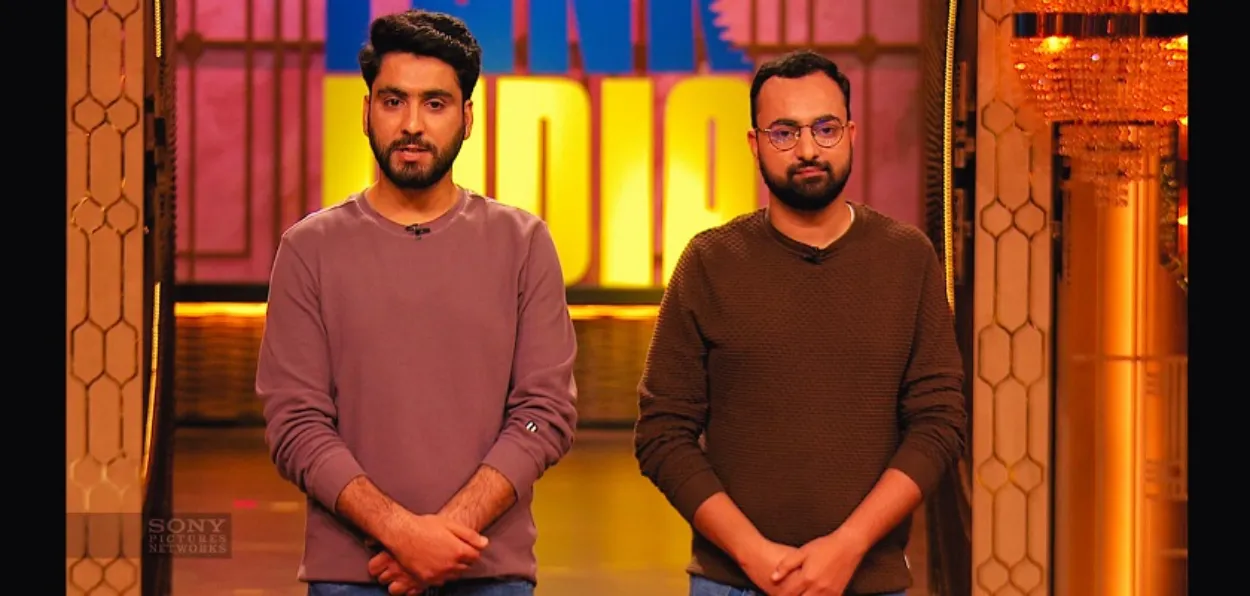
Sheikh Yameen, and Zubair Bhat, Co Founders of Zubair Curve Electrics at Shark Tank India- 4 Show
Two young Kashmiri men’s startup of providing eco-friendly urban transportation solutions may not have won them funding from the judges of Shark Tank India-4, a business reality show on Sony Television, but it won their immense admiration and exposed their successful business model to a larger world.
Sheikh Yameen, and Zubair Bhat, co-founders of Curve Electrics, got many heads nodding in appreciation when they said at the show in two years, their startup has helped environment by saving 145 metric tonnes of carbon emissions.
The mission Curve Electrics, launched in the summer of 2023, began with 50 e-bikes in Srinagar from 11 docking stations, in collaboration with the Srinagar Smart City Limited (SSCL). The number of e bikes has since grown up to 150 in Srinagar.
They also provides these services In the neighbouring Ganderbal district’s Central University of Kashmir (CUK), and the Hindu shrine of Mata Kheer Bhawani, Tulamulla.
“We have already completed 55,000 rides, 720,000 km and have saved 145 metric tonnes of carbon emissions….it is equivalent to the planting of 7200 trees”, during the last one and a half years, said Sheikh Yameen, Managing Director of Curve Electrics.
At the show, Sheikh Yameen, and Zubair Bhat said though at present their operations are limited to Kashmir Valley, they wanted to expand operations to other mountain towns such as Shimla and Mussoorie.
They also spoke about do business in college campuses across the country. They have shortlisted 1,400 campuses where they can expand their business. The entrepreneurs said that they have devised their bikes, and these are available through a mobile application and the users are not asked for seudirty deposits.
Yameen said, “Shark Tank India gave us an incredible platform to share our dream of revolutionizing urban mobility. Coming from Srinagar, this journey represents not just Curve Electric, but the untapped potential of Kashmiri youth. We’re excited for what lies ahead”
Sheikh Yameen and his friend, Mohsin Bashir are the co-founders of this startup. Yameen had completed his MBA in Finance and Marketing from The University of Kashmir, while his friend Mohsin Bashir was studying Management in the US.
The two pitched their sustainable e-bike service Curve Electric to the panel of ‘sharks’, which included Anupam Mittal, Vineeta Singh, Aman Gupta, Peyush Bansal, and newcomer Kunal Bahl.
Peyush was “very impressed” by the entrepreneurs’ ability to erase all the onboarding issues that customers might have. Vineeta explained, “There is a little complexity here. There is a lot of dependence on governments, and from what I’ve seen in all the other companies, the setting that you have to do with governments and local bodies, becomes a make-or-break situation. Your expansion will not depend on your ambition; it will depend on where you get the local support”.
Yameen nodded in agreement, and said that they haven’t had any losses yet, and have raised a round of investment already, valuing their company at Rs 8.5 crore.
Each of them backed out of the deal, but Peyush bid the founders farewell at a positive note. Addressing Yameen, he said, “It’s like looking at a mirror, you are me. You are saying everything I would have said 10 years back. The detailed customer-focused obsession you have, I have not seen in Shark Tank in four years.” In the end, the two entrepreneurs walked away with no deal, but loads of positive wishes.
Curve Electric’s pitch stood out not just for its business potential but also for the pride it brought to Kashmir. The team’s efforts reflect the entrepreneurial energy brewing in the Valley, proving that innovation knows no boundaries, Sheikh Yameen observed.
He said that the overwhelming response from the sharks and viewers alike has bolstered Curve Electric’s vision and opened doors for new opportunities. By fusing modern solutions with the rich cultural backdrop of Kashmir, the startup is paving the way for a cleaner and more sustainable future, leaving an indelible mark on India’s entrepreneurial landscap
source: http://www.awazthevoice.in / Awaz, The Voice / Home> Stories / by Ehsan Fazili, Srinagar / January 11th, 2025
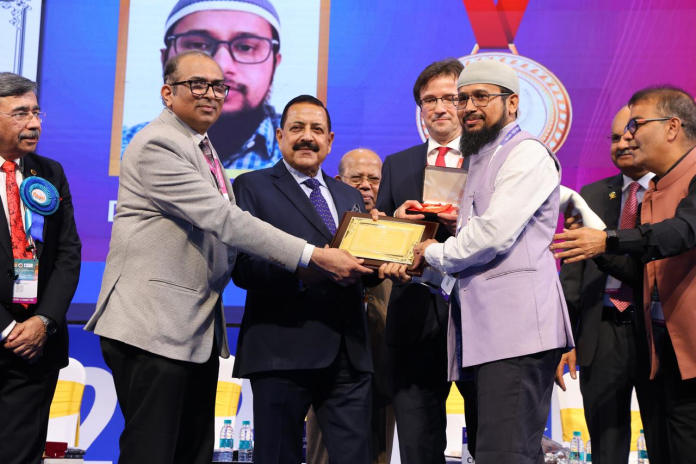
Dr. Hamid Ashraf, Associate Professor and former Director, Rajiv Gandhi Centre for Diabetes and Endocrinology, Aligarh Muslim University, has been honoured with the Best Innovation in Diabetes Care award at the annual conference of the Research Society for the Study of Diabetes in India (RSSDI).
The award was presented by Dr. Jitendra Singh, Minister of State for Science and Technology, Government of India during a ceremony held at Yashobhoomi, New Delhi.
Dr. Ashraf got the recognition for his ground-breaking research on “Machine Learning Techniques for Diabetes Detection Using Iris and Conjunctival Images.” He said that this innovative approach leverages artificial intelligence to enhance early diagnosis and management of diabetes by analysing subtle ocular changes linked to the disease.
He expressed gratitude to his co-investigators Dr. Nadeem Akhtar and Mr. Ehtesham Sana from Department of Computer Engineering, AMU for their contribution.
source: http://www.radiancenews.com / Radiance News /Home> Pride of the Nation> Awards> Latest News / by Radiance News Bureau / November 22nd, 2022
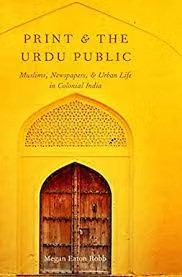
In ‘Print and the Urdu Public’, Megan Eaton Robb writes about the impact and role of popular Urdu newspaper Madinah and how it pushed back against censorship.
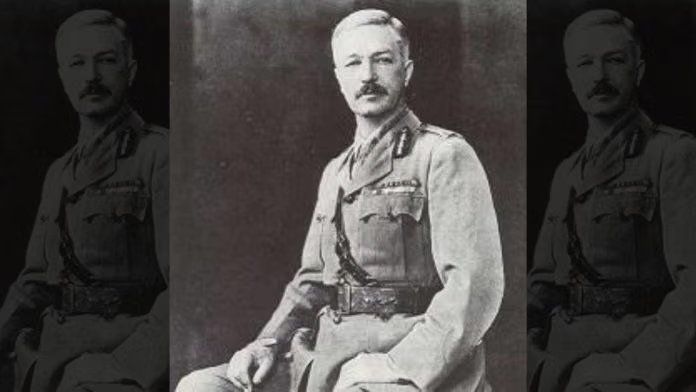
File photo | Gen. Reginald Dyer | Wikimedia Commons
Madīnah’s community of editors, subeditors, and proprietors illustrate the interconnected network of professionals working on newspapers across North India, with a shared commitment to confounding censorship laws. Editors of Madīnah were products of qasbahs and lived in Bijnor or nearby while employed by the publication. At least one assistant editor, Ḥamīd Ḥasan “Fakīr” Bijnorī (1903–1991), was a relative, having married Majīd Ḥasan’s daughter in the 1910s before he became the editor of Madinah Press’s children’s magazine Ghunchah after 1922. Ḥamīd Ḥasan would later be listed as an assistant editor from 1930 to 1935 and even take over as editor for several months when the need arose in 1945. When a new editor took over the work of Madīnah and was not already resident in Bijnor, he would move into the Ḥasan compound, which acted as the administrative office of the paper. Several small apartments attached to the main verandah, so editors could live in comfort with their families, remaining accessible to the newspaper office while maintaining privacy. Maulānā Majīd Ḥasan’s name, along with the name of the current chief editor, always appeared on the paper’s title page. At any given time there could be up to three editors of the paper, with the chief editor being referred to as “mudīr-i mas’ūl.”
Although Majīd Ḥasan’s proprietorship provided continuity for the newspaper, its different editors influenced the paper’s tone and focus. The turnover between editors could be rapid when legal troubles emerged. For instance, in 1924, when the editor Qāẓī Badrul Ḥasan Jalālī (1891–1956) was prosecuted by the British Raj for an article, he resigned his editorship, but he stepped back into his position once the dust of government scrutiny had settled. If Majīd Ḥasan attracted too much scrutiny from government surveillance, he could retreat from view behind the shadow of his prominent editors, continuing to exert the same influence behind the scenes. This allowed his outfit to survive draconian censorship measures while retaining the continuity essential to the newspaper’s success.
When he launched the newspaper in 1912, Majīd Ḥasan had little local influence. The only person of significance attached to the newspaper initially was a prominent journalist of the period, Nūr ul-Ḥasan Zahīn, who wrote for Ṣaḥīfa as well. Colonial censors initially dismissed Madīnah as a “bigoted Muhammadan organ, inclined to make trouble between Hindus and Muhammadans.” Madīnah first earned the ire of colonial administrators by criticizing the headmaster of Bijnor High School for complying with the British Educational Code. This was only the first of many encounters with censorship legislation.
April 1917 marked the beginning of Editor Mazh̤ ar ud-Dīn Shairkoṭī’s tenure, and the newspaper’s shift to publishing more explicitly political, anti-British stances. Shairkoṭī, a novelist as well as a journalist, was born in the Shairkoṭ qasbah of Bijnor in 1888. Initially educated by Maulānā ‘Abdul Qayūm Arshāq and Miyānji Sa‘ad Allah Sahib, he had attended Deoband as a pupil of Maulānā Mahmud ul-Ḥasan Asīr Mālṭā, known as Shaikh ul-Hind. After completing his education at Deoband, Mazh̤ ar ud- Dīn returned to Shairkot, where he worked on the newspaper Dastūr under the management of Ḥakīm Asrār ul-Nabī and on the newspaper Nagīnah.
Maulānā Majīd Ḥasan saw Maz̤har ud-Dīn’s affiliation with the newspaper as the beginning of a new period of commitment to the Muslim community and wrote an illustrious introduction for his new editor. Majīd Ḥasan’s message in his introduction was clear: he had brought in a power player to man the ship of Madīnah, a man who indubitably linked the paper to a network of powerful publications and individuals. The new editor transformed Madīnah into a more explicitly political entity. Maz̤har ud-Dīn associated with prominent political Muslims of the period, including Syed Ḥasan Imām, who presided over the Indian National Congress’s consideration of the Montagu-Chelmsford Reforms in Bombay in 1918. His other associates included Nawab Muḥammad Ismā’il Khān. He was, along with Khalīquzzamān, a key organizer of the UP Muslim League, and a prominent member until 1947; he remained in India after independence.
After the end of World War I in November 1918, discussions of independence and postwar reality in India began in earnest. The state of Islam, and the progress of both national and local branches of organizations such as the Muslim League and Congress, became matters of intense concern. Mohandas Karamchand “Mahātmā” Gāndhī (1869–1948) featured in several articles musing on the way forward for political Muslims. In addition, discussions of the fall out of World War I in Turkey and the caliphate took center stage. Under Mazh̤ ar ud-Dīn’s leadership, the newspaper emphasized the connection between the fate of Indian Muslims and of those in Turkey and other nations with significant ties to Islam.
Mazh̤ ar ud-Dīn presided over Madīnah’s publication of an article critical of the government’s role in the Jallianwallabagh massacre, which led to a dramatic conflict with the British Raj. In April 1919 Madīnah published an article criticizing Lieutenant Governor Sir Michael O’Dwyer’s (1864–1940) endorsement. Putting Madīnah on the Muslim Map of the actions of Colonel Reginald Dyer, who had overseen the disproportionate response at Jallianwallabagh. The article minced no words:
His honour O’Dwyer’s government of Panjab, from the very beginning, kept as the foundation of its policy a despotic course of action [ . . . ] This was his honor O’Dwyer’s last period of government; therefore it was necessary that he make amends for his past course of actions. This was the time when, instead of extinguishing the fire with the water Of gentleness and kindness, he inflamed the hearts of the ahl-i Punjab. Perhaps it could be said that he did not put out the fire with water, but instead doused it with oil. If that were not the case, then why would he at the conclusion of his reign, give orders that were so repellent, so far from resembling affection that they approximated hate?
It was actually illegal at this point in time to question the motives of the colonial government; thus, the final statement of the quotation accusing O’Dwyer of “hate” fell afoul of censorship laws. The government banned Madīnah from circulating in Punjab as a result of this piece. Mazh̤ arud-Dīn and Majīd Ḥasan’s response was defiant: in August 1919 they renamed the newspaper Yasrab, an Arabic synonym of Madīnah, as a bid to evade censorship.64 On the cover of each issue of Yasrab an Iqbal couplet appeared, a knowing wink to its readership base:
The dust of Madinah is better than both worlds. How wonderful is the city where the beloved is.
Khāk-i yas̱rab az do ‘ālam khūshtar ast Ā’e khunak shahre ke ānjā dilbar ast.
The couplet hinted at the paper Yasrab’s true identity, offered praise for the paper’s unpretentious popularity, and emphasized the link between the newspaper and the city Madīnah. Madīnah’s proprietor and editors were men who wore their few educational laurels lightly. More important than formal education was the ability to use that knowledge in the service of Indians generally and Muslims particularly. Unsurprisingly, the attempt at flouting the circulation ban was quickly detected. The paper reverted back to the title Madīnah after a few weeks, and the ban on circulation was lifted eventually.66 Madīnah was a space offering a figurative point of access to the community of Islam, the qaum, and it was a space increasingly under siege of colonial censorship laws.
Madīnah had been only one of many significant voices in the press commenting on the Jallianwallabagh fiasco. As the UP fortnightly report complained, “[The] occurrences in the Punjab [ . . . ] practically absorbed the entire attention of the press.” Along with Madīnah/Yasrab, the British excluded from Punjab al- Khalīl of Bijnor, The Independent of Allahabad (a Nehru paper), Hamdam and Akhuwat of Lucknow (Farangi Mahalli papers), Swadesh of Gorakhpur, and Amrita bazar patrika of Calcutta. The government demanded securities, or large sums of money as surety against future crimes of sedition, from papers in Bengal, Nagpur, Lucknow, and Madras. Madīnah’s inclusion in this censorship was a testament to its growing influence; its subterfuge demonstrated a growing sense of urgency in its mandate to reach readers and an emerging resolve to flout British restrictions.
In the 1920s, Madīnah focused on coverage of the Muslim League and the Indian National Congress, showing a preference for Congress.
It was per- haps Maz̤har ud-Dīn’s affection for the League that motivated him ultimately to resign from Madīnah in 1921. It is also possible that Mazh̤ ar ud-Dīn’s taste for politics pulled him closer to Delhi and toward the League after the political awakening accompanying the Khilafat Movement.
It was common for editors to move around among different qasbah-based newspapers, and after leaving Madīnah, Mazh̤ ar ud-Dīn joined Munshī Safīr Aḥmed’s Naginah-based paper Almān as its first editor; he was instrumental in relocating that paper to Delhi. He later became close to the leadership of the All-India Muslim League, including Muḥammad ‘Alī Jinnāh. In the 1930s he founded a paper entitled Vaḥdat (Unity) in order to assist the propagation of Muslim League ideals. When Maulānā Shabbīr Aḥmed ‘Usmānī, a Deobandi who supported the creation of Pakistan, resigned from the pro-Congress Jam‘īat ‘Ulamā and declared his allegiance to the Muslim League and Jinnah, he did so from Mazh̤ ar ud-Dīn’s office. This demonstrated Madīnah was one node in an important network of political power and publishing prestige in this period and had to make considered choices when it came to balancing shifting political alliances.
This excerpt from Print and the Urdu Public: Muslims, Newspapers, and Urban Life in Colonial India has been published with special permission from Oxford Univerity Press.
source: http://www.theprint.in / The Print / Home> Page Turner> Book Excerpts / by Megan Eaton Robb /May 15th, 2021
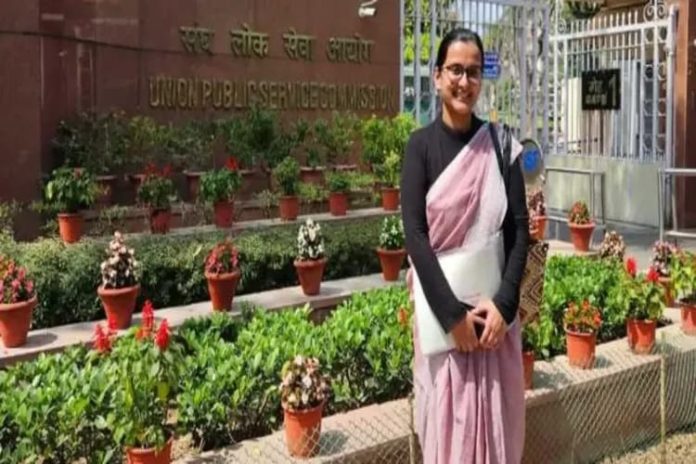
The name of Abeer Asad, daughter of Maulana Muhammad Asad Al-Qasimi Al-Azmi, has featured in the supplementary list of candidates for the 2023 exam released by the Union Public Service Commission (UPSC). Abeer cleared the challenging exam independently, relying on her self-study and determination, making her accomplishment a story of hard work, resilience, and vision, reports the Times of India.
Abeer’s journey to the Civil Services highlights her dedication to serving the nation. Her success came without formal coaching, showcasing the impact of her year-long self-directed study, combined with an unwavering commitment to her goal. From her school days, Abeer was a diligent student, achieving 92.8% in her 10th exams and 97.5% in her 12th, and later graduating with distinction in Economics from Hansraj College, Delhi.
Abeer’s preferred career path includes joining the Indian Administrative Service (IAS) as her top choice, followed by the Indian Revenue Service (IRS) and the Indian Railway Management Service (IRMS). Her position in the supplementary list ranks her at 35th, where she is joined by another successful Muslim candidate, Muhammad Nayab Anjam.
Abeer’s family stands as her pillar of strength. Her brother, Muhammad Basil, is a software engineer, while her mother a homemaker. Their lineage traces back to the well-regarded town of Kirthi Jafar in Mayo district, and they are proud of Abeer’s achievement, which she credits to her parents’ encouragement.
In her message to aspiring youth, especially young Muslim women, Abeer encouraged them to believe in their potential and to pursue their ambitions with passion and focus. “If girls are given freedom, encouragement, and equal opportunities, there’s no limit to what they can achieve,” she stated, urging young Muslims to prioritise their education over distractions.
Her father shared his pride in Abeer’s success and emphasised the importance of education within the Muslim community. “Only education can change the fate of a nation,” he remarked, calling on Muslim families to support their children in following their dreams.
source: http://www.radiancenews.com / Radiance News / Home> Latest News> Markers of Excellence / by Radiance News Bureau / November 01st, 2024
AMU Faculty Wins Best Paper Award at International Conference in Oman
Aligarh:
Dr. Lamay Bin Sabir, Assistant Professor, Department of Business Administration, Aligarh Muslim University (AMU), has been awarded the Best Paper Award at the International Conference on Intelligent Systems and Artificial Intelligence Applications (ISAA 2026) held at the University of Nizwa, Oman.
His award-winning paper, titled “Bridging Algorithmic Transparency and Managerial Trust: The Role of Explainable AI in Decision-Making – A Systematic Literature Review,” examines the challenges posed by limited transparency in AI-driven decision-making. The study highlights that AI systems are often perceived as “black boxes,” which affects managerial trust and decision effectiveness.
Dean, Faculty of Management Studies and Research, Prof. M. Naved Khan along with Chairperson, Department of Business Administration, Prof. Salma Ahmed congratulated Dr. Lamay on his achievement.
source: http://www.radiancenews.com / Radiance News / Home> Awards> Latest News> Science & Technology / by Radiance News Bureau / April 08th, 2026
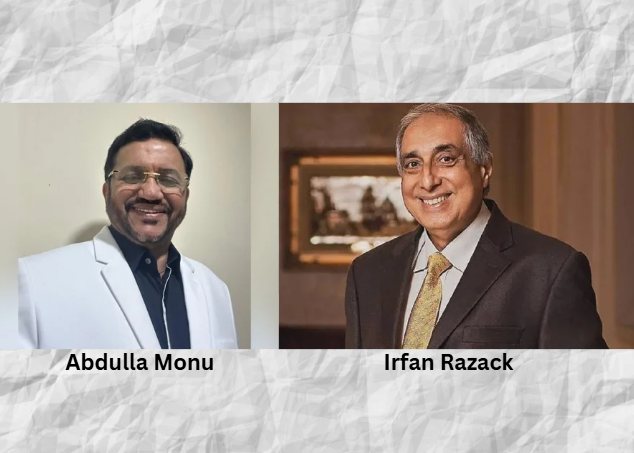
The Karnataka Government has announced Irfan Razack, Chairman and Managing Director of Prestige Group, as one of the recipients of this year’s prestigious Karnataka Rajyotsava Award.
The Karnataka Rajyotsava Award, the state’s second-highest civilian honour, celebrates individuals who have made outstanding contributions to Karnataka in fields such as arts, education, industry, literature, science, social service, sports, and public affairs. The award will be formally presented on November 1, Kannada Rajyotsava Day, which marks Karnataka’s formation as a state.
Irfan Razack, a prominent figure in the real estate and retail industry, has been recognised for his significant contributions to Karnataka’s growth and development through his work in the real estate sector.
With over 48 years of experience, Razack has led Prestige Group with a strong commitment to ethical business practices and a visionary approach to development. Under his guidance, Prestige Group has grown into a major player in the industry, with a reputation for excellence in real estate across India. Razack has received numerous awards and recognitions throughout his career, including the Fellowship of the Royal Institution of Chartered Surveyors (FRICS), the Real Estate Professional of the Year Award at the Real Estate Excellence Awards in 2008, and the prestigious Sir M. Visvesvaraya Memorial Award in 2015 for his contributions to Karnataka’s growth.
He has also been recognised for his exceptional leadership, being voted one of Asia’s Best CEOs in 2014 by Institutional Investor magazine and receiving ‘The World’s Greatest Leaders’ Award by Asia One in 2015-16. His achievements have placed him among India’s top builders and leaders. Besides his professional accomplishments, Razack is actively involved in numerous philanthropic and corporate social responsibility initiatives, supporting causes that benefit society at large.
Abdulla Monu Moideen, a well-known NRI entrepreneur and dedicated social worker, has been chosen to receive the prestigious Dakshina Kannada District Rajyotsava Award this year.
Recognised for his long-standing contributions to community service, Moideen has been actively involved in various social initiatives for over 30 years. Besides his social work, Moideen has been in the automobile business for 23 years. He is the founding president of South Kanara Muslim Association and currently serves as the president of Karnataka Cultural Association in Doha, Qatar.
He is also vice president at Tulu Koota in Doha and is actively involved with numerous other social organisations.
Dr. S.B. Naseer Abbas from Nelmangla near Bengaluru is selected for the Rajyotsava award for his services in the medical line.
Dr. Naseer is the first person to receive this prestigious award in Nelmangla taluka.
source: http://www.radiancenews.com / Radiance News / Home> Pride of the Nation> Awards> Latest News / by Mohammed Atherullah Shariff / November 01st, 2024
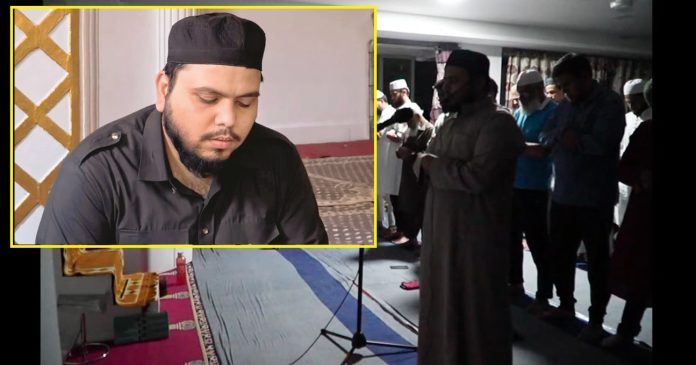
A young dentist from Maharashtra has drawn attention for balancing a professional career with dedicated service to the Quran. Dr. Mohammad Faisal Ansari, aged 26, has been leading Taraweeh prayers for the past six years while also working as a dental professional and online tutor.
Originally from Bijnor in Uttar Pradesh, Faisal grew up in Mira Road after his family moved there in 2000. He received both religious and modern education in the area. Under the guidance of Maulana Sirajuddin, he began learning Arabic and later started memorising the Quran on his own initiative. After completing three parts, his parents formally supported his journey. He completed his Hifz in December 2013 at Darul Uloom Aziziyah under Hafiz Wa Qari Hadis Ansari. Dr. Faisal is a member of the Students Islamic Organization (SIO) of India.
After passing his SSC in 2015 with 82 percent marks, he began leading Taraweeh prayers. He later completed HSC with 72 percent and qualified through NEET to secure admission at Mohammad Ali Rangoonwala Dental College in Pune. He completed his dental degree in 2025.
Since 2021, he has been leading 27-day Taraweeh prayers at the Islamic Information Centre in Pune. Alongside his profession, he teaches Quran memorisation, Tajweed and basic Arabic to students across India and abroad, including learners from Australia, the United States, Switzerland and the United Kingdom.
Speaking about his journey, Dr. Faisal said he gives priority to maintaining his connection with the Quran, especially during Ramadan. He said his teachers advised him to never lose focus on the importance of the Quran regardless of his profession.
He currently works at a dental clinic in Pune and plans to start his own clinic in Mira Road after Eid. Coming from a family deeply connected with Islamic learning, his siblings have also pursued both religious and professional education.
His journey reflects a consistent effort to balance faith, education and professional growth.
Story courtesy inquilab.com
source: http://www.radiancenews.com / Radiance News / Home> Features> Latest News> Markers of Excellence> Personality> Reports / by Radiance News Bureau / March 17th, 2026
29 passengers including 27 pilgrims were rescued from a bus at flooded Kolyak village, in Bhavnagar. Photo Credit: PTI via Vartha Bharati
Bhavnagar, Gujarat:
In a remarkable display of community spirit and collaboration, 29 pilgrims from Tamil Nadu were rescued from a stranded bus on a flooded causeway here after an overnight operation that lasted over eight hours. The pilgrims were on their way to Somnath after visiting the Nishkalank Mahadev temple when their bus became trapped due to rising water levels, reports the Vartha Bharati.
The successful rescue operation was a coordinated effort between local Muslims and the National Disaster Response Force (NDRF). Rescuers first reached the bus using a mini-truck, breaking the rear window to assist the 27 pilgrims onboard. However, the mini-truck also became stranded during the rescue. In response, a larger truck was arranged, enabling the safe transfer of all 29 individuals, including the rescuers, to safety.
Despite the significant involvement of local Muslims in this rescue effort, mainstream media coverage has largely overlooked their contributions. Mohammed Zubair, co-founder of Alt News and a prominent fact-checker, highlighted this disparity on social media, noting that while mainstream outlets focus on negative narratives, positive stories of unity and assistance often remain unreported.
The collective effort of the community and NDRF underscores the importance of solidarity in times of crisis, showcasing the power of cooperation in overcoming challenges faced by those in need.
source: http://www.radiancenews.com / Radiance News / Home> Focus> Social Service / by Radiance News Bureau / September 28th, 2024
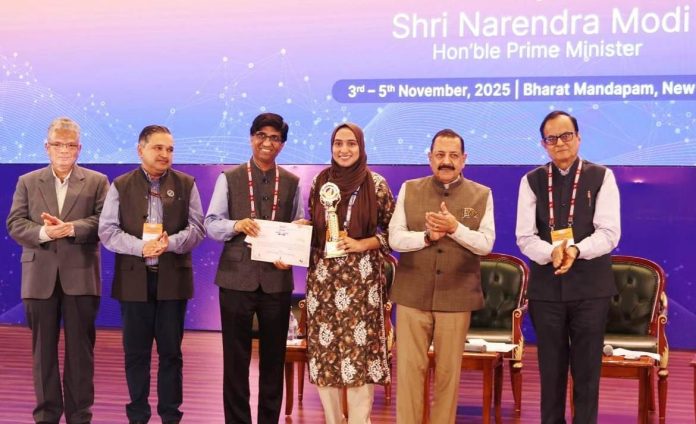
Adiba, a research scholar from the Department of Physics, AMU, receiving the Best Poster Award at the Emerging Science, Technology and Innovation Conclave (ESTIC) 2025
Aligarh:
Adiba, a research scholar from the Department of Physics, Aligarh Muslim University (AMU), has brought laurels to the University by winning the Best Poster Award at the Emerging Science, Technology and Innovation Conclave (ESTIC) 2025, organised by the Department of Science & Technology (DST), Government of India. The prestigious event was held at Bharat Mandapam, New Delhi.
The conclave, inaugurated by Prime Minister Narendra Modi, was supported by thirteen ministries and departments of the Government of India, showcasing the nation’s growing emphasis on innovation and scientific advancement.
Adiba received the award from Dr. Jitendra Singh, Union Minister of State (Independent Charge) for Science & Technology, and Prof. Abhay Karandikar, Secretary, DST, in the presence of Prof. Ajay Kumar Sood, Principal Scientific Adviser to the Government of India, along with several eminent scientists and leaders of India’s science and technology ecosystem.
Out of over 1,000 entries received from across the country, 100 were shortlisted for presentation at the conclave. From these, only five participants were selected for the top honours.
Adiba’s award-winning poster, titled “Bipolar Resistive Switching in Forming-Free, Flexible, and Transparent ReRAM Devices”, showcased her pioneering research on resistive switching mechanisms for neuromorphic and in-memory computing applications – a key area in next-generation electronic devices.
Expressing her gratitude, Adiba said, “It’s an honour to be recognised for my research on such a prestigious platform graced by leading scientists. I am deeply thankful to my supervisor, Prof. Tufail Ahmad, for his constant guidance and support.”
The achievement marks another proud moment for AMU, underscoring the university’s strong contribution to cutting-edge scientific research and innovation.
source: http://www.radiancenews.com / Radiance News / Home> Pride of the Nation> Awards>Latest News / by Radiance News Bureau / November 11th, 2025