Category Archives: First War of Independence 1857 / Naval Mutiny 1946 / Others PreIndependece (wef. July 27th, 2022)

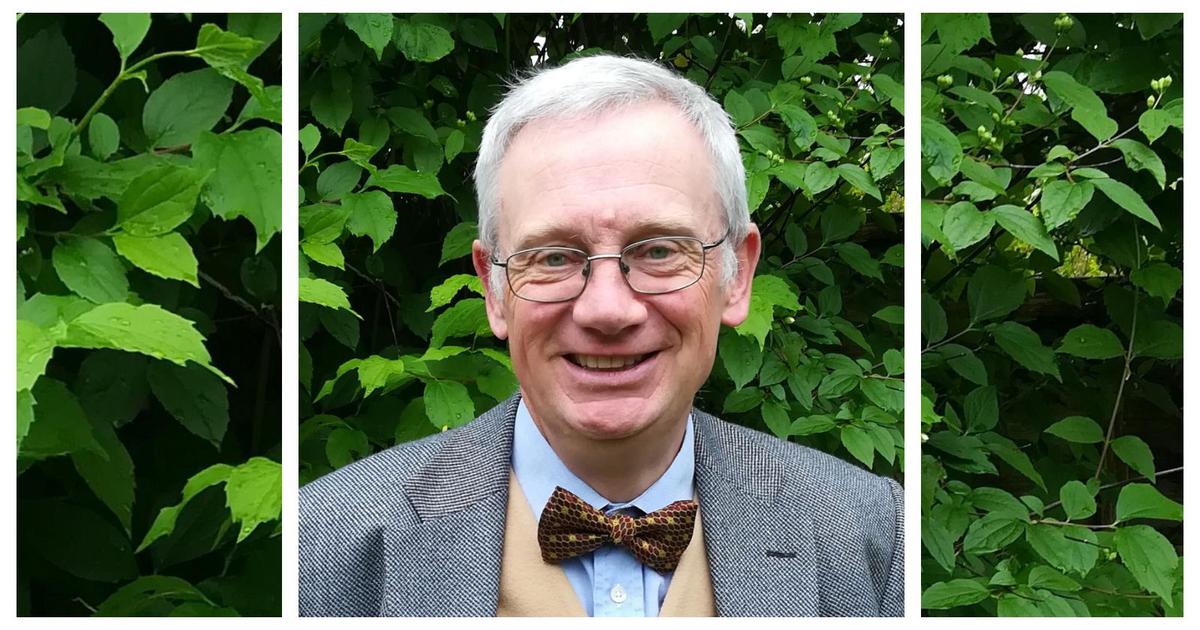
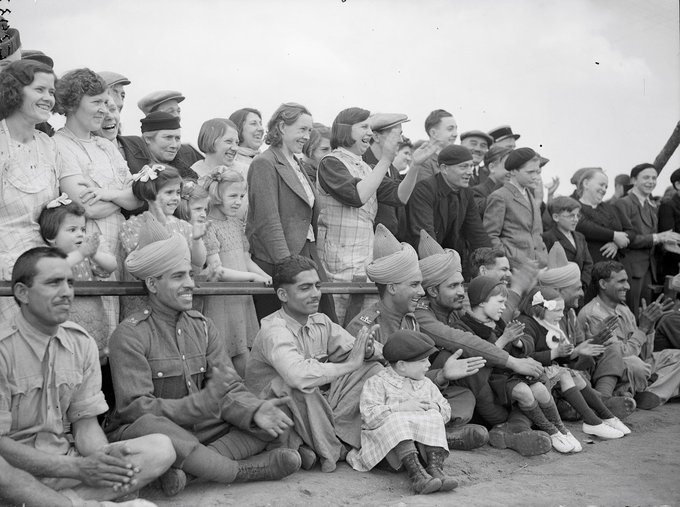
Ghee Bowman (1961-2025): A British historian who unearthed the stories of Indian soldiers at Dunkirk

BRITISH INDIA :

He shone the spotlight on the often-ignored role of the 2.5 million members of the British Indian Army who had served during the Second World War.

Historian Ghee Bowman. | https://www.forcek6.org.uk/about

One day in 2013, when Ghee Bowman was working on a project on the city of Exeter’s multicultural history, he found a book featuring three photographs of Indian soldiers in the English county of Devon during the Second World War.

It piqued his curiosity.

“I thought I knew about the Second World War, but I’d never imagined that there were Indian soldiers with turbans and mules in Devon,” he wrote.

Though he had a BA in drama, Bowman decided to start an MA in history – and went on to write a PhD dissertation on the 4,227 men of Force K6 contingent who spent most of the war in England.

Through their stories, he shone the spotlight on the often-ignored contribution of the 2.5 million men and women of the British Indian Army who had served during the Second World War.

When Bowman started digging, he found that the British Army arrayed against Nazi Germany in Europe early in the war needed mules to transport artillery and supplies. The men of Force K6 and their mules were shipped in from India, more than 11,000 km away.

Several had been evacuated from Dunkirk in France in 1940 when the Allied defense collapsed and spent years in England.

source: youtube.com

Before Bowman died on May 10, he had spent the previous 12 years researching the Indian Army in Europe during the Second World War. His two books on the subjects are superbly researched and cracking reads.

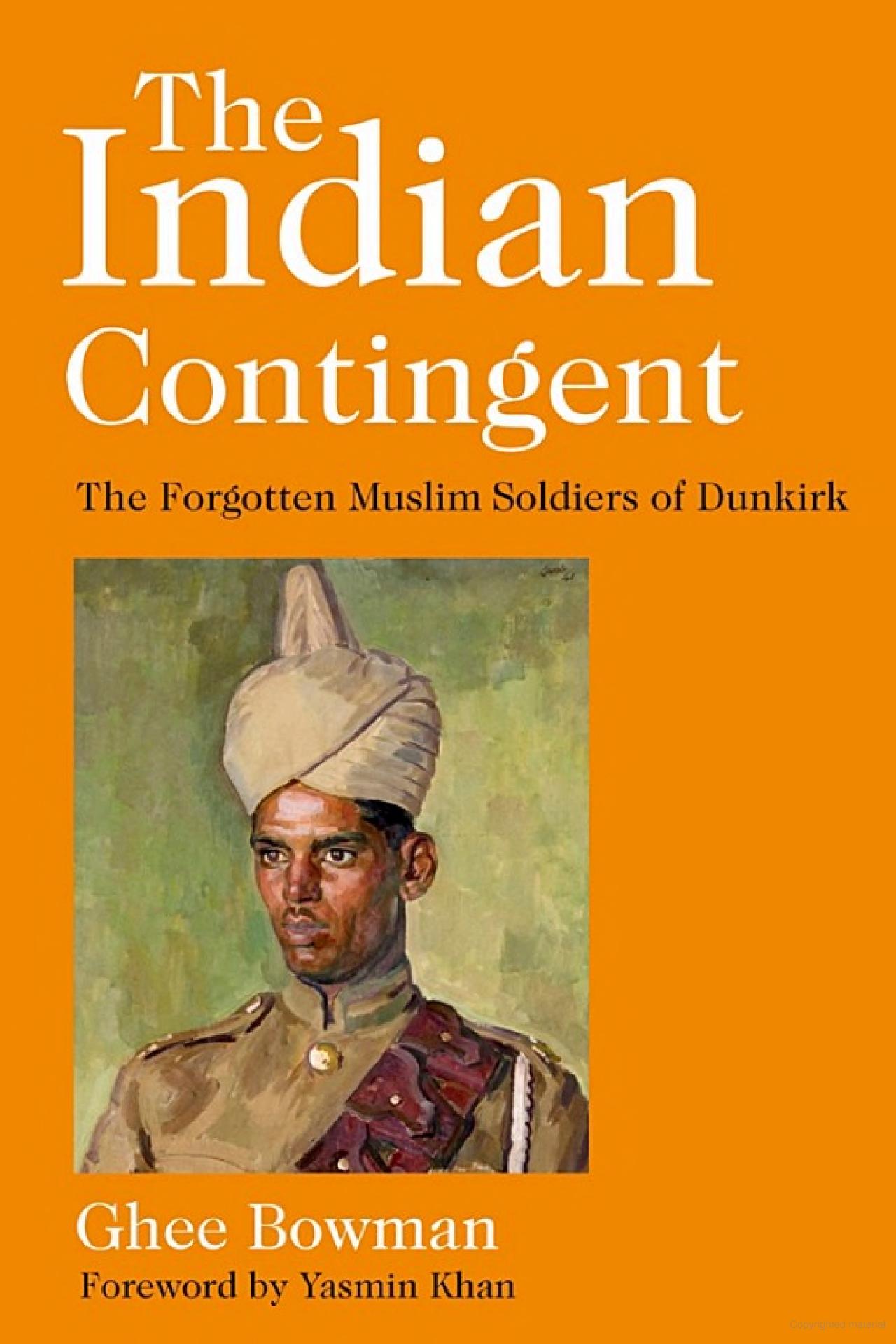
pix: google.co.in/books

Bowman’s first book was The Indian Contingent – The Forgotten Muslim Soldiers of the Battle of Dunkirk, published in 2020. It is the story of the 299 men of the 25th Animal Transport Company of the Royal Indian Army Service Corps.

Because the British used to group men of the same religion and creed together, these men were mainly Muslim. The role of Indian soldiers fighting in North Africa and Italy during the war had been documented. But little was known about the men who were in France.

The Great Epinal Escape – Indian Prisoners of War in German Hands was published in late 2024. Bowman had been toying with the title The Greatest Escape, a reference to the popular movie about the war, The Great Escape. It was about the escape of 500 Indian prisoners of war from a camp at Epinal in France in 1944.

On May 11, 1944, American planes bombed a camp at Epinal in France housing 3,000 Indian prisoners, breaking some walls. Several hundred escaped, of whom 500 reached Switzerland. It was the largest PoW escape during the Second World War.

Though the Indians were conspicuous in the middle of France, they managed to make their way across the border through their grit and the bravery of civilians who helped them along the way.

______________________________

Ghee Bowman / @GheeBowman

#OTD 11th May 1944; a sunny day in Épinal, a small town on the river Moselle, close to the Vosges mountains and Germany. The scene is set: nobody knows that this quiet French place, untouched by war since 1940, will become the site of the largest POW escape of #WW2

1:21 PM . May 12, 2024· / 18.7K View

________________________

Very little has been written about the experience of individual Indian soldiers in the Second World War. With his micro-histories, Bowman took a step towards filling this gap – and pointed the way for other researchers to do so too. Besides, in a time of rising xenophobia in the UK, Bowman’s work serves as a reminder of the long presence of South Asians – and Muslims – in the country and their contributions to keeping it secure at one of its most vulnerable moments vulnerable moments .

After submitting the manuscript for his second book, Bowman wondered how he could do more to tell the story of Indian soldiers during the Second World War. About six months ago, he decided that he had he hit upon the best and most gratifying way of doing this – not by writing more books or articles and making podcasts but by helping families get to know more about a grandfather or uncle who had fought in the conflict.

This would not result in thousands of social media posts and perhaps only one family would get to know about the work. But to Bowman, helping even one person trace their family history was priceless.

“I’m very happy to share what I already know with families and the wider Indian public,” he wrote. “I’ve got letters, photos, recommendations for medals that I’ve found in archives and newspapers. I would love to be able to restore these to the descendants of these brave men.”

He decided to co-opt the willing and reached out to researchers across the world. He created a page on his website listing useful resources. I was proud to be his man in India and Southeast Asia.

____________________

Ghee Bowman / @GheeBowman

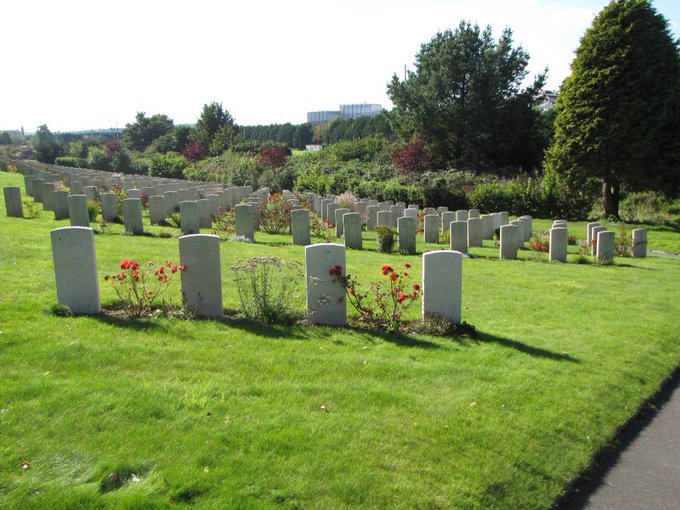
To the good people of #Plymouth. As you think about Muslims in the city this morning, you might like to know about the 4 Muslim graves at Weston Mill Cemetery, 3 miles from where the #plymouthriots happened last night.

@BBCSpotlight / @Plymouth_Live / @SAHM_UK

5:30 PM . Aug 06, 2024 / 3,216 Views

_____________________________________________________________

____________________________________________________________

Ghee Bowman / @GheeBowman

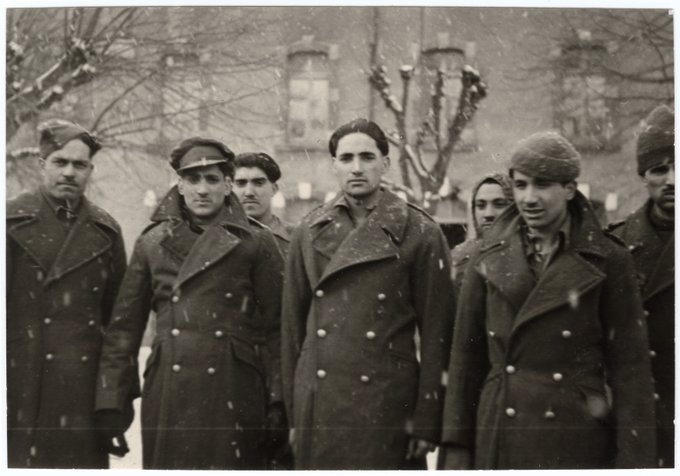
These four men were soldiers of the Indian Army, part of #ForceK6 – Muslim Punjabis sent 7000 miles to help the British in its hour of need. Here are some of their officers inspecting coastal defences in November 1941.

5:30 PM . Aug 06, 2024 / 264 Views

_______________________________________________________

I had the privilege of getting to know Bowman in June 2023, when I reached out to him as I had just begun researching the Indian Army in World War II Singapore. He helped me find sources, to write a book proposal and introduced me to his publishers and others who turned out to be crucial for my own book.

Even as he was trying to help family members trace their relatives, Bowman had been going through a grave personal health crisis. In his regular newsletter in May 2024, he mentioned that he had a fall. His last newsletter was on February 1. He said he had been diagnosed with a brain tumour, was undergoing radiation and chemotherapy and doing well.

He died three months later. Bowman once described himself as “a historian, teacher and story teller…a Quaker and a lifelong learner”. He was all that and much more – he helped others without any gain for himself.

Gautam Hazarika is a Singapore-based author whose book The Forgotten Indian Prisoners of World War II is being published by Penguin India and Pen & Sword UK later this year. He can be contacted at  ghazarika70@yahoo.com.sg

source: http://www.scroll.in / Scroll.in / Home> Tribute / by Gautam Hazarika / May 27th, 2025

Tipu Sultan’s sons engineered the Vellore Mutiny

Srirangapatna (Mysore) KARNATAKA :

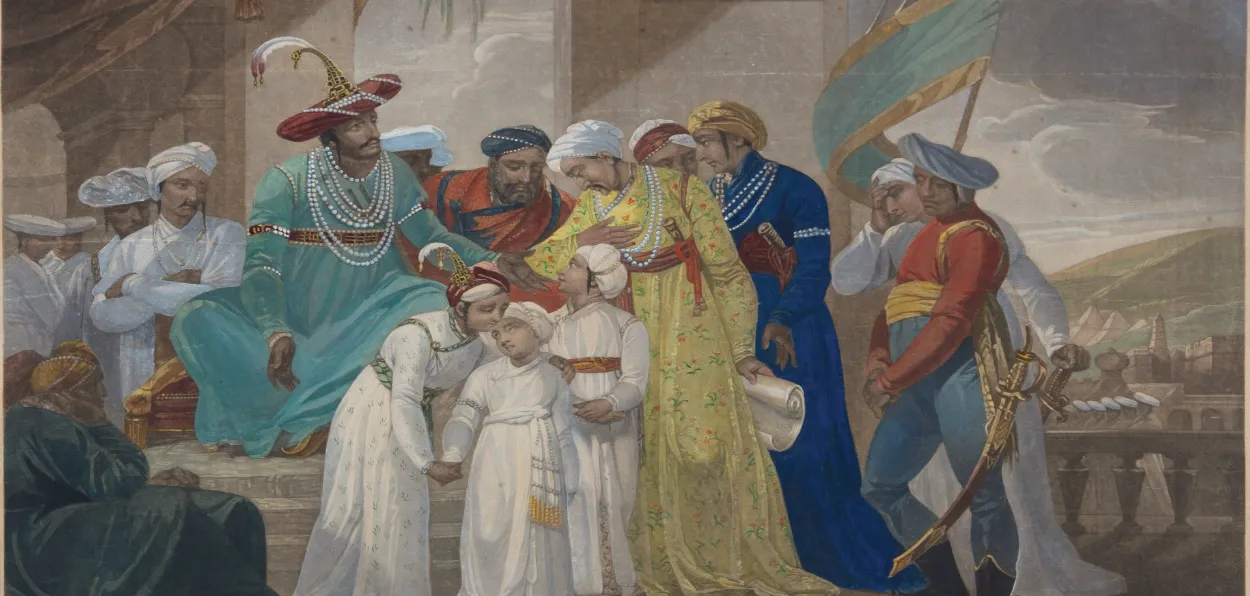
Tippoo Sultaun delivering to Gullum Alli Beg the Vakeel his sons who are taking leave of their brother previous to their departure from Seringapatam (1793) Painting by Henry Singleton

“The Christian drummers were seized, taken to the palace where Tippu’s sons were confined, and made to beat the “general” ; lights flashed in the palace, refreshments were brought out; a mob of sepoys called on the princes to place themselves at their head; Tippu’s own flag, green stripes on a red field, was nailed to the flagstaff. Prince Muizuddin (son of Tipu Sultan) ordered his horse to be saddled, and told off a party of sepoys to go and seize the principal hill fort; when that was captured and the dead body of Colonel Marriott, paymaster of stipends, brought before him, he promised he would mount his horse and ride through the native town proclaiming the restoration of the Mahommedan power.”

A Slice of History

This is the account by Colonel Alfred Keene of the night of 10 July 1806 at Vellore. The rising, popularly known as the Vellore mutiny, was a dress rehearsal of a sort of what would happen in May 1857 at Meerut.

Keene pointed out, “In the mutinies of Vellore and the greater one of 1857, two points of similarity stand out prominently. In each is the unreasoning fear of an attack on the institutions of religion and of caste; for the greased cartridges in the latter mutiny had as much to do with the outbreak as had the new head-dress in 1806, and the presence of the remnants of the Moghul Dynasty at Delhi acted in 1857 precisely as had the presence of Tippu’s family at Vellore in 1806.”

After the fall of Tipu Sultan in 1799, the English East India Company shifted his children to Vellore. In early 1806, the Commander-in-Chief ordered a new headgear and, the removal of beards, tilaks, earrings, or any mark of caste identity.

The Indian sepoys of the 2nd Battalion 4th regiment showed dissatisfaction in May 1806 and disobeyed the orders. These sepoys were tried in army court and 21 of them were found ‘guilty’. Of them, one Hindu leader and other Muslims were discharged from the duty and sentenced to receive 900 lashes each. The other 19 were not discharged but ordered  500 lashes each. The order was passed on 29 June and published to the army on 2 July 1806.

The wife of a serving English officer at Vellore, F. W. Blunt, wrote in a letter to her family in England, “Nine of the ringleaders, as they were called, were brought down to Madras and here passed publicly through the streets in irons, destined to receive the most dreadful military punishment…… The nine men in irons awaiting a most severe punishment was made use of by the sons of Tippoo, who have been kept prisoners in the Palace at Vellore since the taking of Seringapatam and served to ripen a design that had been long formed. A conspiracy was formed by the Sepoys to murder all the Europeans and take possession of that Fort.”

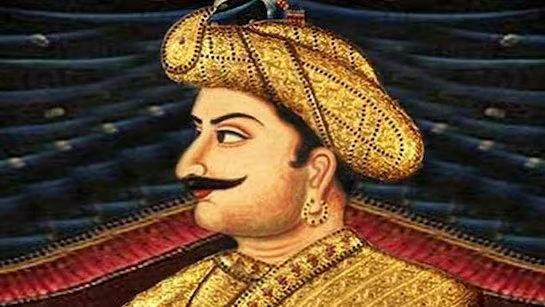
Tipu Sultan

On the night of 10 July 1806, Shaikh Kasim, a sepoy, led the English East India Company sepoys in starting a general massacre of the English troops.

Lt. Col. W. J. Wilson in ‘History of the Madras Army’ wrote, “The sepoys went away shortly afterward, and were heard to call out “Come out, Nawab, come out, Nawab, there is no fear.” This was supposed to be addressed to Futteh Hyder, the eldest of the four Mysore Princes.”

Of the 372 Englishmen present at Vellore, 128 were killed that night by the Indian sepoys. The English flag was replaced with the flag of Tipu Sultan, which was handed over by Moizuddin, the eldest son of Tipu. He was proclaimed the leader of the revolutionaries.

Though the immediate cause was the headgear and other orders, the revolt had been planned for a long time. Charles Macfarlane wrote, “The splendour which the sons of Tippoo were enabled, by the liberality of the Company, to keep up, attracted a continual influx of visitors, including all that came to Vellore from the countries which had once belonged to their father. Among these men were very many who had lost by the change which had taken place in Mysore, who hated the tranquillity which we had introduced into their country, and who longed for the old days of rapine and violence. It is believed that these desperadoes contributed to a regular conspiracy and facilitated the execution of the daring design.

It is said that the confederates intended that all who were brought to join in the insurrection should act upon a preconcerted plan, which had been digested and privately circulated by some of the turbulent Marawa chiefs; and that in connection with these desperadoes were some few Frenchmen, disguised as fakeers or dervishes, who went about the country inveighing everywhere against the English as robbers and tyrants. It is also stated that placards were fixed up within the mosques and Hindu temples, where Europeans never entered, to excite a general spirit of revolt among the whole native population of Madras.”

The English Government set up an enquiry commission headed by Major General Pater which submitted its report on 9 August 1806. The report said, “There are two principal causes which appear to us to have led to the mutiny. The late innovations in the dress and appearance of the sepoys, and the residence of the family of the late Tippoo Sultan at Vellore.”

Sir J. F. Cradock, the Commander-in-Chief, disagreed with these findings and argued in his submission that change in dress was a pretext and the real objective was to restore the rule of Tipu Sultan’s family. 

The Court of Directors after the investigation declared that the “immediate cause of the discontent among the sepoys was the introduction of certain innovations in their dress, which were offensive, and, as they held, degrading to them; and that the captive sons of the late Tippoo Sultan, with their adherents and abettors, took occasion, from the dissatisfaction of the sepoys, to instigate them to insurrection and revolt, with the view of effecting their liberation, and the restoration of the Mahomedan power.”

The mutiny was suppressed by noon on 10 July. Colonel Gillispie stationed at Arcot came to rescue the Englishmen at Vellore before 7 am. His forces, which also included Indian sepoys, killed more than 500 Indians in the fort within a few hours.

At least 15 English officers including, Colonel Fancourt, H.M.’s 34th regiment, commanding the garrison, Lieutenant-Colonel McKerras, Captain Willison and Lieutenants Winchip and Jolly of the 23rd, Captain Miller, Lieutenants O’Reilly, Smart, and Tichbourne of the 1st, and Lieutenants Eley and Popham of the 69th, Mr. Mann Deputy Commissary of Stores, Mr. Gill Conductor of Ordnance, Mr. Smith the Military Paymaster and Major Armstrong of the 16th N.I. were killed.

Among the captured sepoys, six were blown away with cannon guns, five were shot by firing squads, eight were hanged, and several others were transported for life. Out of the retainers of Mysore Princes, one was sentenced to death, two to transportation for life, one to imprisonment for life, and one to imprisonment for ten years. The sons of Tipu Sultan were sent to Kolkata with stricter vigilance.

Lord William Bentinck, Governor, and Sir J. F. Cradock, C-in-C, were removed from their respective offices by the Court of Directors.  

source: http://www.awazthevoice.in / Awaz, The Voice / Home> Stories / by Saquib Salim / July 10th, 2025

Forgotten martyrs: Nawab Kadar Ali, his companions were hanged by British at Sitabuldi fort in Nagpur

Nagpur, MAHARASHTRA :

More than seven decades after India achieved independence, the role of innumerable martyrs and freedom fighters who gave their blood and offered lives for the motherland, needs to be remembered. 

Many of them got harsh punishments, didn’t get proper last rites, remain forgotten and even those whose sacrifices are known, don’t have monuments or memorials built in their memory.

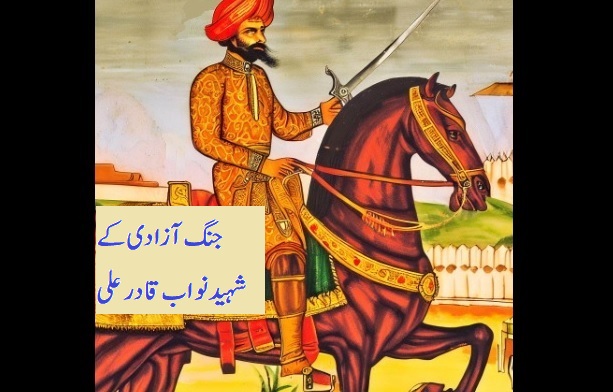
The martyrdom of Nawab Kadar Ali, and his companions, who planned attack on residency and to take on the East India Company forces in Nagpur, also needs to be recalled. They were hanged here for their role in 1857–the first war of independence.

Though there is no monument named after them and no big memorial, they remain heroes in public memory. The fort that had been a base of 118 Infantry Battalion for years, is opened on three days including August 15 and January 26. Thousands of people arrive on these days, and also pay visit to the grave and offer their respects.

The flame for independence was already lit. History books mention that soon after Meerut, the anger was palpable among soldiers and citizens in this region too. On June 13 1857, a large gathering took place near Mission High School. The soldiers too were anxious and ready. 

Scared, some of the East India Compnay officials ran towards Kamptee Cantonment, while others went inside the Sitabuldi Fort. It was due to treachery that the attack plans had been leaked and the news reached British officers. More EIC forces were called from other places to control and overpower the rebels.

Rani Baka Bai, wife of late Raghoji II, was supporting the British and issued a warning that anyone abetting or aiding the revolutionaries would be arrested and handed to the East India Company. It’s a long story and how the soldiers and citizens suffered, refused to name the leaders of the movement. 

Historical texts say that the signal of a fire balloon was decided. But after the traitors gave information to East India Company officers, Plowden, the commissioner, ordered a regiment to move into the city. The irregular calvary at Tali was dismayed. Major Arrow tried to get information from ring leaders but no one gave names.

Baka Bai summoned all her relations, and dissuaded them with threats. This chilled the spirit of public. However, later when Company officials’ strengthened their hold, the rebels were identified. Arms were collected and after inquiry, Dildar Khan, Inayatullah Khan, Vilayat  Khan and Nawab Kadar Ali were tried and executed.

KILLED, HANGED, BURIED IN A COMMON PIT

The Gazetteer briefly mentions that ‘tucked away between the easter walls of the inner fort and the barracks is a large grave known as Nav Gazah Baba…the grave of Nawab Kadar Ali…and his eight associates..who were killed and hanged by the ramparts of the fort due to their role in the war of independence”. 

“They were all buried in a common pit, nine yards long. The fort recalls to our mind the memory of the brave soldiers who fought in an attempt to preserve the independence of the mother land”. It was treachery that was responsible for the arrests and the punishment.  Those who helped the British, got ‘jagirs’ as rewards.

Ghulam Rasool ‘Ghamgeen’, the poet, wrote these lines in Farsi :

Choo.n Qadar Ali Khan Ameer Kabeer
Shud-az-tohmat, ahl-e-balwa aseer

Bajurm shiraakat girafaar shud
Chau mansoor, Hallaj, bar-daar shud

Duaa’e shahaadat ba-raahe Khuda
shab w roz mi kard aa.n mahtada


Khirad guft ee.n misra-e-silk-e-noor
Za-daar-e-jafaa shud ba-daar-e-suroor

The last couplet of this long Persian verse, brings out the ‘tarikh’, the year of execution. The complete verse is mentioned in Dr Mohammad Sharfuddin Sahil’s book ‘Tarikh-e-Nagpur’. It shows the impact of the hangings on the people in the region. Nagpur is geographillcally considered to be a part of Central India and is the biggest city in Vidarbha region of Maharashtra.

The fort for a long period remained the base of 118 Infantry Battalion of Territorial Army. Every year, on August 15 and January 26, fort is opened for public so that it can pay respect to the freedom fighters. It’s also opened on May 1 i.e. Maharashtra Day. [Illustration is representive]

source: http://www.newsbits.in / NEWS Bits / Home> Top News / by Shams Ur Rehman Alavi / August 15th, 2021

Kunjali Maraikkayar; Kutty Muhammad Ali Maraikkayar – 01st in the series of Famous Indians by Al Waris Art & History Project

SOUTH INDIA :

PIX

Maraikkayar (Marakkalalaayar/Marakkar) name refers to the community people who drive business belonging to boats, ships, fishing etc. Maraikkayar is the community they belong to TamilNadu, Kerala & Lanka.

The muslim trade community history record is available in pandiyas, portuguese, french, english.

They are also called Maraikka, Naguda, Malumi, Sukkani & Serangu. (4Kunjali Maraikkayar – Kunjali Maraikkayar I = Kutty Ahmad Ali (1507 – 1531 / 1507 – 1538 / 1520 – 1531 / 1520 – 1538), Kunjali Maraikkayar II = Kutty Pokker Ali (1531 – 1569 / 1531 – 1571), Kunjali Maraikkayar III = Pattu Maraikkar (1571 – 1595), Kunjali Maraikkayar IV = Muhammad Ali Maraikkar (1595 – 1600) Kunjali Maraikkayar was the leader of the marine force for the Kozhikode Raja Samoothiri (Zamorin Dynasty).

Maraikkayar people have done the export business such as rice, ginger, cardamon, pepper, turmeric. Vasco Da Gama landed in Kozhikode in 1498 May 17 or 28 From that he stayed for 86 days. The Portuguese and European traders were not like the Arab traders, Europeans expected monopoly business. European objectives like we only should do the business and not others. The Europeans used firearms, which were invented, produced by the Chinese and then exported to Europeans directly.

In the year 1498 Nov he went back to Portugal. In the year 1503 Vasco da Gama again came back to Hindustan with 1200 Dutch forces. Martin De Souza came with 25 navy ships to attack Kozhikode Samoothiri. Samoothiri made the discussions to attack the Portuguese. Kunjali Maraikkayar advised Samoothiri Raja (Maana Vikraman) that he would start the merchant navy force and attack the Portuguese. Kunjali Maraikkayar constructed the ships with his own wealth.

Vasco da Gama asked (Kalappana Nambudiri) the messenger of Samoothiri whether can we do something to defeat Samoothiri, but he was very honest for his Raja so Vasco da Gama slaughtered the messenger’s ear and stitched the dog’s ear in Kalappana Nambudiri. Vasco da Gama was the one who ordered Samoothiri to avoid doing business with Arabs and to do business only with him. So Vasco da Gama went to ask help with Kochin Raja and he helped to attack Zamorin ships.

Kunjali Maraikkayars fought against the Portuguese for 80 years. Kunjali Maraikkayar I fought against Portuguese Robbers in Kunjali Maraikkayar I fought against Portuguese Robbers in Kilakarai & Vedalayam (Rameshwaram), Kayalpattinam, Nagore, Thoothukudi, Kunjali Maraikkayar I In Thoothukudi dist. There is a perumal koil in madavankurichi (Kunjali Maraikkayar) is worshipped as merchant navy god!

*In the year 1510, Portuguese (Martin De Souza) captured the place Goa. *In the year 1520, Youe De Emiliyo (Leader of Portuguese) attacked Kunjali Maraikkayar navy ships. But Kunjali Maraikkayar attacked and defeated Portuguese from Kozhikode till Goa. At this time from the Deccan (South Hindustan) Avvaro Sante Mehri (Portuguese Leader) attacked Kunjali Maraikkayar with the help of (Portuguese Robbers) Viceroy Di Mento’s 36 ships attacked Kunjali Maraikkayar’s ships. Kunjali Maraikkayar attacked back and killed Viceroy Di Mento (Portuguese Trade Robbers).

*In the year 1521, the Portuguese tried to capture ponnani. So Ahmad Maraikkayar, his brother Kunjali Maraikkayar I, their uncle (mama) Muhammad Ali Maraikkayar from Kochi started to stay in Kozhikode.

*In the year 1523,Samoothiri II made an agreement with the Portuguese because of fear. But Kunjali Maraikkayar I was not getting any help from the government even though he prepared 200 navy force ships for the battle against the Paraingyar. *In the year 1524, Kunjali Maraikkayar I Vs Paraingyars fight was furious, Kunjali won the match, he was shown in the eyes of Parangyars Kunjali hero! *In the year 1525, Kunjali Maraikkayar I and his team lost the battle against the Portuguese. *In the year 1526, Portuguese Robbers attacked suddenly in Barkoor (place name) but Kunjali Maraikkayar and his team attacked and defeated Portuguese. But both of them were having losses. *In the year 1528, Kutty Ali & Kunjali Maraikkayar I and his team Vs Portuguese fought in Barkoor but Kutty Ali was prisoned by the Portuguese. *In the year 1528 in Sethvai, Portuguese stealed, robbed many goods and planned to travel by many ships to Portugal but Kunjali Maraikkayar I attacked Portuguese ships, killed all Portuguese enemies and won the battle. *In the year 1531, Kutty Ahmad Maraikkayar fought against Paraingyars, but due to the extreme war event Kutty Ahamd Maraikkayar was martyred in the battle.

*In the year 1535, Admiral Suleiman Batcha went along with (ruler of Kozhikode) Samoothiri fought and won the battle against Parangiyars.

*In the year 1537, the nomad ‘Kunha’ became the governor and tried to capture Kozhikode, also tried to build the fort in Chaliam, this time Kunjali Maraikkayar II fought against them and won the battle. In the Nagapattinam seashore also the war happened, Kunjali Maraikkayar II went with 51 ships that included around 8000 soldiers to attack them. *In the year 1538, Kunjali Maraikkayar I fought against the Portuguese but he lost the battle. (source Prof. MH Jawahirullah)

*In the year 1565, Thirumala Devarayan Vijayanagar Raja (Krishnadevarayan’s 5th Generation/Grandson of Krishnadevans Grandson’s son) helped the Portuguese by providing money to fight with Maraikkayar & Zamorin. Raja told the Portuguese you attack from the sea, we will attack from the land. Even though they can’t handle Kunjali Maraikkayar III = Pattu Maraikkar (source; Portuguese viceroy’s book – The travels of Francois spirad in the East Indies, Morocco and Brazil)

*Kunjali Maraikkayar I was martyred for the country of Lanka.

*After him, his family took incharge of the protest and fought against the enemies, drohis. In the year 1570 Peppur lake, Chaliam Fort battle Kunjali Maraikkayar II fought against enemies of 65 years war, won and controlled them.

*In the year 1572, Parangyars force stealed, robbed the goods from the masjids, temples, kozhikode port, Thirukodi port, Kappakkattu port, Ponnani port and made huge losses.

*In the year 1586, Kunjali Maraikkayar III fought against the enemies and won the battle.

*In the year 1589, Son-in-Law of Kunjali Maraikkayar III Kuwaji Musa fought against Parangyars and won the battle.

*In the year 1595, Kunjali Maraikkayar IV fought against Parangyars. But the ruler of Kozhikode Samuthri had a secret agreement with the grandson of Vasco da Gama – Francisco da Gama. Kunjali Maraikkayar IV was not aware of this secret agreement, he went to meet the Kozhikode ruler Samoothiri, but the Kozhikode ruler prisoned him and gave it to the parangyars (Lanka Burghers). They tortured by chaining him, without providing any food, sleep made him to die.

Source: India Veeramigu Muslimgal Book by Sh. AbdKader Kashifi, Kasimi

Note: Haji Pakkir Muhammad Sett was the one who donated Rs.2,00,000 to buy the Sudeshi Ship, VO Chidambaram was the captain of the ship.

(Kunjali IV also fought for Sultan of Bijapur & Rani of Pulal!)

Kunjali Maraikkayar built 999 ships, finally his last 1000th ship he planned to build it without any screws. He fought against the Portuguese in Lanka, but portuguese were angry with him and got angry with him they used the chance to kill 700 people in Thoothukudi. So Kunjali Maraikkayar came to Thoothukudi to fight against the Portuguese and won the battle.

And then he went to Lanka. After a couple of months he was martyred by a Portuguese gun bullet in Lanka and buried there. For 25 years he has done the trade by ships. Kunjali Maraikkayars and his team have built 4 forts near the seashore. The fort itself 20 mile from the one to another! Portuguese spied in a wrong way to the raja that he will build a new nation for the mopillas. Raja cheated Maraikkayars by handing him to the Portuguese but Portuguese cheated Zomarin Samoothiri Raja by killing them!

Article by :

AlWaris Art & History Project, KONAKIND FOUNDATION (This AlWaris Art & History Project will focus for Indian history, modern India and the comparison with current India.)

Contributions Welcome:

Contribute your wealth to improve & develop the projects for art & history project you can send Rs.1000 for books also you can email us if you can send us the historical books, Rs.1000 for travel expenses & Rs. 2000 to collect and store the historical coins/clothes, etc:

A/c info: KONAKIND FOUNDATION
A/c: 42849410432
IFSC Code: SBIN0003994
KONAKIND FOUNDATION
Email: konakindfoundation@gmail.com

Nawab Shaffan Khan, heir of Nawab Khan Bahadur Khan, passes away – Urdu News Bareilly

Bareilly, UTTAR PRADESH :

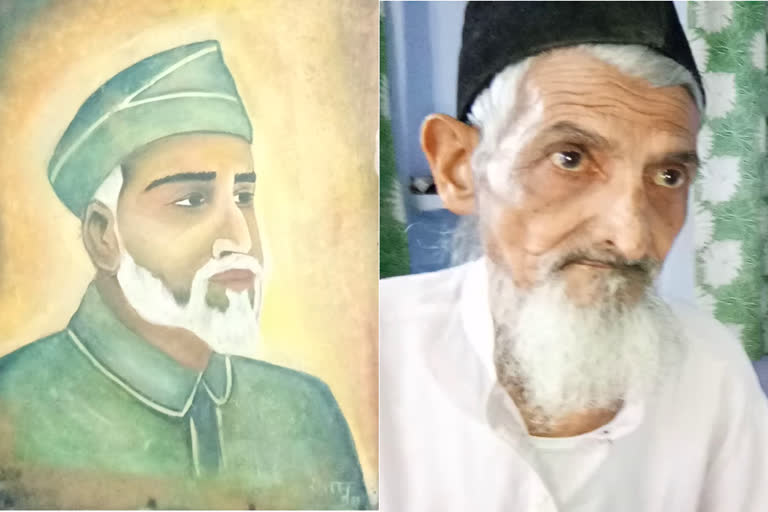
Nawab Shafan Khan, the heir of Nawab Khan Bahadur Khan, who kept the Rohilkhand region free from British rule for eleven months during the 1857 freedom movement, has passed away.

Nawab Shafan Khan breathed his last at the age of 80. The sacrifices of his ancestors are recorded in golden words in the pages of history.

Death of Nawab Shaffan Khan, heir of Nawab Khan Bahadur Khan

Nawab Shafan Khan, a resident of Shahabad area of ​​Bareilly city, has passed away. He was laid to rest in Bhor graveyard near his home after Zuhr prayers. He was the heir to a great family whose ancestors ruled not only Bareilly but also in about 9 surrounding districts. His great-grandfather Nawab Khan Bahadur Khan had set a great example of bravery and sacrifice in the style of his namesake.

He was a hero of the 1857 revolution. He was born in 1791 into a Nawab family. He was the grandson of Rohilla Sardar Hafiz Rehmat Khan.

The slogan of revolution was raised in Meerut on 10 May 1857 and when the news of it reached Bareilly on 14 May, preparations were intensified here too. On 31 May, Khan Bahadur Khan and his generals and soldiers, led by Subedar Bakht Khan, declared a rebellion against the British government.

Tomb of Nawab Khan Bahadur Khan

The then magistrate, civil sergeant, jail superintendent and principal of Bareilly College, “C.Buk”, were killed by the revolutionaries. By five in the evening, the revolutionaries had taken control of the Bareilly division.

On June 1, these revolutionaries took out a triumphant procession. When the procession reached Kotwali, a large number of Bareilly citizens crowned Nawab Khan Bahadur Khan and elected him the Nawab of the Bareilly division.

Heir of Nawab Khan Bahadur Khan

An example of the bravery of Nawab Khan Bahadur Khan is that despite the numerous atrocities and abuses of the British government and being a powerful ruler, he kept the Bareilly division free from the rule of the British government for eleven months.

However, later, the British government arrested Nawab Khan Bahadur Khan while fighting a war at one place. He was brought to the same Kotwali where he was awarded the title of Nawab. He was imprisoned and kept in an unknown place.

Then on February 24, 1860, the hero of the urban people was brought on foot to the Kotwali and hanged on the same day at 7:10 am. A strange silence fell in the city and darkness prevailed.

Heir of Nawab Khan Bahadur Khan

To prevent any unrest in the city after the hanging of Nawab Khan Bahadur Khan, his body was taken to the district jail in an armored police vehicle and buried in the premises of the district jail.

Heir of Nawab Khan Bahadur Khan

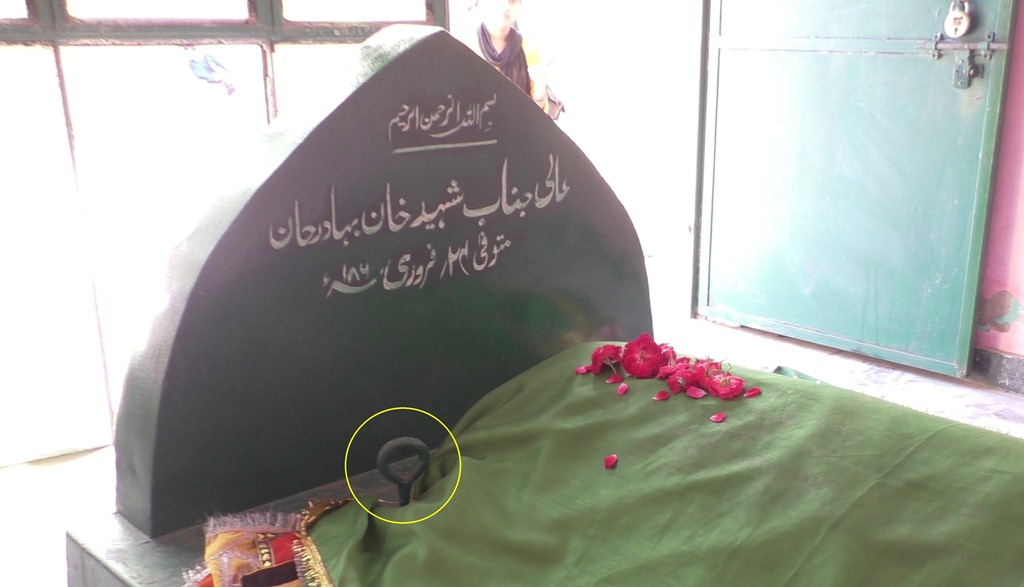
The special thing is that he was buried with irons. Even today, the irons are clearly visible on the head of his grave. The British government had also buried Khan Bahadur Khan in the prison premises so that people could not gather at his grave and there would be no further excitement in the revolution.

Now let us mention Nawab Shafan Khan, the heir of Khan Bahadur Khan. He struggled for life and livelihood till his last breath. Despite belonging to the Nawab family, his family had to face difficulties for years or even their entire lives. Despite this, the struggle did not end in his life till his last breath.

According to his younger brother Nawab Liaquat Khan, Nawab Shaffan Khan’s health had deteriorated for the past five days. He was unable to go to the mosque to offer prayers during those days. Due to the weak financial condition of the family, he was undergoing treatment at home. But in the morning, his health deteriorated further and he died after a few moments.

source: http://www.etvbharat.com / ETV Bharat – Urdu / Home> Urdu> State / by Urdu translation into English / July 02nd, 2021

Rare prints from Tipu Sultan era acquired by city-based collector

Bengaluru, KARNATAKA :

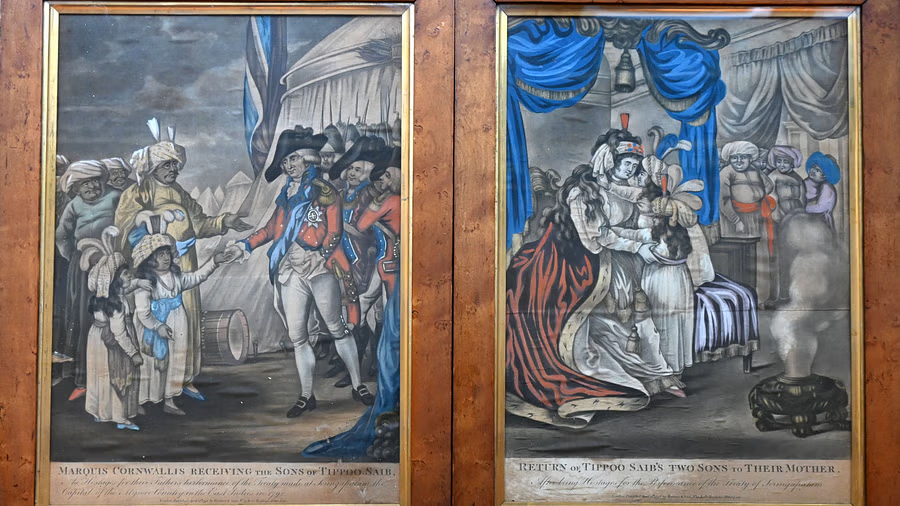
One print depicts Tipu’s two sons being taken hostage by Lord Charles Cornwallis, after the third Anglo-Mysore war in February 1792, and the other is a portrayal of their return to their mother.

The prints were made in 1796 by publisher Haines. / Credit: DH Photo/ B K Janardhan

A city-based art collector, Sunil Baboo, has recently acquired two rare prints of paintings from Tipu Sultan’s era. They capture significant moments in the history of the erstwhile Kingdom of Mysore.

One print depicts Tipu’s two sons being taken hostage by Lord Charles Cornwallis, after the third Anglo-Mysore war in February 1792, and the other is a portrayal of their return to their mother. 

History has it that Cornwallis laid out severe conditions Tipu had to adhere to in the Treaty of Seringapatam. He demanded that Tipu hand over his sons to British custody, until the king carried out all the demands he had agreed upon. 

“While there are multiple artworks depicting the moment of surrender, it is rare to come across one capturing the sons being returned to Tipu’s wife,” says 65-year-old Baboo, who has been collecting historic books, maps, aquatints and documents since 1982.

The creator of the paintings is unknown, but they were turned into prints in 1796 by publisher Haines. This was even before the defeat and death of Tipu during the fourth Anglo-Mysore war in 1799. “Many of these artists never set foot in India. They created these images based on what was described to them. While there was an artistic bent to them, it was more a way for them to document important events,” Baboo explains. Many of these prints were originally etchings and engravings that were coloured by hand, adds the Gangenahalli resident.

He learnt of the prints a few months ago, and was able to edge out some of the biggest auction houses like Bonhams, UK. “They were planning to auction them in June 2024, but I was able to procure them through my contacts,” he explains. Over the years, Baboo has built a wide network of collectors and auction houses that tip him off on new discoveries. Most of this category of prints are found in family collections of descendants of French and British soldiers of the colonial period. 

The prints, once discovered, are restored and framed. Baboo’s 16×14-inch prints came with a lot of archival tape and paper at the back of the frame. “Presumably to reinforce them. They can be kept in this condition for a long time,” he says. 

source: http://www.deccanherald.com / Deccan Herald / Home> India> Karnataka> Bengaluru / by Rashmi Rajagopal / January 24th, 2025

Syed Ahmad Khan’s book on Delhi and its ruins would ‘numb’ other writers, said Mirza Ghalib

DELHI :

Asar-us-Sanadid was published in 1847. Yet, Syed Ahmad Khan distresses over the ‘recent’ increase in Delhi’s population.

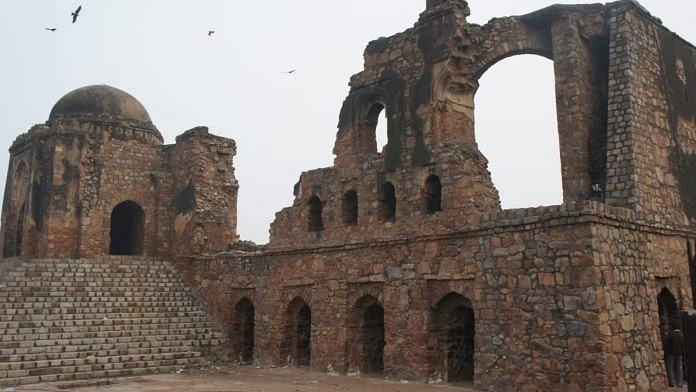
Ruins of Feroz Shah Kotla in Delhi | Commons

Delhi is introduced, interpreted, and celebrated all the time through walks, performances, talks and articles. But not many realise that the person who began telling the stories of Delhi was a young man in his 20s named Syed Ahmad Khan. Two centuries after he was born, his work Asar-us-Sanadid can now enjoy a wider readership because of its translation into English by Rana Safvi in 2018.

Syed Ahmad Khan was not the first writer to describe Delhi, but when he compiled his notes on the ‘remains of the great’ (asar-us-sanadid) into a book, he chose to write not in Farsi but in the accessible Urdu — making him a pioneer. Another first was that it appeared as a book rather than as a manuscript because his brother had just installed a new Urdu printing press in Delhi. Khan’s qualifications to write were not that of a narrow specialist. In those happy days, when education was not one fixed menu, he had studied science, mathematics, Farsi and Urdu. In his 20s, living in his family home in Shahjahanabad (present-day Old Delhi), Khan was a junior official in the East India Company, helping his brother publish an Urdu newspaper, and translating Farsi manuscripts.

Asar-us-Sanadid was published in 1847, and had a quality of eagerness explained by Khan learning the subject as he went along. Khan went to great lengths to transcribe inscriptions (‘He is climbing up with such enthusiasm/That people think he has some work in the sky’ was an affectionate comment about his swinging round the Qutub Minar in an improvised basket-and-poles contraption to read the inscriptions on the higher storeys). The artists’ drawings for the book were based on his own sketches.

There are very few extant copies of the original edition. The better-known second edition, published in 1854, bears the blue pencil marks of the Collector A.A. Roberts, who did a hatchet-job, reducing it by a half, adhering to chronology, giving British scientists a role in the Jantar Mantar project, removing all the poets and artists, and making it an altogether dull book.

Sights, sounds and silences

To Khan, historic architecture was not just patrons, materials, form and function. It was part of a continuous culture, nourished by new infusions. Political history, the overlapping cities and forts, the increasingly sophisticated elements in architecture – these became four-dimensional by reading mosques, dargahs and mazhars as sacred spaces, calm with the presence of mystics and scholars long departed. They were to be experienced in silence, reading the inscriptions, not listening to the patter of a guide. He delineates the complementarity of a vibrant urban culture —music, poetry, dance — and animated bazaars, the tranquil atmosphere of the countryside, fields and hills dotted with ruins. “The charm of the Delhi scene,” as historian Percival Spear would describe it a century later.

In a sentence that sounds startlingly contemporary, Syed Ahmad Khan is distressed by the “recent” increase in the city’s population, making it — and also the bracing hills of Mehrauli — unpleasantly congested. But he insists that “in spite of all these factors, the climate of Delhi is still a thousand times better than that of other cities.” The magnificent Mughal fort (remember that he was writing well before 1857) is described in the second chapter; Shahjahanabad in the third; the artists, poets and musicians in the fourth (the section captioned, charmingly, ‘The nightingale-like sweetly-singing people of Shahjahanabad on the outskirts of Paradise’).

Shining light on Delhi for other historians 

It was a challenging task. Delhi’s landscape was not easy to read in the complete absence of any older accounts or images. There was overlap, modification (particularly in the Qutub Minar area), vandalism (of poet Abdul Rahim Khan-I-Khana’s tomb by the ruler of Awadh). As a teenager, Syed Ahmad Khan was interested in astronomy, so his distress over the neglect of Jantar Mantar is understandable. He would have liked to spend more time studying it: “I will need a separate book to describe the workmanship, use and effectiveness of these instruments.”

Mirza Ghalib, in the ‘Foreword’, describes his friend’s book as one that would “numb the hands of other writers.” Khan’s meticulous account of buildings, even those in ruins, became the template for later books in English. “He who undertakes to write the archaeology of Delhi must constantly seek for light in the pages of Syed Ahmed Khan’s interesting work on that subject,” wrote Carr Stephen in The Archaeology and Monumental Remains of Delhi (1876).

More than 20 years lapsed between Asar-us-Sanadid’s second edition and Stephen’s book. A world separated the two publications. Khan, posted in Bijnor (in present-day Uttar Pradesh), was not caught in the trauma of 1857 (the Great Revolt). Some of the poets he had listed in Asar-us-Sanadid — like Ghalib — sought relief by writing laments to their ravaged city. His own reaction was different. With a sense of grief at seeing an efficient machine derailed, Khan would write Asbab-e-Baghawat-e-Hind (The Causes of the Indian Rebellion) to understand what had gone wrong. His bond with Delhi was severed. He went on to become a distinguished public figure in north India, remembered today for the institution he founded, the Aligarh Muslim University.

Hopefully, reading Asar-us-Sanadid now will return the young Syed Ahmad Khan to us. The past is in many ways a foreign country, and to walk with a guide through towns of the past is an invigorating exercise.

This article is the first of an eight-part series on Reading A City with Saha Sutra on www.sahapedia.org, an open online resource on the arts, cultures and heritage of India. Read the series here.

Dr Narayani Gupta writes on urban history, particularly that of Delhi. Views are personal.

source: http://www.theprint.in / The Print / Home> Opinion> Sahapedia / by Narayani Gupta / December 01st, 2019

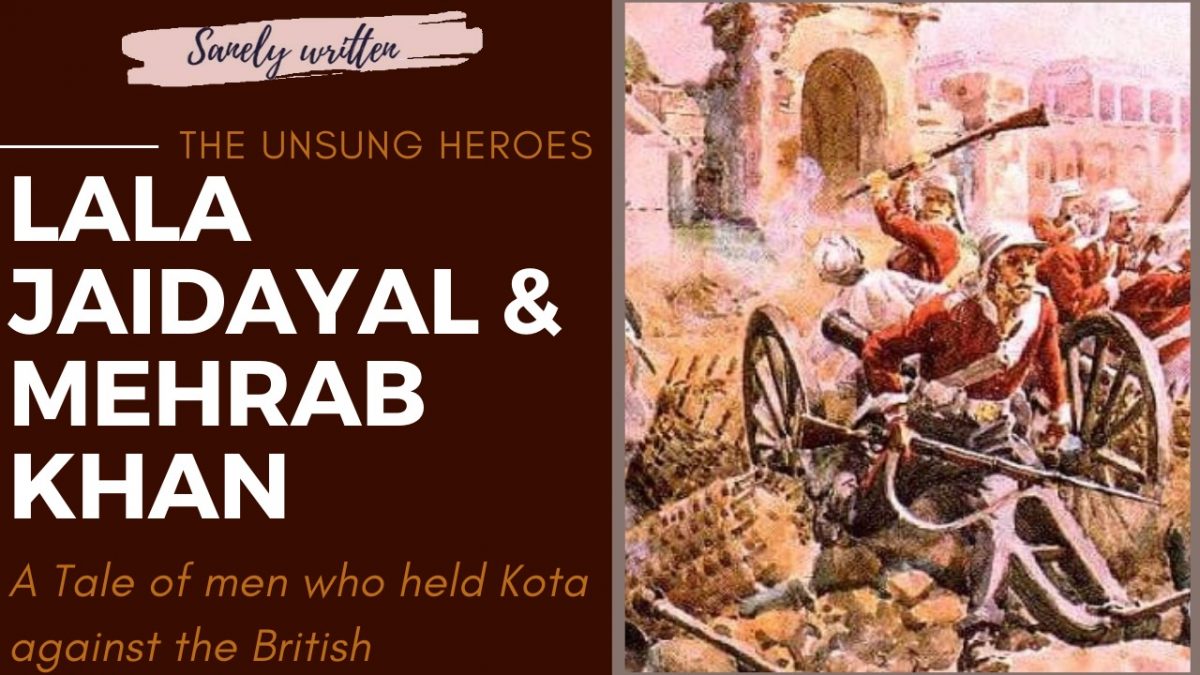
Lala Jaidayal & Mehrab Khan

Kota District, RAJASTHAN :

We all know about the Great War of Independence 1857. We have heard tales about Mangal Pandey, Nana Saheb and the Queen of Jhansi, Rani Lakshmibai. But there was also an uprising that took place in Kota district of Rajasthan in the same year led by Lala Jaidayal Bhatnagar and Mehrab Khan, and we have neither heard of them, nor do we have any pictures of the unsung heroes.

Lala Jaidayal was born on 4th April 1812 in Kama in Bharatpur. After completing his early education, he was appointed as an Advocate by the Kota Maharao in Hadaoti Agency. He was the prime leader of the Kota uprising. Mehrab Khan, his associate was the ‘Risaldar’ in the Kota army and was born on 11th May 1815 in Karoli. Lala Jaidayal along with Mehrab Khan had issued a circular in which they described in detail, about the new weaponry that was used by the British army that had its cartridges made up of animal flesh which was against the religious sentiments of both the Hindus and the Muslims. They also described how the flour and other eatables had the granules of human bones mixed in them. They made an appeal to the people to destroy the British who were intoxicating their lives.

The troops had started feeling the atrocities committed to them and what fuelled the fire was an advice given to the then ruler of the Rajputana state of Kota, Handa Rajput Maharao Ram Singh by the political agent of Kota, Major Burton, which somehow reached the troops. He advised Maharao to dismiss some of his non British soldiers. This message triggered the fire of discontent among the troops. Major Burton had visited Kota on 12th October 1857, with his two sons Frank who was 21 and Arthur who was 16. Maharao ordered a salute in honour of the British annexation of Delhi. The advice was given to Maharao on 14th October 1857 when Burton went to meet him along with his sons. The Kota Raj Pultan, furious with the news, decided to revolt against the King and Major Burton on the very next day i.e. 15th October 1857.

The troops, fuelled with anger, collected their swords and guns and surrounded the residency bungalow. They were also joined by the local civilians. The guards of the palace, having surrounded by around 3000 people offered almost zero resistance. The troops open fired and soon the palace was taken over. Major Burton, on hearing the commotion, thought that it was a procession that was coming out to welcome his return but he wasn’t aware of the reality. First among the victims of the mutineers were Dr. Salder, a native surgeon and a native Christian of Kota dispensary, Dr. Contemm.

A minute by minute description was given by Khoom Singh, the shooter sawar of Major Burton. He was with Major Burton and his two sons till the very end. They ran upstairs. Every Chawkidaar and Chaprasis that were appointed for the safety of Major Burton had run away when they saw the rebels coming. They climbed the ladders and killed Major Burton and both his sons. A parade was taken out by the rebels in the city with the severed head of Burton and was later fired upon with a gun.

source: https://images.app.goo.gl/JdXFRVKhBTw58ek16

The rebels took over the city and Lala Jaidayal was in charge of its administration. Maharao was captured and imprisoned in his own palace. Her queens were sheltered by Maharaja of Udaipur on the request of Maharao but five of his most trusted people were executed with guns as they refused to side with them. Gosain Maharaj, who was the religious head of Kota, acted as a mediator and Maharao had to walk into a treaty with the rebels. He was made to sign an agreement which stated that Major Burton was killed at his instance. For 6 months, the administration of Kota was under Jaidayal, and Mehrab Khan was incharge of the defence of the city. He sought help from the ruler of Sumbalgarh, Vitthal, which shows his ability as an able diplomat. Jaidayal also received a letter from the Thakur of Salumber (Mewar) in which he asked Lala to join him. They were able to win the love and support of a large number of officers in Kota state and many of them were posted in districts and were given the charge of many forts and palaces. But their rule didn’t last long and they were dislodged by the British troops along with the Maharaja of Karauli on 30th March 1858. Jaidayal left Kota and went to Bikaner. A bounty of 12000 was declared on him by the rulers of Kota and Bundi.

An analysis of the events that happened during this rebellion reveals how well planned and well
organized it was. They were hugely supported by the civilians and also by the state officials. They mostly attacked government offices and stores. The rebellion was against the British but when they came to know that Maharao was seeking help from them, they became furious and started the campaign against him. The aftermath of these events were even more heinous. The British troops burned down houses and property and plundered each and every house they came across. The ornaments that decorated the statues of lord Ganesha were also not spared. The followers of Lala Jaidayal and Mehrab Khan were put through miseries and were subjected to merciless torture. Maharao of Kota was unable to control the uprising. The native people were strongly anti-British and General Lawrence, the agent of Governor General and Maharao were aware of their feelings. They also cautioned Major Burton not to visit Kota. This was the reason why he visited Kota just with his two sons, and the rest of his family, including his wife and four other sons, were in Neemuch.

The fact that the leaders of the uprising, Lala Jaidayal and Mehrab Khan were Hindu and Muslim inspired the people of both religions to join hands against the tyranny of the British. The deep rooted dissatisfaction, the constant injustice, and the able leadership of Jaidayal and Mehrab Khan gave them the strength to stand behind their leaders and fight for the atrocities committed against them.

The greed for money has always been one of the main curses that the people of this country have faced throughout history. Same as the case with Liliya, who was responsible for the arrest of Lala Jaidayal Bhatnagar. The trial started in the court of political agent of Hadauti, W.H. Benan during April-May 1860 and he was given death penalty on 17th September 1860 in Kota.

Reference/s:

1. The people’s rising in Kota during the upheaval of 1857 by Vinita Parihar

2. The dictionary of Martyrs of the freedom struggle of India

source: http://www.sanelywritten.com / Sanely Written / Home> Freedom Fighter / by Sanely Writter / August 13th, 2020

Khan Bahadur Khan & Battle at Bareilly

Bareilly, UTTAR PRADESH :

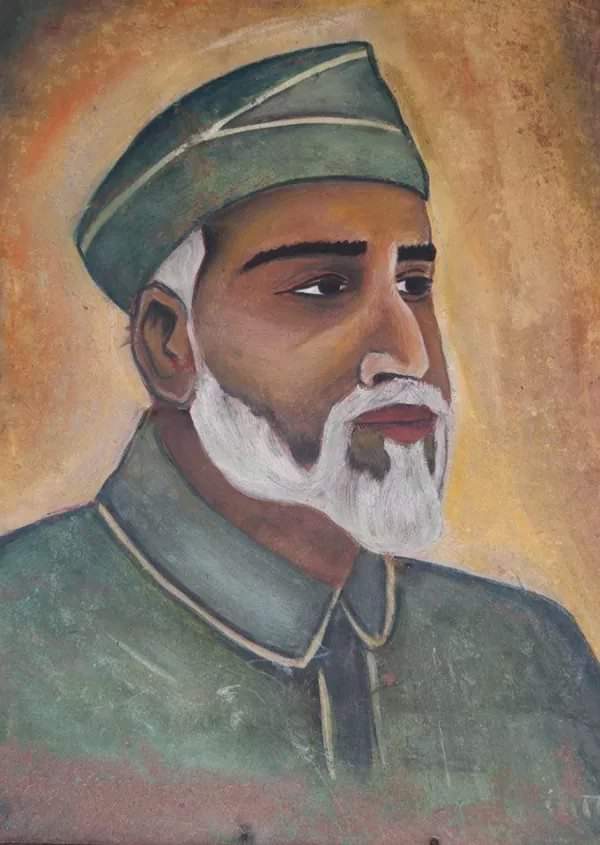
One of the most significant features of the rebellion of 1857-58 was that many scions of the former ruling houses took part in it. One such man was Khan Bahadur Khan (1860), a descendent of Hafiz Rehmat Khan (d. 1774). In this very blog of the Independence Week series, we will be throwing some light on Khan Bahadur Khan and his rebellion. How almost an eighty year old man kept the torch of rebellion against the Company in Bareilly burning.

Source: https://images.app.goo.gl/kLJF62BfAdgBSyRu5

Very little is known about the early life of Khan Bahadur Khan. It seems that having acquired traditional education in Arabic and Persian and Islamic learning; he joined the Company’s service, rising to the position of Sadar Amin (arbitrator or a native civil judge).

Upon retirement he continued to live at Bareilly where he enjoyed considerable status as grandson of the widely venerated Ruhela chief, Hafiz Rahmat Khan. In 1857 when the rebellion began, Khan Bahadur Khan was well over 82 years of age. During the rebellion, Bareilly became one of the important centers of the rebels under Khan Bahadur Khan’s leadership. In course of time, many rebel leaders came to Khan with a view to continue the struggle against the Company’s Government. A communal harmony was maintained in Bareilly despite the constant efforts of the Company to ignite the flame of hatred amongst the people through Bribery and inciting the Rajputs against Khan. This maintenance of harmony amongst the different classes of people in Bareilly is considered one of the major achievements of Khan despite the constant attack by the Company.


The old farmers of the region were affected badly because of the forceful sale of their lands by the British to suit a “capitalist” concept of property. This constant suppression led the uprising of 1816 when the company imposed the Chowkidari taxes. This uprising was soon crushed but it had led to a widespread range and discontent and people from all other regions came to Bareilly to join the uprising. The Rebellion of Bareilly was not just a religious war against the Company, it was due to the bitterness of those who had lost their lands and the anxiety of those who would be forced to lose them.


The rumors of trouble had started circulating in the region a couple of months before the actual revolt took place. The 18th Infantry Regiments and the 8th Irregular Cavalry were stationed at Bareilly. Of these the 8th Irregular Cavalry consisted almost entirely of Pathans. No European troops were stationed at Bareilly. The artillery branch which had in its ranks, as a subedar, Bakhat Khan, a disciple of Moulvi Sarfaraz Ali, the latter took a leading part in the Rebellion of 1857 and brought numerous Ulema of Delhi to call the struggle against the British as Jihad (holy war). It seems that the rebel sepoys were keen to raise Khan Bahadur Khan the Nawab of Bareilly as their leader but in the beginning he did not respond favourably to their overtures.

Ultimately on May 31, 1857. i.e. twenty-one days after the outbreak of the revolt in Meerut, Bareilly joined the rebellion. On 1 June under the guidance of Bakht Khan, concerted efforts were made by the rebels to persuade Khan Bahadur Khan to assume leadership. How Khan came to be persuaded by the rebels is evident from his own letter to the Governor General dated 14th February 1860 where he states that upon the deterioration in law and order, a deputation of the citizens of Bareilly headed by Syed Miyan Jan, Syed Faizullah, Miran Khan from Nau Mahla Mohalla, accompanied by several other persons and traders of the city approached him to take step to restore order. Syed Miran Jan at last prevailed upon him to move out of his residence.


Khan, now assuming leadership visited the city to restore order once again. He held a Darbar were prominent Hindu and Muslims were present. Like other rebel leaders, Khan Bahadur Khan also issued a proclamation addressed to all the Rajas and others, appealing to their zeal in defending religion. The main thrust of his proclamation was that the Indians’ religions (Hinduism and Islam) were in danger owing to the Company’s pro-Christian policy and attempts at Christianizing Indians. The proclamation also criticized some of the progressive measures taken by the Company’s Government such as the prohibition of Sati and widow- remarriage. The Bareilly proclamation was clearly an attempt to win the support of the Rajputs, a social group which practiced Sati and adoption, and so resented their suppression. The Bareilly proclamation also added that the Muslim leaders had to ban cow slaughter — a step considered of vital importance to maintain communal harmony. This was specially so when the majority of the rebel sepoys consisted of Hindus.


Khan Bahadur Khan was so keen to raise an efficient army that he did not burden the Rebel treasury with the pensions he had been receiving earlier from the Company.


The end of March 1858, Bareilly remained in the able control of Khan Bahadur. Despite a clear state resolution, the British policy, just to incite a division of the rebels assumed a new proportion on the cow slaughter issue. This time some Muslims mongers became active and insisted on slaughter on public places which was unacceptable to the Hindu sepoys. This led Khan hold a meeting of both the prominent Hindus and Muslims. It was attended by 12 Hindus and 20 Muslims. It was a tense atmosphere for obvious reasons and an axious and sad Khan Bahadur intervened saying “O Allah, why is so? Why is there so many squabble and blood-shed among the brothers, Hindus and Musalmans? The Hindus are my right hand and my right ear, because of their support and strength; I am able to sit on this seat. From today I declare that if any Muslim oppresses any Hindu or kills a cow at a forbidden place, he would be punished severely. Hindus and Muslims are the same. This ought to be the slogan of the two communities from this day”. In order to further strengthen the communal harmony, Muhammad flags by Hindus and Mahabiri flags by Muslims were hoisted in Bareilly and people were requested to gather under the respective flags to unite against the British. Khan himself visited different parts of the city to unite people and raised the slogans “Hindu and Muslims are one”, “Ram and Rahim are one”, and the people pledged to oust the British from this country.


One of the reasons for the long duration of the rebel regime at Bareilly was the British pre-occupation with the rebellion at other places. During this period Bareilly became a refuge for rebel leaders from far and near.


The movements of the rebel to and from Bareilly were very closely monitored by the British. The rebels lacked an efficient system of communication and the British on the other hand started communicating with Delhi, Agra, Nainital and Ambala and couriers with areas where they had no complete control. The rebels were fully aware of the danger that they had from the British Army and they made elaborate arrangements for guarding various ferry crossings. They also attempted to dislodge the Company officials from Nainital and other places, capturing Haldwani and Bhamauri (October 1857), and then Bundia on the high road between Haldwani and Bareilly. Their advance was checked by Colonel Mclausland at Baheri. The reverse was enough to persuade Khan Bahadur Khan to change the strategy. He instructed the rebel forces: “Don’t attempt to meet the regular column of the infidels, because they are superior to you in discipline and bandubast. and have big guns, but watch their movements. guard all the ghauts on the rivers, intercept their communication, stop their supplies, cut up their daks and posts, and keep constantly hanging about their camps; give them no rest”.

Though the company’s attempt to put the Rajputs against Khan in Bareilly had failed, they had succeeded in pitting the Rajputs of Dhatiganj in Bafaun against Khan, and Khan on the other hand had to take care of the Shia’s and the Sunni’s at this juncture.

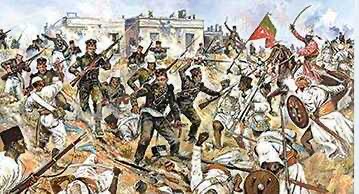
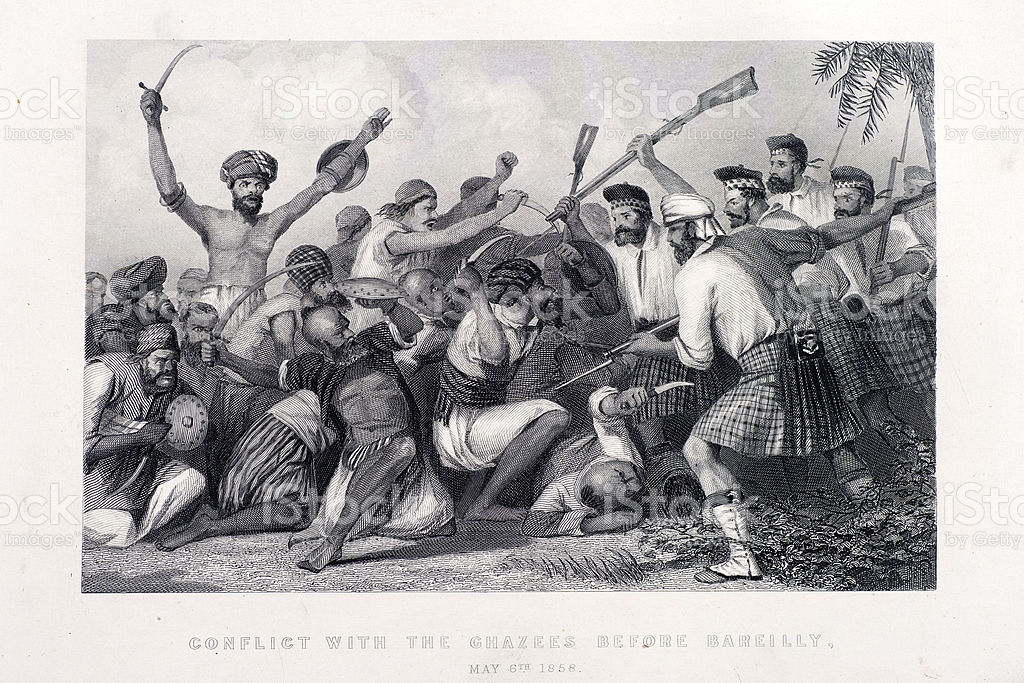
The British in Bareilly had caused an explosion with the help of their agents on 24th March 1858, killing 63 people. At the same time, the strength of the rebels were fast deteriorating due to the constant pressing forward of the company forces. They had recovered areas around Bareilly by the company troops, and the rebels were surrounded from all the sides. The company troops led by Brigadier General Jones surrounded Bareilly on 6th May. Khan Bahadur Khan had no option but to fight a pitched battle. He divided his troops into two lines. The first line was supported by the artillery commanding the bridge. The second comprising the Ghazis, defended the suburbs of the city. The British forces speedily broke the first line. They, however, had to face stiff resistance from the second line which displayed remarkable courage and determination against the enemy’s trained and organized forces. They resisted with such energy and boldness that Sir Colin Campbell was taken by surprise. To quote Russell “…a lot of Gazees got in pass the left of their right wing, attacked Walpole and Cameron, and wounded them……Sir Colin (Campbell) had a narrow escape… The Gazees were fine fellows, grizzly bearded elderly men for the most part, with green turbans and cummerbunds, and every one of them had a silver signet-ring, a long text of Koran engraved on it. They came on with their heads down below their shields, and their tulwars flashing as they whirled them over their heads, shouting, Deen! Deen! And dancing like mad men (6 May 1858)”. Sheer chivalry was, however, futile. The rebels lost the battle. Bareilly was occupied by the British forces on 7 May 1858.

“Conflict with the Ghazees before Bareilly, scence from the Indian Mutiny. Engraving from 1858, Engraver Unkown Photo by D Walker” / Source : https://www.istockphoto.com/vector/battle-at-bareilly-gm172740161-5022003

Having lost the battle, Khan Bahadur Khan took to flight. At this critical moment, the Kurmis around Bareilly provided shelter to the fugitives. From Bareilly, Khan Bahadur Khan moved towards Shahjahanpur with the intention of joining Ahmadullah Shah. Khan kept on moving and attacked the out skirts of Shahjahanpur on 12 June driving in all the pickets posted there.

He, however, could not join Ahmadullah Shah as the latter was treacherously killed by the Raja of Pawayan on 15th June. Ahmadullah Shah’s death left Khan Bahadur Khan alone. The British forces were at their heels. He took shelter in the Terai forest bordering Nepal. He wandered from place to place until Rana Jung Bahadur captured him, in December 1859, near Butwal. For some time he remained a prisoner of the Rana. Subsequently he was brought to Bareilly and confined in the Bareilly fort. He was charged with rebellion and inciting others to rebel and tried by a special Commission of enquiry. He was sentenced to death. He was hanged and laid to rest at the Bareilly Jail on 24 March 1860.

Reference/s :

Bareilly in 1857, Indian History Congress

source: http://www.sanelywritten.com / Sanely Written / Home> Freedom Fighters / by Sanely Written / August 10th, 2020

Unsung heroes of freedom movement from Belgaum Munshi Mazahar Ali

Belagavi (Belgaum) , KARNATAKA :

Munshi Mazahar Ali was a freedom fighter of Belgaum who lived near HESCOM counter at Kacheri Road, Shaniwar Khoot, Belgaum.

He was said to be a butler in the British army at the Belgaum regiment and being a staunch Muslim, was a follower of Wahabi moment. This movement was strictly against British rule in India and played an important role in First Independence war of 1857.

The Belgaum gazette (page 133) refers this great son of the land as “One Muslim Munshi in the army at Belgaum, who had been a Wahabi, was discovered instigating the others, transported for life in the connection “

Munshi Mazahar Ali was involved in the “Reshmi Rumal Movement “and was arrested by the British. He was assassinated at the Race Course grounds in presence of thousands of people.

The Corporation of the City of Belgaum has given the name of Kacheri Road as “Munshi Mazahar Ali Road”. But even now Kacheri Road is used by Govt and the public.

source: http://www.allaboutbelgaum.com / All About Belgaum / Home> History / by editor / August 14th, 2009