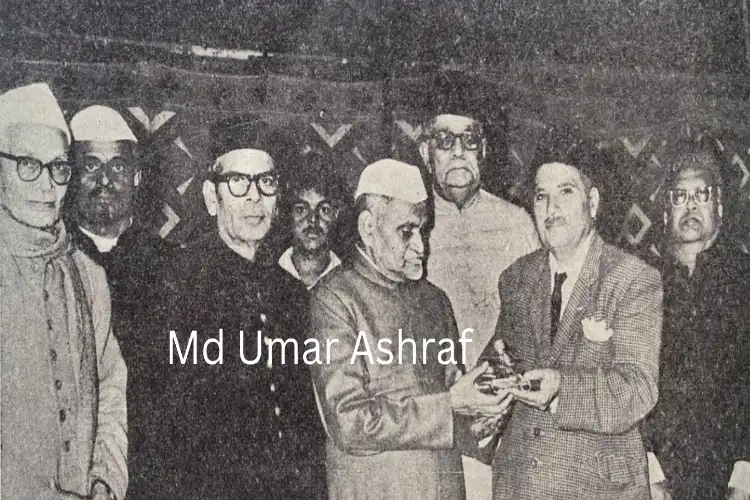
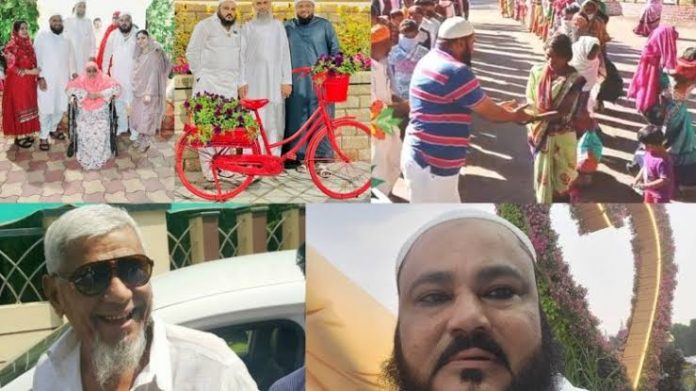
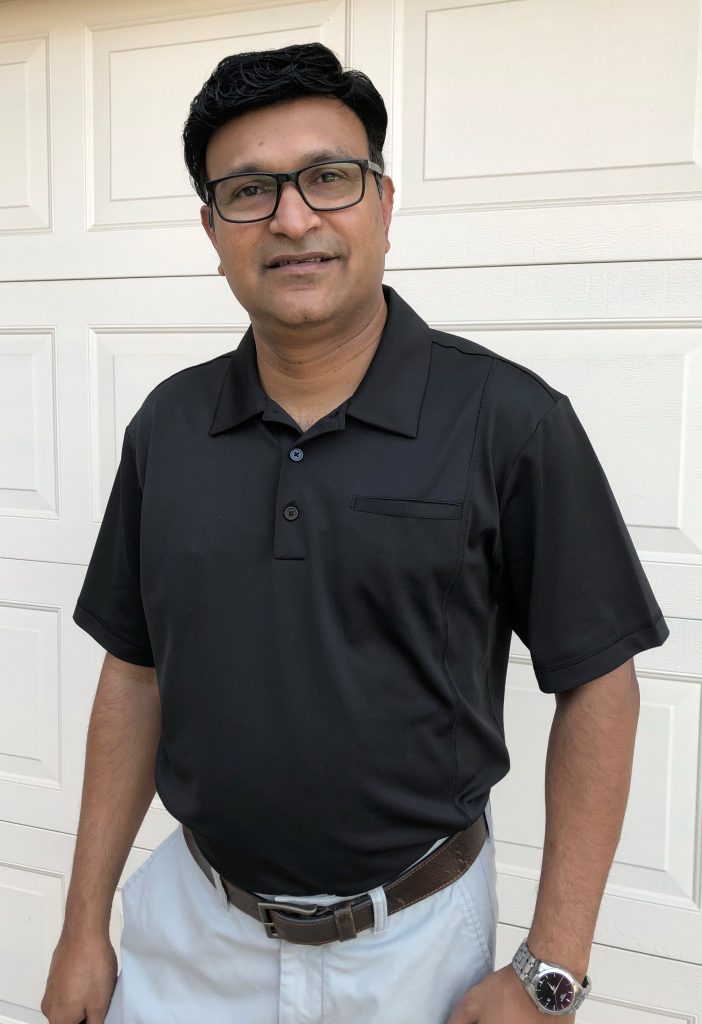
Administrator of Ajmer Sharif Aley Mohammad Shah donating gold to the minister (Courtesy: Md Umar Ashraf)
If I tell you that the Dargah of Khwaja Moinuddin Chishti at Ajmer, Rajasthan, played a role in the war against China when India was invaded in 1962, will you believe it?
In October 1962, the Chinese Army invaded India which had gained freedom 5 years ago. Such national crises test the character of a country. Indians of all creeds, castes, races, and social groups joined hands to fight the mighty enemy.
After 200 years of British colonialism, the Indian economy was in shambles when the colonial rulers left in 1947. When China invaded, India was not as big an economy as it is now. Prime Minister Jawaharlal Nehru appealed to his compatriots to donate gold and money to the defence funds.
Responding to the call, Dargah at Ajmer opened its vaults for the country’s defence forces. The management of the shrine of Hazrat Khwaja Moinuddin Chishti believed that national service comes before any other service. The administrator of the committee handed over 2 kilograms of gold and invested Rupees one lakh in Defence Saving Certificates to the Union Minister of Irrigation and Power at a meeting held at the Dargah. It also announced holding special prayers for the success of the Indian Army daily.
The administrator who handed over the gold, to the minister was Aley Mohammad Shah. His elder son Zameruddin Shah rose to become the Deputy Chief of Army Staff in India while his other son Naseeruddin Shah is a popular film actor.
The episode is a testimony to the fact that for Indian Muslims following Islam and serving the nation are not contradictory.
source: http://www.awazthevoice.in / Awaz, The Voice / Home> Culture / by Saquib Salim / December 14th, 2022
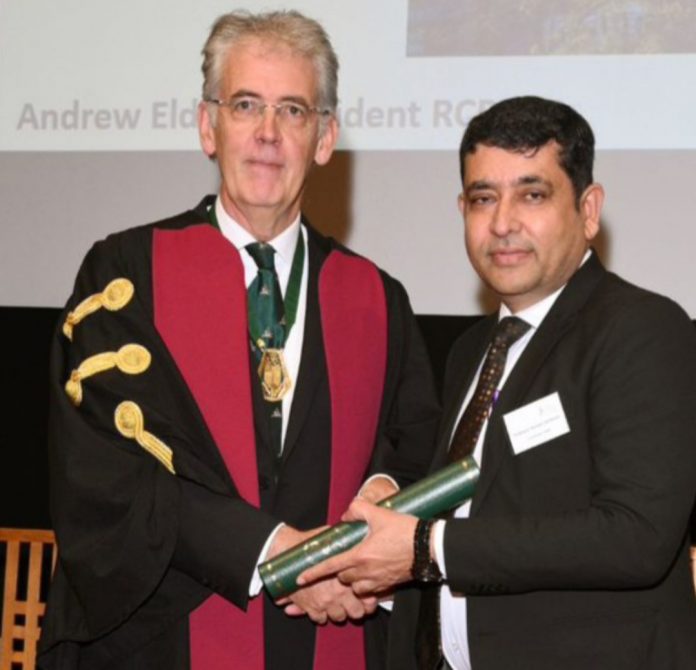
At a meeting of the Urdu Scientific Society, attended by prominent Doctors of Lucknow, Dr. Kausar Usman of King George Medical University, Lucknow was felicitated for the honor he received as a Fellow of the Royal College of Physicians, Edinburgh.
Presently working as a Professor of Internal Medicine at one of the prestigious medical institutions of India King George’s medical university, Dr. Usman is known for his expertise in the field of Medicine in general and Diabetes in particular. In 2016, Dr. Usman became the first Muslim Professor in the medicine department of King George’s Medical University, Lucknow.
Dr. Usman has participated actively in several national and international investigations and has a very solid foundation in research. Numerous national and international publications have published his work. He has more than 70 Publications to his name.
Prior to joining King George’s Medical University as a teaching faculty member, he worked in reputable medical institutions like Indraprasth Apollo Hospital in New Delhi.
In 2017, Dr. Usman had received a Fellowship Award FACP (Fellow of American College of Physicians) in San Diego, California.
Senior Urdu Scientific Society office bearers Padma Shri Dr. Mansoor Hasan, Maulana Khalid Rasheed, Dr. Iqtedar Farooqi, and Dr. Shakir Hashmi congratulated Dr. Usman for his extraordinary achievements.
source: http://www.muslimmirror.com / Muslim Mirror / Home> Indian Muslim> Positive Story / by Muslim Mirror Network / December 13th, 2022
In a glittering ceremony, two books on Muslims’ contribution in India’s Freedom movement were launched here in Patna on 17th December. The function was presided over by Harsh Mandar, former IAS officer and human rights defender in the country.
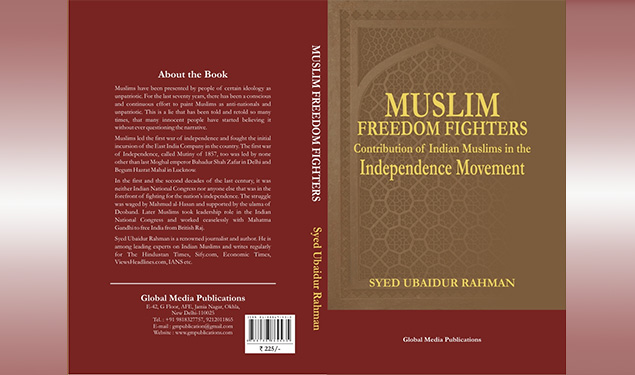
The books ‘Muslim Freedom Fighters: Contribution of Indian Muslims in the Independence Movement’ and its Urdu version ‘Muslim Mujahideen-e-Azadi aur Tehrik-e-Azadi Mein Unki Khidmat’ have been authored by Delhi based author and journalist Syed Ubaidur Rahman.
The two books try to fight the oft-repeated allegations that Muslims are anti-national and have not contributed for the freedom of the nation. The books nail the lie and prove that Muslims not just participated in the freedom movement, they went on to lead the freedom struggle for a long time. The first war of Independence or Mutiny of 1857 was led by Mughal emperor Bahadur Shah Zafar in Delhi and Begum Hazrat Mahal in Lucknow. The Independence Movement in the first two decades of the twentieth century was led by Mahmud Hasan and ulama of Deoband and they had respect and support of everyone including Hindus and Muslims.
If anyone has any doubt about the Muslim contribution in the freedom movement, the fact that the Indian National Congress had as many as nine Muslims as its president till the year 1947 will remove such doubts.
While speaking on the occasion, Harsh Mandar said that the divisive forces in the country are trying to divide the nation on the basis of religion and faith. He said that the danger from such forces for the national fabric and its unity has become grave.
Harsh Mandar added that the threat to the communal amity in the country was never so high as is today as divisive forces are doing every thing to pit one community against the other and create a fear psychosis among the majority community prompting it to turn it against minorities.
Khursheed Mallick, a Chicago based urologist, philanthropist and director of IMEFNA said that the book is a timely reminder to the nation that Muslims and Hindus both sacrificed for the nation and this fact must be clearly told to our young generation. He said Muslims sacrificed heavily for the cause of the freedom of the nation and efforts must be made to tell the history.
Syed Ubaidur Rahman, the author of the two books, while speaking on the occasion said Muslims have been rather loath to write about the sacrifices they have made for the cause of the Independence and freedom. He said Muslims suffered badly throughout the freedom movement. They were the worst suffers in the wake of the mutiny of 1857 and its aftermath when Muslims were hounded across North India and beyond. Tens of thousands of Muslims lost their lives for the freedom.
Syed added that ulama of Deoband played a stellar role in the freedom movement. Unlike the common perception, they were secular to the core and when they established a government in exile in Kabul in 1915, they appointed Raja Mahendra Pratap as its President and Maulana Barkatullah Bhopali as its Prime Minister.
The book documents the lives of forty renowned Muslim freedom fighters including, Shaikhul Hind Maulana Mahmud al-Hasan, Maulana Barkatullah Bhopali, Hakim Ajmal Khan, Maulana Ubaidullah Sindhi, Maulana Abul Kalam Azad, Maulana Mohammad Ali Jauhar, Dr Maghfoor Ahmad Ajazi, Dr Mukhtar Ahmad Ansari, Ashfaqulla Khan, Maulana Hasrat Mohani, Maulana Muhammad Mian Mansoor Ansari, Asaf Ali, Husain Ahmad Madani, Aruna Asaf Ali (Kulsum Zamani), Peer Ali Khan, Saifuddin Kitchlew, Mohammed Abdur Rahiman, Captain Abbas Ali, Abdul Qaiyum Ansari, Prof. Abdul Bari, Moulvi Abdul Rasul, Nawab Syed Mohammed Bahadur, Rahimtulla Mahomed Sayani, Syed Hasan Imam, Sir Syed Ali Imam, M.C. Chagla, Yusuf Meherally, Justice Fazal Ali, General Shah Nawaz Khan, Allama Fazle Haq Khairabadi, Maulana Shaukat Ali, Syed Mahmud, Maulana Mazharul Haque, Badruddin Tyabji, Col Mehboob Ahmed, Begum Hazrat Mahal, Maulana Shafi Daudi, Rafi Ahmed Kidwai, Syed Mohammad Sharfuddin Quadri, Batak Mian
The book launch function was organized at Anjuman Taraqqi Urdu and was presided over by Abdul Qaiyum Ansari, chairman of Anjuman Taraqqi Urdu Bihar.
Name of the Book: Muslim Freedom Fighters: Contribution of Indian Muslims in the Independence Movement Author: Syed Ubaidur Rahman ISBN: 81-88869-43-0 Price Rs 225/- Global Media Publications E-42, G. Floor, AFE, Jamia nagar, Okhla, New Delhi-110025
source: http://www.ummid.com / Ummid.com / Home> India / by ummid.com News Network / December 12th, 2017
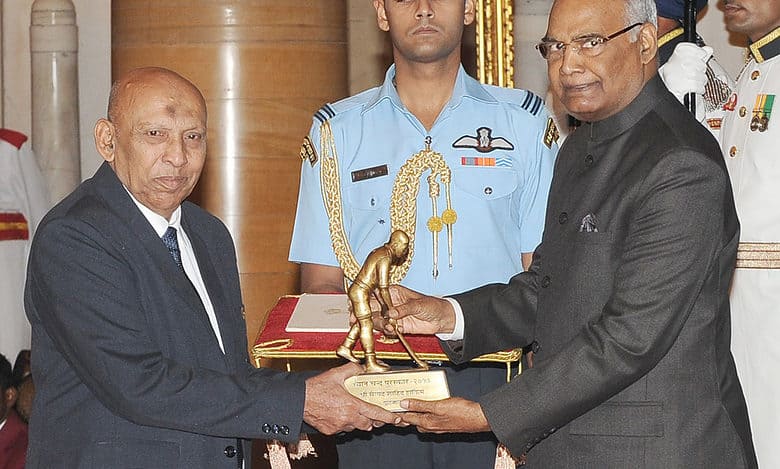
The President, Shri Ram Nath Kovind presenting the Dhyan Chand Award, 2017 to Shri Syed Shahid Hakim for Football, in a glittering ceremony, at Rashtrapati Bhavan, in New Delhi on August 29, 2017. Photo: Wikipedia
The name of Syed Shahid Hakim is familiar to the entire football fraternity of India. He was one of the most accomplished personalities who graced Hyderabad and Indian football as a player, referee and coach. Indeed it would not be wrong to say that there were few people in India who could match his knowledge and acumen about the different aspects of football. Besides being a well known personality in football, he also served as an officer in the Indian Air Force.
Being one of the sons of the great coach S.A. Rahim, he grew up in a football related environment. Hakim belonged to that period when Hyderabad was at the zenith of Indian football. He played with the illustrious players of India. Among his teammates were the famous goalkeeper Peter Thangaraj, D. Kannan, S.A. Latif, Yousuf Khan, S. Narayanan, H H Hamed and others. All these players were from the twin cities of Hyderabad and Secunderabad.
As a player, Hakim’s talent bloomed at an early age. He was at his peak in the late 1950s. He was a member of the Hyderabad state team which won the Santosh Trophy in 1957. Due to his prodigious talent and his rising status in Indian football, he was selected to represent India in the Pre-Olympic tournaments in Jakarta, Singapore and Malaysia.
It was not a surprise when he was also selected in the Indian team for the 1960 Olympic Games in Rome. That was the last time that India qualified for the Olympic Games. Although India narrowly failed to enter the knockout stage of the tournament, the Games were a great learning opportunity for Hakim.
The close interaction that Hakim had with the world’s best players and coaches gave his keen intelligence some valuable insights into the tactics and training of European and South American players. These he later put into use when guiding his own trainees. This is where his education and learning proved to be a big asset. Having studied at All Saints HS, Nizam College and then Osmania University, his level of education was above many other footballers. This enabled him to interact easily with foreigners and learn from everything that he observed.
Later, after he joined the Indian Air Force, he played for the defence services team and went on to be appointed captain of the All India Services team.
After retiring from the game as a player, he continued to serve Indian football in various capacities. He became a well known referee who was among the best in India. Starting from 1970 he continued to serve as a referee for many years. In 1974 he was selected to be a member of the FIFA Referees panel which was a great honour for an Indian referee.
Thereafter, he officiated in 33 international matches and it is a record which is still not broken. No other Indian referee has officiated in 33 international matches.
But that was not the end of his distinguished career. Thereafter, Hakim became a reputed coach and coached the Indian team from 1980 to 1982 for the Merdeka Cup and Delhi Asian Games along with other coaches.
When he was 80, he fell prey to the rampaging COVID pandemic but recovered. However, despite winning the battle against the dreaded virus, his life did not last long thereafter. He suffered two strokes in rapid succession and passed away in Gulbarga where he had been admitted to a hospital in August 2021. His death left a void in Indian football which will perhaps never be fulfilled.
source: http://www.siasat.com / The Siasat Daily / Home> News> Hyderabad / by Abhijit Sen Gupta / December 09th, 2022
The words like ‘bandobast’ and ‘decko’, apart from many other Hindustani words are now loved by the British dictionary.
Mumbai:
If you are born in India, and that means any part of India, Urdu is the language that you must have come across in its purest or hybrid form. The language is even liked by the Oxford English Dictionary, which has words listed throughout its collection. On Wednesday, November 9, Urdu is being celebrated all around the world on the occasion of “World Urdu Day.”
The words that belong to Urdu and are now in the OED include “bandobast”and, after literally “deckoing” the arrangements, “Abba” (father), “Accha” (okay, good), “Gulab Jamun,” “Mirch Masala,” “Keema,” “Chowkidar,” “Funda,” and “Chamcha.”
Urdu, along with Hindi and Sanskrit, is the oldest language and, literally speaking, a display of Indian culture. Though the most real and oldest words are not frequently in used today, there are rhetoric, which belong to Urdu and which the Oxford English Dictionary has included in its collection.
Urdu, before being replaced by the East India Company against Persian, was earlier known as the “Hindustani” language, and its basic roots can be traced to the “Daur (reign)” of Moghul King Shah Jahan. Though the language was in its infancy at the time, there are numerous documentary evidences that prove that the language was used by locals.
The 400-year-old language has maintained its charm in the 21st century. Everything has become online, and for that, English is a must. However, there are some Urdu words that “English” enjoys as well. And these words are included in the Oxford English Dictionary.
Shahid Latif, editor (Madeer in Urdu), explains that the process is entirely dependent on the OED’s meticulous research and analysis. Latif said, “Urdu has major influence from Persian and Arabic.” The words derived from Urdu are being included in the OED with a proper announcement. For example, “Bandobast,” in which band means protection and bast means tightly wrapping, is part of the OED. Apart from it, “decko” is also a word that was included in the English language long before independence, bought from the Urdu word “dekho” and used by the British police to “check out” anything suspicious.
source: http://www.freepressjournal.in / The Free Press Journal / Home> Mumbai / by Nooruddin Inamdar / November 09th, 2022
Billionaires in Africa, Maha tycoons follow father, feed thousands in hometown
Yavatmal :
Decades ago, a humble Maharashtra State Road Transport Corporation (MSRTC) district driver Abdul Narsinghani had a strange habit before going off to work.
Every morning he would instruct his wife Fatima to pack a few ‘rotis’, he put them in his pocket and at various stops of his ST bus en route, would distribute them among a few poor people he encountered.
His young kids — sons Aman, Aslam and daughter Farida — closely watched all this but often wondered at their father’s undue concern for others when they themselves eked out a bare existence in a 200 square feet slum tenement in Yavatmal.
Years later, Aman, 45, and Aslam, 43 are successful business magnates in Congo, (formerly Zaire), Africa, and Farida I. Budhwani is a housewife in Mumbai, but now they warmly cherish their simple father’s small acts of charity for fellow beings.
“We brothers completed our high secondary school (Class XII) and got jobs in Uganda, so we went there in 1998. In just three years (2000), we got an offer to start a pharmaceutical business in the adjoining country, Congo, and we grabbed the opportunity,” Aman told IANS.
That was the turning point for the Narsinghani brothers, and they became the first Indians to start a business in Congo, and their venture is named Sara Pharmaceuticals.
“Many Africans have a fetish to pop in medicines for everything… We imported various types of medicines from India or China and then sold them there… Slowly, that tiny business has grown into a pharma-cum-electronics empire with a turnover of over Rs 1,200 crore per annum,” said Aman.
On their frequent trips back home from Africa, they never forgot their father’s daily habit of donating ‘rotis’ or his wise advice – ‘Let nobody go empty handed from my door’ – and decided to do something to take it forward.
“From 2009, we have launched a community kitchen that feeds around 750 people for lunch and some 250 for dinner daily… 98 per cent of the beneficiaries are the local poor people, irrespective of religion or status, all are equally welcome…” said Aman.
The daily offering through ‘Khidmat-E-Khalk’ (Selfless Service) is either good quality rice-vegetables, lip-smacking vegetable or chicken biryanis and other foodstuff as the people may desire, and distributed at a couple of locations in Yavatmal, 365 days a year.
It was during the Covid-19 pandemic (2020-2021) lockdown that the small kitchen proved its true worth and utility for lakhs of deprived people, especially the migrant folks stranded far from home.
“In the first six months of the stringent lockdown, we fed over 1.50 crore people. We also distributed food-kits of around 25 kg rations worth Rs 2 crore to the helpless people who had lost their jobs,” said Aslam.
After the lockdown eased a bit from October 2020 onwards, the Narsinghani brothers shifted their attention to the local Shri Vasantrao Naik Government Medical College & Hospital, where they served free food to all the patients for over one year.
As the pharma business of the siblings flourished in Central Africa, the duo also progressed, upgrading from their humble 200-sq.ft. slum abode to a palatial 10,000 sq.ft mansion in Yavatmal, where they rank among the most esteemed citizens.
The devout Khoja Muslim, Abdul Narsinghani, who gave his children an invaluable lesson to care for fellow humans, witnessed everything with joy and pride. He passed away peacefully in 2015, while his widow Fatima, 71, continues to guide and support her two sons in all their ventures.
Doing business in Africa is not everybody’s cup tea, given the political turmoil in many countries there, plus the social, cultural and language barriers, but the Narsinghani brothers managed to learn Swahili in just a couple of years and were accepted with open arms in Uganda, Congo and other countries in Central African region.
“Though we have seen a lot of social-cultural-political upheavals there in the past 25 years, but luckily, the Indian community there does not face problems from any quarter and we are probably treated as ‘more than equals’ among the rest,” Aman smiled.
The pharma business has gradually expanded within Africa, and lately the duo diversified into electronics trading which is picking up hugely through their several retail outlets.
“The Almighty has been magnanimous and benevolent to us and coupled with what our parents bequeathed us, we are trying in our own little way, to repay all the blessings,” acknowledge the Narsinghanis. — IANS
source: http://www.muslimmirror.com / Muslim Mirror / Home> Culture> Indian Muslims / by IANS / December 04th, 2022
Since time immemorial, people across cultures have been looking down upon women for their assumed enfeebled existence, but curiously the invincible might of the nation-state is primarily imagined in terms of feminine sensibilities. Nation and women share several traits, such as purity, chastity, and piety that must be protected.
This flimsy admiration aside, women continue to be the object of the stifling affliction of subjugation, marginalization and gender equality. The pitiable condition of Muslim women in India, their boundless deprivation and their servitude to patriarchal misrepresentation of religion look self-evident. Not many know that through determination and self-belief, daughters of destitution knocked over many unsurpassable hurdles and attained unprecedented success.
Undeterred by searing double jeopardy, some determined Muslim women weaved a gripping and admirable narrative of self-discovery and phenomenal individual growth that strengthened collective consciousness, empowerment and national aspirations in the six decades. They have had many firsts to their credit. The fairly long list includes the names of Fathima Bibi ( the first female supreme court judge who took over in 1989); Suraya Tyabji; (the incredible artist who designed our national flag in 1947); Begum Akhtar (the first female singer who judiciously wrapped up Vivadi Sur in Ghazal singing and earned the title of Ghazal Queen), Sania Mirza (the first Indian woman to win the ATS tennis title) Rokeya Sakhwat Hussain, ( jotted down the first female utopian novel, Sultana’s Dream”, 1905 in which gender roles were reversed.) Ismat Chughtai (the first fiction writer who explored various dimensions of the forbidden female sexuality in her short story Lihaf), Rasheed Jahan (edited an anthology of short stories, Angare that presented a poignant and heart wrenching account of exasperating struggles that women have to confront in the patriarchal society) and Qurratul Ain Haider (who judiciously used stream of consciousness to explore and reflect upon the gender injustices). Some Muslim women such as Razia Sultana, Chand Bibi and Begums of Bhopal, especially Sultan Jahan, committed themselves to the male-driven and exhausting path of leading the country, and they mapped new terrains of courage, bravery and governance. However, their contribution to collective life is not adequately documented.
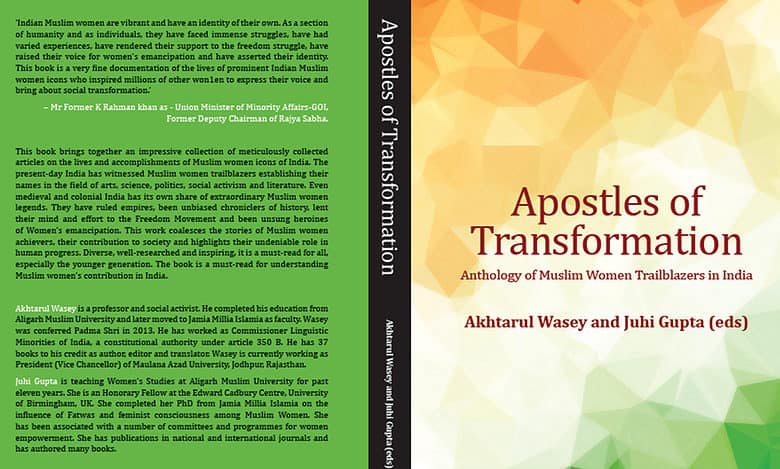
These vital pieces of information largely lay in oblivion and have been aptly articulated and cogently documented in an astutely edited anthology of Muslim women trailblazers, Apostle of Transformation, published recently (Peter Lang, 2022). The anthology, edited by a well-known Islamic scholar Akhtarul Wasey and a promising academician Juhi Gupta, carries an assortment of 23 articles that engages the constitutive acts of turning mundane life into moments of epiphany by Muslim women. Their pulsating and coming-of-age experiences need to be told candidly.
Akhtarul Wasey and Juhi Gupta took pains to upend the widespread but erroneous perception that hardly considers Muslim women beyond being silent and passive onlookers. The book produces a gripping and layered narrative of those women who are to be reckoned as role models, but why their awe-inspiring efforts have not fetched the requisite response? As a central premise of the study, this question hardly took off, and the editors dish out a laudatory and partially plausible answer instead. For Wasey and Juhi, Muslim women, by and large, sump up a story of hope and resilience, and they assert, “In reality, Indian Muslim women, in the past and the present, have exerted their freedom, identity and agency. One way or the other, they have found ways to create, contribute, act and participate in various fields and ascended to prominence. Be it art, science, nation-building or politics, there have been hordes and hordes of Indian Muslim women pioneering, participating and contributing to development in the specific field.”
The creative dexterity, sweep of learning and speculative intelligence of Muslim women resonate with almost every genre of literature and non-fiction, and Urdu is not the only beneficiary. Azarmi Dukht Safavi, Rakshanda Jaleel, Rana Safavi, Annie Zaidi, Sami Rafeeq, Nazia Erum, Rana Ayub, Ghazala Wahab, Huma Khalil, Zehra Naqvi, Reema Ahmad, Nasra Sharma, Sadiqa Nawab Saher and the like make it for Persian English and Hindi with remarkable success. Their stories bear witness to what the editors asserted in the preface.
Several prominent authors and academicians, including Syeda Hameed, Rasheed Kidwai, Madhu Rajput, Bharthi Harishankar, Shahida Murtaza, Sabiha Hussain Ayesha Muneera, Azra Musavi, Shiangini Tandon, excavate details and they set forth a discourse whose emotional arc looks irresistible.
The book zeroes in on many prominent women by employing the case study method. Syeda Hameed, in her ear-to-ground and empathetic story of an accomplished author Saliha Abid Hussain whose fifty books, including her profoundly consequential autobiography, Silsila-e- Roz-o- Shabh (sequence of Days and nights), hardly got the recognition she deserved. It rightfully peeved Syeda Hameed, who candidly enumerated her oeuvre by observing that she was a chronicler of her times with natural talent for storytelling and, above all, a woman who believed, practised, and propagated her religion in its most liberal and humanitarian spirit.
Not many knew that Qudsiya Sikandar, Shah Jhan and Sultan Jahan were more than fortuitous rulers of Bhopal. Rasheed Kidwai employed laudatory idiom for adeptly documenting how their rule saw justice, gender sensitivity, peace and reforms even as faith and traditions remained intact. Surayya Tayyabji’s incredible artistic dexterity and pivotal role in designing our tricolour continue to elude public attention, and Shahida Murtaza’s academic rigour-filled succinct article, Surayya Tayyabji, the Resolute woman, supplements it.
The dreadful and calamitous partition is dotted with poignant tales of sufferance, and heart wrenching stories of the abducted women remained inarticulated. It was the turn of a celebrated author and activist, Begum Anees, who put together permeating and nuanced memories of the event and its earth-shattering aftermaths from the standpoint of women subjected to unprecedented affliction. Azra Musavi made her autobiography, Azadi Ki Chaon Mein (In Freedom’s Shade), the object of a single pristine look. Azra’s lucid close reading of the text draws forth an informed debate on how the two states faltered in fulfilling the aspiration of people.
Ayesha Muneera astutely spells out the contours of Rokeya Sakhawat Hussain’s creative world, and she argues that Sultana’s Dream is a feminist, political, and ecological utopia. She sides with Nilanjana Bhattacharya by terming it an anti-colonial text. For her, the novel works against India’s colonialization and internal colonization of women within Indian society. Rokeya’s trail-blazing text subtly conjures a dystopian world where gender roles are reversed, but the environs remain dreadful.
Naima Khatoon produced an evocative piece on Begum Akhtar, one of the most accomplished singers of Ghazal, Dadra and Thumri that India ever produced. She blended music and poetry with remarkable ease.
In her article, Sabiha Hussain ropes in feminist and cultural studies tools to map the creative terrains of Ismat Chughtai and Qurratul ain Haider.
Juhi Gupta turns her attention to the family of Sheikh Abdullah, the pioneer of Muslim women’s education, and she perceptively analyses the contribution of Begum Abdullah, well-known educationist Mumtaz Jahan, famous author Rasheed Jahan and prominent actor Begum Khurshid Mirza (Renuka Devi).
Shah Alam insightfully unravels the vanguards of change, and his laconic account, Vignettes of Muslim women Politicians in India reads well.
Faiza Abbasi, Mayuri Chaturvedi, Chand Bi, Tauseef Fatima, Bharti Hari Shankar, Rekha Pandey, Abida Quansar, Madhu Rajput, Bilal Wani, Naseem Shah, Shirin Sherwani, Shivandgini Tandon, Ruchika Verma, Anam Wasey and Huma Yaqub are the other contributors who made the anthology an intriguing read.
source: http://www.siasat.com / The Siasat Daily / Home> Featured News / by Shafey Kidwai / November 12th, 2022
Kumrava, Nawada District) BIHAR / Kolkata, WEST BENGAL :
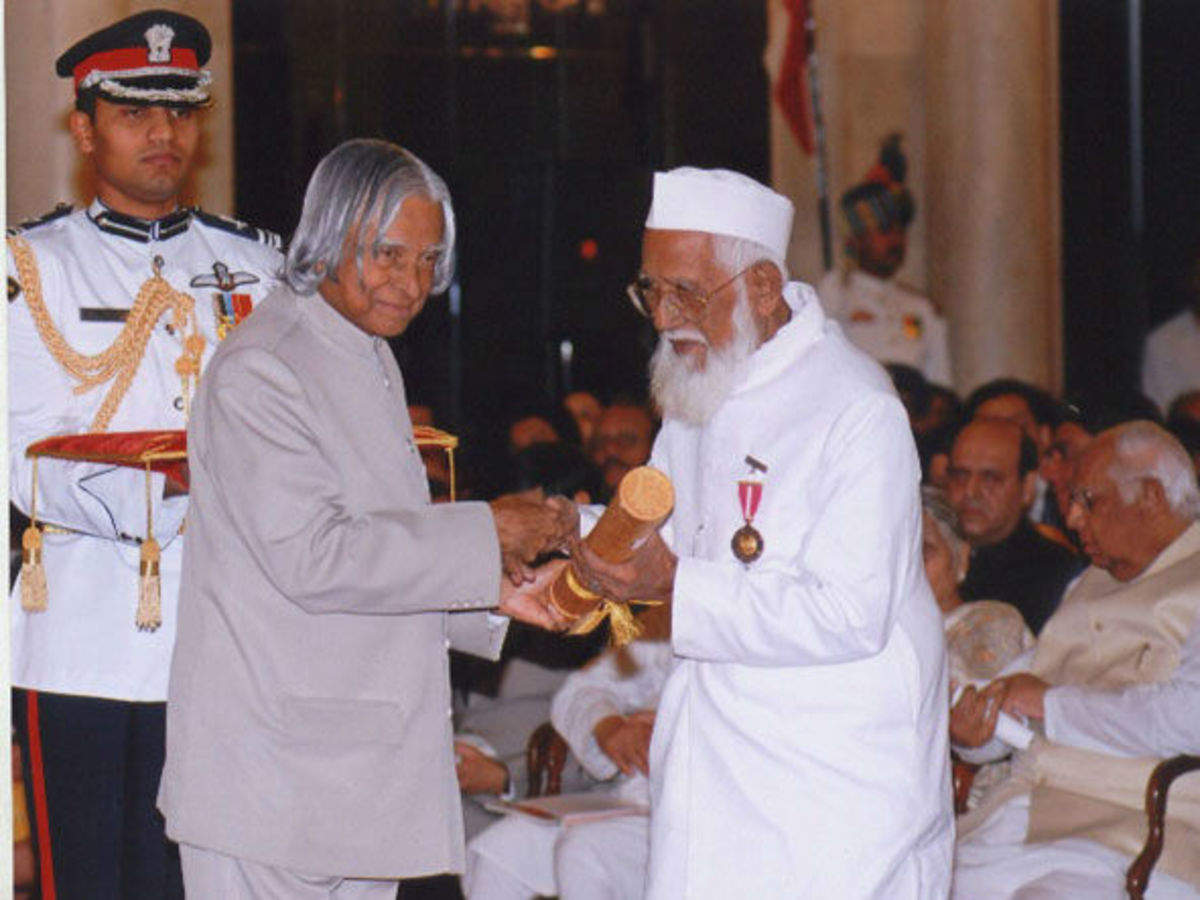
He had accompanied Mahatma Gandhi on the Dandi March and later spent several days with him in a prison in Cuttack. In 2007, he was conferred with the Padma Bhushan for his fight against the British rule in India.
Syed Mohammad Sharfuddin Quadri being conferred with the Padma Bhushan by the then President APJ Abdul Kalam.
Late on Monday night, Syed Mohammad Sharfuddin Quadri, who was affectionately referred to as hakim sahab in his neighbourhood in Rippon Street, passed away three days after celebrating his 114th birthday.
Quadri, a renowned Unani practitioner who was instrumental in founding the Unani Medical College and Hospital in Abdul Halim Lane in central Kolkata, was born on December 25, in 1901 when Kolkata was still the capital of the country and Mahatma Gandhi had not returned to India.
“My father was imprisoned with Gandhiji by the British in Cuttack. He would accompany him everywhere during the Civil Disobedience Movement,” said son Manzar Sadique in the family’s home in 84/9 Rippon Street.
“In October, abba had travelled to Lucknow where he was the chief guest at a conference of Unani practitioners. Chief minister Akhilesh Yadav had invited him over to his house,” informs Sadique.
Quadri was born in the remote village of Kumrava in Nawada district of Bihar on Christmas Day in 1901. His family moved to Calcutta in the mid-1930s. Hakimji would begin his day with Fajar (the morning namaaz) at the break of dawn followed by his visit to his chamber, Swadeshi Dawa khana on Haji Mohammed Mohsin Square, where patients would already be waiting for him. He would examine more than 100 patients every day free of cost, says son Sadique.
“Unani was his passion and he could identify the ailment just by feeling the pulse of the patient,” says Sadique.
The centurion who specialized in treating infertility would never miss his customary walk after work. “He suffered from arthritis which is why he took special care of his fitness,” said Sadique.
Quadri who began an informal school for children and triggered an adult literacy campaign in Rippon Street was the founder member of the
Once Quadri once revealed the secret behind his fitness and longevity to his friends. “I drink two glasses of neem juice every day,” he has said. This fitness mantra was handed over to him by his father Mohammad Mohibbudin who had died at the age of 121 years!
Hasnain Imam, a teacher and resident of Rippon Street fondly recalled the time he had spent with “hakim sahib” when he was in college. “He was a treasure trove of knowledge. From politics to medicine to Sufism, we would discuss a wide range of topics. They don’t make people like them anymore,” said Imam.
source: http://www.timesofindia.indiatimes.com / Times of India / Home> News> Kolkata News / by Zeeshan Javed / TNN / December 30th, 2015
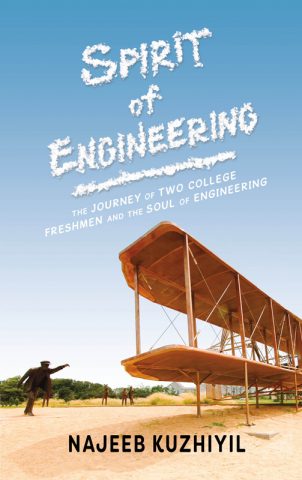
Spirit of Engineering, published by ME alum Najeeb Kuzhiyil in December 2017, tells the story of two freshman college students and their journey to discover what engineering is. Image courtesy of Najeeb Kuzhiyil
A novel penned by a mechanical engineering alum tells the story of two freshmen college students and their journey to discover what engineering is.
“So I thought before you begin your undergrad studies, you should understand what engineering is in simple terms,” said Kuzhiyil. “I really wanted to write a book that was simple enough for high school students.”
The book took about a year and a half to write and started out as separate essays covering four pillars of engineering: methodical approach, practical skills, abstraction, and creativity.
“One morning I was lying in my bed and I thought why don’t I tell this as a story. I can include all of these concepts and wind them into a nice plot,” Kuzhiyil said.
The target audience for the book is high school students or perhaps even freshmen in college. The plot is set in modern times and follows around two main characters who are both first year engineering students at an unnamed Midwestern college: Matt from northern Iowa and Maya from India.
Matt and Maya come across a presentation about the Wright Brothers which piques their interest to the point that they decide to travel to the Wright Brothers museum in Dayton, Ohio in an attempt to better understand what engineering really is. During their travels they meet an experienced, middle-aged engineer who helps them understand how math, physics, and other natural phenomena apply to engineering.
Kuzhiyil said that his PhD advisor Robert C Brown, Anson Marston Distinguished Professor in Engineering, was a major influence on him personally and with his writing style specifically.
“He’s a wonderful engineer and he’s a great writer because we as engineers aren’t always great writers,” said Kuzhiyil. “Before coming to Iowa State I never paid attention to my English but Dr. Brown told us ‘You might be great engineers but you also have to learn how to write well. It’s very important to be able to express your ideas.’”
Brown, who also serves as director of the Bioeconomy Institute at Iowa State, wrote the foreword of the book. He said he thinks the book can be helpful for the next generation of engineers.
“I would have benefited from this book when I was in high school, at the time having no clear idea of the engineering profession. Even today despite the emphasis on STEM education, engineers are rarely portrayed in popular culture except for the occasional less than flattering role of bumbling technocrat. Najeeb’s book helps to overcome this stereotype,” Brown said.
Kuzhiyil cited Brown, whose research focuses on biorenewable resources, as a major reason why he chose Iowa State to pursue his PhD. Kuzhiyil is originally from the state of Kerala in southern India. He attended school in the city of Kochi and began developing an interest in chemical engineering in high school. He attributed his interest in engineering to his older brother, Dr. Abdul Kader, who studied chemistry and worked at a fertilizer manufacturing company.
“I didn’t know anything about chemical engineering, but as a kid I thought it would be cool to learn about it,” he said, adding there was a large petroleum refinery close to home that always fascinated him.
Kuzhiyil graduated with a bachelor of technology in chemical engineering from the University of Calicut and went on to work as a tech service engineer for Indian Oil Corporation.
After a decade in industry, Kuzhiyil decided to pursue an advanced degree. In graduate school his interest shifted from chemical engineering to renewable energy. He graduated with a MS in Combustion and Energy from the University of Leeds in England in 2005.
Kuzhiyil came to Iowa State in 2008 and was involved in various groups outside of his engineering studies, including serving as president of the Indian Students Association from 2009 to 2010. Despite spending just three years in Ames, Kuzhiyil said he made friends and memories that will last a lifetime.
“There were so many moments I really enjoyed at Iowa State,” said Kuzhiyil. “Our research group was so big we had people from all over the world. We had people from India, China, Europe, Africa, from all over and we had discussions on science, on politics, on life, on love, on everything. They were all great for me because different viewpoints and perspectives on different things were really insightful. I really had a blast and enjoyed every moment of my PhD.”
Kuzhiyil added that he loved the beauty of Iowa State’s campus, especially during the spring bloom, and that he enjoyed participating in the International Food Festival during the annual VEISHEA celebration.
After completing his PhD, he worked as a fuels and lubricants technologist at General Electric for six years. In November 2017, he was hired as a staff engineer in synthetic lubricants at ExxonMobil Corporation. His current work focuses on engine oils and gear oils and how it relates to fuel economy.
“By using synthetic lubricants we can improve fuel and the energy efficiency. Synthetics are more of a move toward a sustainable future,” Kuzhiyil said, adding that the job has been a nice marriage between his interests in chemical engineering and renewable energy.
During his career, Kuzhiyil has studied or worked on three different continents. He said that these diverse experiences have contributed to his professional development and have been helpful when approaching challenges.
“In engineering most of the problems we deal with are open-ended. There’s no single answer to many of the problems. You can design things in different ways so the engineer’s job is to design a product or a process or whatever, within the constraints of resources, environment, culture and weather. All of those factors play into the engineering,” said Kuzhiyil.
“Because I come from India, and I lived in Europe and the U.S., all of these places are different if you look at the available resources, the weather, the philosophy, etcetera. I really got a lot of examples of how the same product can be different on these three different continents and I think that’s been helpful in getting me to where I am today.”
source: http://www.news.engineering.iastate.edu / Iowa State University, College of Engineering / by Nick Fetty (headline edited) / April 02nd, 2018
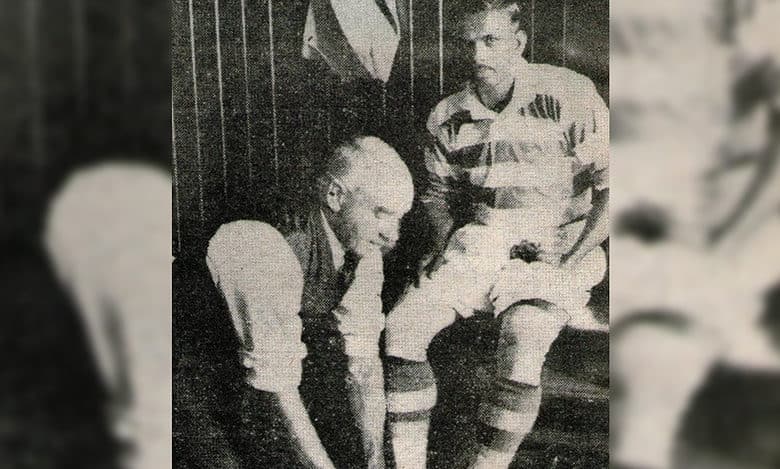
Mohammed Salim, the first Indian footballer to play for a foreign club. In this photograph from 1936, due to playing in bare feet, he is having them bandaged by Jimmy McMenemy the Celtic FC trainer. Photo: Wikipedia
Who was the first Indian footballer to play for a European football club? Very few people in India will be able to answer this question correctly.
He was a Kolkata-based football player Mohammed Salim who was selected by the well-known Celtic Football Club in Scotland in 1936. He carved out a brief but glorious career before returning to his hometown.
An interesting story was once told by his son Rashid Ahmed. After his father had grown old, the son decided to see if the famous Celtic Club of Scotland still remembered his father. He wrote to Celtic Club introducing himself as the son of their former player Mohammed Salim and stated that his father was facing financial difficulty in his old age.
Rashid Ahmed was not really expecting any reply from the club authorities after so many years. He had simply taken a chance. However, he got the biggest surprise of his life when the Celtic football club replied with a letter of sympathy and a bank draft of 100 pounds enclosed.
“I really had no need for the money. It was just a ploy to find out if Mohammed Salim was still alive in their memory. To my amazement, I received a letter from the club. Inside was a bank draft for £100. I was delighted, not because I received the money but because my father still he had a place of pride in Celtic. I have not encashed the draft and will preserve it till I die. I just want my father’s name to be remembered as the first Indian footballer to play abroad,” Rashid told the media.
The reason why Salim returned to India was that he was uncomfortable with the food and the climate of Scotland. He had been born and brought up in Kolkata and therefore was not used to the foreign conditions. Celtic Club pleaded with him to remain in Scotland and even offered to organise a charity match on his behalf. Salim refused and asked that the money be donated to local orphans.
Thereafter German clubs also became interested in retaining Salim. He was offered a professional contract to play in Germany. But he was resolute that he would return to India. So he traveled back to India to rejoin Mohammedan Sporting Club for the beginning of the 1937 Calcutta Football League.
To trace his life back to the starting point, he was born to a middle-class family in Metiaburj in Bengal in 1904. He was studying to be a chemist but football was his first love. His skills were soon spotted by the Mohammedan Sporting club and he was recruited in 1927.
After a brief stint with other clubs, Salim rejoined Mohammedan Sporting in 1934 and ensured that it reached the very top. It was the golden period of this club with Salim spearheading the attacks. He won thousands of hearts with his ball control, dribbling and accurate passes.
A Chinese football official Dr. Chi Chao Yung who saw Salim and his teammates in action said: “Allow me to congratulate the members of the Indian team for their wonderful display. In the course of the game, they showed perfect understanding and exceptional speed. The forwards, Salim, Rahim, Bhattacharjee and Abbas were outstanding in their game.”
Soon after this, Salim departed for Scotland to try his luck there. The well-known Scottish manager Willie Mayley was surprised at the skills that Salim displayed and took him in the Celtic side. On 28 August 1936, he helped Celtic win 7–1 against Galston. The Scottish Daily Express carried the headline: “Indian Juggler – A New Style”, along with a description of Salim that read: “Ten twinkling toes of Salim, Celtic FC’s player from India, hypnotised the crowd last night. Three of Celtic’s seven goals came from his moves.” Another newspaper, The Glasgow Observer wrote: “Salim tickled the crowd at Celtic Park on Friday with his magnificent ball manipulation despite playing barefooted.”
But even after the praise and success, Salim decided to return to India because he missed his home country. In 1940 Mohammedan Sporting became the first Indian club to win the Durand Cup in front of one lakh spectators. The British Viceroy at that time Lord Linlithgow, witnessed the match against the Royal Warwickshire regiment.
In 1980, at the age of 76, Salim passed away in Kolkata.
Before independence, challenging the might of the British rulers was a Herculean task. Salim achieved this seemingly impossible feat with his football. That was his greatest glory. He demonstrated that even barefooted Indian players, with determination and skill, could overcome the strongest of British teams.
source: http://www.siasat.com / The Siasat Daily / Home> Featured News / by Abhijit Sent Gupta / November 26th, 2022