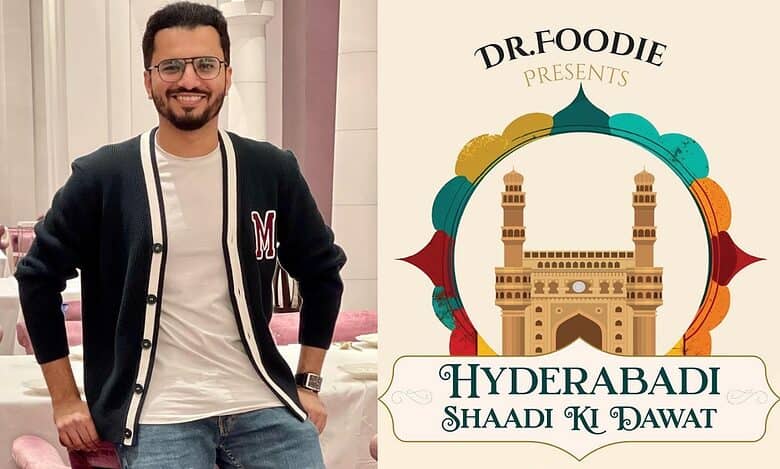
‘Hyderabadi Shaadi Ki Dawat’ is going to be a unique event to experience the food, culture, and hospitality that Hyderabad is known for, all in one place.
Dr Ahmed Ashfaq aka Dr Foodie gears up to host the first ever edition of ‘Hyderabadi Shaadi Ki Dawat’ (Instagram)
If you’ve ever attended a Hyderabadi wedding, you’ll know that it’s a celebration unlike any other. From the colourful outfits, the lip-smacking food to of course the ‘marfa’, it’s a feast for the senses. Agree?
Are you eagerly waiting to attend a Hyderabadi Shaadi and indulge in the rich, flavorful cuisine that our sheher is famous for? If yes, mark your calendars for March 5th, 2023 because a unique event is going to happen in the city that promises to satisfy your craving for Hyderabadi Shaadi ka Khana. But there’s a twist – it’s not an actual wedding!
Idea behind hosting ‘Hyderabadi Shaadi Ki Dawat’
Organized by Hyderabad’s popular food blogger Dr Foodie aka Dr Ahmed Ashfaq, ‘Hyderabadi Shaadi Ki Daawat’ is going to be a unique event to experience the food, culture, and hospitality that Hyderabad is known for, all in one place. And the best part? Nobody gets married here, so you can just enjoy all the festivities without any of the pressure or stress that comes with attending an actual wedding. You will be able to enjoy the shadi without fear of judgement from your ‘phuppu or ‘chachi. The event is powered by Zetch Digital Solutions (Ayesha Sultana & Hasnain Ul Haq).
Speaking to Siasat.com, Dr Foodie spilled beans on the main idea behind the ‘one-of-a-kind’ concept and said, “Whenever I was posting reels about Hyderabadi wedding food, I noticed a lot of interest from people in Hyderabad and across India who were curious about where they could find this cuisine. This got me thinking about how I could provide this delicious food to others.”
He further added, “With the demand for this cuisine being high, I came up with the idea of hosting a shaadi ka event, where people could experience the authentic Hyderabadi wedding food without actually attending a wedding ceremony. It’s a great opportunity for people to savor the flavors and experience the culture of this cuisine.”
Timings: 7pm to 12am Venue: King’s Palace, Gudi Malkapur, Hyderabad.
What’s in the menu?
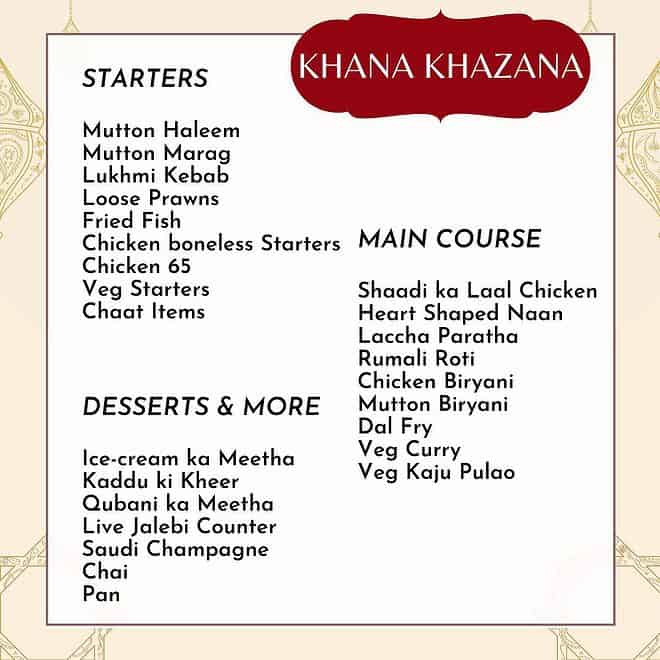
From the aromatic Biryani (The Star Of The Daawat) to the succulent kebabs, the mouth-watering haleem and many desserts, you’ll have the opportunity to savor a lengthy spread of delicious dishes that will leave your taste buds tingling. Lip-smacking vegetarian food items will also be there.
Bhulo Nakko, Dabake Khao!
Check out the menu below:
Beyond the Food!
Hyderabadi Shaadi Ki Daawat is not just about the food.
The event promises to be a cultural extravaganza, featuring music, interactions with your favourite influencers and the ‘vibe’ that is sure to transport you to the heart of Hyderabad.
Entrepreneur, vlogger, and ace tennis player Sania Mirza‘s sister Anam Mirza, popular YouTubers Amer Bin Ishaq and Shahbaaz Khan are among special guests who will be gracing the event.
“We will be creating a mock setup of a stage where attendees can take pictures or even pose as a bride and groom for a fun and memorable experience. In addition, we will have live mehendi stations, so guests can get their henna designs applied by skilled artists,” Dr Foodie said.
He also added, “We also have other surprise stalls planned, but we’ll keep the details under wraps for now to add an element of excitement and anticipation for our guests”.
So, prepare your best attire to glam up, look your best as you join Dr Foodie and his team for a celebration of all things Hyderabadi, and experience the best of the city’s rich culinary heritage.
Tickets For Hyderabadi Shaadi Ki Dawat
If you want to be a part of this unforgettable evening of food, fun, and cultural immersion, click here to book tickets and block your seats!
source: http://www.siasat.com / The Siasat Daily / Home> Lifestyle / by Rasti Amena / February 21st, 2023
The first mutiny of World War I was led mostly by young men from villages of Hisar, Rohtak, Meham and Gurgaon districts of Haryana. The Singapore Mutiny, which is known as the first mutiny of WW-I and left an indelible mark on India’s freedom struggle, started on February 15, 1915. It was led by Muslim soldiers who belonged to British army’s 5th Light Infantry Brigade.
Even as the world observes the centenary of the Great War, the sacrifice of these soldiers has been all but forgotten as most of the soldiers and their descendants migrated to Pakistan after Partition.
The brigade mainly comprised Rajput Muslims and Pathans and had been sent from Madras to replace the Yorkshire Light Infantry in Singapore. They reached there in October 1914 and were to leave for Hong Kong in February. On the day of embarkment, a rumour spread that they were actually being sent to Turkey and would have to fight Muslims there.
Singapore Mutiny shook the foundation of British rule in Asia
A rumoured triggered the Singapore revolt. The sepoys killed British officers and seized ammunition. The mutiny went on for 5 days. Eight hundred Indian sepoys of the British army killed 47 British nationals; 200 sepoys faced court martial; 73 were given a range of punishments.
As many as 41 sepoys were shot by a firing squad in front of 15,000 spectators at Outram Prison in Singapore.
In his book “The Mutiny in Singapore”, author Sho Kuwajima has argued that the mutiny not only caught the British off-guard but also shook the foundation of British rule in Singapore and forced the British to reconsider their strategy in Asia.
“The mutiny had a great impact on India’s freedom struggle. Freedom fighters, including Ghadarites were vindicated when finally in 1946, the British decided to leave following the naval revolt of February 19, 1946 when they felt that their protective shield, the armed forces, had itself turned against them,” said historian Malwinder Jit Singh Waraich, who has penned a number of books on the freedom struggle.
Four of those executed in public were from Jamalpur (Hisar), three from Jatusana (Gurgaon) and two from Balyali (Hisar). According to Phul Chand Jain’s Swatantarta Sainik Granth Mala, most of these people belonged to Jamalpur, Paten, Balyali, Kirawad and Balliya Ali in Hisar; Jatusana, Karmpur and Kheri Nangal in Gurgaon; Garhi, Kani and Kahnaur in Rohtak. One sepoy each was from Muzaffarnagar in Uttar Pradesh, Karnal and Nabha in Punjab.
“These villages were gripped by violence of Partition, so, there is not much trace of their memories now,” says documentary filmmaker Daljit Ami, who is making a film on the Singapore Mutiny and has visited these villages a number of times. In the course of his research, he came across just one man who had heard about these heroes and their Haryana connection.
According to historians, the Singapore Mutiny was followed by the Russian soldiers’ mutiny in 1917 and a series of mutinies in the French armies.
source: http://www.timesofindia.indiatimes.com / The Times of India / Home> News> India News / by Sarika Sharma / TNN / July 05th, 2014
Andaleeb Wajid is a Bangalore-based writer who attempts to authentically portray India’s Muslim diaspora through novels that focus on life, food, family and relationships.
The young Indian Muslim writer Andaleeb Wajid has published five books in almost as many years. Courtesy Andaleeb Wajid
Modestly dressed in a pretty headscarf and shalwar kameez, the Bangalore-based writer Andaleeb Wajid smiles as she talks about her short but successful writing career – she has published five books in six years, most of them featuring a Muslim setting and credibly representing the community in India.
Wajid, 36, says she has been writing since she was 10. Her first book, Kite Strings, was released in August 2009 followed by Blinkers Off (August 2011), My Brother’s Wedding (May 2013) and More Than Just Biryani (January 2014). No Time For Goodbyes, released in April this year, is her latest book and the first in the Tamanna Trilogy series, books on time travel targeted at young adults. The other two will be released in September and December this year.
How did you begin writing?
I have been writing stories since I was 10. When I was in Grade 12, I was left very confused about what I would do with my life. There weren’t many options for girls from orthodox Muslim families. Then it occurred to me to take up writing as a career. I was certain that no one would stop me.
Is there a reason why many of your books have been set in a Muslim milieu?
I’m quite amused with the way Muslims are depicted in Bollywood films and on television in India. My stories attempt to show a slice of Muslim life, which is no different from anyone else’s. I wrote More Than Just Biryani only because I strongly felt that the world has labelled us as just biryani-eaters and I wanted them to be aware of the diversity in Muslim cuisine. Kite Strings discusses the issues a young girl from an orthodox Lababin Muslim [a community from Tamil Nadu] family faces. But a large number of non-Muslim fans also reached out to me, saying how much they identified with the character, which proves that some things transcend religious boundaries.
More Than Just Biryani was conceived as a recipe book. What prompted you to turn it into fiction?
My brother and I had thought of writing a culinary memoir but the idea never took off because I realised early that I could never do justice to non-fiction. Instead I wrote about three women and the role food plays in their lives. Nearly every chapter of the book has a recipe, which is woven into the story.
Have you drawn upon your personal experiences to craft stories?
Yes. Like most writers, I started off writing about what I knew best. In Kite Strings, the protagonist Mehnaz is a rebel without a cause and behaves a lot like I did as a teenager. The story is set in Vellore, Tamil Nadu, where as a child I spent several holidays with my grandparents. In More Than Just Biryani, one of the protagonists loses her father. It was the most painful chapter I have ever written.
What else is in the pipeline?
I have one more young-adult novel in my kitty, about a girl whose mother has left the family. Then there’s another about a crochet teacher and the four women who learn this beautiful craft from her and end up baring their lives to her.
• Andaleeb Wajid’s books are available on Amazon
artslife@thenational.ae
source: http://www.thenationalnews.com / The National / Home / by Priti Salian / July 05th, 2014
The first Muslim judge of a high court in colonial times, Syed Mahmood’s professional conduct offers a counterpoint to the declining standards in Indian judiciary.
WHEN Justice Abdul Nazeer addressed the 16th national council meeting of the RSS-affiliated Akhil Bharatiya Adhivakta Parishad at Hyderabad last December, he said, “Great lawyers and judges are not born but made by proper education and great legal traditions, as were Manu, Kautilya, Katyayana, Brihaspati, Narada, Parashar, Yajnavalkya, and other legal giants of ancient India.” In the symposium on “Decolonisation of the Indian Legal System”, Justice Nazeer also said the “continued neglect of their great knowledge and adherence to the alien colonial legal system is detrimental to the goals of our Constitution and against our national interests…”.
Perhaps Justice Nazeer should have also recalled 19th-century jurist Justice Syed Mahmood (1850-1903). A pioneer in bold assertions against the colonial judiciary, he produced incisive legal commentaries that reflect an audacious dissenter’s point of view. Writing in an Urdu newspaper, his father, Sir Syed Ahmed Khan, narrates Mahmood’s resignation from the Allahabad High Court in 1893 to “protect the self-respect of Indians against the racism of British judges”.
In that era, conceptions of nationhood were still evolving in India. Indian judges would not muster the courage to contest the racism of the imperial power or fellow European judges. But Mahmood did, in intrepid ways. Khan founded the Mohammedan Anglo-Oriental (MAO) College at Aligarh in 1877 and figures prominently but contentiously, stereotyped as a British loyalist and separatist in debates on contemporary nationalism. Mahmood supported his father’s modern education project, but unfortunately, his contributions are largely ignored by historians and the legal fraternity.
By 1920, MAO College, now Aligarh Muslim University, was the most prominent residential university in the country. Its history department has been a premier centre for advanced studies for a half-century. In 1889, primarily on Syed Mahmood’s initiative and his gifts in terms of books, journals and cash, AMU established a law department. Yet, he was neglected in its research. Only in 1973, seven years after the centenary of the Allahabad High Court, the Aligarh Law Journal brought out Mahmood’s contributions, and legal scholars reflected on his high calibre as a lawyer and judge.
The good news is, in 2004, Alan M. Guenther did his doctoral thesis on Mahmood at McGill University, Canada, which is available online for the public to access. His meticulous and well-researched account touches almost every aspect of Mahmood’s public life. Guenther also published an extended essay in 2011on Mahmood’s views on English education in 19th-century India. (In 1895, Mahmood had written a book on the theme for his speeches at the Educational Conference.)
In 1965, Asaf Ali Asghar Fyzee (1899-1981) complained, “Syed Mahmood’s contributions to the transformation of Muslim law in India have been largely neglected by historians and survive primarily as footnotes in legal texts on Muslim law.” Guenther, too, observes, “…overshadowed by the life and writings of his illustrious father, Ahmad Khan, his legacy has not received the attention it deserves. A large part of his father’s achievements in the reform of education, in fact, would not have been possible without the assistance of Syed Mahmood. But when he reached the age at which his father had made his most significant achievements, [Mahmood] had his life cut short.”
Mahmood had laid out his life plans clearly. S. Khalid Rashid, writing in 1973, reports that Mahmood decided early on that, like his ancestors, he would devote the first third of his life to educating himself, the second to earn a living, and the last to “retired study, authorship and devotion to matters of public utility”. But Guenther writes about how Mahmood’s health had deteriorated through alcohol abuse and disease. He died before he turned 53, broken by forced retirement, estranged from his father (who had died five years previously), stripped of responsibilities at the college he had helped found, separated from wife and son, and in poverty. He was selling personal items to repay debts. “His father’s numerous writings and letters are still republished, but Syed Mahmood’s contributions to Muslim thought are hidden in bound volumes of the Indian Law Reports and brittle files of government correspondence,” Guenther writes.
One aspect of Mahmood’s last years is captured by Prof. Iftikhar Alam Khan’s Urdu books, Sir Syed: Daroon-e-Khana (2006, 2020) and the recent Rufaqa-e-Sir Syed: Rafaqat, Raqabat wa Iqtidar Ki Kashmakash. These accounts expose the smear campaigns of the three companion successors of Sir Syed—Samiullah, Mohsin-ul-Mulk and Viqar-ul-Mulk—against Syed Mahmood as they vied for the secretary’s post at MAO College. Often European members of MAO College conspired with them. Exploiting his weaknesses and eccentricities, they ousted him to get a hold over college affairs, compounding his hurt during his tragic final years.
SYED MAHMOOD’S ROLE IN SIR SYED’S EDUCATIONAL ENTERPRISE
Having returned to India in 1872 after studying in England, Mahmood took time out of his budding legal career to assist his father’s reform work, particularly setting up MAO College. He prepared a detailed plan along the lines of his experiences in Cambridge. His specific aim, explained in February 1872, was to produce future leaders of India through an educational institution whose residential nature would be “as indispensable an education as the course of study itself”. The aim was to create a society of students and teachers quite different from the rest of society.
He travelled with his father to Punjab in 1873 and spoke at a rally to promote the project. In 1889, Sir Syed introduced a motion to nominate Mahmood as joint secretary of the board of trustees of MAO College by highlighting his assistance despite the opposition he faced. In particular, he considered his son’s influence the primary factor that persuaded European professors to come to India and teach there.
European staff members confirmed this around six years later when there was renewed opposition to Mahmood continuing as joint secretary. The principal, Theodore Beck (1859-1899), testified, “Syed Ahmad….acknowledged his reliance on Syed Mahmood for advice in all matters, and his imprint could be noted in the correspondence relating to the school. He declared his firm conviction that Syed Mahmood was the one person who shared his vision for the college, and apart from him, no one would be able to administer the school in keeping with that vision.” However, Samiullah (1834-1908) disagreed with Sir Syed on this count. As a result, a tussle for power began in the college management. The power-play could explain why AMU felt inhibited in bringing out a biography of Mahmood, a research gap that Guenther’s doctoral thesis fills. He has extensively relied on important correspondences of Mahmood preserved in the London India Office (British) Library.
SYED MAHMOOD’S TRYST WITH MUSLIM LAW
Mahmood is a forgotten pioneer of the transformation of Muslim law in modern South Asia. In 1882, at just 32, he became the first Muslim judge of the high courts in British India. He delivered numerous landmark decisions that shaped Muslim law, the law in general, and its administration.
Earlier, he blazed a trail his younger contemporaries followed in their judicial roles in British India. He was one of the first Indian Muslims to study in England and train in the English system of jurisprudence, the first Indian to enrol as a barrister in the High Court of Judicature at Allahabad in 1872, the first appointed as a district judge in the restructured judicial system of Awadh in 1879 and the first Indian assigned as a puisne judge to the High Court at Allahabad. He was the first Muslim in any High Court of India. He cleared a path for Indian Muslims to participate in administering justice in India. But his contribution is not limited to creamy career opportunities for Muslim youngsters. His lasting legacy is how Muslim law is perceived and administered in South Asia today.
CHAMPION OF ACCESSIBLE JUSTICE
An abiding concern of Mahmood was the cost of administration of justice. Court procedures were lengthy and expensive, and the “mass of law” was complicated. Distance from courts was another concern, for which he proposed a network of village courts for “on-the-spot” adjudication. He sought to make justice accessible through unpaid tribunals and honorary munsifs. He prepared a comprehensive draft for this, Guenther informs.
Furthermore, he attacked the [racial] mindset and court fees and stamp duties on legal documents. He ruled in August 1884 and February 1885 that “…if justice costs the same amount [to the] rich and poor, it follows that the rich man will be able to purchase it, whilst the poor man will not.” He declared, more than once, that British judges in India were too quick to find fraud.
In a speech at the Allahabad Bar in April 1885, Mahmood raised the language issue in judicial transactions, saying laws should be in languages intelligible to the masses. He insisted on the vernacular in arguments, pleadings and justice delivery and translated verdicts so that people unfamiliar with English could rest assured that judgments are reasoned. Of course, the issue of judicial language continues to be debated, and for this, acknowledgement is due to Mahmood.
AN INDIAN DISSENTER IN THE HIGH NOON OF BRITISH COLONIALISM
Mahmood is known most for outstanding dissenting judgements. In volume 2 of his 2021 book, Discordant Notes, Justice (retd.) Rohinton F. Nariman writes that Mahmood was known for detailed judgments, some of which stand out for thoroughness and fearless language. Mahmood would refer to the original Sanskrit versions when ruling on Hindu laws and the Arabic texts for Muslim laws, rather than using interpretations of the relevant texts.
From the 1860s to 1880s, during the codification of laws, he sought limits on importing British laws and protested that the local context was getting overlooked. His concern was not just the laws but their efficacy and adaptability within India’s cultural diversity.
Guenther observes, “…throughout his life, he identified himself as a Muslim as well as an Indian and a subject of the British crown, and that he was actively involved in the education and improvement of the Indian Muslim community. At the same time, Mahmood… [made] efforts to promote harmony between people of diverse backgrounds, and…[supported] initiatives that improved the situation of all Indians, regardless of religious affiliation…”
An anecdote from Altaf Hali’s Hayat-e-Javed (1901), cited by Shamsur Rahman Faruqi (2006), is worth sharing. “Contrary to the culture of sycophancy and genuflecting before the English colonial authority….Syed Ahmad Khan and his high-profile and brilliant son Syed Mahmud strived to conduct themselves as if they were equal to the English….Syed Ahmad Khan had stayed away from the [1867 Agra] Durbar because Indians had been given seats inferior to the English. A medal was to be conferred on Syed Ahmad Khan at that Durbar. Williams, the then Commissioner of Meerut, was later deputed to present the award to Syed Ahmad Khan at Aligarh railway station. Willams broke protocol and showed his anger at having to do the task under duress and said that government orders bound him, or he wouldn’t be presenting the medal to Syed Ahmad Khan. Syed Ahmad Khan accepted the medal, saying he wouldn’t have taken the award, except that he too was bound by government orders.”
Indian democracy is an outcome of anti-colonial nationalism, and dissent is its core component: Mahmood’s dissent contributed to nationalism in his time. In 2022, the V-Dem Institute described India as an electoral autocracy where dissent is being criminalised, and the judiciary is failing to contain the majoritarian upsurge. Mahmood’s professional conduct is an encouraging counterpoint to the degeneration in the Indian judiciary.
WHAT DID MAHMOOD THINK OF THE INDIAN NATIONAL CONGRESS?
According to Guenther, though Mahmood never joined the Congress, he was “equally aloof” from the anti-Congress propaganda his father indulged in. “…a rare catholicity characterised his views on most of the controversial questions,” he writes. He adds, “His acceptance among the Hindus [elites] generally was demonstrated by the fact that they tried to send him as their representative to the Imperial Legislative Council, though he never received that appointment.”
Nonetheless, like his father, Mahmood harboured class and regional prejudices. Guenther reveals an article Mahmood wrote in The Pioneer on 4 September 1875, suggesting the government must strive to with the sympathies of the “higher classes of natives”. When challenged to defend his position by “Another Native” in the same newspaper two weeks later, Mahmood responded that people in Punjab and the North-western Provinces [now Uttar Pradesh] were, historically speaking, of “much greater political significance” than those of Lower Bengal. Gunther cites his write-up: “…any educational system that succeeded in ‘attracting the Bengalee and fail(ed) to exercise any influence upon the higher classes of the Rajpoot, the Sikh, and the Mussulman’ must be regarded as a failure.”
Considering the socio-regional composition of top functionaries of AMU, even impartial insiders would testify that it still harbours regional and sub-regional prejudices. The Sir Syed Academy is releasing many publications during the ongoing centenary celebration of AMU. Publishing Guenther’s dissertation may be a fitting tribute to Mahmood, who must be regarded as a prominent co-founder of MAO College.
Mohammad Sajjad teaches modern and contemporary Indian History at Aligarh Muslim University. Md. Zeeshan Ahmad is a lawyer based in Delhi. The views are personal.
First published by Newsclick.
source: http://www.theleaflet.in / The Leaflet / Home> History / by Mohammad Sajjad and Zeeshan Ahmad / April 01st, 2022
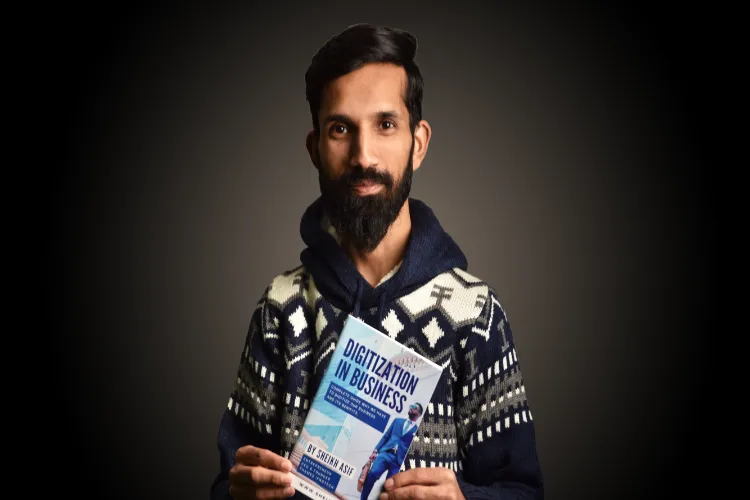
Sheikh Asif, founder, Thames Infotech, holding one of his books
Breaking the stereotype of a company chief, Srinagar’s Asif Sheikh, a school dropout, is the CEO and founder of Thames Infotech, a Manchester-based company with a turnover of Rs 5 crore! He has just turned 28.
“I believe that a person who works hard, with dedication and honesty is always successful; he can never give up even when many a time one loses the courage to carry on. There were setbacks and at the time I did seem to lose courage, but I did not give up,” Sheikh Asif told Awaz-the Voice in a telephonic interview.
Asif’s success is extraordinary given his poor educational background and reaching a position that many persons with degrees from top-end colleges aspire to.
Besides being a successful entrepreneur, Asif is also a professional web designer, developer, graphic designer, digital marketer, and writer. He also gives back to society by giving free tuition to students from all over the world.
Sheikh Asif’s work profile is interesting: he worked with a tour and travel company, sold medical equipment for a company, and with telecom companies like Airtel, Vodafone, and Aircel.
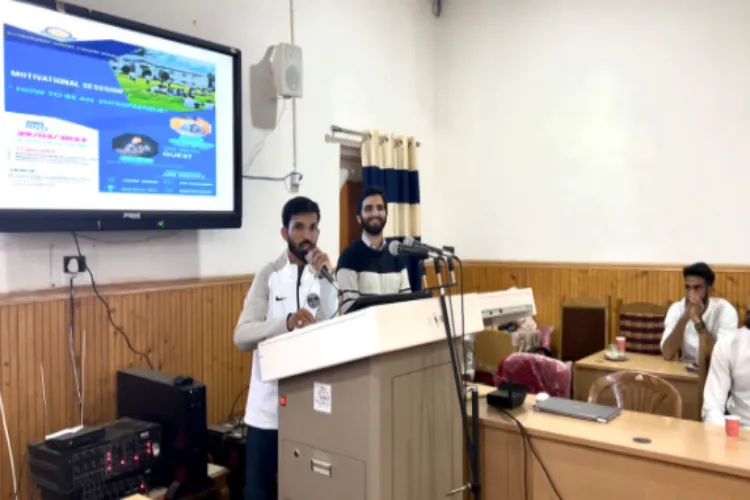
Sheikh Asif deliving a talk on business
In the year 2000, Sheikh Asif was 8 years old when his father’s health deteriorated. His father was a head constable. Due to his father’s illness, the family was reduced to penury. Sheikh Asif says that his father’s illness remains a mystery as the family consulted experts and eminent doctors but nobody could diagnose it.
Sheikh Asif told Awaz-the Voice that his mother sold most of the household assets and took loans to pay for his father’s treatment.
Recalling those days, Asif says that he can never forget one particular day when he was studying in the eighth grade and was to write his exam, but he had no pen. “I was leaving for the examination hall and was worried. My mother came to know the reason for my worry, she sold a copper dish from her kitchen to buy me a pen.”
He says that his mother often sold household goods for the family, especially to meet the needs of the children.
The conditions at home were not conducive for Sheikh Asif to continue his studies. He left school and started working to support his family.
“I went against my mother’s wishes, as she wanted me to become a doctor most parents in Kashmir do, but I gave up my studies to support my financially broke family,” said. He was 15 years old in 2008 when he started earning for his family by doing odd jobs.
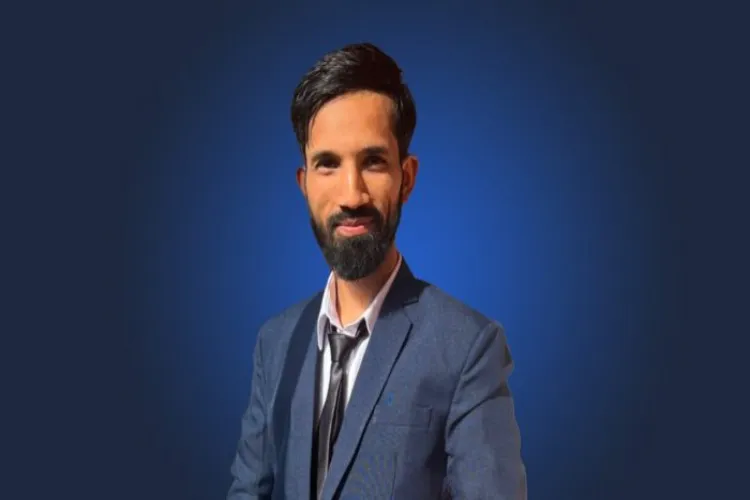
Sheikh Asif
Sheikh Asif was always fascinated by computers and spent a lot of time on them. Due to this, he got his first job as a data entry operator with a local tour and travel company at the age of 16. He earned a salary of Rs 1500.
Sheikh Asif said seeing his interest his father took a loan from a bank to buy him a computer. The turning point in his life came as he watched an interview with Microsoft founder Bill Gates on BBC.
He took full advantage of his computer and yet the challenge was the lack of a high-speed broadband facility in Kashmir. While the rest of the world was running 4G internet, in his locality only 2G internet was available.
He left his first job within two months and started working in a local shop as a salesman for four years. Here he honed his skills and learned all the basics including graphics designing, web designing, etc.
Again there was a rough patch in his life as in the 2014 Kashmir floods, his house was washed away. He used all his savings in rebuilding his house. The family had to start from scratch as all their household belonging had got damaged and washed away.
In the year 2014, he quit his job and started his business, but it turned out to be a year full of troubles for him.
Sheikh Asif’s Srinagar office
However, fortunately, the next year Asif got an opportunity to work in Delhi, and the exposure there opened his mind to a bigger canvas.
“The 2014 flood severely damaged our house and we had to repair or renovate it periodically for four consecutive years after the flood and finally had to sell the house in 2018,” he said.
In the meantime, he worked with OLX from April 2015, and from there he was offered a job at Trimax Printing and Graphics, a UK-based company owned by Tajinder Singh. He was working for the company Hayes Harlington. The company runs an online general store and it had no element of graphic designing till then.
Sheikh Asif told Awaz-The Voice: “I worked for Chanda Trimax Printings & Graphics. Meanwhile, the killing of a militant in Kashmir saw the valley under lockdown for nearly three months. For this reason, I left for Delhi.”
When he met Tajinder Singh in Delhi, the latter was facing issues with his business. His business was suffering due to low sales. Having seen his latent, Tajinder Singh offered him a job at Hayes, Harlington, UK, where Tajinder’s brothers were already working.
Sheikh Asif says he consulted his mother before picking the UKL job. He signed an agreement to work for 18 months and an assured return flight ticket to India.
“They told me that they had changed the name of Trimax Printings & Graphics to Thames Infotech on June 6, 2016,” Asif said.
He set foot on foreign soil for the first time in the first week of November 2016. However, the business did not show positive results there either, thus Tajinder’s brother advised him to find a part-time job in the UK to meet his expenses.
“When I was looking for a part-time job, I met Rizwan, a Kashmiri man originally from Baramulla district in North Kashmir, who came to Manchester in 2000 and now runs a restaurant, Riz Spices.
Sheikh Rizwan offered him a space in his restaurant to set up a part-time business. “Two months later I met another man, Hamza Salim, a senior software engineer at Google, who asked me to build a website for his tech company, on the condition that only if he liked my work I would be paid,” he said.
After approving his website design, Hamza Salim offered him 50 percent equity in his firm.
pix05
During this time, Asif meet many people including natives and others, and kept looking for opportunities.
One such person was Rudrigo Ruiz Karvajal, who frequented the restaurant. He offered me a place that was quite conveniently located. He told me that his father had started his business from there.
“I got my first order for a logo for which I was paid 500 pounds and I was only expecting 30-40 pounds. They gave me another order to build a website for which I was paid 7000 pounds.”
“I was wondering if it’s a dream. Never expected such high remuneration. This order was from the largest food chain in London called Zabka.”
On June 9, 2016, Asif took over the Thames Infotech Manchester UK company which has a current turnover of Rs 5 crore.
It has an office at Advent Colony in Naugam, Srinagar, Kashmir. He employs 35 locals including 32 in UK and 3 in Kashmir for website designing and development, digital marketing, graphics designing, personal branding, social media handling, etc.
Sheikh Asif told Awaz-The Voice that our company is a leading web designing company and has won the 2017, 2018, 2019, and 2020 awards as the Three Best Rated UK, and Best IT Service Provider Award 2018, 2019 organized by Top Developers USA, he claims.
Sheikh Asif said that he received the first award in the year 2003, less than one year after his launching of his company.
So far, Asif has trained around 1000 students, helped 40 businesses through the Covid-19 pandemic, and has published three books – Digitization In Business, Online Business Idea, and Start a Business.
Sheikh Asif was named Entrepreneur of the year 2022 by The Fireboxx. There he was honored by Google as a Digital Marketing Expert in 2018.
To the youth, Sheikh Asif says they must never lose hope and always keep their focus on business. Secondly, they must avoid drugs. They shouldn’t waste their lives by getting immersed in romantic liaison and heartbreaks; these are temporary phases of life and not a goal. “Your personality is your work,” he says.
source: http://www.awazthevoice.in / Awaz, The Voice / Home> Youth / by Shah Imran Hasan, New Delhi / December 17th, 2022
Two candidates, one each from Maharashtra and Uttar Pradesh, secured 100 percentile and emerged as all India toppers.
Eight students from Karnataka, the highest for any State, have emerged as top scorers in Common Law Admission Test (CLAT-2023) results for undergraduate and postgraduate streams declared by the Consortium of National Law Universities on December 23, Friday.
Two candidates, one each from Maharashtra and Uttar Pradesh, secured 100 percentile and emerged as all India toppers. One candidate from Karnataka secured a percentile of 99.97, two secured 99.96 and one each secured a percentile of 99.95, 99.94, 99.93 and 99.92 in CLAT UG from Karnataka.
Kshitika Tyagi
Kshitika Tyagi of Bengaluru got an All India Rank (AIR) of 12 with 106.75 score and a percentile of 99.97 in CLAT-2023 UG. Speaking to The Hindu, she said she started preparing for the exam and found the subject very interesting. “I want to join the National Law School of India University, Bengaluru,” she said.
Ayesha Khan
Another topper from Karnataka, Ayesha Khan, AIR 17 with 105.75 score and 99.96 percentile, said her dream had come true. “From a very young age, I always wanted to be a lawyer, and I will be one now,” she said.
The CLAT-2023 was conducted at 127 centres in 23 States and two Union Territories. A total of 94.87% of the candidates who enrolled appeared for the examination, of which 56% are females 44% are males and 2 are transgenders.
The duration of the CLAT 2023 UG test was 120 minutes. The test had five sections, with a total of 150 questions. One question was withdrawn in the final answer key. The highest mark secured in CLAT 2023 UG is 116.75. CLAT 2023 PG had one section comprising 120 questions and the highest mark secured is 95.25.
source: http://www.thehindu.com / The Hindu / Home> News> India> Karnataka / by The Hindu Bureau / December 23rd, 2022
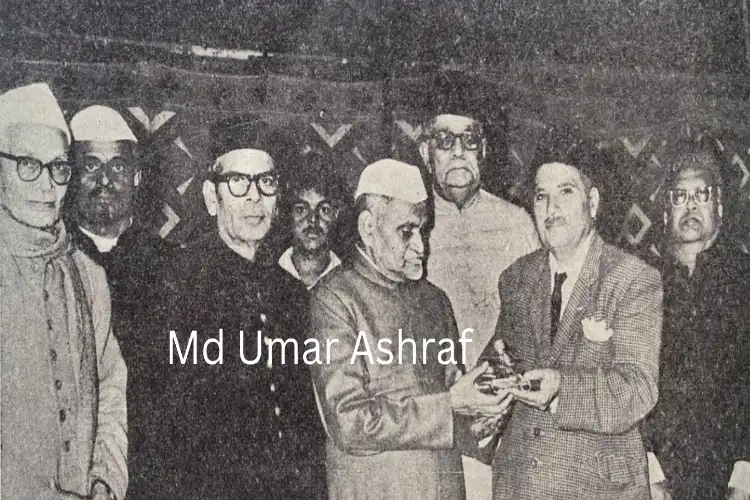
Administrator of Ajmer Sharif Aley Mohammad Shah donating gold to the minister (Courtesy: Md Umar Ashraf)
If I tell you that the Dargah of Khwaja Moinuddin Chishti at Ajmer, Rajasthan, played a role in the war against China when India was invaded in 1962, will you believe it?
In October 1962, the Chinese Army invaded India which had gained freedom 5 years ago. Such national crises test the character of a country. Indians of all creeds, castes, races, and social groups joined hands to fight the mighty enemy.
After 200 years of British colonialism, the Indian economy was in shambles when the colonial rulers left in 1947. When China invaded, India was not as big an economy as it is now. Prime Minister Jawaharlal Nehru appealed to his compatriots to donate gold and money to the defence funds.
Responding to the call, Dargah at Ajmer opened its vaults for the country’s defence forces. The management of the shrine of Hazrat Khwaja Moinuddin Chishti believed that national service comes before any other service. The administrator of the committee handed over 2 kilograms of gold and invested Rupees one lakh in Defence Saving Certificates to the Union Minister of Irrigation and Power at a meeting held at the Dargah. It also announced holding special prayers for the success of the Indian Army daily.
The administrator who handed over the gold, to the minister was Aley Mohammad Shah. His elder son Zameruddin Shah rose to become the Deputy Chief of Army Staff in India while his other son Naseeruddin Shah is a popular film actor.
The episode is a testimony to the fact that for Indian Muslims following Islam and serving the nation are not contradictory.
source: http://www.awazthevoice.in / Awaz, The Voice / Home> Culture / by Saquib Salim / December 14th, 2022
Abbas said he wrote the memoir to enable his children to know their father better.
Saulat Abbas.
In a letter to his friend Thomas Poole, Coleridge wrote that any life, however insignificant, would if truthfully told, be of interest. There are two important points in Coleridge’s observation. One, that it is not important whether the subject of a memoir, biography or autobiography has lived a very eventful life and achieved great success, as any life can be a good enough subject for a book. Two, truthfulness in reporting events of life is an essential feature of a book chronicling a life. And because a memoir lies somewhere between history and literature, the element of selection, omission, foregrounding, and downplaying of events of life can all be part of a memoir.
An ordinary life
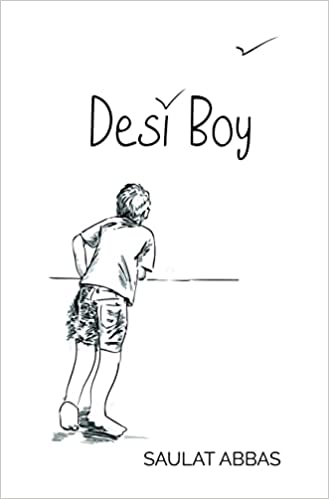
Saulat Abbas’s memoir Desi Boy starts with his modest admission about his ordinariness. He states that his purpose in writing his memoir is to let his children know him if ever they decide to know about their father. “Given all the uncertainties of life, if god decides to take me away before my kids are mature enough to care about who their father is, this book, I believe, will satisfy their curiosity.” While Abbas, whose two marriages did not last long, lives in Saudi Arabia alone, alternating between the gulf countries and his motherland India, his teen-aged son lives in Taiwan with his mother, and his daughter in Malaysia with her mother.
Abbas’s truthfulness in reporting various events of his childhood, adolescence and youth, some even projecting him in a very bad light if seen from some established ethical principles, is the most important feature of his memoir. It certainly must have been an important decision for him to decide which incidents should or should not be included in his memoir. Thus indoctrinated to believe that the punishment for theft is chopping off hands, he almost chopped off the hand of Khajya, his young playmate, with an axe for stealing marbles, injuring him badly enough to leave a cut on his hand.
There is certainly interesting material in his ordinary life: a Muslim boy living in an eastern UP village in a patriarchal set-up struggling with his education; his family moving to western UP town of Bulandshahr where his anglophile father taught English in a postgraduate college; his student days at Aligarh Muslim University; his dreams and his aimlessness finally taking him to Saudi Arabia and Europe where he feels that he has made it. More than the external events, it is his intellectual and spiritual development and his struggle with some ethical principles that make the book eminently readable.
Undoubtedly the most authentic portion of the book is his account of his early childhood in his mother’s village where he was exposed to village superstitions, rural-agricultural practices, Tom Sawyer-like antics of stealing hens and the rigidity of caste structure where, contrary to their religion, Muslim landowners maintained caste hierarchy very ruthlessly. The author narrates how he and his cousins caused a big scandal in his family when they attended a Dalit wedding to watch a nautanki. “As far as I can remember, perhaps, it was the first time that the Sayeds were going to attend a Dalit marriage ceremony, and all because of the fun of the nautanki.” The punishment for this transgression from the elders in the family was fierce: “we could not sit after the caning.”
The villagers believed in black magic, witchcraft and often consulted a mulla, rather than a doctor, when taken ill. Formal education in this set-up was a rarity, often available in a madrasa, and was the prerogative of landowners’ sons as the poor villagers were kept away from learning. “If they became literate, who would do the farming?,” Abbas wryly asks. Writing was done on a wooden board, a takhti, which needed the application of a film of fine clay called multani mitti. For the author the whole process of preparing his wooden board for writing and making reed pens with a sharp tip “was more interesting than writing or learning so we did it as slowly as possible,” till his teacher lost his temper.
Life in the village
Many characters in his account of village life stick in memory. The foul-mouthed, amoral, “ever-giggly-jiggly” Okida, who gives many “arse-spreading ideas” to the author, is also a woman full of practical wisdom. Harcharan, a farm worker in his sixties, not only narrates tales of his sexual exploits, he also gave the author lessons in little thefts like stealing milk right from “the cows’ udders.” The lower caste, good looking Sudhua, who was probably fathered by a zamindar for whom his mother worked, taught him lessons in farming and agriculture as also in the exploitative and unjust social order in his village.
“If any member of Sudhua’s community ever combed his hair or wore sandals or slippers, he would be castigated. In physical care and style they were not supposed to “emulate’ the zamindar.” Shammu Khan, the private tutor known for his strictness, also taught the author lessons in morality and power structure in the family. Granny Iqfa who came from Calcutta not only has many tales behind her but her writing of poems in Urdu and Persian when women hardly had any education, makes her even more interesting.
The break in his idyllic existence and a brief experience of uprootedness informs his description of his life in Bulandshahr, where his family moves. Up to his High School days, he describes, how his lack of interest in studies and attending school made him one of the slowest learners in his class. His teachers had unshaken belief in corporal punishment which he learnt the hard way and his classmates smelled of curry, putting him off from studies further. “In my mind, school had become synonymous with the Nazi concentration camps…teachers looked like demons.” The ruins of houses left behind by people who migrated to Pakistan after the partition became his hideouts where he would spend time with city urchins, learning bad language, playing marbles and smoking bidi. He also specialised in committing petty thefts with friends to finance his passionate love for Hindi films.
An important part of his growing-up years in the college premises where his father worked was his mingling with his Hindu neighbours. Religion was never an issue in his friendships, rather “we learned about one another’s faith, and learned stories that were at the foundation of our religious beliefs.”
One particular incident about hierarchical system of education stands out. As he became more serious about his career, he thought of exploring the possibility of getting admission in St Stephen’s College, New Delhi. However, so mesmerised and scared was he to see the dress, language and confidence of students and staff in the College, that he could not even gather courage to even talk to anyone in the College: “I returned to the bus station, got back home, and never told anyone how heroically the villager was defeated on his first trip to a real city.”
There are a plenty of interesting, funny, and humorous situations in the book which are enlivened by the author’s self-deprecating humour. Thus in watching Hindi films he and his friends felt aroused by Helen, Aruna Irani, or Jayshree, but “respected our heroines…and never cast a lascivious look at them. We thought our heroes had exclusive rights on those women.” He relates how his father’s application for a job in a university in Saudi Arabia and his own application for admission to a course were mixed up by the person handling them in Saudi Arabia because he had learnt to copy his father’s handwriting perfectly. When his father received a letter that he could not get admission to the said course he did not know “that his job prospects in Saudi Arabia were screwed up by his brilliant son.”
There appears a little bit of drama in the narrative when a boy from a lower-class family in his village who had left for Lucknow and later Bombay comes back to his village in style after making it big. It turns out that Rasheed, who made people believe that he was part of the author’s family, to gain respectability and social status, was an underworld don on the run, and the author’s house was the safest place to hide. Obviously the elders in his family had to do a lot of explaining to the police officers who followed Rasheed in the village.
Reproduction of village life, especially some rural Hindi slangs and swear words entailed problems of their translation in English. He uses expressions like “arse spreading remedy” to translate a familiar swear word in Hindi. The author’s wit makes the book very readable. The common practice in his village of keeping the heads of children shaved meant that “five or six little neo-Nazis of similar age, size, and shape often roamed the orchard. Abbas’s style of writing includes allusions to many literary works, often reflecting his study of English literature. Thus nights are dark “like Iago”, and a deserted house, called Chhaouni in the village, reminds him of the atmosphere in The Duchess of Malfi and The Fall of the House of Usher. His uses similes very liberally all through his texts, many of them are very original.
Memory has a very important role in a memoir. It can sometimes play tricks and at other times it can be put to selective uses. The author does not always mention dates or years in reporting many incidents of his life. An aware Indian reader can draw an inference about the time of the incidents but for others the author leaves a lot of work to do. Thus if the author saw Sholay 25 times, one can make out that he is talking about the year 1975. It would also have helped if he had used the names of schools he attended. His account of Aligarh Muslim University could have been longer. The elaborate rituals attending a death in the family and various forms of the expression of griefs are rites of passage for him. However, the description of Moharram, its significance in his formative years and description of many events in Islamic history take something away from the main narrative of the memoir.
All through the memoir the narrator uses a royal “we” to narrate events and experiences which, since it is a plural subject, sometimes feels awkward in the narrative, that is, “We brought a two-page long essay back to my father. He made millions of corrections and trimmed it well, and we memorised it by writing it many times to make sure we were not going to make a mistake on our exam.” In the same way the author uses a common Indianism “beef” to refer to buffalo meat, which in the present context is a very problematic expression. It should have been replaced either by buff or simply buffalo meat, the common Hindi expression for which is “bade ka ghosht.”
In all, Desi Boy is truly an authentic and interesting account of a life because it is truthfully rendered by Saulat Abbas.
Desi Boy, Saulat Abbas, StoryMirror.
source: http://www.scroll.in / Scroll.in / Home> Book Review / by Mohammad Asim Siddiqui / December 10th, 2022
The literary work is the fourth translation and the first Urdu work to win the JCB Prize
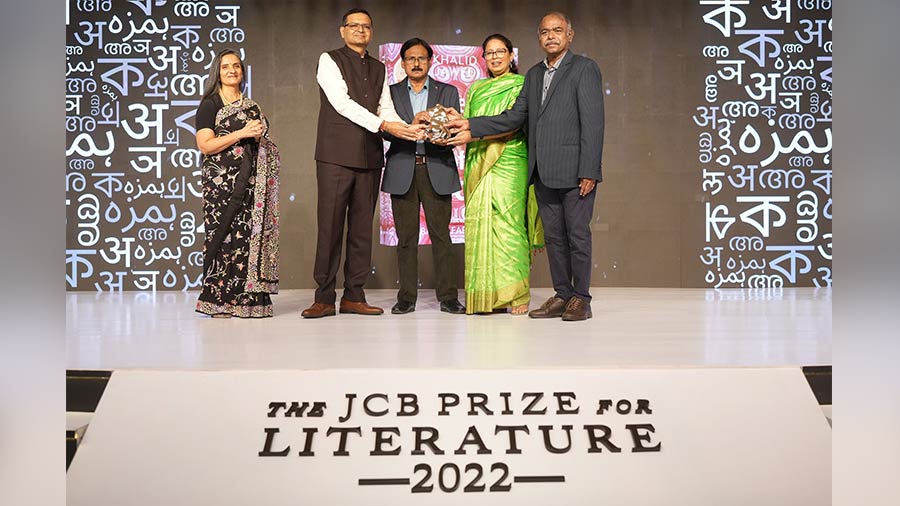
(Left to right) Mita Kapur, literary director, The JCB Prize for Literature; Sunil Khurana, chief operating officer, JCB India; winning author Khalid Jawed; translator of ‘The Paradise of Food’ Baran Farooqi and jury member AS Panneerselvan JCB Prize
Khalid Jawed’s The Paradise of Food has been awarded the JCB Prize for Literature 2022. The book was chosen by a panel of five judges.
The Paradise of Food has been translated into English from Urdu by Baran Farooqi and published by Juggernaut. The Rs 25 lakh prize was awarded to the author virtually by Sunil Khurana, chief operating officer, JCB India, and A.S. Panneerselvan, chair of the jury for 2022, at a hybrid event organised at The Oberoi, New Delhi. Khalid Jawed also received the trophy — a sculpture titled ‘Mirror Melting’ by Delhi artist duo Thukral and Tagra.
The Paradise of Food, which is the fourth translation to win the JCB Prize and the first in Urdu, is a bildungsroman that traces the narrator’s journey through life anchored in a middle-class Muslim joint family.
The jury comprised Panneerselvan, journalist, editor and columnist; author Amitabha Bagchi; J Devika, historian, feminist, social critic and academician; author Janice Pariat and Rakhee Balaram, assistant professor, Global Art and Art History at the University of Albany, State University of New York. The award ceremony began with a welcome note from Mita Kapur, literary director of the JCB Prize, and an address by Deepak Shetty, CEO & managing director, JCB India. Classical dance performances by Shriram Bhartiya Kala Kendra led up to the grand announcement.
Speaking about the merit of The Paradise of Food as a piece of literature, Bagchi commented, “This singular and moving book shines a scintillating light on the violence at the heart of human civilisation. The language contains several beautiful and unusual formulations that are a literary achievement by both the author and the extremely skilled translator. A literary landmark in a less-celebrated genre of Urdu’s grand literary tradition, this work deserves to be widely read in India and beyond.”
Other members of the jury, too, unanimously appreciated Jawed’s book. Rakhee Balaram described the work as a “book of indescribable brilliance” and to J. Devika, it was a “powerful ice-pick in the winter of civilisational crisis that has engulfed the countries of South Asia”.
source: http://www.telegraphindia.com / Telegraph India / Home> My Kolkata> Events> Literary Event / by My Kolkata Web Desk / November 20th, 2022
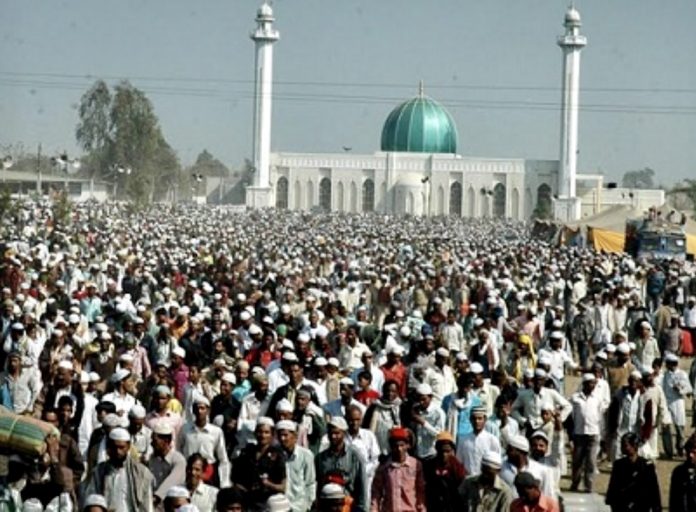
Picture of the Alami Tablighi Ijmeta held in 2019. | Picture: Tablighi News 365
Held for the first time in 1948, the Bhopal Ijtema is known for its massive participation of people and for promotion of peace and inclusivity.
Bhopal (Madhya Pradesh) :
The Alami Tabhligi Ijtema, an annual Islamic congregation held every year in Madhya Pradesh commenced today in the outskirts of the capital Bhopal. The four-day religious event is the third-largest Islamic congregation globally. The first such congregation was held 73 years ago. The event is taking place after two years of halt caused by the Covid-19 pandemic.
The congregation is not only popular for being the largest religious gathering in India but is also well known for the promotion of peace and inclusivity.
For the first time, international participants will not be in attendance at the congregation.
According to a report in Dainik Bhaskar, the congregation will be held on 300 acres of land. “20,000 volunteers will handle management. More than 17,000 taps are installed for ablution only. 7 crore litres of water will be consumed every day for drinking, ablution, and cleansing. Non-veg food is banned due to Lumpi Virus. There will be 45 parking slots and 7000 dustbins. 5000 volunteers will take care of the cleaning. 5 fire brigades and 6 fire bullets will be present there. 2000 policemen will manage security and 500 will handle the traffic management. There will be 3 hospitals of 10 beds each as well,” the report said.
History of the congregation Shams Ur Rehman Alavi, a prominent journalist and former editor with Hindustan Times told TwoCircles.net that even though this grand congregation of Muslims is a purely religious event but in Bhopal, it means much more. “It has a unique relationship with the city and its inhabitants irrespective of their beliefs. Come winter and there is a buzz about the dates of Ijtima. Though such gatherings are now held in different cities across the country, the Ijtima here has an altogether different ‘connect’ with the people,” he said.
Shams Ur Rehman Alavi said that after the independence of the country, the first congregation was held in Bhopal in 1948 at Masjid Shakoor Khan.
It is said that the first congregation was a small gathering. Later, it was shifted to Taajul Masajid and became a big event. In 2002, it was shifted to outside the city in Eintkhedi as the gathering had become too big by then with a participation of 5 lakh people. Today, nearly 1.5 people congregate at the event. “People still get nostalgic when it was held in Tajul Masajid for over half a century. In those days, the temporary market that came to be associated with the gathering gave the congregation another meaning for Bhopalites,” Shams Ur Rehman Alavi said.
Preparations run for months The preparations for the congregation began several months ago. Many youths from the nearby areas volunteer to help with the preparations. “This is farmland. It is very difficult to clean it and make it suitable for the congregation. We made drainage to discharge water from the farms with the help of a generator to dry the land sooner,” Abuzer, a volunteer, told TwoCircles.net.
Abuzer said all volunteer work is done by Muslims. “People willingly come here and do labour without demanding charges. We do it for the sake of Allah,” he said.
Atiq Ul Islam is a member of the organizing team that is looking after the preparations. He told TwoCircles.net that the 300 acres of farmland where the congregation is taking place is lent free by locals, which include both Muslims and non-Muslims.
“Non-Muslims have never refused to lend their lands to this congregation. We organize this Ijtima to please God and send a message to the world to follow God’s commandments which is to do good and refrain from evil,” Atiq Ul Islam said.
He said that the congregation is held to send a message of peace. “Every faithful attends this Ijtima,” he said.
Atiq Ul Islam informed that Muslim volunteers also take responsibility for security and traffic management. “The administration plays a supporting role by keeping an overall eye on things. Rest everything is managed by our volunteers,” he said.
Akram Ahmed Khan is a resident of Bhopal who has been attending the congregation since childhood. For many years, he has volunteered at the event.
Akram said that the congregation has a cross-functional team that has a dedicated system including a security team, transportation and commute team, road management (traffic management) team, parking team, and emergency and procurement (medical team). “The management skills I learned here have helped me in my professional life as well,” Akram Ahmed said.
For effective disposal of waste, the management collaborates with Bhopal Municipal Corporation (BMC). For its zero-waste, the congregation has earned laurels.
Huneza Khan is a student and a budding journalist from Bhopal, Madhya Pradesh. She tweets @KhanHuneza
source: http://www.twocircles.net / TwoCircles.net / Home> Lead Story / by Huneza Khan, TwoCircles.net / November 18th, 2022


:quality(70)/cloudfront-eu-central-1.images.arcpublishing.com/thenational/ACD5KFPDRSOD3UNOBQCGVOPNHM.jpg)