Tag Archives: Badruddin Tyabji

Zohran Mamdani’s New York win revives a forgotten history — of Gujarati Muslim cosmopolitanism

GUJARAT / UGANDA / New York, U.S.A :

From Mughal ports to Dutch wars to Bombay’s merchant dynasties, Gujarati Muslims once shaped the Indian Ocean world — long before one of their descendants took New York.
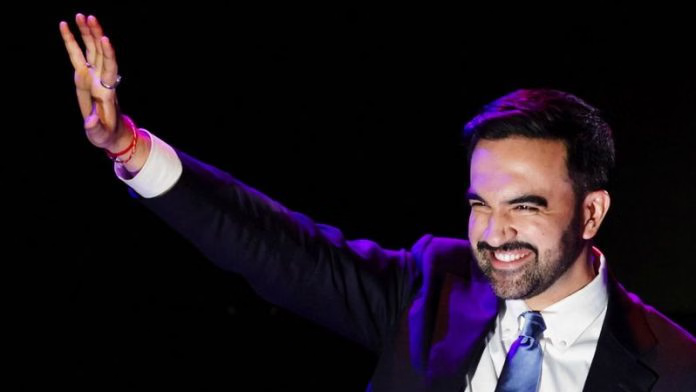
File photo of Zohran Mamdani | Reuters 2025

_______________________________________________

What You Need to Know

Zohran Mamdani’s election highlights a forgotten Indian Muslim cosmopolitanism. Historically, Gujarati Muslim communities dominated Indian Ocean trade, challenging European powers and fostering diverse business relationships. Later, groups like the Khojas adapted through “corporate Islam” (jamaats), becoming powerful economic forces globally. This rich, diverse history is increasingly overshadowed by modern religious nationalism.

*AI-generated summary. Check context in original text.

________________________________________________

Having delivered speeches in Gujarati, Bengali, Arabic, Hindi, Luganda, and Spanish, Mamdani is a reflection of a long-forgotten Indian Muslim cosmopolitanism. The Gujarati Muslim communities he descends from once challenged the Dutch for hegemony in Indonesia; poured money into schools, hospitals, and printing presses from Japan to Arabia; and helped the British Empire consolidate its grip over Africa. To this day, that Indian Muslim history still echoes — in high-end London auction houses as much as in the working-class boroughs of New York.


The election of Zohran Mamdani as Mayor of New York last week has struck a surprising chord in the world’s media — especially considering he is technically the head of just one American city’s administration. But the buzz around this young Indian-origin Muslim, an avowed democratic socialist, is a ripple in a much older ocean.

Gujaratis in the Indian Ocean

This column began with a rather innocuous tweet pointing out that Mamdani’s multilingualism would have made him a fortune in the early modern Southeast Asian spice trade. As of writing, it has racked up over one million views and 54,000 likes — and it’s a pretty accurate reflection of what propelled Gujarati Muslims to international trade superstardom in the first place.

In her paper ‘Gujarat’s Trade with South East Asia (16th and 17th centuries)’, historian Ruby Maloni describes the great port of Khambhat in Gujarat as having “stretched out two arms — one towards Aden, the other towards Malacca.” While Banias were especially prominent in East Africa and the Persian Gulf at the time, Gujarati Muslim merchants dominated the Malacca trade, conveying relatively cheap block-print textiles from manufactories in Ahmedabad deep into Southeast Asia to trade for spices.

The most prominent among these merchants effectively formed ‘dynasties’ closely linked to the Mughal court, among others. But there was also a strong aspect of caste-based collective organisation, paralleling that of Hindu and Jain Gujaratis.

Nowhere was this more evident than in Surat, perhaps the most impressive port on India’s west coast. Its multilingual babble included Gujarati, Arabic, Persian, Urdu, Dutch, English, and Portuguese. Certainly, there were clear distinctions between caste and religious groups, and within their communities Gujarati merchants — Hindu and Muslim alike — could be quite rigid. At the same time, in interpersonal and business relationships, their shared Gujarati heritage encouraged cosmopolitan attitudes.

Historian Jawaid Akhtar offers several examples in his paper ‘The Culture of Mercantile Communities in Mughal Times.’ In Surat, Armenian merchants were in business with Parsis and Muslims; Vaishnavite Bhatias, despite a taboo against crossing the ocean, jointly owned cargo and ships with Muslims. Akhtar cites documentary evidence of Bania men adopting Muslim practices such as offering dowers to their wives. Muslim and Hindu merchants also collectively represented their grievances to Mughal authorities.

On one occasion in 1669, when the Qazi of Surat compelled a Vaishnavite Bania to convert to Islam, nearly 8,000 merchants — apparently of all religions — emigrated to Bharuch in protest against this infringement of their privileges.

Gujarati Muslims quickly identified Europeans as a threat to their trade dominance in Southeast Asia. Maloni notes that Dutch East India Company records mention their difficulties with these merchants, who took them on through price wars and by installing their own candidates as port authorities. It seemed that there was nothing the Dutch could do to prevent Gujarati Muslims from trading. The Sultanate of Johor welcomed ships belonging to the merchant Haji Zahid Beg, who bought tin in flagrant defiance of Dutch embargoes. Other merchants, Maloni writes, hired cargo space on English ships; the spectacularly wealthy merchant Abdul Ghafur of Surat even flew Dutch flags on his own ships. It was only when the Dutch forcibly colonised much of Indonesia that Gujarati Muslims finally lost their grip on Malacca. But by then, new opportunities were already emerging on the horizon.
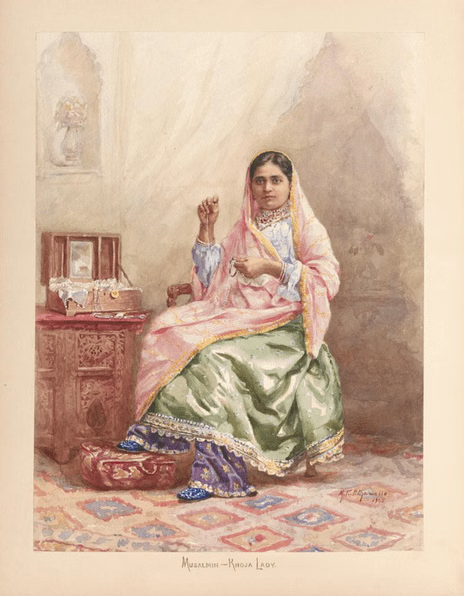
Khoja Lady | From the album presented to the Princess of Wales by the women of Bombay, featuring 13 full-page watercolours of Indian women by artist Manchershaw Fakirjee Pithawalla (1872-1937) | Wikimedia Commons

The rise of ‘Corporate Islam’

As the Mughal juggernaut began to shake and unravel in the 18th century, the old order of great merchant princes and dynasties started to fall apart. Surat, repeatedly raided by the Maratha king Shivaji, faced growing competition from the East India Company’s new port at Bombay.

Three Gujarati Muslim communities — the Bohras, Memons, and Khojas — who had hitherto been relatively small-time traders, found themselves ideally placed to benefit from the changing political landscape. Zohran Mamdani descends from the last of these.

In his seminal book No Birds of Passage: A History of Gujarati Muslim Business Communities, 1800–1975, historian Michael O’Sullivan notes that these three groups had spread “as far east as Ujjain, as far west as Karachi, as far south as Poona, and as far north as Udaipur… They thus inhabited a territory that was, by the reckoning of an Indian lexicographer in the 1840s, larger than Great Britain and Ireland, with their shared mother tongues [Gujarati] serving as the principal language of business in Central and Western India.”

The Bohras, Memons and Khojas had all converted to Islam around the 15th century, but their social and cultural practices varied drastically. Subgroups were affiliated with various Sunni and Shia sects; some were Ismaili and revered the Aga Khans, while others traced descent by region and worshipped Sufi saints.

What these groups shared, though, was the jamaat —an institution that O’Sullivan describes as a form of “corporate Islam”. Essentially, members of each jamaat shared some resources in common — schools, hospitals, that sort of thing. Particularly wealthy members, who often held senior religious positions, also maintained private family trusts and companies.

What the jamaat ensured, O’Sullivan writes, was a mechanism for organisation, exclusivity, and interpretation, allowing these communities to adapt the changing contours of Islamic practice to an era of globalisation. Jamaats could mobilise capital, human resources, and theological flexibility at a rate few other Indian institutions could match.

Collectively, these Gujarati Muslim jamaats emerged as some of the most powerful Indian economic forces of the late 19th and early 20th centuries. Though now outshone in the popular imagination by Parsi and Bania entrepreneurs, Gujarati Muslims similarly negotiated with the Marathas and the British, benefited from the Opium Wars, and switched soon after to manufacturing all sorts of commercial goods, especially in Bombay.

In the 1840s, Gujarati Muslims commissioned pioneering printed texts — in Gujarati — including travelogues and cultural primers for new markets like China. Their growing wealth also funded spectacular mansions, such as those in Sidhpur, now eerily abandoned. It was Gujaratis, perhaps more than any other Indian group, who built the financial infrastructure of the British Raj in East Africa — a migration line from which Zohran Mamdani himself descends.

All of this amounted to a decisive shift in the centre of gravity of Indian Ocean Islam. It was for this reason that the Aga Khan, revered by Ismaili Khojas, moved his seat from Iran to Bombay before Partition.
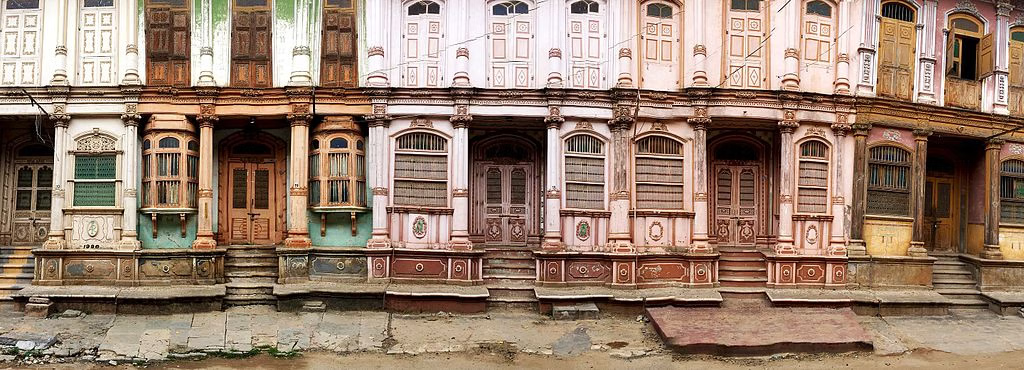
Sidhpur city in Gujarat | Wikimedia Commons

A cosmopolitanism forgotten

The versions of Islam promoted by Gujarati Muslims absorbed the modernist vocabulary of capital accumulation and inheritance, frequently splintering into new jamaats as they expanded into ever-new markets and cultures.

At the same time, as researcher Danish Khan notes, Gujarati Muslims attained positions of leadership and influence in Bombay well before they had even set foot in the United States of America. “The first Muslim baronet in colonial India,” he writes, “was a Khoja and the first Muslim ICS officer was a Sulaimani Bohra. Badruddin Tyabji and Rahimtoola Sayani were the first two Muslim Presidents of Congress party. Sir Adamjee Peerbhoy presided over the first session of the Muslim League in Karachi.”

But with the rise of pan-Islamic and Hindu nationalism in the early 20th century, the scales swung once again, and mercantile, oceanic histories were overridden by grievances inspired by long-dead inland kings.

Where does the history of Gujarati Muslims fit now? Mamdani’s election is ironic on many levels. In Bombay, once the historic home of the community, a BJP politician declared, in response to Mamdani’s victory in New York, that “We won’t allow any Khan to become mayor.”

The fact is that before and since, the history of Gujarati Muslims has, for all intents and purposes, disappeared into the ever–widening gap between radical Hindutva and radical Islam. Every news cycle, it seems, tears India’s many intertwined histories further apart.

Anirudh Kanisetti is a public historian. He is the author of ‘Lords of Earth and Sea: A History of the Chola Empire’ and the award-winning ‘Lords of the Deccan’. He hosts the Echoes of India and Yuddha podcasts. He tweets @AKanisetti and is on Instagram @anirbuddha.

This article is a part of the ‘Thinking Medieval’ series that takes a deep dive into India’s medieval culture, politics, and history.

(Edited by Prashant Dixit)

source: http://www.theprint.in / The Print / Home> Opinion> The Fine Print / by Anirudh Kanisetti / November 13th, 2025
Athar Siddiqui breaks away from tradition and pens some highly evocative sketches

Sahranpur, UTTAR PRADESH / NEW DELHI :

The evocative recapitulation of eminent personalities provides a quick, candid, exquisite and scrupulous portrayal of those who retain their abiding presence without being physically present in the world.

The unprecedented acceptance of monolingualism has put a big question mark on the existence of numerous languages through which people stitch up a warm social rapport and seek to fulfill their cultural aspirations. India, an awe-inspiring repository of innumerable dialects, languages and different linguistic traditions, finds it nerve-racking to carry through the challenges thrown open by the technology-savvy language-English. The domination of English has taken a heavy toll on regional languages, and Urdu, once considered a significant link language, is no exception. Though Urdu is widely used as a spoken language, and its sensitively rendered poetry gets across the country, its script has been fading away with bewildering speed.

It aches much to realize that the popularity draws its sustenance from its oral rendering, and familiarity with its distinct script has been melting away steadily. Barring some notable exceptions, only faculty members and research scholars associated with various departments of   Urdu of the universities and colleges use Urdu as the medium of trifling academic discourse. At a time when Urdu faces the threat of obsolescence,   the gleam of hope emerges from the citadel of learning, Aligarh, where academicians not belonging to humanities draw on Urdu to initiate a perceptive discourse on a plethora of issues without bringing rhetorical flourish into play.

Professor Saeeduz Zafar Chagatai (Physics), Professor  Faseeh Ahmad Siddiqui (Chemistry), Professor  Athar Siddiqui (Zoology), Professor Shaan Mohammad (Political Science), Professor Iftikhar Alam Khan (Museology), Professor Zilur Rehman (Unani Medicine), Professor Mohammad Sajjad( History ), Professor Zafar Mahfooz Nomani (Law) Dr Asad Faisal Farooqui (Mass Communication) and the like seek to strengthen non-fiction prose in Urdu.

Autobiography, memories, diary, letters, sketches and anecdotal scrolls are much-adored genres of non-fiction prose, but in Urdu, they usually betray a strong sense of gushiness and sickening self-adulation. The preponderating narrative of reminisces does not go well with the celebrated author, Professor Athar Siddiqui, whose evocative recapitulation of eminent personalities appeared.

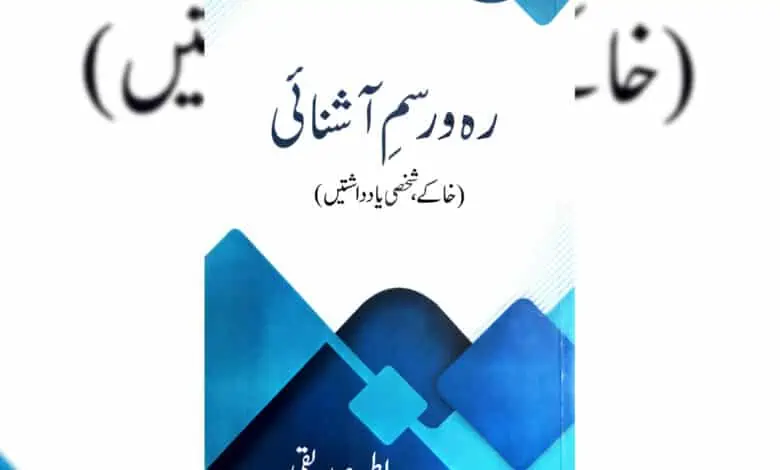
The book Rahe wa Rasm-e-Aashnai (sketches and personal memoirs) provides a quick, candid,   exquisite and scrupulous portrayal of those who retain their abiding presence without being physically present in the world.

Professor Athar Siddiqui, a widely recognized scientist, has produced a captivating narrative of his eventful life, Main Keya Meri Hayat kaya, with disarming humility and jotted down travelogues vividly calling attention to down reaching human experiences that frequent foreign travels produce. Interactive media frequently carry intriguing stories featuring commonplace occurrences. The stories with a strong sense of moral tutoring dished out by the digital world need to be shared with non technology conversant Urdu knowing people.

He left Professor Athar Siddiqui to supplement what had been missing and started translating these pulsating stories into Urdu. It was left to Professor Athar Siddiqui to supplement what had been missing, and he translated these pulsating stories into Urdu.

Tahzibul Aklaqh, a prestigious periodical launched by Sir Syed in 1870, started serializing it with a suggestive title Hairat Sarai Ki Kahaniyan (The stories of wonderland), and two volumes of these laconic and absorbing stories have appeared so far.

He meticulously edited two autobiographies of two illustrious alums of Aligarh Muslim University–Dr. Sheikh Mohammad Abdullah (founder of women’s college, AMU) and Nawab Ahmad Saeed Khan Chattari ( former Governor of Uttar Pradesh). He had astutely done over translating books on Shaheryar and Musa Raza.

Athar Siddiqui’s recently published book, Rah-o-Rasam-e – Aashnai,” creatively maps out the accessible and unchartered terrains of thirty-five personalities in candour-driven idiom, and he hardly holds with the popular notion that put a lock on showing the slightest discourtesy to the deceased. The author asserts, “It is widely mentioned that the sketch writer must not use any indecent or improper word for those resting in the peace. If this sort of exhortation is adhered to, then the sketch, personal article and memories will be read as appreciation and admiration-filled text. If history writing sticks to this principle, then the authentic history of any period could not be produced. I do not buy this argument.”


The subtle wised-up mélange focuses on nine creative writers such as Shahryar, Iqbal Matin, Sajida Zaidi, Qazi Abdus Sattar, Professor Mukhtar Uddin Arzoo, Syed Hamid, Lateefuz Zaman and a couple of close relatives, teachers, friends and former vice-chancellors.

Iqbal Matin, whose awe-inspiring artistic sensibility could not get him the recognition across the country he fully deserved, has come in for a  refined exploration. Athar Siddiqui’s reminiscence is peppered with unusual but fascinating details about the author. The author living in Aligarh tried desperately to contact Iqbal Matin (Hyderabad) when the letter was the preferred communication medium. He realized that his letters were not delivered to the addressee, who was prone to change houses. Iqbal changed thirty-five houses and bore testimony to his nomadic lifestyle.

Much has been written on Jnanpith awardee and prominent poet  Shahryar but a comprehensive and insightful article highlighting his distinctive personal traits and oeuvre is still looked-for. The piece titled  “Shahryar as a man and poet” fills the bill with remarkable ease. Athar saheb cites many instances to prove Shahryar’s unflinching loyalty to his friends but never spitting upon the rivals. The voice of modernism with strong traces of neoclassicism, Shahryar never nurtured animosity and did whatever he could for those who looked up to him in their hours of peril. People, even authors and pushover critics tend to read creative texts in the backdrop of personal details; hence when Shahryar suffering from a terminal illness- cancer–composed a couplet; Aasman ab kuch nahi tere karney ke liye/Ham ne sab taiyaariyan karli hain  marne ke liye (O sky,  now you have nothing to do/I have completed all the preparations for dying) it was considered as the affirmation of impending death. Employing critical acuity, Athar saheb mentioned that the couplet has nothing to do with a nagging sense of personal extinction; the poet laments how we perfected the art of self-destruction reflected in the depletion of Ozone layer manufacturing of weapons of mass destruction.

Athar Siddiqui wrote an immensely readable sketch of Qazi Abdus Sattar, a much overrated and pretentious writer who always took pride in using ornate and florid language in his fiction. His novel Tamam Sultan has been described as magnum opus, but it is hardly more than an oft-repeated titillating story of unrequited love. Athar Saheb and Qazi have had close ties for over fifty years, but Qazi was so intemperate that he pulled ties into pieces as Athar could not attend his facilitation function. It was an act of civility to describe this narcissism as uniqueness of personality.

Prof Zilur Rehman, a widely- respected academician of Unani medicine, is a well-known scholar of Urdu, Persian and Arabic and has more than fifty books to his credit. His books, especially on Ibne Sina, Hakim Ajmal Khan, Sir Ross Masood, Hakim Ehshanullah Khan, and Hakim Abdul Moid, got widespread admiration. In addition to discussing his well-documented and invigorating writings, Athar Siddiqui effortlessly unravels his amenable nature and inimitable passion for books and artefacts. He has a collection of over 70,000 and set up a museum and library, Ibne Sina Academy, which has its website.

Seldom does one attempt to spell out what essentially embodies his wife, going beyond the adulation and berating with a sense of objectivity. This nagging edginess seems to have no bearing on Athar saheb, who painted a stirring wordy portrayal of his wife Zakia Siddiqui, a renowned academician and former principal of Women’s College, Aligarh Muslim University.

One tends to agree with the author when he asserts that during the first ten years wife is treated as the beloved; with the birth of children, she takes over the role of the mother. If harmonious marital life continues, she becomes an inseparable friend who hardly gets perturbed, no matter how annoying one becomes. It is all momentary, and the bond of affinity never weakens.

Athar saheb also evocatively narrated his mother’s life story, and he recollects his memories and anecdotes to document her extraordinary considerate nature. Suhail (son) and Taab (daughter) get pat on the head by the caring and unerring father for their abiding sympathy for others.

The book turns attention to a dozen vice-chancellors and pro-vice-chancellors of AMU, such as Dr Zakir Hussain, Bashir Hussain Zaidi, Badruddin Tyabji, Abdul Aleem, Ali Mohammad Khusro, Syed Hamid, Syed Hashim Ali, Wasiur Rehman, Naseem Farooqui, Mahmoodur Rehman, Hamid Ansari and Abul Hasan Siddiqui.

The author’s appraisal of them looks convincing, but occasionally subjectivity surfaces. The assortment of sketches offers a discerning peep into the life of all who impressed the author. The nuanced and readable prose is used impeccably, and Athar Siddiqui deserves accolades for producing such picturesque vignettes.

Shafey Kidwai is an Indian academic, communication scientist, translator, columnist, and author. He is the chairman of the Department of Mass Communications at Aligarh Muslim University.

source: http://www.siasat.com / The Siasat Daily / Home> Featured News / by Shafey Kidwai / September 26th, 2025

Remembering the person behind the first Republic Day of India

NEW DELHI :

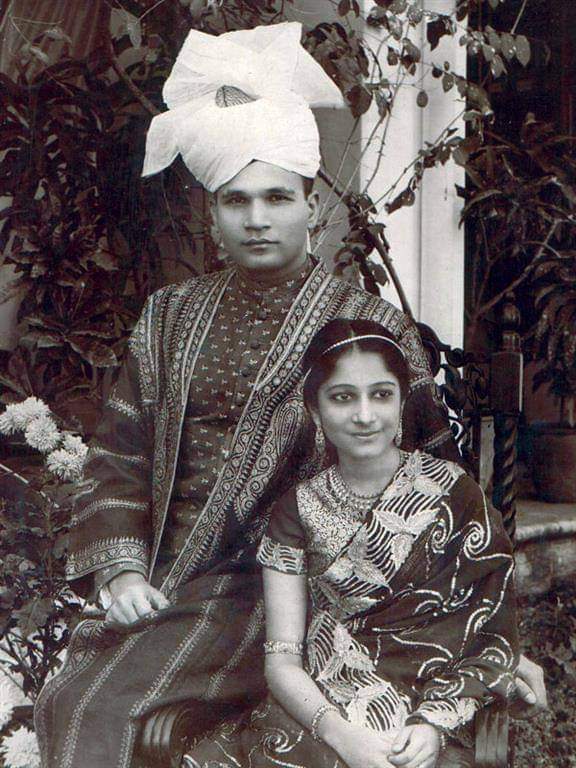
Badruddin Tyabji, the grandson of freedom fighter and third Congress President by the same name, was entrusted with arrangements for the inaugural Republic Day celebrations in 1950.

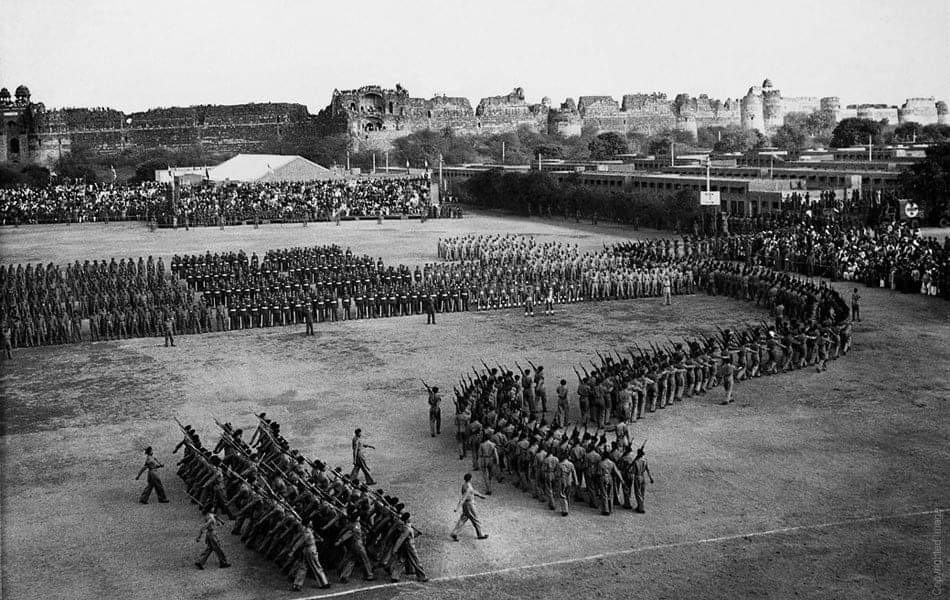
HISTORIC: National Stadium during the first Republic Day Parade. Old Fort is also visible

Every year on January 26, the Tyabji family sit together in their posh West End Colony house (near Vasant Vihar) to watch the Republic Day Parade which holds special significance for them.  

Their late patriarch Badruddin Tyabji, a 1936 batch Punjab cadre Indian Civil Service officer, was responsible for looking after the arrangements of January 26, 1950 functions: first at the President House and later at Irwin Stadium (now Major Dhyan Chand National Stadium). 

Tyabji’s painter wife Surayya Tyabji made the prototype of the Tri-colour on paper based on which the flag of cloth for Republic Day was made in Connaught Place.

“Just a couple of weeks before the first Republic Day, Prime Minister Pandit Jawaharlal Nehru entrusted me to look after the arrangements of the January 26 functions,” Tyabji told this writer in his south Delhi house in 1994. 

He was also member secretary of the Constituent Assembly.  

“I was called by Pt. Nehru and he gave me the huge responsibility for the historic day. I used to live at Sujan Singh Park during those days.” 

From that day onwards, the tall and gracious Tyabji moved from the President House (now Rashtrapati Bhavan) to Irwin Stadium several times a day to finalise the arrangements as time was running out for the big day.

HAPPY FAMILY: The Tyabji clan including Laila Tyabji (centre, front row), who is a social worker, designer, writer and crafts activist

The big day for which Tyabji had worked so hard was also hectic for Rajendra Prasad, the soon-to-be first President of independent India. He marked the momentous occasion with a visit to Raj Ghat to pay homage to Gandhiji. He remained there for around 15 minutes. 

But before the would-be President of India could get to the President House, C Rajagopalachari, the Governor General of India, had already reached there. The latter used to live in the double-storeyed bungalow at the then 10, Hastings Road, which was later renamed after him as Rajaji Marg. Edwin Lutyens, the chief architect of New Delhi, also lived in the bungalow, and so did Pranab Kumar Mukherjee, who also lived in that house after demitting his office of President of India.

“Dr Rajendra Prasad was sworn in as the country’s first President at around 9 am by the Governor General of India, C. Rajagopalachari. Rajvanshi Devi, his wife, and other family members were also there. The swearing-in ceremony was attended by over 500 guests, who had assembled inside the Durbar Hall. President Sukarno of Indonesia and several members of the Diplomatic Corps, members of the Constituent Assembly and prominent citizens had graced the occasion. The President was dressed in black achkan, white churidar and a white Gandhi cap. Pandit Nehru and his other Cabinet colleagues were sworn in soon after Rajendra Prasad,” recalled Tyabji, who was named after his grandfather, the third President of Indian National Congress. 

Immediately after returning from Raj Ghat, Rajendra Prasad was sworn in. The Chief Justice of India, Sir Hiralal Kania, read the oath of office in Hindi. President Prasad repeated it sentence by sentence. 

“The outgoing Governor General, C. Rajagopalachari; our first Prime Minister, Pandit Jawaharlal Nehru, beaming with pride and joy; the Deputy Prime Minister, Sardar Patel; cabinet ministers, judges of the Supreme Court and the Auditor-General of India, were present in the hall to witness the historic moment of India’s history. Pandit Nehru and his other cabinet colleagues were sworn in soon after.”

The national emblem of Ashoka Pillar with three lions was placed in the Durbar Hall for the first time near the throne where the British Viceroys used to sit. 

A smiling statue of Lord Buddha was also placed behind the throne for the first time. Rajendra Prasad, the President, who greeted the large gathering smilingly with folded hands, made a short speech in Hindi and English, stating that it was a memorable day in our annals. 

“Let us begin by offering our thanks to the Almighty Power who has enabled us to see this day; to the Father of the Nation who showed us and to the world at large his infallible method of Satyagraha, and led us on along it to freedom and to the numberless men and women, whose suffering and sacrifice have rendered the attainment of independence and establishment of this sovereign democratic Republic possible.”

The birth of the Republic was celebrated by the masses in the Capital through Prabhat Pheries (early morning movement of people singing patriotic songs). Outside the Durbar Hall, there were unforgettable scenes of jubilation. Large crowd of men, women and children had assembled in the forecourt of President House. 

People raised slogans of Gandhiji-ki-jai and Vande Mataram

After a dignified ceremony was held at the President House, the scene shifted to Irwin Stadium. The new President travelled to the stadium in a horse-drawn carriage and Delhi’s roads were lined up with enthusiastic crowd standing along the five-mile route with the Tri-colour in their hands. A huge crowd greeted the President’s entourage when it reached the vicinity of Connaught Place. And when the first President of India reached the stadium, he was welcomed with a booming 31-gun salute. 

According to Tyabji, “Rajendra Prasad made a brief speech at the stadium. Later, students from various schools of the Capital presented cultural programmes.” 

Old timers still recall that there were very few policemen guarding the VIPs inside the stadium. After the programme, the leaders mingled with the people. Nehru was mobbed by his admirers. He spent a good 20 minutes with them. 

Tyabji, who could not sleep for several days ahead of the big occasion, was there managing the affairs carefully with his colleagues. Following very cold weather days in Delhi, brilliant sunshine greeted the Capital on January 26, 1950. 

It was India’s defining moment, the day India truly freed itself from the shackles of colonialism to become a Republic. A truly sovereign state. 

The talk of the first Republic Day cannot be complete without discussing the role of Tyabji’s wife, Surayya, in the making of the first Tri-colour.  

According to Tyabji, “Once the Constituent Assembly finalised our Tri-colour with Ashok Dharma Chakra inside the flag, I was asked to furnish the model of Tri-colour on both paper and cloth.” 

Without wasting any time, Badruddin Tyabji went straight to his Sujan Singh Park residence and asked his wife Surayya to make the Tri-colour on paper. She did not disappoint her husband. Once she made it on paper, Tyabji carried the design to the now defunct SC Tailors at Regal building of Connaught Place and asked them to make the Tri-colour in cloth. The rest, as they say, is history.

After retirement from government service, Tyabji also served as the Vice-Chancellor of Aligarh Muslim University in the 1960s. 

He finally settled in Delhi and passed away in 1999. His wife, Suraiya, had died before him.

During one of our meetings, Tyabji had told me that when he came to Delhi from Hyderabad to appear for ICS examination, he was staying in Daryaganj. 

He used to take a tonga to reach Metcalfe House in Civil Lines to appear for his examinations. 

“Delhi was a very small city then. Except for old Delhi and villages, there was not much here. New Delhi was coming up,” he had said. 

When India was divided on the basis of religion in 1947, he was perhaps one of the only two Muslim ICS officers who opted to stay in India instead of accepting Islamic Pakistan.

OFFICER RANK: Badruddin Tyabji was a 1936-batch ICS officer of Punjab cadre. His wife, Surayya was a painter

Tyabji’s first son, Hindal Ahmad, was an IAS officer. He passed away last year. 

Tyabji’s daughter, Laila Tyabji is a noted social worker, designer, writer and crafts activist. She is one of the founders of Dastkar, a Delhi-based non-governmental organisation working for the revival of traditional crafts in India. 

Like in the past, the Tyabji family would watch the annual parade this year too. After all, they are the true and proud first family of India’s Republic Day. Yet, they are so self-effacing.

source: http://www.thepatriot.in / The Patriot / Home> Cover Story / by Vivek Shukla / January 26th, 2024

English, Urdu books on contribution of Indian Muslims in freedom movement released

NEW DELHI :

Patna: 

In a glittering ceremony, two books on Muslims’ contribution in India’s Freedom movement were launched here in Patna on 17th December. The function was presided over by Harsh Mandar, former IAS officer and human rights defender in the country.

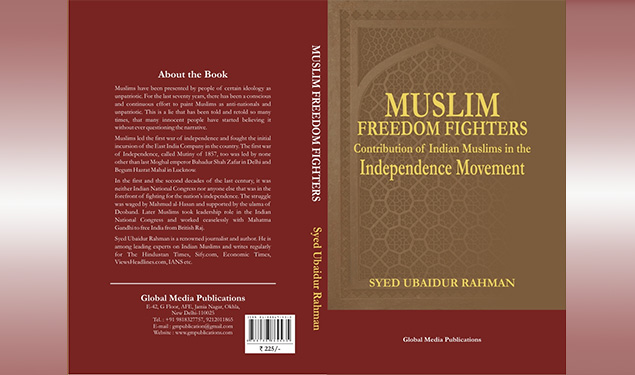
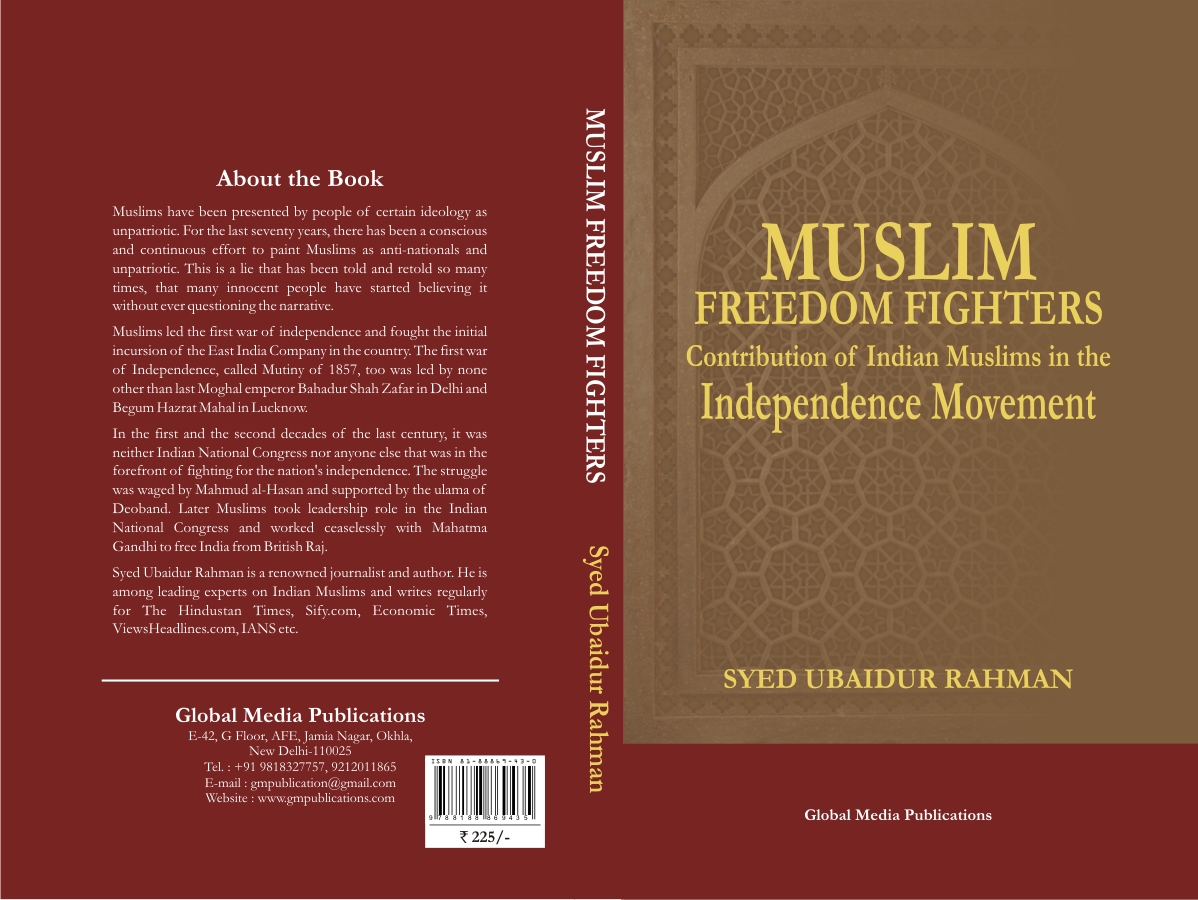
The books ‘Muslim Freedom Fighters: Contribution of Indian Muslims in the Independence Movement’ and its Urdu version ‘Muslim Mujahideen-e-Azadi aur Tehrik-e-Azadi Mein Unki Khidmat’ have been authored by Delhi based author and journalist Syed Ubaidur Rahman.

The two books try to fight the oft-repeated allegations that Muslims are anti-national and have not contributed for the freedom of the nation. The books nail the lie and prove that Muslims not just participated in the freedom movement, they went on to lead the freedom struggle for a long time. The first war of Independence or Mutiny of 1857 was led by Mughal emperor Bahadur Shah Zafar in Delhi and Begum Hazrat Mahal in Lucknow. The Independence Movement in the first two decades of the twentieth century was led by Mahmud Hasan and ulama of Deoband and they had respect and support of everyone including Hindus and Muslims.

If anyone has any doubt about the Muslim contribution in the freedom movement, the fact that the Indian National Congress had as many as nine Muslims as its president till the year 1947 will remove such doubts.

While speaking on the occasion, Harsh Mandar said that the divisive forces in the country are trying to divide the nation on the basis of religion and faith. He said that the danger from such forces for the national fabric and its unity has become grave.

Harsh Mandar added that the threat to the communal amity in the country was never so high as is today as divisive forces are doing every thing to pit one community against the other and create a fear psychosis among the majority community prompting it to turn it against minorities.

Khursheed Mallick, a Chicago based urologist, philanthropist and director of IMEFNA said that the book is a timely reminder to the nation that Muslims and Hindus both sacrificed for the nation and this fact must be clearly told to our young generation. He said Muslims sacrificed heavily for the cause of the freedom of the nation and efforts must be made to tell the history.

Syed Ubaidur Rahman, the author of the two books, while speaking on the occasion said Muslims have been rather loath to write about the sacrifices they have made for the cause of the Independence and freedom. He said Muslims suffered badly throughout the freedom movement. They were the worst suffers in the wake of the mutiny of 1857 and its aftermath when Muslims were hounded across North India and beyond. Tens of thousands of Muslims lost their lives for the freedom.

Syed added that ulama of Deoband played a stellar role in the freedom movement. Unlike the common perception, they were secular to the core and when they established a government in exile in Kabul in 1915, they appointed Raja Mahendra Pratap as its President and Maulana Barkatullah Bhopali as its Prime Minister.

The book documents the lives of forty renowned Muslim freedom fighters including, Shaikhul Hind Maulana Mahmud al-Hasan, Maulana Barkatullah Bhopali, Hakim Ajmal Khan, Maulana Ubaidullah Sindhi, Maulana Abul Kalam Azad, Maulana Mohammad Ali Jauhar, Dr Maghfoor Ahmad Ajazi, Dr Mukhtar Ahmad Ansari, Ashfaqulla Khan, Maulana Hasrat Mohani, Maulana Muhammad Mian Mansoor Ansari, Asaf Ali, Husain Ahmad Madani, Aruna Asaf Ali (Kulsum Zamani), Peer Ali Khan, Saifuddin Kitchlew, Mohammed Abdur Rahiman, Captain Abbas Ali, Abdul Qaiyum Ansari, Prof. Abdul Bari, Moulvi Abdul Rasul, Nawab Syed Mohammed Bahadur, Rahimtulla Mahomed Sayani, Syed Hasan Imam, Sir Syed Ali Imam, M.C. Chagla, Yusuf Meherally, Justice Fazal Ali, General Shah Nawaz Khan, Allama Fazle Haq Khairabadi, Maulana Shaukat Ali, Syed Mahmud, Maulana Mazharul Haque, Badruddin Tyabji, Col Mehboob Ahmed, Begum Hazrat Mahal, Maulana Shafi Daudi, Rafi Ahmed Kidwai, Syed Mohammad Sharfuddin Quadri, Batak Mian

The book launch function was organized at Anjuman Taraqqi Urdu and was presided over by Abdul Qaiyum Ansari, chairman of Anjuman Taraqqi Urdu Bihar.

Name of the Book: Muslim Freedom Fighters: Contribution of Indian Muslims in the Independence Movement
Author: Syed Ubaidur Rahman
ISBN: 81-88869-43-0
Price Rs 225/-
Global Media Publications
E-42, G. Floor, AFE, Jamia nagar, Okhla, New Delhi-110025

source: http://www.ummid.com / Ummid.com / Home> India / by ummid.com News Network / December 12th, 2017

Role of Muslims in freedom struggle

The freedom movement of India was not the sole agenda of a particular political party but it had moved aam aadmi in the form of masses in his/her own capacity. The history of Indian national movement would be biased and incomplete without the presentation of the actual role of Indian Muslims in it, right from the revolt of 1857 to the day of Independence in 1947.

Shoulder to shoulder they fought with the other communities for the Independence of India. The contribution of Muslim poets, revolutionaries and writers is not known today. Instead of secular historiography, it has been communalised.

                                             Courtesy: Mapsofindia.com

The Muslims and other minorities never envisaged India as adopted land because Muslims of India have not come from outside but are the converts to Islam and have deep feeling sense of belonging to this country and therefore contributed to the cultural, economic, intellectual and spiritual progress throughout the ages.

The role, significance and uprising of Indians against British imperialists can be seen since mid of 18th century in the form of Battle of Palashi (Plassey), June 23, 1757. It was Nawab Siraj-ud-Daulah who first awakened Indian rulers and gave a call to oppose the British. He, however, lost the battle and was executed at the young age of 24. This was soon followed by the great Tipu Sultan, who was killed by Lord Wellesley during the fourth Anglo-Mysore war in 1799.

The contribution of Muslim revolutionaries can be witnessed from the first half of 19th century. The Faraizi and the Wahhabi Movements had disturbed the pace of British plan in the initial stages of its expansion in India. The Wahabi movement of Syed Ahmed Barelvi was the most organised one. He appealed to all Hindus and Muslims to overthrow the British and thus he was killed in 1831 at Balakot.

The number of Muslims executed only in Delhi during 1857-58 was 27,000. During this revolt, Asghari Begum (mother of Qazi Abdur Rahim, the revolutionary of Thana Bhawan, Muzaffarnagar) fought against the British and was burnt alive when defeated. It was estimated that about 225 Muslim women gave their lives in the revolt.

Similarly, barely is known about the contribution of Muhammad Ashfaq Ullah Khan of Shahjehanpur who conspired and looted the British treasury at Kakori (Lucknow) to cripple the administration and who, when asked for his last will, before execution, desired: “No desire is left except one that someone may put a little soil of my motherland in my winding sheet.”

Likewise, the present generation does not know about Khan Abdul Gaffar Khan, a great nationalist who had passed 45 years of his 95-years of life in jail for the freedom of India and thus awarded ‘Bharat Ratna’ in 1987. Barkatullah and Syed Rehmat Shah of Ghadar Party sacrificed their lives. Umar Subhani, an industrialist and a millionaire of Bombay who, then, presented a blank cheque to Gandhiji for Congress expenses and who ultimately sacrificed his life for the cause of Independence. Maulana Hasrat Mohani, with his poetry, infused zeal of freedom in young hearts.

Maulana Abul Kalam Azad, at the age of 35, became the youngest person to serve as the President of the Indian National Congress. He was the icon of Hindu-Muslim unity as well as espousing secularism and socialism. Raj Mohan Gandhi in his book ‘Understanding Muslim Minds’ mentioned that Maulana went straight to Congress office just after the funeral procession of his wife, Zuleikha Begum and led Quit India Movement.

Manmohan Kaur in her book entitled as ‘Women In India’s Freedom Movement’ makes reference to only Begum Hazrat Mahel and Bi-Amma out of the hundreds of women who fought the battle of freedom along with their men folk against the British Raj. The history of the Indian national movement would be incomplete without mentioning the heartily services of Abadi Begum (mother of Maulana Muhammad Ali), Amjadi Begum (wife of Maulana Muhammad Ali), Amina Tyabji (wife of Abbas Tyabji), Begum Sakina Luqmani (wife of Dr Luqmani and daughter of Badruddin Tyabji), Nishat-un-Nisa (Begum Hasrat Mohani), Saadat Bano Kitchlew (wife of Dr Saifuddin Kichlew), Zulekha Begum (wife of Maulana Azad), Mehr Taj (daughter of Khan Abdul Ghaffar Khan), Zubaida Begum Daoodi (wife of Shafi Daoodi, the reputed nationalist of Bihar) and many others.

Santimoy Ray’s ‘Freedom Movement And Indian Muslims’ challenges the many prejudices that generate bias and hatred against the Indian Muslims, particularly their contentions role in Indian freedom movement.

This shows the great sacrifices they made to oust the British rule in all the national uprisings from Sanyasi Movement to Independence, finally led to the withdrawal of British from India in 1947. It is such a pity that their roles in the struggle for freedom has not been adequately presented in the Indian history. The comprehensive study about the role of Muslims struggle for freedom is essential to help eradicating prejudices and many misconceptions against the Muslims grown in the absence of fair historiography.

I’m recalling some of the beautiful lines of Faiz Ahmed Faiz …

Ye daagh daagh ujaalaa, ye shab-gaziida sahar,
Vo intizaar thaa jis-kaa, ye vo sahar to nahiiN,
Ye vo sahar to nahiiN jis-kii aarzu lekar
Chale the yaar ke mil-ja`egi kahiiN na kahiN
Falak ke dasht meN taroN kii aakhiri manzil,
KahiN to hogaa shab-e sust mauj kaa sahil,
KahiN to jaake rukegaa safiina-e-gham-e-dil.
Abhii chiraagh-e-sar-e-rah ko kuchh khabar hii nahiiN;
Abhii giraanii-e-shab meN kamii nahiiN aa’ii,
Najaat-e-diidaa-o-dil ki ghaRii nahiiN aa’ii;
Chale-chalo ke vo manzil abhii nahiiN aa’ii.

Meaning:

This stain-covered daybreak, this night-bitten dawn,
This is not that dawn of which there was expectation;
This is not that dawn with longing for which
The friends set out, (convinced) that somewhere there we met with,
In the desert of the sky, the final destination of the stars!
Somewhere there would be the shore of the sluggish wave of night,
Somewhere would go and halt the boat of the grief of pain.
The lamp beside the road has still come no lessening,
The hour of the deliverance of eye and heart has not arrived.
Come, come on, for that goal has still not arrived.

(Author is currently preparing for civil service examinations.)

source: http://www.twocircles.net / TwoCircles.net / Home> Articles> Indian Muslim / by Shaik Amer Arafath / August 14th, 2015

Sify columnist releases book on Indian Muslim freedom fighters

NEW DELHI :

FreedomFightersMPOs22dec2017

Patna:

In a glittering ceremony, two books on the Muslim community’s contribution to the Indian freedom movement were launched in Patna last week. The function was presided over by Harsh Mander, former IAS officer and human rights activist.

The books ‘Muslim Freedom Fighters: Contribution of Indian Muslims in the Independence Movement’ and its Urdu version ‘Muslim Mujahideen-e-Azadi aur Tehrik-e-Azadi Mein Unki Khidmat’ have been authored by well-known Delhi based author and journalist Syed Ubaidur Rahman.

The two books try to fight the oft-repeated allegations that Muslims are anti-national and have not contributed for the freedom of the nation. The books nail the lie and prove that Muslims not just participated in the freedom movement, they went on to lead the freedom struggle for a long time. The first war of Independence or Mutiny of 1857 was led by Mughal emperor Bahadur Shah Zafar in Delhi and Begum Hazrat Mahal in Lucknow.

The Independence Movement in the first two decades of the twentieth century was led by Mahmud Hasan and ulama of Deoband and they had respect and support of everyone including Hindus and Muslims.

If anyone has any doubt about the Muslim contribution in the freedom movement, the fact that the Indian National Congress had as many as nine Muslims as its president till the year 1947 will remove such doubts.

While speaking on the occasion, Harsh Mander said that the divisive forces in the country are trying to divide the nation on the basis of religion and faith. He said that the danger from such forces for the national fabric and its unity has become grave.

Mander added that the threat to the communal amity in the country was never so high as is today as divisive forces are doing every thing to pit one community against the other and create a fear psychosis among the majority community prompting it to turn it against minorities.

Khursheed Mallick, a Chicago based urologist, philanthropist and director of IMEFNA said that the book is a timely reminder to the nation that Muslims and Hindus both sacrificed for the nation and this fact must be clearly told to our young generation. He said Muslims sacrificed heavily for the cause of the freedom of the nation and efforts must be made to tell the history.

Syed Ubaidur Rahman, the author of the two books, while speaking on the occasion said Muslims have been rather loath to write about the sacrifices they have made for the cause of the Independence and freedom. He said Muslims suffered badly throughout the freedom movement. They were the worst suffers in the wake of the mutiny of 1857 and its aftermath when Muslims were hounded across North India and beyond. Tens of thousands of Muslims lost their lives for the freedom.

Syed added that ulama of Deoband played a stellar role in the freedom movement. Unlike the common perception, they were secular to the core and when they established a government in exile in Kabul in 1915, they appointed Raja Mahendra Pratap as its President and Maulana Barkatullah Bhopali as its Prime Minister.

The book documents the lives of forty renowned Muslim freedom fighters including, Shaikhul Hind Maulana Mahmud al-Hasan, Maulana Barkatullah Bhopali, Hakim Ajmal Khan, Maulana Ubaidullah Sindhi, Maulana Abul Kalam Azad, Maulana Mohammad Ali Jauhar, Dr Maghfoor Ahmad Ajazi, Dr Mukhtar Ahmad Ansari, Ashfaqulla Khan, Maulana Hasrat Mohani, Maulana Muhammad Mian Mansoor Ansari, Asaf Ali, Husain Ahmad Madani, Aruna Asaf Ali (Kulsum Zamani), Peer Ali Khan, Saifuddin Kitchlew, Mohammed Abdur Rahiman, Captain Abbas Ali, Abdul Qaiyum Ansari, Prof. Abdul Bari, Moulvi Abdul Rasul, Nawab Syed Mohammed Bahadur, Rahimtulla Mahomed Sayani, Syed Hasan Imam, Sir Syed Ali Imam, M.C. Chagla, Yusuf Meherally, Justice Fazal Ali, General Shah Nawaz Khan, Allama Fazle Haq Khairabadi, Maulana Shaukat Ali, Syed Mahmud, Maulana Mazharul Haque, Badruddin Tyabji, Col Mehboob Ahmed, Begum Hazrat Mahal, Maulana Shafi Daudi, Rafi Ahmed Kidwai, Syed Mohammad Sharfuddin Quadri, Batak Mian .

The book launch function was organized at Anjuman Taraqqi Urdu and was presided over by Abdul Qaiyum Ansari, chairman of Anjuman Taraqqi Urdu Bihar.

Syed Ubaidur Rahman is a New Delhi based writer and commentator. He has written several books on Muslims and Islam in India including Understanding Muslim Leadership in India.

source: http://www.sify.com / Sify.com / Home> SifyNews> National / by SIFY.com / Friday – December 22nd, 2017

How greatness sometimes runs in a family’s genes

Mumbai (formerly Bombay), MAHARASHTRATA / and all over India  :

Some months ago I was in Kolkata when news came of the death of Laeeq Futehally, a writer and critic I greatly admired.

Badruddin-Tyabji-the-first-great-of-his-family

Some months ago I was in Kolkata when news came of the death of Laeeq Futehally, a writer and critic I greatly admired. The friend I was with hadn’t heard of her, so I spoke at some length of Laeeq’s own work (as literary editor of the pioneering journal Quest, and as the author of many books on varied subjects), and of the larger family to which she belonged. ‘Laeeq was a Tyabji,’ I told my friend, ‘and you can think of the Tyabjis as being the Tagores of Western India — a family of men and women of real distinction in the arts and public life’.

A look of disbelief now came over my friend’s face. For which Bengali can countenance a comparison to the Tagores? I pressed on, offering some names in illustration. The first great Tyabji was Badruddin, a judge of the Bombay High Court and an early president of the Indian National Congress. Direct descendants of Badruddin included the tennis player and legal scholar AA Fyzee (author of landmark studies on Islamic law), the politician and social reformer Saifuddin Tyabji, the conservationist Zafar Futehally, and Badruddin Tyabji Jr., a distinguished Indian diplomat and author.

My friend Laeeq Futehally was herself a descendant of Badruddin’s elder brother Shumsuddin Tyabji. Shumsuddin’s only son was Abbas Tyabji; once Chief Justice of Baroda State, he later joined the freedom struggle, being appointed leader of the Salt Satyagraha after Gandhi’s arrest. A nephew of Abbas (and grandson of Shumsuddin) was the great ornithologist Salim Ali, the author of landmark studies of Indian birds and an inspirational figure for conservationists all over the world.

The women of the Tyabji family were likewise quite remarkable. A fine study by the late Salima Tyabji (see http://cinnamonteal.in/authors/salima-tyabji/) narrates how they were the first Muslim women in Western India to emerge out of purdah, to travel overseas, to go to school and college, and to write at length of their experiences. Later generations kept the family name flying. Among Abbas Tyabji’s daughters was the formidable women’s rights activist Sharifa Hamid Ali and the mystic and Meera bhajan singer Raihana Tyabji.

Such was the background to the comment I made about the Tyabjis in Kolkata, a comment that evoked dismay bordering on disgust. But I have since found confirmation of the validity of my comparison. Reading through Gandhi’s Collected Works, I came across a letter written by him to Abbas Tyabji on the 17th April 1920. Here Gandhi says: ‘Indeed the Tagores and the Tyabjis are the rarities for India and they are her friends’.

The contributions of the Tagores are of course colossal, as well as colossally well known. The most famous of the Tagores was Rabindranath: poet, novelist, playwright, composer, artist, institution builder, the first Asian to win a Nobel Prize, and one who profoundly influenced both Gandhi and Nehru.

Rabindranath was a giant who looked farther in part because he stood on the shoulders of those who preceded him. His grandfather, Dwarkanath, was a successful entrepreneur whose wealth laid the basis for the artistic pursuits of his descendants. His father, Debendranath, was a progressive reformer and editor.

Rabindranath’s gifted siblings included the scholar and composer Dwijendranath, the actor and translator Jyotindranath, the singer, editor and social worker Swarnakumari, and Satyendranath, the first non-white member of the Indian Civil Service.

The generation that followed was also not lacking in talent. Rabindranath’s nephews included the modernist painters Abanindranath and Gaganendranath. His nieces included Sarala Devi, a singer, writer and patriot who so entranced Gandhi that he at one stage intended to make her his ‘spiritual wife’.

Which was the greater of the two families, the Tagores or the Tyabjis? Rather than answer the question, let me introduce a third and scarcely less gifted family.

These were the Sarabhais of Ahmedabad. The patriarch, Ambalal, was a textile millowner and philanthropist who was an early supporter of Mahatma Gandhi. When, in 1915, Gandhi’s funders withdrew support because he had admitted an ‘Untouchable’ family into his ashram, Ambalal Sarabhai stepped in to save the project.

Ambalal’s sister Anasuya was herself very close to Gandhi. A pioneering feminist and trade unionist, she ran schools for millworkers and their children. In 1918 she led the workers of Ahmedabad in a strike for fair pay that pitted her directly against her brother, who was representing the millowners.

Anasuya never married, although, in a daring defiance of custom and convention, she had a live-in partner, a fellow Gandhian and trade unionist, Shankerlal Banker.

As for Ambalal Sarabhai, he had seven children — all were talented, and at least four were remarkable. These were Vikram, the polymath physicist who founded both the Indian Institute of Management in Ahmedabad and the Indian Space Research Organisation; Mridula, who worked heroically to settle post-Partition refugees and, later, to bring justice to the Kashmiris and their leader Sheikh Abdullah (who had been incarcerated by the Nehru government); Gautam, a public-spirited entrepreneur who founded the National Institute of Design (NID); and Gira, a brilliant designer who assisted her brother in shaping the NID while also setting up the Calico Textile Museum.

Had Gandhi had the opportunity, he might well have added the Sarabhais to the Tagores and the Tyabjis as among the ‘rarities of India’. These three families had several things in common: the ability to defy social boundaries as well as transcend disciplinary boundaries, an apparently unending stream of creativity, and the striking independence of their women. A single column can scarcely do justice to their talents and achievements. While the Tagores have had their chroniclers, the Tyabjis and Sarabhais still await theirs.

Ramachandra Guha’s most recent book is Gandhi Before India
You can follow him on Twitter at @Ram_Guha
The views expressed by the author are personal

source: http://www.hindustantimes.com / Hindustan Times / Home> Opinion / by Ramchandra Guha / April 11th, 2015